59.2 F
Chicago
Saturday, September 26, 2026
Home Blog Page 1698

Full Circle: Qatar To Supply Natural Gas To Syria Via Arab Pipeline

Full Circle: Qatar To Supply Natural Gas To Syria Via Arab Pipeline

Almost exactly 12 year ago, we explained that the sequence of events that would define the face of the middle east, and spark one of the bloodiest conflicts in the region in ages, namely the relentless proxy war seeking control over Syria, was prompted by nothing more than access to commodities in general, and a Qatari gas pipeline passing through Syria and onward to Europe in particular.

And so, the war that saw the birth and death (and eventual subsequent rebirth) of ISIS, the emergence of countless CIA-funded Al Qaeda spinoffs, and ultimately the fall of the Assad regime, has gone full circle, because as Reuters reports,
Qatar – the country whose massive natural gas deposits started it all – is set to provide Syria with gas via Jordan, ostensibly to “improve the nation’s meagre electricity supply” and also to boost Syria’s new Al-Qaeda rulers.

The move, which is being spun as “the most significant tangible support for the new administration in Damascus by Qatar, one of the region’s sternest opponents of the now-deposed Bashar al-Assad and strongest backers of the rebels-turned rulers who replaced him“, is really just the first step in gas pipeline access from Qatar to Europe.

What is just as interesting is that according to the report, unnamed U.S. officials were quoted saying “the gas deal had a nod of approval from President Donald Trump’s administration without saying how this was communicated.” Which is strange because Trump has been very eager to use US LNG exports to Europe to further balance the US trade deficit with the continent.

Qatar’s state news agency said an agreement had been signed between Qatar’s development fund and Jordan’s energy ministry to provide Damascus with “an approved supply of natural gas” via Jordan to help address Syria’s electricity shortage, without mentioning Syria’s new rulers or Washington. Qatar’s fund will provide Jordan’s energy ministry with a grant to supply Syria with the gas, the fund told Reuters.

Jordanian energy minister Saleh al-Kharabsheh told Jordan’s state news agency the initiative would be fully funded by Qatar’s fund.

The gas will be received at Jordan’s Red Sea port of Aqaba and pumped to Syria via the Arab Gas Pipeline, Jordanian energy minister al-Kharabsheh said. A segment of the pipeline runs from Aquaba north across Jordan to Syria. It is shown in the map below.

This initiative, far from predicated by Qatari concern about the welfare – or electricity needs – of Syria’s new Al-Qaeda leader, Ahmad al-Sharaa who was formerly head of the Hayat Tahrir al-Sham terrorist group, is merely the first step to reincarnating Qatar’s ambitions to provide Europe via a yet to be constructed gas pipeline while using Syria’s puppet regime as a smokescreen….

… to allow transit of Qatar’s copious and cheap gas deposits located in the North Field, the largest natural gas field in the world, which for years has been in desperate need of clients.

The gas – in the current iteration – would be transferred from Jordan via a pipeline to the Deir Ali power plant in southern Syria. The move will initially boost the Deir Ali power plant’s output by 400 megawatts per day, an amount that would “gradually increase”, according to the Qatari fund’s statement. Estimates of Syria’s recent power capacity range up to around 4,000 MW.

The U.S. green light and efforts to encourage a deal between Kurdish forces in Syria’s north and Damascus suggest the US remains actively engaged in Syria, despite Washington moving more cautiously than European states to ease sanctions.

Ever since the latest US-backed coup in Syria late last year (not to be confused with the US-backed coup in Ukraine), the country has been suffering from severe power shortages, with state-supplied electricity available just two or three hours a day in most areas. Damage to the electricity grid means that generating or supplying more power is only part of the problem.

Damascus used to receive the bulk of its oil for power generation from Iran, but supplies have been cut off since the terrorist Islamist cell of Hayat Tahrir al-Sham led the ouster of Tehran-allied former president Assad in December, and was installed as the new ruler of Syria with western blessings.

The interim government has pledged to quickly ramp up power supply, partly by importing electricity from Jordan and using floating power barges that have yet to arrive.

Jordan has reportedly received U.S. approval to move forward with the supply of up to 250 MW of electricity during non-peak hours. However, Syria still needs to make fixes to its electricity grid and solve other technical issues before the supply, expected at around 250 megawatts during non-peak hours, can begin, the sources said.

“The internal network in Syria is not yet ready to receive this and needs a significant amount of work. Additionally, some matters are still unclear about financing of the agreement,” said Ibrahim Seif, a former Jordanian minister of energy and mineral resources.

A Western diplomat briefed on the Qatari gas plan said it came as part of an effort by Doha to follow up political backing from Gulf Arab states including Saudi Arabia and Qatar with tangible help to support Syria’s new rulers.

“They are very keen to finally give something, even if it won’t make a huge difference,” the diplomat said, while not saying that Qatar’s leaders are far more interested in taking the project to its next stage, where Northern Field gas will be directly transported by Syria via pipeline, and from there move on to Turkey and onward, to Europe.

Gulf backing has largely not been matched by official, tangible assistance due to U.S. sanctions on Syria, despite a waiver issued in January that allowed for some transactions, including on energy. But the exemption did not remove any sanctions, and states and entities looking to engage with Syria have sought additional guarantees.

Reuters reported last month that Qatar was holding off providing Syria’s new rulers with funds to increase public sector pay due to uncertainty over whether the transfers would breach U.S. sanctions.

Tyler Durden
Mon, 03/17/2025 – 02:45

The European Parliament Confirmed Poland’s Centrality In The Bloc’s Eastern Security Strategy

The European Parliament Confirmed Poland’s Centrality In The Bloc’s Eastern Security Strategy

Authored by Andrew Korybko via substack,

Most observers missed last week’s European Parliament resolution on the white paper on the future of European defense despite its importance. 

Article 15 “stresses that the East Shield and Baltic Defence Line should be the flagship EU projects for fostering deterrence and overcoming potential threats from the East”, both of which are tied to Poland, while other articles loosen financial restrictions for investing in defense. 

Polish Defense Minister Wladyslaw Kosiniak-Kamysz praised the resolution on both counts.

For those who aren’t aware, Poland’s East Shield and the Baltic Defence Line are complementary projects that aim to build a series of high-tech fortifications along these four countries’ shared borders with Russia and Belarus, hence why they’re considered by some to be a single megaproject. 

Finland’s related border defense plans are oftentimes grouped together with them to expand its sense of scale as running from the Arctic to Central Europe. Here are four background briefings to bring readers up to speed:

* 22 January 2024: “The ‘Baltic Defense Line’ Is Meant To Accelerate The German-Led ‘Military Schengen’”

* 13 May 2024: “Poland’s Border Fortification Buildup Has Nothing To Do With Legitimate Threat Perceptions”

* 25 May 2024: “A New Iron Curtain Is Being Built From The Arctic To Central Europe”

* 28 June 2024: “The ‘EU Defense Line’ Is The Latest Euphemism For The New Iron Curtain”

Polish Prime Minister Donald Tusk foresaw last week’s resolution earlier in the month when he declared that “The Shield East, which is not solely a Polish project after Finnish and Baltic involvement in it, as well the EU’s eastern border, have become a priority and are no more questioned.” This came just several days after European Commission President Ursula Von der Leyen unveiled the bloc’s “ReArm Europe Plan”, part of which includes offering members €150 billion worth of loans for defense investments.

It was with all this in mind that Tusk said the day after the resolution’s passing following his meeting with Turkish President Recep Tayyip Erdogan in Ankara that responsibility for Poland’s eastern border plans should be shared by the EU and NATO. He also suggested that they consider this border to be a “common” one in order for it to then be “easier for us to finance and organize this” initiative. Tusk’s de facto request for more European financing and foreign troops was made in the context explained below:

* 19 February 2025: “Poland Is Once Again Poised To Become The US’ Top Partner In Europe”

* 6 March 2025: “France, Germany, & Poland Are Competing For Leadership Of Post-Conflict Europe”

* 14 March 2025: “France’s Next Quarterly Nuclear Drills Might Become Prestige-Building Exercises With Poland”

* 15 March 2025: “Poland’s Talk About Obtaining Nukes Is Likely A Misguided Negotiation Tactic With The US”

Poland is at a geostrategic crossroads amidst the nascent Russian–US “New Détente” whereby it can either remain a stalwart American ally despite its misgivings about the rapid Russian-US rapprochement, rely more on France to balance the US, or pivot away from the US towards France. The outcome of May’s presidential election will likely determine which way it goes since a conservative or populist victory would raise the odds of the first or second scenarios while a liberal-globalist one would raise the third’s.

Tusk is essentially seeking to secure more European financing and foreign troops before the elections so as to ensure that the next president feels pressured by precedent into relying more on France to balance the US than remaining a stalwart American ally if they’re not from his party. From the conservative and populist perspectives, it’s a net positive to have more stakeholders in Polish security as long as Poland doesn’t have to cede any more of its sovereignty, so they might appreciate what Tusk has achieved.

Tyler Durden
Mon, 03/17/2025 – 02:00

Globalist Games: They Play, We Pay

Globalist Games: They Play, We Pay

Authored by J.B.Shurk via AmericanThinker.com,

Canada’s Liberal Party selected central banker Mark Carney to lead the country as prime minister.  

He only recently became a politician, but already he’s sitting at the head of the class!  No worries, though.  He has the kind of résumé all globalists in good standing with Klaus Schwab’s World Economic Forum would envy.  He ran not only the Bank of Canada, but also the Bank of England.  He’s a central banker extraordinaire!  He loves printing funny money and manipulating markets.  Artificially created inflation is his jam, man!

Carney is the most recent iteration of the World Economic Forum’s standard operating procedure for captured governments (and Canada is most definitely WEF-captured): Whenever possible, put bankers in charge of those pesky territorial designations nostalgically known as nation-states.  France’s petit fromage, Emmanuel Macron, was a Rothschild & Co. investment banker.  Former U.K. prime minister Rishi Sunak was a Goldman Sachs and hedge fund guy.  Don’t be surprised when more transnational bankers seemingly come out of nowhere and immediately dominate the politics of other pseudo-sovereign countries.  Investment banking — and more specifically, central banking — is the lifeblood of globalism.  Why?  Because once a bank is big enough, it gambles with the futures of entire nations (and the millions of individual lives therein) as if they were mere poker chips.

So the globalist cabal claims another section of the world map!  Or retains its claim over Canada, I should say.  Everyone knows that soy-boy Justin Castreau (he cried during his farewell press conference, for Pete’s sake!) and his former deputy prime minister, Chrystia Freeland, call Herr Schwab “Daddy.”  Germany’s Dr. Evil makes a natural father figure for both Canucks.

Kooky Chrystia is that crazy-eyed woke-tard who promised to use nuclear weapons against the United States if President Trump imposes reciprocal tariffs and turns off the American money spigots that have long subsidized Canada’s socialist system.  She is a Canadian Karen not likely to go away.  I’m sure Daddy Klaus will give her another chance to scream, “I am womyn, hear me roar!” after central banker Mark Carney completes Canada’s transition to a “green energy”–reliant vassal state of the international money-printing guild.  When the draft dodgers, hippies, and Chinadians up north have gorged on enough of Carney’s WEF-style globalism for Reichsführer Schwab to deem the peasants sufficiently subjugated, he can install Chrystia as prime minister without any resistance.  Once in place and empowered to finish off what’s left of Trudeau and Carney’s castrated Canada, she will probably rename her censorship-loving slave state “Not-so-Freeland-ia” in honor of her favorite grandpa’s fascist proclivities.  

No wonder President Trump remains worried about the U.S.-Canada border.  King Charles III’s North American refuge has become a hornet’s nest of globalists, communists, and woke Nazis.  Perhaps after the southern wall is finished, the builders should hightail it up to the 49th parallel and get busy.  Forget the “global warming” malarkey.  A WEF-engineered winter is most definitely coming.

Of course, Canada is but one territory being pursued in the globalists’ board game of central bank Risk.  The WEF-ers are rolling the dice and capturing lands all over the planet.  

For three years, the United Kingdom, the European Union, and America’s very own CIA have all been yelling, “Ukraine!  Ukraine!  Ukraine!”  Hoity-toity Davos dandies demand in unison that non-Ukrainians die for the sacred honor of a country known for its vicious gangsters.  Given the Western euphoria for the place that spawned the noxious Tweedle-Vindmans, a naïve observer would erroneously assume that Ukraine must be a bastion of civic virtue and human rights — and not a nation that has outlawed opposition parties, free speech, dissent, religious freedom, and democratic elections.  How jolting it must be for the uninitiated to discover that Volodymyr Zelensky’s fiefdom is not renowned for its “democratic” norms, but is instead considered one of the most irredeemably corrupt crime dens in all of Europe.  If you’ve ever found yourself near any of Europe’s other troubled conflict zones, you know that a reputation for being the continent’s premier destination for depravity is not an easy distinction to claim.  Ukraine had to work hard for its deserved notoriety. 

No matter.  Klaus Schwab’s globalists are good at rebranding.  

When money-printing central bankers fund USAID, and USAID pays Western journalists to run stories about the glorious nobility of Ukraine’s system of government, then the less informed among us eventually start spouting the same thing: Ukraine good.  Russia bad.  We make nuclear war now?  It’s not our fault that we humans can be programmed so easily.  We are biologically wired to trust people in positions of authority.

Here’s the problem: When all the people in positions of authority are either money-printing central bankers or propaganda-spewing espionage chiefs, then the people who die in wars (both soldiers and civilians) do so at the behest of thieves and liars.  Families should not sacrifice their children based on the promises of money-launderers and spies. 

For the jet-set crowd of Davos elites, preserving other people’s freedom is of no concern.  Creating debt slaves is good for their respective family businesses; liberating serfs so that the riffraff can express their low-class opinions is not.  Does anybody believe that the same European countries that regularly censor their own citizens and prevent unapproved political parties from holding power would have any interest in safeguarding the liberties of poor Ukrainians?  European elites (and American warmongers) see Ukrainians as cannon-fodder — which is why they say nothing as Zelensky’s goons abduct men off the street, press-gang them into service, and condemn them to be ripped to shreds.  

War is first and foremost about making money and expanding power.  Elites treat it like a “game” because they risk nothing.  Regular people pray for it to end because they risk everything.  

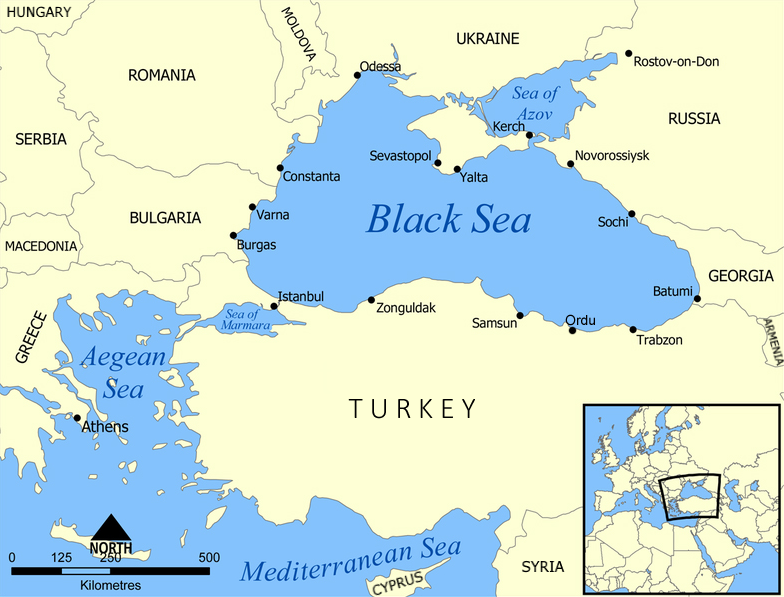
If the WEF-ers can’t prolong the War in Ukraine long enough to win back some valuable Black Sea coastline, they’ll just stir up trouble in one of the neighboring nations.  Take a look at the board game’s map.  Besides Russia, Ukraine, and Turkey, the region includes Moldova, Romania, Bulgaria, Greece, Armenia, and Georgia.  That’s strange.  Every country either on or near the Black Sea has recently experienced a spate of domestic conflicts, political rebellions, or outright civil wars.  In Romania, globalists not only annulled last year’s presidential election when the “wrong” candidate won, but also threw the winning candidate off this year’s ballot to prevent his repeat victory — all in the name of “protecting democracy”!  

Is there something toxic in the rivers draining into the Black Sea?  Or could it be that the West’s one-world-government zealots and intelligence agents/saboteurs are desperate to maintain influence over territories that could limit Russia’s strategic control of Black Sea trade routes and close off Russia’s access to the wider Mediterranean Sea?  

Perhaps disassembling Russia into a dozen separate WEF-conducive nations first requires WEF-enthusiasts to isolate Russia from half the world.  If they can avoid paying for the mess themselves by tricking the United States into sacrificing Americans in an unnecessary third world war, then all the better.  As they like to ask in Klaus Schwab’s neck of the woods, why fight the Russians or the Americans when you can get them to fight each other?  Cannon fodder does not discriminate by nationality.

If Western-style “democracy” means that central bankers control domestic policy, stifle dissent, and decide when war is “profitable,” then perhaps citizens should start asking who the hell put them in charge.  It certainly wasn’t the people.

Tyler Durden
Sun, 03/16/2025 – 23:55

China Maps Out Latest Plan To Boost Consumption, Raise Incomes: Here’s Why All Such Prior Plans Have Been Failures

China Maps Out Latest Plan To Boost Consumption, Raise Incomes: Here’s Why All Such Prior Plans Have Been Failures

It feels like every 3 months China comes up with another zany plan to boost the economy and kickstart consumption, which spikes stocks for a few days, but promptly goes nowhere, is quickly forgotten… only to be replaced with another zany plan 3 months later, and so on.

Today was no exception to this laughable cadence – which has achieved absolutely nothing but unleash core deflation in China for the first time since 2021 – and in a Sunday statement by Beijing State Council we learned that China will take steps to revive consumption by boosting people’s incomes, the official Xinhua News Agency reported.

Other just as vague measures include “stabilizing the stock and real estate markets, and offering incentives to raise the country’s birth rate, as the government tries to ease the deflationary pressures afflicting the economy.”

Of course, we have heard all of these over and over and over, and nothing at all has changed in the past 4 years. So we kinda doubt that anyone will care this time, but we are confident that HFT and various algos who have the memory of a goldfish will push Chinese stocks higher for at least a few days before the sellers inevitably take the upper hand again.

According to Xinhua, Beijing will promote “reasonable growth” in wages and establish a sound mechanism for adjusting the minimum wage. It will also look at setting up a childcare subsidy system, as well as strengthening how investment can support consumption. 

Other highlights of the plan include:

  • Enlarge variety of bond-related products suitable for individual investors
  • Adopt multiple measures to promote increase in farm incomes
  • Raise financial help for some students
  • Appropriately increase the basic pension for retirees
  • Ensure timely and full distribution of unemployment benefits
  • Support tourist attractions in expanding services and the reasonable extension of business hours
  • Support opening of duty-free shops in cities where conditions permit
  • Boost support for trade-in programs
  • Lower the interest rate on housing provident fund loans at an appropriate time
  • Scale back restrictions on consumption in an orderly manner
  • Accelerate the development of new technologies and products such as smart wearables and autonomous driving

More details are available here, but they may well be moot: after all, invigorating consumption has been a challenge for the government since the end of the pandemic and everything Beijing has thrown at the problem has sunk into a seemingly unquenchable deflationary vortex. Retail sales have been anemic while consumer prices fell into deflation in February for the first time in over a year, although the latest macroeconomic dump suggests that things may be turning after all key data printed just slightly better than expected:

  • *CHINA JAN.-FEB. RETAIL SALES RISE 4% Y/Y; EST. 3.8%
  • *CHINA JAN.-FEB. FIXED INVESTMENT RISES 4.1% Y/Y; EST. 3.2%
  • *CHINA JAN.-FEB. INDUSTRIAL OUTPUT RISES 5.9% Y/Y; EST. 5.3%

At annual parliamentary meetings this month, the country’s leadership made boosting consumption their top priority for the first time since President Xi Jinping came to power over a decade ago.

Ahead of the announcement, Chinese stocks rallied the most in two months on Friday after the State Council, China’s cabinet, announced that officials from the finance ministry, the central bank and other government departments plan to hold a press conference Monday on measures to boost consumption.

In a series of posts on X, China watcher Michael Pettis shared his skeptical view on the latest events in China, explaining why so far all attempts to kickstart the economy have failed. 

He starts by observing the above – namely that the government and Communist Party issued a lengthy list of planned initiatives on Sunday to get people to spend more, including larger pensions, better medical benefits and higher wages, but they “assigned many of these tasks to the country’s local governments, many of which are struggling under enormous debts and plummeting revenues from the sale of state land.”

This, according to Pettis, is the problem with every attempt to boost the consumption share of GDP.

He then notes that the sustainable way to boost consumption is to increase the share of GDP retained by households. But increasing their share requires explicit or implicit transfers from either businesses or government. If the household share rises, after all, someone else’s share must decline.

And while Beijing wants local governments to absorb said transfers, given their precarious cashflow positions, for now they can do so mainly by placing new burdens on households or businesses, e.g. through taxes, layoffs, fees, or cutbacks on existing services.

As a result, the net impact on households is reduced, and the remaining costs are absorbed by businesses. The former doesn’t help boost consumption, and the latter, by indirectly forcing businesses to absorb the costs, is bad for the economy.

The only other way to do so involves forcing local governments either to transfer to households a large part of the substantial assets they control, or to liquidate those assets in order directly or indirectly pay for higher household income.

The problem, according to Pettis, is that this implies a radical transformation of the relationship between Beijing and local governments and between local governments and the households and businesses in their jurisdiction, and given the sheer extent of the needed transfers, it will be very difficult.

This is why, for all the years of posturing and promising to boost consumption, it has been impossible for China to make much progress to reboot the economy. Since Beijing has to raise the household share of GDP by 10% at the very least, that means an equivalent reduction of someone else’s share.

Pettis also notes that many analysts insist that China will choose to avoid rebalancing altogether, but they miss the point. These levels of imbalance simply cannot be sustained if neither China nor the rest of the world can absorb the growing gap between consumption and production.

At the end of the day, China will rebalance one way or another. The important question is how it rebalances: whether an increase in the household share of GDP will occur in the form of a debt crisis and a sharp contraction in GDP, as occurred in the US in the early 1930s… or through many years of stable consumption growth and much lower GDP growth, as occurred in Japan after 1990, or of a surge in consumption that keeps GDP growth stable (which would be historically unprecedented).

These are arithmetically the only three ways to rebalance. And since all are extremely painful, either acutely now or chronically over the long-term, no surprise then that Beijing just keeps pretending it will do something while merely kicking the can until it is finally one day forced to do something.

Tyler Durden
Sun, 03/16/2025 – 22:45

Getting Out Of Forever Wars

Getting Out Of Forever Wars

Authored by Don McGregor via RealClearDefense,

A Pragmatic Approach to Protecting U.S. Security Interests

Introduction

Since the 9/11 attacks, the United States has been mired in “forever wars”—prolonged conflicts with no clear victory, draining trillions of dollars, thousands of lives, and economic vitality. A 2023 Pew poll shows 54% of Americans favor reducing overseas military commitments, with 83% prioritizing domestic needs—a clear call for change.

The U.S. can no longer afford years of military overreach. A pragmatic strategy emphasizing diplomacy, allied burden-sharing, and strategic restraint is essential to protect national interests without exhausting finite resources.

The Overwhelming Cost of War

The post-9/11 wars have exacted a staggering toll. Brown University’s Costs of War Project estimates the U.S. has spent $8 trillion—38% of 2020’s GDP—on conflicts in Iraq, Afghanistan, Pakistan, and Syria, equating to $24,000 per citizen.

Future interest on this debt could add $2.2 trillion to the national debt by 2050, burdening future generations. Human losses are equally dire: 7,000 service members and 8,000 contractors killed, 55,000 injured, and 940,000 total deaths from direct violence, with 3.6 million more dying indirectly in war zones.

Beyond numbers, the mental health crisis is profound. Veterans and active-duty personnel from these conflicts have died by suicide at four times the rate of combat losses—over 28,000 since 2001, according to 2022 VA data – mainly driven by post-traumatic stress disorder and repeated deployments.

Adding to the exhausting cost of conflict, caring for these veterans will cost $2.2-$2.5 trillion by 2050. These financial and human costs prove the wars’ unsustainability; constrained resources and public concerns require the U.S. to reassess its global security approach.

Rethinking Overseas Commitments

The U.S. maintains 750 military facilities across 80 countries, per a 2021 International Institute of Strategic Studies, at an annual cost of $80 billion—$55 billion for bases alone. The Quincy Institute reports that 91% of post-9/11 operations relied on these bases. Yet, they’ve often fueled instability—think of the disorder stemming from Iraq’s insurgency or Afghanistan’s collapse—rather than the security they were supposed to provide. This sprawling footprint, born of Cold War logic, no longer aligns with today’s fiscal environment, demanding a leaner, more practical approach.

A Pragmatic Path Forward

Some argue that overseas military bases help deter terrorism, but the evidence suggests otherwise. According to the Cato Institute (2023), the probability of dying in a U.S. terrorist attack is just 1 in 150 million.

Since 9/11, America has experienced nine terrorist attacks, resulting in a total of 44 deaths. In contrast, during the same period, the U.S. military suffered over 7,000 fatalities and 55,000 injuries in Iraq and Afghanistan, raising questions about the purpose of military operations overseas.

The cost alone is staggering. According to a Cato Institute report, a conservative baseline for total overseas basing costs is $80 billion annually, with some estimates reaching $100-$150 billion. This reflects differing indirect expenses, like troop support, highlighting the obscurity of overseas spending.

A 2023 RAND study also found that 30% of bases lack strategic purpose. A 25% reduction, focusing on outdated Cold War sites and unproductive Middle East efforts, would save $15 billion annually.

However, completely withdrawing is unwise; bases in Japan and Germany still deter Russia and China and allow forces to posture when needed. Closing outdated posts in stable regions—like parts of Europe or Asia—frees billions for pressing domestic defense needs.

The use of hard power has become overextended, yielding little success and eventually weighing heavily on the American public. A more effective strategy entails carefully reducing America’s overseas presence, reallocating resources, and reprioritizing homeland defense.

Strengthening Homeland Defense

President Trump’s campaign emphasized ending long-term military engagements, reducing overseas commitments, and reprioritizing defense strategies to enhance defending the homeland.

His 2025 executive order for an “Iron Dome” system reflects this shift, focusing on missile defense against nuclear and newer hypersonic weaponry from advancing adversaries. However, these initiatives currently face funding challenges.

The FY2024 defense budget ($850 billion) allocates $69 billion to overseas operations—defending allies—while just $29.8 billion (3.5%) boosts missile defense, unchanged since 2019.

Redirecting even half of that $69 billion could modernize defenses, aligning spending with existential risks over foreign entanglements.

However, missile defense is not the only way to protect the nation. It also demands attention to vulnerabilities closer to home, such as securing the borders—another pillar of homeland security.

Securing the Border

Border security, a neglected homeland priority, ties directly to resource reallocation. In FY2024, Customs and Border Protection (CBP) logged 3 million encounters at the southern border—up 400% from the 700,000 in the 2020s—costing an estimated $130 billion, challenging public safety and straining national security.

To help tackle this unprecedented challenge, President Trump’s recent executive orders, which declare a national emergency at the southern border and direct the military to support the Department of Homeland Security (DHS) in safeguarding the nation’s territorial integrity, highlight the priority of protecting the homeland.

DHS has also ramped up the activities of Immigration and Customs Enforcement (ICE), leading to a significant 627% increase in the detainment of criminal aliens since January. This surge has prompted DHS to request additional military assistance to aid the detainment process. As a result, more military troops are being deployed to support CBP along the border, and the military detention facility at Guantanamo Bay is being repurposed to accommodate the detention of criminal migrants.

While reallocating military resources from overseas commitments to border security can effectively address domestic threats without requiring additional spending, as illustrated by Secretary of Defense Hegseth’s recent decision to shift eight percent of the FY26 defense budget toward homeland priorities, this approach also highlights a more significant imbalance in U.S. defense spending.

Burden Sharing Security

Disproportionate global security commitments add to the problem, as the U.S. must push NATO allies to meet their 2% GDP defense spending target—America spent twice their combined total from 2014 to 2022.

Leading allies, like the United Kingdom and Germany, spend less as a share of Gross Domestic Product (GDP), with the U.S. shouldering a disproportionate burden of European defense. Additionally, the U.S. upholds numerous other global security agreements that extend well beyond Europe, such as the Pacific Deterrence Initiative—a U.S.-only defense investment and activity used to counter China that costs $10B annually.

The United States can no longer bear the burden of defending others. It must reassess its global security stance and agreements to ensure that costs are shared equitably. A balanced use of projecting power is needed to secure American influence abroad.

Balancing Power Projection

America’s decades-old philosophy of fighting its battles on someone else’s property remains vital to national security. A platform that can project US power quickly and support those efforts remains relevant.

Overseas “power projection platforms”—like overseas mobility bases and carriers in the Pacific—are necessary, enabling rapid response and sustainment to a crisis. However, basing that does not support projecting power should be reconsidered for closure. Trimming these frees funds for soft power—diplomacy and economic leverage—that achieves similar ends at a lower cost.

Harnessing Soft Power

Soft power—persuading through attraction, not force—offers a sustainable edge. Diplomacy can preempt conflicts that mimic hard power wins, such as the ceasefire that paused fighting in Sudan, allowing 150,000 to flee safely and aid to reach 500,000, per UNHCR reports.

Diplomacy can also secure trade deals, such as the 2020 U.S.-Japan Trade Agreement, which cut tariffs and secured U.S. farm exports to counter China’s trade dominance. Yet, while diplomacy can secure trade wins to help balance its trade, its effectiveness diminishes when multilateral agreements lead to persistent inequities.

For example, the Asian-Pacific Economic Cooperation (APEC), a multilateral trade agreement, incurred a deficit of $913 billion in 2024, a 12 percent increase ($97.7 billion) over 2023. Further, according to the Bureau of Economic Analysis, America’s total global goods and services deficit was $918.4 billion in 2024, up $133.5 billion from $784.9 billion in 2023.

This unsustainable trend indicates that the U.S. needs to rethink its negotiating approach in line with more equitable agreements that work directly with each partner, making adherence and fairness more manageable.

However, diplomacy and trade agreements alone cannot guarantee a nation’s security. Economic strength is vitally important and underwrites all its activities, making it essential to influence, leverage, and safeguard its interests.

Prioritizing Economic Security

The U.S. economy—$29 trillion in 2024, 25% of global wealth—thrives on energy, innovation, and resilience. For example, since 2019, an 8-quadrillion-BTU energy surplus has fueled energy exports, supporting Europe against Russia and countering Iran. Energy independence and growth are critical in maintaining America’s edge over rivals and securing its position as a preeminent global power.

However, the U.S. must address significant financial challenges, including its $34 trillion national debt and nearly $2 trillion budget deficit. While the U.S. currently has an economic advantage over China, purchasing power parity, or how much your currency can buy, shows that China leads by 23% and is growing. More concerning is that experts predict that China will surpass the total U.S. economy by 2040.

Remaining a global leader requires economic security and realigning priorities. Protecting against rising financial challenges and economic juggernauts like China means redirecting excessive global commitments to infrastructure and tech, not unproductive overseas commitments.

Conclusion

The post-9/11 wars have cost the United States $8 trillion, nearly a million lives directly and indirectly, and decades of overstretched resources—losses no nation can sustain indefinitely. To secure its interests, the U.S. must pivot from endless military entanglements to a strategy of calculated restraint: reducing outdated overseas commitments, redirecting funds to homeland defense and economic resilience, and leaning on diplomacy and allied cooperation to project influence.

This shift isn’t retreat—it’s recalibration. By prioritizing what strengthens the nation, from border security to soft power, America can safeguard its future without repeating its past mistakes.

Major General Don McGregor (USAF, ret.) is a combat veteran and an F-16 fighter pilot. While serving as a General Officer in the Pentagon, he was the National Guard Director of Strategy, Policy, Plans, and International Affairs, advising a four-star Joint Chiefs of Staff member.

Tyler Durden
Sun, 03/16/2025 – 22:10

David Sacks Exposes The Real Reason Behind DOGE Derangement Syndrome

David Sacks Exposes The Real Reason Behind DOGE Derangement Syndrome

During President Donald Trump’s recent joint address to Congress, viewers likely noticed several Democrat lawmakers brandishing signs reading “MUSK STEALS.” 

Now, we’ve got nationwide attacks on Tesla dealers.

A member of the Seattle Fire Department inspects a burned Tesla Cybertruck at a Tesla lot in Seattle, Monday, March 10, 2025. (AP Photo/Lindsey Wasson)

AI & Crypto Czar David Sacks says that this immature display, widely derided by conservatives, provides a revealing glimpse into the Left’s underlying mindset – exposing their belief that they alone should control American taxpayer funds, in opposition to the Trump administration’s clear mandate to eliminate financial waste and abuse across the federal government.

“I was at the State of the Union and up in the balcony. I was looking down at the Democrats holding up these silly little signs and the sign that I saw the most was one that said ‘Musk Steals,’” Sacks began in his Saturday evening interview with Fox News’s Lara Trump. “I really thought about that. 

How is Elon stealing? He’s returning money to the Treasury. Then it hit me, they actually have come to believe that this taxpayer money is theirs and by returning it to the Treasury, Elon is stealing from them. That’s my best explanation of why they’re in such hysterical state about this.”

Sacks concluded that Democrats are enraged because Trump, with the support of the Department of Government Efficiency (DOGE), is finally delivering on his central campaign promise to drain the swamp.

“But of course, Elon isn’t stealing anything. He is making sure that the federal government is taking good care of our money and that we’re not wasting it, it’s not going to corruption or fraud, and I think that just has the swamp in an absolute tizzy because he, along with president, and at the president’s direction, they are draining the swamp.”

The Democrats’ opposition to DOGE has grown louder in recent weeks as federal agencies have continued to cuts thousands of jobs and slash tens of billions of dollars in wasteful spending. On Friday, Sen. Chris Van Hollen (D-MD) proposed Senate Amendment 1272 to H.R. 1968, amending a bill to “prohibit the use of appropriated funds by DOGE,” but the amendment failed, 52-48. Sen. Lisa Murkowski (R-AK), a critic of DOGE, was the sole Republican to vote for the measure.

Sen.Joni Ernst (R-IA), who leads the Senate’d DOGE caucus, highlighted this week that DOGE has saved taxpayers $115 billion, amounting to $714 per taxpayer.

“Some of DOGE’s findings include: The Small Business Administration gave out more than $300 million in loans to thousands of children 11 years old and younger,” the senator pointed out.

“Thanks to DOGE, that contract was canceled, now the plants will be watered for free.While DOGE keeps delivering more savings every day, Democrats are more upset by the effort to stop wasteful spending than by the misuse of tax dollars,” she added. 

Tyler Durden
Sun, 03/16/2025 – 21:35

Pentagon Says Operations ‘Continue’ Overnight Against Yemen’s Houthis

Pentagon Says Operations ‘Continue’ Overnight Against Yemen’s Houthis

Update(2125ET): In the overnight hours (local), the US military has launched what appears to be a second wave of airstrikes on Yemen. US Central Command posted a new video Sunday saying that operations “continue”…

“The United States and Iran-backed Houthi rebels in Yemen are both vowing escalation after the U.S. launched airstrikes to deter the rebels from attacking military and commercial vessels on one of the world’s busiest shipping corridors,” AP writes.

Like with similar strikes under Biden – and now with Trump – where’s Congress? What authorization is there for a new war in the Middle East?

When you’ve lost the hawkish FoxCon pundit Ann Coulter…

* * *

Yemen’s Health Ministry now says that 32 people, including children, died after Saturday’s major US airstrikes pounded Sanaa, with President Donald Trump warning the Houthis not to attack ships passing through the Red Sea.

But on Sunday, that’s precisely what the Houthis did: a Houthi military announcement claimed the group carried out “a qualitative operation” on the US aircraft carrier Harry S Truman. “Our forces targeted the Truman aircraft carrier with 18 ballistic and cruise missiles and a drone,” a spokesman said.

Via Stars & Stripes

Nasruddin Amer, deputy head of the Houthi media office, described that Saturday’s US air strikes – which reportedly hit some 170 sites – won’t deter the Shia armed group back by Iran. 

Amer pledged more attacks on Red Sea shipping will come: “Sanaa will remain Gaza’s shield and support and will not abandon it no matter the challenges,” he said.

But later in the day Sunday an unnamed Pentagon official was quoted in Reuters as rejecting the Houthi claim. The official dismissed the claim of that a missile and drone attack came close to hitting the USS Harry S Truman.

A subsequent Fox report said that US warships shot down any inbound Houthi drones, and that they were not a serious threat.

Saturday’s strike on Yemen not only resulted in civilian deaths, but a reported over 100 injured, as President Trump vowed to “use overwhelming lethal force” while warning Iran to “immediately” cut its support.

“Your time is up, and your attacks must stop, starting today. If they don’t, hell will rain down upon you like nothing you have ever seen before,” the president said on Truth Social.

“I have ordered the US military today to launch a decisive and powerful military operation against the Houthi terrorists in Yemen,” he said, adding that he’s willing to use “overwhelming lethal force until we have achieved our objective.”

An American defense official denied the Houthi statement:

The Houthis’ leader last just Friday had declared a four-day deadline before attacks on shipping would resume. That four day timeline had ended by close of Tuesday, which means the Red Sea could be soon fiery scene of drone and missile attacks out of Yemen once again.

Since 2023 over 100 missile and drone attacks on commercial vessels have occurred in the Red Sea and the Gulf of Aden. The Houthis have also downed several MQ-9 Reaper drones operated by the Pentagon.

Tyler Durden
Sun, 03/16/2025 – 21:25

Behind The White House’s Decision To Ignore Activist Judge, Let Plane Full Of Deported Criminals Continue To El Salvador

Behind The White House’s Decision To Ignore Activist Judge, Let Plane Full Of Deported Criminals Continue To El Salvador

Update (2112ET): The Trump administration says it disregarded a judge’s order to turn around two planeloads of Venezuelan criminals because the flights were over international waters and therefore the ruling did not apply, Axios reports, citing two senior officials – one of whom made clear that it’s “Very important that people understand we are not actively defying court orders.”

Judge James Boasberg, 2023

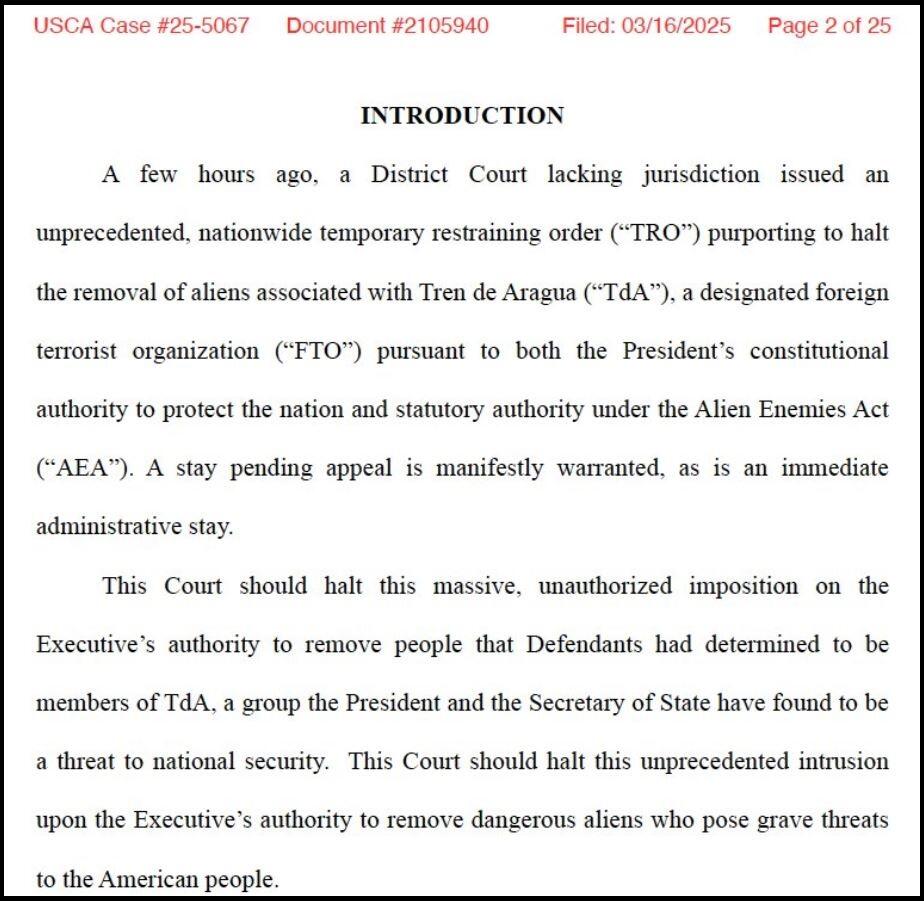
The Trump administration argues that US District Judge James Boasberg overstepped his authority when he issued an order blocking the president from deporting roughly 250 alleged Tren de Aragua gang members under the Alien Enemies Act of 1789, a wartime law that gives the executive branch immense power to deport noncitizens without judicial hearings.

“This is headed to the Supreme Court. And we’re going to win,” a senior White House official told Axios, adding “It’s the showdown that was always going to happen between the two branches of government.”

“And it seemed that this was pretty clean. You have Venezuelan gang members … These are bad guys, as the president would say.”

Axios then cites Democrat attorney Mark S. Zaid…

this guy…

…who posted on X “Court order defied. First of many as I’ve been warning and start of true constitutional crisis,” adding that it could eventually lead to another Trump impeachment, according to Axios.

According to the report, White House Deputy Chief of Staff Stephen Miller “orchestrated” the flights in the West Wing in tandem with DHS Secretary Kristy Noem.

More via Axios:

The timeline: The president signed the executive order invoking the Alien Enemies Act on Friday night, but intentionally did not advertise it. On Saturday morning, word of the order leaked, officials said, prompting a mad scramble to get planes in the air.

  • At 2:31 p.m. Saturday, an immigration activist who tracks deportation flights, posted on X that “TWO HIGHLY UNUSUAL ICE flights” were departing from Texas to El Salvador, which had agreed to accept Venezuelan gang members deported from the U.S.
  • Hours later, during a court hearing filed by the ACLU., Boasberg ordered a halt to the deportations and said any flights should be turned around mid-air.
  • “This is something that you need to make sure is complied with immediately,” he told the Justice Department, according to the Washington Post.
  • At that point, about 6:51 p.m., both flights were off the Yucatan Peninsula, according to flight paths posted on X.

An internal discussion was had in the White House as to whether they should order the planes to turn around – only to press ahead per administration lawyers.

“There was a discussion about how far the judge’s ruling can go under the circumstances and over international waters and, on advice of counsel, we proceeded with deporting these thugs,” said the senior official.

“They were already outside of US airspace. We believe the order is not applicable,” said the other official.

*  *  *

Pick up one of these lighter / flashlight combos!

Buy two for free shipping! (over $50). Satisfaction guaranteed or your money back. Just say you hated it. Pretty easy to rip us off tbh.

*  *  *

Update (1220ET): In response to judge James Boasberg’s move to halt the Trump administration’s deportation of alleged gang members, Rep. Brandon Gill (R-TX) says he’s filing articles of impeachment against the judge. 

“I’ll be filing Articles of Impeachment against activist judge James Boasberg this week,” Gill posted on X.

In response to Boasberg’s order (read all about it below), Attorney General Pam Bondi made an emergency filing with the DC Circuit Court to pause the order, asking the court to “halt this massive, unauthorized imposition on the Executive’s authority to remove people that Defendants had determined to be members of TdA (Tren de Aragua).

Maybe the Trump administration should just take AOC’s advice to ignore the court?

Oopsie… Too Late

Boasberg’s order was issued while a plane full of Venezuelan prisoners was headed to El Salvador – eventually landing in the country…

“Today, the first 238 members of the Venezuelan criminal organization, Tren de Aragua, arrived in our country. They were immediately transferred to CECOT, the Terrorism Confinement Center, for a period of one year (renewable),” said President Nayib Bukele on X. “On this occasion, the U.S. has also sent us 23 MS-13 members wanted by Salvadoran justice, including two ringleaders. One of them is a member of the criminal organization’s highest structure.”

Then, responding to Boasberg’s order, Bukele posted: “Oopsie… Too late“

*  *  *

Have you picked up a John O. flag yet at ZH Store?

Lots of styles and sizes available. Shipping is included in the price…

*  *  *

A federal judge who’s been a critical ally to the deep state has preemptively blocked the Trump administration from deporting five Venezuelan nationals under the Alien Enemies Act (AEA) of 1978.

US District Judge James Boasberg (more on that below) issued his preemptive ruling a few hours after the American Civil Liberties Union (ACLU) filed a motion on the Venezuelans’ behalf against Trump’s reported plan to invoke the AEA to accelerate the removal of illegals from the US.

The ACLU asked Boasberg to block the use of the law, though Trump has yet to invoke it. Boasberg, of course, complied, granting a restraining order Saturday morning that prevents the administration from removing the five Venezuelan nationals for two weeks so the judge can hold a hearing on their challenge.

In their filing, the ACLU, alongside Democracy Forward and the ACLU of the District of Columbia, stated that the government has moved the Venezuelans – alleged members of Tren De Aragua, to a facility in Texas, which they state are being used “as staging facilities to remove Venezuelan men under the AEA.”

Of note, the Trump administration officially declared Tren de Aragua a terrorist organization last month.

If the name Boasberg rings a bell, refresh your memory below…

The ACLU’s wish is his command!

Tyler Durden
Sun, 03/16/2025 – 21:11

Johns Hopkins University Laying Off Over 2,000 Workers After Federal Funding Cut

Johns Hopkins University Laying Off Over 2,000 Workers After Federal Funding Cut

Authored by Aldgra Fredly via The Epoch Times (emphasis ours),

Johns Hopkins University said on Thursday that it will lay off over 2,000 workers worldwide following the Trump administration’s termination of $800 million in federal funding for the institution.

A general view of The Johns Hopkins University in Baltimore, Md., on March 28, 2020. Rob Carr/Getty Images

The university, along with its affiliates, is the largest private employer in Maryland, contributing to more than 93,600 jobs in the fiscal year 2022, according to its previous economic impact report.

The layoffs involve 247 domestic U.S. workers for the academic institution and 1,975 positions outside the United States in 44 countries.

Johns Hopkins said the job cuts will impact its Bloomberg School of Public Health, its medical school, and an affiliated non-profit for international health, Jhpiego.

“This is a difficult day for our entire community,” the university said in a statement. “The termination of more than $800 million in USAID funding is now forcing us to wind down critical work here in Baltimore and internationally.”

Last week, hundreds of Johns Hopkins affiliates rallied near the Lincoln Memorial in Washington, D.C., to oppose cuts to research funding and resulting layoffs.

The university’s publication, Hub, stated that the Trump administration’s cuts to federal research funding would threaten more than 600 ongoing clinical trials conducted by Johns Hopkins, which were previously supported by the National Institutes of Health (NIH).

“The NIH is the only place that can fund science in the public interest because they don’t have shareholders,” Bloomberg professor Jack Iwashyna, who attended the rally, told Hub. Iwashyna was an NIH funding recipient to research pneumonia recovery.

Johns Hopkins University did not respond to a request for comment by publication time.

The developments at Johns Hopkins University come after the Trump administration canceled $400 million in grants and contracts for New York’s Columbia University due to allegations of anti-Semitism on campus. It stated on March 7 that the school holds about $5 billion in federal grant commitments, and the fund cancelation only marked “the first round of action,” with additional cancellations expected to follow.

The Trump administration is also investigating 60 American universities, including Hopkins, over anti-Semitism on campuses.

This also follows Trump’s announcement of a 90-day freeze on all foreign aid and development funding after taking office on Jan. 20, pending reviews to ensure the programs aligned with U.S. interests under his “America First” policy umbrella.

The Trump administration has suspended most USAID programs and placed its employees on administrative leave. Secretary of State Marco Rubio, who also serves as acting USAID administrator, stated on March 10 that about 83 percent of USAID contracts, or 5,200, have been canceled.

Rubio said the canceled contracts “did not serve (and in some cases harmed) the core national interests of the United States” but added that the government would retain the remaining 1,000 contracts under USAID.

Reuters and Katabella Roberts contributed to this report.

Tyler Durden
Sun, 03/16/2025 – 21:00

Ruthless Sibling Leaders Of Zeta Cartel Charged In US – Face Death Penalty

Ruthless Sibling Leaders Of Zeta Cartel Charged In US – Face Death Penalty

Two of Mexico’s most notorious former cartel leaders were arraigned in Washington DC on Friday on a range of federal charges that include drug trafficking, firearm possession and money laundering. Because the charges include engaging in a continuing criminal enterprise involving “multiple murder conspiracies,” they face the possibility of federal executions.  

Brothers Miguel Trevino Morales and Omar Trevino Morales — ages 52 and 48, respectively — are the former leaders of the Los Zetas cartel that once dominated Mexico’s northern region along the US frontier. Also known by aliases “Z-40” and “Z-42,” they allegedly led the cartel in succession from October 2012 until March 2015. Miguel’s term ended with his arrest by Mexican police in 2013, when Omar took over until he was similarly nabbed in 2015. Since that time, Los Zetas has faded relative to the Sinaloa and Jalisco New Generation cartels. 

Omar Trevino Morales was arrested by Mexican authorities in a 2015 pre-dawn raid at a home in a wealthy suburb of Monterrey (via Al Jazeera)

“The defendants represent some of the world’s most vicious cartel leaders, who oversaw Los Zetas’ reign of terror with grotesque impunity and ruthlessness, and a sheer disregard for anything beyond their wealth, power and control,” said Acting Special Agent in Charge Michael Alfonso of New York’s ICE Homeland Security Investigations. 

The Morales brothers are among 29 cartel drug lords extradited to the United States by Mexico in February. “The defendants taken into US custody today include leaders and managers of drug cartels recently designated as Foreign Terrorist Organizations and Specially Designated Global Terrorists,” the DOJ said at the time. 

Looking very much the part of a ruthless cartel boss, Miguel Trevino Morales was captured in 2013 on the outskirts of Nuevo Leon, a border town near Laredo, Texas 

“The Criminal Division is dedicated to achieving the Attorney General’s goal of the total elimination of cartels,” said Supervisory Official Matthew R. Galeotti. “As alleged, former Zetas cartel leaders Z-40 and Z-42 engaged in conspiracies to kill members of the Mexican government, Mexican citizens, members of rival cartels, members of the Guatemalan government, and Guatemalan drug traffickers.” 

The Zetas were founded by deserters from Mexico’s elite special forces, and had a reputation for fearsome brutality, to include decapitations and hanging corpses from highway overpasses. They were also blamed for killing 52 people via an arson attack on a Monterrey casino, and torturing and murdering 72 Central American migrants who resisted the Zeta’s demands that they become drug mules.  

The Zetas pioneered the intimidation tactic of hanging mutilated bodies from bridges; this bloody 2011 display was meant to warn bloggers against writing about the cartel’s activities (Raul Llamas/AFP/Getty Images via National Post)

The US government’s request for the duo’s extradition predates the current Trump administration. Their February transfer came after the State Department announced it had designated eight Latin American drug cartels as foreign terrorist organizations. That move prompted Mexican President Claudia Sheinbaum to warn the White House against taking unilateral military action inside her country. 

Earlier, Sheinbaum said she had approved US surveillance drone flights over Mexico. That claim came after CNN reported that the administration tapped the CIA to use unarmed MQ-9 drones to monitor the cartels. The secret missions were communicated to members of Congress, with the description of the undertaking making no mention of a partnership with the Mexican government.

Tyler Durden
Sun, 03/16/2025 – 20:25