Nicki Minaj Blasts Democrats For Treating The Black Vote Like It’s Theirs
Rapper Nicki Minaj urged young Americans to vote Republican in the upcoming midterm elections during an appearance on Fox’s My View with Lara Trump, according to comments Fox News reported Sunday. Minaj, a supporter of President Donald Trump, also accused the Democratic Party of discouraging black voters from breaking with the party.
Nicki Minaj – July 9, 2023 in Los Angeles, California. Christopher Polk for WWD
She kicked things off with a blunt call to “vote red.”
“You know how much you want a say in what happens and realize that the only way to have that is by voting, not just voting for the president, but just voting and, you know, all of the local elections. Right?” she said. “But I want you guys to do your research, see what candidates are in your area, you know, and just give it a couple, you know, a few minutes or an hour. Research them and then make a decision. You guys are so blessed to be able to vote. And you have to, more than ever now, you have to take advantage of that ability that you guys have to be able to vote, please. And vote red.”
Then Lara Trump asked whether she thought that “there are more people out there who vote for Democrats not because they like their policies and the politics themselves, but because they feel like they’re supposed to vote for Democrats?”
“I think it’s changing now, but obviously, for a very long time, black people specifically feel that they should just vote blue,” Minaj said. “I would say the entire country, there’s been a major shift where people are starting to wake up and see what’s going on and choose differently.“
The Grammy-nominee first came out in support of Trump in November 2025, after Trump spoke out about violence against Christians in Nigeria. She publicly thanked Trump for taking the issue seriously, marking a sharp change from her earlier criticism of his immigration policies. By December, she was openly praising Trump and JD Vance at Turning Point USA’s AmericaFest, calling them “role models” and saying she had “utmost respect and admiration” for Trump.
“Black people are not allowed, according to the Democrats, for the most part, to make a different decision,” she told Lara Trump. “We’re not allowed to think, we’re not allowed to voice concerns, to make an argument as to why we don’t like a particular candidate.”
Plenty of evidence backs this up. Joe Biden infamously told radio host Charlamagne tha God in 2020 that “you ain’t black” if he had trouble picking between him and Trump.
Six years ago today, Joe Biden told Black Americans they “ain’t Black” if they don’t vote for him.pic.twitter.com/GaHmmgFtLP
In 2021, “Uncle Tim” trended on Twitter after Sen. Tim Scott (R-S.C.) delivered the Republican response to Joe Biden’s 2021 joint address to Congress. Justice Clarence Thomas has received similar attacks for decades.
Minaj noted that black voters who aren’t in line with the Democrats face “smear campaigns and just outright nasty behavior from these adults.”
“It just doesn’t look good,” she added. “And so the Democrats kind of have been just digging their own grave in that way and they’re not understanding that people can see them.”
And, according to Minaj, black voters are catching on. “And now they feel, ‘Oh, okay. So you only love me and respect me when I do as you say and don’t ask any questions,'” she said. “And no one wants to be treated that way.”
Minaj: Black people are not allowed to think according to Democrats. We are not allowed to voice concerns, to make an argument as to why we don’t like a particular candidate. And they are seeing in real time if they do, what happens to them. Smear campaigns pic.twitter.com/NQg0qy5i9m
Asked by Lara Trump what she saw in Democrats that “led you to believe that perhaps they did not have the best interest of the country or for you in mind,” Minaj accused the party of becoming “way too caught up in pop culture,” arguing it has let its romance with the entertainment industry spiral out of control. “I think that they’ve allowed their relationships with artists to cause them to act like children and to be so petty and childish. But that’s what I think they do. They allow people in the music industry to influence them. And these people clearly don’t have their best interests at heart. These people have their egos at heart.”
Nicki Minaj: Well, I think the Democrats have gotten way too caught up in pop culture, for lack of a better term. I think they have allowed their relationships with artists to cause them to act like children and to be so petty, but that’s what I think they do. They allow people… pic.twitter.com/wj0GhMYKiE
China’s decision to extend the maximum term for individual home mortgages from 30 years to 40 years has received a lukewarm response from homebuyers.
Residential buildings under construction by Chinese real estate developer Vanke in Hangzhou, in eastern China’s Zhejiang province on May 9, 2024. STR/AFP via Getty Images
Several major Chinese banks moved quickly to offer 40-year mortgages after the policy took effect, with some advertising approval times as short as 15 minutes. However, Chinese media reports indicate that relatively few prospective buyers are opting for the longer loans.
The policy change, announced jointly by the People’s Bank of China (PBOC) and China’s National Financial Regulatory Administration on Aug. 28, allows individual home mortgages to run for up to 40 years, according to Chinese state media Xinhua News Agency.
The PBOC said the longer term would give borrowers and lenders greater flexibility and help promote a “virtuous cycle” between finance and the property sector.
However, the longer repayment period has done little to change a broader shift in household behavior. Chinese consumers are still reluctant to take on additional debt and are instead seeking to reduce their existing liabilities.
Households Pull Back From Debt
Chinese news portal Sina reported on Sept. 20 that banks had been actively promoting the new mortgage option, but prospective buyers remained cautious.
A report by the Chinese media outlet China Times, via Sina, attributed the weak demand to households’ growing reluctance to take on debt as China’s economy slows.
PBOC data showed that household loans fell by 1.03 trillion yuan ($150 billion) during the first eight months of 2026, according to state-run mouthpiece Xinhua.
The slowdown is particularly pronounced in longer-term household borrowing, which includes mortgages. Such loans increased by 1.17 trillion yuan ($33 billion) during the first half of 2026, according to data from China’s Ministry of Commerce.
Another sign of the shift came in April, when repayments of long-term household loans exceeded new loans issued that month. The scale of early repayments reached a record high.
Chinese media Securities Times, in a report carried by Sina, described the trend as Chinese households collectively seeking to “quit” mortgages.
Mike Li, a U.S.-based investment consultant and China expert, told The Epoch Times that the longer mortgage terms do not address the underlying financial pressure facing households.
“The regime is trying to ease borrowers’ economic pressure by extending the repayment period, but the pressure is only being postponed and has not actually been reduced,” Li said.
The reluctance to take on mortgages comes as China’s housing market remains in a prolonged downturn.
Falling home prices create an additional obstacle for households considering a long-term mortgage. Buyers taking on large mortgages face the risk that their homes’ values could decline while their outstanding debt remains high.
Li said this could also create risks for banks if borrowers begin to default.
“If a default occurs, when banks dispose of the property, they may face a decline in the property’s value, insufficient collateral, increased disposal costs, and a lower recovery rate,” he said.
Li said the broader policy response had so far failed to reverse the weakness in the property market or revive consumption.
“The policies introduced by the Chinese Communist Party so far have had very little effect. The property market has not been rescued, and consumption has not improved,” he said.
Bring Your Own Power Plant: Goldman Now Sees Behind-The-Meter Powering 25% Of All Data Centers By 2030
For the past year we have been banging the same drum: if hyperscalers want to plug a city’s worth of load into an already-strained grid, especially without being burned down to the ground by an angry mob after it has seen its electricity bill 10x in a year, they should bring their own power plant.
Back in November, as electric bills began their now-familiar vertical ascent, we said it plainly:
To prevent skyrocketing electric bills, every state has to follow the Texas example: each data center must have its own “behind the meter” onsite power generation.
It took a while, but Goldman has now fully joined the “make behind-the-meter mandatory” camp… or at least the “behind-the-meter is inevitable” camp, which is close enough.
In a new, fascinating 50-page Carbonomics report (yes, the bank’s climate desk just wrote 50 highly combustible pages about the best ways to burn natural gas, more on that below) titled “Behind-the-meter power solutions for data centers: gas turbines, fuel cells and reciprocating engines”, Michele Della Vigna’s team raises its outlook for behind-the-meter (BTM) power generation for data centers from 40GW to 67GW by 2030, and now expects gas turbines, reciprocating engines and fuel cells to supply 28% of US and 25% of global data center power demand by 2030 – versus “effectively 0%” in 2025.
The reason is simple: there is not enough grid, and there won’t be for years (and for those wondering, yes: it will cost a lot of money, which means much more debt is coming).
The demand side: another 170%
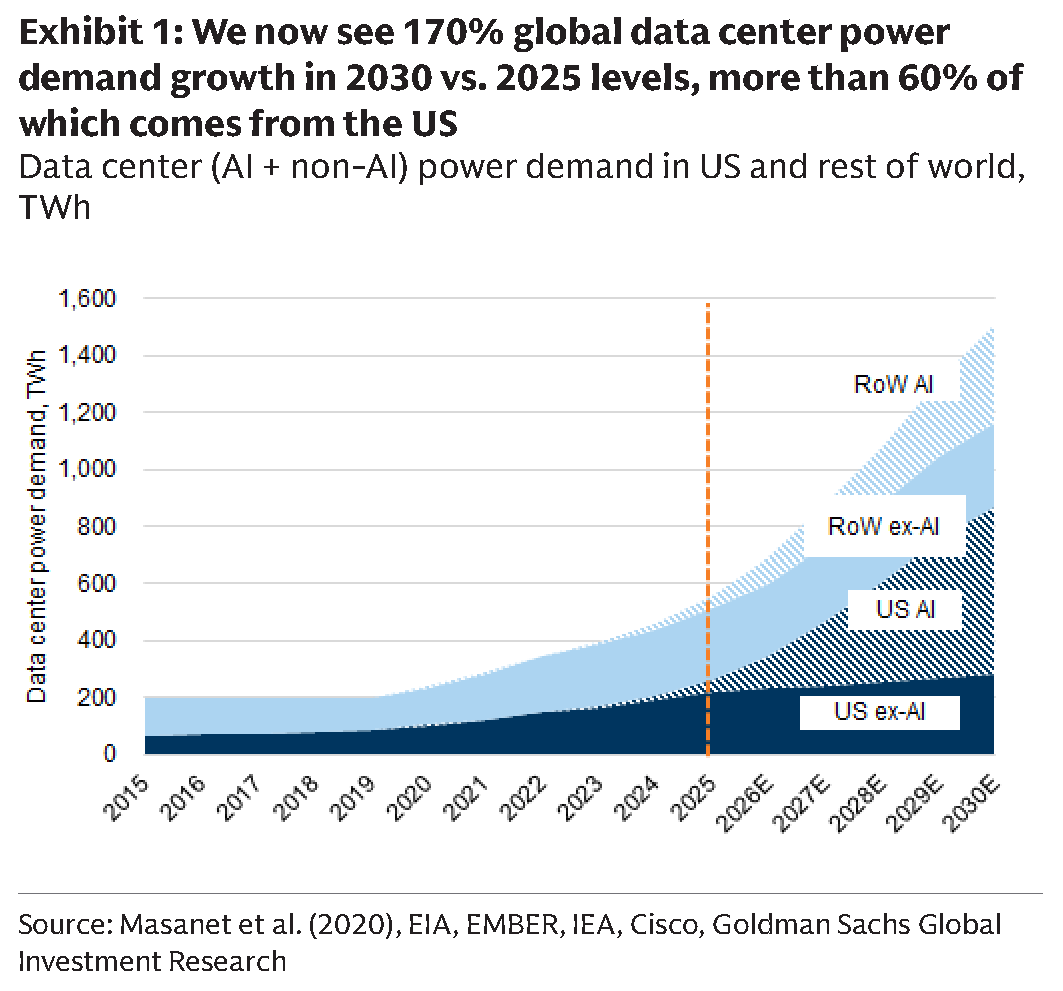
Back in July, Goldman’s US Technology and GS SUSTAIN teams raised their global data center capacity forecast to 217GW by 2030, up from 101GW in 2025 (and vs. 168GW in their prior forecast), with the US alone expected to hit 108GW.
In power terms, the bank now sees 170% global data center power demand growth in 2030 vs. 2025(up from 117% previously), more than 60% of which comes from the US.
That, in turn, pushes Goldman’s total power demand CAGR to 3.5% through 2030 – a number that would have been laughed out of any utility investor day just five years ago.
The supply side: the grid is not coming to save you
Here is where the report gets properly grim for anyone waiting patiently in an interconnection queue (recall a month ago we said that just Texas alone is facing 474GW of interconnection requests (ERCOT), of which 90% is data centers. Which is why gov Abbott froze rollout of new data centers in Texas). According to Goldman, the pace of new US high-voltage transmission construction has collapsed from an average of 1,700 miles per year in 2010-14 to just 350 miles per year in 2020-23, with only 55-125 new miles added in 2023-24. Meanwhile, the median time from interconnection request to commercial operation is now approaching 5 years.
And the grid-side outlook is actually the optimistic read. INNIO, one of the engine makers profiled in the report, says grid connection times have stretched from ~2 years historically to 7+ years today, which is why hyperscalers are now signing 15-year contracts for BTM power. When the alternative is waiting until the next decade to switch on a multi-billion dollar campus, “temporary” on-site power has a way of becoming permanent (as we noted in “Why Data Centers Favor On-Site Gas Power“, the marginal cost of running an on-site gas plant may well end up below industrial tariffs anyway).
There is also the ratepayer angle, which is the whole reason we started pounding the table on BTM in the first place. Every GW that a hyperscaler generates on site is a GW that doesn’t get socialized into Grandma’s electric bill, and with 142 anti-data-center rallies across 42 states this summer (see “The Data-Center Revolt Goes National” from July 19), the political cost of not doing BTM is only going up, and is virtually assuring
So how big does BTM get?
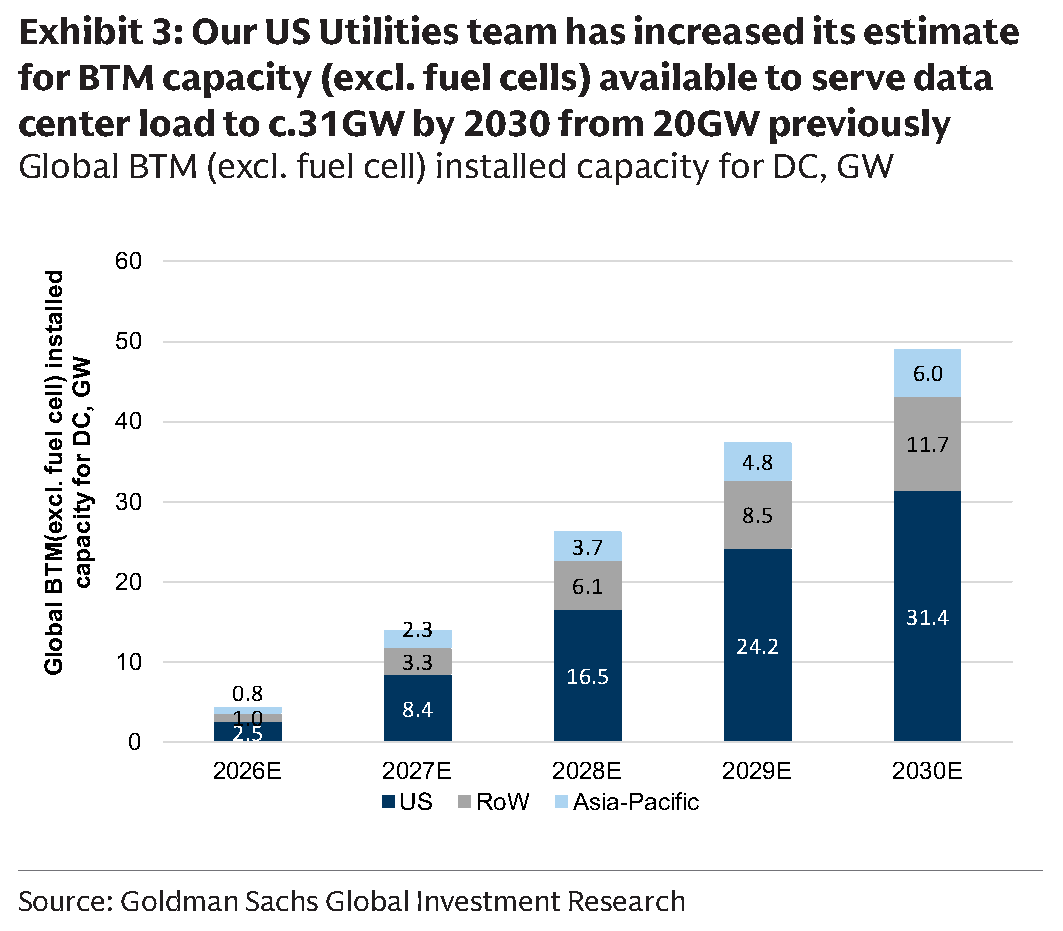
Goldman’s US Utilities team raised its estimate of Behind-The-Meter capacity (excluding fuel cells) available to serve data center load to 31GW by 2030 from 20GW previously, corresponding to 22GW of delivered power vs. 14GW before. Globally, gas-BTM capacity for data centers hits almost 50GW by 2030.
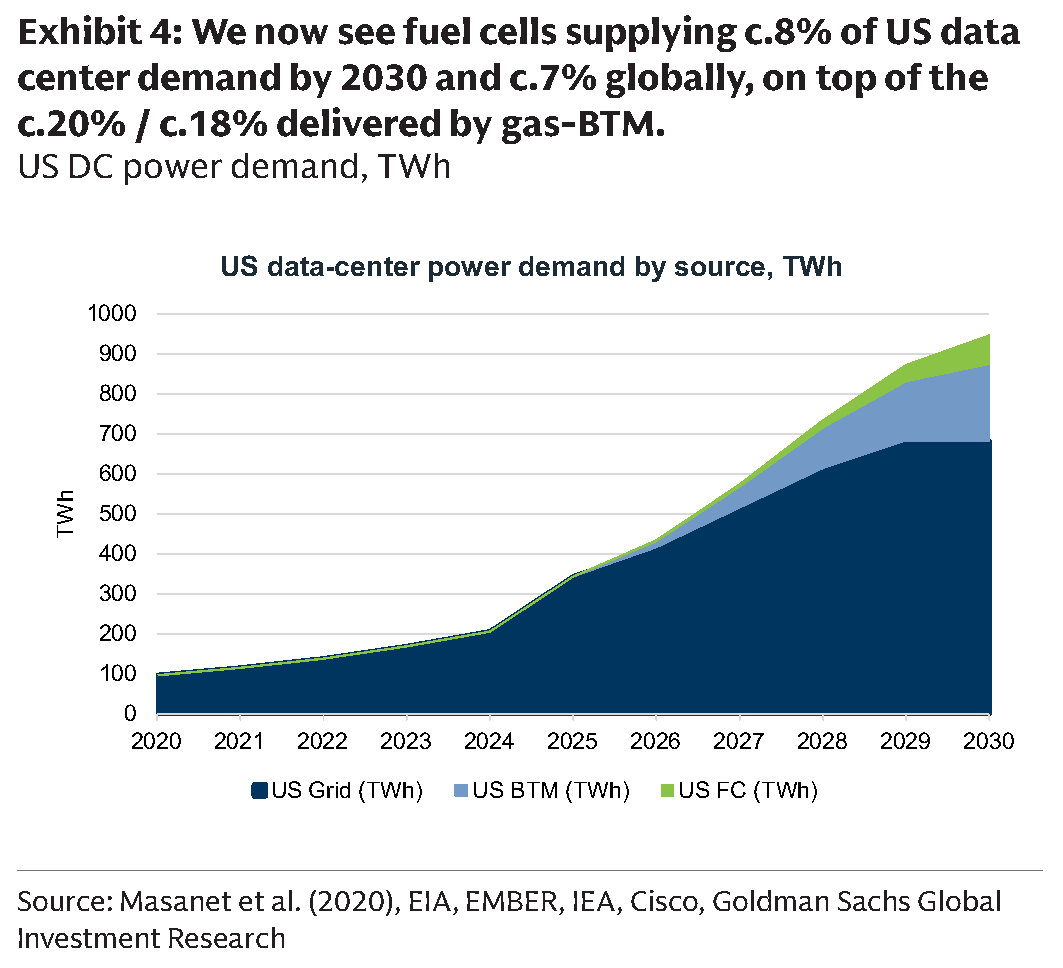
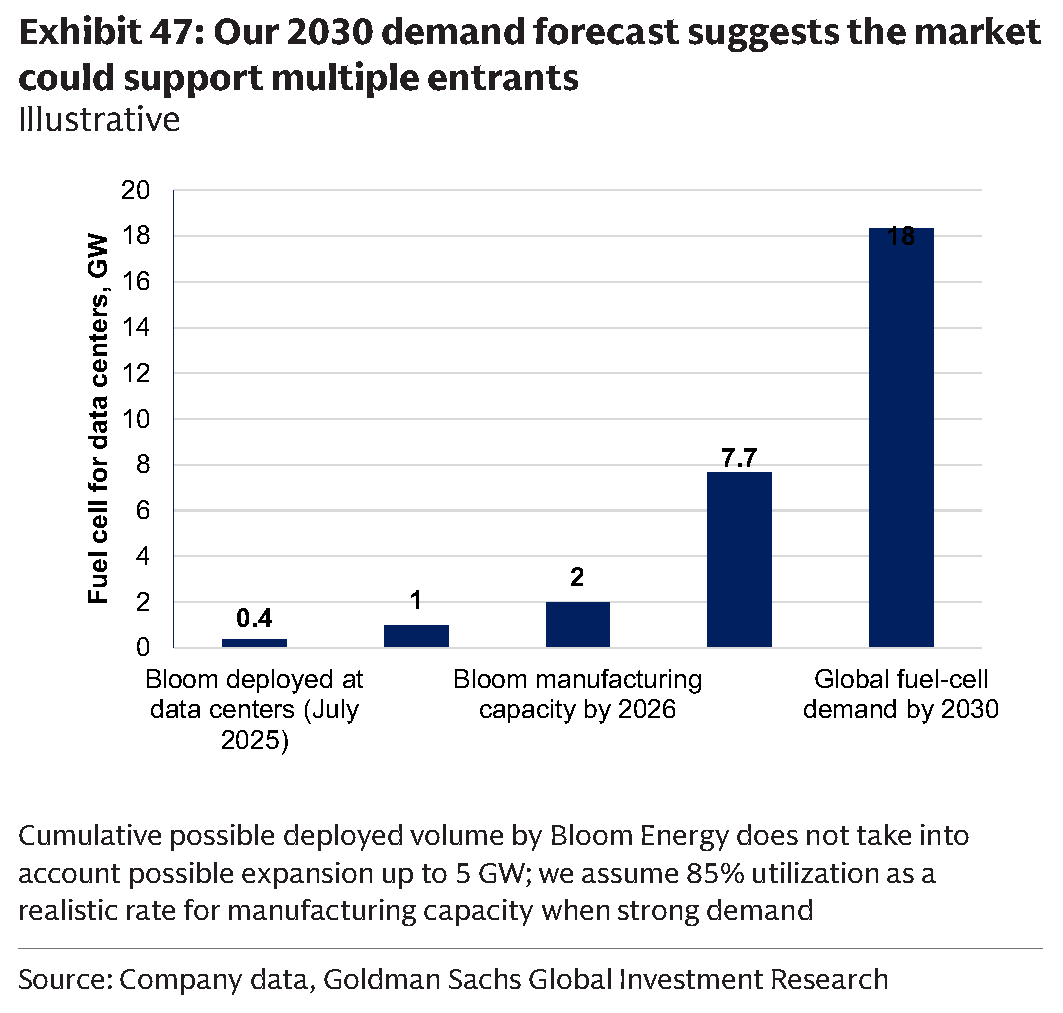
On top of that, Goldman now models a separate pool for fuel cells, which it sees supplying 8% of US data center demand by 2030 (7% globally), on top of the 20% / 18% delivered by gas-BTM. In installed terms, that’s 12GW of fuel cells in the US and 18GW globally by 2030, from a de minimis base today, translating into a cumulative equipment TAM of $35bn in the US and $55bn globally, with a recurring service and stack-replacement stream on top.
Regular readers will recall that back in February, in “Fuel Cells Poised To Capture 1/3 Of Data Center Power Demand By 2030“, we covered Goldman’s first pass at this, when the bank estimated 7-19GW of fuel cell capacity would be needed by 2030. The new 12GW US / 18GW global numbers sit at the top end of that range, which Goldman says gives it “higher conviction in both the level and the composition of the addressable market.”
Why LCOE no longer matters (much)
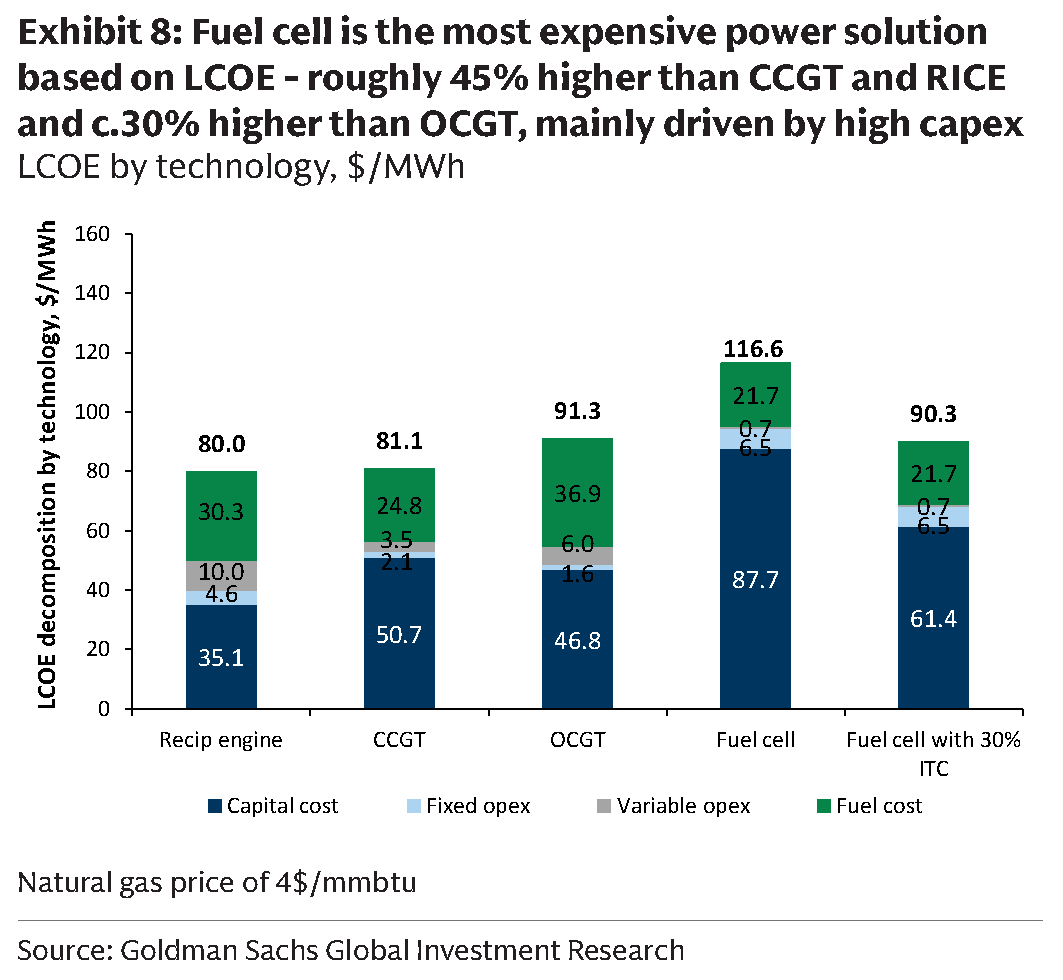
Here is the part of the report that should make every utility-model spreadsheet jockey slightly uncomfortable. On pure cost, fuel cells are the worst option on the table. Goldman’s LCOE (Levelized Cost of Energy is the average cost to build and operate a power plant per unit of electricity generated over its entire lifecycle) work for a 500MW data center shows reciprocating engines at $80/MWh, CCGTs at $81/MWh, OCGTs at $91/MWh and fuel cells at a hefty $117/MWh – roughly 45% above CCGT and RICE and c.30% above OCGT (at $4/mmbtu gas). Even with the 30% ITC, fuel cells only get down to $90/MWh.
The culprit is capex: Goldman assumes installed costs of $1,800/kW for recip engines, $2,400/kW for OCGT, $2,600/kW for CCGT and a whopping $4,750/kW for fuel cells (the ITC takes the fuel cell system down to ~$2,700/kW). Note also that CCGT costs have gone from ~$1,300/kW in 2023 to $2,000-2,200/kW in 2025, with post-2030 deliveries approaching $2,500/kW – turbine inflation is doing the fuel cell salesmen’s work for them.
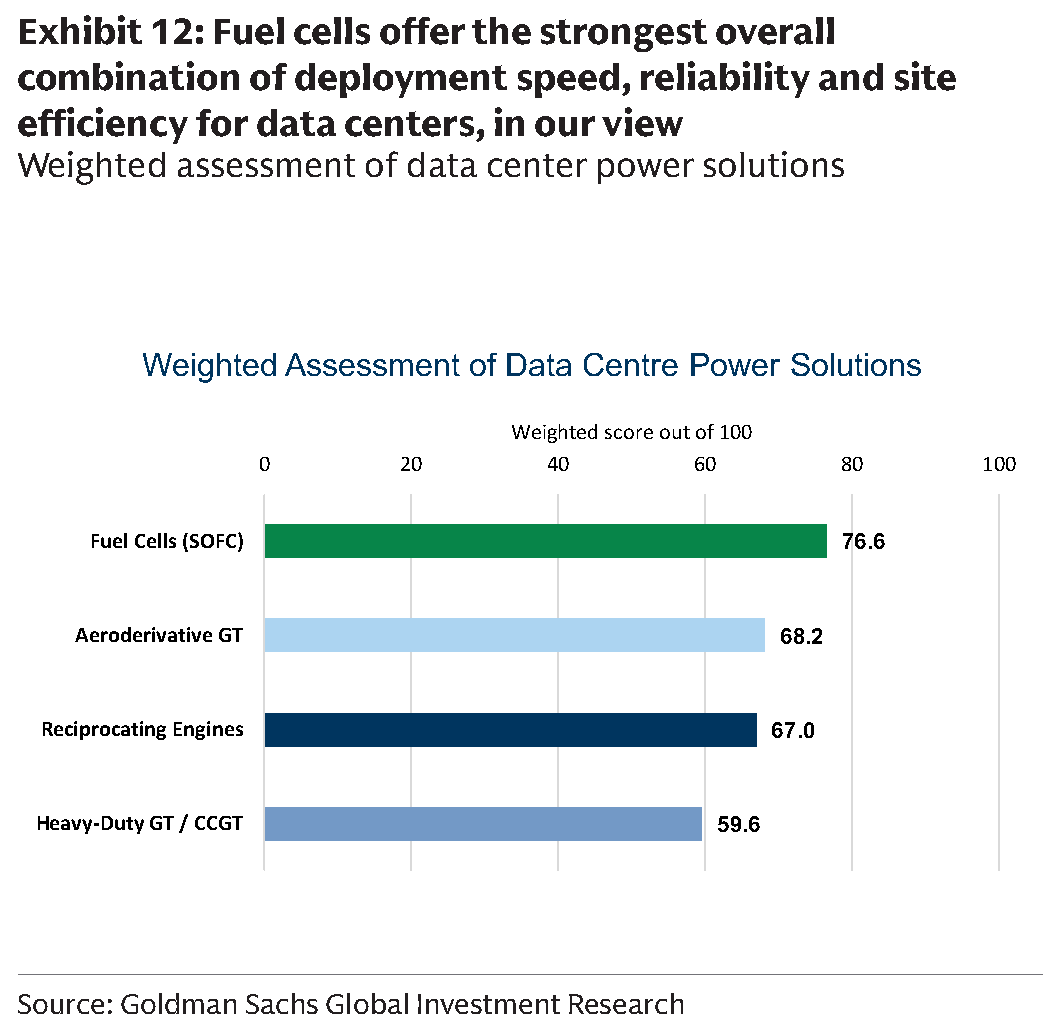
And yet fuel cells win Goldman’s weighted scorecard, with a score of 76.6 vs. 68.2 for aeroderivative turbines, 67.0 for recip engines and 59.6 for heavy-duty GT/CCGT.
The radar version of the same scorecard shows the trade-off even more clearly. Fuel cells (solid dark blue) max out on time-to-power, availability, load-following, power-path efficiency, water use, noise and sensitivity to gas prices, then collapse toward the center on the two metrics utilities have traditionally cared about most: LCOE and upfront capital costs. Recip engines (green dashes) are close to the mirror image, with top marks on cost, modularity and load-following but near-bottom scores on maintenance, noise and emissions. And the heavy-duty turbine/CCGT, the workhorse of every utility IRP for the past 30 years, scores well on LCOE, availability and efficiency, but ends up close to the center on time-to-power, which is the one axis that matters when the order book runs to 2031.
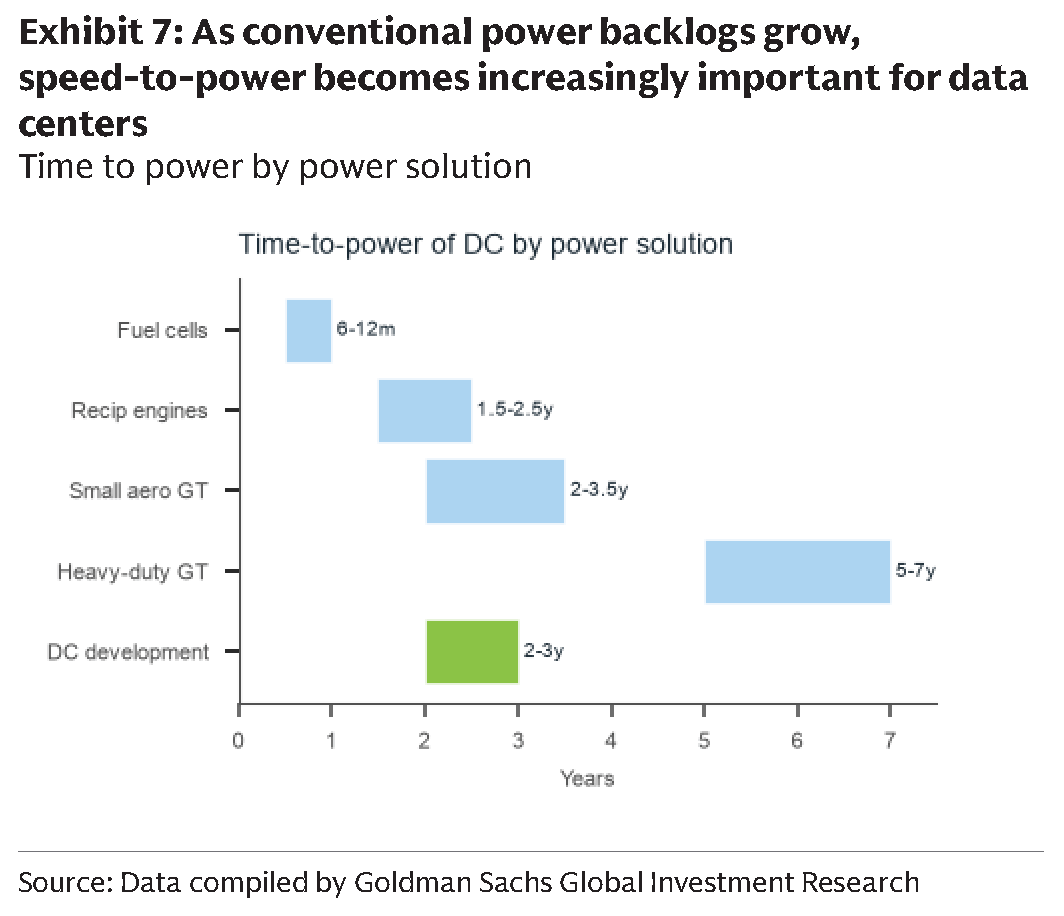
Why does the most expensive option win? Because the scorecard weights time-to-power at 20%, availability at 15%, LCOE at 15% and upfront capex at 10%, and when it comes to time, nothing else comes close. SOFC manufacturers quote 6-12 months from order to power. Recip engines are now 1.5-2.5 years. Heavy-duty gas turbines? 5-7 years, vs. 2-3 years in a “normal” market.
Bottom line: if you want power soon, you’re gonna pay. A lot.
Bloom Energy (not covered by Goldman) summed up the new math on its 2Q call better than any LCOE model could: customers now think in terms of “total cost of power to token revenue,” and one month of earlier power availability for a 1GW data center could be worth $1-2 billion of revenue. At those numbers, a $37/MWh premium over a CCGT is a rounding error. No wonder Bloom stock ripped to record highs after it blew out estimates and hiked guidance in April (see “Bloom Energy Erupts On Beat, Guidance Upgrade As On-Site Data Center Power Demand Soars” from April 29).
Two more wrinkles work in the fuel cells’ favor. First, they need the least overbuild: to serve a 500MW IT load, Goldman estimates fuel cells need just ~9% excess capacity (c.725MW installed) vs. +22% for recip engines, +26% for OCGT and a massive +47% for CCGT (c.979MW).
Second, fuel cells spit out DC power, which plugs straight into Nvidia’s push for 800V HVDC rack architecture and skips the transformer/converter/inverter chain that currently loses ~10-12% of electricity along the way (vs. ~3% in the DC design).
Finally, for those who believe (as we do) that natgas prices aren’t staying at $4 forever, fuel cells have the lowest sensitivity to the fuel bill thanks to their ~60% electrical efficiency. At around $12/mmbtu – close to Goldman’s normalized 2027 TTF estimate of c.$11 – fuel cell LCOE converges with single-cycle gas turbines.
The turbine queue: “now taking reservations for 2031”
Of course, the main reason fuel cells, recip engines and even refurbished boilers are all suddenly in vogue is that the gas turbine market is sold out. Goldman notes that global gas turbine awards hit 100GW in 2025 (vs. 55GW in 2024), and 2026 is tracking even hotter with 67GW booked YTD (38GW in 2Q alone).
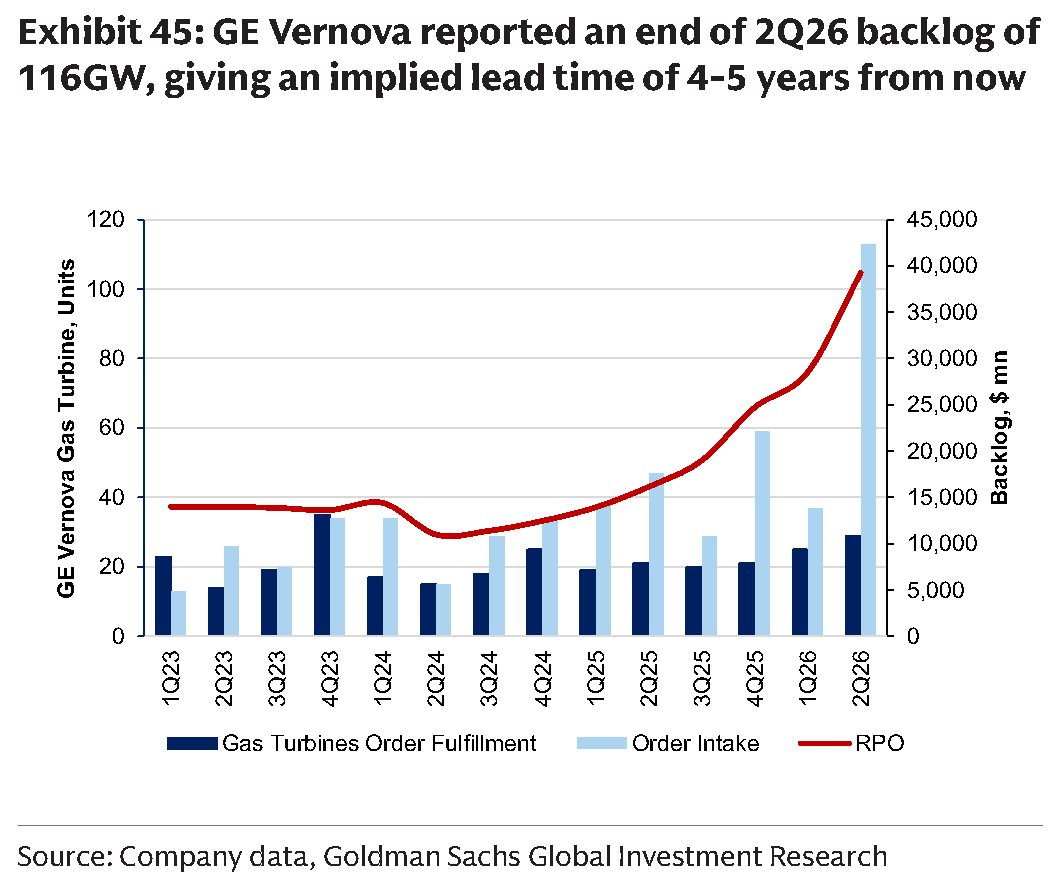
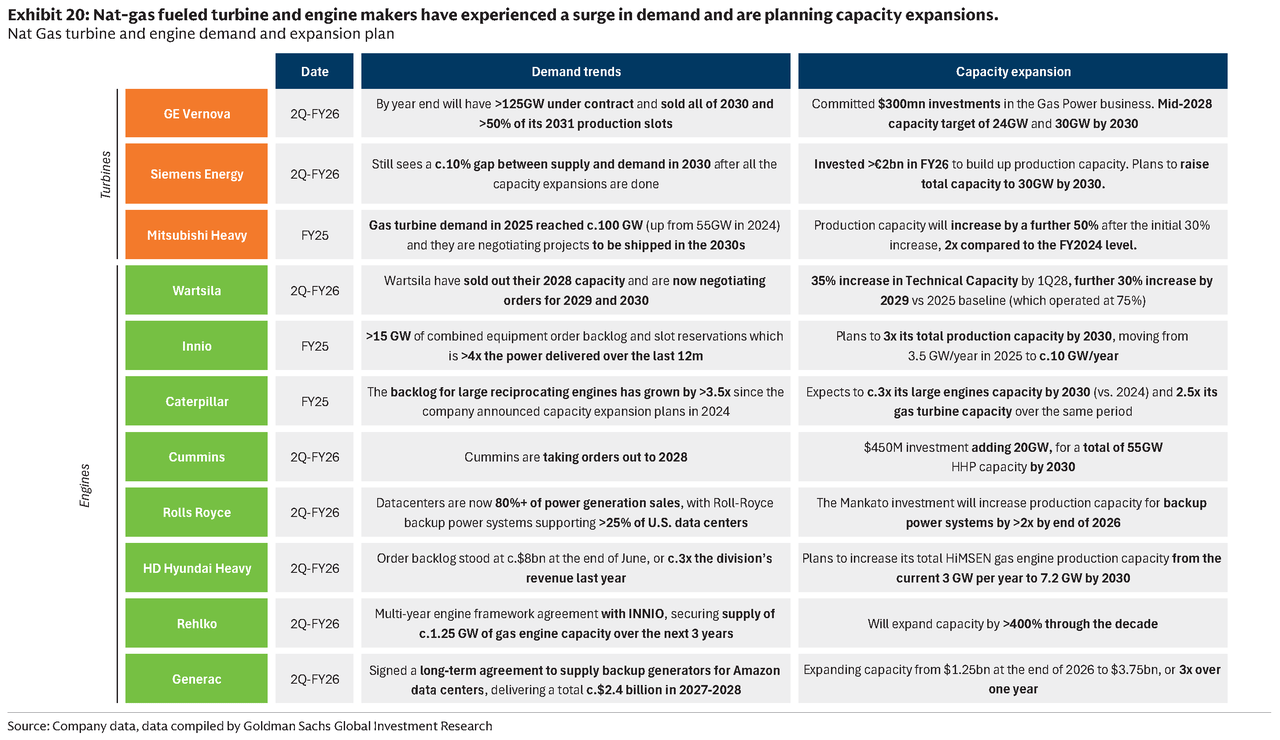
GE Vernova’s backlog plus slot reservations reached 116GW at the end of 2Q26, and the company expects >125GW by year-end with all of 2030 sold and >50% of 2031 production slots on contract – which is why, back in July, we titled our GEV earnings recap “Now Taking Reservations For 2031 Delivery“. Siemens Energy has accumulated 87GW of commitments, 24GW of which are data center related, and still sees a ~10% supply-demand gap in 2030 after all announced expansions. MHI is already negotiating projects to ship in the 2030s.
The engine makers are no better off: Wärtsilä has sold out 2028 and is negotiating 2029-30 slots; INNIO’s backlog plus reservations is >15GW, more than 4x trailing 12-month deliveries (and it just booked a 1.1GW prime-power order for a single megascale data center); Caterpillar’s large-engine backlog is up >3.5x; Cummins is taking orders out to 2028; and Rolls-Royce says data centers now account for 80%+ of its power generation sales.
dc
The desperation is palpable: last month Elon Musk’s SpaceX moved to build its own turbine blade factory in Texas to break the bottleneck (“Profound Game-Changer“, August 29), and AI developers have gone full 19th century, reviving industrial boilers and steam turbines just to get something spinning before 2032 (“Gas Turbine Shortage Sends AI Developers Back To Boilers And Steam“).
…and fuel cells aren’t immune either
Before anyone concludes that fuel cells are the silver bullet, Goldman’s own supply math tells a different story. Bloom’s new 2GW production line, assuming full ramp and 85% utilization, would deliver a cumulative ~7.7GW by 2030 – well short of the ~18GW Goldman forecasts is needed. Getting there requires ~3.8GW of installations per year globally, which means multiple manufacturers (Ceres Power licensees Doosan, Delta, Weichai and whoever else signs up) all scaling at the same time. Doosan’s dedicated Ceres-tech facility, for reference, currently has 50MW of annual capacity.
In other words, even the “fast” solution is set to be capacity-constrained for years. And let’s not forget what these boxes actually run on: natural gas. The fuel cell is cleaner and quieter than a turbine, and it’s great that Goldman’s Carbonomics team has found a way to love a methane-powered data center, but at the end of the day every one of these BTM solutions is a bet on cheap, abundant gas and pipeline access. Which brings us to…
The long-term answer: go nuclear, go modular
Buried on page 6 of the report is the sentence that matters most for anyone thinking beyond 2030. Goldman lists small modular reactors among the viable BTM options, noting that they are “reliable and relatively cheap over the long run,” but concludes that “owing to their long investment cycle, the majority of the investments from data centers are unlikely to result in their realization before 2030.”
We agree with the timing, and that is precisely the point. Everything in this report – turbines, recips, fuel cells, even gas – is a bridge. It is the best bridge available, and we’d make it mandatory tomorrow, but it is a bridge built on 5-7 year turbine queues, capacity-constrained fuel cell lines, and the assumption of $4 gas forever. The only permanent, scalable, fuel-price-insensitive, zero-emission, genuinely behind-the-meter solution for a 1GW AI campus is a modular reactor sitting on site.
That’s why we have long argued that modular reactors such as those being developed by NANO Nuclear are the only long-term solution to the data center power crunch. As we previously reported, NANO’s KRONOS micro modular reactor – designed to produce 15 MWe (45 MWth) – began drilling at the University of Illinois, with the reactor explicitly targeting data centers, industrial sites and military applications. And just last month, NANO signed a commercial framework with Tillman Digital Gateway to deploy modular reactors across US data center campuses, targeting 2GW by the mid-2030s and 6GW by 2040 (“Nano Nuclear Energy Signs Commercial Framework With Tillman To Enable Nuclear Power For Data Centers“, August 24). As NANO CEO James Walker put it, “power availability is becoming one of the defining constraints on the continued expansion of AI infrastructure.”
In fact, if you line up Goldman’s timeline with the SMR developers’, the handoff almost writes itself: gas-BTM and fuel cells carry the load through 2030 (and absorb the ratepayer backlash), while modular nuclear scales into the 2030s just as the first generation of on-site gas assets comes up for recontracting and gas prices do whatever gas prices do. (For more on why the “nuclear renaissance” keeps coming back to small reactors, watch our ZH debate on the topic of “Modular Reactors To Solve Data Center Hysteria?” from July 8).
Stock exposure
For those looking for the trade, Goldman’s Buy-rated names most leveraged to the BTM theme are:
Fuel cells: Ceres Power (CWR.L, PT 930p) – asset-light licensing model, with royalties seen reaching £99mn (base) to £178mn (upside) by 2030 and EBIT margins going from loss-making to ~50%; Weichai Power (2338.HK, PT HK$55) – holds a 17.8% stake in Ceres, targets 700MW+ of SOFC capacity by 2030, and every GW shipped adds an estimated Rmb3.5-4bn of net profit; and Delta Electronics (2308.TW, PT NT$4,120) – pilot SOFC production by end-2026, mass production in 2027-28.
Conventional gas BTM: GE Vernova (GEV, PT $1,268), Siemens Energy (ENR1n.DE, PT €212), Mitsubishi Heavy Industries (7011.T, PT ¥6,200) and INNIO.
And, of course, for those who, like us, think the real endgame is nuclear, there are plenty of names that we have been flagging for a while which aren’t in Goldman’s report at all – that would be the entire nuclear modular space – and which is trading between 50% and 80% lower compared to a year ago.
Two-Month China Truce Falls Short Of Expectations As Markets Fade Trump-Xi Summit
Donald Trump gave Xi Jinping the full state-visit treatment in Washington, but markets were more interested in what the two leaders did not deliver.
After three days of ceremony, an unusually warm presidential welcome and repeated pledges to stabilize relations between the world’s two largest economies, the main economic outcome was a two-month extension of the existing U.S.-China trade truce, pushing its expiration from November 10 to January 10, 2027.
That averted an immediate return to escalation, but fell short of the longer runway many investors had expected.
President Donald Trump, center right, first lady Melania Trump, right, China’s President Xi Jinping, center left, and his wife Peng Liyuan watch a silent drill platoon review on the new helipad from the Blue Room Balcony of the White House, Thursday, Sept. 24, 2026, in Washington. (AP Photo/Alex Brandon)
Following the meeting, China’s CSI 300 fell 1.7% on Thursday, its worst session in a month, while the Shanghai Composite lost 1.2%. On Friday, with the mainland shut for the Mid-Autumn holiday, the Hang Seng dropped another 1.7% to a two-month low, with technology and AI shares leading the decline. The yuan also gave back part of its pre-summit advance as the dollar strengthened.
The reaction was notable because expectations were hardly euphoric going in. The summit had been billed primarily as an exercise in stabilizing a relationship still divided over tariffs, advanced technology, rare-earth supplies, Taiwan and Iran. Even against that modest bar, the two-month extension came in short: Wall Street had generally been discussing three to six months, while some investors had hoped for a one-year rollover.
Barclays senior China economist Yingke Zhou summed up the meeting as “more signaling, less substance.” Zhou’s broader point was that Washington and Beijing appeared focused on preventing another breakdown in relations rather than resolving the disputes that produced the truce in the first place.
The Deal Wasn’t Nothing
The White House said the two governments formally operationalized their previously announced Boards of Trade and Investment. Under the Board of Trade, officials reached consensus on recommendations for more favorable tariff treatment covering roughly $30 billion of non-sensitive goods in each direction, including U.S. agricultural products and medical devices and Chinese consumer goods. China also committed to importing at least 10 million metric tons of U.S. coal in both 2027 and 2028.
U.S. Trade Representative Jamieson Greer said Friday that the two sides had reached agreements allowing certain products to remain outside future tariff disputes and promised significantly more detail on Monday.
“We’re in a managed trade situation,” Greer said, adding that the administration would release “a lot more details” about the negotiations.
That means Monday’s announcement could materially change the initial assessment of the summit. A detailed list of tariff exclusions, purchase commitments and implementation dates would give businesses something they can actually model.
But the official fact sheet also made clear how much remains unfinished.
Rare earths are the most obvious example. Washington said the two governments “continue to work” on U.S. concerns about shortages of rare earths and other critical minerals – careful language that confirms the supply issue remains unresolved. Chinese shipments of rare-earth magnets to the U.S. had already fallen sharply in August, and Beijing’s export-licensing regime continues to give it substantial leverage over Western manufacturers.
There was no broad settlement on advanced semiconductors. No breakthrough on Taiwan. And although the two countries have agreed to establish what the White House calls a “Super Intelligence Dialogue” and an emergency-communication channel, the details remain thin enough that markets have little basis yet for pricing an investment impact.
Rare Earths And Taiwan Are Still There
The rare-earth issue may be the clearest test of whether the current detente has changed the balance of leverage.
China remains dominant in both mining and, more importantly, processing of rare-earth materials, while U.S. officials have complained that deliveries have not fully met earlier commitments. The White House’s own language after the summit indicates that Washington is still seeking more reliable shipment levels.
Taiwan is similarly unresolved. Xi pressed Trump during the visit to take a harder line against Taiwanese independence. At the same time, Washington has been weighing another arms package for Taipei worth roughly $14 billion. Secretary of State Marco Rubio said during the visit that delays in arms sales to Taiwan reflect concerns about U.S. weapons production.
Whatever the eventual timing of that sale, the important point for markets is that the summit did not remove Taiwan from the bilateral risk ledger.
The same is true of AI. Both sides agreed to continue talks, including work on an incident-communication channel, but they remain competitors in advanced chips, models and computing infrastructure.
Sixty Days Of Visibility
For companies exposed to U.S.-China trade, January 10 is better than November 10. It gets the current arrangement through the Christmas import season and prevents an immediate reopening of the tariff war.
But sixty days is not much planning horizon for a manufacturer deciding where to build a plant, sign a multiyear sourcing contract or commit billions of dollars in capital.
And the tariff burden has not disappeared. The latest Penn Wharton Budget Model data put the effective U.S. tariff rate on Chinese imports at roughly 23%, compared with about 7% overall. China still faces the highest effective rate among major U.S. trading partners.
That helps explain why investors distinguished between stability and resolution.
There is a constructive side to that. China’s export sector has remained remarkably resilient, and keeping the truce intact removes the immediate threat of another tariff shock. U.S.-bound manufacturers, electronics suppliers, appliance makers and auto-parts exporters all benefit from having the deadline pushed into next year.
A Summit Built Around Stability
Trump personally greeted Xi and Peng Liyuan at Joint Base Andrews, an unusual gesture for a visiting head of state. The White House staged a formal arrival ceremony and military flyover, followed by bilateral meetings, a state dinner, tea and a visit to the National Archives. Xi repeatedly called for a stable long-term relationship and said the U.S. and China could avoid the so-called Thucydides Trap of conflict between a rising and established power.
China also revived one of its oldest diplomatic tools: pandas. Beijing agreed to send two giant pandas to Zoo Atlanta. Ping Ping and Fu Shuang arrived in Atlanta on Sunday.
But the composition of the summit showed the limits of the commercial thaw.
The American side brought a who’s who of technology and finance, with executives from Nvidia, AMD, OpenAI, Google, Microsoft, Amazon, Meta, Apple, Tesla and major Wall Street firms involved in the broader visit. Xi’s official delegation, by contrast, was dominated by government officials rather than Chinese CEOs – a contrast Barclays cited in arguing that Beijing approached Washington primarily as a strategic dialogue rather than a corporate dealmaking exercise.
Washington and Beijing appear to have decided that keeping the relationship inside guardrails is itself valuable. What they have not done is settle the economic and geopolitical disputes inside those guardrails..
What To Watch Monday
First, Greer’s trade details. The White House has already disclosed the framework for preferential treatment of about $30 billion in non-sensitive goods. Monday should show how much of that framework is operational – which products qualify, when tariff treatment changes and what purchase commitments accompany it.
Second, mainland equities. China’s markets were closed Friday, leaving Hong Kong to absorb the final day of the summit in thin holiday trading. Monday will be the first full onshore session able to react to the completed visit and whatever additional trade details Washington releases.
Third, the yuan. Beijing guided the currency stronger ahead of the summit before allowing some of that move to reverse as the dollar rallied. With the diplomatic event now over, traders will be watching the PBOC’s daily fixing for clues about whether authorities still prefer gradual appreciation or are prepared to tolerate more two-way movement.
The Washington summit therefore leaves investors with a peculiar combination: less immediate danger, but few reasons to declare the underlying dispute settled.
Tariffs remain elevated. Rare-earth supplies remain an issue. Taiwan remains unresolved. AI competition remains intact. And the new trade deadline arrives less than four weeks after the leaders are expected to meet for the fourth time this year.
Washington bought another sixty days of stability. What happens inside those sixty days will determine whether it bought anything more.
TikTok and its creator ByteDance struck a deal Friday with Alabama that will pay the state at least $100 million and force changes in how teenagers use the app, days before what would have been the first state trial over claims the platform was built to addict minors.
TikTok is so powerful its logo alone can mesmerize children. George Chan/Getty Images
The money is due within 45 days. It can climb to $300 million if certain conditions are met, Alabama Attorney General Steve Marshall’s office said. Alabama was set to select a jury on Monday.
“This is a great day for Alabama parents,” Marshall said. “Tonight, they can rest easier knowing real protections are in place to shield their children from the dangers of social media addiction. TikTok has agreed to give parents real control over what their kids see and how much time they spend on the app.”
The complaint had accused TikTok of designing addictive features, exposing young users to serious mental harms, and misleading the public about safety.
TikTok did not admit those claims in the papers released Friday.
The company did not immediately return a request for comment.
The deal requires teen accounts in Alabama to have a two-hour daily cap, which parents can further shorten. After 15, 60, and 90 minutes of continuous use, the app must interrupt the session, a feature the office called “productive pauses,” intended to break endless scrolling.
Teen accounts will be unavailable from midnight to 6 a.m. Messaging and push alerts face extra limits overnight and during school hours. In addition, cosmetic filters are banned for teen users.
The default feed for those accounts is to remain non-personalized, and teen accounts are to be harder for adults to find. Parents get notice of suspicious contacts. Parental controls are supposed to be easier to use.
Last month, a multi-state Meta deal was set to bring Alabama $117 million on similar youth-harm allegations. Earlier, Roblox paid the state $12.2 million and agreed to tighter age checks and chat rules.
The Alabama deal arrives as other fights progress.
On Sept. 10, a Travis County, Texas, judge ruled that TikTok violated the state’s consumer protection law by misleading users about tools meant to keep minors from harmful videos. Judge Cory Liu found Restricted Mode did not work as marketed.
Texas Attorney General Ken Paxton said the case now goes to trial next month to set penalties.
“TikTok sacrificed the safety and innocence of children for engagement and numbers, and now they are being held accountable,” Paxton said then.
In early August, TikTok moved to settle three confidential teen mental-health suits. Lawyer Joseph VanZardt said written papers still had to be finished.
The plaintiffs – identified only as S.J., 15, of Illinois; P.M.Y., 15, of New Jersey; and K.D.B., 18, of Mississippi – alleged addiction, depression, self-harm and, in two cases, eating disorders. Roughly 3,300 similar suits sit before Los Angeles Superior Court Judge Carolyn Kuhl. Meta, YouTube, and Snapchat still face an October trial calendar.
A March jury in that same court awarded $4.2 million against Meta and $1.8 million against Google in a related individual case. TikTok settled that one before opening statements.
In August, the Justice Department separately announced TikTok and ByteDance would pay $400 million to resolve Children’s Online Privacy Protection Act (COPPA) claims. Officials called it one of the largest COPPA recoveries on record. The company did not admit fault.
Beyond The SPR: Stifel Spots Another Depleted Strategic Stockpile In Urgent Need Of Rebuilding
Stifel’s “own the bottlenecks” theme favors producers that can supply Western markets with conflict-free critical materials today. China’s tightening export controls will collide with a looming multiyear rearmament cycle and reinforce the urgency of finding stable production outside China.
The Trump administration’s big push to rebuild the US defense industrial base is creating a multiyear investment opportunity in critical materials supply chains as sourcing shifts from China to allied countries.
Stifel aerospace and defense analyst Jonathan Siegmann wrote in the note titled “National Security Critical Materials & Supply Chain: Own the Bottlenecks” that clients should look beyond big defense giants to producing miners that control scarce supplies of tungsten, magnets, microdisplays, lasers, and drone components.
“Stock playbook: own the choke point, don’t chase the press release,” Siegmann said.
He continued, “Front-running announced federal support has paid impressively, but outperformance is usually short-lived, and the strategy is hard to repeat. We prefer investing in stocks already positioned as bottleneck solutions, where active government support is additive rather than a requirement. A strong defense cycle plus a committed, supportive US customer will structurally improve growth and returns, in our view.”
China is a top-four supplier for 14 of 31 minerals and the single largest for eight; Russia appears among the top suppliers for three: palladium, silicon, and potash.
Siegmann shows that China has been an investment powerhouse in mining and refining since the mid-1990s, while US investment has lagged. Now the Trump administration is playing catch-up.
China Produces the Periodic Table
Siegmann outlines China’s weaponization of critical materials exports against the US and its Western allies.
Why the Critical Materials Shortage Is a National Security Problem
The federal government is attempting to rebuild its critical materials supply chains outside China.
Here’s what happens to mining stocks after the US government announces a strategic stake or partnership deal.
All the deals so far.
One of the most stunning charts Siegmann created for clients shows the 25-year drawdown of the US government’s massive tungsten stockpile, which it will have to reverse for national security reasons.
Against that backdrop, Stifel critical materials analyst Brock Cannon initiated coverage on Almonty Industries, believing the Nasdaq-listed miner is set to be a major beneficiary of Western efforts to reduce dependence on Chinese tungsten.
Siegmann said that building critical materials supply chains outside China has been a national priority and is “not just a Trump trade,” a point politicians on both sides of the aisle agree on.
Siegmann prefers exposure to miners already in production that can deliver conflict-free supplies to the West today. Washington has the money and the urgency. These critical materials are the building blocks for the rearmament cycle, AI, reindustrialization, powering up America, and many other themes shaping the modern economy. That makes this a long-lasting investment theme in which early movers stand to be rewarded.
Failing Lesbian Bar Faces Angry Leftist Mob After Finally Ending Mask Mandate
When your business model’s foundation is catering to mentally ill lunatics, don’t surprised when the most common sense changes evoke insane responses.
One day, probably in the very near future, there will be a hailstorm of studies done on the Covid pandemic era and the absolute hysteria that surrounded it. The virus was essentially a non-issue with an average infection fatality rate of 0.23%, meaning 99.8% of all people would easily survive. Yet, most of the world shut down vast areas of the economy and tried to force the global population to wear masks that were eventually proven to do absolutely nothing to stop the spread.
Perhaps the most interesting detail of all, though, is the political left’s continued obsession with the lockdown period. Leftists treat the pandemic as their “golden era”, the moment in history when they basked in pure authoritarianism, the moment when they had all the power. And like an addictive drug, they just can’t seem to let the pandemic go.
The N95 mask in particular represents a symbol for progressives, a kind of uniform that they used to identify each other and show their fealty to the cult of Covid. Many deep blue areas of the country refused to stop wearing masks well into 2023 long after it was obvious that the virus was not a legitimate danger.
Even today, there are still wacky activists that continue to mask up regularly, because taking off the masks is the same as admitting they are wrong, and taking accountability is the last thing any leftist will ever voluntarily do. Now imagine there’s a lesbian bar that placates such people as their primary customer base? Can you think of a more horrible place to get a drink?
Up until August 31st the Last Ditch Bar and Arts Venue in Greenfield, MA had required patrons to wear KN-95 masks or better just to get in the door. The bar was also known for banning police and posting signs portraying people throwing Molotov Cocktails that said “Cops Are Not Welcome At Last Ditch”.
Massachusetts lgbtq bar ‘Last Ditch’ announced they’re BANNING police from their venue, called them “pigs” and shared images showing them throwing Molotov cocktails at police.
This is a call to violence against law enforcement. @fbi
The problem is that their ridiculous clinging to pandemic mandates destroyed their customer base and the business was failing. In response the lesbian bar finally announced that, on Saturday’s only, the bar would become mask-optional while keeping the requirement on its other nights.
Instead of getting relief and applause for showing a pinch of common sense, the locals pulled out their torches and pitchforks in outrage and started making threats.
The Instagram announcement drew hundreds of responses, including accusations that the change excluded disabled and immunocompromised customers who had regarded Last Ditch as one of the few nightlife spaces built around their mentally deranged needs. In other words, the Last Ditch Bar had “betrayed” the cult by admitting masks are not necessary.
Critics called the decision ableist, eugenicist, and complicity in a “mass disabling event.” Some comments went further:
“People like you kill disabled people in the name of your own leisure and convenience…”
“Just say you’re being complicit in a mass disabling event and get it over with…”
“I hope your venue gets firebombed for robbing my fellow immunocompromised people of their Saturday plans just to scrape extra revenue from ablists…”
It’s like taking a time machine back to 2020. The last remaining owner of the bar became emotional as she explained how she had ended up running the business on her own. “It was not my passion project,” she said.
She told the group she had been living in her truck for six months while putting money into the business, working four jobs, and carrying responsibility for the $50,000 loan the founders had taken out to open Last Ditch. “I never really wanted this,” she said. “I don’t think I’m doing a very good job.”
Some critics remained unmoved, including the bar’s biggest critic, a trans “woman” who identifies as a lesbian and also a he/him.
UPDATE: One of the loudest critics of the Last Ditch COVID-Conscious Lesbian Bar is a male lesbian named Soe Noire 😭 pic.twitter.com/H5y0UwVnjG
But this is to be expected when dealing with progressive psychopaths. They want businesses to enable their emotional dysfunctions, but they don’t want to spend any money keeping those businesses in operation. We have seen this trend in every venue that leftists invade, from movies to video games to marketing and corporate culture – They want every company to reflect their values but they are the worst customers imaginable when it comes to revenues.
The last Ditch Bar owes nearly $4000 in back rent and foot traffic has dried up; the business is likely to close in the near term. The owner says she hopes to convert Last Ditch into a “cooperative” so the financial responsibility does not rest so heavily on one person. However, this is how the business was already being run, and it was a disaster.
The lessons here are many. But first and foremost, incidents like this remind us of the horrors of life under progressive rule during the Biden years. The popular memory is short, it would be a catastrophe if the public were to forget.
Around 157,000 children who crossed the border as unaccompanied minors have been found since the start of the Trump administration while many are still missing, White House border czar Tom Homan told The Epoch Times.
White House border czar Tom Homan after an interview with “American Thought Leaders” in Washington on Sept. 24, 2026. Madalina Kilroy/The Epoch Times
In an interview with senior editor Jan Jekielek for “American Thought Leaders,” airing on Sept. 26, he said that just under half a million children were “smuggled” into the United States during the Biden administration.
Homan said officials at the Department of Health and Human Services (HHS) at the time were proud of the fact that children weren’t in detention for long.
“They weren’t [held] very long, but the problem is they released them quickly because the sponsors weren’t properly vetted,” he said, and with caretakers not responding to communications or check-ins, that caused the government to lose track of nearly 300,000 of the children.
Homan said that when President Donald Trump asked him to return to the federal government under his second administration, one of the top directives he was given was to address the problem of missing children.
“He asked me to do three things: secure the border, run deportation operations, and find these kids.”
The border czar said he was much more optimistic about the first two directives than he was about finding the children, because his team would have to count on the digital footprint of the sponsors, based on information provided by the sponsors.
“We can find you, we can find me. We own homes, we own cars, we have credit cards. We can find us because we all have a digital footprint. Children don’t,” Homan said.
Some Democrats on Capitol Hill have objected to the treatment of unaccompanied minors after they’ve been located.
Sen. Ron Wyden (D-Ore.) condemned the current administration in June for plans to deport some of the children back to Mexico.
“You have been entrusted with the care and safety of the children placed within the [Office of Refugee Resettlement] network,” Wyden said in a letter to the HHS. “Proceeding with this plan knowingly endangers their lives and violates your duty to these vulnerable children.”
When officials began searching for the children, they learned that many of the sponsors had given the wrong information, such as home addresses that turned out to be supermarkets, parking lots, or churches. False names had been used for identification, and locating where the children actually were proved to be a massive undertaking.
Homan told The Epoch Times that of the roughly 157,000 children who have been found, more than 20 have died – some due to natural causes, and others from a drug overdose or as a result of violence.
The work isn’t done, however, and he said he intends to find every one of the 140,000 still missing children, even those who have aged out of the system.
“Just because you’re 18 and 19 doesn’t mean they’re not in forced labor or sex trafficking, so we’re going to keep running down every one of these leads until we find them,” the border czar said.
In 40 years of working at the border Homan has seen many victims of human trafficking, but one in particular broke his heart. He said he’ll never forgot a 9-year-old girl who was sexually assaulted while making the journey to the United States years ago: “That little girl’s never going to be the same again.”
“Illegal immigration is not a victimless crime. You don’t come across the border without approval and paying off the cartels,” he said. “A lot of women and children are sexually assaulted making that journey.”
Last month, HHS announced that the Trump administration had located more than 148,000 unaccompanied illegal immigrant children who had been missing after being released into the care of someone in the United States.
A statement from the Department of Homeland Security last November announced an initiative partnering with local law enforcement to conduct welfare checks on the lost children.
Homan told The Epoch Times that despite the monumental task of finding the still missing children, “We’re not giving up.”
“President Trump has promised that we’re going to look at this until the last day of the administration, and the American people can have my word that we’re going to do that.”
“Looking To Do Big Damage”: Trump Says Suspected UK Airbase Plotters Had Been Under Surveillance
Summary:
Reuters Says Possible Iranian-Linked Motive Likely
Trump Says Suspects “Looking to do Big Damage” Against Airbase
US Stealth Bomber Base In UK On “Delta” Alert As Counter-Terror Police Make Arrests, Deploy Bomb Squad Search Of Vans
Trump Says Suspects “Looking to do Big Damage”
Reuters reported that an Iranian-linked motive could very well be behind the incident that unfolded early Sunday morning, citing a source familiar with the investigation. Counterterrorism investigators are also examining the possibility of Russian sabotage or an Islamist plot.
President Trump told reporters earlier this afternoon that British and US authorities had been monitoring the suspects and alleged they intended to cause “big damage.”
“We had them under investigation. They were looking to do big damage to our fort and working with the British worked out great … We had them under view for a long time, and we got them,” Trump said.
🚨 BREAKING: Donald Trump responds to the suspected bomb plot at RAF Fairford
“Working with Britain, it was an amazing job. We had them under investigation. They were looking to do big damage to our fort, and working with the British worked out great and we got them” pic.twitter.com/PlChiTQlSx
Police established a 400-meter perimeter while bomb-disposal personnel examined the three vans near RAF Fairford in western England. Notably, the airfield hosts strategic US bombers.
The bomb squad found large black barrels inside the vans.
RAF Fairford has become a critical node for US military operations against Iran. Tehran warned in July that airbases used to launch attacks would be considered legitimate targets.
A farmer driving home in the early hours found three white vans blocking a village road with no one inside
Suspicious, she immediately turned around before seeing a “group of Middle Eastern-looking young guys run off through the trees” in the direction of the air base wearing masks
One van displayed a UK number for a company called “Fuel 2You”, which is not registered on Companies House. The number also appeared to be one digit short and does not ring when called
She immediately called 999 and five men were arrested within 25 minutes under the Explosives Act. Homes were evacuated and a major incident was declared just after 8am
Later today, the two rear doors of two of the vans were open and large black containers could be seen scattered around with a bomb disposal robot operating next to the vans
The five suspects were then further arrested on suspicion of preparing a terrorist act
Counter Terror Police are understood to think that a suspected bomb plot linked to Iran is the most likely scenario due to US air bombers operating from the base
Last night, before the incident, reports said that the base was at its highest alert with tractors blocking all gates. A local in the village said they had been stopped at gunpoint at a roadblock by a group of American soldiers, who ordered them to put their hands out of the car and identify themselves
US Stealth Bomber Base In UK On “Delta” Alert As Counter-Terror Police Make Arrests, Deploy Bomb Squad Search Of Vans
British counterterrorism police declared a major incident near RAF Fairford, an airbase used by the US Air Force, after several men were arrested on suspicion of explosives offenses. RAF Fairford was reportedly placed on “Delta,” the highest threat level, according to the national news agency Press Association, now known as PA Media.
🚨 RAF FAIRFORD ALERT DEEPENS — COUNTER-TERROR POLICE, EXPLOSIVES ARRESTS, EVACUATIONS AND HEIGHTENED BASE SECURITY
The security operation near RAF Fairford has moved into a more serious phase.
Several men are under arrest on suspicion of offences under the Explosives Act.…
PA Media reports that military bomb disposal specialists were examining vehicles in Whelford, Gloucestershire, where authorities declared a major incident and evacuated residents from the area.
Villagers have been evacuated from their homes near RAF Fairford, which is used by the United States Air Force (USAF), and the Army’s explosives experts are examining vehicles, police said.
According to the agency, counter-terror police had no advance knowledge of a potential plot.
However, the incident was serious enough for RAF Fairford to block major entrances to the airbase with massive front-end loaders, suggesting concern about a possible vehicle-borne improvised explosive device.
Why could RAF Fairford have been a target? The US Air Force’s 501st Combat Support Wing operates out of the airbase. It supports B-52, B-1, and B-2 bomber operations that have been crucial in the Gulf conflict against Iran.
Visegrád 24: First image of the suspected terror cell arrested near RAF Fairford from where U.S. strategic bombers B-52 & B-1B hit Iran The men arrested under the Explosives Act had their clothes taken off to see whether they wore suicide vests.
BREAKING
First image of the suspected terror cell arrested near RAF Fairford from where U.S. strategic bombers B-52 & B-1B hit Iran
The men arrested under the Explosives Act had their clothes taken off to see whether they wore suicide vests pic.twitter.com/dgdNgQc6j1
Visegrád 24: These are the vans that the bomb squad is have a closer look at near RAF Fairford in the UK. RAF Fairford is the base from where the U.S. strategic bombers B-52 and B-1B have been taking off from for striking missions against Iran.
BREAKING:
These are the vans that the bomb squad is have a closer look at near RAF Fairford in the UK.
RAF Fairford is the base from where the U.S. strategic bombers B-52 and B-1B have been taking off from for striking missions against Iran. pic.twitter.com/XCXBYxLERH
BREAKING: The five individuals arrested earlier this morning over an alleged plot to bomb RAF Fairford and destroy U.S. Air Force B-1B bombers are reportedly British nationals not immigrants arriving by boats or submarines.
— Babak Taghvaee – The Crisis Watch (@BabakTaghvaee1) September 27, 2026
The Independent noted, “The arrests come amid heightened concerns around the threat from hostile states to the UK, with Russia and Iran among those that have used proxies to commit crimes on their behalf on British soil.”
Iran ‘Fully Prepared’ To Resume War, We Don’t Trust Trump: Iran FM
The two big weekend Iran war developments are 1) President Trump has rejected Tehran’s seven day ceasefire roadmap proposal, and reportedly plans to resume bombing Iran – likely after the November midterm elections; 2) the Iranian government announced Sunday its forces have struck 19 ships in the Strait of Hormuz over the past two nights, per Fars News Agency.
The Fars report indicated the Iranians hit 12 vessels Friday night and 7 more Saturday – though Western sources have been slow to report or confirm this, and the Pentagon has not initially commented.
Iranian Foreign Minister Abbas Araghchi has meanwhile once again emphasized in the wake of Trump’s rejection of the latest proposal that on the one hand Tehran stands ‘ready’ for renewed fighting and won’t back down – and on the other has not yet abandoned diplomacy.
JPost/Getty Images
“We are fully prepared for the war to be resumed. We stand firm in the face of any new aggression, even if it comes to a doomsday war,” Araghchi told NBC News Meet the Press on Sunday.
He was specifically asked about the Friday Wall Street Journal report which strongly suggested Trump is ready to resume bombing the Islamic Republic after the midterms.
But Araghchi offered the key caveat and opening: “At the same time, we stand ready for diplomacy. It is up to President Trump to choose,“ he said.
The top Iranian diplomat further make clear his country is not backing off its initial conditions to end the war and reopen the Strait of Hormuz:
Our proposal is very clear. We are ready to open the strait if certain things are done by the U.S. And these certain things are not new, have not come from the space. These are our rights, that we want to be respected. First of all, we want to end this war of aggression. They started this war eight months ago with the hope that in two, three days, you know, they can win the war. It’s now eight months. And we want it to be ended. We want our money, our assets, which are illegally frozen, to be released. We want, you know, to be able to sell our oil. So we want certain things that the U.S. has already committed itself to in the previous, you know, deals.
The main conditions can be summarized as the end of the war on all fronts, the release of frozen assets and the end of the naval blockade.
The NBC show host tried to hold Araghchi down on Iran’s insistence that its funds be unfrozen and returned – which is proving a tall ask from a White House which has unleashed its ‘Economic D-Day’ campaign seeking to totally isolate Iran.
The interview transcript is quite illustrative of the main impasse:
KRISTEN WELKER: But Mr. Foreign Minister, the ambassador’s point was the United States is not going to unfreeze assets on the front end. It’s not going to lift sanctions on the front end. Is it possible to negotiate a new peace plan at this juncture? Or has diplomacy failed?
FOREIGN MINISTER ABBAS ARAGHCHI: Well, why aren’t they ready to release our money? It is our own money. It is not, you know, any other’s money.
KRISTEN WELKER: Because they want to see some actionable items from Iran, like opening the Strait of Hormuz, before they do that. Has diplomacy failed, Mr. Foreign Minister?
FOREIGN MINISTER ABBAS ARAGHCHI: Well, there is always hope for diplomacy. But to be honest with you, we have no reason to come back to diplomacy and engage with this administration once again, because of how they’ve behaved in the past two years. You know, in 2025 they offered negotiations…
And so clearly the situation is back to square one in terms of the stalemate that’s been on from the beginning, and has persisted for seven months, as Washington finds itself in yet another quagmire in the Middle East.
🔺 Iran says it struck 19 ships in the Strait of Hormuz over the past two nights, Fars News Agency reported Sunday, after Kpler reported over 20 million barrels of crude and products exiting the US blockade line as 7-day average.
Regional analyst and editor of Amwaj.media, Mohammad Ali Shabani, concludes of weekend events: “The next phase of the war will likely revolve around destroying Iran’s economic infrastructure. The method is collective immiseration until desperate Iranians with nothing to lose will do the regime change.”
This of course sets the US on a trajectory of yet another ‘forever war’ in the region. Trump, it seems, may also opt for bombing in search of a ‘better deal’ – though this will simultaneously ensure a more hardline resistance will be entrenched in decision-making centers in Tehran.