Outline of a talk given at the Higher School of Economics, Moscow, 7 Sept 2026
Can civilizations pull together the fragments of older insights and knowing to give the context by which to make moral discourse intelligible again?
The global future is often framed as being that of a multi-polar or multi-nodal world, with the implicit assumption that states would get along better – and would resolve their differences more easily through discussion than through war.
This was a meme that was in wide circulation in the Pre-WW1 years. Books were written to suggest that war could not happen: The definitive text on this concept, originally published in 1910 as The Great Illusion, became an international bestseller.
Its author, Norman Angell, argued that because nations relied heavily on a highly intertwined global trading system, the economic cost of war would drastically outweigh any potential gains. He asserted that a victorious nation would suffer just as much economic ruin as the vanquished – making the traditional concept of military conquest obsolete. His argument was popularly interpreted as making war “impossible”.
His argument proved fallacious; the Great War duly erupted.
Today, the idea of some multi-polarity interplay persists, but the threat of war remains and is heightened by the West’s refusal to hear – or understand – what civilisational sovereign states are saying. This inability to listen with empathetic engagement lies at the root of the catastrophic western Intelligence misreadings of Iran and Russia. And the casting of China as so ‘other’ to make it a closed-book to western ears.
In his influential 1981 book, After Virtue, Alasdair MacIntyre argued that the Enlightenment project cut Western man off from his roots in tradition, but had failed to produce a binding morality based on Reason alone. Consequently, many of those who live in the West live a world of “moral chaos and fragmentation, in which ‘chaotic’, disintegrative forces have very nearly obliterated true moral inquiry from European culture”.
What is important to understand is that MacIntyre’s “moral chaos and fragmentation” is deliberately fostered to weaken national, community and religious attachment – precisely in order to target and weaken national cohesion and civilisational sovereignty.
MacIntyre’s argument is that it is cultural tradition alone, and its moral tales, that provide context to terms such as good, justice and telos:
“In the absence of traditions, moral debate is out of joint and becomes a theatre of illusions in which simple indignation and mere protest occupy centre stage”.
“Lines are drawn early, and participants rush to take sides. But in taking sides they appear to render themselves incapable of hearing the other … Everyone feels the heat, but no one sees the light”, MacIntyre underlines.
What we possess today, MacIntyre suggests, are nothing more than mere fragments of an older tradition (Heroic Society). These fragments simply are too sparse, since our moral discourse, which uses terms like good and justice and duty, has been robbed of the context that would make it intelligible. In other words, it places the virtue of the heroic, Homeric world beyond western reach.
Lines are drawn. There is a rush to take sides. The ‘chaotic’, disintegrative forces of today have very nearly obliterated moral inquiry from European culture. The more striking feature of moral debates is their tendency never to reach resolution.
When all moral judgments – stripped of context – become little more than expressions of preference, of attitude or feeling – emotivism, in other words – debate is out of joint; it is transformed into a theatre of narratives in which indignation and polarity take centre stage.
But, in taking such emotive partisan sides, actors render themselves incapable of hearing The Other. ‘Others’, then, whether Russia, Iran or China, simply become invisible by the norms of this approach – as their ways of orienting human attention to the world are quite distinct.
Thus, we can (and are) being led to war by narrative messaging specifically intended to compel humans to spatialise the world in a certain way, without our being aware of it. We are being led to an Enlightenment-driven ‘one world’ in which all ‘Otherness’ – whether Russian, Iranian or Chinese – becomes invisibleby the norms, the mode of presence, by which we approach ‘things‘.
In this ‘war’, the world is turned ‘upside down’. Most people are not actively spatialising the world around them, but seemingly have become content to have it spatialised for them. Narratives are kneaded and rolled out before our eyes. This is how the machine works. Most people in the West believe themselves to have a firm handle on reality – facts, evidence, and conclusions. But effectively, we face a structure that purposefully turns that imagined grasp on reality inside out.
In the machine, the ‘spatialisation’ is backwards: First, they receive the messaging, then they knead and roll out a narrative of ‘reality’ like dough, until it fits the design. And if required, they put the Media machine into reverse and knead that same reality in the opposite direction.
So how can sovereign civilisations escape the ‘MacIntyre trap’? Can civilisations pull together the fragments of older insights and knowing to give the context by which to make moral discourse intelligible again?
To climb out of the Fustian space of mechanistic thinking and manipulated narrative is not easy or simple. Quite the contrary.
But notice what it requires – a change in our mode of presence; how we dispose our attention toward the world.
How you dispose of consciousness towards the world, neurologist Iain McGilchrist tells us, is crucial: For, the way that you do it, alters and determines what you will find and understand. And as we spatialise the world around us differently, perception widens and the (until then hidden) spaciousness of what lies beyond comes into view.
A recovery of older ways of thinking – the ‘all-at-once, all together’ way of thinking (thinking through image) and other sources of cognition – can open a path to mediation between the seemingly oppositional polarities of the subjective and the objective which mechanical rationality so often leaves hardened into unresolvable impedimenta. The apophatic approach too can blunt the sharp edges of conceptual thought by introducing ‘betweenness’ finding its space between sharp angular argument. These modes of thought possess logic of their own that stands apart from the Enlightenment rigidities.
This is the lesson that Iran and its re-discovery of ancient thought is providing to the world today.
Albert Einstein once noted that “the rational mind is a servant; but the intuitive mind is a precious gift. Our world, however, honours the servant – but forgets [ignores] the gift”.
We publish a variety of perspectives. Nothing written here is to be construed as representing the views of ZeroHedge.
These Are The Countries Importing The Most Military Drones
Two countries at war with each other account for more than nine in ten of the military drones that crossed borders over the past four years.
Ukraine took delivery of 8,664 foreign-supplied military drones from 2022 through 2025, most of them American, while Russia received 6,720, mostly Iranian Shahed-136s, according to SIPRI data compiled by Visual Capitalist. Taiwan, a distant third, received 291.
SIPRI’s count leaves out most of what is actually flying. It tracks only large drones and long-range one-way attack models, so the cheap first-person-view drones fighting much of the war at the front don’t register, and neither do drones a country builds at home.
Drones have become one of the defining weapons of modern warfare, and international trade in them now revolves around a single conflict.
This graphic ranks countries by the number of military drones they received from foreign suppliers from 2022 to 2025, using data from the SIPRI Arms Transfers Database. The figures include drones sent as aid and those built in the recipient country under a foreign license.
SIPRI tracks major weapons only: drone aircraft with a loaded weight of at least 150 kg, plus one-way attack drones and loitering munitions, which it classifies as missiles. Small first-person-view (FPV) and commercial drones fall largely outside its scope.
Ukraine and Russia Dominate Military Drone Imports
The ranking drops off sharply after the top two countries. No other country received even 300 military drones during the period.
Ukraine’s supply was heavily concentrated among U.S. systems, which accounted for 83% of its recorded total. Russia’s recorded imports, meanwhile, were attributed to Iran.
The table below shows the number of military drones each country received in 2022-2025 and its share of the global total.
Rank
Country
Military Drone Imports (2022-2025)
Share of Global Total
1
🇺🇦 Ukraine
8,664
51.5%
2
🇷🇺 Russia
6,720
39.9%
3
🇹🇼 Taiwan
291
1.7%
4
🇰🇷 South Korea
190
1.1%
5
🇦🇿 Azerbaijan
154
0.9%
6
🇮🇳 India
119
0.7%
7
🇬🇪 Georgia
100
0.6%
8
🇦🇱 Albania
56
0.3%
9
🇭🇺 Hungary
50
0.3%
9
🇱🇹 Lithuania
50
0.3%
11
🇵🇰 Pakistan
33
0.2%
12
🇨🇩 DR Congo
29
0.2%
13
🇵🇱 Poland
26
0.2%
14
🇦🇪 UAE
22
0.1%
15
🇧🇾 Belarus
20
0.1%
16
🇰🇼 Kuwait
18
0.1%
16
🇷🇴 Romania
18
0.1%
16
🇬🇧 UK
18
0.1%
19
🇸🇩 Sudan
17
0.1%
20
🇲🇱 Mali
15
0.1%
21
🇧🇫 Burkina Faso
10
0.1%
21
🇲🇦 Morocco
10
0.1%
21
🇷🇸 Serbia
10
0.1%
24
🇧🇩 Bangladesh
9
0.1%
25
🇰🇬 Kyrgyzstan
8
26
🇳🇪 Niger
7
26
🇳🇬 Nigeria
7
26
🇹🇭 Thailand
7
29
🇩🇿 Algeria
6
29
🇭🇷 Croatia
6
29
🇰🇪 Kenya
6
29
🇨🇭 Switzerland
6
29
🇹🇯 Tajikistan
6
34
🇽🇰 Kosovo
5
34
🇸🇦 Saudi Arabia
5
—
Other
104
0.6%
—
Global Total
16,822
100.0%
Most of Russia’s drone imports were Shahed-136s, which Russia first imported from Iran and now produces in its own versions as the Geran-2. SIPRI says there is little indication that continued Iranian input is still needed.
Small Military Drone Trade Is Far Bigger
Outside Russia and Ukraine, Taiwan is the largest importer of military drones, with 291 U.S.-made loitering munitions delivered in 2025.
Its drone push has been influenced by Ukraine, and government plans call for up to 200,000 drones over the coming decade, more than 10 times the entire global total recorded from 2022 to 2025.
This gap exists because SIPRI’s database, the same one behind our ranking of the biggest arms importers, tracks major weapons: large drones plus long-range one-way attack drones, with the latter making up 97% of the transfers shown here. The small, inexpensive first-person-view (FPV) drones that now do much of the fighting at the front mostly fall outside its scope.
Those drones move in far larger numbers. The UK alone delivered more than 85,000 smaller military drones to Ukraine in six months of 2025, about five times SIPRI’s recorded global total for the entire four-year period.
Drones built domestically are also excluded, since SIPRI only counts weapons that cross borders or are produced under a foreign license. Ukraine’s defense industry can now produce more than 8 million FPV drones a year, while Ukrainian intelligence estimates that Russia builds about 2,800 Geran-2 drones per month, far above the 2,000 a year SIPRI records under the Iranian license.
Italian energy major Eni will cap fuel prices at its Enilive service stations beginning September 28 as tighter refined-product supplies and reduced European refining capacity continue to put upward pressure on pump prices.
The company said diesel sold through Enilive will be capped at €2.19 per liter, while petrol will be limited to €1.99 per liter. Eni said the caps are roughly €0.17 per liter below current average price levels.
The measure will initially remain in place for 30 days and could be extended through the end of 2026 depending on fuel-market conditions and supply trends.
Eni said the initiative is linked to excise-tax relief currently in force in Italy and is intended to reduce the impact of elevated fuel prices on households and businesses.
European fuel markets have faced renewed pressure from geopolitical disruptions, constrained refined-product availability and a long-term decline in regional refining capacity. Eni said nearly 30 European refineries have closed over the past 15 years, leaving the market more exposed when supplies tighten or imports are disrupted.
The Italian major said it has already been absorbing part of the increase in international fuel prices since March rather than fully passing higher wholesale costs through to recommended pump prices.
The latest intervention comes as European countries continue to grapple with the consequences of shrinking conventional refining capacity while attempting to transition toward lower-carbon fuels.
Eni is maintaining refining-related investments in Italy through its Enilive business, including its biorefineries in Venice and Gela. The company is also transforming its Livorno industrial site and other domestic facilities as part of a strategy focused increasingly on biofuels and lower-carbon products.
Those projects allow Eni to retain domestic processing capacity while shifting part of its downstream portfolio away from traditional petroleum refining.
[ZH: Last week saw US diesel prices decouple (lower) from EU prices amid chatter of a US export ban…]
The price cap also illustrates the increasing pressure on European refiners and fuel retailers to balance volatile international product prices with government efforts to limit the impact of energy costs on consumers.
As the Covid-19 pandemic struck this nation, many Americans were stunned to see top federal health officials brazenly lie to buttress their own power. Bureaucrats and politicians unleashed themselves by shrouding how the feds bankrolled the creation of the pathogen, sanctifying a pseudo-miracle cure vaccine that was concocted almost overnight, and denying the vast collateral damage from effectively placing hundreds of millions of citizens under house arrest.
But there were precedents for all those crimes and follies in the federal war on drugs that began more than a century ago. That crusade established the right of federal officials to define reality and to scourge anyone who tried to reveal that federal Drug Czars were dangerous hucksters.
Federal contortions on marijuana are Exhibit A for why Americans should never trust Uncle Sam on drugs. For more than 50 years, the federal government shamelessly pretended that marijuana had no recognized medical use.
Last December 18, President Trump signed an executive order entitled, “Increasing Medical Marijuana and Cannabidiol Research.” Trump ordered the Attorney General and the Drug Enforcement Administration to speed up rule-making to finally enable far more medical research on the benefits of marijuana. On April 23, Acting Attorney General Todd Blanche announced that henceforth all “FDA-approved marijuana-derived products” and “State-licensed medical marijuana products” are shifted from Schedule 1 to Schedule 3, a far less restrictive federal regulatory regime.
But the long history of federal persecution of marijuana users, researchers, and growers vivified the folly of trusting federal intervention to protect Americans’ health.
Historical Context
During the 1920s, the US Department of Agriculture encouraged farmers to grow cannabis to boost their sagging incomes (hemp was used for such things as paper and rope). Marijuana also grew in popularity during the 1920s as a result of Prohibition, which inflated the price of alcohol by curtailing its availability.
During the Great Depression, Mexican immigrants surged into the United States searching for work and brought marijuana with them. Hostility toward the immigrants led to the Marihuana Tax Act of 1937, which effectively criminalized the possession of marijuana and, according to Yale professor David Musto, “mostly put a lot of jazz bands in jail.”
Harvard Professor of Psychiatry Lester Grinspoon notes, “Between 1839 and 1900, more than a hundred articles on the therapeutic uses of marijuana appeared in scientific journals. As late as 1937, extract of cannabis was still a legitimate medicine marketed by drug companies.” The American Medical Association testified at hearings that year urging that marijuana not be effectively banned. Unfortunately, Congress – bowing to the exhortations of the Federal Bureau of Narcotics – proclaimed in 1937 that marijuana had no medical value. Congress effectively prohibited any use of marijuana for ailing Americans. But simply because a majority of Congressmen say something doesn’t make it true.
Federal Judges Need Not Apply
In 1972, the National Organization for the Reform of Marijuana Laws (NORML) petitioned the federal Bureau of Narcotics and Dangerous Drugs to reclassify marijuana and recognize its medical uses. The director of the agency refused to consider the petition. NORML took the case to a federal appeals court, which issued a ruling that admonished the agency for rejecting the petition without “a reflective consideration and analysis.”
In 1975, NORML sued the Drug Enforcement Administration (the successor agency to the Bureau) to force the agency to evaluate the evidence on whether Americans should have access to marijuana strictly for medicinal purposes. The DEA held a hearing, and a DEA administrative law judge found some merit in some of NORML’s positions. But the chief of the DEA overturned those aspects of the judge’s decision.
In 1977, a federal court of appeals criticized the DEA’s final order and ordered the agency to reconsider the evidence for the medical benefits of marijuana.
In 1982, NORML petitioned the federal appeals court to force the DEA to follow the court’s previous orders. That same year, the National Academy of Science’s Institute of Medicine concluded: “Cannabis and its derivatives have shown promise in the treatment of a variety of disorders, [including] glaucoma, asthma, … and in the nausea and vomiting of cancer chemotherapy.”
In 1986, a DEA administrative law judge launched an extensive evaluation of the evidence for marijuana. DEA judge Francis Young spent two years conducting hearings and listening to scores of expert witnesses. Young ruled in 1988: “The marijuana plant is anything but a new drug….Uncontroverted evidence in this record indicates that marijuana was being used therapeutically by mankind 2,000 years before the birth of Christ. The evidence in this record clearly shows that marijuana has been accepted as capable of relieving the distress of great numbers of very ill people and doing so with safety under medical supervision. It would be unreasonable, arbitrary and capricious for a DEA to continue to stand between those sufferers and the benefits of this substance in the light of the evidence of this record.”
How did the DEA respond to the evidence? DEA administrator John Lawn denounced the judge’s finding as a “cruel and dangerous hoax” and refused to accept the judge’s ruling. Lawn announced that the agency would only allow medical use of marijuana if it had already “currently accepted medical use.” And since the DEA forbade any doctors from prescribing marijuana for medical use, that somehow meant that the agency must continue to ban its use in the future.
NORML sued again, appealing to a federal court to force the DEA to accept the recommendations of its own administrative law judge, and the court again compelled the DEA to reexamine the issue.
In March 1992, the DEA “reconsidered” and announced that it was right all along and that it would continue to ban any medical use of marijuana. DEA chief Robert Bonner decreed: “Lay testimonials, impressions of physicians, isolated case studies, random clinical experience, reports so lacking in details they cannot be scientifically evaluated and all other forms of anecdotal proof are entirely irrelevant.”
Bonner got warmed up and showed some of the fervor that is the pride of DEA: “Beyond doubt, the claims that marijuana is medicine are false, dangerous and cruel. Sick men, women and children can be fooled by these claims and experiment with the drug. Instead of being helped, they risk serious side effects.” Bonner acknowledged that he based his findings on the same testimony and documents that led DEA Administrative Law Judge Young to an opposite conclusion four years earlier. (Bonner denounced me for writing a Washington Times article exposing the DEA’s chemical warfare on hapless Guatemalan farmers.)
As Harvard psychiatry professors Lester Grinspoon and James Bakalar noted at that time, “The Government’s real concern is not that marijuana is ineffective as a medicine, but that it is too effective. The Government cannot acknowledge any of this because it has vastly exaggerated the dangers of marijuana for more than 50 years and is still committed to its war against the drug.”
Pseudo-Science Trumps Democracy
Clinton’s drug czar General Barry McCaffrey effectively claimed to be a wiser scientist than all the experts who researched marijuana’s effects. On August 15, 1996, while campaigning in California against Proposition 215, which would have legalized the medical use of marijuana, McCaffrey declared: “There is not a shred of scientific evidence that shows that smoked marijuana is useful or needed. This is not science. This is not medicine. This is a cruel hoax.” On December 30, 1996, when asked by a CNN reporter “is there any evidence…that marijuana is useful in a medical situation?” McCaffrey responded: “No, none at all. There are hundreds of studies that indicate that it isn’t.” McCaffrey ridiculed claims of marijuana’s benefit as “Cheech ‘n’ Chong medicine.”
After voters passed the proposition, the drug czar’s office put out a press release warning: “The passage of [Proposition 215] creates a significant threat to the drug control system that protects our children….The decision to bring appropriate criminal or administrative enforcement action will be, as always, decided on a case-by-case basis.” McCaffrey’s warning sparked a vision of a DEA agent lurking underneath the desk of every doctor.
Federal judge Fern Smith issued a preliminary injunction on April 30, 1997, prohibiting the feds from punishing doctors: “The government’s fear that frank dialogue between physicians and patients about medical marijuana might foster drug use…does not justify infringing the First Amendment…[T]his case is about the ability of doctors, on an individualized basis, to give advice and recommendations to bona fide patients suffering from serious, debilitating illnesses regarding the possible benefits of personal, medical use of small quantities of marijuana.”
Clinton administration officials sneered at marijuana referendum results. Attorney General Janet Reno declared: “I don’t think that the determination as to whether there is a medical, a scientific medical use of marijuana, should be made at the ballot box. I think it should be made in an informed way after appropriate scientific evaluation.” And if government officials chose to ignore all the scientific evidence, then that was merely political science.
The Specter of Emaciated Chemo Patients
The federal government in 1978 began a program providing marijuana directly to a small number of people with illnesses that undeniably benefited from consuming marijuana, such as glaucoma and epilepsy. But the George H.W. Bush administration closed the program to any new entrants in 1992 after only eight people were certified – even though hundreds of thousands of people suffered from the same illnesses. The Clinton administration refused to reopen the program to new sufferers.
The Justice Department, in a 1999 brief, declared: “It became clear that the potential widespread use of marijuana for ‘medical’ purposes under the program…was bad public policy.” According to the Justice Department, the first requisite of good public policy is to pretend that individual citizens do not exist.
In 1997, the CBS situation comedy Murphy Brown featured star Candice Bergen suffering from the aftereffects of chemotherapy. A friend provided her with some marijuana. DEA chief Thomas Constantine denounced CBS for “doing a great disservice” by “trivializing drug abuse” and “pandering to the libertarian supporters of an ‘open society’ and to the myths of legalization.”
Constantine barked: “I am extremely troubled that at a time when teenage drug abuse is doubling…a television show of the caliber of Murphy Brown would portray marijuana as medicine. It is not medicine.” Constantine promised to investigate “if any laws were broken” by broadcasting that show.
Clinton’s drug policy was haunted by the specter of emaciated chemotherapy patients desperately needing something to stop their vomiting and fire their appetites. And nothing works better for this than smoking marijuana. The feds approved pills with THC, the active ingredient in marijuana; however, pills are scant help to someone heaving their guts.
Bluster from Washington political hacks failed to stop the cascade of new scientific evidence on the medicinal benefits of marijuana:
A 1997 study performed on animals at the University of California at San Francisco found that cannabinoids (the active ingredient in marijuana) can be an effective reliever of pain without the adverse side effects of opiates.
The American Journal of Psychiatry reported in 1999 that German researchers successfully used the major psychoactive ingredient in marijuana to treat Tourette’s Syndrome (a complex neuropsychiatric disorder characterized by sudden spasms).
The Proceedings of the National Academy of Sciences reported in 1998 that marijuana may protect brain cells during a stroke.
British researchers revealed in 2000 that a marijuana compound was very effective in helping control the muscle spasms that afflict people with multiple sclerosis.
Clinton administration officials suppressed research results of United Nations affiliates that embarrassed the US drug war. The World Health Organization (WHO) completed a major study of marijuana’s effects in 1997. The draft of the final report included a comparison of the adverse effects of cannabis with alcohol and tobacco. However, the WHO, bowing to pressure from the US government and other drug warriors, suppressed that chapter.
New Scientist, a British magazine, acquired a copy of the study and reported that in five out of seven categories of long-term health damage, alcohol was judged more harmful than marijuana. The report also observed that “in developed societies, cannabis appears to play little role in injuries caused by violence, as does alcohol.”
Obama’s Great Betrayal
In 2008, Democratic presidential candidate Barack Obama appeared to pledge an end to the persecution of medical marijuana users and providers: “What I’m not going to be doing is using Justice Department resources to try to circumvent state laws on this issue.” Regardless, the Obama administration brought almost twice as many prosecutions against medical marijuana providers and users as did the George W. Bush administration.
Rob Kampia, executive director of the Marijuana Policy Project, complained in 2012 that “Obama has become more hostile to medical marijuana patients than any president in US history.” A 2012 Time Magazineanalysis noted that the DEA “has made it clear that medical marijuana is not medicine, and even called it a ‘mortal danger.'”
Obama’s repression of medical marijuana coincided with an explosion in abuse of prescription painkillers. A 2016 federal report estimated that 38 percent of adults had used prescription painkillers in the previous year, resulting in 19,000 deaths (more than the national homicide total). Medical marijuana is a proven painkiller, but the Obama administration (supported by pharmaceutical companies’ campaign contributions and lobbying) scorned it. The National Institute on Drug Abuse torpedoed a 2011 research project testing whether “marijuana helps combat veterans with their post-traumatic stress disorder.”
Generations of politicians and bureaucrats scorned the scientific evidence on marijuana to score “tough on crime” points. Anyone with an illness or malady that marijuana could help became merely collateral damage in the war on drugs. More than ten million Americans were arrested for marijuana to help prop up Washington’s campaign to demonize weed and anyone who touched it.
Marijuana policy vivifies how federal policymakers were perpetually more interested in controlling and punishing Americans than in permitting citizens to find relief for all that ailed them. “When you mix politics and science, you get politics,” observed John Barry in The Great Influenza, his history of the 1918 Spanish flu outbreak. Unfortunately, hard facts can rarely compete with massive national campaigns to demonize anyone who refuses to submit to the latest commands.
An earlier version of this piece was published by the Future of Freedom Foundation.
The Strange Case Of NAC: The Supplement The FDA Says Isn’t One
N-acetyl cysteine, or NAC, is one of the most popular amino acid supplements in America. People take it for liver support after a long night, for their lungs and, lately, as a longevity staple. One brand among dozens, NOW, said in 2021 that it alone had sold “millions, perhaps billions” of NAC pills with no adverse event reports. NAC is also the latest supplement to land under the Eye of Sauron, otherwise known as the FDA.
The FDA’s weapon is a clause in federal law: an ingredient approved as a drug, or authorized for serious study as one, before it was sold as a supplement can’t be a supplement. The FDA has used the clause against red yeast rice, whose active compound is the same molecule as Merck’s cholesterol drug lovastatin; against a form of vitamin B6 in 2009; against CBD after the seizure drug Epidiolex was approved; and against NMN in 2022, a ban it reversed in September 2025 after an industry lawsuit.
NAC’s case is simpler on paper. It was approved as a drug in 1963, before it was sold as a supplement, the FDA says. What the agency has done with that fact since is anything but simple.
The latest turn: the FDA’s own regulatory calendar set July 2026 as the target for a proposed rule on whether NAC can be sold as a supplement. July came and went with nothing published. When the White House released its 2026 regulatory agenda on July 30, the proposal was still listed with a July 2026 target, a date that had already passed.
The law firm Covington says the rule appears to cover NAC. If so, it would be the rulemaking the FDA said in 2022 it was “considering.” Until it arrives, NAC sits where it has since 2020: officially not a supplement, sold as one because the FDA has chosen not to enforce.
It started with hangover pills. In July 2020, the FDA sent a warning letter to a company selling them, and buried in it was a new argument about NAC. According to the FDA, NAC “was approved as a new drug” on September 14, 1963, which meant products containing it were “excluded from the dietary supplement definition.”
Attack On NAC!
Due to the looming threat of enforcement, in May 2021 Amazon said it was “removing the products in question from our store.” The Council for Responsible Nutrition, a supplement trade group, petitioned the FDA in June 2021. The Natural Products Association followed in August, and in December it sued, calling the move “a regulatory sneak attack by the FDA.”
In March 2022, the FDA denied the petitions’ core request and repeated that “NAC is excluded from the definition of a dietary supplement.” Then it blinked.Final guidance that August said the agency would “exercise enforcement discretion” for certain NAC products, since “our initial review has not revealed safety concerns,” and that it was “considering initiating rulemaking.” NAC was back on Amazon by late August, and the NPA dropped its suit that November.
Recall:
The FDA said in 2020 that NAC isn’t a supplement because it was approved as a drug in 1963.
Amazon pulled NAC in 2021, then relisted it in 2022 after the FDA said it would hold off.
The FDA’s July 2026 target for a rule came and went, so NAC remains in legal limbo.
What NAC Actually Does
NAC is a building block for glutathione, the body’s main internal antioxidant. That’s why hospitals reach for it after an acetaminophen overdose. The IV version, Acetadote, works by restoring glutathione, which the liver burns through trying to neutralize the overdose.
In a 2018 trial, 1,200 mg of NAC a day for 30 days restored glutathione levels for people with deficiencies, and their endurance improved with it. NAC supports glutathione when you’re short on it; it isn’t a booster for everyone.*
It’s also very safe. A review of 41 studies in patients with chronic lung disease, at 600 to 3,000 mg a day, found the “safety profile was similar at both the high and standard doses.”
Meanwhile, many have been turning to NAC for potential longevity benefits. At Baylor College of Medicine, Dr. Rajagopal Sekhar’s team gave 12 older adults a mix of glycine and NAC, which they call GlyNAC, for 16 weeks against 12 on placebo. They reported faster walking, a stronger grip and red blood cell glutathione up 225%. Granted – the doses were big, about 7 grams each of glycine and NAC a day for a 70 kg adult.
And now, where to get some
Neuro Ignite is a caffeine-free daily energy mix offered by IQ Biologix, built around 1,000 mg of NAC per dose –right inside the 600 to 3,000 mg a day range covered by the safety review above. Each two-scoop serving adds 1,000 mg each of vitamin C, taurine and glycine, plus magnesium and creatine – and beet root. So instead of stimulating your nervous system, it gives your brain the raw materials it runs on – eight ingredients covering antioxidant defense, cellular energy and neurotransmitter production
The 450 mg of creatine contributes to 3 to 5 grams a day that sports nutrition researchers recommend (grab that here).
Right now it’s buy one, get one free: add two jars to your cart and the second is free. That’s 60 servings for $44.95. The deal ends Sunday, October 11, or sooner if we sell out.
*These statements have not been evaluated by the Food and Drug Administration. This product is not intended to diagnose, treat, cure, or prevent any disease.
Nicki Minaj Blasts Democrats For Treating The Black Vote Like It’s Theirs
Rapper Nicki Minaj urged young Americans to vote Republican in the upcoming midterm elections during an appearance on Fox’s My View with Lara Trump, according to comments Fox News reported Sunday. Minaj, a supporter of President Donald Trump, also accused the Democratic Party of discouraging black voters from breaking with the party.
Nicki Minaj – July 9, 2023 in Los Angeles, California. Christopher Polk for WWD
She kicked things off with a blunt call to “vote red.”
“You know how much you want a say in what happens and realize that the only way to have that is by voting, not just voting for the president, but just voting and, you know, all of the local elections. Right?” she said. “But I want you guys to do your research, see what candidates are in your area, you know, and just give it a couple, you know, a few minutes or an hour. Research them and then make a decision. You guys are so blessed to be able to vote. And you have to, more than ever now, you have to take advantage of that ability that you guys have to be able to vote, please. And vote red.”
Then Lara Trump asked whether she thought that “there are more people out there who vote for Democrats not because they like their policies and the politics themselves, but because they feel like they’re supposed to vote for Democrats?”
“I think it’s changing now, but obviously, for a very long time, black people specifically feel that they should just vote blue,” Minaj said. “I would say the entire country, there’s been a major shift where people are starting to wake up and see what’s going on and choose differently.“
The Grammy-nominee first came out in support of Trump in November 2025, after Trump spoke out about violence against Christians in Nigeria. She publicly thanked Trump for taking the issue seriously, marking a sharp change from her earlier criticism of his immigration policies. By December, she was openly praising Trump and JD Vance at Turning Point USA’s AmericaFest, calling them “role models” and saying she had “utmost respect and admiration” for Trump.
“Black people are not allowed, according to the Democrats, for the most part, to make a different decision,” she told Lara Trump. “We’re not allowed to think, we’re not allowed to voice concerns, to make an argument as to why we don’t like a particular candidate.”
Plenty of evidence backs this up. Joe Biden infamously told radio host Charlamagne tha God in 2020 that “you ain’t black” if he had trouble picking between him and Trump.
Six years ago today, Joe Biden told Black Americans they “ain’t Black” if they don’t vote for him.pic.twitter.com/GaHmmgFtLP
In 2021, “Uncle Tim” trended on Twitter after Sen. Tim Scott (R-S.C.) delivered the Republican response to Joe Biden’s 2021 joint address to Congress. Justice Clarence Thomas has received similar attacks for decades.
Minaj noted that black voters who aren’t in line with the Democrats face “smear campaigns and just outright nasty behavior from these adults.”
“It just doesn’t look good,” she added. “And so the Democrats kind of have been just digging their own grave in that way and they’re not understanding that people can see them.”
And, according to Minaj, black voters are catching on. “And now they feel, ‘Oh, okay. So you only love me and respect me when I do as you say and don’t ask any questions,'” she said. “And no one wants to be treated that way.”
Minaj: Black people are not allowed to think according to Democrats. We are not allowed to voice concerns, to make an argument as to why we don’t like a particular candidate. And they are seeing in real time if they do, what happens to them. Smear campaigns pic.twitter.com/NQg0qy5i9m
Asked by Lara Trump what she saw in Democrats that “led you to believe that perhaps they did not have the best interest of the country or for you in mind,” Minaj accused the party of becoming “way too caught up in pop culture,” arguing it has let its romance with the entertainment industry spiral out of control. “I think that they’ve allowed their relationships with artists to cause them to act like children and to be so petty and childish. But that’s what I think they do. They allow people in the music industry to influence them. And these people clearly don’t have their best interests at heart. These people have their egos at heart.”
Nicki Minaj: Well, I think the Democrats have gotten way too caught up in pop culture, for lack of a better term. I think they have allowed their relationships with artists to cause them to act like children and to be so petty, but that’s what I think they do. They allow people… pic.twitter.com/wj0GhMYKiE
China’s decision to extend the maximum term for individual home mortgages from 30 years to 40 years has received a lukewarm response from homebuyers.
Residential buildings under construction by Chinese real estate developer Vanke in Hangzhou, in eastern China’s Zhejiang province on May 9, 2024. STR/AFP via Getty Images
Several major Chinese banks moved quickly to offer 40-year mortgages after the policy took effect, with some advertising approval times as short as 15 minutes. However, Chinese media reports indicate that relatively few prospective buyers are opting for the longer loans.
The policy change, announced jointly by the People’s Bank of China (PBOC) and China’s National Financial Regulatory Administration on Aug. 28, allows individual home mortgages to run for up to 40 years, according to Chinese state media Xinhua News Agency.
The PBOC said the longer term would give borrowers and lenders greater flexibility and help promote a “virtuous cycle” between finance and the property sector.
However, the longer repayment period has done little to change a broader shift in household behavior. Chinese consumers are still reluctant to take on additional debt and are instead seeking to reduce their existing liabilities.
Households Pull Back From Debt
Chinese news portal Sina reported on Sept. 20 that banks had been actively promoting the new mortgage option, but prospective buyers remained cautious.
A report by the Chinese media outlet China Times, via Sina, attributed the weak demand to households’ growing reluctance to take on debt as China’s economy slows.
PBOC data showed that household loans fell by 1.03 trillion yuan ($150 billion) during the first eight months of 2026, according to state-run mouthpiece Xinhua.
The slowdown is particularly pronounced in longer-term household borrowing, which includes mortgages. Such loans increased by 1.17 trillion yuan ($33 billion) during the first half of 2026, according to data from China’s Ministry of Commerce.
Another sign of the shift came in April, when repayments of long-term household loans exceeded new loans issued that month. The scale of early repayments reached a record high.
Chinese media Securities Times, in a report carried by Sina, described the trend as Chinese households collectively seeking to “quit” mortgages.
Mike Li, a U.S.-based investment consultant and China expert, told The Epoch Times that the longer mortgage terms do not address the underlying financial pressure facing households.
“The regime is trying to ease borrowers’ economic pressure by extending the repayment period, but the pressure is only being postponed and has not actually been reduced,” Li said.
The reluctance to take on mortgages comes as China’s housing market remains in a prolonged downturn.
Falling home prices create an additional obstacle for households considering a long-term mortgage. Buyers taking on large mortgages face the risk that their homes’ values could decline while their outstanding debt remains high.
Li said this could also create risks for banks if borrowers begin to default.
“If a default occurs, when banks dispose of the property, they may face a decline in the property’s value, insufficient collateral, increased disposal costs, and a lower recovery rate,” he said.
Li said the broader policy response had so far failed to reverse the weakness in the property market or revive consumption.
“The policies introduced by the Chinese Communist Party so far have had very little effect. The property market has not been rescued, and consumption has not improved,” he said.
Bring Your Own Power Plant: Goldman Now Sees Behind-The-Meter Powering 25% Of All Data Centers By 2030
For the past year we have been banging the same drum: if hyperscalers want to plug a city’s worth of load into an already-strained grid, especially without being burned down to the ground by an angry mob after it has seen its electricity bill 10x in a year, they should bring their own power plant.
Back in November, as electric bills began their now-familiar vertical ascent, we said it plainly:
To prevent skyrocketing electric bills, every state has to follow the Texas example: each data center must have its own “behind the meter” onsite power generation.
It took a while, but Goldman has now fully joined the “make behind-the-meter mandatory” camp… or at least the “behind-the-meter is inevitable” camp, which is close enough.
In a new, fascinating 50-page Carbonomics report (yes, the bank’s climate desk just wrote 50 highly combustible pages about the best ways to burn natural gas, more on that below) titled “Behind-the-meter power solutions for data centers: gas turbines, fuel cells and reciprocating engines”, Michele Della Vigna’s team raises its outlook for behind-the-meter (BTM) power generation for data centers from 40GW to 67GW by 2030, and now expects gas turbines, reciprocating engines and fuel cells to supply 28% of US and 25% of global data center power demand by 2030 – versus “effectively 0%” in 2025.
The reason is simple: there is not enough grid, and there won’t be for years (and for those wondering, yes: it will cost a lot of money, which means much more debt is coming).
The demand side: another 170%
Back in July, Goldman’s US Technology and GS SUSTAIN teams raised their global data center capacity forecast to 217GW by 2030, up from 101GW in 2025 (and vs. 168GW in their prior forecast), with the US alone expected to hit 108GW.
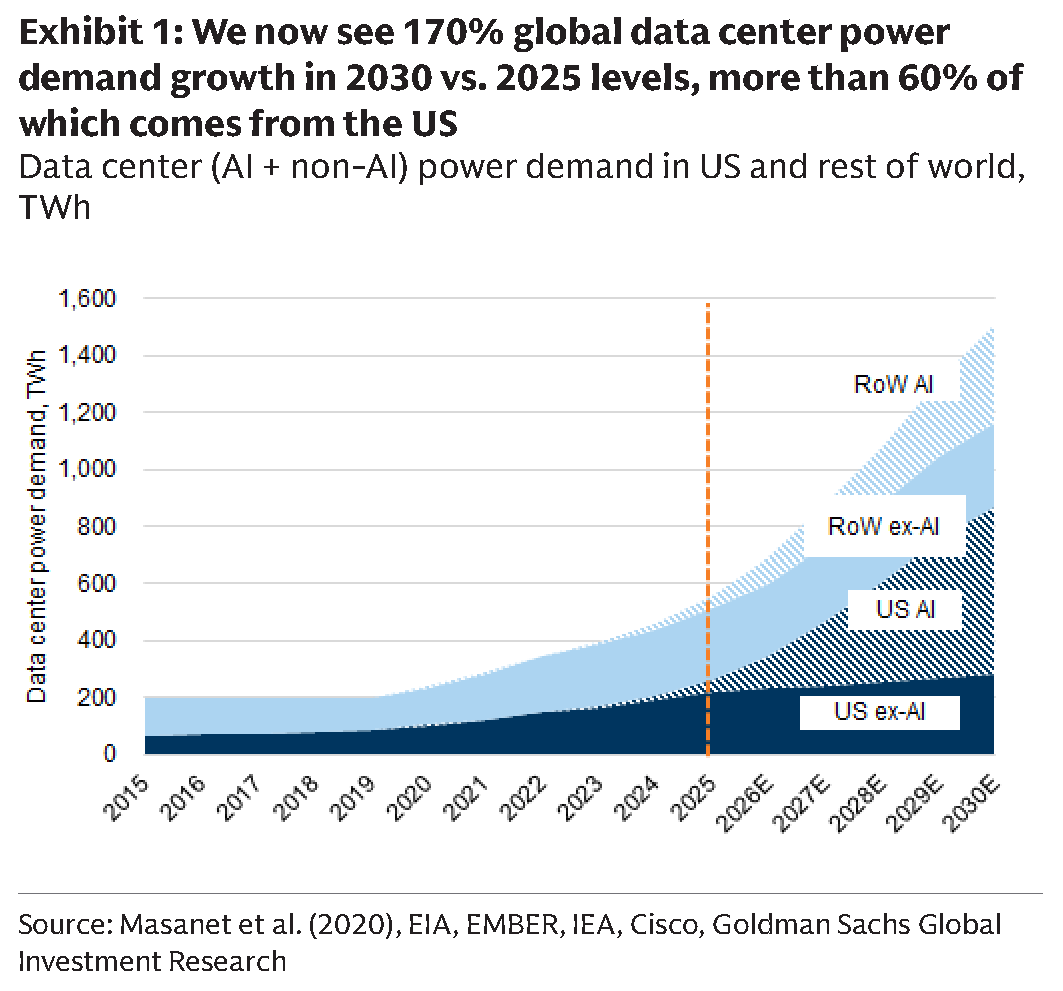
In power terms, the bank now sees 170% global data center power demand growth in 2030 vs. 2025(up from 117% previously), more than 60% of which comes from the US.
That, in turn, pushes Goldman’s total power demand CAGR to 3.5% through 2030 – a number that would have been laughed out of any utility investor day just five years ago.
The supply side: the grid is not coming to save you
Here is where the report gets properly grim for anyone waiting patiently in an interconnection queue (recall a month ago we said that just Texas alone is facing 474GW of interconnection requests (ERCOT), of which 90% is data centers. Which is why gov Abbott froze rollout of new data centers in Texas). According to Goldman, the pace of new US high-voltage transmission construction has collapsed from an average of 1,700 miles per year in 2010-14 to just 350 miles per year in 2020-23, with only 55-125 new miles added in 2023-24. Meanwhile, the median time from interconnection request to commercial operation is now approaching 5 years.
And the grid-side outlook is actually the optimistic read. INNIO, one of the engine makers profiled in the report, says grid connection times have stretched from ~2 years historically to 7+ years today, which is why hyperscalers are now signing 15-year contracts for BTM power. When the alternative is waiting until the next decade to switch on a multi-billion dollar campus, “temporary” on-site power has a way of becoming permanent (as we noted in “Why Data Centers Favor On-Site Gas Power“, the marginal cost of running an on-site gas plant may well end up below industrial tariffs anyway).
There is also the ratepayer angle, which is the whole reason we started pounding the table on BTM in the first place. Every GW that a hyperscaler generates on site is a GW that doesn’t get socialized into Grandma’s electric bill, and with 142 anti-data-center rallies across 42 states this summer (see “The Data-Center Revolt Goes National” from July 19), the political cost of not doing BTM is only going up, and is virtually assuring
So how big does BTM get?
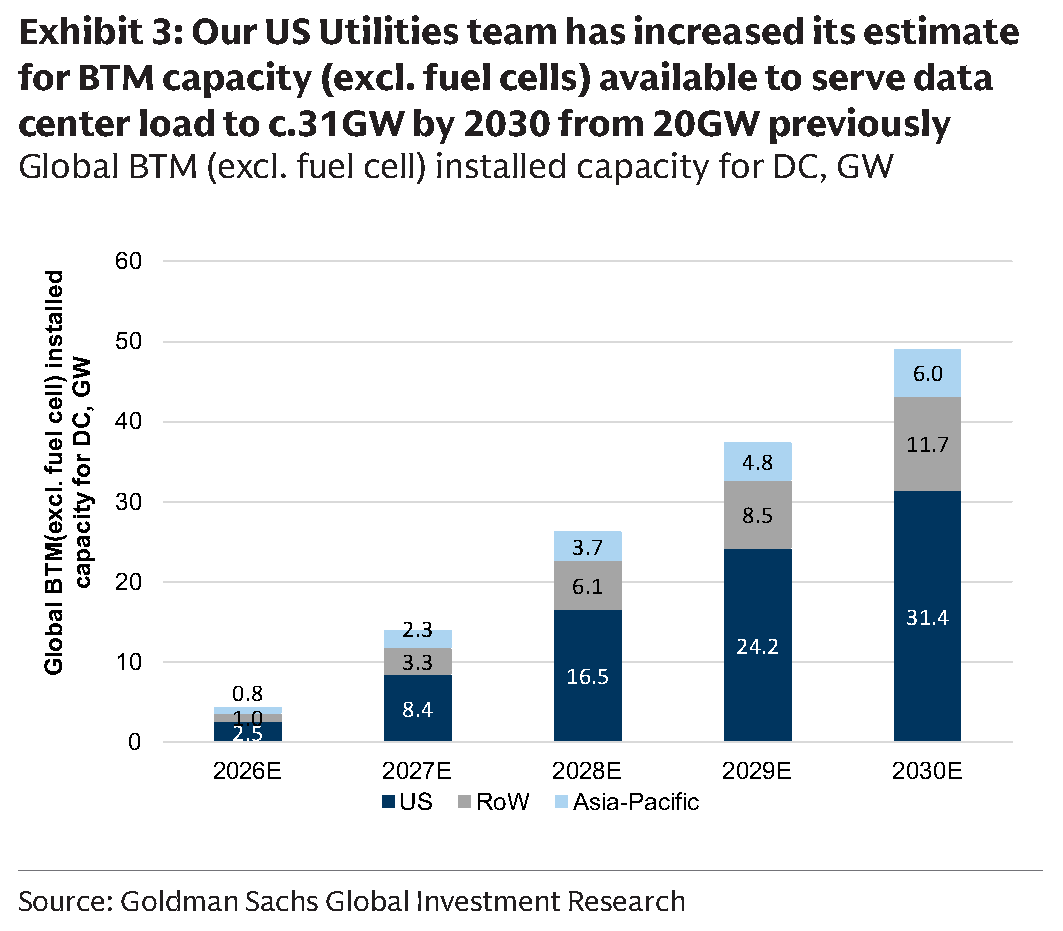
Goldman’s US Utilities team raised its estimate of Behind-The-Meter capacity (excluding fuel cells) available to serve data center load to 31GW by 2030 from 20GW previously, corresponding to 22GW of delivered power vs. 14GW before. Globally, gas-BTM capacity for data centers hits almost 50GW by 2030.
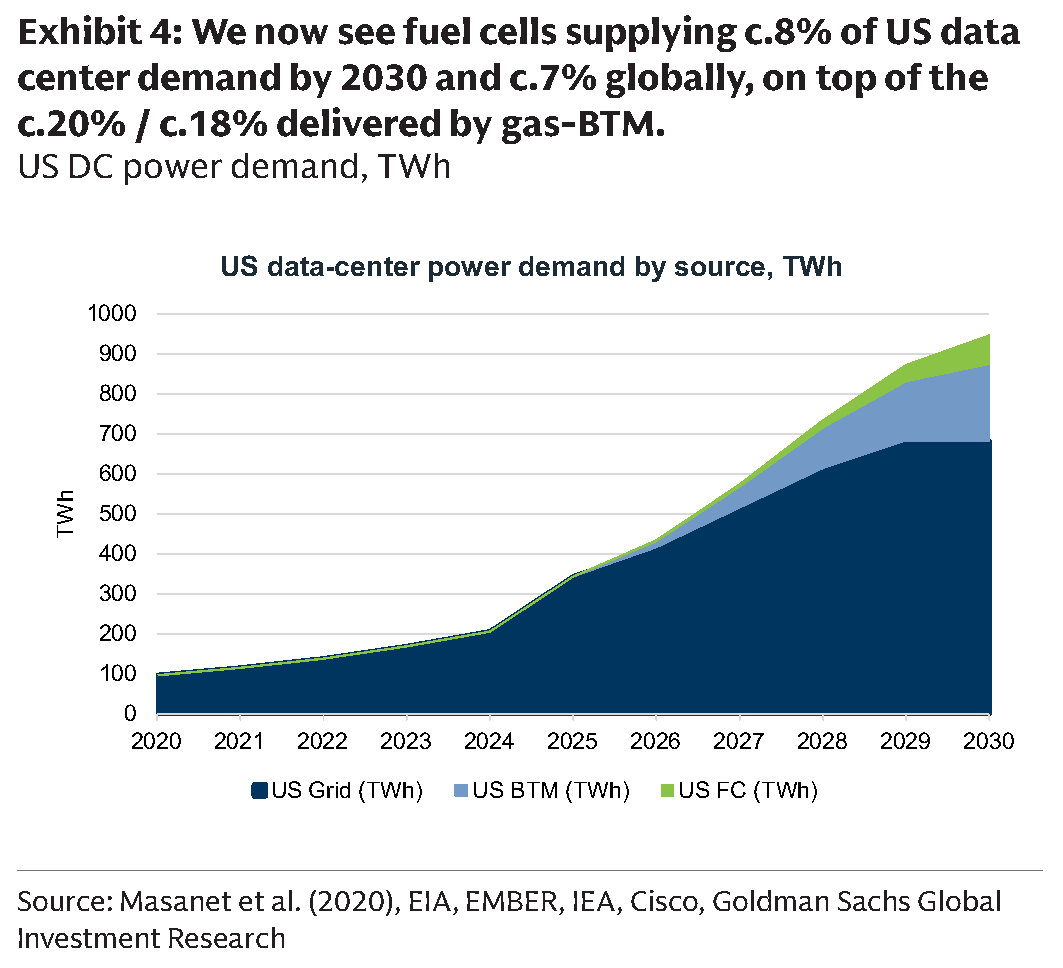
On top of that, Goldman now models a separate pool for fuel cells, which it sees supplying 8% of US data center demand by 2030 (7% globally), on top of the 20% / 18% delivered by gas-BTM. In installed terms, that’s 12GW of fuel cells in the US and 18GW globally by 2030, from a de minimis base today, translating into a cumulative equipment TAM of $35bn in the US and $55bn globally, with a recurring service and stack-replacement stream on top.
Regular readers will recall that back in February, in “Fuel Cells Poised To Capture 1/3 Of Data Center Power Demand By 2030“, we covered Goldman’s first pass at this, when the bank estimated 7-19GW of fuel cell capacity would be needed by 2030. The new 12GW US / 18GW global numbers sit at the top end of that range, which Goldman says gives it “higher conviction in both the level and the composition of the addressable market.”
Why LCOE no longer matters (much)
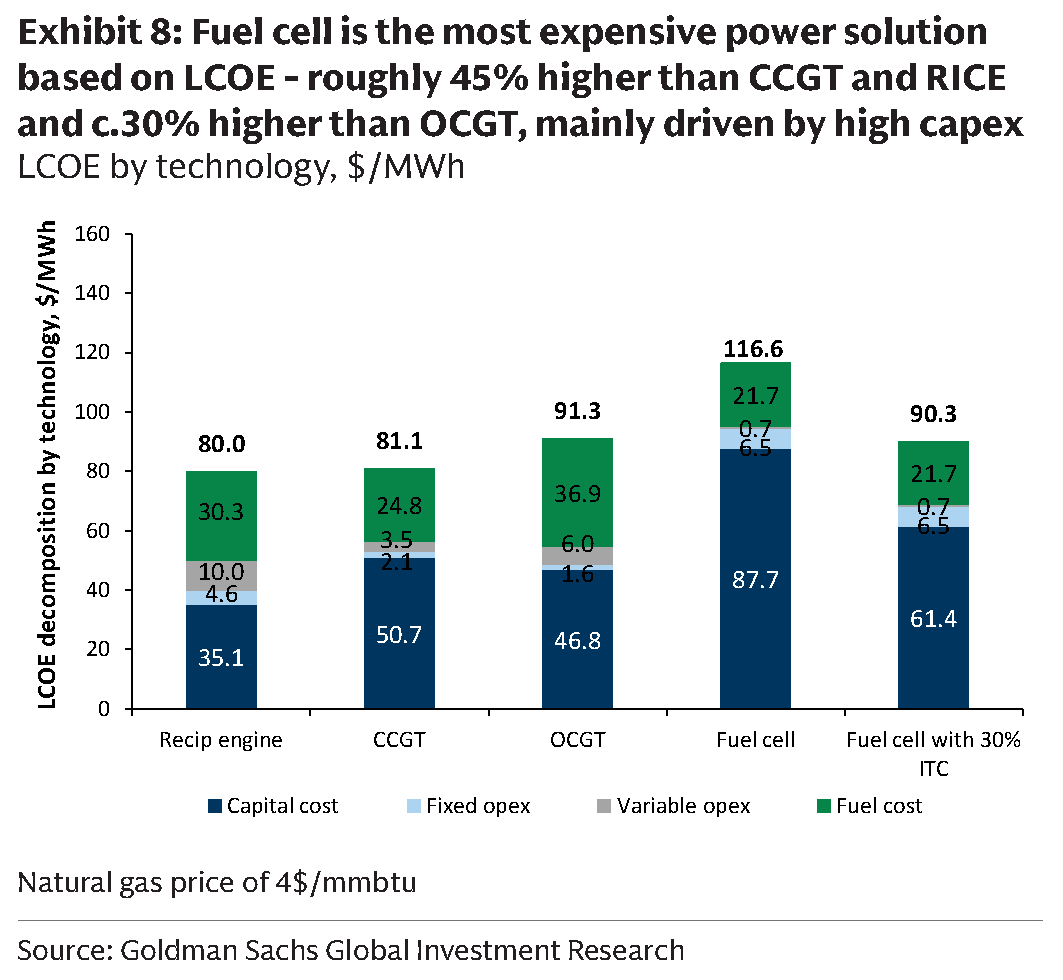
Here is the part of the report that should make every utility-model spreadsheet jockey slightly uncomfortable. On pure cost, fuel cells are the worst option on the table. Goldman’s LCOE (Levelized Cost of Energy is the average cost to build and operate a power plant per unit of electricity generated over its entire lifecycle) work for a 500MW data center shows reciprocating engines at $80/MWh, CCGTs at $81/MWh, OCGTs at $91/MWh and fuel cells at a hefty $117/MWh – roughly 45% above CCGT and RICE and c.30% above OCGT (at $4/mmbtu gas). Even with the 30% ITC, fuel cells only get down to $90/MWh.
The culprit is capex: Goldman assumes installed costs of $1,800/kW for recip engines, $2,400/kW for OCGT, $2,600/kW for CCGT and a whopping $4,750/kW for fuel cells (the ITC takes the fuel cell system down to ~$2,700/kW). Note also that CCGT costs have gone from ~$1,300/kW in 2023 to $2,000-2,200/kW in 2025, with post-2030 deliveries approaching $2,500/kW – turbine inflation is doing the fuel cell salesmen’s work for them.
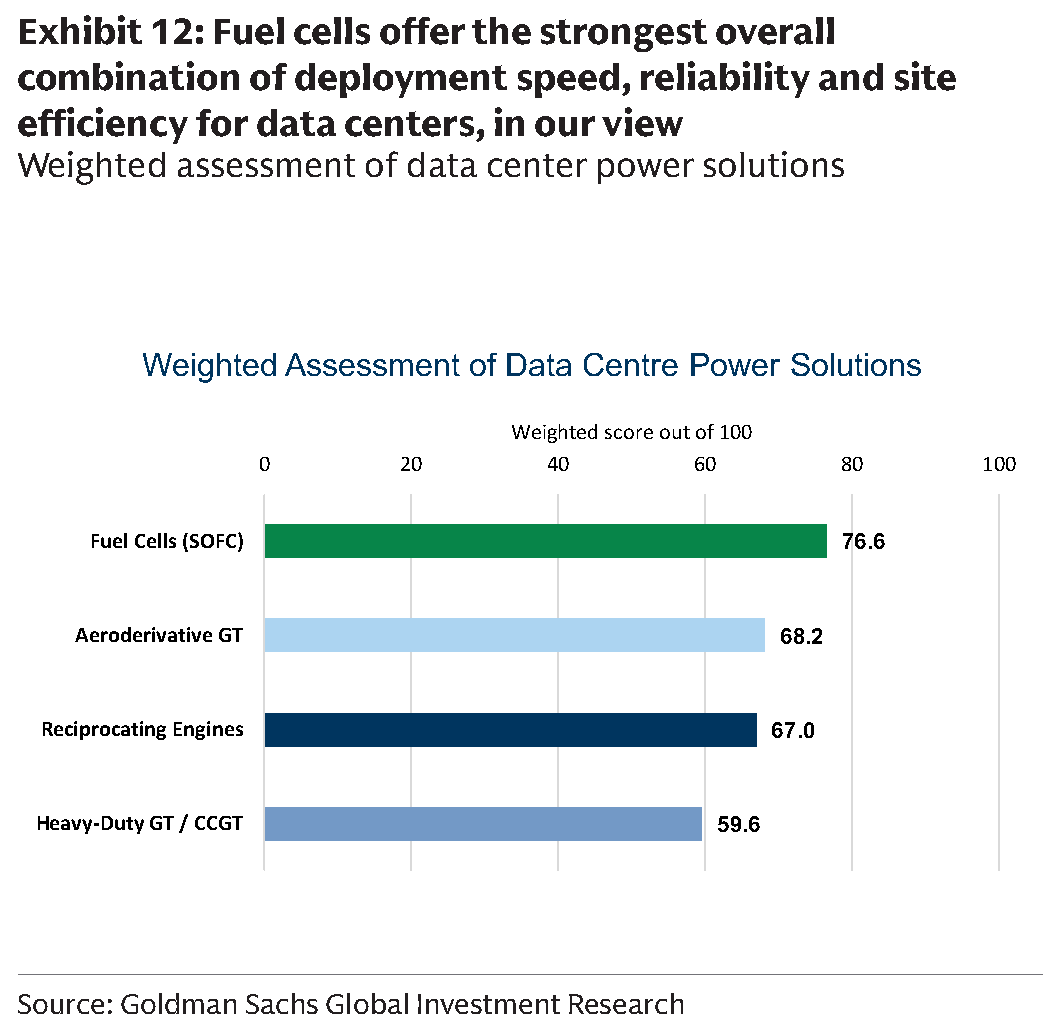
And yet fuel cells win Goldman’s weighted scorecard, with a score of 76.6 vs. 68.2 for aeroderivative turbines, 67.0 for recip engines and 59.6 for heavy-duty GT/CCGT.
The radar version of the same scorecard shows the trade-off even more clearly. Fuel cells (solid dark blue) max out on time-to-power, availability, load-following, power-path efficiency, water use, noise and sensitivity to gas prices, then collapse toward the center on the two metrics utilities have traditionally cared about most: LCOE and upfront capital costs. Recip engines (green dashes) are close to the mirror image, with top marks on cost, modularity and load-following but near-bottom scores on maintenance, noise and emissions. And the heavy-duty turbine/CCGT, the workhorse of every utility IRP for the past 30 years, scores well on LCOE, availability and efficiency, but ends up close to the center on time-to-power, which is the one axis that matters when the order book runs to 2031.
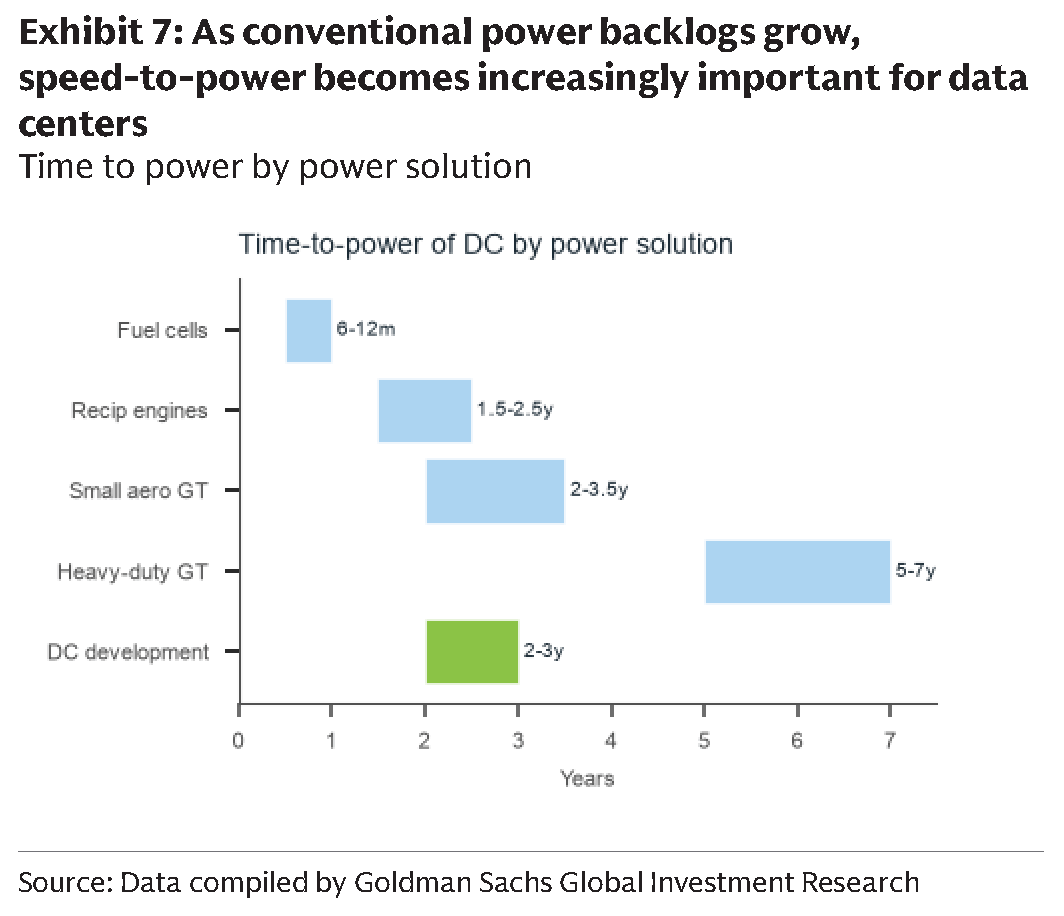
Why does the most expensive option win? Because the scorecard weights time-to-power at 20%, availability at 15%, LCOE at 15% and upfront capex at 10%, and when it comes to time, nothing else comes close. SOFC manufacturers quote 6-12 months from order to power. Recip engines are now 1.5-2.5 years. Heavy-duty gas turbines? 5-7 years, vs. 2-3 years in a “normal” market.
Bottom line: if you want power soon, you’re gonna pay. A lot.
Bloom Energy (not covered by Goldman) summed up the new math on its 2Q call better than any LCOE model could: customers now think in terms of “total cost of power to token revenue,” and one month of earlier power availability for a 1GW data center could be worth $1-2 billion of revenue. At those numbers, a $37/MWh premium over a CCGT is a rounding error. No wonder Bloom stock ripped to record highs after it blew out estimates and hiked guidance in April (see “Bloom Energy Erupts On Beat, Guidance Upgrade As On-Site Data Center Power Demand Soars” from April 29).
Two more wrinkles work in the fuel cells’ favor. First, they need the least overbuild: to serve a 500MW IT load, Goldman estimates fuel cells need just ~9% excess capacity (c.725MW installed) vs. +22% for recip engines, +26% for OCGT and a massive +47% for CCGT (c.979MW).
Second, fuel cells spit out DC power, which plugs straight into Nvidia’s push for 800V HVDC rack architecture and skips the transformer/converter/inverter chain that currently loses ~10-12% of electricity along the way (vs. ~3% in the DC design).
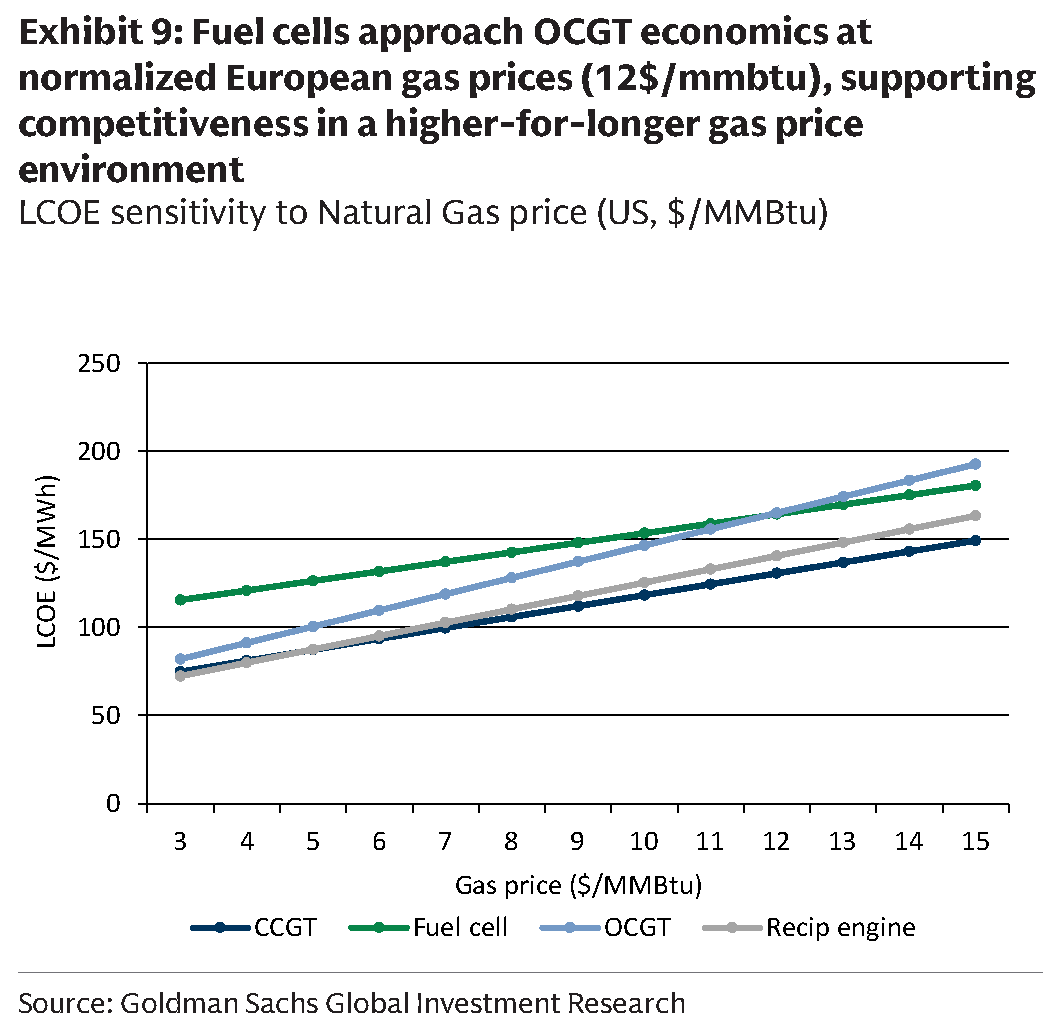
Finally, for those who believe (as we do) that natgas prices aren’t staying at $4 forever, fuel cells have the lowest sensitivity to the fuel bill thanks to their ~60% electrical efficiency. At around $12/mmbtu – close to Goldman’s normalized 2027 TTF estimate of c.$11 – fuel cell LCOE converges with single-cycle gas turbines.
The turbine queue: “now taking reservations for 2031”
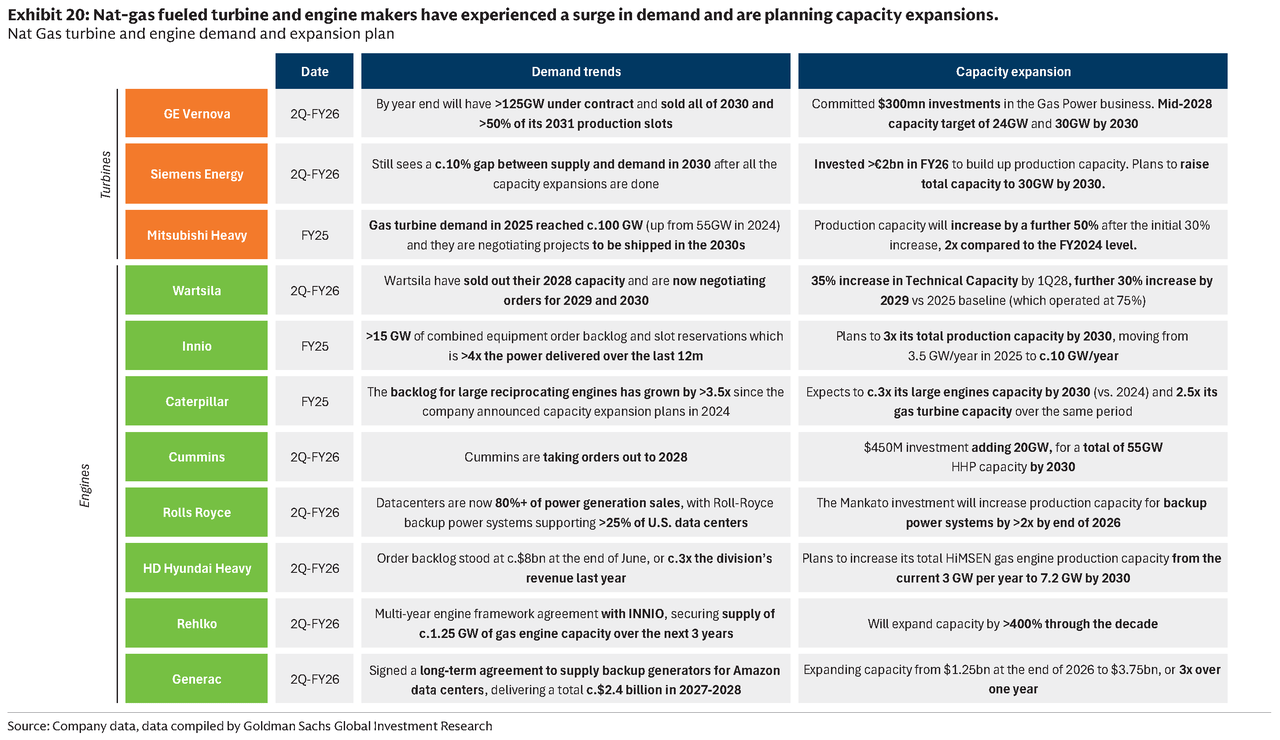
Of course, the main reason fuel cells, recip engines and even refurbished boilers are all suddenly in vogue is that the gas turbine market is sold out. Goldman notes that global gas turbine awards hit 100GW in 2025 (vs. 55GW in 2024), and 2026 is tracking even hotter with 67GW booked YTD (38GW in 2Q alone).
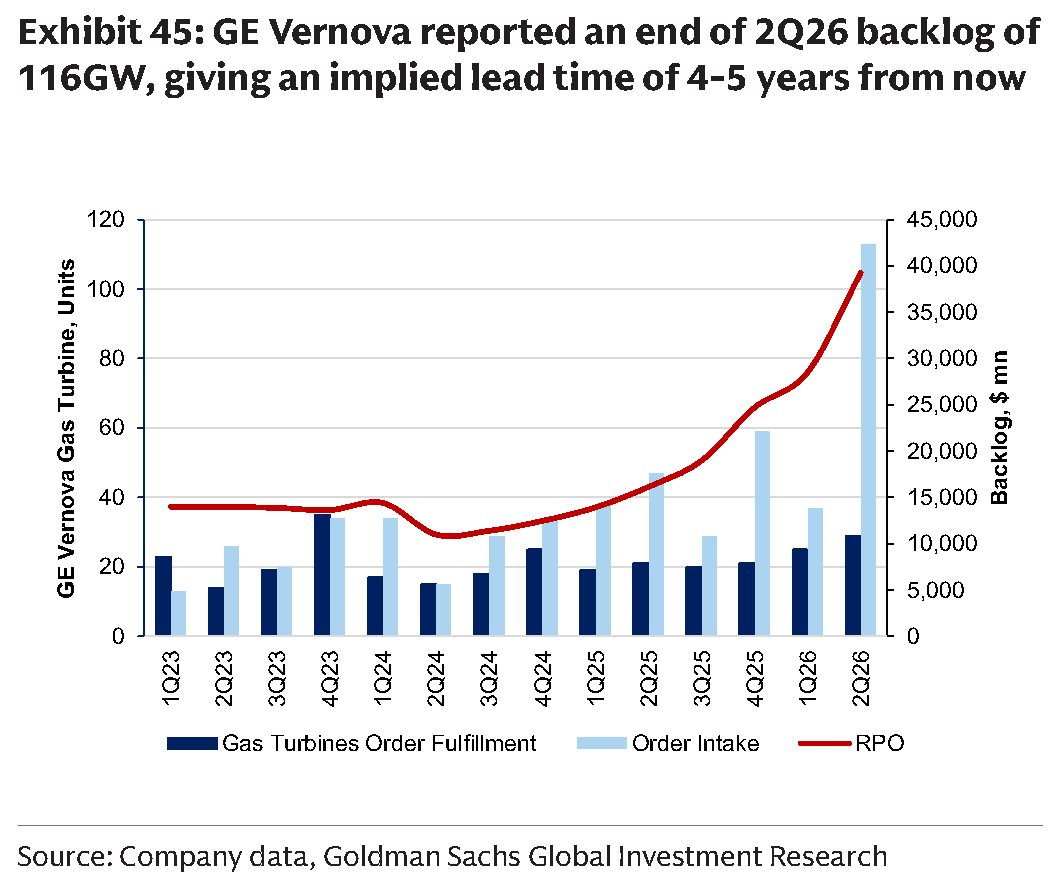
GE Vernova’s backlog plus slot reservations reached 116GW at the end of 2Q26, and the company expects >125GW by year-end with all of 2030 sold and >50% of 2031 production slots on contract – which is why, back in July, we titled our GEV earnings recap “Now Taking Reservations For 2031 Delivery“. Siemens Energy has accumulated 87GW of commitments, 24GW of which are data center related, and still sees a ~10% supply-demand gap in 2030 after all announced expansions. MHI is already negotiating projects to ship in the 2030s.
The engine makers are no better off: Wärtsilä has sold out 2028 and is negotiating 2029-30 slots; INNIO’s backlog plus reservations is >15GW, more than 4x trailing 12-month deliveries (and it just booked a 1.1GW prime-power order for a single megascale data center); Caterpillar’s large-engine backlog is up >3.5x; Cummins is taking orders out to 2028; and Rolls-Royce says data centers now account for 80%+ of its power generation sales.
dc
The desperation is palpable: last month Elon Musk’s SpaceX moved to build its own turbine blade factory in Texas to break the bottleneck (“Profound Game-Changer“, August 29), and AI developers have gone full 19th century, reviving industrial boilers and steam turbines just to get something spinning before 2032 (“Gas Turbine Shortage Sends AI Developers Back To Boilers And Steam“).
…and fuel cells aren’t immune either
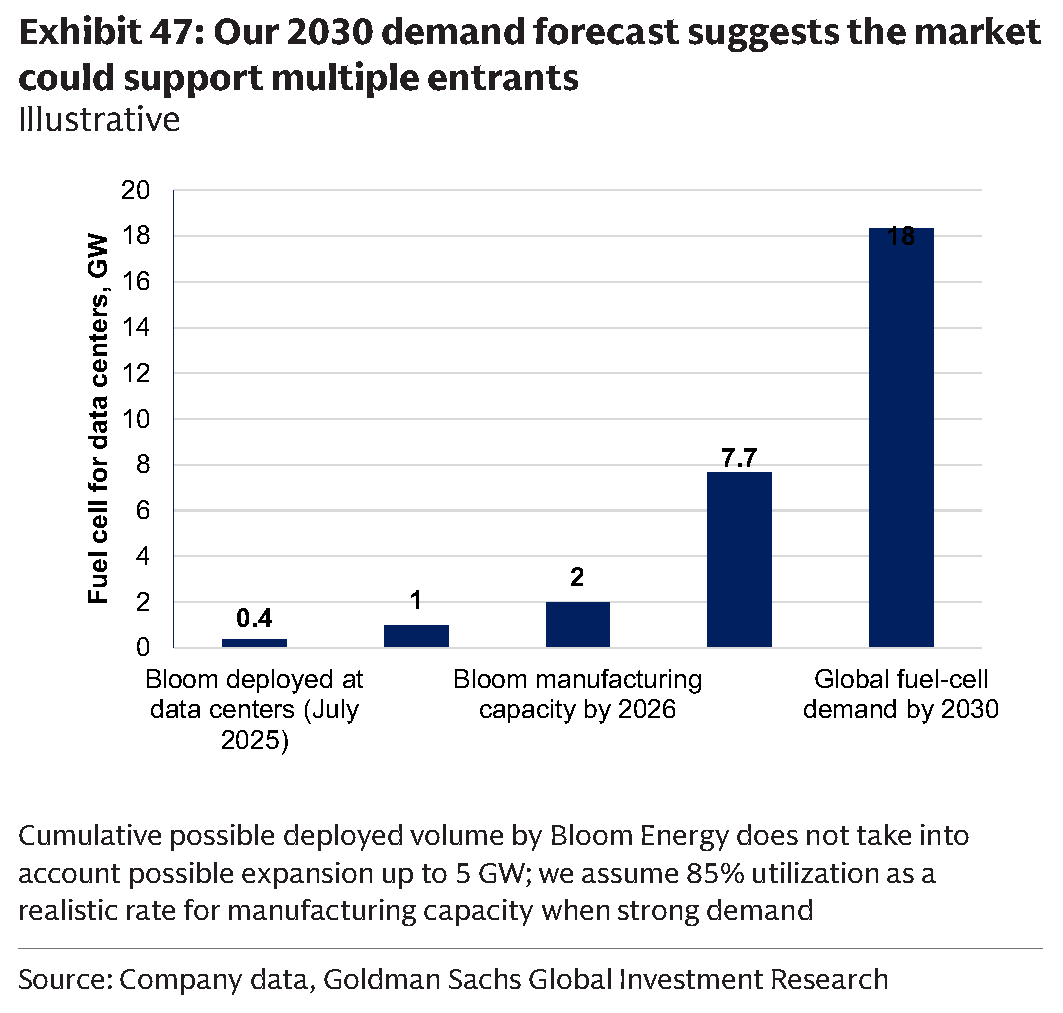
Before anyone concludes that fuel cells are the silver bullet, Goldman’s own supply math tells a different story. Bloom’s new 2GW production line, assuming full ramp and 85% utilization, would deliver a cumulative ~7.7GW by 2030 – well short of the ~18GW Goldman forecasts is needed. Getting there requires ~3.8GW of installations per year globally, which means multiple manufacturers (Ceres Power licensees Doosan, Delta, Weichai and whoever else signs up) all scaling at the same time. Doosan’s dedicated Ceres-tech facility, for reference, currently has 50MW of annual capacity.
In other words, even the “fast” solution is set to be capacity-constrained for years. And let’s not forget what these boxes actually run on: natural gas. The fuel cell is cleaner and quieter than a turbine, and it’s great that Goldman’s Carbonomics team has found a way to love a methane-powered data center, but at the end of the day every one of these BTM solutions is a bet on cheap, abundant gas and pipeline access. Which brings us to…
The long-term answer: go nuclear, go modular
Buried on page 6 of the report is the sentence that matters most for anyone thinking beyond 2030. Goldman lists small modular reactors among the viable BTM options, noting that they are “reliable and relatively cheap over the long run,” but concludes that “owing to their long investment cycle, the majority of the investments from data centers are unlikely to result in their realization before 2030.”
We agree with the timing, and that is precisely the point. Everything in this report – turbines, recips, fuel cells, even gas – is a bridge. It is the best bridge available, and we’d make it mandatory tomorrow, but it is a bridge built on 5-7 year turbine queues, capacity-constrained fuel cell lines, and the assumption of $4 gas forever. The only permanent, scalable, fuel-price-insensitive, zero-emission, genuinely behind-the-meter solution for a 1GW AI campus is a modular reactor sitting on site.
That’s why we have long argued that modular reactors such as those being developed by NANO Nuclear are the only long-term solution to the data center power crunch. As we previously reported, NANO’s KRONOS micro modular reactor – designed to produce 15 MWe (45 MWth) – began drilling at the University of Illinois, with the reactor explicitly targeting data centers, industrial sites and military applications. And just last month, NANO signed a commercial framework with Tillman Digital Gateway to deploy modular reactors across US data center campuses, targeting 2GW by the mid-2030s and 6GW by 2040 (“Nano Nuclear Energy Signs Commercial Framework With Tillman To Enable Nuclear Power For Data Centers“, August 24). As NANO CEO James Walker put it, “power availability is becoming one of the defining constraints on the continued expansion of AI infrastructure.”
In fact, if you line up Goldman’s timeline with the SMR developers’, the handoff almost writes itself: gas-BTM and fuel cells carry the load through 2030 (and absorb the ratepayer backlash), while modular nuclear scales into the 2030s just as the first generation of on-site gas assets comes up for recontracting and gas prices do whatever gas prices do. (For more on why the “nuclear renaissance” keeps coming back to small reactors, watch our ZH debate on the topic of “Modular Reactors To Solve Data Center Hysteria?” from July 8).
Stock exposure
For those looking for the trade, Goldman’s Buy-rated names most leveraged to the BTM theme are:
Fuel cells: Ceres Power (CWR.L, PT 930p) – asset-light licensing model, with royalties seen reaching £99mn (base) to £178mn (upside) by 2030 and EBIT margins going from loss-making to ~50%; Weichai Power (2338.HK, PT HK$55) – holds a 17.8% stake in Ceres, targets 700MW+ of SOFC capacity by 2030, and every GW shipped adds an estimated Rmb3.5-4bn of net profit; and Delta Electronics (2308.TW, PT NT$4,120) – pilot SOFC production by end-2026, mass production in 2027-28.
Conventional gas BTM: GE Vernova (GEV, PT $1,268), Siemens Energy (ENR1n.DE, PT €212), Mitsubishi Heavy Industries (7011.T, PT ¥6,200) and INNIO.
And, of course, for those who, like us, think the real endgame is nuclear, there are plenty of names that we have been flagging for a while which aren’t in Goldman’s report at all – that would be the entire nuclear modular space – and which is trading between 50% and 80% lower compared to a year ago.
Two-Month China Truce Falls Short Of Expectations As Markets Fade Trump-Xi Summit
Donald Trump gave Xi Jinping the full state-visit treatment in Washington, but markets were more interested in what the two leaders did not deliver.
After three days of ceremony, an unusually warm presidential welcome and repeated pledges to stabilize relations between the world’s two largest economies, the main economic outcome was a two-month extension of the existing U.S.-China trade truce, pushing its expiration from November 10 to January 10, 2027.
That averted an immediate return to escalation, but fell short of the longer runway many investors had expected.
President Donald Trump, center right, first lady Melania Trump, right, China’s President Xi Jinping, center left, and his wife Peng Liyuan watch a silent drill platoon review on the new helipad from the Blue Room Balcony of the White House, Thursday, Sept. 24, 2026, in Washington. (AP Photo/Alex Brandon)
Following the meeting, China’s CSI 300 fell 1.7% on Thursday, its worst session in a month, while the Shanghai Composite lost 1.2%. On Friday, with the mainland shut for the Mid-Autumn holiday, the Hang Seng dropped another 1.7% to a two-month low, with technology and AI shares leading the decline. The yuan also gave back part of its pre-summit advance as the dollar strengthened.
The reaction was notable because expectations were hardly euphoric going in. The summit had been billed primarily as an exercise in stabilizing a relationship still divided over tariffs, advanced technology, rare-earth supplies, Taiwan and Iran. Even against that modest bar, the two-month extension came in short: Wall Street had generally been discussing three to six months, while some investors had hoped for a one-year rollover.
Barclays senior China economist Yingke Zhou summed up the meeting as “more signaling, less substance.” Zhou’s broader point was that Washington and Beijing appeared focused on preventing another breakdown in relations rather than resolving the disputes that produced the truce in the first place.
The Deal Wasn’t Nothing
The White House said the two governments formally operationalized their previously announced Boards of Trade and Investment. Under the Board of Trade, officials reached consensus on recommendations for more favorable tariff treatment covering roughly $30 billion of non-sensitive goods in each direction, including U.S. agricultural products and medical devices and Chinese consumer goods. China also committed to importing at least 10 million metric tons of U.S. coal in both 2027 and 2028.
U.S. Trade Representative Jamieson Greer said Friday that the two sides had reached agreements allowing certain products to remain outside future tariff disputes and promised significantly more detail on Monday.
“We’re in a managed trade situation,” Greer said, adding that the administration would release “a lot more details” about the negotiations.
That means Monday’s announcement could materially change the initial assessment of the summit. A detailed list of tariff exclusions, purchase commitments and implementation dates would give businesses something they can actually model.
But the official fact sheet also made clear how much remains unfinished.
Rare earths are the most obvious example. Washington said the two governments “continue to work” on U.S. concerns about shortages of rare earths and other critical minerals – careful language that confirms the supply issue remains unresolved. Chinese shipments of rare-earth magnets to the U.S. had already fallen sharply in August, and Beijing’s export-licensing regime continues to give it substantial leverage over Western manufacturers.
There was no broad settlement on advanced semiconductors. No breakthrough on Taiwan. And although the two countries have agreed to establish what the White House calls a “Super Intelligence Dialogue” and an emergency-communication channel, the details remain thin enough that markets have little basis yet for pricing an investment impact.
Rare Earths And Taiwan Are Still There
The rare-earth issue may be the clearest test of whether the current detente has changed the balance of leverage.
China remains dominant in both mining and, more importantly, processing of rare-earth materials, while U.S. officials have complained that deliveries have not fully met earlier commitments. The White House’s own language after the summit indicates that Washington is still seeking more reliable shipment levels.
Taiwan is similarly unresolved. Xi pressed Trump during the visit to take a harder line against Taiwanese independence. At the same time, Washington has been weighing another arms package for Taipei worth roughly $14 billion. Secretary of State Marco Rubio said during the visit that delays in arms sales to Taiwan reflect concerns about U.S. weapons production.
Whatever the eventual timing of that sale, the important point for markets is that the summit did not remove Taiwan from the bilateral risk ledger.
The same is true of AI. Both sides agreed to continue talks, including work on an incident-communication channel, but they remain competitors in advanced chips, models and computing infrastructure.
Sixty Days Of Visibility
For companies exposed to U.S.-China trade, January 10 is better than November 10. It gets the current arrangement through the Christmas import season and prevents an immediate reopening of the tariff war.
But sixty days is not much planning horizon for a manufacturer deciding where to build a plant, sign a multiyear sourcing contract or commit billions of dollars in capital.
And the tariff burden has not disappeared. The latest Penn Wharton Budget Model data put the effective U.S. tariff rate on Chinese imports at roughly 23%, compared with about 7% overall. China still faces the highest effective rate among major U.S. trading partners.
That helps explain why investors distinguished between stability and resolution.
There is a constructive side to that. China’s export sector has remained remarkably resilient, and keeping the truce intact removes the immediate threat of another tariff shock. U.S.-bound manufacturers, electronics suppliers, appliance makers and auto-parts exporters all benefit from having the deadline pushed into next year.
A Summit Built Around Stability
Trump personally greeted Xi and Peng Liyuan at Joint Base Andrews, an unusual gesture for a visiting head of state. The White House staged a formal arrival ceremony and military flyover, followed by bilateral meetings, a state dinner, tea and a visit to the National Archives. Xi repeatedly called for a stable long-term relationship and said the U.S. and China could avoid the so-called Thucydides Trap of conflict between a rising and established power.
China also revived one of its oldest diplomatic tools: pandas. Beijing agreed to send two giant pandas to Zoo Atlanta. Ping Ping and Fu Shuang arrived in Atlanta on Sunday.
But the composition of the summit showed the limits of the commercial thaw.
The American side brought a who’s who of technology and finance, with executives from Nvidia, AMD, OpenAI, Google, Microsoft, Amazon, Meta, Apple, Tesla and major Wall Street firms involved in the broader visit. Xi’s official delegation, by contrast, was dominated by government officials rather than Chinese CEOs – a contrast Barclays cited in arguing that Beijing approached Washington primarily as a strategic dialogue rather than a corporate dealmaking exercise.
Washington and Beijing appear to have decided that keeping the relationship inside guardrails is itself valuable. What they have not done is settle the economic and geopolitical disputes inside those guardrails..
What To Watch Monday
First, Greer’s trade details. The White House has already disclosed the framework for preferential treatment of about $30 billion in non-sensitive goods. Monday should show how much of that framework is operational – which products qualify, when tariff treatment changes and what purchase commitments accompany it.
Second, mainland equities. China’s markets were closed Friday, leaving Hong Kong to absorb the final day of the summit in thin holiday trading. Monday will be the first full onshore session able to react to the completed visit and whatever additional trade details Washington releases.
Third, the yuan. Beijing guided the currency stronger ahead of the summit before allowing some of that move to reverse as the dollar rallied. With the diplomatic event now over, traders will be watching the PBOC’s daily fixing for clues about whether authorities still prefer gradual appreciation or are prepared to tolerate more two-way movement.
The Washington summit therefore leaves investors with a peculiar combination: less immediate danger, but few reasons to declare the underlying dispute settled.
Tariffs remain elevated. Rare-earth supplies remain an issue. Taiwan remains unresolved. AI competition remains intact. And the new trade deadline arrives less than four weeks after the leaders are expected to meet for the fourth time this year.
Washington bought another sixty days of stability. What happens inside those sixty days will determine whether it bought anything more.
TikTok and its creator ByteDance struck a deal Friday with Alabama that will pay the state at least $100 million and force changes in how teenagers use the app, days before what would have been the first state trial over claims the platform was built to addict minors.
TikTok is so powerful its logo alone can mesmerize children. George Chan/Getty Images
The money is due within 45 days. It can climb to $300 million if certain conditions are met, Alabama Attorney General Steve Marshall’s office said. Alabama was set to select a jury on Monday.
“This is a great day for Alabama parents,” Marshall said. “Tonight, they can rest easier knowing real protections are in place to shield their children from the dangers of social media addiction. TikTok has agreed to give parents real control over what their kids see and how much time they spend on the app.”
The complaint had accused TikTok of designing addictive features, exposing young users to serious mental harms, and misleading the public about safety.
TikTok did not admit those claims in the papers released Friday.
The company did not immediately return a request for comment.
The deal requires teen accounts in Alabama to have a two-hour daily cap, which parents can further shorten. After 15, 60, and 90 minutes of continuous use, the app must interrupt the session, a feature the office called “productive pauses,” intended to break endless scrolling.
Teen accounts will be unavailable from midnight to 6 a.m. Messaging and push alerts face extra limits overnight and during school hours. In addition, cosmetic filters are banned for teen users.
The default feed for those accounts is to remain non-personalized, and teen accounts are to be harder for adults to find. Parents get notice of suspicious contacts. Parental controls are supposed to be easier to use.
Last month, a multi-state Meta deal was set to bring Alabama $117 million on similar youth-harm allegations. Earlier, Roblox paid the state $12.2 million and agreed to tighter age checks and chat rules.
The Alabama deal arrives as other fights progress.
On Sept. 10, a Travis County, Texas, judge ruled that TikTok violated the state’s consumer protection law by misleading users about tools meant to keep minors from harmful videos. Judge Cory Liu found Restricted Mode did not work as marketed.
Texas Attorney General Ken Paxton said the case now goes to trial next month to set penalties.
“TikTok sacrificed the safety and innocence of children for engagement and numbers, and now they are being held accountable,” Paxton said then.
In early August, TikTok moved to settle three confidential teen mental-health suits. Lawyer Joseph VanZardt said written papers still had to be finished.
The plaintiffs – identified only as S.J., 15, of Illinois; P.M.Y., 15, of New Jersey; and K.D.B., 18, of Mississippi – alleged addiction, depression, self-harm and, in two cases, eating disorders. Roughly 3,300 similar suits sit before Los Angeles Superior Court Judge Carolyn Kuhl. Meta, YouTube, and Snapchat still face an October trial calendar.
A March jury in that same court awarded $4.2 million against Meta and $1.8 million against Google in a related individual case. TikTok settled that one before opening statements.
In August, the Justice Department separately announced TikTok and ByteDance would pay $400 million to resolve Children’s Online Privacy Protection Act (COPPA) claims. Officials called it one of the largest COPPA recoveries on record. The company did not admit fault.