The U.S. Department of Education on March 11 announced that 1,315 employees—about half its workforce—will be laid off within 90 days as part of its ongoing cost-saving measures.
A senior official told reporters in a press call that the staff reduction addresses redundancies in the communications, human resources, information technology, and other offices within the department.
The affected workers were to be notified via email at 6 p.m. on March 11. The Washington, D.C., office will be closed on March 12 for safety protocols, and the senior official said the workers are expected to work remotely with full pay and benefits through March 21. They will then be placed on administrative leave, with pay, through June 9.
The laid-off staffers will be awarded severance payments based on their years of service, with the most senior members receiving up to 20 weeks of salary.
The agency said about 600 of its 4,133 employees have already agreed to leave voluntarily, including 313 who accepted $25,000 buyout offers last week.
Department of Education offices outside of Washington, including New York, Boston, Dallas, Chicago, and San Francisco, will be closed. The dates are based on current leases and were not revealed. The senior official said that after the closures, all employees will work in one building in Washington.
The senior official said the staff reduction will not affect any of the department’s services, including college financial aid loan and grants functions, Title 1 funding for low-income students, special education funding, and civil rights functions.
She said these decisions were carefully thought out and will make the agency more efficient.
“What we are doing now is not working,” she said. “It’s just not.”
The Department of Education noted that the pay for administrative leave and severance packages is pursuant to federal regulations and the provisions of the unionized employees’ contract.
“Today’s reduction in force reflects the Department of Education’s commitment to efficiency, accountability, and ensuring that resources are directed where they matter most: to students, parents, and teachers,” Secretary of Education Linda McMahon said in a statement.
“I appreciate the work of the dedicated public servants and their contributions to the Department. This is a significant step toward restoring the greatness of the United States education system.”
The Education Department said some divisions will require “significant reorganization to better serve students, parents, educators, and taxpayers.”
This latest cost-saving effort follows the cancellation of $900 million in contracts related to the department’s Education Sciences agency and $101 million in contracts linked to diversity, equity, and inclusion training in education.
Those planned reductions were verified last month.
President Donald Trump previously noted his intention to shrink the Department of Education, move its functions to other federal agencies or states, and eventually eliminate it.
McMahon supports Trump’s plan to dissolve the department and eliminate her position after the agency’s functions and funding streams are moved to other federal agencies or states.
She previously told federal lawmakers that only Congress, which created the agency in 1979, has the authority to eliminate it.
Last week, McMahon said she would continue working with the Department of Government Efficiency to identify potential departmental reductions. Only 47 cents of every dollar her agency provides to states makes it to classrooms, she said, and most of the federal money is spent on compliance with regulations.
Countdown Has Begun To Resumption Of Attacks On Red Sea Shipping: Houthis
The Houthis of Yemen (Ansar Allah) have announced on Tuesday the countdown has begun to the resumption of attacks on Red Sea shipping and military vessels patrolling the waters.
The Iran-backed Shia group which has effectively been at war with Israel since the Oct.7 2023 Hamas attacks and beginning of the subsequent Gaza war has issued a new deadline for Israel to lift restrictions on humanitarian aid to the Strip.
“Confirming the readiness of the Yemeni naval operations, whose mission is to confront the Israeli American starvation and terrorist siege of Gaza,” an Ansar Allah spokesman Mohamed Ali Al-Houthi, posted in an Arabic statement on X.
“Any escalation will be the responsibility of the Israeli and American enemies,” the statement added. The Houthis had paused their long-running attacks on Red Sea vessels – both merchant ships and military – when the Hamas-Israel truce and hostage exchange deal took effect.
Deputy Head of Ansar Allah’s Media Authority Nasruddin Amer on X:
“Only hours separate us from announcing the closure of the sea to Zionist navigation if the efforts of the mediators fail to pressure the Zionist enemy to adhere to the agreement and lift the siege on Gaza.”
But when Israel starting last week blocked humanitarian aid and fuel shipments into the Gaza Strip, which has also more lately included the cutting off of remaining electricity supplies, the Houthis warned to restore the aid or else face resumed attacks.
The group’s leader last Friday had declared a four-day deadline before attacks on shipping would resume. That four day timeline is about to end by close of Tuesday, which means the Red Sea could be fiery scene of drone and missile attacks out of Yemen once again.
Since 2023 over 100 missile and drone attacks on commercial vessels have occurred in the Red Sea and the Gulf of Aden. The Houthis have also downed several MQ-9 Reaper drones operated by the Pentagon.
A US-led naval coalition which began under the Biden administration has been able to do nothing in terms of putting a dent in Houthi capabilities, even after several bombing raids on Yemen, also at times including Israeli and UK jets.
After a decade-long American effort to remove Syrian President Bashar al-Assad from power in Damascus, Senator Lindsey Graham says the US-backed jihadists that now control the country are causing more concern than ever.
In an interview on Fox News Sunday, Graham explained that he had “never been more worried about the deterioration of Syria than I am now.” The senator was discussing an outbreak of violence in the country, where forces aligned with the new government are conducting mass executions targeting the Alawites and other religious minorities.
Under President Barack Obama, Washington provided training and arms for Assad’s opposition, hoping to remove him from power and undermine Iran’s regional influence. However, the most powerful rebel factions were violent jihadists, a fact acknowledged in a 2012 internal memo circulated by Obama’s Defense Intelligence Agency (DIA).
During Trump’s first administration, he ended US support for the Sunni opposition, but enforced sweeping sanctions on Damascus that prevented the government from crushing Syrian al-Qaeda, led by Abu Mohammad al-Jolani and then concentrated in the country’s Idlib province.
At least some support for the rebels resumed during the Joe Biden presidency. In 2024, equipped with Ukrainian drones, Jolani’s forces went on the offensive, capturing Damascus and forcing Assad to flee the country.
Jolani and his organization – Hayat Tahrir al-Sham (HTS), a jihadist umbrella group – then seized control of the country. After dubbing himself the new Syrian leader, Jolani was embraced by Washington and its allies. Last week, when violence broke out in Syria’s coastal region, HTS responded by killing hundreds of Alawite civilians.
The events of the past weekend left Senator Graham questioning whether the US could still work with Jolani and HTS. “Is this al-Qaeda or ISIS-light or is this some new form of Islam that we can all live with?” he asked, adding that before any sanctions were removed, Jolani must comply with unspecified conditions.
Graham has supported the regime change operations against Assad for well over a decade. In 2012, he argued, “We need to form a coalition to help arm the rebels, as well as create no-fly and no-drive zones to stop the slaughter by the Assad regime. I cannot say with certainty what will follow Assad but I can say with certainty that Assad must go, sooner rather than later.”
“If America is seen as being helpful in ending the slaughter of the Syrian people, it will allow us to have a stronger, future relationship with Assad’s eventual successor,” he continued. “Replacing Assad in Syria is critical to regional stability, a major blow to the Iranian regime and will bolster our national security interests.”
The next year, the senator acknowledged that “radical Islamists are hijacking [the Syrian] revolution.” However, that did not sway Graham’s support for regime change.
In 2015, the South Carolina lawmaker argued that the US should prioritize taking out Assad to fighting the jihadists. “How can we train a Free Syrian Army or send any other force into Syria if we don’t first deal with the Assad air threat?” he said, referring to the country’s supposedly “moderate” rebel FSA faction.
During the first Trump administration, in 2020, Graham called for the creation of a no-fly zone in Idlib to protect HTS and its jihadi allies from Syrian government airstrikes. “The world is sitting on its hands and watching the destruction of Idlib by Assad, Iran, and the Russians. This is one of the greatest humanitarian disasters in decades and the brutal aggression of Assad supported by Iran and Russia needs to come to an end,” he said at the time.
“I very much appreciate Turkey’s intervention in Idlib. It is now time for the international community to establish a no-fly zone to save thousands of innocent men, women, and children from a horrible death,” Graham added.
Leaving birthright citizenship to the Roberts court is walking into a minefield – legislation is the smarter route to end this unnecessary relic of the 19th century.Here’s why.
If conservatives are counting on the Supreme Court to rule birthright citizenship for illegal aliens unconstitutional, think again – it isn’t the slam dunk many believe it to be. But that doesn’t mean there isn’t a better path to abolishing this disastrous policy for good.
Some background: President Trump’s Jan. 20 executive order rolling back birthright citizenship for illegal aliens stipulates that natural-born U.S. citizens must have at least one parent who is a citizen or permanent resident.
On Feb. 19, the 9th Circuit Court of Appeals upheld a nationwide injunction on the order until it hears the case in June. Trump’s lawyers will ultimately have to convince the Supreme Court of his interpretation of the 14th Amendment’s Section 1: “All persons born or naturalized in the United States, and subject to the jurisdiction thereof, are citizens of the United States and the state wherein they reside.”
Despite much legal analysis to the contrary, originalist conservatives should be wary of turning to the framers of the 14th Amendment or later Supreme Court rulings on this controversial issue.
Instead, Congress needs to immediately back up President Trump’s executive order before it makes its way to the Supreme Court. The justices will be more amenable to legislation, considering Section 5 of the 14th Amendment givesCongress the “power to enforce, by appropriate legislation, the provisions of this article.”
The court has never established precedent on birthright citizenship for the children of illegal aliens, but it acts like Wong Kim Ark (1898) – which established it for legal immigrants’ children – did.
In Plyler v. Doe (1982), liberal Justice William Brennan muddied the waters, writing in a non-binding footnote that there is “no plausible distinction with respect to Fourteenth Amendment ‘jurisdiction’” between lawful and unlawful immigrants. Notably, none of the four justices who dissented in Plyler v. Doe objected to Brennan’s footnote on birthright citizenship – including conservatives William Rehnquist and Sandra Day O’Connor.
We should expect the current Supreme Court to examine the framers’ intent, something the late University of Texas law professor Lino Anthony Graglia correctly argued is the best way to interpret a constitutional law. But that’s where things get tricky.
In 1866, the House of Representatives didn’t debate the birthright citizenship issue because the version that body passed didn’t include that clause in Section 1.
Once the amendment moved to the Senate, however, debate transcripts show senators interpreted the birthright citizenship clause – introduced by Sen. Benjamin Wade (R-OH) – to extend to everyone born in the U.S., except the children of foreign diplomats and – at the time – Indian tribe members.
Sen. William Fessenden (R-ME) specifically asked if the clause would include those “born here of parents from abroad temporarily in this country.”
“I know that is so in one instance,” replied Sen. Wade, “in the case of children of foreign ministers . . . their children would not be citizens of the United States, although born in Washington.”
Some point to the statement of Sen. Jacob Howard (R-MI) as evidence that the 14th Amendment’s original intent did not extend birthright citizenship to the children of non-citizens. “This will not, of course, include persons born in the United States who are foreigners, aliens, who belong to the families of ambassadors of foreign ministers accredited to the government of the United States,” he said.
But Sen. Howard was simply reiterating Sen. Wade on diplomats’ children. We know this because senators subsequently rose in opposition and support of the clause precisely because it would give birthright citizenship to the children of foreigners and aliens, and no one – including Sen. Howard – objected to their interpretation.
Sen. Edgar Cowan (R-PA) opposed the clause because it would give birthright citizenship to the children of Gypsies who “settle as trespassers.”
Sen. John Conness (R-CA) said, “I voted for the proposition to declare that the children of all parentage whatever, born in California, should be regarded and treated as citizens of the United States . . .”
Sen. Conness then threw up a roadblock to the argument that the 14th Amendment doesn’t apply to temporary legal residents’ children. To reassure Sen. Cowan, the amendment would not cause the Chinese to immigrate Californians “out of house and home,” he explained, “The habits of those people, and their religion, appear to demand that they all return to their own country at some time or other, either alive or dead.”
This is the heart of the problem for conservatives counting on our originalist Supreme Court today to rule birthright citizenship unconstitutional. If the Roberts court – which laudably bases decisions on the words and original intent of the men who authored our constitutional amendments – stops here, we might end up enshrining birthright citizenship forever instead of abolishing it.
Prof. Graglia argued the senators could not have meant to grant birthright citizenship to the children of illegal aliens because “there were no illegal aliens in 1868.” Although mid-19th century American immigration law was a veritable Wild West compared with today, it isn’t smart to gamble that at least five justices will distinguish between 19th century Gypsy “trespassers” and today’s illegal aliens.
But that’s only half of President Trump’s executive order. There remains far less hope that the court will interpret the 14th Amendment to exclude the children of temporary legal immigrants based on the statements of Sens. Wade and Conness.
A 2010 Congressional Research Service report concluded: “In a still evolving area of law,” the court has held that Congress can use Section 5 to go “beyond judicial decisions defining such rights in order to enforce” the 14th Amendment. It added that even if the court were to disagree, Congress already has the power to define “subject to the jurisdiction thereof” under its immigration and naturalization authority in clauses 4 and 18 of Article I, Section 8.
Congress has already established precedent in redefining “subject to the jurisdiction thereof” with the Indian Nationality Act of 1924. It follows that Congress could have as easily excluded illegal aliens from birthright citizenship in the Citizenship Act of 1934, the Nationality Act of 1940, or the Immigration and Nationality Act of 1952.
The Supreme Court itself suggested as much in Kim Wong Ark when it explained why the U.S., even in 1898, remained an anomaly in offering birthright citizenship. In the feudal era, Europe, too, offered citizenship based strictly on birthplace. That changed when legislatures modernized their citizenship laws. Nothing’s stopping Congress from doing the same – so they should.
Fortunately, there’s already a solution at hand. Republican Sens. Katie Britt (AL), Lindsay Graham (SC), and Ted Cruz (TX) have co-sponsored the Birthright Citizenship Act of 2025, which mirrors Trump’s executive order. President Trump should rally Republicans to pass it and gain a surefire victory instead of betting on the high court and risking cementing this relic of the 1860s forever.
Americans are tired of our broken immigration system rewarding mass immigration and illegal aliens and are demanding a historic and lasting solution. Voters gave Trump a mandate to end birthright citizenship. He did his part admirably. If successful, this will be one of his greatest legacies. Now it’s up to Congress to do its part in ensuring that mandate makes it over the finish line.
“Shred And Burn All Documents”: USAID Staff Ordered To Destroy Evidence On Tuesday
A senior USAID official on Tuesday ordered the agency’s remaining staff to report to their now-former headquarters in Washington DC for an “all day” group effort to destroy documents, many of which contain sensitive information, Politico reports.
The materials marked for destruction include “classified safes and personnel documents” at the Ronald Reagan Building, according to an email sent by USAID’s acting executive director, Erica Carr.
“Shred as many documents first, and reserve the burn bags for when the shredder becomes unavailable or needs a break,” read the email instructing staff to label the burn bags with “SECRET” and “USAID/B/IO” (which stands for “bureau or independent office”) in dark sharpie.
🚨🚨 THIS IS A 5-ALARM FIRE 🚨🚨 Right now, as we speak, today, USAID is shredding and burning the contents of the agency’s classified safes — the key information needed to reconstruct the history of USAID’s weaponization both at home and abroad. THIS MUST BE STOPPED pic.twitter.com/G4uEuUY0yd
According to the report, the email did not provide any reasoning for the document destruction, however the building is currently being emptied out after mass layoffs, which may have disrupted the routine destruction of materials.
The effort also underscores the tumultuous way in which the Trump administration is dismantling an agency that once managed a $40 billion annual budget and had more than 10,000 staff around the world.
Efforts by Musk’s Department of Government Efficiency last month to access secure computer systems at USAID — including information about employees’ security clearances — triggered an uproar at the agency that prompted the administration to place two of the agency’s security staff on administrative leave. A DOGE spokesperson subsequently said that there was no improper access to classified material. –Politico
According to a former USAID staffer, “I’ve never seen something like this — en masse. Everyone with a safe is supposed to keep it up to date and destroy documents when they no longer need to be stored. Sometimes security will check your safe and tell you if you have to clean out old material.”
The attorney in the freedom of information case against the Federal Bureau of Investigation seeking the contents from the computers of a murdered staffer of the Democratic National Committee has criticized the number of redactions in the indexthat the bureau turned over to the court late Monday night.
“Lots of things in the Seth Rich indexes don’t pass the smell test,” wrote Ty Clevenger, the attorney for Brian Huddleson, a Texas businessman, who filed a Freedom of Information Act request in September 2017 seeking to learn whether Rich was the source of WikiLeaks’ 2016 publication of DNC emails that impacted that year’s U.S. presidential election. Huddleson sued the F.B.I. in June 2020 after the bureau turned down his request.
Rich, who was the DNC’s voter expansion data director, was murdered on a Washington D.C. street in the early morning hours of July 10, 2106, 12 days before WikiLeaks released its DNC emails and 15 days before the start of the DNC convention on July 25, 2016. The case has never been solved.
Suspected WikiLeaks Link
The suspicion that Rich may have been WikiLeaks’ source arose when Julian Assange told a Dutch TV interviewer two weeks later on Aug. 10, 2016 that:
“Whistle-blowers go to significant efforts to get us material and often very significant risks. As a 27-year-old, works for the DNC, was shot in the back, murdered just a few weeks ago for unknown reasons as he was walking down the street in Washington.”
Pressed by the interviewer to say whether Rich was the source of the DNC emails, Assange said WikiLeaks never reveals its sources. Yet, it appeared to be an indirect way of naming Rich, while formally maintaining WikiLeaks‘ policy.
(Assange could also have been cynically using Rich’s death to divert the trail from the real source. Rolling Stone magazine reported in November 2019 that lawyer’s for Seth’s brother Aaron had tried to subpoena WikiLeaks and Assange to depose them on evidence of Seth’s involvement but were unable to.)
On the same day of the Dutch TV interview, WikiLeaks offered a $20,000 reward for information leading to the solution of the mystery of who killed Rich.
The suspicion was furthered when an audio recording of investigative reporter Sy Hersh, taped without his knowledge, was posted online on Aug. 1, 2017.
“What I know comes off an F.B.I. report. Don’t ask me how. You can figure it out, I’ve been around a long time,” Hersh says on the tape. “I have somebody on the inside who will go and read a file for me. This person is unbelievably accurate and careful, he’s a very high-level guy and he’ll do a favor. You’re just going to have to trust me.”
The F.B.I. cyber unit got involved after the D.C. police were unable to access protected files on Rich’s computer, Hersh said. So the F.B.I. “found what he’d done. He had submitted a series of documents, of emails. Some juicy emails from the DNC,” to Wikileaks, Hersh said.
“He offered a sample, an extensive sample, you know I’m sure dozens of emails and said ‘I want money.’ Then later Wikileaks did get the password, he had a Dropbox, a protected Dropbox,” Hersh said. He went on:
“Wikileaks got access, and before he was killed … he also, and this is also in the F.B.I. report, he also let people know, with whom he was dealing. … I don’t know how he dealt with the Wikileaks and the mechanism but … the word was passed according to the NSA report, ‘I’ve also shared this box with a couple of friends so if anything happens to me it’s not going to solve your problem.’”
WikiLeaksposted a link to the Hersh audiotape on Twitter on the day it was released. Hersh has since backed away from making those remarks and refuses to discuss it.
Kim Dotcom, the internet entrepreneur who was close to WikiLeaks and Assange told Consortium News in an interview that he was the middleman between Rich and WikiLeaks, after Rich had contacted him.
And the Veterans Intelligence Professionals for Sanity ran a test led by William Binney, a former technical director of the National Security Agency, which showed that the DNC emails had to be locally downloaded and not sent over the internet.
The NSA, Binney argues, would have a record of a Russian hack of the emails, which it has never produced, despite the mainstream belief, based in part on an unproven U.S. indictment, that Russian military intelligence, and not a DNC insider, had stolen the emails and given them to WikiLeaks.
If Rich communicated with someone at WikiLeaks or with Dotcom a record of those emails or messages would presumably be found on either his work or personal computer. It is that information that Huddleson sought to obtain with his FOIA request.
Reasons for Withholding Information
It took nearly five years battling in court for the F.B.I. to finally turn over a so-called Vaughn Index of files found on Rich’s laptops and only after a judge’s order last November. This is just a list, not the content, of the files, (some with brief descriptions some without, some with dates and some without), and the reasons why the F.B.I. is withholding them from the public.
Files that have dates are mostly not in chronological order making it difficult to create a timeline.
The reasons the bureau gave for withholding Rich files were mostly to “protect a person’s personal privacy” and to not “interfere with law enforcement proceedings or investigations.” These reasons were given on Rich files described as “Written School Assignment, Essay or Term Paper;” “Cover Letter;” “Resume;” “Job Posting;” “Campaign Organization Chart;” and even a “Poem” and a “Birthday Party Menu,” which were withheld.
Yaacov Apelbaum, a technical expert for the plaintiff, says that redacting a file called “Chart of Calls Made and Shifts Scheduled” because it supposedly could interfere with law enforcement suggests “evidence of coordination or activity the FBI does not want exposed.”
He said the redacted “List of Events by Date and Time” file “could suggest organized activities or misconduct.” “Roster of Names and Phone Numbers” “may contain associates, informants, or persons of interest that the FBI is protecting” or “indicates repeated efforts to hide individuals connected to a case,” Apelbaum said.
Clevenger tweeted, somewhat sarcastically it seems: “A lot to sort through here. They’re withholding his job offer letter from the DNC, for example, ‘to protect information, that if disclosed, could reasonably be expected to interfere with law enforcement proceedings or investigations.’ So the DNC is a suspect in his murder?”
Clevenger told Consortium News in an email: “We will definitely challenge the indexes. The small number of files in the indexes indicates one of two things: files have been deleted or files have not yet been accounted for. Even the files listed in the indexes have been redacted excessively.”
Binney went further in his reaction to the released index, telling an email group:
“Where’s the index of all the email? Further, where are the emails? … They only show an index of a few email from November and December of 2012. Guess they don’t want to show any connection to Wikileaks. This is a major issue for KP [F.B.I. Director Kash Patel] – coverup of criminal activity.”
Joe Lauria is editor-in-chief of Consortium News and a former U.N. correspondent for The Wall Street Journal, Boston Globe, and other newspapers, including The Montreal Gazette, the London Daily Mail and The Star of Johannesburg. He was an investigative reporter for the Sunday Times of London, a financial reporter for Bloomberg News and began his professional work as a 19-year old stringer for The New York Times. He is the author of two books, A Political Odyssey, with Sen. Mike Gravel, foreword by Daniel Ellsberg; and How I Lost By Hillary Clinton, foreword by Julian Assange.
House Passes Full-Year Stopgap As Democrat Crosses Party Lines, Massie Votes ‘No’
Update (1755ET): The House passed the stopgap resolution on Tuesday to avert a partial government shutdown and fund federal agencies through September.
House Speaker Mike Johnson (R-LA) was able to convince most Republicans to vote for the bill, with the exception of Rep. Thomas Massie (R-KY), while one Democrat – Jared Golden (D-ME) joined the Republicans in passing the measure which increases security spending by $4.4 billion, contains a $440 million boost for immigration enforcement, and cuts the IRS budget by $20 billion.
It also prevents Washington DC from spending $1 billion of its own tax dollars, and allows the Pentagon flexibility to buy new weapons – an odd provision in a stopgap bill that was demanded by GOP defense hawks.
The bill also has no new limits on DOGE, and does not prevent agency heads from firing federal workers or canceling federal grants and contracts – actions which are currently being challenged in the courts in what critics argue amount to illegal impoundments of money approved by Congress.
The bill passed in a 217 – 213 vote, and will now move to the Senate, where it needs at least 60 votes to pass – meaning around 10 Democrats will need to cross party lines.
Moderate Senate Democrats, including Jeanne Shaheen of New Hampshire, Jacky Rosen of Nevada, and Mark Kelly of Arizona have given no indication on how they’ll vote, while Sen. John Fetterman (D-PA) said he would support it.
If a Saturday shutdown does occur, the White House budget office would have the flexibility to decide which federal workers are furloughed (and would receive backpay) and which essential staff must continue in their positions without pay. The military would remain on duty without pay until the shutdown was over.
Update (1240ET): JP Morgan has weighed in with the usual ‘government shutdowns have meant little to the economy with the 5-week shutdown during 2018-19, real GDP fell by $11bn though $8bn was recovered after the gov’t reopened,’ however the bank does note that ‘equities have tended to fall in the days leading up to a shutdown before recovering all loses and resuming their trend higher,’ while concluding “The setup is different this time and a gov’t shutdown is likely not on many investors’ radar.”
Oh, fun…
* * *
With three days remaining before the next shutdown, the House is expected to pass a stopgap funding package on Tuesday after the House Freedom Caucus agreed to back it – which means Speaker Mike Johnson (R-LA) may be able to pass the bill, which would fund the government until September – without the help of Democrats.
That said, despite the Freedom caucus’ buy-in, Johnson still has several GOP holdouts – with the only one to go public being Rep. Thomas Massie (R-KY) – who President Donald Trump dragged on social media, calling for him to be primaried, and comparing him to Rep. Liz Cheney.
On Sunday, Massie said on X “I’m not voting for the Continuing Resolution budget (cut-copy-paste omnibus) this week,” adding “Why would I vote to continue the waste fraud and abuse DOGE has found?”
To which Trump replied on Truth Social: “Congressman Thomas Massie, of beautiful Kentucky, is an automatic ‘NO’ vote on just about everything, despite the fact that he has always voted for Continuing Resolutions in the past,” Trump said. “HE SHOULD BE PRIMARIED, and I will lead the charge against him.”
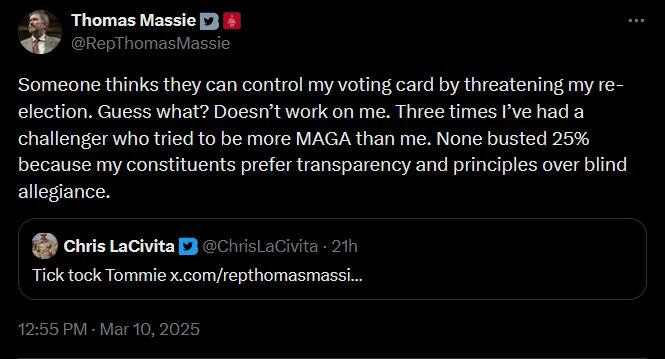
To which Massie then replied: “Someone thinks they can control my voting card by threatening my re-election. Guess what? Doesn’t work on me.”
Also potentially on the fence Punchbowl reports that Reps. Kat Cammack (R-FL) and Beth Van Duyne (R-TX) both raised concerns over the measure during a GOP whip meeting on Monday.
That said, the House Freedom Caucus endorsed the CR in a statement, saying:
“The House Freedom Caucus supports the FY 2025 Continuing Resolution. Contrary to Congress’ longtime abuse of this legislative tool, this CR is a paradigm shift.
This bill will reduce and then freeze spending for the next six months to allow President Trump and his Administration to continue their critical work within the Executive Branch to find and eliminate waste, fraud, and abuse.
It entirely kills the prospect of a budget busting, pork filled omnibus this fiscal year, and it breaks the longstanding practice in the Swamp of handcuffing increases in defense funding with increases to the non-defense bureaucracy.
Furthermore, it contains zero earmarks, makes major rescissions to the Internal Revenue Service and the so-called “Commerce slush fund,” and includes additional funding for immigration enforcement and deportation operations. Perhaps most importantly, it prevents Democrats from derailing the America First agenda with a go-nowhere government shutdown.
With the six months of funding this bill provides, Freedom Caucus Members look forward to working hand-in-hand with DOGE, OMB, and the new cabinet secretaries in eliminating even more waste, fraud, and abuse — and enacting historic spending reforms via reconciliation — all as part of President Trump’s effort to balance the budget.”
Trump, meanwhile, has been working the phones – calling undecided House Republicans, and will continue to do so today according to the report. As Punchbowl reports further:
Vice President JD Vance will attend the Republican Conference meeting this morning for a final lobbying blitz. OMB Director Russ Vought – a former Hill aide himself – met with GOP lawmakers on Monday night. Vought has been speaking to House Republicans one-on-one about the package.
“Trump is all in,” one House Republican leadership aide told us Monday night. “Members can’t be on the wrong side of this.”
Some of the opposition may be performative. Remember: Several House Republicans opposed giving Johnson another term as speaker in early January but buckled after Trump weighed in. Last month, a number of House Republicans backed the budget resolution only after entreaties from Trump.
Enter Hakeem
Meanwhile, House Minority Leader Hakeem Jeffries (D-NY) has gone all-in on opposing the funding bill, insisting that his caucus “will not be complicit in the Republican effort to hurt the American people.”
On Tuesday, Johnson said “They are going to try to shut the government down. Every House Democrat will participate in this… You’re about to see on vivid display, very clear the contrast: You will see one team that is working to fund the government… You’re going to see another opposing the CR.”
Senate Looms
If the bill can pass the House, Senate Democrats are a solid ‘maybe’ on the CR, while Sen. Rand Paul (R-KY) is a solid ‘no.’
Given that, eight Democrats will have to vote yes to overcome a filibuster.
Key Senate Dems have trashed the CR as bad policy, however they also view a shutdown as an outcome that nobody wants – so they haven’t declared it DOA in the Senate.
“Passing a full-year CR risks handing [Trump] a huge slush fund with which to do what he wants in ways that could be harmful to our national security,” said Sen. Chris Coons (D-DE).
“I’m waiting to see what the final version is, until then we’re not gonna make any decisions,” said Sen. Ruben Gallego (D-AZ).
And while Sen. Mark Warner (D-VA) told Punchbowl just days ago that the CR was “awful,” he told the outlet that he preferred it to a government shutdown.
Ukraine Has Agreed To Enter Truce Negotiations With Moscow: Rubio
Update(1745ET): Coming out of the Jeddah talks with the Ukrainian delegation, which lasted over eight hours, Secretary of State Marco Rubio has issued a statement hailing that Kiev has agreed to enter negotiations with Russia to end the war.
“Today, we’ve made an offer that the Ukrainians have accepted, which is to enter into a ceasefire and into immediate negotiations to end this conflict in a way that’s enduring and sustainable,” Rubio stated.
The 30-Day ceasefire aspect which was announced earlier appears designed to jump-start direct talks – with the intent that the guns would go silent to allow for talks to begin in earnest. It appears akin to a ‘freeze’ of the front lines of the conflict (something which Putin is likely to reject, seeing in in a possible ploy for Ukraine to rearm and regroup).
The offer is to stop the shooting. The goal here is the only way out – to end this war is to negotiate out of it. There’s no military solution to this war. The solution to this war and the way to end it and to achieve the President’s objective of peace is to negotiate.
But before you can negotiate you have to stop shooting at each other, and that’s what the President has wanted to see, and that’s what – that’s the commitment we got today from the Ukrainian side, their willingness to do that. Obviously, now that will be delivered to the Russians.
Rubio says if Russia does not accept the ceasefire, “we’ll unfortunately know what the impediment is to peace here.” So while Russia is making gains, they will have to accept terms dictated by the US/Ukraine — while US arms resume flowing — or else they become the “impediment” pic.twitter.com/LQCYXme7Sy
On communicating the plan to Russia, Rubio said “It’ll be delivered to them directly through multiple channels, meaning not only will they obviously see it – we’ve – it’ll be communicated to them through our diplomatic channels, through conversations, and other methods. But they’ll obviously be well aware.”
“And our hope is that the Russians will say yes, that they will also agree, so the shooting will stop, the killing will stop, the dying will stop, and the talks can begin about how to end this war permanently in a way that’s acceptable and enduring for both sides,” the US top diplomat added.
* * *
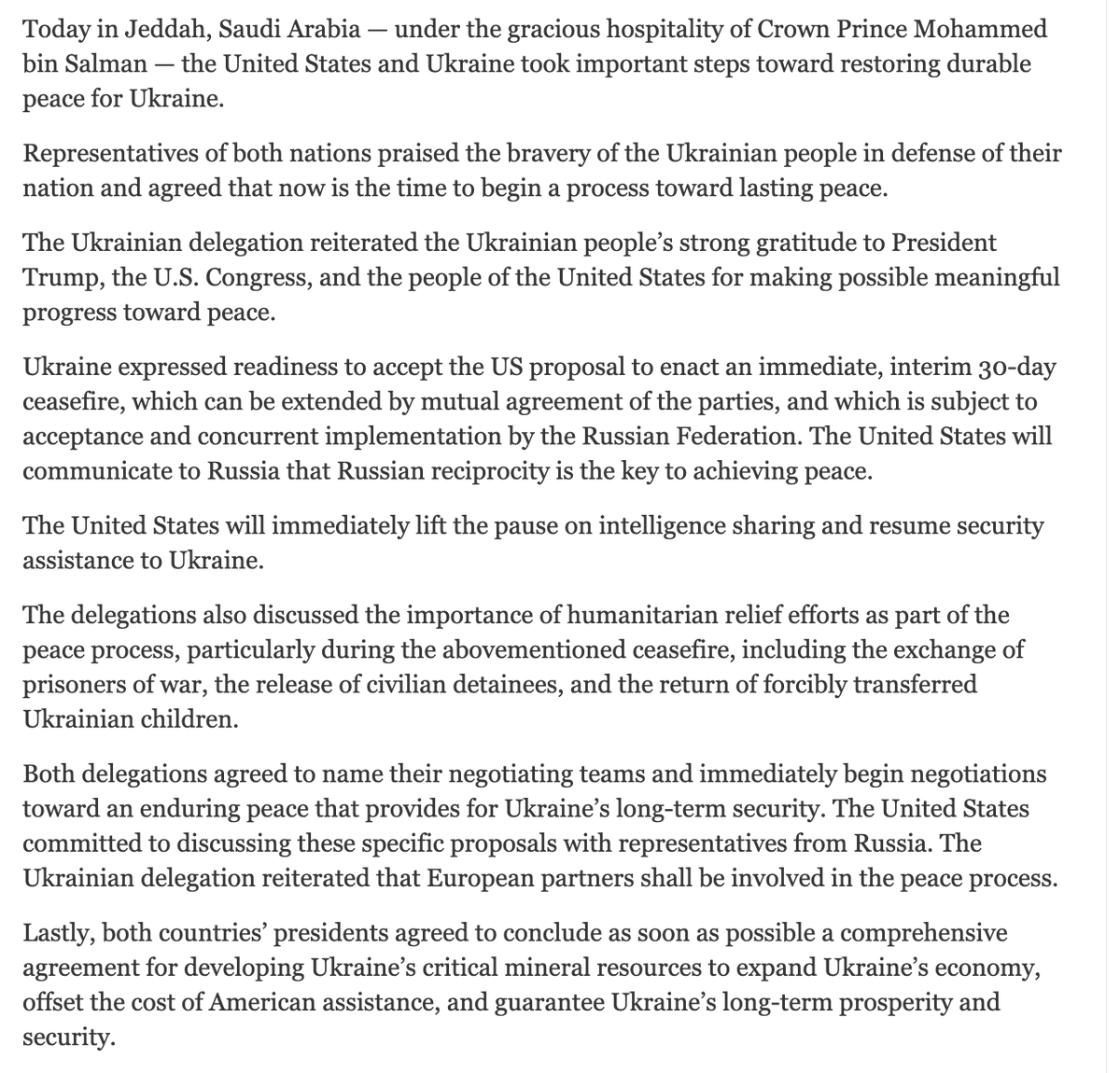
An apparent breakthrough in Jedda talks between the US and Ukraine, as the United States has announced it “will immediately lift the pause on intelligence sharing and resume security assistance to Ukraine.”
The Zelensky government has also “expressed readiness to accept the U.S. proposal to enact an immediate, interim 30-day ceasefire, which can be extended by mutual agreement of the parties, and which is subject to acceptance and concurrent implementation by the Russian Federation,” the statement said.
“The United States will communicate to Russia that Russian reciprocity is the key to achieving peace,” it added. This comes after a reported over eight hour-long meeting between the US and Ukrainian delegations in the Saudi port city on Tuesday. No doubt, the Ukrainians came hat in hand, ready to please Trump after relations had fallen off a cliff with the Zelensky Oval Office confrontation earlier this month.
Shortly before the announced US-Ukraine agreement for a 30-day ceasefire, a TASS headline said that the Kremlin has no information on any details coming out of the Jeddah meeting.
But will Putin agree? There’s as yet little incentive for him to enact a temporary ceasefire, given as Trump recently admitted… he has all the cards (and Zelensky doesn’t).
By all accounts the Russians are fast taking back territory in Kursk and advancing along front lines in the Donbas. Likely Russia fears that Kiev could simply use this ceasefire as an opportunity to rearm, rest, resupply and regroup – especially given Washington just said the US arms and intel pipeline is back on.
Moscow is likely to see this is simply a matter between Washington and Kiev, and it appears to be a version of Zelensky’s ‘partial ceasefire’ which demands a halt to all air assaults. Or in essence it sounds like Zelensky just wants his satellite images turned back on.
Ukraine’s presidential office presenting this as the joint statement following the talks led by Rubio, Waltz, and Witkoff:
“The United States will immediately lift the pause on intelligence sharing and resume security assistance to Ukraine.”
“Both countries’ presidents agreed to conclude as soon as possible a comprehensive agreement for developing Ukraine’s critical mineral resources to expand Ukraine’s economy, offset the cost of American assistance, and guarantee Ukraine’s long-term prosperity and security.”
The full statement:
From Russia’s point of view, there’s nothing about turning back on the halt in weapons and intel assistance which will help anything, given also just last night Ukraine launched its biggest drone attacks in Russian territory to date, targeting the capital of Moscow.
A federal judge in New York has temporarily blocked any effort by the Trump administration to deport Mahmoud Khalil, a Palestinian student and permanent resident who led pro-Palestinian encampment protests at Columbia University after the deadly Oct. 7, 2023, attack on Israel by the Hamas terrorist group.
U.S. District Judge Jesse M. Furman of the Southern District of New York (Obama judge) ordered on March 10 that Khalil—who was arrested over the weekend—must not be deported until further legal proceedings have played out and the court potentially authorizes his removal from the United States.
“To preserve the Court’s jurisdiction pending a ruling on the petition, Petitioner shall not be removed from the United States unless and until the Court orders otherwise,” Furman wrote.
The judge set a March 12 hearing to consider the case of Khalil, whose arrest was celebrated by President Donald Trump and the White House but denounced by Democrats and some civil rights groups.
In a statement on Truth Social, Trump praised Immigration and Customs Enforcement (ICE) for arresting Khalil, calling him a “Radical Foreign Pro-Hamas Student.”
The president said that Khalil’s apprehension was the “first arrest of many to come” and warned that additional detentions would target individuals engaged in “pro-terrorist, anti-Semitic, anti-American activity” on college campuses nationwide.
“Many are not students, they are paid agitators,” Trump wrote. “We will find, apprehend, and deport these terrorist sympathizers from our country—never to return again. If you support terrorism, including the slaughtering of innocent men, women, and children, your presence is contrary to our national and foreign policy interests, and you are not welcome here.”
The Department of Homeland Security (DHS) said Khalil was taken into custody as a result of Trump’s executive orders prohibiting anti-Semitism after having “led activities aligned with Hamas.”
Secretary of State Marco Rubio underscored the administration’s stance in a post on social media platform X, stating that the government “will be revoking the visas and/or green cards of Hamas supporters in America so they can be deported.” He did not provide further details on the policy implementation.
Khalil’s detention sparked opposition from a constellation of critics, including congressional Democrats, who demanded that he be freed immediately.
Some civil rights groups and free speech advocates accused the Trump administration of using its immigration enforcement powers to suppress criticism of Israel.
“This arrest is unprecedented, illegal, and un-American,” Ben Wizner, a director at the American Civil Liberties Union (ACLU) said in a statement. “The federal government is claiming the authority to deport people with deep ties to the U.S. and revoke their green cards for advocating positions that the government opposes.
The Council on American-Islamic Relations, a national Muslim civil rights advocacy group, alleged in a statement that Khalil’s arrest was motivated by his protests against the Israeli military’s anti-Hamas operations in Gaza and “represents a blatant attack on the First Amendment’s guarantee of free speech, immigration laws, and the very humanity of Palestinians.”
The Epoch Times reached out to ICE for comment on the case.
Khalil’s arrest coincides with the Trump administration’s move to revoke $400 million in federal grants and contracts from Columbia University, citing the institution’s alleged failure to address anti-Semitic incidents and harassment of Jewish students on campus.
Following the Hamas attack and Israel’s subsequent military response in Gaza, student-led protests erupted at universities across the United States, including Columbia. Last spring, pro-Palestinian activists organized a prolonged encampment and occupied a campus building.
This past week, Trump reaffirmed his opposition to such demonstrations.
“All Federal Funding will STOP for any College, School, or University that allows illegal protests,” Trump wrote in a post on Truth Social. “Agitators will be imprisoned/or permanently sent back to the country from which they came. American students will be permanently expelled or, depending on the crime, arrested.”
Columbia’s interim president, Katrina Armstrong, said on March 7 that the university will cooperate with federal agencies and pledged “serious action” against campus anti-Semitism.
Tesla Rebounds After Trump Showcases Vehicles At White House
Update (1530ET):
Tesla shares rebounded late in the session, rising about 6%, after a fleet of Tesla vehicles arrived at the White House.
President Trump announced plans to purchase a Tesla vehicle on Monday to show support for Elon Musk and DOGE.
Trump is checking out five different Tesla models. There is speculation that the president may choose the Cybertruck.
“Number one, it’s a great product — as good as it gets — and number two, because he [Musk] has devoted his energy and his life to doing this and I think he has been treated very unfairly,” Trump told reporters, adding, “will be buying a Tesla today.”
Recall Tesla was excluded from the Biden-Harris administration’s EV summit at the White House in 2021.
Also, note that Tesla is one of the most made-in-America vehicles and fulfills Trump’s ‘America First’ manufacturing pledge.
Did Tesla vehicles arriving at the White House put a bottom in the stock?
Meanwhile, Trump told reporters that ongoing violence by leftists against Tesla vehicles will be labeled as “domestic terrorism.”
* * *
President Trump announced early Tuesday morning on Truth Social that he will support Elon Musk by purchasing a new Tesla.
While the president did not specify which model he intends to purchase, his endorsement comes as Musk’s DOGE has been a massive success, neutering parts of the Deep State—though not without consequences for the billionaire.
Musk has faced backlash from unhinged leftists, who have attacked Tesla showrooms, torched Tesla Superchargers, attacked vehicles, and even initiated a boycott—all because these folks are outraged that DOGE has found billions of waste and fraud within the federal bureaucracy.
“To Republicans, Conservatives, and all great Americans, Elon Musk is “putting it on the line” in order to help our Nation, and he is doing a FANTASTIC JOB!” Trump wrote on Truth Social.
In recent weeks, Torsten Slok, Apollo’s chief economist, has pointed out that DOGE-related federal government job cuts could reach around 300,000. He said combined layoffs of federal workers and contractors could top one million, as DOGE’s demolition of the corrupt Deep State is a mandate the American people handed the president.
In recent days, Trump told Musk publicly to transition from “hatchet” to “scalpel” in eliminating fraud and waste within the federal government, but more importantly, within the corrupt NGO complex.
Leftists are furious with Musk’s DOGE this week after Secretary of State Marco Rubio thanked Musk on Monday for uncovering fraud and waste in USAID, a rogue agency captured by the Deep State. Rubio announced on Monday that 83% of USAID’s programs would be shuttered.
Given Musk’s success with DOGE, Trump continued:
But the Radical Left Lunatics, as they often do, are trying to illegally and collusively boycott Tesla, one of the World’s great automakers, and Elon’s “baby,” in order to attack and do harm to Elon, and everything he stands for.
They tried to do it to me at the 2024 Presidential Ballot Box, but how did that work out?
In any event, I’m going to buy a brand new Tesla tomorrow morning as a show of confidence and support for Elon Musk, a truly great American. Why should he be punished for putting his tremendous skills to work in order to help MAKE AMERICA GREAT AGAIN???
Trump’s support for Musk’s Tesla comes as shares plunged 15% on Monday, down 45% year-to-date, round-tripping all presidential election gains.
Some of Monday’s losses came after UBS analyst Joseph Spak slashed delivery projections to 367,000 from 437,000 for the first quarter. The analyst also lowered his 12-month price target to $225 from $259.
Last week, Goldman Sachs analysts Mark Delaney, Will Bryant, and others lowered their Tesla delivery forecast for the first quarter to 375,000 from 399,000.
As for Trump, there’s no telling what model he will choose – but likely – a Cybertruck.