66.1 F
Chicago
Saturday, September 26, 2026
Home Blog Page 1716

Russia & UK Engaged In Escalating Spy Wars, Diplomatic Expulsions

Russia & UK Engaged In Escalating Spy Wars, Diplomatic Expulsions

Russia is seeking to clamp down on Western spying on its soil, amid ongoing tit-for-tat diplomatic expulsions especially involving Britain, related to alleged espionage. The Russian Federal Security Service (FSB) confirmed Monday that the Ministry of Foreign Affairs revoked the accreditation of two British diplomats, accusing them of entering Russia based on false information. They are being booted from the country.

The counterintelligence agency described it had “identified signs of intelligence and subversive work” that the pair had carried out against Russian national security interests. Countries often issue diplomatic cover for intelligence operatives working out of their foreign embassies.

The UK Foreign Office was adamant in rejecting the basis of the accusations: “This is not the first time that Russia has made malicious and baseless accusations against our staff,” it said. But this didn’t seem so ‘direct’ a denial speaking to whether the two were spies or not.

Britain had expelled a Russian diplomat on similar grounds last month, and as a response to Moscow expelling a UK diplomat in November 2024.

And just last week three Bulgarian nationals were convicted in a London court for carrying out “industrial-scale” spying for Russia. The Guardian has detailed the case as follows:

Three Bulgarian nationals accused of spying for Russia have been found guilty of espionage charges in a trial that heard how they were involved in a string of plots around Europe directed by a fugitive based in Moscow.

After more than 32 hours of deliberations, a jury at the Old Bailey reached unanimous verdicts on Katrin Ivanova, 33, a lab technician, Vanya Gaberova, 30, a beautician, and Tihomir Ivanchev, 39, a painter and decorator, all of whom were living in London before their arrest.

The three were convicted for being junior members of a spy ring that was ultimately directed by Jan Marsalek, an Austrian businessman who had fled to Russia in 2020 after a company he helped to run collapsed amid a €1.9bn (£1.6bn) fraud.

Marsalek directed the hostile surveillance of Christo Grozev – an investigative journalist who had helped implicate Russian spies in the poisoning of the opposition leader Alexei Navalny – in Bulgaria, Austria and Spain. All three defendants were involved in the operation.

Katrin Ivanova (left), Tihomir Ivanchev and Vanya Gaberova. source: Metropolitan police

Apparently they also set up an operation to steal mobile phone numbers of Ukrainian troops believed to be training at a US barracks in Stuttgart, Germany. UK media reports say they utilized military-grade snooping and electronic equipment.

Britain believes all of this was ultimately at the direction of Russian intelligence. So just as Moscow’s relations with Washington improve, relations with London keep growing more and more hostile and distant.

There was also the recent case of a British mercenary being captured by Russian forces in Kursk. The UK military veteran was given a 19-year prison sentence for fighting alongside Ukrainian forces while invading Russian soil. A Moscow court dubbed him a ‘terrorist’ and not a soldier who would have been afforded protections under the Geneva Convention.

Tyler Durden
Tue, 03/11/2025 – 15:25

Uncharted Waters: How President Trump Can Navigate Toward A More Resilient Economy

Uncharted Waters: How President Trump Can Navigate Toward A More Resilient Economy

Authored by Daniel Lacalle and Jaime Figueras,

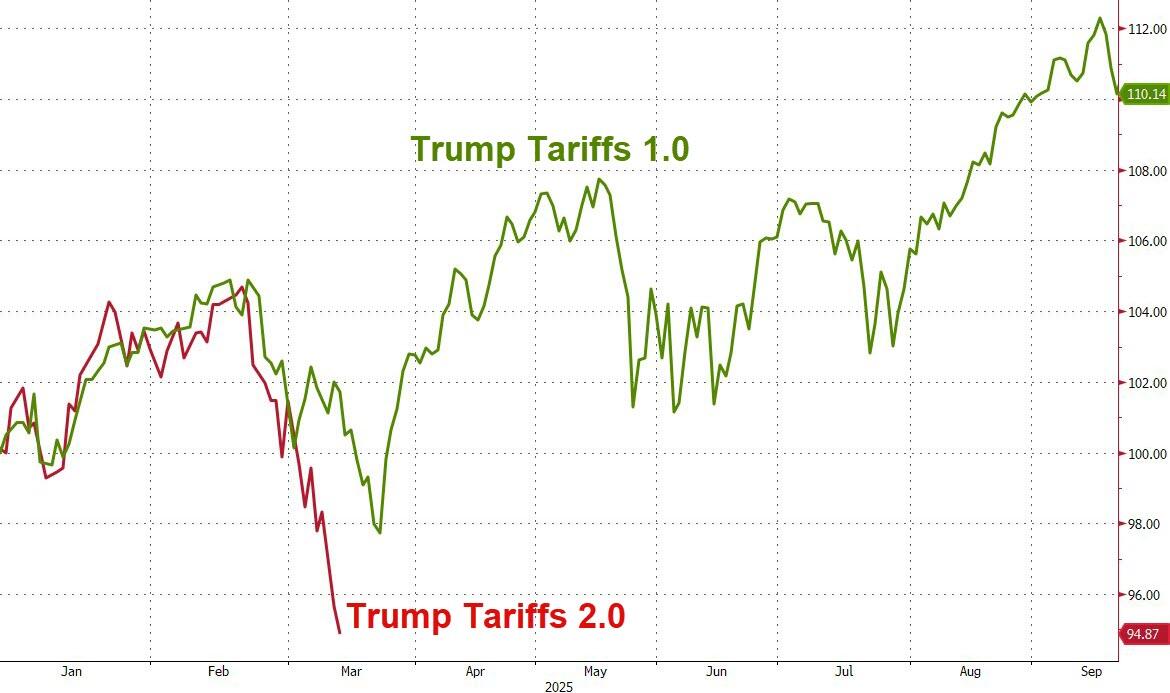
This week, financial markets have experienced unprecedented volatility.

Two key issues dominate the national conversation: first, the shifting economic landscape under President Trump’s leadership and second, the increasing financial burden faced by older Americans. 

While market uncertainty looms, President Trump’s policies are aimed at fostering long-term stability and growth, both domestically and globally.

At the same time, we urgently need to address the mounting credit card debt among older Americans who are facing financial difficulties as they near retirement.

These two issues, while seemingly unrelated, share a common theme: the need for strategic planning, responsible policies, multi-horizon solutions that alleviate the immediate economic burden for older Americans as well as long-term solutions that galvanize the US economy for younger individuals.

The recession and stagflation risk was created by four years of insane government spending and record deficits in a growth economy, not by a month and a half of a new administration.

Milei in Argentina implemented decisive and drastic cuts and many predicted chaos. However, the economy strengthened, inflation declined, and poverty fell… In less than a year. Supply-side measures do not work immediately, but they work, and they last. Don’t expect miracles in a month.

Unfortunately, some market participants tend to get excited about central planning and scared of supply-side measures. Why? Because the first one means printing money and the other requires bottom-up deep research. However, betting on central planning always leads to disaster.

Increased government spending leads to the issuance of more currency units and an artificial increase in money velocity. Keynesian interventionists propose higher taxes to reduce the excess of money in the system. Therefore, government size in the economy rises in periods of expansion and rises as well in periods of slowdown, eroding the investment and saving capability of the economy. The road to stagnation. This leads to persistent inflation, lower real wages, and economic stagnation.

As such, a short recession resulting from the control of government spending and debt is not a negative event. It is simply the manifestation of a previous excess. Reducing taxes and cutting the excesses of past years in government jobs and expenditures will only make the GDP healthier.

In the past four years, federal debt growth has exceeded even nominal GDP growth, and by a significant margin. Curbing that path to ruin is an essential policy.

It is better to have a short and healthy recession if it comes from lower government spending and more attractive taxes than to maintain GDP growth with debt and unproductive expenditure.

A short recession can be positive. It is like the process of losing weight and exercising following a sugar and alcohol binge. The economy will be stronger by making the private sector more robust, and subsequent growth will be more productive and sustainable.

It is essential that the next Treasury secretary talk about the essential adjustments required by the economy and the reality of the time bomb inherited from the Biden administration. Bidenomics was an upside-down approach to economics, and the United States requires supply-side strategies to restore productivity, wealth, and genuine prosperity.

Reducing deficits and debt with higher taxes is an unacceptable option. On the one hand, there is no revenue measure that can eliminate the current $2 trillion deficit. However, tax receipts follow a cyclical pattern, while public spending is a yearly and consolidated process. Therefore, using taxes to reduce debt always fails.

Sound money and a responsible government budget, supported by lower taxes and reduced bureaucratic expenditures, are the only options to strengthen America’s economy. Socialism would be disastrous. Conservative Keynesianism would be useless. The U.S. must learn the lesson of the UK and the EU countries’ recent examples and avoid the convenient trap of right-wing socialism.

The only way in which the United States will escape the seemingly inevitable debt and currency crisis will be to cut spending, reduce taxes, pump growth driven by private investment and rising real wages, and strengthen the US dollar by reducing indebtedness and conducting a sound monetary policy.

President Trump’s economic agenda is rooted in a vision of a more resilient American economy. Despite facing significant challenges—such as heightened levels of market volatility, tariff negotiations, and shifting global alliances—President Trump remains resolute in his belief that the U.S. will emerge stronger and more prosperous (we agree). His administration’s focus on reducing trade imbalances, cutting excessive regulations, and unleashing the power of the private sector is setting the stage for sustainable economic growth. Though concerns about growth and the impact of fiscal policy changes have surfaced, Trump’s long-term strategy is designed to achieve a more efficient and competitive economy, not just for the U.S. but for global partners as well.

One of the most striking examples of this global shift is Europe’s reevaluation of its fiscal policies in light of U.S. economic changes. In response to shifts in U.S. foreign policy, particularly in terms of defense spending and international relations, Germany is now considering loosening its traditionally stringent fiscal constraints. This could result in increased investments in infrastructure and defense, potentially driving European economic growth and fostering greater competition on the world stage.

Meanwhile, China is also signaling a new phase of economic reforms, aimed at addressing the threats of stagnation and inefficiency. By blending stimulus with reform, China is positioning itself to navigate its economic challenges while potentially benefiting from more balanced trade relationships with the U.S. under Trump’s administration. Although uncertainties persist in global markets, there is an emerging belief that a more balanced and prosperous global economy is within reach, thanks in part to President Trump’s vision of economic rebalancing.

However, as the global economy rebalances, credit card debt among older Americans is becoming a pressing issue. A recent survey by AARP has revealed a troubling trend: nearly half of Americans aged 50 and older who carry credit card debt are relying on it to cover essential living expenses. This growing reliance on credit cards is exacerbated by rising costs in healthcare, food, and housing, placing a heavy burden on those already nearing retirement.

The survey paints a grim picture of how older Americans are struggling with their finances. Among those with credit card debt, 47% reported using their cards for basic living expenses, and 37% of them have accumulated more debt over the past year. Nearly half (48%) carry a balance of $5,000 or more, with some even surpassing $10,000 in debt. These figures are particularly concerning as they coincide with a time when older adults should be planning for a secure retirement, not facing mounting debt. 

Healthcare costs have emerged as one of the leading contributors to this growing debt. With many older Americans on fixed incomes, medical expenses are forcing them to lean on credit cards just to get by. This situation is further exacerbated by high interest rates, making it increasingly difficult for individuals to pay off their balances. As a result, many are facing the tough decision of whether to prioritize paying off debt or saving for their future. For those aged 50-64, this financial strain is particularly acute, as they are at the cusp of retirement and must weigh the consequences of their financial choices.

The impact of this growing debt is not just immediate—it is eroding older Americans’ ability to save for the future. Nearly half of those with credit card debt report that their current financial situation is hindering their ability to save for retirement. This is a dire situation that requires immediate attention and action from both policymakers and financial institutions to provide older adults with the resources and support they need to regain control of their finances.

President Trump’s economic vision, with its focus on reducing tariffs, promoting private sector growth, and fostering fairer international trade, can be seen as part of a broader solution to these interconnected challenges. By creating a more dynamic and competitive economy, both in the U.S. and globally, the economic policies that Trump advocates could help alleviate some of the financial pressures on older Americans, especially if they lead to reduced healthcare costs and more sustainable economic growth.

However, while Trump’s economic policies aim to reshape global and domestic markets, it is equally important to address the financial realities faced by older Americans. Comprehensive solutions to the credit card debt crisis should include measures to reduce interest rates, expand access to financial education, and provide more robust healthcare support to ensure older adults can live with dignity and security in their later years.

Ultimately, the economic agenda of President Trump and the financial struggles of older Americans are intertwined. While the global economy undergoes a transformation, it is vital that the financial system evolve to protect those most vulnerable—especially older Americans who are facing unprecedented debt burdens. By supporting these individuals through targeted policies and economic reforms, we can create a future where both the U.S. and its citizens can thrive, free from the shackles of financial uncertainty.


Tyler Durden
Tue, 03/11/2025 – 15:05

Stocks Jump As Ontario Folds, Suspends Electricity Surcharge After Talk With White House

Stocks Jump As Ontario Folds, Suspends Electricity Surcharge After Talk With White House

Update (1445ET): After earlier responding to President Trump’s threats with more sound and fury:

“I want to send more electricity” to the US, Ford said during an interview with CNBC, but cutting off power exports remains “a tool in our toolkit.” 

Ontario Premier Doug Ford just folded like a broken deckchair and agreed to suspend its surcharge of 25% on exports of electricity to Michigan, New York and Minnesota, Ontario Premier Doug Ford says in a post on X.

Today, United States Secretary of Commerce and Premier of Ontario Doug Ford had a productive conversation about the economic relationship between the United States and Canada.

Secretary Lutnick agreed to officially meet with Premier Ford in Washington on Thursday, March 13 alongside the United States Trade Representative to discuss a renewed USMCA ahead of the April 2 reciprocal tariff deadline.

In response, Ontario agreed to suspend its 25 per cent surcharge on exports of electricity to Michigan, New York and Minnesota.

As a reminder, this was not earth-shattering as Minnesota and Michigan imported about 1% of its power from Canada in 2024, and less than half of that came from Ontario, according to the region’s grid operator, Midcontinent Independent System Operator. New York imported about 4.4% of its total electricity from the country in 2023, according to Bloomberg calculations.

The response in market was immediate with stocks ramping to the highs of the day…

*  *  *

Just when you thought it was safe to dip your toe back in the growth-challenged markets, President Trump took to Truth Social and unleashed a retaliatory strike against Canada (more specifcally Ontario) for its ongoing tariffs (and electricity price hike)… (emphasis ours)

Based on Ontario, Canada, placing a 25% Tariff on “Electricity” coming into the United States, I have instructed my Secretary of Commerce to add an ADDITIONAL 25% Tariff, to 50%, on all STEEL and ALUMINUM COMING INTO THE UNITED STATES FROM CANADA, ONE OF THE HIGHEST TARIFFING NATIONS ANYWHERE IN THE WORLD. 

This will go into effect TOMORROW MORNING, March 12th. 

Also, Canada must immediately drop their Anti-American Farmer Tariff of 250% to 390% on various U.S. dairy products, which has long been considered outrageous. I will shortly be declaring a National Emergency on Electricity within the threatened area. This will allow the U.S to quickly do what has to be done to alleviate this abusive threat from Canada. 

If other egregious, long time Tariffs are not likewise dropped by Canada, I will substantially increase, on April 2nd, the Tariffs on Cars coming into the U.S. which will, essentially, permanently shut down the automobile manufacturing business in Canada. 

Those cars can easily be made in the USA! 

The result is that the Canadian dollar dumped…

And US stocks gave up some their early gains.

It’s different this time.. for now…

Trump then diverted back to his previous comments on making Canada America’s 51st State:

Also, Canada pays very little for National Security, relying on the United States for military protection. 

We are subsidizing Canada to the tune of more than 200 Billion Dollars a year. WHY??? This cannot continue. 

The only thing that makes sense is for Canada to become our cherished Fifty First State. 

This would make all Tariffs, and everything else, totally disappear. 

Canadians taxes will be very substantially reduced, they will be more secure, militarily and otherwise, than ever before, there would no longer be a Northern Border problem, and the greatest and most powerful nation in the World will be bigger, better and stronger than ever — And Canada will be a big part of that. 

The artificial line of separation drawn many years ago will finally disappear, and we will have the safest and most beautiful Nation anywhere in the World — And your brilliant anthem, “O Canada,” will continue to play, but now representing a GREAT and POWERFUL STATE within the greatest Nation that the World has ever seen!

We are sure Mr Carney will bristle with Trump’s hurtful words.

*   *   * 

Top sellers from last week at ZH Store:

ZH Multitool

Anza Swat Micarta Blued knife (1 left until resupply)

ReadyWise Heirloom Seed Vault

IQ Colostrum

ZH Coffee + Tumbler deal (buy 2 bags, get free tumbler)

Anza Tanto Black Micarta… 6.75″ overall length. Satisfaction guaranteed or your money back.

Tyler Durden
Tue, 03/11/2025 – 14:50

3Y Auction Tails Despite Crashing Stocks

3Y Auction Tails Despite Crashing Stocks

In a week when everyone is allegedly scrambling for the “safety” of bonds with stocks crashing at the fastest rate since the covid collapse, one would think that demand for the week’s first coupon auction wouldbe off the charts. One would be wrong. Moments ago the Treasury sold $58 billion in 3Y paper in a tailing, subpar auction.

The auction priced at a high yield of 3.908% , down sharply from 4.300% in February and the lowest since October; it tailed the When Issued 3.902% by 0.6bps, the 5th tail in the past 6 auctions.

The bid to cover was 2.70, down from 2.79 but above the 2.62 recent average.

The internals were soggier with Indirects sliding from 74.0% to 62.5%, the lowest since January and below the 67.5 recent average. And with Directs awarded a whopping 26%, which was the second highest on record and only February 2013 saw higher Directs, Dealers were left holding just 11.5%, above last month’s near record low 10.2% but well below the recent average of 15.7%.

Overall, this was a subpar auction and while not terrible one would expect a far stronger showing at a time when everyone is – reportedly – piling into Bills and the short-end of the curve as protection from the ongoing collapse in risk. Which then begs the question: what is everyone doing with all that excess cash they just got from nuking their deep underwater momentum stonks…

Tyler Durden
Tue, 03/11/2025 – 13:26

Judge Declines Bid To Force Federal Government To Restore Canceled Foreign Aid Contracts

Judge Declines Bid To Force Federal Government To Restore Canceled Foreign Aid Contracts

Authored by Zachary Stieber via The Epoch Times (emphasis ours),

A federal judge on March 10 declined to compel President Donald Trump’s administration to restore foreign assistance contracts that it had canceled.

The U.S. Agency for International Development logo is covered with black tape in Washington on Feb. 7, 2025. Madalina Vasiliu/The Epoch Times

U.S. District Judge Amir Ali said that Trump’s administration must spend money allocated by Congress on foreign aid, but that it is up to the Executive Branch as to which projects it funds with the money.

“The separation of powers dictates only that the Executive follow Congress’s decision to spend funds, and both the Constitution and Congress’s laws have traditionally afforded the Executive discretion on how to spend within the constraints set by Congress,” Ali said in a 48-page ruling.

“The appropriate remedy is accordingly to order Defendants to ’make available for obligation the full amount of funds Congress appropriated’ under the relevant laws.”

Officials have canceled about 9,900 of the 13,100 USAID and State Department agreements, according to court filings. Secretary of State Marco Rubio said on social media this week that the canceled contracts “did not serve, (and in some cases even harmed), the core national interests of the United States.”

The ruling came in response to a lawsuit from organizations that had agreements with the State Department and the U.S. Agency for International Development (USAID) when Trump paused foreign aid spending to let the State Department review agreements to make sure they furthered his agenda.

After Ali previously ruled that USAID and the State Department must fund contracts that predated the Trump administration but were paused under the freeze, the U.S. Supreme Court directed the judge to clarify which obligations the government must meet to comply with his order.

Ali set a March 10 deadline to issue payments to the organizations, while promising further instructions concerning groups that are not parties in the case.

In the new ruling, Ali said that the Executive Branch unlawfully impounded congressionally appropriated foreign aid funds and ordered the Trump administration to pay committed funds for work completed before Feb. 13.

The administration must pay nearly $2 billion in total, issuing around 300 payments a day until the organizations that had agreements with the government are recompensed for their work, the judge said.

Ali said that he concluded that government lawyers defending the withholding of foreign assistance funds, which were allocated by Congress, “offer an unbridled view of Executive power that the Supreme Court has consistently rejected—a view that flouts multiple statutes whose constitutionality is not in question.”

However, he also said that courts are restrained in the relief they can offer in such disputes.

“The Court must be careful that any relief it grants does not itself intrude on the prerogative of a coordinate branch,” he said. “The Court accordingly denies Plaintiffs’ proposed relief that would unnecessarily entangle the Court in supervision of discrete or ongoing Executive decisions, as well as relief that goes beyond what their claims allow.”

Tyler Durden
Tue, 03/11/2025 – 13:05

“The Setup Is Different This Time”: JPMorgan Says If Shutdown Actually Happens, “Not On Many Investors’ Radar”

“The Setup Is Different This Time”: JPMorgan Says If Shutdown Actually Happens, “Not On Many Investors’ Radar”

Update (1240ET): JP Morgan has weighed in with the usual ‘government shutdowns have meant little to the economy with the 5-week shutdown during 2018-19, real GDP fell by $11bn though $8bn was recovered after the gov’t reopened,’ however the bank does note that ‘equities have tended to fall in the days leading up to a shutdown before recovering all loses and resuming their trend higher,’ while concluding “The setup is different this time and a gov’t shutdown is likely not on many investors’ radar.”

Oh, fun…

*  *  *

With three days remaining before the next shutdown, the House is expected to pass a stopgap funding package on Tuesday after the House Freedom Caucus agreed to back it – which means Speaker Mike Johnson (R-LA) may be able to pass the bill, which would fund the government until September – without the help of Democrats.

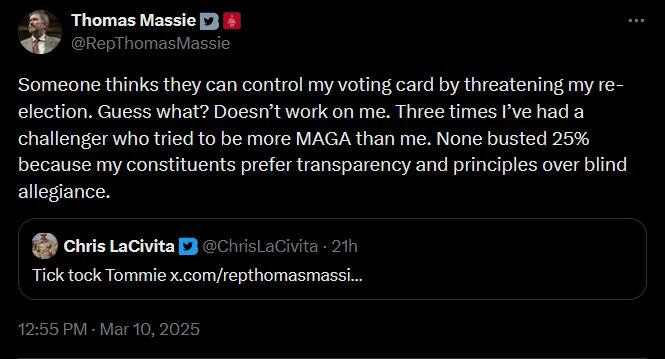
That said, despite the Freedom caucus’ buy-in, Johnson still has several GOP holdouts – with the only one to go public being Rep. Thomas Massie (R-KY) – who President Donald Trump dragged on social media, calling for him to be primaried, and comparing him to Rep. Liz Cheney.

On Sunday, Massie said on X “I’m not voting for the Continuing Resolution budget (cut-copy-paste omnibus) this week,” adding “Why would I vote to continue the waste fraud and abuse DOGE has found?”

To which Trump replied on Truth Social: “Congressman Thomas Massie, of beautiful Kentucky, is an automatic ‘NO’ vote on just about everything, despite the fact that he has always voted for Continuing Resolutions in the past,” Trump said. “HE SHOULD BE PRIMARIED, and I will lead the charge against him.”

To which Massie then replied: “Someone thinks they can control my voting card by threatening my re-election. Guess what? Doesn’t work on me.”

Also potentially on the fence Punchbowl reports that Reps. Kat Cammack (R-FL) and Beth Van Duyne (R-TX) both raised concerns over the measure during a GOP whip meeting on Monday.

*   *   * 

Top sellers from last week at ZH Store:

ZH Multitool

Anza Swat Micarta Blued knife (1 left until resupply)

ReadyWise Heirloom Seed Vault

IQ Colostrum

ZH Coffee + Tumbler deal (buy 2 bags, get free tumbler)

Anza Tanto Black Micarta… 6.75″ overall length. Satisfaction guaranteed or your money back.

That said, the House Freedom Caucus endorsed the CR in a statement, saying:

“The House Freedom Caucus supports the FY 2025 Continuing Resolution. Contrary to Congress’ longtime abuse of this legislative tool, this CR is a paradigm shift.

This bill will reduce and then freeze spending for the next six months to allow President Trump and his Administration to continue their critical work within the Executive Branch to find and eliminate waste, fraud, and abuse.

It entirely kills the prospect of a budget busting, pork filled omnibus this fiscal year, and it breaks the longstanding practice in the Swamp of handcuffing increases in defense funding with increases to the non-defense bureaucracy.

Furthermore, it contains zero earmarks, makes major rescissions to the Internal Revenue Service and the so-called “Commerce slush fund,” and includes additional funding for immigration enforcement and deportation operations. Perhaps most importantly, it prevents Democrats from derailing the America First agenda with a go-nowhere government shutdown.

With the six months of funding this bill provides, Freedom Caucus Members look forward to working hand-in-hand with DOGE, OMB, and the new cabinet secretaries in eliminating even more waste, fraud, and abuse — and enacting historic spending reforms via reconciliation — all as part of President Trump’s effort to balance the budget.”

Trump, meanwhile, has been working the phones – calling undecided House Republicans, and will continue to do so today according to the report. As Punchbowl reports further:

Vice President JD Vance will attend the Republican Conference meeting this morning for a final lobbying blitz. OMB Director Russ Vought – a former Hill aide himself – met with GOP lawmakers on Monday night. Vought has been speaking to House Republicans one-on-one about the package.

“Trump is all in,” one House Republican leadership aide told us Monday night. “Members can’t be on the wrong side of this.”

Some of the opposition may be performative. Remember: Several House Republicans opposed giving Johnson another term as speaker in early January but buckled after Trump weighed in. Last month, a number of House Republicans backed the budget resolution only after entreaties from Trump.

Enter Hakeem

Meanwhile, House Minority Leader Hakeem Jeffries (D-NY) has gone all-in on opposing the funding bill, insisting that his caucus “will not be complicit in the Republican effort to hurt the American people.”

On Tuesday, Johnson said “They are going to try to shut the government down. Every House Democrat will participate in this… You’re about to see on vivid display, very clear the contrast: You will see one team that is working to fund the government… You’re going to see another opposing the CR.”

Senate Looms

If the bill can pass the House, Senate Democrats are a solid ‘maybe’ on the CR, while Sen. Rand Paul (R-KY) is a solid ‘no.’ 

Given that, eight Democrats will have to vote yes to overcome a filibuster.

Key Senate Dems have trashed the CR as bad policy, however they also view a shutdown as an outcome that nobody wants – so they haven’t declared it DOA in the Senate.

“Passing a full-year CR risks handing [Trump] a huge slush fund with which to do what he wants in ways that could be harmful to our national security,” said Sen. Chris Coons (D-DE).

“I’m waiting to see what the final version is, until then we’re not gonna make any decisions,” said Sen. Ruben Gallego (D-AZ).

And while Sen. Mark Warner (D-VA) told Punchbowl just days ago that the CR was “awful,” he told the outlet that he preferred it to a government shutdown.

Tyler Durden
Tue, 03/11/2025 – 12:40

Former Philippines President Duterte ‘Forcibly Taken’ On Plane Bound For The Hague

Former Philippines President Duterte ‘Forcibly Taken’ On Plane Bound For The Hague

The International Criminal Court (ICC) has over the years issued plenty of arrest warrants for members or leaders of governments and militaries which are basically unenforceable. Such is the case with its recent arrest warrants for Russia’s Vladimir Putin and Israel’s Benjamin Netanyahu. However, they certainly begun avoiding flying into most European countries as a result.

Former Philippines President Rodrigo Duterte has also for years had a warrant hanging over him issued from The Hague-based court, but he too seemed of high enough stature to be beyond enforcement. This is why the Tuesday headlines of his being “forcibly taken” onto a plane headed for The Hague comes as such as surprise.

Former Philippine President Rodrigo Duterte before a ‘war on drugs’ senate inquiry in Manilla in 2024, via AP.

His own daughter has confirmed he was taken on to a plane flight late Tuesday. “They are taking him out on a plane by force without considering his health conditions,” Veronica Duterte wrote on Instagram. Reuters also confirmed, and photographs have emerged.

“As I write this, he is being forcibly taken to The Hague tonight. This is not justice — this is oppression and persecution,” she said.

The ICC arrest warrant stems from his prior and hugely controversial “war on drugs” campaign. The 79-year old former leader had quickly upon taking office in June 2016 launched a fierce crackdown on the drug trade. He was president for six years. Alleged dealers were hunted down by elite law enforcement teams in shantytowns, and there were widespread reports of extrajudicial killings throughout the campaign.

Official police data says that at least 6,000 were killed in Duterte’s crackdown, but Human Rights Watch has listed that over 12,000 Filipinos have been killed, mostly urban poor. The police have been widely accused of often times falsifying evidence in order to target alleged criminal networks.

The fact that the current government took the drastic step of forcing him on a Hague-bound plane has shocked the country of 115 million people, leading many of his supporters into the streets, where some initial clashes with police have been reported.

Interestingly, Duterte had actually withdrew the Philippines from the ICC in 2019. Opponents charged that he was simply trying to shield himself from prosecution, but The Hague has since said that it has jurisdiction involving crimes that took place previously under the membership period.

China’s People’s Daily writes: A chartered plane on Tuesday night flew former Philippine President Rodrigo Duterte to the International Criminal Court in The Hague, the Netherlands, due to an arrest warrant issued by the ICC over his “war on drugs” campaign.

He had long been looked upon as a bit of a ‘rogue’ figure by many in the West, and he had positive, warm relations with everyone from Vladimir Putin to Donald Trump. Upon his first meeting with Putin in 2016, Duterte had lashed out at Western “bullying” and “hypocrisy” and declared that when it came to alliances, the United States could not be trusted. 

“Historically, I have been identified with the Western world. It was good until it lasted,” he told the Russian leader at the time. “And of late, I see a lot of these Western nations bullying small nations. And not only that, they are into so much hypocrisy,” he had said. Now apparently the ‘Western world’ is getting its revenge in the form of the ICC arrest.

Tyler Durden
Tue, 03/11/2025 – 12:25

The Legal Loophole That Costs Medicaid Billions

The Legal Loophole That Costs Medicaid Billions

Authored by Lawrence Wilson via The Epoch Times (emphasis ours),

Medicaid is a broadly popular program that provides medical coverage to low-income Americans through a combination of state and federal funding. More than 60 percent of Americans either know someone who has benefited from Medicaid or have been enrolled themselves, according to health policy think tank FFF. So any talk of altering the program usually meets strong opposition.

Yet few seem to know how the system works, what it costs, or the level of unnecessary spending hidden within its $880 billion annual budget.

One example is a little-known quirk in the Medicaid system that allows states to artificially inflate their Medicaid costs to recoup more federal dollars. The arrangement allows some states to pocket a share of the money paid to them for providing treatment to Medicaid patients.

Here’s how it works.

The Loophole

When a Medicaid patient receives a treatment or service, the state pays the doctor, hospital, nursing home, or other provider. The federal government reimburses each state for a portion of its Medicaid expenses. The reimbursement ranges from 50 to 76.9 percent depending on the income level in the state and other factors.

Although, for people who enrolled through the Medicaid expansion under the Affordable Care Act, the reimbursement rate is 90 percent.

So if a state had a 60 percent reimbursement rate and spent $10 billion on Medicaid services, the federal government would reimburse the state $6 billion.

That’s how the system was designed to work back in 1965, generally speaking.

By the mid-1980s, some states had found a way to increase payments to providers and their own Medicaid costs at the expense of the federal government.

First, medical providers would either voluntarily donate money to a state or agree to pay a tax. The states would then return the amount of the donation or tax, and possibly even more, through increased reimbursement. Finally, the states would bill the federal government for the increased cost.

In some cases, the providers initiated these arrangements, according to the Congressional Research Service (CRS).

For example, a hospital might agree to pay the state $10 million in taxes. The state might then increase Medicaid payments to that hospital by $20 million. If the state’s reimbursement rate was 60 percent, it would receive $12 million in federal Medicaid funding.

Together with the tax income, the state would receive $22 million and pay $20 million, netting $2 million for additional Medicaid costs or other purposes.

The arrangement benefited providers by increasing their reimbursement, and the states benefited by reducing their costs or even gaining revenue. The federal government bore the cost of those increases.

Congress debated the issue in 1991.

Lawmakers who favored keeping the arrangement in some form argued that it had become a vital part of state Medicaid funding.

Rep. Raymond McGrath (R-N.Y.) said at the time that doing away with the system would cost his state $500 million in federal matching funds. He predicted “chaos” in the Medicaid system if provider taxes were abolished.

The administration of President George H.W. Bush strongly opposed the taxes in a position statement, saying, “State donation and provider-specific tax programs, if unchecked, will undermine a basic premise of the Medicaid program—that States have a stake in the costs of the program.”

In the end, Congress chose to impose limits on provider taxes and donations.

First, provider donations to the state are strictly limited to prevent abuse. Second, state taxes must meet certain conditions or the state will lose federal funding.

Taxes must apply to all providers in a certain class, such as nursing homes, not just those who serve Medicaid patients. Also states can’t provide any direct or implied guarantee that they will reimburse providers for the amount of the tax. The limit on provider taxes is 6 percent.

Here’s how the provider tax works today.

Increasing Tax, Dependence

In 2004, 35 states had taxes on medical care providers. Now every state but Alaska taxes some providers, as does the District of Columbia.

And states depend more on tax revenue to fund Medicaid—and other things—according to the Government Accountability Office (GAO).

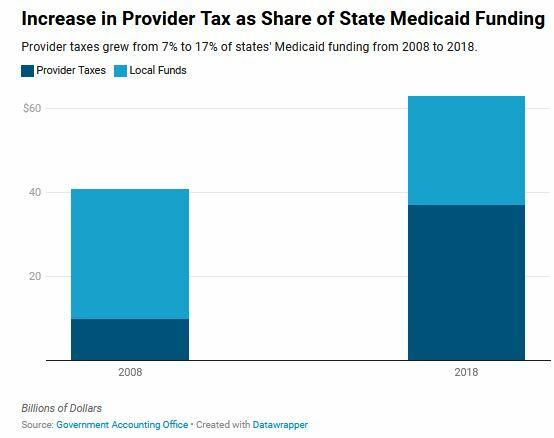
From 2008 to 2018, the share of states’ Medicaid spending covered by provider taxes grew from 7 percent to 17 percent according to the GAO.

In 2018, states received $63 billion in provider taxes and local government funds, according to GAO estimates. Of that amount, $16 billion (25 percent) was not used to pay providers.

That shifted 5 percent of the cost of Medicaid from the states to the federal government, the GAO estimates. The practice also resulted in lower overall reimbursement to some providers when accounting for their tax payments.

When measured as a percentage of the nation’s gross domestic product (GDP), a common measure of the country’s total wealth, the burden of providing Medicaid remained the same for states from 2008 to 2023. While overall spending went up, the economy was growing, too, so state Medicaid spending was essentially flat according to the think tank Paragon Health Institute.

Yet the overall cost of the program increased dramatically, meaning that the federal government paid the entire increase in the cost of the program over 15 years, according to Paragon.

Over that same period, the federal government’s share of the total cost of Medicaid grew from 60 to 72 percent.

Read the rest here…

Tyler Durden
Tue, 03/11/2025 – 12:05

The Educational Cartel: How Randi Weingarten Finally Said The Quiet Part Out Loud

The Educational Cartel: How Randi Weingarten Finally Said The Quiet Part Out Loud

Authored by Jonathan Turley,

American Federation of Teachers president Randi Weingarten is known primarily for two things: screaming into microphones at political rallies and making the teacher’s union an extension of the Democratic Party. However, Weingarten had an unintended substantive moment when she changed her earlier position on the elimination of the Education Department. Weingarten previously shrugged off the elimination of the department as not a big deal for education. Recently, she returned to her irate default in denouncing the elimination. The reason, however, was telling.

After Trump was reelected in November, Weingarten said that the elimination was not a big deal and that teachers had originally opposed the creation of the department: “I mean, my members don’t really care about whether they have a bureaucracy of the Department of Education or not. In fact, Al Shanker and the [American Federation of Teachers] in the 1970s were opposed to its creation.”

Now, however, Weingarten has resumed her natural state of being “really angry.” In an interview with MSNBC, Weingarten explained:

“That is why so many people are so mad about it. Because they’re just taking opportunity away from kids that don’t have it. So billionaires – kids of billionaires, they have it, they go to private schools. Everyone else, 90% go to public schools. Don’t take away their opportunity. Sorry, I’m really angry about this … I’m really angry,”

However, it is the reason that is most interesting.

In a podcast, Weingarten explained that they have to avoid such “block grants” going to families. 

Host Molly Jong-Fast readily agreed, raising the danger that it might even support Catholic and religious schools.  

Weingarten stressed that “We know, for example, what Texas would do. They’ll use it for vouchers. So they won’t give [federal funding] to the kids who have it now, they’ll just give it for vouchers.”

There is reason for Weingarten and the teacher’s union being so concerned.

Florida allows for school choice and has demanded greater performance from public schools. Despite attacks by Weingarten and other Democrats, Florida has been ranked as the number one state for both education and the economy.

We have previously discussed how schools have been dropping the use of standardized tests to achieve diversity goals in admissions. 

That trend continued this month with Cal State dropping standardized testing “to level the playing field” for minority students. 

I have long been a critic of this movement given the overwhelming evidence that these tests allow an objective measure of academic merit and have great predictive value on the performance of students.

Many colleges and universities are returning to standardized testing after the much-acclaimed abandonment of the tests for a more “holistic approach” to selection.

However, public educators have continued to lower proficiency requirements and cancel gifted programs to “even the playing field.” The result has been to further hide the dismal scores and educational standards of many public school districts.

I previously wrote about how public educators and teacher unions are killing public education in America. Many of us have advocated for public education for decades. I sent my children to public schools, and I still hope we can turn this around without wholesale voucher systems.

Teachers and boards are killing the institution of public education by treating children and parents more like captives than consumers. They are force-feeding social and political priorities, including passes for engaging in approved protests.

As public schools continue to produce abysmal scores, particularly for minority students, board and union officials have called for lowering or suspending proficiency standards or declared meritocracy to be a form of “white supremacy.” Gifted and talented programs are being eliminated in the name of “equity.”

Once parents have a choice, these teachers lose a virtual monopoly over many families. They are no longer a captive audience. If public unions want to maintain funding, they will have to actually improve educational results for these families.

You see, Weingarten knows that, like her, they are “really angry,” but not about the future of a union that increasingly sounds like an educational cartel.

Tyler Durden
Tue, 03/11/2025 – 10:35

Trump Retaliates Against Ontario’s “Electricity” Tariff, Threatens To “Permanently Shutdown” Canadian Carmakers, Pushes 51st State Idea

Trump Retaliates Against Ontario’s “Electricity” Tariff, Threatens To “Permanently Shutdown” Canadian Carmakers, Pushes 51st State Idea

Just when you thought it was safe to dip your toe back in the growth-challenged markets, President Trump took to Truth Social and unleashed a retaliatory strike against Canada (more specifcally Ontario) for its ongoing tariffs (and electricity price hike)… (emphasis ours)

Based on Ontario, Canada, placing a 25% Tariff on “Electricity” coming into the United States, I have instructed my Secretary of Commerce to add an ADDITIONAL 25% Tariff, to 50%, on all STEEL and ALUMINUM COMING INTO THE UNITED STATES FROM CANADA, ONE OF THE HIGHEST TARIFFING NATIONS ANYWHERE IN THE WORLD. 

This will go into effect TOMORROW MORNING, March 12th. 

Also, Canada must immediately drop their Anti-American Farmer Tariff of 250% to 390% on various U.S. dairy products, which has long been considered outrageous. I will shortly be declaring a National Emergency on Electricity within the threatened area. This will allow the U.S to quickly do what has to be done to alleviate this abusive threat from Canada. 

If other egregious, long time Tariffs are not likewise dropped by Canada, I will substantially increase, on April 2nd, the Tariffs on Cars coming into the U.S. which will, essentially, permanently shut down the automobile manufacturing business in Canada. 

Those cars can easily be made in the USA! 

The result is that the Canadian dollar dumped…

And US stocks gave up some their early gains.

It’s different this time.. for now…

Trump then diverted back to his previous comments on making Canada America’s 51st State:

Also, Canada pays very little for National Security, relying on the United States for military protection. 

We are subsidizing Canada to the tune of more than 200 Billion Dollars a year. WHY??? This cannot continue. 

The only thing that makes sense is for Canada to become our cherished Fifty First State. 

This would make all Tariffs, and everything else, totally disappear. 

Canadians taxes will be very substantially reduced, they will be more secure, militarily and otherwise, than ever before, there would no longer be a Northern Border problem, and the greatest and most powerful nation in the World will be bigger, better and stronger than ever — And Canada will be a big part of that. 

The artificial line of separation drawn many years ago will finally disappear, and we will have the safest and most beautiful Nation anywhere in the World — And your brilliant anthem, “O Canada,” will continue to play, but now representing a GREAT and POWERFUL STATE within the greatest Nation that the World has ever seen!

We are sure Mr Carney will bristle with Trump’s hurtful words.

Tyler Durden
Tue, 03/11/2025 – 10:14