66.1 F
Chicago
Saturday, September 26, 2026
Home Blog Page 1717

“The Setup Is Different This Time”: JPMorgan Says If Shutdown Actually Happens, “Not On Many Investors’ Radar”

“The Setup Is Different This Time”: JPMorgan Says If Shutdown Actually Happens, “Not On Many Investors’ Radar”

Update (1240ET): JP Morgan has weighed in with the usual ‘government shutdowns have meant little to the economy with the 5-week shutdown during 2018-19, real GDP fell by $11bn though $8bn was recovered after the gov’t reopened,’ however the bank does note that ‘equities have tended to fall in the days leading up to a shutdown before recovering all loses and resuming their trend higher,’ while concluding “The setup is different this time and a gov’t shutdown is likely not on many investors’ radar.”

Oh, fun…

*  *  *

With three days remaining before the next shutdown, the House is expected to pass a stopgap funding package on Tuesday after the House Freedom Caucus agreed to back it – which means Speaker Mike Johnson (R-LA) may be able to pass the bill, which would fund the government until September – without the help of Democrats.

That said, despite the Freedom caucus’ buy-in, Johnson still has several GOP holdouts – with the only one to go public being Rep. Thomas Massie (R-KY) – who President Donald Trump dragged on social media, calling for him to be primaried, and comparing him to Rep. Liz Cheney.

On Sunday, Massie said on X “I’m not voting for the Continuing Resolution budget (cut-copy-paste omnibus) this week,” adding “Why would I vote to continue the waste fraud and abuse DOGE has found?”

To which Trump replied on Truth Social: “Congressman Thomas Massie, of beautiful Kentucky, is an automatic ‘NO’ vote on just about everything, despite the fact that he has always voted for Continuing Resolutions in the past,” Trump said. “HE SHOULD BE PRIMARIED, and I will lead the charge against him.”

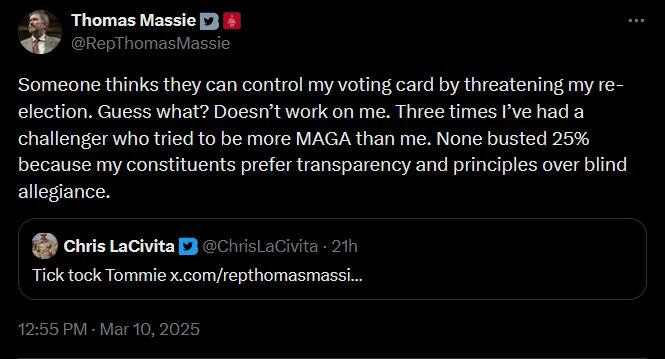
To which Massie then replied: “Someone thinks they can control my voting card by threatening my re-election. Guess what? Doesn’t work on me.”
Also potentially on the fence Punchbowl reports that Reps. Kat Cammack (R-FL) and Beth Van Duyne (R-TX) both raised concerns over the measure during a GOP whip meeting on Monday.

*   *   * 

Top sellers from last week at ZH Store:

ZH Multitool

Anza Swat Micarta Blued knife (1 left until resupply)

ReadyWise Heirloom Seed Vault

IQ Colostrum

ZH Coffee + Tumbler deal (buy 2 bags, get free tumbler)

Anza Tanto Black Micarta… 6.75″ overall length. Satisfaction guaranteed or your money back.

That said, the House Freedom Caucus endorsed the CR in a statement, saying:

“The House Freedom Caucus supports the FY 2025 Continuing Resolution. Contrary to Congress’ longtime abuse of this legislative tool, this CR is a paradigm shift.

This bill will reduce and then freeze spending for the next six months to allow President Trump and his Administration to continue their critical work within the Executive Branch to find and eliminate waste, fraud, and abuse.

It entirely kills the prospect of a budget busting, pork filled omnibus this fiscal year, and it breaks the longstanding practice in the Swamp of handcuffing increases in defense funding with increases to the non-defense bureaucracy.

Furthermore, it contains zero earmarks, makes major rescissions to the Internal Revenue Service and the so-called “Commerce slush fund,” and includes additional funding for immigration enforcement and deportation operations. Perhaps most importantly, it prevents Democrats from derailing the America First agenda with a go-nowhere government shutdown.

With the six months of funding this bill provides, Freedom Caucus Members look forward to working hand-in-hand with DOGE, OMB, and the new cabinet secretaries in eliminating even more waste, fraud, and abuse — and enacting historic spending reforms via reconciliation — all as part of President Trump’s effort to balance the budget.”

Trump, meanwhile, has been working the phones – calling undecided House Republicans, and will continue to do so today according to the report. As Punchbowl reports further:

Vice President JD Vance will attend the Republican Conference meeting this morning for a final lobbying blitz. OMB Director Russ Vought – a former Hill aide himself – met with GOP lawmakers on Monday night. Vought has been speaking to House Republicans one-on-one about the package.

“Trump is all in,” one House Republican leadership aide told us Monday night. “Members can’t be on the wrong side of this.”

Some of the opposition may be performative. Remember: Several House Republicans opposed giving Johnson another term as speaker in early January but buckled after Trump weighed in. Last month, a number of House Republicans backed the budget resolution only after entreaties from Trump.

Enter Hakeem

Meanwhile, House Minority Leader Hakeem Jeffries (D-NY) has gone all-in on opposing the funding bill, insisting that his caucus “will not be complicit in the Republican effort to hurt the American people.”

On Tuesday, Johnson said “They are going to try to shut the government down. Every House Democrat will participate in this… You’re about to see on vivid display, very clear the contrast: You will see one team that is working to fund the government… You’re going to see another opposing the CR.”

Senate Looms

If the bill can pass the House, Senate Democrats are a solid ‘maybe’ on the CR, while Sen. Rand Paul (R-KY) is a solid ‘no.’ 

Given that, eight Democrats will have to vote yes to overcome a filibuster.

Key Senate Dems have trashed the CR as bad policy, however they also view a shutdown as an outcome that nobody wants – so they haven’t declared it DOA in the Senate.

“Passing a full-year CR risks handing [Trump] a huge slush fund with which to do what he wants in ways that could be harmful to our national security,” said Sen. Chris Coons (D-DE).

“I’m waiting to see what the final version is, until then we’re not gonna make any decisions,” said Sen. Ruben Gallego (D-AZ).

And while Sen. Mark Warner (D-VA) told Punchbowl just days ago that the CR was “awful,” he told the outlet that he preferred it to a government shutdown.

Tyler Durden
Tue, 03/11/2025 – 12:40

Former Philippines President Duterte ‘Forcibly Taken’ On Plane Bound For The Hague

Former Philippines President Duterte ‘Forcibly Taken’ On Plane Bound For The Hague

The International Criminal Court (ICC) has over the years issued plenty of arrest warrants for members or leaders of governments and militaries which are basically unenforceable. Such is the case with its recent arrest warrants for Russia’s Vladimir Putin and Israel’s Benjamin Netanyahu. However, they certainly begun avoiding flying into most European countries as a result.

Former Philippines President Rodrigo Duterte has also for years had a warrant hanging over him issued from The Hague-based court, but he too seemed of high enough stature to be beyond enforcement. This is why the Tuesday headlines of his being “forcibly taken” onto a plane headed for The Hague comes as such as surprise.

Former Philippine President Rodrigo Duterte before a ‘war on drugs’ senate inquiry in Manilla in 2024, via AP.

His own daughter has confirmed he was taken on to a plane flight late Tuesday. “They are taking him out on a plane by force without considering his health conditions,” Veronica Duterte wrote on Instagram. Reuters also confirmed, and photographs have emerged.

“As I write this, he is being forcibly taken to The Hague tonight. This is not justice — this is oppression and persecution,” she said.

The ICC arrest warrant stems from his prior and hugely controversial “war on drugs” campaign. The 79-year old former leader had quickly upon taking office in June 2016 launched a fierce crackdown on the drug trade. He was president for six years. Alleged dealers were hunted down by elite law enforcement teams in shantytowns, and there were widespread reports of extrajudicial killings throughout the campaign.

Official police data says that at least 6,000 were killed in Duterte’s crackdown, but Human Rights Watch has listed that over 12,000 Filipinos have been killed, mostly urban poor. The police have been widely accused of often times falsifying evidence in order to target alleged criminal networks.

The fact that the current government took the drastic step of forcing him on a Hague-bound plane has shocked the country of 115 million people, leading many of his supporters into the streets, where some initial clashes with police have been reported.

Interestingly, Duterte had actually withdrew the Philippines from the ICC in 2019. Opponents charged that he was simply trying to shield himself from prosecution, but The Hague has since said that it has jurisdiction involving crimes that took place previously under the membership period.

China’s People’s Daily writes: A chartered plane on Tuesday night flew former Philippine President Rodrigo Duterte to the International Criminal Court in The Hague, the Netherlands, due to an arrest warrant issued by the ICC over his “war on drugs” campaign.

He had long been looked upon as a bit of a ‘rogue’ figure by many in the West, and he had positive, warm relations with everyone from Vladimir Putin to Donald Trump. Upon his first meeting with Putin in 2016, Duterte had lashed out at Western “bullying” and “hypocrisy” and declared that when it came to alliances, the United States could not be trusted. 

“Historically, I have been identified with the Western world. It was good until it lasted,” he told the Russian leader at the time. “And of late, I see a lot of these Western nations bullying small nations. And not only that, they are into so much hypocrisy,” he had said. Now apparently the ‘Western world’ is getting its revenge in the form of the ICC arrest.

Tyler Durden
Tue, 03/11/2025 – 12:25

The Legal Loophole That Costs Medicaid Billions

The Legal Loophole That Costs Medicaid Billions

Authored by Lawrence Wilson via The Epoch Times (emphasis ours),

Medicaid is a broadly popular program that provides medical coverage to low-income Americans through a combination of state and federal funding. More than 60 percent of Americans either know someone who has benefited from Medicaid or have been enrolled themselves, according to health policy think tank FFF. So any talk of altering the program usually meets strong opposition.

Yet few seem to know how the system works, what it costs, or the level of unnecessary spending hidden within its $880 billion annual budget.

One example is a little-known quirk in the Medicaid system that allows states to artificially inflate their Medicaid costs to recoup more federal dollars. The arrangement allows some states to pocket a share of the money paid to them for providing treatment to Medicaid patients.

Here’s how it works.

The Loophole

When a Medicaid patient receives a treatment or service, the state pays the doctor, hospital, nursing home, or other provider. The federal government reimburses each state for a portion of its Medicaid expenses. The reimbursement ranges from 50 to 76.9 percent depending on the income level in the state and other factors.

Although, for people who enrolled through the Medicaid expansion under the Affordable Care Act, the reimbursement rate is 90 percent.

So if a state had a 60 percent reimbursement rate and spent $10 billion on Medicaid services, the federal government would reimburse the state $6 billion.

That’s how the system was designed to work back in 1965, generally speaking.

By the mid-1980s, some states had found a way to increase payments to providers and their own Medicaid costs at the expense of the federal government.

First, medical providers would either voluntarily donate money to a state or agree to pay a tax. The states would then return the amount of the donation or tax, and possibly even more, through increased reimbursement. Finally, the states would bill the federal government for the increased cost.

In some cases, the providers initiated these arrangements, according to the Congressional Research Service (CRS).

For example, a hospital might agree to pay the state $10 million in taxes. The state might then increase Medicaid payments to that hospital by $20 million. If the state’s reimbursement rate was 60 percent, it would receive $12 million in federal Medicaid funding.

Together with the tax income, the state would receive $22 million and pay $20 million, netting $2 million for additional Medicaid costs or other purposes.

The arrangement benefited providers by increasing their reimbursement, and the states benefited by reducing their costs or even gaining revenue. The federal government bore the cost of those increases.

Congress debated the issue in 1991.

Lawmakers who favored keeping the arrangement in some form argued that it had become a vital part of state Medicaid funding.

Rep. Raymond McGrath (R-N.Y.) said at the time that doing away with the system would cost his state $500 million in federal matching funds. He predicted “chaos” in the Medicaid system if provider taxes were abolished.

The administration of President George H.W. Bush strongly opposed the taxes in a position statement, saying, “State donation and provider-specific tax programs, if unchecked, will undermine a basic premise of the Medicaid program—that States have a stake in the costs of the program.”

In the end, Congress chose to impose limits on provider taxes and donations.

First, provider donations to the state are strictly limited to prevent abuse. Second, state taxes must meet certain conditions or the state will lose federal funding.

Taxes must apply to all providers in a certain class, such as nursing homes, not just those who serve Medicaid patients. Also states can’t provide any direct or implied guarantee that they will reimburse providers for the amount of the tax. The limit on provider taxes is 6 percent.

Here’s how the provider tax works today.

Increasing Tax, Dependence

In 2004, 35 states had taxes on medical care providers. Now every state but Alaska taxes some providers, as does the District of Columbia.

And states depend more on tax revenue to fund Medicaid—and other things—according to the Government Accountability Office (GAO).

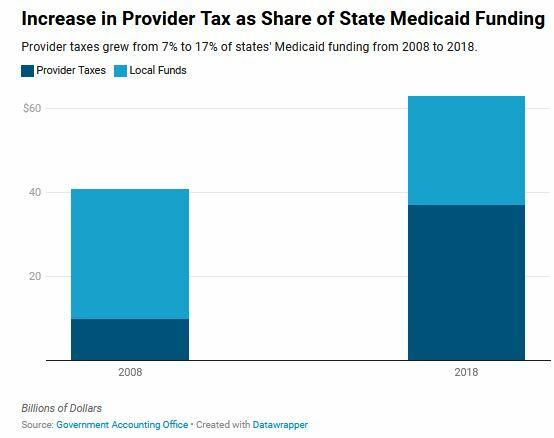
From 2008 to 2018, the share of states’ Medicaid spending covered by provider taxes grew from 7 percent to 17 percent according to the GAO.

In 2018, states received $63 billion in provider taxes and local government funds, according to GAO estimates. Of that amount, $16 billion (25 percent) was not used to pay providers.

That shifted 5 percent of the cost of Medicaid from the states to the federal government, the GAO estimates. The practice also resulted in lower overall reimbursement to some providers when accounting for their tax payments.

When measured as a percentage of the nation’s gross domestic product (GDP), a common measure of the country’s total wealth, the burden of providing Medicaid remained the same for states from 2008 to 2023. While overall spending went up, the economy was growing, too, so state Medicaid spending was essentially flat according to the think tank Paragon Health Institute.

Yet the overall cost of the program increased dramatically, meaning that the federal government paid the entire increase in the cost of the program over 15 years, according to Paragon.

Over that same period, the federal government’s share of the total cost of Medicaid grew from 60 to 72 percent.

Read the rest here…

Tyler Durden
Tue, 03/11/2025 – 12:05

The Educational Cartel: How Randi Weingarten Finally Said The Quiet Part Out Loud

The Educational Cartel: How Randi Weingarten Finally Said The Quiet Part Out Loud

Authored by Jonathan Turley,

American Federation of Teachers president Randi Weingarten is known primarily for two things: screaming into microphones at political rallies and making the teacher’s union an extension of the Democratic Party. However, Weingarten had an unintended substantive moment when she changed her earlier position on the elimination of the Education Department. Weingarten previously shrugged off the elimination of the department as not a big deal for education. Recently, she returned to her irate default in denouncing the elimination. The reason, however, was telling.

After Trump was reelected in November, Weingarten said that the elimination was not a big deal and that teachers had originally opposed the creation of the department: “I mean, my members don’t really care about whether they have a bureaucracy of the Department of Education or not. In fact, Al Shanker and the [American Federation of Teachers] in the 1970s were opposed to its creation.”

Now, however, Weingarten has resumed her natural state of being “really angry.” In an interview with MSNBC, Weingarten explained:

“That is why so many people are so mad about it. Because they’re just taking opportunity away from kids that don’t have it. So billionaires – kids of billionaires, they have it, they go to private schools. Everyone else, 90% go to public schools. Don’t take away their opportunity. Sorry, I’m really angry about this … I’m really angry,”

However, it is the reason that is most interesting.

In a podcast, Weingarten explained that they have to avoid such “block grants” going to families. 

Host Molly Jong-Fast readily agreed, raising the danger that it might even support Catholic and religious schools.  

Weingarten stressed that “We know, for example, what Texas would do. They’ll use it for vouchers. So they won’t give [federal funding] to the kids who have it now, they’ll just give it for vouchers.”

There is reason for Weingarten and the teacher’s union being so concerned.

Florida allows for school choice and has demanded greater performance from public schools. Despite attacks by Weingarten and other Democrats, Florida has been ranked as the number one state for both education and the economy.

We have previously discussed how schools have been dropping the use of standardized tests to achieve diversity goals in admissions. 

That trend continued this month with Cal State dropping standardized testing “to level the playing field” for minority students. 

I have long been a critic of this movement given the overwhelming evidence that these tests allow an objective measure of academic merit and have great predictive value on the performance of students.

Many colleges and universities are returning to standardized testing after the much-acclaimed abandonment of the tests for a more “holistic approach” to selection.

However, public educators have continued to lower proficiency requirements and cancel gifted programs to “even the playing field.” The result has been to further hide the dismal scores and educational standards of many public school districts.

I previously wrote about how public educators and teacher unions are killing public education in America. Many of us have advocated for public education for decades. I sent my children to public schools, and I still hope we can turn this around without wholesale voucher systems.

Teachers and boards are killing the institution of public education by treating children and parents more like captives than consumers. They are force-feeding social and political priorities, including passes for engaging in approved protests.

As public schools continue to produce abysmal scores, particularly for minority students, board and union officials have called for lowering or suspending proficiency standards or declared meritocracy to be a form of “white supremacy.” Gifted and talented programs are being eliminated in the name of “equity.”

Once parents have a choice, these teachers lose a virtual monopoly over many families. They are no longer a captive audience. If public unions want to maintain funding, they will have to actually improve educational results for these families.

You see, Weingarten knows that, like her, they are “really angry,” but not about the future of a union that increasingly sounds like an educational cartel.

Tyler Durden
Tue, 03/11/2025 – 10:35

Trump Retaliates Against Ontario’s “Electricity” Tariff, Threatens To “Permanently Shutdown” Canadian Carmakers, Pushes 51st State Idea

Trump Retaliates Against Ontario’s “Electricity” Tariff, Threatens To “Permanently Shutdown” Canadian Carmakers, Pushes 51st State Idea

Just when you thought it was safe to dip your toe back in the growth-challenged markets, President Trump took to Truth Social and unleashed a retaliatory strike against Canada (more specifcally Ontario) for its ongoing tariffs (and electricity price hike)… (emphasis ours)

Based on Ontario, Canada, placing a 25% Tariff on “Electricity” coming into the United States, I have instructed my Secretary of Commerce to add an ADDITIONAL 25% Tariff, to 50%, on all STEEL and ALUMINUM COMING INTO THE UNITED STATES FROM CANADA, ONE OF THE HIGHEST TARIFFING NATIONS ANYWHERE IN THE WORLD. 

This will go into effect TOMORROW MORNING, March 12th. 

Also, Canada must immediately drop their Anti-American Farmer Tariff of 250% to 390% on various U.S. dairy products, which has long been considered outrageous. I will shortly be declaring a National Emergency on Electricity within the threatened area. This will allow the U.S to quickly do what has to be done to alleviate this abusive threat from Canada. 

If other egregious, long time Tariffs are not likewise dropped by Canada, I will substantially increase, on April 2nd, the Tariffs on Cars coming into the U.S. which will, essentially, permanently shut down the automobile manufacturing business in Canada. 

Those cars can easily be made in the USA! 

The result is that the Canadian dollar dumped…

And US stocks gave up some their early gains.

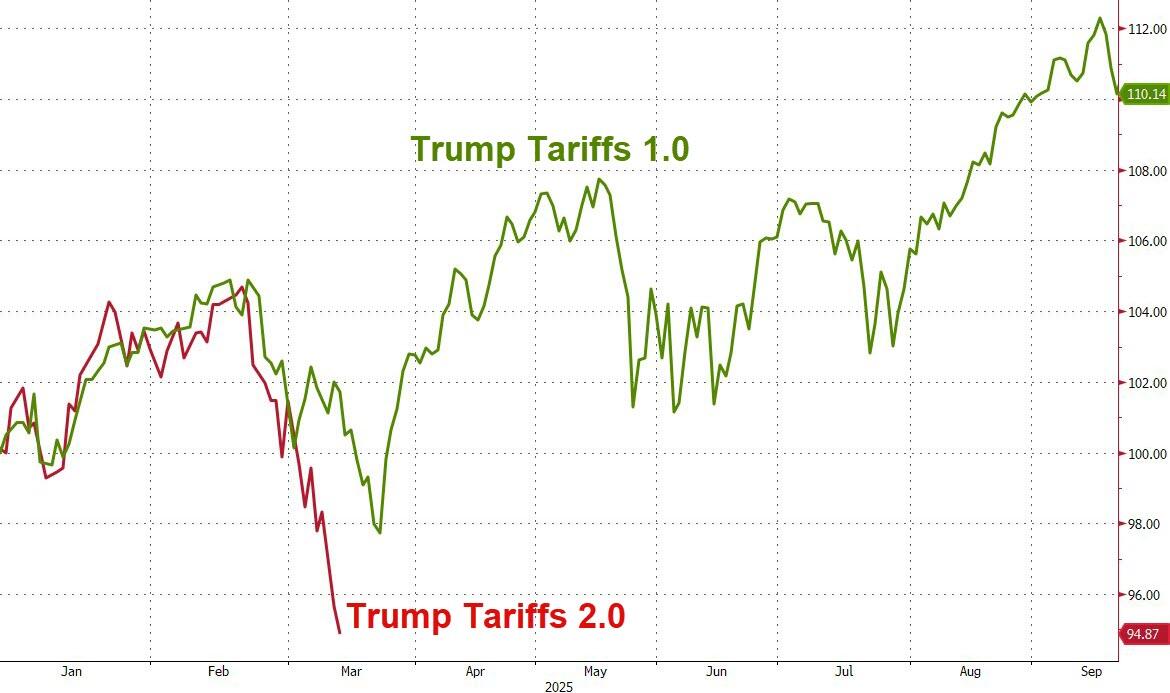
It’s different this time.. for now…

Trump then diverted back to his previous comments on making Canada America’s 51st State:

Also, Canada pays very little for National Security, relying on the United States for military protection. 

We are subsidizing Canada to the tune of more than 200 Billion Dollars a year. WHY??? This cannot continue. 

The only thing that makes sense is for Canada to become our cherished Fifty First State. 

This would make all Tariffs, and everything else, totally disappear. 

Canadians taxes will be very substantially reduced, they will be more secure, militarily and otherwise, than ever before, there would no longer be a Northern Border problem, and the greatest and most powerful nation in the World will be bigger, better and stronger than ever — And Canada will be a big part of that. 

The artificial line of separation drawn many years ago will finally disappear, and we will have the safest and most beautiful Nation anywhere in the World — And your brilliant anthem, “O Canada,” will continue to play, but now representing a GREAT and POWERFUL STATE within the greatest Nation that the World has ever seen!

We are sure Mr Carney will bristle with Trump’s hurtful words.

Tyler Durden
Tue, 03/11/2025 – 10:14

If Europe Seizes Russian FX Reserves, It Would Immediately Reset The Global Financial System

If Europe Seizes Russian FX Reserves, It Would Immediately Reset The Global Financial System

By Michael Every of Rabobank

Resetting expectations

Yesterday saw the Nikkei -2.2%, the Dax -1.7%, the S&P -2.7%, and the Nasdaq –3.8%, while the US Treasury 10-year yield the White House is now focused on was -5bp to 4.16%. As the headlines put it, markets were “swooning”, first on China drifting back to deflation, then on President Trump’s comments that refused to rule out a US recession. Frankly, that commentary managed to be both very shallow and deeply myopic at the same time.

China is “struggling” with deflation due to mercantilism. An economy that ‘must’ grow at 5%, and via more supply, not demand, necessarily makes too much, exports it, and… dominates global supply chains. Many Western economies could do with that right now – as Trump implied.

He made clear he wants to reset the US, and by extension, global economy: “I hate to predict things like [a recession]. There is a period of transition, because what we’re doing is very big. We’re bringing wealth back to America. That’s a big thing. And there are always periods of – it takes a little time… But I think it should be great for us… What I have to do is build a strong country… You can’t really watch the stock market. If you look at China, they have a 100-year perspective. We go by quarters. And you can’t go by that. You have to do what’s right.” Vice-President Vance put the same thing another way: “President Trump’s economic policies are simple: if you invest in and create jobs in America, you’ll be rewarded. We’ll lower regulations and reduce taxes. But if you build outside of the US, you’re on your own.”

Markets, which presumed Trump 2 would retain Trump 1’s monomania for stocks, just want what’s right for them. However, anyone who thought shifting the US to production-based mercantilism from asset-based financialisation via economic statecraft over economic policy could be done without assets falling didn’t understand either ‘ism’, or statecraft. Hence the sell-off.

Of course, this attempted US reset could go horribly wrong; or right. Either way, markets will be dragged along behind it.

We are also seeing a matching US global foreign policy reset via political statecraft:

The US and Ukraine are to meet in Saudi Arabia today to discuss ending that war, as Senator Graham threatens to sanction Russia aggressively if they don’t come to the table; the US wants a deal, not war between Israel and Hamas, and it, not Israel, is now seen in charge of hostage negotiations and the end game; the US is also getting tougher on Iranian oil, as the Houthis reportedly get ready to attack things again; Trump seems set for a June ‘two birthdays’ summit with China’s Xi despite the escalating trade war; and the FT’s Gideon Rachman claims Trump is “Making Europe Great Again” after decrying all the actions that led to that outcome.

Again, this attempted US reset could go horribly wrong; or right. Either way, markets will be dragged along behind it. So, do try to keep up.

Moscow is now blaming the UK for instigating global wars – a Russian obsession and a good way not to blame the US, helping build détente, perhaps. However, that flatters the UK as much as recent comparisons between PM Starmer and Churchill. The looming UK Strategic Defence Review (SDR) reportedly states the military is so weak after 25 years of hollowing out that it will take ten years to become “match fit”, and require “much more” investment, and “industrial policy” to onshore production, tech, and jobs, as well as a recommendation this is done without the US.

Oddly for military thinkers, the SDR seems to assume an economics-style static backdrop when it will be dynamic and antagonistic. What if Russia, China, or even the US make the UK’s “industrial policy” or military decoupling more difficult and expensive via grey-zone sabotage, supply chain ‘shocks’, or economic statecraft countermeasures? At the very least, anyone thinking “much more” investment was covered by the recent policy shift away from foreign aid to defence spending, or that this is going to take only ten years, or that the government has a shovel-ready plan for military protectionism to allow it to happen is likely mistaken.

The same applies to Europe: will the new “four-year” loosening of the EU’s Stability and Growth Pact, or the 1.5 percentage points of GDP, be all we get as it rearms? Half a Euro tank or a Euro combat aircraft to replace US systems like the F-35 for fear of built-in ‘kill switches’ –so requiring even more complex new supply chains to be built from scratch, and economies of scale, i.e., larger orders, to make it affordable– is no use to Europe at all.   

Meanwhile, geopolitics is ‘even’ seen in central banks’ hallowed halls – as anyone who’s read their history knows is actually line 1, page 1, chapter 1.

In the US, the Fed is now in blackout mode ahead of its meeting next week – but what will it say if markets keep falling even if as recently as Friday the US economy was seen as “fine” by Fed Chair Powell?  

In Europe, Politico notes ECB Governing Council’s Kazaks has become the first member to say that seizing €200bn of Russia’s FX reserves to help Ukraine is a “viable option,” with other Baltic central bank officials reportedly privately endorsing the same, and pressure maybe building to act. ECB President Lagarde is still opposed for now, but recognzses it will ultimately come down to politicians, who face a huge rearmament bill, not central bankers: and that’s a dynamic central bankers need to get used to going forwards.

Were this to occur it would be the most radical European economic statecraft step in that area since WW2. It would shatter EU assertions of their defence of the ‘rules-based order’, or unilaterally rewrite them, reduce the attractiveness of the Euro as a global reserve currency just as the same is being said of the US dollar in some quarters, and could even have an impact on the holding of Eurozone government bonds by key Global South asset holders. And what if the US opposed the move, bringing US-EU financial tensions onto the table alongside trade, geopolitical, and military?

In short, seizing Russia’s FX reserves would prompt urgent discussions about a reset of the global financial system, and its bifurcation.

That’s where a lot of what has been discussed in this Daily logically ends up, if you look through the “markets swoon” headlines. Time to reset your own expectations accordingly?

Tyler Durden
Tue, 03/11/2025 – 10:05

Largest Ever Ukrainian Drone Attack On Moscow Kills Three Civilians, Injures 9

Largest Ever Ukrainian Drone Attack On Moscow Kills Three Civilians, Injures 9

Just hours ahead of a major meeting between American and Ukrainian delegations in Saudi Arabia toward finding a path to ceasefire with Russia, Ukraine’s military launched an unprecedented cross-border attack on Moscow and the surrounding region of the capital.

“The largest ever attack by enemy drones on Moscow has been repelled,” Mayor Sergei Sobyanin announced on Telegram early Tuesday of the overnight attack. “Seventy-four combat drones were shot down on their way to Moscow, with hundreds more intercepted at various points.”

Via Reuters

At least three people were killed as the drones in some cases scored direct hits on residential buildings and neighborhoods of the capital. The scale of the launch included multiple hundreds of UAVs – given that Russia’s defense ministry said it downed 337 unmanned aircraft during the assault.

A statement claimed that 91 drones were downed around Moscow, with another 126 intercepted over the Kursk region bordering Ukraine.

At least nine others were wounded, with some reports suggesting up to 20 were hurt. One man who was killed was struck in a parking lot outside a meat packing plant, the regional governor said. Another man succumbed to his injuries at a hospital.

Russia’s Investigative Committee has dubbed the attack an act of terrorism and said that President Putin has been briefed on the matter.

Transportation in the capital was impacted, with Domodedovo train station south of Moscow experiencing service disruptions after falling drone debris caused damage. Also, all Moscow airports were temporarily halted for all inbound and outbound flights.

Russian Foreign Ministry spokeswoman Maria Zakharova blasted Kiev for the attack, pointing out that it happened just as OSCE Secretary General Feridun H. Sinirlioglu (of Turkey) was visiting Moscow.

“The Kyiv regime once again sent drones toward the city,” Zakharova said on Telegram. “The head of an organization that Zelensky’s sponsors have reduced to mere rhetoric, stripping it of its original purpose — ensuring security and cooperation in Europe.”

“This is yet another signal to the international community — to the so-called collective West, which in reality is anything but united — that the monster they nurtured, fed, armed and showered with money is now completely out of control,” she continued.

But Ukraine is already presenting it as an example of its supposed leverage, threatening that such attacks will continue unless Putin accepts a ceasefire for the air, which Ukraine is expected to present to the US. This is key to the ‘partial ceasefire’ now being pushed by Zelensky.

“The largest drone attack in history was carried out on Moscow and the Moscow region,” Ukraine’s National Security and Defense Council spokesman Andriy Kovalenko touted in connection to talks with the US. “This is an additional signal to Putin that he should also be interested in a ceasefire in the air.”

Tyler Durden
Tue, 03/11/2025 – 09:45

Russian Spies Warn That The UK Is Trying To Sabotage Trump’s Envisaged “New Détente”

Russian Spies Warn That The UK Is Trying To Sabotage Trump’s Envisaged “New Détente”

Authored by Andrew Korybko via substack,

Russia’s Foreign Spy Service (SVR) accused the UK of trying to sabotage the nascent Russian–US “New Détente” for self-interested geopolitical reasons. According to their sources, the success of their talks could break the Brits’ regional containment of Russia, which is why they’re employing a dual-track policy for preventing this. The first part involves information warfare fearmongering about Trump’s ties with Russia while the second seeks to escalate the Ukrainian Conflict through a conventional intervention.

SVR’s report lacks any bombshells since everything that they revealed was already self-evident to astute observers, but it’s still important that they lent credence to what others before them had already picked up on and the timing with which they did so. “France, Germany, & Poland Are Competing For Leadership Of Post-Conflict Europe” while the UK plans to divide-and-rule the continent like usual, to which end it’s expected to rely more on Poland and/or Ukraine with whom it’s been colluding since February 2022.

Few either saw it at the time or still remember, but the UK forged an informal trilateral alliance with Poland and Ukraine exactly one week before the special operation began, which was leveraged shortly after to convince Zelensky to abandon spring 2022’s peace talks with Russia as was explained here. In the three years since, Poland and the US have taken harder stances towards Ukraine, the first initially for domestic political reasons and the second due to Trump’s eagerness to “Pivot (back) to Asia” pronto.

The aforesaid developments have left the UK as Ukraine’s top supporter, the position of which it expects to maintain for as long as possible since that former Soviet Republic is the lynchpin in London’s regional anti-Russian containment strategy, but events might ultimately force it to abandon this project. Until that happens, however, the UK is doing its utmost within all realistic limits to complicate and even possibly sabotage the nascent Russian-US “New Détente” and associated deal over Ukraine.

Should it fail, which is seemingly inevitable, then the fallback plan could be to refocus on Poland as the core of a new regional containment coalition that’ll be smaller in scope but nonetheless still formidable. Poland has the largest economy of the EU’s eastern members, now boasts NATO’s third-largest army, and aspires to restore its lost “sphere of influence” at the expense of Russia’s security interests. These factors could converge to make Poland the UK’s preferred top partner in post-conflict Europe.

The only problem to these plans is that the US is poised to make Poland its own top partner on the continent so the UK might have to compete with its American ally or accept junior partner status vis-à-vis Washington in any trilateral that might form between them. 

At the same time, however, Foreign Minister Radek Sikorski is a diehard Anglophile who even had British citizenship till he gave it up in 2006 to join the government so he might operate as the UK’s “agent of influence” to advance its agenda.

From the UK’s perspective, the best-case scenario is that: the nascent Russian-US “New Détente” fails for whatever reason; the US then feels compelled to resume large-scale military support to Ukraine in response so as to teach Russia a lesson as Trump might see it; but the UK successfully manipulates Western public opinion to supplant the US as the “leader of the free world” due to its consistently anti-Russian position that never once wavered no matter how difficult things became for Ukraine in the past.

On the flipside, the worst-case scenario from the UK’s perspective is that: the nascent Russian-US “New Détente” succeeds; a pragmatic compromise follows in Ukraine which turns it into an informal joint protectorate between Russia and the US; the US then turns Poland into its top partner in post-conflict Europe; and the US, not the UK, guides Poland as it restores part of its lost “sphere of influence” and then uses this geopolitical network to divide-and-rule Europe by keeping Germany and Russia apart.

It’s precisely this sequence of events that’s presently unfolding and which might consequently provoke the UK into doing something very dramatic to sabotage this process out of desperation. Russia clearly has an interest in preventing that, ergo why SVR chose this moment to lend credence to what others before them had already picked up on about the UK’s interests in this context. Trump 2.0 must become aware of the threat that the UK poses to its plans and respond accordingly to defend the US’ interests.

Tyler Durden
Tue, 03/11/2025 – 09:25

Is Tennessee The Next Housing Market To Drop?

Is Tennessee The Next Housing Market To Drop?

The US housing market is off to a slow start at the beginning of the spring selling season, as highlighted in our most recent note, “Goldman’s Housing Heat Map Shows a Tepid Start to the Selling Season.”

Nick Gerli, CEO and founder of real estate analytics firm Reventure Consulting, has highlighted for many months very alarming figures of soaring housing supply in several US housing markets, including Florida and Texas. 

Gerli has now focused on the Tennessee housing market, asking: “Is Tennessee the next market to drop?”

Gerli wrote:

“Inventory is spiking in Tennessee due to a slowdown in buyer demand mixed with a large pipeline of builder inventory. Like most Sun Belt markets, prices in Tennessee skyrocketed during the pandemic (+56%) and locals are now priced out.” 

He touched on affordability woes plaguing buyers.

The housing expert believes rising inventory should lead to a “modest correction in the market”… 

Supply in Nashville has topped 2010 levels. 

And Knoxville.

Nashville’s housing market was one of those red-hot markets during the Covid era. However, the party ended with interest rate spikes in 2022.

The 30-year mortgage rate still trends around 7%. 

Jeff Checko, the relocation director with The Ashton Real Estate Group of RE/MAX Advantage, recently provided insight into the Nashville housing market to local outlet WKRN, stating that normalization will continue through the spring selling season.

“We saw signs of things returning to a typical seasonal market this year, with interest rates getting back into the sixes and the mid-sixes, and then it was kind of one step forward, one step back, one step forward, one step back again,” Checko said, adding, “We’re hoping that we get something kind of normal for the first time in about half a decade.”

The question for Nashville real estate is whether the soaring housing supply will lead to normalization or a more pronounced downturn, as Gerli asked.

Tyler Durden
Tue, 03/11/2025 – 06:55

Orbán Demands Referendum On Ukraine’s EU Membership

Orbán Demands Referendum On Ukraine’s EU Membership

Via Remix News,

Hungarian Prime Minister Viktor Orbán is taking a novel approach to the years-long controversy over whether or not Ukraine should be granted status as a European Union member state: asking the bloc’s existing citizens.

Orbán told Hungarian reporters in Brussels on Thursday evening that Hungary would hold a referendum on this issue, as he does not believe that such a crucial decision should be made “over the heads of the people,” as reported by the Hungarian news outlet Infostart.

The Hungarian prime minister made this announcement at the conclusion of a summit involving all the leaders of the EU member states, where the bloc had been hoping to release a joint statement announcing that it would continue supplying Ukraine with weapons to continue the war against Russia. Orbán, as the only EU leader to reject the statement, exercised his country’s veto power to prevent it from being made.

All decisions at the EU level must be made unanimously by all member states.

The EU’s scramble to find ways of continuing to support Ukraine comes as the United States has stopped its own aid to the country, given that President Donald Trump is attempting to pressure the country into accepting a ceasefire.

Hungary has called national referendums many times since Orbán was first reelected in 2010, such as in 2016, when one was held on the issue of whether the country should accept receiving quotas of migrants from elsewhere in the EU. Another occurred in 2022, when citizens were given the opportunity to vote for or against Orbán’s legislation aimed at protecting children from gender ideology and pedophilia. Although such referendums are non-binding, they give an indication of how much of the Hungarian public supports the government’s actions.

Affirming the government’s commitment to gauging public opinion on this issue, Fidesz MP Balázs Orbán, who is also Viktor Orbán’s political director, said on Friday that “for the first time, Hungarians have a chance in Europe to decide whether they support Ukraine’s EU membership or not.”

Orbán explained his position on Ukraine’s EU membership by saying that it is not possible to make a responsible decision regarding it under current conditions. He added that allowing Ukraine into the bloc would also have a deep impact on its economy – and not necessarily for the better. “We are not prepared for this,” he indicated.

Orbán further stated that he does not think the EU’s economy, and certainly not Hungary’s, is capable of continuing to bear the burden of sending aid to the beleaguered and war-ravaged nation.

“26 out of 27 member states argued that Ukraine should continue the war,” he emphasized. “Hungary remained on the side of peace.” 

He went on to say that Europe should instead “support the president of the United States with the greatest possible strength and energy in order to ensure the success of peace negotiations.”

Read more here…

Tyler Durden
Tue, 03/11/2025 – 06:30