

67.8 F
Chicago
Thursday, October 1, 2026
Home Blog Page 1864

Medicare Isn’t Broke – Yet

0
Medicare Isn’t Broke – Yet

Authored by Lawrence Wilson via The Epoch Times (emphasis ours),

Medicare has a money problem. Or it will in about 10 years. It’s the sort of problem Dwight Eisenhower might have called important but not urgent, like a balloon payment on a mortgage or a roof that only leaks once in a while. Such problems are easy to ignore until it’s too late to fix them.

Illustration by The Epoch Times, Shutterstock

Yet anything costing $1 trillion a year will inevitably become urgent soon enough, and Medicare’s funding shortfall will demand attention and action by 2036 to prevent a crisis.

That’s when the Hospital Insurance (HI) Trust Fund, which pays hospital bills for 68 million Americans, will be depleted, according to Medicare’s trustees. After that, the annual income for Medicare Part A will fall 11 percent short of expenses.

But that’s a decade away. For now, the HI Trust Fund has a surplus of more than $200 billion, according to the latest report. And Medicare Part B, which covers things such as doctor visits and diagnostic tests, had reserves of over $180 billion.

Medicare is not insolvent, but there is an increasingly large gap between the revenue generated by the program and its total expenses. And that requires an increasingly large transfer of cash from the U.S. Treasury to make the program work.

In 2023, revenue coming into Medicare through payroll taxes, premiums, and interest covered about 57 percent of the program’s expenses. The other 43 percent, about $43 billion, had to be paid from the government’s general fund. This gap between income and expenses has always existed, but it’s growing rapidly. By 2053, the general fund will have to cover fully half of program costs.

President Donald Trump, like former President Joe Biden before him, has promised to protect Medicare, though neither articulated a plan for doing so.

Medicare, which will have its 60th birthday in July, chugged along for decades without attracting much attention. Why is it now falling further and further behind expenses?

That’s partly due to the way Medicare was designed, and it’s partly a result of changing demographics, American innovation, and decisions that were made along the way.
It’s Not a Business

Medicare provides medical care for people who are age 65 and older, or disabled, or have end-state renal disease or ALS, also known as Lou Gehrig’s disease.

Medicare is called an insurance program but it wasn’t designed to be fully self-sustaining. It has always operated more like a federally subsidized health payment program.

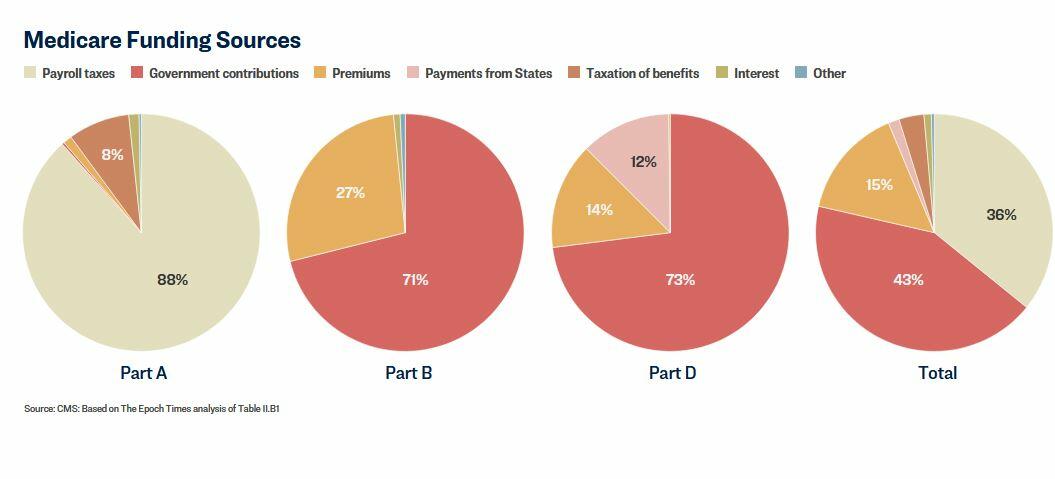
Medicare Part A, which pays for hospitalization, is the most like traditional insurance and the closest to being financially stable. The lion’s share of funding for Part A comes from a 2.9 percent payroll tax. The rest comes from a tax on Social Security benefits, interest on the fund balance, and premiums paid by some beneficiaries.

It’s a mistake to think of the HI Trust Fund as an endowment or a pension, according to Jon Kingsdale, an adjunct associate professor of health care policy at Brown University.

“It’s simply like a checking account, which is filled up by payroll taxes throughout the year and is drawn down by spending for hospitals and nursing homes and other facilities,” Kingsdale told The Epoch Times.

Like a checking account, the HI Trust Fund can reach a zero balance. The trustees predict that will happen in 2036. After that, the income it receives will cover only about 79 percent of Part A obligations.

Medicare Part B is a little different. Its expenses are paid through the Medicare Supplemental Medical Insurance (SMI) Trust Fund, as are expenses for Medicare Part D, prescription drug coverage.

People who qualify for Medicare can opt into Parts B and D by paying a premium. Part B also receives some income from interest on the fund balance, and states contribute to support Part D.

But that income covers only a fraction of the expenses. More than 70 percent of the funding for the SMI Trust fund comes from the general budget. Every year, Congress estimates upcoming expenses, then adds money to cover the gap.

Increases in premiums have not kept pace with expenses, so the share paid by the general fund has grown larger.

When the HI Trust Fund is depleted, it will cause an urgent problem because the government currently has no legal mechanism for adding more money to it. But the larger issue is that the primary funding sources for Medicare are not keeping pace with rising costs, requiring the government to pay a larger and larger share of the nation’s wealth to keep the program going.

Medicare now consumes about 3.8 percent of the country’s gross domestic product, the total value of all goods and services produced. By 2048 it will be 5.8 percent, according to the Medicare trustees.

Three main factors are driving that.

Senior citizen Yoko Mitani waits for her prescription at Ballin Pharmacy in Chicago on May 3, 2004. Enrollment for the Medicare Drug Benefit program offering discounts on prescription drugs for senior citizens was made available today. Tim Boyle/Getty Images

Demographics, Innovation, Medicare Advantage

Two population events coincided in the 20th century that resulted in financial pressure on Medicare. First, the 76 million baby boomers who were born between 1946 and 1964. They started to retire in 2011. That caused Medicare enrollment, which had been growing by about 500,000 a year, to add 1.3 million beneficiaries a year for the next 14 years.

Additionally, long before the baby boomers signed up for Medicare, the birth rate fell significantly. Americans have gone from having 123 births per 1,000 women aged 15 to 44 at the height of the baby boom to having 56.1 births per 1,000 by 2022.

Taken together, those events created a situation in which fewer workers are paying the Medicare payroll tax compared with the number of people receiving benefits. When the program was created in 1965, the ratio of workers to beneficiaries was 4 to 1. Today it’s 2.8 to 1 and will continue to decrease through 2040.

The rise in obesity, addiction, diabetes, and other chronic illnesses costs all Americans, including Medicare beneficiaries, more now. Americans spent about $8,500 per person, adjusted for inflation, on health care in 2000. Today the amount is more than $14,500.

The second factor in the cost of Medicare is innovation in the health care industry. Medicare pays for far more diagnostic tools and treatments than it did in 1965, including things such as CT scans, MRIs, and joint replacement surgery. But the biggest recent cost increase has come from prescription drugs, which were not covered by Medicare until 2006. By 2022, prescription drugs accounted for 14 percent of all Medicare spending.

A third factor is Medicare Part C, or Medicare Advantage. That’s an optional program started in 1997 to allow private insurance companies to manage benefits for Medicare beneficiaries.

People who opt into Medicare Advantage continue to pay their Part B premium to Medicare. Then the government pays the insurer a lump sum to pay for their treatment. An analysis by KFF, a health policy research group, found that Medicare Advantage cost $321 per year more per enrolled beneficiary than traditional Medicare did in 2019. That amounted to $7 billion.

Now, more than half of Medicare’s 68 million beneficiaries are enrolled in Medicare Advantage plans.

Read the rest here…

Tyler Durden
Mon, 01/27/2025 – 21:45

Scott Bessent Confirmed As Treasury Secretary, Pushes For Gradual Universal Tariffs Up To 20%

0
Scott Bessent Confirmed As Treasury Secretary, Pushes For Gradual Universal Tariffs Up To 20%

Late on Monday, the Senate confirmed Scott Bessent’s nomination for Treasury Secretary in a 68–29 vote, putting him in a key role in implementing President Trump’s tariff and growth agenda. The billionaire investor will be spearheading Trump’s plan of cutting taxes and curbing deficits, while putting forward a tariff plan that also facilitates growth.

The Senate Finance Committee approved Bessent’s nomination for Treasury Secretary on a 16-11 vote, with two Democrats—Sens. Maggie Hassan (D-N.H.) and Mark Warner (D-Va.)—joining Republicans. Democrats who opposed his nomination alluded to concerns about his tax dispute with the IRS.

“Like a lot of Wall Street titans, he’s opted out of paying a fair share into Medicare,” said Sen. Ron Wyden (D-Ore.), ranking member on the committee.

Bessent has previously said the U.S. faces economic calamity if Congress does not renew key provisions from Trump’s Tax Cuts and Jobs Act that are set to expire Dec. 31, 2025. According to the Epoch Times, negotiating the extension of those tax cuts will be one of Bessent’s major responsibilities even as he pushes for 3 percent annual growth, significant trims to deficits, and increasing domestic oil production by 3 million barrels a day.

Senate Majority Leader John Thune (R-S.D.) described the Wall Street veteran as an “example of the American dream in action.”

“He brings a wealth of private sector experience in the economy and markets to his new role, as well as the concern for the needs of working Americans,” Thune said on the Senate floor.

Senate Finance Committee Chairman Mike Crapo (R-Idaho) defended Bessent before the vote, saying that the Key Square Group founder has complied with tax laws.

Many Democrats, naturally, disagreed. Sen. Sheldon Whitehouse (D-R.I.), one of the Democrats who voted against Trump’s pick to lead the Treasury Department,  called it a “double standard in America” during an executive committee hearing on Jan. 21.

Sen. Elizabeth Warren (D-Mass.) said Bessent’s nomination further highlights billionaires’ influence on U.S. politics. “Billionaires dominate the American economy, and Republicans plan to give them more tax breaks,” she said.

In his Jan. 16 confirmation hearing in front of the committee, Bessent discussed various economic issues. Bessent has expressed how critical it is to extend the 2017 Tax Cuts and Jobs Act (TCJA), President Donald Trump’s signature legislation from his first term in the White House.

Sitting before the Senate Finance Committee during his Jan. 16 confirmation hearing, the Wall Street veteran told lawmakers that allowing the TCJA to expire would cause “an economic calamity” and lead to “financial instability.” “We will see a gigantic middle-class tax increase. We will see the child tax credit halved,“ Bessent said. ”We will see the deductions halved … it has the potential for a sudden stop.”

Contrary to his most recent hedge fund letter, the billionaire financier now also supports the president’s tariff plans. He highlighted the various benefits associated with trade levies, such as strengthening the U.S. dollar, forcing foreign manufacturers to export deflation, and nudging consumers to change their preferences to support American jobs.

And speaking of flipflopping, exactly one year after he wrote in his KeySquare letter to investors that he found it “unlikely that across-the-board tariffs, as currently reported by the media, would be enacted”, the FT reported that Bessent is now pushing for new universal tariffs on US imports to start at 2.5% and rise gradually.

The 2.5% levy would move higher by the same amount each month, the people familiar with it said, giving businesses time to adjust and countries the chance to negotiate with the US president’s administration.

The levies could be pushed up to as high as 20 per cent — in line with Trump’s maximalist position on the campaign trail last year. But a gradual introduction would be more moderate than the immediate action some countries feared.

The proposal by Bessent comes as Trump’s team debates how to implement tariff plans, with the president escalating his tariff rhetoric on Monday in a speech in Florida, threatening more duties on semiconductors, metals and pharmaceutical goods.

“We have to bring production back to our country,” Trump said.

Trump was speaking after a day of turmoil in US stock markets, triggered by a tech sell-off as China appeared to make a leap ahead of the US in the global artificial intelligence race. His threat to impose tariffs on semiconductors entering the US would be difficult to carry out given the impact on tech companies relying on chipmakers such as Taiwan’s TSMC.

In contrast, Bessent’s plan would see just 2.5% added to tariffs each month. According to the FT, it was unclear if the Treasury secretary had convinced other central stakeholders, including Howard Lutnick, Trump’s pick for commerce secretary, to adopt his proposal for a gradual introduction of tariffs.

Meanwhile, Trump has threatened to force tariffs of up to 25% on imports from Canada and Mexico as soon as this weekend, and in recent days threatened Colombia with 25% tariffs in a dispute over deportees. That said, an FT source said that Trump’s thinking said he was weighing different options. “There is not a single plan the president is ready to decide on yet.”

When asked by reporters last week whether he planned to introduce universal tariffs, Trump replied: “We may. But we’re not ready for that yet.”

We may not be there yet, but we will be there soon, especially if Trump follows through on his urging to abolish income tax altogether, which implies that tariffs would need to somehow generate similar amounts of revenue. In that case a 20% universal tariff is just the start.

Tyler Durden
Mon, 01/27/2025 – 21:20

Missouri Takes CCP To Court For $25 Billion Over Hoarding Of COVID-19 Protective Equipment

0
Missouri Takes CCP To Court For $25 Billion Over Hoarding Of COVID-19 Protective Equipment

Authored by Melanie Sun via The Epoch Times (emphasis ours),

The Chinese Communist Party (CCP) will be on trial in Missouri on Jan. 27 after the state sued over damages sustained as a result of its actions during the COVID-19 pandemic.

Andrew Bailey during the 2024 Conservative Political Action Conference the Gaylord National Convention Center in Fort Washington, Maryland, Thursday, Feb. 22, 2024. Photo by Dominic Gwinn / Middle East Images / Middle East Images via AFP

“We’re hauling China into court to hold them accountable for unleashing COVID-19 on the world,” state Attorney General Andrew Bailey said in a press release, Gray Media local affiliate KAIT8 reported.

It said that Bailey is scheduled to appear in federal district court in Cape Girardeau for the trial.

Missouri will be the first state to sue the CCP and its relevant entities over actions it says allowed COVID-19 to spread globally.

Bailey’s office said it will seek $25 billion in damages for actions it says caused significant loss of life and economic disruptions in Missouri and harmed its citizens.

“Missouri v. China is truly a landmark case, as we seek $25 billion in damages,” Bailey said. “We won a key victory in this case last year, so we’re feeling confident heading into trial.”

Bailey filed the lawsuit in federal district court in 2020 during the pandemic. Bailey’s office sought damages for the CCP’s cover up of critical information about human-to-human spread of the virus inside China and for hoarding personal protective equipment.

None of the China-based defendants named in the lawsuit responded, though briefs were filed by Lawyers for Upholding International Law and The China Society of Private International Law to defend China.

The CCP dismissed any factual or legal basis for the lawsuit, which it called “very absurd.”

The case was dismissed by the district court judge, who ruled that the defendants were immune under the 1976 Foreign Sovereign Immunities Act (FSIA), which generally prohibits lawsuits against foreign states in U.S. courts. Upon appeal to a three-judge panel of the U.S. Court of Appeals for the Eighth Circuit, Missouri’s case was revived in January 2024 but only for the state’s claims regarding the hoarding of personal protective equipment.

The panel ruled that part of the lawsuit as an antitrust claim that fell under the statutory exception related to commercial activity by foreign states.

The state must now prove that the CCP and the other named China-based entities hoarded personal protective equipment, and that the direct effect of this caused harm to Missouri and its citizens.

The CCP is not expected to have a representative in court, which could make a default judgment in Missouri’s favor easier to achieve, facing no cross-examination or rebuttals from China.

Critics of the case have called it a stunt aimed at publicly placing blame on the CCP for the COVID-19 pandemic. Some legal experts have also warned that the case could set a risky precedent to see foreign governments allow plaintiffs to sue the United States in tribunals around the world.

Tyler Durden
Mon, 01/27/2025 – 20:55

House Republicans Huddle With Trump At Miami Resort

0
House Republicans Huddle With Trump At Miami Resort

House Republicans are gathering at President Trump’s National Doral in Miami, Florida this week for their annual policy retreat, where they will golf, talk shop, and listen to Donald Trump deliver an expected address on Monday.

Former President Donald Trump and his motorcade arrive at Trump National Doral Miami on Monday, June 12, 2023, in Doral, Fla. MATIAS J. OCNER

According to The Hill, House GOP leaders have already indicated that they’ll be discussing Trump’s legislative agenda – which includes an extension of his 2017 tax cuts, tackling inflation through energy policy, and securing the southern US border. Republicans are looking to try and move the agenda in a single bill through the budget reconciliation process vs. splitting it into two pieces as some Republicans had hoped for.

Reconciliation carries the threat of a Democratic filibuster in the Senate, but can be used only once or twice in a year – and will need near-unanimous support from GOP Senators. That said, balancing Trump’s agenda with demands from fiscal hawks that the legislation be neutral, or even reduce the deficit.

“We’ve got a math problem,” said Rep. Ralph Norman (R-SC), a fiscal hawk who’s gunning for more than $2 trillion in cuts. “Let’s put the math on the board, and let’s go about it agency by agency.”

This week’s policy retreat, which starts Monday afternoon and ends Wednesday morning, is slated to have a number of meetings among members about what policies to include in the bill and how to offset their cost.

While members expect the final details will not be complete for weeks, Republicans will soon have to make a decision about the broad topline number expected in their proposal in order to tee up the legislative vehicle for the Trump agenda reconciliation bill. GOP leaders hope to pass that budget resolution by the end of February. –The Hill

Meanwhile, Republicans will need to come up with a game plan for the debt ceiling, which Trump has demanded they do without giving Democrats leverage.

That may prove more difficult than Trump envisions, as the aforementioned fiscal hawks want steep spending cuts that Democrats will lose their shit over, as they always do.

One idea being floated by Republicans is to include a debt limit increase in a package that would pair regular government funding and wildfire aid, in the hopes that the disaster relief would entice a sufficient number of Democrats to make up for GOP hardliner opposition.

That said, when asked on Thursday if Democrats could support a debt ceiling hike attached to wildfire aid for California, House Minority Leader Hakeem Jeffries (D-NY) said “It’s a nonstarter.”

Also last week, Speaker Mike Johnson (R-LA) told The Hill that the decision on how to handle the debt limit could be made at this week’s retreat.

“There are a number of ideas on the table we’re talking about,” said Johnson, when asked about addressing the debt limit via reconciliation or attaching it to wildfire aid. “We’re taking all the House Republicans to a big retreat early next week down in Florida, and we’ll finalize all those decisions.”

Tyler Durden
Mon, 01/27/2025 – 20:30

Federal Agencies Made Over $161 Billion In Improper Payments Last Year: Watchdog

0
Federal Agencies Made Over $161 Billion In Improper Payments Last Year: Watchdog

Authored by Naveen Athrappully via The Epoch Times (emphasis ours),

The U.S. government made billions of dollars worth of improper payments in the most recent fiscal year, with several agencies found to be non-compliant with regulations on the matter, according to a recent report from the U.S. Government Accountability Office (GAO).

The U.S. Capitol building in Washington on Jan. 9, 2025. Madalina Vasiliu/The Epoch Times

“Since fiscal year 2003, executive branch agencies have reported cumulative improper payment estimates of about $2.8 trillion, including $161.5 billion for fiscal year 2024,” the Jan. 23 report from the agency read.

An improper payment is one made by the government that “should not have been made or was made in an incorrect amount,” including duplicate payments, money sent to ineligible recipients, and payments made for goods or services not received.

The $161 billion is enough to buy over 380,000 homes in the United States, according to median home sales price data tracked by the Federal Reserve Bank of St. Louis. It is lower than the $236 billion in improper payments estimated to have been made by federal agencies in fiscal year 2023. Annual improper payments have remained above the $150 billion level since 2019.

The Payment Integrity Information Act of 2019 (PIIA) mandates that agencies identify risks related to improper payments and take corrective actions, while also reporting improper payments within the programs they administer.

GAO found that 10 agencies under the Chief Financial Officers Act were “noncompliant with PIIA criteria for fiscal year 2022.”

The 10 agencies are the Departments of Agriculture, Defense, Education, Health and Human Services, Homeland Security, Housing and Urban Development, Labor, Treasury, Veterans Affairs, and Small Business Administration.

Out of the 10, nine were found to be noncompliant with the PIIA criteria for one or more programs or activities for two consecutive years—fiscal years 2021 and 2022. The only exemption was the Department of Homeland Security.

When an agency has been noncompliant for two consecutive years for the same activity or program, they are required to submit proposals on how they plan to become compliant with the PIIA.

These proposals are to be submitted to the Office of Management and Budget (OMB). According to GAO, OMB is expected to provide guidance on the matter in the development of the fiscal year 2026 President’s Budget.

GAO recommended the director of OMB clarify that agencies not in compliance with PIIA explicitly state in their annual financial statements that they will come into compliance.

Before the GAO report was released, a draft version was submitted to OMB for review and comment. OMB agreed with GAO’s recommendations, without providing any comments on the report.

DOGE

The GAO report comes as President Donald Trump signed an executive order on his first day in office announcing the Department of Government Efficiency (DOGE) initiative seeking to modernize federal technology and software “to maximize governmental efficiency and productivity.” The U.S. Digital Service has been renamed as the U.S. DOGE Service (USDS).

According to the order, a temporary organization called the U.S. DOGE Service Temporary Organization is to be set up with a lifespan of around 18 months, headed by the USDS administrator. The organization “shall be dedicated to advancing the President’s 18-month DOGE agenda.”

The order mandates every government agency to establish a DOGE team, which coordinates with the USDS and advises agency heads on implementing the DOGE agenda.

The DOGE venture has already attracted opposition, with four lawsuits being filed against it on Jan. 20 by several groups at a court in Washington.

One complaint was filed by a coalition of associations including the American Public Health Association, American Federation of Teachers, Minority Veterans of America, and the Citizens for Responsibility and Ethics in Washington.

A second lawsuit was filed by the Center for Biological Diversity, a third by the National Security Counselors, and a fourth one by consumer watchdog group Public Citizen.

Kieran Suckling, executive director of the Center for Biological Diversity, alleged that DOGE will attempt to remove federal protections “for our air, water, and most imperiled wildlife.”

Earlier on Jan. 14, Sen. James Lankford (R-Okla.), a founding member of the DOGE Caucus, introduced a bill aimed at making the government more efficient.

“The American people gave Washington a mandate in November—waste less, save more. Today, I’m introducing a first set of bills to follow through on their mandate by prioritizing streamlined regulations, rulemaking, and record keeping. It’s time to put government waste in the doghouse and let DOGE get to work,” the lawmaker said.

Tyler Durden
Mon, 01/27/2025 – 20:05

Trump & His New Frenemies, Abroad And At Home

0
Trump & His New Frenemies, Abroad And At Home

Authored by Victor Davis Hanson via American Greatness,

President Trump recently gave a video talk to the World Economic Forum (WEF) assemblage in Davos.

He expressed fondness for Europe. He praised many for their attendance – and then tore into the evils of hyperregulation, high taxes, radical environmentalism, and the DEI/ESG commissariat of both the prior Biden administration and indeed the European Union.

One might have thought the attendees’ heads would have exploded when Trump referred to oil as “liquid gold.”

And he topped that by referring to the venerated Green New Deal as the “Green New Scam.”

“I terminated the ridiculous and incredibly wasteful Green New Deal—I call it the ‘Green New Scam,’ withdrew from the one-sided Paris Climate Accord, and ended the insane and costly electric vehicle mandate.”

But then a strange thing happened.

The questions from international bankers and financiers that followed were not all that critical. In fact, one could characterize them as curious and carefully encouraging.

So, what prompts the polite European reception to such green and economic heresy?

A careful hearing of Trump’s entire speech would reveal it was not confrontational as much as aspirational. He was trying to envision a new European partnership—albeit one under American leadership.

“Under our leadership, America is back and open for business . . . So, you know I’m trying to be constructive because I love Europe. I love the countries of Europe.”

The U.S. economy has grown to nearly twice the size of the European Union’s since its inception more than two decades ago. Indeed, over 20 years, the gross domestic product of both was roughly comparable.

European energy costs are constantly soaring, especially given radical green restrictionism and the disruption of the Ukraine War.

There is further European recognition that their economies, like those of Japan, South Korea, and Taiwan, hinge on American policies, economic, cultural, and social—and especially access to U.S. markets and consumers.

In this regard, Biden’s hard pivot to green globalism, fiery rhetoric about eliminating internal combustion engines, natural gas, and gasoline fuels, coupled with woke/DEI policies, proved not just disastrous at home; it also weakened the position of Euro realists abroad.

During the Biden years, Western allies abroad felt they had to fall in line with a strange, quirky new America.

Under Biden, the U.S. seemed to rush well leftward of even Europe—undermining European traditionalists, free-marketers, and economic and cultural conservatives who had been slowly gaining ascendance.

The wounded European money people at Davos were essentially saying to Trump that socialism may be an affordable, temporary boutique diversion in traditional capitalist America. But in an already inert, static, neo-socialist Europe, such an American hard shift to the left has proved disastrous.

So, it was in such a Davos moment that the global financial grandees were politely stunned at Trump’s call for a new golden age of American-led, freer market capitalism.

He promised not just to ensure lower interest rates, fiscal sobriety, fewer regulations, lower taxes, smaller government, and less state intervention in the economy, secure borders, and an end to illegal immigration. He went further to promise that these methods would ensure greater Western prosperity, security, and freedom, both American and European.

Trump trashed past American censorship, political orthodoxies, deficit spending, inflation, and high interest. He summed up the Biden four-year detour as culpable and wrongheaded.

“President Biden totally lost control of what was going on in our country.”

Stranger still, Trump located his pitch in ecumenical terms—of a strong U.S. seeking to help Europe reemerge to fulfill its natural potential.

Indeed, it was past time for the proverbial American and European “West” to stick together in a dangerous economic world of Chinese mercantilism, Russian aggression, and a new political and military axis of China, Russia, Iran, and North Korea—with countries like India and Turkey keen to see which alignment comes out on top.

Most of the bankers at Davos, in fact, wished Trump to double down on his promises.

Patrick Pouyanné, CEO of TotalEnergies, was not worried about Trump’s grandiose plans to expand fossil fuel production. Instead, his concern was only whether Trump could guarantee Europe could buy lots of his gas.

When he asked Trump point-blank whether he would honor his promise to ship massive amounts of liquid natural gas to Europe, Trump gushed back, “I would make sure that you get it. If we make a deal, we make a deal; you’ll get it.”

Another European banker apparently was also worried not about too much Trumpism but apparently not enough:

“We very much welcome your focus on deregulation and reducing bureaucracy. So, my question is: What are your priorities in this regard, and how fast is this going to happen?”

How fast?

Trump’s veritable messaging is now something like “Make Europe Great Again” (MEGA)—and most certainly not the old Obama idea that the US is merely one unexceptional nation, equal to all others.

Nor is Trump’s vision anything like the Biden effort to absorb failed European ideas about taxes, regulation, borders, and energy and then amplify such dreary statism with an American veneer—and boomerang the disastrous agenda back across the Atlantic.

Instead, the Trump idea is to make Europe and the U.S. both stronger economically and militarily. He wants to supercharge the U.S. economy and offer Europe avenues to join the ride.

In that regard, Trump’s Davos speech was the foreign policy counterpart to his domestic appeal to tech giants like Elon Musk, Jeff Bezos, Mark Zuckerberg, and the CEOs of Apple, Google, and other Silicon Valley conglomerates.

Under Biden’s growing statist octopus, its tentacles were starting to reach out and wrap around his once-loyal multibillionaire supporters—in order to strangle them.

They were always, of course, somewhat uneasy about Biden’s tax increases, redistributionist multi-trillion-dollar deficits, hyperinflation, and resulting high interests.

But what now terrified them was the increasing candor of the envisioned Biden eight-year agenda. Joe, in his role as a waxen effigy, would supposedly continue the ‘ol’ Joe from Scranton’ cover to facilitate another four years of an even harder Bernie Sanders/Elizabeth Warren/Squad/Obama socialist blueprint.

In other words, the neo-socialist Biden government would not just take profits from them on the back end with taxes and fees. But now it would also restrict and control on the front end what an entrepreneur would be allowed even to do—and how, when, and where he could innovate to make products and profit as he thought best.

Implied—and indeed feared—was that an army of thirty-something zealous, know-nothing government ideologues and bureaucrats would divide up business concessions. And they would offer slices of allotments to tech lords, based on their own fealty to the administration and their hard-left credentials.

So future tech winners and losers would not be determined by talent or market successes but by ideological purity—the usual historical framework where toadies, the mediocre, and the status quo triumph over mavericks, the fearless, and the unorthodox.

So, finally the tech giants, like the vestigial Euro capitalists, figured that Trump would unleash their animal spirits—and in a way more radically than any prior president.

The aim would not merely be to enrich them. He would also enlist them to make their countries preeminent in 21st-century globalist arenas such as biotech, artificial intelligence, cryptocurrency, cyberwarfare, drones, and lasers.

Read Trump’s Davos speech and the subtext is that the only impediment to Western success is Western fear and loathing of it.

Trump counts on the excitement of a shared adventure to free the West from its crabby naysayers as a moral and uplifting experience far preferable to the current nihilist slouching to statism and stagnation.

Tyler Durden
Mon, 01/27/2025 – 18:25

Pardoned J6 Protestor Says He Has Proof Police Incited Riots At Capitol

0
Pardoned J6 Protestor Says He Has Proof Police Incited Riots At Capitol

Virginia Beach resident Jacob Hiles is a charter boat captain arrested for crimes related to the protests on J6.  He ultimately plead guilty to one misdemeanor count of parading, demonstrating, or picketing in a Capitol building. In exchange for Hiles’ guilty plea, the Department of Justice dropped the remaining three misdemeanor charges against him.  He was given two years probation.

However, Hiles says there’s a lot more to the story that he could not tell the public until he was officially pardoned by Donald Trump last week. 

The boat captain tells a local NBC affiliate, WAVY-TV 10 that he has video proof of capitol police acting to incite the riots.  At least 9 minutes of his video is posted to WAVY-TV 10, though it appears to be heavily edited.  

“I have several videos from Jan. 6 — I have over an hour of video that I shot on Jan. 6…It shows all sorts of things. I have videos that show Capitol Police inciting inciting riots by shooting. They were walking through the crowds with a super soaker-style water gun that was full of bear spray.”

“I have [on video] a man who who had been sprayed by a Capitol Police officer…I’m standing right beside him and he walks up to the Capitol Police officer and says, ‘Hey, why did you spray me with with pepper spray?’ The guy … said he was a Vietnam veteran and he’s never done anything but serves the country.”

Not only that, Hiles also asserts that federal agents threatened him with long term imprisonment if he took those videos to the media or posted them to the internet.

“It was what I was told in August of 2021…And in a Zoom meeting with Brandon Merriman, who is the special agent in charge of Jan. 6, and he’s the guy you saw do the interview about 60 Minutes about Jan. 6.

In a Zoom meeting with Brandon Merriman in August of 2021, he told me that if I go to the media and start talking about Jan. 6, if my videos find the media or the Internet, that I would, quote, ‘spend the rest of my life in prison.’ I asked for what [and] he said. ‘I’ll find something.’” 

An attorney for Hiles believes that this exchange with the special agent was recorded, which means it could now be accessed by the Trump Administration. 

Hiles testimony supports previous claims by J6 protesters that the Capitol Police and federal agents incited the violence by attacking the peaceful protesters with tear gas and rubber bullets.  Video clips from the event taken from body cam footage and protester footage show police engaged in harassing the crowd with munitions well before the protesters attacked the building or the officers.  

Videos also show police accidentally gassing themselves, which forced them to retreat closer to the building.  Officials originally blamed protester violence for their retreat. 

The official J6 narrative reiterated to the public for years was, in fact, a lie.  The tale of an unhinged crowd of “far-right insurrectionists” hellbent on violently disrupting the 2020 elections and spurred on by Donald Trump as a would-be dictator?  That never happened.  It is yet another fallacy added to a long list of fallacies perpetrated by Democrats and establishment bureaucrats to perpetually demonize conservatives, likely as a means to secure election supremacy for years to come. 

Obviously, they failed. 

The media and the Biden Administration constructed a house of cards around the same repeated handful of carefully cherry-picked J6 video clips.  They only show what occurred after police had already attacked and enraged protesters.  What they never show is what happened to make the crowd so angry in the first place.  Those videos also don’t show what happened behind the scenes, including the intimidation that was apparently used by federal agents to keep arrested protesters quiet.     

Tyler Durden
Mon, 01/27/2025 – 18:00

7 Charged In America’s Biggest COVID Tax Credit Fraud Scheme

0
7 Charged In America’s Biggest COVID Tax Credit Fraud Scheme

Authored by Naveen Athrappully via The Epoch Times (emphasis ours),

A group of seven who allegedly sought to steal hundreds of millions of dollars in the “largest COVID-19 tax credit scheme” by falsely claiming pandemic-era benefits were charged on Jan. 22, according to the U.S. Department of Justice (DOJ).

The Department of Justice in Washington on Jan. 9, 2025. Madalina Vasiliu/The Epoch Times

An indictment unsealed in New York charged the seven people with “operating a multi-state conspiracy in which they attempted to defraud the United States of more than $600 million by filing more than 8,000 false tax returns claiming COVID-19-related employment tax credits,” the agency said in a statement. The fraud targeted programs like employee retention credit (ERC) and paid sick and family leave credit (SFLC), which were passed in response to the COVID-19 pandemic.

The ERC gave tax credits to businesses, incentivizing them to keep employees on their payroll, while SFLC was a reimbursement made to businesses for paying employees “on sick or family leave and could not work because of COVID-19.”

The charges were made against Keith Williams, Jamari Lewis, Morais Dicks, Janine Davis, Tiffany Williams, James Hames Jr., and Ewendra Mathurin; all of whom are either current or former residents of New York.

Between November 2021 and June 2023, the defendants “repeatedly exploited” ERC and SFLC programs, the DOJ said. “The scheme was allegedly headquartered at Credit Reset, a purported credit repair business Keith Williams owned and operated.”

The defendants acted as tax preparers and allegedly filed over 8,000 fake employment tax returns on behalf of themselves and clients, claiming COVID tax credits from the IRS. In some of the fake returns, they allegedly claimed SFLC which exceeded reported wages, according to the department.

The defendants managed to secure refund checks from the Treasury, while also profiting by charging clients a fee or percentage of the tax refunds they received, the agency accused.

“The defendants allegedly concealed their preparation of the false tax returns by not listing themselves as the paid preparer on the tax returns and by using Virtual Private Networks (VPNs) to obscure their IP addresses while filing the false returns,” the DOJ said.

“If a client did not have a business, members of the conspiracy allegedly would sometimes sell shell companies to them in order to file false tax returns.”

The fraudsters reportedly filed for $600 million in tax credits as part of the scheme, of which the IRS roughly disbursed $45 million. Authorities charged the defendants with 45 counts, including wire fraud, conspiracy to defraud the United States, and assisting in preparing false tax returns.

Some of the defendants also allegedly submitted false applications for loans under the pandemic-era Paycheck Protection Program (PPP). Six people allegedly involved in the PPP fraud were charged with wire fraud as well.

If convicted, defendants face prison terms ranging from three to 30 years per count, depending on the charge.

Tackling Pandemic Fraud

The DOJ had previously charged several hundreds of individuals for fraud related to COVID-19. Back in August 2023, the agency announced 718 enforcement actions for alleged COVID-19 fraud offenses involving $836 million. This included federal criminal charges against 371 defendants.

Many of the cases were linked to pandemic unemployment insurance benefit fraud, as well as fraud related to the Economic Injury Disaster Loans and PPP.

In March last year, the IRS announced that its Criminal Investigation (CI) unit had investigated 1,644 tax and money laundering cases worth $8.9 billion that were linked to COVID fraud.

The cases involved fraudulently obtained loans, payments, and credits aimed at supporting American workers and small businesses.

“In the last year alone, we have opened nearly 700 new COVID fraud investigations that collectively add up to $5 billion in potential fraud,” CI Chief Guy Ficco said at the time. “Our special agents continue to seek out fraudsters who stole money from government loan programs for their personal gain.”

This month, Sen. Joni Ernst (R-Iowa) announced the introduction of the “Complete COVID Collections Act” that seeks to extend authorization of the Special Inspector General for Pandemic Recovery (SIGPR) through 2030.

SIGPR, created as a watchdog to oversee loans provided under the Coronavirus Aid, Relief, and Economic Security Act, is scheduled to expire in March 2025. Extending the authorization allows the SIGPR to continue pursuing people who stole COVID funds reserved for small businesses, Ernst said.

“Con artists took advantage of small businesses’ pain during COVID to defraud government programs designed to help hardworking Americans,” Ernst said.

“While we are $36 trillion in debt, we especially cannot afford to leave more than $200 billion floating around, especially in the hands of fraudsters. My Republican colleagues and I are making sure that all resources are available in this fight to get taxpayers’ money back and hold these criminals accountable.”

Tyler Durden
Mon, 01/27/2025 – 17:40

DeepSeek Hit By “Large-Scale” Cyberattack

0
DeepSeek Hit By “Large-Scale” Cyberattack

Chinese AI company DeepSeek reminded Western investors about global competition in the artificial intelligence race, particularly in China, where large language models can be developed and trained at a fraction of the cost incurred by Mag7 companies. This sparked a global selloff across the AI complex as investors worry over “negative capex impact” and ROI concerns over hefty AI investments.

In a separate development, DeepSeek’s API landing page posted this warning around noon: “Due to large-scale malicious attacks on DeepSeek’s services, registration may be busy. Please wait and try again. Registered users can log in normally. Thank you for your understanding and support.” 

The Hangzhou-based company continued, “To ensure continued service, registration is temporarily limited to +86 phone numbers. Existing users can log in as usual.” 

DeepSeek did not disclose who was behind the “attacks” or where they originated. However, given that hundreds of billions of dollars in market capitalization were wiped out from Mag7 stocks (-$700bln), plus a massive AI narrative shift, one might reasonably speculate about where the attacks are coming from, directly or indirectly through proxy groups. 

Our forensics analysis of Chinese public records provides a more in-depth view of DeepSeek. 

Business purpose:

Hangzhou Deep Quest Artificial Intelligence Basic Technology Research Co., Ltd., with its office address located in Hangzhou, the capital of Zhejiang Province and a paradise on earth, Room 1201, Building 1, West Huijin International Building, No. 169 North Huancheng Road, Gongshu District, Hangzhou City, Zhejiang Province (registered address), our company mainly provides: engineering and technical research and experimental development; technical services, technical development, technical consulting, technical exchanges, technology transfer, and technology promotion; software development; computer system services; information system integration services; artificial intelligence application software development; information technology consulting services; electronic product sales; communication equipment sales; instrument sales; data processing services; Internet data services; computer software, hardware and auxiliary equipment retail; artificial intelligence hardware sales; professional design services.

Upstream Ownership (Founder: Liang Wenfeng):

Additional public records data on DeepSeek:

DeepSeek’s training costs for its latest LLM are allegedly around $6 million—far less than the hundreds of billions of dollars Mag7 companies spent.

PitchBook data shows a recent money raise…

Meanwhile, Bernstein analyst Stacy Rasgon told clients: “Did DeepSeek really build OpenAI for $5 million? Of course not,” adding, “It seems like a stretch to think the innovations being deployed by DeepSeek are completely unknown by the top tier AI researchers at the world’s other numerous AI labs.”

However, if DeepSeek did… 

Latest DeepSeek reporting:

. . . 

Tyler Durden
Mon, 01/27/2025 – 17:20

Rep. Fallon To New USSS Director: Make Swift Reforms

0
Rep. Fallon To New USSS Director: Make Swift Reforms

Authored by Susan Crabtree via RealClearPolitics,

Less than 48 hours into the job as Secret Service director, Sean Curran is getting an earful of advice on overhauling the agency, including from the House member who sharply tangled with his predecessor.

Rep. Pat Fallon, a Texas Republican, who got into a screaming match with former Acting Secret Service Director Ron Rowe during a House hearing in early December, spearheaded a letter sent to Curran Friday, lauding his selection while pressing him to usher in “dramatic change” to the agency.

“Congratulations on your recent appointment by President Trump to serve as the next director of the U.S. Secret Service,” wrote Fallon, a member of the House Task Force. “As you know well, this is both a great honor and a great responsibility. Your courageous actions on July 13, 2024, at the Butler, Pa. rally, while serving as President Trump’s special agent in charge, demonstrate your superb commitment to your agency’s zero-fail mission.”

Five other Republicans on the Task Force signed the letter, including its chairman, Rep. Mike Kelly of Pennsylvania, and Reps. Clay Higgins of Louisiana, Mark Green of Tennessee, David Joyce of Ohio, and Laurel Lee of Florida.

Curran, who headed Trump’s campaign security detail for more than two years, was one of the first agents to leap on the then-GOP nominee and cover him with a human shield amid flying bullets. The efforts may have helped save Trump’s life, even as Trump pushed through the protection to rise from the floor, pump his fist, and shout, “Fight, fight, fight!” He also repeatedly requested additional security assets for Trump, but was rebuffed by USSS leaders until the FBI briefed them on an Iranian plot against Trump’s life in the days leading up to the Butler rally.

The House Republicans placed the blame for the “unacceptable failures” that led to the Butler assassination attempt squarely on the USSS leadership, including Rowe, who moved into the acting Secret Service director role after Congress pressured former Director Kimberly Cheatle to resign. The Texas Republican urged Curran to read the House Task Forces’ report “thoroughly and strongly consider the recommendations therein.”

“We cannot stress enough the need for dramatic change in culture at the USSS,” they wrote. “The events of July 13 in particular underscore why the world’s premier protective agency, the USSS, can never succumb to complacency.”

“There is good evidence that, as the agency’s next director, you will effect such change, and we are reassured by President Trump’s over confidence in you as his choice to lead,” they added. “Our republic is counting on you to ensure [the] USSS lives up to its zero-fail mission.”

Tensions flared between Fallon and Rowe during a December House Task Force hearing that pressed Rowe about the findings of the group’s investigation. Fallon lambasted Rowe for taking nine days to visit the Butler site despite being the deputy director at the time. He then accused him of trying to push Biden’s protective agents to the side so he could stand in a position of prominence at a New York City event celebrating the 23rd anniversary of 9/11.

“I actually responded to Ground Zero. I was there going through the ashes of the World Trade Center,” Rowe retorted. “I was there, congressman – I was there to show respect for a Secret Service member that died on 9/11. Do not invoke 9/11 for political purposes.”

The exchange became even more explosive, with both men trying to interrupt each other after Fallon said Rowe was trying to change the subject because the criticism was true.

“You know why you were there, because you wanted to be visible, because you are auditioning for this job that you’re not going to get,” he further yelled during their confrontation, accusing Rowe of endangering lives.

Even before receiving the letter, Curran was wasting little time in starting to clean house at the Secret Service. On his first day on the job, as many as 10 senior leadership officials, including Rowe, were warned that they would either be fired, moved, or pressed into retirement, according to three Secret Service sources.

Curran has been inundated with information on which top officials on the 8th floor of headquarters to oust or replace. Agents are circulating removal wish lists, as well as names of those agents Curran or other members of his new leadership team already informed that their services are no longer needed.

Agents are expressing an urgent need to remove Chief Operating Officer Cynthia Sjoberg Radway from her leadership post. Radway was incredibly close to Cheatle, the pair having become good friends during a previous Radway stint working for the agency. When Cheatle became director, she brought Radway back to work more directly for her in the COO role and gave her a bonus to do so, according to multiple sources. The fear is that Radway, if allowed to stay, will continue to serve as a pipeline of information back to Cheatle. She also has crossed many agents Curran respects.

“She will be a major roadblock to positive progress,” if allowed to stay, one source in the Secret Service community told RealClearPolitics.

One of the biggest points of contention about who should stay and go is being waged over an alleged decision by former USSS leadership, under Cheatle’s and Rowe’s direction, not to inform Curran of the security threats against Trump before the Butler rally.

In addition to Cheatle and Rowe, David Torres, assistant director of Strategic Intelligence and Information, was also involved in keeping the Trump campaign detail in the dark about a specific Iranian attempt against Trump’s life. The Pittsburgh Field Office, which partnered with the Trump campaign detail for planning and executing security for the Butler rally, also was never informed before the July 13 assassination attempt. If the two Secret Service contingents had been informed, the agents charged with providing security may have upped their game to come up with a more robust security plan and far better execution, these sources contend.

Rowe officially passed the torch to Curran in a “good-bye” letter to all Secret Service personal sent late Thursday night and obtained by RealClearPolitics. In it, he praised Curran’s selection for the role, while omitting any reference to the two assassination attempts against Trump’s life while he was serving in top leadership agency roles. Rowe only became acting director after Kimberly Cheatle resigned under pressure from Congress in the wake of the Butler assassination-attempt debacle.

Rowe strangely claimed he is “excited” to announce that Curran will be the next director, the 28th in the agency’s history. (Trump previously announced that decision on Truth Social.)

“Throughout his career, Director Curran has led and played critical roles in both protective operations and the investigative mission,” Rowe wrote. “He has consistently demonstrated outstanding leadership, integrity, and courage.”

“His vision, dedication, and ability to drive results have earned him respect inside the agency and from law enforcement partners,” he continued. “I am confident that under his leadership the Secret Service will continue to grow, innovate, and remain steadfast in our unwavering commitment to succeed in our missions.” Rowe’s conclusion that he’s “proud of all that we have accomplished together” without any mention of the monumental failures in Butler and during the second assassination attempt on Trump’s life at a Florida golf course spurred instant ridicule among rank-and-file agents.

But it was the way he signed the letter that gave fellow agents and USSS officers the most pause. Rowe listed his title as deputy director, the post he held before former Homeland Security Secretary Mayorkas elevated him to the acting director role following Cheatle’s resignation.

If Rowe is moving to the deputy director role with Curran in the top post, agents tell RCP they believe nothing will change, and the USSS will continue to experience protection failures, retention problems, and low morale. “When are we going to seriously fix the problems instead of putting lipstick on a pig?” one source questioned.

Yet, Rowe may simply be moving back to the deputy director job temporarily before Curran has a chance to name his own No. 2 and chief of staff. The names circulating among the Secret Service for those top leadership roles include Matthew Piant, who served as Curran’s No. 2 on the Trump campaign detail, and Tyler McQuiston, a former agent who previously served in several senior protective operations roles.

Susan Crabtree is RealClearPolitics’ national political correspondent.

Tyler Durden
Mon, 01/27/2025 – 17:00
