70.2 F
Chicago
Thursday, October 1, 2026
Home Blog Page 1867

DOGE Seeks To Shed Vast Amounts Of Government Office Space

0
DOGE Seeks To Shed Vast Amounts Of Government Office Space

Authored by Wolf Richter for WOLF STREET,

The DOGE people in the Trump administration are considering shedding a big portion of the massive office space that the government owns or leases nationwide, managed by the General Services Administration (GSA), including selling two-thirds of the office space the government owns and terminating three-quarters of the leased office space, according to the WSJ.

Much of this office space is vacant or underused and poorly maintained due to lack of funding, according to GSA testimony before Congress in 2023, cited by the WSJ, which further noted:

“A recent report from Sen. Joni Ernst, a Republican from Iowa who chairs the Senate DOGE caucus, found that not one of the headquarters for any major agency or department in Washington is more than half full. GSA-owned buildings in Washington, D.C., average about a 12% occupancy rate. The government owns more than 7,500 vacant buildings across the country, and more than 2,200 that are partially empty.”

The office sector is already in a depression, with default rates that exceed those during the worst moments of the Financial Crisis. Putting this inventory on the market for sale is going to weigh on the already collapsed prices of older office buildings – prices of 50-70% below the last sale before the pandemic are now common.

And terminating leases is going to stress office buildings, their landlords, and their lenders even more, likely entailing more defaults and foreclosure sales. This is a much needed but very bitter medicine to alleviate government waste.

What office landlords and their lenders are facing.

Here we look at the leased office space, where those buildings are, and what portion of the leased space the GSA has the right to terminate in 2025, and also through 2028 (Trump 2.0), based on an analysis from Trepp, which tracks commercial real estate debt and CMBS.

  • GSA leases 149 million square feet (msf) of office space around the US.

  • GSA pays $5.2 billion in annual rent to private-sector landlords.

  • Through 2028, GSA has the right to terminate 53.1 msf of leases, or 35.5% of its leased space, spread over 2,532 properties.

  • In 2025, GSA has termination rights on 21.2 msf spread over more than 1,000 properties,

  • If GSA terminates all possible leases during Trump 2.0, it would save the government $1.87 billion in annual rent after 2028.

  • In the vast Washington DC metro, GSA leases nearly 10% of the entire office market, 35.8 msf in 446 buildings, and can terminate 9.6 msf of that in 2025.

  • In the Washington D.C. metro, GSA currently pays $1.47 billion in annual rent.

  • GSA leases nearly 6% of the office space in the Kansas City metro (DoD, USPS, Treasury, VA, and USDA), 4.3 msf, of which it can terminate 1.0 msf in 2025.

Here are the top 10 metros in terms of government office space. GSA leases 66.3 msf of office space in them and has termination rights in 2025 on 18.9 msf (28.5%):

Office CRE would be stressed enough without this.

The office sector of commercial real estate is in a depression, and office debt just keeps getting worse: The delinquency rate of office mortgages across the US that have been securitized into commercial mortgage-backed securities (CMBS) spiked to a record 11% at the end of 2024, blowing by the Financial Crisis peak, having exploded over the past 24 months from an everything-is-just-fine 1.6% at the end of 2022, to a disastrous 11.0% at the end of 2024.

The motto in 2024 was “survive till 2025” via extend-and-pretend. But now it’s 2025, and here comes the government’s vacant office space.

*  *  *

Enjoy reading WOLF STREET and want to support it? You can donate. I appreciate it immensely. Click on the beer and iced-tea mug to find out how

Tyler Durden
Mon, 01/27/2025 – 06:30

European Leaders Double-Down On Stagnation At Davos

0
European Leaders Double-Down On Stagnation At Davos

Authored by Daniel Lacalle,

Many market participants appeared astonished to learn that Von Der Leyen and Scholz in Davos were steadfastly pursuing the policies that have severely damaged the EU. However, this is typical bureaucratic behaviour.

In a predictable move, EU bureaucrats have chosen to exploit the new Trump administration as an external enemy, rather than seizing the opportunity to unleash the immense potential of their economies. Bureaucrats do not care about results; they care about bureaucracy.

Ursula Von Der Leyen expressed her unwavering commitment to upholding the European Union’s climate and economic strategies when she asserted that “Europe will continue on its current path,” a stance marked by stagnation, high taxes, low competitiveness, and excessive debt. The Paris Agreement continues to be the best hope of all humanity,” she repeated. “Europe will stay the course and keep working with all nations that want to protect nature and stop global warming.” This statement is simply incorrect. The EU has used the Paris Climate Agreement as a tool for economic and social control, causing harm to its industrial and business infrastructure. In fact, the Paris Climate Agreement has achieved the opposite of its intended goals. The EU is now more dependent on imports of liquefied natural gas and coal to address supply challenges. European Union climate policies have only reduced emissions by crippling economic growth and industrial production.

Technology, competition, and free markets are necessary for environmental defence, not interventionism.

We should not be surprised when we read that the European Commission will present its competitive compass plan without reducing government overspending or eliminating any of the taxation and legislation burdens that have crippled the European Union.

Over the past 16 years, the U.S. GDP has grown by 94%, while the European Union’s nominal GDP has only increased by 11.2%. This has happened in a period of enormous fiscal and monetary “stimulus packages,” including the Juncker Plan and the Next Generation EU Fund, as well as negative nominal rates. The European Union stagnation is a consequence of a chain of public sector-promoted spending programs that have left a trail of debt and no real productivity growth.

From 2010 to 2023, productivity in the EU increased by only 5%, significantly lower than the 22% increase in the U.S. during the same period. How can this happen?

When governments subsidise low productivity and penalise high productivity with enormous taxes, the economy slumps.

European Union officials justify this trend, citing the rise of China and emerging economies as the reasons for the European relative decline. However, the share of global GDP for the EU has decreased from 34% in 1960 to 15% in 2024, while the U.S. has seen an increase from 28% to 25% over the same timeframe.

Social indicators are also significantly poorer. The unemployment rate in the European Union was 5.9% in November 2024. In the same period, the unemployment rate in the United States was recorded at 4.2%. However, countries like Spain and Greece have unemployment rates of 11.2% and 9.6%, respectively, with the population at risk of poverty and exclusion at 27% in Spain, 25% in Greece, and an average of 21% in the EU, according to Eurostat, with 13% of the population living in poverty. In the United States, the equivalent to the European rate is 22%, with 11% of the population living in poverty.

The EU’s at-risk-of-poverty threshold for a single person in Germany, the richest nation, stood at $14,124 per year. In Spain, it stood at $10,393 according to INE. In the US, it was $14,580 according to official figures. This means the poor in the United States are richer and fewer than in Europe.

The sad truth is that the alleged social contract and enormous government spending have not helped Europe in any area, and the average tax wedge is ten points higher in the EU than in the US, according to the Tax Foundation.

In Europe, it’s quite common to blame its economic weakness on a lack of central bank support.  It is simply false. The increase in money supply (M2) in the Euro Area from 2020 to 2025 was around 15%, and the balance sheet of the ECB is significantly larger than the United States Federal Reserve. The ECB’s balance sheet stands at 42% of GDP after reaching a peak of 69%, while the Fed’s balance sheet is 24.4% of GDP after reaching a peak of 37%. Furthermore, the European Central Bank (ECB) implemented negative nominal interest rates on June 11, 2014, and has kept its anti-fragmentation and liquidity tools intact.

The ECB has been characterised by a hugely accommodative policy, focusing on maintaining price stability with a target inflation rate of “below, but close to, 2% over the medium term.”

The European Union is the poster boy of neo-Keynesianism and is losing in every social and economic area, missing all its opportunities in energy, technology, and industry. Bureaucracy, high taxes, and misguided interventionist policies.

The European Union could thrive with lower government spending, tax cuts, and eliminating bureaucracy because it has the human capital, businesses, and entrepreneurs to achieve it. However, the EU leaders do not want to reduce interventionism and their economic control objectives, leading to a significant risk of the EU bowing to China instead of cooperating with the US.

The EU problem is not Trump; it is the European Union’s interventionist political agenda.

Tyler Durden
Mon, 01/27/2025 – 05:00

Tether USDt Tops Salary Payments & Savings In EU In 2024; Brighty

0
Tether USDt Tops Salary Payments & Savings In EU In 2024; Brighty

Authored by Helen Partz via CoinTelegraph.com,

Tether USDt, the world’s largest stablecoin by market capitalization, was the most widely used currency for salary payments and savings on the European crypto banking platform Brighty in 2024, according to a new report.

Brighty’s “Crypto Earners’ Money Habits” report, shared with Cointelegraph, revealed that USDt accounted for 85% of all crypto deposits on the platform.

The stablecoin also ranked as the second-largest savings asset after the euro, representing 33% of all business-to-customer (B2C) savings.

Brighty’s insights on money habits by crypto earners are based on data extracted from its base of 200,000 users for 2024 and additional surveys of 400 crypto earners across the European Union.

Tron-based USDT is the winner

While USDT enjoyed overwhelming dominance among crypto earners, rival stablecoin USD Coin only accounted for 5% of all B2C deposits by earners on Brighty last year.

Bitcoin, the largest cryptocurrency by market cap, saw a similar share of 5%.

The share of currency/digital currency on Brighty’s deposits, withdrawals and card payments. Source: Brighty

According to Brighty’s data, TRC-20 USDT — USDT issued on the Tron blockchain — was the dominant stablecoin on the platform, accounting for more than 60% of overall USDT transactions on the platform.

The dominance of TRC-20 USDT is attributed to lower fees for transacting the stablecoin, as ERC-20 USDT — Ethereum-based USDT — has been associated with higher network fees.

The data aligns with Brighty’s survey results, as at least 70% of respondents cited lower transaction fees as a reason for using crypto for payments more frequently.

Reasons for using crypto for payments by Brighty’s survey respondents. Source: Brighty

Brighty expects a “challenging transition to USDC”

Brighty’s data raises questions in the context of the European crypto framework known as Markets in Crypto-Assets (MiCA), suggesting a potential massive switch in USDT’s dominance.

While Tether’s rival Circle received a MiCA license for issuing its USDC stablecoin last year, Tether has opposed some MiCA requirements, effectively distancing itself from compliance. As such, European crypto asset service providers (CASP) might have to restrict USDT as a noncompliant MiCA stablecoin, according to some industry observers.

“Historically, USDT represented more than half of all crypto utilized by users,” Brighty’s co-founder and chief technology officer, Nick Denisenko, told Cointelegraph, adding:

“We expect a challenging transition to USDC, and users will need a lot of time to adapt to the changes.”

Brighty is a Swiss personal finance app that combines traditional digital banking experience with the benefits of stablecoins and decentralized finance. Its services include crypto exchange against numerous fiat currencies, particularly targeting global digital nomads, who are expected to reach 60 million by 2030.

As a European CASP, Brighty is working to obtain a MiCA license from local regulatory authorities, Denisenko said.

Tyler Durden
Mon, 01/27/2025 – 04:15

Will Trump’s Threats Push Putin To Negotiate?

0
Will Trump’s Threats Push Putin To Negotiate?

Via RFE/RL,

  • President Trump threatens significant sanctions to pressure Russia into ending its war with Ukraine.

  • Experts debate the effectiveness of sanctions in altering Putin’s plans, given Russia’s resilience.

  • Skepticism remains about whether economic leverage alone can force a diplomatic resolution.

Since long before his inauguration this week and his election in November, President Donald Trump has been promising to broker an end to Russia’s war against Ukraine while providing few hints about how he would seek to get it done.

On January 22, two days after starting his new term, Trump laid out one lever he indicated he would use to get Russia to the negotiating table, a crucial and challenging initial step toward any deal: slapping additional sanctions on Moscow if it proves recalcitrant.

“If we don’t make a ‘deal,’ and soon, I have no other choice but to put high levels of Taxes, Tariffs, and Sanctions on anything being sold by Russia to the United States, and various other participating countries,” Trump wrote in a post on his social media website Truth Social.

Trump’s past praise for Putin, his criticism of U.S. aid to Ukraine, and his apparent eagerness for a quick end to the fighting have led to concerns among Ukraine’s supporters that he might sacrifice Kyiv’s interests in the name of a deal, ultimately strengthening Russia.

But Trump has been talking tough this week. The January 22 post was the latest in a series of pointed comments suggesting the war is ruining Russia and that Putin should seek peace before it’s too late: Russia’s economy “is failing,” Trump wrote.

‘Is The Enemy At Our Gates?’

The tone and content have pleased Kyiv as well as Western advocates of pressure on Russia. Ukraine’s foreign minister, Andriy Sybiha, said Trump’s remarks sent a “strong signal.”

Moscow, meanwhile, quickly set out to show that the threat of new sanctions won’t work. Putin’s spokesman, Dmitry Peskov, said on January 23 that the Kremlin doesn’t see “any particularly new elements here.”

Pro-Kremlin TV host Vladimir Solovyov was equally dismissive but used sharper wording — a blustery effort to tell Russians they should not be concerned. “What, is it possible to talk to Russia that way?” he said in a video comment posted on Telegram. “What, are we losing the war? Is the enemy at our gates?”

Those comments echoed Putin’s outward confidence that the war is going well for Russia despite the massive casualties Russia has been suffering as it makes gradual gains on the battlefield, and that the economy is doing fine despite high inflation and other troubles.

Beneath that veneer, however, concerns on both counts may lurk, and some experts said Trump’s new sanctions threat will aggravate those worries.

“I think this will really have rattled the Kremlin,” Nigel Gould-Davies, senior fellow for Russia and Eurasia at the International Institute for Strategic Studies in London, told RFE/RL.

‘Putting Down A Marker’

“He’s putting down a marker pretty much at the first possible moment,” Gould-Davies said of Trump, adding Ukraine and its backers have worried that “his main way into the problem of ending the war would be to put pressure on Ukraine and cut back support…and leave Ukraine vulnerable.”

At least in these recent remarks, Gould-Davies said, Trump’s “framing of the problem of ending the war is in terms of forcing Putin to compromise, rather than forcing Ukraine to compromise…. It was far from obvious that he would do that.”

In a January 23 report, Reuters cited “five sources with knowledge of the situation” as saying Putin “has grown increasingly concerned about distortions in Russia’s wartime economy.” It cited former Russian Central Bank Deputy Chairman Oleg Vyugin as saying, “Russia, of course, is economically interested in negotiating a diplomatic end to the conflict.”

Mounting economic problems have “contributed to the view within a section of the Russian elite that a negotiated settlement to the war is desirable,” Reuters cited two of its sources, who spoke on condition of anonymity, as saying.

Trump’s threats “put Putin in a tough spot,” former Lithuanian Foreign Minister Gabrielius Landisbergis wrote on X. “Now Putin has to choose —accept that he fears new sanctions because his economy is a shambles, or prove that his imperialist ambitions will not be limited by these demands.”

Some analysts are far more skeptical, saying the economic troubles won’t prompt Putin to abandon the goal of subjugating Ukraine, even if a cease-fire or peace deal were to leave Russia in unofficial control of the roughly 20 percent of Ukraine it currently occupies.

“We should avoid overestimating the impact of these economic concerns on Putin’s plans for Ukraine,” Tatyana Stanovaya, senior fellow at the Carnegie Russia Eurasia Center, wrote on X. “In my view, no matter the economic situation, Putin will persist in seeking to end the war on Russian terms. For him, this is an existential conflict. He is deeply committed to the idea that without a ‘friendly Ukraine,’ Russia’s long-term survival is at risk.”

In addition, Trump’s dire description “contradicts Putin’s own convictions about the state of his economy,” which he sees as “a source of pride, particularly when compared to Western economies,” Stanovaya wrote in a separate post. “If Trump plans to use this belief [in the poor state that Russia’s economy] as leverage to convince Putin to make concessions, he is bound to fail.”

Secondary Sanctions And The ‘Shadow Fleet’

Not so fast, other experts say, arguing that hitting the Russian economy hard enough could potentially change Putin’s calculus.

Be that as it may, skeptics point to the fact that successive rounds of Western sanctions imposed since Putin launched Russia’s full-scale invasion of Ukraine in February 2022 have not caused it to flag. Another question is what potential punitive measures remain following the Biden administration’s imposition, just 10 days before Trump’s inauguration, of what U.S. officials said were the most significant sanctions yet.

Substantial potential sanctions remain, Gould-Davies argued.

“The United States has this unique and fearsome weapon of secondary sanctions,” he said, referring to measures imposed not on Russia itself but aimed to dissuade other countries and entities from conducting transactions that could help Moscow fight the war. Washington and the West could also step up sanctions on Russia’s “shadow fleet,” the often old and uninsured vessels used to bypass sanctions and keep oil revenues flowing in.

Rachel Ziemba, a sanctions expert at the Center for a New American Security, said enforcement of existing economic penalties and imposing secondary sanctions would be the most significant steps the Trump administration could take.

Russia has been able to mitigate the impact of sweeping U.S. sanctions and technology bans with the help of intermediates in third countries such as China, Kazakhstan, Uzbekistan, and Kyrgyzstan. Ziemba said those countries would be vulnerable to secondary sanctions.

China has played a particularly important role in supporting Russia through the facilitation of dual-use technology shipments and purchase of oil.

“The question mark would be, would the Trump administration be more willing than the Biden administration to sanction Chinese banks for supporting Russia’s military supply chains or buying Russian oil,” she said.

“It’s still an open question how much of it is rhetoric…versus action,” she said.

Tyler Durden
Mon, 01/27/2025 – 03:30

Record 9 Billion Passenger-Trips Forecast For China’s Spring Festival

0
Record 9 Billion Passenger-Trips Forecast For China’s Spring Festival

A record 9 billion inter-regional trips are expected during this year’s China Spring Festival travel surge, according to the National Development and Reform Commission.

The 40 day period between January 14 and February 22 is expected to see record highs in terms of passenger volumes for both rail trips (exceeding 510 million passengers) and civil aviation trips (exceeding 90 million passengers).

Despite rail and air travel for the Chinese New Year gaining popularity, Statista’s Anna Fleck reports that travel by road is still the most popular mode of transport for the holiday. Eighty percent, or 7.2 billion out of the projected 9 billion trips taken on the occasion, will be in cars and buses, according to Chinese authorities.

Infographic: Record 9B Passenger Trips Forecast for China's Spring Festival | Statista

You will find more infographics at Statista

The New Year falls on January 29 this year. The Spring Festival or Lunar New Year comes amidst a tough economic climate with a property market crisis, low consumption and high youth unemployment.

Tyler Durden
Mon, 01/27/2025 – 02:45

World Bank Forecasts Economic Slowdown In The Caucasus And Central Asia

0
World Bank Forecasts Economic Slowdown In The Caucasus And Central Asia

Authored by EurasiaNet.org,

  • The World Bank projects a decline in real GDP growth rates for most Caucasus and Central Asian countries over the next two years.

  • Georgia and Azerbaijan are expected to experience the biggest declines due to political crisis and decreased oil production, respectively.

  • Central Asian economies are projected to remain mostly flat, with Kazakhstan experiencing a temporary boost from increased oil exports.

The World Bank is predicting broadly slower growth for the next two years in the countries of the Caucasus and Central Asia. 

The World Bank forecast published this month, titled Global Economic Prospects, projects Georgia and Azerbaijan to experience the biggest declines in real GDP growth of all Caucasian and Central Asian states. 

Georgia, which is grappling with a political crisis precipitated by the government’s sharp geopolitical turn away from the West, is projected to see its annual real GDP growth rate shrink from an estimated 9 percent in 2024 to 5 percent by 2026.

Azerbaijan’s growth rate is projected to decline from last year’s 4 percent to 2.4 percent in 2026, due to an expected drop in oil production.

The growth rate for Armenia is projected to fall moderately, from 5.5 percent last year to 4.6 percent next year.

Economic growth in most Central Asian states is projected to remain mostly flat, or experience slight dips in growth in the coming years.

An increase in oil exports is projected to push up Kazakhstan’s growth rate in 2025 to 4.7 percent from last year’s estimated rate of 4 percent. But the country’s rate in 2026 is expected to settle back to 3.5 percent.

Tajikistan is projected to be Central Asia’s worst economic performer with the growth rate predicted to recede to 5 percent in 2026 from last year’s rate of 8 percent.

Growth rates in Kyrgyzstan and Uzbekistan are projected to remain comparatively stable over the next two years at 4.5 percent and 5.8 percent respectively.

The World Bank did not report economic data for Turkmenistan.

Tyler Durden
Mon, 01/27/2025 – 02:00

China’s DeepSeek AI Moves The Capital Of Tech From Palo Alto To Hangzhou

0
China’s DeepSeek AI Moves The Capital Of Tech From Palo Alto To Hangzhou

Authored by Mike Whitney,

In a matter of days, the news of China’s AI sensation, DeepSeek R1, has gone from a gentle breeze to a Force 5 hurricane. It’s clear now that no one in Silicon Valley or Washington DC had the slightest idea that their world was about to be turned upside-down by an innovative new product that would shift the geopolitical plates further eastward. But that, in fact, is what has happened. And it’s not simply because DeepSeek’s latest version matches or exceeds the performance of America’s best model, OpenAI; but because it is cheaper, more accessible and more transparent. This is AI for everyone regardless of their station or income. And its sudden emergence from ‘out of the blue’ has cast doubts on the ability of western tech giants to anticipate the capability of their competitors or to lead an industry that is essential for Washington to preserve its ever-loosening grip on global power. Here’s a brief recap from Venture Beat:

….thanks to the release of DeepSeek R1, a new large language model that performs “reasoning” similar to OpenAI’s current best-available model o1 — taking multiple seconds or minutes to answer hard questions and solve complex problems as it reflects on its own analysis in a step-by-step, or “chain of thought” fashion.

Not only that, but DeepSeek R1 scored as high or higher than OpenAI’s o1 on a variety of third-party benchmarks…, and was reportedly trained at a fraction of the cost…, with far fewer graphics processing units (GPU) under a strict embargo imposed by the U.S., OpenAI’s home turf.

But unlike o1, which is available only to paying ChatGPT subscribers of the Plus tier ($20 per month) and more expensive tiers (such as Pro at $200 per month), DeepSeek R1 was released as a fully open source model, which also explains why it has quickly rocketed up the charts of AI code sharing community Hugging Face’s most downloaded and active models. 

– Why everyone in AI is freaking out about DeepSeek, Venture Beat

“Freaking out” is probably the understatement of the century. Silicon Valley is in a full-blown emotional meltdown and the path forward is far from certain. As we will see further along, western tech mandarins are going to have to return to Square 1 and modify their approach to the new reality. In short, the agenda is being set by people with different priorities, values and beliefs who live 10,000 miles away. They do not ascribe to the idea that advances in technology should reinforce police-state surveillance or other repressive forms of social control.(as they do in the West) Their vision of the future is altogether different, but invariably optimistic.

Did you notice that “DeepSeek R1 scored as high or higher than OpenAI’s o1 (while) under a strict embargo imposed by the US”?

In other words, these Chinese whiz-kids created their cutting-edge version with one hand tied behind their back. They shrugged off Washington’s onerous sanctions and beat Uncle Sam at his own game, which is quite an accomplishment. (Forbes: “U.S. export controls on advanced semiconductors were intended to slow China’s AI progress, but they may have inadvertently spurred innovation.”) Here’s more:

thanks to the fact that it is fully open source, people have already fine-tuned and trained many multiple variations of the model for different task-specific purposes such as making it small enough to run on a mobile device or combining it with other open-source models. Even if you want to use it for development purposes, DeepSeek’s API costs are more than 90% cheaper than the equivalent o1 model from OpenAI. 

– Why everyone in AI is freaking out about DeepSeek, Venture Beat

Cheaper, more adaptable and more transparent. Is there more? There is:

Most impressively of all, you don’t even need to be a software engineer to use it: DeepSeek has a free website and mobile app even for U.S. users with an R1-powered chatbot interface very similar to OpenAI’s ChatGPT. Except, once again, DeepSeek undercut or “mogged” OpenAI by connecting this powerful reasoning model to web search — something OpenAI hasn’t yet done…

– Why everyone in AI is freaking out about DeepSeek, Venture Beat

Is the author right; are the tech-honchos and their moneybags allies “freaking out” over DeepSeek or do they see it as a minor glitch on the road to AI supremacy? Here’s how he answers that question:

A message posted to Blind… has been making the rounds suggesting Meta is in crisis over the success of DeepSeek because of how quickly it surpassed Meta’s own efforts to be the king of open source AI with its Llama models.

It sounds like a lot of people are very concerned, and for good reason. DeepSeek is a nuclear bomb detonated in the heart of Silicon Valley. It is a straight-up challenge to America’s de facto Royal Family of tech Brahmins who thought their reign would last forever. Now they find themselves playing ‘catch-up’ with an upstart cadre of bluestocking brainiacs who are bringing their world crashing down around them. More importantly, the future of AI is being decided in Hangzhou not Palo Alto which means we might see a lull in the warmaking as Uncle Sam finds it harder to finance his endless bloodletting. What a welcome reprieve that would be.

The author of the above piece even quotes one of my favorite analysts on X, Arnaud Bertrand, an invaluable source of unbiased information about developments in China. Here’s what he said:

“There’s no overstating how profoundly this changes the whole game. And not only with regards to AI, it’s also a massive indictment of the US’s misguided attempt to stop China’s technological development, without which Deepseek may not have been possible…”

Yep, the whole semiconductor embargo-thing backfired spectacularly illustrating once again that we are ruled by incompetent lamebrains who love to punish people for violations to rules they make up on-the-fly. Just look at the mess these ‘geniuses’ have made.

We’ll end with Bertrand’s insightful critique of Trump’s $500 billion Stargate boondoggle which will be obsolete before they even break ground:

Stargate, if it goes forward, is likely to become one of the biggest wastages of capital in history:

1) It hinges on outdated assumptions about the importance of computing scale in AI (the ‘bigger compute = better AI’ dogma), which DeepSeek just proved is wrong.

2) It assumes that the future of AI is with closed and controlled models despite the market’s clear preference for democratized, open-source alternatives

3) It clings to a Cold War playbook, framing AI dominance as a zero-sum hardware arms race, which is really at odds with the direction AI is taking (again, open-source software, global developer communities, and collaborative ecosystems)

4) It bets the farm on OpenAI—a company plagued by governance issues and a business model that’s seriously challenged DeepSeek’s 30x cost advantage.

In short it’s like building a half a trillion dollars digital Maginot line: a very expensive monument to obsolete and misguided assumptions. This is OpenAI and by extension the US fighting the last war.
Arnaud Bertrand @RnaudBertrand

Or, as Jim Fan said: the … future of AI is democratization…. It’s the tide of history that we should surf on, not swim against.…Jim Fan @DrJimFan

Indeed, it is.

Tyler Durden
Sun, 01/26/2025 – 23:55

Trump Effect: LA Bends The Knee, Will Reopen Pacific Palisades To Residents Starting Monday

0
Trump Effect: LA Bends The Knee, Will Reopen Pacific Palisades To Residents Starting Monday

Two days after President Trump scolded Los Angeles for refusing to allow residents affected by the recent fires to return to their homes, Mayor Karen Bass announced that Pacific Palisades will be completely reopened to residents during daylight hours, starting Monday, Jan. 27.

During a Friday roundtable, Bass told Trump that it was unsafe for residents to return. After residents at the meeting decried the slow response, Bass compromised – saying they could return “within a week.”

Trump replied: “That’s a long time, a week. I’ll be honest, to me, everyone standing in front of their house, they want to go to work and they’re not allowed to do it. … They’re safe. They’re safe. You know what? They’re not safe. They’re not safe now. They’re going to be much safer. A week, a week is actually a long time the way I look at it.“

Residents of the Palisades began trying to their homes and lots on Saturday – some of whom were able to talk their way past police, according to Breitbart‘s Joel Pollak, a Palisades resident whose house was spared. Pollak has been reporting from the ground since the fires began.

The county’s decision to allow residents to return on Monday came with a caveat; weather permitting, and only until 5:00 p.m., which will allow people to sift through the rubble for belongings, or grieve and make peace with their loss.

Tyler Durden
Sun, 01/26/2025 – 23:20

The Most Important Week Of The Quarter: Month End, Fed, ECB, Earnings , PCE And More

0
The Most Important Week Of The Quarter: Month End, Fed, ECB, Earnings , PCE And More

By Goldman trader Paolo Schiavone

Key Events – Global Week Ahead:  Fed and ECB, Lunar New Year, 20% S&P Earnings

  • Monday : China industrial profits and PMI, Germany IFO , US new home sales, Lagarde speak in Budapest, Bessent confirmation. 3rd Feb first QRA. 
  • Tuesday : US consumer confidence, durable goods, Informal dinner Lagarde and Von der Leyen. GM, Starbucks results. 
  • Wednesday : Fed, Brazil and Canada rate decision, Spain GDP, Tesla, Microsoft, Meta, ASML earnings, Reeves speech in Oxfordshire, BOJ minutes
  • Thursday : ECB, Apple, CAT, Visa, UPS Deutsche Bank, Shell earnings, US Q4 GDP; RBA Jones speaks, BOJ Himino speaks.
  • Friday : France CPI, Germany CPI, unemployment, US personal income, PCE inflation, employment cost index, Samsung earnings, Bowman remarks.

Trading markets

  1. The plethora of events suggest x-asset vol is likely to be back next week. It’s Fed vs Mag7 earnings                          
  2. Very opportunity-rich environment if you’re quick on the trigger. But also, plenty of bad volatility (in as, not fundamentally driven, hard to forecast).                                                                                                                           
  3. So, you need to be nimble, size at half-75% of normal. Strong convictions weakly held. Weak convictions expressed in a risk efficient, premium down format.

Framework: Technical, Flows, Positioning. Valuation, Sentiment. 

  • Technical 30% : Top of the channel for US Equities/ Europe Breaking out / Oil and Copper at support / Momentum in bonds sell off seem to have calmed. 
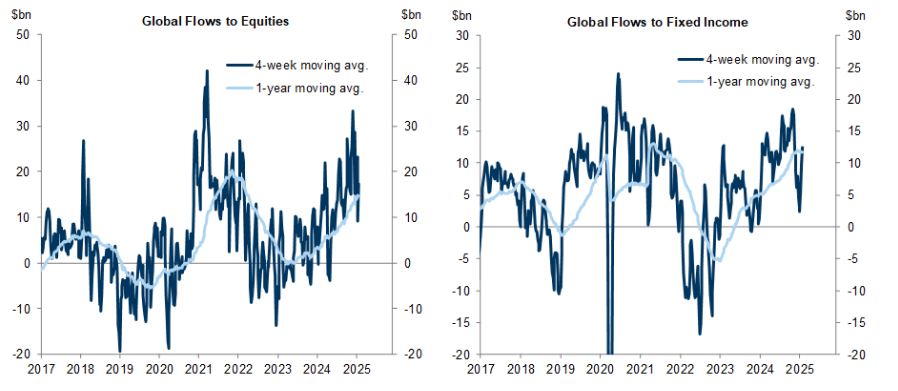
  • Flows 30% :  Global equity funds slowed (+$6bn vs +$13bn last week). Fixed income stronger demand (+$14bn vs +$11bn last week). EM negative flows. FX , USD demand. 
  • Positioning 20% : Cleaner in Equities/ FI/ FX. Tariffs, strong earnings, healthy thematic, supportive macro have left clients with limited convictions. 
  • Valuation 10% : Low Equity Risk premia / Neutral for bonds. Would say not very high for the Mag7 given the reset in EPS expectations. Bonds 
  • Sentiment 10%: AAII stretched, GS Neutral. Despite one of the largest USD weekly drawdowns in years still constructive in Equities, Short oil, Neutral bonds. 

Fed view: We are pricing, 7 for March ,14 for May 25 for June. We view “market pricing as a probabilistic statement about possible Fed paths in coming years is too hawkish”

Interesting Trades:

  1. Fed- Dovish vs pricing- Rec SFRM5Z5
  2. Rec BOC meeting on Wed- 25 or more than 0
  3. Deepseek- low quality dip on Nasdaq. Buy dips in NQH5
  4. Earnings: ASML short MSFT long/ Meta long
  5. Earnings: Oracle/ Microsoft/ Amazon vs NVDA
  6. Long Copper into Chinese seasonality and Lunar new year destocking.

Weekend News flow: 

  1. Trump ridicules Denmark and insists US will take Greenland – FT
  2. Meta’s chief AI scientist says DeepSeek’s success shows that “open source models better vs proprietary ones”
  3. President Trump said he wants to “clean out” the Gaza Strip and urged Jordan and Egypt
  4. German Election Taboos Broken as Merz and Musk Flirt With AfD
  5. Baltic Sea data cable damaged in latest case of potential sabotage
  6. Reeves seeks to unlock billions from UK pension schemes for investment- FT

Charts: 

Chart 1 GS Flow of funds last week:

Chart 2: Mag Seven: EPS expectations slowing- buying opportunity on a lower bar ( BBG)

Chart 3: SPX short and USD shorts capitulation was at full speed.

Chart 4: Corporate Insiders are dumping shares at the fastest pace in history (data going back to 1988) 

Chart 5: Gold continues to be one of the highest conviction/ trend trades out of the gates in 2025. (Goldman)

More in the full Goldman note available to pro subs.

Tyler Durden
Sun, 01/26/2025 – 23:13

Russian Forces Officially Seize Last Strategic City In Southern Donbas Region

0
Russian Forces Officially Seize Last Strategic City In Southern Donbas Region

As we warned at the end of December, Russian troops had been gaining ground on the eastern front at an exponential rate, with the key city of Velyka Novosilka nearly encircled and ready to fall.  After weeks of incomplete reports on the situation, Ukrainian officials have finally confirmed that the area has been overrun.  Some reports also indicate that Ukrainian soldiers were nearly surrounded during the retreat.

Kiev claims encirclement while Russian footage of clean-up operations on the ground indicates that some Ukrainian units may have been abandoned. 

The establishment media has remained relatively quiet on the event, even though geo-located video footage showing Russian troops raising flags over the center of the city are circulating widely on social media.  Analysis of known Ukrainian defenses suggests that Kiev’s lines are thin beyond Velyka Novosilka and that the city was the last major stronghold preventing Russian troops from surging into central Ukraine and the Dnipropetrovsk Oblast region.

Velyka Novosilka was made vulnerable to Russian attack after Ukraine retreated from Vuhledar, roughly 30 kilometers (18 miles) east.  The Ukrainians originally claimed that Vuhledar was strategically “unimportant”, but the loss has proven to be disastrous. 

The prevailing ugly truth for the Ukrainians is one of manpower – They don’t have enough.  In the early days of the war a steady stream of western mercenaries, many of them military veterans from the US and the UK, flooded into Ukraine along with NATO weapons, cash and “advisers”.  This source of extra manpower dried up at least 18 months ago 

The initial retreat by Russia to the east in 2022 was wrongly interpreted by western media as a sign of surrender by Vladimir Putin, but Russia was in fact reforming their lines in order to execute a new attrition strategy.  Attrition warfare negates the tactical advantages of maneuver warfare commonly used by NATO armies.

Continuing Russian gains bring into question the context of peace talks being arranged by the new Trump Administration.  It is unlikely that Putin will accept any agreement that requires Russia to give up any part of the Donbas territory; Russia has all the leverage.

Trump has indicated that Vladimir Zelensky is also resistant to entering negotiations and insists on continuing the war.  Zelensky seems to operate under the assumption that the US or the EU will eventually be forced to deploy troops to the front and that Ukraine will not be required to give up any territory.  This, of course, would would result in a new world war over a country that most Americans are no longer interested in propping up.      

Tyler Durden
Sun, 01/26/2025 – 22:45