63.3 F
Chicago
Friday, October 2, 2026
Home Blog Page 1876

Texas Instruments’ Bearish Outlook Indicates “Auto & Industrials Have Not Bottomed Yet”

0
Texas Instruments’ Bearish Outlook Indicates “Auto & Industrials Have Not Bottomed Yet”

Texas Instruments issued a weaker-than-expected earnings forecast for the first quarter, signaling continued softness in key end markets. Goldman analysts reiterated a “Sell” rating on TXN, citing concerns over elevated valuations, lower fab utilization, and record-high inventory levels that may further pressure margins. 

TXN expects first-quarter 2025 revenue between $3.74 billion and $4.06 billion, compared with the Bloomberg Consensus estimate of $3.88 billion. Expected earnings per share range from 94 cents to $1.16, missing the analyst estimate of $1.17. The outlook indicates that TXN’s efforts to boost manufacturing capacity will weigh on profitability. Additionally, the broader electronics industry remains in a slump, contributing to nine consecutive quarters of declining sales.

Here is the first quarter forecast (courtesy of Bloomberg): 

  • Sees revenue $3.74 billion to $4.06 billion, estimate $3.88 billion (Bloomberg Consensus)

  • Sees EPS 94c to $1.16, estimate $1.17

  • Sees effective tax rate about 12%, estimate 12.9%

TXN is the largest producer of basic semiconductors used in electric systems, including electric vehicles, industrial robots, solar panels, and satellites. Three months ago, management warned that some end markets were experiencing slowdowns, resulting in an inventory chip glut. 

In contrast with the gloomy forecast, TXN’s fourth-quarter results beat Bloomberg Consensus estimates. Though sales declined 1.7% to $4.01 billion, analysts had projected $3.86 billion. Profit was $1.30 a share, compared with the forecast of $1.21. 

Here’s a snapshot of fourth-quarter results: 

EPS $1.30 vs. $1.49 y/y, estimate $1.21

Revenue $4.01 billion, -1.7% y/y, estimate $3.86 billion

  • Analog revenue $3.17 billion, +1.7% y/y, estimate $3.07 billion
  • Embedded processing revenue $613 million, -18% y/y, estimate $620.6 million
  • Other revenue $220 million, +7.3% y/y, estimate $233 million

Operating profit $1.38 billion, -10% y/y, estimate $1.3 billion

Capital expenditure $1.19 billion, +3.8% y/y, estimate $1.3 billion

Free cash flow $806 million, +3.9% y/y, estimate $613.7 million

R&D expenses $491 million, +6.7% y/y, estimate $498.2 million

Cash and cash equivalents $3.20 billion, +8% y/y, estimate $2.28 billion

Commenting on the earnings, Goldman analysts Toshiya Hari, Chris Kress, and others maintained a “Sell” rating on TXN, noting that valuations remain elevated relative to the higher depreciation costs and lower fab utilization, both of which are expected to pressure margins this quarter.

Hari outlined the tailwinds for TXN: 

  1. China strength: China revenue increased yoy for the second consecutive quarter in 4Q24. Automotive was an area of particular strength as revenue grew high-single digits (%) on a sequential basis driven by sustained strength in EVs. Note Auto revenue outside of China declined high-single digits (%) qoq.

  2. We believe TI is shipping below trend in Analog and Embedded Processing: while Analog revenue increased 2% yoy in 4Q24 (following 8 consecutive quarters of yoy declines), TI’s Analog business remains well below trend as illustrated in Exhibit 2 as is the case with its Embedded Processing business (Exhibit 3). We believe this is a positive set-up as we look ahead into 2H25 and 2026 given historical precedent of volumes and revenue ultimately reverting toward trend.

  3. Low cancellation rates and upside in turns are positive signs: although none of the end-markets that TI serves have yet to experience an inflection in demand, we view low (and stable) cancellation rates combined with an improvement in turns (i.e. revenue that is booked in the same quarter) as a precursor to a cyclical recovery.

  4. Improving FCF generation: TI generated $806mn in FCF in 4Q24, the highest since 4Q22. Looking ahead, while the big inflection is likely to happen in 2026 (when we forecast a ~$3bn yoy decrease in capital spending), we do expect a gradual recovery in FCF over the next several quarters on an improving net income and working capital outlook.

And her concerns:

  1. Timing and magnitude of recovery remain uncertain: despite our belief that TI and the rest of the industry is nearing a cyclical bottom, we acknowledge that the shape of the recovery remains uncertain given the fluid macroeconomic and geopolitical backdrop.

  2. Compression in gross margin: in 4Q24, gross margin declined 190bps qoq to 57.7% due to lower volumes, higher depreciation and reduced factory loadings. Gross margin is expected to decline again in 1Q25 by a few hundred bps on a sequential basis, per management, on lower revenue and further cuts to production.

  3. Record high inventory: while management remains content with its balance sheet, inventory grew further and reached a new all-time high of $4.5bn (+5% qoq, +13% yoy), while days of inventory increased 10 days qoq to 241 days at the end of 4Q24 or above the high-end of the company’s target range of 130 to >200 days. Management reiterated its emphasis on reducing factory loadings in 1Q25, and we expect inventory dynamics to weigh on near-term gross margins.

Given that TXN is a bellwether for the global economy, the record-high inventory of its chips is a very deep concern on the global macro level:

Here’s an update to the analysts’ estimates for 2025 and 2026:

We tweak our 2025/26 revenue estimates by <+1%/-1%, respectively. We reduce our 2025/26 operating EPS forecasts by 5%/11% to $5.06/$5.96 from $5.34/$6.71, respectively, on lower gross margin and marginally higher opex. Note we also introduce 2027 estimates in conjunction with this note.

Hari noted that TXN’s valuation is rich at these levels. 

Her 12-month price target for TXN has been shifted down from $190 to $186. 

Here’s what other Wall Street analysts are saying (courtesy of Bloomberg):

Morgan Stanley analyst Joseph Moore (underweight, PT $165)

  • Texas Instruments’ lower gross margins in the quarter pressure EPS
  • The company will “see gross margins underperform peers through CY26”

JPMorgan analyst Harlan Sur (overweight, PT $230)

  • Cyclical trends are slowly improving for Texas Instruments but industria and auto end-markets continue “to weigh on slope of recovery”
  • The company’s free cash flow “remains muted” on strong capital expenditure and slower end market recovery

Bloomberg Intelligence analyst Kunjan Sobhani

  • Texas Instruments “continues to seek a bottom, prompting further production cuts and pricing actions, which will shave gross margin and lead to softer 1Q earnings per share”
  • Industrial and auto “could bottom by mid-2025,” given the turmoil in the sector and uncertainty around global trade

Truist Securities (hold, PT to $195 from $199)

  • “TXN makes it clear” that “autos & industrial have not bottomed yet”
  • “Profitability is under incremental pressure from a combination of lower utilization, steady OpEx, and lower interest income”

Vital Knowledge

  • The results show “solid upside” on earnings and sales, but guidance mid-points for 1Q are “mixed,” with revenue roughly in line and earnings below expectations

TXN shares rejected the $200 handle. 

As for the broader chip industry, sentiment around Trump’s Stargate project sent the PHLX Semiconductor Sector higher on the year, yet still remains below a 2024 peak. 


Maybe an improving industrial capacity utliazaiton in China will help TXN. 

The takeaway is that TXN’s outlook highlights an uneven recovery across the sector, while companies supplying data center chips remain in focus with bulls. Meanwhile, persistent weakness in the automotive and industrial markets suggests more headwinds ahead for TXN. 

Tyler Durden
Fri, 01/24/2025 – 11:45

Do Money Supply, Deficits, & QE Create Inflation?

0
Do Money Supply, Deficits, & QE Create Inflation?

Authored by Lance Roberts via RealInvestmentAdvice.com,

I recently debated with Michael Pento, who made an interesting statement that increases in the money supply, the deficit, and a return to quantitative easing (QE) will lead to 1970s-style inflation. The recent experience of inflation in 2021 and 2022 would seem to justify such a view. However, is that historically the case, or was the recent inflationary surge due to a different set of drivers? In today’s post, we will examine the money supply represented by M2, the Federal budget deficit, the Fed’s previous adventures with QE, and the correlation to inflation.

Let’s begin with the money supply. One common mistake the “inflation is coming back” crowd makes is focusing on increases in the money supply. Their key argument is that the government is “printing money out of thin air, destroying the dollar’s value.” This argument has two fallacies.

The first is to view the inflation-adjusted value of the dollar and claim it has less purchasing power today than in 1900. While this is a true statement, it assumes that the U.S. is the only country in the world that has experienced inflation over the last 125 years. In other words, the value of the U.S. dollar has declined relative to every other currency in the world as the money supply has grown. However, that has not been the case. The chart below shows the 5-year annual % change of the U.S. dollar on a trade-weighted basis versus the money supply. Today’s dollar has roughly the same value as in 1980, and the money supply has increased. Notably, increases in the money supply, on a rate of change basis, typically correlate to a stronger, not weaker, dollar.

The second flaw is that increases in the money supply create inflation. Historically, money supply changes have not led to inflation increases, except for the COVID-19 pandemic, where the supply/demand balance was shifted. (We will discuss that in detail momentarily.) Outside of that singular and unique event, increases in the money supply have generally coincided with recessionary and deflationary events like the “Dot.com crash” and “Financial Crisis.” However, since the turn of the century, the inflation rate has remained fairly stable, averaging roughly 2.6%, with M2 growing at 3.8%. Most notably, from 2009 to 2019, the average inflation rate was below the long-term average despite increased money supply levels. In other words, the increased money supply did not lead to inflation.

While Michael argued during the debate that increased “money printing” would lead to higher inflation and interest rates, there is a reason that hasn’t occurred outside of the Pandemic shutdown. The reason is that the government is not “printing” money.

“All money is lent into existence.”

Read that again.

When the government needs to pay for obligations that exceed current revenues, the U.S. Treasury issues debt. That debt is sold to the primary dealers, who purchase it and provide capital for the Government to meet its obligations. If the Treasury Department could just “print” money, there would be no need to issue debt. This is why debt issuance has increased over the last four decades: to meet the continued shortfall between government spending and incoming revenue, known as the “federal deficit.”

The Federal Deficit Is Deflationary

Michael’s second argument was that the deficit would lead to inflation and higher interest rates. This argument has several problems, but first, we must understand how the deficit is derived. Here is a current breakdown of the Federal budget and deficit spending requirements through the end of 2023 (the data for 2024 is not available at the time of this publication.)

According to the Center On Budget & Policy Priorities, in 2023, roughly 90% of every tax dollar went to non-productive spending. 

“In fiscal year 2023, the federal government spent $6.1 trillion, amounting to 22.7 percent of the nation’s gross domestic product (GDP). About nine-tenths of the total went toward federal programs; the remainder went toward interest payments on the federal debt. Of that $6.1 trillion, only $4.4 trillion was financed by federal revenues. The remaining amount was financed by borrowing.”

Think about that for a minute. In 2023, 90% of all expenditures went to social welfare, non-productive spending, and interest on the debt. Those payments required $6.1 trillion, roughly 138% more than the tax dollars collected.

The problem with “non-productive spending” is that it has a zero to negative multiplier on economic growth.

“History teaches us that although investments in productive capacity can in principle raise potential growth and r* in such a way that the debt incurred to finance fiscal stimulus is paid down over time (r-g<0), it turns out that there is little evidence that it has ever been achieved in the past.

 Rising federal debt as a percentage of GDP has historically been associated with declines in estimates of r* – the need to save to service debt depresses potential growth. The broad point is that aggressive spending is necessary, but not sufficient. Spending must be designed to raise productive capacity, potential growth, and r*. Absent true investment, public spending can lower r*, passively tightening for a fixed monetary stance.” – Stuart Sparks, Deutsche Bank

We can see this visually by comparing the Federal debt as a percentage of GDP to potential economic growth. Since government spending is primarily non-productive, it should be unsurprising that increases in debt do foster stronger economic activity.

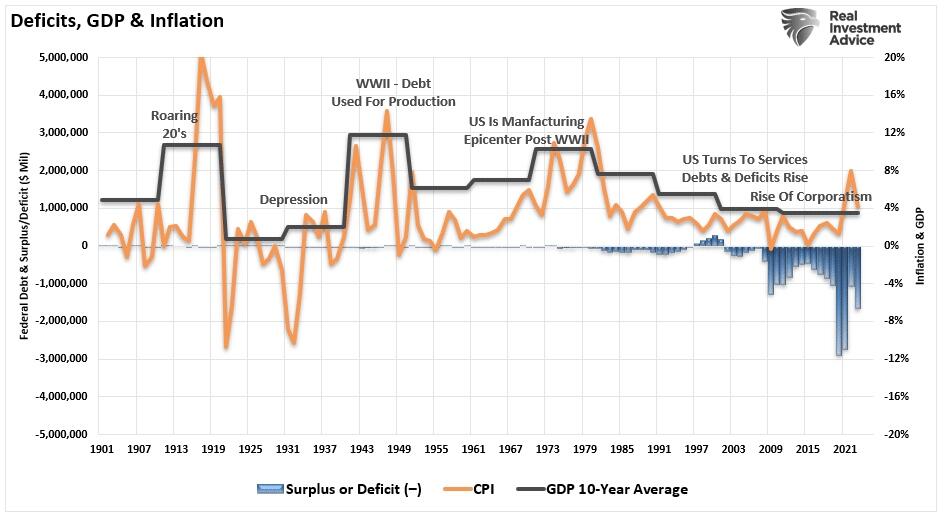
That last sentence is the most crucial. Inflation comes from increases in demand,d which is reflected by increases in economic activity. However, since 1985, the annual inflation rate has decreased while the Federal deficit has increased. What should be noted is that inflation tends to rise when the federal deficit declines. That correlation makes sense, as the deficit decreases when tax revenues increase due to more substantial economic growth rates.

However, when economic activity slows, the federal deficit must increase to offset the decline in tax revenues to meet the required government spending. As such, increases in the deficit are directly correlated to slowing economic activity and declining inflation.

The crucial conclusion is that today’s backdrop of higher inflation is radically different, unlike the 1970s, when inflation was a function of surging commodity prices due to the Iranian oil embargo. A reversal in demographic trends, elevated debt levels, and a shift from manufacturing to services suggest the long-term trend growth rate of the economy and inflation will be lower, and so will inflation.

But what about the Federal Reserve?

QE Doesn’t Create Inflation

Michael’s final argument was that the Federal Reserve “learned its lesson in 2020”.As such, the Fed would be reticent to do “Quantitative Easing (QE)” in the future due to inflation concerns. The Federal Reserve is well aware of what caused inflation in 2020 and that it wasn’t QE that caused it.

However, to understand why, we must return to how the Government funds its deficit. When the government issues debt, the major banks or “primary dealers” must buy that debt. If the Federal Reserve engages in a QE program, it issues a notice of what bonds it buys. The primary dealers can then submit those bonds to the Federal Reserve for a “credit” to their reserve account. This exchange DOES NOT increase the money supply; instead, it is an asset swap between the bank and the Fed. This is why M2 and debt are highly correlated when you look at them as a percentage of GDP. It would have been noticeable if the Federal Reserve had added to the money supply.

As noted above, “Money is lent into existence.”

As such, an asset swap, in this case, a digital accounting mechanism, does not create money. However, it does boost reserves to the financial system, as shown below. While banks should lend those reserves to the economy, that has not happened. Instead, those reserves have found their way back into the financial markets.

However, increasing bank reserves is not inflationary, particularly when, as noted, those reserves are not lent to the economy to create activity. This is why, despite repeated rounds of QE, the annual inflation rate moderated around the Fed’s 2% target until early 2020.

Therefore, if QE does not create inflation by stimulating economic activity, why did inflation surge in 2020? For that answer, we must return to the very basic principles of economics.

Why We Had Inflation And Why It’s Not Coming Back

In economics, inflation is a general increase in the prices of goods and services. Changes in inflation are a function of fluctuations in actual demand for goods and services (also known as demand shocks, including changes in fiscal or monetary policy or recession), changes in available supplies such as during energy crises (also known as supply shocks), or changes in inflation expectations, which may be self-fulfilling. Note that supply and demand are key facets of the inflation equation.

Basic economics states prices will be set at a level where the supply of goods or services meets consumer demand.

There was no better example of what happens with prices than the massive Government interventions in 2020 and 2021. During that period, the Government sent rounds of checks to households (creating demand) during an economic shutdown (shuttering supply). The economic illustration shows this basic principle taught in every “Econ 101” class. Unsurprisingly, in 2020, inflation was the consequence of restricting supply and massively increasing demand.

That massive surge in stimulus sent directly to households resulted in an unprecedented spike in “savings,” creating artificial demand. As shown, the “pig in the python” effect is evident. Over the next two years, that “bulge” of excess liquidity has reverted to the previous growth trend. Given that economic growth lags behind the reversion in savings by about 12 months, we should continue to see economic growth slow into 2025. Notably, that “lag effect” is critical to the “inflation is returning” thesis.

Understanding that inflation is solely a function of supply and demand, reversing monetary liquidity will erode future economic activity. Notably, what caused the inflation spike post-2020 was not an increase in the debt or the Federal Reserve but rather the temporary increase in the money supply caused by sending checks to households. Therefore, unless the Government passes a new infrastructure spending bill of massive proportions or sends another round of stimulus to households, no factor is available to restart the inflation process of increased demand.

Over the coming decades, the massive surge in unproductive debt will increase deflationary pressures and slower economic growth. These issues are not new but have plagued economic growth for the last 40-years. The result is that debts and deficits will continue to detract from rather than contribute to economic growth. As shown, the surge in debt and deficits coincides with a peak in the 10-year average economic growth rate.

The decline in economic prosperity adds deflationary pressures on the economy. Such requires continued government deficit spending to sustain the demands on the welfare system.

The reality is that despite mainstream thinking that inflation will resurge due to rising debts, deficits, or Federal Reserve interventions, the historical evidence does not support such claims. The negative impact of debt on the economy is evident. Furthermore, the negative correlation between the size of the government and economic growth suggests the most likely outcome in the future is deflation.

Could something else happen? Absolutely. However, another inflationary surge will require an event that causes a massive distortion in supply and demand. Until such an imbalance occurs, the biggest risk for investors to focus on remains disinflation, which ultimately impacts earnings growth.

Tyler Durden
Fri, 01/24/2025 – 11:25

Major Russian Microchip Factory Which Supplies Military Halts Production After Drone Attack

0
Major Russian Microchip Factory Which Supplies Military Halts Production After Drone Attack

Ukrainian sources say that Russia was hit with over 50 explosions at oil and industrial targets as it launched a massive new drone attack Friday. This included a direct overnight hit on Russia’s Ryazan Oil Refinery and the Ryazan Thermal Power Plant, leaving parts of them on fire.

“As a result of the strikes, fires broke out at the production facilities of the Ryazan Oil Refining Company and at the Ryazan oil pumping station,” a statement from the General Staff of Ukraine’s Armed Forces said. This is Russia’s largest refinery as it has capacity of 17 million metric tons of oil annually. Ryazan lies a little over 300 miles from the Ukraine border.

The Kremniy El microchip, western Bryansk region. Source: bryansk.news

While oil depots and energy infrastructure have been a frequent target of drone attacks on Russian territory throughout much of the war, the attack included rare serious damage to a chip plant which supplies the Russian military and weapons systems.

“Also, the microelectronics plant ‘Kremniy El’ in Bryansk was hit. This is one of the key enterprises of the microelectronics industry of Russia,” the Ukraine military statement indicated.

Representatives of the Kremniy El microchip plant subsequently confirmed the strike which resulted in damage, halting production. “Six drones [struck Kremniy El] on the night of Jan. 24, damaging part of the production facilities and the finished products warehouse,” the plant’s press service told TASS.

The statement indicated further the attack disrupted the plant’s power supply and assembly lines, but there have been no reports of casualties. There were two prior drone strikes on the facility earlier in the nearly three-year long war.

According to background on the plant from a regional source:

Kremniy El, one of Russia’s largest microelectronics manufacturers, employs 1,700 people and has an annual production volume of 3.9 billion rubles ($39.7 million).

The plant supplies 94% of its production to the Russian Defense Ministry, including components for the Pantsir and S-500 missile systems, as well as Kalibr cruise missiles, according to local media reports.

A statement from the Russian Defense Ministry described that at least 121 Ukrainian drones were intercepted overnight by air defense systems, with a big concentration of them being over the Bryansk region.

Massive blasts rocked the sprawling Ryazan oil refinery overnight:

While Ukraine is losing ground along the frontlines in Donetsk region, it has upped its large-scale drone and missile operations on Russian territory – but this has made no real strategic difference on the battlefield.

Still, Ukraine’s military in a statement added that the “systematic and targeted destruction of facilities” supplying the Russian military will continue “until the Russian Federation’s armed aggression against Ukraine is completely stopped.”

Ukraine wants to degrade and destroy Russia’s military-industrial defense sector, but overall the sector remains vast enough that such cross-border drone attacks will barely put a dent in it. However, these attacks do make life harder on the population, and may present a long-term economic toll.

Tyler Durden
Fri, 01/24/2025 – 11:05

Watch: Davos Globalists Admit “We Have Lost To Trump”

0
Watch: Davos Globalists Admit “We Have Lost To Trump”

Authored by Steve Watson via Modernity.news,

A panel of globalists at the World Economic Forum meeting in Davos remarkably admitted that President Trump and his America first movement has defeated their agenda.

In a segment of their discussion focusing on Trump’s election victory, former Defense Department official Graham Allison, now a professor at Harvard, remarked “We shouldn’t normalize Trump. Trump has done something no person in the world has ever done before. A dead man, a dead politician, has risen.”

“This is the greatest comeback in political history for a politician, and therefore he thinks he can do anything. There’s a supreme confidence now about that,” Allison continued.

“This is a phenomenon we shouldn’t try to understand only in the terms we traditionally accept. We should say something strange, new, and amazing is happening here, and we should study it,” Allison further urged.

Yale University Professor Walter Reed emphasised “I think we need to also factor in not only who has won (Trump) but also who has lost, which is to say us.”

“By ‘us,’ I mean the general intellectual, professional, managerial people who believed history was over, and we were merely administering and managing things according to clear and known rules,” Reed explained.

“Something new, not necessarily better, but new, is moving into the center,” he added.

Ian Bremmer, president of political consulting firm Eurasia Group remarked:

“Anti-establishment forces in the United States are growing, and their momentum is undeniable.”

Trump himself addressed the globalists at Davos today by video link and put them on blast that America is back.

“I’m pleased to report that America is a free nation once again,” Trump announced, adding “On day one, I signed an executive order to stop all government censorship.”

“No longer will our government label the speech of our own citizens as misinformation or disinformation, which are the favorite words of censors and those who wish to stop the free exchange of ideas and, frankly, progress,” Trump asserted, adding “We have saved free speech in America, and we’ve saved it strongly.”

Trump also stated that “With another historic executive order this week, I also ended the weaponization of law enforcement against the American people and frankly, against politicians, and restored the fair, equal, and impartial rule of law.”

Klaus Schwab sounded like he was biting his own tongue off when announcing Trump as the President of the United States.

Here are Trump’s full comments.

*  *  *

Your support is crucial in helping us defeat mass censorship. Please consider donating via Locals or check out our unique merch. Follow us on X @ModernityNews.

Tyler Durden
Fri, 01/24/2025 – 10:45

Group Launches New Recall Effort To Remove California Governor

0
Group Launches New Recall Effort To Remove California Governor

Authored by Jill McLaughlin via The Epoch Times (emphasis ours),

A new coalition of Californians, named Saving California, publicly announced a new effort to recall Gov. Gavin Newsom on Jan. 23.

California Gov. Gavin Newsom (R) surveys damage in Pacific Palisades with CalFire’s Nick Schuler during the Palisades Fire, in Pacific Palisades, Calif., on Jan. 8, 2025 Jeff Gritchen/The Orange County Register via AP

The group launched the effort at a retail store in Los Angeles on Thursday, with several speakers scheduled as they planned to collect at least 50 signatures to begin the recall.

“We can’t afford two more years of Gavin Newsom … we just can’t,” Saving California Chairman Randy Economy told The Epoch Times on Wednesday. “High priority right now is not California.”

Economy, who was involved in a previously unsuccessful September 2021 recall campaign despite gathering enough signatures to hold an election, said he felt the governor was not performing for California residents.

“He’s not a hands-on governor,” Economy said.

Recall supporters who were expected to speak on Thursday and sign the intent letter included Economy; Bishop Juan Carlos, founder of Churches in Action; Robert Kennedy III; Fraser Ross, owner of Kitson; and Chef Andrew Gruel, an Orange County-based chef and television personality who helped feed and provide services to fire evacuees this month.

In the letter of intent, organizers say Newsom’s time in office has been marked by a “series of catastrophic failures“ that ”directly impact” their daily lives.

“His gross mismanagement during the Los Angeles County fires, with inadequate resources and delayed responses, left communities devastated,” the group wrote in the letter.

Saving California also mentioned soaring crime rates, a rise in the cost of living, the increase in homelessness, the drug epidemic, and border issues as reasons for the recall.

“The recall will happen this time as the incompetence of Gavin Newsom, along with other political leaders, cannot be tolerated anymore,” Ross said in a statement on Wednesday. “The destruction of California is at an all-time high; I’ve had to deal with shoplifting at all my Kitson stores and take matters into my own hands, and truly I just have had enough now.”

Newsom has served half of his second term. Saving California plans to serve the governor with the letter of intent this week.

Newsom’s political team responded to the recall campaign announcement on Wednesday afternoon, pointing out multiple failed attempts in the past.

Randy Economy, senior adviser and official spokesman to RecallGavin2020, during an interview with The Epoch Times. Economy is serving as the chairman of a new effort to recall California’s governor. Screenshot/The Epoch Times

“Governor Newsom is focused on the fires and marshaling resources for the extensive recovery—not politics,” political spokesman Nathan Click told The Epoch Times in an email.

Click serves as the governor’s political adviser and led communications efforts for Newsom during the last recall effort in 2021.

“The same group of far right Trump acolytes have launched [seven] different recall attempts against the governor since he’s taken office, each of which have failed spectacularly,” Click said. “Even Republican Party leaders have criticized these repeated attempts as a brazen campaign finance ‘grift,’ and the recall organizers have been sued by their own donors for pocketing funds raised previously.”

The progressive California governor has been under scrutiny by the public after several major fires broke out in Los Angeles County this month.

During the Palisades fire, crews reported finding dry fire hydrants and an empty reservoir on Jan. 7 as thousands of homes in Pacific Palisades began to burn to the ground.

“The water system got low on us—on firefighters—so when they were out fighting the fire, there were times when they had very low water pressure,” San Digiovanna, chief of the Verdugo Fire Academy in Glendale, told The Epoch Times during the fires.

Newsom announced on Jan. 10 that he was calling for an independent investigation into the loss of water pressure to local fire hydrants and the reported lack of water supplies from the Santa Ynez Reservoir.

“We need answers to ensure this does not happen again and we have every resource available to fight these catastrophic fires,” Newsom wrote in an X post.

If the group is successful, Newsom would become the second California governor to be officially removed from office by voters.

In 2003, Gov. Gray Davis, a Democrat, was recalled by voters with 55 percent of the vote following a public outcry over how he handled the state’s electricity industry. Gov. Arnold Schwarzenegger, a Republican, was elected as his replacement.

Former California Gov. Gray Davis (L) and chairman and CEO of Showtime, Matt Blank, attend the after party for the film premiere of “Spinning Boris” at the Paramount Theatre, in Los Angeles on March 3, 2004. Davis was recalled in 2003. Frederick M. Brown/Getty Images

Since 1913, there have been 181 recall attempts of state elected officials in California, according to the secretary of state’s office. Eleven recall efforts collected enough signatures to qualify for the ballot, resulting in the recall of six officials.

Saving California’s recall campaign is in the beginning stages and would still require collecting signatures and many other steps before appearing on a ballot, but organizers believe they will be successful.

“This is a democracy we live in,” Economy said. “He works for the people, and I think he forgets that, and he does what he does.

“This time is different.”

Tyler Durden
Fri, 01/24/2025 – 09:10

BlackRock CEO Wants SEC To “Rapidly Approve” Tokenization Of Bonds & Stocks

0
BlackRock CEO Wants SEC To “Rapidly Approve” Tokenization Of Bonds & Stocks

Larry Fink, CEO of the world’s largest fund manager BlackRock, has expressed his hope that the US Securities and Exchange Commission (SEC) will swiftly approve the tokenization of bonds and stocks.

During a CNBC interview on Jan. 23, Fink strongly endorsed digital assets, underscoring their potential to democratize investments.

But, as CoinTelegraph’s Marcel Pechman notes, the open question is whether this shift toward tokenizing traditional assets can benefit cryptocurrencies, which sectors might flourish, and which projects might face heightened competition.

There is no doubt that 24-hour worldwide trading and the transparency of blockchain technology bring advantages to assets such as bonds and stocks. However, this move relies on regulatory updates and approvals from relevant government agencies. More importantly, regulated assets may not align well with decentralized finance (DeFi).

Tokenization’s impact on stablecoins, memecoins, DeFi and decentralized oracles

Tokenizing bonds that produce stable yields could pose a challenge to stablecoins by providing a digital asset tied to real-world interest rates. This development would introduce new instruments into financial markets, competing for liquidity and user confidence as investors seek tangible returns.

Similarly, tokenized stocks like GameStop or AMC could function as onchain assets with volatile price fluctuations, backed by communities in a manner reminiscent of memecoins. This evolution might affect retail trading platforms as investors gravitate toward regulated but still speculative stock tokens rather than purely speculative memecoins.

GameStop (GME) and AMC Networks (AMC) in 2021. Source: TradingView / Cointelegraph

The integration of tokenized bonds and stocks also broadens the offerings on established DeFi platforms, potentially driving higher total value locked. It would impact decentralized exchanges and lending protocols, as they could incorporate traditional asset classes to create new revenue streams.

By tokenizing real-world assets, direct ownership and pricing data can be embedded within a token’s native structure, reducing the need for external oracles. This shift also affects blockchain data providers, as onchain assets inherently include their own data.

Basic decentralized oracles workflow. Source: Pontem Network

The tokenization of bonds and stocks greatly expands the pool of assets available for onchain derivatives, influencing decentralized exchanges and lending platforms looking to offer diverse markets. Synthetic tokens that mirror these securities could also bypass certain regulatory barriers, opening new opportunities for margin trading and yield generation.

Stocks and bond tokenization could take longer than anticipated

Despite these benefits, tokenized securities must navigate regulatory hurdles such as Know Your Customer (KYC) mandates, accredited investor restrictions, and securities law compliance. Region-specific rules and listing limitations hamper accessibility, while partial onchain data coverage still requires oracles.

Additionally, legal uncertainties and potential vulnerabilities in smart contracts can erode investor trust. As a result, many DeFi protocols are forced to impose stricter oversight, limiting the free-flow nature typically associated with cryptocurrencies and slowing widespread adoption.

US Senator Cynthia Lummis’s appointment as chair of the Senate Banking Subcommittee on Digital Assets on Jan. 23 could accelerate legislation for stock and bond tokenization.

Known for her pro-crypto stance, Lummis is expected to foster cooperation among the SEC, the Department of the Treasury, CFTC, FINRA, and state securities regulators.

Still, one should consider BlackRock CEO Larry Fink’s statements with caution since the firm holds a major interest in tokenizing real-world assets. Such changes could broaden the base of buyers for US-listed stocks and bonds, in which BlackRock is among the top investors. Moreover, the company might serve as an intermediary, handling custody or administrative functions.

Tyler Durden
Fri, 01/24/2025 – 08:50

Futures Dip To Close Best Inauguration Week For S&P Since Reagan

0
Futures Dip To Close Best Inauguration Week For S&P Since Reagan

US equity futures are slightly lower to close out a blowout week for risk assets. As of 8:00am S&P futures are down 0.1% after the index reached its new ATH on Thursday, the first of the year; Nasdaq futures are unchanged with megacap tech flat this morning (TSLA +57bp) while Russell futs are also down 0.1%. European flash PMIs were mixed with mfg beats for UK/France/Germany/EZ while services were mixed: FTSE -35bps, CAC +95bps, DAX +30bps, Nikkei -7bps, Hang Seng +1.86%, Shanghai +70bps. Trump overnight hinted at a softer approach toward tariffs telling Fox News he’d rather not impose them on China which sent the yuan and Chinese stocks higher.  Bond yields are flat around 4.64%, and the USD is modestly lower on the back of EUR strength. Commodities are mixed; precious metals; Ags are mostly lower, while WTI is up 30bps at $74.85; Bitcoin is up 2% to $105,300 after Trump unveiled his much anticipated executive order. Overnight, BOJ hiked 25bp as expected with an on the margin hawkish surprise as no downgrades to economic outlook and inflation outlook was revised higher. However, after initially sliding, the USDJPY has since rebounded and is flat. Today, the key focus will be global PMIs and earnings, with AXP and VZ being the most important ones to provide further color on consumer demand and economic growth. Wall Street estimates PMI-Mfg and PMI-Srvcs to print at 49.8 and 56.5, respectively; we also get the U of Mich (10am), Existing Home Sales (10am), and Kanas City Fed Services (11am).

In premarket trading, Texas Instruments fell 4% after the chipmaker gave a disappointing earnings forecast due to sluggish demand and higher manufacturing costs. Despite the disappointing results, Mag7 stocks were modestly higher: Alphabet (GOOGL) +0.2%, Amazon (AMZN) +0.1%, Apple (AAPL) +0.6%, Microsoft (MSFT) flat, Meta Platforms (META) +0.4%, Nvidia (NVDA) -0.3% and Tesla (TSLA) +0.8%. NVO is up 10% after an experimental shot delivered as much as 22% weight loss in an early-stage trial. Boeing slips 1.6% after the planemaker suffered another quarter of fresh charges and losses, highlighting the long road ahead for Chief Executive Officer Kelly Ortberg as he tries to stabilize the US aircraft manufacturer.; VZ +3% on rev/eps beat; Burberry (BRBY LN) +12.5% on better comp sales (could help luxury retail sentiment). Here are some other notable pre-market movers:

  • Affirm Holdings (AFRM) rise 4% after the Wall Street Journal reported that the asset-management unit of Liberty Mutual will provide $750 million in funding to the buy-now-pay-later company.
  • American Express (AXP) falls 3% after posting quarterly results.
  • CSX (CSX) declines 3% after the railroad’s earnings missed estimates.
  • Grindr (GRND) jumps 7% after the dating company boosted its forecast for revenue growth for 2024.
  • Intuitive Surgical (ISRG) slips 2% after the robotic-surgery company gave a profit margin forecast for the year that trailed expectations and warned that the potential impact of new tariffs could be material.
  • Middleby (MIDD) climbs 6% after the Wall Street Journal reported that Garden Investments has built an activist position in kitchen-equipment maker, citing people familiar with the matter.
  • Twilio (TWLO) surges 16% after the software company reported preliminary fourth-quarter revenue growth that topped estimates. The company also authorized a $2 billion share buyback plan.

Global stocks are closing the week at record highs after President Trump appeared to soften his approach toward tariffs on China. In an interview with Fox News, Trump said that he would “rather not” use tariffs against the world’s second-largest economy (which he has said before and he will flipflop again, but algos as usual took this as gospel and hammered the USD). He has also, so far, held back from imposing tariffs on Europe, though he warned of levies against Canada and Mexico. Signs that Trump is open to negotiation has helped lift assets around the world under the shadow of a trade war, from stocks to currencies. Emerging-markets currencies are on course for their best week since July 2023. Europe’s benchmark Stoxx 600 index is on track for a fifth weekly advance after hitting a record. The dollar dropped to a one-month low as investors switched to higher-yielding assets.

As for the the, the S&P 500 is up 2% this week so far, and is poised for the best start for a new president since Ronald Reagan was sworn in to power in 1985.

“It is early days but nothing that President Donald Trump has said or done has caused a bad reaction in financial markets,” said Chris Iggo, chief investment officer of core investments at AXA Investment Managers. “Quite the contrary. It is paying to stay invested.”

And anyone who is surprised by this outcome is an idiot: Trump has long declared that the stock market is the best, if not only, barometer by which his performance is to be measured. As such, he will redline the market – telling OPEC to cut oil prices and telling Powell to cut rates – until something breaks. For now, the upbeat data, including signs that inflation is easing, is helping both bonds and stocks, according to Goldman Sachs strategist Lilia Peytavin.

“This is adding to the positive earnings we’ve got so far,” she said.

In Europe, the Stoxx 600 added 0.4% as it rose for the eighth consecutive session, benefiting as Asian shares did from hopes US President Trump could take a softer-than-feared stance on tariffs. Sentiment was boosted as traders pared bets on how fast the ECB will lower interest rates this year after the euro area’s private sector returned to growth in January, surprising analysts, with the Composite Purchasing Managers’ Index rising to 50.2. Burberry Group Plc jumped after the maker of upmarket trench coats reported better-than-expected sales. Banca Monte dei Paschi di Siena SpA shares slumped after the Italian lender launched a takeover bid for Mediobanca SpA, whose shares rose.

Earlier in the session, Asian equities climbed to a one-month high, with sentiment buoyed by Trump’s comment that he would rather not have to use tariffs against China. The MSCI Asia Pacific Index jumped as much as 1% to the highest since Dec. 18. The gauge has advanced 2.5% this week to head for its biggest weekly increase since September. Technology shares including Tencent, Alibaba and Xiaomi contributed the most to the gains on Friday. Trump’s reluctance to impose tariffs on Chinese goods sparked a risk-on tone, which helped make shares in Hong Kong and China the region’s best performers. The Hang Seng China Enterprises Index rallied 2.1%, while the CSI 300 Index jumped 0.8%. “Trump’s Lunar New Year gift to China is a sign that negotiations may be progressing well,” said Charu Chanana, chief investment strategist at Saxo Markets. “However, it remains hard to imagine that China will be let go of some hard concessions even if a deal is reached.”

In FX, the Bloomberg Dollar Spot Index falls 0.5%. The yen pared most of its earlier advance seen after the Bank of Japan delivered a widely expected interest rate hike that was accompanied by higher inflation forecasts. The euro climbs 0.7% and made a brief appearance above $1.05 as traders pared bets on how fast the ECB will lower interest rates this year after the euro area’s private sector returned to growth in January, surprising analysts, with the Composite Purchasing Managers’ Index rising to 50.2.

In rates, treasuries are slightly richer led by short maturities, extending Thursday’s pronounced steepening of 2s10s curve, after US President Trump appeared to soften his approach toward tariffs on China; 10-year treasuries are little changed at around 4.64%, is near top of its 4.528%-4.662% weekly range; 2-year TSY yields are 1.5bp richer on the day, steepening 2s10s curve by about a basis point following Thursday’s 4.1bp increase in the spread. In Europe bunds and gilts underperforming by 3bp in the sector after the euro-zone composite PMI beat estimate, lifting German front-end yields.

In commodities, oil prices advance, with WTI rising 0.4% to $74.90 a barrel. Spot gold climbs $18 to $2,773/oz. Bitcoin rises 2% above $105,000.

On today’s economic calendar we have the January preliminary S&P Global US manufacturing and services PMIs (9:45am), January final University of Michigan sentiment and December existing home sales (10am) and January Kansas City Fed services index (11am)

Market Snapshot

  • S&P 500 futures little changed at 6,148.00
  • STOXX Europe 600 up 0.3% to 531.95
  • MXAP up 0.7% to 182.94
  • MXAPJ up 0.8% to 575.21
  • Nikkei little changed at 39,931.98
  • Topix little changed at 2,751.04
  • Hang Seng Index up 1.9% to 20,066.19
  • Shanghai Composite up 0.7% to 3,252.63
  • Sensex down 0.5% to 76,139.22
  • Australia S&P/ASX 200 up 0.4% to 8,408.87
  • Kospi up 0.8% to 2,536.80
  • German 10Y yield little changed at 2.57%
  • Euro up 0.8% to $1.0503
  • Brent Futures up 0.3% to $78.53/bbl
  • Gold spot up 0.7% to $2,774.38
  • US Dollar Index down 0.63% to 107.37

Top Overnight News

  • The US House Republican committee chairs pitched in a private meeting what could add up to between USD 2.5-3 trillion of spending cuts and budget savings to fund Republicans’ reconciliation package, according to Punchbowl News. The Energy and Commerce Committee is eyeing up to USD 2tln of cuts, including per capita caps for Medicaid. Energy-related cuts, such as rolling back tailpipe rules and fuel efficiency benchmarks for cars and light trucks, known as CAFE standards, were also part of the committee’s pitch. The Education and Workforce panel believes it has up to USD 500bln in cuts, largely through targeting student loans. The House Agriculture Committee is targeting between USD 100bln and USD 250bln in cuts. Some would impact SNAP, aka food stamps. The Transportation and Infrastructure panel’s up to USD 26bln in savings would include raising tonnage duties for ships, and electric vehicles fees that would go into the Highway Trust Fund. Ultimately, each and every cut will have to get approved by every Republican member in the House – any GOP member could kill the bill, at least until early April.
  • Trump reiterated that he will impose “massive” tariffs on Russia and “big” sanctions if it doesn’t settle the war in Ukraine. Trump also said he’s had “good, friendly” talks with Xi Jinping. BBG
  • China’s new rules for mutual funds and major insurers should inject at least 1 trillion yuan ($138 billion) into its ailing stock market this year. The most bullish estimates expect ~13 trillion Yuan over the next 3 years.
  • The Bank of Japan raised interest rates on Friday to their highest since the 2008 global financial crisis and revised up its inflation forecasts, underscoring its confidence that rising wages will keep inflation stable around its 2% target. RTRS
  • Governor Kazuo Ueda voiced optimism about spring wage talks and market stability in the wake of Trump’s various comments, though cautioned that uncertainty over tariffs remains high. Japan’s key inflation gauge jumped to a 16-month high of 3% in December on higher energy costs. BBG
  • The euro climbed as PMI data showed the region’s private sector unexpectedly grew in January. Eurozone flash PMIs for Jan saw strength thanks to upside in manufacturing (46.1 vs. 45.1 in Dec) while services ticked down modestly (51.4 vs. 51.6 in Dec) (one source of concern was a sharp jump in inflation metrics). BBG, S&P
  • The ECB rates outlook got less clear, a survey of economists showed. Almost all still expect 25-bp cuts next week and in March, but from April views start to diverge, leaving year-end forecasts between 1.25% and 2.5%. BBG
  • The US Treasury said it’s expanding its use of special accounting measures to avert breaching the federal debt limit, which kicked back in earlier this month. BBG
  • The Fed should cut rates to ease price pressures on Americans, Trump said, adding that he plans to have a talk with Jerome Powell “at the right time.” BBG
  • NVO +10% in the premarket. Novo shares jumped after an experimental shot delivered as much as 22% weight loss in an early-stage trial. BBG

A more detailed look at global markets courtesy of Newsquawk

APAC stocks were mostly higher following the continued gains on Wall St and constructive comments from US President Trump related to China tariffs but with the upside capped as the attention turned to the BoJ which delivered a widely expected rate hike. ASX 200 edged mild gains with sentiment helped by the encouraging tariff-related rhetoric by Trump on China. Nikkei 225 initially extended above the 40,000 level but then pared its advances after the BoJ hiked rates by 25bps to 0.50% and raised its Core CPI forecasts across the board which disappointed those that were hoping for an overtly dovish hike. Hang Seng and Shanghai Comp were encouraged by the pre-taped comments from US President Trump that conversations with Chinese President Xi went fine and that he would rather not have to use tariffs over China, although risk sentiment in the mainland was somewhat tempered after the PBoC’s MLF operation resulted in a CNY 795bln drain.

Top Asian News

  • PBoC conducted a CNY 200bln 1-year MLF operation and left the rate unchanged at 2.00% for a CNY 795bln drain.
  • Monetary Authority of Singapore kept the width of the policy band and level where it is centred unchanged but announced to reduce the slope of SGD NEER policy band, while it stated the measured adjustment is consistent with a modest and gradual appreciation path for the SGD NEER policy band, aiming to ensure medium-term price stability.

European bourses (Stoxx 600 +0.3%) began the session almost entirely in the green and continued to gradually extend higher as the morning progressed. A slew of PMI metrics from within the EZ had little impact on the complex. European sectors hold a slight positive bias, with the gainers for the day generally attributed to comments via US President Trump overnight; he noted that that talks with Chinese President Xi went fine and added that he would rather not have to use tariffs over China in a pre-taped interview with Fox News. Basic Resources, Autos and Consumer Products all lead; the latter also benefiting from post-earning strength in Burberry (+15%). Telecoms is the underperformer today, stemming from particular post-earning weakness in Ericsson (-7.9%); the co. reported weak Q4 results and highlighted particular weakness in India. Novo Nordisk (NOVOB DC) has completed the phase 1B/2A trial with subcutaneous Amycretin in people with overweight or obesity. People treated with Amycretin achieved an estimated body weight loss of 9.7% on 1.25mg over the course of 20 weeks, 16.2% on 5mg over 28 weeks and 22% on 20mg over 36 weeks.

Top European News

  • Maersk (MAERSKB DC) says will continue to sail around Africa vis Cape of Good Hope until safe passage through Red Sea/Gulf of Aden is ensured for longer term.
  • ECB’s Lagarde says she has confidence that inflation will continue to slow.
  • German Government forecasts 0.3% Economic Growth in 2025, revised down from 1.1%, via Handelsblatt

FX

  • Hefty losses in the DXY in a continuation of the price action seen yesterday and overnight after US President Trump suggested a preference of not using tariffs on China, while the greenback was also not helped by Trump’s recent calls for lower interest rates during his address to the WEF. Further losses were seen following the EZ PMI metrics (detailed in EUR section). DXY fell from a 108.19 high to a low of 107.27 at the time of writing, dipping under its 50 DMA (107.63) with the next level to the downside the low from 18th December 2024 (106.82).
  • EUR is firmer on the back of the aforementioned dollar softness, sanguine Trump tariff rhetoric on China, and with mostly constructive EZ PMI data. To recap, French services missed forecasts and dipped from the prior, in turn dragging down the pan-EZ services metrics. Aside from that, other French metrics beat while all German figures topped forecasts. The EZ-wide figures saw stronger Manufacturing/Composite figures whilst the Services metric was a little lower. EUR/USD rose from a 1.0410 intraday low to test and eventually breach 1.0500 to the upside, rising above its 50 DMA at 1.0431.
  • A choppy session for the JPY with the BoJ in focus overnight and in the European morning. The BoJ hiked rates by 25bps to 0.50%, via an 8-1 vote split. Furthermore, the Outlook Report projections were somewhat varied as Core CPI forecasts were lifted across the entire horizon period, while the Real GDP projection was cut for Fiscal 2024 but maintained for the subsequent years after. USD/JPY sits around the middle of a 154.83-156.37 range, back around 155.50, after briefly dipping under its 50 DMA (154.94).
  • GBP was supported by the aforementioned weak dollar and boosted by above-forecast UK flash PMIs. GBP/USD resides closer to the top of a 1.2345-1.2447 range as it eyes the 8th January high (1.2494).
  • Firmer cross antipodeans amid the softer dollar and after US President Trump suggested a preference of not using tariffs on China.
  • PBoC set USD/CNY mid-point at 7.1705 vs exp. 7.2779 (prev. 7.1708).

Fixed Income

  • JGBs came under modest pressure on the BoJ announcement which saw a hike, 8-1 vote split, and upgrades to the inflation forecasts. Thereafter, a more pronounced move was seen at Governor Ueda’s press conference with his initial remarks around the spring wage talks weighing on JGBs which slipped from 140.72 to 140.61 over the course of six minutes. Following this, JGBs lifted from 140.62 to 140.78, echoing the upward move in USD/JPY, as Ueda said they have no preset idea on future adjustments.
  • USTs are moving in tandem with JGBs, Bunds and Gilts thus far. However, USTs remain just about in the green at the low end of a 108-09+ to 108-19+ band. US Flash PMIs due later.
  • For Bunds, initial action modestly influenced by JGBs. Thereafter, no move on the French Flash PMIs (beats, ex-Services). Thereafter, the German figures printed firmer than forecast with Composite surprisingly returning to expansionary territory. A print that weighed on Bunds to the tune of 20 ticks with the contract slipping further to a 131.29 low just before the pan-EZ figure. Thereafter, the UK numbers (see below) added to this and a 131.12 trough printed.
  • Gilts followed the above into their own data releases, however Gilts were initially outperforming after gapping higher by a handful of ticks and thereafter hit a 92.25 session high. Thereafter, the session’s main move came on the Flash PMI release for January which beat across the board and weighed on Gilts by 20 ticks in an immediate move, taking it below 92.00 and thereafter extended further to a 91.55 session low.

Commodities

  • Crude holds a modest upward bias on Friday with prices still taking a breather following the declines yesterday owing to comments from US President Trump who told the WEF in Davos that he will be asking Saudi Arabia and OPEC to bring down the cost of oil. Brent Mar sits in a USD 77.60-78.61/bbl range.
  • Precious metals are bolstered by the weaker dollar as the Trump tariffs trade partially unwound following conciliatory commentary from US President Trump on China, whilst Trump also said that he will demand that US interest rates drop immediately. On China, US President Trump said the conversation with Chinese President Xi went fine and responded he can when asked if he can make a deal with China, while he added would rather not have to use tariffs over China in a pre-taped interview with Fox News.
  • Firmer trade across base metals on the back of the weaker dollar coupled with US President Trump’s constructive remarks on China. 3M LME copper currently resides in a USD 9,216.50-9,362.00/t range.
  • UBS says risks to oil prices remain skewed to the upside in the short term. Oil demand should grow in line with long term growth rate of 1.2MBPD, with oil market almost balanced this year. Remain long gold in global strategy with target of USD 2,850/oz by the year end.
  • Russian Kremlin (on the prospect of lower oil prices helping to end the war in Ukraine) says the essence of conflict for Russia is based on national security, not oil.
  • Ukraine Military says drones struck a Russia’s Ryazan oil refinery and other oil facilities in an overnight attack.
  • China crude steel output+11.8% Y/Y to 75.0mln tonnes in December 2024; Global crude steel +5.6% Y/Y.

BOJ

  • BoJ hiked rates by 25bps to 0.50%, as expected via an 8-1 vote with Nakamura the dissenter, while it reiterated it will continue to raise rates if the economy and prices move in line with forecasts and it will conduct monetary policy as appropriate from the perspective of sustainably and stably achieving the 2% inflation target. BoJ said real interest rates are at very low levels and inflation expectations have risen moderately, as well as noted the chance of Japan’s economy moving in line with the forecast is heightening and that many firms are saying they will offer solid pay hikes in this spring’s wage talks.
  • Dissenter Nakamura said the BoJ should decide on changing the guideline for money market operations after confirming a rise in firms’ earnings power from sources, and after checking sources such as financial statements and statistics of corporations at the next monetary policy meeting.
  • Furthermore, the Outlook Report projections were somewhat varied as Core CPI forecasts were lifted across the entire horizon period, while the Real GDP projection was cut for Fiscal 2024 but maintained for the subsequent years after.

Ueda presser

  • No preset idea on future adjustments. No preconceived ideas around the scope/timing of the next rate rise. Next rate hike will depend less on economic growth but more on price moves.
  • Board has judged that spring wage talks will result in strong hikes again this year. Growing number of firms expressed intentions to continue increasing wages steadily. Growing number of firms factoring in plans to raise wages, in view of the medium-term projection.
  • Financial markets have been stable as a whole. Markets have been calm post-Trump

Geopolitics: China

  • US President Trump said the conversation with China’s Xi went fine and responded he can when asked if he can make a deal with China, while he added he would rather not have to use tariffs over China, via a pre-taped interview with Fox News.

Geopolitics: Middle East

  • Palestinian TV reported large Israeli forces stormed the city of Tulkarm in the West Bank accompanied by military bulldozers, according to Sky News Arabia.
  • Trump administration officials told Israeli officials that he does not intend to start his term with a new war in the Middle East and wants to reach a very strict agreement to prevent Iran from reaching a nuclear weapon, while Trump believes that the Iranians will rush to the negotiating table under his leadership, according to Channel 12.
  • UKMTO said it received a report of an incident 86NM northeast of Ras Tanura, Saudi Arabia in which a vessel was approached by a small military craft which kept hailing the vessel to turn to port towards Iranian territorial waters.

Geopolitics: Ukraine

  • Russia’s Kremlin says President Putin has made clear he wants to restart Nuclear arms cuts talks as soon as possible.
  • Russia’s Security Council Secretary Shoigu said risk of an armed clash between nuclear powers is growing and accused NATO of increasing activities on the eastern flank of Russia and Belarus and of rehearsing offensive operations there, according to TASS.
  • Moscow’s Mayor announced that air defence units southeast of Moscow repel attacks by drones headed for the capital, while the Governor of Russia’s Ryazan region southeast of Moscow announced that emergency services were responding to an air attack.

Geopolitics: Other

  • US Secretary of State Rubio reinforced US commitment to NATO in a call with the NATO Secretary General and discussed the importance of “real burden sharing”, as well as the importance of ending Russia’s war in Ukraine and the need for a peaceful solution.

US Event Calendar

  • 09:45: Jan. S&P Global US Services PMI, est. 56.5, prior 56.8
  • 09:45: Jan. S&P Global US Manufacturing PM, est. 49.8, prior 49.4
  • 09:45: Jan. S&P Global US Composite PMI, est. 55.6, prior 55.4
  • 10:00: Jan. U. of Mich. Sentiment, est. 73.2, prior 73.2
    • U. of Mich. Expectations, prior 70.2
    • U. of Mich. Current Conditions, prior 77.9
    • U. of Mich. 1 Yr Inflation, est. 3.2%, prior 3.3%
    • U. of Mich. 5-10 Yr Inflation, est. 3.2%, prior 3.3%
  • 10:00: Dec. Existing Home Sales MoM, est. 1.2%, prior 4.8%
  • 10:00: Dec. Home Resales with Condos, est. 4.2m, prior 4.15m
  • 11:00: Jan. Kansas City Fed Services Activ, prior 2

DB’s Jim Reid concludes the overnight wrap

as was widely expected the BoJ have raised rates by 25bps this morning to 0.5%, the first since July when their unexpected hike seemed to kick start a huge but brief global sell-off. This follows CPI ex fresh food coming in at 3%, also inline with expectation but the first time since August 2023 that this measure had hit 3%. All other measures were inline. The BoJ have upgraded their inflation forecasts with the hike which is a bit hawkish but have also cited many uncertainties concerning the outlook. Much will depend on where the emphasis is in Ueda’s press conference that starts just before this will hit inboxes.

The Yen has rallied around half a percentage point since the decision which may reflect a couple of big trades rather than any market surprises especially as the Nikkei is trading pretty flat. 10yr JGBs are up +2.7bps as I type though.

Elsewhere in Asia Chinese equities are rallying overnight as Mr Trump has said in an interview with Fox News that the US has great power over China with regards to tariffs but that he would rather not have to use them. Clearly these are off the cuff remarks but it has left the overnight market feeling like there’s a scenario where China escapes the worst of the tariff regime. I suspect there’s plenty more time for a more aggressive approach but for now the Hang Seng is +2.21% and the Shanghai Comp +0.64%. Elsewhere the KOSPI is +0.71%. US equity futures are down around a tenth of a percent.

Ahead of all that, US and European markets put in a decent performance yesterday, with both the S&P 500 (+0.53%) and the STOXX 600 (+0.44%) advancing to record highs for the first time this year. Markets had initially been fairly quiet, with investors in a holding pattern before the Fed and ECB decisions next week, as well as earnings from 5 of the Magnificent 7. But there were then some larger moves in the US session after remarks from President Trump, who triggered a noticeable decline in oil prices after saying he’d “ask Saudi Arabia and OPEC to bring down the cost of oil”. Brent immediately fell more than -1.5% intra-day from being up for the day. It closed -1.44% lower in the session at $77.86/bbl, which marked a 6th consecutive decline to its lowest level since the US announced a package of sanctions against Russian oil on January 10. And in turn, that helped equities move higher, as the prospect of lower inflation cemented the view that the Fed would still cut rates this year. Just over a week ago we were at around 5-month highs so this fall (-5.7% from the intra-day peaks last Wednesday) has helped markets over the last week.

Trump was speaking virtually before the World Economic Forum’s meeting at Davos, where remarks covered a lot of ground. Aside from the oil comments, a big one from a market perspective was “I’ll demand that interest rates drop immediately”. The Fed independence angle got further attention after the US close, as Trump questioned the Fed Chair’s decision making on interest rates in comments to reporters, saying “I think I know interest rates much better than they do, and I think I know it certainly much better than the one who’s primarily in charge of making that decision” and adding that he planned to speak to the Fed Chair “at the right time”. Otherwise, Trump said he wanted to cut corporate taxes further, saying that “we’re going to bring it down from 21 to 15% if there’s a big if, if you make your product in the US”. And there were also critical remarks towards the EU, saying that “From the standpoint of America, the EU treats us very, very unfairly, very badly” and denouncing EU cases against US tech giants as “a form of taxation”.

With oil prices moving lower, that added some growing confidence that the Fed would be cutting rates this year. For instance, the amount of cuts priced in by the December meeting inched up +0.9bps on the day to 40bps. That saw 2yr Treasury yields fall also by -0.9bps on the day to 4.29%, having been on track to closer higher before Trump’s remarks. However, long-end yields weren’t affected as much, with the 10yr yield ticking up +3.3bps to 4.64%, which in turn led to the sharpest daily steeping of the 2s10s curve so far this year.

Aside from Trump’s remarks though, markets had been fairly subdued yesterday, with several factors restraining the advance. One was the US weekly jobless claims, where the continuing claims moved up to their highest level since November 2021, at 1.899m (vs. 1.866m expected). In addition, the initial jobless claims ticked up to a 6-week high of 223k (vs. 220k expected). While this created a bit of doubt about the state of the US labour market, the increases were predominantly driven by California, so likely reflecting the impact of the wildfires there.

Turning to equities, these saw a broad-based rise yesterday, with all 11 major sector groups in the S&P 500 moving higher. However, we did see a headwind from AI stocks, with semiconductors moving lower after SK Hynix’s results weren’t as stellar as some had hoped. On one level the results weren’t too bad, but given the hype around AI, the bar for a positive market reaction is so high that even beating expectations can lead to a pullback on the grounds that they didn’t beat by even more. In Europe , ASML (-4.38%) posted its biggest decline in two months, although over in the US a late rally helped Nvidia (+0.10%) recover after trading -2.3% down early on.
European markets generally saw a solid session yesterday, with both the STOXX 600 (+0.44%) and the DAX (+0.74%) moving up to all-time highs. For bonds, the German 10yr bund yield was only up +1.7bps on the day, a smaller increase than for US Treasuries, whilst the euro itself (+0.17%) ticked up slightly against the US Dollar. Increasingly in Europe, the focus is turning towards the ECB decision next week, who are widely expected to cut rates by 25bps. Ahead of that, our economists have put out a preview for Thursday’s meeting, where they stick to their view of 25bp cuts at each of the four Governing Council meetings in H1.

To the day ahead now, and data releases include the January flash PMIs from the US and Europe, and in the US there’s also the University of Michigan’s final consumer sentiment index for January, and existing home sales for December. Central bank speakers include the ECB’s Lagarde and Cipollone.

Tyler Durden
Fri, 01/24/2025 – 08:13

“Deportation Flights Begin”: White House Announces First Jumbo Jet Of Illegals Departs America

0
“Deportation Flights Begin”: White House Announces First Jumbo Jet Of Illegals Departs America

The White House announced on X that mass deportation flights of illegal aliens have already started: “Just as he promised, President Trump is sending a strong message to the world: those who enter the United States illegally will face serious consequences.” 

On Thursday, ABC News confirmed that four military cargo planes—two C-17s and two C-130s—are being positioned for deportation flights of illegal aliens. 

The Trump administration is racing against time to secure the southern and northern borders to stop the flow of third-world migrants, including criminals, gang members, and even terrorists. There is also an urgent effort underway to restore national security, which has been alarmingly undermined by globalists in the Biden-Harris regime over the past four years. 

Recapping the week on the immigration front:

The ‘Trump Effect‘: Migrant encounters at border ports of entry have dramatically declined since Trump took office on Monday. Imagine that—the Biden-Harris regime had the ability all along to slow or stop the migrant invasion but chose not to, suggesting the crisis may have been intentional. The American people must hold the Democratic Party accountable at the ballot box in future elections for years of chaos. 

Immigration and Customs Enforcement agents have already been arresting criminal illegal aliens, rapists, murderers, serial offenders… 

Democrats in corporate media have had meltdowns over the potential costs associated with the mass deportation of illegal aliens.

What cost do you put on national security? 

Democrats still aren’t reading the room. The American people gave Trump a mandate: secure borders, deport illegals, and restore national security.

Tyler Durden
Fri, 01/24/2025 – 08:10

VDH: The Addicted, Petty, And Hysterical Left

0
VDH: The Addicted, Petty, And Hysterical Left

Authored by Victor Davis Hanson,

Donald Trump won the 2024 election in part because the left’s hysterical style of attacking Trump no longer worked.

After a decade of this unhinged furor, it proved worthless in winning public support… and for two simple reasons.

One, after years of Russian collusion hoaxes, the laptop disinformation farce, and the warped lies about the “suckers” and “fine people on both sides”—the shrill left became predictable.

So, the bored public began tuning them out, switching channels, hitting the mute button, and pulling the plug.

Like the deleterious effects of inflation that eventually render a currency worthless, nonstop hectoring, hysterics, pontification, and distortion finally made all such criticisms of Trump mostly as valueless as 1930s German marks.

Second, the wearied public never heard reasoned counterarguments from the likes of a Rachel Maddow. Instead, on spec, she kept mouthing, “The walls are closing in” on Trump.

Joe Biden did not explain why his open border was a better idea than Trump’s closed one. He preferred mumbling about “semi-fascists!” and “ultra-MAGA!”

The Never Trumpers did not critique the Trump deficits. Instead, they hammered away that Trump was Hitler, or Mussolini, or Putin—or just a dangerous dictator or autocrat.

Angry retired generals never demonstrated why Trump was, in their view, an existential threat to democracy. Instead, they shouted nonstop in op-eds and interviews that he was a fascist, Nazi-like, no different from the guards at Auschwitz, a pathological liar, and should be summarily removed.

Worn-out voters began to understand these psychodramas were substitutes for substantive criticism or occasions for legitimate debate.

Indeed, the exhausted public finally concluded that the hysterics increased in direct proportion to the poverty of the charges.

So, what did ten years of such derangement achieve for the left?

Trump now has control of the White House and both houses of Congress operate under Republican majorities.

The Supreme Court is mostly conservative. Almost all of Trump’s issues—the border, immigration, the economy, foreign policy, and crime—poll well over 50 percent.

No matter, the left is still hammering away at the trivial and irrelevant—and remains paralyzed in furor and hysterics.

When Snoop Dogg performed for the Trump inauguration, Ann Navarro of The View, in racist fashion, called the African-American rapper “a trained seal.”

When Pete Hegseth went before the Senate for confirmation as Secretary of Defense nominee, Democrats asked almost nothing about nuclear strategy, recruitment shortfalls, or a paucity of artillery shells.

Instead, what followed were animated gotcha lectures about Hegseth’s prior adultery.

No sooner had Hegseth finished his successful audit than the left rounded up his former sister-in-law, now divorced from his brother.

A hardcore Democrat, she confessed she wanted his nomination rejected. She further claimed—with no evidence—that she had “heard” from his ex-wife that Hegseth was a wife-beater.

His former wife immediately denied the charges. She pointed to their prior divorce settlement that recorded neither had ever lodged such a complaint against the other.

Next, the left went after Elon Musk. Recently, he had finished an address by touching his heart and then extending his arm out to the crowd.

To the left, that greeting now became proof of a “Nazi salute.”

Yet in no time, the internet cited photos of Hillary Clinton, Barack Obama, and Elizabeth Warren all extending their stiff arms out in identical fashion to Musk.

We were next told by critics that Donald Trump was not technically president because he did not place his left hand on the Bible as he swore his presidential oath.

The Constitution, of course, demands no such act. But it does explicitly state that no religious test shall be required to hold public office.

During a National Prayer Service for newly sworn-in President Trump, the Episcopal bishop of Washington D.C., Mariann Budde, hijacked the sermon. She rebuked Trump—sitting right in front of her—because he supposedly had portrayed illegal aliens and transgendered children “in the harshest of lights.”

Budde later bragged that had she used the occasion to sandbag Trump with a “one-on-one conversation.”

She talked grandly of mercy, but not of the thousands of Americans who have been physically assaulted or attacked by illegal aliens, or tens of thousands of deaths due to illegally imported fentanyl, or the unfairness of open borders to legal immigrant applicants, or the suffering of our citizen poor when their social services are overwhelmed by some 12 million illegal entries of the last four years.

In sum, the left wants no debate because they know voters have rejected what they saw and suffered during the last four years of the Biden administration.

Forgetting nothing, learning nothing, like zombies, leftists keep screaming banalities.

But like addicts and their feel-good fixes, their hysterics only further turn off the public as they destroy themselves.

Tyler Durden
Fri, 01/24/2025 – 07:45

Moore: Liberals Guffawing Over Trump’s Greenland Vision Might Want To Crack Open A History Book

0
Moore: Liberals Guffawing Over Trump’s Greenland Vision Might Want To Crack Open A History Book

Authored by Stephen Moore via DailyCaller.com,

The media and the intelligentsia are laughing at President Donald Trump’s idea of the United States acquiring Greenland from Denmark. At first hearing of what seemed to be an outlandish idea, I guffawed too.

Trump’s argument is that Greenland is of strategic military and national security value to the United States.

He is also betting this giant island has other rare and undiscovered assets.

There is no question that it would serve as a strategic buffer between the United States and Russia and perhaps other hostile nations, including China.

This would be a purchase, not a conquest. But does it make sense? Let’s turn back the clock.

Anyone who paid attention to their U.S. history class in high school has heard of “Seward’s Folly.”

This was the American acquisition of Alaska in 1867 by then-Secretary of State William Seward.

The price tag was $7 million. That would be the equivalent of less than $1 billion today — or less than what Washington spends every day.

Alaska is more than twice the size of Texas, so Russia practically gave it away to us.

The purchase of Alaska was showered with widespread criticism; it was an “icebox” that was viewed as uninhabitable and more suitable for polar bears than people.

How wrong the skeptics were. Alaska was soon discovered to have vast quantities of gold in the Yukon and played a strategic role during World War II. Then, of course, the North Slope of Alaska was discovered to have massive deposits of oil and gas. No doubt, Putin would love today to have Alaska in his portfolio.

Thank God for William Seward.

The idea of purchasing land in order to expand freedom and America’s manifest destiny predates the purchase of Alaska.

In the first hundred years of our country’s history, we repeatedly acquired land to expand America’s reach. Most famously, was Thomas Jefferson’s Louisiana Purchase — which roughly doubled America’s land area from the original 13 colonies/states.

That purchase was criticized as a “land grab” as well. But it was the gateway to the development of the West.

Florida came shortly thereafter — a virtual gift from Spain.

The “Republic of Texas” was an independent territory and joined the U.S. voluntarily and we gladly and wisely brought the Lone Star state into the fold.

Needless to say, none of these acquisitions or additions was “folly.”

Which brings us back to Greenland.

Why does Denmark need it?

It is hard to imagine anything that would add more income, wealth and security to the less than 100,000 people living in Greenland than to plant the American flag there and make it a U.S. territory.

The residents of Greenland would be able to bequeath to their children one of the greatest assets on the planet — a U.S. passport.

While we are on the topic of acquisitions, if Trump is really thinking big, he should also consider offering to bury from Mexico a 50-to-100 mile stretch of coastal land stretching from San Diego down the Pacific coast.

If Mexico were to sell that land to us, this idyllic beachfront property might instantly become some of the most valuable land in the world — inflating in price by perhaps 10- to 20-fold.

Here is another thought experiment.

 Imagine how rich Cuba would be today, if it were an American territory. 

Cuba could and would be the Hong Kong of the western hemisphere if it detoured from its near seven-decade long excursion into communism.

Trump is not an imperialist. He wants to spread freedom, prosperity and peace to much of the rest of the world. The old joke about Greenland is that it is neither green nor land.

It is a vast sheet of floating ice. Plant the American flag on that ice and suddenly it becomes a hot property.

*  *  *

Stephen Moore is a senior fellow at the Heritage Foundation and a co-founder of Unleash Prosperity. His latest book is “The Trump Economic Miracle.”

The views and opinions expressed in this commentary are those of the author and do not reflect the official position of the Daily Caller News Foundation or ZeroHedge.

Tyler Durden
Fri, 01/24/2025 – 06:30