52.1 F
Chicago
Monday, November 9, 2026
Home Blog Page 1901

First In-Orbit Image Released From Classified X-37 Spaceplane

0
First In-Orbit Image Released From Classified X-37 Spaceplane

On Thursday evening, the Secretary of the Air Force Public Affairs published the first-ever in-orbit image captured by Boeing’s X-37 spaceplane, which was shared on the DVIDS website.

USAF Public Affairs described the photo, taken by an onboard camera designed to monitor the X-37’s “health and safety,” as showing Earth in the distant background during a series of “experiments in a highly elliptical orbit in 2024.” 

“As part of the X-37 B’s seventh mission, the vehicle executed a series of first-of-its-kind maneuvers, called aerobraking, to safely change its orbit using minimal fuel,” the public affairs office said. 

The top-secret spaceplane, built by Boeing and operated by the Air Force Rapid Capabilities Office and the Space Force, has spent years in space quietly conducting classified missions. Its real purpose has yet to be revealed. 

With each successive top-secret mission, the X-37B spends long and longer time in orbit:

In the age of DOGE, perhaps it’s time for the Space Force to provide more color on the spaceplane’s objectives to determine if the return on investment for taxpayers is truly justified.

Tyler Durden
Fri, 02/21/2025 – 23:00

Mapping The Growth Of Government

0
Mapping The Growth Of Government

Submitted by OpenTheBooks

As DOGE continues searching for and flagging waste, fraud and abuse across the federal government, American taxpayers are hearing about a lot of outrageous spending – and obscure agencies and projects – for the first time.

The scandalous spending at USAID on foreign programs (think a transgender opera in Colombia) and progressive NGO’s (think The Aspen Institute) set off an explosion of headlines. Separately, our own auditors found $22 BILLION spent by the Office of Refugee Resettlement – a division of Health and Human Services – on aid to migrants since 2020. Again, NGO’s were granted the money to go out and act as ideological proxies for the Biden administration.

It’s become clear that Americans need an exhaustive map of the federal government and how much spending at each agency has grown over time.

When we began that work, we immediately found another problem.

Record keeping within the Federal Register, which is supposed to be the definitive guide to government policy, is shockingly bad.

At least 75 agencies listed there are effectively defunct or obsolete; they’ve been subsumed by other entities, renamed, or don’t even exist any longer.

Not only are agencies listed that are long-defunct, but records of those agencies are often not updated, so members of the public must conduct deep research to ascertain the composition of their own government.

The vast scope of DOGE’s task becomes much clearer in that context.

We doubled down and began taking inventory of the remaining agencies that do exist, so that taxpayers can track the changing number of federal employees per agency and the growth in expenditures over the years. We’re untangling this web in a public database.

By cataloguing every federal agency, it will create a clearer picture of the government as it stands. Where is there duplication? Bloat? Which agencies are mostly sending cash out the door for others to do the work of government?

For DOGE to be as effective as possible, it’s necessary to have the best possible understanding of the status quo as of 2024.

Open the Books will periodically release a list of agencies our auditors have studied, charting their growth, expense and activity over time. Are taxpayers getting their money’s worth? Are they getting anything at all? Regardless of your affiliation, it’s in everyone’s interest to open the books together and find out.

THE FIRST 50

Already, we’ve charted nearly 50 federal agencies as far back as the data goes, tracking the growth in headcount and the growth in outlays (money spent by the agency).

They include the Department of Justice; Department of Defense; Department of Transportation; Department of Homeland Security (and its many subagencies like FEMA, ICE and the Border Patrol); Department of Education; Department of Health and Human Services (which includes the National Institutes of Health, the Centers for Disease Control, the Centers for Medicare and Medicaid Services and the Food & Drug Administration); and an assortment of independent agencies ranging from the now-infamous USAID to the lesser known, like the Administrative Conference of the United States.

We’ll continue updating this list over the next weeks until taxpayers have the full picture. It’s an absolute avalanche of data with historical context, and we invite every concerned citizen, journalist, member of Congress, and DOGE employee to take a close look. There’s an untold number of stories to be mined from these topline numbers!

KEY EXAMPLES

Critics of DOGE have complained – early and often – that the size of the federal workforce has not grown enormously since the last time cuts were implemented in the Clinton era. Why make cuts when the country has grown and the federal workforce has stayed static? they demand to know.

At agency after agency, a pattern emerges. While headcounts may or may not grow appreciably, spending seems to soar much faster regardless.

Across the political spectrum, there are explanations to be had – it’s not just inflation.

Progressive critics of the efficiency project say the real problem is privatization of government services – private-sector outsourcing like Medicare Advantage or huge equipment contracts signed by the Pentagon. More small-government proponents lament the amount of NGO’s that sop up taxpayer dollars to act as ideological proxies for the administration in power.

SIDEBAR: Our most recent story details shocking amounts of money filtered out of HHS to nonprofit organizations for aid to migrants. Not just life-saving aid, but help with home and auto loans, small business startups, fixes for credit histories, and much more! $22.6 Billion worth. Nonprofit group International Rescue Committee alone received $598 million since 2020! READ MORE.

There’s plenty of data to suggest both can be true, and then some. (We can’t forget improper payments either!)

National Institutes of Health

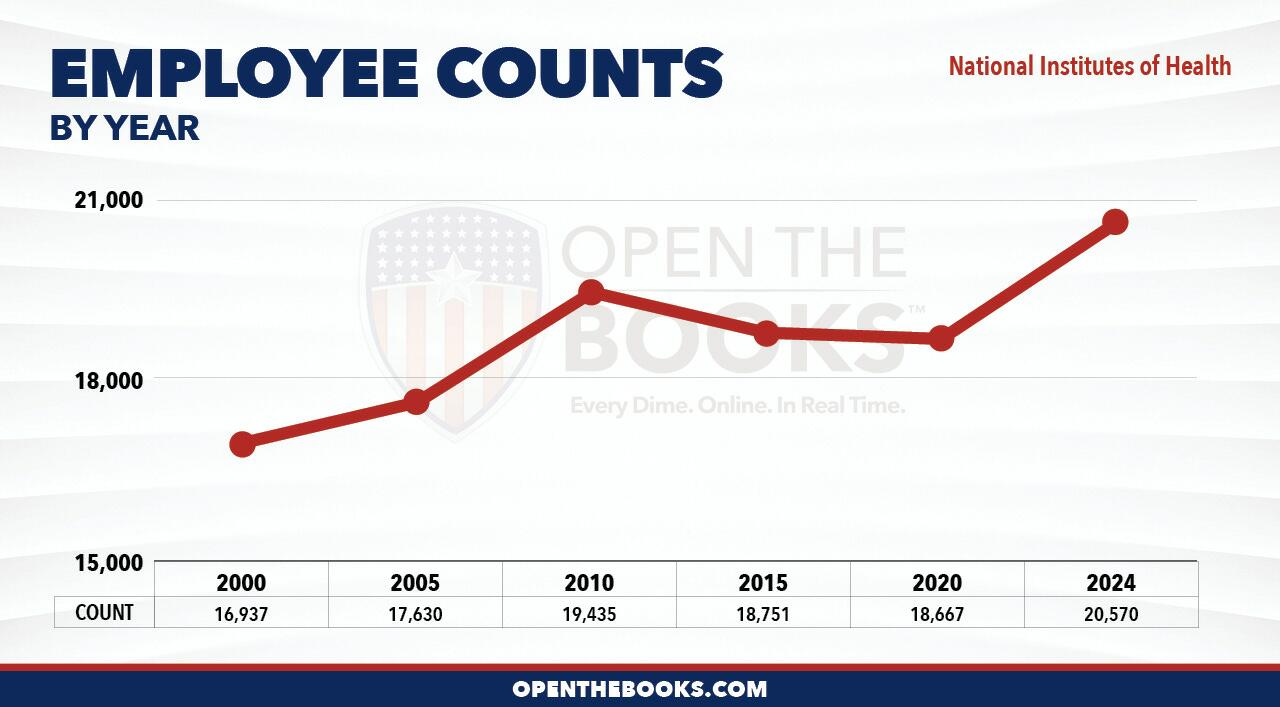
Take the National Institutes of Health for example. Sure, headcount grew 21.5% higher than in the year 2000. But over the same period, spending has skyrocketed 301% of that figure.

Department of Education

The pattern repeats, even more extremely, at the Department of Education. Employee headcounts actually decreased since 2000, to 13.9% lower. But spending? It rose to astonishing 749% of the prior total.

That calculation looks even more galling on the heels of recent news the American students are not recovering from Covid learning losses – they’ve fallen further behind on reading and made little improvement in math. The National Assessment of Educational Progress—known as America’s report card – showed “growing numbers of students lack basic reading skills,” according to the Associated Press. Peggy Carr, commissioner for the National Center of Education Statistics, told journalists that “poor results can no longer be blamed solely on the pandemic, warning the nation’s education system faces ‘complex challenges.’”

FEMA

What about the Federal Emergency Management Agency (FEMA)? They’ve come under fire for shortfalls in their Disaster Relief Fund, and for spending big sums to house migrants in hotels. Well, their employee count actually did rise significantly – it’s just that their spending still outpaced it by miles.

FEMA headcount was 290% higher in 2024 than in 2000. But spending swelled more than seven times faster – to 2,096% of the prior spending levels! There has to be a better way to get aid to disaster zones that’s more timely and efficient – and get away from mission creep like migrant housing.

USAID

For good measure, we’ll take a look at the Agency for International Development (USAID), as it’s been the subject of so much news. Head count since 2000 has grown 218% larger. But spending has risen to 467.7% of outlays from 2000. That’s a lot of DEI for Serbian workplaces and trans comic books for Peru.

Tyler Durden
Fri, 02/21/2025 – 22:35

These Are The Countries Who Depend On Remittances The Most

0
These Are The Countries Who Depend On Remittances The Most

Remittance inflows to low- and middle-income countries rose to $685 billion in 2024, up from $647 billion the previous year, according to estimates from the World Bank. 

Globally, remittances also grew, reaching $905 billion.

In absolute terms, India ($129 billion), Mexico ($68 billion), and China ($48 billion) remained the top recipients of remittances in 2024. However, it’s smaller and poorer economies that feel the impact the most, as these inflows make up a significant share of their economies. Tajikistan, where remittances accounted for 45.4 percent of GDP in 2024, is one such case. OECD analysts say this is partly driven by the higher demand in Russia for migrant workers.

As Statista’s Anna Fleck shows in the following chart, three of the top four countries where remittances made up the largest share of GDP were classified as highly fragile by the OECD. 

Infographic: The Countries Who Depend On Remittances The Most | Statista 

You will find more infographics at Statista

Nicaragua (27.2 percent of GDP), for example, saw high remittances as economic and political instability drove migration, primarily to the United States. Honduras was previously also listed a “high fragility” context in an earlier OECD report, but has since been downgraded to a lower fragility rating.

Overall, the OECD identified 14 out of 61 highly or extremely fragile contexts where remittances made up more than 10 percent of GDP in 2023.

Tyler Durden
Fri, 02/21/2025 – 22:10

Former CNBC Analyst To Admit Conning Investors Out Of Nearly $3 Million

0
Former CNBC Analyst To Admit Conning Investors Out Of Nearly $3 Million

Authored by Jill McLaughlin via The Epoch Times (emphasis ours),

Former CNBC financial analyst James Arthur McDonald faces decades behind bars after defrauding investors out of at least $2.7 million, the U.S. Department of Justice (DOJ) announced Feb. 19.

James Arthur McDonald, Jr., pleaded guilty to bilking investors out of at least $2.7 million. FBI

McDonald, 53, a former resident of Arcadia, Calif., agreed to plead guilty to one count of securities fraud, a felony that carries a statutory maximum sentence of 20 years in federal prison.

“This defendant was entrusted by his clients to care for their money and he violated that trust by using it to enrich himself,” said acting U.S. Attorney Joseph McNally.

In June 2024, federal officers arrested McDonald in Washington state, where he fled in 2021 to avoid appearing before the U.S. Securities and Exchange Commission (SEC).

At his Washington hideout, officers found a fake Washington, D.C., driver’s license bearing McDonald’s photograph and the name “Brian Thomas,” according to the U.S. Attorney’s Office in Los Angeles.

McDonald was the CEO and chief investment officer of two companies headquartered in Los Angeles—Hercules Investments LLC and Index Strategy Advisors Inc. He also often appeared on the CNBC financial news network.

In late 2020, federal prosecutors say McDonald lost tens of millions of dollars of Hercules client money after adopting a risky short position that effectively bet against the health of the U.S. economy in the aftermath of the U.S. presidential election.

McDonald projected that the COVID-19 pandemic and the election would result in major sell-offs that would cause the stock market to drop, federal prosecutors asserted.

When the market decline did not happen, Hercules clients lost between $30 million and $40 million.

By December 2020, Hercules clients were complaining to company employees about the losses, according to court documents.

The SEC filed a civil complaint against McDonald in September 2022, charging him and Hercules with violating federal securities law.

In early 2021, McDonald solicited millions of dollars’ worth of funds from investors to raise capital for Hercules but misrepresented how the money would be used. The SEC alleges he raised more than $5.1 million from 23 investors and clients and misappropriated more than $2.9 million of those funds for personal investments and Ponzi-like payments to earlier investors, meaning he paid some clients using funds from other clients.

The seal of the U.S. Securities and Exchange Commission (SEC) at its headquarters in Washington on May 12, 2021. The SEC filed civil charges against James Arthur McDonald, Jr., in 2022, accusing him of violating federal securities law. Reuters/Andrew Kelly/File Photo

He also failed to disclose the massive losses the company previously realized, according to the U.S. Attorney’s Office in Los Angeles.

As part of the campaign to raise capital, McDonald received $675,000 in investment funds from one victim group on March 9, 2021. Prosecutors say he misappropriated most of those funds in various ways, including spending $179,610 at a Porsche dealership and transferring $109,512 to the landlord of a home McDonald was renting in Arcadia.

Prosecutors also claim McDonald defrauded clients of his other firm, Index Strategy Advisors Inc., using less than half of about $3.6 million he raised for trading purposes. Instead, he frequently commingled client funds with funds from his personal bank account, which he used to purchase luxury cars and to pay rent on his home, personal credit card charges, and Hercules operating expenses.

Prosecutors also say he used the funds to make Ponzi-like payments to the company’s clients.

In total, McDonald caused losses of about $2.7 to more than $3 million, according to federal prosecutors.

In April 2024, U.S District Judge Percy Anderson found McDonald and Hercules liable and ordered they pay civil penalties and several million dollars in disgorgement, which is a court-ordered remedy requiring that someone give up ill-gotten gains.

Tyler Durden
Fri, 02/21/2025 – 21:45

Blockbuster Yale Study: Millions Of Long COVID Patients Might Actually Be Vaccine Injured

0
Blockbuster Yale Study: Millions Of Long COVID Patients Might Actually Be Vaccine Injured

Authored by Paul D. Thacker via The Disinformation Chronicle,

Yale researchers released a study today that posits millions of Americans thought to have Long COVID may have been misdiagnosed and actually have post-vaccination syndrome caused by exposure to the spike protein in COVID vaccines. Spike protein produced by the Pfizer and Moderna vaccines triggers the body’s immune response, and the FDA claimed in a 2023 Politifact fact check that vaccine spike protein is not toxic and does not linger in the body. However, Yale researchers report that some patients, who were never infected with COVID virus, were sick with post-vaccination syndrome (PVS) and had elevated levels of virus spike protein in their blood up to 709 days after vaccination.

“There is considerable overlap in self-reported symptoms between long COVID and PVS, as well as shared exposure to SARS-CoV-2 spike (S) protein in the context of inflammatory responses during infection or vaccination,” noted the study authors.

NIH has poured $1.6 billion into Long COVID research, while ignoring patients harmed by COVID vaccines, causing some well-known patient advocates to hide vaccine injury. After a 13-month battle with Long COVID, Hollywood screenwriter Heidi Ferrer took her own life after deciding death was preferable to another minute in her own “personal hell.” Death of the Dawson’s Creek writer made headlines across the media including places such as People, the Guardian, Variety, CNN, Newsweek, and The Daily Mail—each recounting Ferrer’s struggle with Long COVID.

But in a private video circulating among patient groups and obtained by The DisInformation Chronicle, Ferrer’s husband Nick Guthe stated that Moderna’s COVID vaccine was the final straw, causing Heidi to develop tremors and then internal vibrations when she lay down for bed, so that even prescription sleeping pills would not allow her to sleep.

“And that’s when things turned,” Guthe said in the video.

Prominent patient advocate Beth Mazur also committed suicide after a COVID vaccine apparently worsened her struggles with myalgic encephalomyelitis (ME), a chronic illness with many similarities to Long COVID. Mazur co-founded #MEAction for patients with chronic illness. #MEAction reported in early 2021 that a significant number of ME/CFS patients experienced “both new symptoms and long-lasting exacerbations of their pre-existing ME/CFS symptoms” after a COVID vaccine.

“Beth was a compassionate advocate for ME/CFS and a fierce advocate for vaccine injury after she experienced this herself sometime before she took her own life,” said one of Mazur’s personal friends who did not wish to be identified. “Having people come after you for vaccine injury is worse than being sick itself. And people can’t handle that. It’s a shroud of shame.”

One of the study’s lead authors, Yale Medical School’s Akiko Iwasaki, previously shot down public concerns about COVID vaccine side effects. When Houston Methodist Hospital staffers sued to avoid the hospital’s coronavirus vaccine mandate in 2021, Iwasaki told the Washington Post that the employees’ fears were “absurd” because “no safety concerns” had been found in the mRNA vaccine clinical trials.

Along with other prominent health experts, Iwasaki also signed a petition supporting the OSHA COVID-19 vaccine mandate which the Supreme Court later blocked.

Several of the study’s findings as well as research the authors cite in their paper have been labeled as false by federal agencies, medical experts, and fact checkers. Because medical journals have been rejecting studies on vaccine side effects, the authors uploaded their paper to the preprint site medRxiv.

Passages from the paper are examined below, as well as “fake fact checks” with false and misleading statements by federal agencies and medical experts that, in the past, called these new scientific findings fallacious. Hyperlinks to research papers cited by the study authors have been added to replace their footnotes.

Yale researchers point out that vaccine injury has not been totally defined and has been labeled both PVS and PACVS. Unlike Long COVID, health authorities do not officially recognize PVS, so patients get little support or care. See passage from paper:

In addition, some individuals have reported post-vaccination symptoms resembling long COVID beginning shortly after vaccination. This condition, sometimes referred to as post-vaccination syndrome (PVS) or post-acute COVID-19 vaccination syndrome (PACVS), is characterized by symptoms such as exercise intolerance, excessive fatigue, numbness, brain fog, neuropathy, insomnia, palpitations, myalgia, tinnitus or humming in ears, headache, burning sensations, and dizziness. Unlike long COVID, PVS is not officially recognized by health authorities, which has significantly limited patient care and support.

Both Long COVID and PVS rely on patient’s self-reported symptoms, which have quite a bit in common. Exposure to the spike protein during infection or vaccination causes inflammation. Various parts of the mRNA vaccine might also be problematic such as the mRNA itself which then creates the spike protein, or the tiny fat globule that encases vaccine mRNA called a lipid nanoparticle.

However, there is considerable overlap in self-reported symptoms between long COVID and PVS, as well as shared exposure to SARS-CoV-2 spike (S) protein in the context of inflammatory responses during infection or vaccination. In susceptible individuals, vaccines may contribute to long-term symptoms by multiple mechanisms. For example, vaccine components, such as mRNA, lipid nanoparticles, and adenoviral vectors, trigger activation of pattern recognition receptors.

FAKE FACT CHECK: In a 2021 fact check, AP claimed spike protein from COVID vaccines are not toxic.

The Pfizer and Moderna vaccines create a spike protein that is also called “S protein” or “S1”. See passage from paper:

Secondly, it has been shown that the S protein expressed following BNT162b2 [Pfizer] or mRNA-1273 [Moderna] vaccination circulates in the plasma as early as one day after vaccination.

The virus spike protein has two parts called S1 and S2. These might break down into smaller units called peptides. Some patients with PVS have been found with S protein in their blood cells. In animals, the mRNA vaccine has been found to cross over a membrane and enter the brain. If the mRNA then created spike protein, this could cause neurological problems.

Interaction with full-length S, its subunits (S1, S2), and/or peptide fragments with host molecules may result in prolonged symptoms in certain individuals. Recently, a subset of non-classical monocytes has been shown to harbor S protein in patients with PVS. Further, biodistribution studies on mRNA–LNP platforms in animal models indicate its ability to cross the blood-brain barrier, and the local S expression could result in neurocognitive symptoms.

FAKE FACT CHECK: In a March 2021 fact check, Reuters claimed spike protein is broken down after it leaves a cell.

The researcher report that patients with PVS cited the following symptoms:

The most frequent symptoms reported by participants were excessive fatigue (85%), tingling and numbness (80%), exercise intolerance (80%), brain fog (77.5%), difficulty concentrating or focusing (72.5%), trouble falling or staying asleep (70%), neuropathy (70%), muscle aches (70%), anxiety (65%), tinnitus (60%) and burning sensations (57.5%)

Patients reported symptoms from the vaccines around 4 days, and severe symptoms about 10 days after vaccination.

The median number of days for the development of any symptom was 4 [Interquartile range (IQR): 23 days], while for severe symptoms, it was 10 (IQR: 44 days) post-vaccination.

Patients with PVS had higher levels of spike protein or S1 in their blood.

The results indicated that participants with PVS had significantly higher circulating S1 levels compared with the control group (p = 0.01).

This figure from the paper shows that PVS patients had spike protein or S1 in their blood up to 709 days after they were vaccinated.

FAKE FACT CHECK: In 2023 Politifact alleged the spike protein does not linger in the body after vaccination, based on claims from an FDA official.

PVS and Long COVID share similar symptoms probably from exposure to S protein. Researchers have found the full spike protein and the smaller S1 protein in Long COVID patients. See passage from paper:

Given the similarities between PVS and long COVID symptoms, one hypothesis in the literature is that shared exposure to the S protein may play a role and several groups have independently reported the presence of circulating S1 & full-length S in long COVID using various detection methods.

The highest levels of spike protein were found in PVS patients who had been vaccinated but never infected by COVID virus.

Notably, we observed that the highest levels of detectable S1 in the PVS-I group were the furthest away from the last known exposure and ranging between greater than 600-700 days.

Patients vaccinated with mRNA COVID vaccines and the adenovirus COVID vaccine have shown harm. Patients with PVS had poor health as defined by standardized tests called GHVAS and PROMIS29. Few studies have investigated the cause of PVS, which has no agreed upon definition. See passage from paper:

Post-acute conditions following COVID-19 vaccination have been reported for multiple vaccine platforms including mRNA and adenoviral-vectored vaccines. We observed that the general health status of the PVS participants was far below the general US population average based on the GHVAS scores. The patient-reported outcome scores from the PROMIS29 domains were also indicative of lower quality of life. To date, only a few studies have investigated the immunological mechanisms associated with PVS and no consensus definition of this syndrome exists.

Underlying risk factors for developing PVS are similar for Long COVID. This might be due to problems caused by spike protein, but should be studied further.

The demographics at risk of developing PVS and symptom manifestations are similar to those of long COVID. Whether this reflects overlapping underlying mechanisms such as persistent S protein remains to be determined.

High levels of spike protein in the blood were found in PVS patients who had been infected with the COVID virus and those who had never been infected. This makes sense as spike protein has been found in blood cells. Spike protein has been found in the blood of patients who had myocarditis after COVID vaccination. Because PVS and Long COVID are so similar, the spike protein might be causing the chronic health problems.

By contrast, in our study, significantly elevated levels of circulating S1 and S were observed in a subset of PVS participants both in the infection-naive and infection-positive groups up to 709 days post-exposure. This is in line with the findings of S1 persistence in monocytes in people with PVS. Circulating full-length S has also been detected in cases of post-vaccination myocarditis. Given the striking similarities between long COVID and PVS symptoms, there has been speculation regarding the potential causal role of the persistent presence of spike protein driving the chronic symptoms.

More reporting on vaccine side effects in patients to come.

We strongly encourage you to subscribe to The Disinformation Chronicle.

Tyler Durden
Fri, 02/21/2025 – 20:55

Mapping Every Known US Military Base Overseas

0
Mapping Every Known US Military Base Overseas

This graphic, via Visual Capitalist’s Pallavia Rao, locates the known overseas bases of the American military, categorized by who controls the base.

In red are the ones controlled by the U.S., and blue are ones controlled by the host country.

ℹ️ This map does not include several hundred temporary sites for military exercises or contingency operations.

Data is sourced from a Congressional report published in 2024. Troop data is from the Defense Manpower Data Center, current to March 2024.

Ranked: Countries with the Most U.S. Bases and Troops

Based on unclassified data, the U.S. has at least 128 bases across 49 countries.

Of them, Japan (14), has the most by far, followed by the Philippines (9) and South Korea (8). Here’s the full list of all 128 listed bases, the country they’re in, and who controls them.

Base Name Country ISO Code Status
Kyogamisaki CS 🇯🇵 Japan JPN Ally Controlled
Misawa AB 🇯🇵 Japan JPN U.S. Controlled
Shariki CS 🇯🇵 Japan JPN Ally Controlled
Yokota AB 🇯🇵 Japan JPN U.S. Controlled
Camp Zama 🇯🇵 Japan JPN U.S. Controlled
USFA Yokosuka 🇯🇵 Japan JPN U.S. Controlled
NAF Atsugi 🇯🇵 Japan JPN U.S. Controlled
MCAS Iwakuni 🇯🇵 Japan JPN U.S. Controlled
Kure Pier 6 🇯🇵 Japan JPN U.S. Controlled
USFA Sasebo 🇯🇵 Japan JPN U.S. Controlled
USAG Okinawa 🇯🇵 Japan JPN U.S. Controlled
MCB Camp Butler 🇯🇵 Japan JPN U.S. Controlled
MCAS Futenma 🇯🇵 Japan JPN U.S. Controlled
Kadena AB 🇯🇵 Japan JPN U.S. Controlled
MCI Mujuk 🇰🇷 South Korea KOR Ally Controlled
USAG Daegu 🇰🇷 South Korea KOR U.S. Controlled
USAG Yongsan-Casey 🇰🇷 South Korea KOR U.S. Controlled
Tango 🇰🇷 South Korea KOR U.S. Controlled
Osan AB 🇰🇷 South Korea KOR U.S. Controlled
Camp Humphreys 🇰🇷 South Korea KOR U.S. Controlled
Kunsan AB 🇰🇷 South Korea KOR U.S. Controlled
USFA Chinhae 🇰🇷 South Korea KOR U.S. Controlled
USAG Kwajalein Atoll 🇲🇭 Marshall Islands MHL U.S. Controlled
Navy Region
Center Singapore
🇸🇬 Singapore SGP U.S. Controlled
NSF Diego Garcia 🇮🇴 British Indian Territory IOT U.S. Controlled
Antonio Bautista AB 🇵🇭 Philippines PHL Ally Controlled
Benito Ebuen AB 🇵🇭 Philippines PHL Ally Controlled
Lumbia Airport 🇵🇭 Philippines PHL Ally Controlled
Basa AB 🇵🇭 Philippines PHL Ally Controlled
Fort Magsaysay 🇵🇭 Philippines PHL Ally Controlled
Camp Melchor Dela 🇵🇭 Philippines PHL Ally Controlled
Lal-lo Airport 🇵🇭 Philippines PHL Ally Controlled
NB Camilo Osias 🇵🇭 Philippines PHL Ally Controlled
Balabac Island 🇵🇭 Philippines PHL Ally Controlled
Nadzab Airport 🇵🇬 Papua New Guinea PNG Ally Controlled
Lae Seaport 🇵🇬 Papua New Guinea PNG Ally Controlled
Momote Airport 🇵🇬 Papua New Guinea PNG Ally Controlled
Lobrum NB 🇵🇬 Papua New Guinea PNG Ally Controlled
Port Moresby 🇵🇬 Papua New Guinea PNG Ally Controlled
Jackson International Airport & Seaport 🇵🇬 Papua New Guinea PNG Ally Controlled
RAAF Base Darwin 🇦🇺 Australia AUS Ally Controlled
RAAF Base Tindal 🇦🇺 Australia AUS Ally Controlled
NCS Harold E. Holt 🇦🇺 Australia AUS Ally Controlled
Robertson Barracks 🇦🇺 Australia AUS U.S. Controlled
Pituffik Space Base 🇬🇱 Greenland GRL U.S. Controlled
NAS Keflavik 🇮🇸 Iceland ISL U.S. Controlled
Joint Warfare Center 🇳🇴 Norway NOR U.S. Controlled
RAF Menwith Hill 🇬🇧 UK GBR U.S. Controlled
RAF Alconbury /
Molesworth
🇬🇧 UK GBR U.S. Controlled
RAF Lakenhealth 🇬🇧 UK GBR U.S. Controlled
RAF Mildenhall 🇬🇧 UK GBR U.S. Controlled
RAF Croughton 🇬🇧 UK GBR U.S. Controlled
Lajes Field 🇵🇹 Portugal PRT U.S. Controlled
Moron AB 🇪🇸 Spain ESP U.S. Controlled
NS Rota 🇪🇸 Spain ESP U.S. Controlled
USAG Benelux 🇧🇪 Belgium BEL U.S. Controlled
Kleine Brogel AB 🇧🇪 Belgium BEL U.S. Controlled
Geilenkirchen AB 🇧🇪 Belgium BEL U.S. Controlled
Spangdahlem AB 🇩🇪 Germany DEU U.S. Controlled
Ramstein AB 🇩🇪 Germany DEU U.S. Controlled
USAG Weisbaden 🇩🇪 Germany DEU U.S. Controlled
USAG Stuttgart 🇩🇪 Germany DEU U.S. Controlled
USAG Ansbach 🇩🇪 Germany DEU U.S. Controlled
USAG Bavaria 🇩🇪 Germany DEU U.S. Controlled
Aviano AB 🇮🇹 Italy ITA U.S. Controlled
USAG Vicenza 🇮🇹 Italy ITA U.S. Controlled
Ghedi AB 🇮🇹 Italy ITA U.S. Controlled
Camp Darby 🇮🇹 Italy ITA U.S. Controlled
NSA Detachment Gaeta 🇮🇹 Italy ITA U.S. Controlled
NSA Naples 🇮🇹 Italy ITA U.S. Controlled
NAS Sigonella 🇮🇹 Italy ITA U.S. Controlled
Amari AB 🇪🇪 Estonia EST Ally Controlled
Lielvarde AB 🇱🇻 Latvia LVA Ally Controlled
Siauliai 🇱🇹 Lithuania LTU Ally Controlled
Camp Herkus 🇱🇹 Lithuania LTU Ally Controlled
NSF Redzikowo 🇵🇱 Poland POL Ally Controlled
Powidz AB 🇵🇱 Poland POL Ally Controlled
Lask AB 🇵🇱 Poland POL Ally Controlled
Zagan 🇵🇱 Poland POL Ally Controlled
Camp Kosciuszuko 🇵🇱 Poland POL Ally Controlled
Papa AB 🇭🇺 Hungary HUN Ally Controlled
Kecskemet AB 🇭🇺 Hungary HUN Ally Controlled
Camp Turzii 🇷🇴 Romania ROU Ally Controlled
NSF Deveselu 🇷🇴 Romania ROU Ally Controlled
Mihail Kogalniceanu AB 🇷🇴 Romania ROU Ally Controlled
Novo Selo Training Area 🇧🇬 Bulgaria BGR Ally Controlled
Graf Ignatievo AB 🇧🇬 Bulgaria BGR Ally Controlled
Larissa AB 🇬🇷 Greece GRC Ally Controlled
Stefanovikeio AB 🇬🇷 Greece GRC Ally Controlled
NSA Souda Bay 🇬🇷 Greece GRC U.S. Controlled
RAF Akrotiri 🇨🇾 Cyprus CYP Ally Controlled
Camp Bondsteel 🇽🇰 Kosovo XKX U.S. Controlled
Incirlik AB 🇹🇷 Turkey TUR U.S. Controlled
Izmir AS 🇹🇷 Turkey TUR U.S. Controlled
MFO South Camp 🇪🇬 Egypt EGY Ally Controlled
Muwaffaq Salti AB 🇯🇴 Jordan JOR Ally Controlled
Al-Tanf garrison 🇸🇾 Syria SYR Ally Controlled
Rumalyn 🇸🇾 Syria SYR Ally Controlled
Erbil AB 🇮🇶 Iraq IRQ Ally Controlled
Al Assad AB 🇮🇶 Iraq IRQ Ally Controlled
Duqm 🇴🇲 Oman OMN Ally Controlled
Jebel Ali 🇦🇪 UAE ARE Ally Controlled
Al Dhafra AB 🇦🇪 UAE ARE U.S. Controlled
Al Udeid AB 🇶🇦 Qatar QAT U.S. Controlled
NSA Bahrain 🇧🇭 Bahrain BHR U.S. Controlled
Sheik Isa AB 🇧🇭 Bahrain BHR Ally Controlled
Prince Sultan AB 🇸🇦 Saudi Arabia SAU Ally Controlled
King Faisal AB 🇸🇦 Saudi Arabia SAU Ally Controlled
Camp Buehring 🇰🇼 Kuwait KWT U.S. Controlled
Al Jaber AB 🇰🇼 Kuwait KWT U.S. Controlled
Ali Al Salem AB 🇰🇼 Kuwait KWT U.S. Controlled
Camp Arifjan 🇰🇼 Kuwait KWT U.S. Controlled
Al Mubarak AB 🇰🇼 Kuwait KWT U.S. Controlled
Camp Lemonnier 🇩🇯 Djibouti DJI U.S. Controlled
Ascension Island
Auxiliary Airfield
🇸🇭 St. Helena HLE U.S. Controlled
Chabelley Airfield 🇩🇯 Djibouti DJI Ally Controlled
Baledogle 🇸🇴 Somalia SOM Ally Controlled
Mogadishu 🇸🇴 Somalia SOM Ally Controlled
Kismayo 🇸🇴 Somalia SOM Ally Controlled
Manda Bay 🇰🇪 Kenya KEN Ally Controlled
Mombasa 🇰🇪 Kenya KEN Ally Controlled
N’djamena 🇹🇩 Chad TCD Ally Controlled
Atlantic Undersea
Test & Evaluation
Center
🇧🇸 The Bahamas BHS U.S. Controlled
Naval Station
Guantanamo Bay
🇨🇺 Cuba CUB U.S. Controlled
Soto Cano Air Base 🇭🇳 Honduras HND U.S. Controlled
CSL Comalapa 🇸🇻 El Salvador SLV Ally Controlled
CSL Reina Beatrix
International Airport
🇦🇼 Aruba ABW Ally Controlled
CSL Hato
International Airport
🇨🇼 Curacao CUW Ally Controlled

A quick glance at the map reveals the two major security priorities for the U.S. military: Europe and East Asia.

Japan also has the most troops stationed in any country, numbering 53,000 at last count.

While Germany, Italy, and the UK don’t have double-digit bases like Japan, collectively Europe has a huge American presence, when adding in all bases and troops together.

And this isn’t even accounting for the additional 80,000 soldiers deployed to the region after the 2022 Russian invasion.

Middle East: A Growing Security Sphere

While not as nearly cluttered as Europe and East Asia, the Middle East is also home to numerous American bases. Key allies Kuwait and Bahrain also host forces.

Rank Countries With the
Most U.S. Bases
Bases Countries With the
Most U.S. Troops
Troops
1 🇯🇵 Japan 14 🇯🇵 Japan 52,852
2 🇵🇭 Philippines 9 🇩🇪 Germany 34,894
3 🇰🇷 South Korea 8 🇰🇷 South Korea 23,732
4 🇮🇹 Italy 7 🇮🇹 Italy 12,319
5 🇵🇬 Papua New Guinea 6 🇬🇧 UK 10,180
6 🇩🇪 Germany 6 🇧🇭 Bahrain 3,424
7 🇬🇧 UK 5 🇪🇸 Spain 3,253
8 🇵🇱 Poland 5 🇹🇷 Turkey 1,683
9 🇰🇼 Kuwait 5 🇧🇪 Belgium 1,119
10 🇦🇺 Australia 4 🇨🇺 Cuba 572

Nothing makes security priorities more clear than base in Djibouti, not just for the U.S. but also the rest of the world.

It’s situated on the Bab-el-Mandeb Strait, which connects the Gulf of Aden and the Red Sea, and is a key shipping route. The Red Sea has been in the news lately due to Houthi rebel attacks.

Thus, Djibouti’s strategic location, and careful deal-making, has resulted in the country hosting military bases from seven other nations as well. This includes political rivals to the U.S., like China.

You might have noticed several NATO members hosting troops and bases. Check out: NATO Members Are Ramping up Defense Spending to see how the Russian invasion had an impact.

Tyler Durden
Fri, 02/21/2025 – 20:30

Nearly 2 Dozen Trinitarios Gang Members Arrested In Massachusetts

0
Nearly 2 Dozen Trinitarios Gang Members Arrested In Massachusetts

Authored by Rachel Acenas via The Epoch Times (emphasis ours),

Nearly two dozen members of a violent transnational gang were arrested and charged in Massachusetts, federal authorities announced Feb. 19.

U.S. Immigration and Customs Enforcement officers in a file photograph. U.S. Immigration and Customs Enforcement via Getty Images

Twenty-two alleged Trinitarios gang members face various federal charges including racketeering conspiracy in connection with several murders, attempted murders, shootings, kidnappings, and robberies.

Authorities confirmed that factions of the Trinitarios gang have been identified in the cities of Lawrence, Lynn, Boston, and Haverhill.

“We believe those arrested today–leaders, members, and close associates of the Trinitarios–have allegedly shown a reckless indifference to human life in order to control their turf, push their poison, and make money,” Jodi Cohen, special agent in charge of the FBI’s Boston Division, said in a statement.

The investigation, led by U.S. Customs and Immigration Enforcement (ICE), began in the aftermath of four murders and a series of attempted murders and shootings that happened in Lynn back in 2023. Two of the alleged gang members were juveniles at the time the crimes were committed and have been charged with murder.

“The Massachusetts Trinitarios allegedly recruit new members among communities of legal immigrants and illegal aliens from the Dominican Republic—specifically juveniles in local high schools in Lawrence and Lynn,” according to ICE.

U.S. Attorney Leah B. Foley said this latest enforcement ends the gang’s “reign of terror” in Massachusetts.

Meanwhile, federal prosecutors continue to target violent criminal enterprises. Members and associates of Tren de Aragua, one of the world’s most dangerous transnational criminal organizations, have been nabbed in recent targeted enforcement operations across the country.

The Trump administration on Wednesday officially designated six drug cartels and two gangs as foreign terrorist organizations, or FTOs.

The organizations that received the label include Tren de Aragua, MS-13, Sinaloa cartel, Jalisco New Generation cartel, Tepalcatepec cartel, Los Zetas cartel, Gulf cartel, and La Nueva Familia Michoacana.

The notice issued by Secretary of State Marco Rubio said that the groups pose a risk to U.S. national security, foreign policy, and economic interests. The label expands the government’s ability to crack down on criminal groups operating in the United States. Designating a group as an FTO allows the government to disrupt the group’s finances through sanctions, including asset freezes and travel bans, on its members and associates.

The move comes after Trump issued an executive order on his first day in office last month that called on officials to evaluate whether any criminal cartels or transnational gangs should be designated as terrorism groups.

From NTD News

*  *  *

Check out these excellent knives for no reason in particular…

In case you run out of bullets…


Tyler Durden
Fri, 02/21/2025 – 20:05

Social Security Chief Says Millions Of Dead People On Record ‘Not Necessarily Receiving Benefits’

0
Social Security Chief Says Millions Of Dead People On Record ‘Not Necessarily Receiving Benefits’

Authored by Tom Ozimek via The Epoch Times (emphasis ours),

The new head of the Social Security Administration (SSA) on Wednesday addressed speculations that millions of deceased individuals over the age of 100 may be receiving Social Security benefits, stating that they are likely exaggerated.

A Social Security card sits alongside checks from the U.S. Treasury in Washington on Oct. 14, 2021. Kevin Dietsch/Getty Images

Acting SSA Commissioner Lee Dudek, appointed recently by President Donald Trump, issued a statement on Feb. 19, clarifying concerns raised by Trump, DOGE frontman Elon Musk, and White House press secretary Karoline Leavitt. The three had said in social media posts and press briefings that SSA records list individuals as being 100, 200, or even 300 years old—raising questions about potential improper payments.

Dudek said he wants to “acknowledge recent reporting about the number of people older than age 100 who may be receiving benefits from Social Security,” adding that the “reported data are people in our records with a Social Security number who do not have a date of death associated with their record.”

“These individuals are not necessarily receiving benefits,” Dudek said, while expressing confidence in the audits conducted by DOGE, which Trump has tasked with uncovering any fraud, waste, and abuse in government spending.

“I am confident that with DOGE’s help and the commitment of our executive team and workforce, that Social Security will continue to deliver for the American people,” Dudek said.

Trump said at a Florida press briefing on Feb. 18 that DOGE’s findings suggest “millions and millions” of centenarians may be receiving benefits improperly. This is “obviously fraudulent or incompetent,” he said.

“If you take all of those millions of people off Social Security, all of a sudden, we have a very powerful Social Security with people that are 80 and 70 and 90, but not 200 years old,” the president said.

Click pic… buy colostrum… live long enough to collect vampire social security? Satisfaction guaranteed or your money back.

“It’s a very positive thing” that DOGE had shed light on the potential issue, Trump said. “We’re figuring it out.”

Musk echoed these concerns on social media.

“Maybe Twilight is real, and there are a lot of vampires collecting Social Security,” he joked in one post. In another, he wrote: “Having tens of millions of people marked as ‘ALIVE’ when they are definitely dead is a HUGE problem. Some of them would have been alive before America existed as a country. Think about that for a second.”

Musk also criticized the lack of action on past government reports that highlighted the issue. “What’s super weird is that the @USGAO pointed out years ago that millions of dead people were tagged as alive by Social Security, but nothing was done!” he wrote.

Leavitt said in an appearance on Fox News that Musk and DOGE have been working to identify fraud at the SSA. “They haven’t dug into the books yet but they suspect that there are tens of millions of deceased people receiving fraudulent Social Security payments,” she said.

Concerns about outdated records are not new. SSA’s Office of the Inspector General has noted the presence of inactive Social Security numbers and that the records don’t necessarily mean fraudulent payments are occurring.

A March 2015 report and a July 2023 follow-up found that the SSA had not updated its system to properly annotate death information for approximately 18.9 million people born in 1920 or earlier who were not officially marked as deceased. The reports also stated that “almost none” of these individuals were actively receiving benefits.

The SSA ultimately decided not to update the database due to the cost, which was estimated to exceed $9 million. Additionally, since September 2015, SSA policy has automatically stopped payments to anyone listed as older than 115 years old.

The extent of improper Social Security payments remains uncertain.

A July 2024 report from the Social Security inspector general found that, between fiscal years 2015 and 2022, the agency distributed nearly $8.6 trillion in benefits. Of that amount, $71.8 billion, less than 1 percent, was classified as improper payments, with the majority being overpayments to living recipients rather than deceased individuals.

Additionally, in early January, the U.S. Treasury recovered more than $31 million in various federal payments—not limited to Social Security—that had been mistakenly sent to deceased individuals. Former Treasury official David Lebryk described the recovery efforts as “just the tip of the iceberg.”

Tyler Durden
Fri, 02/21/2025 – 19:15

Voter Rolls Like They Oughta Be

0
Voter Rolls Like They Oughta Be

Authored by Doug Truax via RealClearPolitics,

Why do we tolerate purposeful government incompetence? Especially when it comes to our voter registration rolls – the lists we use to make sure only qualified voters cast ballots in an election.

These rolls are bloated with ineligible voters, only periodically updated, and opaque to the public.

What if our bank records were like that? How long would that last before we’d spill out into the streets?

There’s one state official who’s trying to change that. He’s Ohio Secretary of State Frank LaRose, who announced recently he’d make available to the public daily snapshots of the voter rolls to keep up with additions and subtractions to the list. That’s a great reform. LaRose has been ahead of most state election officials, passing a series of reforms that puts Ohio on the leading edge of election transparency.

While LaRose is on the right track, there’s still a long way to go. Our vision at the Voter Reference Foundation is to have all the rolls up to date at all times in an easily consumed format. That was our idea when we created VoteRef.com in 2021, the first attempt ever in America to publish voter rolls in all 50 states.

We understand – as do LaRose and many election experts – that fixing the voter rolls is the lynchpin for clean elections. It makes sense – in order to conduct an election, you need an accurate, up-to-date registration list of eligible voters to start. Any bogus name on the list, including dead voters or those who have moved away, is an open invitation for vote fraud. Those who oppose clean, accurate voter rolls are people not concerned with election integrity.

We have made tremendous progress, but some states are more committed to hiding their voting records than exposing them to public scrutiny. More than a dozen either ban their publication or severely hamstring a taxpayer’s ability to examine them. Most of those states are run by Democrats. One, New Mexico, sued us in federal court and referred us for criminal investigation for publishing them. A federal judge agreed with us that we had the legal right to publish the rolls.

Another obstacle is that states charge lots of money for access to the rolls and don’t update them in real-time. We are doing our best to work around these limitations. State officials don’t seem to understand that taxpayers pay for election administration and, under federal law, have a right to examine the records. These are our records, not theirs.

The new Trump administration in Washington is certainly attuned to the election integrity crisis in America. Large swaths of our population lack confidence that elections are free, fair, and accurate. We must change that, and now is the time.

We hope Frank LaRose’s actions in Ohio will be the spark that convinces states to open up their voting records more fully to the public. Our republic cannot tolerate a sloppy and inaccurate government that gives an opening to the corruption of our elections.

Let’s get moving.

Doug Truax is founder and CEO of Restoration of America, one of the most active and effective political organizations in America. He is a West Point graduate, successful entrepreneur, and former Army Ranger.

Tyler Durden
Fri, 02/21/2025 – 18:25

Trump Set To Take Control Of Postal Service – Privatization Could Be Next

0
Trump Set To Take Control Of Postal Service – Privatization Could Be Next

Continuing his government-reformation fiesta, President Trump is expected to issue an executive order dissolving the US Postal Service leadership and absorbing the organizaton into the Commerce Department. That bold move may be just a first step toward an even more ambitious and controversial goal: privatizing the perpetual money-loser. 

From leadership to rank-and-file employees, the USPS will most certainly mount intense legal and political efforts against both initiatives. The USPS governing board is already gearing up: On Thursday, the USPS board held an emergency meeting in which it hired outside attorneys and directed them to file legal challenges when Trump makes his first move, the Washington Post reported.   

The USPS Board of Governors, led by chair Amber McReynolds, has given outside lawyers orders to file suits to block any Trump moves

The Postal Service is politically powerful — starting with its raw headcount: While you may not guess it given the long lines that typify a visit to a post office, USPS has a staggering 650,000 employees, who rise up whenever privatization gains momentum. It’s also popular among Americans — 72% view it favorably, compared just 21% who view it unfavorably, according to a 2024 Pew Research poll. 

A 2018 Pittsburgh postal workers union rally against Trump’s interest in privatizing the US Postal Service (Lake Fong/Pittsburgh Post-Gazette via AP) 

In December, the Post reported that Trump had been discussing USPS privatization with Howard Lutnick, who is now Secretary of Commerce, along with other transition officials whom Trump used as a sounding board on the topic. The Department of Government Efficiency (DOGE) held its own meetings to explore drastic actions with the 250-year-old service. 

In November, USPS disclosed a net loss of $9.5 billion for the 2024 fiscal year — a loss that was 46% worse than the service’s $6.5 billion deficit in 2023. The plunge came alongside a slight uptick in revenue enabled by the latest annual increase in postage rates, pursuant to the 2021 Delivering for America plan. That program was supposed to help the perennially-profitless behemoth “achieve financial sustainability and service excellence.” The service also has a crummy balance sheet, with nearly $80 billion in liabilities. 

The USPS “profit” in 2022 was a mirage resulting from the repeal of a requirement to prepay future retiree health benefits, and the cancellation of past-due pre-funding obligations (chart via Washington Post)

In recent years, USPS has increased its headcount despite that fact that mail volumes have steadily declined since a Covid-era spike. Grilling Postmaster General Louis DeJoy at a Senate hearing, Rand Paul asked, “Can you think of a private business — where 80% of what they’re doing to make money is going down in volume — would actually increase their employees?” Here’s a particularly well-framed video of the exchange: 

Since 1970, the USPS has operated as a quasi-governmental agency, led by a board of governors whose members are appointed by presidents subject to Senate confirmation. Earlier this week, DeJoy informed the USPS board that he was ready to step down from his position, and asked the board to begin seeking his successor. His move halfway through his 10-year-term came amid reports that Trump was thinking of replacing him. DeJoy was appointed by Trump in the summer of 2020, and soon became a lightning rod for Democrats who accused him of thwarting the vote-by-mail free-for-all that leftists fostered during that pandemic-stricken election year. In the crucial state of Pennsylvania, 76% of mailed ballots went to Biden.  

Predictably, leftists have started losing their minds over Trump’s pending moves, simultaneously decrying USPS reform as Russian interference, racism and an attack on democracy…

Tyler Durden
Fri, 02/21/2025 – 18:00