72 F
Chicago
Sunday, October 4, 2026
Home Blog Page 1918

L.A. Residents Sue Edison Utility Over Potential Role In Palisades Fire

0
L.A. Residents Sue Edison Utility Over Potential Role In Palisades Fire

Update (1508ET):

 *   *   * 

Update (1320ET):

Energy company Edison International was sued on Monday for its alleged role in igniting at least one of the wildfires in Los Angeles County. 

Bloomberg reports, “The lawsuit is on behalf of a group of homeowners, renters, business owners and others with properties destroyed by the Eaton Fire in the Pasadena area,” adding, “The suit alleges a Southern California Edison pole holding power lines was the cause of the blaze that leveled the town of Altadena.”

X users said…

Shares of Edison International plunged 13% on Monday morning, bringing the total decline since the fires started nearly one week ago to 28%. The daily RSI (14D) has fallen to 7.9. 

Zooming in on the most oversold RSI ever… 

Edison did not comment on the suit that appeared on the Los Angeles Superior Court website on Monday morning. 

Meanwhile, it’s only a matter of time before lawsuits are filed against the City of Los Angeles or even the State of California for gross negligence. These lawsuits will likely cite improper forest management, cuts to fire budgets, and the mishandling of the Palisades Reservoir, given that city officials knew very well about dry conditions and wind storms ahead of the first full week of the new year.

 *   *   * 

Firefighters are racing to contain three active wildfires in Los Angeles County as Santa Ana winds are forecasted to return Monday morning. The fires have scorched 40,000 acres, forced the evacuation of at least 150,000 residents, and claimed 24 lives. Residents are expressing outrage at far-left Democratic politicians in the county and state, blaming them for negligence in the spread of the Palisades Fire. At the same time, AP News tried to provide cover for Democrats and blame the fire’s spread on ‘climate change.’ 

The National Weather Service has issued “Particularly Dangerous Situation” red flag warnings for the Ventura and Los Angeles counties through Wednesday. Gusts are expected to be between 50 and 65 mph, with dry air that will worsen conditions for firefighters and likely lead to more evacuations. 

There are currently three fires burning (list courtesy of LA Times): 

Palisades Fire:

Burned 23,713 acres and numerous homes, businesses and landmarks in Pacific Palisades and westward along Pacific Coast Highway, toward Malibu. As of late Sunday, the fire was 13% contained. Many parts of Pacific Palisades, Malibu, Santa Monica, Calabasas, Brentwood and Encino are under evacuation orders or warnings. More than 12,000 structures remain threatened. Officials estimate that more than 5,300 structures, including many homes, have been damaged or destroyed.

Eaton Fire:

Burned 14,117 acres and many structures in Altadena and Pasadena. Additional evacuation orders were mandated Thursday afternoon when fire climbed toward Mt. Wilson. Other mandatory evacuations were lifted as city officials notified residents in Glenoaks Canyon and Chevy Chase Canyon that it was safe to return to their homes. As of 8 p.m. Sunday, the fire remained 27% contained. Officials say 7,000 structures have been burned in the fire.

Hurst Fire:

Burned 779 acres in the area around Sylmar. Evacuation orders have been lifted. As of Sunday night, the fire was 89% contained, according to Cal Fire.

Fire Map (LA Times):

Latest Zero Hedge headlines:

Latest LA Times headlines:

  • Increasing winds bring potential for ‘explosive fire growth’ across LA County this week

  • Death toll from Palisades and Eaton fires climbs to 24. 

  • Newsom to deploy an additional 1,000 National Guard members to LA.

  • Investigators study Eaton Canyon electrical tower area as possible origin of Altadena fire

On Sunday, Captain Andrew Cruz from the LA County Sheriff’s Incident Management Team said a curfew in the fire zones remains in place. 

“Nightside, we continue to support the efforts here at the Palisades Fire with 104 sworn personnel plus 16 National Guard soldiers,” Cruz said.

Looters were out in force over the weekend, ransacking mansions in the Palisades area despite police and National Guard deterrence.

“Yes. Please be careful in some areas, as there is non-zero risk of armed looters. Cybertruck side panels are bulletproof to subsonic projectiles (handguns, shotgun & Tommy gun), but the glass is not, so make sure to duck if you see anyone wielding a gun. This is not fiction,” Elon Musk wrote on X. He noted earlier, “We are going to position Cybertrucks with Starlinks and free WiFi in a grid pattern in the areas that most need it in the greater LA/Malibu area.” 

Palisades transformed into an inferno. 

The debate over gross negligence centers on why the Palisades Reservoir was not filled before the fire.

“Incompetence in the limit is indistinguishable from sabotage,” Musk wrote on X. He’s referring to LA Mayor Karen Bass and Gov. Gavin Newsom. There’s a lot of controversy about fire budget cuts and the mismanagement of resources. 

For the households that lost everything, it’s time to hold the radical leftist politicians in charge accountable. This is unacceptable.

Tyler Durden
Mon, 01/13/2025 – 15:08

Biden Pressing Gaza Deal Hard Before Trump Inauguration, Reports Of ‘Breakthrough’

0
Biden Pressing Gaza Deal Hard Before Trump Inauguration, Reports Of ‘Breakthrough’

There is once again talk of a “breakthrough” in efforts to achieve a Gaza ceasefire and prisoner swap between Israel and Hamas, Reuters and other publications are reporting Monday. President Biden is also touting this in his last foreign policy speech:

A Gaza deal is “on the brink”, President Joe Biden has said in his final foreign policy address. The outgoing US president said it would include a hostage release deal and a “surge” of aid to Palestinians.

“In the war between Israel and Hamas, we’re on the brink of a proposal that I laid out in detail months ago finally coming to fruition,” Biden said while visiting the State Department for the final time as president.

What’s new about this current round of negotiations is that Trump’s envoy for the conflict, Steve Witkoff, is present, along with the Biden administration’s outgoing envoy Brett McGurk. A draft deal has reportedly been presented to all sides, and mediators are awaiting Hamas’ response. “The next 24 hours will be pivotal to reaching the deal,” an official told Reuters. And separately, the Israeli side has said: “The hostage deal outline is clear, and Israel has come a long, long way.”

Via Al Jazeera

“We are moving forward slowly and carefully. We hope that Hamas will stop with its refusals,” the official added. According to further details:

Mediators gave Israel and Hamas a final draft of a deal on Monday to end the war in Gaza, an official briefed on the negotiations said, after a midnight “breakthrough” in talks attended by envoys of both Joe Biden and Donald Trump.

The official said the text for a ceasefire and release of hostages was presented by Qatar to both sides at talks in Doha, which included the chiefs of Israel’s Mossad and Shin Bet spy agencies and Qatar’s prime minister.

The proposed three-stage deal comes as the Biden administration desperately hopes to mediate peace with merely a week to go before Trump is inaugurated on Jan.20. What has stalled things in the past is Hamas’ demand that Israel’s military leave the Gaza Strip, something which PM Netanyahu has considered a non-starter.

For much of the last year Secretary of State Antony Blinken has claimed to be at the ‘goal line’ of achieving a deal, but talks have consistently collapsed despite these overly optimistic assessments.

Still, Israeli Foreign Minister Gideon Saar is now claiming that greater progress has been made due to the coordination between Biden’s and Trump’s teams.

“There is progress, it looks much better than previously. I want to thank our American friends for the huge efforts they are investing to secure a hostage deal,” Saar told a press briefing. Biden’s White House officials have said a deal is being pressed hard ahead of Trump taking office:

The Biden administration sees a possible Gaza agreement as soon as this week, White House national security adviser, Jake Sullivan, told Bloomberg News earlier today. Despite expressing optimism, he stressed there were no guarantees that Israel and Hamas would agree to such a deal that could pause the 15-month-old war on the devastated territory. The US is pressing for a deal before Donald Trump takes office on 20 January.

Is there legitimate progress this time due to the Trump factor?

Starting early last month the president-elect betwen threatening escalation if Hamas and Palestinian militants in Gaza don’t immediately free the remaining Israeli hostages. “Everybody is talking about the hostages who are being held so violently, inhumanely, and against the will of the entire World, in the Middle East – But it’s all talk, and no action!” Trump had stated on his Truth Social.

He warmed that there will be “hell to pay” if Hamas doesn’t release the captives. “Please let this TRUTH serve to represent that if the hostages are not released prior to January 20, 2025, the date that I proudly assume Office as President of the United States, there will be ALL HELL TO PAY in the Middle East, and for those in charge who perpetrated these atrocities against Humanity,” Trump continued in the statement.

In Lebanon the 60-day agreed upon ceasefire between Israel and Hezbollah has largely held. This may provide momentum for regional diplomats to finally secure a path forward in Gaza. There’s officially some 100 Israeli captives still unaccounted for; however, Israeli and US intelligence believe many are deceased.

Tyler Durden
Mon, 01/13/2025 – 15:05

Russia’s Shadow Shipping Fleet: How It Works And Why It Is Hard To Tackle

0
Russia’s Shadow Shipping Fleet: How It Works And Why It Is Hard To Tackle

Authored by Chris Summers via The Epoch Times,

Russia has been growing its so-called shadow shipping fleet for several years but concerns have escalated in the last few months after some of them were linked to a series of incidents involving undersea infrastructure.

Germany, Britain, and 10 other European countries agreed in December on measures to “disrupt and deter” Russia’s shadow fleet.

“The shadow fleet presents risks to the environment, maritime safety and security, international seaborne trade, as well as international maritime law and standards. It also works to circumvent our sanctions and soften their impact,” the countries said in a joint statement.

But what is the shadow fleet, why does Russia need it, and can it be disrupted without breaking the international laws of the sea?

Neil Roberts, head of Marine & Aviation at Lloyd’s Market Association, said Russia may control around 1,100 ships—a mixture of oil tankers, container ships, and bulk carriers—but he said it’s something of a misnomer to call them a shadow fleet.

4 Types of Fleet

He told The Epoch Times there are four types of fleet.

“There’s the Western-administered A1 fleet which has all the right insurance and controls. Then, there’s a parallel fleet, run by China, India, and the Asian countries, which is well-maintained but does not follow sanctions.”

“Then, there’s the ‘gray fleet’, which is ships used for smuggling drugs and arms, completely illegal. But then you have the Russian fleet, which they have acquired. Some of it is of a reasonable quality but other vessels are older,” Roberts said.

The term shadow suggests they are secretive but Roberts notes they operate openly and use international shipping lanes, including the Suez Canal.

The ships—which often have a confusing array of aliases—have been plying the world’s seas since long before Russia invaded Ukraine in February 2022. But the conflict and the growing tension with NATO has drawn them into focus.

Not only is the shadow fleet suspected of breaking sanctions but some of the ships are alleged to have tampered with undersea infrastructure, and others are feared to be so old or poorly maintained that they might cause marine pollution.

Last month, the state-owned news agency Tass reported that two Russian ships, the Volgoneft 212 and Volgoneft 239, caused an “oil spill emergency” in the Black Sea after colliding. Both ships were reportedly over 50 years old.

On Dec. 26, a Russian-owned ship, the Eagle S, flying the flag of the Cook Islands, was stopped by the Finnish Border Guard after it was suspected of cutting an undersea cable, Estlink-2, which supplies power to Estonia.

The following day, the Estonian Navy was drafted in to protect the Estlink-1 cable, and the European Union’s foreign policy chief Kaja Kallas said the Eagle S incident was “the latest in a series of suspected attacks on critical infrastructure.”

Last month, Britain, Denmark, Sweden, Poland, Finland, and Estonia said they would begin checking insurance documents of vessels in the English Channel, the Gulf of Finland, and the Kattegat—the strait between Denmark and Sweden.

Estonian Prime Minister Kristen Michal said, “If the ships do not cooperate, next steps will be taken. They will be put on a list for prohibition, or they will be boarded in certain areas.”

Roberts said those actions bring up the question of legality, “which might be a moot point if you’re in a conflict, but we’re not in a declared conflict.”

During World War II, Allied ships would frequently board and take over German, Japanese, and Italian commercial vessels—or sink them—but because the only countries who are at war here are Russia and Ukraine, there is no “declared conflict” that would permit such action by third parties.

Roberts also pointed to a treaty—posted on the CIA’s website—that prevents ships heading to or from Russia from being intercepted.

The 1857 Copenhagen Treaty states no ship is to be stopped while traveling through the straits between Denmark and Sweden. It was a clause that was scrupulously adhered to throughout the Cold War, when Soviet submarines and battleships would pass through on their way to the open seas.

He said one of the biggest concerns of the Western shipping industry is what would happen if a shadow vessel collided with a ship, or caused a major pollution event.

Lloyd’s of London is the one of the world’s biggest shipping insurance markets in the world, and the Lloyd’s Market Association represents 55 managing agents who together insure 52.6 billion pounds ($64.2 billion) worth of shipping and other assets.

Roberts said, “The question that everyone is asking is: ‘What happens if an insured vessel collides with a sanctioned vessel?’”

Shadow fleet vessels are often subject to obscure ownership, and an insurance structure that allows them to evade detection and sanctions.

But Roberts said while shadow fleet ships need a higher grade of insurance to enter a Western port, all they need to sail the high seas was protection and indemnity insurance, known as P&I.

Last month, Lloyd’s List reported that the European Union had sanctioned another 52 ships, bringing the total under sanctions to 79. Among them was the liquefied natural gas (LNG) tanker Pioneer, which flies the flag of the tiny Pacific nation of Palau, and is also sanctioned by the United States.

Another ship, also called the Pioneer but now known as Hero II, is an oil tanker sanctioned by the U.S. Office of Foreign Assets Control (OFAC) for its links to Iran.

‘Bankroll His Illegal War’

In its statement on Jan. 6, the British government said it had now sanctioned more than 100 Russian ships, including 93 oil tankers that “Putin has been using to soften the blow of sanctions and bankroll his illegal war in Ukraine.”

Among them were the tankers Ocean Faye, Andaman Skies, and Mianzimu, which Britain claims each carried more than four million barrels of Russian oil in 2024.

Another sanctioned ship is the Feng Shou, a crude oil tanker that flies the flag of Panama and is currently in the Russian Far East. The ship, previously known as the Andromeda Star, was also sanctioned by the European Union in June 2024.

The Open Sanctions website, which is part-funded by the German government, said, “In March 2024, the vessel crashed near Denmark when it was on its way to load Russian oil in the [Baltic] port of Primorsk.

British Defense Secretary John Healey confirmed on Jan. 6 that Britain would lead a 10-nation Joint Expeditionary Force (JEF) to track potential threats to undersea infrastructure, and monitor Russia’s shadow fleet.

Britain’s Ministry of Defence (MOD) released a statement saying the new system, called Nordic Warden, was activated last week.

The MOD said Nordic Warden “harnesses AI to assess data from a range of sources, including the Automatic Identification System (AIS) ships use to broadcast their position, to calculate the risk posed by each vessel entering areas of interest.”

The statement said, “Specific vessels identified as being part of Russia’s shadow fleet have been registered into the system so they can be closely monitored when approaching key areas of interest.”

The MOD added, “If a potential risk is assessed, the system will monitor the suspicious vessel in real time and immediately send out a warning, which will be shared with JEF participant nations as well as NATO allies.”

It said JEF’s operational headquarters in Northwood, on the outskirts of London, was currently monitoring 22 areas of interest, including the English Channel, the North Sea, the Baltic Sea, and the Kattegat.

Roberts said, “There’s a lot of spoofing going on, which is where you say you’re in one place, and you’re somewhere else. And that’s being done in the eastern Mediterranean a lot, and in the Black Sea.”

There is a legal system governing the world’s seas and oceans, called the United Nations Convention on the Laws of the Sea (UNCLOS), which was adopted in 1982 but only came into force in 1994.

A sailor keeps watch on an Estonian naval ship patrolling in the Baltic Sea on Jan. 9, 2025. Hendrik Osula/AP

Russia is one of 170 signatories to UNCLOS, but the United States has never signed or ratified it, despite several presidents, including most recently President George W. Bush in 2007, urging the Senate to do so.

Roberts said the convention states clearly the different gradations of water boundaries, from inland waters to oceans.

He said there is no “right of innocent passage” for foreign ships in a country’s lakes, canals, rivers, or ports and they need permission to enter.

“Then, you have your territorial waters where you’ve got full sovereignty, up to 12 nautical miles. Then there’s a contiguous zone up to 24 nautical miles, where you’ve got some ability to intervene if there’s been an offense in your territorial waters,” Roberts said.

“Now, past that, is the EEZ (exclusive economic zone) where, as a country, you’re able to use and exploit marine resources in that area,” he said, referring to the area up to 200 nautical miles from a country’s coast.

“Then, there’s the continental shelf. Not everyone has that, but that’s out to 350 miles, and beyond that is the high seas,” he said.

“Anything outside 12 nautical miles, you haven’t got full power. If you start boarding vessels in what would be considered to be international waters without due cause, that would be antagonistic to the country of the vessels that you’re boarding.”

He said the shadow fleet vessels do not all have the same flag.

“They have a variety of flags, so the number of states that you are likely to offend is quite wide, unless you’ve negotiated with them, unless you can prove that you have due cause,” Roberts said.

He said the 10 countries seeking to “disrupt and deter” Russia’s shadow fleet will have to prove the vessels are not engaged in “innocent passage.”

“How that’s done is quite hard,” Roberts said.

There is also the danger that Russia could retaliate by boarding Western ships in areas such as the Black Sea, or the White Sea, north of Murmansk.

Roberts said he questions whether sanctions against Russia can be effective, especially considering Moscow’s trade links with China.

“There’s a Western desire to show support for Ukraine … and they chose to use sanctions as a way of showing that support. And I think there was an expectation they’d be more effective than they were,” he said.

Roberts said President Woodrow Wilson’s idea in 1919 to use economic sanctions was based on the premise that “they should be more terrible than war.”

But Roberts said, “Unless you’re targeting a very small area, you need international support. And this is where the weakness is: they haven’t got everybody onside.”

Tyler Durden
Mon, 01/13/2025 – 14:45

Incoming: “Big Dumps Of Cold Air. Reminiscent Of 2013/14 Winter”

0
Incoming: “Big Dumps Of Cold Air. Reminiscent Of 2013/14 Winter”

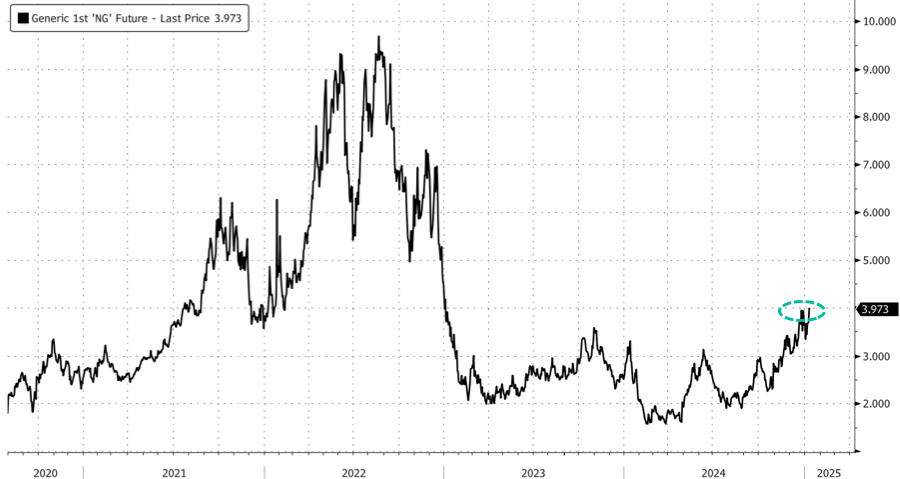
US natural gas futures spiked to an intraday high of $4.279/MMBtu during Sunday evening trading, driven by forecasts of another round of cold air set to sweep through next week.

“The pattern ahead is about as favorable as it gets for big dumps of cold air. Reminiscent of 2013/14 Winter at times in terms of the cold set up. Most of the country in the deep freezer by Day 8,” private weather forecaster BAMWX wrote on X. 

BAMWX said the “major cold shot” will be the “coldest air yet this year” and “extend all the way to the Deep South.”

“One feature that has continued reoccur throughout this winter has been what we call the +TNH or the Hudson Bay Vortex,” the private weather forecaster said, adding, “We haven’t had a consistent +TNH pattern through winter in several years. The only recent year that had a strong +TNH was 2022.” 

BAMWX noted, “This type of pattern was more common in the early 2010s/late 2000s.” 

According to data compiled by Bloomberg and several weather models, average temperatures across the Lower 48 are forecasted to plunge early next week. Depending on the model, temperatures could range between 20°F and 30°F, remaining well below the 5-, 10-, and 30-year averages through the end of the month.

Heating degree days, a measurement of how cold the temperature is and how much energy is needed to heat a building, for the Lower 48, is expected to soar. This is an indication energy demand will jump even higher. 

The continued cold blast and another round of frigid temperatures sent US NatGas prices as high as $4.279/MMBtu in the overnight hours. 

Last week, Goldman Sachs co-head of Global Commodities Research Samantha Dart explained more about the next round of cold plus elevated LNG exports that forced her to revise her Henry Hub summer 2025 $2.90/mmBtu forecast to $3.30/mmBtu. The prospect of rising LNG exports leaves the analyst’s 2026 target of $4/mmBtu “skewed to the upside.” 

BAMWX’s meteorologist Bret Walts provides clients this morning with a long-range forecast for the Lower 48:

All eyes are on the $4/mmBtu level.

Tyler Durden
Mon, 01/13/2025 – 14:27

Consumer Inflation Expectations Jump As Labor Market, Household Finance Sentiment Crumbles

0
Consumer Inflation Expectations Jump As Labor Market, Household Finance Sentiment Crumbles

Inflation expectations among consumers polled in December by the New York Fed unexpectedly jumped at the 3-Year horizon, rising from 2.6% to 3.0%, the highest since 2023; the increase at the three-year horizon was broad-based across age, education, and income groups. At the same time, median 5-year inflation expectations declined to 2.7% from 2.9%, the lowest since March 2024. However, the decline at the five-year point was driven by respondents below age 40 and was most pronounced for those with a high-school education or less (who, we have learned lately, tend to be much more accurate about pretty much everything than their college educated peers). Inflation expectations also rose modestly at the 1-year horizon, where they increased from just below 3.0% to just above. The survey’s measure of disagreement across respondents (the difference between the 75th and 25th percentile of inflation expectations) was unchanged at the one-year horizon, increased at the three-year horizon, and decreased at the five-year horizon. Median inflation uncertainty—or the uncertainty expressed regarding future inflation outcomes—increased at the one- and three-year horizons and declined at the five-year horizon.

The findings follow the release of prelim results of the latest U of Michigan survey published Friday, which showed long-term inflation expectations, five to 10 years ahead, jumped this month to the highest since 2008 on concerns about potential tariffs from the incoming Trump administration. They also showed consumers see prices rising 3.3% over the next year, up half a percentage point from December’s survey.

The surge in inflation expectations comes as investors sharply scaled back recent bets on Fed rate cuts and the yields on benchmark 10-year Treasury notes have risen to the highest in over a year as inflation worries have seeped into financial markets. The surveys indicate households also remain uncertain about the central bank’s ability to return inflation to its target in the near term. Monthly data on consumer prices are due Wednesday from the Bureau of Labor Statistics.

Year-ahead commodity price expectations for food increased by 0.2% point to 4.0%, while price expectations for other commodities declined. Year-ahead price expectations fell by 0.7% for gas to 2.0% (the lowest reading since September 2022) – good luck with that now that BIden has unleashed a barrage of Russian sanctions that will send oil prices soaring – by 1% point for the cost of college education to 5.7%, by 0.2% for the cost of medical care to 5.8%, and by 0.2 percentage point for rent to 5.5%.

Median home price growth expectations increased by 0.1 percentage point to 3.1%. The series has held in a range from 3.0 to 3.3% since August 2023.

Separately, the New York Fed report showed mixed sentiment on the labor market: While the perceived likelihood of job loss fell, the chances of leaving one’s job voluntarily also declined (as the recent plunge in the JOLTS Quits data set showed) and the perceived chances of finding a new position in the event of job loss fell to 50.2%, the lowest level since April 2021, hardly a ringing endorsement of the validity of Friday’s “red hot” jobs report, which as we will learn in a few months, was complete fake news.

There was more bad news: among other labor market indicators, the NY Fed revealed that median one-year-ahead expected earnings growth decreased by 0.2 percentage point to 2.8%. At the same time, the mean perceived probability of losing one’s job in the next 12 months declined by 1.6 percentage points to 11.9%. The mean probability of leaving one’s job voluntarily in the next 12 months also declined by 2.0 percentage points to 18.2%. Both readings are the lowest since January 2024. The declines were most pronounced for the respondents with some college education and those with annual household incomes below $50,000.

Turning to household finance, there was more weakness here too: the median expected growth in household income declined by 0.3% point to 2.8%, the lowest reading since May 2021. The series remains slightly above the pre-pandemic level of 2.7% from February 2020.

Meanwhile, median household spending growth expectations increased by 0.1 percentage point to 4.8%, remaining well above pre-pandemic levels.

Here are some more observations on the Household Finance part of the survey:

  • Perceptions of credit access compared to a year ago deteriorated, with a larger share of respondents reporting tighter conditions. Expectations about credit access a year from now also deteriorated, with a smaller share of respondents expecting looser credit and a larger share expecting tighter credit a year from now.
  • The median expected year-ahead change in taxes at current income level decreased by 0.4 percentage point to 3.0%, its lowest reading since October 2020.
  • Median year-ahead expected growth in government debt declined by 0.3 percentage point to 5.9%, reaching the lowest level since January 2018 (good luck with that).
  • The mean perceived probability that the average interest rate on saving accounts will be higher 12 months from now decreased by 1.5 percentage points to 25.2%.
  • The mean perceived probability that U.S. stock prices will be higher 12 months from now declined by 0.6 percentage point to 39.8%.

Finally, consumers are also growing more concerned about their ability to keep up with debt payments, according to the survey results. The perceived odds of missing a minimum debt payment over the next three months rose to 14.2%, matching the highest reading since April 2020. Those earning more than $100,000 reported the highest probability of missing a payment in more than 10 years.

Overall, consumer sentiment is becoming increasingly stagflationary as inflation refuses to drop (and remains sticky) while most other economic reading are starting to deteriorate: slowly at first, then all of a sudden…

Tyler Durden
Mon, 01/13/2025 – 13:50

Chicago Public Schools Should Reject Union Demands For 9% Annual Raise…

0
Chicago Public Schools Should Reject Union Demands For 9% Annual Raise…

Authored by Ted Dabrowski and John Klingner via Wirepoints.org,

In defense of the everyday Chicagoans that continue to be pummeled by higher taxes, fees and fines – and a city that’s increasingly at risk of some form of insolvency – Chicago Public Schools should reject the Chicago Teachers Union’s four-year contract demand for 9% yearly raises (6% raises plus step increases of around 3%). Instead, the board should implement a salary freeze immediately.*

We can hear the long list of objections now. Don’t you get it – the school board that’s negotiating with the CTU was hand-picked by CTU-activist-turned-mayor Brandon Johnson? The union would never go for it. They’d go on strike anyway. 

We get all that, but we’re still going to make four arguments for a freeze anyway. Because at some point, cuts have to happen. It’s just a matter of when.

Start with the fiscal argument. The city and CPS are both in deep fiscal trouble. Their finances have begun to unravel again after being held together for a few years by the billions in federal covid money. Now that money is gone and Chicago is back to its pre-pandemic reality: the worst financial standing among big cities in the country.

The city, CPS and the Chicago Transit Authority are all facing near billion dollar deficits in the next couple of years. ​​The risk of a doom loop persists. Pension debts are putting on the squeeze again. A New York Times article even dared to broach the subject of “bankruptcy” this month after the actuary for Chicago’s largest pension plan warned of “potential insolvency” for the fund “if an economic recession or investment market downturn were to occur in the near term.” 

Both the city and CPS are under threat of credit downgrades, with Moody’s rating Chicago just one notch above junk and CPS one notch into junk. 

And worries persist about population loss – the biggest risk to the survival of the city. Of the nation’s 15 most-populous cities in 2000, Chicago is the only city besides Detroit to shrink in population since then.

Then there’s the fairness argument.  How much more in taxes should Chicagoans pay when all-in spending at CPS is already at $30,000 per student for 2025?

As we recently noted in another piece, Chicago property taxes over the last decade have grown at 3.5 times the pace of inflation, putting a big squeeze on Chicagoans. All that money has helped push CPS spending on salaries and benefits up by nearly 50% since 2019 alone.

As a result, Chicagoans’ taxes have made CPS teachers among the nation’s highest paid educators when compared to teachers in the country’s 148 largest school districts. That’s based on a comparison of teacher contracts compiled by the National Council on Teacher Quality. CPS starting teacher salaries rank number 1 in that comparison. After adjusting for cost of living, they get $64,800 a year. That’s far more than New York’s $56,700 or Los Angeles’ $49,800.

In fact, across all the step and lane comparisons in the NCTQ database, CPS teacher salaries consistently rank 1st, 2nd or 3rd in the country.

There’s also the accountability argument. Despite all the new money and a spend of $30,000 per student, CPS increasingly fails to deliver. Most students can’t read or do math at grade level.

Chicago taxpayers, along with the contribution provided by state taxpayers, have nearly doubled per student spending at CPS in just seven years. And yet, SAT scores have dropped from already dismal levels to even lower levels. Today, just 12% of black students at CPS can read at grade level, while only 18% of Hispanics are proficient. In math, the percentages are even lower.

And last, there’s the “hold Chicago together till we can get real leadership in place” argument. Of course, Mayor Johnson and unions don’t give a damn about this argument. But we make this case for Chicagoans, who will eventually have to decide who and what they support. It’s a race right now between those of us pushing for reforms and the progressive policies that will continue the city’s decline. 

A recent piece in Crain’s provides what may best support our case for a CPS salary freeze:

“Chicago should make the interests of the current and future residents of Chicago its priority and central in planning a successful financial restructuring. Who speaks for them? The unions and creditors are fully capable of taking care of themselves.”

If the city keeps screwing things up, residents will increasingly escape, creating a vicious cycle of higher and higher taxes on fewer and fewer people. If and when reforms or bankruptcy finally come, it may simply be too late.

Tyler Durden
Mon, 01/13/2025 – 11:30

Global Smartphone Sales Rebound, But Apple AI Falls Short Of Sparking Upgrade Boom

0
Global Smartphone Sales Rebound, But Apple AI Falls Short Of Sparking Upgrade Boom

The global smartphone market rebounded in 2024 after two consecutive years of declines. However, new data from Counterpoint Research shows that Apple lost market share to Chinese rivals. The over-hyped Apple Intelligence feature failed to spark a massive upgrade cycle some on Wall Street had forecasted. 

Preliminary data from Counterpoint Research’s Market Pulse showed that global smartphone sales increased 4% year-over-year in 2024 , following two years of mounting macroeconomic headwinds weighing on cash-strapped consumers. Smartphone sales in 2023 were at their lowest level in a decade. 

“2024 was a year of recovery and normalization after a difficult 2023. Smartphones continue to be an essential product, pivotal to people’s daily lives, and as macroeconomic pressures softened, the market started showing signs of recovery from Q4 2023 and has now grown for five consecutive quarters. Almost all markets showed growth, led by Europe, China, and Latin America,” Counterpoint’s Research Director Tarun Pathak wrote in a press release. 

Sell-through data reveals that Apple’s iPhone market share dropped to 18% in 2024, while Samsung also experienced a decline. In contrast, Chinese brands such as Xiaomi and Vivo gained market share. Apple’s sales declined by 2% on the year, while global smartphone sales increased by 4%.

“iPhone sell-through was down, but consumers are pivoting to Apple’s ultra-high end, helping to offset some of the declines. In markets like China, we’re seeing sell-through share of Pro series devices ballooning. To illustrate, Pro and Pro Max devices were at mid-forties share in China during Q4 2023, but in Q4 2024, we’re likely to see the final numbers tip well over the halfway mark,” Counterpoint’s Senior Analyst Ivan Lam stated. 

Counterpoint noted, “Xiaomi grew fastest among the top five brands in 2024, helped by its portfolio realignment, premium push and aggressive expansion activities,” adding, “OPPO came in fourth, with a YoY decline, but it ended the year with stronger momentum. vivo rounded off the top five, led by strong performance in India and China, where it ended the year as the top-ranked OEM. The top 5 remained the same as in 2023 but lost some share to aggressive competition from Huawei, HONOR and Motorola, the fastest-growing OEMs among all the top 10 brands.” 

Counterpoint’s data is nothing new for readers who have known for months about the muted launch of Apple Intelligence…

Last month, Goldman’s Allen Chang and Verena Jeng provided clients with insights into Apple’s big dilemma in China, the world’s largest handset market: How it plans to compete with Chinese brands offering low-cost, AI-equipped smartphones priced as low as $168.

Tyler Durden
Mon, 01/13/2025 – 11:15

Jobs, Stocks, And Bonds, Oh My!

0
Jobs, Stocks, And Bonds, Oh My!

Via RealInvestmentAdvice.com,

The initial reaction to Friday’s BLS jobs report was a yield surge and a sharp stock decline.

Stock investors are finally noticing higher yields.

While sentiment can certainly cause stocks and bonds to deviate from fundamentals, at the end of the day, they both have fundamental roots in economic activity. Over the past couple of Commentaries, we have shared data showing that the recent increase in bond yields is due to poor sentiment. Before this past week, the stock market didn’t seem concerned about higher interest rates resulting from the negative bond sentiment, aka higher term premiums.

The stock market’s negative reaction to the jobs data and higher yields is not necessarily a reaction to how the Fed might react.

Sure, if the Fed were to raise rates, that, on the margin, might portend stock weakness.

Instead, however, we think the adverse reaction directly relates to the expected economic impact of higher rates.

The graph below, courtesy of Pictet Asset Management, shows the lagged correlation between the Citi Economic Surprise index and yields and the dollar.

It portends that economic data will likely fall below forecasts for the next few months.

In other words, it takes a few months for higher rates and a stronger dollar to impact economic data negatively. And stocks seem to acknowledge that.

Tyler Durden
Mon, 01/13/2025 – 10:55

Regime Media Mouthpieces Chuck Todd, Jenn Rubin To Quit Outlets

0
Regime Media Mouthpieces Chuck Todd, Jenn Rubin To Quit Outlets

Is the establishment ‘resistance’ finally crumbling?

With trust in mainstream news at all time lows after a decade of anti-Trump propaganda, media darlings Chuck Todd and Jenn Rubin are reportedly leaving their outlets just one week before President-elect Donald Trump is set to retake the Oval Office.

According to Semafor, NBC host Chuck Todd has “quietly been meeting with Washington media organizations about his post NBC-future,” reportedly telling top editors and leaders from other media organizations that he’s outta there when his contract is up this year, and has discussed potential roles with the network in both broadcast and digital media.

Todd was once a key part of NBC’s broadcast offerings, hosting Meet The Press and a daily Meet The Press politics program on MSNBC and writing for its website. But while NBC announced that Todd would focus on longform projects after stepping down from Meet the Press in 2023, he has been a far less visible presence across the news network and its cable counterpart. –Semafor

Meanwhile, WaPo‘s resident resistance crone Jenn Rubin is leaving the outlet as well – and will be teaming up with former White House ethics czar Norm Eisen to launch a new startup called The Contrarian – aka career collapse. 

According to CNN, The Contrarian’s tagline, “not owned by anybody” is a ‘pointed reference to billionaire Washington Post owner Jeff Bezos’ and other moguls who she says “bent the knee” to Trump.

In hindsight, the writing was on the wall…

Tyler Durden
Mon, 01/13/2025 – 10:35

Key Events This Week: CPI, PPI, Retail Sales, Q1 Earnings Start And Fed Speakers Galore

0
Key Events This Week: CPI, PPI, Retail Sales, Q1 Earnings Start And Fed Speakers Galore

As DB’s Jim Reid writes in his weekly preview note, it’s hard to determine what’s icier at the moment, global bond markets or the weather across much of Northern Europe and even New York where sub zero temperatures have been the norm in recent days. But as the weather warms up a bit, whether the deep freeze in bond markets continues may be determined by how US CPI on Wednesday materializes after Friday’s blockbuster payrolls report. Elsewhere in the US the main highlights are the New York Fed 1-yr inflation expectations (today), PPI (tomorrow), retail sales (Thursday), building starts and permits and industrial production (Friday), and the unofficial start of earnings season on Wednesday with a selection of big banks reporting. Outside of the US, the key events are UK CPI and European Industrial production (Wednesday), UK monthly GDP and the ECB account of the December meeting (Thursday) and China GDP on Friday.

The full calendar of events, including central bank speakers, is at the end as usual but lets now go through the main highlights in more details.

There’s nowhere else to start other than Wednesday’s US CPI that occurs after 10yr UST yields climbed +16.1bps last week to close Friday at their highest since October 2023. DB’s economists expect headline (+0.40% mom forecast vs. +0.31% last month) to be impacted by strong food and energy and eclipse a tamer core (+0.23% vs. 0.31%). This would ensure a YoY rate of 2.9% (+0.2pp) and 3.3% (unch) respectively. The core rate’s steady decline from late 2022 petered in the second half of 2024 around current levels and that’s before Trump’s policies take effect. DB economists also eye how rents will boost this month’s release but with signs of rental disinflation ahead. The curve ball going forward will of course be policy.

For US PPI on Tuesday, headline (+0.4% vs. +0.4%) and core (+0.2% vs. +0.2%) will likely be similar in magnitude to CPI but as ever we will be most focused on the PPI categories that feed into the core PCE deflator namely, health care services, airfares and portfolio management. Elsewhere Thursday’s retail sales is likely to be strong given holiday spending trends in December with headline (+0.6% vs. +0.7%), ex auto (+0.5% vs. +0.2%), and retail control (+0.3% + 0.4%) all firm.

In terms of earnings, the kick-off on Wednesday sees JPMorgan, Goldman Sachs and BlackRock report. Bank of America and Morgan Stanley will follow on Thursday, when investors will be also closely watching the Taiwanese semiconductor company TSMC. DB’s equity strategists expect S&P 500 earnings growth near 13% in Q4, similar to the low double-digit growth seen in recent quarters.

There are also a few political points of interest this week with Senate confirmation hearings for Trump’s cabinet nominees including Secretary of Defense, Secretary of State and Attorney General among others. In France, the new Prime Minister Bayrou will deliver his General Policy Statement tomorrow which will likely be followed by a vote of no confidence which at this stage he will likely win due to abstentions from the far right and the socialist party.

Here is a day-by-day calendar of events, courtesy of DB.

Monday January 13

  • Data: US December NY Fed 1-yr inflation expectations, federal budget balance, China December trade balance, Japan November BoP current account balance, BoP trade balance, December bank lending
  • Central banks: ECB’s Lane and Rehn speak

Tuesday January 14

  • Data: US December PPI, NFIB small business optimism, Japan December Economy Watchers survey, M2, M3, Italy November industrial production
  • Central banks: Fed’s Williams and Schmid speak, BoJ’s Himino speaks, ECB’s Rehn, Lane and Holzmann speak, BoE’s Breeden speaks

Wednesday January 15

  • Data: US December CPI, January Empire manufacturing index, UK December CPI, RPI, PPI, November house price index, Japan December machine tool orders, PPI, Italy November general government debt, Eurozone November industrial production, Canada December existing home sales, November manufacturing sales
  • Central banks: Fed releases the Beige Book, Barkin, Kashkari, Williams and Goolsbee speak, ECB’s Lane, Guindos, Villeroy and Vujcic speak, BoE’s Taylor speaks
  • Earnings: JPMorgan, Wells Fargo, Goldman Sachs, Blackrock, Citigroup

Thursday January 16

  • Data: US December retail sales, import price index, export price index, January NAHB housing market index, Philadelphia Fed business outlook, New York Fed services business activity, November business inventories, initial jobless claims, UK December RICS house price balance, November monthly GDP, Italy November trade balance, Eurozone November trade balance, Canada December housing starts
  • Central banks: ECB’s account of the December meeting, BoE’s bank liabilities survey (Q4 2024)
  • Earnings: TSMC, UnitedHealth, Bank of America, Morgan Stanley

Friday January 17

  • Data: US December industrial production, capacity utilisation, housing starts, building permits, November total net TIC flows, China Q4 GDP, December industrial production, retail sales, home prices, property investment, UK December retail sales, Italy November current account balance, ECB November current account, Canada November international securities transactions
  • Central banks: ECB’s Escriva speaks
  • Earnings: Truist Financial, Schlumberger

* * *

Finally, the key economic data releases this week are the CPI report on Wednesday and the retail sales report on Thursday. There are several speaking engagements by Fed officials this week.

Monday, January 13

  • There are no major economic data releases scheduled.

Tuesday, January 14

  • 08:30 AM PPI final demand, December (GS +0.3%, consensus +0.4%, last +0.4%); PPI ex-food and energy, December (GS +0.2%, consensus +0.3%, last +0.2%); PPI ex-food, energy, and trade, December (GS +0.2%, consensus +0.3%, last +0.1%);
  • 10:00 AM Kansas City Fed President Schmid (FOMC voter) speaks: Kansas City Fed President Jeff Schmid will speak to the Central Exchange in Kansas City. A Q&A is expected. On January 9, Schmid said “My read is that interest rates might be very close to their longer-run level now. Regardless, I am in favor of adjusting policy gradually going forward and only in response to a sustained change in the tone of the data. The strength of the economy allows us to be patient.”
  • 03:05 PM New York Fed President William (FOMC voter) speaks: New York Fed President John Williams will give opening remarks at a New York Fed event. Speech text is expected. On December 20, Williams said “I don’t think we’re at the long run neutral rate at all. I think we’re still at a restrictive stance of policy given where the fed funds rate is and where inflation is.” He also said “My baseline trajectory is moving rates down toward neutral. We need to be data dependent, and we have time to be patient and really assess the data. I think we’re in a great place, well positioned, and we just need to keep doing what we’re doing.”

Wednesday, January 15

  • 08:30 AM Empire State manufacturing survey, January (consensus +3.0, last +0.2)
  • 08:30 AM CPI (MoM), December (GS +0.40%, consensus +0.3%, last +0.3%); Core CPI (MoM), December (GS +0.25%, consensus +0.2%, last +0.3%); CPI (YoY), December (GS +2.91%, consensus +2.9%, last +2.7%); Core CPI (YoY), December (GS +3.27%, consensus +3.3%, last +3.3%): We estimate a 0.25% increase in December core CPI (month-over-month SA), which would leave the year-over-year rate unchanged on a rounded basis at 3.3%. Our forecast reflects an increase in used car prices (+1.0%) reflecting an increase in auction prices, another increase in airfares (+1.0%) reflecting a boost from seasonal distortions, and a slight rebound in the car insurance category (+0.3%) based on continued—albeit decelerating—increases in premiums in our online dataset. We expect the shelter components to rebound slightly on net (OER +0.30% vs. +0.23% in November; primary rent +0.25% vs. +0.21% in November). We expect seasonal distortions to boost the communications category relative to its deflationary trend (GS forecast flat vs. -1.0% in November). We estimate a 0.40% rise in headline CPI, reflecting higher food (+0.35%) and energy (+2.3%) prices. Our forecast is consistent with a 0.18% increase in core PCE in December. We will update our core PCE forecast after the CPI is released.
  • 09:20 AM Richmond Fed President Barkin (FOMC non-voter) speaks: Richmond Fed President Tom Barkin will speak at an event in Annapolis, Maryland. Speech text and a Q&A are expected. On January 3, Barkin said “Inflation is not yet back to target, so we still have more work to do, but we don’t think we need to be nearly as restrictive as we once were to finish that job.” He also said that “The layoff rate remains near historic lows. A low hiring, low firing labor market is still a healthy one,” and added that “it feels like the current labor market equilibrium is more likely to break toward hiring than toward firing.”
  • 10:00 AM Minneapolis Fed President Kashkari (FOMC non-voter) speaks: Minneapolis Fed President Neel Kashkari will give welcoming remarks and participate in a fireside chat.
  • 11:00 AM New York Fed President Williams (FOMC voter) speaks: New York Fed President John Williams will give keynote remarks at the CBIA Economic Summit and Outlook 2025. Speech text and a Q&A are expected.
  • 12:00 PM Chicago Fed President Goolsbee (FOMC voter) speaks: Chicago Fed President Austan Goolsbee will speak at the Midwest Economic Forecast Forum. A Q&A is expected. On January 10, Goolsbee said “I think [the December employment report was] a strong report and it makes me more comfortable that the labor market is stabilizing at something like full employment.” He also said “If conditions are stable, and we don’t have an uptick in the inflation rate, and we keep having it come in around 2% with stable employment, I think that rates should go down to where I think neutral is. So, over the next 12-18 months, rates will be a lot lower than they are now.”
  • 02:00 PM Beige Book, January meeting period: The Fed’s Beige Book is a summary of regional economic anecdotes from the 12 Federal Reserve districts. The Beige Book for the December FOMC meeting period noted that economic activity rose slightly in most districts, and “expectations for growth rose moderately across most geographies and sectors.” In this month’s Beige Book, we look for anecdotes related to the evolution of labor demand and firms’ expectations of activity growth for the remainder of the year.

 Thursday, January 16

  • 08:30 AM Philadelphia Fed manufacturing index, January (GS -5.0, consensus -5.0, last -10.9)
  • 08:30 AM Retail sales, December (GS +0.6%, consensus +0.6%, last +0.7%); Retail sales ex-auto, December (GS +0.5%, consensus +0.5%, last +0.2%); Retail sales ex-auto & gas, December (GS +0.5%, consensus +0.4%, last +0.2%); Core retail sales, December (GS +0.4%, consensus +0.4%, last +0.4%): We estimate core retail sales expanded 0.4% in December (ex-autos, gasoline, and building materials; month-over-month SA), reflecting healthy growth in measures of card spending. We estimate a 0.6% increase in headline retail sales, reflecting lower gasoline prices but higher auto sales.
  • 08:30 AM Import price index, December (consensus -0.2%, last +0.1%); Export price index, December (consensus +0.1%, last flat)
  • 08:30 AM Initial jobless claims, week ended January 11 (GS 205k, consensus 210k, last 201k): Continuing jobless claims, week ended January 4 (consensus 1,877k, last 1,867k)
  • 10:00 AM Business inventories, November (consensus +0.1%, last +0.1%)
  • 10:00 AM NAHB housing market index, January (consensus 45, last 46)

 
Friday, January 17

08:30 AM Housing starts, December (GS +3.0%, consensus +2.8%, last -1.8%): Building permits, December (consensus -2.2%, last +5.2%)

09:15 AM Industrial production, December (GS +0.1%, consensus +0.3%, last -0.1%): Manufacturing production, December (GS +0.3%, consensus +0.2%, last +0.2%)

Capacity utilization, December (GS 76.9%, consensus 77.0%, last 76.8%): We estimate industrial production increased +0.1%, reflecting strong natural gas production but weak electricity and oil production. We estimate capacity utilization increased to 76.9%.

Tyler Durden
Mon, 01/13/2025 – 10:25