73.2 F
Chicago
Sunday, October 4, 2026
Home Blog Page 1922

Why Was Pacific Palisades Reservoir Empty? It Gets Worse…

0
Why Was Pacific Palisades Reservoir Empty? It Gets Worse…

Authored by Victoria Taft via PJMedia.com,

An empty reservoir and dry fire hydrants are now the symbols of California and local officials’ response to the horrific Pacific Palisades wildfire—one of six Santa Ana windblown firestorms still burning in Los Angeles. Gov. Gavin Newsom has ordered an investigation to demonstrate that he’s doing something, but the damage is being done right now. 

The 117 million-gallon Santa Ynez Reservoir was empty and down for maintenance when the devastating fire was sparked, perhaps in the brush, between the homes and the Pacific Coast Highway. You can see a map of the area in my story Good Intentions Might Be the Cause of Devastating Palisades Fire. 

Friday, officials confirmed that the reservoir had been down for nearly a year —closing in February 2024—for maintenance to the cover of the reservoir. 

The New York Times reports that a contractor was hired in November to fix a crack in the cover. It is unclear why the reservoir had to be shut down for that extended period of time. 

The ripple effect was beyond devastating. 

The fires broke out Tuesday, Jan. 7. By the next day, Janisse Quiñones, the head of the Los Angeles Department of Water and Power, said their system tanks went dry three times. You’ll want to remember that because the story is about to get worse. 

We have three large water tanks, about a million gallons each. We ran out of water in the first tank at about 4:45 p.m. yesterday. We ran out of water in the second tank about 8:30 p.m. and the third tank about 3 a.m. this morning.

She never mentioned the empty reservoir, though former DWP Commissioner and mayoral candidate Rick Caruso did say that “the reservoir” hadn’t been filled. He was right and righteously angry.  

Firefighters complained that there was no water coming out of the hydrants. The fires burned uncontrollably. 

In addition to the “investigation” by Newsom, the New York Times reported that the Department of Water and Power, whose job it is to fill the reservoirs, is looking into whether the empty Santa Ynez reservoir in Pacific Palisades made a difference in their fire response. We are not kidding. 

 See if you can spot a problem for the DWP in the Times’ piece.

Water for the Pacific Palisades is fed by a 36-inch line that flows by gravity from the larger Stone Canyon Reservoir, said Marty Adams, a former general manager and chief engineer at the Los Angeles Department of Water and Power. That water line also fills the Santa Ynez Reservoir. 

Water from the two reservoirs then sustain the water system for the Pacific Palisades, and also pump systems that fill storage tanks that feed higher-elevation homes in the neighborhood. It was unclear whether officials could have brought the reservoir back online before the fire, after forecasters began warning of dangerous wildfire conditions.

Now, I’m no hydrologist or physicist, but wouldn’t water pressure be helped by having water in all the tanks and reservoirs? Am I missing something here? 

But, what ho! We get an answer.

Mr. Adams said an operational reservoir would have been helpful initially to more fully feed the water system in the area. But he also said it appeared that that reservoir and the tanks would have eventually been drained in a fire that was consuming so many homes at once. Municipal water systems are generally designed to sustain water loads for much smaller fires than what consumed Pacific Palisades. [emphasis added]

Those are a lot of words to say that more water would have been helpful. 

Speaking of not being a hydrologist, I looked up the latest state hydrology report because the global warming crowd desperately hopes to blame “climate change/catastrophe” for the fires. Yeah, well, that dog won’t hunt. 

If you’re new here, from east to west Southern California, there’s desert, then mountains, then semi-arid land all the way to the ocean. While the media will tell you this is climate change, this is no change at all. This is the state of play in California all the time. However, California has received a surge in water in the last few years following a drought, but there have been no new reservoirs built to store water since the last one opened in 1979.

According the latest hydrologist report, “Major flood control reservoirs are either near their respective top of conservation levels or below.” Precipitation has been slow in the first couple of weeks of the year, but the “The statewide accumulated precipitation to end of November 2024 was 5.22 inches, which is 132% of average.” The snowpack, which is also where water is stored, and Gavin Newsom lets flow out to the Pacific Ocean to “save” a bait fish, is growing. “The statewide average snow water equivalent (SWE) was 5.1 inches for December 1, which is 168% percent of normal and 19% of April 1 average.”

In other words, there’s been precipitation — remember all those atmospheric rivers? — and if there were more storage there would be more water available for drinking and fighting fires. 

I could go into the environmental rules that don’t allow much, if any, thinning in forests, road building, otherwise known as fire breaks, reservoir building, and preventative burning, which used to happen all the time to stop these conflagrations that the enviros like to blame on climate, but I do in my other stories. 

Here’s Newsom touting full reservoirs in Southern California — though the one that counted was empty.

And here’s Newsom excitedly patting himself on the back because he removed dams (and reservoirs) to help tribal fish flows, but what about having enough water to drink and put out fires? 

In addition, California’s self-inflicted wounds continue as the state spends less money on necessities and more on the left’s luxury beliefs. If you’re paying some of your firefighters upwards of $700,000 then you can’t afford a lot of them, OK, L.A.? You’ll find the highest-paid public servants in L.A. here. 

California’s profligacy has also caused homeless people to flock to the state. More than 50% of the fire responses are to homeless camps as I point out in my story What Started L.A.’s Firestorm? Hint: It’s Not ‘Climate Change.’

Instead of kicking people out of their encampments so they don’t start fires, the response has been to look the other way and/or find someone shelter where druggies don’t want to go. 

Homeless campers setting a fire destroyed part of an I-10 Freeway overpass in 2023. A mile-long stretch of freeway was closed and Newsom declared a state of emergency for L.A. County. 

Voters have taxed themselves billions to “solve the homelessness problem.” But there’s virtually no accountability, as I wrote in this story headlined: No Wonder Gavin Newsom Didn’t Want an Audit to Track $24 Billion in Homeless Spending.

In 2014, voters also taxed themselves billions to build more reservoirs. Environmentalists don’t want those either. 

And the reservoir that counted this week was dry. 

Tyler Durden
Sun, 01/12/2025 – 14:00

Jobs Report And AI: “Basically, It’s Garbage In, Garbage Out”

0
Jobs Report And AI: “Basically, It’s Garbage In, Garbage Out”

By Peter Tchir of Academy Securities

Jobs and AI

This isn’t about jobs that will be displaced by AI, or jobs that will be created by AI. It is a look at the job market today, the data, and some questions regarding AI on that subject. On Friday, we did a quick post-NFP Report – Look Out Above on Yields. It focused on how the strong data (and the NFP report was quite strong), coupled with growing concerns about the inability to force inflation lower, will keep the Fed on hold. But, as the day went on, after multiple conversations on the market reaction, and while preparing for some presentations next week, I couldn’t get one thought out of my mind:

What if markets reacted so poorly because no one believes the data, but everyone believes that the Fed will need to react to the data?

It is a simplification. It likely overstates that sentiment, but I think that there is something to it, so we will explore. This will lead us to some questions, and maybe some answers, but definitely some questions about AI.

Geopolitical Outlook 2025

If you missed Geopolitical Risks & Opportunities from Tuesday, I highly recommend giving it a quick read. We focus as much on the opportunities as the risks. With geopolitical risk at or near the top of everyone’s list of concerns for 2025, it seemed appropriate to highlight the opportunities. Being too pessimistic about risks might cause you to miss them. Yes, there is an irony about the T-Report warning you about being too pessimistic, but there you have it.

We cover a range of topics beyond the usual suspects. Space and Cyber get some treatment through a national security lens. Shipping is an area where we were possibly at risk of being labeled “the boy who cried wolf,” but it is garnering longer conversations. “BRICS and Barter” is highly relevant as we expect to see some tariff and trade activity via executive order in the early days of Trump 2.0. Peace through Strength is an overriding theme, though not sure how Canada, Panama, Mexico, and Greenland feel about that.

Back to Jobs

After that brief geopolitical detour, let’s get back to the task at hand: understanding the jobs data.

Bloomberg had estimates from 75 economists. This is not just a “handful” of estimates. It is a pretty robust sample size. All the big-name firms were in with their estimates. Some of the best independent firms were included in the survey. Bloomberg even takes the time to tabulate who the top 10 are at estimating the number (presumably using track records from prior estimates).

This group of highly intelligent, motivated, and typically well-resourced survey respondents had an estimate of 165k for jobs. The top 10 did better (if better means getting closer to the published number) with an average of 186k. I often like to examine the most recent submissions (under the premise that they incorporate the latest data and therefore might be making more of an effort). 16 estimates were provided in the 2 days before the release and they averaged 174k, so a bit better (again, assuming coming closer to the published number is better), but still off.

There was exactly 1 estimate higher than the published number. The Bloomberg Economics estimate is ranked 6th and was submitted 2 days before the release. There is some method to the madness of trying to qualitatively analyze the estimates.

A whopping 98.7% of analysts had estimates below the official number.

Not only were 74 out of 75 below the official data, but also only 5% of the estimates were above 200k. Think what you will about the dismal science, but I find it incredibly difficult to believe that so many really smart, organized, well-resourced, and well-intentioned estimates were all so wrong.

It almost defies explanation that this many people could be so wrong – which gives rise, at least to me, that potentially the published number itself is inaccurate.

ADP, which presumably has some good, real-time, real-world data, had a miss with only 126k jobs. Far fewer economists bother to estimate ADP, but the distribution looks far more normal with some a little high, some a little low, and a couple of outliers. This is a distribution of estimates that does not indicate gross incompetence. This is one takeaway (a cruel takeaway, and clearly not one that I believe in) from the NFP estimates.

Some “Silly” T-Report Items

In Messy, But Manageable, we highlighted two recurring thoughts on jobs data:

1. Expect a strong Household Report because it was so bad recently relative to the Establishment Report (check the box on that one).
2. The seasonal adjustments are off and add too many jobs every winter (including data during COVID and due to missing the shift in where construction occurs). We don’t know if we were correct on this assumption, but if we get downward revisions later in the year, we might try taking a small victory lap.

These were two basic reasons why we thought we could see better than expected data. In that report, we highlighted that the “whisper” number was even lower than the official estimates (which might also explain the market reaction).

We have written a lot about problems with the jobs reports over the years that go far beyond these simple issues. We’ve covered what we believe are flaws in how the Birth/Death model works in a “gig” economy, the low initial survey response rates, etc. Others are harping on these issues more and more.

Which brings us back to where we started today’s piece.

What if markets reacted so poorly because no one believes the data, but everyone believes that the Fed will need to react to the data?

While not today’s topic, we’ve had similar discussions about inflation. It was so clear (to anyone who actually had to buy anything) that the official inflation data wasn’t capturing the extent of inflation in the real world. The “owners’ equivalent rent” was so far behind anything remotely representing timely transactions in the rent market, that it would have been laughable if it didn’t seem to shape Fed policy.

The Fed is forced to rely on official data (hard not to given that it is an honest effort, and all that the mainstream media focuses on), but the data isn’t reflective of reality. Does that lead to policy mistakes?

I’m not saying that is occurring, but I am saying that when 99% of people get something “wrong” maybe we should rethink the number itself and not their estimates.

Instead of trying to evaluate if they did “better” in terms of guessing the actual number, we should be wondering if the number itself should be questioned. Ahhhh…now we can see where AI might come in handy.

One Jobs Chart

It would seem cruel to rant and rave about the “official” data possibly being wrong without providing at least one chart.

I’ve been arguing (I think rationally, some might say hysterically) that the JOLTS Job Openings report is another one where the official data hasn’t caught up to how jobs are really advertised. The number of jobs available “coincidentally” seems much higher since on-line sites are now the primary tool for job searches. I am confident that it is not a coincidence, and that we aren’t accounting for how those platforms are used, hence the overstatement of jobs. But enough on that, I do think that the Hire and Quit rates are at least somewhat useful, particularly the Quit rate.

We have argued that the QUIT rate is the closest thing that we have to “crowd sourced” data. People who decide to quit (or not quit) have a lot of information about their job prospects. They know themselves, their fields, and the current state of hiring in their fields. Presumably, they have a sense of geographic hot spots and their willingness to move there if necessary. A QUIT rate below 2% is something that we really only saw as we entered and slowly recovered from the GFC!

I’m aware of the issues with identifying a couple of pieces of data (in a slew of data that I generally think is off), but I’m willing to live with that paradox. Also, in a similar vein, it is impossible not to point out that the HIRE rate is pretty abysmal too.

AI and Jobs

Could AI help get better jobs data? Presumably having good information (accurate and timely) on the labor market would be good for policy makers and decision makers at every level.

As we ask that question, we probably need to assume that even if the BLS doesn’t use AI (and they might well use it), at least some of the survey respondents incorporate some amount of AI into their analysis.

Let’s just for a moment assume that someone develops an AI-based tool that accurately analyzes the job market. Whatever this AI-based model spits out is the reality of the job market. Would it help or hurt you if it didn’t match the official data?

From a trading perspective, over the short-term, I’m not sure how much help it would be to “know” the reality if everyone is going to trade off of the other number. Presumably over time, investors and corporations would benefit from having the actual data, even if policy is based on the potentially erroneous official data. Or would you just make “different” mistakes because policy doesn’t match what you prepared for? You would like to think that it has to help, but when we see downward revisions of a million jobs from the previous year, the market tends to shrug its proverbial shoulders. Is the dirty little secret that no one wants to go back and admit that decision after decision was made on bad data? Basically, admitting to garbage in, garbage out.

I have no idea what the answer really is, but now I feel justified in not trying to build an AI system to calculate the real state of the job market since it wouldn’t help me anyways. Clearly, somewhat tongue in cheek, but makes you think, I hope.

The corollary of this is if this jobs data is incorrect and will later be revised, but it is an input into your AI, are you getting useful answers?

Applying more AI to the BLS process might be good. But it doesn’t fix things like the survey response rate. It just would attempt to potentially use it differently. Presumably “better” but how would we really know?

If you thought this section on applying AI to jobs would be easy, you probably know more than I do about AI, but I cannot help but think it highlights two issues:

  • If you get an “answer” that people in charge don’t agree with, what did you accomplish (this seems like a second order effect, that some, but not all, can overcome).
  • If the “answer” is based on bad data, what good is it?

I’m nervous that all I’m doing is exposing my still very limited understanding of AI, especially since it doesn’t correlate well with the massive rush we’ve seen to apply it to more and more questions using more and more data. Maybe the data and questions are valid, but I cannot help but wonder.

Bottom Line

Messy remains a theme. On rates, the 10-year at 4.76% seems like a screaming buy in my head and in my gut, but I cannot get there. I remain nervous for now and think that we proceed towards 5%.

Equities will be choppy and will be negatively affected by higher yields, but the driving force will ultimately be understanding what policies Trump 2.0 prioritizes and how likely those policies are to get implemented.

Credit supply will remain heavy, but spreads will remain well behaved.

I started the report thinking that AI and Jobs were a perfect match, but now I’m less sure. Alternatively, I didn’t think that I’d agree as strongly with the view that the risk of making policy decisions on bad data is not only real, but it is also possibly starting to get priced into the market!

Alternatively, the official data might be accurate, and we might all be really bad at predicting it, and I’ve wasted your time with this report (though I highly suspect that is not the case).

With wildfires and devastation raging in California it is extremely difficult to find a positive way to sign off today’s missive.

Tyler Durden
Sun, 01/12/2025 – 12:50

JPMorgan Chase Freezes Employee Comments Amid Return-To-Office Backlash

0
JPMorgan Chase Freezes Employee Comments Amid Return-To-Office Backlash

On Friday, JPMorgan Chase informed its 300,000 employees that the firm is poised to eradicate almost all work-from-home arrangements. The employee response was apparently so voluminous and negative that JPMorgan quickly blocked the comment feature on an in-house article explaining the policy change, the Wall Street Journal reports. 

According to Friday’s memo from JPMorgan’s operating committee — Chairman/CEO Jamie Dimon and 14 other officers — hybrid schedules comprising a mix of days at home and days in the office will vanish in a matter of weeks:

“Developing effective teams and maintaining a vibrant, healthy culture are clearly key for our success — and we believe best achieved through working together in person. This is why starting in March, we’ll be asking most employees currently on a hybrid schedule to return to the office five days a week…We know that some of you prefer a hybrid schedule and respectfully understand that not everyone will agree with this decision. We think it is the best way to run the company.”

The executives said affected employees would be given 30 days notice before they’re expected to retire their workday pajamas and join their colleagues in JPMorgan offices. That wasn’t sufficient to head off a backlash, with employees venting via the article-comment feature on an in-house news site. In comments tied to their names, employees bemoaned the looming impact on their child-care and commuting expenses, or their work-life balance, according to the Wall Street Journal.

At least one employee of the country’s largest lender brainstormed that the solution was to form a union to resist returning to the office. JPMorgan quickly turned off the comment feature, but left many of the already-posted comments intact. 

JPMorgan’s Friday announcement is the latest step in the firm’s gradual extrication from Covid-era work-from-home arrangements. JPMorgan started bringing employees back to offices — at least on a partial basis — in June 2021. “[Work-from-home] doesn’t work for people who want to hustle, doesn’t work for culture, doesn’t work for idea generation,” Dimon told a conference in May of that year, throwing out a timeline that would prove inaccurate by more than three years: “By September it’ll look like just it did before. We are getting blowback about coming back internally, but that’s life.”

Jamie Dimon and his wife Judith Kent at a White House state dinner for then-Chinese President Hu Jintao (Bloomberg via Getty Images)

It wasn’t until 2023 that JPMorgan compelled all managing directors to come in five days a week, but it sounds like close to half of all employees are still spending some working hours at home. “As it stands, more than half of our workforce already comes into the office full-time,” JPMorgan leaders wrote in Friday’s internal announcement, which extolled the advantages of office working environments: 

Tyler Durden
Sun, 01/12/2025 – 12:15

Hedge Fund CIO: Trump Has Blown The Overton Window So Wide Open, Anything Seems Possible

0
Hedge Fund CIO: Trump Has Blown The Overton Window So Wide Open, Anything Seems Possible

By Eric Peters, CIO of One River Asset Management

“Wayne, would you like to be governor of Canada?” asked Trump, speaking with his buddy Gretsky, tugging at the Overton Window with all his might. “MAKE GREENLAND GREAT AGAIN,” the President-Elect tweeted on Truth Social, sending his oldest son north with a box of red hats. He wouldn’t rule out taking the Panama Canal by force. And with each such suggestion, the window widened further.

The Overton Window is a concept in political science and sociology that refers to the range of policies or ideas considered acceptable in public discourse at a given time. Like most things in life, I learned about it rather late.

“We’re going to be changing the name of the Gulf of Mexico to the Gulf of America, which has a beautiful ring that covers a lot of territory, the Gulf of America. What a beautiful name,” Trump said at Mar-a-Lago, prying the window open so wide that nearly anything seems possible, plausible, probable.

Say such things enough times, amplify the words using our AI-enabled social media machines, and presto, nothing’s shocking. But not only that, AI will soon converge with quantum computing.

“The Willow processor performed a computation in under five minutes that would take one of today’s fastest supercomputers 10 septillion years. It lends credence to the notion that quantum computation occurs in many parallel universes, in line with the idea that we live in a multiverse,” wrote Google, presenting its latest breakthrough, cracking our perception of reality.

As the window widens fully, not only is nothing impossible, but almost anything can seem reasonable. The right and left tails of every distribution lengthen and fatten. And we are left unanchored, adrift, in an endless sea of wild possibility, volatility.

“I’m going to give you a report on drones about one day into the administration, because I think it’s ridiculous that they’re not telling you about what’s going on with the drones,” pledged the President-Elect. 

Windows

John Overton posited that ideas travel through stages, moving from being seen as extreme or unthinkable to becoming widely accepted and adopted as policy. Democracy was once considered unthinkable. Universal suffrage too. Emancipation. Most things that matter have traveled this path. Here are Overton’s six stages:

  • Unthinkable – outside of acceptable thought.
  • Radical – at the edge of discussion.
  • Acceptable – starting to gain traction.
  • Sensible – reasonable and widely discussed.
  • Popular – widely supported.
  • Policy – acted upon and implemented.

Overton introduced this framework to describe how the feasibility of a policy idea depends not on its inherent merits but on whether it falls within the range of public acceptance. He argued that public policy is constrained by this “window” of acceptable ideas and politicians tend to stay within the window to maintain public support. But what was yesterday’s unthinkable can become tomorrow’s policy as the window widens, shifts left, or right. And what moves the window is naturally tied into one of life’s great mysteries, the superorganism we call humanity.

Overton’s framework helps us make sense of society, markets too, risks, opportunities. I try to look at emerging investment themes through this lens. With each move of the window, power structures shift, capital flows adjust, new winners emerge, incumbents struggle or fail. The nimble survive, thrive. With such stakes, those with influence are desperate to guide the process. Politicians, propagandists, business leaders, religious leaders, union bosses, authors, artists, athletes, advocacy groups, lobbyists, social media influencers, and now AI.

There was a time, not so long ago when it was radical or even unthinkable to call network news fake. No longer. And now we openly joke about Canada becoming our 51st state. Where that leads is anyone’s guess, but the window has widened. Greenland’s Prime Minister announced today that he’s ready to speak with Trump. I started trading in 1989 and never in that time has the Overton Window shifted this rapidly across so many dimensions. There’s no precedent for it in modern history. And this dynamic is becoming a new market fundamental.

But it’s not just Trump. Javier Millei has thrown open an anti-statist libertarian window that had been nailed shut for as long as I’ve been alive. Argentina had the best performing stock market in the world last year. This is breathtaking change. And in roughly two short years, we went from the FTX apocalypse to serious talk of strategic sovereign Bitcoin reserves.

That window is wide open. Intertwined with both Millei and Bitcoin is radical talk of sovereign insolvency throughout the western world. Before it’s over, make no mistake, we’ll be talking about massive entitlement cuts. But for today, that idea is stuck in the unthinkable stage.

Tyler Durden
Sun, 01/12/2025 – 11:40

Europe Dominates Global Nuclear Energy Investment

0
Europe Dominates Global Nuclear Energy Investment

The vast energy potential and clean nature of generating power through nuclear reactions have caused a surge in global demand, with nearly every region increasing nuclear energy investment by at least 50% over the last five years.

For this graphic, Visual Capitalist has partnered with Global X ETFs to analyze the increasing investments in nuclear energy and identify the regions with the highest levels of investment.

Which Region Invested the Most?

Over the last five years, the International Energy Agency (IEA) has estimated that over $300 billion has been invested in nuclear energy globally. Here’s how this breaks down by region:

Trends in Energy Investment

While all regions have invested significantly in nuclear energy, investment is growing further in advanced economies like the U.S., which has pledged an additional $2.7 billion to the nuclear fuel supply chain on top of the $7.5 billion it already invests in nuclear power yearly.

Growing global investment in nuclear energy emphasizes its essential role in the shift towards clean energy. South America and Eurasia, in particular, have seen the potential in nuclear power and have chosen to invest heavily, more than doubling their annual investment rates.

A Key Role in the Global Energy Transition

Nuclear energy’s high energy potential and near emission-less nature make it a key player in the transition toward clean energy.

Consequently, many nations are investing heavily in energy sources, and forecasts show that the demand for nuclear-generated electricity will only grow.

Tyler Durden
Sun, 01/12/2025 – 11:05

Consolidation Continues: Technical Breakdown Levels To Watch

0
Consolidation Continues: Technical Breakdown Levels To Watch

Authored by Lance Roberts via RealInvestmentAdvice.com,

So Goes The First Five Days

Last week, we addressed the inability to sugarcoat the market’s poor performance heading into year-end. Furthermore, we discussed the “January Barometer,” which sets the year’s tone. To wit:

“However, even with a failed Santa rally, the January barometer holds the key for the year. Historically, a positive January has been a bullish sign for stocks. The chart below highlights that the popular Wall Street maxim has stood the test of time. Since 1950, the S&P 500 has posted an average annual return of 16.8% during years that included a positive January. Furthermore, the index generated positive returns in 89% of these years. In contrast, when the index traded lower in January, annual returns dropped to -1.7%, with only 50% of occurrences yielding positive results.”

However, before we reach the full month of January, the market must pass the first five days. As of Wednesday, which concluded the first five trading days of January, that market did generate a positive return, rising about 0.62%.

As we noted last week, this is the first of two “January Indicators” that have historically, on average, set the tone for the year. Since 1950, the S&P 500 has logged net gains during the first five days of the year 47 times. Of those 47 instances, the index ended the year up in 39 of them. That’s an 83% success rate for the first five-day theory. However, don’t get too excited. Of the 74 completed years since 1950, the S&P 500 has logged a full-year gain 73% of the time. That is likely because stocks are rising as the growth of the global economy continues despite the occasional stumble.

The last point is most notable, and most investors often ignore it. The first five days of January and the “January Barometer” are certainly statistically notable, but its failure rate as an indicator for bearish outcomes is also noteworthy. In the 27 years where stocks lost ground during the first five days of the new calendar year, the S&P 500 logged full-year gains in 15 of them anyway. In other words, the indicator only boasts a 45% success rate when predicting full-year losses.

It’s also worth noting that some of the market’s very best years since 1950 got started on a bearish foot. For example, the S&P 500 rallied 21% in 1991 despite losing 4.6% of its value during the first five days of that year. Conversely, despite rising 1.1% over the first five days of 2002, the S&P 500 lost more than 22% that year. When the theory is wrong, it can be very wrong.

As investors, these calendar-based time frames can give us some psychological comfort. However, the outcomes are likely not as closely tethered to reality as investors want to believe. As we discussed recently, the success rate as a bullish indicator is mainly rooted in that stocks rise more often than they fall.

Since 1900, the stock market has “averaged” an 8% annualized rate of return. However, this does NOT mean the market returns 8% every year. As we discussed recently, several key facts about markets should be understood. Stocks rise more often than they fall: Historically, the stock market increases about 73% of the time. The other 27% of the time, market corrections reverse the excesses of previous advances. The table below shows the dispersion of returns over time.”

In other words, while the first five trading days have been fruitful, investors should remain focused on the risks that could derail the markets further into the year.

This week, we will address the recent increase in volatility that has marked the beginning of the year.

Consolidation Continues

While Wall Street analysts continue to expect another bullish return year for stocks, December and January have been rather weak as markets consolidate the gains following the election. There are a few reasons for the recent bout of weakness. The first is that the markets were technically overbought heading into December and deviated above current moving averages. Such provides the conditions for a correction or consolidation, but a catalyst was needed.

That catalyst needed to be some event that changes the market’s perception about current valuations, expectations, or earnings. In this case, that catalyst occurred on December 18th when the Federal Reserve delivered a more “hawkish” FOMC meeting message that reduced the number of expected rate cuts in 2025. The perceived change in the Fed’s policy led to a jump in bond yields on the long end of the yield curve. Compounding that change in sentiment was stronger-than-expected economic data, which further supported concerns of inflationary pressures and reduced Fed policy changes.

The Federal Reserve’s modest shift in tone, when combined with an exuberant and overbought market, the ensuing consolidation should not have been unexpected. However, more bearish headlines have populated the media coverage recently, which happens whenever markets cease to rise. As of late, this has been the case, further increasing selling pressure in the markets. However, despite the rise in negativity, the market remains range-bound and holds above the 100-DMA moving average support. Furthermore, this consolidation over the last few weeks has fully reversed the overbought and deviated conditions.

That said, there are certainly reasons why this consolidation process could last longer. However, we are at levels more consistent with at least a short-term reflexive recovery. A good example is indicators like the percentage of stocks with bullish buy signals, which is at levels where stocks usually find some buying support.

Secondly, our technical gauge, comprising multiple weekly technical indicators from relative strength to momentum, has fallen to levels more consistent with short-term tradeable rallies.

In the near term, this weakness tends to beget more weakness. However, the “good news” is that such low readings have often marked the bottom of market corrections and consolidations.

Technically, nothing is “wrong” with the markets, and the overall bullish trend remains. The consolidation process will likely pass, and more constructive price action will take hold. However, investors should always “err to the side of caution” and understand that there are times when a consolidation process can turn into a more significant correction.

How will we know the difference?

Technical Breakdown Levels To Watch

As we will discuss next, some issues could derail the more bullish expectations for 2025. However, one of the investors’ most significant mistakes is tied to the psychological bias of “loss aversion.”

What is loss aversion?

“Loss aversion is a tendency in behavioral finance where investors are so fearful of losses that they focus on trying to avoid a loss more so than on making gains. The more one experiences losses, the more likely they are to become prone to loss aversion. Research on loss aversion shows that investors feel the pain of a loss more than twice as strongly as they feel the enjoyment of making a profit.” – Corporate Finance Institute

According to CFI, examples of “loss aversion” include:

  • Investing in low-return, guaranteed investments over more promising investments.
  • Not selling a stock when your current rational analysis of the stock indicates that it should be.
  • Selling a stock that has gone up in price to realize a gain of any amount, even though analysis indicates investors should hold the stock.
  • Telling oneself that an investment is not a loss because the sell transaction has not occurred.

Even more notable is that many investors avoid bull markets, expecting the eventual bear market decline to wipe them out. These are all emotional decisions driven by either actual or expected price declines.

However, bear markets rarely happen all at once. In most bear markets, the market showed plenty of warning signs well before the “bear” came out of hibernation. Such gave investors ample time to exit the market, reduce risks, and raise cash to minimize the eventual reversion to capital. Currently, there are warning signs we should be paying close attention to.

For example, the number of stocks in long-term uptrends continues to dwindle, as noted by Sentimentrader.com this week:

“The latest indicator highlighting the dwindling participation comes from the percentage of stocks in the S&P 500 trading above their 200-day average. For only the 8th time since 1928, fewer than 52% of the members held above their long-term averages as the S&P 500 resided within 3% of a high. As shown in the chart below, when fewer than 52% of stocks are above their 200-day average or fewer than 57% exhibit a rising 200-day average, annualized S&P 500 returns decline to 4.2% and 5.2%, respectively, well below the returns seen above these levels.“

Secondly, credit spreads suggest that market risk is well elevated. Credit spreads have NOT yet signaled market stress; however, they tend to be a strong leading indicator of bearish market downturns. The investment-grade bond to AAA spread is near its lowest level. The vertical bars denote when that spread increased, and markets generally suffered downturns either coincidentally or lagged by some period.

Furthermore, we can look at the spread between the 10-year US Treasury and “junk bonds.” As the chart shows, when this spread is at very low levels, as it is currently, and rises, the market eventually undergoes a corrective process.

While watching participation and credit spreads certainly warns investors to reduce portfolio risk, the market will also provide clues. There are several important support levels that, if broken, will bring increasing selling pressure into the market. The first level sits at 5870. If that level fails, prices will search for support near 5619, coinciding with the July 2024 peak just before the “Yen Carry Trade” event. If the market reaches that level, it will likely be oversold enough to provide investors with a counter rally to reduce risk further.

However, if the market rallies and fails, the next support levels become more critical. 5400 and 4971 are going to start breaching levels that will trigger further algorithmic selling and could lead to a more aggressive selloff. Investors should be fully risk-reduced if the market starts breaching these levels. A corrective move would likely encompass a 25% decline from peak to trough.

While such a decline should be expected at some point, there is no guarantee that a significant correction will happen this year or even next. An event or catalyst is needed to reverse the market’s earnings expectations to cause a reversal in market valuations. Given currently elevated valuations, such an event could lead to a significant price realignment. Therefore, watching breadth and credit spreads will indicate whether a current consolidation is just a consolidation or the beginning of a larger corrective process.

Speaking of risks to the markets and valuations. Another issue on our radar is worth discussing.

Yields And Equity Risk Premiums

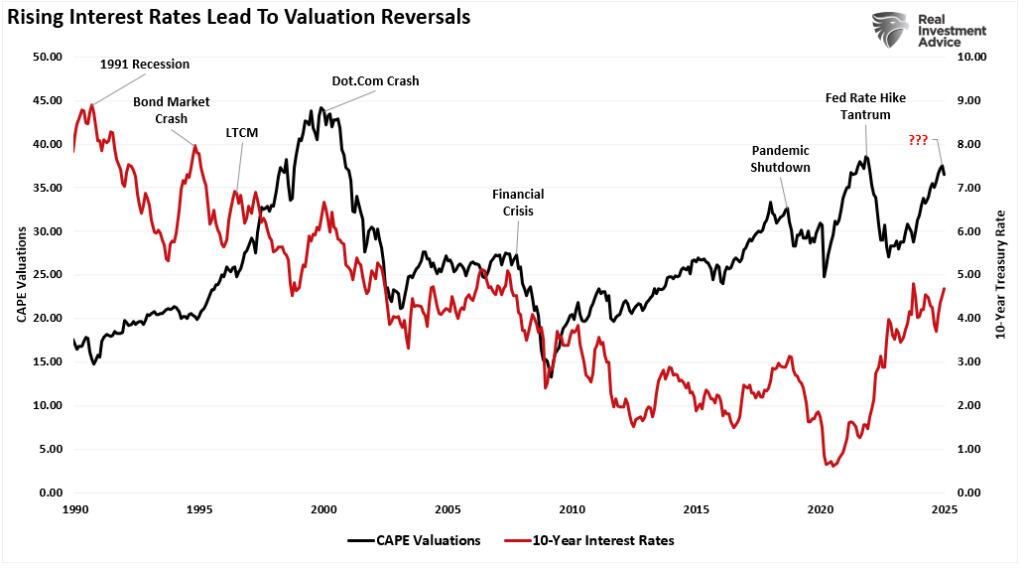
Over the past few weeks, two entirely “sentiment-driven“ things have plagued the markets: concerns that “tariffs” could lead to inflationary pressures and valuations. The concern over tariffs has created a feedback loop in the economy. Since the election, producers have been buying products to get ahead of tariffs, which increased demand for those products, pushing prices higher, as seen in recent ISM reports. In other words, the fear of tariffs creating inflation caused inflation by their actions. However, as discussed in this article, tariffs haven’t caused inflation historically.

That “sentiment shift” on inflationary pressures has caused bond yields to rise as hedge funds and portfolio managers shift positioning rather than reflecting underlying fundamentals. As Michael Lebowitz noted this week:

We created a relatively simple but highly effective proprietary fundamental yield model based on inflation and economic growth. Our bond yield model only uses two inputs.

  1. Inflation—The Cleveland Fed Inflation Expectations Model. This model is unique as it uses actual inflation data and market—and survey-based measures of inflation expectations. The combination of actual and expected price changes provides a complete inflation picture.
  2. Economic activity– Real GDP. Real GDP strips out inflation to estimate economic activity without the impact of price changes.

We then ran a multiple regression analysis of the two inputs with yields. Doing so created a significant correlation with an r-squared of .9702.The line graph comparing the expected model yield to actual yields shows that the model yield is 3.78% versus the actual yield of 4.57%. The difference of .79% is the term premium. 

In other words, the recent yield run has little to do with the economic fundamentals and more with sentiment. Therefore, as the economic fundamentals take hold and inflation continues to decline towards the Fed’s target of 2%, the excess premium will eventually be reversed from the market. As Michael concludes:

“So why are bond yields rising? During the fourth quarter, the ten-year UST yield rose by 62 basis points. 52 basis points were due to the rising term premium, leaving only 10 basis points as the result of economic activity and inflation. The two culprits behind the jump in the term premium were the fear of deficits and inflation. Even with no change to the fundamental factors, a sizeable return can be had in longer-term bonds if the premium diminishes. Furthermore, those returns could be supercharged if a recession, economic weakness, and/or a return to 2% or less inflation occurs.

Bond investors will most likely be rewarded handsomely when economic fundamentals normalize and the term premium fades. Until then, sentiment, not economic data, is the key factor impacting rates.”

Secondly, valuations are becoming more of a concern for markets, particularly as the equity risk premium declines. Equity risk premiums (ERP) are also driven by sentiment. As investors expect increased asset prices, they are willing to be “paid less” for the “risk” they are taking to own equities. However, with bond yields now significantly above the ERP, there is an increasing probability that investors, at some point, may opt for being “paid” by owning bonds.

The stock and bond markets are currently detached from the underlying fundamentals. If, or rather when, a reversion takes hold, the decline in equity risk will be offset by the rise in bond prices as yields realign with economic fundamentals. This has been the case, particularly when rates rise significantly into an overvalued market.

There is little reason to expect this time to be any different.

Tyler Durden
Sun, 01/12/2025 – 10:30

Palisades Fire Threatens New Upscale Communities As Santa Ana Winds Return

0
Palisades Fire Threatens New Upscale Communities As Santa Ana Winds Return

The Los Angeles Fire Department continued battling four major blazes that have burned over 38,000 acres and destroyed over 10,000 structures. Another round of Santa Ana winds is expected from Monday through Wednesday, elevating fears that the fires will continue to spread. The Palisades Fire has placed Brentwood, Encino, Bel Air, Sherman Oaks, and West Los Angeles at severe risk. Additionally, Malibu has lost a third of its eastern edge to the Palisades Fire.

Here’s the latest size and containment of the four major fires:

  • Palisades Fire: 23,654 acres burned, 11% contained
  • Eaton Fire: 14,117 acres burned, 15% contained
  • Kenneth Fire: 1,052 acres burned, 90% contained
  • Hurst Fire: 799 acres burned, 76% contained

Fire Map (courtesy of LA Times):  

On Saturday, the Palisades Fire threatened the communities of Brentwood, Encino, Bel Air, Sherman Oaks, and West Los Angeles as the inferno continued to spread. Very tense moments unfolded as the LAFD battled out-of-control flames that almost crossed the 405 freeway into parts of Bel Air.

Today will be another challenging day for LAFD personnel. Strong Santa Ana winds are expected to return to Los Angeles and Ventura counties later this evening through the first half of the new week. 

The National Weather Service issued a red flag warning for the area, with wind gusts expected between 50 and 75 mph.

“The very dry vegetation combined with the prolonged extreme fire weather conditions will support rapid spread and erratic behavior of any new or existing fires,” NWS wrote in the warning.

The latest headlines from NBC Los Angeles:

  • Almost 35,000 still without power in LA County

  • Firefighters fend off Palisades Fire’s threat to Mandeville Canyon, Encino

  • Malibu has lost about 1/3 of its eastern edge, mayor says

  • 2 arrested for curfew violations near Brentwood home of Vice President Harris

  • Death toll in Southern California wildfires climbs to 16

Latest Zero Hedge headlines:

Early Sunday morning, on Truth Social, President-elect Trump criticized woke Californian politicians, calling them “incompetent” and claiming they “have no idea how to put” the fires out. 

“Thousands of magnificent houses are gone, and many more will soon be lost. There is death all over the place. This is one of the worst catastrophes in the history of our Country. They just can’t put out the fires. What’s wrong with them?” Trump said. 

Days ago, Elon Musk wrote on X the massive loss of mansions across LA has primarily been a failure of California Gov. Gavin Newsom and LA Mayor Karen Bass…

Newsom, a far-left radical, was Community Noted on X. 

Meanwhile, Mayor Bass is a Marxist. 

And the people in power in LA are far-left social justice warriors who made important decisions about governing through an “equity lens.” 

“What attracted me most to the role was social equity. It’s important for me that everything we do is with an equity lens and social justice and writing the wrongs that we’ve done in the past,” Janisse Quiñones, the head of the Los Angeles Department of Water and Power, recently stated on a local radio station. 

There will be a major investigation into why the massive reservoir in Pacific Palisades was not filled, knowing about dry conditions, high winds, and elevated fire risk. Plus, Mayor Bass slashed the budget for the LAFD. 

Meanwhile, Sen. Ed Markey, D-Mass, used the typical Democratic Party playbook to deflect from the incompetence (DEI = DIE) of California politicians, using talking points that described California wildfires as “what a climate emergency looks like.”

Markey should be called “Malarkey Markey”… 

About man-made climate change.

“Incompetence in the limit is indistinguishable from sabotage,” Musk wrote on X on Saturday. 

This time, Democrats won’t be able to hide behind climate change farce. Real accountability is coming. People died, thousands lost everything, and even liberals in LA are turning on their far-left politicians who were never actual real competent managers, to begin with, just social justice warriors with ‘equity’ Marxism pom-poms. Remember, Marxists hate capitalism. 

Tyler Durden
Sun, 01/12/2025 – 09:55

Trump Energizes Greenland Independence Movement, Divorce Agreement Coming Up

0
Trump Energizes Greenland Independence Movement, Divorce Agreement Coming Up

Authored by Mike Shedlock via MishTalk.com,

Greenland is making moves towards independence. A two-year commission underway.

Independence Movement Picks Up Steam

The Wall Street Journal reports Trump’s Talk of Buying Greenland Energizes Island’s Independence Movement

Greenland is a self-ruling part of the Kingdom of Denmark. The Danish government says it is willing to grant Greenland full independence if there is local support, and recent Greenlandic elections and polls indicate there is.

Trump’s recent threat of a trade war with Denmark is changing the negotiating dynamic, says Ulrik Pram Gad, a senior researcher at the Danish Institute for International Studies. The Danish government now might be more open to agreeing a divorce deal that includes some continued payments to ease Greenland’s path to independence, he says. “My prognosis is that the Danish government will accept it in the next few years,” he says. An independent Greenland would then be free to forge its own security or economic ties with the U.S., Denmark or anyone else.

In April, Greenland goes to the polls in a vote that could fire the starter gun on independence for the territory of 57,000 people. The last time elections were held, pro-independence parties got 80% of the vote.

The prime minister of Greenland made a New Year’s address to the nation saying that a draft constitution for the country has been prepared and that the independence process should be triggered.

“It is now time to take the next step for our country,” Múte Egede said. “Like other countries in the world, we must work to remove the obstacles to cooperation—which we can describe as the shackles of the colonial era—and move on.” 

A 2009 Danish law lays out how Greenland can take the first step in the process: It must notify the Danish government, the two must negotiate a divorce agreement and the deal must then be ratified by a referendum in Greenland. The Greenlandic government has commissioned legal experts to work out the details of how step one would work with a two- year deadline.

Pro-independence campaigners in Greenland would like to adopt a “free association” model, similar to the relationship between the Marshall Islands and the U.S. or the Cook Islands and New Zealand. 

Some of Trump’s advisers have privately acknowledged a sale of Greenland is unlikely, but an expansion of U.S. military and financial presence on the island is a possibility. A poll in 2021 showed that 69% of Greenlanders favored more cooperation with the U.S., compared with 39% who favored tighter cooperation with China.

Trump’s Offer to Buy Greenland

Some people thought I was crazy when I posted Trump’s Offer to Buy Greenland Is Not as Preposterous as it Sounds

A free association model may be more likely, but don’t rule out an outright purchase.

There are only about 59,000 Greenland citizens. I proposed an offer of $2 million each. That would only be $118 billion.

Greenland would be cheap at double the price if I am correct about the mineral deposits.

Critical Materials Risk Assessment

Our Department of Energy has placed some of the rare earth minerals we need for weapons systems, wind turbines, batteries, semiconductors, cell phones, and aircraft on a critical materials list.

Nearly all of them are mined or refined in China.

Please consider a Critical Materials Risk Assessment by the US Department of Energy

If Trump increases tariffs on China by 60 percent, China could easily shut down rare earth exports. I have been warning about this for years

China controls more than 80% of the world’s supply of tungsten and about 90% of global magnesium production

China has an effective monopoly over processing major heavy rare earths – Dysprosium (Dy) and Terbium (Tb), and Light Rare Earths – Neodymium (Nd) and Praseodymium (Pr).  

China Halts Rare Earth Exports

On December 3, I commented China Halts Rare Exports Used by US Technology Companies and the Military

This is China’s advance salvo at Trump tariffs. It comes one day after the Biden administration expanded curbs on the sale of advanced American technology to China.

The US gets rare earths from allies who get them from China. But don’t rule out the possibility that China shuts off all access.

Tyler Durden
Sun, 01/12/2025 – 09:20

Bulgaria And Romania Join The Schengen Area

0
Bulgaria And Romania Join The Schengen Area

On January 1, 2025, Bulgaria and Romania became full members of the Schengen area of free movement, after a thirteen-year-long wait.

While controls have been lifted at airports and seaports since March 2024, these have now been removed at land borders too. The accession was finally made after Austria dropped its veto last December, which until then had opposed the entry of the two countries to the passport free area. Temporary controls will continue to operate at their land borders for the next six months, while the border between Bulgaria and Turkey is set to be reinforced.

Even as the Schengen Area has expanded, temporary controls have been reintroduced along several internal borders.

For example, Germany currently has such controls along the border with each of its nine neighboring countries.

As Statista’s Anna Fleck reports, according to the European Commission, members of the Schengen agreement are allowed to temporarily introduce border controls at internal borders in the event of a serious threat to public policy or internal security and must be applied as a last resort measure or in exceptional situations, for a limited time period only. There are a number of issues cited for the need for the temporary border crossings currently in place, including security, migration control, public safety and, in the case of Denmark, Russian attempts of espionage.

The introduction of border checks has sparked backlash from groups such as the student organization AEGEE, which says that reintroducing controls could foster suspicion between states and lead to discrimination, as certain groups could face heightened scrutiny based on nationality or ethnicity.

Infographic: Bulgaria and Romania Join the Schengen Area | Statista

You will find more infographics at Statista

The Schengen area was created in 1995, after five states (France, Germany, the Netherlands, Belgium and Luxembourg) signed the Schengen Agreement in 1985, followed by the Schengen Convention in 1990.

The Schengen area is an area of free movement of people, which also guarantees its member states enhanced protection at external borders.

The majority of EU Member States have gradually joined the Schengen area, which now includes 25 of the 27 EU Member States (Ireland and Cyprus are not currently members), as well as four non-EU Member States: Iceland (joined in 1999), Norway (1999), Switzerland (2008) and Liechtenstein (2011).

Tyler Durden
Sun, 01/12/2025 – 08:45

The Walls Close In On Zelensky

0
The Walls Close In On Zelensky

Authored by James Rickards via DailyReckoning.com,

The walls are closing in on Ukraine’s President Zelensky.

In a meeting with allies in Germany this week, the embattled leader requested NATO troops on the ground in Ukraine.

“Our goal is to find as many instruments as possible to force Russia into peace. I believe that such deployment of partners’ contingents is one of the best instruments. Let’s be more practical in making it possible.”

Nothing about this proposal is “practical”. Even if Zelensky is speaking about peacekeeping troops as part of a settlement, which isn’t clear, it’s still a fundamentally crazy idea. Simply put, it would bring us to the brink of nuclear war.

Of course, this isn’t the first time Zelensky has suggested that NATO should send troops to fight and die in this war. But this latest instance is noteworthy because it comes just ahead of President Trump’s inauguration.

Given the circumstances, the move signals desperation.

Trump Stands Firm

President Trump has stood his ground on this issue thus far.

Just this week he acknowledged that NATO’s courtship of Ukraine was a major cause of the war, noting that if Ukraine were to join the Western military alliance, “then Russia has somebody right on their doorstep, and I could understand their feelings about that.”

Trump correctly blames Biden for promising Ukraine NATO membership and escalating the war.

In early December, Trump’s team conveyed the message that Ukraine would need to make major concessions to end the war. Those concessions will probably involve giving up land already captured by Russia, agreeing to a form of disarmament, and pledging to never join NATO.

This was an important shift, as it became clear even to the biggest hawks that Ukraine wasn’t going to recapture much, if any lost territory. And forget about Crimea.

Trump’s views on Ukraine are certainly unique in Washington D.C., But his base is ready for the war to end, and this issue was one of the keys to his landslide victory.

Meanwhile, it’s unclear whether Zelensky and the Ukrainian deep state would agree to such concessions. It’s also unclear whether they truly have a say in the matter, unless they’re prepared to go it alone against Russia.

But it’s also not clear if Russia would agree to such a deal. Putin could insist upon an end to sanctions on Russia, and a return of their frozen assets.

There’s also a chance that Russia won’t want to give Ukraine a break to re-arm itself. NATO has already pulled a fast one on Russia once, during the Minsk accords from 2014-2021. Former German Chancellor Angela Merkel has admitted this peace deal was in actuality a stall tactic to give Ukraine more time to build its military capabilities.

So President Putin may want to press the attack, eliminate Ukraine’s military capabilities, and gain more territory. Russia is advancing along almost the entire frontline. Its use of hypersonic missiles, artillery, drones, and guided glide bombs has devastated Ukrainian strongholds.

Ukrainian forces have been forced to fall back into far less favorable defensive positions, and this does not bode well for their outlook.

True Costs

The waste of life in this conflict is exponentially larger than the public has been told. In December of 2024, President Zelensky claimed that only 43,000 of his nation’s troops had been killed in the war so far.

In truth, upwards of 600,000 Ukrainian soldiers have likely died. On paper, the Ukrainian army is over one million strong. But across the line, foxholes are empty. Where are all the soldiers?

Russia has likely lost at least 100,000 soldiers KIA as well, though they haven’t released any specific numbers.

When the truth about this war comes out, it will shock anyone who is still paying attention at that point.

Make no mistake. Trump has his work cut out for him. But he is the only person in the world today who stands a chance at ending this war.

I believe he’ll get it done. But the cost in terms of geopolitical capital may be high.

Tyler Durden
Sun, 01/12/2025 – 08:10