70.9 F
Chicago
Thursday, October 8, 2026
Home Blog Page 1994

Futures Flat As Markets Wind Down For 2024

0
Futures Flat As Markets Wind Down For 2024

US equity futures entered the last week of 2024 gingerly and steady in subdued trading as traders, already on the ski slopes or in various warm, non-extradition countries, assessed the outlook for economic growth and interest rates. The dollar gained after a US government shutdown was averted in the last minute. As of 8:10am, contracts on the Nasdaq 100 added 0.4% and those on the S&P 500 were little changed, erasing an earlier gain, following a sharp rebound on Friday after the core PCE index increased at the slowest pace since May. Europe’s stock benchmark edged higher. Market gains will likely be capped by the continued rise in rates which has seen 10Y yields rise 2bps to 4.55%. Oil, gold and bitcoin all dropped while a Bloomberg gauge of the dollar rose after sliding 0.5% on Friday. Today’s macro data include the Chicago Fed, Durable Goods, New Home Sales and the Conference Board Consumer Confidence.

In premarket trading, Qualcomm rose 2% as the company prevailed at trial against Arm Holdings Plc’s claim that it breached a license for chip technology that the world’s largest maker of mobile-phone processors acquired when it bought a startup in 2021. Arm slips 3%. Applied Therapeutics fell 3% after William Blair stepped away from its bullish rating due to increased uncertainty around the future of the Govorestat drug and a limited cash runway. Here are some other notable premarket movers:

  • Despegar.com (DESP), a Latin American online travel agency, jumps 31% after Prosus entered into a definitive agreement to acquire the booking site.
  • Playa Hotels & Resorts (PLYA) rises 11% after executing an exclusivity agreement with Hyatt Hotels Corp. (H) where Playa agrees to negotiate exclusively with Hyatt regarding potential strategic alternatives.
  • Rumble (RUM) jumps 43% after the video-sharing platform said Tether is set to acquire a stake in the company for $7.50/share.
  • Rigetti Computing and other stocks linked to quantum computing rise on optimism over Alphabet’s Willow chip capabilities. Rigetti (RGTI) +13%, D-Wave Quantum (QBTS) +18%
  • Xerox (XRX) rises 2% after agreeing to buy the laser printer maker Lexmark International Inc. from a consortium of Asian investors in a deal valued at $1.5 billion.

As we close out the year, investors are taking a step back after a stream of robust US economic data saw the Federal Reserve scale back the number of cuts it anticipates in 2025. The PCE data reignited hopes of deeper rate cuts, though overall sentiment remains cautious as investors brace for the prospect of sweeping global tariffs imposed by US President-elect Donald Trump, and as China continues to see a lackluster economic recovery.

“Friday’s PCE data was enough to cheer the mood and reignite hopes about the possibility of lower inflation next year, which would allow the Fed to cut rates faster,” said Daniela Hathorn, a senior market analyst at Capital.com. “The avoidance of a US government shutdown over the weekend has also helped ease some of the negative pressure on stocks.”

“There are still hopes that the US stock markets in particular will end 2024 with a positive undertone,” Dana Malas, a strategist at SEB, wrote in a note. “After two explosive weeks of central banking and news, to say the least, it is time for the market to recharge batteries and update forecast models for the world that begins on January 20 with Donald Trump in the White House.”

Europe’s Stoxx 600 index turned higher as drugmaker Novo Nordisk A/S staged a partial recovery from the biggest slump in more than two decades on Friday. Among other individual movers, Evolution AB plunged after the UK Gambling Commission began a review of its Malta operations. Direct Line Insurance Group Plc shares rose after Aviva Plc agreed to buy the insurer in a deal valuing the firm at around £3.7 billion ($4.7 billion). Here are some of the biggest movers on Monday:

  • Novo Nordisk shares rise as much as 10%, clawing back some of Friday’s 21% plunge, after the Danish drugmaker’s experimental obesity shot CagriSema failed to meet its own bar for success.
  • Direct Line shares rise as much as 3.6% after Aviva agrees to buy the UK insurer in a £3.7 billion ($4.65 billion) deal.
  • European Defense shares rise after the Financial Times reported that Donald Trump will demand NATO members increase their defense spending to 5% of their respective GDP, citing people familiar.
  • VusionGroup shares rise as much as 14% as the maker of digital shelf labels extends a contract with Walmart to cover the retailer’s 4,600 US stores.
  • SBB shares rise as much as 14% after the Swedish landlord said the outcome of its tender and exchange offers had significantly reduced risks in regard to the ongoing litigation in the English High Court.
  • Volkswagen shares fall as much as 2.3%, as analysts at Jefferies and Bernstein say the German firm’s agreement with labor unions to cut capacity significantly misses the carmaker’s original goals.
  • Fagron falls as much as 16%, the most in almost nine years, after the Belgian supplier of raw ingredients to the pharmaceutical industry said it received an FDA warning letter for its Wichita site, following an inspection.
  • Evolution shares slide as much as 12% after the gaming firm says the UK Gambling Commission has started a review of Evolution Malta Holding Limited’s operating license.
  • Enagas slips as much as 4.1% after the World Bank’s International Centre for Settlement of Investment Disputes made a ruling over a dispute with Peru over the Gasoducto Sur Peruano concession.

Earlier in the session, Asian stocks rose, rebounding from last week’s selloff, as tech shares rallied after US inflation data supported the case of further interest-rate cuts by the Federal Reserve next year. The MSCI Asia Pacific Index advanced as much as 1.4%, poised for its first gain in seven sessions, with TSMC and Toyota Motor among the biggest contributors to the benchmark’s move. Taiwanese stocks led gains in the region, after AI powerhouse Nvidia Corp.’s Friday rally and local media reports boosted investor sentiment. A below-than-expected reading on the Fed’s preferred inflation gauge helped cool investor concerns after the central bank’s relatively hawkish stance at its meeting last week. Still, expectations of further trade tariffs by Donald Trump and thin liquidity heading into the holiday season have kept a lid on overall sentiment.

In FX, a Bloomberg gauge of the dollar rose after sliding 0.5% on Friday, and Treasury yields ticked higher. President Joe Biden signed funding legislation to keep the US government operating until mid-March, avoiding a year-end shutdown and kicking future spending decisions into Trump’s presidency.

In rates, treasuries are slightly cheaper across the curve, following wider losses seen across core European bonds over early London session after ECB President Christine Lagarde said in an FT podcast that policymakers remain alert to lingering price pressures in the services sector. Treasury yields cheaper by around 0.5bp to 1.5bp across the curve with spreads broadly within one basis point of Friday’s close. US 10-year yields trade around 4.55% with bunds and gilts lagging by 0.5bp and 1bp in the sector. US session focus includes start of this week’s auctions which kick-off with 2-year note sale Monday, followed by 5- and 7-year notes Tuesday and Thursday. Busy data slate also includes durable goods orders and consumer confidence.

US economic data calendar includes November building permits, Chicago Fed national activity, durable goods orders (8:30am), November new home sales and December consumer confidence (10am). No Fed members are scheduled to speak on the day

Market Snapshot

  • S&P 500 futures up 0.3% to 6,020.00
  • STOXX Europe 600 up 0.3% to 503.51
  • MXAP up 1.2% to 181.37
  • MXAPJ up 1.3% to 573.37
  • Nikkei up 1.2% to 39,161.34
  • Topix up 0.9% to 2,726.74
  • Hang Seng Index up 0.8% to 19,883.13
  • Shanghai Composite down 0.5% to 3,351.26
  • Sensex up 0.6% to 78,511.21
  • Australia S&P/ASX 200 up 1.7% to 8,201.58
  • Kospi up 1.6% to 2,442.01
  • German 10Y yield up 3.5 bps at 2.32%
  • Euro down 0.1% to $1.0415
  • Brent Futures up 0.5% to $73.27/bbl
  • Brent Futures up 0.5% to $73.27/bbl
  • Gold spot up 0.2% to $2,629.43
  • US Dollar Index up 0.27% to 107.91

Top Overnight News

  • US Trade Representative Office has launched a new investigation into Chinese-made legacy chips, may lead to more tariffs.
  • US President-elect Trump has selected David Fink to serve as the Administrator of the Federal Railroad Administration: Reuters.
  • Brian McCormack, a long-time energy consultant, and Andrew Peek, a seasoned Middle East adviser, will take senior roles on Trump’s National Security Council: CBS
  • US government has enacted a budget to avert a shutdown, but the deal does not include President-elect Donald Trump’s proposal to raise the federal borrowing limit: BBC.
  • US jury has found that Qualcomm (QCOM) did not breach Nuvia’s license agreement with Arm (ARM) and determined that Qualcomm’s custom CPUs are licensed under its agreement with Arm: Reuters.
  • Japan’s antitrust watchdog is set to conclude that Google (GOOG) violated the law in a search-related case: Nikkei.

A more detailed look at global markets courtesy of Newsquawk

APAC stocks opened firmer across the board on a holiday-thinned week, following a similar performance from Wall Street on Friday, with broad risk-on sentiment through the US afternoon, albeit with indices closing off peaks. ASX 200 saw its gains supported by gold miners following the rebound of the yellow metal, with IT also among the top performers after a similar stateside sectoral performance on Friday. Nikkei 225 conformed to the broader risk tone amid a lack of macro drivers, whilst a stable JPY also boded well for the Nikkei. Hang Seng and Shanghai Comp traded firmer alongside the region as sentiment from Wall Street reverberated through APAC. However, macro news flow remained quiet, and the indices drifted off their best levels.

Top Asian News

  • NIO (NIO, 9866 HK) CEO William Li stated that the company will accelerate the construction of battery swapping stations in Europe, with costs for those designed for Firefly EVs reduced by a third compared to stations for NIO-branded cars, according to Reuters.
  • Nippon Steel (5401 JT) and US Steel (X) have alleged that the White House exerted impermissible influence over the CFIUS review of their proposed tie-up, a claim the White House denies. The companies have vowed to challenge the expected block of the deal, according to Reuters, citing a letter.
  • Nvidia (NVDA) reportedly plans to build an offshore headquarters in Taipei, Taiwan, according to CTEE.

European bourses are generally sitting in negative territory, despite a mostly positive handover from overnight APAC trade. In recent trade, a couple of indices are attempting to climb into the green. European sectors opened with a strong negative bias, but are now mixed. Healthcare is by far the clear outperformer today, as Novo Nordisk (+6%) attempts to pare some of the hefty losses seen on Friday. Autos sits towards the lower half of the pile, but with downside in the sector pretty much in-fitting with peers. Volkswagen (-1%) initially opened higher after traders digested news that VW reached a deal with IG Metall to cut 35k jobs and avert a strike; though, did slip into negative territory thereafter. US equity futures are modestly firmer, with slight outperformance in the NQ, in a continuation of the gains seen on Wall St in the last trading day. Honda (7267 JT) and Nissan (7201 JT) announce the signing of the basic agreement to consider integration; Cos and Mitsubishi Motors (7211 JT) sign an MOU on collaborative considerations. Intend to set up the holding Co. in August 2026

Top European News

  • ECB’s Lagarde said still believe that ECB should be very vigilant about service; getting very close to that stage when ECB can declare that we have sustainably brought inflation to our medium-term 2% target, via FT; coming close to the end of that process where wages have caught up with price.
  • ECB’s Makhlouf said the outlook for next year was probably clouded by “more uncertainty than there was when we went into lockdown; and argued against calls for the ECB to start cutting rates by 50bps at a time in early 2025, via FT. He said his preference was still “for gradual moves rather than big leaps”, unless “the facts and the evidence” suggest otherwise.
  • BoE Governor Bailey and FCA CEO Nikhil Rathi will reportedly join UK Chancellor Reeves as part of Britain’s delegation to China next month, according to Sky News.
  • Hungarian PM Orban stated that when the dollar strengthens, the forint automatically weakens, adding that the current weakening of the forint is not driven by Hungary’s economic fundamentals, according to Reuters.

FX

  • DXY is slightly firmer and currently trades towards the upper end of a 107.68-108.01 range, just eclipsing the round 108.00 mark, but still someway off Friday’s best at 108.54. Docket ahead includes, US Consumer Confidence & Durable Goods.
  • EUR is incrementally softer vs the Dollar and also losing vs the GBP; EUR/USD currently holds towards the upper end of Friday’s 1.0342-1.04471 range. German Import Prices printed above expectations, metrics which ultimately sparked little move in the Single-Currency.
  • JPY is incrementally lower, with USD/JPY sitting within a very tight 156.33-80 range, given the holiday-thinned conditions. If some pressure appears in the pair, could see a test of Friday’s low at 155.94.
  • Cable is flat and currently trades within a 1.2554-1.2588, a little short of the 1.26 mark at best. Further upside could see a test of Friday’s peak at 1.2613 and then its 21 DMA at 1.2659 thereafter. From a macro perspective, the UK posted its Q3 GDP metrics, which saw the YY and QQ both revised a touch lower, with the QQ figure showing no growth within the period. Figures which had little impact on the Pound.
  • Antipodeans are very modestly in positive territory, with modest outperformance in Aussie. The Aussie holds towards the upper end of Friday’s 0.6214-0.6274 range; NZD is also a little firmer, and holds around 0.5660.
  • PBoC set USD/CNY mid-point at 7.1870 vs exp. 7.2880 (prev. 7.1901)

Fixed Income

  • USTs are contained in narrow ranges with catalysts light so far. A very slight bearish-bias in play as the US risk tone is robust following the nation avoiding a gov’t. shutdown. As it stands, in a narrow 108-27+ to 109-00+ band which is entirely within Friday’s 108-19+ to 109-08+ parameters, ahead of US Consumer Confidence and Durable Goods.
  • Bunds came under modest pressure early doors and remains the fixed income underperformer. Pressure which occurred in limited trade with volumes very light and as such is perhaps not worth reading extensively into, though a better than expected set of import data likely influenced. Spent the morning at the low-end of a 133.72 to 134.06 band, dipping below Friday’s base and matching last week’s trough; however, in recent trade the benchmark has trimmed some downside.
  • Gilts opened lower by 21 ticks before extending to a 92.48 base. Pressure which came given the lead from peers and despite downward revisions to UK Q3 GDP and very bleak CBI commentary from its latest indicator. 92.48 base remains comfortably above Friday’s 92.18 low and the contract trough from Thursday thereafter at 91.87.

Commodities

  • WTI & Brent were firmer, taking impetus from the APAC/US risk tone; however, they have succumbed to some recent selling pressure to trade around flat currently. Brent Feb’25 briefly dipped below USD 73/bbl, currently pivoting the mark.
  • Gold is marginally firmer, benefitting from the tepid European risk tone though with any real advance prohibited by the indications from US futures. At a USD 2633/oz peak, resistance comes into play at USD 2643/oz where the 21-DMA resides and coincides with the peak from last Wednesday.
  • Dutch TTF was around flat, but caught a slight bid after Russia’s Kremlin said the situation with European countries that get Russian gas is complicated and needs further attention (somewhat in contrast to weekend comments where Fico said Russia confirmed a readiness).
  • US NatGas outperforms on commentary from Qatar.
  • 3M LME is firmer, continuing action from APAC trade which saw modest gains for the complex in-fitting with the broader risk tone. However, 3M LME Copper is still yet to comfortably/lastingly eclipse the USD 9k handle.
  • Qatar has warned that it will “stop” gas sales to the EU if fined under the due diligence law, according to the Financial Times.
  • Slovak PM Fico noted that Russian President Putin confirmed Russia’s readiness to continue supplying gas to the West and Slovakia, according to Reuters.
  • Libya’s Acacus Oil Company has achieved oil production of 301.5k BPD, while the Sirte Oil Company has reached 103k BPD over the past two days, its highest output since 2007, according to the NOC spokesman.
  • Oil transit through Russia’s Druzhba pipeline resumed on Saturday, according to Belarus’ BelTa state news agency. Earlier, Reuters reported that oil flows from Russia and Kazakhstan to Hungary, Slovakia, the Czech Republic, and Germany via the Druzhba pipeline had been halted since Thursday due to technical issues at a Russian pumping station.
  • Russia’s Kremlin says Putin discussed gas, Ukraine and bilateral ties with Slovakia’s Fico; situation with European countries that get Russian gas is complicated and needs further attention.

Geopolitics

  • Iranian Foreign Ministry says the nuclear deal will be discussed with Europe in January.
  • “Israel plans to launch an attack on Yemen”, according to Sky News Arabia.
  • “Israel is considering helping the Kurds in Syria in a non-military way”, according to Sky News Arabia; “Israel is concerned about Turkey’s intention to launch a large-scale military operation against the Kurds in northern Syria”.
  • US military announced that it carried out airstrikes targeting Iran-backed Houthi missile storage and command/control facilities in Yemen, according to Reuters. US military stated that it conducted precision airstrikes targeting a missile storage facility and a command-and-control facility operated by Iran-backed Houthis in Sanaa, according to Reuters.
  • Yemeni Houthis have confirmed targeting central Israel with a ballistic missile, according to Reuters
  • China is considering allowing seafood imports from Japan and may lift the ban as early as the first half of 2025, according to Nikkei.
  • China condemned the latest US military aid to Taiwan on Sunday, stating that the USD 571mln package violates the “one China principle” and the terms of the joint communique between China and the US, according to Reuters.
  • China’s Defence Ministry on Saturday expressed its dissatisfaction over a US report released this week on China’s military, which it said distorted its defence policy and “grossly interferes” in its internal affairs, according to Reuters.
  • Chinese Foreign Ministry announced that China will take countermeasures against two Canadian institutions and 20 personnel, specifically targeting Canada’s Uyghur Rights Advocacy Project and the Canada-Tibet Committee, according to the ministry.

US Event Calendar

  • 08:30: Nov. Durable Goods Orders, est. -0.3%, prior 0.3%
  • 08:30: Nov. Durables-Less Transportation, est. 0.3%, prior 0.2%
  • 08:30: Nov. Cap Goods Orders Nondef Ex Air, est. 0.1%, prior -0.2%
  • 08:30: Nov. Cap Goods Ship Nondef Ex Air, est. 0.2%, prior 0.3%
  • 08:30: Nov. Chicago Fed Nat Activity Index, est. -0.15, prior -0.40
  • 10:00: Nov. New Home Sales MoM, est. 9.8%, prior -17.3%
    • Nov. New Home Sales, est. 670,000, prior 610,000
  • 10:00: Dec. Conf. Board Consumer Confidence, est. 113.0, prior 111.7
    • Dec. Conf. Board Present Situation, prior 140.9
    • Dec. Conf. Board Expectations, prior 92.3

Tyler Durden
Mon, 12/23/2024 – 08:31

Migrant Suspect Arrested After Allegedly Setting Woman On Fire In NYC Subway Car

0
Migrant Suspect Arrested After Allegedly Setting Woman On Fire In NYC Subway Car

A Guatemalan migrant has been arrested for allegedly lighting a woman on fire while she was asleep in a subway car in Brooklyn.

The victim burned to her death while the suspect allegedly sat on a bench “calmly” watching the fire consume her body. 

The New York Post reports the disturbing crime was one of the most savage to take an innocent life in the city of New York.

As AP reports, Transit police apprehended the suspect after receiving a report from three high school students who had recognized the man.

They had seen images of the suspect taken from surveillance and police body cam video and widely distributed by police.

“New Yorkers came through again,” said New York City Police Commissioner Jessica Tisch, who described the case as “one of the most depraved crimes one person could possibly commit against another human being.”

After the train came to a stop, surveillance video from the subway car showed the man “calmly” walk up to the victim, who was seated motionless, possibly sleeping, and set her clothing on fire with what appeared to be a lighter.

The woman’s clothing then “became fully engulfed in a matter of seconds,” Tisch said.

Unbeknownst to the officers, the suspect had remained at the scene and was seated on a bench on the subway platform, just outside the train car, Tisch said.

Body cameras worn by the officers caught a “very clear, detailed look” at the suspect and those images were publicly disseminated.

Officials said the 33-year-old suspect came to the US in 2018 from Guatemala.

He was detained by border patrol agents in Arizona in June of that year, sources said. His legal status wasn’t immediately clear Sunday night.

He received a transit summons in May 2023, but his criminal record in New York City was largely clean otherwise, sources said. He was living at a shelter on Randall’s Island at the time of the infraction.

The police reportedly do not believe the migrant and the victim he burned to death knew each other before the disturbing killing. The woman had not yet been identified as of Sunday night.

Tyler Durden
Mon, 12/23/2024 – 08:30

Drone Operators Leery Over New Rules Proposed After Nationwide Aerial Sightings

0
Drone Operators Leery Over New Rules Proposed After Nationwide Aerial Sightings

Authored by Allan Stein via The Epoch Times (emphasis ours),

As the owner of Rekt Drones in Mesa, Arizona, Pete Phimphavong has seen many ups and downs in the seven years that he has been selling, servicing, and test-flying both commercial and recreational drones.

Pete Phimphavong, owner of Rekt Drones in Mesa, Ariz., displays a popular racing drone in his store on Dec. 18, 2024. Allan Stein/The Epoch Times

“There’s been a lot of things going on” with the industry lately, Phimphavong said. “Especially with this holiday season.”

“Not only with the drone scare but with the upcoming possibility of tariffs,” he said.

Phimphavong was alluding to President-elect Donald Trump’s threat of 100-percent import tariffs on any country that wants to replace the U.S. dollar—China, in particular.

He said that adding tariffs would make his products more expensive and hurt his business.

Phimphavong is still unsure of how to interpret the most recent reports of unidentified drone sightings across the nation, mainly in New York and New Jersey.

“These things that are up there for five hours—who knows what they are,” he said.

The Federal Aviation Administration (FAA) recently announced a no-fly zone over certain parts of New Jersey as a precautionary measure.

On Dec. 16, the FAA, FBI, and Departments of Homeland Security and Defense released a joint statement regarding the ongoing response to some 5,000 reports of drone sightings and 100 leads developed.

According to the statement, thousands of commercial, recreational, and law enforcement drones are in the sky on any given day, and more than a million drones are legally registered with the FAA in the United States.

As of Dec. 2, the FAA said that there were 403,358 commercial drone registrations, 387,355 recreational drone registrations, and 423,047 certified remote pilots.

After examining the technical data and tips from eyewitnesses, the federal agencies say that the sightings so far include a combination of lawful commercial drones, hobbyist drones, law enforcement drones, manned fixed-wing aircraft, helicopters, and stars that were mistaken for drones.

“We have not identified anything anomalous and do not assess the activity to date to present a national security or public safety risk over the civilian airspace in New Jersey or other states in the northeast,” the joint statement said.

A small number of drone sightings over military installations in New Jersey and other locations, including restricted air space, have also been reported.

The statement added that sightings like this over or close to Department of Defense (DOD) installations are not unusual.

“DOD takes unauthorized access over its airspace seriously and coordinates closely with federal, state, and local law enforcement authorities, as appropriate,” the agencies said.

“Local commanders are actively engaged to ensure there are appropriate detection and mitigation measures in place.”

Organizations that represent private drone operators say they’re watching the situation with caution.

“Like many others in the industry, we are closely monitoring the ongoing events and proposed legislation regarding drone sightings, and we share in the concern about the lack of clarity surrounding who is flying these things,” Jay Hanna, a founding member of the National Drone Operators Association, told The Epoch Times.

“It is troubling that so much time has passed without identifying the operators behind these drones.”

Hanna said that two clear images of alleged drones looked more like winged aircraft compared with other common drones with four propellers and an X-type shape.

Hanna said the organization is continuing to navigate the current regulatory environment.

“However, I do expect that additional legislation will be passed in the future, which may further limit the usage of drones by the public. We will continue to stay informed and adapt as necessary to ensure compliance and maintain smooth operations.”

Phimphavong said that more laws mean more legal hurdles for commercial drone operators and hobbyists.

“With the way things are going, drones are becoming more integrated in our society. It only takes a few bad apples to ruin the bunch,” he said.

Following the recent sightings, New Jersey Gov. Phil Murphy said that he now supports the Safeguarding the Homeland from the Threats Posed by Unmanned Aircraft Systems Act of 2023.

Multiple drones are seen over Bernardsville, N.J., on Dec. 5, 2024 Brian Glenn/TMX via AP

The legislation would give the Department of Homeland Security and the Department of Justice more authority to regulate unmanned aircraft, including drones. Congress hasn’t taken action on the bill yet.

The FAA currently limits commercial and hobby drones to 400 feet and a maximum speed of 100 mph.

Missouri state Rep. Dean van Schoiack, a Republican, believes that the many sightings of unmanned craft have caused a contagious psychological effect. He has received calls from constituents who say they’re seeing drones.

“I had a guy who said he saw one in the sky for four hours. Whether it was a drone or not, I don’t know,” Van Schoiack told The Epoch Times.

He said he has filed two bills to enhance safety, security, and privacy regarding drone and other unmanned aircraft operations in Missouri’s skies.

The Preserving Freedom from Unwarranted Surveillance Act (HB209) would allow law enforcement to fly unmanned aircraft without a warrant in life-threatening emergencies.

Drone flights over privately held land would require the owner’s permission.

“Right now, people have the idea they can put a drone up in the sky and fly wherever they want to and look at whatever they want to look at. That’s an invasion of property rights,” Van Schoiack said.

HB209 would also prohibit drone flights over open-air facilities, such as football stadiums.

Van Schoiack said 15 unauthorized drones flew overhead during the Kansas City Chiefs vs. Buffalo Bills playoff game on Jan. 23, 2022, in Kansas City.

He said the results could have been serious if one of the drones had crashed into the crowd.

Van Schoiack’s second bill, the Unmanned Aerial Systems Security Act of 2025 (HB210) would prevent state government agencies from using, buying, or obtaining drones or drone parts made in a “country of concern.”

Van Schoiack said he filed HB210 in early December to address security concerns arising from the drone sightings.

“I wish we were getting clear answers from our government. They’re just not telling the people for one reason or another,” he said.

“If they’re civilian drones, why fly them at night? Whoever is doing it, there’s a reason for it. They’re not happening by accident. It’s a purposeful act, so what’s the purpose?”

The countries of concern listed in HB210 include China, Russia, Iran, Korea, Cuba, Venezuela, and Syria.

Made In China

Companies such as Da-Jiang Innovations (DJI), which manufactures drones for both personal and professional use, would fall under this category, Van Schoiack said.

On the federal level, the Countering CCP Drones Act of the National Defense Authorization Act of 2025 would have banned DJI and other Chinese drone makers from selling their products in the United States.

However, the final approved bill did not include this prohibition. Instead, the new law requires a risk assessment for drones made in China.

A DJI Mavic 2 Pro and DJI Mavic Mini made by the Chinese drone maker fly near each other in Miami, Fla, on Dec. 15, 2021. Joe Raedle/Getty Images

“DJI welcomes the scrutiny and looks forward to the opportunity to demonstrate our privacy controls and security features,” DJI said in a statement.

“DJI should be provided with a fair opportunity and allowed due process in order to either validate or address any potential findings from the assessment, as no technology audit is ever perfect.”

Since 2017, DJI said it has conducted “regular audits of its products and has rewarded external security researchers for identifying vulnerabilities through a bug bounty program.”

The Association for Unmanned Vehicle Systems International notes that drones made in China account for more than 90 percent of the hobby drone market, 70 percent of the industrial drone market, and 80 percent of the first responder market in the United States.

A drone operator helps to retrieve a drone after photographing over Hart Island in New York City on April 29, 2018. Seth Wenig/AP Photo

Market analysts project sales of consumer drones in the United States to reach more than $1.4 billion in 2029, according to statista.com.

Autel Robotics, another China-based drone manufacturer, voiced its concern about the ongoing sightings of unmanned aircraft over the Northeast.

In a Dec. 4 statement, the company said it is firmly against the use of drone products for military purposes or “any activities that infringe upon human rights.”

The company believes that any concerns about Autel technology used for illegal purposes are unfounded and speculative.

“We extend our deepest sympathies to the ordinary civilians who suffer in times of conflict and fervently hope for a business environment conducive to peaceful development,” the company said.

Tyler Durden
Mon, 12/23/2024 – 08:15

Santa Comes Early For 1 In 6 American Families

0
Santa Comes Early For 1 In 6 American Families

Christmas traditions vary greatly across the world.

While some countries hold the main celebration on Christmas Eve, others wait until Christmas Day to get festive and, most importantly at least to kids, to open presents.

In the United States, most families unwrap their gifts on Christmas Day, with the majority not waiting until breakfast to get cracking or unpacking.

According to data from Statista Consumer Insights, Santa comes early to 1 in 6 families, however, as 17 percent of respondents said they mainly open presents on Christmas Eve in their household.

Infographic: Santa Comes Early for 1 in 6 American Families | Statista

You will find more infographics at Statista

Tyler Durden
Mon, 12/23/2024 – 07:45

Musk Derangement Syndrome

0
Musk Derangement Syndrome

Authored by Roger Kimball via American Greatness,

Move over, Trump Derangement Syndrome! It is time to make room for the latest pathology: Musk Derangement Syndrome.

The hysteria has been building for some time.

It wasn’t so long ago that Elon Musk enjoyed enviable street cred among the brotherhood of snotty, self-congratulating elites. A green energy guru, he made the hearts of the Sierra Club Sultans go pit-a-pat with his talk of “sustainable transport” and solar roofs.

Then Musk made several missteps. The first was buying Twitter and restoring open discourse to a platform that was started to encourage, well, open discourse but had become a headquarters of government surveillance and censorship during the first Trump administration. Musk never recovered his progressive credentials after he came out as a supporter of free speech.

But the atmosphere of left-wing disapproval that was swaddling Musk since his purchase of Twitter turned toxic and hysterical this past summer when, following the assassination attempt against Donald Trump, he announced that, gasp, he was supporting Trump’s reelection bid. Could you believe it? Supporting Trump’s reelection—especially actively, ostentatiously, effectively supporting Trump’s reelection bid—was like the sin against the Holy Ghost: unforgivable.

And then Musk compounded the perfidy by joining forces with Vivek Ramaswamy to form DoGE: the “department” of government efficiency, a time-limited initiative to help bring government spending and regulation under control. They have set an expiration date of July 6, 2026, by which date they hope to have been able to give America a 250th birthday gift of fiscal solvency and rational regulation.

Many people have wondered what DoGe would be able to accomplish since it would just be making recommendations with no real power to enforce them.

We have just been vouchsafed a glimpse of its possible potency.

For several years now, the approach of Christmas has brought not just visions of sugar plums and Santa sightings but also the annual Congressional budget snit known as CR, short for “Continuing Resolution.”

The exercise now seems almost venerable. In fact, though, it is an admission of failure, begotten in legislative irresponsibility, bred in malodorous sluices of pork-laden, politically correct greed.

Every year, Congress is supposed to deliver a budget before it breaks for Christmas. America’s last real budget was passed in 1996. The usual expedient is the stopgap measure of a “continuing resolution” in which Congress says it will just continue funding things at more or less the same level as it had been, kicking the can down the road and into the next fiscal year. (For an excellent explanation of the process, I recommend this brief but gimlet-eyed presentation: some college government department should hire this chap.)

Contemplating the embarrassing sideshow that was this year’s CR squabble, a friend reminded me of the old quip. If “con” is the opposite of “pro,” what is the opposite of “Congress?” This year, as has become the usual practice, Congress waited until the last possible moment to plop the text of the Continuing Resolution on the desks of our Conscript Fathers. What had started as a twenty-page document had lizzoed into a 1547-page behemoth. This was no “continuing resolution” but a porker full of self-serving giveaways to Congress as well as numerous woke initiatives designed to stymie the incoming Trump administration.

Among many noxious items were a provision to scuttle any serious inquiry into the activities of Liz Cheney’s January 6 investigation and another provision to continue funding the State Department’s Global Engagement Center. This innocuous-sounding initiative (we’re all in favor of “global engagement,” right?) funds the Britain-based Global Disinformation Index, which encourages advertisers to flee media outlets of which the guardians of the Narrative disapprove. This includes the Washington Examiner, RealClearPolitics, Reason, the New York Post, Blaze Media, the Daily Wire, the Federalist, the American Conservative, Newsmax—and American Greatness. It is, as Vivek Ramaswamy observed, a “key node of the censorship industrial complex.”

This monstrosity was stopped, but how? Critics of Musk blame him. “He tweeted about our beloved monstrosity,” they skirled. “He killed the bill.”

But this is wrong. Musk did indeed post, with Olympic assiduity, about the egregious piece of self-serving lard.

But what scotched the original bill was the public outcry.

Musk may have been the catalyst, the tocsin in the night.

The fire brigade was manned by ordinary citizens.

As one social media poster put it, “All Elon did was read a bill, post on a public platform that the reckless spending in it was unacceptable, ask others to contact their representatives if they agreed, and made clear that he will help primary Ds + Rs who support it.”

This is exactly right.

But to listen to the Dems, you would think the world was coming to an end.

On December 18, Rep. Richard Neal (D-MA), knickers twisted tight, asked angrily, “Can you imagine what the next two years are going to be like if every time that Congress works its will and then there’s a tweet? Or from an individual who has no official portfolio, who threatens members on the Republican side with a primary? And they succumb?” Yes, just imagine, Dick, if it is the people themselves, and not your little club of coddled thumb suckers, who shed light on the activities of Congress as it pretends to go about the people’s business?

Sen. Chris Murphy (D-CT) sounded a similar note. “We had a deal to avert a shutdown,” this pathetic tool skirled. “Musk et al. blew it up because it didn’t help billionaires enough.”

Right.

Then came the sweaty lie.

“They wrote a new bill to cut cancer treatment for kids and grease a new tax cut for the rich.”

There are no “tax cuts for the rich.” And although “cutting cancer treatment for kids” got massive circulation for fifteen minutes, Murphy neglected to mention that the funding for pediatric cancer treatment was passed by the GOP-controlled House last March and was awaiting passage by the Democrat-controlled Senate.

It is an ill wind that blows nobody good, however, and I am grateful to this latest nocturnal emission of Democrat ire for my introduction to Rep. Rosa DeLauro (D-CT). Some unkind people have said that she is an escapee from the set of an Addams Family movie. That is grossly unfair—to the Addams family. I am not sure whether it was DeLauro who first referred to Musk as “President Musk.” She certainly helped circulate the epithet, which is part of a flaccid, already failing effort to drive a wedge between Musk and Donald Trump. De Lauro, understand, is not just another of the 538 members of Congress. She was chair of the House Appropriations Committee for the first two years of the Biden administration and has, since the GOP takeover in 2022, been its ranking member. She is the perfect face for the Democrat Party circa 2024. Savor her here as she casts her imprecations, like one of the weird sisters in Macbeth, against Elon Musk.

In the event, the final bill, called the American Relief Act, 2025, passed in the opening minutes of Saturday, December 21. It was the third version of the CR. At some 120 pages, it is less than a tenth as long as the original Brobdingnagian version. Who applied the Ozempic? Notwithstanding the wailing of the Dems, it wasn’t Elon Musk. It was the duly elected representatives of the people who, caught with their hands in the cookie jar, withdrew almost all the pork and politically noxious provisions of the original. It was a big win for Trump.

What tipped the scale? I suspect that a widely circulated picture of the original bill side by side with its slimmed-down cousin had people aghast and searching for their congressman’s telephone number. Donald Trump had wanted them to raise the debt ceiling now, presumably so he wouldn’t have to do it on his watch, but they denied him that concession. It was about the only one they did deny him.

Everywhere one turned, there were shouts and whispers that we’d just missed a major tragedy. “Government Shutdown Averted!” the headlines rang out. But what difference would a government shutdown have made? As John Stossel noted on X, past shutdowns show that such contingencies are largely theatrical events. “Life went on,” he observed. At the end of the day, “government demonstrated how needless most of it is.”

There are two main lessons to be drawn from this episode.

  • One is that timely, forceful, and rapidly repeated exposure of government malfeasance can prompt the public to intervene and end it. Musk is accounted a villain by the left because he repeatedly shone a klieg light on the worst aspects of the adipose abomination that was the original bill. Somehow, no one had been so effective a town crier before.

  • The second lesson has to do with the utterly irresponsible, but by now habitual, process that Musk helped to expose. The insidious practice of turning to “continuing resolutions” as a substitute for timely legislation is an invitation to corruption. The Dems have eagerly accepted the invitation, injecting all manner of tendentious (and, it may go without saying, expensive) desiderata into the annual CR fest, convinced that the public won’t notice.

The remedy is twofold:

1. Insist that proposed legislation be published well in advance of its deadline and

2. disaggregate the pieces of any proposed legislation so that each bill covers only a single subject. No more sneaking woke expedients into general spending legislation at the last minute.

Mentions of “spending” bring me to the existential pressure that first prompted Musk and Ramaswamy to embark on their quest for “government efficiency”: out-of-control, potentially paralyzing government spending. Together with the regulatory nightmare that the bureaucratic state has saddled us with, incontinent spending (the federal debt is currently north of $36 trillion) threatens to impoverish the United States and, hence, the world. Milton Friedman was right to advise us to keep our “eye on one thing and one thing only: how much government is spending because that’s the true tax. . . . If you’re not paying for it in the form of explicit taxes, you’re paying for it indirectly in the form of inflation or in the form of borrowing.”

Musk has said that he hopes to trim government spending by $2 trillion per annum. If he and Vivek can manage a quarter of that, they will be national heroes. In fact, they already are.

Tyler Durden
Mon, 12/23/2024 – 07:20

US Military Bases, Sensitive Sites Targeted By Drones For Years

0
US Military Bases, Sensitive Sites Targeted By Drones For Years

Authored by Andrew Thornebrooke via The Epoch Times (emphasis ours),

A sudden spike in unidentified drone sightings near sensitive government sites is unnerving residents and lawmakers alike.

The Federal Aviation Administration (FAA) announced on Dec. 17 that it is banning drone flights over 22 critical infrastructure locations in response to the incidents, though the White House maintains that there is no credible threat to public safety.

Illustration by The Epoch Times

The concern follows more than a month of reported drone sightings in or near the airspace of airports and military facilities in California, Maryland, Massachusetts, New Jersey, New York, Ohio, Pennsylvania, Utah, and Virginia, as well as overseas bases in Germany and the UK.

In all, the FBI said it has received more than 5,000 reports of drone sightings in the last month; of which the agency said about 100 warrant further investigation.

Below is a timeline of the most notable confirmed sightings.

Dec. 16 – Hill Air Force Base, Utah

Several drone sightings are confirmed at Hill Air Force Base in Utah on Dec. 16. One drone flies close to the fuel storage at the facility.

A spokesperson for the base told local media that the base is undertaking measures to safeguard personnel, equipment, and infrastructure but that the incidents have not impacted operation.

The base houses the Ogden Air Logistics Complex, which oversees the management of a wide range of aircraft, missiles, and software for the military. It is also home to several dozen advanced F-35 fighter aircraft.

Drone encounters in this location began in 2022 and have continued intermittently to the present.

F-35A’s of Hill Air Force Base’s 388th and 419th fighter wings land and taxi after a training exercise at Hill Air Force Base, Utah, on Nov. 19, 2018. George Frey/Getty Images

Dec. 13–17 – Wright-Patterson Air Force Base, Ohio

White House National Security Council spokesperson John Kirby tells reporters that drones had penetrated the restricted airspace around several military complexes, including Wright-Patterson Air Force Base in Ohio, which houses the Air and Space Forces’ national intelligence centers.

The number of drones, their type, and formation fluctuated from Dec. 13 through 17, a base spokesperson tells Stars and Stripes, a Department of Defense-managed publication.

No damage or threat is reported, but at least one incident forces the facility to close its airfields for four hours.

Dec. 14 – Logan International Airport, Massachusetts

Local police in Boston arrest two men for allegedly operating a drone “dangerously close” to Logan International Airport.

The police used drone monitoring technology to track the operators’ position on a nearby island. There, they confronted three individuals who fled on foot. Two of the three were taken into custody and charged with trespassing, while a third escaped by boat and remains at large.

An aerial view of Logan Aiport in Boston on Sept. 9, 2012. David Wilson/CC

Dec. 13 – Stewart International Airport, New York

The Stewart International Airport is forced to close its runways for an hour while an unidentified drone flies around the facility.

New York Gov. Kathy Hochul urges Congress to pass a bill that would give state authorities the legal authority to shoot drones down, saying that a “state-of-the-art drone detection system” loaned out by the federal government is not enough.

Dec. 9–15 – Camp Pendleton, California

Unidentified drones violated the restricted airspace six times in a six-day period at Camp Pendleton, one of the U.S. Marine Corps’ largest bases and a center of its training activities.

A spokesperson for the base told The Epoch Times that there is no threat to operations at the installation, without elaborating.

“Force protection considerations restricts our ability to provide further information to ensure the operational security of the installation and the safety and welfare of the base population and the surrounding areas,” the spokesperson said.

A view of the main entrance to Camp Pendleton in Oceanside, Calif., on July 26, 2019. Sandy Huffaker/Getty Images

Dec. 3 – Ramstein Air Base, Germany

Unauthorized drones fly over the sprawling Ramstein Air Base in western Germany. The facility is a major hub for the U.S. military and houses NATO’s central command for all allied air and space forces.

Local police tell Stars and Stripes that the drones had previously been tracked flying over the site of a major multinational chemical corporation, and anonymous sources have said the drones were not of a type associated with hobby use.

Ramstein Air Base in Germany. U.S. Army Corps of Engineers photo by Justin Ward/CC BY 2.0

Nov. 30 – Vandenberg Space Force Base, California

Chinese national Yinpiao Zhou allegedly flies an unregistered drone over Vandenberg Space Force Base in California.

Zhou allegedly uses the drone to photograph SpaceX rocket pads on the same day the company is launching a sensitive national reconnaissance payload from the base.

On Dec. 6, federal agents arrest Zhou at San Francisco International Airport as he prepared to board a China-bound flight, according to the U.S. Attorney’s Office in Los Angeles.

A United Launch Alliance Delta IV-Heavy rocket carrying a National Reconnaissance Office payload launches from Space Launch Complex-6 at Vandenberg Air Force Base, Calif., on Aug. 28, 2013. Public Domain

Nov. 22 – Trump National Golf Club, New Jersey

The FAA closes the airspace over the Trump National Golf Club Bedminster after reports of several drones and a fixed-winged aircraft flying along the 70-mile Raritan River in Somerset and Middlesex counties in New Jersey.

President-elect Donald Trump, who owns the golf course and maintains a home in nearby Bedminster, later said he had canceled a trip to the area because of the continued presence of the drones.

Trump added in a post on his Truth Social media platform that the drones should be shot down if the government does not know where they are coming from.

Read the rest of this insanity here…

Tyler Durden
Mon, 12/23/2024 – 06:30

Visualizing The $115 Trillion World Economy In One Chart

0
Visualizing The $115 Trillion World Economy In One Chart

There’s nothing quite like a big chart to really get into the data. In this edition, Visual Capitalist’s Pallavi Rao takes a look at the massive $115 trillion world economy in 2025, along with how it breaks down per country.

Data is sourced from the International Monetary Fund’s GDP estimates for 2025 (except for Pakistan). All figures are rounded and in nominal USD.

Ranked: Every Country by GDP in 2025

The U.S. has been the world’s largest economy for over 100 years, and in 2025 will maintain its lead, at $30.3 trillion.

Rank Countries 2025 GDP (Billions USD)
1 🇺🇸 U.S. $30,337.2
2 🇨🇳 China $19,534.9
3 🇩🇪 Germany $4,921.6
4 🇯🇵 Japan $4,389.3
5 🇮🇳 India $4,271.9
6 🇬🇧 UK $3,730.3
7 🇫🇷 France $3,283.4
8 🇮🇹 Italy $2,459.6
9 🇨🇦 Canada $2,330.3
10 🇧🇷 Brazil $2,307.2
11 🇷🇺 Russia $2,195.7
12 🇰🇷 South Korea $1,947.1
13 🇦🇺 Australia $1,881.1
14 🇪🇸 Spain $1,827.6
15 🇲🇽 Mexico $1,817.8
16 🇮🇩 Indonesia $1,492.6
17 🇹🇷 Türkiye $1,455.4
18 🇳🇱 Netherlands $1,273.0
19 🇸🇦 Saudi Arabia $1,136.6
20 🇨🇭 Switzerland $999.6
21 🇵🇱 Poland $915.5
22 🇹🇼 Taiwan $814.4
23 🇧🇪 Belgium $689.4
24 🇸🇪 Sweden $638.8
25 🇮🇪 Ireland $587.2
26 🇦🇷 Argentina $574.2
27 🇦🇪 UAE $568.6
28 🇸🇬 Singapore $561.7
29 🇦🇹 Austria $559.2
30 🇮🇱 Israel $550.9
31 🇹🇭 Thailand $545.3
32 🇵🇭 Philippines $507.7
33 🇳🇴 Norway $506.5
34 🇻🇳 Vietnam $506.4
35 🇲🇾 Malaysia $488.3
36 🇧🇩 Bangladesh $481.9
37 🇮🇷 Iran $463.7
38 🇩🇰 Denmark $431.2
39 🇭🇰 Hong Kong SAR $422.1
40 🇨🇴 Colombia $419.3
41 🇿🇦 South Africa $418.0
42 🇷🇴 Romania $406.2
43 🇵🇰 Pakistan* $374.6
44 🇨🇱 Chile $362.2
45 🇨🇿 Czech Republic $360.2
46 🇪🇬 Egypt $345.9
47 🇫🇮 Finland $320.0
48 🇵🇹 Portugal $319.9
49 🇰🇿 Kazakhstan $306.6
50 🇵🇪 Peru $294.9
51 🇮🇶 Iraq $270.9
52 🇬🇷 Greece $265.2
53 🇩🇿 Algeria $264.3
54 🇳🇿 New Zealand $262.9
55 🇭🇺 Hungary $245.6
56 🇶🇦 Qatar $226.2
57 🇳🇬 Nigeria $195.0
58 🇺🇦 Ukraine $189.8
59 🇲🇦 Morocco $168.6
60 🇰🇼 Kuwait $162.0
61 🇸🇰 Slovak Republic $152.5
62 🇩🇴 Dominican Republic $135.5
63 🇺🇿 Uzbekistan $127.4
64 🇪🇨 Ecuador $125.7
65 🇵🇷 Puerto Rico $122.2
66 🇬🇹 Guatemala $121.0
67 🇪🇹 Ethiopia $120.9
68 🇦🇴 Angola $118.4
69 🇰🇪 Kenya $116.7
70 🇧🇬 Bulgaria $115.5
71 🇴🇲 Oman $111.3
72 🇻🇪 Venezuela $110.0
73 🇨🇷 Costa Rica $100.7
74 🇱🇺 Luxembourg $97.0
75 🇭🇷 Croatia $96.0
76 🇨🇮 Côte d’Ivoire $95.5
77 🇵🇦 Panama $91.7
78 🇹🇲 Turkmenistan $91.2
79 🇷🇸 Serbia $88.6
80 🇱🇹 Lithuania $88.0
81 🇺🇾 Uruguay $86.4
82 🇹🇿 Tanzania $85.5
83 🇨🇩 DRC $79.2
84 🇸🇮 Slovenia $77.4
85 🇦🇿 Azerbaijan $77.0
86 🇧🇾 Belarus $76.9
87 🇬🇭 Ghana $75.8
88 🇲🇲 Myanmar $65.0
89 🇺🇬 Uganda $62.9
90 🇲🇴 Macao SAR $59.3
91 🇨🇲 Cameroon $57.7
92 🇯🇴 Jordan $56.1
93 🇹🇳 Tunisia $54.7
94 🇧🇴 Bolivia $51.3
95 🇰🇭 Cambodia $51.2
96 🇧🇭 Bahrain $49.5
97 🇱🇻 Latvia $48.2
98 🇱🇾 Libya $48.0
99 🇳🇵 Nepal $47.8
100 🇵🇾 Paraguay $46.8
101 🇪🇪 Estonia $45.3
102 🇭🇳 Honduras $39.0
103 🇸🇻 El Salvador $37.8
104 🇸🇳 Senegal $37.8
105 🇨🇾 Cyprus $37.7
106 🇿🇼 Zimbabwe $36.9
107 🇬🇪 Georgia $35.9
108 🇮🇸 Iceland $35.4
109 🇵🇬 Papua New Guinea $32.6
110 🇿🇲 Zambia $31.8
111 🇭🇹 Haiti $30.6
112 🇸🇩 Sudan $30.0
113 🇧🇦 Bosnia and Herzegovina $29.9
114 🇹🇹 Trinidad and Tobago $29.2
115 🇦🇱 Albania $28.0
116 🇬🇳 Guinea $27.3
117 🇲🇳 Mongolia $27.2
118 🇦🇲 Armenia $26.6
119 🇲🇹 Malta $26.3
120 🇲🇿 Mozambique $24.5
121 🇬🇾 Guyana $24.5
122 🇧🇫 Burkina Faso $23.6
123 🇲🇱 Mali $23.2
124 🇧🇯 Benin $23.1
125 🇧🇼 Botswana $22.1
126 🇳🇪 Niger $21.9
127 🇯🇲 Jamaica $21.6
128 🇬🇦 Gabon $21.0
129 🇳🇮 Nicaragua $21.0
130 🇲🇩 Moldova $19.6
131 🇹🇩 Chad $19.6
132 🇲🇬 Madagascar $18.1
133 🇰🇬 Kyrgyz Republic $17.4
134 🇲🇰 North Macedonia $17.1
135 🇧🇳 Brunei Darussalam $16.7
136 🇲🇺 Mauritius $16.5
137 🇾🇪 Yemen $16.2
138 🇨🇬 Congo $15.9
139 🇧🇸 Bahamas $15.3
140 🇱🇦 Lao P.D.R. $14.4
141 🇳🇦 Namibia $14.4
142 🇹🇯 Tajikistan $14.2
143 🇷🇼 Rwanda $14.0
144 🇸🇴 Somalia $13.9
145 🇬🇶 Equatorial Guinea $12.9
146 🇽🇰 Kosovo $11.8
147 🇲🇷 Mauritania $11.1
148 🇲🇼 Malawi $10.8
149 🇹🇬 Togo $10.5
150 🇲🇪 Montenegro $8.8
151 🇸🇱 Sierra Leone $7.8
152 🇧🇧 Barbados $7.6
153 🇲🇻 Maldives $7.6
154 🇫🇯 Fiji $6.1
155 🇸🇿 Eswatini $5.4
156 🇸🇸 South Sudan $5.3
157 🇱🇷 Liberia $5.1
158 🇸🇷 Suriname $5.0
159 🇩🇯 Djibouti $4.7
160 🇦🇼 Aruba $4.4
161 🇦🇩 Andorra $4.1
162 🇧🇹 Bhutan $3.5
163 🇧🇿 Belize $3.5
164 🇨🇫 Central African Republic $3.0
165 🇬🇲 The Gambia $3.0
166 🇨🇻 Cabo Verde $2.9
167 🇱🇨 Saint Lucia $2.7
168 🇦🇬 Antigua & Barbuda $2.4
169 🇱🇸 Lesotho $2.4
170 🇬🇼 Guinea-Bissau $2.4
171 🇸🇨 Seychelles $2.2
172 🇧🇮 Burundi $2.2
173 🇹🇱 Timor-Leste $2.1
174 🇸🇲 San Marino $2.1
175 🇸🇧 Solomon Islands $1.8
176 🇰🇲 Comoros $1.5
177 🇬🇩 Grenada $1.5
178 🇻🇨 Saint Vincent & Grenadines $1.2
179 🇰🇳 Saint Kitts & Nevis $1.2
180 🇻🇺 Vanuatu $1.2
181 🇼🇸 Samoa $1.1
182 🇸🇹 São Tomé & Príncipe $1.0
183 🇩🇲 Dominica $0.7
184 🇹🇴 Tonga $0.6
185 🇫🇲 Micronesia $0.5
186 🇵🇼 Palau $0.4
187 🇰🇮 Kiribati $0.3
188 🇲🇭 Marshall Islands $0.3
189 🇳🇷 Nauru $0.2
190 🇹🇻 Tuvalu $0.1
N/A 🌍 World $115,338.3

*Pakistan’s forecast for 2025 is not yet released, so 2024 data is used here.

Second-largest China ($19.5 trillion) will also hold its position, now on a 15-year streak. The top two together account for over two-fifths (43%) of the world’s $115 trillion GDP.

However, there have been changes in the top five recently. Germany ($4.9 trillion) overtook Japan ($4.4 trillion) in 2024 as the third-largest economy. Meanwhile India ($4.3 trillion) passed the UK ($3.7 trillion) as 5th largest in 2020.

All three countries are expected to retain their positions till 2026—when India is projected to first pass Japan for fourth, and then Germany for third place in 2028.

Meanwhile, around the top 10 mark, Australia is predicted to overtake Spain for 13th place this year. And Brazil is expected to make the top eight by 2028.

So…What’s 2025 Going to Be Like?

The IMF expects global economic growth to continue at 3.2% fueled by rate cuts as inflation retreats across key markets in the U.S. and Europe.

Geopolitical risks remain the lurking threat to growth. In February, Russia’s invasion of Ukraine will complete its third year, previously a key trigger to Europe’s post-pandemic inflation rise.

The latest Israel-Palestine conflict has already passed a year, drawing in neighbors Lebanon and Yemen, and disrupting key shipping routes.

Meanwhile, Syria remains in focus after rebels overthrew the Bashar al-Assad government in Damascus, ending 24-years of rule.

As it happens we have a whole series dedicated to looking ahead. Join VC+ today to get access to the 2025 Global Forecast Series, filled with experts predictions and consensus for sectors, markets, and economies in the New Year.

Need more massive charts to sink your teeth into? Check out UN States Not Recognized by Other Members by creator Julie Peasley to see all-important geopolitical tensions visualized.

Tyler Durden
Mon, 12/23/2024 – 05:45

China Weaponizes Rare Earth Metals

0
China Weaponizes Rare Earth Metals

Authored by John Mills via The Epoch Times,

In the waning days of the Biden administration, the constriction of Chinese access to semiconductors continues.

On Dec. 2, the U.S. Department of Commerce announced another round of rules aimed at inhibiting the flow of semiconductors to China. The Department’s Bureau of Industry and Security (BIS) released new rules, stating they are “designed to further impair the People’s Republic of China’s (PRC) capability to produce advanced-node semiconductors that can be used in the next generation of advanced weapon systems and in artificial intelligence (AI) and advanced computing, which have significant military applications.”

Likely adding urgency to the Dec. 2 action is a U.S. Senate report from September showing how Russia’s war effort in Ukraine is substantially supported by China. The report highlights the Chinese regime’s aggressive worldwide campaign to purchase U.S. chips and use third-party countries to re-ship the items to Russia, China, Iran, and North Korea. Within days of the semiconductor ban, China retaliated by banning the export of some key rare earth metals (REMs) used in chip production. According to the MIT Technology Review, China ceased the export of three critical REMs: gallium, germanium, and antimony. In addition, the export of superhard materials used in manufacturing was banned.

Why does China now disallow the export of REMs when it needs the chips? It’s because the availability of REMs is one of China’s advantages in the trade war with the United States.

China’s Strategic Play in Rare Earth Metals

While China is vulnerable in energy and food production, REMs provide a significant advantage. China controls 60–70 percent of the world’s extraction of REMs and 90 percent of its refining capacity. Since the 1980s, China has viewed REMs as a strategic asset.

“Recognizing the strategic importance of these metals, China began heavily subsidizing its rare earth mining and processing industries. This allowed Chinese producers to undercut international competitors, driving many mining operations in the U.S., Australia, and elsewhere out of business,” reports Zimtu Capital Corporation of Canada.

Western countries, by contrast, regarded the extraction and processing of REMs as dirty, labor-intensive, and best left to other nations. Meanwhile, China prioritized this sector. “Lax environmental regulations and low labor costs gave China a cost advantage that other nations struggled to match,” Zimtu noted. While these practices drew criticism, they enabled China to dominate the market.

The American government has prioritized semiconductor production in partnership with Taiwan, Japan, South Korea, and the Netherlands. However, by controlling the extraction and refining of REMs, China can undermine and disrupt the production of semiconductors. If China cannot obtain semiconductors from the American-dominated process, it can ensure no one else can either by leveraging control over the REM supply chain.

A Promising US Response to China

While Taiwan’s TSMC is the world’s largest semiconductor producer, it requires REMs from China for its renowned chip-building process. President-elect Donald Trump’s appointment of key officials—such as Peter Navarro as senior counselor for trade and manufacturing—signals a strong stance on trade. Navarro, known for his aggressive trade policies, has been empowered to use tariffs and other measures to compel China to adhere to fair trade practices.

Navarro could receive significant support from former U.S. Trade Representative Robert Lighthizer, who shares Navarro’s views on the malign nature of China’s trade practices. Ambassador Rick Grenell, appointed to the new role of presidential envoy for special missions, adds further muscle to this team. Grenell’s past close relationship with Trump suggests he will play a critical role in resolving obstacles related to REMs. Together, this team will likely focus on reviving U.S. REM extraction and refining capabilities while countering China’s REM dominance.

‘Refine, Baby, Refine’

Although many REMs exist outside of China, their production has been largely shuttered due to environmental concerns. By revisiting government regulations to balance environmental safety and economic necessity, the United States can reinvigorate its REM extraction and refining industry. For example, antimony is already being extracted in Idaho, and the United States and partner nations possess significant deposits of other REMs, including gallium and germanium. However, refining capacity remains the primary bottleneck.

A new corollary to Trump’s famous “drill, baby, drill” might be “refine, baby, refine”—a rallying cry to reestablish REM refining processes in the United States and trusted foreign partners.

Leadership, determination, and investment are needed to bring new refining plants online.

The resources exist; the challenge is overcoming the legacy of globalism that led Western nations to abandon REM industries. With the incoming Trump administration, the United States appears poised to rebuild its REM supply chain and hold the Chinese regime accountable.

*  *  *

Views expressed in this article are opinions of the author and do not necessarily reflect the views of The Epoch Times or ZeroHedge.

Tyler Durden
Mon, 12/23/2024 – 05:00

EU-Sanctioned Russian Oil Still Hits Markets Via Bulgaria

0
EU-Sanctioned Russian Oil Still Hits Markets Via Bulgaria

Authored by Cyril Widdershoven via OilPrice.com,

  • Bulgaria’s Lukoil Burgas refinery continues to process Russian oil via shadow fleet transfers.

  • EU sanctions have expanded to target 80 Russian vessels, but Bulgaria and other nations like Romania and Turkey remain involved in sanction-evasion schemes.

  • Concerns over Russian influence persist as Hungary’s MOL moves to acquire Lukoil’s Bulgarian assets.

Even though the EU sanctions Russian oil, Bulgaria still allows crude to be processed at the Lukoil Burgas refinery. An investigation by Ukrainian journalist Mykhailo Tkach, working for the Ukrainska Pravda, shows that Lukoil’s Bulgarian Burgas refinery is still processing Russian crude. The volumes are being transported by Russia’s shadow fleet and transshipped offshore near the coast of Bulgaria. Tkach has made videos of the ship-to-ship (STS) transfers just opposite the port of Rosenets, the main port for crude oil deliveries to the Burgas refinery. The Ukrainian reporter shows that the Liberian-registered tanker Lipari, arriving on November 24 from Novorossiysk, Russia, docked near the Rosenets port. Via an STS, the Maltese-registered tanker Stames took delivery of crude oil at sea.

This STS appears to have delivered Russian naphtha, for which the EU in 2022 granted Bulgaria an exemption to import until the end of 2024. Reports, such as those from Global Witness, show Bulgaria imported much more Russian naphtha than necessary in 2023. Global Witness also stated that the Burgas refinery processed 5 million tons of Russian naphtha in the first ten months of 2023, contributing around €1 billion to Russian government coffers. In response, the Bulgarian government announced in 2023 that it plans to decrease Russian naphtha imports by 80%, stopping all imports by 2024. However, Tkach’s video indicates that the Burgas refinery is still processing Russian oil.

To limit the ability of the Russian dark fleet to bring crude and products to European markets, the EU imposed additional sanctions on December 1, 2024, targeting around 50 additional Russian oil tankers, bringing the total sanctioned dark fleet to approximately 80 vessels. Tkach’s findings suggest that the Bulgarian government remains complicit in Russian STS operations linked to Burgas refinery activities. Analysts have proposed that the Russian naphtha could be rebranded as KEBKO (Kazakh Export Blend Crude Oil) to bypass restrictions. Ukrainian and Bulgarian media claim that Bulgarian government officials are likely aware of the multimillion-dollar deals involved. Reports also suggest that the Russian-Bulgarian oil connection is part of Moscow’s disinformation and influence strategy.

As evidence of Moscow’s sway, Bulgaria’s government, led by Prime Minister Grachev, has declined to sign a bilateral security agreement with Ukraine, creating a rift with 25 EU member states that have signed similar agreements. Grachev’s government appears to be following Hungary’s Viktor Orbán in aligning with Russian interests.

Interestingly, Lukoil’s Bulgarian assets, including the Burgas refinery—the largest in the Balkans—are up for sale. Hungarian oil and gas company MOL is reportedly in the process of acquiring the assets. Hungarian President Orbán has been pushing for the deal, as evidenced by his visits to Bulgarian officials, including President Radev. Analysts warn that Russian financing could be involved, as MOL’s financial capacity is limited. Orbán’s involvement should raise concerns for European authorities, who might consider blocking the deal if Russian connections are proven. Hungarian ownership of Lukoil’s assets could further entrench Moscow’s influence in the Balkans.

Another issue complicates the sale of Lukoil’s assets. The company holds a dominant position in Bulgaria’s fuel market but has not paid profit taxes. Bulgarian sources estimate that Lukoil owes around BGN 500 million ($265 million) in unpaid taxes.

Bulgaria is not the only European country importing large volumes of Russian oil and products. Reports show that Romania has also violated EU sanctions. In November, the Panama-registered tanker Sredina arrived in Romanian waters near the port of Constanta and performed an STS transfer with another Panama-registered tanker, Melahat. According to Marine Tracking, Melahat later docked with the Russian-registered vessel VF Tanker 3, which had come directly from Novorossiysk, Russia. Other vessels, such as the Altai, have also transported Russian crude to Romanian ports like Midia.

Turkey is another route for Russian crude and products into Europe. The EU’s Anti-Fraud Office is investigating the Turkish route, where vessels from Russia pass through ports without refining capabilities. Marine Traffic has documented other vessels coming from Novorossiysk, further establishing Turkey’s role in the ongoing trade of Russian oil to European markets.

Tyler Durden
Mon, 12/23/2024 – 03:30

7,000 People Die Every Hour…

0
7,000 People Die Every Hour…

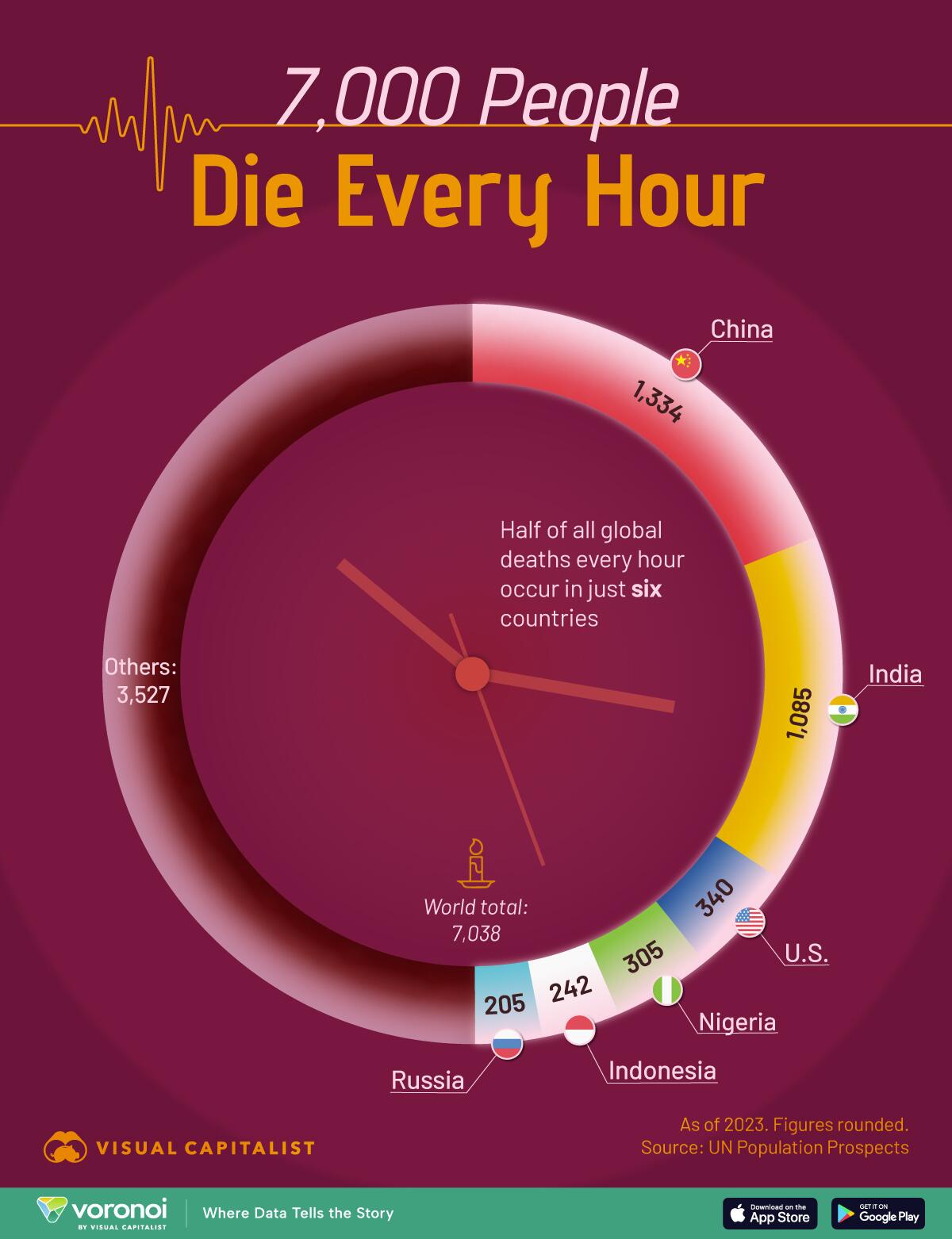
In 2023, nearly 62 million lives were lost worldwide – an average of around 7,000 deaths every hour.

These numbers reflect the impacts of aging, illness, and conflict, and Visual Capitalist’s Pallavi Rao takes a further look into the countries with the most deaths every hour.

Data is sourced from the latest UN Population Prospects and figures are rounded.

Ranked: Countries with the Most Deaths (2023)

At the top of the list, China lost more than 1,300 people every hour in 2023. This is about 300 more deaths than second-ranked India (roughly 1,000 people ever hour).

Rank Country Deaths in 2023 Deaths per Hour
1 🇨🇳 China 11,684,177 1,334
2 🇮🇳 India 9,507,008 1,085
3 🇺🇸 U.S. 2,975,658 340
4 🇳🇬 Nigeria 2,675,442 305
5 🇮🇩 Indonesia 2,117,706 242
6 🇷🇺 Russia 1,794,857 205
7 🇵🇰 Pakistan 1,600,313 183
8 🇯🇵 Japan 1,524,430 174
9 🇧🇷 Brazil 1,494,154 171
10 🇩🇪 Germany 1,034,140 118
11 🇨🇩 DRC 901,851 103
12 🇧🇩 Bangladesh 859,075 98
13 🇲🇽 Mexico 799,366 91
14 🇪🇹 Ethiopia 767,018 88
15 🇵🇭 Philippines 716,490 82
16 🇮🇹 Italy 663,448 76
17 🇻🇳 Vietnam 659,980 75
18 🇬🇧 UK 653,747 75
19 🇹🇭 Thailand 637,306 73
20 🇪🇬 Egypt 625,449 71
21 🇫🇷 France 616,095 70
22 🇿🇦 South Africa 584,015 67
23 🇹🇷 Turkey 551,598 63
24 🇲🇲 Myanmar 495,470 57
25 🇺🇦 Ukraine 495,421 57
26 🇪🇸 Spain 447,463 51
27 🇮🇷 Iran 423,367 48
28 🇵🇱 Poland 412,310 47
29 🇰🇪 Kenya 399,024 46
30 🇹🇿 Tanzania 385,799 44
31 🇦🇷 Argentina 349,195 40
32 🇰🇷 South Korea 345,502 39
33 🇸🇩 Sudan 320,491 37
34 🇨🇦 Canada 311,824 36
35 🇨🇴 Colombia 282,433 32
36 🇷🇴 Romania 257,119 29
37 🇰🇵 North Korea 255,826 29
38 🇦🇴 Angola 254,482 29
39 🇦🇫 Afghanistan 240,296 27
40 🇨🇮 Ivory Coast 238,741 27
41 🇬🇭 Ghana 237,869 27
42 🇺🇬 Uganda 235,583 27
43 🇲🇿 Mozambique 235,520 27
44 🇲🇬 Madagascar 234,841 27
45 🇳🇪 Niger 231,746 26
46 🇺🇿 Uzbekistan 221,249 25
47 🇩🇿 Algeria 214,259 24
48 🇻🇪 Venezuela 213,955 24
49 🇹🇩 Chad 213,123 24
50 🇲🇦 Morocco 212,624 24
51 🇳🇵 Nepal 205,841 23
52 🇹🇼 Taiwan 205,339 23
53 🇲🇱 Mali 205,047 23
54 🇨🇲 Cameroon 202,882 23
55 🇾🇪 Yemen 188,764 22
56 🇮🇶 Iraq 186,266 21
57 🇵🇪 Peru 185,861 21
58 🇦🇺 Australia 183,924 21
59 🇧🇫 Burkina Faso 183,375 21
60 🇲🇾 Malaysia 181,166 21
61 🇸🇴 Somalia 180,554 21
62 🇳🇱 Netherlands 169,320 19
63 🇱🇰 Sri Lanka 162,453 19
64 🇰🇿 Kazakhstan 136,388 16
65 🇬🇳 Guinea 131,455 15
66 🇭🇺 Hungary 128,063 15
67 🇨🇱 Chile 127,691 15
68 🇬🇷 Greece 127,018 14
69 🇿🇼 Zimbabwe 124,412 14
70 🇧🇯 Benin 124,132 14
71 🇧🇾 Belarus 121,587 14
72 🇸🇾 Syria 118,900 14
73 🇵🇹 Portugal 115,917 13
74 🇧🇪 Belgium 113,791 13
75 🇨🇿 Czech Republic 113,525 13
76 🇲🇼 Malawi 113,181 13
77 🇨🇺 Cuba 111,819 13
78 🇰🇭 Cambodia 111,340 13
79 🇸🇸 South Sudan 110,339 13
80 🇿🇲 Zambia 107,917 12
81 🇧🇬 Bulgaria 102,980 12
82 🇸🇳 Senegal 100,882 12
83 🇸🇪 Sweden 93,944 11
84 🇷🇸 Serbia 93,928 11
85 🇦🇹 Austria 93,223 11
86 🇪🇨 Ecuador 92,204 11
87 🇧🇮 Burundi 91,963 10
88 🇭🇹 Haiti 90,966 10
89 🇧🇴 Bolivia 87,812 10
90 🇬🇹 Guatemala 87,523 10
91 🇷🇼 Rwanda 82,826 9
92 🇸🇦 Saudi Arabia 77,837 9
93 🇹🇳 Tunisia 74,071 8
94 🇨🇭 Switzerland 73,788 8
95 🇹🇬 Togo 71,661 8
96 🇩🇴 Dominican Republic 70,823 8
97 🇸🇱 Sierra Leone 70,116 8
98 🇦🇿 Azerbaijan 67,842 8
99 🇵🇬 Papua New Guinea 67,700 8
100 🇫🇮 Finland 59,984 7
101 🇩🇰 Denmark 57,275 7
102 🇭🇰 Hong Kong 57,190 7
103 🇭🇷 Croatia 55,029 6
104 🇸🇰 Slovakia 54,167 6
105 🇮🇱 Israel 51,294 6
106 🇱🇾 Libya 48,610 6
107 🇨🇫 Central African Republic 48,529 6
108 🇱🇦 Laos 47,682 5
109 🇭🇳 Honduras 47,670 5
110 🇹🇯 Tajikistan 47,595 5
111 🇸🇻 El Salvador 47,443 5
112 🇬🇪 Georgia 45,077 5
113 🇱🇷 Liberia 44,333 5
114 🇳🇴 Norway 44,143 5
115 🇧🇦 Bosnia & Herzegovina 42,861 5
116 🇹🇲 Turkmenistan 42,575 5
117 🇰🇬 Kyrgyzstan 42,200 5
118 🇲🇩 Moldova 41,730 5
119 🇱🇹 Lithuania 40,940 5
120 🇵🇾 Paraguay 39,034 4
121 🇵🇸 Palestine 38,937 4
122 🇨🇬 Congo 38,880 4
123 🇳🇿 New Zealand 37,686 4
124 🇮🇪 Ireland 35,550 4
125 🇯🇴 Jordan 34,873 4
126 🇵🇷 Puerto Rico 34,664 4
127 🇱🇧 Lebanon 34,419 4
128 🇺🇾 Uruguay 33,145 4
129 🇳🇮 Nicaragua 31,294 4
130 🇨🇷 Costa Rica 27,861 3
131 🇸🇬 Singapore 27,728 3
132 🇲🇷 Mauritania 27,725 3
133 🇱🇻 Latvia 27,614 3
134 🇦🇲 Armenia 27,579 3
135 🇱🇸 Lesotho 24,612 3
136 🇦🇱 Albania 23,428 3
137 🇯🇲 Jamaica 22,933 3
138 🇸🇮 Slovenia 21,581 2
139 🇵🇦 Panama 21,272 2
140 🇪🇷 Eritrea 20,984 2
141 🇲🇳 Mongolia 20,340 2
142 🇲🇰 North Macedonia 19,863 2
143 🇳🇦 Namibia 18,279 2
144 🇬🇲 Gambia 16,975 2
145 🇪🇪 Estonia 16,693 2
146 🇬🇦 Gabon 15,577 2
147 🇬🇼 Guinea-Bissau 15,181 2
148 🇬🇶 Equatorial Guinea 14,556 2
149 🇧🇼 Botswana 14,197 2
150 🇹🇹 Trinidad & Tobago 12,577 1
151 🇲🇺 Mauritius 11,124 1
152 🇹🇱 Timor-Leste 10,065 1
153 🇽🇰 Kosovo 9,981 1
154 🇦🇪 UAE 9,916 1
155 🇴🇲 Oman 9,597 1
156 🇨🇾 Cyprus 9,499 1
157 🇸🇿 Eswatini 9,475 1
158 🇰🇼 Kuwait 8,624 1
159 🇩🇯 Djibouti 8,596 1
160 🇫🇯 Fiji 8,553 1
161 🇲🇪 Montenegro 7,209 1
162 🇰🇲 Comoros 6,119 1
163 🇬🇾 Guyana 6,049 1
164 🇧🇹 Bhutan 4,805 1
165 🇷🇪 Réunion 4,797 1
166 🇱🇺 Luxembourg 4,642 1
167 🇸🇷 Suriname 4,182 0
168 🇸🇧 Solomon Islands 4,113 0
169 🇲🇹 Malta 3,928 0
170 🇪🇭 Western Sahara 3,678 0
171 🇬🇵 Guadeloupe 3,560 0
172 🇲🇶 Martinique 3,502 0
173 🇧🇸 Bahamas 3,480 0
174 🇲🇴 Macau 3,423 0
175 🇧🇭 Bahrain 3,278 0
176 🇧🇧 Barbados 2,996 0
177 🇶🇦 Qatar 2,771 0
178 🇨🇻 Cape Verde 2,642 0
179 🇮🇸 Iceland 2,612 0
180 🇧🇳 Brunei 2,400 0
181 🇧🇿 Belize 2,025 0
182 🇨🇼 Curaçao 1,844 0
183 🇳🇨 New Caledonia 1,818 0
184 🇻🇺 Vanuatu 1,629 0
185 🇱🇨 Saint Lucia 1,544 0
186 🇬🇫 French Guiana 1,502 0
187 🇼🇸 Samoa 1,334 0
188 🇻🇮 U.S. Virgin Islands 1,321 0
189 🇸🇹 São Tomé & Príncipe 1,287 0
190 🇲🇻 Maldives 1,230 0
191 🇻🇨 Saint Vincent & the Grenadines 1,165 0
192 🇯🇪 Jersey 1,150 0
193 🇬🇺 Guam 1,144 0
194 🇸🇨 Seychelles 1,051 0
195 🇬🇩 Grenada 1,037 0
196 🇦🇼 Aruba 1,034 0
197 🇵🇫 French Polynesia 1,026 0
198 🇰🇮 Kiribati 934 0
199 🇮🇲 Isle of Man 882 0
200 🇫🇲 Micronesia 860 0
201 🇾🇹 Mayotte 854 0
202 🇩🇲 Dominica 849 0
203 🇲🇨 Monaco 817 0
204 🇹🇴 Tonga 674 0
205 🇦🇬 Antigua & Barbuda 643 0
206 🇬🇬 Guernsey 595 0
207 🇧🇲 Bermuda 573 0
208 🇫🇴 Faroe Islands 564 0
209 🇬🇱 Greenland 551 0
210 🇦🇩 Andorra 491 0
211 🇰🇳 Saint Kitts & Nevis 466 0
212 🇰🇾 Cayman Islands 351 0
213 🇸🇽 Sint Maarten 347 0
214 🇹🇨 Turks and Caicos Islands 342 0
215 🇦🇸 American Samoa 334 0
216 🇱🇮 Liechtenstein 300 0
217 🇲🇭 Marshall Islands 271 0
218 🇸🇲 San Marino 270 0
219 🇧🇶 Caribbean Netherlands 258 0
220 🇲🇫 Saint Martin 255 0
221 🇬🇮 Gibraltar 250 0
222 🇻🇬 British Virgin Islands 233 0
223 🇲🇵 Northern Mariana Islands 212 0
224 🇵🇼 Palau 204 0
225 🇨🇰 Cook Islands 132 0
226 🇦🇮 Anguilla 96 0
227 🇹🇻 Tuvalu 90 0
228 🇳🇷 Nauru 89 0
229 🇸🇭 Saint Helena 89 0
230 🇼🇫 Wallis & Futuna 88 0
231 🇵🇲 Saint Pierre & Miquelon 82 0
232 🇧🇱 Saint Barthélemy 70 0
233 🇲🇸 Montserrat 60 0
234 🇫🇰 Falkland Islands 27 0
235 🇳🇺 Niue 27 0
236 🇹🇰 Tokelau 14 0
237 🇻🇦 Vatican City 13 0
N/A 🌎 World 61,654,589 7,038

Note: Figures are rounded to closest whole number for deaths per hour

Put together, nearly one-in-three deaths every hour occur in India or China.

Going through the rest of the list, the U.S. (340) and Nigeria (305) have nearly the same number of hourly deaths, as do Indonesia (242), and Russia (205).

These six countries account for half of all global deaths every hour.

For two of them, Russia and China, their death rate is currently higher than their birth rate, and with low immigration, both their populations are officially shrinking.

What Shrinking Populations Mean for China and Russia

Both countries will have to contend with an aging population, shrinking workforces, and an increase in related social costs like healthcare.

For Russia, its demographic concerns are also exacerbated by the war in Ukraine, already impacting an economy under sanctions. Brain drain is also a serious issue.

Meanwhile China built its economic engine on top of an abundant and cost-competitive workforce. As it loses that advantage, a potential economic stagnation—similar to Japan in the 90s—could stifle future growth.

We know what the first question is after reading this article. Check out: Global Births per Hour, by Country for an overview of the other side of the spectrum.

Tyler Durden
Mon, 12/23/2024 – 02:45