70.9 F
Chicago
Thursday, October 8, 2026
Home Blog Page 1995

US Military Bases, Sensitive Sites Targeted By Drones For Years

0
US Military Bases, Sensitive Sites Targeted By Drones For Years

Authored by Andrew Thornebrooke via The Epoch Times (emphasis ours),

A sudden spike in unidentified drone sightings near sensitive government sites is unnerving residents and lawmakers alike.

The Federal Aviation Administration (FAA) announced on Dec. 17 that it is banning drone flights over 22 critical infrastructure locations in response to the incidents, though the White House maintains that there is no credible threat to public safety.

Illustration by The Epoch Times

The concern follows more than a month of reported drone sightings in or near the airspace of airports and military facilities in California, Maryland, Massachusetts, New Jersey, New York, Ohio, Pennsylvania, Utah, and Virginia, as well as overseas bases in Germany and the UK.

In all, the FBI said it has received more than 5,000 reports of drone sightings in the last month; of which the agency said about 100 warrant further investigation.

Below is a timeline of the most notable confirmed sightings.

Dec. 16 – Hill Air Force Base, Utah

Several drone sightings are confirmed at Hill Air Force Base in Utah on Dec. 16. One drone flies close to the fuel storage at the facility.

A spokesperson for the base told local media that the base is undertaking measures to safeguard personnel, equipment, and infrastructure but that the incidents have not impacted operation.

The base houses the Ogden Air Logistics Complex, which oversees the management of a wide range of aircraft, missiles, and software for the military. It is also home to several dozen advanced F-35 fighter aircraft.

Drone encounters in this location began in 2022 and have continued intermittently to the present.

F-35A’s of Hill Air Force Base’s 388th and 419th fighter wings land and taxi after a training exercise at Hill Air Force Base, Utah, on Nov. 19, 2018. George Frey/Getty Images

Dec. 13–17 – Wright-Patterson Air Force Base, Ohio

White House National Security Council spokesperson John Kirby tells reporters that drones had penetrated the restricted airspace around several military complexes, including Wright-Patterson Air Force Base in Ohio, which houses the Air and Space Forces’ national intelligence centers.

The number of drones, their type, and formation fluctuated from Dec. 13 through 17, a base spokesperson tells Stars and Stripes, a Department of Defense-managed publication.

No damage or threat is reported, but at least one incident forces the facility to close its airfields for four hours.

Dec. 14 – Logan International Airport, Massachusetts

Local police in Boston arrest two men for allegedly operating a drone “dangerously close” to Logan International Airport.

The police used drone monitoring technology to track the operators’ position on a nearby island. There, they confronted three individuals who fled on foot. Two of the three were taken into custody and charged with trespassing, while a third escaped by boat and remains at large.

An aerial view of Logan Aiport in Boston on Sept. 9, 2012. David Wilson/CC

Dec. 13 – Stewart International Airport, New York

The Stewart International Airport is forced to close its runways for an hour while an unidentified drone flies around the facility.

New York Gov. Kathy Hochul urges Congress to pass a bill that would give state authorities the legal authority to shoot drones down, saying that a “state-of-the-art drone detection system” loaned out by the federal government is not enough.

Dec. 9–15 – Camp Pendleton, California

Unidentified drones violated the restricted airspace six times in a six-day period at Camp Pendleton, one of the U.S. Marine Corps’ largest bases and a center of its training activities.

A spokesperson for the base told The Epoch Times that there is no threat to operations at the installation, without elaborating.

“Force protection considerations restricts our ability to provide further information to ensure the operational security of the installation and the safety and welfare of the base population and the surrounding areas,” the spokesperson said.

A view of the main entrance to Camp Pendleton in Oceanside, Calif., on July 26, 2019. Sandy Huffaker/Getty Images

Dec. 3 – Ramstein Air Base, Germany

Unauthorized drones fly over the sprawling Ramstein Air Base in western Germany. The facility is a major hub for the U.S. military and houses NATO’s central command for all allied air and space forces.

Local police tell Stars and Stripes that the drones had previously been tracked flying over the site of a major multinational chemical corporation, and anonymous sources have said the drones were not of a type associated with hobby use.

Ramstein Air Base in Germany. U.S. Army Corps of Engineers photo by Justin Ward/CC BY 2.0

Nov. 30 – Vandenberg Space Force Base, California

Chinese national Yinpiao Zhou allegedly flies an unregistered drone over Vandenberg Space Force Base in California.

Zhou allegedly uses the drone to photograph SpaceX rocket pads on the same day the company is launching a sensitive national reconnaissance payload from the base.

On Dec. 6, federal agents arrest Zhou at San Francisco International Airport as he prepared to board a China-bound flight, according to the U.S. Attorney’s Office in Los Angeles.

A United Launch Alliance Delta IV-Heavy rocket carrying a National Reconnaissance Office payload launches from Space Launch Complex-6 at Vandenberg Air Force Base, Calif., on Aug. 28, 2013. Public Domain

Nov. 22 – Trump National Golf Club, New Jersey

The FAA closes the airspace over the Trump National Golf Club Bedminster after reports of several drones and a fixed-winged aircraft flying along the 70-mile Raritan River in Somerset and Middlesex counties in New Jersey.

President-elect Donald Trump, who owns the golf course and maintains a home in nearby Bedminster, later said he had canceled a trip to the area because of the continued presence of the drones.

Trump added in a post on his Truth Social media platform that the drones should be shot down if the government does not know where they are coming from.

Read the rest of this insanity here…

Tyler Durden
Mon, 12/23/2024 – 06:30

Visualizing The $115 Trillion World Economy In One Chart

0
Visualizing The $115 Trillion World Economy In One Chart

There’s nothing quite like a big chart to really get into the data. In this edition, Visual Capitalist’s Pallavi Rao takes a look at the massive $115 trillion world economy in 2025, along with how it breaks down per country.

Data is sourced from the International Monetary Fund’s GDP estimates for 2025 (except for Pakistan). All figures are rounded and in nominal USD.

Ranked: Every Country by GDP in 2025

The U.S. has been the world’s largest economy for over 100 years, and in 2025 will maintain its lead, at $30.3 trillion.

Rank Countries 2025 GDP (Billions USD)
1 🇺🇸 U.S. $30,337.2
2 🇨🇳 China $19,534.9
3 🇩🇪 Germany $4,921.6
4 🇯🇵 Japan $4,389.3
5 🇮🇳 India $4,271.9
6 🇬🇧 UK $3,730.3
7 🇫🇷 France $3,283.4
8 🇮🇹 Italy $2,459.6
9 🇨🇦 Canada $2,330.3
10 🇧🇷 Brazil $2,307.2
11 🇷🇺 Russia $2,195.7
12 🇰🇷 South Korea $1,947.1
13 🇦🇺 Australia $1,881.1
14 🇪🇸 Spain $1,827.6
15 🇲🇽 Mexico $1,817.8
16 🇮🇩 Indonesia $1,492.6
17 🇹🇷 Türkiye $1,455.4
18 🇳🇱 Netherlands $1,273.0
19 🇸🇦 Saudi Arabia $1,136.6
20 🇨🇭 Switzerland $999.6
21 🇵🇱 Poland $915.5
22 🇹🇼 Taiwan $814.4
23 🇧🇪 Belgium $689.4
24 🇸🇪 Sweden $638.8
25 🇮🇪 Ireland $587.2
26 🇦🇷 Argentina $574.2
27 🇦🇪 UAE $568.6
28 🇸🇬 Singapore $561.7
29 🇦🇹 Austria $559.2
30 🇮🇱 Israel $550.9
31 🇹🇭 Thailand $545.3
32 🇵🇭 Philippines $507.7
33 🇳🇴 Norway $506.5
34 🇻🇳 Vietnam $506.4
35 🇲🇾 Malaysia $488.3
36 🇧🇩 Bangladesh $481.9
37 🇮🇷 Iran $463.7
38 🇩🇰 Denmark $431.2
39 🇭🇰 Hong Kong SAR $422.1
40 🇨🇴 Colombia $419.3
41 🇿🇦 South Africa $418.0
42 🇷🇴 Romania $406.2
43 🇵🇰 Pakistan* $374.6
44 🇨🇱 Chile $362.2
45 🇨🇿 Czech Republic $360.2
46 🇪🇬 Egypt $345.9
47 🇫🇮 Finland $320.0
48 🇵🇹 Portugal $319.9
49 🇰🇿 Kazakhstan $306.6
50 🇵🇪 Peru $294.9
51 🇮🇶 Iraq $270.9
52 🇬🇷 Greece $265.2
53 🇩🇿 Algeria $264.3
54 🇳🇿 New Zealand $262.9
55 🇭🇺 Hungary $245.6
56 🇶🇦 Qatar $226.2
57 🇳🇬 Nigeria $195.0
58 🇺🇦 Ukraine $189.8
59 🇲🇦 Morocco $168.6
60 🇰🇼 Kuwait $162.0
61 🇸🇰 Slovak Republic $152.5
62 🇩🇴 Dominican Republic $135.5
63 🇺🇿 Uzbekistan $127.4
64 🇪🇨 Ecuador $125.7
65 🇵🇷 Puerto Rico $122.2
66 🇬🇹 Guatemala $121.0
67 🇪🇹 Ethiopia $120.9
68 🇦🇴 Angola $118.4
69 🇰🇪 Kenya $116.7
70 🇧🇬 Bulgaria $115.5
71 🇴🇲 Oman $111.3
72 🇻🇪 Venezuela $110.0
73 🇨🇷 Costa Rica $100.7
74 🇱🇺 Luxembourg $97.0
75 🇭🇷 Croatia $96.0
76 🇨🇮 Côte d’Ivoire $95.5
77 🇵🇦 Panama $91.7
78 🇹🇲 Turkmenistan $91.2
79 🇷🇸 Serbia $88.6
80 🇱🇹 Lithuania $88.0
81 🇺🇾 Uruguay $86.4
82 🇹🇿 Tanzania $85.5
83 🇨🇩 DRC $79.2
84 🇸🇮 Slovenia $77.4
85 🇦🇿 Azerbaijan $77.0
86 🇧🇾 Belarus $76.9
87 🇬🇭 Ghana $75.8
88 🇲🇲 Myanmar $65.0
89 🇺🇬 Uganda $62.9
90 🇲🇴 Macao SAR $59.3
91 🇨🇲 Cameroon $57.7
92 🇯🇴 Jordan $56.1
93 🇹🇳 Tunisia $54.7
94 🇧🇴 Bolivia $51.3
95 🇰🇭 Cambodia $51.2
96 🇧🇭 Bahrain $49.5
97 🇱🇻 Latvia $48.2
98 🇱🇾 Libya $48.0
99 🇳🇵 Nepal $47.8
100 🇵🇾 Paraguay $46.8
101 🇪🇪 Estonia $45.3
102 🇭🇳 Honduras $39.0
103 🇸🇻 El Salvador $37.8
104 🇸🇳 Senegal $37.8
105 🇨🇾 Cyprus $37.7
106 🇿🇼 Zimbabwe $36.9
107 🇬🇪 Georgia $35.9
108 🇮🇸 Iceland $35.4
109 🇵🇬 Papua New Guinea $32.6
110 🇿🇲 Zambia $31.8
111 🇭🇹 Haiti $30.6
112 🇸🇩 Sudan $30.0
113 🇧🇦 Bosnia and Herzegovina $29.9
114 🇹🇹 Trinidad and Tobago $29.2
115 🇦🇱 Albania $28.0
116 🇬🇳 Guinea $27.3
117 🇲🇳 Mongolia $27.2
118 🇦🇲 Armenia $26.6
119 🇲🇹 Malta $26.3
120 🇲🇿 Mozambique $24.5
121 🇬🇾 Guyana $24.5
122 🇧🇫 Burkina Faso $23.6
123 🇲🇱 Mali $23.2
124 🇧🇯 Benin $23.1
125 🇧🇼 Botswana $22.1
126 🇳🇪 Niger $21.9
127 🇯🇲 Jamaica $21.6
128 🇬🇦 Gabon $21.0
129 🇳🇮 Nicaragua $21.0
130 🇲🇩 Moldova $19.6
131 🇹🇩 Chad $19.6
132 🇲🇬 Madagascar $18.1
133 🇰🇬 Kyrgyz Republic $17.4
134 🇲🇰 North Macedonia $17.1
135 🇧🇳 Brunei Darussalam $16.7
136 🇲🇺 Mauritius $16.5
137 🇾🇪 Yemen $16.2
138 🇨🇬 Congo $15.9
139 🇧🇸 Bahamas $15.3
140 🇱🇦 Lao P.D.R. $14.4
141 🇳🇦 Namibia $14.4
142 🇹🇯 Tajikistan $14.2
143 🇷🇼 Rwanda $14.0
144 🇸🇴 Somalia $13.9
145 🇬🇶 Equatorial Guinea $12.9
146 🇽🇰 Kosovo $11.8
147 🇲🇷 Mauritania $11.1
148 🇲🇼 Malawi $10.8
149 🇹🇬 Togo $10.5
150 🇲🇪 Montenegro $8.8
151 🇸🇱 Sierra Leone $7.8
152 🇧🇧 Barbados $7.6
153 🇲🇻 Maldives $7.6
154 🇫🇯 Fiji $6.1
155 🇸🇿 Eswatini $5.4
156 🇸🇸 South Sudan $5.3
157 🇱🇷 Liberia $5.1
158 🇸🇷 Suriname $5.0
159 🇩🇯 Djibouti $4.7
160 🇦🇼 Aruba $4.4
161 🇦🇩 Andorra $4.1
162 🇧🇹 Bhutan $3.5
163 🇧🇿 Belize $3.5
164 🇨🇫 Central African Republic $3.0
165 🇬🇲 The Gambia $3.0
166 🇨🇻 Cabo Verde $2.9
167 🇱🇨 Saint Lucia $2.7
168 🇦🇬 Antigua & Barbuda $2.4
169 🇱🇸 Lesotho $2.4
170 🇬🇼 Guinea-Bissau $2.4
171 🇸🇨 Seychelles $2.2
172 🇧🇮 Burundi $2.2
173 🇹🇱 Timor-Leste $2.1
174 🇸🇲 San Marino $2.1
175 🇸🇧 Solomon Islands $1.8
176 🇰🇲 Comoros $1.5
177 🇬🇩 Grenada $1.5
178 🇻🇨 Saint Vincent & Grenadines $1.2
179 🇰🇳 Saint Kitts & Nevis $1.2
180 🇻🇺 Vanuatu $1.2
181 🇼🇸 Samoa $1.1
182 🇸🇹 São Tomé & Príncipe $1.0
183 🇩🇲 Dominica $0.7
184 🇹🇴 Tonga $0.6
185 🇫🇲 Micronesia $0.5
186 🇵🇼 Palau $0.4
187 🇰🇮 Kiribati $0.3
188 🇲🇭 Marshall Islands $0.3
189 🇳🇷 Nauru $0.2
190 🇹🇻 Tuvalu $0.1
N/A 🌍 World $115,338.3

*Pakistan’s forecast for 2025 is not yet released, so 2024 data is used here.

Second-largest China ($19.5 trillion) will also hold its position, now on a 15-year streak. The top two together account for over two-fifths (43%) of the world’s $115 trillion GDP.

However, there have been changes in the top five recently. Germany ($4.9 trillion) overtook Japan ($4.4 trillion) in 2024 as the third-largest economy. Meanwhile India ($4.3 trillion) passed the UK ($3.7 trillion) as 5th largest in 2020.

All three countries are expected to retain their positions till 2026—when India is projected to first pass Japan for fourth, and then Germany for third place in 2028.

Meanwhile, around the top 10 mark, Australia is predicted to overtake Spain for 13th place this year. And Brazil is expected to make the top eight by 2028.

So…What’s 2025 Going to Be Like?

The IMF expects global economic growth to continue at 3.2% fueled by rate cuts as inflation retreats across key markets in the U.S. and Europe.

Geopolitical risks remain the lurking threat to growth. In February, Russia’s invasion of Ukraine will complete its third year, previously a key trigger to Europe’s post-pandemic inflation rise.

The latest Israel-Palestine conflict has already passed a year, drawing in neighbors Lebanon and Yemen, and disrupting key shipping routes.

Meanwhile, Syria remains in focus after rebels overthrew the Bashar al-Assad government in Damascus, ending 24-years of rule.

As it happens we have a whole series dedicated to looking ahead. Join VC+ today to get access to the 2025 Global Forecast Series, filled with experts predictions and consensus for sectors, markets, and economies in the New Year.

Need more massive charts to sink your teeth into? Check out UN States Not Recognized by Other Members by creator Julie Peasley to see all-important geopolitical tensions visualized.

Tyler Durden
Mon, 12/23/2024 – 05:45

China Weaponizes Rare Earth Metals

0
China Weaponizes Rare Earth Metals

Authored by John Mills via The Epoch Times,

In the waning days of the Biden administration, the constriction of Chinese access to semiconductors continues.

On Dec. 2, the U.S. Department of Commerce announced another round of rules aimed at inhibiting the flow of semiconductors to China. The Department’s Bureau of Industry and Security (BIS) released new rules, stating they are “designed to further impair the People’s Republic of China’s (PRC) capability to produce advanced-node semiconductors that can be used in the next generation of advanced weapon systems and in artificial intelligence (AI) and advanced computing, which have significant military applications.”

Likely adding urgency to the Dec. 2 action is a U.S. Senate report from September showing how Russia’s war effort in Ukraine is substantially supported by China. The report highlights the Chinese regime’s aggressive worldwide campaign to purchase U.S. chips and use third-party countries to re-ship the items to Russia, China, Iran, and North Korea. Within days of the semiconductor ban, China retaliated by banning the export of some key rare earth metals (REMs) used in chip production. According to the MIT Technology Review, China ceased the export of three critical REMs: gallium, germanium, and antimony. In addition, the export of superhard materials used in manufacturing was banned.

Why does China now disallow the export of REMs when it needs the chips? It’s because the availability of REMs is one of China’s advantages in the trade war with the United States.

China’s Strategic Play in Rare Earth Metals

While China is vulnerable in energy and food production, REMs provide a significant advantage. China controls 60–70 percent of the world’s extraction of REMs and 90 percent of its refining capacity. Since the 1980s, China has viewed REMs as a strategic asset.

“Recognizing the strategic importance of these metals, China began heavily subsidizing its rare earth mining and processing industries. This allowed Chinese producers to undercut international competitors, driving many mining operations in the U.S., Australia, and elsewhere out of business,” reports Zimtu Capital Corporation of Canada.

Western countries, by contrast, regarded the extraction and processing of REMs as dirty, labor-intensive, and best left to other nations. Meanwhile, China prioritized this sector. “Lax environmental regulations and low labor costs gave China a cost advantage that other nations struggled to match,” Zimtu noted. While these practices drew criticism, they enabled China to dominate the market.

The American government has prioritized semiconductor production in partnership with Taiwan, Japan, South Korea, and the Netherlands. However, by controlling the extraction and refining of REMs, China can undermine and disrupt the production of semiconductors. If China cannot obtain semiconductors from the American-dominated process, it can ensure no one else can either by leveraging control over the REM supply chain.

A Promising US Response to China

While Taiwan’s TSMC is the world’s largest semiconductor producer, it requires REMs from China for its renowned chip-building process. President-elect Donald Trump’s appointment of key officials—such as Peter Navarro as senior counselor for trade and manufacturing—signals a strong stance on trade. Navarro, known for his aggressive trade policies, has been empowered to use tariffs and other measures to compel China to adhere to fair trade practices.

Navarro could receive significant support from former U.S. Trade Representative Robert Lighthizer, who shares Navarro’s views on the malign nature of China’s trade practices. Ambassador Rick Grenell, appointed to the new role of presidential envoy for special missions, adds further muscle to this team. Grenell’s past close relationship with Trump suggests he will play a critical role in resolving obstacles related to REMs. Together, this team will likely focus on reviving U.S. REM extraction and refining capabilities while countering China’s REM dominance.

‘Refine, Baby, Refine’

Although many REMs exist outside of China, their production has been largely shuttered due to environmental concerns. By revisiting government regulations to balance environmental safety and economic necessity, the United States can reinvigorate its REM extraction and refining industry. For example, antimony is already being extracted in Idaho, and the United States and partner nations possess significant deposits of other REMs, including gallium and germanium. However, refining capacity remains the primary bottleneck.

A new corollary to Trump’s famous “drill, baby, drill” might be “refine, baby, refine”—a rallying cry to reestablish REM refining processes in the United States and trusted foreign partners.

Leadership, determination, and investment are needed to bring new refining plants online.

The resources exist; the challenge is overcoming the legacy of globalism that led Western nations to abandon REM industries. With the incoming Trump administration, the United States appears poised to rebuild its REM supply chain and hold the Chinese regime accountable.

*  *  *

Views expressed in this article are opinions of the author and do not necessarily reflect the views of The Epoch Times or ZeroHedge.

Tyler Durden
Mon, 12/23/2024 – 05:00

EU-Sanctioned Russian Oil Still Hits Markets Via Bulgaria

0
EU-Sanctioned Russian Oil Still Hits Markets Via Bulgaria

Authored by Cyril Widdershoven via OilPrice.com,

  • Bulgaria’s Lukoil Burgas refinery continues to process Russian oil via shadow fleet transfers.

  • EU sanctions have expanded to target 80 Russian vessels, but Bulgaria and other nations like Romania and Turkey remain involved in sanction-evasion schemes.

  • Concerns over Russian influence persist as Hungary’s MOL moves to acquire Lukoil’s Bulgarian assets.

Even though the EU sanctions Russian oil, Bulgaria still allows crude to be processed at the Lukoil Burgas refinery. An investigation by Ukrainian journalist Mykhailo Tkach, working for the Ukrainska Pravda, shows that Lukoil’s Bulgarian Burgas refinery is still processing Russian crude. The volumes are being transported by Russia’s shadow fleet and transshipped offshore near the coast of Bulgaria. Tkach has made videos of the ship-to-ship (STS) transfers just opposite the port of Rosenets, the main port for crude oil deliveries to the Burgas refinery. The Ukrainian reporter shows that the Liberian-registered tanker Lipari, arriving on November 24 from Novorossiysk, Russia, docked near the Rosenets port. Via an STS, the Maltese-registered tanker Stames took delivery of crude oil at sea.

This STS appears to have delivered Russian naphtha, for which the EU in 2022 granted Bulgaria an exemption to import until the end of 2024. Reports, such as those from Global Witness, show Bulgaria imported much more Russian naphtha than necessary in 2023. Global Witness also stated that the Burgas refinery processed 5 million tons of Russian naphtha in the first ten months of 2023, contributing around €1 billion to Russian government coffers. In response, the Bulgarian government announced in 2023 that it plans to decrease Russian naphtha imports by 80%, stopping all imports by 2024. However, Tkach’s video indicates that the Burgas refinery is still processing Russian oil.

To limit the ability of the Russian dark fleet to bring crude and products to European markets, the EU imposed additional sanctions on December 1, 2024, targeting around 50 additional Russian oil tankers, bringing the total sanctioned dark fleet to approximately 80 vessels. Tkach’s findings suggest that the Bulgarian government remains complicit in Russian STS operations linked to Burgas refinery activities. Analysts have proposed that the Russian naphtha could be rebranded as KEBKO (Kazakh Export Blend Crude Oil) to bypass restrictions. Ukrainian and Bulgarian media claim that Bulgarian government officials are likely aware of the multimillion-dollar deals involved. Reports also suggest that the Russian-Bulgarian oil connection is part of Moscow’s disinformation and influence strategy.

As evidence of Moscow’s sway, Bulgaria’s government, led by Prime Minister Grachev, has declined to sign a bilateral security agreement with Ukraine, creating a rift with 25 EU member states that have signed similar agreements. Grachev’s government appears to be following Hungary’s Viktor Orbán in aligning with Russian interests.

Interestingly, Lukoil’s Bulgarian assets, including the Burgas refinery—the largest in the Balkans—are up for sale. Hungarian oil and gas company MOL is reportedly in the process of acquiring the assets. Hungarian President Orbán has been pushing for the deal, as evidenced by his visits to Bulgarian officials, including President Radev. Analysts warn that Russian financing could be involved, as MOL’s financial capacity is limited. Orbán’s involvement should raise concerns for European authorities, who might consider blocking the deal if Russian connections are proven. Hungarian ownership of Lukoil’s assets could further entrench Moscow’s influence in the Balkans.

Another issue complicates the sale of Lukoil’s assets. The company holds a dominant position in Bulgaria’s fuel market but has not paid profit taxes. Bulgarian sources estimate that Lukoil owes around BGN 500 million ($265 million) in unpaid taxes.

Bulgaria is not the only European country importing large volumes of Russian oil and products. Reports show that Romania has also violated EU sanctions. In November, the Panama-registered tanker Sredina arrived in Romanian waters near the port of Constanta and performed an STS transfer with another Panama-registered tanker, Melahat. According to Marine Tracking, Melahat later docked with the Russian-registered vessel VF Tanker 3, which had come directly from Novorossiysk, Russia. Other vessels, such as the Altai, have also transported Russian crude to Romanian ports like Midia.

Turkey is another route for Russian crude and products into Europe. The EU’s Anti-Fraud Office is investigating the Turkish route, where vessels from Russia pass through ports without refining capabilities. Marine Traffic has documented other vessels coming from Novorossiysk, further establishing Turkey’s role in the ongoing trade of Russian oil to European markets.

Tyler Durden
Mon, 12/23/2024 – 03:30

7,000 People Die Every Hour…

0
7,000 People Die Every Hour…

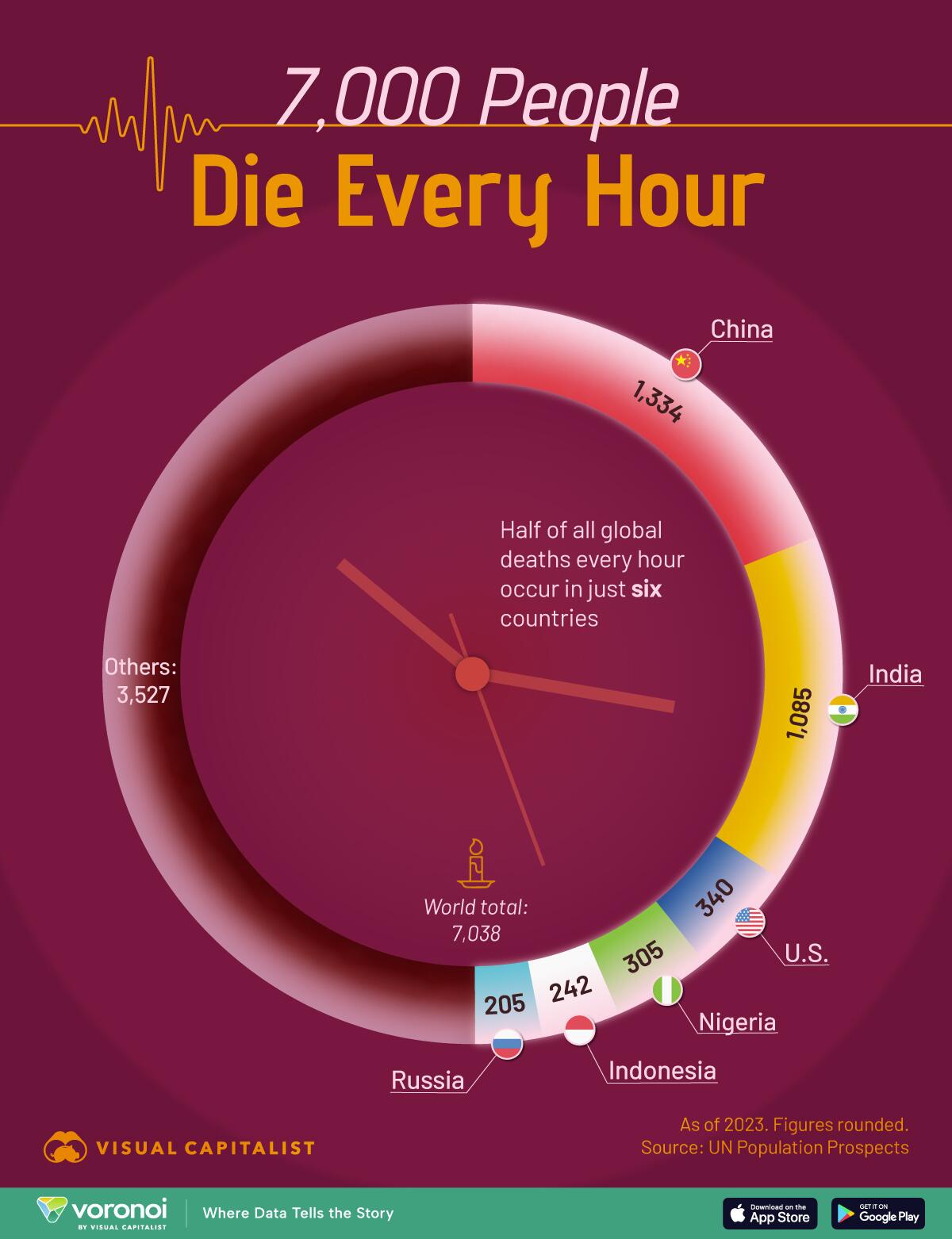
In 2023, nearly 62 million lives were lost worldwide – an average of around 7,000 deaths every hour.

These numbers reflect the impacts of aging, illness, and conflict, and Visual Capitalist’s Pallavi Rao takes a further look into the countries with the most deaths every hour.

Data is sourced from the latest UN Population Prospects and figures are rounded.

Ranked: Countries with the Most Deaths (2023)

At the top of the list, China lost more than 1,300 people every hour in 2023. This is about 300 more deaths than second-ranked India (roughly 1,000 people ever hour).

Rank Country Deaths in 2023 Deaths per Hour
1 🇨🇳 China 11,684,177 1,334
2 🇮🇳 India 9,507,008 1,085
3 🇺🇸 U.S. 2,975,658 340
4 🇳🇬 Nigeria 2,675,442 305
5 🇮🇩 Indonesia 2,117,706 242
6 🇷🇺 Russia 1,794,857 205
7 🇵🇰 Pakistan 1,600,313 183
8 🇯🇵 Japan 1,524,430 174
9 🇧🇷 Brazil 1,494,154 171
10 🇩🇪 Germany 1,034,140 118
11 🇨🇩 DRC 901,851 103
12 🇧🇩 Bangladesh 859,075 98
13 🇲🇽 Mexico 799,366 91
14 🇪🇹 Ethiopia 767,018 88
15 🇵🇭 Philippines 716,490 82
16 🇮🇹 Italy 663,448 76
17 🇻🇳 Vietnam 659,980 75
18 🇬🇧 UK 653,747 75
19 🇹🇭 Thailand 637,306 73
20 🇪🇬 Egypt 625,449 71
21 🇫🇷 France 616,095 70
22 🇿🇦 South Africa 584,015 67
23 🇹🇷 Turkey 551,598 63
24 🇲🇲 Myanmar 495,470 57
25 🇺🇦 Ukraine 495,421 57
26 🇪🇸 Spain 447,463 51
27 🇮🇷 Iran 423,367 48
28 🇵🇱 Poland 412,310 47
29 🇰🇪 Kenya 399,024 46
30 🇹🇿 Tanzania 385,799 44
31 🇦🇷 Argentina 349,195 40
32 🇰🇷 South Korea 345,502 39
33 🇸🇩 Sudan 320,491 37
34 🇨🇦 Canada 311,824 36
35 🇨🇴 Colombia 282,433 32
36 🇷🇴 Romania 257,119 29
37 🇰🇵 North Korea 255,826 29
38 🇦🇴 Angola 254,482 29
39 🇦🇫 Afghanistan 240,296 27
40 🇨🇮 Ivory Coast 238,741 27
41 🇬🇭 Ghana 237,869 27
42 🇺🇬 Uganda 235,583 27
43 🇲🇿 Mozambique 235,520 27
44 🇲🇬 Madagascar 234,841 27
45 🇳🇪 Niger 231,746 26
46 🇺🇿 Uzbekistan 221,249 25
47 🇩🇿 Algeria 214,259 24
48 🇻🇪 Venezuela 213,955 24
49 🇹🇩 Chad 213,123 24
50 🇲🇦 Morocco 212,624 24
51 🇳🇵 Nepal 205,841 23
52 🇹🇼 Taiwan 205,339 23
53 🇲🇱 Mali 205,047 23
54 🇨🇲 Cameroon 202,882 23
55 🇾🇪 Yemen 188,764 22
56 🇮🇶 Iraq 186,266 21
57 🇵🇪 Peru 185,861 21
58 🇦🇺 Australia 183,924 21
59 🇧🇫 Burkina Faso 183,375 21
60 🇲🇾 Malaysia 181,166 21
61 🇸🇴 Somalia 180,554 21
62 🇳🇱 Netherlands 169,320 19
63 🇱🇰 Sri Lanka 162,453 19
64 🇰🇿 Kazakhstan 136,388 16
65 🇬🇳 Guinea 131,455 15
66 🇭🇺 Hungary 128,063 15
67 🇨🇱 Chile 127,691 15
68 🇬🇷 Greece 127,018 14
69 🇿🇼 Zimbabwe 124,412 14
70 🇧🇯 Benin 124,132 14
71 🇧🇾 Belarus 121,587 14
72 🇸🇾 Syria 118,900 14
73 🇵🇹 Portugal 115,917 13
74 🇧🇪 Belgium 113,791 13
75 🇨🇿 Czech Republic 113,525 13
76 🇲🇼 Malawi 113,181 13
77 🇨🇺 Cuba 111,819 13
78 🇰🇭 Cambodia 111,340 13
79 🇸🇸 South Sudan 110,339 13
80 🇿🇲 Zambia 107,917 12
81 🇧🇬 Bulgaria 102,980 12
82 🇸🇳 Senegal 100,882 12
83 🇸🇪 Sweden 93,944 11
84 🇷🇸 Serbia 93,928 11
85 🇦🇹 Austria 93,223 11
86 🇪🇨 Ecuador 92,204 11
87 🇧🇮 Burundi 91,963 10
88 🇭🇹 Haiti 90,966 10
89 🇧🇴 Bolivia 87,812 10
90 🇬🇹 Guatemala 87,523 10
91 🇷🇼 Rwanda 82,826 9
92 🇸🇦 Saudi Arabia 77,837 9
93 🇹🇳 Tunisia 74,071 8
94 🇨🇭 Switzerland 73,788 8
95 🇹🇬 Togo 71,661 8
96 🇩🇴 Dominican Republic 70,823 8
97 🇸🇱 Sierra Leone 70,116 8
98 🇦🇿 Azerbaijan 67,842 8
99 🇵🇬 Papua New Guinea 67,700 8
100 🇫🇮 Finland 59,984 7
101 🇩🇰 Denmark 57,275 7
102 🇭🇰 Hong Kong 57,190 7
103 🇭🇷 Croatia 55,029 6
104 🇸🇰 Slovakia 54,167 6
105 🇮🇱 Israel 51,294 6
106 🇱🇾 Libya 48,610 6
107 🇨🇫 Central African Republic 48,529 6
108 🇱🇦 Laos 47,682 5
109 🇭🇳 Honduras 47,670 5
110 🇹🇯 Tajikistan 47,595 5
111 🇸🇻 El Salvador 47,443 5
112 🇬🇪 Georgia 45,077 5
113 🇱🇷 Liberia 44,333 5
114 🇳🇴 Norway 44,143 5
115 🇧🇦 Bosnia & Herzegovina 42,861 5
116 🇹🇲 Turkmenistan 42,575 5
117 🇰🇬 Kyrgyzstan 42,200 5
118 🇲🇩 Moldova 41,730 5
119 🇱🇹 Lithuania 40,940 5
120 🇵🇾 Paraguay 39,034 4
121 🇵🇸 Palestine 38,937 4
122 🇨🇬 Congo 38,880 4
123 🇳🇿 New Zealand 37,686 4
124 🇮🇪 Ireland 35,550 4
125 🇯🇴 Jordan 34,873 4
126 🇵🇷 Puerto Rico 34,664 4
127 🇱🇧 Lebanon 34,419 4
128 🇺🇾 Uruguay 33,145 4
129 🇳🇮 Nicaragua 31,294 4
130 🇨🇷 Costa Rica 27,861 3
131 🇸🇬 Singapore 27,728 3
132 🇲🇷 Mauritania 27,725 3
133 🇱🇻 Latvia 27,614 3
134 🇦🇲 Armenia 27,579 3
135 🇱🇸 Lesotho 24,612 3
136 🇦🇱 Albania 23,428 3
137 🇯🇲 Jamaica 22,933 3
138 🇸🇮 Slovenia 21,581 2
139 🇵🇦 Panama 21,272 2
140 🇪🇷 Eritrea 20,984 2
141 🇲🇳 Mongolia 20,340 2
142 🇲🇰 North Macedonia 19,863 2
143 🇳🇦 Namibia 18,279 2
144 🇬🇲 Gambia 16,975 2
145 🇪🇪 Estonia 16,693 2
146 🇬🇦 Gabon 15,577 2
147 🇬🇼 Guinea-Bissau 15,181 2
148 🇬🇶 Equatorial Guinea 14,556 2
149 🇧🇼 Botswana 14,197 2
150 🇹🇹 Trinidad & Tobago 12,577 1
151 🇲🇺 Mauritius 11,124 1
152 🇹🇱 Timor-Leste 10,065 1
153 🇽🇰 Kosovo 9,981 1
154 🇦🇪 UAE 9,916 1
155 🇴🇲 Oman 9,597 1
156 🇨🇾 Cyprus 9,499 1
157 🇸🇿 Eswatini 9,475 1
158 🇰🇼 Kuwait 8,624 1
159 🇩🇯 Djibouti 8,596 1
160 🇫🇯 Fiji 8,553 1
161 🇲🇪 Montenegro 7,209 1
162 🇰🇲 Comoros 6,119 1
163 🇬🇾 Guyana 6,049 1
164 🇧🇹 Bhutan 4,805 1
165 🇷🇪 Réunion 4,797 1
166 🇱🇺 Luxembourg 4,642 1
167 🇸🇷 Suriname 4,182 0
168 🇸🇧 Solomon Islands 4,113 0
169 🇲🇹 Malta 3,928 0
170 🇪🇭 Western Sahara 3,678 0
171 🇬🇵 Guadeloupe 3,560 0
172 🇲🇶 Martinique 3,502 0
173 🇧🇸 Bahamas 3,480 0
174 🇲🇴 Macau 3,423 0
175 🇧🇭 Bahrain 3,278 0
176 🇧🇧 Barbados 2,996 0
177 🇶🇦 Qatar 2,771 0
178 🇨🇻 Cape Verde 2,642 0
179 🇮🇸 Iceland 2,612 0
180 🇧🇳 Brunei 2,400 0
181 🇧🇿 Belize 2,025 0
182 🇨🇼 Curaçao 1,844 0
183 🇳🇨 New Caledonia 1,818 0
184 🇻🇺 Vanuatu 1,629 0
185 🇱🇨 Saint Lucia 1,544 0
186 🇬🇫 French Guiana 1,502 0
187 🇼🇸 Samoa 1,334 0
188 🇻🇮 U.S. Virgin Islands 1,321 0
189 🇸🇹 São Tomé & Príncipe 1,287 0
190 🇲🇻 Maldives 1,230 0
191 🇻🇨 Saint Vincent & the Grenadines 1,165 0
192 🇯🇪 Jersey 1,150 0
193 🇬🇺 Guam 1,144 0
194 🇸🇨 Seychelles 1,051 0
195 🇬🇩 Grenada 1,037 0
196 🇦🇼 Aruba 1,034 0
197 🇵🇫 French Polynesia 1,026 0
198 🇰🇮 Kiribati 934 0
199 🇮🇲 Isle of Man 882 0
200 🇫🇲 Micronesia 860 0
201 🇾🇹 Mayotte 854 0
202 🇩🇲 Dominica 849 0
203 🇲🇨 Monaco 817 0
204 🇹🇴 Tonga 674 0
205 🇦🇬 Antigua & Barbuda 643 0
206 🇬🇬 Guernsey 595 0
207 🇧🇲 Bermuda 573 0
208 🇫🇴 Faroe Islands 564 0
209 🇬🇱 Greenland 551 0
210 🇦🇩 Andorra 491 0
211 🇰🇳 Saint Kitts & Nevis 466 0
212 🇰🇾 Cayman Islands 351 0
213 🇸🇽 Sint Maarten 347 0
214 🇹🇨 Turks and Caicos Islands 342 0
215 🇦🇸 American Samoa 334 0
216 🇱🇮 Liechtenstein 300 0
217 🇲🇭 Marshall Islands 271 0
218 🇸🇲 San Marino 270 0
219 🇧🇶 Caribbean Netherlands 258 0
220 🇲🇫 Saint Martin 255 0
221 🇬🇮 Gibraltar 250 0
222 🇻🇬 British Virgin Islands 233 0
223 🇲🇵 Northern Mariana Islands 212 0
224 🇵🇼 Palau 204 0
225 🇨🇰 Cook Islands 132 0
226 🇦🇮 Anguilla 96 0
227 🇹🇻 Tuvalu 90 0
228 🇳🇷 Nauru 89 0
229 🇸🇭 Saint Helena 89 0
230 🇼🇫 Wallis & Futuna 88 0
231 🇵🇲 Saint Pierre & Miquelon 82 0
232 🇧🇱 Saint Barthélemy 70 0
233 🇲🇸 Montserrat 60 0
234 🇫🇰 Falkland Islands 27 0
235 🇳🇺 Niue 27 0
236 🇹🇰 Tokelau 14 0
237 🇻🇦 Vatican City 13 0
N/A 🌎 World 61,654,589 7,038

Note: Figures are rounded to closest whole number for deaths per hour

Put together, nearly one-in-three deaths every hour occur in India or China.

Going through the rest of the list, the U.S. (340) and Nigeria (305) have nearly the same number of hourly deaths, as do Indonesia (242), and Russia (205).

These six countries account for half of all global deaths every hour.

For two of them, Russia and China, their death rate is currently higher than their birth rate, and with low immigration, both their populations are officially shrinking.

What Shrinking Populations Mean for China and Russia

Both countries will have to contend with an aging population, shrinking workforces, and an increase in related social costs like healthcare.

For Russia, its demographic concerns are also exacerbated by the war in Ukraine, already impacting an economy under sanctions. Brain drain is also a serious issue.

Meanwhile China built its economic engine on top of an abundant and cost-competitive workforce. As it loses that advantage, a potential economic stagnation—similar to Japan in the 90s—could stifle future growth.

We know what the first question is after reading this article. Check out: Global Births per Hour, by Country for an overview of the other side of the spectrum.

Tyler Durden
Mon, 12/23/2024 – 02:45

German ‘Deep State’ Effort To Ban AfD Faces Major Setback

0
German ‘Deep State’ Effort To Ban AfD Faces Major Setback

Via Remix News,

A motion to ban the Alternative for Germany (AfD) is unlikely to move forward, as there is less than a week left to vote on such a ban in this legislative period, and sources involved with the effort say there is no majority in place for such a move.

The motion, originally put forward by CDU MP Marco Wanderwitz, who previously said he would retire after this term, will definitely not be put forward this term, co-signer Carmen Wegge (SPD) told the Rheinische Post.

As Remix News previously reported, it appeared as if a ban procedure would almost certainly move forward just a month ago, with 105 MPs voicing cross-party support, including from MPs like Claudia Roth and Katrin Göring Eckardt from the Greens, and Ralf Stegner and Helge Lindh from the SPD, just to name a few.

The motion will only move forward if there is a majority, but so far, the CDU and the SPD have spoken out against it. There are grave worries that such a ban procedure could take years, and in any case, with elections expected to take place in February, it could lead to a substantial boost for the AfD. Currently, the SPD and CDU also see no success with the Constitutional Court, which has the final say in such a ban procedure.

So far, Chancellor Olaf Scholz (SPD) and CDU leader Friedrich Merz do not back the ban, although both have hinted that they may support such a procedure in the future.

Notably, politicians involved in the ban procedure are once again resorting to claims of protecting democracy by banning what is currently the second-largest party in the country.

“Due to the early elections, it is not yet clear whether we can put our motion to a vote in this legislative period,” said Wegge.

“The AfD represents the greatest threat to our democracy.”

She claims the party’s goal is to abolish democracy, despite the AfD actually putting forward motions for direct democracy in the country, which would allow the country to make decisions via nationwide referendums — undoubtedly a purer form of democracy than what currently serves as democracy in Germany.

Meanwhile, as Remix News previously reported, the Greens are working on an alternative ban procedure which would be more gradual but which MPs of the party, and other parties, believe would have a better chance of succeeding.

Efforts to ban the AfD are certainly not helped by the fact that it is the second most popular party in the country at the moment, routinely polling between 18 and 20 percent. A move to outright ban the party would be seen as a catastrophic blow to democracy.

Read more here…

Tyler Durden
Mon, 12/23/2024 – 02:00

7 Chinese Nationals Arrested On Guam For Illegal Entry During Key Missile Test

0
7 Chinese Nationals Arrested On Guam For Illegal Entry During Key Missile Test

Authored by Catherine Yang via The Epoch Times,

Seven Chinese nationals were arrested recently for illegally entering Guam around the time of a recent U.S. missile interception test on Dec. 10 and 11, according to Guam authorities.

The Guam Customs and Quarantine Agency said at least four of the seven were found “in the vicinity of a military installation” and that the investigation is ongoing.

The Chinese nationals had arrived on a boat from Saipan, Northern Mariana Islands, according to authorities.

Guam is home to several U.S. military installations, including the Andersen Air Force Base, where the U.S. military conducted a live ballistic missile interception test using a new radar on Dec. 10.

A military aircraft dropped a ballistic missile about 930 miles from Guam, and the interceptor tracked and destroyed it mid-flight at 600 kilometers (373 miles) above sea level before it reached the island.

The first-ever missile interception test on Guam occurred as part of efforts to strengthen defenses in and engage threats aimed at the island or the broader Indo-Pacific region.

“This is a tremendous group effort and provides a glimpse of how organizations within the Department of Defense have come together to defend our homeland Guam now and in the future,” stated U.S. Missile Defense Agency Director Lt. Gen. Heath Collins.

“Collectively, we will use this to build upon and validate joint tracking architecture and integrated air and missile defense capabilities for Guam.”

Guam, a Micronesia island, is strategically important for the United States in the Indo-Pacific as the Chinese communist regime aggravates military tensions in the area with U.S. allies while strengthening its own influence over island nations.

Its strategic location also makes it a potential target for U.S. adversaries, according to the Pentagon. Former congressman Mike Gallagher last year sounded the alarm that Guam is “highly vulnerable” to an attack by the Chinese military because of gaps in missile defense.

U.S. officials and lawmakers have also raised concern about Chinese espionage on U.S. military bases.

Recently, a Chinese national was arrested for flying a drone over a military base in California during a Space Force launch.

In October, five Chinese nationals were charged with covering up their visit to Camp Grayling in Michigan, the largest Army National Guard training facility in the United States, during last summer’s annual Northern Strike training event.

In July, a Chinese student pleaded guilty to espionage misdemeanors for for using a drone to take photos of naval shipyards in Virginia.

Lawmakers have urged law enforcement to shore up detection of this type of “non-traditional” intelligence collection, such as the Chinese regime utilizing civilians including tourists and foreign exchange students.

Tyler Durden
Sun, 12/22/2024 – 23:20

Cognizant Discrimination Case Highlights Flaws in H-1B Visa System

0
Cognizant Discrimination Case Highlights Flaws in H-1B Visa System

In the evolving landscape of global IT services, the recent class-action lawsuit against Cognizant Technology Solutions Corp. stands out as a stark illustration of systemic employment discrimination within major corporations. This case, brought forward by Latreecia Folkes and over 2,000 other plaintiffs, has uncovered deep-rooted biases against non-Indian employees, highlighting troubling practices within the use of the H-1B visa program.

As Bloomberg notes;

In October, a jury in a federal class-action lawsuit returned a verdict that found Cognizant intentionally discriminated against more than 2,000 non-Indian employees between 2013 and 2022. The verdict, which echoed a previously undisclosed finding from a 2020 US Equal Employment Opportunity Commission investigation, centered on discrimination claims based on race and national origin. Cognizant, based in Teaneck, New Jersey, was found to have preferred workers from India, most of whom joined the firm’s US workforce of about 32,000 using skilled-worker visas called H-1Bs.

Cognizant says they’re going to appeal the verdict.

“Cognizant provides equal employment opportunities for all employees and does not tolerate discrimination in any form,” Spokesman Jeff DeMarrais told Bloomberg, adding that the company had sought fewer new visas over the past several years.

“Like many consulting firms and other technology companies in the US, Cognizant utilizes the H-1B visa program to fill positions it cannot fill with available US workers,” he continued.

Early Promises and Professional Setbacks

Latreecia Folkes began her career at Cognizant with notable success, quickly earning accolades for her contributions to a new project. However, her career trajectory took a sudden downturn when she was asked to train a replacement from India.

Latreecia Folkes. Photographer: Matt Odom/Bloomberg

This marked the beginning of a series of professional disappointments characterized by denied opportunities for advancement, a reflection of a broader corporate bias that she attributed to her nationality and race.

Latreecia Folkes was put on the bench twice during her two years at Cognizant, according to the company’s internal data. She spent less than a month there in late 2016 before finding a position in South Carolina, which required her to fly back and forth from her home in Atlanta. She went on the bench again in March 2017. She said she spent a month trying to get on a new project. After being passed up for multiple positions, she said she was offered one that required her to relocate to Washington, DC. That’s when she filed an internal discrimination complaint, alleging she was being pushed out of the company. -Bloomberg

Despite Folkes’ competence and early success, she found herself sidelined due to systemic preferences for Indian workers, culminating in her dismissal after filing an internal discrimination complaint.

“You get on the bench,” she told the outlet. “In that time, they said they would get you a role for you to apply to internally. And I applied like a dog. I applied, I applied, I applied, almost begging.”

Folkes filed an internal discrimination complaint in 2017. Three days later, she was fired.

Legal Repercussions and Wider Industry Trends

The legal scrutiny into Cognizant’s practices intensified when a jury verdict in October, backed by a previously undisclosed 2020 U.S. Equal Employment Opportunity Commission (EEOC) investigation, confirmed intentional discrimination within the company.

This verdict revealed that Cognizant preferred Indian workers, many of whom were employed under H-1B visas, over their American counterparts. This practice was not isolated to Cognizant; it reflects a widespread industry trend where IT outsourcing companies exploit the H-1B visa system to hire a cheaper, more compliant workforce, often at the expense of U.S. workers’ opportunities and wage conditions.

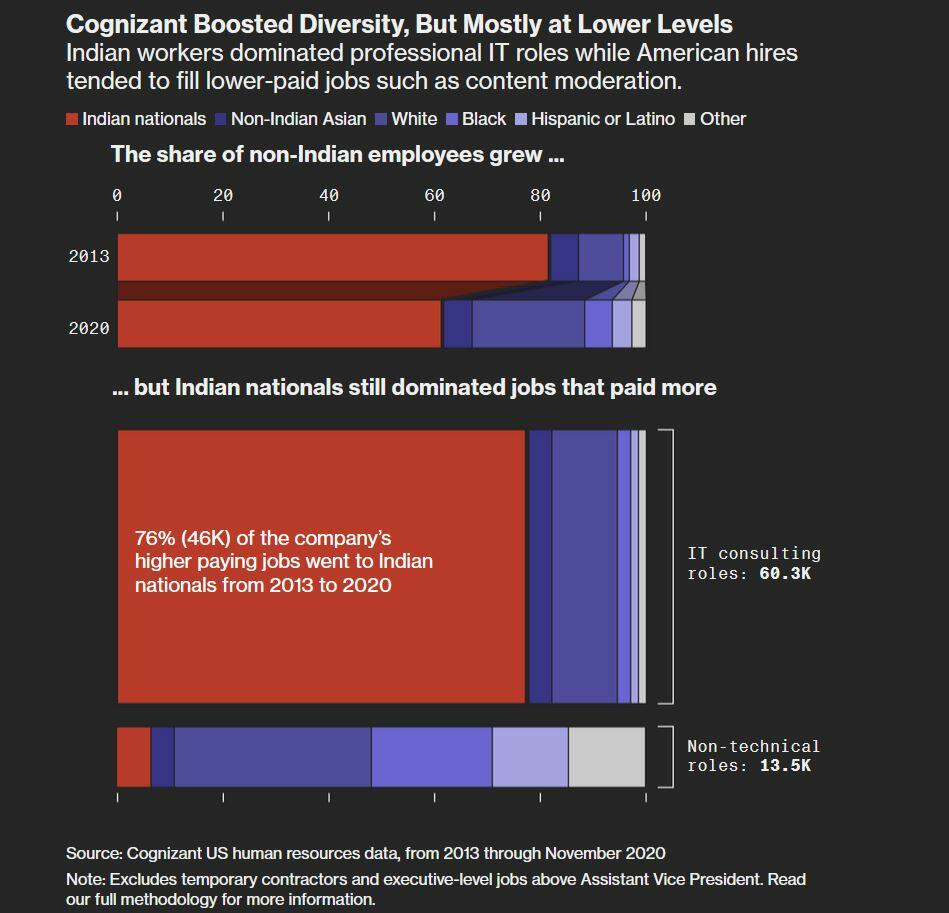
Meanwhile, a Bloomberg analysis of Cognizant’s internal data found that from 2013 – 2020:

  •     About two-thirds of the firm’s US-based employees were from India.
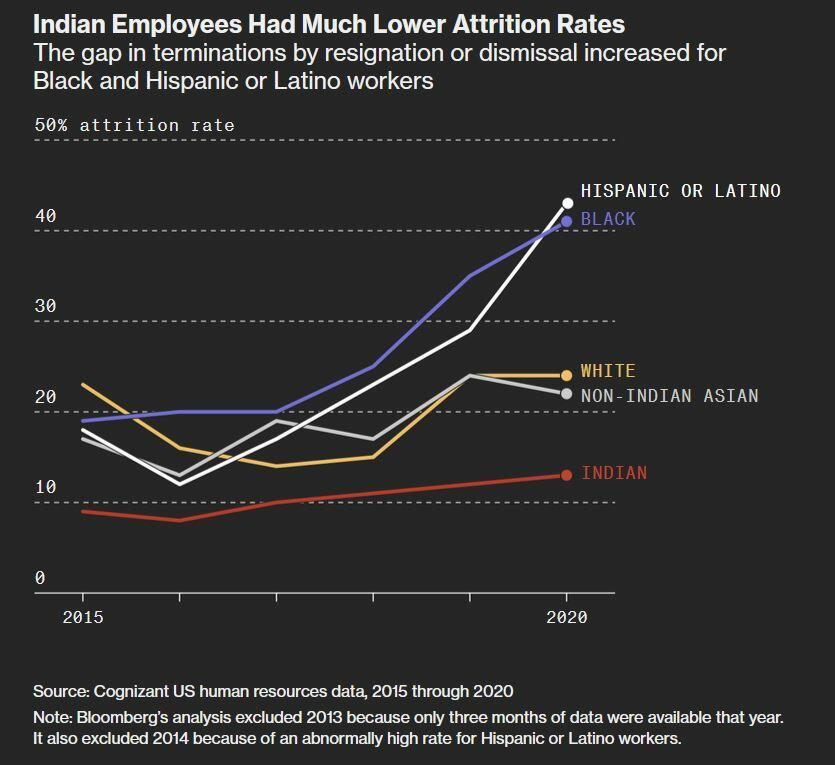
  •     American workers were twice as likely to have their employment “terminated” – by resignation or dismissal – as were their counterparts on visas.
  •     For Black and Hispanic or Latino workers, the annual rates of such terminations were about three times higher than for Indian nationals.

Cognizant’s DeMarris said Bloomberg’s analysis of terminations is flawed because it doesn’t include visa workers who left the company’s US operations “by choosing to return to their home country.” – something which the company’s lawyers raised in pretrial motions.

The judge in the case, however, ruled that Cognizant had refused to provide information about “what really happened” to such employees – i.e. whether their employment ended or not, and prevented the company from presenting the issue to the jury. DeMarrais wouldn’t say either way, however he did admit that 60% of the company’s US workforce is Asian – including Indian workers.

According to 2023 data the company submitted to the EEOC, however, 70% of Cognizant’s professional and managerial staff reporting to their Texas HQ identified as Asian.

The H-1B Visa Controversy

While the H-1B visa program was designed to allow U.S. employers to hire foreign specialists when qualified Americans are unavailable, it has often been leveraged to fill lower-level, less specialized positions at a lower cost.

Cognizant, along with other outsourcing giants, has faced criticism for this approach, which appears to prioritize cost reduction over the program’s original intent to supplement the American workforce with specialized skills not otherwise available.

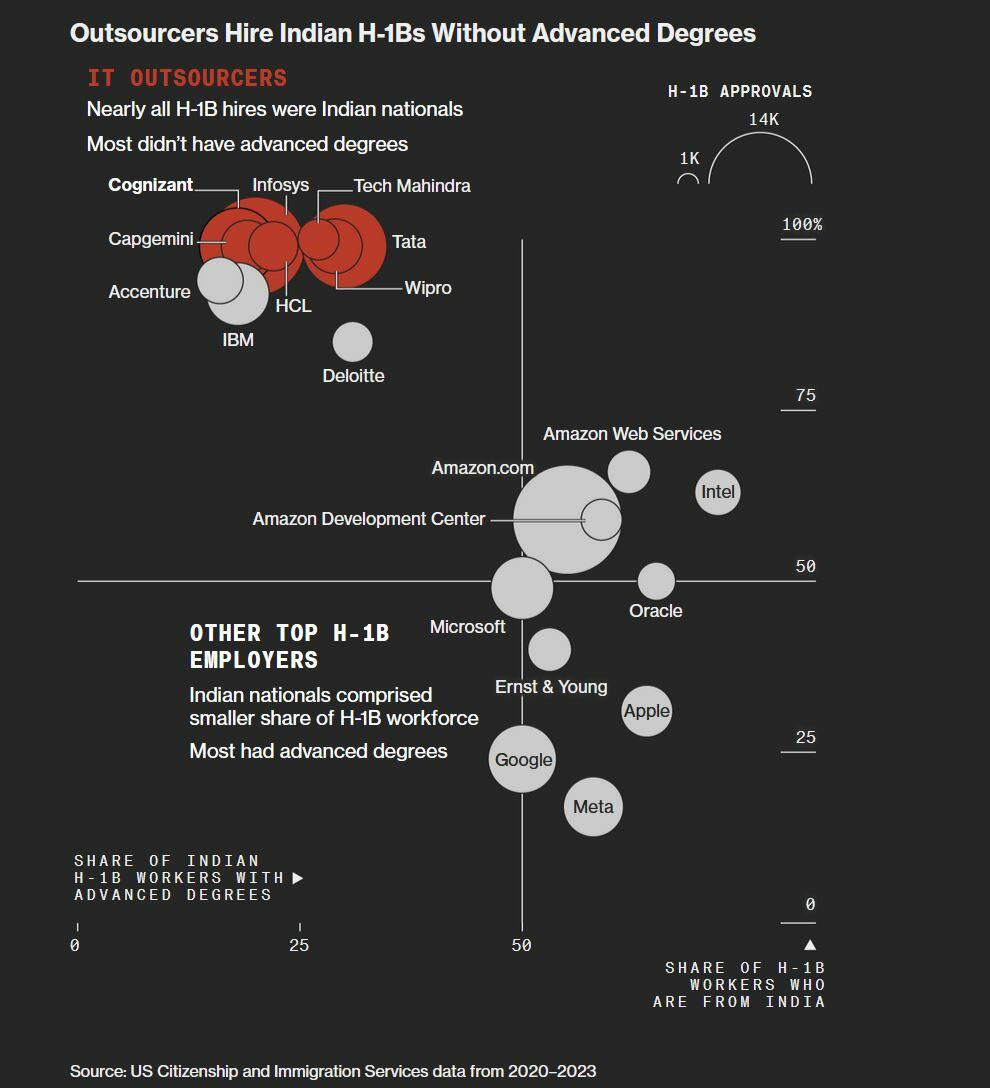
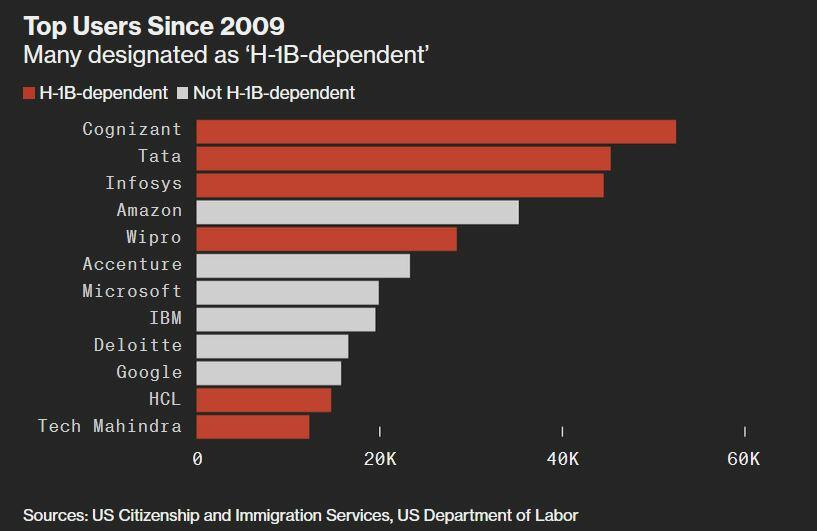
The US Department of Labor classifies Cognizant as an “H-1B-dependent” employer, which means more than 15% of its workers have the visas. Companies with that designation are required to attest that they’re not taking jobs from US workers – but only if they pay their visa workers less than $60,000 a year, a threshold that hasn’t been increased in two decades. Consequently, none of the outsourcing firms that have been deemed “H-1B-dependent” – Wipro Ltd, Infosys Ltd, Tata, Cognizant and HCL Technologies Ltd – is required to make the attestations. -Bloomberg

Meanwhile, former Cognizant employees say that the company’s use of Indian workers is nothing more than an attempt to reduce labor costs – an assertion DeMarrais refutes.

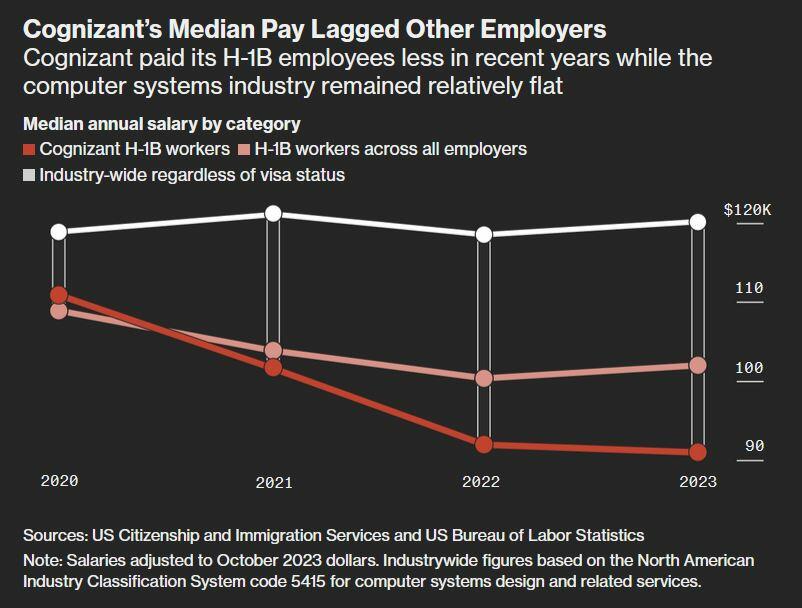
That said, the company has seen recent savings from its immigrant workers – whose median pay fell by 20% since 2000.

According to DeMarrais, “Cognizant complies with federal laws regarding pay for visa workers,” adding that the company “disagrees that any financial incentive exists to hire visa workers.”

Former employees, however, say that the company likes H-1B workers because they’ll take inconvenient or less-favorable assignments, and have a hard time jumping between companies because they must persuade new employers to go through the hassle of transferring their visas.

In response to the lawsuit, Cognizant has maintained that its hiring practices are justified by a shortage of suitable U.S. tech workers, asserting a commitment to equal employment opportunities. However, this stance has been met with skepticism, especially given the statistical evidence presented in court showing a pattern of employment terminations disproportionately affecting American employees.

Tyler Durden
Sun, 12/22/2024 – 22:45

Rich To Abandon Washington State As Governor Pushes For “Wealth Tax”

0
Rich To Abandon Washington State As Governor Pushes For “Wealth Tax”

Authored by Jonathan Turley,

Washington State’s unofficial state motto has long been “Al-ki” which means either “bye and bye” or “by and by” in Chinook. The former meaning now seems official as Gov. Jay Inslee pushes for a “wealth tax.” Wealthy citizens are already saying bye to the state in anticipation of what one Democratic billionaire recently called a “boneheaded” move.

The problem is that rich people can move. Unlike fixed assets like a mansion, they can take their wealth and taxes to other states without such laws.

The post from Senate Democrats supporting Senate Bill 5486 said, “The first $250 million of assessed value is exempted, meaning only the wealthiest people in Washington would pay the tax, including some of the wealthiest individuals in the world.”

I have previously written against wealth taxes from both constitutional and practical perspectives in the federal system. Sen. Elizabeth Warren (D., Mass.) has long been a proponent of wealth taxes and the Biden Administration supported the effort.

The Wharton Budget Model at the University of Pennsylvania found that Warren’s legislation would raise $2.7 trillion in revenue, but it would also reduce capital by 3.1%, depress average hourly wages by 1.2%, and reduce gross domestic product (GDP) by 1.2% in 2050.

It is part of an “eat the rich” pitch from liberal politicians and pundits.

When struggling in the 2020 Democratic presidential primaries, Sen. Elizabeth Warren (D-Mass.) pledged a wealth tax, declaring that she was coming after “the diamonds, the yachts, and the Rembrandts too.” Then-New York City Mayor Bill DeBlasio, another Democratic contender at the time, was barely registering in the polls when he promised that “we will tax the hell out of the wealthy.”

The federal constitutional problems are not barriers to the states. However, the effort to hammer the wealth has never worked for states or countries. France previously saw a massive exodus after it attempted to clip the most wealthy and had to reverse its policies.

Putting aside expected legal challenges, Democratic donor Nick Hanauer criticized state Democrats for the push and said he had already spoken to the wealthiest citizens about fleeing the state.

“Even if it clears the legal, implementation & other challenges, it’s unlikely to raise much [money] given every wealthy person I’ve spoken to in the last few days has said they will leave the state. I believe them. Thoughtful taxes don’t actually drive people away, boneheaded taxes do.”

That is the problem with eating the rich . . . they have to stay put to be eaten. These wealthy individuals are already willing to pay some of the highest taxes in blue states for income. However, a wealth tax would expose their property to what is likely to become an irresistible target for politicians unwilling to make tough budget choices.

Of course, Washington could follow California in seeking a retroactive tax. Rather than try to keep the most wealthy citizens, it could seek to make them pay to leave the state like a giant Venus Flytrap.

We previously discussed the push in California to impose a retroactive tax on the many citizens and companies fleeing that state due to its high taxes and other problems. Warren wants to do the same nationally. So, if businesses are fleeing the country due to these policies, they would have to essentially pay for the freedom in a type of captivity tax.  It is incredibly short-sighted.  They need these businesses and they will not be able to coerce them into staying by trying to make it more expensive to leave.

The wealth tax campaigns combine fiscal negligence with political opportunism. Rather than imposing budgetary restraints and reducing budgets, Democrats promise to fleece the superrich. This short-term appeal is likely to cost the state dearly as the wealthy leave for less predatorial states.

You can stay in Washington state and get hit with a wealth tax or you can “bye and bye” and move out of the way. It appears that millionaires are already training with a financial expert in Washington to move out of the way of the wealth tax:

*  *  *

Jonathan Turley is the Shapiro Professor of Public Interest Law at George Washington University. He is the author of “The Indispensable Right: Free Speech in an Age of Rage.”

Tyler Durden
Sun, 12/22/2024 – 22:10

Public Schools Using Multimillion Dollar Fees To Stop Parental FOIA Requests

0
Public Schools Using Multimillion Dollar Fees To Stop Parental FOIA Requests

Are you a parent wanting to know what exactly the local school is teaching your child?  Looking for official documentation of those lessons or the policies that motivated them? Better have millions of dollars in the piggy bank because that’s what these taxpayer funded institutions are demanding parents pay for access to public records through FOIA request.  

The impetus for the sudden interest from parents in school activities is obvious. Attempts by educators to indoctrinate children with covid propaganda, including lessons on “anti-vaxxers” and even giving children vaccines without parental consent led to a wave of parental participation in how their local schools operate.

Multiple state supreme courts have blocked parental lawsuits and set a precedent giving schools immunity from litigation, specifically concerning health related policies.  The only other option for citizens with children was to force their way into school board meetings and watch every move of the people involved. 

FOIA requests have become frequent because schools refused to offer lesson transparency.  In other words, school officials and teachers unions assert that they are not required to tell parents what their children are being taught, so the only way to know is to press the issue through access to public records. 

But getting a FOIA request fulfilled is becoming a nightmare – Schools continue to believe that they do not answer to the public and are using every loophole at their disposal to stop parents from getting the info they need.  One such loophole is the use of fees related to FOIA.  Legally, the fees are not allowed to surpass the actual costs required for employees to gather the requested information.  However, school officials are ignoring this requirement and hyperinflating the fees in order to dissuade parents from continuing FOIA. 

One such example is the Rochester Community School District in Michigan, which was recently forced to pay nearly $190,000 to parent Elena Dinverno as settlement for allegedly keeping a ‘dossier’ on her after she criticized their virtual learning policy during the covid padnemic.  District officials reportedly contacted Dinverno’s employer and used the dossier to get her fired. 

When other parents contacted the schools in the area for information, they were stonewalled.  Elizabeth Clair, mother to a seventh grader studying in the same district, decided to file a Freedom of Information Act request in 2022. She wanted to know what the school was doing to ‘stem future retaliation against parents’. 

The financial analyst had asked to see six months’ worth of emails that had the word ‘anti-retaliation’ in them.   In September 2022, Clair heard back from FOIA Coordinator Matthew McDaniel who told her that she would have to pay over $33 million for an employee, who was being paid $46 an hour, to review 21,514,288 emails.  The district also asked for a good faith deposit of $16,551,616.28 for the process to begin.  

Similar fees have also been used by schools to prevent parental access to information on woke propaganda lessons, including Critical Race Theory indoctrination, DEI lessons and classes on gender fluid theory.  The primary organizations blocking parental access are national teachers unions.  They are the driving force behind the fast spread of woke indoctrination in the US school system, with a greenlight from the Department of Education, of course.  

The underlying hypocrisy is that teachers and school districts claim they are doing nothing wrong, yet, if that was the case they would not feel the need to hide their activities behind litigation, intimidation and a corrupt FOIA fee process.  The bottom line is that parents have every right to know what schools are teaching their kids.  Their taxes pay the salaries of those educators.  Schools are not co-parents. 

A campaign to break up teachers unions is necessary, along with a complete reformation of the American public school system.  School choice legislation (which teachers unions viciously oppose) could also be used to take down schools that have been overrun by progressives, simply by giving parents easier access to alternatives.  In the new Trump era the public education system faces a reckoning that is well deserved. 

Until that day, parents may need pull their children out of these institutions and home school.  It’s the only way to be sure their kids aren’t being brainwashed.    

Tyler Durden
Sun, 12/22/2024 – 21:35