61.2 F
Chicago
Friday, October 9, 2026
Home Blog Page 2007

FAA Issues Temporary Flight Ban On Drones In Areas Across New Jersey

0
FAA Issues Temporary Flight Ban On Drones In Areas Across New Jersey

Authored by Jack Phillips via The Epoch Times,

The Federal Aviation Administration (FAA) issued a temporary ban on drone operations in multiple areas across New Jersey until next month unless operators are given special permission, amid heightened concerns over recent sightings of the unmanned vehicles.

Over the past several weeks, drones – sometimes swarms of them – have been spotted in New Jersey by local residents and police, drawing alarm from elected officials in the state. Some, including Reps. Jeff Van Drew (R-N.J.) and Chris Smith (R-N.J.), have called for the federal government to take down the drones, while federal officials say the drones don’t pose a threat to national security or public safety.

An Epoch Times review of the FAA’s Notice to Airmen (NOTAM) messages for New Jersey shows that the federal agency, starting from Dec. 18, has barred people from flying drones across most of the state, with some exceptions.

The ban went into effect on Dec. 18 and will end on Jan. 17, 2025, according to the messages.

“No UAS [unmanned aircraft system] operations are authorized in the areas covered by this NOTAM (except as described),” the FAA said on Dec. 18 for multiple regions across New Jersey.

Those exceptions include law enforcement, Homeland Security, firefighting, disaster response missions, drone operations in “support of event” operations, and commercial drone operations with a valid work reason. People who are operating drones for commercial purposes must also have an approved federal waiver while the ban is in effect, the notice said.

The FAA also recommended that operators check its NOTAMS section on a regular basis to see if “possible changes” were made by the agency.

An Epoch Times review of the NOTAMs shows that the temporary restrictions on drone flight operations were implemented in the following municipalities in the state: Bayonne, Branchburg, Bridgewater, Burlington, Camden, Cedar Grove, Clifton, Edison, Elizabeth, Evesham, Gloucester City, Hancocks Bridge, Hamilton, Harrison, Jersey City, Kearny, Metuchen, North Brunswick, Sewaren, South Brunswick, Westampton, and Winslow.

The restrictions also stipulate that no drone systems can operate within a distance of the airspace that is specified in each notice, including from the ground level up to 400 feet in height.

FAA rules allow drone operators to fly their unmanned aircraft at a maximum height of 400, although professional and commercial drones can fly above that range if they are within 400 feet of a building. But in the aforementioned areas in New Jersey, those rules are suspended until the FAA lifts the restrictions next month.

Several weeks ago, the FAA set up temporary flight restrictions for Bedminster and Picatinny Arsenal, which will remain in effect. President-elect Donald Trump has a golf course and residence in Bedminster, which he often visits.

U.S. agencies and the White House have said the spike in drone sightings does not pose national security risks and appear to be mostly aircraft, stars, or hobbyist drones, although several lawmakers have sounded the alarm that some drones may have nefarious intent. House Foreign Affairs Chairman Michael McCaul told reporters this week he believes some are being operated by the Chinese Communist Party, namely those seen near military bases.

Separately, the FBI’s Newark office warned people not to shoot at drones—or what they think are drones—with firearms or shine lasers at them.

The bureau warned that the practice “could be dangerous” and could lead to “deadly consequences if manned aircraft are targeted mistakenly,” because pilots may be blinded by the lasers.

Drone sightings have led to the shutdown of at least one military base in recent days, with Wright-Patterson Air Force Base in Ohio being closed temporarily over the past weekend, a spokesperson for the base told The Epoch Times on Tuesday. Another “drone incursion” was reported a few days later, on Dec. 17 and Dec. 18, a spokesperson for the base separately said.

On Wednesday, U.S. Marine Corps officials confirmed to The Epoch Times that a drone was spotted flying near Camp Pendleton base in Southern California between Dec. 9 and Dec. 15, stressing they posed “no threat” to ground or air operations.

Tyler Durden
Thu, 12/19/2024 – 11:25

Terror Threat? NYC Now Deploys “Largest Military Presence In Subways Since 9/11 Aftermath”

0
Terror Threat? NYC Now Deploys “Largest Military Presence In Subways Since 9/11 Aftermath”

New York Gov. Kathy Hochul beefed up the number of New York National Guard members patrolling NYC subway stations, marking the largest military presence in the city’s subway system since the aftermath of 9/11. This heightened security measure coincides with mounting public hysteria over unidentified drones in NJ-NY airspace and the rising threat of terrorism.   

On Wednseday, Gov. Hochul told reporters that 250 additional Guard members will join the already deployed 750 Guard members to combat rapes, murders, and robberies that plague NYC’s subway system.

In March, when we heard about the initial deployment, we asked…

“This marks the largest military presence in the city’s subway system since the aftermath of 9/11,” local paper Gothamist noted. 

Really need rifles to combat criminals in the subway? Seems like there has been an ongoing terror threat. 

The governor said, “I’ve heard from many people that the presence of the National Guard has made not just a physical difference, but a psychological difference in how they feel about safety. When people see a person in uniform, NYPD, MTA, transit, even our national Guard, they feel more secure than why it’s a deterrent to those who would break our laws and threaten other riders,” adding, “They see that sense of security that if they have a problem, there’s someone there to help.”

Hochul credited the increased military presence, first deployed in March, with making riders feel safer… 

Sure, increasing the number of Guard members to combat subway crime might make sense. But why not simply beef up NYPD patrols? Or the threat is much larger than NYPD officers can handle. There must be something the government is failing to tell folks in NYC – just like the feds went weeks with keeping the public in the dark about mystery drone flights in the region.

The most alarming issue NYC faces comes from disastrous Biden-Harris’ open borders that flooded NYC with upwards of 200,000 unvetted migrants, some of whom may be pre-trained terrorists. 

In the short term, the threats to the homeland are rising, as described by Dr. Mahmut Cengiz, an Associate Professor and Research Faculty with Terrorism, Transnational Crime and Corruption Center and the Schar School of Policy and Government at George Mason University: 

“Radicalized Hamas members may increasingly look to Al-Qaeda as a more viable destination for their operations, given Al-Qaeda’s growing capabilities and its strategic ties to Iran. This shift could significantly strengthen Al-Qaeda’s position in the region, making it an even more formidable threat to Western and Israeli interests in the future.” 

While Hochul claims beefing up the Guard’s presence to the highest levels since the aftermath of 9/11 is merely to combat crime, the expanded deployment is likely a response to a more significant threat than drug addicts and rapists, considering Democrats have transformed America into a “terrorist playground” with open borders. 

Tyler Durden
Thu, 12/19/2024 – 11:05

It’s Christmas (Market Chaos), All Over, Again

0
It’s Christmas (Market Chaos), All Over, Again

Submitted by QTR’s Fringe Finance

I just had a moment thinking about today’s action in the market that inspired me to pen a small note tonight, ahead of tomorrow’s regularly scheduled programming.

The market sold off in sharp fashion today after the Federal Reserve did exactly what almost everybody on Wall Street thought they would do: cut by 25 basis points.

Interestingly, the “whisper scenario” that started to bubble up to the surface over the last few days was whether the Fed might even wait on cutting, despite more than 95% of the Street unanimously believing a rate cut was set for this month. The last-minute concern came from inflation and producer price index data that all but indicated inflation is under control. In fact, progress on inflation appears to have stalled, while at the same time, the economy continues to slow and the job market follows suit.

Today gave me an immediate flashback to the week before Christmas in December 2018. Those who have been reading my blog for a long time know that I have harped endlessly on the fact that market crashes don’t usually occur until the Fed actually starts cutting rates. From September:

This situation is not unlike the one we have with the stock market and the economy now. In addition to the American consumer being tapped out, I’ve pointed out multiple times that the stock market has a history of finally cracking and giving way after cuts begin. In essence, cuts finally happening could wind up being the biggest “sell the news” event in recent memory.

In countless posts here, I have used 2018 as an example. When the market started to drop precipitously at the end of 2018, just days before Christmas, the Fed sped up rate cuts and blew more air back into a bubble that would continue up until today.

Remember just a few months ago when I was making fun of Jeremy Siegel for requesting an emergency 75 basis point cut during the yen carry trade chaos?

Well, the market is more than 15% higher than those lows right now and, despite today’s “chaos,” is still just a couple of percent off its all-time highs. The market is going to return nearly 30% this year unless all hell really breaks loose in the next 12 days.

Today stood out because, over the last week, including in an interview with Chris DeMuth that I’ll be releasing in a couple hours, the idea of leverage has haunted me.

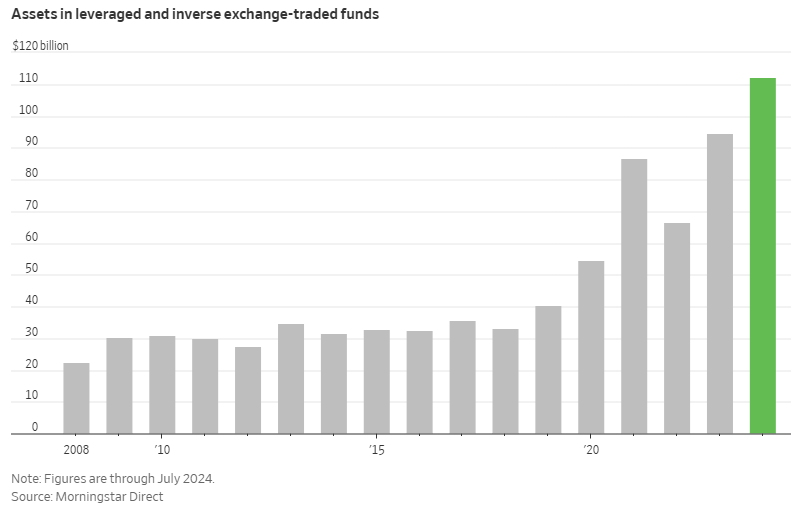
Perhaps it was Interactive Brokers founder Thomas Peterffy talking about the alarming amount of margin outstanding that he saw, or perhaps it was crypto’s recent skyrocket higher—as I pointed out in this piece just days ago—that alerted me to the idea of leverage. Day after day, I’ve watched Bitcoin skyrocket higher, fully aware that people are likely utilizing monster leverage to buy it. I’ve watched public companies sell stock to buy more Bitcoin. I’ve watched insane volume in the options market driving tech stocks higher and pushing the Shiller price-to-earnings ratio to almost 40x. As I discussed with Chris DeMuth, even equities now have leverage—with what feels like more 2X and 3X levered ETFs out there than there are underlying products for those ETFs to track.

Source: WSJ (and this was before the election, from August 2024)

The options market, levered ETFs, options on futures, and leverage on crypto are all tails that have been wagging the dog. As the market has moved higher, an entirely new generation of unsophisticated gambling addicts disguised as investors has pressed their bets all the way up. This includes every single person on social media who told you to “have fun staying poor” and every self-made millionaire you’ve seen posting on r/WallStreetBets as a result of buying options in tech stocks.

It’s these kinds of examples that make me ponder the question: Is it really different this time? But today, I’m remembering another lesson—that for every single time I’m exasperated at how euphoric things have become and mystified by the market’s resilience, there lies an even larger comeuppance and devastating lesson for those who get the market wrong.

Heading into the close today, we may have gotten a small taste of how much leverage the system has taken on. But whether or not we are even close to being fully liquidated remains to be seen (spoiler alert: hell no). One thing is for sure: we don’t have another rate cut planned to balance us out anytime soon, and Jerome Powell’s commentary today leaves the door open to a hawkish 2025. Of course, that won’t happen if the market seriously crashes before President Trump takes office.


🎄 HOLIDAY SALE – 50% OFF FOR LIFE: Using this entitles you to 50% off an annual subscription to Fringe Finance for life: Get 50% off forever


So once again, we are faced with the question: Is this simply another “BTFD” situation, just like every other plunge in markets has been for the last hundred years? Do we turn a blind eye to valuation and the economic reality here in the United States because the central bank won’t let markets crash for long? Or could it really be different this time, heading in the wrong direction for most market participants?

In some respects, I hope that I continue to be wrong with my prognostications about eventual disorder and chaos the likes of which we’ve never seen before. But the word leverage continues to haunt me – as does the idiom that unprecedented monetary policy, blowing an unprecedented bubble, will yield unprecedented results.

To close out 2024, we’re going to see how much it haunts the rest of the market.

Everybody is already ready to close the book on an extremely successful 25% or 30% year for markets. But as the old saying goes: “Stocks take the stairs up and the elevator down.” So if I were bullish, I’d be hoping and praying that today was just an aberration, because if it is the beginning of a bigger deleveraging or liquidity event, people’s historical recollection of 2024 may be starkly different than many have already written in the history books to close out the year.

There are 4 trading days until Christmas, and 9 trading days until 2025. Strap in.

QTR’s Disclaimer: Please read my full legal disclaimer on my About page here. This post represents my opinions only. In addition, please understand I am an idiot and often get things wrong and lose money. I may own or transact in any names mentioned in this piece at any time without warning. Contributor posts and aggregated posts have been hand selected by me, have not been fact checked and are the opinions of their authors. They are either submitted to QTR by their author, reprinted under a Creative Commons license with my best effort to uphold what the license asks, or with the permission of the author.

This is not a recommendation to buy or sell any stocks or securities, just my opinions. I often lose money on positions I trade/invest in. I may add any name mentioned in this article and sell any name mentioned in this piece at any time, without further warning. None of this is a solicitation to buy or sell securities. I may or may not own names I write about and are watching. Sometimes I’m bullish without owning things, sometimes I’m bearish and do own things. Just assume my positions could be exactly the opposite of what you think they are just in case. If I’m long I could quickly be short and vice versa. I won’t update my positions. All positions can change immediately as soon as I publish this, with or without notice and at any point I can be long, short or neutral on any position. You are on your own. Do not make decisions based on my blog. I exist on the fringe. The publisher does not guarantee the accuracy or completeness of the information provided in this page. These are not the opinions of any of my employers, partners, or associates. I did my best to be honest about my disclosures but can’t guarantee I am right; I write these posts after a couple beers sometimes. I edit after my posts are published because I’m impatient and lazy, so if you see a typo, check back in a half hour. Also, I just straight up get shit wrong a lot. I mention it twice because it’s that important.

Tyler Durden
Thu, 12/19/2024 – 10:45

Fani Flushed: Court Rules Fulton DA Disqualified From Trump ‘Election Interference’ Case

0
Fani Flushed: Court Rules Fulton DA Disqualified From Trump ‘Election Interference’ Case

Fulton County District Attorney Fani Willis has been disqualified from prosecuting President-elect Trump in his election interference case by a Georgia court of appeals.

While the court didn’t throw out Trump’s indictment, Willis and the assistant DAs working in her office were found to have “no authority to proceed” with the case.

The new ruling means that Georgia’s Prosecuting Attorneys’ Council will need to find another prosecutor to take over the case and decide whether to continue pursuing it – though if Willis decides to appeal to the state Supreme Court, that could be delayed.

Needless to say, CNN is crestfallen.

Developing…

Tyler Durden
Thu, 12/19/2024 – 10:37

Johnson Meets With Trump Team To Throw Federal Funding Hail Mary

0
Johnson Meets With Trump Team To Throw Federal Funding Hail Mary

With Friday’s government shutdown looming – and odds spiking after everyone figured out that the 1,547-page Continuing Resolution (CR) was full of Orwellian bullshit and other malarkey, House Speaker Mike Johnson (R-LA) has gone to Donald Trumps team with hat in hand.

The new plan will be a federal funding stopgap plan that includes disaster aid, pushing off the debt limit fight for two years, and a one-year farm bill extension, Politico reports, citing Republicans familiar with the discussions.

No word on how close this comes to a “clean” bill, or how much of the aforementioned bullshit is gone – such as funding the Global Engagement Center, shielding the Jan. 6 committee from subpoenas, and funding new biolabs, but we guess we’ll find out.

Also unknown is whether Democrats will support the plan.

But Trump had made an 11th hour public demand that any stopgap bill should deal with the debt limit. Trump’s team is pushing for at least a commitment to lift the debt limit before Jan. 20.

The level of disaster aid and whether it’s completely paid for is still unclear. The package would also likely include some additional economic aid for farmers, amid threats from rural Republicans to oppose any stopgap that doesn’t include the funding. -Politico

In a closed door meeting on Thursday, House Minority Leader Hakeem Jeffries (D-NY) told Democratic lawmakers: “Let us never negotiate out of fear. But let us never fear to negotiate,” citing JFK.

Polymarkets odds of a government shutdown went from 15% yesterday to 49% this morning.

According to Punchbowl News, here’s what happened, and what’s next;

At some point today, House Republicans and Democrats will likely have separate party meetings to chart their path forward. Democrats have announced their meeting for 9 a.m. We’ll talk more about them below.

But make no mistake — this is Johnson and Trump’s mess to solve. And we’re inching toward a shutdown as government funding runs out at midnight Friday.

Johnson was mostly MIA Wednesday, holed up in his Capitol office for hours without showing his face. Even the House GOP leadership team felt like they were being kept in the dark about what was happening.

Late in the evening, Johnson met with Vance, House Majority Leader Steve Scalise, Reps. Jim Jordan (R-Ohio), Chip Roy (R-Texas) and Mario Diaz-Balart (R-Fla.), Appropriations Committee Chair Tom Cole (R-Okla.) and Rules Committee Chair Michael Burgess (R-Texas). Jordan and Roy are conservative hardliners. Diaz-Balart is a senior appropriator.

As Scalise left around 10 p.m., he told reporters “We’re not there yet” when asked whether the debt-limit boost would be part of any new government-funding plan. “A lot of things have come up,” Scalise added.

A somewhat obvious play may be a funding bill with a two-year debt-limit extension. Why? Because Trump supports increasing the debt limit now. Given how volatile Trump was during his first term, there’s no guarantee he’ll do this again. (For what it’s worth, Biden administration officials estimate the debt limit won’t be reached until sometime next summer. GOP leaders were planning to handle it in a reconciliation bill).

Trump is giving Johnson cover for the time being. It’s limited, however. Because Trump, once again, has put his party in a bind. There are probably dozens of Republicans who have never voted for raising the debt ceiling. Now Trump is forcing them to do so.

Check back for updates.

Tyler Durden
Thu, 12/19/2024 – 10:25

Jobless Claims Improve, Q3 GDP Revised Higher, But Another Manufacturing Survey Collapses

0
Jobless Claims Improve, Q3 GDP Revised Higher, But Another Manufacturing Survey Collapses

Quite a mixed bag this morning…

On the good side, the final (3rd) read for Q3 GDP, US economic growth was revised up to 3.1% QoQ Annualized (from 2.8%)…

…with personal consumption also revised up to +3.7% (better than the 3.6% exp)…

On the not bad side (sorry to break the analogy), jobless claims tumbled back to earth last week – after spiking the prior week…

New York and Texas saw the largest drop in initial jobless claims…

Continuing claims dipped but holds still around the 1.9 million level (three year highs)…

On the bad side, The Philly Fed Manufacturing survey collapsed from -5.5 to -16.4 (dramatically worse than the +2.8 expected and far below even the worst analyst expectation)…

Source: Bloomberg

Future general activity expectations plunged 26 points to 30.7 in December (after jumping higher the previous two months), with future new orders and future shipments indexes both declined

Source: Bloomberg

On the ugly side, Prices Paid are surging while Prices Received are falling… that’s a disaster for corporate margins…

So strong GDP, strong labor force, but manufacturing is shaky….

…what will Powell do next?

Tyler Durden
Thu, 12/19/2024 – 08:43

Futures Rebound After Powell’s Hawkish Pivot Plunge

0
Futures Rebound After Powell’s Hawkish Pivot Plunge

US futures staged a partial recovery on Thursday after the worst Fed day rout since the 2013 Taper Tantrum, suggesting the selloff after the Federal Reserve’s hawkish pivot was overdone, even as stock indexes  in Europe and Asia retreated as equity markets caught up with post-Fed moves in the US. As of 8:00am, S&P futures advanced 0.5% following the US benchmark’s biggest lost for a scheduled Fed decision day since 2001. Nasdaq 100 contracts rose 0.4% even as chip leader Micron crashed 13% on disappointing guidance. 10Y yields rose again, hitting 4.53%, the highest level since May and nearly 100bps higher than the 2024 lows reached in September. The dollar retreated after soaring on Monday even as the yen cratered after the Bank of Japan left rates unchanged, disappointing a lot of generally clueless strategists who were expecting a hike. Oil and bitcoin also rebounded after sliding on Wednesday. Key events today include the latest GDP revision, initial and continuing claims, existing home sales as well as the October TIC flows data.

In premarket trading, Micron Technology tumbles 13% after its revenue forecast missed projections, hurt by sluggish demand for smartphones and personal computers. Baidu dropped 2% after Reuters reports that Apple is in talks with Tencent and Bytedance to integrate their AI models into iPhones sold in China. Here are some other notable premarket movers:

  • IonQ (IONQ) rises 5% as DA Davidson initiates with a buy recommendation, saying the stock “is positioning itself as the leader in quantum computing.”
  • Lamb Weston (LW) slides 20% after the French-fry supplier cut its sales and adjusted earnings per share guidance for the full year.
  • Lennar Corp. (LEN) drops 10% after the homebuilder forecast new orders for the first quarter that missed the average analyst estimate.
  • Sangamo Therapeutics (SGMO) rises 8% after the biotech reached a license agreement with Astellas, under which Sangamo will receive a $20 million upfront license fee.
  • Vertex Pharmaceuticals (VRTX) falls 12% after the the company’s nonaddictive drug helped patients with lower back pain in a mid-stage trial, but performed similar to a placebo, causing shares to decline.
  • Worthington Steel (WS) declines 5% after posting fiscal 2Q revenue that dropped 9% from the year-ago quarter, hurt by lower volumes and selling prices.

The Fed scaled back the number of 2025 cuts it sees from four to two as Powell said future easing would require fresh progress on inflation. The reaction interrupted this year’s stellar rally in US stocks, with S&P 500 still on course to notch more than 20% of gains due to optimism about artificial intelligence and the outlook for the economy under a Donald Trump administration. While the severity of Wednesday’ reaction showed that equity markets were less prepared for the Fed’s announcement, the shift implied that profits could be stronger than anticipated in the near term, said Florian Ielpo, head of macro research at Lombard Odier Investment Managers.

“What we have seen is a little cold water poured on what is otherwise a decent economy,” John Bilton, JPMorgan Asset Management’s head of global multi-asset strategy, told Bloomberg TV. “I am constructive about next year. If I’m a bull, I have got to love a healthy pullback.” Money markets are now pricing in fewer than two quarter-point reductions for the entirety of 2025, even less than what was implied in the Fed’s so-called dot plot on Wednesday. In the SOFR options market one large block trade placed Wednesday afternoon bet on the start of another hiking cycle next year.

Elsewhere in central banks, the Norges Bank stood pat while the Riksbank cut their policy rate by 25 bps, both as expected. The Norwegian krone and Swedish krona both held higher on the day. The pound dropped after the Bank of England’s dovish hold.

In Europe, the Stoxx 600 dropped 1.2% after the surprisingly hawkish Fed messaging sparked the biggest rout in US stocks since early August. Semiconductor stocks fall after Micron Technology posted disappointing revenue forecast. Here are some of the biggest movers on Thursday:

  • SoftwareOne shares rise as much as 13%, while Crayon drops 8.1% after the Swiss firm offers to buy the Norwegian IT services firm for a total of 144 kroner/share.
  • Pharming shares gain as much as 11%, the top performer in the Euronext Amsterdam AEX Health Care Index, after RBC analysts boosted their price target on the Dutch biopharma company to a Street high.
  • UK Water providers are among best performers in Europe on Thursday as industry regulator Ofwat announces details of a hike to bills. It’s a “major clearing event,” according to Barclays. Severn Trent is up as much as 2.1%, Pennon Group +3.5%.
  • Saipem shares gained, reversing earlier losses, as a consortium including the Italian construction and drilling services co. won an offshore contract in Nigeria, which Mediobanca expects will push year-to-date book-to-bill ratio to highest in a decade.
  • European semiconductor stocks slide in early Thursday trading, hit by a weak revenue outlook by memory chipmaker Micron and a Federal Reserve that signaled less urgency to lower rates further. ASML -3.7%, Infineon -3.8%, STMicro -4.7%.
  • Roche shares drop as much as 2.2% after a mid-stage study of the pharmaceutical company’s prasinezumab missed its primary endpoint.
  • Zurich Insurance Group falls as much as 2.3% after UBS cuts its recommendation to sell, saying the valuation leaves “limited margin for maneuver.” Munich Re is cut to neutral from buy and falls as much as 1.4%.
  • Netcompany slumps as much as 11% after Carnegie downgrades its rating on the Danish IT company to hold from buy.
  • Tessenderlo falls as much as 8% to its lowest intraday value in ten years, after the firm cut its adjusted Ebitda outlook for the full year, according to a statement. KBC says the valuation is still attractive due to the company’s sizable free cash flow.

Asian stocks recorded their biggest decline in over two month after the Federal Reserve dialed back expectations for rate cuts next year. The MSCI Asia Pacific Index fell as much as 1.7%, with TSMC, Samsung and Commonwealth Bank of Australia the biggest contributors to the decline. Benchmarks of South Korea and Australia were among the worst performers in the region. Indian stocks also dropped. China erased earlier declines amid expectations the government will maintain a loose policy in 2025.

“Investors need to be pretty agile, bob-and-weave as we always say,” Thomas Taw, head of APAC investment strategy at Blackrock, said in a Bloomberg TV interview. Interest rates are likely going to be higher for longer and the rest of market will take a little time to digest that, Taw said.

In FX, the Bloomberg Dollar Spot Index fell 0.1% after soaring on Wednesday; the yen tumbled 1.4% – just as we told our premium subscribers – after comments by BOJ Governor Kazuo Ueda cast doubt on whether the bank could hike interest rates in January, or even beyond that, instead signaling that more information is needed on wages and the policies of Donald Trump before making a decision. USD/JPY has topped 157, a level where the BOJ will have to start jawboning verbal intervention only this time nobody will believe it. In China, authorities ramped up support for the currency via its daily reference rate after the Fed’s caution over future rate cuts sent the offshore yuan to a fresh one-year low.

In rates, treasuries are mixed with the curve steeper as long-end yields rise an additional 3.5bp while front-end of the curve rallies as traders continue to digest Wednesday’s market reaction to the Fed policy announcement and revised dot-plot forecasts. The yield curve steepened further with 10-year borrowing costs rising another 1 bp to 4.52% while two-year yields pull back. Into the steepening move the 2s10s spread tops at the widest level since Sept. 26. Treasury 2-year yields richer by around 3bp on the day while 30-year yields rise around 3.5bp, steepening 2s10s and 5s30s spreads by 5.5bp and 4bp on the day; US 10-year yields trade around 4.535%, just off session highs and at cheapest levels since May. Gilts outperform Treasuries slightly after UK bonds rallied in the aftermath of Bank of England voted 6-3 to keep rates unchanged at 4.75%.

In commodities, oil held within its recent range as expectations for fewer interest-rate cuts by the Federal Reserve next year boosted the dollar. Gold staged a partial recovery after tumbling more than 2% in the previous session.

US economic data calendar includes 3Q GDP, December Philadelphia Fed business outlook, initial jobless claims (8:30am), November Leading index, existing home sales (10am), December Kansas City Fed manufacturing activity (11am) and October TIC flows (4pm)

Market Snapshot

  • S&P 500 futures up 0.4% to 5,894.50
  • STOXX Europe 600 down 1.2% to 508.26
  • MXAP down 1.6% to 180.90
  • MXAPJ down 1.4% to 572.89
  • Nikkei down 0.7% to 38,813.58
  • Topix down 0.2% to 2,713.83
  • Hang Seng Index down 0.6% to 19,752.51
  • Shanghai Composite down 0.4% to 3,370.03
  • Sensex down 1.2% to 79,248.34
  • Australia S&P/ASX 200 down 1.7% to 8,168.22
  • Kospi down 2.0% to 2,435.93
  • German 10Y yield up 4 bps at 2.29%
  • Euro up 0.6% to $1.0417
  • Brent Futures little changed at $73.35/bbl
  • Gold spot up 1.4% to $2,621.03
  • US Dollar Index down 0.16% to 107.85

Top Overnight News

  • A stopgap funding deal to keep the US government running collapsed following opposition from Trump and Elon Musk. The president-elect wants lawmakers to include an increase to the debt ceiling in the package — which needs to happen before the summer to avoid a default — so that it would be raised under Joe Biden’s watch. BBG
  • Trump said he’s totally against stopgap bill, and instead he and JD Vance called for a temporary funding bill without “Democrat giveaways” combined with an increase in the debt ceiling; Congress should debate the debt limit now: Fox News
  • The drive to force Justin Trudeau to step aside as Canadian PM gained momentum. About a third of the 153-person Liberal contingent in the House of Commons want him out, according to one lawmaker. BBG
  • The yen sank more than 1% as BOJ Governor Kazuo Ueda cast doubt on the prospect of a January rate hike after the central bank stood pat. Inflationary trends are slow and rate-setters want a fuller picture on wages and Donald Trump’s policies, he said. BBG
  • Chinese banks raised mortgage rates for the first time since 2021, according to research firm Data Motion. The average for buyers’ first homes in 42 big cities inched up to 3.08% in November from a record low of 3.05% in the previous month. BBG
  • Sweden’s Riksbank lowers its policy rate by 25bp to 2.5% (as expected), but the forward guidance is tweaked in a modestly hawkish direction, with the central bank saying it would “carefully evaluate the need for future rate adjustments” given recent easing measures (it said it’s possible that just one 25bp reduction occurs in H1). Riksbank
  • Norway’s Norges Bank kept its policy rate unchanged at 4.5% (as expected), but the forward guidance was somewhat dovish, with the central bank noting that “the time to begin easing monetary policy is soon approaching” (it said a rate reduction was likely to occur in March). Norges Bank
  • The BOE left the key rate unchanged at 4.75% as the Monetary Policy Committee voted 6-3 in favor of keeping its benchmark interest rate unchanged. The BOE signaled it will keep easing gradually in 2025 as a growing minority of officials set aside evidence of lingering inflation to back an immediate cut in borrowing costs. BBG
  • Israeli warplanes struck Houthi sites in Yemen’s capital and elsewhere in response to new missile attacks on Tel Aviv. BBG
  • Russian President Putin says he has not spoken to US President-elect Trump in four years but is ready to talk to him.
  • Morgan Stanley now expects the Fed to deliver two 25 bps rate cuts in 2025 (prev. forecast of three 25 bps cuts) following the December FOMC meeting, according to Reuters.
  • Apple said Meta has made 15 requests for potentially far-reaching access to Apple’s technology, and it raises concerns about users’ privacy and security as it made more requests than other firms: Reuters.
  • Apple is in talks with Tencent and ByteDance to integrate their AI models into iPhones sold in the Chinese market. RTRS
  • Indonesian President Prabowo has reportedly approved Apple’s $1bln investment plan: BBG
  • Teamsters launched the largest strike against Amazon in US history; workers to strike nationwide on Thursday: RTRS

A more detailed look at global markets courtesy of Newsquawk

APAC stocks traded with losses across the board amid the fallout from the hawkish Fed, as sentiment from Wall Street reverberated to the region. ASX 200 was pressured by its IT and gold sectors following the post-Fed tech downside and the slide in the yellow metal. Nikkei 225 pared some losses following the BoJ’s decision to maintain rates, but choppy trade was  seen thereafter ahead of Governor Ueda’s presser. Hang Seng and Shanghai Comp were both lower as China conformed to the broader post-Fed risk tone, with Fed Chair Powell also suggesting that some Fed members had taken a very preliminary step and incorporated conditional effects of coming policies in their projections – i.e. potential Trump tariffs.

Top Asian News

  • BoJ’s comprehensive review of past monetary easing steps highlighted it was deemed appropriate for the bank to continue conducting monetary policy with the aim of achieving the price stability target of 2% in a sustainable and stable manner. The bank stated that no specific measures should be excluded at this point when considering the future conduct of monetary policy. Regarding the effectiveness of monetary easing, it was noted that the quantitative degree of its effects remains uncertain compared with conventional monetary policy measures. While monetary easing influenced inflation expectations to some degree, it was not sufficiently effective in anchoring inflation at 2%. In terms of its impact on interest rates and the economy, long-term interest rates were reduced by approximately 1ppt since 2016. Large-scale monetary easing contributed to GDP growth by an estimated 1.3% to 1.8%, while its effect on CPI was between 0.5 and 0.7ppts. Note, the policy review was initiated by Ueda when he took office in April 2023.
  • Honda (7267 JT) and Nissan (7201 JT) talks to start as early as next week, according to Nikkei.
  • HKMA cut its base rate by 25bps to 4.75%, as expected in lockstep with the Fed.
  • South Korean Finance Minister said market-stabilising measures will be taken if volatility is deemed excessive; will prepare FX stability and liquidity measures in 2025 policy plan, according to Reuters.
  • South Korean financial regulator said it has asked banks to flexibly adjust FX transactions and loan maturity for firms, according to Reuters.
  • South Korea’s National Pension Service (NPS) and BOK to extend and expand their FX swap agreement, according to Reuters.
  • Indonesia’s central bank said it is committed to stabilising the IDR in case of any excessive volatility, according to Reuters.
  • Westpac now forecasts the RBNZ to cut the cash rate to 3.25% by May 2025 following the NZ GDP data.

European bourses began the session entirely in the red and have generally traversed worst levels throughout the morning, as traders react to the hawkish cut at the Fed which sparked considerable pressure in US stocks, in the prior trading day. European sectors are entirely in the red, with sentiment hit following the hawkish Fed decision. Optimised Personal Care fares better than peers, with Autos taking second spot. Technology is by far the clear underperformer today, with sentiment across chip-makers hit after Micron’s (-15.5% pre-market) guidance disappointed. US equity futures are modestly in positive territory, as the complex attempts to recoup some of the losses seen in the prior session after the hawkish cut delivered by the Fed, sent the S&P 500 tumbling by around 3%.

Top European News

  • Riksbank Rate 2.50% vs. Exp. 2.50% (Prev. 2.75%); if the outlook for inflation/activity remains unchanged, the rate could be cut again during H1-2025 (reiteration). Riksbank’s Thedeen says they are somewhere near the neutral rate, this justifies going forward a little more carefully. If the situation is unclear, will wait with rate changes.
  • Norwegian Key Policy Rate 4.50% (exp. 4.50%, prev. 4.50%); “the policy rate will most likely be reduced in March 2025”.
  • ECB’s Simkus says “best to keep consistent pace toward neutral; economic environment to determine terminal rate; downward direction monetary policy is clear; 1.75% is below the neutral rate. Inflation risks are balanced for the next year.”

BoJ Statement:

  • BoJ maintained its rate at 0.25% as expected, with an 8-1 vote; Board Member Tamura dissented, advocating for a 25bps hike to 0.50%. The central bank said inflation expectations were heightening moderately, and inflation was likely to reach a level generally consistent with the BoJ’s price target in the second half of the three-year projection period through fiscal 2026.
  • However, uncertainty regarding Japan’s economic and price outlook remains high, the central bank said. BoJ highlighted the need to scrutinise FX and market movements, along with their impact on Japan’s economy and prices.
  • BoJ said the impact of FX volatility on inflation could be greater than in the past due to changes in corporate wage and price-setting behaviour. Meanwhile, Japan’s economy was recovering moderately despite some weaknesses, with private consumption increasing.
  • Little action was seen outside of Japanese assets; USD/JPY and JGB futures saw upside, Nikkei trimmed some earlier losses.

Ueda Press conference

  • For the next rate hike need “one more notch” to decide on tightening. Want to see next year’s wage negotiation momentum.
  • Hard to say if the January outlook report and various info are sufficient as “one more notch”.
  • If they decide not to hike, will consider whether this decision is a safe one. A risk of falling behind the curve while waiting. Will consider the risks, if they were to decide to skip rate hike.
  • Need more data on the wage outlook; needs a little bit more information on wage trends.
  • Will need considerable time to see the full picture of wage hikes and Trump policies. Need to gauge the situation for quite a while.
  • Large picture on wage trends will become clearer in March and April. Will have to combine other data to make rate decisions until then.
  • In totality, Ueda’s remarks have a dovish and cautious skew with Ueda expressing a desire for “one more notch” to decide on tightening. Overall, the presser has increased the odds of rates being left unchanged at the January 24th meeting with focus on the March 19th gathering as details on Spring wage negotiations will have begun filtering through by then.

FX

  • USD is currently giving back some of yesterday’s FOMC-induced gains which saw DXY take out the 22nd Nov 2024 high (108.09), topping out at 108.25. DXY has since returned to a 107 handle. As the dust settles on the Fed decision, around 2bps of loosening is priced for the Fed’s January decision with the next 25bps cut not priced until July, whilst around 36bps of cuts is priced by end-2025.
  • EUR macro drivers are on the light side and as such impetus for EUR/USD is being mostly driven by the USD leg of the equation. EUR/USD is back on a 1.04 handle after slumping to a 1.0343 low in the aftermath of the FOMC. As for NY OpEx, there are a slew of notable clips due to roll off (details below).
  • JPY is by the far the underperformer across the G10 FX complex. USD/JPY was already driven higher following the hawkish Fed announcement, reaching a 154.86 peak. This extended to 155.44 following the BoJ’s decision to keep rates unchanged. Thereafter at Governor Ueda’s press conference, despite some initial firming of the JPY (as Ueda flagged the need to look at financial and FX markets), JPY then sharply depreciated as Ueda struck a cautious tone on future rate hikes. (details in the BoJ section above).
  • GBP near the top of the G10 leaderboard in the run-up to today’s BoE policy announcement which is expected to see the MPC hold rates at 4.75% via an 8-1 vote split on account of stubborn services inflation, elevated wage growth and a potential upcoming boost to growth from recent fiscal measures.
  • Antipodeans are both firmer vs. the USD in today’s session but very much down on the week after being dealt a hammer blow by yesterday’s FOMC policy decision. AUD/USD made a fresh YTD low overnight at 0.6200 to hit its lowest level since October 2022. NZD/USD also hit a fresh YTD low overnight at 0.5609 to trade at its lowest level since October 2022. Softness in NZD was also exacerbated by soft GDP metrics overnight.
  • EUR/SEK fell from 11.50 to an 11.4872 session low. SEK appreciation was in response to outside bets for 50bps unwinding (though, recent global hawkish action had already done this), phrasing around a “more tentative approach” to policy easing going forward and the elevated CPIF forecast for 2025.
  • Following the Norges Bank announcement to keep rates unchanged (as expected), there was some modest two-way reaction seen in EUR/NOK. Initially, the NOK came under pressure on the explicit nod to March before paring given MPR adjustments; as the dust settles, EUR/NOK is back towards pre-release levels of 11.7680.
  • PBoC set USD/CNY mid-point at 7.1911 vs exp. 7.3165 (prev. 7.1880)
  • BCB announces spot Dollar auction for December 19th; to offer up to USD 3bln.

Fixed Income

  • USTs continue to falter post-FOMC and now at a 108-26+ trough, just below Wednesday’s 108-27 base and at a contract low. Ahead, we look to the US quarterly PCE and GDP before Friday’s monthly metric ahead of blackout lifting and Fed speak potentially resuming. Amidst this, the 2yr, 5yr, 7yr announcement before a TIPS auction. The US yield curve is steepening and markedly so with the 10yr at a 4.53% peak, its highest since May when 4.69% printed, while the short-end is under pressure and the 2yr is pulling back from a 4.36% peak.
  • JGBs caught a bid following BoJ Governor Ueda’s press conference, in which he largely held a dovish tone and remained cautious on future hikes, noting he is waiting for “one more notch” on the wage data front. Currently higher by around 21 ticks, after rising to a 142.51 peak earlier.
  • Bunds were pressured, in-fitting with USTs as outlined above. Specifics for the bloc have been light, with focus thus far and ahead firmly on external drivers. Bunds down to a 133.79 trough overnight, for reference 132.00 is the contract low from November, but have since bounced back above 134.00 to a 134.23 peak taking impetus from JGBs.
  • Gilts gapped lower by 69 ticks before moving below the 92.00 handle to a 91.87 base, which is another contract low. The BoE is set to announce is policy decision today, where it is widely expected to keep rates unchanged, so focus will lie on any potential forward guidance.

Commodities

  • WTI and Brent are essentially flat; the complex came under post-FOMC, but has since attempted to recoup some of the losses as the Dollar strength fades a touch. Brent Feb 2025 currently at the today’s peak at USD 73.55/bbl.
  • Gold is firmer, lifted off USD 2584/oz post-Fed lows as the USD comes off highs and the risk tone in Europe sours. In terms of resistance levels the 21-DMA resides at USD 2650/oz before the 50-DMA at USD 2670/oz.
  • Base metals are in the red, alongside the slump in sentiment and the relatively strong Dollar; albeit, the USD strength has unwound a touch in the European morning. 3M LME copper has traversed the bottom end of the day’s USD 8,906.50-961.50/oz range thus far.
  • Sinopec Energy Outlook said China’s petroleum consumption is expected to peak in 2027 at up to 800mln metric tons, according to Reuters.
  • Indonesia is considering deep cuts to Nickel mining, according to Bloomberg; looking at reducing Nickel ore allowed to be mined in 2025 to 150mln tonnes

Geopolitics

  • “Israel-Hamas hostage deal not imminent”, according to Al Jazeera citing Jerusalem Post.
  • “IDF: Sirens sound in several areas of central Israel, including Tel Aviv”, according to Sky News Arabia.
  • Senior Israeli official said IDF attacked in Sana’a (Yemen), according to Axios’ Ravid.
  • Yemeni Houthi spokesperson posted “An important statement for the Yemeni armed forces in the coming hours.”, via X.
  • “Arab media reported attacks in the area of the Yemeni capital Sana’a, the port of al-Hodeidah in the west of the country, and an oil facility in the Ras al-Issa area”, according to Kann News.
  • “An adviser to the Houthis’ information ministry in Yemen: ‘The Israeli attacks will not go unanswered. We will attack facilities related to electricity and oil reservoirs deep inside the occupation entity'”, via Kan’s Kais on X.
  • Ukrainian drone attack on Russia’s Rostov region starts fire at Novoshakhtinsk oil refinery, according to the regional governor.
  • Swedish Police say they went on board the Yi Peng 3 vessel today at the invitation of Chinese authorities

US Event calendar

  • 08:30: 3Q GDP Annualized QoQ, est. 2.8%, prior 2.8%
    • 3Q Personal Consumption, est. 3.6%, prior 3.5%
    • 3Q GDP Price Index, est. 1.9%, prior 1.9%
    • 3Q Core PCE Price Index QoQ, est. 2.1%, prior 2.1%
  • 08:30: Dec. Initial Jobless Claims, est. 230,000, prior 242,000
    • Dec. Continuing Claims, est. 1.89m, prior 1.89m
  • 08:30: Dec. Philadelphia Fed Business Outl, est. 2.8, prior -5.5
  • 10:00: Nov. Home Resales with Condos, est. 4.08m, prior 3.96m
    • Nov. Existing Home Sales MoM, est. 3.0%, prior 3.4%
  • 10:00: Nov. Leading Index, est. -0.1%, prior -0.4%
  • 11:00: Dec. Kansas City Fed Manf. Activity, est. -1, prior -2
  • 16:00: Oct. Total Net TIC Flows

DB’s Jim Reid concludes the overnight wrap

There might only be 6 days until Christmas, but markets still had time for another surprise yesterday, as a hawkish cut from the Fed saw the S&P 500 (-2.95%) post its biggest decline after a Fed meeting since 2001. The moves led to a significant cross-asset slump, with the 10yr Treasury yield (+11.5bps) closing above 4.5% for the first time since May, whilst the VIX index of volatility surged +11.75pts to 27.62pts, which is its highest since the market turmoil back in the summer. And that’s before we get onto the mounting likelihood of a US government shutdown, as well as a major selloff in Brazil amidst growing fiscal concerns there.

Starting with the Fed, they delivered a widely expected 25bp cut, taking the fed funds rate down to the 4.25-4.50% range. But aside from the decision itself, just about every other aspect leant in a more hawkish direction than expected. For instance, the latest dot plot only pencilled in 50bps of cuts for 2025, down from 100bps in September and less than the 75bps expected by consensus. Similarly, the long-run median dot moved up to 3.0%, whilst the inflation projections saw a visible upgrade, with 2025 PCE inflation now seen at 2.5% (vs. 2.1% before). Indeed, most FOMC members now see the risks to core PCE as tilted to the upside, and Cleveland Fed President Hammack voted against the rate cut altogether.

That hawkish tone was followed up by Chair Powell in the press conference, who said that the latest rate cut “was a closer call”, and they were “at a point at which it would be appropriate to slow the pace of rate cuts”. In particular, Powell repeatedly noted that they need to see more “progress on inflation” to cut rates further, and said they were “not going to settle” for inflation staying above 2%. Our US economists see yesterday’s meeting as reinforcing their baseline view that a skip at the January meeting will likely turn into an extended pause in 2025. See their full reaction here .

In terms of the market reaction, there was a sizeable repricing in rate expectations, with the rate priced in for the Fed’s December 2025 meeting up +14.5bps yesterday to 4.01%. In turn, that led Treasuries to sell off across the curve, with 2yr yields up +11.0bps to 4.35% and 10yr yields +11.5bps to 4.51%, their highest level since late May. In the equity space, the S&P 500 fell -2.95%, marking its worst Fed decision day since 2001, with all of its 24 industry groups lower on the day. That was driven by even bigger losses for the Magnificent 7 (-4.12%), and the small-cap Russell 2000 (-4.39%) underperformed as well. The notable beneficiary of the Fed’s hawkishness was the US dollar, with the dollar index up +1.00% and the euro closing below $1.04 for the first time in two years.

Whilst the Fed was dominating attention yesterday, investors have also been alert to the growing risks of a US government shutdown later this week. That came as Donald Trump and JD Vance said that they opposed the continuing resolution that House Speaker Mike Johnson had negotiated with Democrats, which would fund the government until March. Instead, they called for “a streamlined spending bill” and for Republicans in Congress to push for an increase in the debt ceiling before the end of Biden’s term. On Polymarket, that’s seen the likelihood of a government shutdown before year-end rise from 10% just 24 hours ago to 53% now. The bill would have kept funding going until mid-March, as funding is currently set to run out at the end of this week.

Overnight, there’s been no let up in the newsflow, with the Bank of Japan leaving its policy rate steady at 0.25%. It was an 8-1 vote, with Naoki Tamura voting for a 25bp hike given his view that “risks to prices had become more skewed to the upside”. However, the tone remained cautious generally, and the statement said that “there remain high uncertainties surrounding Japan’s economic activity and prices”. And with the Fed becoming more hawkish and the BoJ staying on hold, that’s seen the Japanese Yen weaken to 155.33 against the US Dollar this morning.

More broadly, equity markets in Asia have lost ground following the Fed’s decision, with declines for the Nikkei (-0.51%), the Hang Seng (-0.68%), the Shanghai Comp (-0.45%) and the KOSPI (-1.69%). Australian markets have seen a significant slump too, with their 10yr government bond yield up +13.1bps overnight, whilst the S&P/ASX 200 is down -1.70%. The one exception to this negative pattern is the CSI 300, which is up +0.13% this morning. And looking forward, US equity futures have stabilised after the Fed-induced decline yesterday, with those on the S&P 500 up +0.11%.

Elsewhere, the other main development yesterday was a deepening selloff in Brazilian markets. That’s been driven by concerns over the country’s deficit, which our economists see at 8% over the next couple of years, and that’s led in turn to a major slump in the currency. The government are seeking to push through some spending cuts, although lawmakers in lower house watered down some of the package on Tuesday, which added to questions about how much would actually get passed.

That backdrop led to significant losses for Brazilian assets yesterday, with further declines amidst the post-FOMC risk-off mood. The Brazilian Real declined -2.87% to an all-time low against the US Dollar, bringing its losses over 2024 so far to -22.9%. That was echoed across other asset classes, and the Ibovespa equity index fell -3.15% in its worst daily performance since November 2022. In the meantime, 10yr yields on local currency debt were up +45.6bps to their highest level since 2016, whilst those on the country’s USD government debt were up +30.2bps.

Looking forward, central banks will stay in the spotlight today, as the Bank of England will announce their latest decision at 12pm London time. In terms of the decision itself, they’re widely expected to keep rates unchanged, with Bank Rate staying at 4.75%. And looking forward, our UK economist doesn’t expect any changes to the key message, which is that a gradual removal of policy restraint is appropriate, while policy will need to stay restrictive for sufficiently long until inflation risks dissipate further. For more details, see his full preview here.

Ahead of the BoE’s decision, UK gilts remained under pressure, and the 10yr spread over bunds widened to 231bps. That’s its widest level since 1990, and comes after the November CPI showed a fresh pickup in inflation. For instance, headline inflation was up to an 8-month high of +2.6%, and core inflation also moved higher for a second month running to +3.5%. But even though the pickup was broadly expected, the moves cemented the view that the UK data was headed in a more stagflationary direction, and the 10yr gilt yield (+3.4bps) closed at a 4.56%, within 1bp of its one-year high seen in early November.

Elsewhere in Europe, markets put in a more robust performance before the Fed, with the STOXX 600 (+0.15%) picking up after four consecutive declines. That was echoed among the major equity indices, with modest gains for the CAC 40 (+0.26%) and the FTSE MIB (+0.25%), although the German DAX (-0.02%) lost a bit of ground. For sovereign bonds, the story was a similar one of modest rises in yields, with those on 10yr bunds (+1.5bps), OATs (+1.4bps) and BTPs (+1.8bps) all moving higher. However, both equity and bond futures are pointing lower in Europe after the Fed, with those on the DAX down -1.29% this morning.

Finally, there wasn’t much other data yesterday, although we did a mixed report on the US housing market. On the downside, housing starts fell to an annualised rate of 1.289m in November (vs. 1.345m expected), which is their weakest level in four months. But on the upside, building permits moved up to an annualised rate of 1.505m (vs. 1.430m expected), which is their strongest in nine months. With that in hand, the Atlanta Fed’s GDPNow estimate for Q4 ticked slightly higher, and now sees an annualised growth rate of 3.2%.

To the day ahead now, and one of the main highlights will be the Bank of England’s latest policy decision. Otherwise, US data releases include the weekly initial jobless claims, existing home sales for November, the Conference Board’s leading index for November, and the third estimate of Q3 GDP. Finally, we’ll get earnings releases from Nike and FedEx.


Tyler Durden
Thu, 12/19/2024 – 08:23

Global Conditions Portend A Catch-Down In America

0
Global Conditions Portend A Catch-Down In America

Authored by Michael Lebowitz via RealInvestmentAdvice.com,

For $20,000, you can buy a global airline pass to see the world. Or, for the low price of free, you can take a quick trip with us worldwide. Unfortunately, our global trip is not as exciting as an around-the-world pass. Still, it may enlighten you about some economic struggles abroad. Moreover, why, in time, they may be problematic for the US.

China, Britain, Europe, and other countries and regions are experiencing sluggish economic growth and, in some cases, contraction. At the same time, the US continues its strong post-pandemic growth pace. Has the US economy diverged from the global economy, or are a lot of economic canaries in coalmines keeling over and warning the US is soon to catch down?

Globalization

Before summarizing economic conditions in a few major economies, it’s worth appreciating that globalization has tightly bonded the economic activity of the US and developed nation’s economies.

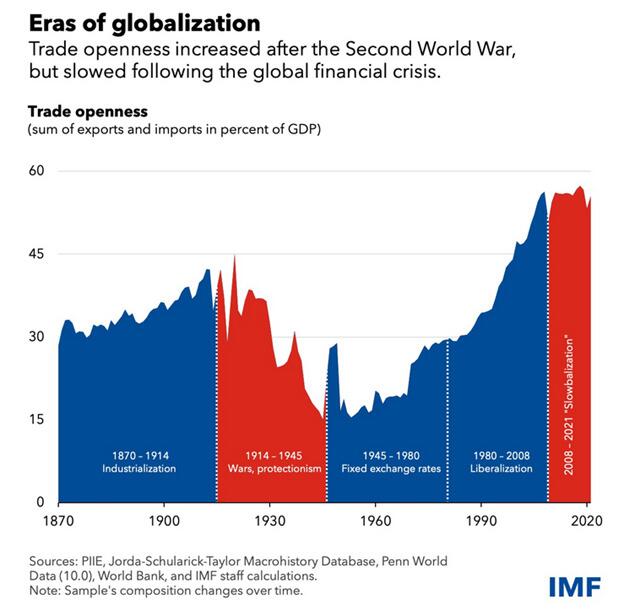
The graph below, courtesy of the IMF, shows that the amount of international trade as a percentage of global GDP is at the highest level since at least 1870. We venture to say it’s the highest ever. The recent upward trend starting in 1944 is the result of the dollar becoming the world’s reserve currency.

Based on data from the World Bank, the following graph shows powerful statistical economic relationships between the US and other nations and economic regions. The number beside each country in the X-axis is their global GDP rank.

Other than Japan, the correlation between the real GDP of the US and that of every nation and region shown has increased over the last ten years compared to the prior twelve-year period. Equally important, the relationship between the US economy and the European Union, OECD nations, and the rest of the world is incredibly high. Those three aggregates exclude the US in their computations.

The graph below further highlights the strong relationships that globalization has brought upon US economic activity.

Regression Analysis Confirms Economic Globalization

Lastly, we created a multiple regression model to predict US real GDP based on the real GDP of the ten nations we highlighted in the prior graphs. Our model has an R-square of .886, denoting a significant statistical relationship.

The graph below compares the US real GDP versus the model’s output. The difference between the US GDP and the model averages slightly less than half a percent annually and doesn’t vary beyond +/- 1%.

The US economy is tied at the hip to the global economy and economies of leading developed economies. Very short-term divergences occur, but barring a change to the world trade order or another round of massive US stimulus, it’s improbable that recent divergences will last.

Note: The data for the following graphs is through 2023; thus, it does not include 2024. Our discussion of economic divergence between the US and other nations primarily pertains to more recent data.

Britain

Britain’s real GDP, as shown below, courtesy of the BBC, has contracted for two months in a row. Furthermore, it has shown no growth since June.

Personal consumption is a contributor to weak UK growth. Per Bloomberg:

A big drag on the economy was consumer-facing services, where output tumbled 0.6%, including a 2% decline in pubs and restaurants. It suggests that households tightened their belts, possibly fearing a squeeze from the budget. 

Consumer sentiment in Britain is poor. Its citizens are worried about above-average inflation and high interest rates. More recently, consumers appear to be pulling back due to increased proposed fiscal spending that will be funded with higher taxes and borrowing.

As with most nations, the fear of US tariffs weighs on UK consumer and business sentiment.

Lastly, it is worth noting that Britain’s real GDP growth in 2023 was a mere 0.10%. The nation has barely grown in two years!

Europe

The European Union faces challenges similar to those faced by Britain. Europe’s economic powerhouse, Germany, saw its real GDP decline last year, and contraction will likely continue this year.

One large differentiator between paltry European growth and growth in the US is in the fiscal response to the pandemic. The US flooded its economy with stimulus during and well after the initial sting of the pandemic. Consumers were provided with funds and many other financial benefits, and the CHIPS Act fed infrastructure and manufacturing projects, further bolstering growth. While the European Union and its nations also stimulated economic activity, the amounts were much less. Per the Atlantic:

The UK and Germany spent more than $500 billion. France spent $235 billion, Italy $216 billion. But the United States was in a league of its own, spending an astonishing $5 trillion on pandemic relief. That’s more, even in today’s dollars, than America spent on the New Deal and World War II combined—and, crucially, it’s more than double what most European countries spent on pandemic relief relative to the sizes of their respective economies.

Further, consider that Russia’s invasion of Ukraine and the impact it has on energy prices is also to blame for sluggish growth along with a host of other political and social factors.

China

Before the financial crisis, China had grown its economy by 10-15% yearly. While remarkable, it was unsustainable. Since then, growth has slowed substantially, albeit it’s still high compared to most developed nations. From 2020 to 2023, its real GDP growth was a relatively low 4.1%. It is expected to remain below 5% for the remainder of this year and next year.

The nation is dealing with a credit hangover following decades of significant economic growth driven partly by massive infrastructure investment. Vacant cities and properties across China are leading to a decline in real estate activity, which once accounted for a significant portion of GDP. Construction and related industries have been negatively impacted, as has consumer sentiment.

Simultaneously, the country has a shrinking workforce and an aging population. Moreover, it faces weaker global export demand amid ongoing geopolitical tensions, particularly with the US. Trade restrictions and the post-pandemic redirection of global supply chains away from Chinese manufacturing have negatively impacted key industrial sectors. Lastly, business confidence is eroding due to recent government policies, including regulatory crackdowns on tech firms and mixed signals on private-sector stimulus.

High levels of corporate debt and local government borrowing have further limited fiscal flexibility, making the government’s recent spate of stimulus packages much less effective than prior stimulus. China’s bond investors are taking notice. As shown below, its ten-year sovereign bond yield is now below 2%, the lowest in history.

China, once the world’s marginal driver of economic growth, is exporting their economic slowdown across the globe.

Canada

We shared the following paragraph and graph from our recent Commentary on Canada:

On Wednesday, the Bank of Canada cut its key benchmark rate by 50bps. They have now cut by 150 bps in 2024, compared to what will likely be 100 bps for the Fed after next week’s meeting. Unlike the Fed, Canada’s central bank is fighting off a recession. Canadian real GDP for the last four quarters has been below 1%. Its unemployment rate troughed in January 2022 at a fifty-year low of 4.9%. However, since then, it has risen steadily to 6.8%. The Canadian dollar has been trading at its lowest levels compared to the US dollar since 2016 (excluding the pandemic).

We should pay attention because the US economy and Canada are extremely closely linked despite being different. The biggest differentiator is that Canada’s economy relies much more heavily on commodities and manufacturing, while the US is more service-sector-oriented. Despite the differences, there has been a historically tight economic relationship between Canada and the US, as shown below.

High interest rates and sluggish oil prices weigh on Canada’s economic growth. Unlike China, they are experiencing population growth. However, its growth masks economic weakness. Per The Fraser Institute:

Canada’s recent growth record has received so much attention because it is, quite simply, abysmal. One recent analysis noted that due to weak total growth accompanied by a surging population, Canada has actually been in a “per capita” recession for some time. Per-person GDP has declined by 3.4 percent in inflation-adjusted terms between the second quarter of 2022 and the final quarter of 2023.

Summary

We could summarize economic conditions in other developed countries, and in almost all cases, we would provide you with themes similar to those we share above. The takeaway is not necessarily the particulars of each country and region but the recent rare economic growth divergence between the US and the world.

The enormous pandemic and post-pandemic stimulus by the US government is a key factor explaining the difference. The US provided more stimulus on a GDP basis than all major developed economies. The stimulus was in the form of emergency payments, which had limited duration benefits. However, it also came in longer-lasting forms like the CHIPS Act and loan forgiveness programs, which continues to bolster growth.

Indeed, significant federal deficit spending has helped offset much higher interest rates and stubborn inflation. Consumer confidence remains weary, but consumers continue to spend as the labor markets are relatively healthy. While all may seem well, we are growing concerned that headwinds to growth, including the global economy and high interest rates, will weigh on the US economy.  

As we wrote earlier, “Very short-term divergences occur, but barring a change to the world trade order or another round of massive US stimulus, it’s improbable that recent divergences will last.”

It’s more likely the US economy will catch down to the global economy!

Tyler Durden
Thu, 12/19/2024 – 08:10

Pound Slides After “Dovish Hold” By Bank of England

0
Pound Slides After “Dovish Hold” By Bank of England

One day after the Fed’s furiously hawkish pivot, which prompted many to ask why cut rates if Powell will just complain about the risk of rising inflation (thanks to his bizarro jumbo rate cut just three months ago which it is now clear was entirely meant to usher in president Kamala), moments ago the Bank of England kept interest rates unchanged at 4.75%, as expected, but with more policymakers voting for a cut than had been expected, one which sent the pound lower as this was seen as a dovish hold as three members wanted a cut, while the market expected an 8-1 split.

The Monetary Policy Committee’s decision, which was in line with economists’ forecasts, came a day after the latest data showed that UK inflation rose to 2.6% last month from 2.3% in October.

The BoE cut rates by a quarter point at its previous meeting in November, but signalled at the time that another cut was unlikely until 2025. It has cut rates twice in 2024.

The majority of rate-setters said the recent increase in wage and price growth had “added to the risk of inflation persistence”. But three out of the nine MPC members, deputy governor Dave Ramsden, Alan Taylor and Swati Dhingra , voted for a quarter-point reduction because of sluggish demand and a weaker labor market. For the market, which was expecting just 1 dissenter, this was seen as a rather dovish twist.

The BOE said that a “gradual approach” on rate cuts remains right and they can’t commit to when or by how much rates will be cut in 2025. It said the labor market is coming back into balance. However, the bulk of the committee continued to worry that inflationary pressures were resolving only slowly and in fact headline inflation is expected to rise slightly. The overall guidance remained that policy needed to stay restrictive for sufficiently long to bring inflation back to target.

“The magnitude and direction of any such impacts would depend on a range of factors that were at present unknown, including the total package of economic policies to be delivered in the United States, their timing and any subsequent policy responses from other countries” the bank noted.

They said that risks around trade policy uncertainty have “increased materially” given the proposals from the incoming Trump administration on tariffs.

The minutes to the BOE December meeting showed that staff now expect zero growth in the final quarter of this year, weaker than forecast in November, reaffirming the dovish stance.

“Most indicators of UK near-term activity have declined,” the bank said on Friday.

It added that risks to global growth and inflation from geopolitical tensions and trade policy uncertainty had “increased materially” — an apparent reference to US President-elect Donald Trump’s plans to increase tariffs on imports to the US.

The BoE also continues to be skeptical about official wage data – on which markets placed huge emphasis earlier in the week. It said while earnings data did pick up in October, the official number “has tended to be more volatile than other wage indicators”. In fact, it said the information from its regional agents suggested 2025 settlements are likely to be in the 3-4% range (vs. ONS data at north of 5% in October).

In terms of forward guidance the MPC stuck to its previous message of gradual approach to easing. In terms of changes in assessment from the last meeting, the Committee noted that while inflation outcomes have been slightly higher than expected, it now judges that the labour market is “broadly in balance”. On the activity side, the MPC now expects 0% q/q GDP growth in Q4, below the November MPR projections

To re-iterate our call assumes that following a pause today, the Bank will cut again (-25bp) in February. Overall, we expect the Bank to cut with quarterly frequency in H1-25 before accelerating to cutting at every meeting in H2-25 brining Bank Rate to 3.25% by end-25.

The pound dipped to $1.259 after the BoE’s decision, though it was still up 0.2% on the day.

The yield on rate-sensitive two-year government bonds fell slightly to 4.46 per cent, flat on the day, with analysts citing the unexpectedly high number of dissents within the MPC.

Traders also have been reining in expectations of cuts next year. Immediately before Thursday’s MPC meeting, investors were betting on two quarter-point cuts next year. In October they had expected four.

Tyler Durden
Thu, 12/19/2024 – 07:43

Houthis Claim Hypersonic Missile Strike On Israel, Prompting IDF Airstrikes On Yemen

0
Houthis Claim Hypersonic Missile Strike On Israel, Prompting IDF Airstrikes On Yemen

Houthi spokesman Yahya Saree claimed on X that Iran-backed Yemeni Armed Forces launched two hypersonic ballistic missiles targeting military sites in the Jaffa region near Tel Aviv. Israel reported intercepting the missile strike, which was followed hours later by Israeli fighter jets pounding key infrastructure in Yemen. 

“Statement of the Yemeni Armed Forces regarding the implementation of a qualitative military operation targeting two qualitative and sensitive military targets of the Israeli enemy in the occupied Jaffa region with two hypersonic ballistic missiles of the Palestine 2 type,” Saree wrote on X (translated via Google). 

Israel’s military announced the interception of a missile launched from Yemen: “Rocket and missile sirens were sounded following the possibility of falling debris from the interception,” adding that a missile had been intercepted before entering Israeli airspace. 

“I urge the leaders of the Houthi organization to see, to understand and to remember: whoever raises a hand against the state of Israel, his hand will be cut off,” Israeli Defense Minister Israel Katz said, referring to the retaliatory strikes. 

AP News reported that Israeli retaliatory airstrikes were in “two waves of strikes in a preplanned operation that began early Thursday and involved 14 fighter jets.”

“The military said the first wave of strikes targeted Houthi infrastructure at the ports of Hodeida, Salif and the Ras Isa oil terminal on the Red Sea,” AP noted, adding, “Then, in a second wave of strikes, the military said its fighter jets targeted Houthi energy infrastructure in Sanaa.”

US forces were active in the skies of Yemen to start the week, launching a series of strikes on the Houthi rebels, according to US Central Command. 

Thursday’s exchange of strikes between the Iranian-backed Houthis and Israel implies that Tehran’s self-described “Axis of Resistance” remains active in the region, with the potential to escalate further. The rebels maintain a firm hold on the critical maritime chokepoint in the southern Red Sea.

In the short term, the threats to the homeland are rising, as described by Dr. Mahmut Cengiz, an Associate Professor and Research Faculty with Terrorism, Transnational Crime and Corruption Center and the Schar School of Policy and Government at George Mason University: 

“Radicalized Hamas members may increasingly look to Al-Qaeda as a more viable destination for their operations, given Al-Qaeda’s growing capabilities and its strategic ties to Iran. This shift could significantly strengthen Al-Qaeda’s position in the region, making it an even more formidable threat to Western and Israeli interests in the future.” 

Given the turmoil in the Middle East and the Biden-Harris administration’s disastrous handling of the region, the risk of a domestic attack is undoubtedly rising. Open borders have allowed an invasion of illegal aliens, some of whom may be pre-trained terrorists. Voters gave Trump a clear mandate: restore national security.

Tyler Durden
Thu, 12/19/2024 – 07:20