59.5 F
Chicago
Friday, October 9, 2026
Home Blog Page 2011

J6 Cmte Legal Cover? Censorship Cartel Funding? Spending Package Riddled With Weaponized Pork

0
J6 Cmte Legal Cover? Censorship Cartel Funding? Spending Package Riddled With Weaponized Pork

Update (1308ET):

The new spending package isn’t just riddled with pork as detailed below, it’s packed full of weaponized pork.

For starters, it gives the Global Engagement Center – the government’s censorship juggernaut, additional funding.

It also contains language that allows Congress to block subpoenas for House data – which could prevent an investigation into the Jan. 6 committee:

New Biolab funding?

Vivek and Elon weigh in

Vivek Ramaswamy, who will be in charge of the new Department of Government Efficiency (DOGE) along with Elon Musk, has analyzed the bill:

Via X:

I wanted to read the full 1,500+ page bill & speak with key leaders before forming an opinion. Having done that, here’s my view: it’s full of excessive spending, special interest giveaways & pork barrel politics. If Congress wants to get serious about government efficiency, they should VOTE NO.

Keeping the government open until March 14 will cost ~$380BN by itself, but the true cost of this omnibus CR is far greater due to new spending. Renewing the Farm Bill for an extra year: ~$130BN. Disaster relief: $100BN. Stimulus for farmers: $10BN. The Francis Scott Key Bridge replacement: $8BN. The proposal adds at least 65 cents of new spending for every dollar of continued discretionary spending.

The legislation will end up hurting many of the people it purports to help. Debt-fueled spending sprees may “feel good” today, but it’s like showering cocaine on an addict: it’s not compassion, it’s cruelty. Farmers will see more land sold to foreign buyers when taxes inevitably rise to meet our obligations. Our children will be saddled with crippling debt. Interest payments will be the largest item in our national budget.

Congress has known about this deadline since they created it in late September. There’s no reason why this couldn’t have gone through the standard process, instead of being rushed to a vote right before Congressmen want to go home for the holidays. The urgency is 100% manufactured & designed to avoid serious public debate.  

The bill could have easily been under 20 pages. Instead, there are dozens of unrelated policy items crammed into the 1,547 pages of this bill. There’s no legitimate reason for them to be voted on as a package deal by a lame-duck Congress. 72 pages worth of “Pandemic Preparedness and Response” policy; renewal of the much-criticized “Global Engagement Center,” a key player in the federal censorship state; 17 different pieces of Commerce legislation; paving the way for a new football stadium in D.C.; a pay raise for Congressmen & Senators and making them eligible for Federal Employee Health Benefits. It’s indefensible to ram these measures through at the last second without debate.

We’re grateful for DOGE’s warm reception on Capitol Hill. Nearly everyone agrees we need a smaller & more streamlined federal government, but actions speak louder than words. This is an early test. The bill should fail.

*  *  *

Speaker Mike Johnson, (R-LA), has unveiled a 1,547-page government funding bill that has Republicans seeing red – and not just because of the looming Friday midnight shutdown deadline. Packed with disaster relief, farmer aid – oh, and they’re giving themselves a raise, the short-term spending bill is a hot mess of pork.

The bill, known as a continuing resolution (CR), keeps the federal government funded through March 14, buying Congress a little breathing room. But in classic Capitol Hill fashion, the measure is loaded with provisions unrelated to basic spending – and House conservatives are furious, according to Punchbowl News.

  • $100 billion in disaster relief for hurricane-hit states.
  • $30 billion in economic assistance for farmers.
  • Restrictions on U.S. capital investment in China, a win for GOP hawks wary of Beijing’s influence.
  • A delay in the implementation of a “beneficial ownership” database meant to curb money laundering until 2026.
  • The transfer of RFK Stadium to the District of Columbia, clearing the way for a shiny new Washington Commanders stadium.
  • The relocation of an Air National Guard fighter squadron from D.C. to Maryland.
  • Even the American Music Tourism Act of 2024 got squeezed in

And what’s this?

They’ve also given themselves a pay raise through the resumption of the Cost of Living Adjustment (COLA):

Since 2009, Congress has blocked COLA for lawmakers by inserting language into annual spending bills. While other federal employees receive regular pay increases, members of Congress have deliberately frozen their own salaries for over a decade.

The new CR, however, quietly amends language in a prior bill that blocked the member COLA, effectively clearing the way for a pay raise. As Bloomberg Government’s Jack Fitzpatrick first reported, the provision appears on page 15 of the 1,547-page bill and doesn’t state the pay increase explicitly.

Currently, members of Congress earn $174,000 annually—a substantial sum compared to the average American salary, but one that lawmakers argue no longer reflects the cost of serving in office. If COLA adjustments had been in place, their 2024 salaries would reach $243,300, according to a Congressional Research Service (CRS) report.

GOP Hardliners Demand Concessions

Johnson’s problems began Tuesday, when he sounded out hardliners on the House Rules Committee – Reps. Chip Roy (TX), Thomas Massie (KY), and Ralph Norman (SC) – to gauge their support for the bill. Unsurprisingly, the trio demanded a price for their cooperation:

  1. Adherence to the 72-hour rule to review the bill before voting.
  2. Spending offsets to counter the new funding.
  3. Restrictions on selling off border wall materials.

Johnson hasn’t agreed to these conditions, leaving him with little choice but to bring the CR to the floor under suspension of the rules, which requires a two-thirds majority for passage. A floor vote is expected Thursday, giving the Senate barely 24 hours to clear the bill before the clock strikes midnight Friday.

Sen. Rand Paul (R-KY) said he had “hoped to see @SpeakerJohnson grow a spine,” but “this bill full of pork shows he is a weak, weak man.“

“It’s silly to pretend this is just a skinny CR,” one GOP staffer told Punchbowl News. “It’s a three-month spending bill with ornaments hanging all over it.”

Meanwhile, conservatives in the House Freedom Caucus (HFC) are fuming at the bill’s scope and the speaker’s handling of the process. And GOP moderates are frustrated by the party’s inability to settle on a clean solution. Johnson, for his part, has no easy out – having opted for neither a clean CR nor a comprehensive omnibus spending package, and instead delivering a stopgap bill stuffed with unrelated provisions. Some hardliners are already withholding public support for Johnson ahead of his January 3 re-election bid for speaker, signaling that his light-handed leadership style may be backfiring.

Even Elon Musk has weighed in, voicing his displeasure online.

To which he essentially shrugged his shoulders.

Johnson has also pissed off the Ways and Means Committee, chaired by Rep. Jason Smith (R-MO), over two trade programs: the African Growth and Opportunity Act (AGOA) and a program granting duty-free access to U.S. markets for Haitian apparel exports. While Smith was close to a deal to extend both programs for five years, Johnson allowed the Haiti trade program into the CR while leaving AGOA on the cutting-room floor.

With the shutdown deadline looming, Johnson has little time to spare. The House is expected to vote on the bill Thursday, but with opposition mounting from conservatives, passage under suspension of the rules is far from certain. If Johnson can’t corral enough votes, the federal government risks shutting down just as lawmakers prepare to leave town for the Christmas holiday.

For example, as X user @TexasLindsay_ notes:

The 1,547 page federal spending bill has so many outrageous things in it, it’s hard to know where to begin – but it without a doubt should NOT pass as-is. But a great example of why we need @doge  more than ever to reel in the governments insane spending & redundancies.

Highlights:

1. $8 BILLION—For Emergency Relief for damage caused by a cargo ship to the Francis Scott Key Bridge in Baltimore, MD and 20 surrounding counties, including reconstruction of the bridge.

2. A section regarding our health agencies – has a lot of red flags – and appears to aim to limit what the new HHS Secretary (@RobertKennedyJr) can and cannot do:

“The Secretary may not revise the Vaccine Injury Table to include a vaccine for which the Centers for Disease Control &!Prevention has issued a recommendation for routine use in children or pregnant women until at least one application for such vaccine has been approved… Upon such revision of the Vaccine Injury Table, all vaccines in a vaccine category on the Vaccine Injury Table, including vaccines authorized under emergency use… shall be considered included in the Vaceine Injury Table and they also added “CLARIFICATION—Notwithstanding… an injury or death related to a vaceine administered at a time when the vaccine was a covered countermeasure subject to a declaration under section 319F-3(b) SHALL NOT BE ELIGIBLE FOR COMPENSATION under the Program.”

3. Drinking Water Infrastructure Risk & Resilience  Budget simply struck through their previous budget amount and just doubled their budgets across the board and updated the year(s)—because why not just double it.

From the bill:
—in paragraph (4), by strike: “$5,000,000′ and inserting “$10,000,000′;
—in paragraph (5) strike “$10,000,000′ and insert “$20,000,000′;
—in paragraph (6)—strike “$25,000,000′ and insert “$50,000,000”; & strike “2020 and 2021” and inserting “2026 and 2027”.

4. $3.5 BILLION— For Capital Improvement & Maintenance [p. 81]

5. $2.5 BILLION—For Nat’l Forest Maintenance, which designates $75,000,000 “for the construction or maintenance of shaded fuel breaks in the Pacific Regions” —a cool $75 mil for shady gas breaks.

6.  The Department of Commerce added language that will make them exempt from the “Freedom of Information Act” [p. 269]

(A federally funded government agency—especially one overseeing Commerce should not be granted exemption from public transparency via FOIA. Unacceptable.)

7. $30.7 BILLION—Ag Research: Various research projects, including many viewed as low priority/redundant with a need for scrutiny to improve efficiency.

8. $1.5 BILLION—Economic Development Admin: criticized for funding projects with low economic return or favoritism. (Orwellian title FTW)

Tyler Durden
Wed, 12/18/2024 – 14:01

Extending Olive Branch? Houthis Reportedly Plan Security Maritime Seminar With Shipping Insiders

0
Extending Olive Branch? Houthis Reportedly Plan Security Maritime Seminar With Shipping Insiders

In a surprising move, Iran-backed Houthi rebels—responsible for dozens of attacks on Western-linked commercial vessels and warships in the critical maritime chokepoint of the Southern Red Sea—are reportedly planning to host a seminar and webinar on “security of navigation in the Red Sea.”

The shipping news website gCaptain, citing a report from the maritime publication TradeWinds, indicated that the Houthis are extending an olive branch to industry insiders by seeking input on the agenda for an upcoming conference on security and shipping, aimed at providing insights to “enrich the discussion.” 

Here’s more from gCaptain:

The email, sent to TradeWinds by an events manager for the Humanitarian Operations Coordination Center (HOCC), is raising eyebrows across the shipping community. HOCC is the same entity that has issued threats to shipping companies and shipowners, including warnings earlier this year that vessels failing to cooperate with Houthi authorities would be “banned” from crossing the Red Sea.

Those warnings also included direct threats that ships calling at Israeli ports would be “directly targeted by the Yemeni Armed Forces” in locations “deemed appropriate.”

In stark contrast, the latest email strikes a markedly softer tone. It invites industry participation to discuss the “current state of navigation security in the Red Sea and Gulf of Aden” and Yemen’s role in ensuring safe passage.

“Within the framework of enhancing cooperation and discussing issues of common interest,” the email reads, “your active participation will undoubtedly contribute to ensuring the success of this event and achieving the desired effect.”

Experts warn that responding could inadvertently legitimize the group’s actions.

The irony in all of this is that the Houthis have been responsible for disrupting global shipping in the Southern Red Sea and Gulf of Aden for over a year, targeting Western-linked container ships, tankers, and military vessels.

Washington Institute’s Noam Raydan penned a note this week outlining, “Houthis effectively turned the Bab al-Mandab chokepoint into an anti-access/area-denial zone” this year, launching attacks on at least 100 commercial ships and warships. 

Houthis are extending an olive branch to the shipping industry at a time when tanker flows through the critical maritime chokepoint are surging from the lows (according to Goldman analysts)…

Source: Goldman

… and also come when the Trump administration is about a month away from entering the White House with expected hardline counter-Houthi policies. 

Tyler Durden
Wed, 12/18/2024 – 13:40

“Free Speech Is A Human Right!” Professors Jonathan Turley & Dave Karpf Clash

0
“Free Speech Is A Human Right!” Professors Jonathan Turley & Dave Karpf Clash

In a divide that says a lot about where Americans stand, depending on whom you ask “The Twitter Files” were a revolutionary exposé of government censorship or a “nothingburger”.

George Washington law professor and favorite among ZeroHedge readers Jonathan Turley debated his left-leaning GW colleague, David Karpf, on the preeminent speech question of our age: how to secure free online discourse. Moderated by Gene Epstein of The SoHo Forum, they discussed Musk’s acquisition of Twitter and whether its new form — X — has been a net positive for society.

We encourage readers to listen to the full debate (linked below), but for those short on time here were the key moments:

“Nothingburger”

After Musk released internal Twitter documents from the previous regime to journalists like Taibbi and Shellenberger, we often heard from the left and mainstream media that it was exaggerated excerpts from routine and banal content moderation discussions. Karpf shares this view.

Turley, on the other hand, argues that it was a pivotal moment in exposing a censorship apparatus that had grown out of hand.

“The statement that the Twitter files was a ‘nothingburger’ is really breathtaking,” he says. “They were censoring jokes. They were censoring people who had dissenting views of COVID. People were barred and throttled and blacklisted.”

“[Social media companies] were one monolithic whole, and they were all working with the U.S. government in a censorship system that a federal court called ‘perfectly Orwellian’.”

The Silencing of Jay Bhattacharya

The question of Stanford physician Jay Bhattacharya was raised. The Context: A now-infamous leaked email between Francis Collins and Anthony Fauci, then-directors of National Institute of Health (NIH) and National Institute of Allergies and Infectious Diseases (NIAID), respectively, revealed that the top Biden Admin scientists privately ordered a “devastating published take down” of Bhattacharya’s criticism of national lockdown policy. It was additionally revealed that he was shadow-banned on Twitter.

Asked whether these actions taken against Bhattacharya — now Trump’s pick to lead the NIH — constituted a free speech infringement, Karpf replied that Bhattacharya’s current success proves that his “cancelling” was ineffective and thus inconsequential.

Turley took issue, saying Karpf and his ilk are essentially advocating for certain voices to be “disappeared”.

“I’m really troubled by this line of argument,” Turley rebutts. “It’s sort of like a doctor saying, ‘Yes I committed malpractice, but I didn’t kill the patient… The fact that people can survive is a rather chilling test when determining whether this was a good or bad thing.”

Grasping Governments

As Turley points out, for centuries governments have tried to limit the means through which their subjects can communicate via unauthorized channels.

“The internet itself is the most important invention since the printing press,” he argues. “When the printing press came out, the first reaction of governments was to limit the printing press. The internet scared the daylights out of governments. Also now with social media.”

Turley describes social media platforms as powerful tools that have scaled communication from orators standing atop boxes on urban street corners to everyone having global reach at all times. He views this as tremendously positive for speech while Karpf believes Musk abused this power to elect Trump and that Turley is only celebrating because “his side” won.

Karpf: “We are now at a version of Twitter where Elon Musk is spending basically every day with President-to-be Donald Trump, helping to dictate what government policy should be and which agencies should effectively go away. And he’s calling for people who work for the government to be fired.”

Watch the full debate below or listen on Spotify:


Tyler Durden
Wed, 12/18/2024 – 11:45

The Tone Regarding Ukraine’s Future Has Shifted Significantly And Fast

0
The Tone Regarding Ukraine’s Future Has Shifted Significantly And Fast

By Teeuwe Mevissen, Senior Macro Strategist at Rabobank

While Trump still has to be officially inaugurated as the 47th president of the United States of America, it almost seems he already entered the White House. This has already been demonstrated by Trumps attendance of the formal reopening of one of the pinnacles  of French gothic architecture. Indeed, the Notre Dame. In the limelight of this event, Trump, Macron and Zelensky had a meeting where they discussed the future of Ukraine. While no clear deal(s) seem to have been made yet, some would argue that it boiled down to going from a celebrative event organized in a holy place to a meeting that could lead to an unholy deal. While it is unsure yet what has been exactly discussed during the meeting between the three leaders, the tone regarding the future of Ukraine has definitely shifted significantly and fast!

Since February 2022, the Western mantra was that Ukraine would be supported for as long as it takes and that it was up to Ukraine to decide whether it wanted to engage in negotiations with Russia. A logical argument for those who also continued to emphasize Ukraine’s sovereignty and, directly related to it, the right of self-determination. Both are crucial pillars of the concept of the nation state that has it roots in the Treaty of Westphalia. If the West would be as serious about upholding the international rules-based order as has been voiced so often, then Ukraine should be considered the litmus test.  Not continuing or even stepping up support would in effect boil down to the alternative scenario in which the West would signal that they are unreliable guarantors of security alliances or partnerships (remember that Ukraine received those guarantees from the US and the UK in exchange for giving up its nuclear deterrent), that might makes right and that the West can be impressed and coerced by rattling the nuclear sabre, amongst others. The negative consequences should be clear to anybody with even a basic understanding of security studies or international affairs. 

History also provides us with clues of what might be the result of such an approach. During the 1930’s, Germany felt humiliated because of the treaty of Versailles and the Nazis came with a fascist concept of a civilization state claiming territory based on both historic and ethnic grounds. After it could seize some territories without putting up a real fight, it eventually decided to test France and the UK by invading Poland. Back in the late 1930’s, the United Kingdom was still recovering from the impact of the Great War and the gradual loss of control over its empire and its hegemonic status. From Chamberlains point of view, another large war was to be avoided at all cost. But as all of us know by now, this attitude soon proved to be even more costly in a such a way that nobody could ever have imagined. The parallels with the current situation should be clear and as such have often been drawn by international relations observers. 

Making a leap in time, Putin has been very clear all along about his views of the collapse of the Soviet Union which he calls the greatest geopolitical catastrophe of the century. So to be clear, apparently from the Kremlin’s point of view it is not the more than 25 million Russians that died during World War II fighting Nazi Germany but the nonviolent collapse of a communist block that subjugated many previously independent and sovereign states, that was the greatest geopolitical catastrophe of the (last) century. 

Eager to reverse what the Kremlin seems to consider as an unpalatable humiliation, Russia embarked on several ‘adventures’ in Georgia, Chechnya, and now clearly Ukraine. This is relevant because this point of view makes it less likely that a deal between Russia, Ukraine and the West will turn out to be a stable and durable one. 

Taking all of the above into account it is the West that now seems to position itself as deal takers instead of deal makers when dealing with rule breakers. The majority of blame should go to Europe. While the war has already been dragging on for almost three years, many European member states continue to talk the talk instead of walk the walk. At the cost of precious lives and Europe’s own security. It is again a demonstration of Europe’s infamous lack of true leadership. We have plenty of Chamberlains and government officials dragging their feet but there is no Churchill in sight, except perhaps for some countries in the east that have been ignored in the past but have been warning the rest of us in Europe for many years. 

Now what does this all mean for the economy the curious and impatient reader might rightfully ask by now. While the government is primarily responsible for offering security to its inhabitants, It also means that businesses – and especially strategic sectors) should be mobilized to support efforts to enhance security in the broadest way. This means efforts to secure the physical (supply chains, industry and logistics) the digital (cyber security, AI and quantum computing) and increasingly space. It should be clear that part of such a mobilization includes much needed funding.

It is here that the financial sector comes into play. Until recently, many politicians and governments were highly critical on financial sector involvement related to the defense industry, making the banking sector wary of providing funding. The pendulum has swung. At least amongst politicians. In the Netherlands  former Minister of Defence Kaisa Ollongren called for pension funds and other players in the financial sector to increase investments in this specific sector. But this also applies on a European level.  And that means that financial markets will also have to play an important role. 

On a European level we have seen initiatives for EU funding for the defence industry financed via the issuance of Eurobonds. While common debt is still a thorny issue for the more frugal European member states, alternative ways to coordinate funding and effectively channel this to relevant industries or new industrial initiatives should be taken into consideration. The previous Recovery and Resilience Fund could (partly) serve as a blue print. This means that there could also be a role for the ECB. While the possibilities are plentifully it becomes increasingly urgent to act.

Tyler Durden
Wed, 12/18/2024 – 11:25

Textron Halts ATV, UTV, Snowmobile Production Amid Imploding Consumer Demand

0
Textron Halts ATV, UTV, Snowmobile Production Amid Imploding Consumer Demand

Defense contractor and industrial conglomerate Textron has halted production of its entire powersports product line within its Specialized Vehicles unit, which includes golf carts, utility vehicles, side-by-sides, ATVs, and snowmobiles. Textron cited “soft” consumer end-market powersports demand, a warning that overlaps with Polaris’ concerns about “challenging retail demand” for its ATVs, UTVs, and jet skis.

Textron’s powersports line includes ATVs, UTVs, and snowmobiles by Arctic Cat, golf carts by E-Z-GO, and utility offroad/ turf vehicles by Cushman and Jacobsen. 

“The consumer end market demand for powersports products continues to remain soft,” Textron wrote in a filing on Wednseday morning. 

Sliding consumer demand for ATVs, UTVs, and snowmobiles has forced Textron to pause powersports production “indefinitely in the first half of 2025.” 

As a result these developments, Textron noted that it expects restructuring costs between $190 million to $205 million, up from a previously announced range of $165 million to $170 million. 

“The increased charges of $25 million to $35 million are related to contract termination costs associated with the powersports production pause,” Textron said, adding, “These charges will be recorded in the fourth quarter of 2024, with additional cash outlays of $25 million to $35 million expected primarily in the first half of 2025.” 

In addition to Textron, Polaris CEO Mike Speetzen wrote in the fall that “consumer confidence and retail demand remain challenging” for its ATVs, UTVs, jet skis, and snowmobiles. 

Demand for off-road vehicles has been crushed in a high-interest-rate environment that will continue into 2025. Plus, everyone who wanted a Polaris RZR or Arctic Cat ATV bought those vehicles with cheap money during the Covid bubble. 

Not all is lost for Textron. Goldman’s Noah Poponak recently told clients that the stock is a “Buy” on strong private jet demand and overall aerospace in a “strong demand cycle.” 

As for readers who have been actively searching for deals on ATVs, UTVs, and snowmobiles but did not pull the trigger during Covid because of high prices and shortages… Well, Arctic Cat might be offering some of the best deals.

Tyler Durden
Wed, 12/18/2024 – 11:05

Bluesky ‘Trust And Safety’ Head Embraces Canadian-Style Speech Limits For Liberal Site

0
Bluesky ‘Trust And Safety’ Head Embraces Canadian-Style Speech Limits For Liberal Site

Authored by Jonathan Turley,

After the election, liberal pundits and media have attempted to rally the public in a shift from X to Bluesky, a smaller site that is viewed as a safe space for the left. I have been critical of the move as a retreat deeper into the liberal echo chamber after an election that showed how out-of-touch many of these writers were with the majority of voters. They would be better served engaging with a broader swath of public opinion.  Today, one of the top Bluesky officials embraced Canadian-style speech controls and rejected more robust views of free speech as the model for the site.Bluesky has long been criticized as a site built on the concept of “safe spaces” in higher education for those triggered by opposing views. Many of those leaving Twitter long for the “good ole days” of when all social media platforms engaged in extensive censorship to exclude or marginalize opposing voices.

This week, Aaron Rodericks, the head of trust and safety at Bluesky, confirmed the worst fears of the site. Bluesky has been hammered with complaints from conservatives and libertarians that they have been subject to not only death threats on the site but also blocked from posting.

Some have demanded even more aggressive measures to block or suppress conservative or libertarian views deemed threatening or demeaning. Liberal pundits have heralded the site as allowing them to “breathe again” without hearing the type of opposing views allowed on X.

Rodericks espoused the type of anti-free speech rationalizations that are addressed in my recent book, The Indispensable Right: Free Speech in an Age of Rage.” He insisted that there are alternative views of free speech than the type of “absolutism” supported by figures like myself.

Rodericks juxtaposed what he called “free speech absolutism” against the more enlightened Canadian model, adding, “I think it just comes down to philosophies of free speech.”

He explained:

“Being Canadian shapes a lot of my perspective. There’s enough of the American perspective in the world on a day-to-day basis. For example, in the Canadian constitution… you have rights and freedoms, but they’re not unequivocal.”

It was a chilling reference for many in the free speech community since free speech is in a free fall in Canada.  As we have previously discussed, there has been a steady criminalization of speech, including even jokes and religious speech, in Canada. The country has eviscerated the right to free speech and association.

Yet, that is apparently the model for Bluesky. Rodericks repeats the doublespeak of the anti-free speech movement in claiming that he just wants to create a space where all are welcomed but excluding those who are not welcomed:

 “I’m glad that [critics] consider it a safe space and ideally it can be a safe space for them as well. The whole point of Bluesky is for it to be safe and welcoming to all users. I think the issue is some people are defining their identity by opposition to others and how well they can harass others and deny their existence. Bluesky may not be the right place for them.”

Not surprisingly, Rodericks used to work at trust and safety for Twitter before he was fired by Elon Musk. He has also sued Musk over a tweet. At issue is Musk’s response to the criticism of his firing Rodericks’s team by noting, “Oh you mean the ‘Election Integrity’ Team that was undermining election integrity? Yeah, they’re gone.”

That would seem clearly protected opinion under the First Amendment, but, of course, for the former censors of Twitter, it should not be allowed.

We have previously discussed the censorship standards at Twitter. For example, former Twitter executive Anika Collier Navaroli testified on what she repeatedly called the “nuanced” standard used by her and her staff on censorship. Toward the end of the hearing, she was asked about that standard by Rep. Melanie Ann Stansbury (D., NM). Her answer captured precisely why Twitter’s censorship system proved a nightmare for free expression.

Navaroli then testified how she felt that there should have been much more censorship and how she fought with the company to remove more material that she and her staff considered “dog whistles” and “coded” messaging. She said that they balanced free speech against safety and explained that they sought a different approach:

“Instead of asking just free speech versus safety to say free speech for whom and public safety for whom. So whose free expression are we protecting at the expense of whose safety and whose safety are we willing to allow to go the winds so that people can speak freely.”

Rep. Stansbury responded by saying  “Exactly.”

The statement was reminiscent of that of former CEO Parag Agrawal. After taking over as CEO, Agrawal pledged to regulate content as “reflective of things that we believe lead to a healthier public conversation.”

Agrawal said the company would “focus less on thinking about free speech” because “speech is easy on the internet. Most people can speak. Where our role is particularly emphasized is who can be heard.”

The same standard seems to be at play at Bluesky as controversial figures like Rodericks decide which views are deemed harassing or amount to a denial of the existence of others. They will be shown, Canadian style, why “Bluesky may not be the right place for them.”

*  *  *

Jonathan Turley is the Shapiro Professor of Public Interest Law at George Washington University. He is the author of “The Indispensable Right: Free Speech in an Age of Rage.”

Tyler Durden
Wed, 12/18/2024 – 10:45

WTI Holds Gains As ‘Tank Bottoms’ Loom At Cushing Hub; Crude Stocks Drop For 4th Straight Week

0
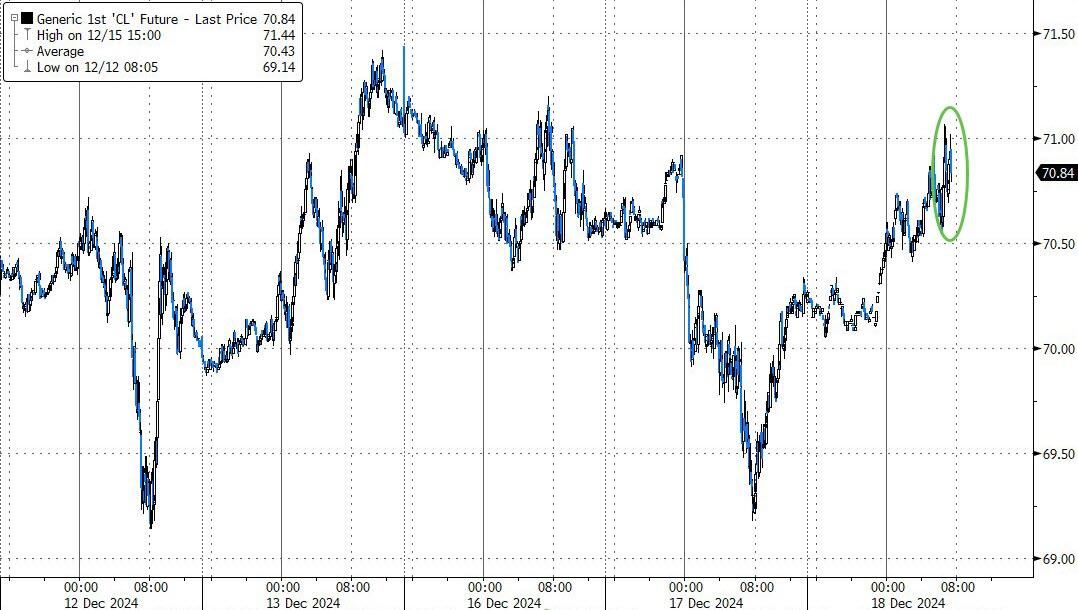
WTI Holds Gains As ‘Tank Bottoms’ Loom At Cushing Hub; Crude Stocks Drop For 4th Straight Week

 Oil prices are higher this morning after API’s overnight report signaled a sizable drawdown in US commercial crude inventories and Kazakhstan pledged to comply with OPEC+ production quotas.

The cartel member had earlier unsettled markets by signaling that it would adhere to its original plan of raising oil output by 190,000 barrels a day, according to Rebecca Babin, senior energy trader at CIBC Private Wealth Group, despite OPEC’s decision to delay production hikes.

Still,“the rally remains fragile, with broader macroeconomic factors continuing to dominate price movements,” Babin said.

“The upcoming Federal Reserve statement and potential shifts in China’s economic policy are key factors that will likely shape the medium-term direction for crude prices.”

in the even shorter-term, this morning’s official inventory and supply data will be the focus.

API

  • Crude -4.7MM

  • Gasoline +2.4MM

  • Distillates -0.7MM

  • Cushing +0.8MM

DOE

  • Crude

  • Gasoline

  • Distillates

  • Cushing

Crude stocks declined for the 4th straight week, according to official data (but last week saw a far smaller drawdown than API reported). Gasoline stocks rose for the 5th straight week…

Source: Bloomberg

Despite a 519k barrel addition to the SPR, total crude stocks fell for the 4th week in a row…

Source: Bloomberg

Cushing stocks remain near tank bottoms again…


Source: Bloomberg.

US crude production remains near record highs…

Source: Bloomberg

WTI was hovering just below $71 ahead of the official data, and is holding gains for now…

Source: Bloomberg

As Bloomberg reports, crude has traded in a narrow band for the past two months, supported by geopolitical tensions in the Middle East and Europe, and the threat of further sanctions on supplies from Iran and Russia.

Restraining prices are lackluster Chinese demand and expectations for robust production from non-OPEC+ nations such as the US, where President-elect Donald Trump has promised to encourage domestic development.

Tyler Durden
Wed, 12/18/2024 – 10:38

Final Countdown: Slovakia Warns Of “Economic Damage” As Ukraine NatGas Transit Nears End

0
Final Countdown: Slovakia Warns Of “Economic Damage” As Ukraine NatGas Transit Nears End

Slovak Prime Minister Robert Fico has warned of financial turmoil and emphasized the urgent need to maintain Russian NatGas flows through Ukraine, as a NatGas transit agreement with Moscow is set to expire in the coming weeks.

Fico was quoted by Bloomberg on Wednseday, warning about the end of $525 million in transit fees per year it earns if Russian NatGas through Ukraine stops flowing. He said these fees are critical for state coffers. 

“Are we just going to let that pipeline dry up?” Fico said, adding, “In the name of what? Because you don’t like the Russians? Fine, I like them.”

On Tuesday, Slovakia’s state-owned energy company SPP, the country’s largest energy supplier, and its partners in Hungary, Italy, and Austria urged the continuation of Russian NatGas flows through Ukraine. 

“The declaration that we have prepared at SPP is intended to support the continuation of gas transportation through the territory of Ukraine and the preservation of its gas infrastructure, because it is the most advantageous solution not only for gas consumers in Europe, but also for Ukraine itself,” said Vojtech Ferencz, Chairman of the Board and CEO of SPP.

CEO Ferencz warned: 

“The document is an important voice of business directly responsible for the energy security and economy of the region, which may suffer significant economic damage in the near future. We will submit the declaration to the President of the European Commission Ursula von der Leyen so that she has first-hand information about the threat to energy and economic security in our region.”

“Using the example of the Slovak Republic, we can calculate that if gas from the east flows to our territory only partially or stops flowing completely, any other alternative will be significantly more expensive,” SPP said. 

Ferencz added:

“If SPP, which has approximately a 65% share of our market, were to lose gas supplies from the east and we were to purchase the entire required volume from another source and physically transport it to Slovakia, it would cost us an additional 150 million euros. In the case of the entire Slovak market, it would be more than 220 million euros. The difference is mainly caused by transit fees, which will probably increase by next year, while their final amount is still unknown. At the same time, the interruption of natural gas supplies through Ukraine will naturally also result in an increase in its prices on wholesale markets. In addition, if a cold winter comes, this situation may cause a shortage of gas and problems with its supplies throughout Europe.” 

SPP presented the document to European Commission President Ursula von der Leyen so the Brussels bureaucrats would understand that their moves to shift entire European countries off cheap Russia NatGas would have severe economic consequences. 

We previously noted in early October that Russian NatGas transits to the EU via Ukrainian pipelines are set to expire on Dec. 31.

Local paper The Kyiv Independent noted, “Kyiv said it has no intention of prolonging the deal as Moscow continues to wage its all-out war.”

The SPP CEO warned that halting the Russian NatGas flows will only send EU NatGas prices higher as winter in the Northern Hemisphere intensifies in January. 

Time is running out for Slovakia to avoid a pipeline halt. Bloomberg pointed out, “Several ideas have been floated to keep supplies coming, including with the help of intermediaries.” 

Meanwhile, Europe’s gas inventories are falling in line with a 15-year average this winter (read here). The halt next month could accelerate the drawdown in supplies across the continent, with a Goldman analyst forecasting storage levels dropping to 39% by the end of the heating season—well below this year’s 53% mark. 

Goldman analyst Samantha Dart said the continent will still be able to refill inventories next summer, “but that requires a lot of things going right.” 

Locked in a 33-month war with Russia, Ukraine has repeatedly said it will not extend the NatGas transit agreement. 

Tyler Durden
Wed, 12/18/2024 – 07:50

Full Jet Production At Boeing Resumes In Seattle Area After Strike Turmoil 

0
Full Jet Production At Boeing Resumes In Seattle Area After Strike Turmoil 

Just over a week after Boeing resumed production of its 737 Max aircraft at its Renton factory in Seattle, Washington, after strikes in early fall, the planemaker has returned to full jet production across all programs.

“We have now resumed production across our 737, 767, and 777/777X airplane programs,” Stephanie Pope, the head of Boeing’s commercial jet division, wrote in a post on LinkedIn on Tuesday night. 

Pope Said, “Our teammates have worked methodically to warm up our factories in the Pacific Northwest, using Boeing’s Safety Management System to identify and address potential issues and ensure a safe and orderly restart.” 

“In particular, we have taken time to ensure all manufacturing teammates are current on training and certifications, while positioning inventory at the optimal levels for smooth production,” she continued. 

The resumption comes a little more than a week after Boeing restarted production of the 737, the planemaker’s best-selling commercial jet. 

Two Max crashes, Covid travel downturn, supply chain snarls, financial challenges, and multiple Max jet incidents — including a door panel blowout on an Alaska Airlines 737 Max 9 — have been mounting headwinds for the struggling planemaker. On top of this, a seven-week strike sent the company to the brink of a devastating stall. 

Analysts at Jefferies recently forecasted that Boeing will likely average about 29 737 Max jets per month in 2025, falling far short of the company’s pre-restriction goal of 56. Earlier this year, the FAA capped 737 Max production at 38 per month due to safety vulnerabilities within its Renton production line. 

The good news is that Boeing is under new leadership. Newly appointed CEO Kelly Ortberg is dismantling disastrous DEI initiatives and shifting the focus to safety as the era of wokeism comes to an abrupt end.

As of mid-November, Goldman’s Noah Poponak and Anthony Valentini still had a “Buy” rating on the planemaker with a 12-month price target of $200.

“Our 12-month price target of $200 is derived from targeting a 4.5% free cash flow yield on 2026E free cash, discounted back one year at 12%. Key risks: (1) the pace of air traffic growth, (2) supply chain ability to ramp-up production, and (3) contract operating performance within the defense segment,” the analysts said. 

Returning to output is critical for the cash-strapped planemaker. 

Tyler Durden
Wed, 12/18/2024 – 07:45

Senate Democrats Propose Constitutional Amendment To Abolish Electoral College

0
Senate Democrats Propose Constitutional Amendment To Abolish Electoral College

Authored by Sam Dorman via The Epoch Times,

Senate Democrats proposed a constitutional amendment on Dec. 16 that would abolish the Electoral College and ensure the country’s presidential elections were determined by the popular vote.

“It is time to retire this 18th-century invention that disenfranchises millions of Americans,” Senate Judiciary Chairman Dick Durbin (D-Ill.) said in a press release.

He and Sens. Brian Schatz (D-Hawaii) and Peter Welch (D-Vt.) proposed the legislation after another proposal emerged in the House last week.

“No one’s vote should count for more based on where they live,“ Schatz said in the press release. ”The Electoral College is outdated and it’s undemocratic. It’s time to end it.”

Article II of the Constitution establishes the Electoral College, which directs states to appoint electors for casting votes for president and vice president.

The practice has come under considerable criticism from Democrats such as Durbin, who noted in his press release that he tried to abolish the Electoral College in 2000.

“In all but five presidential elections, the winner of the election received the most votes,” the press release read. “Two of those five times came in the last 25 years, handing the presidency to candidates the majority of voters rejected.”

The release was referring to former President George W. Bush and candidate Donald Trump losing the popular vote in 2000 and 2016 respectively. In the most recent presidential election, Trump won 49.9 percent of the popular vote compared with Vice President Kamala Harris’ 48.4 percent.

Trump has both supported and criticized the Electoral College in social media posts. He said in 2012 that it was a “disaster for democracy” and in 2019 said he “realize[s] the Electoral College is far better.”

He said that the “brilliance of the Electoral College is that you must go to many States to win,” adding that without it, smaller states would lose power.

Eliminating the Electoral College via constitutional amendment would require state and national approval.

According to Article V of the Constitution, Congress can send the issue to the states after two-thirds of both the House and Senate approve an amendment. From there, three-fourths of the state Legislatures or state ratifying conventions must also approve.

The House legislation is a joint resolution with proposed text for a constitutional amendment. It reads in part: “The pair of candidates having the greatest number of votes for President and Vice President shall be elected.”

The bill clarifies that the change would be enacted following verification by three-fourths of state Legislatures.

The bill and amendment seem poised to fail with a Republican-dominated Congress next year.

In October, Senate Minority Leader Mitch McConnell (R-Ky.) panned a call by his state’s governor to abolish the Electoral College.

McConnell said the Electoral College encourages candidates to travel to smaller states. “At its core, the Electoral College protects Americans from the whims of the majority, something I’m familiar with in the Senate. … Without it, no presidential candidate would ever travel to a small state in Middle America, like Kentucky,” he said.

Senate Democrats’ press release on Dec. 16 noted that 17 states and the District of Columbia “have joined a national plan to bypass the Electoral College by agreeing to allocate its electoral votes to whichever candidate wins the nationwide popular vote.”

That seemed to be a reference to the National Popular Vote Interstate Compact, which has seen legislative approvals from multiple typically blue states since 2007.

In September, Pew Research Center said that more than six in 10 Americans support the popular vote determining who the next president is. Only 35 percent favored retaining the Electoral College.

Tyler Durden
Wed, 12/18/2024 – 07:20