63.1 F
Chicago
Saturday, October 10, 2026
Home Blog Page 2055

Fauci, Schiff, And Cheney May Receive ‘Preemptive Pardons’

0
Fauci, Schiff, And Cheney May Receive ‘Preemptive Pardons’

Days after President Joe Biden pardoned his son Hunter for a 10-year period dating back to his involvement with Burisma, senior White House aides are reportedly locked in a contentious debate over a potential unprecedented move: issuing preemptive pardons to a wide range of current and former public officials who could find themselves under intense scrutiny, and prosecution, after Donald Trump takes office, Politico reports.

Among those discussed for potential pardons are high-profile figures like Senator-elect Adam Schiff (D-CA), former Rep. Liz Cheney (R-WY), and Dr. Anthony Fauci, the former head of the National Institute of Allergy and Infectious Diseases.

Their justification is that Trump will seek retribution, with their concerns growing more urgent following Trump’s announcement last weekend appointing Kash Patel as FBI director. Patel, a staunch ally of Trump, has vowed to pursue the former president’s critics, heightening concerns among Biden aides about possible investigations or indictments against officials who have opposed Trump in the past.

Biden aides are deeply divided, according to the report. On one hand, granting preemptive pardons could provide a shield against Trump’s promised “revenge tour” but might also create the appearance of impropriety, effectively validating Trump’s accusations of corruption. Additionally, those offered pardons might refuse them, citing innocence or the perception of guilt that could accompany a pardon.

Meanwhile, were there any takers on this?

Because…

Historical Precedent and Political Risk

End-of-administration pardons are always politically fraught, but the stakes in this case are uniquely high. Biden’s aides have privately discussed the precedent set by President Gerald Ford’s 1974 preemptive pardon of Richard Nixon, which spared the nation further division after Watergate. Democrats like Sen. Ed Markey (D-MA) have invoked that example, suggesting that pardons might be necessary to heal a polarized nation and protect officials from undue political persecution.

“If it’s clear by January 19 that [revenge] is his intention, then I would recommend to President Biden that he provide those preemptive pardons to people, because that’s really what our country is going to need next year,” Markey said in a recent interview.

Others are far less supportive. Schiff, who chaired the House Intelligence Committee during Trump’s first impeachment, has been outspoken in his opposition. “I would urge the president not to do that,” he said, adding “I think it would seem defensive and unnecessary.”

As X user Derek Wang notes:

Preemptive pardon has never been used in history and I think will likely be challenged and to be decided by SC.

Section. 2 of US Constitution: The President shall be Commander in Chief of the Army and Navy of the United States, and of the Militia of the several States, when called into the actual Service of the United States; he may require the Opinion, in writing, of the principal Officer in each of the executive Departments, upon any Subject relating to the Duties of their respective Offices, and he shall have Power to grant Reprieves and Pardons for Offences against the United States, except in Cases of Impeachment.

“Offenses” are not “potential offenses”, the word clearly indicates the offenses that are already determined by court legally, not any potential offenses to be determined in future.

Hunter Biden’s Pardon and the Broader Clemency Debate

Biden’s recent pardon of his son, Hunter Biden, has further complicated the White House’s deliberations. Hunter’s sweeping 11-year pardon drew criticism from many within the Democratic Party and intensified pressure on Biden to extend clemency to others.

House Democratic Leader Hakeem Jeffries (D-N.Y.) invoked Hunter Biden’s pardon this week in calling on the president to, on a case-by-case basis, spare “the working-class Americans in the federal prison system whose lives have been ruined by unjustly aggressive prosecutions for nonviolent offenses.” -Politico

Trump has repeatedly vowed to go after those he views as part of the Deep State. His disdain for figures like Cheney and Fauci is well-documented, with Trump even calling for members of the Jan. 6 committee to face jail time.

The decision to issue preemptive pardons would undoubtedly solidify Biden’s status as one of the worst presidents in US history. On one side lies the risk of fueling Trump’s narrative of impropriety; on the other, the prospect of leaving key public servants exposed to investigations that are completely warranted.

Tyler Durden
Wed, 12/04/2024 – 18:25

Renovation Downturn Forces These Home Furnishing Retailers To Increase Deals

0
Renovation Downturn Forces These Home Furnishing Retailers To Increase Deals

Record-high home prices, combined with the average 30-year fixed mortgage rate surpassing 7% once again, continue to create the worst housing affordability environment in a generation. Consequently, the residential renovation market sours, pressuring home furnishing companies to offer better deals. 

A team of Goldman analysts led by Kate McShane updated their proprietary home furnishings promotional tracker for November, in which they found increased promotions, markdowns, and free shipping across the industry for notable home furnishings retailers including Arhaus, At Home, Bassett Furniture, Cost Plus World Market, Crate & Barrel, Ethan Allen Interiors, Havertys, Kirkland’s, Pottery Barn, PB Teen, Pottery Barn Kids, Rejuvenation, Wayfair, and West Elm.

McShane noted that average markdowns were slightly higher for the industry year-over-year last month, although Williams-Sonoma was one of the only home furnishings retailers not offering increased deals to somewhat flattish compared with the same month last year. 

Here are the key observations from their findings:

  • Free shipping ticked up sequentially and year over year in November across the industry and Williams Sonoma banners;

  • Markdowns increased sequentially and year over year across the industry;

  • Promotions are notably higher sequentially and year over year at the Williams Sonoma banner, while promotions are lower at West Elm and Rejuvenation

Industry-wide, markdowns increased month-over-month and year-over-year, with PB Kids and Wayfair offering the best deals. 

  • November’s industry markdowns increased both m/m and y/y: Sequentially, the average markdown across the industry increased m/m at 40% in Nov vs. 37%/37%/41% in Oct/Sep/Aug. The average markdown increased y/y compared to 39% in Nov ’23.

  • Markdown level by company: Overall, PB Kids (58%) and Wayfair (58%) were the companies with the highest average markdowns in Nov ’24. PB Teen, Rejuvenation, and West Elm had the highest markdowns on a 1-year average (also taking account of consistency in promotions over the months).

  • Free shipping: Overall days of free shipping increased both sequentially and y/y in Nov ’24 to 14 days, vs. 9/13 days in Oct’ 24/Nov ’23. Kirkland’s, Pottery Barn, and Williams-Sonoma offered free shipping every day in Nov ’24, with the next highest frequency seen at PB Kids’s at 29 days.

McShane noted, “While we don’t include RH in our promotional analysis, we do note the company continues to advertise its fall clearance sale with up to 60% off outdoor, living, dining, and bedroom items.” 

Average Markdowns on a retailer basis:

Pottery Barn 

West Elm

Williams-Sonoma

Rejuvenation

The number of days home furnishings companies offered ‘free shipping’ last month surged. 

Williams-Sonoma’s free shipping promotion was much higher than the industry average. 

The entire industry has been in the dumps since the Covid spike.

And this is why.

McShane highlighted that the barometer for the residential renovation market remains uninspiring. 

Given all this, there are indeed deals for patient consumers who held back during the Covid surge in home renovations. Goldman’s McShane gives readers a broad understanding of what home furnishings companies offer the best deals. 

Tyler Durden
Wed, 12/04/2024 – 18:00

Trump Selects Peter Navarro As Top Trade Adviser

0
Trump Selects Peter Navarro As Top Trade Adviser

Authored by Jackson Richman and Andrew Moran via The Epoch Times (emphasis ours),

President-elect Donald Trump announced on Dec. 4 that he has selected Peter Navarro as senior counselor for trade and manufacturing.

During Trump’s first term, Navarro, a staunch advocate of tariffs, served as director of the National Trade Council and as director of the Office of Trade and Manufacturing Policy.

The former director of the U.S. Office of Trade and Manufacturing Policy, Peter Navarro, speaks on the third day of the Republican National Convention at the Fiserv Forum in Milwaukee, on July 17, 2024. Joe Raedle/Getty Images

Trump said the new role “leverages Peter’s broad range of White House experience while harnessing his extensive policy analytic and media skills.”

Navarro’s “mission will be to help successfully advance and communicate the Trump manufacturing, tariff, and trade agendas,” the president-elect said.

Navarro was released from prison on July 17 after serving a four-month sentence for refusing to appear before the House select committee investigating the Jan. 6, 2021, breach of the U.S. Capitol.

Tariffs were an integral economic policy feature of Trump’s 2024 election campaign. Since his victory last month, Trump has threatened to impose 25 percent tariffs on Canadian and Mexican imports, slap 10 percent levies on Chinese goods, and implement a 100 percent tariff on countries engaged in anti-dollar activities.

As one of the top White House economic and trade advisers in Trump’s first administration, Navarro was a leading voice in enacting tariffs on the United States’ trading partners, particularly China.

Navarro said levies would help level the playing field and rectify what he viewed as unfair imbalances in international trade.

“President Trump has made it clear he’s a free trader. He’s made it abundantly clear that for this administration, free trade means is free, fair, reciprocal, and balanced,” Navarro said in prepared remarks at a June 2018 Hudson Institute event outlining Trump’s policy regarding the U.S.–China trade relationship.

In 2019, he also championed Trump’s threat of tariffs on Mexico in response to Mexico’s “exports” of “illegal aliens.”

“This is strictly about national security and threats to our economy from illegal immigration from a criminal enterprise,” Navarro told CNBC’s “Squawk on the Street.”

Despite various criticisms that Trump’s tariffs would ignite inflation pressures and weigh on economic growth prospects, Navarro defended his trade agenda as “one of the most successful applications of a defense trade policy in U.S. history.”

Appearing at a Harvard University event in April 2019, Navarro declared that “Ricardo is dead.” This was in reference to 19th-century economist David Ricardo, who touted that international trade is always beneficial and that nations can prosper with the theory of “comparative advantage.”

However, according to Navarro, 19th-century economic philosophies have little relevance in modern global markets filled with “industrial espionage, rampant cheating, intellectual property theft, forced technology transfer, state capitalism, and currency misalignments.”

Navarro has been reluctant to back trade agreements supported by whom he called “globalist elites” on Wall Street.

“If Wall Street is involved and continues to insinuate itself into these negotiations, there will be a stench around any deal that’s consummated because it will have the imprimatur of Goldman Sachs and Wall Street,” Navarro said in a 2019 speech at the Center for Strategic and International Studies.

Navarro will not be the only pro-tariff official in the incoming administration.

Trump has been surrounding himself with staunch defenders of his trade agenda.

Scott Bessent, a Wall Street financier tapped to lead the Treasury Department, has been vocal in supporting levies on U.S. trading partners.

Bessent has spoken favorably about tariffs, describing the measure as a negotiating tool to accomplish the president-elect’s foreign policy objectives.

“Whether it is getting allies to spend more on their own defense, opening foreign markets to U.S. exports, securing cooperation on ending illegal immigration and interdicting fentanyl trafficking, or deterring military aggression, tariffs can play a central role,” Bessent wrote in a recent Fox News op-ed.

In an interview with CNBC’s “Squawk Box,” Bessent also said that tariffs should be “layered in gradually” to prevent immediate inflationary pressures and allow disinflationary measures to offset higher prices.

Trump selected billionaire Howard Lutnick as commerce secretary.

Lutnick, the CEO of investment firm Cantor Fitzgerald, has also endorsed tariffs, calling them “bargaining chips” to negotiate better trade pacts that can slash levies.

“I think tariffs make sense,” Lutnick told CNBC’s “Money Movers” in September. “We should compare what people tariff us and put the exact same tariffs on them and make it equal.”

The president-elect recently rounded out his economic team with Kevin Hassett as director of the White House National Economic Council and international trade attorney Jamieson Greer as U.S. trade representative.

Hassett was the previous head of the Council of Economic Advisers, a position that Trump has yet to announce.

According to Trump, Greer was integral in his first term in replacing the decades-old North American Free Trade Agreement with the U.S.–Mexico–Canada Agreement and implementing tariffs on China.

Greer was the chief of staff to Robert Lighthizer, who served as Trump’s former trade representative.

Tyler Durden
Wed, 12/04/2024 – 17:40

Israel Warns Troops Against Traveling Abroad Over ‘Blacklists’ In Europe 

0
Israel Warns Troops Against Traveling Abroad Over ‘Blacklists’ In Europe 

Israel continues feeling the pressure in the wake of the controversial International Criminal Court’s (ICC) decision to issue arrest warrants against Prime Minister Benjamin Netanyahu and his former defense minister Yoav Gallant for overseeing alleged war crimes in the Gaza Strip.

Israel’s military has issued an alert to all troops warning about travel abroad. “Some soldiers have already been required to leave countries they visited due to concerns about legal proceedings,” the Israeli news site Ynet reports Wednesday.

The report details that in many cases pro-Palestinian organizations are pressuring governments abroad to block certain individuals from traveling, by creating “blacklists” with details of Israeli army soldiers. Names and photos are used and circulated while “hoping to identify future travel plans.”

Via Flash90

“Individual proceedings against soldiers and junior officers traveling abroad could be based on ICC rulings. To any soldier or officer, if they are arrested, summoned for questioning, or feel they are being followed or photographed while abroad, Israel will provide immediate legal assistance through its local embassy or the Foreign Ministry’s situation room,” the army said in the message.

“In non-ICC member countries such as the US, China, or India, there is local legislation governing the law of war. These nations are not obligated to act on ICC arrest warrants, but local laws could still pose risks,” it added. 

 Ynet notes that some European governments have already taken action against over a dozen soldiers:

The IDF has identified about 30 cases of criminal proceedings initiated against its members. At least eight soldiers, including some who had traveled to Cyprus, Slovenia and the Netherlands, were forced to leave immediately.

The push for the arrest warrants was overseen by The Hague-based ICC’s Karim Khan, and subsequently the warrants for Netanyahu and Gallant were obtained on November 21.

While the ICC has no enforcement arm, relying on individual member states, it creates a political headache for the Israeli government. And clearly, given the army’s warning to all ranks of troops, the warrants are having a chilling and trickle-down effect.

Israel, the US, and some other allies have blasted the ICC move as outrageous and even ‘antisemitic’. The ICC has in turn said it has long faced coercion and threats from Israeli officials.

Tyler Durden
Wed, 12/04/2024 – 17:20

Trump Selects An Actual Astronaut To Lead NASA

0
Trump Selects An Actual Astronaut To Lead NASA

President-elect Donald Trump announced Wednesday afternoon that he has selected billionaire entrepreneur and veteran SpaceX astronaut Jared Isaacman to lead the National Aeronautics and Space Administration (NASA).

If confirmed, Isaacman would replace Bill Nelson, a former US senator from Florida who oversaw the space agency under the outgoing Biden administration.

Here’s Trump’s statement on Isaacman’s nomination:

I am delighted to nominate Jared Isaacman, an accomplished business leader, philanthropist, pilot, and astronaut, as Administrator of the National Aeronautics and Space Administration (NASA). Jared will drive NASA’s mission of discovery and inspiration, paving the way for groundbreaking achievements in Space science, technology, and exploration.

Over the past 25 years, as the Founder and CEO of Shift4, Jared has demonstrated exceptional leadership, building a trailblazing global financial technology company. He also co-founded and served as CEO of Draken International, a defense aerospace company, for over a decade, supporting the US Department of Defense, and our Allies.

Jared’s passion for Space, astronaut experience, and dedication to pushing the boundaries of exploration, unlocking the mysteries of the universe, and advancing the new Space economy, make him ideally suited to lead NASA into a bold new Era.

Congratulations to Jared, his wife Monica, and their children, Mila and Liv!

Moments after Trump posted on X, Isaacman released his statement:

Trump’s decision to nominate Isaacman comes months after he and SpaceX engineer Sarah Gillis made history by performing the world’s first commercial spacewalk farther from Earth than any other astronaut in over half a century. 

That mission, called Polaris Dawn, was partially funded by Isaacman to test Starlink technology and space suits. 

Isaacman emphasized how America will maintain its space dominance: “We will never again lose our ability to journey to the stars and never settle for second place.” This comment concerns the space race between the US, China, and Russia. 

The NASA Administrator manages a budget of about $25 billion and will play a pivotal role in the upcoming Artemis moon mission in the coming years. 

“There will inevitably be a thriving space economy — one that will create opportunities for countless people to live and work in space,” Isaacman said, adding, “At NASA, we will passionately pursue these possibilities and usher in an era where humanity becomes a true spacefaring civilization.”

Elon Musk’s SpaceX is why America is far ahead in the global space race. 

Another example of inefficient government infected by the woke mind virus, while the private sector, driven by meritocracy, soars into space.

It’s time to ‘Make Space Great Again’ and usher in an era (again) where future generations can look to the stars and say, ‘I want to grow up to be an astronaut.’ This stands in stark contrast to today’s dystopic reality, where kids only aspire to become ‘OnlyFans’ models or prank video creators on TikTok.

Tyler Durden
Wed, 12/04/2024 – 15:25

Why More Middle Income Americans Are Struggling to Save Money

0
Why More Middle Income Americans Are Struggling to Save Money

Authored by Autumn Spredemann via The Epoch Times,

Reduced inflation and wage increases haven’t stemmed the economic struggles of middle-class Americans. In fact, some middle-income earners say it’s harder than ever to put money away in savings.

Many ascribe this to stagnant wages and higher prices for things like gas, groceries, and utilities that began in 2021 and persist to this day.

The United States hit a 41-year inflation high in 2022, which is when residents saw historic price hikes. In 2022, the consumer price index soared by more than 9 percent, according to the Bureau of Labor Statistics.

“Our research shows mathematically that the overwhelming driver of that burst of inflation in 2022 was federal spending, not the supply chain,” Mark Kritzman, a senior lecturer at the Massachusetts Institute of Technology’s Sloan School of Management, wrote in an article.

Two years later, inflation has fallen to 2.6 percent, but Americans aren’t seeing price adjustments in areas like grocery stores, housing costs, utility bills, and insurance.

Mary Lopez, a marketing manager and middle-income earner at Trusted Wedding Gown Preservation, a New Jersey-based business, said wage stagnation and a higher cost of living across the board has made it hard to save money and maintain a middle-class lifestyle.

“In terms of significant changes, my household, like many others, has felt the impact in areas like health care and housing,” Lopez told The Epoch Times via email.

“For instance, the rate of health insurance has spiraled upward and we’ve faced hikes in rent consistently. Many of my peers cite similar experiences, struggling to save amid these increasing costs.”

The median home price in September 2024 was just over $400,000. This represents the highest September median the National Association of Realtors has ever recorded and is $20,000 shy of the all time high, according to a Bankrate analysis. The rental markets haven’t fared any better, with asking prices more than 33 percent higher than before the pandemic.

The average premium for single coverage health care increased by 6 percent this year and family premiums rose 7 percent.

“Middle class” as defined by the Pew Research Center is households with two-thirds to double the U.S. median household income. In 2023, the median household income was $80,610, according to the U.S. Census Bureau.

A White House press release stated that real wages—the amount received with inflation taken into account—grew more than 4 percent between 2022 and 2024. But even with a rise in purchasing power, many U.S. residents aren’t seeing the difference when paying their bills.

People shop at a grocery store in Columbia, Md., on Oct. 24, 2024. Madalina Vasiliu/The Epoch Times

Wage Stagnation Versus Inflation

David Kindness, CPA and finance writer at Best Money, said wage growth hasn’t kept pace with rising costs.

“Even with inflation cooling in certain areas, essential goods and services remain stubbornly expensive, eating up larger chunks of household budgets,” he told The Epoch Times via email.

“Rising grocery bills have made weekly shopping trips a source of financial stress. Many families, including my own, have had to rework their budgets to accommodate these increases, cutting back in other areas to stay afloat,” he said.

Ali Zane, a financial planner and founder of Imax Credit Repair, said that one of the most overlooked drivers of “paycheck-to-paycheck” living is the disconnect between wage growth and the actual cost of living.

“While inflation is blamed, stagnant wages over the past two decades are the root issue. Salaries may inch upward, but housing prices, which rose 30 to 40 percent in many regions since 2020, have far outpaced them. Add in the relentless climb of healthcare premiums and childcare expenses, and it’s no wonder families feel financially strapped,” Zane told The Epoch Times in a text.

Evidence supports the claim that real wage growth hasn’t outpaced inflation. Since January 2021, prices have risen 20 percent, while U.S. wages increased 17.4 percent during the same period, according to Bankrate’s second-annual Wage To Inflation Index.

But this isn’t a new problem. Real wage growth began to slow in the 1970s compared to overall economic performance in the United States, according to researchers at the Kellogg School of Management at Northwestern University.

Historically, real wage stagnation has been attributed to globalization and automation. Kellogg finance professor Efraim Benmelech disagrees.

“None of these explanations goes back long enough in time,” he said. Wage growth has been slowing since the early 1970s,” he said in a 2019 economic analysis.

With colleagues at the National Bureau of Economic Research, Benmelech points to what is known as “labor market concentration” as a hidden culprit. This is when having too few employers in a given industry creates a sort of unofficial salary price fixing.

A credit card decal is displayed on the window of a business in San Rafael, Calif., on Feb. 7, 2024. Credit card debt in U.S. households increased by $24 billion in the third quarter of this year, according to the Federal Reserve Bank of New York. Justin Sullivan/Getty Images

“There has been a discussion in recent years about what happened to middle-class Americans,” Benmelech said. “We don’t say that we have the only explanation, but we have an explanation that is consistent and can explain the long-term phenomenon of stagnant wages.”

America’s struggle to save money is also evident in the country’s mountain of credit card debt. In the third quarter of this year, the Federal Reserve Bank of New York reported that credit card balances in U.S. households increased by $24 billion. Total household debt also increased in the third quarter, hitting $17.94 trillion.

“Many of my friends and clients have shared that they’re finding it harder to save, even those who had strong habits before,” Kindness said. “Unexpected expenses, like medical bills or car repairs, quickly eat into any money set aside for emergencies. With monthly costs already stretching their paychecks thin, putting away money for the future often feels out of reach.”

Kindness said he’s noticed that savings goals among his middle-class peers have shifted away from long term dreams such as buying a home or early retirement to simply having an emergency fund.

“It’s not just that middle-income families aren’t saving. They’re actively going into debt to stay afloat. The rise in buy-now-pay-later options for groceries and essentials shows just how precarious cash flow has become,” Zane said.

Paycheck to Paycheck

In October, Bank of America released a sobering study on American households living paycheck to paycheck. The results indicated the number of households barely making it between paychecks has increased across every income bracket since 2019, even those making more than $150,000 per year.

Middle-income earners in the $51,000 to $75,000 range had the largest increase between 2019 and 2024, after households with less than $50,000, in which a quarter or more live paycheck to paycheck.

Moving up the income spectrum showed similar results, with roughly a quarter of all households living in this manner. Almost half of all respondents perceive themselves as living paycheck to paycheck.

The study noted that these households have much higher necessity spending, adding that most of the expenses are “likely unavoidable, as they relate to family and housing costs.”

Zane said that groceries have become a “silent tax” on the middle class, but pointed at rising utility costs as another big factor.

“Utility costs—often neglected in mainstream discussions—have become a household budget breaker. For families living in regions with harsh winters or sweltering summers, energy bills consume a more considerable monthly income than ever,” he said.

This is the case for Maria and Andrew in the Twin Cities area of Minnesota, who asked that The Epoch Times not use their real names. The couple said utilities are a major expense for their middle-class household, regardless of the season.

“We don’t turn on the heat until we have consecutive days below 40 [Fahrenheit]. Same deal in summer, the air conditioning doesn’t go on until it’s into the 90s,” Maria said.

A window air conditioner unit on the side of an apartment building in Arlington, Va., on July 10, 2023. Energy bills consume a large portion of household monthly income, according to Zane. Saul Loeb/AFP via Getty Images

She said that her kids complain about the house “always being cold” in the winter because even when she turns on the heat, the thermostat stays at a brisk 66 degrees Fahrenheit.

“Even doing that, our bill is over $500 in the winter. It’s not quite as bad in summer since we try not to run the air much, but you have to have heat in the winter here. We get months of consistently below zero temperatures. Heat is not a luxury,” Maria said.

Maria and Andrew say they are excited when an electric bill is less than $200. Over the past three years, Maria said she’s watched utility bills go up, a common complaint among locals in her area.

Andrew said, “We hear things from officials like, ‘we need to upgrade this infrastructure’ from officials and then get a nightmare bill down the road.”

Sky high energy bills have undoubtedly created an additional debt burden for U.S. residents. Between December 2023 and August 2024, Americans’ utility debt rose 8 percent and topped out at almost $17.4 billion, according to the National Energy Assistance Directors Association.

In general, Americans have shouldered the burden of higher utility bills for the past couple of years with no end in sight.

When asked which expense reduction would make the most difference in their home, Andrew and Maria quickly said their weekly grocery bill.

“Since the pandemic, we’ve bought the same items in the same quantity and the same brands and watched our bill increase by 50 percent,” Maria said.

Andrew added, “Forget about eating out. That’s just for special occasions now.”

Many middle-class income earners have also cut back on what are now considered luxuries.

Kindness said, “My household scaled back on dining out and paused a couple of streaming subscriptions. These might seem like small adjustments, but they’re reflective of a larger pattern: people are prioritizing necessities and cutting what they view as luxuries.”

Lopez and her family have also restructured their financial priorities by trimming unnecessary spending.

“In the past year, we’ve consciously scaled back on non-essential expenses such as dining out, subscription services, and vacations to manage our finances. It’s sobering to note, but these once regular ‘luxuries’ are becoming increasingly occasional events,” she said.

People at Tatte Bakery & Cafe in Washington on Oct. 3, 2024. Reducing the frequency of dining out can help cut back on non-essential expenses to save money. Madalina Vasiliu/The Epoch Times

“This shift isn’t unique to my family; it’s an adjustment many middle-income earners are reluctantly making due to escalating costs and financial uncertainty.”

Zane said middle-class households aren’t just cancelling Netflix or skipping restaurant splurges. They’re making more profound sacrifices in order to save money or, in some cases, just to survive.

“Parents are delaying children’s extracurricular activities, skipping preventive health care, and cutting back on professional development to avoid additional expenses. These choices aren’t sustainable and reflect a troubling downward spiral in financial stability,” he said.

Zane’s point is highlighted by a recent Forbes Advisor survey, which revealed that one in every four Americans has less than $1,000 in emergency savings.

By respondent age group, this is the case for 32 percent of Generation Z, followed by 31 percent of Millennials, 27 percent of Generation X, and 20 percent of Baby Boomers.

Read more here…

Tyler Durden
Wed, 12/04/2024 – 15:05

Unexpectedly Hawkish Beige Book Finds Economic Activity “Rose” In Most Districts As “Slowness” Tumbles

0
Unexpectedly Hawkish Beige Book Finds Economic Activity “Rose” In Most Districts As “Slowness” Tumbles

Back in September, the otherwise sleepy and mostly boring report that is the Fed’s Beige Book report (which nobody otherwise reads due to its sheer size and dismal signal-to-noise ratio) got a sudden boost of notoriety and popularity when none other than Jerome Powell explained after the Fed’s 50bps rate cut, that he had been closely following the Beige Book which had emerged as a driving force behind the Fed’s unexpected “jumbo” 50bps rate cut. And unlike others, we actually do read the Beige Book, which is why two weeks before the FOMC rate cut we titled our analysis of the latest report as follows: “Ugly Beige Book Reveals Economic Activity “Flat Or Declining”, Consumer Spending Slowing In Most Districts.” So one can see why Powell panicked and why two rate cuts followed in September and November, just days after the election.

Fast forward to today when moments ago the Fed published its latest, December, Beige Book which suggested that a reversal of the sluggish, “flat or declining” conditions observed in September and November is underway, and which together with a strong jobs report on Friday may be sufficient to enable the Fed to pause rate cuts for the foreseeable future, especially now that Donald Trump is in the White House.

According to the Fed’s latest report, economic activity “rose slightly in most Districts”, a clear improvement from the descriptions used in the previous months, and that “three regions exhibited modest or moderate growth that offset flat or slightly declining activity in two others.” Employment levels were flat or up only slightly across districts and prices rose only at a modest pace across Federal Reserve districts.

Reading further, we find yet another indication of the Trump effect, namely that although growth in economic activity was generally small (thank Biden), expectations for growth rose moderately across most geographies and sectors (thanks Trump) and “business contacts expressed optimism that demand will rise in coming months.”

Elsewhere, we find that consumer spending was “generally stable” although many consumer-oriented businesses across Districts noted further increases in price sensitivity among consumers, as well as several reports of increased sensitivity to quality. Among the negative aspects, spending on home furnishings was down, which contacts attributed to limited household mobility, while demand for mortgages was low overall, though reports on recent changes in home loan demand were mixed due to volatility in rates. Commercial real estate lending was similarly subdued. Still, contacts generally reported financing remained available.

Turning to capital spending and purchases of raw materials, these were flat or declining in most Districts while sales of farm equipment were a notable headwind to overall investment activity, and several contacts expressed concerns about the future prices of equipment given ongoing weakness in the farm economy.

Energy activity in the oil and gas sector was flat but demand for electricity generation continued to grow at a robust rate. The rise in electricity demand was driven by rapid expansions in data centers and was reportedly planned to be met by investments in renewable generation capacity in coming years.

Some more details from the Beige Book, starting with Labor Markets:

  • Employment levels were flat or up only slightly across Districts.
  • Hiring activity was subdued as worker turnover remained low and few firms reported increasing their headcount.
  • The level of layoffs was also reportedly low. Contacts indicated they expected employment to remain steady or rise slightly over the next year, but many were cautious in their optimism about any pickup in hiring activity.
  • Wage growth softened to a modest pace across most Districts, as did expectations for wage growth in coming months.
  • Job growth and wage growth for entry-level positions and skilled trades were an exception, rising robustly and expected to grow further through next year.

While Friday’s jobs report will have more to say about this, today’s ADP report which indicated a sharp bounce in wage growth suggests that the Fed is now working on stale wage data.

Turning to prices:

  • Prices rose only at a modest pace across Federal Reserve Districts.
  • Both consumer-oriented and business-oriented contacts reported greater difficulty passing costs on to customers.
  • Input prices were said to be rising faster than selling prices for most businesses, resulting in declining profit margins.
  • Although input prices rose generally, contacts in several Districts noted declines in certain raw materials and non-labor costs.
  • In contrast, rising insurance prices were again reported widely as significant costs pressures for many businesses.
  • Contacts indicated they expect the current pace of price growth to persist, but businesses in several Districts indicated tariffs pose a significant upside risk to inflation.

Here are the main highlights by Fed District

  • Boston: Economic activity was down a bit on balance. Prices increased at a slight pace. Employment held steady despite a slowdown in hiring demand. Consumers held back on restaurant spending. Warm, dry weather crimped demand for selected goods. Commercial real estate contacts perceived stabilization in the office sector. Expectations were mixed, marked by uncertainty among many contacts.
  • New York: On balance, regional economic activity expanded slightly, led by strong growth in the manufacturing sector. Employment in the region grew slightly, and wage growth remained moderate. Commercial real estate markets steadied after a period of weakness, with a pickup in demand in the New York City office market. Selling price increases remained modest.
  • Philadelphia: Business activity edged up in the current Beige Book period after falling slightly last period. Consumer spending was flat overall, but the broader nonmanufacturing sector edged up, and manufacturers reported modest growth. Employment, wages, and prices all rose modestly, but inflation expectations edged higher over concerns about potential tariffs. On average, firms expect moderate economic growth over the next six months.
  • Cleveland: District business activity grew modestly in recent weeks, and contacts expected activity to increase further in the months ahead. Demand for business services remained robust, and nonresidential construction activity increased modestly. Employment levels grew slightly. Overall, contacts indicated that wages, nonlabor input costs, and prices increased modestly.
  • Richmond: The regional economy grew slightly in recent weeks. Some negative impacts from Hurricane Helene and the port worker strike were reported by businesses in affected regions and segments of the economy. Employment was little changed this cycle, while wages grew moderately and price levels were little changed, leading to reports of profit margin compression for businesses.
  • Atlanta: Economic activity in the Sixth District grew. Employment was steady and wages grew slowly. Input costs and prices were little changed. Retail sales improved slightly. Tourism declined modestly. Demand for housing deteriorated. Transportation activity grew slightly. Loan growth was modest. Manufacturing fell, and energy activity grew modestly.
  • Chicago: Economic activity increased slightly. Consumer and business spending rose modestly; employment was up slightly; construction and real estate activity was flat; nonbusiness contacts saw little change in activity; and manufacturing activity decreased modestly. Prices were up modestly, wages rose moderately, and financial conditions loosened slightly. Prospects for 2024 farm income were unchanged.
  • St. Louis: Economic activity across the Eighth District has slightly increased since our previous report. Prices increased moderately, with greater pushback against those price increases. Consumer spending has slightly declined across the income distribution. Contacts expected slight growth in employment, particularly coming from industrial production. The outlook has modestly improved; however, contacts noted that uncertainty about future policies was slowing investment, and businesses were increasing inventories in anticipation of potential import tariffs.
  • Minneapolis: District economic activity increased slightly. Employment grew, but labor demand softened, and turnover was down. Wage growth was moderate, and prices increased slightly. Consumer spending was flat, but tourism increased. Energy, commercial construction, and residential real estate also saw growth while manufacturing and homebuilding decreased.
  • Kansas City: Economic growth was modest and balanced across sectors. Expectations for demand growth were strong and supported plans to increase hiring and capital expenditures. Most contacts indicated they do not plan to raise wages substantially over the next year. Yet, the outlook for consumer spending remained strong, even as customers became more sensitive to prices and quality.
  • Dallas: Economic activity rose moderately over the reporting period. Growth continued in nonfinancial services and resumed in manufacturing and retail. Employment increased, and wage growth ticked up. Outlooks improved, with widespread increases in demand expectations. Interest rate cuts have had an overall positive but mild effect, and contacts were mostly bullish on prospective business conditions under the incoming administration, though some noted worry about potential trade and immigration policy changes.
  • San Francisco: Economic activity was stable. Employment levels were generally unchanged, and wages and prices increased slightly. Retail sales and activity in services sectors changed little. Activity in manufacturing, residential real estate, and financial services increased somewhat, while conditions in commercial real estate were stable. Conditions in agriculture softened slightly

And in keeping with the argument that the Dec Beige Book was much more hawkish than many expected, a quick semantic analysis finds that mentions of “slow” collapsed from 55 in October and an average of 56 in the past year to just 29, the lowest since the covid surge. Meanwhile, “inflation” remained sticky with 12 mentions, up 1 from last month and the highest since April

Bottom line: if the September Beige Book is what ultimately tipped the scales for the Fed to cut 50bps, then the December Beige Book is the first solid hint that a Fed pause may take place as soon as this month (which is perfectly understandable since Trump is now in the White House and the Fed will do everything in its power to make his life miserable).

Tyler Durden
Wed, 12/04/2024 – 14:40

French Government Falls As PM Barnier Loses Confidence Vote

0
French Government Falls As PM Barnier Loses Confidence Vote

What seemed like a foregone conclusion is now confirmed – French PM Barnier just lost a no-confidence vote (with 331 votes – 288 was needed) forcing his government’s resignation and Macron to appoint a new premier

The debate before the vote was lively with RN’s Le Pen blasting Barnier’s budget and making it clear he was dead in the water.

“It’s the end of this ephemeral government,” Le Pen declares.

Much of her comments are focused on taxes in Barnier’s budget, saying it was “all about taxes, taxes and more taxes.”

“Where’s all the money? The French want to know,” she said.

“To those who think I’m intent on choosing a policy of disaster through a vote of no confidence, I want to tell them that the disastrous policy would be not to censure such a budget, such a government,” Le Pen says.

Boris Vallaud, the head of the Socialists in parliament called Barnier’s budget “unjust and inefficient” and confirmed he would vote against Barnier.

France unbowed’s Coquerel slammed the government for not making enough compromises on the budget and confirms his party is supporting the no-confidence motion put forth by the leftist coalition.

The prime minister notes that the same issues will confront the next government if his is toppled, saying he would have “liked to have distributed money even though there isn’t any.”

“This won’t disappear with the magic of a no-confidence motion.”

What happens next?

  • First, Barnier would tender the resignation of the government; his outgoing cabinet would remain in place with limited powers to manage current affairs.

  • This caretaker administration continues until Macron appoints a new premier. There is no constitutional time limit for this decision — and it took Macron nearly two months to select Barnier.

  • During the interregnum, the government would likely rely on untested emergency legislation to collect taxes and deliver vital spending.

  • Once named, a new prime minister would propose a cabinet to be appointed by the president, and that new government would present a 2025 budget to parliament

Macron has a history of finding unexpected people to be prime minister – and of changing his mind at last minute.

Here are some names circulating in Paris that could become the next premier:

  • Bernard Cazeneuve, 61: Former French prime minister and interior minister under Socialist President Francois Hollande. Already considered as a possible PM this summer, picking him could help Macron fracture the left-wing bloc by capitalizing on Cazeneuve’s ties to his former party.

  • Sébastien Lecornu, 38: A skilled politician who in 2022 became the youngest defense minister since the French Revolution. He’s a Macron loyalist who’s originally from the center-right Republicans party.

  • François Bayrou, 73: The veteran centrist leads the MoDem party, a key ally for Macron in parliament. Currently the high commissioner for government planning, Bayrou supports proportional representation in parliamentary elections, which has also been a request of the National Rally.

  • Jean Castex, 59: A former prime minister under Macron known for his southern French accent and management skills. He is currently the head of the RATP, the state-owned company that operates the Paris metro.

On whether Macron should remain in office, Le Pen said that “it’s up to his conscience to decide whether he can sacrifice public action and the fate of France to his own pride.” She added:

“If he decides to stay, he will be forced to acknowledge that he is the President of a Republic that is no longer entirely at peace with itself.”

He can serve out his full term until 2027 and said only yesterday that this is exactly what he plans to do.

“I’ve been elected twice by the French people, and I’m extremely proud of that,” Macron said during a trip to Saudi Arabia.

“I’ll honor that trust with all my energy, right up to the last second.”

The euro was at the highs of the day ahead of the vote (which makes all the sense in the world to someone), but dropped on the inevitable result…

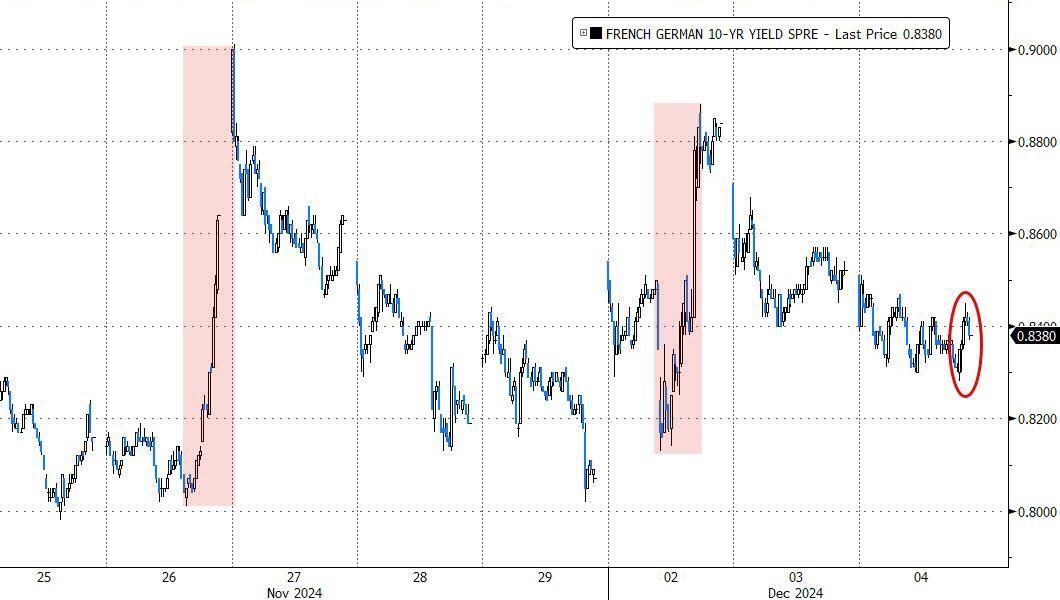
Spreads were near the lows of the day ahead of the vote, but started to creep higher as the debate neared the end. The bond markets closed before the vote…

Aberdeen Investments’ Alex Everett suggests that French 10-year yields would likely move toward 100 basis points over Germany, notably above current levels, citing “continued malaise, a dearth of decision making and insufficient progress toward debt sustainability.”

Tyler Durden
Wed, 12/04/2024 – 14:30

Southwest Airlines Agrees To End DEI Employment Practices In Response To Lawsuit

0
Southwest Airlines Agrees To End DEI Employment Practices In Response To Lawsuit

Authored by Matt McGregor via The Epoch Times,

Southwest Airlines dropped its diversity, equity, and inclusion (DEI) requirements on Monday, according to a constitutional rights legal firm that sued the airline company over what it alleged to be “unlawful discriminatory employment practices.”

America First Legal (AFL) issued a statement on Tuesday in which it shared a letter from the U.S. Department of Labor’s Office of Federal Contract Compliance Programs (OFCCP) confirming the airline company “acknowledged and agreed to end its illegal race and sex-based discrimination in all hiring and promotional processes, including all unlawful DEI quotas, benchmarks, or preferences.”

The OFCCP said in the letter that it held an “informal compliance conference” with Southwest Airlines to address the allegations AFL made in a complaint filed in January.

The OFCCP reported to AFL in the letter that Southwest “understands that OFCCP regulations do not permit quotas, preferences, or set asides” and agrees that placement goals regulations “are not to be interpreted as a ceiling or floor for the employment of particular groups of persons, but rather should serve as a benchmark against which Southwest Airlines Co. measures the representation of persons within its workforce.” 

In the complaint, AFL alleged that Southwest Airlines, United Airlines, and American Airlines are in breach of federal contract because they violated Executive Order 11246.

According to the order, federal contractors that secure more than $10,000 in yearly government business are prohibited from engaging in employment decisions that discriminate against employers because of their race or gender.

AFL said that since 2007, Southwest Airlines has received more than $330 million in federal government contracts.

“The American people should not have money taken out of their paychecks to facilitate facially discriminatory actions by federal contractors,” said AFL attorney Gene Hamilton earlier this year.

“But that’s precisely what happens when federal contractors embrace policies that—as they openly admit on their websites and in other public materials—discriminate against Americans based on immutable characteristics.”

Southwest Airlines, United Airlines, American Airlines, and the OFCCP didn’t respond to The Epoch Times’ request for comment by publication time.

Tyler Durden
Wed, 12/04/2024 – 14:25

Total Grid Collapse Strikes Cuba (Again) 

0
Total Grid Collapse Strikes Cuba (Again) 

Cuba’s national power grid collapsed shortly after 0200 local time on Wednesday, plunging 11 million people into darkness. 

Total blackout. Well done, Communists—can’t even keep the power on.

The Energy and Mines Ministry said the 330-megawatt capacity CTE Antonio Guiteras power plant suffered a failure earlier this morning but did not provide details. 

“At 2:08 this morning, the Electrical System, SEN, was disconnected when the Antonio Guiteras thermoelectric plant went out due to the automatic tripping. The restoration process is underway,” the ministry wrote on X. 

This is the second failure at the Antonio Guiteras power plant in months. In mid-October, the plant, located about 62 miles east of Havana, suffered a similar failure. Then, weeks later, a hurricane knocked out power across the country. 

When power fails, so does the internet…


Bloomberg noted, “The cash-strapped, communist-run nation is mired in its worst economic crisis since the fall of the Soviet Union,” adding, “A full 10% of the population has fled the country since 2020, and the government is bracing for renewed political pressure from the US as Donald Trump prepares to return to the White House.” 

Let’s all be glad the Communists have not taken over the US. 

Tyler Durden
Wed, 12/04/2024 – 12:05