79.6 F
Chicago
Saturday, October 10, 2026
Home Blog Page 2061

Futures Gain, S&P On Pace For 55th Record Closing High Of 2024

0
Futures Gain, S&P On Pace For 55th Record Closing High Of 2024

US equity futures are flat as the yield curve sees slight steepening; for once, the US is not benefiting from the risk-on rally seen in EU/APAC. As of 8:00am ET, S&P futures are fractionally in the green reversing earlier losses as traders await a busy line-up of Fed speakers and data releases after the index notched its 54th closing high of the year on Monday; Nasdaq 100 futures are down 0.1% even though Mag7 names are mostly higher in the premarket and Semis are bid. The USD is lower as the commodity complex catches a bid; WTI, silver, and sugar the outperformers; earlier Bloomberg reported China moved to restrict exports of rare earth metals to the US used in high-tech/military applications (gallium, germanium, antimony, and other superhard materials). Today’s macro focus will be on JOLTS and Vehicle Sales.

In premarket trading, Zscaler shares fall as much as 8.0% after the security software company gave a forecast for adjusted second-quarter earnings that missed expectations. Here are some other notable premarket movers

Anglogold Ashanti shares rise 3.7% after RBC Capital Markets upgraded the mining company to outperform from sector perform.

  • Credo Technology shares jump as much as 35% after the communications equipment company reported second-quarter results that beat expectations.
  • CVS Health gains 1.5% after Deutsche Bank upgrades the pharmacy chain to buy from hold, saying both earnings and the stock’s multiple appear to be near trough levels.
  • Janux Therapeutics shares soar 68% after the biotechnology firm announced positive updated interim clinical data for its oncology lead asset, JANX007.
  • Joby Aviation shares fall as much as 2.3%% after the all-electric vertical take-off and landing aircraft startup said its CFO Matthew Field notified the company he’d be resigning effective Dec. 13 for personal reasons.
  • Kroger shares advance 1% after Jefferies upgraded the retailer to buy from hold, and noted that the company has upside potential whether the acquisition of Albertsons goes through or not.
  • Microchip Technology shares decline 1.3% after the chipmaker said it planned to shut down a plant in Arizona, known as Fab 2. Additionally, the company sees third-quarter revenue being close to the low end of its original guidance.
  • TransMedics Group shares drop 8.0% after the medical-technology company narrowed its full-year revenue forecast. It also named a new chief financial officer.

The notable macro events this week include Friday’s payrolls report, which is expected to show hiring bounced back in November, preceded by Fed Chair Jerome Powell’s scheduled participation in a moderated discussion on Wednesday. Swaps are pricing a more than 70% chance of a quarter-point rate cut at the Fed’s Dec. 17-18 meeting.

“The market still expects the Fed will cut rates,” Mark Haefele, chief investment officer at UBS Global Wealth Management, said on Bloomberg Television. “We will see when the employment data comes through on Friday how brave you have to be. But I think the bias is still there and the market thinks there is still room to do that, given the overall picture.”

Elsewhere, Citi strategists said short sellers are capitulating as the S&P 500 keeps hitting record highs and is set for its best year since 2021, while positioning on European stocks remains bearish, further widening the gap between the two markets. According to Citi’s Chris Montagu, investor positioning in S&P 500 futures is “completely one-sided,” and is “setting new highs for a fourth consecutive week and increasingly the hold-out shorts are capitulating.”

Indeed, appetite for US equities has shown no sign of abating this year. The S&P 500 has surged 27%, powered by technology shares and a broad preference for US assets. The rally extended after the election of Donald Trump raised hopes of tax cuts and deregulation. By contrast, positioning on Euro Stoxx 50 futures remains net bearish while ETF outflows are accelerating. Investors are shunning the region’s stocks amid sluggish economic and earnings growth and political instability in France and Germany.

Much attention right now remains focused on Paris, where the government faces a vote of no confidence on Wednesday. French far-right leader Marine Le Pen is expected to join forces with a left-wing coalition to topple Michel Barnier’s administration.

And speaking of Europe, stocks there rose, with the Stoxx 600 up 0.4%, as a rally for technology stocks drove a fourth straight day of gains for the benchmark, helping investors look past political risks in France. French stocks traded in line with their European peers on Tuesday, but the crisis has weighed on the CAC 40, causing it to trail neighboring markets like Germany, where the DAX Index rose above 20,000 points for the first time in its history. Here are the biggest movers Tuesday:

  • Hochtief shares rise as much as 5.9% after BofA upgraded its recommendation on the German infrastructure company to buy. The broker is positive about firms with US exposure going into 2025
  • BMW shares gain as much as 2.5% after UBS upgraded the German carmaker to buy from neutral, citing prospects for improved cash returns. Analysts say the firm is now their top OEM pick
  • SSP Group shares soar as much as 14% after the company, which runs food outlets in travel hubs, reported in-line annual results and said strong revenue growth has continued
  • Ceres Power shares rise as much as 3.2% after RBC upgraded the firm to sector perform, saying the British fuel-cell technology company is more insulated from headwinds versus peers
  • Greencore Group shares jump as much as 14% after the food company delivered a beat and raise, sweetened by the return of its dividend and a new share buyback
  • DiscoverIE shares gain as much as 16%, the most in a year, after the electrical component maker reported 1H results, prompting Shore Capital to upgrade its rating to hold from sell
  • Victrex shares jump as much as 17%, the most on record, after the specialty chemicals company reported results, with analysts noting decent trends in fiscal 4Q and reassuring comments about next year
  • Covivio shares drop as much as 11%, the most since April 2020, after Morgan Stanley downgraded the French firm to underweight from equal-weight, saying it may “lag” the real estate sector in 2025
  • Swiss Life shares fall as much as 4.2% after the insurer’s new targets were viewed as “challenging” by some analysts. JPMorgan says the payout ratio and cash remittances disappoint
  • Forvia shares drop as much as 6.1% as UBS downgraded the French car parts firm to neutral and set a Street-low price target, citing record uncertainty around the outlook for Europe’s car industry
  • Nel shares slide as much as 3.7% after RBC cut its recommendation to sector perform from outperform, citing slowing commercial activity with only two contracts announced this year
  • Grenergy shares plunge as much as 6.3% after the Spanish renewable company reported 9-month results impacted by low energy prices and a higher debt level

Earlier in the session, Asian stocks rose, on course for a third-straight daily gain, as semiconductor-related shares rallied after the US announced fresh curbs on technology exports to China. The MSCI Asia Pacific Index rose as much as 1.2%, with chip stocks TSMC and Tokyo Electron among the biggest boosts. Key benchmarks gained more than 1% in South Korea, Japan and Taiwan after the US unveiled measures to limit China’s access to crucial tech but stopped short of earlier proposals. Chinese stocks also reversed earlier losses after news that the country’s top leaders plan to start a key annual economic work conference next Wednesday to map out growth targets and stimulus plans for 2025.

In FX, a drop in the dollar gives relief to G-10 currencies, barring the yen, with a 0.3% decline to around 149.80/USD; the euro rises 0.3%, partly due to dollar weakness, while the CAC 40 climbs 0.6%.

In rates, treasuries are mixed in early US session with the curve steeper as long-end losses lift 30-year yields by ~2bp, steepening 2s10s and 5s30s spreads to day’s wides. US front-end yields are slightly richer on the day, widening 2s10s, 5s30s spreads by 1bp-2bp; 10-year yields around 4.21%, rising 2bps from Monday’s close, and outperforming bunds in the sector by 1.5bp, trails OATs outperforming by 2.5bp. In European bond markets, Germany’s is under pressure while France outperforms; French 10-year bonds are steady after a no-confidence vote was set for Wednesday, with the yield spread to comparable German debt hovering around 85 basis points. OAT-bund spread that widened the most in six months Monday is slightly narrower. German bonds underperform gilts and Treasuries across the curve, with yields rising most at the front end. Peripheral spreads tighten to Germany.

In commodities, oil climbed ahead of an OPEC+ supply meeting on Thursday, with the market supported by hopes China’s leadership will approve more stimulus at a major meeting next week. WTI trades within Monday’s range, adding 0.9% to around $68.73. Spot gold rises roughly $6 to trade near $2,645/oz. Spot silver gains 1.6% near $31.

Looking at today’s US economic data calendar, we get the October JOLTS job openings at 10am. Fed speaker slate includes Daly (12:15pm), Kugler (12:35pm), Goolsbee (1:30pm, 3:45pm)

Market Snapshot

  • S&P 500 futures little changed at 6,062.75
  • STOXX Europe 600 up 0.5% to 516.11
  • MXAP up 1.3% to 187.38
  • MXAPJ up 1.2% to 586.44
  • Nikkei up 1.9% to 39,248.86
  • Topix up 1.4% to 2,753.58
  • Hang Seng Index up 1.0% to 19,746.32
  • Shanghai Composite up 0.4% to 3,378.81
  • Sensex up 0.8% to 80,917.24
  • Australia S&P/ASX 200 up 0.6% to 8,495.22
  • Kospi up 1.9% to 2,500.10
  • German 10Y yield little changed at 2.07%
  • Euro up 0.2% to $1.0520
  • Brent Futures up 1.0% to $72.58/bbl
  • Gold spot up 0.2% to $2,645.15
  • US Dollar Index down 0.18% to 106.26

Top Overnight News

  • China imposed an outright ban on the export of crucial chipmaking materials — including gallium and germanium — to the US, citing concerns over military usage and “abuse” of export controls. It comes after the US imposed fresh curbs on the sale of high-bandwidth memory chips to China. BBG
  • China’s Central Economic Work Conference, at which officials will discuss economic targets and stimulus plans for 2025, will commence on Wed 12/11. Mainland stocks rebounded, while the yuan slid to a one-year low despite fresh PBOC support. BBG
  • China’s crude oil imports are on track to peak as soon as next year as transport fuel demand begins to decline for the world’s top crude buyer, ending the country’s decades-long run as the dominant driver of expanding oil consumption. RTRS
  • Israel’s military said it “remains obligated” to a US-backed ceasefire after carrying out airstrikes in Lebanon yesterday in response to Hezbollah’s first attack under the truce. BBG
  • French lawmakers will hold a no-confidence vote Wednesday, with far-right leader Marine Le Pen expected to join forces with a left-wing coalition to topple the government. Prime Minister Michel Barnier used a constitutional mechanism on Monday to force through an unpopular budget, leading to a leftist coalition and Le Pen’s National Rally to call for votes of no confidence. BBG
  • The Fed’s John Williams expects more rate cuts will probably be needed “over time,” though stopped short of saying whether he would back a reduction this month. BBG
  • Donald Trump said he’ll block the Nippon Steel takeover of US Steel, instead pledging to revive it with tariffs and tax incentives. Separately, the president-elect picked investment banker Warren Stephens to be US ambassador to the UK. BBG
  • Intel CEO Pat Gelsinger’s exit may revive previously rejected deal options, including a split of the factory and product design businesses. BBG
  • BlackRock has agreed to buy private credit manager HPS Investment Partners for ~$12B in stock (HPS has ~$150B in AUM). WSJ
  • Fed’s Williams (voter) said he expects more rate cuts to happen over time and that monetary policy remains in a restrictive stance, while he added that what the Fed does with policy depends on incoming data and the outlook for the economy and policy remains ‘highly uncertain’. Furthermore, Williams expects US GDP at 2.5% this year but might be higher, as well as noted that they will need to bring interest rates down over time and it is unclear where the neutral rate is right now.

A more detailed look at global markets courtesy of Newsquawk

APAC stocks were mostly positive as the region took impetus from the fresh record highs seen in the S&P 500 and the Nasdaq. ASX 200 rose to a fresh record high with advances led higher by healthcare, tech and consumer discretionary. Nikkei 225 outperformed and reclaimed the 39,000 level with tech companies benefitting from further US export controls on China as restrictions related to advanced chips could spur a scramble for China to secure legacy-generation chip tools. Hang Seng and Shanghai Comp traded indecisively after the US unveiled a new package of chip export controls against China.

Top Asian News

  • China’s Semiconductor association say US chips are no longer “safe and reliable”. Relevant industries will have to be cautious about procuring these US chips.
  • China’s Internet Society call on domestic companies to carefully consider the procurement of US chips and seek to expand cooperation with chipmakers from other countries. US chip export controls have caused substantial harm to stable development of China’s internet industry
  • China’s MOFCOM bans to export of “dual-use items” relating to gallium, germanium, antimony and super-hard materials to the US. Tighter end-user and end-use vetting for graphite dual-use items which are exported to the US. Effective Dec. 3rd. Export of dual-use items to US military users or for military reasons is prohibited.
  • China is reportedly to hold the Central Economic Work Conference on December 11th-12th on 2025 economic growth targets and stimulus plans.

European bourses began the European session mostly in the positive territory, and sentiment continued to improve as the morning progressed, to display a sea of green in Europe. European sectors hold a strong positive bias, with only a handful of industries in negative territory. The top of the pile is populated by Banks, Travel & Leisure and Tech. The latter is buoyed by gains in heavy-weight ASML (+2.1%) after the Co. noted that the impact of export restrictions will fall within its existing outlook and will not have a direct material impact on business in 2024. Real Estate is the laggard. US equity futures are essentially flat and trading on either side of the unchanged mark, and unable to benefit from the positive momentum seen across the pond. RBC S&P 500 outlook: raises Communication Services to Overweight from Marketweight; cuts Healthcare to Marketweight from Overweight; cuts Materials to Marketweight from Overweight. China’s Auto Industry Body says Tesla (TSLA) sold 78,856 China made vehicles in Nov. (82,000 Y/Y).

Top European News

  • ECB’s Kazaks says a data-dependent and gradual approach are still appropriate, the pace and depth of easing will be determined by data and judgement.
  • France to hold no-confidence vote on Wednesday, 4th December. Press report that the vote will take place at 15:00GMT.
  • Barclaycard UK November Consumer Spending fell 0.5% Y/Y in November.

FX

  • USD is softer vs. peers as markets digest comments from the influential Waller at the Fed who stated that he is leaning in favour of a cut for the December meeting. Ahead, JOLTS ahead of speak from Fed’s Daly, Kugler and Goolsbee (twice). DXY is holding above the 106 mark and within yesterday’s 105.78-106.73 range.
  • EUR has been granted some reprieve vs. the USD. Albeit, it remains to be seen how long this will last given French political issues. The latest reports note that a no-confidence vote will take place at 15:00GMT on Wednesday. EUR/USD is back on a 1.05 handle and within yesterday’s 1.0460-1.0587 range.
  • GBP is firmer vs. the broadly softer USD with UK-specific drivers on the light side. As such, it is likely that events stateside will continue to dictate the state-of-play for Cable which is currently sat within yesterday’s 1.2617-1.2742 range.
  • Antipodeans are both near the top of the G10 leaderboard despite AUD facing some soft domestic data overnight and a softer CNY. The uptick in AUD/USD has led the pair back above the 0.65 mark. NZD/USD has been pivoting around the 0.59 mark.
  • CHF is modestly softer vs. the EUR following the latest Swiss inflation metrics which saw the Y/Y rate print at 0.7% vs. exp. 0.8% (prev. 0.6%) and fall short of the SNB’s Q4 average expectation of 1.0%.
  • PBoC set USD/CNY mid-point at 7.1996 vs exp. 7.2702 (prev. 7.1865).

Fixed Income

  • USTs are softer, weighed on by recent strong data which is lifting yields from the belly out. However, short-end debt is bid in the wake of Fed speak overnight with yields at the short-end pressured. Overnight, Waller said he is leaning towards a December cut, though noted one could argue the case for skipping and will be watching the data closely. USTs at the low-end of a 110-31+ to 111-06 band with the curve steeper.
  • OAT-Bund yield spread is narrowing down to 85bps having peaked just shy of 89bps on Monday. The main update in today’s session has been the timing of the no-confidence vote on Barnier, which is provisionally set for 15:00GMT on Wednesday.
  • Bunds are softer, with specifics somewhat light thus far and while ECB speak is in focus the likes of Cipollone haven’t added anything surprising. At the low-end of a 135.14-40 parameter, which is entirely within Monday’s 134.79-135.46 band. A fairly decent Schatz auction had little impact on Bund prices.
  • Gilts were trading in-fitting with peers going into the region’s own auction, in what has been a catalyst thin session thus far, aside from BRC Retail Sales data, which was weak. The auction saw a strong cover though both the price and yield tails were elevated when compared to recent taps, sparking some very modest pressure.
  • Germany sells EUR 3.607bln vs exp. EUR 4.5bln 2.0% 2026 Schatz Auction: b/c 2.3 (prev. 2.20x), average yield 1.94% (prev. 2.11%) & retention 19.84% (prev. 19.62%).
  • UK sells GBP 2.25bln 4.375% 2054 Gilt Auction: b/c 3.0x (prev. 3.08x), average yield 4.747% (prev. 4.735%), tail 0.4bps (prev. 0.3bps).

Commodities

  • A slightly choppy morning for crude benchmarks but underlying action is firmly bullish with WTI & Brent at the top-end of parameters and within proximity to yesterday’s USD 69.11/bbl and USD 72.89/bbl best. Complex benefitting from both reports that OPEC is likely to extend its latest output cuts and tensions around the Lebanon ceasefire.
  • Gold is trading at the top-end of a relatively narrow c. USD 15/oz range, peaked at USD 2650/oz overnight and while XAU remains firmer on the session it is yet to re-test the above high.
  • Base metals traded lacklustre overnight, but did catch a slight bid in tandem with the broader risk tone and the softer Dollar. 3M LME Copper probing USD 9.1k to the upside, a marked rebound from Monday’s USD 8.91k trough.
  • OPEC is likely to extend its latest oil output cuts until the end of Q1 2025 during its meeting on Thursday, according to OPEC+ sources cited by Reuters.
  • Premiums for Russia’s espo blend reach 2yr record of USD 1.30-1.50/bbl to brent, according to Reuters sources.
  • JPMorgan says Brent crude oil price is projected to average USD 80/bbl in 2024; says US Nat Gas 2025 price expected to average USD 3.50/MMBtu.
  • JPMorgan expects gold to rise towards USD 3,000/oz in 2025 with an average price of USD 2,950/oz in Q4 2025; says catch up trade later in 2025 could push silver prices towards USD 38/oz whilst platinum rallies to USD 1200/oz. Sees copper price towards USD 10,400/MT by Q4’25 and average USD 11,000/MT in 2026. Sees aluminium prices towards USD 2850/MT over H2’25.

Geopolitics

  • Israeli Defense Minister says if ceasefire collapses “we will no longer differentiate between Lebanon and Hezbollah”
  • Israeli forces blew up residential buildings in the Al-Geneina neighbourhood, east of Rafah in the southern Gaza Strip.
  • US Secretary of State Blinken met with Israel’s Strategic Affairs Minister Dermer and reiterated the importance of ending the Gaza war.
  • Syrian Armed Opposition Operations Department said they took control of Halfaya, Maardis and Taiba al-Imam in the northern countryside of Hama, according to Al Jazeera.

US Event Calendar

  • 10:00: Oct. JOLTs Job Openings, est. 7.52m, prior 7.44m

Fed speakers

  • 12:15: Fed’s Daly Is Interviewed Live on Fox Business
  • 12:35: Fed’s Kugler Gives Speech on Labor Market, Policy
  • 15:45: Fed’s Goolsbee Gives Closing Remarks

DB’s Jim Reid concludes the overnight wrap

Morning from Zurich where the DB Outlook roadshows roll on. There were lots of questions yesterday about the latest French situation as it became apparent that a French government collapse was increasingly likely. The situation went back and forth as the day went on, but ultimately, Marine Le Pen’s National Rally announced that they would support a motion of no confidence in the government of PM Michel Barnier. So along with the left-wing parties who are also backing the no-confidence motion, they have a majority in the National Assembly capable of bringing the government down, and this has led to a pretty serious market reaction. In fact, the Franco-German 10yr spread (+7.5bps) hit its widest level since 2012 yesterday, which was just before Mario Draghi pledged to do “whatever it takes” to save the euro. And the euro itself weakened by -0.75% against the US Dollar, marking its biggest daily decline since the week of Trump’s victory in the US election.

In terms of how the situation evolved yesterday, the prospects for the French government had looked pretty weak from the get-go. Indeed, the National Rally’s President Jordan Bardella said on RTL radio that “The National Rally will activate the censure vote unless of course there is a last minute miracle”. But around lunchtime, it was confirmed by the government that there’d be no change to the medication reimbursement system. So that pointed to a potential compromise with the National Rally’s demands, and the spread began to tighten again as it looked as though the government might survive. However, shortly after, Barnier announced that he’d push through the budget using special constitutional powers without a vote. So that saw the announcement of a no-confidence motion, which Marine Le Pen said she’d back after their demands weren’t met.

In terms of what happens next, we’re in territory that hasn’t been seen in a long time, as the last successful no-confidence motion was in 1962. That vote is likely to take place this week, possibly as soon as Wednesday, and assuming it’s successful, that would force the government’s resignation. In the short term, the government can remain in office as a caretaker government. But snap elections can’t happen again until the summer, as the French Constitution requires a one-year wait until another dissolution can take place, meaning that isn’t an option. So President Macron would have to propose a new PM, which could in theory be Barnier again, but there’s no reason to think a new government would be any more stable, given how fractured the National Assembly is. In terms of passing a budget, lawmakers could approve a special law authorising the government to collect existing taxes, and after that the government could allocate public spending by decree. However, this would only permit public spending that was part of the 2024 budget, rather than additional expenditures.

The likelihood of an imminent government collapse immediately led to fresh losses among French assets. For instance, the 10yr Franco-German spread ended the day at 88.1bps, the widest since 2012. Indeed, it also meant that the French 10yr yield (2.918%) closed only just below the Greek 10yr yield (2.927%), which just goes to show how investors’ assessment of sovereign risk has shifted over the last decade. For equities, the CAC 40 did manage to eke out a +0.02% gain, but that made it the worst performer of the big European indices, well behind the STOXX 600 that posted a +0.66% advance. Banks were hit in particular, with fresh losses for Société Générale (-2.61%), BNP Paribas (-1.24%) and Crédit Agricole (-0.87%), which built on their declines of the last two weeks.

Unlike the Euro crisis, there were no obvious signs of broader contagion to other countries yesterday. In fact, the 10yr Italian yield (-1.0bps) actually fell to a two-year low of 3.266%, and Spain’s 10yr yield (-2.4bps) fell to 2.768%, its lowest level in almost two years as well. Moreover, the push into safe assets meant yields on 10yr bunds (-5.4bps) saw the biggest declines, falling to its lowest since January at 2.034%. In the UK, the spread of 10yr gilt yields over bunds hit its widest since Liz Truss was PM, closing at 221.5bps yesterday. Matters weren’t helped there after the final UK manufacturing PMI for November was revised down six-tenths from the flash reading to 48.0, which is the weakest it’s been since February. So it continues the recent run where UK data has kept underwhelming expectations.

Outside of Europe, markets actually put in a decent performance yesterday, with the S&P 500 (+0.24%) moving up to yet another record high. One supportive factor was an upside surprise in the ISM manufacturing for November, which came in at 48.4 (vs. 47.5 expected). So even though it was still in contractionary territory, it was the strongest since June, and the new orders subcomponent (50.4) was in expansionary territory for the first time since March. That’s lifted up other growth estimates as well, with the Atlanta Fed’s GDPNow tracker for Q4 pointing to an annualised pace of +3.2%, which is its highest level to date.

That equity rally was led by further strength among big tech stocks, and the NASDAQ (+0.97%) and Magnificent 7 (+1.41%) moved up to record highs of their own. So it was a fairly narrow rally over the last 24 hours, and the equal-weighted S&P 500 actually saw a decent fall of -0.27%, moving off the all-time high it achieved last Friday.

In the meantime, US Treasury yields inched higher, with the 2yr yield up +2.9bps to 4.18%, whilst the 10yr yield rose +2.1bps to 4.19% (4.21% this morning). So that just about pushed the 2s10s curve back into inversion territory. The weakness on the 2yr might be pointing to a higher terminal rate, but investors yesterday priced in a greater chance of a rate cut this month. The chance of a cut closed at 76%, up 10pp from Friday, and the highest we have observed since US CPI data was released over 2 weeks ago. The uptick came after Fed Governor Waller spoke at the American Institute for Economic Research (AIER) Monetary Conference in Washington, D.C. last night. He said that “I am leaning toward continuing the work we have started in returning monetary policy to a more neutral setting,” signaling further cuts ahead, while adding that “an additional cut at our next meeting will not dramatically change the stance of monetary policy and allow ample scope to later slow the pace of rate cuts, if needed.” On the path of inflation he noted, “I believe the evidence is strong that policy continues to be significantly restrictive and that cutting again will only mean that we aren’t pressing on the brake pedal quite as hard.”

In Asia the Nikkei (+2.24%) is trading sharply higher and is leading gains in the region while the KOSPI (+1.75%) is also trading noticeably higher with the S&P/ASX 200 (+0.75%) also trading in positive territory. Elsewhere, Chinese stocks are mixed with the Hang Seng (+0.08%) slight up but with the Shanghai Composite (-0.86%) turning sharply lower as I type. US equity futures are flat. seeing slight gains while the CSI (-0.02%) is struggling to gain traction in early trade.

In FX, the Chinese yuan (-0.25%) is weakening for the third consecutive day, trading at a one-year low of 7.2913 against the dollar despite PBOC’s efforts to support sentiment as the central bank has been setting stronger-than-expected fixes since November.
To the day ahead now, and central bank speakers include the ECB’s Cipollone and Panetta, along with the Fed’s Kugler and Goolsbee. Otherwise, US data releases include the JOLTS report of job openings for October.

Tyler Durden
Tue, 12/03/2024 – 08:24

Telecoms Cable Between Sweden & Finland Damaged In Two Separate Places 

0
Telecoms Cable Between Sweden & Finland Damaged In Two Separate Places 

A land-based fiber-optics cable running across the border between Sweden and Finland was damaged in two separate locations on Monday. This incident comes weeks after EU investigators probed a Chinese-flagged vessel suspected of sabotaging undersea cables in the Baltic Sea. 

Internet provider Global Connect told AP News that the telecommunications cable was severed in two places in southern Finland. 

“The first damage has been repaired, and internet access has been mostly restored,” said Global Connect’s spokesman in Sweden, Niklas Ekström, adding that thousands of customers were briefly knocked offline. 

Ekström said, “We are still working on fixing the second damage.”

He noted that the first incident was related to construction work but provided no further details about what caused the second incident, stating: “We have no analysis on this so far.”

“The authorities are investigating the matter together with the company. We take the situation seriously,” Finland’s minister of transportation and communications, Lulu Ranne, wrote on X.

Euronews said, “Swedish media reported that Finnish police suspect a criminal offence in connection to the damaged cable.”

The incident comes weeks after two undersea fiber optic cables connecting Finland, Germany, Sweden, and Lithuania across the Baltic Sea were severed by what EU investigators believe was an act of sabotage by a 225-meter Chinese bulk carrier. NATO warships have since surrounded the vessel.

With wars ongoing in Eastern Europe and parts of the Middle East, spillover risks remain elevated, as terror groups, rogue nations, and or just plain bad actors may be intensifying sabotage efforts targeting infrastructure. 

Tyler Durden
Tue, 12/03/2024 – 07:45

“Already Pretty Far Down The Line”: The Container Store Could File For Bankruptcy As Soon As Next Year

0
“Already Pretty Far Down The Line”: The Container Store Could File For Bankruptcy As Soon As Next Year

As the retail apocalypse that started with Amazon and e-commerce continues, the latest victim is The Container Store.

The retail giant could file for bankruptcy as soon as next year, according to the New York Post, who said the retailer is blaming its recent descent on “a weak housing market and inflated prices” hurting sales.

The chain, based in Coppell, Texas, saw a pandemic-driven surge in 2020 and 2021 as homebound consumers, inspired by Marie Kondo’s Netflix show, embraced decluttering.

However, a sluggish housing market and persistent inflation have curbed moves, home renovations, and discretionary spending, shrinking demand for storage products. Or, in other words, people simply have less money for crap nowadays. 

The Post reported that the Container Store faces a “high probability” of bankruptcy next year, according to Tim Hynes, global head of credit research at Debtwire, following the path of retailers like Big Lots and LL Flooring.

Amid a record wave of store closures predicted this year by Coresight Research, The Container Store has shown signs of distress. In May, it suspended its earnings outlook and began a strategic review to address declining performance. In its latest quarter ending September 28, sales dropped 10.5%, with losses totaling $30.8 million.

A potential $40 million lifeline from Beyond, owner of Bed Bath & Beyond and Overstock.com, to stock Bed Bath & Beyond products appears in jeopardy. Last week, Bed Bath & Beyond hinted the deal might collapse, citing The Container Store’s inability to meet financing conditions.

Hynes said: “I don’t see any dramatic increase in holiday sales that will change the situation. They are already pretty far down the line.”

Incidentally, this also means a lot of bored housewives could be looking for new ‘projects’ heading into the New Year, so stay out of their way…

Tyler Durden
Tue, 12/03/2024 – 06:55

As Many As 200,000 Ukrainian Soldiers Have Deserted: Lawmaker

0
As Many As 200,000 Ukrainian Soldiers Have Deserted: Lawmaker

Authored by Kyle Anzalone via The Libertarian Institute,

Ukrainian soldiers refusing to report for duty or walking away from their front-line positions are becoming an increasing problem for Kiev. One Ukrainian lawmaker said that there have been as many as 200,000 desertions. 

Ukrainian officials and soldiers told the AP that “Facing every imaginable shortage, tens of thousands of Ukrainian troops, tired and bereft, have walked away from combat and front-line positions to slide into anonymity.”

Ukrainian ground forces, via Reuters

The report adds, “Entire units have abandoned their posts, leaving defensive lines vulnerable and accelerating territorial losses, according to military commanders and soldiers.”

“Some take medical leave and never return, haunted by the traumas of war and demoralized by bleak prospects for victory,” writes The Associated Press. 

“Others clash with commanders and refuse to carry out orders, sometimes in the middle of firefights.”

Soldiers failing to report to their posts are a rapidly worsening problem for Kiev. In 2022, only 9,000 Ukrainians were prosecuted for desertion.

That number increased to 24,000 in 2023. Ukrainian government data showed prosecutions skyrocketed to 50,000 during the first nine months of 2024. 

The prosecutions do not capture the whole picture as one Ukrainian lawmaker told AP the number “could be as high as 200,000.”

The growing problem is likely a result of war fatigue.

“It is clear that now, frankly speaking, we have already squeezed the maximum out of our people,” said one military officer. 

Between casualties and desertions, Kiev is facing a massive manpower shortage. The AP noted Kiev lost a net 4,000 soldiers along the front lines in September. The White House is pushing Ukraine to lower its consumption age to 18 to help fill shortages.

Tyler Durden
Tue, 12/03/2024 – 06:30

These Are The Fastest-Growing European Economies In 2024

0
These Are The Fastest-Growing European Economies In 2024

European countries have faced significant challenges recently, including shrinking business activity and the euro hitting its lowest level against the dollar since 2022. Additionally, the threat of potential tariffs from a Donald Trump presidency in the U.S. has further weighed on the region.

Despite these headwinds, some nations have demonstrated robust economic growth in 2024.

This graphic, via Visual Capitalist’s Bruno Venditti, ranks the top 15 European countries by their projected GDP growth for 2024, based on data from the IMF’s World Economic Outlook as of October 2024.

Malta and Serbia at the Top

At the top of the list, Malta stands out with an economy heavily focused on services, including tourism and financial services. The country also excels in manufacturing exports, particularly electronics and pharmaceuticals. Notably, Germany is Malta’s largest economic partner, accounting for 13% of its exports.

Serbia’s economy has also gained momentum in 2024, driven by services such as trade, tourism, catering, and construction.

The Impact of the Ukraine War

Russia’s economy, despite facing sanctions, has expanded through increased trade with China and India, along with growth in local businesses replacing Western companies.

Meanwhile, Ukraine’s economy is expected to grow by 3% this year, despite months of heavy Russian attacks on its energy infrastructure. This growth has been supported by the opening of a Black Sea export corridor along the coast last year and substantial aid from international partners, including EU institutions and the United States.

If you like this visualization, make sure to check EU’s Major Trade Partners in One Chart.

Tyler Durden
Tue, 12/03/2024 – 05:45

Panama Delists 6 Flagged Ships Over UK Russia Sanctions

0
Panama Delists 6 Flagged Ships Over UK Russia Sanctions

By Alex Kimani of OilPrice.com

Panama said it will cancel the registration of six ships sailing under its flag after they were sanctioned by the UK last week.

The delisting comes after Panama’s maritime authority in October pledged to penalize vessels sanctioned by the U.S., European Union, UK and United Nations.

“Safeguarding the prestige of our flag is a top priority for this administration. The state has a fundamental responsibility to protect the integrity of the Panamanian ship registry, ensuring it remains free from international sanctions and unlinked to vessels associated with such listings,” Ramon Franco, director general of merchant marine at the Panama Maritime Authority, said in a statement.

Moscow continues to export large volumes of crude despite sanctions by the West.

Earlier in the year, Panama Canal authorities engaged in talks with U.S. LNG producers on how to meet increased demand for crossings as water levels recovered. The canal authorities worked with shippers to secure more passage for LNG customers, with plans to build water reservoirs as a solution to mitigate climate change-related shortages.

Last year, Europe accounted for 66 percent of total U.S. LNG exports, followed by Asia at 26 percent and Latin America and the Middle East with a combined eight percent.

However, Cheniere Energy is highly optimistic about Asian LNG demand, despite some countries with large gas-reliant economies currently hampered by poor credit ratings.

“They tend to rely more on state-to-state agreements. Obviously that is not something we can participate in. We see Thailand, Philippines as very attractive markets,” Chief Commercial Officer Anatol Feygin told Reuters. Feygin expects China to import 100 million metric tons per year in the future, up from about 64 million metric tons in 2022.

However, Europe’s likely to continue being the leading consumer of U.S. LNG for years to come, with the continent poised to cut off more Russian gas.

Earlier, Politico reported that the European Commission proposed sanctions on Russia’s LNG sector as part of Brussels’ 14th sanctions package against Russia.

Tyler Durden
Tue, 12/03/2024 – 05:00

Visualizing Ukraine’s Collapsing Front Lines Amid The Steady Russian Onslaught 

0
Visualizing Ukraine’s Collapsing Front Lines Amid The Steady Russian Onslaught 

As we detailed earlier, the White House is currently overseeing a ‘massive surge’ in arms to Ukraine with just 50 days left before President-elect Trump enters office. The US is also this week announcing $725 million in more aid, which is the latest defense package for Ukraine drawn directly from US inventories.

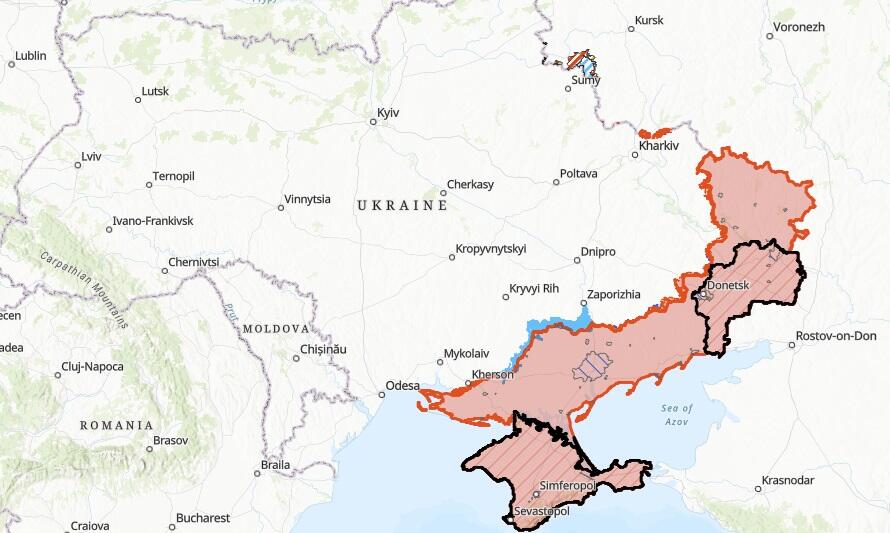
It will include a second shipment of antipersonnel mines, and comes the same day that Germany also unveiled another $680 million in Ukraine aid. The Western allies have asserted that they want to see Zelensky and Ukraine forces in as favorable a position as possible before negotiations to end the war inevitably proceed (something which Trump has repeatedly promised from day one of his second administration). But the prime question remains: what good will the rapid infusion of more weapons do when the real problem is Ukraine’s collapsing manpower? To illustrate the reality of Russia’s rapid advance of the past several months…

Below is a round-up of the progression of the Russian advance according to article headlines stretching back more than a month ago to today, illustrating the same.

* * *

Headline from four weeks ago: Ukrainian defenses in Donbas risk getting steamrolled by Russian advance

On the front lines in Donbas, the situation “remains difficult”, Ukraine’s army chief Oleksandr Syrsky said in a Telegram message on November 2. Ukrainian forces there are “holding back one of the most powerful Russian offensives since the beginning of the full-scale invasion”, he added.

A renewed push by Russian forces that began in springtime now seems to be bearing fruit in east Ukraine. 

The Russian army advanced 478 km² into Ukrainian territory in October, according to an AFP study analysing data from the American thinktank the Institute for the Study of War. This is the largest advance it has made since the early days of the full-scale offensive in Ukraine in spring 2022.

Headline from two weeks ago: Ukraine front could ‘collapse’ as Russia gains accelerate, experts warn

The ISW data shows Moscow’s forces have seized around 2,700 sq km of Ukrainian territory so far this year, compared with just 465 sq km in the whole of 2023, a near six-fold increase.

Dr Marina Miron, a defence researcher at Kings College London, suggested to the BBC that there was a possibility the Ukrainian eastern front “might actually collapse” if Russia continued to advance at pace.

More than 1000 sq km was taken between 1 September and 3 November, suggesting the push accelerated in recent months. Two areas bearing the brunt of these advances are Kupiansk in Kharkiv region, and Kurakhove, a stepping stone to the key logistical hub of Pokrovsk in Donetsk region.

Headline from one week ago: Ukraine War Map Reveals Russia’s Rapid Front Line Advances

Russian forces have been advancing far more quickly in Donetsk region in recent weeks than they did for the whole of last year, according to the Institute for the Study of War (ISW), whose map shows the state of play on the front line.

The Washington, D.C., think tank said on Sunday that recent Russian gains near Vuhledar and Velyka Novosilka showed that the war “is not stalemated” and the Donetsk region is “becoming increasingly fluid” with the latest Russian advances. Newsweek has emailed the Russian and Ukrainian defense ministries for comment.

Russian forces have seized settlements northeast of Vuhledar and advanced north of the town they had captured in October, according to Ukrainian sources and geolocated footage.

Current war map, via ISW

Headline from two days ago: Russia Forges Ahead in Eastern Ukraine, Capturing More Villages in Recent Days

Russian troops in eastern Ukraine have seized at least 10 villages and settlements in roughly as many days, according to a group with ties to the Ukrainian Army that maps the battlefield, as Moscow presses on with slow but steady advances that have heightened pressure on Ukraine’s authorities to start cease-fire talks.

The situation looks particularly precarious for Ukrainian forces in Donetsk, in Ukraine’s east, where Russian forces are closing in on their last two strongholds in the southern part of the region, according to the analysis by the group, DeepState. The fall of the strongholds, Kurakhove and Velyka Novosilka, could pave the way for a Russian takeover of the area, experts say.

Russia, which annexed Donetsk in 2022 and controls about two-thirds of the region, is seeking to consolidate power over the whole territory.

Headline from today (Monday): ‘Major compromise’: How Ukraine’s Zelenskyy shifted goals to end Russia war 

President Volodymyr Zelenskyy said over the weekend that he seeks an early end to the war with Russia, adding Ukraine could retake occupied land later through diplomacy if Kyiv’s NATO membership is certain.

This marks a shift from his earlier stance, where he said the end of the war was contingent on Russia returning seized Ukrainian territory.

* * *

Russia could see itself in such a position as to not need negotiations at this point. If the two sides two sit down at the table to seek ceasefire, the terms will without doubt be fully in Moscow’s favor. With Russia winning on the battlefield in the east in this tragic war of attrition, the Kremlin is unlikely to want to “give up” anything at all. Compromise and territorial concessions will be on the Zelensky government’s shoulders.

Tyler Durden
Tue, 12/03/2024 – 04:15

Scholz In Surprise Ukraine Visit Inspects Kamikaze Drones, Unveils $680M New Arms Package

0
Scholz In Surprise Ukraine Visit Inspects Kamikaze Drones, Unveils $680M New Arms Package

German Chancellor Olaf Scholz made a surprise visit to Kiev on Monday, which marked his first trip to Ukraine in two-and-a-half years, having arrived by train after which was greeted by President Zelensky.

“Winter is just around the corner, so there will also be winter equipment, as well as hand-held weapons and warming devices,” a German defense ministry spokesperson said while commenting on the German leader’s visit.

dpa/picture alliance

Scholz used the unannounced visit to unveil another massive military aid package at 650 million euros, or $680 million, to be transferred by the end of the year.

The supposed urgency of the aid is meant to underscore the alarm European leaders feel as Trump is set to enter the White House on Jan.20. He has promised to immediately begin negotiating an end to the war with Moscow.

“I would like to make it clear here on the ground that Germany will remain Ukraine’s strongest supporter in Europe,” said Scholz. “Ukraine can rely on Germany — we say what we do. And we do what we say,” Scholz additionally stated a post on social media.

Zelensky has in turn stated that his forces must become stronger amid reports that negotiations with Moscow are all but inevitable. He stressed that diplomacy could be an option “only when we know that we are strong enough.”

Scholz while in the Ukrainian capital inspected Western and German supplied kamikaze drones, which have been described as a “low-cost barrage munition”…

Simultaneous to Scholz being in Ukraine, German German Foreign Minister Annalena Baerbock is on an official visit to Beijing, where she blasted that Chinese-made drones are showing up in the Ukraine conflict, deployed by the Russian side.

“Drones from Chinese factories and North Korean troops attacking peace in the center of Europe violate our core European security interests,” Baerbock said just after a meeting with China’s top diplomat Wang Yi.

She told Wang that “increasing Chinese support for Russia’s war against Ukraine has an impact on our relations” and that this means “core German and European security interests are affected.” The West has condemned the ‘internationalization’ of the Ukraine war, after North Korean troops joined the Russian side; however, the clear double-standard is seen in the fact that the US and Europe haven’t batted an eye in providing massive NATO support to Kiev from the start.

Tyler Durden
Tue, 12/03/2024 – 02:45

Erdogan Backstabs His Way Into Center Of Middle East Conflict

0
Erdogan Backstabs His Way Into Center Of Middle East Conflict

Authored by Conor Gallagher via NakedCapitalism.com,

Turkish President Recep Tayyip Erdoğan just had a phone call with his Russian counterpart Vladimir Putin on Nov. 24 in which the former reportedly talked up plans to expand cooperation as the two countries have done in recent years. Part of that includes years of Moscow holding the hands of Erdogan and Syrian President Bashar al-Assad in an effort to mend ties due to Türkiye’s key role in the dirty war effort to topple the Assad government.

Beijing was also interested in seeing that reconciliation happen and were led by Erdogan to believe it was in the cards and that Türkiye’s days of launching jihadi operations were over.

The Turkish people are also overwhelmingly against the Israel-US rampage through the Middle East, and Erdogan has spent the past year-plus railing against their crimes and selling the people on stopping the flow of supplies to Tel Aviv vital for its genocidal operations (in reality he’s only been disguising it).

Erdogan stabbed them all in the back when it launched its paramilitary forces in northwestern Syria into action last week in the most intense fighting in northwestern Syria since 2020, when Russian-backed government forces seized areas previously controlled by opposition fighters.

US proxies — Ukrainian neo-Nazis, Islamic fundamentalists, and Zionist genocidaires — are all converging on Syria in a renewed attempt to topple Syrian President Bashar al-Assad or at least peel off more territory ahead of any potential settlement and weaken the influence of Tehran in the country.

Türkiye, as the biggest backer of the Islamist paramilitaries Hayat Tahrir-al-Sham (HTS), formerly known as Jabhat al-Nusra, is playing a central role. Turkish Foreign Minister Hakan Fidan is denying Ankara involvement, but while that’s implausible enough given that Türkiye has long provided all types of support, it’s even more so considering that the Turkish-backed Syrian National Army militia reportedly participated in the battle alongside HTS. Elsewhere, Turkish security sources are saying they attempted to prevent the offensive but were unsuccessful while adding that it’s only “a limited offensive.”

While many in various corners are celebrating the offensive thinking this will weaken Russia (reports are that Russia is having to send reinforcement to Syria) and finally topple the hated Assad, a few things to keep in mind:

What Is Türkiye Doing in Syria?

Here is the state of the situation in Syria as of Sunday morning, according to Elijah J Magnier:

The Syrian opposition forces, primarily led by Hayat Tahrir al-Sham (HTS) and Ahrar al-Sham, with support from Islamist jihadist groups, have launched a significant ground offensive over the past 48 hours in rural Idlib, rural Aleppo, and parts of Aleppo city supported by drones and armoured battalions. In a rapid and well-coordinated advance, they have captured dozens of villages, including strategic areas along the M4 and M5 international highways connecting Damascus to Aleppo and Aleppo to Latakia, as well as the critical cities of Saraqeb and most of Aleppo. With the Syrian army’s defensive lines nearly nonexistent, it appears only a matter of time before opposition forces gain complete control of Aleppo city. Reclaiming these losses would require tens of thousands of troops, a resource the Syrian army does not currently possess.

Some reports now say that the opposition groups are already in control of Aleppo and Syrian government forces fell back to prepare for a counterattack.

The Turkish-backed offensive is conveniently timed to coincide with the Lebanon “ceasefire,” and according to Yedioth Ahronoth, Israeli officials view the advance on Aleppo as an opportunity to weaken Syria. That is unsurprising as it’s widely believed that Israel, thwarted in its ground invasion of Lebanon, has circled back to its previous backup plan following its 2006 failure in Lebanon, which is to eliminate Iran’s ability to resupply Hezbollah via Syria.

Türkiye is helping. As Syrian Foreign Minister Bassam Sabbagh said on 29 November, the Turkish-HTS offensive comes “within the framework of serving the goals of the Israeli occupation entity and its sponsors.”

Not only are Erdogan’s denunciations of Tel Aviv empty words, but it appears he is actively conspiring with Netanyahu and the US in Syria.

According to AFP and Russia’s Izvestia, Turkish intelligence gave the green light to and is helping to direct the offensive. It was coordinated between Turkish, Ukrainian, and French intelligence, with Israeli backing and US approval. HTS also receives considerable support from Ukrainian special forces with a focus on drone warfare to target Russian and Syrian positions — a connection facilitated by the Turks.

The US, like Turkey, is denying any involvement in the HTS-led offensive, but claimed the reason for Syria’s problems are Assad’s “reliance on Russia and Iran.”

Elsewhere in Syria, Israel is working in tandem with ISIS. Here’s what Syrian researcher, former soldier and journalist Ibrahim Wahdi told Vanessa Beeley about one such IAF attack on Syrian forces in Palmyra:

Local sources said that the Zionist aggression on the SAA and auxiliary forces in Palmyra city came during their rest after returning from military missions in the central Syrian desert.

According to field sources these units had been engaged in fierce clashes with ISIS terrorist groups in the Al Shoula area of the Deir Ezzor desert after they had been spotted infiltrating from within the US-imposed 55km exclusion zone around the US unlawful military base of Al Tanf on the border with Jordan, taking advantage of heavy fog to try and advance towards Syrian allied positions.

The Syrian allied forces routed the ISIS terrorists and caused significant injures and deaths among their ranks. Israel attacked Palmyra from the Al Tanf “protected” airspace therefore we can conclude that Israel was supporting the ISIS terrorist operations with airstrikes against the forces that have been entirely responsible for the defeat of ISIS in Syria with the help of the Russian Airforce since September 2015.

Beeley’s conclusion:

Israel is trying to decimate the Syrian Air Defence capability, demoralise and deplete Syrian armed forces and to destroy the essential infrastructure that provides a road link to Lebanon and the Hezbollah resistance forces. At the same time the US and Israel are bombing the Al Bukamal border crossing with Iraq to try to close the land bridge between Iran, Iraq, Syria and Lebanon. Thus they are intending to isolate both Lebanon and Syria from their allies and to break the links in the Resistance chain of supply which includes humanitarian aid, energy resources to combat the US occupation of Syrian resources, and military equipment to support the Resistance.

…The plan is clear – to deplete Syrian military capability and to keep the Syrian Arab Army busy on multiple fronts – in the north-west (Idlib), in the north (Türkiye and former Free Syrian Army proxies), in the north-east (US and Kurdish Contras), in the east (US base at Al-Tanf incubator for terror gangs including ISIS) and in the south (possible land invasion by Israel and Druze separatists backed by Israel, remnants of illegal armed groups in Daraa and surrounding countryside).

HTS (at that time still known as Al Nusra) and other jihadist groups previously had control of the majority of Syrian territory in the mid-2010s, before a major intervention by Russia, Iran and Hezbollah swung the situation in the other direction. According to Military Watch, the only reason HTS can continue to operate northwestern Syria is because Turkey has the area under its protection with military bases. Past Syrian efforts to defeat HTS and retake Idlib were squashed by the Turks, including air and artillery support to target Syrian positions and protect jihadists.

Turkey by assisting HTS and others in the current offensive — if not directing it — is violating the 2019 agreement it sponsored along with Russia and Iran to freeze the line of the conflict.

Since that 2019 agreement the US has kept up sanctions in an effort to strangle Syria while Israel continued to bomb groups that it claimed were Iranian revolutionary guards or Hezbollah militants. It would appear Erdogan simply used the 2019 freeze not to work towards a permanent peace with Assad’s Syria, but to rearm and prepare.

Erdogan Calculations

Erdogan’s interests in this case overlap with the US-Ukraine-Israel group. The diehard neo-Ottoman ambitions of Erdogan and his clique, which wish to see Turkey strengthen its influence over much of the former empire, coincide with the US-Ukraine-Israel’s desire to curtail Russian and Iranian influence curtailed in the region.

At the bare minimum Türkiye is looking to get more territory under its and its proxies control in Syria ahead of any permanent settlement (potentially under Trump II) for refugee return and which would also allow Ankara better positioning to neutralize the Kurdish forces it sees as a threat. Türkiye hosts more than three million Syrians, which Erdogan is under pressure domestically to do something about, and has been accused of coercing thousands into signing declarations of “voluntary return.” As the security environment “strengthens” in Syria, Erdogan says more Syrians will be expelled from Türkiye.

That’s the generous view. The other is that all Erdogan’s talk about joining the BRICS, SCO, statements against Israel, thawing ties with Assad, (Syria wants Erdogan to withdraw troops and Islamist paramilitary groups before normalizing ties, which Erdogan refuses to do) have been a big head fake.

Burning Moscow — Again

Ankara faces a difficult balancing act with Moscow. Türkiye does not want to see Russia (or Iran) become too strong in the region and has always used the US as a counterweight. At the same time, Russia and Türkiye have a mutually beneficial economic relationship — one that has been critical to Erdogan’s political survival and helpful to Moscow in bypassing Western sanctions.

The US is increasingly putting that arrangement under strain by slapping more sanctions on Turkish and Russian entities, including recent restrictions on Gazprombank, which is linked to the Russian gas giant. Ankara is trying to get the US to agree to a waiver, a decision Washington would be unlikely to take without something in return.

Türkiye gets nearly half of its natural gas and a quarter of its oil from Russia on good deals. Russia even showed flexibility on payment to help Erdogan get re-elected this year.

Russian tourism to Turkiye has gone through the roof since the war in Ukraine and western sanctions started. Russia is also completing work on a nuclear power plant in Türkiye, a major milestone for the country on a deal beneficial to Türkiye, which includes the training of nuclear engineers by the Russians. Not only that, but Ugur Gurses, a former Turkish central banker, believes the Russians were using that plant to  transfer funds by purchasing Turkish bonds instead of direct bank transfers in a boost to Türkiye’s foreign reserves in a bid to help Erdogan get re-elected, which he did in the closest call in his two-decade rule.

Erdogan’s calculations in Syria likely conclude that Russia cannot retaliate too hard… yet. Erdogan similarly reneged on a deal with Russia last year when he returned Azov fighters in Turkish custody to Ukraine in violation of a prisoner exchange deal. While Moscow would no doubt be furious over Turkish support for the Syrian offensive, Russia  also wants to ensure going forward that Türkiye will continue to keep the Turkish Straits closed to NATO warships thereby keeping them out of the Black Sea. Russia wants to continue to send oil and gas to and through Türkiye to remaining European customers. Russia also needs to maintain good ties with Azerbaijan, which is close to Israel and Türkiye, for transport corridor purposes.

Meanwhile, Türkiye is getting a lot of good will from the West recently.

It looks like the US is rethinking the sale of F-35s to Türkiye, which was dropped from the program over its purchase of Russian S-400 missile defense system. It was rumored that Türkiye would have to hand over the S-400s for readmission to the F-35 program, but in light of the recent developments in Syria, maybe that’s not what the Americans were after. Der Spiegel recently reported that Germany’s Federal Security Council, which meets in secret, is approving the sale of $368 million worth of heavy weaponry to Türkiye, as well as reconsidering Türkiye’s request to purchase Eurofighter warplanes. That’s big news as it marks the end of a years-long unofficial embargo imposed by Western allies on Türkiye, which has hampered its defense sector development.

Burning China and the SCO

One of the biggest items on the Shanghai Cooperation Organization (SCO) agenda at this summer’s summit, which Türkiye attended, was the resolution of the Syria issue.

The SCO has always emphasized the importance of combating terrorism and radicalism, especially in Central Asia where the US has tried to stir up trouble in recent years to no avail as investment by China and Russia in these countries dwarfs what the West has on offer. The recent summit, however, was seen as an expansion of the SCO’s ambitions to become the security provider to the Eurasian continent.

What the SCO wants to guard against above all else is efforts by the West to use terrorism or any other division strategies to thwart the growing power and economic integration of its member states.

Erdoğan attended the SCO summit and played up Türkiye’s potential contributions to the organization. Here he is alongside President Xi Jinping:

“The organization has become one of our important dialogue channels with Asia owing to our dialogue partner status, which we’ve held since 2013,” he said. “Our many years of experience fighting terrorism show that international cooperation is essential to dealing with this threat. In this context, we are ready to further strengthen our dialogue with the Shanghai Cooperation Organization.”

In reality, Erdogan has done more supporting of terrorism than fighting. The Idlib governate straddling the Turkish border controlled by jihadist groups and supported by Ankara for is the primary hub of Islamist terror operations not only in Syria but also one of the biggest in the world.

Erdogan had an opportunity to wind that down, but instead looks to be doubling down, and Beijing is sure to be upset with his latest demonstration that he cannot be trusted.

Erdoğan, once an outspoken critic of Beijing due to its alleged treatment of Uyghurs, a Muslim minority of Turkic origin in western China, has almost completely dropped his criticism in recent years.

Both Erdoğan at the SCO summit and FM Fidan on his summer trip to China (where he said Türkiye “will not allow activities in Türkiye that undermine China’s territorial integrity” in reference to support for jihadists that could aid Xinjiang separatists) were asking for more investment from Beijing in Türkiye. (The EU-27 countries still contribute 59 percent of Türkiye’s foreign direct investment inflows.)

Beijing was slowly obliging. Chinese automotive company BYD recently announced that it will construct a $1 billion plant in western Türkiye. Ali Baba is planning to invest $2 billion in Turkiye. The Chinese lithium-ion power batteries company Farisis started production at a plant near Istanbul last year. Ankara is also in separate talks with Chinese EV makers SAIC Motor Corp., Chery Automobile, and Great Wall Motor Co for investments in factories in Türkiye.

One wonders if Beijing is rethinking.

Shortsighted Calculations?

Erdogan’s ongoing support for extremist groups not only puts the economic relationship with China and Russia at risk, but if he’s doing so in part due to promises from the West, that could end up coming back to bite him. Like Erdogan, the US-led West is not agreement-capable, and any sanctions relief, F-35 deals, or Zangezur corridor promises could be snatched away as quickly as they’ve been gifted.

There’s also a good chance that Türkiye is throwing in with the losing side. An Iranian response to Israel is supposedly still coming. This renewed push by US proxies in Syria makes it more likely it’s going to be a strong one this time.

And the Moscow and Damascus response is already underway in Syria. From Military Watch:

…it was reported that over 400 militants were killed in the first 24 hours of engagements. The casualties were reported by deputy chief of the Russian Center for Reconciliation of the Opposing Parties in Syria, Captain 1st rank Oleg Ignasyuk, who stated: “Illegal armed units linked to the Jabhat Al Nusra terrorist organization started to attack government-controlled areas in the provinces of Aleppo and Idlib at 7:50 a.m. on November 27. The Syrian army, backed by Russia’s Aerospace Forces, is engaged in heavy fighting. Terrorist units suffered major troop and equipment losses in the past 24 hours. At least 400 militants were eliminated.” The figures appear credible when considering Al Nusa’s demonstrated ability in the past to absorb massive casualties during its offensives, as well as the heavily fortified nature of the Syrian Arab Army’s positions between Aleppo and the Idlib governate where the jihadist group’s forces are based. Reports have indicated that foreign advisors supporting the offensives of have also been killed, with both Türkiye and Ukraine having provided such support to Al Nusra in the front.

According to Larry Johnson at Sonar21, “Reports on Telegram indicate that Syria, with ample support from Russia, are responding effectively to defeat the HTS attack. “

As referenced above, Russia might want Türkiye’s cooperation on the Black Sea and economic fronts for now, but for how much longer is it deemed necessary? Put another way, at what point does the cost of catering to Erdogan outweigh the benefits?

Maybe Russia, armed with its actual wonder weapons (as opposed to the imaginary Western ones), decides it’ll deal with the consequences of the Turkish straits being opened to NATO warships. Maybe Moscow decides it has enough other oil and gas customers, and it’ll take the hit by forgoing the exports to Türkiye and southeastern Europe. And there are other nations willing to help Russia bypass sanctions — although not in the EU customs union like Turkey.

Russia likely doesn’t want an even worse Türkiye headache at this time, but once Ukraine is eventually wrapped up, it could be bad news for Erdogan and his inner circle. It could be bad news even sooner if the majority of Turks figure out he’s playing them with all his fiery rhetoric against Israel.

We recently wrote about the potential spread of the Middle East conflict to the Caucasus region. All the major players from the Middle East conflicts are heavily involved in geopolitical maneuvering in the Caucasus. With Türkiye’s dramatic step into the ring and the Georgia color revolution attempt in full swing, as well as ongoing Armenia-Azerbaijan tensions with a heavy American presence in the former, it unfortunately looks like we’re inching closer to the Caucasus becoming another theater of the increasingly global New Cold War conflict.

Tyler Durden
Tue, 12/03/2024 – 02:00

Escobar: Trump May Be ‘Oreshniked’ On Ukraine Even Before He Gets To China

0
Escobar: Trump May Be ‘Oreshniked’ On Ukraine Even Before He Gets To China

Authored by Pepe Escobar,

With Oreshnik now entering the picture, everywhere the Hegemon will try to harass China they will also have to face Russia…

When it comes to state of the art Russian weaponry, what the inestimable Ray McGovern defines as the MICIMATT – the whole Hegemonic complex – seems to dwell in perpetual stupor.

They had no clue about Kalibr, Sarmat, Khinzal, Zircon or Avangard before they were introduced. They had no clue about Oreshnik (‘Hazel”) before the 30-minute protocolar warning by the Russians, stating a missile test was coming, and it was not nuclear. The Americans assumed that would be just another ballistic missile test, as they happen routinely close to the Arctic.

Even President Putin didn’t know Oreshnik was ready for its close-up until the last minute. And Kremlin spokesman Peskov confirmed that only an ultra-rarefied circle knew Oreshnik even existed.

In a nutshell: the MICIMATT only sees what Russia shows off – and when it happens. Call it a leak-proof vow of secrecy permeating the Russian military complex – which, by the way, is a massive state, nationalized company, with a few private components.

And that offers the Russian government, in practice, better engineering, better physics, better mathematics and better practical, final results than anything across the self-important collective West.

Oreshnik – a kinetic weapons system – is a certified game-changer when it comes to military technology and warfare in more ways than one: actually several. Simple physics tells us that by combining enough kinetic force and mass, utter devastation is guaranteed, comparable to a low-to-medium yield nuclear weapon. With the added benefit of no radiation.

Oreshnik is an intermediate-range ballistic missile (IRBM), under development by Russia (along with other systems) even before Trump 1.0 pulled the U.S. out of the INF treaty in 2019.

A few concise analyses have pointed out how Oreshnik can be fitted into intercontinental (italics mine) non-nuclear missiles. The Russians are being very diplomatic, not stressing that if Oreshnik is launched from the Russian Far East, it can easily reach most latitudes across the USA.

Moreover, applying Oreshnik tech to tactical missiles – Putin late last week said this is already happening – also changes the whole tactical domain.

The new game in town is Russia being capable of unleashing ultra-high-velocity kinetic weapons literally anywhere around the world – after warning civilians to abandon the area around the targets. And there’s absolutely no defense against it, anywhere.

Nowhere to run, baby, nowhere to hide

It’s quite predictable that the woke, arrogant/ignorant MICIMATT, as well as NATO and the whole, brainwashed collective West simply have no idea what just hit them, seemingly out of the blue.

To be concise: a system with the destructive power of a tactical nuclear weapon but carrying the precision of a top sniper’s bullet.

Ergo, sitting duck billion-dollar aircraft carriers; the whole, 800-plus Empire of Bases; assorted underground bunkers; ICBM launch platforms; naval shipyards; not to mention NATO’s HQ in Brussels, the Aegis Ashore base in Redzikowo (Poland), the NATO joint force center in the Netherlands, southern NATO command in Naples – all these immensely expensive assets are fair game for non-nuclear Oreshniks capable of reducing them to dust in a flash after flying for mere minutes at over Mach 10.

By now multitudes around the world are aware that Oreshnik may reach Berlin in 11 minutes and London in 19 minutes. Also that launched from southern Russia, Oreshnik may reach the U.S. air base in Qatar in 13 minutes; launched from Kamchatka in the Far East, it may reach Guam in 22 minutes; and launched from Chukotka, it may reach Minuteman III silos in Montana in 23 minutes.

To quote the epic 1960s Motown hit: “Nowhere to run, baby, nowhere to hide.”

Graphic proof that the MICIMATT and NATO have absolutely no clue what hit them – and will hit them again – is the escalation dementia in effect even after Oreshnik’s warheads reduced a missile factory in Dnipropetrovsk to smithereens. And even after Moscow made it quite clear that they don’t need nuclear weapons to hit anything they want anywhere on Earth.

The MICIMATT plus NATO, in tandem, fired ATACMS twice against Kursk; released a P.R. trial balloon related to the suicidal possibility of sending nuclear weapons to Kiev; NATO warned businesses to enter a “wartime scenario”; NATO’s armchair admiral Rob Bauer, a Dutch non-entity, advocated pre-emptive bombings of Russia; Le Petit Roi in France and the ghastly British PM re-started the gambit of “troop deployments” to Ukraine (Starmer later backed off); and last but not least, the Liver Sausage government in Germany started to draw plans to use metro stations as air raid shelters.

All this escalation paranoia sounds like a bunch of screaming kids playing in their dirty sandbox. Because for all practical purposes it is Russia which is now ruling the escalation game.

Breaking up Russia-China is hard to do

And that brings us to Trump 2.0.

The Deep State has already targeted Trump with a vicious war – a de facto pre-emptive counter-insurgency, even before he attempts to do anything practical regarding NATO’s collapsing Project Ukraine.

His ideal off-ramp might be an Afghanistan-style exit, leaving all the burdens ahead to a basket of NATO chihuahuas. Still, that’s not gonna happen.

Andrey Sushentsov is a program director of the Valdai Club and dean of MGIMO’s school of International Relations. He’s one of Russia’s top analysts. Sushentsov released this pearl to TASS, among other things:

“Trump is considering ending the Ukrainian crisis, not out of any sympathy for Russia, but because he acknowledges that Ukraine has no realistic chance of winning. His goal is to preserve Ukraine as a tool for U.S. interests, focusing on freezing the conflict rather than resolving it. Consequently, under Trump, the long-term strategy of countering Russia will persist. The U.S. continues to benefit from the Ukrainian crisis, regardless of which administration is in power.”

Sushentsov fully recognizes how “the U.S. state system is an inertial structure that resists decisions it deems contrary to American interests, so not all of Trump’s ideas will come to fruition.”

That’s just one graphic illustration, among many, that Moscow harbors no illusions whatsoever about Trump 2.0. Putin’s conditions for an attempt to solve the Ukraine riddle have been known at least since June: total Kiev withdrawal from Donbass and Novorossiya; no Ukraine in NATO; end of all 15,000+ Western sanctions; and a non-aligned, nuclear-free Ukraine.

That’s it. Everything non-negotiable; otherwise the war will continue on the battlefields, the way Russia sees fit, until Ukraine’s total surrender.

Evidently the Five Eyes – actually only 2 (U.S.-UK) – plus minion France, side by side with the most powerful silos inside the Deep State will continue to force Trump to double down on Project Ukraine, which is an essential part of the Forever Wars ethos.

The best he might be able to do is to divert attention from Project Ukraine by accommodating the Old Testament psychopathological genocidals in Tel Aviv, plus the Zio-con armada in D.C., in their obsession of forcing Washington to fight their war on Iran. Talk about a slight change of focus of the Forever Wars.

Tehran not only exports most of its energy to China but is an absolutely essential node of the International North South Transportation Corridor (INSTC) as well as the Belt and Road Initiative (BRI); that is, north-south and east-west crisscrossing Eurasia.

That would be the real war of choice – simultaneously against three BRICS (Russia, China, Iran). After all the American ruling class is already invested on a do-or-die Hybrid War against BRICS.

Still, the Trump 2.0/China face-off will be the fulcrum of the Hegemon’s foreign policy starting January 20. Virtually all of Trump’s appointments – as misguided as they may be – believe it is possible to break apart the Russia-China comprehensive strategic partnership and prevent China from buying energy from Iran.

There will be attempts to disrupt shipping lanes and supply lines – from the Maritime Silk Roads in the Indian Ocean rimland to the Northern Sea Route by the Arctic, including possible false flags along the INSTC.

But with Oreshnik now entering the picture, everywhere the Hegemon will try to harass China they will also have to face Russia. So the temptation to end Project Ukraine and NATO’s encroachment on Russia’s western borders will always be there in the back of Trump’s mind, part of a “seduce Russia to undermine China” syndrome.

The problem for the Hegemon is that the interlocking BRICS/SCO-wide Russia-China-Iran strategic partnerships do have other – kinetic – ideas.

Tyler Durden
Mon, 12/02/2024 – 23:25