79.6 F
Chicago
Saturday, October 10, 2026
Home Blog Page 2062

Mexico Stops 2 Migrant Caravans After Trump Tariff Threat

0
Mexico Stops 2 Migrant Caravans After Trump Tariff Threat

Days after Donald Trump announced that Mexican President Claudia Sheinbaum had “agreed to stop Migration through Mexico, and into the United States,” or face 25% import duties on Mexican goods, it appears she’s done just that.

Migrants walking in a caravan heading to the United States take a break in the municipality of Tapachula in Chiapas.Juan Manuel Blanco (EFE)

According to the Associated Press, Mexico has already broken up two migrant caravans consisting of approximately 4,000 people at their peak. Some of the migrants were bused to cities in southern Mexico, while others were offered transit papers, which allow them to travel across Mexico for 20 days.

According to migrant rights activist Luis García Villagrán, Mexico’s actions against the two caravans appear to be part of “an agreement between the president of Mexico and the president of the United States.”

According to the report, the first of the caravans started near the Mexico-Guatemala burder on Nov. 5, the day Trump was elected. It had traveled roughly 270 miles in the ensuing four weeks of walking, ending up in Tehuantepec in the state of Oaxaca when it was broken up.

“They took some of us to Acapulco, others to Morelia, and others from our group to Oaxaca city,” said said Bárbara Rodríguez, a native Venezuelan who ended up catching a bus into Mexico City.

In a statement Saturday, the National Immigration Institute said the migrants voluntary accepted bus rides “to various areas where there is medical assistance and where their migratory status will be reviewed,” and said “upon accepting (the rides), they said they no longer wanted to face the risks along their way.” -AP

The second caravan made it around 140 miles to the town of Tonala in Chiapas state, where authorities offered the migrants the transit visas.

Meanwhile, Mexico’s Supreme Court of Justice of the Nation (SCJN) has approved an injunction filed by the Jesuit Refugee Service and the Alaíde Foppa Legal Clinic to create a public registry of detained migrants.

Tyler Durden
Mon, 12/02/2024 – 23:00

US Market Valuation: One For The History Books

0
US Market Valuation: One For The History Books

By Damien Cleusix of the Quantastic World substack

Executive Summary

This analysis presents a sobering outlook for the S&P 500, arguing that it is currently the most overvalued it has ever been, surpassing even the 2000 Tech Bubble and 2021 market frenzy. Key points include:

  1. The Margin-Adjusted Cyclically-Adjusted Price Earning Ratio (MAPE) indicates extreme overvaluation.
  2. Projections suggest negative nominal total returns for the S&P 500 over the next 10 years, with potential annual losses of 1.4% to 8.9%.
  3. A market correction to historical valuation norms could result in substantial losses, potentially up to 21.4% annually if occurring within the next three years.
  4. Ultra-loose monetary and fiscal policies have contributed to market distortion and speculation.
  5. Current market behavior reflects complacency and diminished critical thinking among investors.
  6. The analysis warns of potential inflationary pressures and the need for investors to reassess risk tolerance and prepare for lower returns or significant drawdowns.

The article concludes that achieving positive real returns in the coming decade would require exceptional circumstances, urging investors to remain grounded in fundamental valuation principles.

“Value investing is at its core the marriage of a contrarian streak and a calculator.”   – S. Klarman

“The first principle is that you must not fool yourself, and you are the easier person to fool.” – R. Feynman

In this analysis, we aim to objectively examine the current discrepancy between the intrinsic value and the market price of the S&P 500.

Our conclusion is that the S&P 500 is unlikely to have a positive nominal total return in the next 10 years and a ‘miracle’ would be needed to achieve positive real total returns.

Central Banks have brought forward future equity returns (and some more) with their accommodative policies and hyper-sensibility to downside volatility. Ultra-loose fiscal policies since Covid (justified in the first 6 months not thereafter) have put gasoline on the fire.

Being blunt, there is a real possibility for the S&P 500 to revisit at least the 2020 lows in the coming years.

Before we dive in, it’s important to recognize that valuation metrics have little to no ability to predict short-term market fluctuations. Think of it like a rubber band: the farther the market price is from its intrinsic value, the stronger the pull back toward that value. This means that even seemingly insignificant events can trigger the start of a mean reversion when valuations are extreme.

Market Behavior and Investor Psychology

When equity markets appear unstoppable—rising relentlessly on good, bad, or no news—investors may neglect the fundamental principle that value anchors price.

Over a decade of quasi-invincibility, where every market decline is swiftly recovered, can lead to complacency and diminished critical thinking. Reflection becomes a liability. The educated fools are in control.

This environment fosters narratives like “Buy the Dip,” and the creation of viral acronyms such as BTFD (Buy The F***ing Dip), FOMO (Fear Of Missing Out), and HODL (Hold On for Dear Life).

This time it is really different! Is it?

Central Banks around the world, by lowering interest rates aggressively and providing unlimited support, verbally and/or materially, to the markets at the slightest emergence of stress and by taking too much time or even refusing to remove the accommodations they provided, have set the stage for historical markets and social dislocations.

If one add that a chunk of the post-Covid fiscal spending largess going directly to the equity markets through gamified trading applications or passive mom and pop vehicles or the emergence of the YOLO meme/life mantra you have all the ingredients for a massive speculation frenzy.

When finance dominates everything, when companies’ management are obsessed by financial engineering and short-term personal rewards, when governments/central banks/regulators are controlled and not controlling, dogmatic and not pragmatic, the end result cannot be good.

While we will expand on this in another article, Ben Hunt of Epsilon theory has written extensively and brilliantly on the subject. One could start here.

Bubbles need leverage to expand

Although central banks have rapidly increased their target rates—often belatedly—they are now swiftly reversing course, once again demonstrating their asymmetric reaction functions.

Interest rates below a certain level probably have a detrimental effect for the real economy as investments in new productive capital become less and less elastic to rates as they decline toward 0%.

Zombie companies survive, preventing any Schumpetarian creative destruction, leaving excess supply in place, pushing inflation rate down (what? low rates could be deflationary?).

Furthermore, savers are forced to spend less unless they take more risk as their fixed income portfolio doesn’t generate much of an income.

The only thing striving is finance where actors put on more and more leverage to buy existing capital (buybacks, M&A, dividend payment to private equity firm, etc).

The sad consequence is a larger stock of debt unbacked by new productive capital.

A system where overall debt cannot be repaid, ever. A system where the can is kicked down the road until it can’t anymore.

The end game is either an inflationary burst to save the debtors, a multi-decade’s slow growth environment or a deflationary burst.

Given that the debtors are governments, interest groups lobbying them and Generation X and the younger ones (who will soon dominate the electorate), we have little doubt that the inflationary scenario is the most probable.

But let’s come back to the main subject of this article, the US equity market valuation.

Stocks are a claim on a expected future stream of cash flows. To assess this stream’s value today, we have to calculate its present value using an appropriate discount rate. This present value is called the intrinsic value of a stock or of a group of stocks.

At a given discount rate, the short-term fluctuations of cash flows have very little influence on intrinsic value. Remove entirely 1 or 2 years of cash flow and the difference will be small.

Longer-term expectations, on the other hand, have a large impact. Those expectations are highly pro-cyclical.

Earnings are already, as we will shortly demonstrate, well above trend and, therefore are highly likely to grow less than the overall economy. Still analysts are expecting them to grow much more quickly.

Changing the discount rate can have a huge impact.

Discount rate assumptions backed by market participants are strongly correlated with their mood. Bullish participants will accept a lower discount rate, ceteris paribus.

Prevailing interest rates usually serve as a loose anchor to discount rate assumptions. We can nevertheless see, experimentally, an increased exposure to risky assets the lower the risk-free rate is, even when the mean excess return is the same.

On the graph below, one can see the average allocations to a risky asset across different interest rate conditions. Each condition has 200 participants, from the MTurk platform. The x-axis shows the risk-free rate in each condition. The mean excess return on the risky asset is 5% in all conditions.


We will now demonstrate using a methodology proposed by J. Hussman, the Margin-Adjusted Cyclically-Adjusted Price Earning Ratio (MAPE), that the US stock markets is the most overvalued it has ever been.

R. Shiller and J. Campell proposed the concept Cyclically-Adjusted Price Earning (CAPE) to forecast 7-12 years markets future return using a long moving average of earnings back in 1988 (originally 10 years). The goal was to smooth out the business cycle influence on earnings in order to get a smoother series they called trend earnings.

The CAPE model was good at forecasting forward return in the past (M. Faber applied it to foreign markets too) but some argue that accounting changes, payout policies, a move toward less competitive markets could have made the CAPE model lose some or even most of its forecasting ability.

One can find some great discussion on the subject here and here.

R. Shiller introduced the Cyclically-Adjusted Total Return Price Earning Ratio to account for the change in company payout policies with the increased use of buybacks to return capital to shareholders.

Two flaws remained nevertheless.

First, as identified by J. Hussman, one can get an even smoother trend earning series by adjusting the CAPE to get constant historical margins. He uses 5.4% margin as its average. So if the most recent 10 years average margin is 7%, one ought to multiply the CAPE by 7%/5.4% (1.3). A CAPE of 30 becomes a MAPE of 40.

The second problem is that margin could have increased permanently due to structural change in the economy and the dominance of capital-light businesses.

While this might explain some of the increase in margin, we are convinced that a large part of the increase in margin is transitory and that once capitalism is allowed to work as it should, it will disappear. It will be the subject for another article.

Anyhow, we have assumed a permanent increase of margin to 7% starting in 1998 with the emergence of internet.

Let’s now look at the data.

As one can see, today’s MAPE is the highest it has ever been, dwarfing the 2000 Tech Bubble and the end of 2021 frenzy.

We won’t talk about the divergence on factor valuations here, it will be the subject of another article.

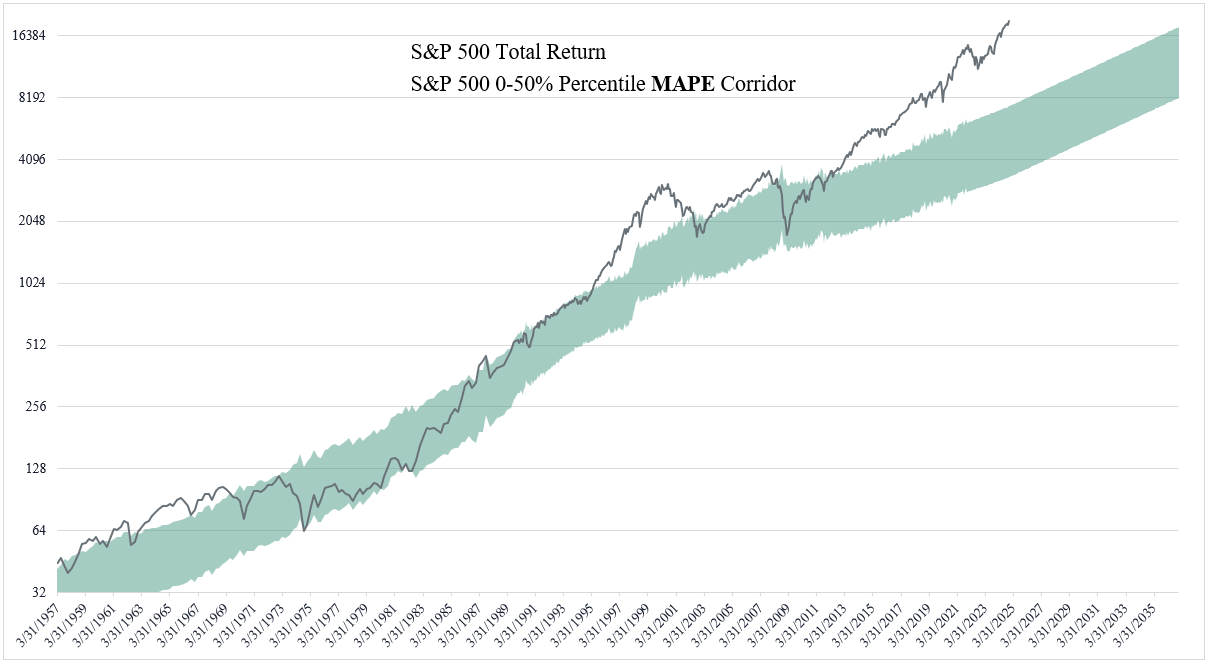
If we construct an historical corridor with boundaries between the 0% and 50% percentiles of MAPE history, the prospect looks grim for Buy and Holders.

If we construct an historical corridor with boundaries between the 0% and 50% percentiles of MAPE history, the prospect looks grim for Buy and Holders.

The S&P 500 is currently almost 400% above the level corresponding to a bottom MAPE and 130% above the 50% percentile MAPE history.

If we assumed a return to the MAPE 50% percentile, with nominal trend earnings growing at their historical pace and the current 1.26% dividend yield, one can see that the S&P 500 nominal total return for the next 10 years would be at -1.4% annually.

If the markets reached similar valuation to the summer 1982, the nominal total return for the next 10 years would be at -8.9% annually.

We doubt (and it is a strong understatement) the markets will wait 10 years to test the MAPE 50% percentile. A retest in the next 3 years is possible. Reaching the MAPE 50% percentile in 3 years’ time would imply an annualized 21.4% loss.

Even if we assume normalized margins to be 10%, a return to the MAPE 50% percentile in 3 years’ time would imply an annualized loss of more than 15%!

One should also not forget the historical tendency of deeply overvalued markets to fall significantly below the MAPE 50% percentile.

It is also important to remember that today’s margins are above our 7% assumption and that the CBO is projecting around 4% nominal US GDP growth to 2034. The odds are thus stacked against the >6% nominal earning growth we have assumed.

Among all the factors which will impact the markets nominal total return, the most important is inflation. As we have said earlier, on a 10-20 years’ basis the politicians’ rulers and their electors will favor much higher level of inflation.

In this scenario, while nominal earning growth will be higher, ceteris paribus, with increasing inflation, the price investors will be willing to pay for each unit of earning will decline. Investors do not like inflation or deflation.

Conclusion

In light of our analysis, the current state of the S&P 500 presents a sobering outlook for investors. The unprecedented levels of the Margin-Adjusted Cyclically-Adjusted Price Earning Ratio (MAPE) signal a market that is significantly overvalued, even surpassing the extremes of the 2000 Tech Bubble and the 2021 market frenzy.

Our projections suggest that achieving positive real returns in the coming decade would require nothing short of a miracle. The combination of ultra-loose monetary policies, misaligned fiscal measures, and a pervasive “this time is different” mentality has created a perfect storm of market distortion.Investors should be acutely aware that:

  1. The S&P 500 is currently trading at levels that are unsustainable in the long term.
  2. Even with optimistic assumptions, the potential for negative returns over the next 10 years is significant.
  3. A market correction to historical fair value could result in substantial losses, potentially as high as 21.4% annually if occurring within the next three years.

As we navigate these treacherous waters, it’s crucial to remember the wisdom of Seth Klarman: “Value investing is at its core the marriage of a contrarian streak and a calculator.” Now, more than ever, investors must resist the siren song of market euphoria and anchor their decisions in sound valuation principles.

The road ahead may be challenging, but it also presents opportunities for those who maintain discipline and a clear-eyed view of market fundamentals.

As we face the possibility of increased inflation and potential market turbulence, prudent investors should reassess their risk tolerance, diversify wisely, and prepare for a period of lower returns or even significant drawdowns.

In closing, let us heed Richard Feynman’s caution against self-deception. The markets have a way of teaching harsh lessons to those who ignore the fundamentals.

By staying grounded in reality and maintaining a long-term perspective, investors can navigate the coming years with greater resilience and potentially position themselves to capitalize on the opportunities that inevitably arise when markets return to more rational valuations.

“It is better to be out of the markets wishing to be in than in the markets wishing to be out” – Unknown

“I never invest at the bottom, and I always sell too soon.” – Nathan Rothschild

Tyler Durden
Mon, 12/02/2024 – 22:35

Japanese ‘Human Washing Machine’ Uses AI For When You’re Too Lazy To Wash Your Own Ass

0
Japanese ‘Human Washing Machine’ Uses AI For When You’re Too Lazy To Wash Your Own Ass

As if obese redundant piles of American protoplasm, to borrow George Carlin’s phrase, weren’t already stagnant enough with the invention of Ozempic and the likes, there is now an AI powered human ‘washing machine’ that’ll wash their ass for when they’re too lazy to perform the most basic of hygiene tasks. 

Japanese firm Science Co. has unveiled an AI-powered “bath of the future,” a shower pod called the “Mirai Ningen Sentakuki.”

Resembling a high-tech capsule, it can wash and dry users in just 15 minutes. Chairman Yasuaki Aoyama revealed at an Osaka lecture that the device is 70% complete, aiming for a revolutionary bathing experience, according to the New York Post.

The user sits in a transparent capsule that partially fills with water, as shown in a viral video we’ve posted below. Sensors in the seat monitor vital signs to ensure an optimal bath, while high-speed jets with micro-sized air bubbles cleanse the body.

Chairman Yasuaki Aoyama commented: “We’re about 70% there.”

The Post wrote on Monday that the pod uses AI to monitor user biomarkers, projecting calming videos inside the capsule to enhance relaxation.

High-speed jets create microbubbles that burst with pressure waves, scrubbing away grime—a technique inspired by cleaning delicate electronics. The experience offers both physical and psychological cleansing, according to the company.

The design draws from the Ultrasonic Bath exhibited at the 1970 Japan Expo, which also used water and ultrasound for cleaning. Inspired by that, company chairman Yasuaki Aoyama plans to showcase the new “human washing machine” at Expo 2025 in Osaka, where 1,000 visitors can try it.

Reservations are already open, with plans for a home edition in the works.

And as for “enhanced relaxation”, this can only mean we are just one step from…well, The Dude said it best…

Tyler Durden
Mon, 12/02/2024 – 22:10

Pakistan: Slow Motion Train Wreck

0
Pakistan: Slow Motion Train Wreck

Authored by Eric Margolis via EricMargolis.com,

Pakistan is the world’s most important Muslim nation. It has 251 million people, nuclear weapons, the world’s sixth largest armed forces, intelligent, capable people, vast lands and major sources of water.

Yet Pakistan is a giant mess. Its current politics are a form of tribal warfare. Corruption engulfs almost everything. Disease, particularly diabetes, afflicts its long-suffering people. Polio is making return.

In recent years, Pakistan has suffered vast floods that have ravaged this nation. Equally menacing, next-door India remains an ever-present danger. Far-right Hindu extremists who are heavily represented in the current Modi government, keep talking about ‘reabsorbing’ Pakistan into ‘Mother India.’ This would have happened long ago except for Pakistan’s important nuclear arsenal and delivery systems.

Via Reuters

India has also built an extensive nuclear arsenal, including three new submarines armed with intermediate-ranged nuclear missiles. This while people in India and Pakistan starve in the streets. And 60% of homes in India lack indoor plumbing.

The only institution in Pakistan that really works well is the armed forces. I have met many of its generals: most of them are intelligent, combat-ready officers. I knew Gen. Akhtar Abdur Rahman Khan, the ferocious chief of ISI intelligence service who led the anti-Soviet war in Afghanistan. He was murdered with the tough tank general Zia ul Haq who ruled Pakistan until his aircraft was sabotaged in 1988. Zia was a great Islamic warrior and man of steel. Many Pakistanis still believe he was assassinated by the US though there is no direct evidence.

I was friends with the late Benazir Bhutto, a fascinating and alluring woman who was murdered in 2007. I interviewed Gen. Pervez Musharraf in 1999, a man who seemed insignificant compared to Gen. Zia.

Benazir Bhutto, whose father Zulfikar was ordered hanged by Zia, used to tease me, ‘oh Eric, you love your Pakistani generals.’ I did. Most were fierce Pashtuns from the NW Frontier, born warriors. They first defeated the Soviet Union, then the mighty USA.

I also took to some of the Indian generals that I met. They and their Pakistani counterparts had none of the slipperiness and deceit of most politicians.

This brings me to the jailed, 51-year-old former cricket star, Imran Khan, Pakistan’s most popular political figure. Khan was jailed on fake charges over receiving gifts, when the ruling oligarchy feared Khan would win a landslide in elections. His wife was also thrown into prison.

Imran Khan’s chief enemies were the Sharif brothers, Shebhaz and Nawaz. Both were rich Punjabi industrialists often accused of egregious corruption. I came out of war-torn Afghanistan to interview Nawaz. He left me unimpressed, particularly after the time I spent with the fiery General Zia.

The United States and Britain, vocal champions of democracy, had nothing to say about the illegal imprisonment of Pakistan’s most popular democratic politician. It was clear they were supporting the Sharif brothers who were more amenable to America’s wishes and anti-Islamic policies. Pakistan’s influential army appears to be backing the Sharif regime.

This is interesting. Washington, which makes so much noise about democracy, is now supporting undemocratic regimes in Morocco, Tunisia, totalitarian Egypt, Jordan, Oman, Iraq, Saudi Arabia, Pakistan, and the Gulf, not to mention Africa and Latin America. The CIA installed the current Ukrainian regimes. Efforts are again afoot to overthrow the Assad regime in Syria and, of course, to crush the life out of Palestinians.

What Washington really wants around the globe is total obedience, not real democracy.

Pakistan is a sad example. President Pervez Musharraf told me that a senior State Department official warned him that if Pakistan did not allow US troops to use his nation to attack Taliban-ruled Afghanistan ‘we will bomb you back to the Stone Age.’

Great powers want to have their way. Democracy and common sense too often do not stand in the way. At least the new Trump administration in Washington is being brutally frank about its wants and needs unlike the honey-tongued hypocrites of the Biden years.

Tyler Durden
Mon, 12/02/2024 – 21:45

NATO Chief Warned Trump ‘Bad’ Ukraine Peace Deal Is A ‘Dire Threat’ To US, Europe

0
NATO Chief Warned Trump ‘Bad’ Ukraine Peace Deal Is A ‘Dire Threat’ To US, Europe

NATO’s new secretary-general is trying to talk tough ahead of Donald Trump taking office. Surely he knows Brussels is in for a rough ride, given that during the first Trump administration the president (rightly) ripped NATO member states for not paying their fair share in defense spending, while relying on Washington to shoulder the burden.

Mark Rutte has warned Trump in a Financial Times interview that if Ukraine is pressured into a ‘bad’ peace deal which is favorable to Moscow, then the United States and Europe would face a “dire threat” from Iran, China, and North Korea.

Via Associated Press

All of these ‘rogue’ states (in the lexicon of some Western leaders) have deepened their relations with Russia throughout the course of the nearly three-year long war in Ukraine. North Korea and Russia in particular even signed a defense pact last summer, resulting in some 10,000 North Korean soldiers being deployed to support the Russian side. All are also coordinating on circumventing US-led sanctions.

Like some pundits at hawkish US think tanks, Rutte tried to frame to outcome of the Ukraine war as of dire importance for Taiwan’s freedom. According to FT:

Rutte noted the risks from Russia supplying missile technology to North Korea and cash to Iran. In an apparent reference to Taiwan, he said that Chinese President Xi Jinping “might get thoughts about something else in the future if there is not a good deal [for Ukraine]”.

“We cannot have a situation where we have [North Korean leader] Kim Jong Un and the Russian leader and Xi Jinping and Iran high-fiving because we came to a deal which is not good for Ukraine, because long-term that will be a dire security threat not only to Europe but also to the US,” Rutte told the FT in his first interview as head of the western military alliance.

Rutte had met with Trump a week-and-a-half ago at his Mar-a-Lago estate in Florida. It was their first such meeting since Trump won the election on November 5.

Clearly the NATO chief tried to persuade Trump to essentially keep up the same muscular stance on Moscow as the Biden administration. It seems he tried to present the same ‘domino’ effect argument which hearkens back to the Cold War – which goes something like if ‘X enemy is not stopped here, then Y enemy will also feel emboldened and seek military conquest’ etc.

“Look at the missile technology which is now being sent from Russia into North Korea, which is posing a dire threat not only to South Korea, Japan, but also to the US mainland,” Rutte said he told Trump, as quoted in FT.

“Iran is getting money from Russia in return for, for example, missiles, but also drone technology. And the money is being used to prop up Hizbollah and Hamas, but also steering conflict beyond the region,” he had claimed.

“So the fact that Iran, North Korea, China and Russia are working so closely together . . . [means] these various parts of the world where conflict is, and have to be managed by politicians, are more and more getting connected,” explained Rutte.

“And there is one Xi Jinping watching very carefully what comes out of this,” he added, in apparent reference to Taiwan. “These were the points I made,” the NTO leader stressed.

But we doubt that that Ukrainians young and old, tragically dying along the front lines in this horrific war of attrition, will care much about NATO and Western grand strategy regarding far-flung places like China or North Korea.

Tyler Durden
Mon, 12/02/2024 – 21:20

De Beers Pulls “Last Resort” Price Cut As Diamond Price-Floor Crumbles 

0
De Beers Pulls “Last Resort” Price Cut As Diamond Price-Floor Crumbles 

A new report says the collapse in rough diamond prices has prompted the world’s largest producer to implement broad price cuts. 

Bloomberg reports that De Beers’ final sale of rough diamond stones on the secondary market was led by a 10% to 15% price cut amid a slumping market pressured by the proliferation of artificial diamonds and sliding demand across the West and China. 

Yet on Monday, the company capitulated on that position at its final sale of the year. De Beers cut prices by 10% to 15% for most of the goods it sells, according to people familiar with the situation. That’s the first major price cut since the start of the year and a historically large reduction.-BBG

Price cuts at Anglo American’s De Beers come as the Diamond Standard Index, which dates back to early 2022, has plunged to record low levels. 

Here’s more from the report:

De Beers wields considerable power in the rough-diamond market. It holds 10 sales each year in which the buyers — known as sightholders — generally have to accept the price and the quantities offered.

Still, even after the steep cut in prices today, the company’s stones are still more expensive than the going rate in the secondary market, the people said, asking not to be identified as the matter is private. The company also removed some of the flexibility it had offered at previous sales.

De Beers typically reserves aggressive price cuts as a last resort. While it keeps pricing secret, the across-the-board cut this month is hefty.

So much for the diamond giant putting a floor under prices… 

Take a look at our prior note titled “Diamond Prices Crash To Multi-Decade Lows As Art, Wine, & Rolex Markets Sour.” 

Tyler Durden
Mon, 12/02/2024 – 20:30

The Failure Of COP29: Does The “Green Agenda” Have A Future?

0
The Failure Of COP29: Does The “Green Agenda” Have A Future?

Authored by Raphael Machado,

Following the conclusion of the multilateral climate conference COP29, held in Baku, Azerbaijan, the atmosphere is one of defeat.

Nearly an entire week of speeches and endless meetings did not suffice to reach a reasonable consensus on a series of practical measures that had been anticipated.

Specifically, the debate on funding climate policies sank.

The so-called “developing countries” had expected an annual grant policy exceeding $1 trillion for energy transition and climate change mitigation policies, but only $300 billion per year will be allocated—optimistically.

Moreover, this sum will not necessarily be in the form of grants but may include loans and other financing mechanisms that bring interest and debt.

India denounced the final result of COP29, supported by Bolivia, Cuba, and Nigeria, as a farce and an insult from developed countries to developing nations.

This financing debate will now be deferred to COP30, scheduled to take place in Brazil in 2025. However, the chances of COP30 succeeding where COP29 failed seem very slim.

While climate alarmism and eco-globalism are now part of Brazil’s official ideology, in the rest of the world, these postmodern beliefs are losing momentum.

Take, for example, the reasons why expanding funding for the “Green Agenda” has been impossible in “developed countries.” Observing European governments’ behavior since the beginning of Russia’s special military operation in Ukraine, one can see increasing difficulty in advancing energy transition and net-zero carbon policies.

Germany, for instance, was once one of the main drivers of climate alarmism worldwide, even closing its nuclear power plants “for the environment” (despite nuclear plants being far less polluting than most other energy sources). Yet today, facing an energy crisis caused by the NordStream’s destruction, Germany is reopening its coal-fired power plants.

Sweden, long a leader in international climate activism, has reversed many of its previous environmental measures. The Ministry of the Environment has been dismantled, and the government now prioritizes ensuring cheap fuel.

Meanwhile, in the United Kingdom, the previous administration of Prime Minister Rishi Sunak suspended the ban on diesel car sales and decided to stop promoting the replacement of gas heaters. Similar examples can be found in several other countries.

Clearly, sanctions and the NordStream’s destruction have made Europe’s energy situation difficult enough to raise living costs, convincing European governments to roll back at least some environmental measures and dampen their enthusiasm for promoting global climate alarmism.

This retreat by European nations will be compounded by the fact that, starting in 2025, the United States will likely be governed by Donald Trump, who holds a critical stance toward climate alarmism and promises to intensify fracking for hydrocarbon extraction in the country. This is corroborated by the nominations of Chris Wright as Secretary of Energy and Lee Zeldin to the U.S. Environmental Protection Agency.

In Brazil, the media has revealed that Lula’s administration fears a lackluster COP30 in the Amazon region in 2025, with the U.S. under Trump’s administration. Naturally, for Brazilian patriots focused on safeguarding national sovereignty over the Amazon and exploring oil in the Equatorial Margin, this is good news.

Indeed, Brazil’s insistence on adhering to the “Green Agenda” is puzzling, considering it often serves as a geopolitical control tool favoring major powers at the expense of developing nations. The climate agenda frequently imposes disproportionate obligations on Brazil relative to its actual contribution to global greenhouse gas emissions, which are significantly lower than those of more industrialized economies.

With a predominantly renewable energy matrix, Brazil is already an example of sustainability and energy efficiency worldwide. Approximately 84% of Brazil’s electricity is generated from clean sources, such as hydropower, wind, solar, and biomass—a level that countries like the United States and Germany have yet to achieve, despite leading global climate discourse.

Meanwhile, developed countries that built their wealth through the indiscriminate exploitation of natural resources and environmental pollution now advocate environmental restrictions designed to limit the growth of emerging economies like Brazil. These impositions often harm strategic sectors such as oil and gas exploration, mining, and agribusiness, which are vital to national development and sovereignty.

In practice, we appear to be witnessing the crisis of the “Green Agenda” that has dominated global politics for years. Yet some countries still seem unaware that this entire agenda has never been more than a new strategy by global elites to accumulate capital and impose new forms of social control.

Tyler Durden
Mon, 12/02/2024 – 20:05

Education: The Global Challenges Facing Schools

0
Education: The Global Challenges Facing Schools

A new report by Ipsos on global attitudes towards education and schools has highlighted the breadth of issues that affect different systems around the world.

More than 1,000 respondents took part in each of the 30 countries surveyed between June 21 and July 5, 2024.

As Statista’s Anna Fleck shows in the chart below, a third of respondents in the U.S. say that political or ideological bias is the greatest challenge facing their country’s educational system today. Similarly, 30 percent of adults in Hungary and Poland felt the same.

Infographic: Education: The Global Challenges Facing Schools | Statista

You will find more infographics at Statista

Worry over their children’s safety was the second most commonly picked concern in the U.S. at 31 percent.

It was also a main concern in France (30 percent), India, Mexico and Brazil (24 percent each).

In Indonesia, six in ten respondents stated that unequal access to education was the greatest issue troubling the schooling system, with the next two most commonly selected answers inadequate infrastructure (36 percent) and insufficient usage of technology (30 percent).

Meanwhile, in the UK, a lack of public funding was cited by 40 percent of respondents, marking the largest share of the 30 countries polled, followed by several South American nations (Colombia at 37 percent, Chile at 36 percent and Brazil at 35 percent).

The survey also found that the most positive perceptions of education systems were primarily in Asia.

Adults in several countries across the region were also more likely to say that they thought the education system in their country is contributing to reducing social inequalities.

For example, the vast majority of respondents in India (72 percent) agreed with this statement, as well as Singapore (68 percent), Thailand (66 percent), Indonesia (64 percent) and Malaysia (63 percent).

At the other end of the spectrum of 30 countries were Turkey (34 percent) and Hungary (30 percent).

Tyler Durden
Mon, 12/02/2024 – 19:40

Debanked: The Financial Suppression Of Bitcoin Businesses Must End

0
Debanked: The Financial Suppression Of Bitcoin Businesses Must End

Authored by Colin Crossman via BitcoinMagazine.com,

“We can’t live in a world where somebody starts a company that’s a completely legal thing, and then they literally [] get sanctioned [] and embargoed by the United States government through a completely unaccountable [process] by the way. No due process. None of this is written down. There’s no rules. There’s no court, there’s no decision process. There’s no appeal. Who do you appeal to, right? [] Who do you go to to get your bank account back?”

– Marc Andreessen, speaking to Joe Rogan, published on 11/26/2024

In yet another troubling manifestation of “Chokepoint 2.0,” a Wyoming company was summarily debanked in early November, 2024, by Mercury, a banking platform operated with Evolve Bank (and other banking partners). After years of seamless operations and exemplary service, Mercury abruptly terminated the account without clear cause. The excuse? A vague nod to “internal factors” that remain as opaque as the regulatory pressures likely behind them.

Let’s be clear: The company’s banking activity was uncontroversial. The only potential offense is that the company accepts a sizable portion of its customer payments in Bitcoin. Aside from monthly wires from Kraken (a regulated crypto exchange), its transactions included rent, utility payments, hardware store purchases, and subcontractor invoices.

The termination couldn’t have had anything to do with risky behavior or financial misconduct. Instead, the closure is emblematic of a systemic effort to hobble Bitcoin businesses by exploiting the centralized banking choke points regulators have turned into tools of suppression.

This is Chokepoint 2.0 in action. Regulators have found new ways to suppress industries they disfavor—this time, targeting Bitcoin miners and businesses. Instead of legislative debate or due process, unelected bureaucrats leverage their oversight of banks to nudge them into “de-risking” clients that engage in entirely legal activities. The company was simply collateral damage in the campaign to isolate Bitcoin from the traditional financial system.

This is a chilling echo of Operation Chokepoint 1.0, where federal regulators illegally pressured banks to cut off services to lawful but disfavored industries, such as firearms dealers and payday lenders. That campaign ended in disgrace when the FDIC was forced to settle a lawsuit in 2019. The settlement affirmed what should have been obvious: weaponizing the financial system against legal businesses is unconstitutional. Regulators know this—and yet here we are again.

Why This Matters

Debanking isn’t just an inconvenience. For businesses, it’s existential. Operating without a reliable banking partner in today’s economy is like trying to breathe without air. When banks are coerced into severing ties with Bitcoin-related companies, it sends a chilling message: engage in this industry at your peril. It also stifles innovation, a dangerous precedent for a country founded on economic freedom.

Moreover, this practice undermines the core tenet of fairness in financial services. The American banking system isn’t a private fiefdom. It operates under public charters and with public trust, and its gatekeepers should not act as arbiters of political or ideological purity.

The harm extends beyond Bitcoin. If regulators can throttle this industry, what stops them from targeting others? What happens when innovation, dissent, or inconvenient truths are deemed “too risky” for the comfort of entrenched powers? This is about more than Bitcoin—it’s about the integrity of the financial system and the preservation of free markets.

A Call to Action: Accountability for Regulators

The new Congress and Trump administration must seize this moment to hold the architects of Chokepoint 2.0 accountable. This isn’t a partisan issue; it’s a constitutional one. Regulators acting as de facto lawmakers, imposing policies that would never survive public scrutiny, must be reigned in.

1. Investigations into Regulatory Overreach

Congress must launch comprehensive investigations into the agencies pressuring banks to sever ties with Bitcoin businesses. Who issued these directives? Under what authority? The American people deserve answers, and the offending parties deserve consequences.

2. Personal Accountability for Regulators

Bureaucrats who abuse their power should not be shielded by the anonymity of the regulatory machine. Those responsible for weaponizing the financial system against lawful businesses must be named, shamed, and removed from their positions, permanently lose any security clearances they may have, and potentially lose their government pensions and retirement benefits.

3. Restoration of Due Process

Any decisions to restrict banking access should require clear, codified standards and a transparent appeals process. No more shadow rules. If a business is to be debanked, the reasons should be public, defensible, clearly articulated & defined, grounded in law, and appealable.

4. Legislation to Protect Financial Access

Congress should pass laws prohibiting banks from discriminating against lawful industries based on political or ideological reasons. The free market thrives on neutrality; it withers under bias.

5. Decentralization of Financial Systems

Bitcoin exists as a hedge against precisely this kind of overreach. Policymakers should embrace and encourage its growth, not fight it. America cannot afford to fall behind in the global race for financial innovation.

Much of the above could be addressed through Section 10 of the SAFER Banking Act, which directly limits undue regulatory influence over banking services. Specifically, it prohibits federal banking agencies from pressuring financial institutions to terminate relationships with lawful businesses, including those in the Bitcoin and cryptocurrency industry, based on reputational risks or political motivations. This provision reinforces the principle that decisions about financial services should rely on risk-based analysis of individual accounts rather than blanket biases against entire industries. By codifying such protections, the SAFER Banking Act would promote fairness and transparency in financial services, ensuring that regulators adhere to their duties of impartial oversight while respecting the rights of businesses operating legally under state or federal law.

In addition to legislative solutions, the presence of even one bank with the willingness and capability to resist undue regulatory pressure could dramatically reshape the financial landscape for Bitcoin businesses. Caitlin Long’s Custodia Bank, based in Wyoming, exemplifies this potential. Custodia has consistently demonstrated its commitment to operating within the law while challenging the overreach of federal regulators, as seen in its lawsuit against the Federal Reserve.

A bank with this level of resolve, direct access to the Federal Reserve itself, and a proven track record of standing up to regulators will provide a lifeline for Bitcoin (and other) businesses seeking reliable financial services. By fostering an ecosystem where lawful businesses can thrive without fear of arbitrary debanking, Custodia Bank offers a template for how other institutions might follow suit, ensuring that innovation and economic freedom remain protected.1

Taken together, the SAFER Banking Act and the perseverance of institutions like Custodia Bank represent two critical fronts in the fight against financial discrimination. While the SAFER Act provides a legislative framework to curtail regulatory overreach and protect lawful businesses from debanking, it has faced significant resistance, having been introduced multiple times in Congress only to be repeatedly blocked. Meanwhile, Custodia Bank’s struggle underscores the severity of institutional hostility; the Federal Reserve’s refusal to grant Custodia access to the banking system forced the bank to file a federal lawsuit just to claim its rightful place in the financial ecosystem. These challenges highlight the entrenched opposition to reform, but they also emphasize the urgent need for a multi-pronged strategy—legislative, judicial, and entrepreneurial—to ensure fair and impartial access to banking services for all lawful businesses.

Bitcoiners: The Frontline of Freedom

Bitcoin isn’t just money; it’s an idea—an idea that money and power belong to the people, not the state. This is why we’re here. This is why Bitcoin exists. The legacy financial system is crumbling under its own corruption, and every act of suppression only underscores the need for decentralized alternatives.

To be clear, I don’t fully blame Mercury and Evolve for this. They’re likely being forced into it by their regulators.2 Indeed, due to the Orwellian Bank Secrecy Act, the banks aren’t allowed to disclose the reasons for these matters to the affected customers. Banks like Mercury, and any others who have willingly cooperated with Chokepoint 2.0 should be subject to Congressional Subpoenas to explain themselves, and also name-and-shame the regulators who coopted them.

The future of Bitcoin—and America’s role as a leader in innovation—depends on exposing and dismantling Chokepoint 2.0, and holding all those who participated in it accountable.

Tyler Durden
Mon, 12/02/2024 – 17:40

Iran-Backed Iraqi Militias Pour Across Border Into Syria To Bolster Assad

0
Iran-Backed Iraqi Militias Pour Across Border Into Syria To Bolster Assad

Widespread reports, including observers on the ground, have indicated that Iran-backed Iraqi militias have been pouring across the border into eastern Syria to assist Damascus in repelling the Islamist militant advance after Al Qaeda splinter group Hayat Tahrir Al-Sham took over Aleppo this weekend.

A Syrian army officer has told Reuters that Iraqi militia forces crossing the border are “fresh reinforcements being sent to aid our comrades on the frontlines in the north.”

Many of the fighters have been identified as belonging to the Kataib Hezbollah and Fatemiyoun groups. The US has long been in an internecine conflict with Kataib Hezbollah in Iraq, with over the years periodic rocket fire even targeting the US Embassy in Baghdad, as well as various bases which host remaining American troops.

The Iraqi militias have been staging in the area of Abu Kamal overnight. There were rumors that US warplanes attacked their positions, but these reports turned out to be untrue.

But these forces have been fully aware that the Pentagon could attack their convoys at any moment, and so have reportedly been crossing the border in small groups and using concealed roads.

“At least 300 fighters, primarily from the Badr and Nujabaa groups, crossed late on Sunday using a dirt road to avoid the official border crossing, two Iraqi security sources said, adding that they were there to defend a Shi’ite shrine,” Reuters reports.

Iranian Foreign Minister Abbas Araqchi said on Monday that with regard to new fighting in Syria, “resistance groups will help and Iran will provide any support needed.” Russia has been assisting with aerial bombardments.

To recap via a note from Rabobank:

On the geopolitics front the swift dismantling of Hezbollah by Israel, and Russia’s preoccupation with its war on Ukraine appears to have come at great cost for Syria’s Bashar al-Assad. ‘Rebel’ forces recaptured the country’s second largest city of Aleppo as regime troops were left somewhat stranded by Russian, Iranian and Hezbollah allies and were consequently overwhelmed by the Turkish-backed rebels.

In a situation similar to Yemen, civil war has been raging in Syria for 13 years without attracting a great deal of mainstream interest in Western media. In the case of Yemen, that all changed once the civil war impacted upon freight transits through the Suez Canal, while in Syria the ongoing competition for spheres of influence by Great Powers (Russia, USA, China, Saudi Arabia, Turkey, Iran, Israel etc) provides a useful microcosm of the new global paradigm, but only if one cares to look.

In Lebanon, interestingly Hezbollah has said it does not plan to send its fighters “for now” to northern Syria to help Assad forces regain territory. Lebanese Hezbollah has of course been bogged down in over a year of fighting with Israel’s military, which has included the last two months of an IDF ground offensive in the south.

Hezbollah was instrumental during the first ten years of proxy war in pushing out the US-Gulf backed jihadists; however, currently it looks like Assad’s main help will come from Iran and Iraq.

President Assad was somewhat quiet throughout much of the Israel-Hezbollah war, and this could be at play in Hezbollah leadership’s current reluctance to engage in the Syria theatre of the war. But it remains that the Lebanese Shia group is still desperately trying to rebuild its command structure and replenish its resources. 

via BBC

As for the Iraqi militia presence in eastern Syria, they are likely to clash with the US-backed ‘Free Syrian Army’ and ‘Syrian Democratic Forces’ (SDF) in the area. It remains possible that US warplanes could engage as well.

Tyler Durden
Mon, 12/02/2024 – 17:20