NFL, NBA Issue “Security Alert” After Migrant Gangs Target Players’ Mansions
America’s top professional sports leagues have warned players about the growing threat of illegal alien criminal gangs targeting their mansions. This comes after a string of break-ins of athletes’ homes, including Kansas City Chiefs stars Patrick Mahomes and Travis Kelce.
NFL Network’s Tom Pelisseropublished a note about how the sports league issued a “security alert” to teams after “organized and skilled criminals” targeted players’ homes.
Pelissero continued:
Sources say the FBI is investigating the crime wave as international organized crime. The league, the NFL Players Association and team security forces also have been monitoring the crime spree, which is believed to be tied to a South American crime syndicate. At least one other current NFL player’s home was burglarized in the past week.
“It’s legit,” said one source familiar with the situation. “It’s a transnational crime ring, and over the last three weeks, they’ve focused on NBA and NFL players, and it’s all over the country.”
…
The homes of Mahomes and Kelce were burglarized on consecutive days last month in the Kansas City area. The Minnesota home of former Vikings defensive tackle Linval Joseph, who now plays for the Dallas Cowboys, was part of a series of burglaries last weekend, according to police.
Multiple people with knowledge of the crimes said the perpetrators are nonconfrontational and do not burglarize homes while residents are inside. Instead, they use public records to find players’ addresses and conduct extensive surveillance. Then, by tracking team schedules and the social media accounts of players and their families, they wait until homes are empty — often during games — and gain access and quickly steal items such as cash, jewelry, watches and handbags, focusing mainly on master bedrooms and closets.
The alert issued on Wednesday by NFL Security confirmed the modus operandi and offered a number of recommendations, including not posting in real time on social media, installing security systems and keeping valuables out of plain sight.
Separately, NBC News confirmed a memo sent by the NBA to teams, citing FBI intelligence, about crimes linked to “transnational South American Theft Groups” that target “professional athletes and other high-net-worth individuals.”
South American gangs are now robbing NFL player’s mansions…
They’re targeting the homes during games when no one is there.
An alarming trend of illegal alien crimes has spread nationwide to major cities because of the Biden-Harris administration’s nation-killing open southern border invasion (championed by globalists) that rolled out the red carpet to ten-plus million unvetted migrants.
One of the worst transnational South American gangs is Tren de Aragua, spreading across the nation like stage four cancer, setting up operations in major cities.
Just months ago, investigative reporter James O’Keefe published a US Army North Division memo that warned an estimated 5,000 TdA gangsters were in the US. We suspect that number is a lot higher.
The American people have given President-elect Donald Trump and incoming Border Czar Tom Homan a mandate to fix this illegal alien invasion crisis. It’s time to hold accountable those who rolled out the red carpet for dangerous illegal aliens.
Ever since Election Day, much talk has focused on President-elect Donald Trump’s appointments – in record time – of his Cabinet, advisors, and agency directors. This new administration is a diverse mix, but they all have one thing in common: The returning president sees them as loyal to him and his outsized agenda.
But what about all the other, more entrenched denizens of DC?
Enter Schedule F – Trump’s bold plan to “drain the Swamp.”
Washington is abuzz with the extraordinary diversity of beliefs among the new designees. This is far from typical for incoming presidents, who ordinarily populate their administrations with political veterans in lockstep with their ideology. But after assembling a largely forgettable team upon his arrival in DC as a novice in 2017, the road-tested 47th president has broken the mold, as is his wont, by selecting Republicans and Democrats, hawks and doves, neoconservatives and populists, corporatists and unionists, insiders and outsiders.
Trump’s most famously ambitious objective, however, is to drain and ultimately empty the DC swamp of its unelected, unaccountable, and obstructionist bureaucrats who can thwart the will of the president, as they did so often during his first administration. The arrogance of these supercilious apparatchiks is due to the iron-clad protections they enjoy as civil servants. They cannot be fired no matter their behavior, except in the rarest of circumstances. Presidents come and go, they tell themselves, but we will outlast them all and can act accordingly.
Trump and the “All of Government” Edict
You may recall the so-called “all-of-government” approach to the DEI agenda during the current administration, where the goal of equity must be embraced and adopted not only in social planning and policies but across all agencies and cabinet departments. Well, the incoming president will employ that same broad, sweeping approach to weeding out the most unproductive and recalcitrant employees among the federal government’s 2.2 million-strong civilian workforce. And while DOGE – the newly formed non-governmental Department of Government Efficiency to be headed by Elon Musk and Vivek Ramaswamy – has been the talk of Washington, it faces severe limits in its attempts to affect systemic reform. No less than 60% of the government’s $6.8 trillion budget is “non-discretionary” and largely untouchable because it is devoted to Social Security, Medicare, Medicaid, and interest on the exploding national debt, now more than $36 trillion. Another 13% is devoted to defense, which Trump has pledged to increase. Thus, Musk’s stated goal of cutting $2 trillion in unnecessary federal spending will be extremely difficult, if not impossible, to achieve.
However, taking an axe to the bloated budget ultimately figures to have less permanent impact than Trump’s audacious plans to alter the federal government’s modus operandi and its entrenched culture. The linchpin for his game-changing reforms is reinstating the innocuous-sounding Schedule F, instituted by Trump in the waning days of his first term but immediately reversed by Joe Biden upon taking office. It will empower massive changes in the bureaucracy, re-classifying thousands of careerists as political appointees. It refers to a section of the Civil Service Reform Act of 1978, exempting some federal employees from civil service protections, specifically those “whose position has been determined to be of a confidential, policy-determining, policy-making or policy-advocating character.” Under Trump’s plan, the number of such employees would jump from roughly 4,000 to about 50,000, signaling a sea change in the way Washington does business.
The outgoing Biden administration, deeply fearful of Trump’s bold plans to upend the DC establishment, is working overtime to “Trump-proof” (as much as possible) the federal government, hoping to minimize the damage to its familiar and comfortable way of life.
The Downside of Schedule F
The danger inherent in Schedule F is the likelihood that the next Democratic president could use the same expanded executive control over the bureaucracy to reverse course from Trump and bring in committed progressives who could do even more damage than the present embedded bureaucrats. So, to make these plans stick beyond Trump’s next term, his administration might attempt to move one or more executive agencies out of Washington. This would wrench thousands of civil servants out of their comfort zone, likely leading to a significant number of resignations by those accustomed to life inside the DC beltway.
Despite setting a risky precedent that could backfire on Republicans in the years ahead, Trump is focused on the here and now, believing the addition of Schedule F will force permanent structural change on what has effectively become a fourth branch of government, namely, the administrative state. Everyday Americans have complained about federal bureaucratic hegemony for as long as we can remember, but now they will finally have a president in place with specific plans to do something about it.
FinTech CEOs Expose How Feds Colluded In ‘Debanking’ Schemes After Andreessen ‘Opened The Floodgates’ On Rogan
Last week Marc Andreessen sat down with Joe Rogan for three hours, where the billionaire investor and founder of VC firm Andreessen Horowitz dropped an aerial bombardment of redpillson the general public – spanning everything from the US government’s designs to completely control AI, to a weaponized government effort to secretly ‘debank’ 30 tech founders in an effort to destroy political opponents, particularly those in crypto.
Following the interview, former PayPal president, Facebook executive, and Coinbase board member (2017-2018) David Marcusrevealed on Friday how political pressure and red tape led to the demise of Facebook’s cryptocurrency project, Libra (later rebranded as Diem).
Libra was an advanced blockchain paired with a stablecoin aimed at solving global payment inefficiencies at scale. Despite extensive efforts to address regulatory concerns, including financial crime prevention, reserve management, and consumer protections, the project was ultimately derailed—not by legal obstacles but by political opposition.
“Prior to announcing the project, we spent months briefing key regulators in DC and abroad. We then announced the project in June 2019 alongside 28 companies. Two weeks later, I was called to testify in front of both the Senate Banking Committee and the House Financial Services Committee, which was the starting point of two years of nonstop work and changes to appease lawmakers and regulators,” Marcus writes on X.
According to Marcus, the turning point came in 2021 after having “addressed every last possible regulatory concern across financial crime, money laundering, consumer protection, reserve management, buffers, and so much more” in advance of launch.
Federal Reserve Chair Jay Powell appeared ready to greenlight a limited pilot of the project, but Treasury Secretary Janet Yellen allegedly intervened. In a private meeting, Yellen reportedly warned Powell that supporting Libra would be “political suicide,” a move that Marcus describes as the definitive blow. Shortly thereafter, Federal Reserve representatives discouraged participating banks from moving forward, effectively intimidating the financial institutions into withdrawing their support. For Marcus, this marked not just the end of Libra but also a disheartening realization about the political dynamics within the U.S. financial system.
“Shortly thereafter, the Fed organized calls with all the participating banks, and the Fed’s general counsel read a prepared statement to each of them, saying: “We can’t stop you from moving forward and launching, but we are not comfortable with you doing so.” And just like that, it was over.” -David Marcus
Marcus emphasized that there was “no legal or regulatory angle left for the government or regulators to kill the project. It was 100% a political kill—one that was executed through intimidation of captive banking institutions.”
[ZH: Hey PayPal, can we get our account back now?]
Everything David said is true.
For example, here is the public letter sent to Visa, Mastercard, and Stripe threatening them with regulatory “scrutiny” to stop them from working with Libra. https://t.co/DJIG5FMaVopic.twitter.com/K1DNexzcsK
I can confirm Dem leaders called Visa with similar messages. Our crypto team had to backtrack our support.
There were plenty of critiques of how Libra might work but the fact that the experiment was not allowed to move forward was a huge step backwards for the USA.
Gemini COO Marshall Beard replied to Marcus’ post, saying “We were closely aligned with his team during this and saw first hand went they went through.”
I’m glad @davidmarcus is sharing this. We were closely aligned with his team during this and saw first hand went they went through https://t.co/hpWIWaVCj4
After Andreessen then brought up the ‘critical question’ of “Who has been making these decisions? Management? The government? Or both,” Dennis Porter, CEO and Co-Founder of the Satoshi Act Fund, a US-based nonprofit which advocates for Bitcoin adoption, replied “the banks themselves. But the reason they do it is totally out of their control.”
Porter and team wrote a paper on the problem, highlighting how the feds pressure banks to classify certain industries as “risky,” and then threaten to investigate.
The federal regulators (OCC, FDIC, and the Federal Reserve) apply soft-power pressure to banks. Federal regulators started by classifying certain industries (such as crypto) as risky and by default any crypto account holders as a risk to any bank that banked them. If a bank is discovered to be banking “risky” businesses that gave Federal regulators the authority to dig deeper and audit the bank to see if anything else they are doing is “risky”. Banks don’t like to be audited. It’s expensive and time consuming. So banks “voluntarily” began to debank their “risky” customer. Also, a “risky” bank may have its FDIC payments (premiums) increase due to its “risky behavior” of banking risky industries. So the banks once again prefer to debank these customers voluntarily to avoid increased costs. –Dennis Porter
Gemini co-founder Tyler Winklevoss chimed in, saying “This is how debanking works.”
This is how debanking works. Political opponents are categorized by regulators as “high risk”. If a bank continues banking them, it opens itself up to investigations, exam findings, enforcement actions, etc. As a result, banks have little choice but to end these customer… https://t.co/5AB6t3ZBch
This absolutely did happen. I was working at @Coinbase at the time and I remember how hard we were working in crypto engineering to add custody support for Libra/Diem because we knew it would be a huge stablecoin with @Meta behind it. But sadly it suffered a political death for… pic.twitter.com/JTnfdKlJpw
HSBC is the worse bro, even in France they debanked everyone who was affiliated with crypto. Thankfully though other french banks are perfectly fine accepting crypto money!
Got approved (not preapproved) for a mortgage on a house by my primary bank. Get a call after contract is signed that their head of risk has decided to revoke the approval because I work for @SolanaFndn and we “do crypto selling”
Most miss a key part of the story: Dodd-Frank effectively created barriers to entry through regulatory compliance costs. (As Andreessen points out, no new banks since.) Funny how the “neoliberalism” folks who complain about concentration of capital always support this stuff.
The following article was originally published by the Mises Institute. The opinions expressed do not necessarily reflect those of Peter Schiff or SchiffGold.
Commercial real estate continues to suffer despite the Federal Reserve’s attempt at ameliorating the capital markets with a 50-basis point rate cut in September.
The pain is especially apparent in the so-called “CRE-CLO” bond market. CRE-CLO bonds are packaged commercial real estate mortgages comprising short-term floating rate loans. These bridge loans were recently, and most notably, used to facilitate the biggest apartment investment bubble in history, but were also used in financing other commercial real estate sectors including office, retail, hotel, industrial, and self-storage.
Most of the current batch of bridge loans originated in the 2020-2022 period—when benchmark rates were near zero and commercial real estate prices were peaking—and carried maturities of three to five years. Benchmark rates are now much higher, prices much lower, and property performance far worse than anticipated. Thus, a wall of maturities is staring borrowers, lenders, and bondholders in the face, all while underlying property performance disappoints.
Despite attempts by lenders to extend and pretend—kicking the can down the road in the short term to avoid defaults until the Federal Reserve lowers rates enough to bail them out—their delusions of reprieve may be fading fast.
Apartment Investors Play Checkers Instead of Chess
At the end of Q3, the distress rate for CRE-CLO loans across all commercial real estate sectors reached 13.1 percent, an all-time high. Distress in this instance is defined as any loan reported 30 days or more delinquent, past the maturity date, in special servicing (typically due to a drop in occupancy or a failure to meet certain performance criteria), or any combination thereof.
Figure 1
While roughly one in seven loans meets these criteria, the weakness is concentrated in two or three sectors.
Unsurprisingly, office properties have the highest rate of distress, with nearly one in five CRE-CLO office loans experiencing current distress. This is to be expected after the covid panic of 2020, subsequent to which various “work-from-home” directives essentially made the office market obsolete.
For similar reasons, distress is also high in the retail segment, as all but the most well-heeled retailers were forced under by the maniacal and criminal government edicts of the time.
However, the real story here is in the apartment, or multifamily, sector. Seen in Figure 1, the distress rate for apartments touched 16.4 percent in August. An astonishing number, indicating that one in six apartment bridge loans were distressed. The improvement to 13.7 percent shown for September is seasonal, as renters settle in at the start of the school year.
While this picture is bad enough, the reality under the surface is far worse. As reported by the Wall Street Journal, using Q2 data from MSCI, the batch of currently distressed apartment bridge loans comprise roughly $14 billion in total loans, but there exists an additional $81 billion in potentially distressed loans. MSCI categorizes loans as “potentially distressed” if they have seen delinquent payments, forbearance (when the lender lets interest payments accrue rather than taking a default action), or where key performance metrics like occupancy and net operating income are dangerously low.
Figure 2
The arithmetically-aware will note that if the $14 billion of currently distressed apartment bridge loans comprise a roughly 14 percent distress rate at the end of Q2 (as shown in Figure 1) and there are an additional $81 billion in potentially distressed loans not yet categorized as “currently distressed” (as shown in Figure 2), then MSCI data implies that 95 percent of all apartment bridge loans are either currently distressed or in imminent danger of distress.
While astounding, this level of distress will come as no surprise to veterans of the apartment market. In the 2020-22 period, bridge loans of this variety were ubiquitous above a certain minimum loan size. And, because of the extreme and reckless nature of money printing undertaken by the Federal Reserve during this time—when interest rates were effectively zero—lenders underwrote property acquisitions with a 1.0x debt service coverage ratio (“DSCR”), meaning the initial net operating income of the property was projected to just cover interest payments, with nothing left over.
Bridge loan interest rates floated at a spread (typically around 350 basis points, or 3.5 percent) to the Secured Overnight Financing Rate (“SOFR”), which was essentially 0 percent until mid-2022. Because of the 1.0x DSCR standard, a property acquired during this period that had net operating income of $1 million would have also had interest payments of $1 million at the then-prevailing interest rate of 3.5 percent.
SOFR is now 4.9 percent, indicating a total interest rate of 8.4 percent (SOFR + 3.5 percent spread). This same property now has interest payments of $2.4 million while net operating income is unlikely to have increased to any significant extent, if at all. Insurance and property tax increases in particular have damaged apartment profitability while rent increases have been difficult to execute in the face of stagnating real wages. By the same token, absurdly optimistic renovation plans have been impossible in the face of cash flows increasingly shunted towards paying interest.
The Amazing Disappearing Rate Cut
The high amount of potential distress in CRE-CLO bonds, and the loans that underlie them, indicate an expectation on the part of lenders that help is coming in the form of lower interest rates. After all, capital markets have become used to being bailed out by the Federal Reserve, all but demanding that the taxpayer—not they—be held responsible for their poor decisions. Nevertheless, the Fed’s recent rate cut is proving not to be the magic bullet on which lenders relied.
By August of this year, futures markets had fully priced in a 25-50 basis point Fed rate cut in September, and were expecting additional 25 basis point cuts in November and December. This expectation for the Fed Funds Rate carried over into Treasury yields, a key benchmark for the commercial real estate industry. Particularly important in the case of distressed bridge loans since any hopes of refinancing are placed not on more bridge loans—which are now much less pervasive—but on the fixed-rate agency market comprising Fannie- and Freddie-backed apartment loans, which prices loans off a spread to treasuries.
At the beginning of August, as markets priced in 75-100 bps of Fed rate cuts by year-end, 10-year Treasury yields reacted accordingly, dropping from 4.30 percent in late July (they had been 4.70 percent in April) to 3.65 percent in the middle of September. As of early November, most of that move had been erased—with yields back near 4.30 percent—roughly where they were prior to market pricing in this year’s Fed rate cuts.
Fear and Trembling
Undeniably, participants in the commercial real estate market—apartment bridge lenders in particular—are relying on loose monetary policy for their immediate salvation. They may get their wish. While Treasury rates have moved stubbornly higher, market forces only mean so much if the Fed decides to supplement rate cuts with purchases of treasuries, driving yields lower—another round of quantitative easing.
Nevertheless, to the extent they’re allowed to be heard, market signals are unmistakable. A regime that can’t stop spending and continues to appropriate the property of its citizens through inflation will provide upward pressure on Treasury yields, all else equal. In a free market context, the rent-seekers that comprise the commercial real estate market will have to work out their own salvation.
Israel Lifts Restrictions In Northern Israel As Ceasefire Holds; Hezbollah Chief Claims ‘Victory’
The Israel-Hezbollah ceasefire began four days ago, and has held enough to where for the fist time in more than a year tens of thousands of Israelis who’ve remained forcibly evacuated form their homes in the north can return to assess the situation.
The IDF Home Front Command on Saturday announced for the first time in many months that it is easing restrictions in northern Israel, allowing larger gatherings and for schools to finally reopen, in the clearest indicator so far that the ceasefire is holding and both sides are taking it seriously.
“Under the changes, schools in the northern frontier communities and the north Golan Heights will now be able to operate if adequate shelter can be reached in time,” Israeli media writes.
All restrictions previously in place throughout all areas of the country have now been lifted, which was approved by Defense Minister Israel Katz. Some 80,000 Israelis had been displaced by daily Hezbollah rocket and drone fire in the north.
On the other side of the border, tens of thousands of previously displaced Lebanese have been viewing their homes and communities for the first time in months. The opening couple days of the ceasefire, which took effect early on Nov.27, saw reports of some intermittent fire – especially from the Israeli side.
The 60-day US and French-brokered ceasefire has been widely viewed as off to a successful start, ending over 14 months of cross-border fire between Iran-linked Hezbollah and the Israel Defense Forces (IDF).
Despite the assassinations of its upper-tier leadership, including Hassan Nasrallah who died in an Israeli airstrike on September 27, the new head of Hezbollah, Naim Qassem, claimed ‘victory’ in the war. Yet Hezbollah’s top command ranks have been devastated, suffering historic losses after over two months of bombs falling on Beirut.
Still, he hailed that the group had achieved a “divine victory” in a Friday speech. “To those that were betting that Hezbollah would be weakened, we are sorry, their bets have failed,” he said.
But he also pledged that the ceasefire deal with Israel will be upheld, and that Hezbollah leadership had agreed to it “with heads held high.” Qassem explained Hezbollah had “approved the deal, with the resistance strong in the battlefield, and our heads held high with our right to defend [ourselves].”
A Reuters report at the end of this week claimed that Hezbollah’s internal numbers are that it lost 4,000 of its fighters, which is a much higher tally than what the Lebanese government lists.
But what is very evident is that the death and destruction surpasses even the 2006 Lebanon war, which up till this year was the deadliest on Lebanese soil in the last several decades.
Turkey-Backed Jihadists Eye Hama Next After Capturing Central Aleppo, International Airport
Update(1425ET): After capturing the central and northwestern parts of Aleppo, Syria’s largest northern city, armed jihadist insurgents led by Hay’at Tahrir al-Sham (HTS) are reportedly seeking to take the west-central city of Hama next.
Regional media has cited HTS sources to say they’ve “begun marching towards Hama, successfully capturing six towns and villages in the countryside, including Morek, which lies along an important highway connecting central Syria to the north.” The Syrian government has denied that many of these towns or villages were captured, amid conflicting social media reports.
Importantly, the jihadists also now claim control of Aleppo city’s international airport, which has long been a key regional hub. Russian and Syrian airstrikes have continued to pound the central occupied parts of Aleppo. These mark the first such major aerial bombardments of the city since the anti-Assad insurgents were driven out in 2016.
Another historic shot: Syrian rebel fighters inside Aleppo International Airport. pic.twitter.com/4mqJxvhFoM
Amid rapid and stunning gains on Saturday, HTS and other allied al-Qaeda splinter groups have also captured the strategic city of Khan Sheikhoun in southern Idlib region. Dozens of civilians, Syrian Army soldiers, as well as HTS militants have died Friday into Saturday, especially as airstrikes ramp up against the black-clad and well-armed invaders.
The Syrian Army has acknowledged a temporary retreat from Aleppo in order to regroup, also as Moscow is demanding that President Assad quickly restore order:
The military said on Saturday that dozens of its soldiers had been killed or wounded in fierce battles with “armed terrorist organisations” in the governorates of Aleppo and Idlib over the previous few days and that it was now regrouping, redeploying troops to strengthen its defence lines as it prepared a “counterattack”.
It said that rebel groups had launched “a broad attack from multiple axes on the Aleppo and Idlib fronts”, reporting clashes “over a strip exceeding 100km [60 miles]”.
The army said the rebels had entered large parts of Aleppo but army bombardment had stopped them from establishing fixed positions. It promised to “expel them and restore the control of the state … over the entire city and its countryside”.
Al Jazeera correspondent Resul Serdar has remarked, “That this happened in just four days is unbelievable.”
The Syrian Army seems to be in retreat from Hama, pulling back to Homs, which called itself the center of the revolution in 2012.
One of the more interesting revelations and admissions from mainstream media has been that this new assault is being directed from NATO member Turkey. The AFP has bluntly said Turkish intelligence gave the greenlight for the attack on Aleppo.
AFP writes that “Opposition sources in touch with Turkish intelligence said Turkey had given a green light to the offensive.” AFPs correspondent in HTS/AQ-held Idlib additionally reported that “The jihadists and their Turkey-backed allies took orders from a joint operations command.”
⚡️Al Nusra terrorists begin taking down Christmas trees in Aleppo, priorities for these extremists…pic.twitter.com/ToBhuH7uV8
And this is precisely how Idlib was taken over by various Al-Qaeda factions in 2015: an operations room in southern Turkey staffed by NATO allies’ intelligence officers supported it from start to finish.
The Syrian Army reportedly has a strong presence in Hama in preparation for possible attack:
Meanwhile, below is a brief trip down memory lane to understand how all of this began over a decade ago, and Washington’s direct role in the regime change efforts in Syria…
Here is Professor Jeffrey Sachs on Morning Joe calmly explaining how Obama deployed the Brennan CIA in a regime change op to begin the Syrian Civil War that led to the rise of ISIS pic.twitter.com/WV051My5tl
Hours after thousands of Syrian Islamic militants entered Syria’s largest city of Aleppo, facing little resistance from government troops, and fanned out inside the city in vehicles with improvised armor and pickups, deploying to landmarks such as the old citadel on Saturday, Russian fighter jets stationed in Syria carried out airstrikes against the jihadist militants attacking the northern city of Aleppo, the spokesman for Moscow’s expeditionary force has said. The escalation follows after the Al-Qaeda linked Hayat Tahrir-al-Sham or HTS (an offshoot of Al-Qaeda affiliate Jabhat al-Nusra) insurgent group, which was added by the US State Department to the list of Foreign Terrorist Organizations in 2018, and allied militias attacked government-controlled territory in northern Syria on Wednesday, breaking a fragile truce mediated by Russia and Turkey in 2020.
Assad’s Syrian Arab Army (SAA) is in Full Retreat across Northern Syria, as Turkish-Backed Forces advance from the Northwest and U.S-Backed Forces advance from the East. pic.twitter.com/obJ5hvuIma
“Providing support to the Syrian Arab Army, the Russian Aerospace Forces are carrying out missile and bomb strikes on the equipment and manpower of illegal armed groups, command posts, warehouses, and artillery positions of terrorists. Over the past 24 hours, at least 200 militants have been eliminated,” Colonel Oleg Ignasyuk, the deputy head of the Russian Reconciliation Center for Syria, told reporters in a briefing on Friday. He added that another 400 militants were killed by Russian and Syrian forces the day before.
Also on Saturday, Syria’s armed forces said that to absorb the large attack on Aleppo – which is located 350 kilometers north of Damascus – and save lives, it has redeployed and is preparing for a counterattack. The statement acknowledged that insurgents entered large parts of the city but said they have not established bases or checkpoints.
Terrorists were filmed outside police headquarters, in the city center, and outside the Aleppo Citadel. They tore down posters of Syrian President Bashar Assad, stepping on some and burning others.
⚡️Airstrike carried out on Al Nusra fighters who were tearing down the statue of Bashar al-Assad’s brother in Aleppo pic.twitter.com/qAC1K4f9Db
The surprising takeover of Aleppo following the blitz campaign is an embarrassment for Assad, who managed to regain total control of the city in 2016, after expelling insurgents and thousands of civilians from its eastern neighborhoods following a grueling military campaign in which his forces were backed by Russia, Iran and its allied groups.
Aleppo has not been attacked by opposition forces since then. The 2016 battle for Aleppo was a turning point in the war between Syrian government forces and rebel fighters after 2011 protests against Assad’s rule turned into an all-out war.
🇸🇾 Clashes between Syrian Defense Forces and terrorist formations reported in northern Aleppo.
* The Syrian Democratic Forces (SDF) is a coalition of Kurdish, Arab, and Assyrian militias formed in 2015 during the Syrian Civil War. Led by the Kurdish YPG, it operates primarily in… pic.twitter.com/X90u6HYJX7
Before adopting its current name in 2017, HTS was known as Jabhat al-Nusra, and was one of the main Sunni islamist factions opposing President Bashar Assad’s government during the Syrian Civil War. Jabhat al-Nusra was originally founded as an offshoot of Al-Qaeda in Syria.
The jihadists launched their shock offensive in the Aleppo and Idlib countryside on Wednesday and wrestled control of dozens of villages and towns before entering Aleppo on Friday. The pro-government Al-Watan newspaper reported airstrikes on the edge of Aleppo city targeting rebel supply lines. It posted a video of a missile landing on a gathering of fighters and vehicles, in a street lined with trees and buildings.
The timing is remarkable: over the past decade, Syria has become a focal point of rapid foreign military escalation with the CIA-backed Islamic State emerging out of nowhere in 2014 and destabilizing the region for the next 4 years, and now – during a time of upheaval for the Deep State – it is once again Syria that is the focus of CIA escalatory tactics, this time involving another Al-Qaeda-linked terrorist organization, the HTS.
The push into Aleppo followed weeks of simmering low-level violence, including government attacks on opposition-held areas. In its amusing commentary, the AP notes that Turkey, which has openly backed Syrian opposition groups, “failed in its diplomatic efforts to prevent the Syrian government attacks”, which were seen as a violation of a 2019 agreement sponsored by Russia, Turkey and Iran to freeze the line of the conflict. What the AP really means is that Turkey has once again been quietly seeking to destabilize the region and has succeeded.
The latest offensive comes as Iran-linked groups, primarily Lebanon’s Hezbollah, which has backed Syrian government forces since 2015, have been preoccupied with their own battles at home. A ceasefire in Hezbollah’s two-month war with Israel took effect Wednesday, the day the Syrian opposition factions announced their offensive. Israel has also escalated its attacks against Hezbollah and Iran-linked targets in Syria during the last 70 days.
According to social media reports, government troops remained in the city’s airport and at a military academy but most of the forces have already filed out of the city from the south. Syrian Kurdish forces remained in two neighborhoods. The redeployment “is a temporary measure and (the military central command and armed forces) will work to guarantee the security and peace of all our people in Aleppo,” the military statement said.
There was light traffic in the city center on Saturday according to AP. Opposition fighters fired in the air in celebration but there was no sign of clashes or government troops presence. Earlier in the day, HTS told Al Jazeera and Türkiye’s Anadolu news agency that its fighters had entered several neighborhoods of Aleppo. The group claimed to have taken control of over 400 square kilometers of land in Aleppo and Idlib provinces and captured heavy weaponry and other equipment from the Syrian Army.
For the first time ever, Syrian Opposition Forces are claiming to have Captured the entire Idlib Governorate in the Northwest. pic.twitter.com/uEmA1gI0jJ
Videos shared on social media purportedly show HTS gunmen moving through Aleppo on foot and in armored vehicles.
The government in Damascus said its troops have “inflicted heavy losses” on the attackers and regained control of some areas. Local media reported the arrival of Syrian Army reinforcements to both Idlib and Aleppo on Friday. Meanwhile Russian fighter jets stationed in Syria carried out multiple airstrikes against jihadist militants attacking the northern city of Aleppo. Twenty fighters were killed in the airstrikes, said the Syrian Observatory for Human Rights. Aleppo residents reported clashes and gunfire. Some fled the fighting.
⚡️Airstrike carried out on Al Nusra fighters who were tearing down the statue of Bashar al-Assad’s brother in Aleppo pic.twitter.com/qAC1K4f9Db
Schools and government offices were closed Saturday as most people stayed indoors, according to Sham FM radio, a pro-government station. Bakeries were open. Witnesses said the insurgents deployed security forces around the city to prevent any acts of violence or looting.
BREAKING NEWS – Russian airstrikes target the outskirts of the governorate building in Aleppo, Syria. pic.twitter.com/aJA5d0brey
Russia intervened in the conflict in 2015, helping Assad retake much of the country from al-Nusra, the Islamic State, and dozens of US-supported armed groups described by Washington as ‘moderate rebels’.
NEW – #Russia just struck central #Aleppo city for the 1st time since its capture, hitting a group of celebrating civilians reportedly.
Approximately 20 bodies torn apart & strewn across the street. It’s started.
Syrian forces lifted the nearly five-year siege of Aleppo in December 2016 and pushed al-Nusra and other groups west into Idlib province. Türkiye took responsibility for Idlib in 2018, vowing to separate terrorists from “legitimate rebels,” but never did so. A March 2020 agreement between Russian President Vladimir Putin and Turkish President Recep Tayyip Erdogan was meant to permanently end the fighting around Idlib.
* * *
Appendix: A Primer on the Islamic group HTS, Who They Are, and why Iran, Israel are wary of al-Qaeda-linked jihadists? (via The Week)
Syria’s Hayat Tahrir al-Sham (HTS) is once again in the news after a fresh rebel offensive in Aleppo put the government forces on the back foot. Bashar al-Assad’s government troops lost significant ground to the sudden attack by HTS-led fighters, losing control of several villages and military establishments in Aleppo — located almost 350 kilometres away from Damascus.
In an already volatile Middle East, reports of unrest and gunfights returning to Syria are bad news. As the country braces for the return of conflict-ridden days, the focus is back on the HTS, which was once affiliated with terror group al-Qaida. Here is what you need to know about Hayat Tahrir al-Sham, which is the principal rebel fighting force behind the fresh violence in Syria.
Syria’s Hay’at Tahrir al-Sham rebels
The US Department of State added Hay’at Tahrir al-Sham (HTS) to the list of Foreign Terrorist Organizations (FTO) in 2018. Traced back to the early days of the Syrian civil war, HTS is an offshoot of al-Qaeda affiliate Jabhat al-Nusra.
Hay’at Tahrir al-Sham loosely translates to the “Organization for the Liberation of the Levant” in English. Based out of Idlib, the organization enjoyed operational presence in Syria’s Aleppo, Hama, Dera’a, and Damascus during its prime. According to Armed Conflict Location & Event Data (ACLED), Hayat Tahrir al-Sham remains the most powerful anti-government armed group in northwest Syria.
Who leads HTS? What is its take on Israel?
Initially, the organization was funded by sympathizers from the Persian Gulf. Its style of taxing territories under control and effective insurgent attacks attracted more fighters to its ranks despite the presence of numerous outfits in the region.
In 2017, the group guided by Salafi-jihadist ideology openly split from the al-Qaeda and is currently led by Abu Mohammed al-Golani. According to US-based Center For Strategic and International Studies, despite the split, HTS, in theory, continues to have a secret relationship with al-Qaeda and receives strategic and operational guidance from the Islamic terror organisation.
Also called Muhammad al-Jawlani and Muhammad al-Julani, the 42-year-old led the al-Nusrah Front (ANF) before its merger with the HTS. On May 16, 2013, the US Department of State designated al-Jawlani as a Specially Designated Global Terrorist for carrying out several terrorist attacks targeting civilians across Syria.
HTS: An Islamic organization with “local” goals
The major difference between HTS and al-Qaeda is the fact that unlike the latter, HTS in recent times has distanced itself from the dream of establishing an Islamic Caliphate across the world.
The organisation has declared its ultimate objective to be the establishment of Islamic rule in Syria and the expelling of Iranian militias from the country. The toppling of the Assad government remains the aim of “modern” HTS, CSIS says, despite Abu al-Jolani having made statements like “With this spirit… we will not only reach Damascus, but, Allah permitting, Jerusalem will be awaiting our arrival” in the past.
This indicates the Zionist ideology and the Jewish state of Israel is a sworn enemy of the HTS like most other Islamic militant groups.
A rebel group that governs Syrian regions!
In 2017 of the Syrian Salvation Government (SSG), a body made up of independent and HTS-linked technocrats, was formed to function as the HTS’s governance wing. Through the SSG, HTS administers various welfare services, delivers essential goods, and runs food aid programs.
It also has a monopoly on the economy through control of al-Sham Bank and the oil sector through Watad Company. SSG has established itself as the de facto administrative authority in the territories under its purview and controls the Bab al-Hawa border crossing with Turkey, through which flows the humanitarian aid on which 90% of the four million people living in northwest Syria depend, the ACLED report claims.
HTS has pushed the theory that it is “an independent entity that follows no organization or party, al-Qaeda or others” hard in recent years. HTS leadership went to the extent of arresting al-Qaeda-linked individuals in its territories to prove its independent existence. Yet, the West has reasons to believe secret ties exist between the two groups and refuses to engage in talks with its leadership.
Hayat Tahrir al-Sham today: War in Aleppo and total strength
The Russian-Turkish truce of March 2020 ended Syrian government offensives against rebel factions. This gave HTS and its sworn ally al-Fath al-Mubin Operation Room to regroup. US reports show that since 2022, Syrian forces have come under constant attacks by the two groups. Sniper fire has been the common strategy of HTS fighters to target government troops in its strongholds and many lives have been lost in these frequent skirmishes.
HTS commanded the allegiance of a fighting force of between 12,000 and 15,000 militants as of October 2018. It is unknown how many new fighters were recruited ahead of the fresh offensive. It is reported that HTS is supported by several Turkish-backed factions in the recent offense. Although many of these groups dislike each other, they have come together under the ‘Syrian National Army’ due to their mutual hatred for Assad.
From a federal government operating far beyond the bounds of the Constitution to law enforcement agencies routinely entering private property without warrants, tyranny takes many forms in the United States. However, few are as shocking to the sensibilities as civil asset forfeiture, the controversial practice that empowers police to seize money, cars, trucks, houses or anything else they merely accuse of having a link to criminal activity — regardless of whether the property owner is charged with a crime.
Civil asset forfeiture is an affront to anyone who’s sincerely committed to the American justice system’s cornerstone presumption of innocence. With law enforcement typically keeping some or all of the assets that are seized, the practice has rightly been called “policing for profit.”
I’ve previously examined the raw tyranny of civil asset forfeiture, spotlighting the story of a Mississippi man who took $42,300 in cash to Houston with the intent of buying a second semi truck for his fledgling trucking business, only to have it seized — or, in legal jargon, “forfeited” — by Harris County police, who pulled him over for allegedly following the vehicle in front of him too closely.
Now I’m compelled to share a new example of this legalized theft — the most brazenly unjust and opportunistic one I’ve encountered yet: In an ongoing, multi-million-dollar racket in Indianapolis, police are routinely seizing cash they find in FedEx packages that happen to be routed through that company’s second-largest hub.
Like bears wading into a river teeming with salmon, state and local Indiana police officers routinely stride up to the conveyer belts at FedEx’s sprawling Indianapolis facility, where tens of thousands of packages flow by every hour, pouncing when they see a package with traits that meet their absurdly broad definition of “suspicious.”
Review the criteria and you’ll quickly conclude you’ve sent and received many “suspicious” packages yourself. Supposedly damning attributes include:
A box that’s taped on all its seams — something FedEx itself recommends
A box that’s new
A package that was dropped off at a FedEx shipping center
A shipment paid by credit card, or “possibly by cash,” or by “unknown means” — a trio of criteria that seems to cover every possible means of payment.
A package being sent to or from a so-called “source state” — a state that police consider a prominent conduit of illegal drugs. Depending on the law enforcement agency, that could encompass, among others, California, Oregon, Washington, Colorado, Arizona, New Mexico and Texas. That sample list alone accounts for 29% of the US population.
After plucking a package from the FedEx stream, police present it to a K-9. If the dog alerts — which dogs have been found to do unjustifiably up to 66% or more of the time — police obtain a warrant to open it. While they often find no drugs, they’re all too happy when they find cash, which is confiscated and held as prosecutors file suit for the government to take permanent ownership.
In April of this year, Henry and Minh Cheng, who run a mom-and-pop jewelry wholesaling business in Los Angeles, were caught in Indiana’s unconscionable web, as police confiscated $42,825 in a FedEx package en route to them from a retailer in Virginia. The retailer had been slow to pay for jewelry the Chengs had shipped to them in January. When the Chengs followed up on the invoice, the retailer offered to pay immediately via cash. In a fateful move, the Chengs obtained a FedEx shipping label and transmitted it to the Virginia retailer.
“The next thing I know is the police and the prosecutor [are] forfeiting my money…based solely on suspicions,” Henry Cheng told Los Angeles station ABC7. “They didn’t even name the crime that I’ve committed, because I know I have not committed any crime.”
Consistent with the inherent madness of civil asset forfeiture — in which property itself is put on trial — asset forfeiture cases are given bizarre case names such as “Nebraska v. One 1970 2-Door Sedan Rambler (Gremlin).” The case in which Indiana seeks ownership of the Chengs’ seized cash is “State of Indiana v. $42,825.00 in US Currency.”
It’s bad enough when Indiana police seize cash out of a car they pull over for speeding somewhere in the state, baselessly assuming the money played some unknown role in the violation of Indiana law. However, in their exploitation of the FedEx facility, Indiana police are typically taking cash that’s only in Indiana because FedEx’s logistical algorithms routed it there rather than through another FedEx hub.
(When asked by Stark Realities if the police presence at the facility requires FedEx’s consent, the company declined comment. FedEx likewise chose not to say if it was concerned about customers’ property being seized by police without any specific allegation of a crime.)
The Marion County Prosecutor’s Office has sued to confiscate currency in FedEx packages traveling to and from states other than Indiana at least 130 times in just the past two years, never identifying any specific violation of Indiana law that’s the basis for the asset forfeiture. The prosecutor’s complaint typically only alleges that “the seized currency was furnished or was intended to be furnished in exchange for a violation of a criminal statute, or is traceable as proceeds of a violation of a criminal statute, in violation of Indiana law” — which is utterly implausible given the money was merely being shipped through the state, and not at the direction of the shipper or receiver.
Civil asset forfeiture places a daunting burden on those are victimized by it, forcing them to spend time and money navigating the government’s house of mirrors in an attempt to prove their money or property wasn’t associated with a crime. In many cases, victims of this legalized theft find the situation hopelessly complex and expensive, and simply give up. That demoralizing dynamic is compounded where the Indianapolis FedEx hub is concerned, as victims often live several hundred or even thousands of miles away.
Fortunately for the Chengs and hundreds of other victims of Indiana’s FedEx trap, their plight is now the focus of a class action lawsuit filed on their behalf by the Institute for Justice — a non-profit, public interest law firm that’s represented civil asset forfeiture victims across the country. Among other wrongs, the suit asserts that the police seizures of FedEx packages violate the US Constitution’s guarantees of due process, and the Indiana Constitution’s prohibition against prosecuting alleged crimes that occur outside Indiana.
“This scheme is one of the most predatory we have seen, and it’s past time to put a stop to it,” said Institute for Justice attorney Sam Gedge when the suit was filed. “It’s illegal and unconstitutional for Indiana to forfeit in-transit money whose only connection to Indiana is the happenstance of FedEx’s shipping practices.”
Perhaps seeking to thwart the class action suit, the Marion County prosecutor’s office last week said it would give the lead plaintiff Chengs their money back — some seven months after taking it without articulating any specific violation of Indiana law. The suit will proceed, however, with Institute for Justice lawyers asking the court to bar the state of Indiana and Marion County prosecutor Ryan Mears from initiating currency forfeitures like the one that targeted the Chengs.
Reflecting on what police have done to him and continue doing to people across the country, Henry Cheng’s sentiments echo those of many Americans upon first learning about civil asset forfeiture: “I am just totally stunned that this can happen in America.”
* * *
Stark Realities undermines official narratives, demolishes conventional wisdom and exposes fundamental myths across the political spectrum. Read more and subscribe at starkrealities.substack.com
Views expressed in this article are opinions of the author and do not necessarily reflect the views of ZeroHedge.
Kremlin Warns Biden It Will Mount Response To ‘Each’ Use Of US-Supplied Missiles
The Kremlin has communicated to the Biden administration that its forces will hit back in major attacks on Ukrainian targets “each time” Russia is hit with US-supplied missiles.
President Putin “had warned that the authorization to use U.S. and other foreign-made missiles was an irresponsible and escalatory step,” Kremlin spokesman Dmitry Peskov told reporters in a Friday briefing.
“And if these missiles are used, there will be an appropriate response every time,” he warned.
This new warning came after President Putin said Russia could hit “decision-making centers” in Kiev with the new intermediate-range hypersonic ballistic missile, the Oreshnik. “As I have said repeatedly, there will always be a response from our side,” Putin stressed.
This past week began with days of record-setting drone and missile attacks on Ukraine, chiefly targeting the country’s energy infrastructure. This has left vast swathes of Ukraine without power, or else on a rolling blackout rationing system.
A Thursday overnight attack had additionally included 90 missiles and around 100 drones, according to Moscow’s description.
Ukraine’s Energy Minister German Galushchenko has said the national power infrastructure was “under massive enemy attack.“
“Once again, the energy sector is under massive enemy attack. Attacks on energy facilities are taking place across Ukraine,” Galushchenko said.
Emergency power outages have been confirmed in the regions of Kyiv, Odesa, Dnipro and Donetsk. Ukrenergo said it “urgently introduced emergency power cuts,” as temperatures hover at around 32 degrees Fahrenheit.
“Mate, let’s face it. We’re waging a proxy war!”
Boris Johnson states unambiguously that Britain is engaged in a proxy war with Russia in Ukraine. pic.twitter.com/pJTswKDi0p
Outside of Ukraine, a ‘dirty war’ and NATO escalation is taking shape. The below is a summary of events via Al Jazeera:
Russia is waging a “staggeringly reckless campaign” of sabotage in Europe, while also stepping up its nuclear sabre-rattling to scare other countries off from backing Ukraine, the head of the United Kingdom’s MI6 foreign spy agency said.
Poland has deployed Leopard 2 battle tanks in Latvia to reinforce the NATO brigade there.
German defence giant Rheinmetall and Lithuania signed deals to begin construction of a $190m ammunition plant to make artillery shells in the country.
German Defence Minister Boris Pistorius wants to order four new submarines to help meet NATO’s security requirements in Europe, a parliamentary budget committee source told the AFP news agency.
Germany’s BfV domestic intelligence agency has warned of possible attempts by other states to influence the upcoming federal election.
When President-elect Donald Trump enters the White House on January 20, he will certainly have his hands full on the diplomatic front, if he hopes to negotiate a quick end to the war – as currently the conflict is only growing.
The 2024 presidential election may be remembered as the moment Americans abandoned the issues that defined the post-Cold War era and formed new political coalitions based on class, some experts say.
President-elect Donald Trump solidified his hold on the working class in his second electoral victory, even as voters with higher incomes and education levels moved to the left. Whether those shifts will be permanent depends largely on how both parties respond to the emerging politics of class, according to analysts.
Some believe Democrats can recapture their historic working-class base by listening to the voters who have been drifting away from their party for a decade and crafting a new liberal vision based more on class than on race, gender, or social issues.
Republicans, on the other hand, might keep this new party configuration together if they deliver on the promises that won the majority while forming a governing philosophy based on Trump’s America First agenda without alienating traditional Republicans of the Reagan-Bush era.
Here’s what happened in 2024 and what it means for both parties.
Voters Moved in Both Directions
The composition of the major political parties has been shifting since 2012, but that shift reached a tipping point in 2024. The movement was seen most clearly in working-class voters, who supported Trump in even greater numbers than in 2016 and 2020.
Analysts commonly use education and income levels as indicators of class identity. By both measures, working-class voters across racial lines shifted right.
Education and Income
College graduates favored Republican candidates in every election from 1988 through 2004. That began to change in 2008 when President Barack Obama earned 50 percent of the college vote. The shift accelerated in 2016 when Democrats gained 55 percent of the vote among college graduates and held a majority for the next two elections. In 2024, 53 percent of voters with a Bachelor’s degree voted for Harris, as did 59 percent of those holding an advanced degree, exit polls showed.
Over the same period, voters who never attended college, a traditional mainstay of the Democratic coalition, increasingly voted Republican. In 2016, 46 percent of voters having a high school education or less voted Republican, which was consistent with the two previous election cycles. By 2024, the number of Republican voters who never attended college had risen to 63 percent, the polls revealed.
A similar migration occurred in terms of income. In 2012, 60 percent of voters with household incomes less than $50,000 voted Democrat. By 2024, that number had dropped below half.
At the same time, a majority of voters from households earning more than $100,000 per year favored the Democratic candidate for the first time since the data was tracked in 1988. The Republican share from this group in 2024 was 46 percent, the lowest ever.
Race, Gender, Religion
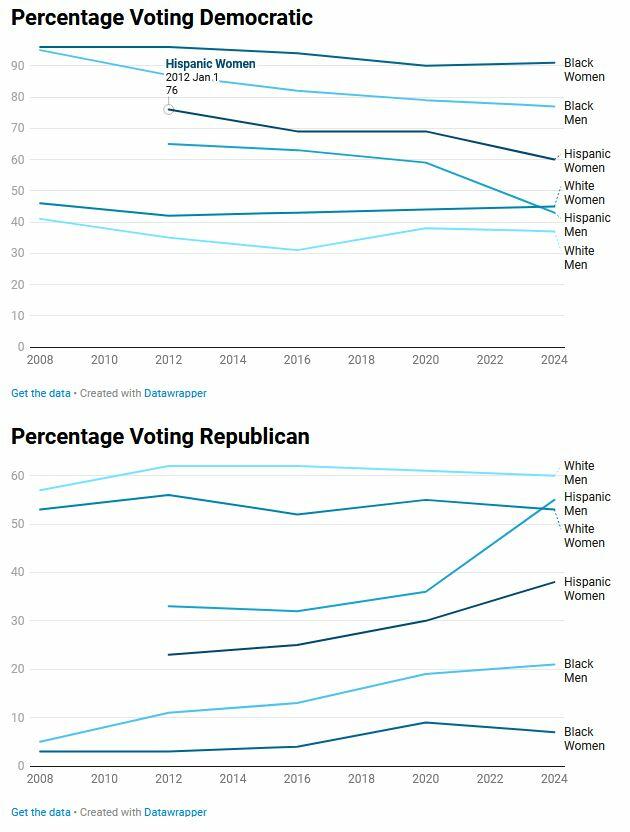
Minorities’ support for Democratic candidates has been strong since the 1970s, reaching a high point in 2008 with the election of Obama. Since then, however, the dropoff has been significant, especially among black and Hispanic men.
Support for Democrats by black voters fell from a high of 95 percent in 2008 to 85 percent in 2024. The drop was greatest among black men, 77 percent of whom voted for the Democratic candidate in 2024, the same percentage as in 1972. Black women, the most reliable Democratic voters, voted 91 percent for Vice President Kamala Harris, 5 percent lower than for Obama in 2008.
Hispanic support for the Democrats hovered around 65 percent for over 40 years. In 2024, the level dropped by 13 percentage points. The decline was more pronounced among Hispanic men. Just 43 percent of them voted Democratic this year, a lower percentage than that of white women.
Asian voters supported the Democratic candidate by 73 percent in 2012. That number dropped steadily over the next three cycles, reaching 54 percent in 2024.
Muslim voters, 74 percent of whom had supported Democrats in 2016 and 69 percent in 2020, all but abandoned the party in 2024, according to exit polling conducted by the Council on American-Islamic Relations. That was due largely to the Biden administration’s handling of the Israel-Hamas war. Only 20 percent of Muslim voters chose Harris. In Michigan, home to the nation’s highest concentration of Muslim Americans, the number was 14 percent.
Regional Shifts
Shifts in the electorate by class and race in 2024 were significant enough to create movement, if not a landslide, in regional voting patterns.
The Blue Wall of industrial states, Pennsylvania, Michigan, and Wisconsin, had been solidly Democratic in presidential elections from 1992 until 2016, when Trump won all three. Though President Joe Biden rebuilt that wall in 2020, Trump again carried those states again in 2024.
Trump also eroded Democratic support in traditional party strongholds like New York, New Jersey, and California. While Harris carried all three by a comfortable margin, she gained a smaller share of the vote than either Biden in 2020 or Hillary Clinton in 2016.
In Wayne County, Michigan, home to Detroit, Harris drew about 38,000 fewer votes than Biden did in 2020. In Philadelphia County, Pennsylvania, Harris received about 36,000 fewer votes than Biden had. In Queens County, New York, the deficit was nearly 165,000, and in Los Angeles County, California, it was 621,000.
“Harris, in Democratic strongholds in Michigan and Pennsylvania, simply underperformed Biden’s vote totals,” Ken Kollman, a professor of political science at the University of Michigan, told The Epoch Times.
Though Harris still won those counties by a large margin, the erosion of support in traditionally strong democratic areas fueled Trump’s victory, according to Kollman.
According to William Galston, a senior fellow at the Brookings Institution, the upshot of these shifts is that class has again become a powerful force in electoral politics.
“We are witnessing the emergence of a new politics of class,” Galston said in a Nov. 12 panel hosted by the Brookings Institution. “Class, defined as educational attainment, dominates the scene in the United States and throughout the industrialized world.”
This new reality undercuts assumptions that have informed both parties for decades, and experts say both will need to make adjustments before the next election.
Democrats: Listen, Reimagine
Self-reflective statements by Democrats in the wake of the election have centered on the need to listen to voters.
“The country wanted change, and the vice president’s campaign decided they would not offer that,” longtime Democratic strategist James Carville said in a PBS interview on Nov. 13.
Doris Kearns Goodwin, the historian and Democratic commentator, focused on the need to reengage the people who have given the party its strength for generations.
“The most important thing that the Democrats have to take away from this loss is that they lost the working class base, and that’s been the foundation of the Democratic Party ever since FDR,” Goodwin said in a Fox News interview on Nov. 8. “I think the working class felt invisible. They felt forgotten.”
David Schultz, a political science professor at Hamline University in St. Paul, Minnesota, told The Epoch Times that Democrats should talk to real working-class people.
“More importantly, go out and listen to them,” he said.
Economics Trumps Identity
A likely takeaway from those conversations, Schultz said, could be that identity politics seems less important to working-class voters than basic questions of economic survival.
“Hispanics, at the end of the day, are saying, ‘We want jobs. We’re not thrilled about illegal immigration, and we want higher wages.’” Schultz said, noting that this does not conform to the general perception of “Hispanic issues.”
Gabriel Sanchez, a professor of political science at the University of New Mexico, reached a similar conclusion.
“Overwhelmingly, the economy is what Latino men have actually been talking about for three election cycles in a row,” Sanchez said in the Nov. 12 panel discussion.
That may be, in part, because Hispanics are a diverse group comprising a mix of national origins and cultures. As a result, “they do not have nearly as strong a sense of linked fate,” Aaron Dusso, a professor of political science at Indiana University Indianapolis, told The Epoch Times, referring to the sense of common identity and interests that characterizes some demographic groups.
The sense of linked fate is more pronounced among black Americans, according to Dusso. Yet an increasing share of black men voted Republican in the 2024 presidential election—for a fourth consecutive time. And that was despite direct appeals to black men from both Obama and his wife, Michelle Obama, to vote for Harris based on their identity.
One explanation for that shift may be that younger blacks seem less concerned with the civil rights issues of a previous generation and more concerned with economic opportunity.
Lorenzo Sewell, a Detroit-area pastor who spoke at the Republican National Convention, said his decision to support Trump was rooted in disappointment with the economic results of Democratic leadership for the black community.
Noting that many are routinely forced to choose between paying rent, repairing their car, or paying child support, Sewell told the Epoch Times, “We’ve had Democrats running this city for 56 years. I’m not saying Democrats are wrong. I’m just asking, ‘Where’s the change?’”
Harris campaigned heavily on a promise to protect access to abortion as a civil right. Democrats had success with that issue on several state ballot initiatives after the U.S. Supreme Court’s Dobbs decision overturned Roe v. Wade in 2022.
Yet in the presidential contest, Harris drew the smallest share of the women’s vote, 53 percent, since 2004. Trump, with 45 percent, received the highest share of the women’s vote by any Republican since President George H.W. Bush.
“It’s a clear indication to me that, ultimately, the Dobbs decision is not going to have a political effect,” Dusso said.
Russian Jets Support Syrian Counteroffensive After Jihadist Insurgents Capture Aleppo
Hours after thousands of Syrian Islamic militants entered Syria’s largest city of Aleppo, facing little resistance from government troops, and fanned out inside the city in vehicles with improvised armor and pickups, deploying to landmarks such as the old citadel on Saturday, Russian fighter jets stationed in Syria carried out airstrikes against the jihadist militants attacking the northern city of Aleppo, the spokesman for Moscow’s expeditionary force has said. The escalation follows after the Al-Qaeda linked Hayat Tahrir-al-Sham or HTS (an offshoot of Al-Qaeda affiliate Jabhat al-Nusra) insurgent group, which was added by the US State Department to the list of Foreign Terrorist Organizations in 2018, and allied militias attacked government-controlled territory in northern Syria on Wednesday, breaking a fragile truce mediated by Russia and Turkey in 2020.
Assad’s Syrian Arab Army (SAA) is in Full Retreat across Northern Syria, as Turkish-Backed Forces advance from the Northwest and U.S-Backed Forces advance from the East. pic.twitter.com/obJ5hvuIma
“Providing support to the Syrian Arab Army, the Russian Aerospace Forces are carrying out missile and bomb strikes on the equipment and manpower of illegal armed groups, command posts, warehouses, and artillery positions of terrorists. Over the past 24 hours, at least 200 militants have been eliminated,” Colonel Oleg Ignasyuk, the deputy head of the Russian Reconciliation Center for Syria, told reporters in a briefing on Friday. He added that another 400 militants were killed by Russian and Syrian forces the day before.
Also on Saturday, Syria’s armed forces said that to absorb the large attack on Aleppo – which is located 350 kilometers north of Damascus – and save lives, it has redeployed and is preparing for a counterattack. The statement acknowledged that insurgents entered large parts of the city but said they have not established bases or checkpoints.
Terrorists were filmed outside police headquarters, in the city center, and outside the Aleppo Citadel. They tore down posters of Syrian President Bashar Assad, stepping on some and burning others.
⚡️Airstrike carried out on Al Nusra fighters who were tearing down the statue of Bashar al-Assad’s brother in Aleppo pic.twitter.com/qAC1K4f9Db
The surprising takeover of Aleppo following the blitz campaign is an embarrassment for Assad, who managed to regain total control of the city in 2016, after expelling insurgents and thousands of civilians from its eastern neighborhoods following a grueling military campaign in which his forces were backed by Russia, Iran and its allied groups.
Aleppo has not been attacked by opposition forces since then. The 2016 battle for Aleppo was a turning point in the war between Syrian government forces and rebel fighters after 2011 protests against Assad’s rule turned into an all-out war.
🇸🇾 Clashes between Syrian Defense Forces and terrorist formations reported in northern Aleppo.
* The Syrian Democratic Forces (SDF) is a coalition of Kurdish, Arab, and Assyrian militias formed in 2015 during the Syrian Civil War. Led by the Kurdish YPG, it operates primarily in… pic.twitter.com/X90u6HYJX7
Before adopting its current name in 2017, HTS was known as Jabhat al-Nusra, and was one of the main Sunni islamist factions opposing President Bashar Assad’s government during the Syrian Civil War. Jabhat al-Nusra was originally founded as an offshoot of Al-Qaeda in Syria.
The jihadists launched their shock offensive in the Aleppo and Idlib countryside on Wednesday and wrestled control of dozens of villages and towns before entering Aleppo on Friday. The pro-government Al-Watan newspaper reported airstrikes on the edge of Aleppo city targeting rebel supply lines. It posted a video of a missile landing on a gathering of fighters and vehicles, in a street lined with trees and buildings.
The timing is remarkable: over the past decade, Syria has become a focal point of rapid foreign military escalation with the CIA-backed Islamic State emerging out of nowhere in 2014 and destabilizing the region for the next 4 years, and now – during a time of upheaval for the Deep State – it is once again Syria that is the focus of CIA escalatory tactics, this time involving another Al-Qaeda-linked terrorist organization, the HTS.
The push into Aleppo followed weeks of simmering low-level violence, including government attacks on opposition-held areas. In its amusing commentary, the AP notes that Turkey, which has openly backed Syrian opposition groups, “failed in its diplomatic efforts to prevent the Syrian government attacks”, which were seen as a violation of a 2019 agreement sponsored by Russia, Turkey and Iran to freeze the line of the conflict. What the AP really means is that Turkey has once again been quietly seeking to destabilize the region and has succeeded.
The latest offensive comes as Iran-linked groups, primarily Lebanon’s Hezbollah, which has backed Syrian government forces since 2015, have been preoccupied with their own battles at home. A ceasefire in Hezbollah’s two-month war with Israel took effect Wednesday, the day the Syrian opposition factions announced their offensive. Israel has also escalated its attacks against Hezbollah and Iran-linked targets in Syria during the last 70 days.
According to social media reports, government troops remained in the city’s airport and at a military academy but most of the forces have already filed out of the city from the south. Syrian Kurdish forces remained in two neighborhoods. The redeployment “is a temporary measure and (the military central command and armed forces) will work to guarantee the security and peace of all our people in Aleppo,” the military statement said.
There was light traffic in the city center on Saturday according to AP. Opposition fighters fired in the air in celebration but there was no sign of clashes or government troops presence. Earlier in the day, HTS told Al Jazeera and Türkiye’s Anadolu news agency that its fighters had entered several neighborhoods of Aleppo. The group claimed to have taken control of over 400 square kilometers of land in Aleppo and Idlib provinces and captured heavy weaponry and other equipment from the Syrian Army.
For the first time ever, Syrian Opposition Forces are claiming to have Captured the entire Idlib Governorate in the Northwest. pic.twitter.com/uEmA1gI0jJ
Videos shared on social media purportedly show HTS gunmen moving through Aleppo on foot and in armored vehicles.
The government in Damascus said its troops have “inflicted heavy losses” on the attackers and regained control of some areas. Local media reported the arrival of Syrian Army reinforcements to both Idlib and Aleppo on Friday. Meanwhile Russian fighter jets stationed in Syria carried out multiple airstrikes against jihadist militants attacking the northern city of Aleppo. Twenty fighters were killed in the airstrikes, said the Syrian Observatory for Human Rights. Aleppo residents reported clashes and gunfire. Some fled the fighting.
⚡️Airstrike carried out on Al Nusra fighters who were tearing down the statue of Bashar al-Assad’s brother in Aleppo pic.twitter.com/qAC1K4f9Db
Schools and government offices were closed Saturday as most people stayed indoors, according to Sham FM radio, a pro-government station. Bakeries were open. Witnesses said the insurgents deployed security forces around the city to prevent any acts of violence or looting.
BREAKING NEWS – Russian airstrikes target the outskirts of the governorate building in Aleppo, Syria. pic.twitter.com/aJA5d0brey
Russia intervened in the conflict in 2015, helping Assad retake much of the country from al-Nusra, the Islamic State, and dozens of US-supported armed groups described by Washington as ‘moderate rebels’.
NEW – #Russia just struck central #Aleppo city for the 1st time since its capture, hitting a group of celebrating civilians reportedly.
Approximately 20 bodies torn apart & strewn across the street. It’s started.
Syrian forces lifted the nearly five-year siege of Aleppo in December 2016 and pushed al-Nusra and other groups west into Idlib province. Türkiye took responsibility for Idlib in 2018, vowing to separate terrorists from “legitimate rebels,” but never did so. A March 2020 agreement between Russian President Vladimir Putin and Turkish President Recep Tayyip Erdogan was meant to permanently end the fighting around Idlib.
* * *
Appendix: A Primer on the Islamic group HTS, Who They Are, and why Iran, Israel are wary of al-Qaeda-linked jihadists? (via The Week)
Syria’s Hayat Tahrir al-Sham (HTS) is once again in the news after a fresh rebel offensive in Aleppo put the government forces on the back foot. Bashar al-Assad’s government troops lost significant ground to the sudden attack by HTS-led fighters, losing control of several villages and military establishments in Aleppo — located almost 350 kilometres away from Damascus.
In an already volatile Middle East, reports of unrest and gunfights returning to Syria are bad news. As the country braces for the return of conflict-ridden days, the focus is back on the HTS, which was once affiliated with terror group al-Qaida. Here is what you need to know about Hayat Tahrir al-Sham, which is the principal rebel fighting force behind the fresh violence in Syria.
Syria’s Hay’at Tahrir al-Sham rebels
The US Department of State added Hay’at Tahrir al-Sham (HTS) to the list of Foreign Terrorist Organizations (FTO) in 2018. Traced back to the early days of the Syrian civil war, HTS is an offshoot of al-Qaeda affiliate Jabhat al-Nusra.
Hay’at Tahrir al-Sham loosely translates to the “Organization for the Liberation of the Levant” in English. Based out of Idlib, the organization enjoyed operational presence in Syria’s Aleppo, Hama, Dera’a, and Damascus during its prime. According to Armed Conflict Location & Event Data (ACLED), Hayat Tahrir al-Sham remains the most powerful anti-government armed group in northwest Syria.
Who leads HTS? What is its take on Israel?
Initially, the organization was funded by sympathizers from the Persian Gulf. Its style of taxing territories under control and effective insurgent attacks attracted more fighters to its ranks despite the presence of numerous outfits in the region.
In 2017, the group guided by Salafi-jihadist ideology openly split from the al-Qaeda and is currently led by Abu Mohammed al-Golani. According to US-based Center For Strategic and International Studies, despite the split, HTS, in theory, continues to have a secret relationship with al-Qaeda and receives strategic and operational guidance from the Islamic terror organisation.
Also called Muhammad al-Jawlani and Muhammad al-Julani, the 42-year-old led the al-Nusrah Front (ANF) before its merger with the HTS. On May 16, 2013, the US Department of State designated al-Jawlani as a Specially Designated Global Terrorist for carrying out several terrorist attacks targeting civilians across Syria.
HTS: An Islamic organization with “local” goals
The major difference between HTS and al-Qaeda is the fact that unlike the latter, HTS in recent times has distanced itself from the dream of establishing an Islamic Caliphate across the world.
The organisation has declared its ultimate objective to be the establishment of Islamic rule in Syria and the expelling of Iranian militias from the country. The toppling of the Assad government remains the aim of “modern” HTS, CSIS says, despite Abu al-Jolani having made statements like “With this spirit… we will not only reach Damascus, but, Allah permitting, Jerusalem will be awaiting our arrival” in the past.
This indicates the Zionist ideology and the Jewish state of Israel is a sworn enemy of the HTS like most other Islamic militant groups.
A rebel group that governs Syrian regions!
In 2017 of the Syrian Salvation Government (SSG), a body made up of independent and HTS-linked technocrats, was formed to function as the HTS’s governance wing. Through the SSG, HTS administers various welfare services, delivers essential goods, and runs food aid programs.
It also has a monopoly on the economy through control of al-Sham Bank and the oil sector through Watad Company. SSG has established itself as the de facto administrative authority in the territories under its purview and controls the Bab al-Hawa border crossing with Turkey, through which flows the humanitarian aid on which 90% of the four million people living in northwest Syria depend, the ACLED report claims.
HTS has pushed the theory that it is “an independent entity that follows no organization or party, al-Qaeda or others” hard in recent years. HTS leadership went to the extent of arresting al-Qaeda-linked individuals in its territories to prove its independent existence. Yet, the West has reasons to believe secret ties exist between the two groups and refuses to engage in talks with its leadership.
Hayat Tahrir al-Sham today: War in Aleppo and total strength
The Russian-Turkish truce of March 2020 ended Syrian government offensives against rebel factions. This gave HTS and its sworn ally al-Fath al-Mubin Operation Room to regroup. US reports show that since 2022, Syrian forces have come under constant attacks by the two groups. Sniper fire has been the common strategy of HTS fighters to target government troops in its strongholds and many lives have been lost in these frequent skirmishes.
HTS commanded the allegiance of a fighting force of between 12,000 and 15,000 militants as of October 2018. It is unknown how many new fighters were recruited ahead of the fresh offensive. It is reported that HTS is supported by several Turkish-backed factions in the recent offense. Although many of these groups dislike each other, they have come together under the ‘Syrian National Army’ due to their mutual hatred for Assad.