64.9 F
Chicago
Sunday, October 11, 2026
Home Blog Page 2071

Snowpocalypse Strands Drivers Along I-90 In Lake Erie Area 

0
Snowpocalypse Strands Drivers Along I-90 In Lake Erie Area 

The lake-effect snowstorm that pummeled Great Lakes communities on Friday and into the early morning hours on Saturday has stranded drivers along a large stretch of Interstate 90 in Pennsylvania. 

Meteorologist Ryan Maue wrote on X this morning that some towns along Lake Erie could receive feet of snow after this is all over. 

Real-time traffic data from TomTom shows that a 100-mile stretch of Interstate 90 from Ashtabula, Ohio, to Derby, New York, is plagued with major delays and road closures due to the snowpocalypse.

Dramatic footage posted on X shows hundreds of motorists were stuck in snow drifts.

The eastern half of the US has been plagued with chilly temps and multiple rounds of winter weather so far. 

Whatever happened to Greta, the spokeswoman for the global warming industrial complex heavily invested in ‘green’ tech (much of which comes from China), reading scripted talking points about how the world would end in fiery doom if we didn’t all give up our petrol-burning cars and hamburgers? 

. . .  

Tyler Durden
Sat, 11/30/2024 – 10:15

Europe’s Gas Storage Empties At Fastest Rate Since 2016

0
Europe’s Gas Storage Empties At Fastest Rate Since 2016

By John Kemp, senior energy analyst at JKempEnergy

Europe’s gas inventories have depleted at the fastest rate for eight years, as the region has experienced repeated bouts of colder-than-normal temperatures and low wind speeds since the start of the winter heating season.

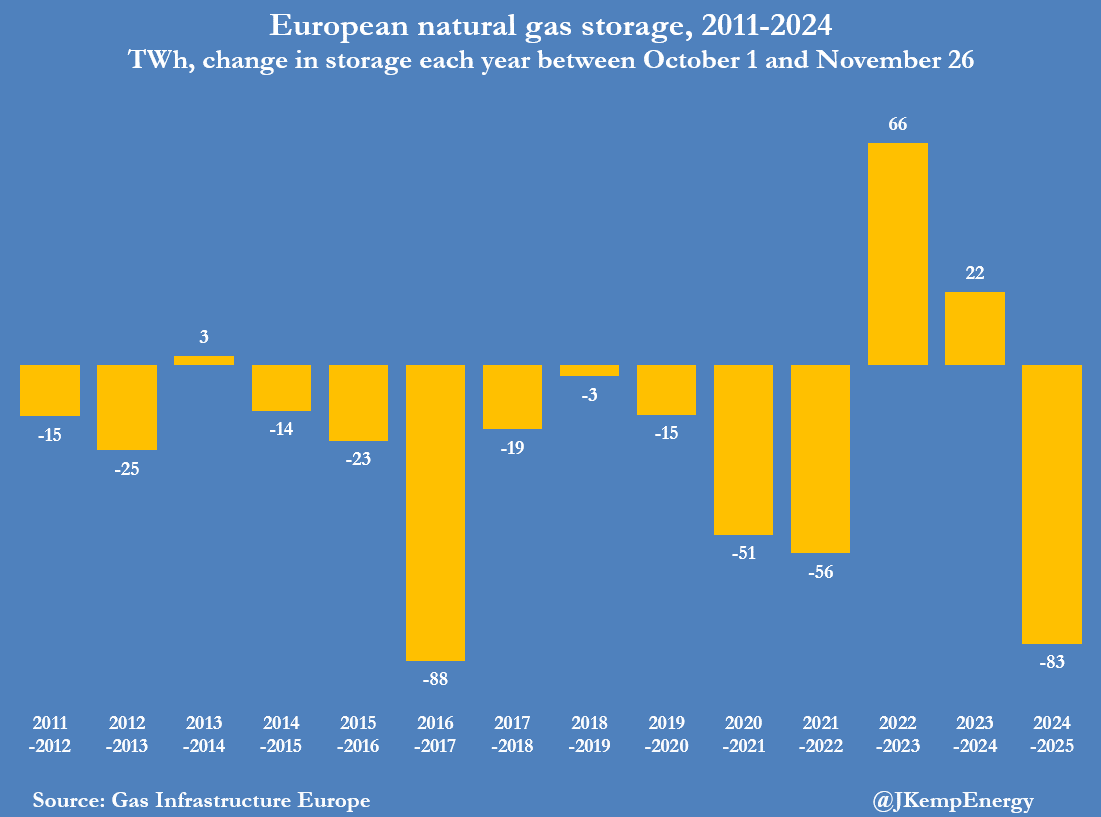
Combined inventories in underground storage across the European Union and the United Kingdom dropped by 83 terawatt-hours (TWh) between the official start of winter on October 1 and November 26.

Stocks have fallen more than four times faster than the average over the last ten years, and by the most for any year since 2016, according to data from operators compiled by Gas Infrastructure Europe (GIE).

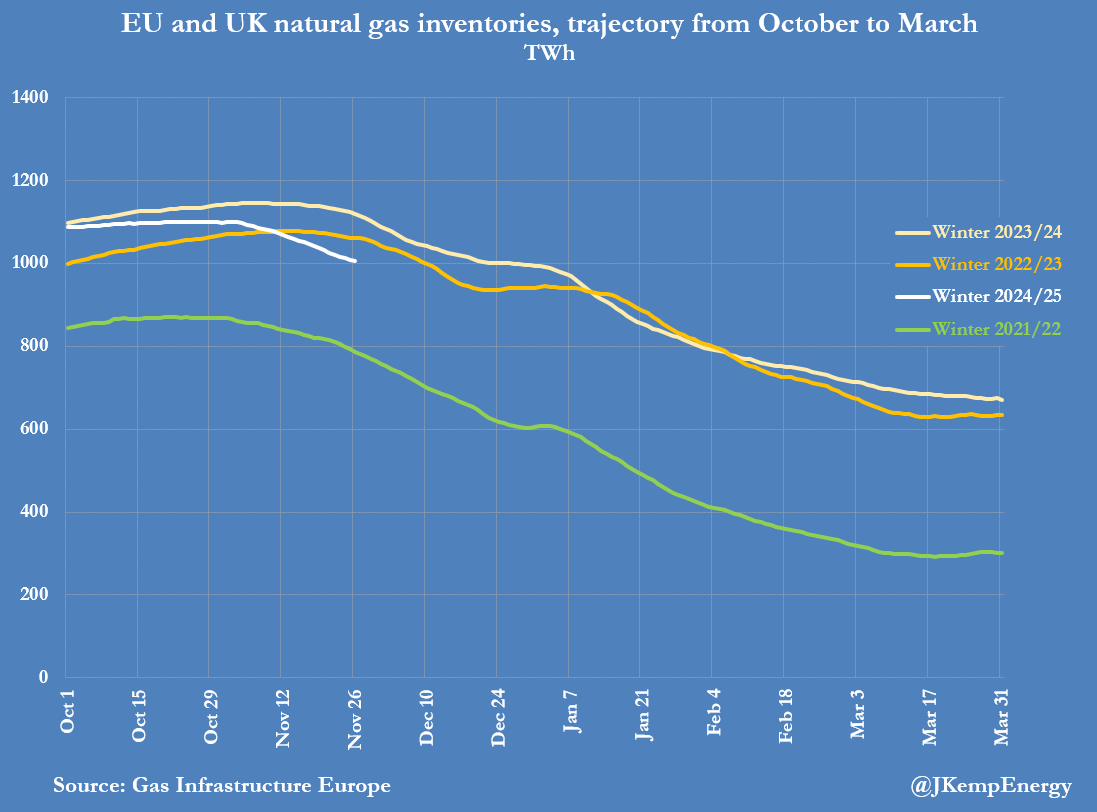
Inventories were still 58 TWh (+6% or +0.55 standard deviations) above the prior ten-year seasonal average on November 26, but the surplus had narrowed from 122 TWh (+13% or +1.38 standard deviations) at the start of winter.

Storage facilities across the region were 87% full on average, sharply lower than 97% on the same date in 2023 and 94% in 2022.

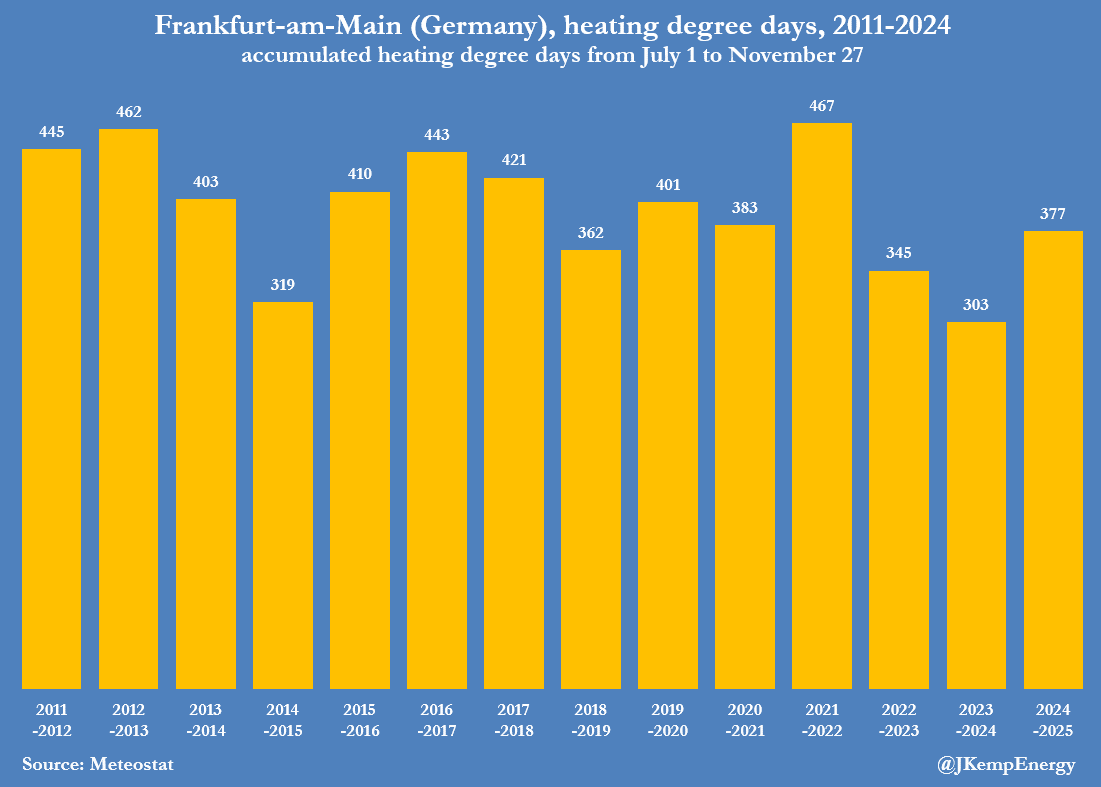
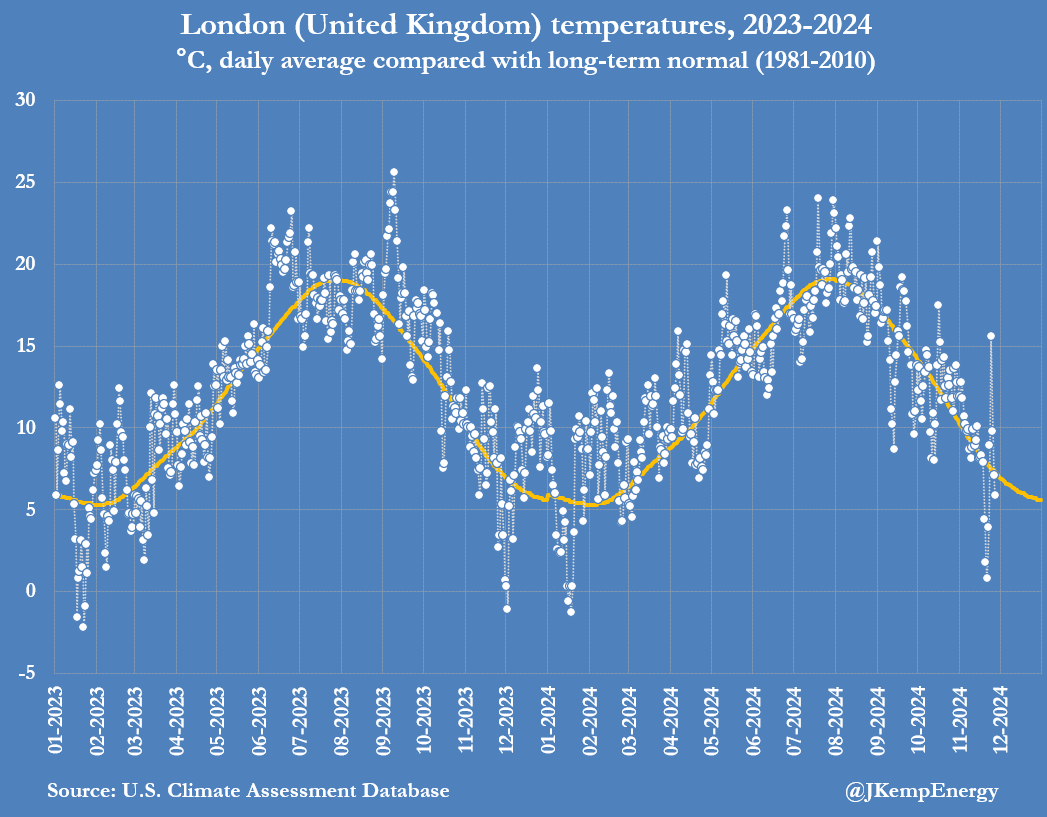
Northwest Europe has experienced a colder start to the winter this year, after exceptionally mild winters in 2023/24 and 2022/23, which has boosted heating demand.

With the heating season now approaching the 20% mark, Frankfurt has experienced 377 heating degree days, close to the average for the last ten years, but many more than in 2023 (303) and 2022 (345).

London has so far shivered through 327 heating degree days, the coldest start to the winter for five years, and well above the number in 2023 (268) and 2022 (219).

While colder temperatures have boosted heating demand, wind speeds in the North Sea have been below normal, cutting generation from offshore wind farms and forcing more reliance on gas-fired units.

Based on inventory movements over the last decade, EU and UK stocks are currently on course to end the winter around 468 TWh (with a likely range from 293 TWh to 573 TWh).

The projected carryout is already much lower than the 532 TWh (with a likely range from 349 TWh to 718 TWh) when the winter began.

On this course, inventories will end the winter almost 30% below record carryouts at the end of winter 2023/24 and 2022/23.

TOUGHER REFILL SEASON

Stocks are still comfortable but can no longer be described as plentiful and prices have risen to discourage consumption and attract more liquefied natural gas (LNG) cargoes to the region.

Front-month futures prices on the Dutch Title Transfer Facility have averaged €44 per megawatt-hour so far in November up from €36 in September and just €26 in February.

After adjusting for inflation, front-month prices in November are in the 87th percentile for all months since 2010 up from the 43rd percentile in February, signalling the need to conserve stocks and attract more supply.

But the greatest futures price increases have been for deliveries after this winter ends, in the second and third quarters of 2025.

Because of the much bigger depletion this winter, traders anticipate Europe will need to buy much more gas to refill its storage facilities in the summer of 2025 than was the case in the summers of 2024 and 2023.

Futures prices for the summer of 2025 (April-September) have recently traded as much as €4 per megawatt-hour above those for the winter of 2025/26 (October-March).

The unusual backwardation is a sign traders expect Europe will have to pay more next summer to refill storage and ensure stocks are back to a comfortable level ahead of winter 2025/26.

Europe will have to attract more LNG cargoes away from the fast-growing gas markets in Asia next summer and that implies higher prices.

In most seasonal commodity markets, the biggest risk of shortages comes not from a single disruption but repeated disruptions in successive years.

Inventories are normally enough to absorb one unexpected supply disruption or demand shock but that will leave them depleted and poorly prepared in the event of a second disruption or shock.

Europe’s major challenge is what would happen if winter 2024/25 remains colder-than-normal and is followed by another cold winter in 2025/26. To minimise that risk, depleted inventories will have to rebuilt during the summer of 2025, and traders are already betting that will prove expensive as Europe competes for more gas with fast-growing economies in Asia.

Tyler Durden
Sat, 11/30/2024 – 09:20

Explosion Rocks Port Of Miami

0
Explosion Rocks Port Of Miami

Dramatic footage from the overnight hours shows what appears to be an explosion rocking part of the Port of Miami, a major seaport located in Biscayne Bay at the mouth of the Miami River in Miami, Florida.

“Numerous people have reported hearing and seeing a large explosion at the Port of Miami,” X user RawAlerts said in the early morning hours. 

RawAlerts said, “Additional footage and According to one worker, a 20-foot container with a car inside reportedly blew up. Car brand unknown. Which reportedly caused the large explosion.”

Local media WSVN confirmed the incident:

Emergency crews were seen dousing a vehicle fire early Saturday morning in the Port of Miami. Video from Only in Dade showed smoke rising high in the air Friday night. Residents said they heard a loud explosion followed by the thick smoke and flames. The cause of the fire is still under investigation.

Here’s more footage of the incident. 

Remember a time when vehicles didn’t randomly explode?

Tyler Durden
Sat, 11/30/2024 – 08:30

“I Won’t Claim That Milan Is A Safe City” Admits Leftist Mayor After Damning Stats Show Surge In Migrant Crime

0
“I Won’t Claim That Milan Is A Safe City” Admits Leftist Mayor After Damning Stats Show Surge In Migrant Crime

Authored by Thomas Brooke via Remix News,

Italian Interior Minister Matteo Piantedosi has announced the deployment of 600 additional police officers to Milan, citing concerns over integration challenges and rising crime rates, particularly in areas with significant immigrant populations.

The announcement follows recent unrest in the Corvetto district, where a 19-year-old Egyptian resident, Ramy Elgaml, died in a road accident after a police chase, sparking mass protests by the considerable immigrant population.

During a meeting on security with Milan’s prefect Claudio Sgaraglia and Police Chief Vittorio Pisani, Piantedosi confirmed that the reinforcements, planned before the Corvetto unrest, will enhance territorial control and improve public safety.

He offered damning statistics on the disproportionate involvement immigrants have in committing crime, noting that 65 percent of all offenses in the city are committed by foreign nationals despite representing 20 percent of all residents.

“These figures highlight integration challenges that must be addressed to reduce marginalization and its consequences,” Piantedosi stated. He denied comparisons to the recent Parisian suburban riots, calling them “very exaggerated,” but acknowledged that the Corvetto unrest signals issues requiring attention.

The Italian minister criticized the reliance on issuing residence permits as a solution to integration issues, pointing out the need for more comprehensive measures. He highlighted efforts already underway, noting over 40 high-impact operations and 162 arrests in Corvetto this year, but accepted that much more needed to be done.

“The second-most important city in Italy after Rome deserves all the attention it can get,” he added.

Milan’s left-wing mayor Beppe Sala echoed the need for investments in public housing and community centers to foster integration and accepted that the Italian city can no longer be considered a safe place to live.

“I won’t claim Milan is a safe city, but it is making an effort to address challenges faced by all international cities,” he said.

Sala claimed that migrant crime was a result of shortcomings in creating spaces for young immigrants to engage positively within their communities, linking the lack of such centers to increased alienation in the suburbs.

With over 60,000 public housing units out of Milan’s 800,000 apartments, Sala described the distribution as “disproportionate,” emphasizing the importance of equitable urban planning.

Italy’s Deputy Prime Minister Matteo Salvini, whose League party first made its name in the northern Italian city and the surrounding area, remarked on the meeting in a post on X.

“Minister Piantedosi’s data are crystal clear. Yet for the left, it is a non-problem, they seek justifications to the point of falsifying reality,” he wrote.

“Woe to anyone who criticizes the dogma of indiscriminate reception at all costs, woe to anyone who criticizes environments in which foreign crime thrives in our cities, woe to anyone who wants to harshly apply the law to intervene in an increasingly unsustainable situation,” he quipped.

Read more here…

Tyler Durden
Sat, 11/30/2024 – 08:10

Istanbul’s Grand Bazaar Rocked By Fears Over Fake $50 And $100 Bills

0
Istanbul’s Grand Bazaar Rocked By Fears Over Fake $50 And $100 Bills

Fears of counterfeit $50 and $100 bills have disrupted foreign-exchange trade at Istanbul’s Grand Bazaar, the nation’s largest currency trading gray market.

According to the state-run Anadolu Agency, some bureaus at the bazaar, a hub for currency trading, stopped purchasing the bills, saying the counting machines they use can’t identify the fake notes.

“The number of counterfeit dollars isn’t clear,” Anadolu cited Resat Yilmaz, a tradesman at the Bazaar, as saying. “These bills have to be collected, which can take two weeks.” Money-counting machines also have to be updated, he added.

A representative for currency traders said the disruption has no basis and “there’s no fake currency” in circulation. He blamed banks for what he said was a “clogging” of trading.

“Banks should accept old dollar bills. Currently, no bank is doing that,” Mehti Seren, head of the Association of All Authorized Institutions and Foreign Exchange Offices, said in a press conference. “Clients are then returning the dollars to us. That’s what’s clogging the system.”

The central bank said it’s sent warnings and expert opinions about the fake bills to banking associations.

“The necessary guidance on precautions to be taken regarding the technological infrastructure has been made,” the bank said in a statement. Bill counters, bill checkers and teller machines are being controlled and updated, the Turkish Banks Association said in a separate statement.

The prosecutor’s office in Istanbul launched an investigation, Anadolu said. The counterfeit bills entered Turkey from abroad, Haberturk reported, citing sources it didn’t identify.

Tyler Durden
Sat, 11/30/2024 – 07:35

Russia’s Foreign Intelligence Service Warned About A 100k-Strong NATO Intervention In Ukraine

0
Russia’s Foreign Intelligence Service Warned About A 100k-Strong NATO Intervention In Ukraine

Authored by Andrew Korybko via substack,

NATO might be willing to test Putin’s patience by crossing yet another of Russia’s perceived red lines in spite of its updated nuclear doctrine and new Oreshniks.

The NATO-Russian proxy war in Ukraine might be on the brink of an unprecedented escalation that could easily spiral out of control if Russia’s Foreign Intelligence Service (SVR) is correct in claiming that NATO is planning a 100,000-strong military intervention in Ukraine under the guise of peacekeepers. The purpose is to freeze the conflict, presumably by having these troops function as tripwires for deterring a Russian attack that could spark World War III, and then rebuild Ukraine’s military-industrial complex (MIC).

SVR revealed that Poland will have control over Western Ukraine (like it did during the interwar period); Romania will be responsible for the Black Sea coast (which it seized during World War II via and ruled as the “Transnistria Governorate”); the UK will lord over Kiev and the north; while Germany will deploy its forces to the center and east of the country. The latter’s Rhinemetall will lead the efforts to rebuild Ukraine’s MIC by investing heavily, dispatching specialists, and providing high-performance equipment.

Another important detail is that “NATO is already deploying training centers in Ukraine, through which it is planned to drag at least a million mobilized Ukrainians”, while police functions will be carried out via Ukrainian nationalists that SVR likens to World War II-era Sonderkommandos. The last part is intriguing since it raises the question of why 100,000 NATO troops/peacekeepers would be required. Only a fraction of that is needed for tripwire and training purposes so perhaps those numbers are inaccurate.

In any case, this latest move isn’t surprising, and readers can review the following analyses to learn why:

* 1 November: “Trump 2.0 would be no easy ride for Vladimir Putin”

* 7 November: “Here’s What Trump’s Peace Plan Might Look Like & Why Russia Might Agree To It”

* 8 November: “View from Moscow: Russia tepidly welcomes Trump’s return”

* 9 November: “The Clock Is Ticking For Russia To Achieve Its Maximum Goals In The Ukrainian Conflict”

* 10 November: “10 Obstacles To Trump’s Reported Plan For Western/NATO Peacekeepers In Ukraine”

* 11 November: “Five Reasons Why Trump Should Revive The Draft Russian-Ukrainian Peace Treaty”

* 15 November: “Trump Probably Really Does Appreciate Two Points From Zelensky’s ‘Victory Plan’”

* 18 November: “The Moment Of Truth: How Will Russia Respond To Ukraine’s Use Of Western Long-Range Missiles?”

* 20 November: “Russia’s Updated Nuke Doctrine Aims To Deter Unacceptable Provocations From NATO”

* 22 November: “Putin Is Finally Climbing The Escalation Ladder”

The last analysis also includes a map at the end depicting the most realistic best-case scenario for Russia.

To summarize, Biden is beating Trump to the punch by “escalating to de-escalate” on better terms for the US, which Russia’s updated nuclear doctrine and the historic first use of the MIRV-capable Oreshnik hypersonic medium-range missile in combat are meant to deter. The 10 obstacles described above still stand, however, so it’s unclear exactly how viable NATO’s reportedly planned conventional intervention in Ukraine (regardless of the numbers involved and the pretext relied upon for justifying it) actually is.

Nevertheless, the fact that SVR warned the world about it suggests that it’s no longer the far-fetched scenario that it was thought to be, though the clock is also now ticking for NATO too since the possible rise to power of a populist conservative-nationalist in Romania next month could spoil these plans. NATO might therefore intervene before 21 December when that figure will take office if he wins. If he loses, then they might bide their time to prepare better, possibly placing this responsibility on Trump’s lap.

At any rate, SVR’s claim that NATO is setting up training centers in Ukraine shows that the bloc is still expanding there. If Russia doesn’t target these facilities, which could spark World War III, then it might have to accept as a fait accompli what SVR just warned about. In that event, as proposed in the “escalation ladder” analysis above, Russia might then reach a deal allowing NATO to safely enter Ukraine up to the Dnieper if Ukraine first demilitarizes everything east of it and north of Russia’s new regions.

Tyler Durden
Sat, 11/30/2024 – 07:00

Socialism: Science Or Cyanide?

0
Socialism: Science Or Cyanide?

Authored by Lawrence Reed From the Foundation for Economic Education (FEE),

Editor’s note: Marianna Davidovich, head of external relations at FEE, recently published a booklet titled “The Buried Stories of Communism & Socialism.” The following essay by FEE’s president emeritus, Lawrence W. Reed, appears in it as the Afterword.

In this volume, Marianna Davidovich vividly recounts the world’s horrific experiences with the evil of communism. It’s a ghastly record, littered with the bodies of a hundred million victims and the lost liberties of hundreds of millions more. No one should have ever expected otherwise; even the founder of modern communist ideology, Karl Marx, advocated extreme violence as a necessary ingredient in the communist formula.

What the world refers to as “communist” countries—such as the Soviet Union of Lenin and Stalin, Pol Pot’s Cambodia, Mao’s China, Castro’s Cuba, and others Marianna discusses—would not be labeled as such by Karl Marx himself. He postulated that communism would be the end game of all history and would be characterized by government “withering away” after a period of socialism and its brutal “dictatorship of the proletariat.”

So, what we widely refer to as communist countries are, according to both Marx and the governments of those very countries themselves, socialist. None of them called themselves communist; all of them proudly adopted the socialist label. The full name of the old Soviet Union, for example, was the Union of Soviet Socialist Republics.

Marx’s prediction that socialist dictatorships would eventually dissolve into government-less, communist utopias was embraced by pseudo-intellectuals as some sort of messianic prophecy. But how could Marx know the future of his own country, let alone that of others? Was he a palm reader? Did he use tarot cards, a crystal ball, or a Ouija board? Or did God (in whom he didn’t believe) generously gift him with visionary powers that no one else has?

Of course, none of those things apply here. Marx was no fortune-teller. He was a charlatan, an angry and nasty scribbler with vile, racist, and anti-Semitic tendencies. He mooched off others all his life. As British historian Paul Johnson explained in his book, “Intellectuals,” Marx was cruel to his own family. He yearned for the violence his predicted socialist dictatorships would produce. Hardly anyone showed up for his funeral.

Marx’s notion that under communism, government would “wither away” was always a nonsensical non-starter. He never explained how or why that would occur. What would possibly prompt dictators with absolute power to one day just walk away from it? That’s more like a dumb fairy tale than a prophecy.

Now that Marianna has provided the awful details of death and destruction in the countries influenced by Marx’s teaching, the big remaining question is WHY? Why does socialism so naturally produce mayhem on an industrial scale?

Wait a minute, you ask.

What about the peaceful “democratic socialism” of Scandinavia?

Scandinavian countries are not socialist. They have no minimum wage laws, almost no interference with prices and the market forces of supply and demand. They have lower taxes on business and more school choice than the United States. They boast trade-based, globalized economies, and few if any nationalized industries.

The prime minister of Denmark recently declared, “I know that some people in the U.S. associate the Nordic model with some sort of socialism. Therefore, I would like to make one thing clear. Denmark is far from a socialist planned economy. Denmark is a market economy.” The Index of Economic Freedom ranks Denmark, Norway, and Sweden as among the freest (most capitalist) in the world.

It’s true that after World War II, Scandinavian countries stumbled into generous welfare states, but being no more than a welfare state is not by itself dictionary socialism. More to the point, those nations eventually turned away from even that—cutting taxes and spending and reviving private sector entrepreneurship. Margaret Thatcher forced the same changes in Britain when, by the late 1970s, her country’s welfare state turned Britain into “the sick man of Europe.”

When countries adopt a blend of socialism and capitalism—a formula once termed “the middle way”—socialists claim credit for progress real or imagined. But repeatedly, such situations reveal that most if not all the “progress” such places achieve is not because of the socialism they’ve adopted, but because of the capitalism they haven’t yet destroyed. Capitalism produces wealth (even Marx admitted to that), whereas socialism and socialists simply confiscate and redistribute it.

Back to the central question: Why does socialism so naturally produce mayhem on an industrial scale?

One very big reason is its accumulation and centralization of power, the most toxic motivation in human history. The desire to dominate and control, to plan other people’s lives, to push others around and take their stuff, to monopolize one corner of society after another—all these elements of a “power trip” are part and parcel of the socialist vision.

But socialism promises to help the poor and the needy, you say! Well, of course, it promises such things. How far would it get if its advocates told the truth? Lenin, Stalin, Mao, Castro, Pol Pot, etc. all proclaimed “solidarity with the people,” especially the poor. They never honestly declared, “Give us power, and we will crush dissent and throw you to the dogs for opposing our plans!”

Socialism is rightly and widely perceived as diametrically opposed to capitalism. So, it can’t possibly be defined as acts of caring, sharing, giving, and being compassionate toward the needy. There is demonstrably more caring, sharing, giving, and compassion toward the needy under capitalism!

Even when it comes to most foreign aid, capitalist countries are the donors and socialist countries are the recipients. You can’t give it away or share it with anybody if you don’t create it in the first place, and socialism offers utterly no theory of wealth creation, only wealth confiscation and consumption.

Note that socialists do not propose to accomplish their objectives by mutual consent. They do not advocate raising the money for their plans by way of bake sales or charitable solicitations. Your participation is not voluntary. From start to finish, socialism’s defining characteristic is not so much the promises meant to beguile but rather, the method by which it implements its agenda—FORCE. If it’s voluntary, it’s not socialism. It’s that simple.

In theory, practice, and outcome, socialism is profoundly anti-social. Here’s why:

  1. The plans of socialists are more important than yours. Why? Because they say so. Isn’t that reason enough? “The more the State plans,” wrote Austrian economist F. A. Hayek, “the more difficult planning becomes for the individual.” But socialists don’t care about that because what they have in mind is surely more noble than anything us peasants are thinking. Socialism is profoundly anti-individual because it seeks to homogenize people in a giant, collectivist blender.

  2. Socialists are know-it-alls and know-nothings, simultaneously. This is a remarkable achievement, perhaps socialism’s singular contribution to sociology. Even if a socialist’s own life is a mess, he still knows how to run everybody else’s. Even if he doesn’t believe there’s a God, he thinks the State can be one. F. A. Hayek nailed it when he wrote, “The curious task of economics is to convince men of how little they know about what they imagine they can design.”

  3. Socialism rejects biological science. No climate-change denier denies that climate exists. But socialists claim that if there’s such a thing as human nature, they can abolish and reinvent it. Humans are individuals, with no two alike in every way, but socialists believe they can homogenize and collectivize us into an obedient blob. It doesn’t bother them to punish individual success and achievement even if the result is equal impoverishment. They believe that human beings will work harder and smarter for the State than they will for themselves or their families. This is much closer to witchcraft than science.

  4. Socialists call the cops for everything. Have you ever noticed that the socialist agenda is not a page of helpful suggestions, or a list of tips for better living? When they’re in charge, you don’t get to say, “No, thanks.” Freedom of choice? No, sir! Socialist ideas are so good, the old saying goes, that they must be mandatory and opposing views must be censored. Deep inside every socialist, even the naïve but well-meaning ones, a totalitarian demon is struggling to get out. This is what socialists eventually do with such monotonous regularity that you can absolutely count on it.

  5. Socialism is more than anti-capitalism. It’s anti-capital. In his remarkable book, “Intellectuals,” British historian Paul Johnson penned a blistering chapter about Karl Marx. Johnson quotes Marx’s own mother as famously remarking that she wished her son Karl “would accumulate some capital instead of just writing about it.” Mrs. Marx was on to something. Karl and his acolytes, to one degree or another, make war on the single most powerful generator of the material wealth that improves the lives of people—namely, private property and its accumulation by private, profit-seeking individuals who invest and create and employ. Wherever such lunacy gains power, it marches its subjects backward towards the Stone Age.

  6. Conflict is their God. From Marx to socialists of the present day, conflict is everything.If it’s not present, they will invent it. After all, everyone is either a victim or a villain, an oppressor or part of the oppressed. Conflict is the way history unfolds, so they tell us. And like palm readers and tarot card practitioners, they declare the future to be on their side. This always-angry perspective rules out a spirit of gratitude, especially toward capitalists. Socialists never show up at a business of any size with signs exclaiming “Thank you for taking risks, providing products and employing people.”

One of the greatest economists ever, Ludwig von Mises, wrote this eloquent summation:

A man who chooses between drinking a glass of milk and a glass of a solution of potassium cyanide does not choose between two beverages; he chooses between life and death. A society that chooses between capitalism and socialism does not choose between two social systems; it chooses between social cooperation and the disintegration of society. Socialism is not an alternative to capitalism; it is an alternative to any system under which men can live as human beings.

Communism as envisioned by its intellectual father Karl Marx is an unachievable and undesirable fantasy. In the real world, efforts to realize Marx’s delusions are simply full-blown, unadulterated socialism. And that’s the cyanide that both Mises and Marianna are warning us about.

Tyler Durden
Fri, 11/29/2024 – 23:50

Moana, Wicked, Gladiator II Set To Shatter Thanksgiving Box Office Records

0
Moana, Wicked, Gladiator II Set To Shatter Thanksgiving Box Office Records

The Hollywood Reporter cited impressive data showing that Disney’s Moana sequel, Universal’s Wicked, and Paramount’s Gladiator II are set to break US box-office records for the Thanksgiving holiday week. 

“Thanks to the potent combination of Disney’s Moana sequel, Universal’s Wicked and Paramount’s Gladiator II, overall five-day revenue will hit a high for the long Turkey Day holiday, or well north of $400 million (the previous best was 2018 with $316 million),” the media outlet wrote in a report on Friday. 

Here’s more from the report:

Disney’s fantasy musical Moana 2 opened to a record-shattering $57.5 million on Wednesday, followed by $28 million on Thursday — the biggest Thanksgiving of all time and the fourth-biggest Thursday for a non-opening day. Rival studios show the animated sequel opening north of $200 million — as in $225 million or more — but Disney won’t comment until Friday so as to avoid what happened last weekend when Wicked and Gladiator II came in millions lower than estimated.

…

Moana 2 will shatter numerous records in its launch, including becoming the top Thanksgiving opening of all time for the five days, beating Frozen ($94 million). It will also pass up Frozen II ($125 million) to become the top earner for the five days. And it has already served up the top opening day ever for a Walt Disney Animation title and the third-biggest opening day for any animated title behind Incredibles 2 and Inside Out 2, not adjusted for inflation. It was also the third-biggest day of 2024 to date behind Deadpool & Wolverine and Inside Out 2.

As of early Friday afternoon, Bloomberg dropped this headline…

  • DISNEY SEES ‘MOANA 2’ SETTING THANKSGIVING WEEKEND RECORD

‘Moanapocalypse’ hits the box office.

Ahead of the Thanksgiving holiday week, AMC Entertainment Holdings, the world’s largest movie theater chain, reported record revenue last weekend. The chain operates 900 theaters with 10,000 screens globally, including 660 theaters and 8,200 screens in the US. 

“Naturally, we are pleased that at our US theatres, AMC just recorded our highest revenues for a pre-Thanksgiving weekend in AMC’s entire history. Similarly, it is thoroughly satisfying that fully 4.6 million people graced our AMC Theatres in the US and Odeon Cinemas abroad over the just completed four days Thursday to Sunday. What a wonderful way to head into what we expect will be a busy and entertaining holiday moviegoing season,” AMC Chairman and CEO Adam Aron wrote in a statement. 

In markets, the ‘meme’ stock AMC hovers around the $5 handle as traders on this quiet half-day overlooked this week’s Thanksgiving box-office blowout.

Bloomberg data shows 13.3% of the float is short, or about 49.8 million shares. 

We covered AMC earlier this week in a note titled “‘Meme’ Stock AMC Reports Pre-Thanksgiving Revenue Record.”

Redditors are more focused on crypto pumps than meme stocks…

Tyler Durden
Fri, 11/29/2024 – 23:15

What Kennedy Must Do To Defeat Regulatory Capture

0
What Kennedy Must Do To Defeat Regulatory Capture

Authored by Bretigne Shaffer via The Brownstone Institute,

President-Elect Donald Trump’s nomination of Robert F. Kennedy, Jr. to head the Department of Health and Human Services is cause for celebration for anyone who cares about the pharmaceutical industry’s influence over regulatory agencies, and the deleterious effect it has had on the health of Americans. 

It is nearly impossible to express just how remarkable and potentially world-changing this is. Only a few years ago, it would have been beyond the imagination of any serious political commentator. Those of us who believe in the freedom of medical choice – and especially those who have been personally harmed by the industry – have every reason to be ecstatic.

But even if Kennedy is confirmed, and even if he manages to implement his ideas, will they be enough to bring about real, lasting, change?

One of Kennedy’s primary targets will be the regulatory capture that practically defines the pharmaceutical industry and the agencies tasked with overseeing it. He has spent decades tirelessly battling this particular beast, and has recently articulated a number of specific policy ideas aimed at rooting out the “corruption” that characterizes the regulatory agencies as well as the world of medical research. But is that even possible?

In order to answer this question, we need to examine the nature of the regulatory state itself.

The Regulatory State

There is nothing new about private commercial interests seeking to use government force to subvert the free market to their advantage – and to the disadvantage of everyone else. The medical and pharmaceutical industries are hardly unique in this regard. Generally, interest groups, or individual corporations, do this by convincing politicians to erect barriers – in the form of laws and regulations – to those who would compete with them.

Much has been written about the extent to which the regulation of business sprang, not from a desire to protect consumers, but rather from the desire on the part of a few businesses to secure for themselves an environment in which they are insulated from competition. In their 1993 paper, “The Protectionist Roots of Antitrust,” for example, Don Boudreaux and Tom DiLorenzo look at some specific examples of business interests lobbying government to enact antitrust legislation that would stifle their competition.

They write:

“(F)or over a century the antitrust laws have routinely been used to thwart competition by providing a vehicle for uncompetitive businesses to sue their competitors for cutting prices, innovating new products and processes, and expanding output. This paper has argued that, moreover, antitrust was a protectionist institution from the very beginning; there never was a ‘golden age of antitrust’ besieged by rampant cartelization, as the standard account of the origins of antitrust attests.“

The world of health care as we know it today in America is the result of similar efforts by some practitioners and professional associations to defeat their competitors, not by outperforming them in the marketplace, but by enacting laws to limit their ability to practice.

Most notorious among these efforts was the 1910 Flexner Report. Commissioned by the Carnegie Foundation, the Report recommended closing down the vast majority of medical schools; streamlining medical education to exclude non-allopathic modalities (and mostly eliminating medical schools for women and African Americans); giving state governments the power to approve medical schools; and dramatically tightening medical licensing restrictions.

In fact, the Flexner Report was, for the most part, an unpublished 1906 report written by the American Medical Association (AMA). At the time, the AMA made no secret about its motives in seeking the reforms to which Abraham Flexner lent his name. It sought to reduce the supply of physicians in order to further enrich its own members. In 1847, the Association’s committee on educational standards reported that:

“The very large number of physicians in the United States…has frequently been the subject of remark. To relieve the diseases of something more than twenty millions of people, we have an army of Doctors amounting by a recent computation to forty thousand, which allows one to about every five hundred inhabitants…No wonder, then, that the profession of medicine has measurably ceased to occupy the elevated position which once it did; no wonder that the merest pittance in the way of remuneration is scantily doled out even to the most industrious in our ranks…”

The very history of the regulatory state informs us that it was not implemented for the purpose of protecting consumers from powerful corporate interests, but to protect the interests of certain powerful corporations and groups of professionals. It is important to remember this when we hear critics bemoan the “corruption” in the regulatory agencies, and insist that this can be remedied if we just put the right people in charge of them.

No. “Corruption” is the primordial swamp from which these agencies emerged. It is in their DNA. It is, in fact, their very reason for being. There is no “reforming” that which is operating precisely as it was designed to operate.

Moreover, even if these agencies had been designed with the interests of the public in mind (and never mind that “the public” is not a single entity with uniform interests to begin with), the reality remains that there is no mechanism by which they can be made accountable to us.

Accountability between two parties can only come when each party has choice regarding whether or not they interact with the other. This is not the case with regulatory agencies. These are imposed upon us. We are forced to use their “services” whether we are happy with them or not; whether they do a good job or not; whether they make our lives more dangerous than they otherwise would be or not. No matter how badly regulatory agencies perform, we are not free to take our business elsewhere.

The FDA

What this means is that – just as with all other political actors – the leaders of these agencies are removed from the consequences that their actions have on others. In the case of the US Food and Drug Administration (FDA), this has led to decades of malfeasance and error that have cost many, many, lives.

Perhaps the most infamous example in recent times is the FDA’s complete failure to protect the public from the painkiller Vioxx. The agency approved the drug in 1999, following which it is believed to have killed as many as 55,000 Americans before being withdrawn in 2004. Significantly, the FDA did not withdraw Vioxx from the market, Merck did that itself. In fact, it appears that the regulatory agency worked to suppress information about the known risks of the drug:

“A Merck memo uncovered in November showed that Merck scientists were aware in 1996 that the drug might contribute to heart problems. Then in 2000, a Merck study found that patients taking Vioxx were twice as likely to suffer heart attacks as patients taking older painkillers. Meanwhile, mid-level FDA officials who warned of these dangers were shunned by the agency. In FDA parlance, those with a “point of view” on Vioxx were unwelcome in certain meetings concerning the drug.’”

To believe that the Vioxx scandal was an isolated event would be a mistake. 

Indeed, the history of the agency is littered with similar stories. Worse, it also uses its power to prevent people from having access to treatments that may help them, but that would not be very profitable, or which might otherwise go against the interests of the agency’s industry benefactors. We witnessed this in the extreme during the past few years, when the FDA and the rest of the regulatory establishment waged a war on Covid-19 treatments such as hydroxychloroquine, Ivermectin, and even Vitamins C and D.

The FDA does not fail to protect the public because it happens to have bad people in its leadership, or because they are “incompetent.” It fails to protect us because it has no incentive to do so. We are captive “customers.” We cannot take our money elsewhere. The leadership at the FDA has no tangible reason to care about our interests. And there is no amount of “draining the swamp” that can change this.

What Can Be Done?

The only hope, within this kind of system, is to defy the odds – and not insignificantly, to defy the vast sums of industry lobbying money – and get someone into a position of power over the regulatory agencies who has the will to force them to act contrary to their own incentives within the system. That person right now is undoubtedly Robert F. Kennedy, Jr., and, should he be confirmed as Secretary of HHS, he will undoubtedly do some good things.

But what happens after he is gone? The system itself will not have been changed. The incentives that are in place now will still be in place then. What happens when there is no longer a good person, with good intentions, in a position of some power over these agencies? Should our right to informed consent, for example, rely on our being fortunate enough to have “good people” in charge of fundamentally unaccountable agencies? Agencies that have the power to withhold potentially life-saving products from the marketplace, while at the same time providing a false sense of security about the dangerous ones they allow?

One of the proposals Kennedy has put forward is to reform the Prescription Drug User Fee Act. He writes: 

“Pharmaceutical companies pay a fee every time they apply for a new drug approval, and this money makes up about 75% of the budget of the Food and Drug Administration’s drug division. That creates a barrier to entry to smaller firms and puts bureaucrats’ purse strings in the hands of the pharmaceutical industry.”

Reforming, or better yet, eliminating, this fee would be a step in the right direction. But it would not change the fundamental nature of the FDA. It would not magically make that agency accountable to the public, nor would it remove the ability of those in the pharmaceutical industry to make other forms of payments to the agency.

Even now, the industry has other ways of exerting its influence, including the infamous “revolving door,” whereby agency officials who do well by a particular drug company while working for the FDA are later rewarded with lucrative positions in that company. And according to an investigative report by Science, post-approval payments in varying forms are also common. 

Science examined payment records between 2013-2016, and found that:

“Of the more than $24 million in personal payments or research support from industry to the 16 top-earning advisers—who received more than $300,000 each—93% came from the makers of drugs those advisers previously reviewed or from competitors.”

Critics of this kind of industry capture have long called for “getting money out” of the regulatory structure. But it remains unclear how this might be achieved. Certainly, specific payment channels, such as the Prescription Drug User Fees, can be eliminated or banned. But to imagine that those in the industry would not contrive of other ways to buy influence is not realistic. 

Just as critically though, even if pharmaceutical companies were somehow prevented from being able to pay off the agencies that regulate them, this would still not render those agencies accountable to the public, or to anyone other than themselves. 

The only way to “get money out” of the regulatory state is to stop giving that state favors to sell. It is to eliminate the state’s power to restrict market entry and market participation. These are the political favors that powerful industry interests bid for. If we want to stop that from happening, we need to eliminate those favors.

But We Need the Regulatory State to Keep Us Safe!

Astonishingly, even after the past four years, there are still a great many people who believe that the regulatory state exists to keep us safe. That it withheld potentially life-saving therapeutics from us, not out of malice or the interests of its corporate cronies, but for our protection. That it worked hard to censor information about these therapeutics, and about the dangers of the experimental product it was promoting, for the same reason. That maybe some mistakes were made during this time, but that really, truly, these agencies are designed to protect us and if we just get the right people in charge, and maybe do a little tinkering with the machinery, they will work as they are supposed to.

Again, no. They are working precisely as they are supposed to. 

But for those who remain unconvinced, for anyone who still believes that existing laws against fraud, malpractice, and other torts are not enough, that we need some sort of government oversight over the medical industry, let’s look a little closer.

Economist Milton Friedman famously recommended abolishing both medical licensing and the FDA. He wrote: 

“The FDA has done enormous harm to the health of the American public by greatly increasing the costs of pharmaceutical research, thereby reducing the supply of new and effective drugs, and by delaying the approval of such drugs as survive the tortuous FDA process.”

Others who have examined the agency’s track record concur that the agency does more harm than good.

Nobel laureate George Hitchings, for instance, estimated that the FDA’s five-year delay in introducing the antibiotic Septra to the market resulted in 80,000 deaths in the US.

Drug regulation expert Dale Gieringer says that the death toll resulting from the FDA forcibly keeping new medications from the market far outweighs any benefits it may have produced. He writes:

“The benefits of FDA regulation relative to that in foreign countries could reasonably be put at some 5,000 casualties per decade or 10,000 per decade for worst-case scenarios. In comparison…the cost of FDA delay can be estimated at anywhere from 21,000 to 120,000 lives per decade.”

Economist Daniel Klein notes that, prior to the FDA’s powers being expanded in 1962, existing tort law did a good job of protecting consumers:

“The FDA was much less powerful before 1962. The historical record—decades of a relatively free market up to 1962—shows that free-market institutions and the tort system succeeded in keeping unsafe drugs to a minimum. The Elixir Sulfanilamide tragedy (107 killed) was the worst in those decades. (Thalidomide was never approved for sale in the United States.) The economists Sam Peltzman and Dale Gieringer have made the grisly comparison: the victims of Sulfanilamide and other small tragedies prior to 1962 are insignificant compared to the death toll of the post-1962 FDA.”

He goes on to compare medical regulation to safety regulation in other industries:

“How is safety assured in other industries? In electronics, manufacturers submit products to Underwriters’ Laboratories, a private organization that grants its safety mark to products that pass its inspection. The process is voluntary: manufacturers may sell without the UL mark. But retailers and distributors usually prefer the products with it.

“Suppose someone proposed a new government agency that forbade manufacturers from making any electronic product until approved by the agency. We would think the proposal to be totalitarian and crazy. But that is the system we have in drugs…”

Conclusion

As long as regulatory powers exist that allow state entities to restrict entry into markets, and to dictate how producers may participate in those markets, there will always be those who are incentivized to gain access to the levers of that power and use it to further their own ends. Those who have the means to pay for this power will always find ways to do so.

What many call “corruption” is rather the predictable and inevitable outcome of institutions that are, by their very nature, unaccountable to those they purport to serve. The solution is not to get “better people” in charge of these institutions, nor is it to engage in a never-ending battle to stop participants from following the incentives the system has created for them. The solution is to remove those incentives. The solution is to remove the powers of the regulatory state itself.

If Robert F. Kennedy, Jr. is confirmed as Secretary of the Department of Health and Human Services, he will undoubtedly strike some blows against regulatory capture. Whatever he does in this position can only be an improvement over what we have now, and it is possible that some of his reforms may even endure beyond his own tenure. But he has the chance to do much more.

The regulatory state is a Gordian knot, and it is not enough to work at untangling its various components. It needs to be sliced through once and for all. The way to do this is simple: Abolish the FDA, abolish the NIH, abolish the CDC. End all medical licensing and accreditation. Get the government out of health care everywhere. 

Perhaps this sounds like a political impossibility. And perhaps it is. But until very recently, RFK, Jr. as Secretary of Health and Human Services was a political impossibility. I submit that we do not know what is possible and what is not.

Kennedy has an unprecedented opportunity to strike at the root of what makes our healthcare system so dysfunctional: to dismantle the institutions that stifle the production of medicine, distort information about its safety, and suppress alternatives. He has an opportunity to make a profound difference not only for the next four years but for generations to come. We should all hope that he does not waste it.


Tyler Durden
Fri, 11/29/2024 – 22:40

Democrat Mayors Say They Will Use Police To Obstruct Trump’s Deportation Of Illegals

0
Democrat Mayors Say They Will Use Police To Obstruct Trump’s Deportation Of Illegals

There are only two issues that Democrats might care more about than the national legalization of abortion: Blocking the passage of voter ID laws, and, blocking the mass deportation of illegal immigrants. 

The reason should be relatively obvious – Keeping the border open and illegal immigrants flowing into the US is the key to election victory for progressives in the long run.  If leftists are going to exterminate millions of future voters in the womb, then their only other option to fill ballot boxes is to import people from the third world and give them as much free stuff as possible so they’re sure to vote blue.

Democrats have been pushing for a sweeping amnesty for illegals for years.  If they had won the 2024 election by a comfortable margin it’s a certainty that an amnesty would be at the top of their priority list.  The open border policies and sanctuary actions of the political left are in direct violation of US immigration law, but Democrats act as if these laws are a suggestion rather than the rule.  Without federal enforcement squarely in their corner blue cities and states only have one option left – Pretend they have the moral high ground and drum up as much civil unrest as possible.

This might work in deep blue sanctuary cities, but the Trump Administration won the election in a landslide which included the popular vote.  The majority of Americans want deportations and these cities do not have significant national backing.  Despite this fact, some Democrat mayors are threatening to utilize local police forces to obstruct Trump’s mass deportation efforts.

Denver Mayor Mike Johnston claims the deportation of illegals is “unconstitutional” and he initially threatened to use local law enforcement to block federal agencies from entering the city to carry out migrant arrests.  He ultimately walked these comments back, but only to a point, saying he’s ‘willing to go to jail’ to prevent deportations.

For leftists the standard procedure is to wait and see how effectively they can use activist groups as a shield and then they change their rhetoric accordingly.  If they can get the mob to show up on the doorsteps of DHS and ICE officials like they did with Supreme Court judges in 2023 then they may feel emboldened to escalate. Johnston seemed to tone down his chest puffing theatrics after incoming Border Czar Tom Homan gave him a reality check.

“You are absolutely breaking the law. All he has to do is look at Arizona v. U.S. and he would see he’s breaking the law, Homan said flatly. “But, look, me and the Denver mayor, we agree on one thing. He’s willing to go to jail, I’m willing to put him in jail.”

Democrats don’t have the testicular fortitude to go into any fight alone, but the deportation debate is within their favorite wheelhouse, which is “resistance against the man”.  For the past four years progressives have had the support of every government institution, almost every corporation and every NGO in the US and abroad, yet, they still tried to pretend they were the underdog fighting a rebellion against an oppressor.  Now they truly are the underdog and they will certainly try to play to that image using the deportation drama as a background.  

The Mayor of Tuscon, Regina Romero, has also threatened the use of local police to obstruct deportation arrests.  Her messaging is once again centered on the claim that deportations of illegals are a violation of higher moral standards.  The law and the will of the voters must therefore take a back seat to the superior virtues of the progressive ideology.

It should be noted that members of the violent Venezuelan gang Tren de Aragua have been intercepted in Denver County and in Cochise County just east of Tuscon.  They are specifically organizing in sanctuary cities with lax immigration standards, and they often recruit from illegal migrant shelters already in these areas.   

Multiple blue cites have stated publicly that they intend to refuse help to immigration agents during deportations.  This includes the catch and release of violent criminals in order to prevent their arrest by ICE.  In other words, Democrats would rather see rapists and murders back on the streets than hand them over to Trump.  The thought process here seems utterly insane, but again, it makes perfect sense when one realizes how much time and energy Democrats have invested in their amnesty model.  

Without a massive third world voting block bought off with US tax dollars, it’s unlikely that progressives will win another election for a very long time.

Tyler Durden
Fri, 11/29/2024 – 22:05