73.7 F
Chicago
Monday, October 12, 2026
Home Blog Page 2119

VDH: Restoring Deterrence Will Prevent Endless Wars

0
VDH: Restoring Deterrence Will Prevent Endless Wars

Authored by Victor Davis Hanson,

On January 3, 2020, the Trump administration conducted a drone strike near Baghdad International Airport, killing Iranian Major General Qassem Soleimani.

Soleimani had a long record of waging surrogate wars against Americans, especially during the Iraq conflict and its aftermath.

After the Trump cancellation of the Iran Deal, followed by U.S. sanctions, Soleimani reportedly stepped up violence against regional American bases—most of which Trump himself ironically wished to remove.

A few days later, Iran staged a performance-art retaliatory strike against Americans in Iraq and Syria, assuming Trump had no desire for a wider Middle East war.

So, Iran launched 12 missiles that hit two U.S. airbases in Iraq. Supposedly, Tehran had warned the Trump administration of the impending attacks that killed no Americans. Later reports, however, suggested that some Americans suffered concussions, while more damage was done to the bases than was initially disclosed.

Nonetheless, this Iranian interlude seemed to reflect Trump’s agenda of avoiding “endless wars” in the Middle East while restoring deterrence that prevented, not prompted, full-scale conflicts.

Yet in a second Trump administration, rethreading the deterrence needle without getting into major wars may become far more challenging. The world of today is far more dangerous than when Trump left in 2021.

An inept Biden administration has utterly destroyed U.S. deterrence abroad through both actual and symbolic disasters:

  • the Chinese dressing down of U.S. diplomats in Anchorage;

  • the humiliating skedaddle from Afghanistan;

  • the brazen flight of a Chinese spy balloon across the U.S.;

  • the invasion of Ukraine by Russia;

  • the October 7, 2023 massacre of 1200 Israelis;

  • the serial Houthi attacks on international shipping in the Red Sea;

  • the visible restraint of Israeli from fully replying to Iranian missile attacks on its homeland;

  • and renewed bellicosity on the part of both North Korea and China toward American allies such as Japan, South Korea, and Taiwan.

Of course, a second-term Trump must radically reform the Pentagon and beef up the military while warning enemies of the consequences to follow from any unwise aggression.

But if opponents believe such admonitions remain only vocal threats, then empty verbiage surely will erode deterrence further—such as Joe Biden’s serial and empty braggadocio, “Don’t!”

Biden’s past theatrical finger-shaking translated into aggressors like Putin going into Ukraine, Iran sending missiles into Israel, and the Houthis serially hitting shipping in the Red Sea.

Given the past messes of the Iraqi, Libyan, and Syrian interventions, and the catastrophic Biden humiliation in Afghanistan, Trump in 2024 is much more emphatic about the need to avoid such overseas dead-end entanglements or even the gratuitous use of force that historically can sometimes lead to tit-for-tat entanglements.

Still, Trump’s selection of J.D. Vance as vice president, along with Tulsi Gabbard, RFK, Jr., and Tucker Carlson as close advisors, coupled with the announcements that former Secretary of State Mike Pompeo and prior UN Ambassador Nikki Haley will not be in the administration, may be misinterpreted by scheming foreign adversaries as proof of Trump neo-isolationism.

Moreover, the U.S. is battered by an unsustainable $37 trillion national debt and a nonexistent southern border that saw 12 million illegal aliens enter with impunity.

So, the use of force abroad is now often seen in a zero-sum fashion as coming at the expense of unaddressed American needs at home.

Moreover, a woke, manpower-short military has not achieved strategic advantages from wars abroad, while disparaging and alienating the very working-class recruits who disproportionately fight and die in them.

Recently, even as President-elect Trump’s inner circle emphasized an end to endless conflicts, Trump warned Russian Federation President Vladimir Putin not to escalate his attacks against Ukraine. Yet that advice was followed by a Russian massive drone onslaught against civilian Ukrainian targets.

Putin no doubt wishes to encourage American enemies to test Trump’s deterrent rhetoric against his campaign’s domestic promises to mind America’s own business at home.

Is there a way to square the deterrence circle?

Trump will have to speak clearly and softly while carrying a club. And for the first few months of his administration, he will be tested as never before to make it clear to Iran and its terrorist surrogates, China, North Korea, and Russia that aggression against US interests will be swiftly and quietly met with disproportionate and overwhelming repercussions.

Yet Trump will likely have to rely on drones, missiles, and air strikes and not on major engagements, to deter enemies from aggression—and his domestic critics from claiming he turned into a globalist interventionist.

He is not.

Trump remains a Jacksonian. But such deterrence entails warning from time to time the reckless and adventurous abroad that our allies have no better friend than America and our adversaries no worse enemy.

In other words, Trump must remind Americans only by periodically deterring enemies can he prevent endless wars.

Views expressed in this article are opinions of the author and do not necessarily reflect the views of ZeroHedge.

Tyler Durden
Fri, 11/15/2024 – 17:00

Election Week Saw Huge Money-Market Fund Inflows, Bank Deposits Rise, Loan Volumes Shrink

0
Election Week Saw Huge Money-Market Fund Inflows, Bank Deposits Rise, Loan Volumes Shrink

Money market funds saw massive inflows for the second straight week (+$81.6BN), pushing the total assets under management to a new record high of $6.66TN…

Source: Bloomberg

And while MM funds surged, total US bank deposits dropped modestly (-$7.5BN on a seasonally-adjusted basis)…

Source: Bloomberg

Though interestingly, on a non-seasonally-adjusted basis, total deposits rose by a modest $3.7BN during the week ending 11/6 (which included the election)…

Source: Bloomberg

Excluding foreign deposits, US banks saw domestic deposits rise on both an SA (+$12BN) and NSA (+$16.7BN) basis…

Source: Bloomberg

Loan volumes shrank significantly during election week…

Source: Bloomberg

Finally, the decoupling between bank reserves at The Fed and the total US equity market capitalization has reached an extreme…

Source: Bloomberg

With liquidity being drawn down from The Fed’s reverse repo facility at a pace, we wonder how long that spread can be maintained.

Tyler Durden
Fri, 11/15/2024 – 16:41

Russia Eyes New Gas Route To China, Betting Big On Growing Demand

0
Russia Eyes New Gas Route To China, Betting Big On Growing Demand

Authored by Julianne Geiger via OilPrice.com,

Russia is eyeing yet another pipeline to China, this time via Kazakhstan, capable of delivering up to 35 bcm of natural gas annually.

Announced by Deputy Prime Minister Alexander Novak, the plan comes as Moscow pivots hard toward Beijing, already shipping 40 bcm of gas to the Asian giant this year.

With Europe now firmly out of the picture, China is the Kremlin’s star energy customer, even if gas accounts for just 2.8% of Beijing’s energy mix.

The logic is simple:

China likes gas, and its appetite is growing.

Domestic consumption surged 8.8% in the first eight months of the year, hitting 283 bcm, fueled by urban heating, industry, and a major push to replace diesel trucks with LNG. By 2040, natural gas demand in China is expected to soar by over 50%.

Still, let’s not forget—coal is king in China, holding nearly 60% of the energy mix, making gas a flashy side dish rather than the main course.

Meanwhile, Kazakhstan isn’t sitting idle.

The Caspian state clearly sees room for growth, with gas exports to China at a modest 4 bcm annually.

For Moscow, this pipeline would be a lifeline in its attempt to solidify ties with Beijing and fill the gaping revenue hole left by Europe. But let’s not get ahead of ourselves—China isn’t about to put all its energy eggs in Russia’s basket, and it’s no stranger to using competition to negotiate prices down.

China’s gas hunger is driving the moves as it plays the long game. Russia must decide whether its latest bet will pay off.

Tyler Durden
Fri, 11/15/2024 – 14:40

The Elephant In The Room… No, The Other Elephant

0
The Elephant In The Room… No, The Other Elephant

Authored by Charles Hugh Smith via OfTwoMinds blog,

No one is going to finger extreme wealth inequality as the proximate cause of what’s going down in the next decade, but that doesn’t mean it isn’t the tectonic cause.

Ah, yes, the elephant in the room, a problem that’s 1) big and obvious and 2) can’t be solved with the usual painless policy tweaks, so we act as if it’s not there. Denial and delusion are the preferred “solution” because they work just fine until the elephant starts rampaging, at which point we blubber “no one could see it coming.”

Yes, the elephant in the room, what everyone should be focusing on instead of ignoring it. In the current zeitgeist, the room is so jam-packed with elephants, there’s hardly any room left for those ignoring the elephantine crush.

For the elephant in the room is also shorthand for YICBIC (pronounced Yick-Bik): yes it’s clickbait, but it’s important clickbait, so click here and I’ll enlighten you about the really really big problem no one else dares address, the problem that’s going to disrupt all our nice little plans to continue getting richer everyday, in every way.

So shift your gaze from the herd of elephants in the room to the other elephant, the one that’s truly ignored: extreme wealth inequality. This elephant gets an occasional pat on the rear end, more or less equal to the heartbreak of psoriasis or the odds of a Carrington Event frying every digital device on the planet.

So what if wealth inequality now exceeds the peak of 1928-29, just before that decade-long spot of bother, The Great Depression?. That was mere coincidence. The cause wasn’t extreme wealth inequality, it was a Fed policy error, blah blah blah.

The reason why it’s so easy to ignore extreme wealth inequality (EWI) is that we don’t experience EWI as a thing, we experience a decline in our standard of living as wealth is siphoned up into the top 10%. We sense we’re falling behind, that our situation is increasingly precarious, and the source of this decline seems to be inflation–a decline in the purchasing power of our earnings as prices soar–and global competition from low-cost labor.

Yes, these are factors, but the real driver of extreme wealth inequality is hard to pin down because it works its magic behind the difficult-to-understand convolutions of finance: financialization, which has morphed in the past 15 years into a supercharged hyper-financialization in which capital has risen to dominate the entire economy and the cultural zeitgeist. Everything is now subservient to capital increasing its dominance.

We all understand inflation, soaring prices and rising asset valuations, but understanding the financial plumbing that generates these consequences is difficult, and it’s made more difficult by purposefully misleading fictions designed to obscure, mis-direct or explain away the actual mechanisms of financialization.

For example, the Social Security Trust Fund, a fictitious facade designed to obscure the reality that Social Security and Medicare/Medicaid are pay-as-you-go programs, funded by tax revenues and borrowed money (i.e. federal deficit spending).

If we ask cui bono, to whose benefit?, the answer is obvious: the top 10% who have experienced an unprecedented expansion of their private wealth as financialization bled earnings and diverted the economy’s gains into the incomes and assets concentrated in the top 10%.

Yes, the very same 10% which sits atop every sector in the entire economy, from finance to the media. If we strip away the cultural / political differences in the top 10%–all the hot-button elephants in the room they’re noisily pointing out to the rest of us–we find a foundation of unanimity / consensus that crosses all cultural-political divides: our wealth should continue increasing because we’re so smart / valuable / worthy, and there is no reason for us to sacrifice our wealth to rebalance extreme wealth inequality.

The top 10% is united by their belief that their rocket-launched wealth is earned and deserved, and the “solution” to extreme wealth inequality is to toss a few crumbs at the 90% who have been bled dry / left behind: a handful of subsidized “affordable housing” units, a tax cut of which 95% of the gains goes to the top 10%, and so on: feel-good virtue-signaling that changes nothing in the financial system that generates extreme wealth inequality.

So the “solution” is to leave the engine of extreme wealth inequality running, and pat the rear end of the elephant in the room: you can extricate yourself from the quicksand of precarity and a declining standard of living by becoming an influencer, or day-trader of zero-day-expiration options–the sky’s the limit, baby.

In other words: America is a classless society, anyone can get rich if they work really hard and they play to win in the financialization casino. This illusion of classlessness neatly obscures the reality that virtually all the wealth generated by the economy has flowed to those who bought assets before the Everything Bubble sent asset valuations and finance-related earnings into low Earth orbit.

The employee making $13 an hour in 2010 might make $17 or $18 an hour now, maybe just enough to keep up with the 46% inflation since 2010, or maybe not. Meanwhile, stocks have gone up ten-fold, and housing has risen 2.5-fold. So who fell behind and who got ahead, the wage-earner or the owner of assets?

(I maintain a spreadsheet of my earnings adjusted for official inflation and purchasing power–what an hour’s wage could buy in the real world–going back to 1970–and by this measure, I have never earned more in terms of purchasing power than I did in 1976 at the age of 23. Please see the chart below of how wages peaked in the 1970s.)

The ceaselessly repeated cliche is that the system doesn’t generate winners and losers, while the reality is the system generates winners and losers by its very design. Free admission to the casino isn’t actually the same as taking advantage of the games being rigged.

Longtime readers are probably tired of these charts, because they dismantle all the self-serving rah-rah and distractions spewed by the top 10%. The RAND study Trends in Income From 1975 to 2018 concluded that capital skimmed $50 trillion from labor from 1975 to 2018.

Using data from the Federal Reserve’s FRED database (series A4102E1A156NBEA), correspondent Alain M. calculated the actual sum for the period 1970 to 2022 (2022 being the most recent data available) was a staggering $149 trillion: his spreadsheet is available here as a PDF: Employees Share of Gross Domestic Income 1970-2022.

If wage earners’ share of Gross Domestic Income had remained at 51% instead of declining to 43%, wage earners would have received an additional $149 trillion over those 52 years. That’s roughly $3 trillion a year, which works out to an additional $22,000 annually for America’s 134 million full-time workers or an additional $18,000 annually for the nation’s entire work force (full-time, part-time, self-employed, gig workers) of 163 million.

No wonder wage-earners sense their standard of living has been falling for decades: it has been falling doe decades, despite all the cheerleading about what a great economy we have. Yes, but great for who?

The bottom 50% of American households didn’t get a 10-bagger; their share of the nation’s financial wealth actually fell. We got your great economy right here, big fella:

The top 0.01% have had a considerably different experience as their wealth soared far above inflation. These are the folks flustered by the agony of choosing which foreign enclave they’re going to retire to; oh heck, just buy a villa in each one:

It’s a classless society, at least looking down from the top. Those looking up have a different perspective:

What bubble? We don’t see any bubble. No elephants, no bubbles, just blue sky ahead:

Look, I’ve gained ground along with everyone else who bought assets long ago, for the same reason: asset appreciation scooped up all the gains. It wasn’t my smarts, or my education (come on, a degree in philosophy?) or all my hard work (oh, please–all the truly hard work is paid poorly) or anything other than dumb luck.

In my view, there should be zero taxes on all earnings up to the median wage of $60,000 annually–no Social Security taxes, nothing–and progressively steeper taxes on all income / capital gains from capital/finance above some modest amount, say half of the median wage ($30,000 annually), along with a transaction tax for every financial trade submitted, whether it executes or not. Shifting the tax burden from labor to capital/finance would at least start the overdue rebalancing.

So here we are, smugly ignoring the the extreme wealth inequality elephant in the room, hurrying to explain it away with a pat on its rear end. Yes, the economy changed, and by golly, we’re the winners, but it’s not the result of the game being rigged to our favor; it’s globalization, better education, we worked hard. Yes, now it all makes sense: we’re the winners as the natural order of things.

No one is going to finger extreme wealth inequality as the proximate cause of what’s going down in the next decade, but that doesn’t mean it isn’t the tectonic cause. While we’re glorying in the wonders exposed by the sea strangely receding from the beach, we’re blind to the tsunami racing toward us. We don’t call extreme wealth inequality the cause, but that’s the temblor that set the tsunami in motion.

One last thought to those patting the rear end of the extreme wealth inequality elephant on the way out the door to collect their winnings: making the rich even richer with more tax breaks, more financialization, more rigged-casino winnings and continuing to inflate the Everything Bubble (AI!) isn’t going to fix what’s broken; it’s going to hasten the breakdown of the entire status quo, which has put all its chips on capital / finance.

It’s a pretty simple choice: either radically rebalance the economy now or hang on to your beach chair when the wave washes it all away.

*  *  *

Become a $3/month patron of my work via patreon.com.

Subscribe to my Substack for free

Tyler Durden
Fri, 11/15/2024 – 14:00

American People May Finally Know COVID Origins With Trump In Office

0
American People May Finally Know COVID Origins With Trump In Office

Despite Covid-19 killing 1.2 million Americans and unleashing $18 trillion in economic damages on the US economy, the origins of the virus have yet to be officially disclosed to the American public by regulators, policymakers, and public health officials. Corporate mainstream media, Washington elite swamp creatures, intelligence agencies, and Big Tech unleashed a censorship cartel in a multi-year crusade on anyone who dared to mention a potential research lab leak in Wuhan, China. Under the Trump administration’s second term, the origin of Covid is likely to be revealed to the American people. 

In an exclusive interview, Sen. Rand Paul (R-KY) told New York Post reporters he will take over the upper chamber’s Homeland Security Committee in January after serving two years as the panel’s top Republican. He explained that he would uncover the truth about Covid’s origins. 

“I chose to chair this committee over another because I believe that, for the health of our republic, Congress must stand up once again for its constitutional role,” Paul told the Post in an interview Wednesday, adding, “This committee’s mission of oversight and investigations is critical to Congress reasserting itself.”

“I think we’re on the cusp of, really, the beginning of uncovering what happened with COVID,” Paul continued. He believes his new position and Trump in the White House will help promote transparency on this sensitive subject.

Paul said, “We are going to, hopefully, have a friendlier administration, and we’re hoping that there will be a friendly person at [the Department of Health and Human Services], and we’re hoping they’ll be friendly at [the National Institutes of Health].”

He’s right about that. On Thursday afternoon, President-elect Donald Trump nominated Robert F. Kennedy Jr. as the Secretary of Health and Human Services. 

Paul noted, “The biggest item of the COVID coverup is that for years, we’ve known there is this dangerous research.” He added that Americans should be free to discuss any topic related to Covid without Washington elites and big tech’s censorship cartel silencing anyone who has a non-governmnet approved opinion. 

Remember this from Jan. 2020. We were one of the first to mention the lab leak theory in the public domain. 

Then 2021. 

Fast forward to 2023…

And this year…

Also, on Thursday, Sen. Roger Marshall (R-KS) penned a letter (first revealed by NYPost) to the Intelligence Community Inspector General Thomas Monheim about the integrity of the federal investigation into the origins of Covid…

” … conflicted individuals may have censored the laboratory-origin related intelligence,” Marshall wrote.

The American people deserve answers.

Tyler Durden
Fri, 11/15/2024 – 13:40

Rickards: Your Trump Investment Guide

0
Rickards: Your Trump Investment Guide

Authored by James Rickards via DailyReckoning.com,

Now that Trump is on his way to the White House as the 47th president, it’s not too soon to start building a portfolio that will outperform the stock market in the early years of the new Trump administration.

This kind of active asset allocation requires close attention to prospective policy details and their possible impact on specific business models. Not all stocks will perform well under the new administration. Some will perform brilliantly.

Let’s first review the likely Trump policies and then consider their impact on certain stocks and sectors.

The Revival of the American System

Under the guidance of Trump advisors Robert Lighthizer (former U.S. Trade Representative) and Peter Navarro (former Director of the Office of Trade and Manufacturing Policy), Trump will pursue a twenty-first-century version of what was originally known as the American System.

The American System was invented in 1790 by Alexander Hamilton and supported by a succession of U.S. presidents and leading political figures including George Washington, Henry Clay, John Quincy Adams, Abraham Lincoln, William McKinley, Calvin Coolidge, and Dwight Eisenhower.

There were opponents who favored agrarian interests over manufacturing interests, including early members of what later became the Democratic Party such as Thomas Jefferson, James Madison and James Monroe. Yet, their financial failures, including the liquidation of the First Bank of the United States (an early central bank with limited powers) and difficulties in financing the War of 1812 led to the success of the mercantilist and manufacturing programs of the American System leaders.

The American System relied on the following policies:

  • High tariffs to support manufacturing and high-paying jobs

  • Infrastructure investment (public and private) to support productivity

  • A strong army and navy to protect the U.S. but not to fight foreign wars

  • A central bank with limited powers to provide liquidity to commerce

To the extent there was government spending, it was for productive projects such as canal and road building and later to support railroads. To the extent that early central banks existed, they were for secure lending to sound entities (including the U.S. government) and not for purposes such as printing money, fixing interest rates or “stimulus.” The entire program could be summarized as sound money, smart investment and a strong military in the service of high-paying American jobs.

The American System prevailed from 1790 to 1962 with occasional periods of agrarian ascendency and some disruptions such as the Civil War.

Beginning after World War I, the neo-liberal movement of Austrian economists and libertarians began to promote globalist policies of open borders, open capital accounts, and free trade.

Of course, free trade is a myth because of subsidies and non-tariff barriers. Comparative advantage is obsolete because the factors of production are highly mobile.

Taiwan had no comparative advantage in semiconductors in 1979, but today they dominate global production. They made that happen through a Taiwanese version of the American System.

In contrast, the neo-liberals were living an ideological fantasy in which globalism was to displace sovereignty. At a minimum, their goal was the encasement of sovereigns in a larger orb of multilateral institutions such as the IMF, World Bank, WTO and the United Nations.

Beginning with the Trade Expansion Act of 1962, the Trade Act of 1974, and successive rounds under the General Agreement on Tariffs and Trade (today the WTO), the U.S. embraced the neo-liberal consensus including drastic tariff cuts. As jobs moved offshore to take advantage of cheap labor, capital followed as direct foreign investment.

The result was the hollowing-out of U.S. manufacturing, wage stagnation, slower growth, greater debt, and a succession of failed wars. The open border policy of Biden-Harris is consistent with neo-liberal views on the end of sovereignty but is a death knell for American jobs and social cohesion.

Trump, Lighthizer, Navarro, and others will return the United States to the pre-1962 glory days with the revival of the American System.

Foreign companies will be free to sell goods to Americans but only if they are manufactured in the U.S. This will lead to a wave of inbound investment in the U.S., a reduction in U.S. trade deficits, a stronger dollar (as the world demands dollars to invest here), and higher wages for U.S. workers. Higher wages will raise real incomes, stimulate consumption, decrease income inequality and expand the tax base to help reduce deficits without raising tax rates.

A Trump Portfolio

Sectors that will benefit from the return of the American System include:

Oil and natural gas drilling, production, and refining. This sector will benefit from Trump’s “drill, baby, drill” policies including increased leasing on Federal lands, increased offshore drilling, replenishment of the Strategic Petroleum Reserve, new pipelines, and expanded refinery capacity.

Mining (gold, silver, copper, lithium). Industrial metals will be in increased demand related to the expansion of U.S. manufacturing. Precious metals will be in demand as a hedge against geopolitical uncertainty and as a non-digital store of wealth.

Defense and National Security. This will especially benefit defense and intelligence contractors with extensive R&D programs. The U.S. does not need more obsolete weapons; we need newer and more sophisticated weapons to keep up with the high-tech systems that Russia is using. AI will be a valuable tool in intelligence analysis, especially from open sources (OSINT).

Automobile manufacturing. Foreign manufacturers will face huge tariffs. This will include Mexican manufacturers that are fronts for China. The United States-Mexico-Canada Agreement (USMCA) will be modified as needed to accommodate the tariffs.

Cryptocurrency plays. Trump will ease SEC and other regulatory constraints on cryptocurrency mining, distribution and use.

Banking and finance. As the economy grows, banks profit as intermediaries without the need for high leverage and high risk.

Trucking and airlines. These sectors will benefit from lower prices for refined products such as diesel and aviation fuel (basically kerosene).

Sectors that will underperform in a new Trump administration will be Big Pharma and Big Agriculture under the motto of Make America Healthy Again.

Robert F. Kennedy, Jr. will lead this effort. Elon Musk will also lead an effort at government efficiency, which will hurt the profits of government contractors in sectors such as health care, education, and the Green New Scam (including EVs, and windmill manufacturers). DEI initiatives will wither and die. Portfolios that invest heavily in China or use ESG metrics will underperform.

Be sure to invest accordingly in the coming return of the American System, and rejoice as it brings prosperity back to U.S. citizens.

Tyler Durden
Fri, 11/15/2024 – 13:20

X Sees Return Of Major Advertisers As NewsGuard & “Boycott Cartel” Come Under Fire From FCC

0
X Sees Return Of Major Advertisers As NewsGuard & “Boycott Cartel” Come Under Fire From FCC

While Mark Cuban and other sore losers are leaving X to shout into the void, several major advertisers have returned to the platform.

Comcast, IBM, Disney, Warner Brothers, Discovery and Lionsgate Entertainment have all resumed ad spending on the social media giant – albeit this is more of a toe-dip than a full recommitment. According to Adweek, the brands collectively spent less than $3.3 million on X from January to September 2024, a far cry from the $170 million spent during the same period in 2023.

Either way, it’s an admission that pulling ad spend over ‘hate speech’ and ‘antisemitism’ was nothing more than a giant virtue signal, particularly considering Facebook and Instagram’s long history of providing a safe forum for child sexual abuse.

While a global survey by Kantar of senior marketers across 20 countries found that 26% of them plan to cut spending on X in 2025, the 2024 election may have changed that.

“X’s owner now has the ear of the president-elect, a man who has a long history of helping his friends, and punishing his enemies,” said Max Willens, senior analyst at Emarketer. “Sending at least a trickle of ad spending toward X may be seen as good for business, albeit in an indirect way.”

Advertising Cartel Under Fire

Speaking of the tide turning, the woke cabal of advertisers trying to starve conservative platforms out of a voice is now coming under fire (have we mentioned lately that we really appreciate our premium subscribers?).

In a Wednesday letter to Microsoft, Alphabet (Google), Apple, and Meta, FCC Commissioner Brendan Carr accused them of having “participated in a censorship cartel that included not only technology and social media companies but advertising, marketing, and so-called “fact-checking” organizations as well as the Biden-Harris Administration itself.”

“The relevant conduct extended from removing or blocking social media posts to suppress their information and viewpoints, including through efforts to delist them, lower their rankings, or harm their profitability.”

Carr then suggested that their protection from liability under Section 230 may be on the line.

“As you know, Big Tech’s prized liability shield, Section 230, is codified in the Communications Act, which the FCC administers. As relevant here, Section 230 only confers benefits on Big Tech companies when they operate, in the words of the statute, “in good faith.”

Wow…

Carr then set his sights on NewsGuard – which Jonathan Turley notes has been long accused by conservatives “of targeting conservative and libertarian sites and carrying out the agenda of its co-founder Steven Brill. Conversely, many media outlets have heralded his efforts to identify disinformation sites for advertisers and agencies.”

Basically, NewsGuard bombards conservative sites with struggle-session questionnaire emails demanding explanations for the slightest of indiscretions, after which they issue a “report card” that advertisers use to justify pulling ad spend.

As Carr notes in the letter; “It is in this context that I am writing to obtain information about your work with the one specific organization – the Orwellian named NewsGuard. As exposed by the Twitter Files, NewsGuard is a for-profit company that operates as part of the broader censorship cartel. Indeed, NewsGuard bills itself as the Internet’s arbiter of truth or, as its co-founder put it, a “Vaccine Against Misinformation.” Newsguard purports to rate the credibility of news and information outlets and tells readers and advertisers which outlets they can trust.”

Carr suggests following NewsGuard’s ratings may constitute a violation of Section 230 (this is huge).

“NewsGuard’s own track record raises questions about whether relying on the organization’s products would constitute “good faith” actions within the meaning of Section 230. For one, reports indicate that NewsGuard has consistently rated official propaganda from the Communist Party of China as more credible than American publications.“

“For another, NewsGuard aggressively fact checked and penalized websites that reported on the COVID-19 lab leak theory.”

Carr then demands the following information:

  1. A list of every one of your products or services (if any, including advertising) that use or rely on any NewsGuard product, service, or ranking.
  2. A list of every one of your products or services (if any) that enables any of your users or customers to use or rely on NewsGuard product, service, or ranking.
  3. If you offer an advertising service, provide details on the use of any media monitor or fact checking service, including NewsGuard, that you may utilize.

Tyler Durden
Fri, 11/15/2024 – 13:00

Zelensky: “The War Will End Faster” Under Trump Administration

0
Zelensky: “The War Will End Faster” Under Trump Administration

Update(1120ET): Merely a year ago or less, Ukrainian officials and Kiev’s staunchest supporters essentially considered it ‘treason’ to even broach the possibility of peace talks with Russia. President Zelensky himself had frequently made it clear that he would not consider it so long as Putin is in power.

But on Friday, Zelensky issued some remarks which constitute a glaring 180-degree reversal, in the wake of Trump’s election victory, on the prospect of peace in Ukraine. Zelensky stated that under the Trump administration “the war will end faster”. He laid out the following in a fresh interview, according to a regional source:

“It is very important for us to have a just peace, so that we do not feel that we have lost our best because of the injustice that has been imposed on you. The war will end, but there is no exact date. Certainly, with the policies of this team that will now lead the White House, the war will end sooner. This is their approach, their promise to their society, and it is also very important to them,” he said.

As for the earlier Putin-Scholz phone call, it ended on a note that the two leaders should talk again soon. Their discussions has been described as “frank” and “detailed” concerning the Ukraine conflict. Putin conveyed to the German leader that Russia-German relations have seen “unprecedented degradation” – according to TASS.

Below is the call summary/readout from the Russian side:

“The chancellor and the Russian president agreed to stay in contact from now on. The German government will ensure that allies and partners, as well as the EU and NATO leadership are informed,” the source said.

In addition to the information released by the German government’s press service after the conversation, the source said that Scholz expressed concern over reports about the alleged deployment of North Korean servicemen to Russia. According to him, this could allegedly lead to “a significant escalation and expansion of the conflict.”

All of this – especially Zelensky’s apparent change of heart (or else realization that the war is unwinnable at this point) – points to strong momentum toward talks is already underway before Trump is sworn in on Jan.20. Zelensky, when he last met Trump in New York, had described that Ukraine has “been through hell”.

via dpa

* * *

Potential near-term Russia-Ukraine negotiations to end the war continue to move toward reality in the wake of Donald Trump’s election win. 

German Chancellor Olaf Scholz and Russian President Vladmir Putin are planning to hold their first phone call in almost two years on Friday. 

Via Associated Press

Bloomberg was the first to report the development, citing several sources, and highlights the uncertainty felt in Europe concerning Ukraine policy over Trump’s return to the White House. “Germany is Ukraine’s second-biggest supporter after the US and has pledged billions of euros in additional aid,” it notes.

Scholz first announced Sunday his desire to speak to Putin “soon” about achieving peace in Ukraine, bringing the war to an end. “Yes, I decided to talk to the president of Russia at the right time. But I’m a responsible politician, I don’t do it alone,” Scholz told a German broadcaster.

The timing of the German leader’s words suggest Trump being in the White House provides the nudge to finally get serious about diplomacy and negotiations with Moscow:

Scholz spoke with U.S. President-elect Donald Trump on Sunday, with the German chancellor’s spokesman saying the two discussed working “toward a return to peace in Europe.”

The last phone call between Putin and Scholz was all the way back in December 2022. Scholz made the call to urge that Russian troops leave Ukraine and return home, and there’s been radio silence between the two throughout the war.

Since then, German Foreign Minister Annalena Baerbock has insisted that Putin was “no longer even prepared” to speak with the chancellor, amid Berlin ramping up is military support for Ukraine and drastically expanding its defense budget, reversing a posture of historic neutrality.

France’s Macron had been the only European leader to hold semi-regular contact with Putin throughout the opening months of the war, but he came under severe criticism from some corners of Europe for doing so.

But the drastic political change in Washington is clearly changing the mood in war-weary Europe as well. Now, even Ukraine is getting the memo – that there’s about to be a different track.

“Ukrainian officials have said for months that they would not cede territory occupied by Russia in any peace settlement. Now, as Ukraine contemplates an accelerated timetable for negotiations pushed by President-elect Donald J. Trump, it is putting at least as much importance on obtaining security guarantees as on where an eventual cease-fire line might fall,” NY Times wrote Thursday.

“The territorial question is extremely important, but it’s still the second question,” one Ukrainian official told the Times. “The first question is security guarantees.”

Trump’s team has been talking about pressuring Kiev to halt aspirations to join NATO for twenty years. It would likely be on that basis that Ukraine will seek pledges from Western partners for protection in the event Moscow breaks any potential deal.

Tyler Durden
Fri, 11/15/2024 – 11:20

New York Relaunches Congestion Pricing With $9 Toll, But Plan Is DOA Thanks To Trump

0
New York Relaunches Congestion Pricing With $9 Toll, But Plan Is DOA Thanks To Trump

Several months after abruptly pulling the plug on a $15 charge just hours it was set to start, arguing it would have strained working families and small businesses, New York Governor Kathy Hochul decided to strain working families and small businesses anyway, and announced plans to revive congestion pricing for drivers entering large parts of Manhattan.

Hochul announced the initiative on Thursday, this time with a $9 charge for most motorists driving into Manhattan’s central business district.  However, the proposed plan is DOA: since Donald Trump opposes the plan, the governor has limited time to implement the new charge before the Jan 20 inauguration and avoid the incoming administration stalling the program, as it did during his first term. The $9 toll could bring in revenue that the Metropolitan Transportation Authority, which runs the city’s decrepit transit network, would borrow against to modernize a more than 100-year-old system.

“Governor Hochul paused congestion pricing because a daily $15 toll was too much for hard-working New Yorkers in this economic climate,” Avi Small, a spokesperson for the governor, said in a statement. “Tomorrow, the Governor will announce the path forward to fund mass transit, unclog our streets and improve public health by reducing air pollution.”

Donald Trump immediately responded, saying that “I have great respect for the Governor of New York, Kathy Hochul, and look forward to working with her to Make New York and America Great Again. But I strongly disagree with the decision on the congestion tax.”

“It has never worked, but especially so with a city, town, or village that is trying to come back from very rough times, which can certainly be said of New York City. It will put New York City at a disadvantage over competing cities and states, and businesses will flee.”

Trump, whose platform of tax breaks for workers and retirees helped secure his return to the White House, said it would be those struggling to make ends meet who would suffer most.

“Not only is this a massive tax to people coming in, it is extremely inconvenient from both driving and personal bookkeeping standards. It will be virtually impossible for New York City to come back as long as the congestion tax is in effect,” he said.

So $15 is too expensive, as Hochul herself admitted, but $9 is “just right” for working families? Meanwhile, as it pleads that the MTA is in dire straits, New York spends over $4 billion on illegal aliens: If just these funds were redirected, NYC would have more than enough to support the MTA without further financial burdens. But, alas, Democrats seem unable to do simple math.

Pausing the congestion pricing opened up a $15 billion deficit in the MTA’s current capital plan and deferred signal upgrades, subway renovations, accessibility projects and purchasing 250 electric buses; it did however enable continued embezzlement, corruption and inefficiency that have marked the MTA for decades. The MTA’s next five-year $65.4 billion capital budget is also at risk as nearly half of it is unfunded. The transit provider is seeking to rehabilitate aging structures after years of neglect and improve service to attract more riders to its system of subways, buses and commuter rail lines.

Hochul’s revised plan would initially slash the prior tolling structure by 40%, with E-ZPass motorists paying $9 rather than $15 to drive south of 60th Street during peak hours, according to the people familiar.

To begin the program, Hochul needs the federal government to approve the revised tolling structure and to also sign a value pricing pilot program agreement with New York. However, it is guaranteed that the incoming Trump administration will not make those authorizations after the president said he would terminate congestion pricing in his first week back in the White House.

Even if Hochul gets federal approval – which it won’t – Bloomberg reports that congestion pricing faces several lawsuits, including from New Jersey Governor Phil Murphy, who says the environmental review of the tolling program was insufficient and doesn’t show the potential impacts to some Garden State neighborhoods. A lower fee fails to make up for the failures of that review, lawyers for Murphy wrote in a letter dated Wednesday and filed to the court.

“Merely lowering the toll amount would not cure the defects in the National Environmental Policy Act review process conducted by the defendants when the Federal Highway Administration issued its Finding of No Significant Impact,” the lawyers wrote in the letter, which urges the court to make a ruling in the case.

If implemented, the toll would apply to motorists entering Manhattan’s central business district, which runs from 60th Street to the southern end of the island. New York City is the world’s most-congested urban area, according to INRIX Inc., a traffic-data analysis firm.

The goal of congestion pricing is to reduce the number of the vehicles in the district by 17% and improve air quality. It may be difficult to hit those targets with a lower $9 toll because it may fail to persuade commuters and visitors to use public transportation rather than cars to get into Manhattan.

The tolling program could still face risks even after Trump takes office. Brad Lander, New York City’s comptroller — who supports congestion pricing and has been push Hochul to restart it — warned that the incoming administration could try to end the program through litigation or administrative action.

“Theoretically in the same way that New Jersey sued, the federal government could turn around and sue to say it was done improperly,” Lander said Wednesday, speaking about the environmental review process.

Trump and Hochul have been sharply at odds over the years, but had a warm phone call after the Republican won the Nov. 5 election over Vice President Kamala Harris.

Hochul, 66, has the power to pardon Trump of his May conviction on 34 counts of falsifying business records to conceal reimbursement of 2016 hush money payments — should Judge Juan Merchan not dismiss the case outright pending sentencing later this month.

Trump’s ambitious tax-reform plans call for eliminating the $10,000 State and Local Tax (SALT) federal tax deduction cap — which hits New Yorkers particularly hard –– as well as eliminating taxes on tips, overtime and Social Security benefits.


Tyler Durden
Fri, 11/15/2024 – 11:00

All The Right People Hate Trump’s Cabinet Picks

0
All The Right People Hate Trump’s Cabinet Picks

Authored by Steve Watson via Modernity.news,

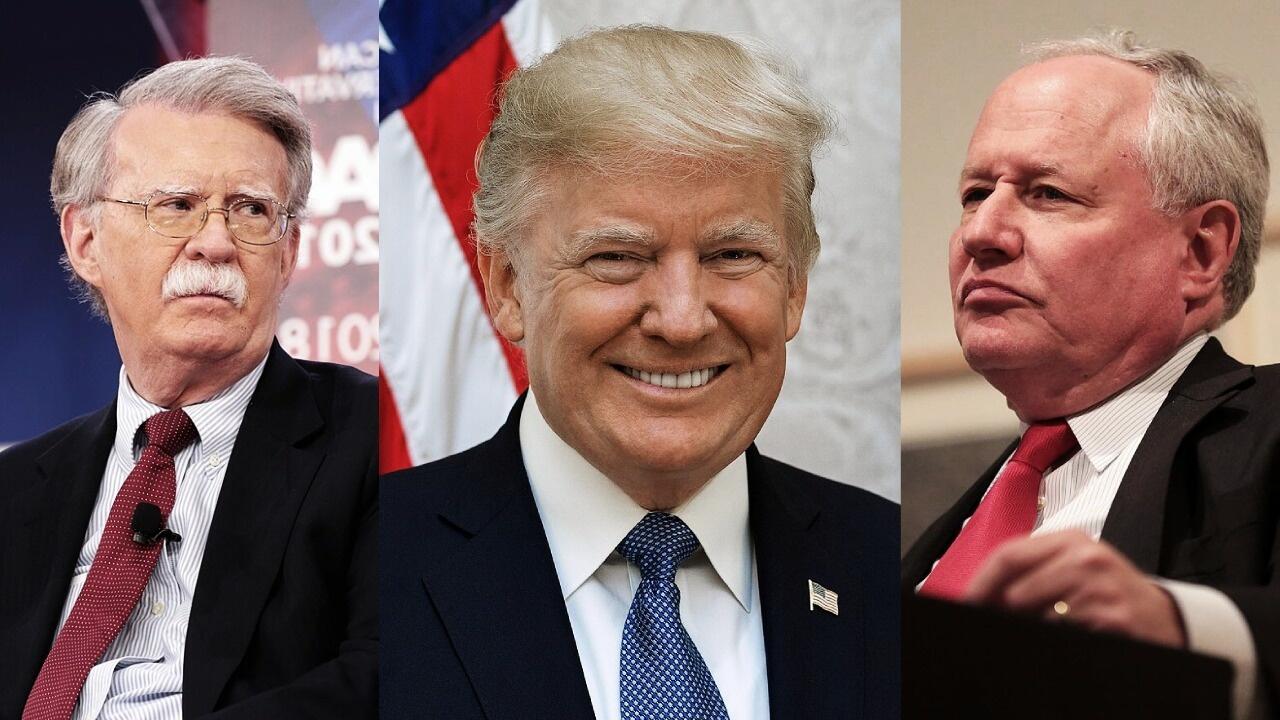
After president-elect Trump nominated the likes of Tulsi Gabbard, RFK Jr. Matt Gaetz and Pete Hegseth to cabinet positions, the usual crowd of neocons, warmongers and screechy leftists are unhappy. Good.

First in line was RINO warmonger and all around lunatic John Bolton, who must be devastated that he won’t see a massive war with Iran any time soon.

Bolton was toured around the defunct legacy cable news outlets to label Gabbard and Gaetz as the “worst” and “second worst” cabinet nominations in history.

Really? Worse than these guys?

Bolton called for FBI investigations into Gaetz and Gabbard before anyone even thinks about Senate confirmation hearings.

He labelled Gabbard a “Russian propagandist,” and “a serious threat to our national security” without citing any evidence whatsoever.

Later he called Gaetz “totally incompetent,” and “a person of moral turpitude.”

Wow. John Bolton, a primary advocate of the Iraq War, someone who has overseen totally undemocratic coups around the world, is calling someone else immoral.

He then trounced Gabbard again while admitting he’s done no research on her.

On CNN Bolton declared that the Gaetz nomination “is like the legend of Caligula, the Roman emperor who wanted to nominate his horse as a Roman consul,” again claiming both he and Gabbard are “lacking in the in the moral characteristics, the character that you need to hold these jobs.”

This is exactly the kind of person that its good to see pissed off.

Next up, Bill Kristol, another Project For A New American Century neocon is annoyed that Trump has nominated Pete Hegseth for Secretary of Defense.

Good.

He’s got bad tattoos…or something and will use the military against Americans, according to Kristol.

The most hilarious thing about this one is the fact that Kristol actually endorsed Hegseth for the Senate before Hegseth was allied with Trump.

But, but but Hegseth works for Fox News.

Yes. He also served in Iraq and Afghanistan, was a platoon leader at Guantanamo Bay, a Major in the Army, has two Bronze Stars, two Commendation medals and a National Defense award.

He’s worked extensively with veterans, held a previous position in the government and has two degrees from Harvard and Princeton.

He’s also not an out of touch four star general ensconced in years of Pentagon bureaucracy.

Finally, moving to RFK Jr. as HHS Secretary.

Need we say more?

Ok, there’s this.

Just because he’s now aligned with Trump he’s somehow not to be considered for a cabinet position.

The guy has spent his life fighting to make food safe to eat and water safe to drink.

He’s qualified.

*  *  *

Your support is crucial in helping us defeat mass censorship. Please consider donating via Locals or check out our unique merch. Follow us on X @ModernityNews.

Tyler Durden
Fri, 11/15/2024 – 10:40