80.7 F
Chicago
Tuesday, October 13, 2026
Home Blog Page 2131

Donald Trump Jr. Joining 1789 Capital To Fund ‘America First’ Themes

0
Donald Trump Jr. Joining 1789 Capital To Fund ‘America First’ Themes

President-elect Donald Trump’s oldest son has opted out of a spot on the transition team and instead plans to join a venture capital firm focused on investing in conservative-leaning companies. 

The New York Times reports that Donald Trump Jr. plans to become a partner at Florida-based venture firm 1789 Capital. He unveiled his new career pathway at a conference held by the Rockbridge Network on Sunday night. 

Omeed Malik, once self-described “run-of-the-mill corporate Democrat,” launched 1789 Capital in 2023 to capitalize on opportunities in the so-called parallel economy of conservative-friendly companies.

Malik is also on the board of PSQ Holdings, a Council on Foreign Relations member, and a Chairman-Circle Member at Milken Institute.

On the deal tracker website PitchBook, 1789 Capital has made one public investment of $15 million in Tucker Carlson Network. The fund size is $150 million. 

1789 Capital’s website said the fund invests in “companies building the next era of American prosperity” centered around these four areas:

  1. the Replication/Parallel Economy;
  2. Deglobalization,
  3. Anti-ESG (i.e. sectors that have been negatively impacted by such principles) and (iv) Cutting edge technologies that disrupt industries weighed down by excessive bureaucracy.

1789 Capital’s push into funding conservative media could not have come at a better time…

As legacy media implodes, X and alternative media outlets have become more popular than ever among Americans, who have abandoned far-left corporate media outlets and broken out of the so-called matrix in their pursuit of truth.

Tyler Durden
Tue, 11/12/2024 – 12:30

OPEC Oil Production Jumps By 470,000 Bpd As Libyan Output Returns

0
OPEC Oil Production Jumps By 470,000 Bpd As Libyan Output Returns

Authored by Tsvetana Paraskova via OilPrice.com,

The return of Libya’s oil production to full capacity raised the total OPEC output by 466,000 barrels per day (bpd) in October from September, the cartel’s monthly report showed on Tuesday, less than two months ahead of a planned reversal of part of the cuts.

Total crude oil production in all 12 OPEC members averaged 26.53 million bpd in October 2024, up by 466,000 bpd compared to September, according to secondary sources in OPEC’s Monthly Oil Market Report published today.

Crude oil output increased mainly in Libya, Nigeria and Congo, while production in Iran, Iraq, and Kuwait decreased, OPEC said.

Libya saw a jump of 556,000 bpd in its production last month after the political impasse that had halted more than half of its output was resolved.

Libya had most of its output halted for the whole month of September, and its oil production was decimated after the country’s two rival administrations locked horns over the appointment of a new central bank governor.

Following the resolution of this latest crisis, Libyan oil production resumed in early October and is now estimated to have exceeded pre-crisis levels and hit 1.3 million bpd.

Iran’s oil production, on the other hand, dropped by 68,000 bpd in October, per OPEC’s secondary sources.

Awaiting a retaliatory strike from Israel, the Islamic Republic reduced output and also exports last month.

Early last month, Iranian oil tankers were spotted moving away from Kharg Island, Iran’s biggest oil export terminal, amid fears of an imminent Israeli attack on the most important crude export infrastructure in Iran. Israel opted for a limited strike on Iran, which has somewhat defused tensions in the region, for now.

Elsewhere among OPEC’s producers, Saudi Arabia, the top producer in the cartel, saw its output stable at just below 9 million bpd—as the Kingdom pledged more than a year ago.

OPEC is set to begin reversing the production cuts in January 2025, market conditions permitting.

Tyler Durden
Tue, 11/12/2024 – 12:10

​​​​​​​”Keep Grinding”: Elon Musk’s America PAC Will Continue Anti-Soros Push Ahead Of Special Elections & Midterms

0
​​​​​​​”Keep Grinding”: Elon Musk’s America PAC Will Continue Anti-Soros Push Ahead Of Special Elections & Midterms

Elon Musk’s America PAC, the super PAC that spent about $200 million (according to AP sources) in support of Trump, will continue operating after the elections to counter George Soros’ influence and increase Republican registrations in key states ahead of special elections and the midterms.

“Normally, PACs go somewhat dormant after a big election. America PAC is going to do the opposite and keep grinding, increasing Republican registrations in key districts around the country, in preparation for special elections and the midterms,” Musk wrote on X earlier Tuesday morning. 

He added, “And, of course, play a significant role in primaries.” 

Musk’s America PAC is embarking on a new era in American history to restore law and order across a land battered by crises – some of which were fueled by Soros funding far-left district attorneys and mayors that failed to prosecute criminals and, in return, sent some metro areas like San Fran to NYC, spiraling dangerously into a vicious death loop of violent crime and murder tsunamis.

“Something has to be done to kind of counter the damage that Soros has done to the American system,” Musk recently said, adding, “America PAC’s going aim to weigh in heavily on the midterms and intermediate elections, as well as just doing common sense stuff like having DAs who prosecute violent criminals who are obviously a danger to people.”

In 2023, Musk told Joe Rogan: “In my opinion, George Soros fundamentally hates humanity.”

Oddly, Democrats never mention who is pulling the strings behind the curtain… Soros … Or maybe this election cycle, Alex Soros, George’s son.

The kid’s election battle against Musk ended with the incumbent political order being crushed across the West. 

Trump’s historic win shows Americans want a return to law and order. They’re done with woke Marxist policies, which they feel have damaged the nation. A new political order is preparing to unfold. 

Tyler Durden
Tue, 11/12/2024 – 11:50

Woman Kills Own Father With Ax After Being “Overwhelmed” On Election Night

0
Woman Kills Own Father With Ax After Being “Overwhelmed” On Election Night

Authored by Steve Watson via Modernity.news,

A woman in Seattle has been arrested on first-degree murder charges, allegedly killing her own father with an ice ax after becoming “overwhelmed” on the night of the US election.

The New York Post reports that 33-year-old Corey Burke, who “appeared to be having a mental health crisis,” is accused of murdering Timothy Burke, 67 last Tuesday, after the pair got into an argument over turning off the lights.

While there is no mention in arresting documentation of the election result being the trigger for the brutal killing, some have speculated it could have contributed to the woman’s mental unravelling.

King County prosecutors documents obtained by the Post state that police found the father’s body with wounds to his head and torso, including 2-inch lacerations to his rib cage and a puncture wound near the base of his skull.

Burke was witnessed covered in blood by police and allegedly broke windows in the house.

Police found a silver-and-blue ice climbing pickaxe covered in blood, according to the documents.

The report notes that Burke wanted to turn off the lights in the house, but her father didn’t want them shut off.

“The defendant told Detectives that she knew that she could not convince him to keep the lights off, so she went upstairs retrieved an ice axe and tripped her father, strangled him with the axe and her hands and then bit him and hit him several times in the head and side with the blunt and sharp ends of the ice axe,” a case summary by the prosecutor’s office notes.

The report states that Burke confessed to using the ax to kill her father, and admitted to biting him while also choking him.

“Corey stated … when her father started arguing with her, about the lights being shut off, that she ‘just freaked out,’” according to the documents.

Other disturbing violent incidents potentially linked to the election have also been reported in its wake.

As we highlighted earlier, there is a new online trend going around suggesting that women should POISON their husbands and male partners if they voted for Trump.

Many are calling for more scrutiny to be turned on the likes of MSNBC’s Joy Reid as she repeatedly tells leftists to disown family members who support Trump and that they’re fascists for voting for him.

*  *  *

Your support is crucial in helping us defeat mass censorship. Please consider donating via Locals or check out our unique merch. Follow us on X @ModernityNews.

Tyler Durden
Tue, 11/12/2024 – 11:30

MSNBC, CNN Ratings Collapse After Election While Fox News Flourishes

0
MSNBC, CNN Ratings Collapse After Election While Fox News Flourishes

Mainstream propaganda outlets MSNBC and CNN have seen an absolute collapse in viewership following the 2024 presidential election.

According to Neilsen data, last Thursday’s total views on Fox News came in at 2.6 million – of which 375,000 were in the coveted 25-54 age demographic, Mediaite reports. In comparison, MSNBC only had 596,000 / 71,000 25-54 viewers and CNN brought in 419,000 / 91,000 25-54.

Fox News was up some 60 percent year over year for the day, while MSNBC and CNN were down 23 and 40 percent – respectively. In prime time the news was even more bleak for CNN and MSNBC as they shed 30 percent and 54 percent of their viewers, respectively, compared to the same day last year. MSNBC host Alex Wagner had her lowest-rated show ever in terms of total viewers, while Chris Hayes’s show brought in its worst numbers since May of 2016.

On Friday, seven MSNBC shows recorded their lowest Friday ratings for the year. While Fox averaged 4.4M viewers Wed-Fri in prime time and 701,000 in that key demographic, MSNBC had just 808,000 total viewers for the same period (90k in demo), and CNN had 611,000 total average prime time viewers (159k in demo).

No wonder CNN’s Chris Wallace is about to explore podcasting.

Fox‘s Elizabeth MacDonald breaks down the carnage at MSNBC by time slot between Oct. 30 and Nov. 8:

  • Morning Joe 1st hour – down 39.6%
  • Morning Joe 2d hour – down 36.9%
  • Andrea Mitchell – down 39.7%
  • Ari Melber – down 49.6%
  • Joy Reid’s Reidout – down 54.6%
  • All-in w Chris Hayes – down 47.2%
  • Alex Wagner Tonight- down 53.6%
  • Lawrence O’Donnell – down 60.6%
  • Stephanie Ruhle – down 67%

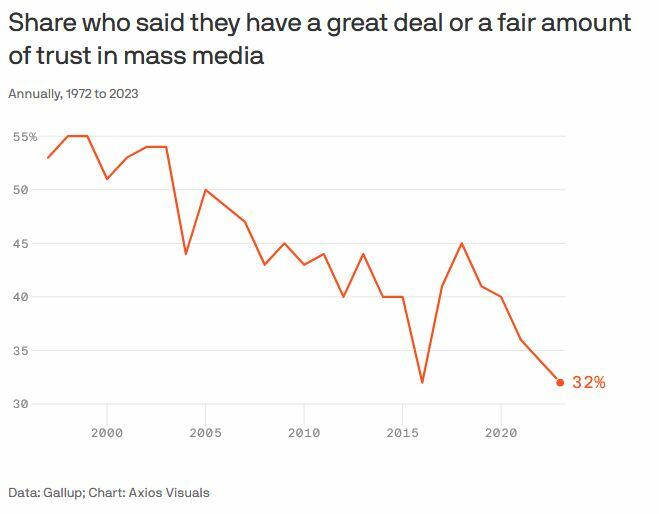
Three weeks ago Axios, citing Gallup, pointed out that Americans’ trust in media has plummeted to a historic low…

What’s interesting is that Democrats have the highest trust in mass media, yet their networks are ghost towns.

As Outkick.com reports further;

CNN and MSNBC’s futures are bleak. 

The two networks maintained relevancy during Trump’s first term by aggressively promoting the Russia hoax. Though the networks could try to manufacture another phony scandal, who would believe them?

Trump’s decisive victory demonstrated that the left-wing cable news networks have lost their influence. CNN and MSNBC exhausted every resource at their disposal to stop Donald Trump from achieving victory, eventually stooping to a plot to depict him as the second coming of Adolf Hitler, the most ruthless dictator in modern world history.

It didn’t work. The lies, the hysteria, and the besmirchment only made Trump more popular and sunk CNN and MSNBC deeper.

Here is how race lady Joy Reid is handling the results:

*  *  *

Tyler Durden
Tue, 11/12/2024 – 11:10

Trump Rally Fizzles: Futures Drop As Dollar, Yields Extend Surge

0
Trump Rally Fizzles: Futures Drop As Dollar, Yields Extend Surge

The torrid five-day rally that pushed the S&P 500 to its 51st record close above 6,000 on Monday has finally reversed amid unease over nosebleed equity valuations and the composition of Trump’s incoming cabinet. As of 8:00am, contracts on the S&P 500 and Nasdaq 100 indexes slipped about 0.2% with Mag7 and semiconductors under pressure, while Tesla also dropped in after a post-election surge that lifted its valuation past $1 trillion; healthcare names among the notable gainers. Europe’s Stoxx 600 gauge lost 1% as the rout in Asia continued and the MSCI Asia Pacific Index dropped as much as 1.3%, with chipmakers TSMC and Samsung among the biggest drags. Bond yields are 3-6bps higher as the curve twists flatter; yields are pulling the dollar higher. Commodities are weaker with Energy outperforming. Other Trump trades remained in play, however, with Treasuries falling, the dollar hitting a one-year high and Bitcoin hovering just below $90,000. Today’s macro data focus is on SLOOS, 1-year inflation expectations, and Small Business Optimism, as well as five Fed speakers.

In premarket trading, cryptocurrency-exposed stocks erase earlier premarket gains as Bitcoin retreated after its record-breaking rally took the digital asset beyond $89,000. The digital currency has rallied as traders bet on a crypto boom under Trump. Here are some other notable premarket movers:

  • Grab Holdings (GRAB) jumps 8% after the ride-hailing and delivery company boosted its earnings and revenue forecasts for the year.
  • Live Nation (LYV) climbs 5% after the entertainment posted 3Q profit that impressed.
  • Luminar (LAZR) gains 2% after the auto technology company entered pacts with Volvo and a Japanes automaker.
  • Neurogene (NGNE) sinks 33% after the drug developer said it became aware of an emerging serious side effect related to its experimental treatment for Rett syndrome. Rival Taysha Gene Therapies rose 19% as analysts say issues at Neurogene could level the playing field.
  • On Holding (ONON) rises 1% after the sportswear company reported third-quarter net sales ahead of consensus estimates.
  • Sea (SE) rises 8% after the e-commerce company reported 3Q revenue that came ahead of estimates.
  • Shopify (SHOP) soars 13% after reporting 3Q sales that beat analysts’ estimates, a sign that the Canadian e-commerce company is gaining momentum as spending continues to shift from stores to websites.

According to Citi, the election outcome has taken investors’ US equity exposure to the highest in three years, suggesting the rally could run out of steam. Traders are also pondering the potential for Trump’s economic policies, including trade tariffs and immigration crackdowns, to spur inflation and affect the path for Federal Reserve monetary policy.

“If we have those tariffs kicking in, if we have those so-called deportations, those would have an outright inflationary impact, and so would result in higher bond yields,” said Kevin Thozet, a member of the investment committee at Carmignac. “Higher bond yields across the curve may start to bite at some point,” especially at a time of lofty stock-market valuations, he said. Ten-year Treasury yields rose as much as six basis points as the market reopened after Monday’s holiday.

Traders are now focusing on the make-up of the incoming Trump adminstration. Fears for the future of China’s relationship with the US played out in Hong Kong’s Hang Seng Index, which shed more than 3%. US-listed Chinese stocks, such as Alibaba Group Holding Ltd. and PDD Holdings Inc. also fell.

Overnight, we got reports that Senator Marco Rubio — known for his aggressive stance on China — is expected to be named secretary of state. Representative Mike Waltz, who views China as a “greater threat” to the US than any other nation, is in line to be national security advisor. Tom Homan, named as “border czar,” was criticized for harsh immigration policies implemented during Trump’s first term.

“Up until Trump’s inauguration in January, we will be in a period where there will be some form of uncertainty regarding the implementation of his policy measures,” Thozet said. Meanwhile, US inflation data due Wednesday, could determine whether the Fed cuts interest rates again next month. The core consumer price index, which excludes food and energy, is expected to have risen at the same pace on both a monthly and annual basis compared with September’s readings.

European stocks dropped in early trading in the wake of similar declines in Asia as worries over the policies of US President-elect Donald Trump may fuel inflation. The Stoxx 600 fell 1.1% to 506.61 with basic resources, chemicals and consumer products leading declines. German chemical giant Bayer shares plunged as much as 14% to the lowest level in 20 years after the German company reported weaker-than-expected results for the third quarter and cut its guidance for the year. Here are the biggest movers Tuesday:

  • ConvaTec rises as much as 22%, the most since March 2020, after the maker of medical and surgical equipment lifted its FY24 guidance. Analysts note that organic growth was stronger than expected
  • DCC shares rise as much as 18%, the most since May 1994, after the sales and support services group announced a new strategy plan that analysts said will help unlock value
  • Infineon rises 6.4% as the chipmaker guided for a modest rebound starting from 2Q fiscal 2025, following a steep sales drop in the current quarter as an inventory correction drags on
  • FLSmidth rises as much as 7.2%, the most since February, after the Danish industrial machinery company revealed a strong third-quarter Ebita beat. It also upped its margin guidance
  • OCI shares rise as much as 6.6% after the Dutch agricultural chemicals firm released a trading update and said it expects to make another extraordinary distribution of ~$1 billion
  • Drax shares gain as much as 7.6%, the most since July, after the renewable energy company reported a trading update, saying it sees FY24 Ebitda guidance toward the top end of range
  • Temenos gains as much as 4.8%, the most in over a month as analysts saw the Swiss banking software firm’s delayed mid-term targets as a more realistic strategy
  • Bayer shares plunge as much as 14% to the lowest level in 20 years after the German company reported weaker-than-expected results for the third quarter and cut its guidance for the year
  • Brenntag falls as much as 10% to their lowest intraday value since 2022 after the German chemicals firm reported operating Ebita for the third quarter that missed the average estimate
  • Vodafone shares fall as much as 5.5% after the telecom operator reported a bigger-than-expected drop in service revenue in its core market of Germany, hit by a regulatory changes
  • Direct Line drops as much as 8.2% to the lowest since 2023 after Jefferies downgrades to hold from buy, saying in a note the insurer’s valuation is “uncompelling” and upside risks are muted
  • Fresnillo shares drop as much as 7.4% after the gold and silver miner warned the Sabinas mine is experiencing “operational difficulties” that are affecting production
  • Verbio falls as much as 14% to their lowest intraday value in over four years. Jefferies says the German biofuel firm’s results missed expectations due to biodiesel and bioethanol pricing

Earlier, Asian equities fell, weighed by declines in China and major technology companies amid rising geopolitical uncertainties. The MSCI Asia Pacific Index dropped as much as 1.3%, with chipmakers TSMC and Samsung among the biggest drags. Chinese internet firms Tencent and Alibaba also slumped ahead of their earnings reports later this week.
Chinese stocks fell as fears of worsening Sino-US ties further undermined investor confidence after underwhelming fiscal stimulus and weak economic data affected sentiment. Reports that President-elect Donald Trump is poised to pick two men with track records of harshly criticizing China for key positions in his new administration added to investor worries.

In FX, the dollar added to its post-election gain, with the Bloomberg Dollar Spot Index advancing 0.4% to the highest since Nov. 1, 2023. Investor expectations for Trump’s policy agenda have lifted the greenback in recent sessions. “The fundamental dollar uptrend remains intact,” Win Thin, global head of markets strategy at Brown Brothers Harriman & Co., wrote in a note. “The Fed made it clear it is in no hurry to cut rates, growth remains solid in Q4”

In rates, treasuries slumped as the incoming Trump administration has investors fretting over the prospect of a resurgence in inflation. US 10-year yields climb 5 bps to 4.36% while the yield on the two-year Treasury rose as much as 8 basis points to 4.33%, its highest since July 31. Bunds rose to session highs after German ZEW data fell short of estimates. German lawmakers have also agreed to hold an early election in February, according to government officials familiar with the talks. Gilts underperform their German peers after mixed UK jobs data. Oil prices advance, with WTI rising 0.8% to $68.60 a barrel. Spot gold falls $26 to $2,592/oz.

Bitcoin is lower having flirted with the $90,000 level earlier on.

The US economic data calendar includes October New York Fed 1-year inflation expectations at 11am and the Senior Loan Officers Survey at 2pm; the Fed speaker slate includes Waller (10am), Barkin (10:15am, 5:30pm), Kashkari (2pm) and Harker (5pm). Senior Loan Officer opinion survey is released at 2pm.

Market Snapshot

S&P 500 futures little changed at 6,026.75
Brent Futures up 0.5% to $72.17/bbl
Gold spot down 1.0% to $2,593.31
US Dollar Index up 0.28% to 105.84

Top Overnight News

  • China may embrace greater stimulus, manufacturing support and a weaker yuan to counter the negative effects of a second Trump presidency, according to surveyed economists. BBG
  • China plans to cut taxes for home purchases as the government continues to take steps aimed at bolstering the economy. Regulators are working on a proposal that would allow mega cities including Shanghai and Beijing to cut the deed tax for buyers to as low as 1% from a current level of as much as 3%. BBG
  • A Chinese court will hear a lawsuit filed by a local developer against Apple over its App Store practices — a decision may spur greater scrutiny of the company’s role in the mobile ecosystem. BBG
  • Japan’s government said it would provide at least ~$65B in support for the semiconductor and AI industries through 2030. Nikkei
  • UK wage growth cools modestly in Sept while hiring stalls, leaving the door open to further BOE easing. WSJ
  • Trump’s initial immigration staffing selections point to a very hawkish approach to this issue when the new administration takes power in January. Politico
  • Marco Rubio is expected to be named secretary of state, a person familiar said, as Trump turns to allies and China skeptics to fill his cabinet. Mike Waltz was said to be selected as national security advisor and CNN reported that Kristi Noem will head homeland security. BBG
  • Trump is preparing to hire a slew of crypto-friendly officials as he staffs up his new government. Washington Post
  • American LNG may prove a crucial bargaining chip in a potential US-EU trade deal, the FT reported. Higher shipments to Europe could be exchanged for dissuading Trump from levying hefty import tariffs. BBG

A more detailed look at global markets courtesy of Newsquawk

APAC stocks were ultimately mixed and failed to sustain the momentum from Wall St where the major indices climbed to fresh record highs in a continuation of the Trump Trade and in quiet conditions due to Veterans Day. ASX 200 was restrained by weakness in mining and resources after underlying commodity prices were hit by dollar strength. Nikkei 225 gave up its early gains and more despite initial tailwinds from JPY weakness and chip-related support. Hang Seng and Shanghai Comp weakened with notable underperformance in the Hong Kong benchmark amid weakness in tech and auto names owing to the current tariff-related concerns, while the mainland was also pressured after recent new loans and financing data underwhelmed but with the downside cushioned after the PBoC recently pledged measures and with China reportedly planning to cut homebuying taxes to boost the property sector. Softbank Group (9984 JT) 6-month (JPY): Revenue 3.47tln (exp. 3.42tln). Net +1.01tln (prev. -1.41tln). Co. reaffirms guidance.

Top Asian News

  • Fitch says China’s new fiscal proposals are unlikely to immediately bolster growth
  • China plans to cut homebuying taxes to boost the property sector in which the home purchase deed tax could be reduced to 1% from 3%, according to Bloomberg.
  • China is to strengthen monetary support for the economy and PBoC should provide liquidity through a RRR cut, while the PBoC should inject long-term liquidity in Q4 to offset a rise in government bond issuance, according to an article by PBoC-backed Financial News citing analysts.

Top European News

  • BoE’s Pill says still some work to be done on underlying domestic inflation pressure in the UK. Policy has anchored expectations close to target. It was not obvious two years ago that CPI would now be at target. Today’s labour data shows that pay growth it still at high levels. Additional rate cuts are to be a gradual process. Shocks the the global economy could know the UK off its lower inflation path. Underlying Q/Q UK economic growth of 0.3% is not far off the trend growth rate. Overall picture on fiscal policy is one of consolidation despite the short-term boost from the budget. UK is perhaps further along with its adjustment process towards neutral rates. Higher neutral rate in the UK is not a base case but is something the MPC must consider. Not surprising that markets are considering possibility of a higher neutral rate.
  • ECB’s Rehn says the ECB is data dependent, not data point dependent; the direction of the ECB is clear, the speed depends on data; will could be leaving restrictive territory in Spring 2025. Disinflation is well on track in EZ. Says the speed of rate cuts will depend on the assessment at each meeting. sees downside risks to growth; waiting for December macro projection for a better view, most of the data is quite weak, particularly in manufacturing.
  • ECB’s Holzman says Trump’s tariffs will put pressure on EZ inflation; will mean higher US rates with an affect on FX
  • Brussels is to free up billions of euros for defence from the EU budget and policy shift will allow the bloc’s capitals to redirect ‘cohesion funds’ amid the Ukraine conflict and Trump victory, according to FT.
  • German union and employers’ association says an agreement was reached in wage talks for metal and electrical engineering industries
  • German lawmakers reportedly near deal for early election in February, according to Bloomberg. Chancellor will first submit to a confidence vote in the lower house of parliament to trigger national ballot, likely H1 of December.
  • Germany’s political parties propose Feb 23rd as the date for the new election, according to Rheinische post. According to the report, there is also talk that the Chancellor could ask for a vote of confidence on December 18. However, this is still open because time could then be running out to pass laws, according to party circles. German Parliment to hold a confidence vote on Dec 16th, according to Reuters sources. mixed reporting
  • UK reportedly nearing a free-trade agreement with oil-rich Gulf nations including Saudi Arabia, according to Bloomberg sources

FX

  • DXY is firmer vs. all peers as the post-election rally continues and focuses markets on the prospect of looser fiscal policy vs. a subsequently potentially tighter approach from the Fed. DXY has been as high as 105.87 with all eyes on a test of the 106 mark.
  • EUR is softer vs. the broadly stronger USD with the pair’s bruising post-election sell-off continuing to pick-up pace. From a macro perspective in the Eurozone, today has seen commentary from ECB’s Rehn and Holzmann with the former flagging downside risks to growth and the latter cautioning over the impact of Trump tariffs on inflation. German ZEW fell short of expectations. EUR/USD has delved as low as 1.0618.
  • USD/JPY has made its way onto a 154 handle, topping out at 154.16 vs. yesterday’s opening levels of 152.61. Fresh macro drivers for Japan have been on the quiet side today.
  • GBP is near the foot of the leaderboard in the wake of UK jobs metrics. The usual data quality caveats apply, however, the main takeaway was a larger-than-expected jump in the unemployment rate to 4.3% from 4.0% and a slowdown in the rate of employment. Comments from BoE’s Pill this morning adopted a cautious stance towards further policy loosening.
  • Antipodeans are both softer vs. the USD with risk sentiment in Europe very much on the backfoot and a poor showing for China overnight.
  • PBoC set USD/CNY mid-point at 7.1927 vs exp. 7.1944 (prev. 7.1786).

Fixed Income

  • USTs are softer but only modestly so, with US-specific newsflow somewhat light as we count down to a handful of Fed speakers today before CPI and Powell later in the week. Currently, at the mid-point of a 109-24+ to 110-04 bound, yields firmer across the curve which is a touch flatter as it stands.
  • Bunds were under modest pressure, but lifted incrementally from a 132.24 base, amid geopolitical reports, which suggested that Israel is planning an imminent ground operation in Lebanon, reported via Sky News Arabia (since deleted). Thereafter, soft ZEW metrics helped lift Bunds futher to a 132.62 peak.
  • Gilts underperform vs peers after today’s mixed jobs report, where the unemployment rate lifting markedly, whilst the wages metrics remained sticky. Gilts lifted off lows in tandem with the bid in Bunds, and were largelly unreactive to its own robust auction.
  • Netherlands sells EUR 2.105bln vs exp. EUR 2.0-2.5bln 0.25% 2029 DSL Auction: average yield +2.295% (prev. -0.427%).
  • UK sells GBP 2.25bln 4.75% 2043 Gilt Auction: b/c 3.28x (prev. 3.27x), average yield 4.4836% (prev. 4.421%) & tail 0.1bps (prev. 0.1bps)
  • Germany sells EUR 4.019bln vs exp. EUR 5bln 2.0% 2026 Schatz Auction; b/c 2.20x (prev. 2.61x), average yield 2.11% (prev. 2.16%) & retention 19.62% (prev. 16.76%)

Commodities

  • Crude holds a mild upward bias after Israel’s Defence Minister Katz poured cold water on hopes of a Hezbollah-Israel ceasefire, suggesting there will be no ceasefire and Israel will continue to hit Hezbollah with full force. Brent towards the top of a USD 71.55-72.36/bbl parameter.
  • Precious metals are softer across the board amid the continued gains in the USD on the back of the ongoing Trump trade. Spot gold fell under USD 2,600/oz resides towards the bottom of a USD 2,590.89-2,627.23/oz parameter.
  • Base metals are lower across the board amid the firmer Dollar and a continuation of the disappointment from the NPC Standing Committee meeting last week. 3M LME copper fell to levels under USD 9,200/t.
  • OPEC Monthly Oil Market Report due to be released at 11:40GMT/06:40EST.
  • Biden’s administration is setting out plans for the US to triple nuclear power capacity by 2050, according to Bloomberg.

Geopolitics: Middle East

  • Washington Post quoting US official: Israel tells Washington that it is planning an imminent ground operation in Lebanon”, via Sky News Arabia – NOTE: Sky News Arabia has since deleted this tweet
  • Israel’s Defence Minister Katz says in Lebanon there will be no ceasefire, and will continue to hit Hezbollah with full force.
  • “Palestinian source to Sky News Arabia: No agreement between Fatah and Hamas and the gaps between the two sides are still wide”, according to Sky News Arabia.
  • “Israeli PM Netanyahu in conversations in recent days: When Trump goes back to the White House – we should put the annexation issue back on the table”, according to sources via Kann news.
  • Walla cited US officials stating Israeli PM Netanyahu made it clear to the Biden administration that he wants to end the war in Lebanon within weeks, according to Sky News Arabia. Axios also cited US and Israeli officials stating that the Israeli Minister of Strategic Affairs briefed US President-elect Trump on plans for Gaza and Lebanon over the next two months. It was also reported that Israeli PM Netanyahu’s close aide Dermer met with US President-elect Trump on Sunday.
  • Times of Israel reported that two officials in the previous Trump administration warned Israelis against assuming Trump would support Israel’s annexation of the West Bank in his second term, according to Sky News Arabia.
  • Israeli occupation forces raided the cities of Bethlehem and Hebron in the southern West Bank, according to Al Jazeera.
  • Iraqi armed factions attacked a “military target” in southern Israel with drones, according to Sky News. Arabia.
  • Central Command of the US Army announced that it attacked nine targets in two locations linked to pro-Iranian militias in Syria as a response to the militias’ activity against US forces in the past 24 hours, according to Kann News.
  • Ansar Allah media outlets reported US-British raids on the Hodeidah governorate in Yemen, according to Al Jazeera.

Geopolitics: Other

  • Russian state agencies reported that a Russian navy carrier of hypersonic missiles conducted drills while passing through the English Channel, while RIA reported that the Russian ship capable of carrying hypersonic missiles carried out missions in the Atlantic after passing through the English Channel.

US Event Calendar

  • 06:00: Oct. SMALL BUSINESS OPTIMISM 93.7, est. 92.0, prior 91.5
  • 11:00: Oct. NY Fed 1-Yr Inflation Expectat, est. 2.97%, prior 3.00%
  • 14:00: Senior Loan Officer Opinion Survey on Bank Lending Practices

Central Bank Speakers

  • 10:00: Fed’s Waller Speaks at Banking Conference
  • 10:15: Fed’s Barkin Speaks in Baltimore
  • 14:00: Senior Loan Officer Opinion Survey on Bank Lending Practices
  • 14:00: Fed’s Kashkari Participates in Moderated Conversation
  • 17:00: Fed’s Harker Speaks on Fintech, AI
  • 17:30: Fed’s Barkin Repeats Speech, followed with Q&A

DB’s Jim Reid concludes the overnight wrap

The post-election rally edged higher yesterday, as the S&P 500 (+0.10%) closed above the 6,000 mark for the first time, posting a fourth consecutive record high following the election and its 51st of 2024 so far. In fact, the index is currently experiencing its strongest YTD performance since 1995, having risen by +25.82% since the start of the year, and it’s the first time since 1997-98 that it’s on course to post back-to-back annual gains above +20% and only the third time in 100 years. So it was another strong performance, with the Dow Jones (+0.69%) closing above 44,000 for the first time as well, just as the small-cap Russell 2000 (+1.47%) closed just 0.3% from its all-time high back in November 2021.

This rally has led to a significant easing of financial conditions, but yesterday also saw investors dial back their expectations for rate cuts yet again. For instance, the rate priced in by the December 2025 meeting was up to 3.82% yesterday, meaning that investors are only pricing in three more 25bp rate cuts by the end of 2025. Bear in mind that’s risen by almost 100bps in just over six weeks, thanks to positive US data and the election result. So this is a significant reassessment of the Fed’s outlook, and with investors pricing in fewer rate cuts, the dollar index strengthened another +0.52%, reaching its highest level since early July. 

Given the Veterans Day holiday, cash trading in US Treasuries was closed yesterday. But futures markets showed them losing ground across the curve, with 2yr, 5yr and 10yr futures all pointing towards higher yields. This morning in Asia they’ve crystallised this with 2 and 10yr yields up +3.8bps and +2.1bps, respectively. That also comes ahead of the CPI release tomorrow, where there’s been some concern about another robust print, particularly after monthly core CPI was at a 6-month high in September. We’ll have to see what that brings, but inflation expectations have risen quite a bit over the last couple of months, with the 2yr inflation swap up from just 1.99% on September 10 to 2.62% yesterday, so another upside surprise would only accelerate that trend. That said, our US economists expect core CPI to tick down in October to +0.26%.

In the meantime, there was a lot of focus on several “Trump trades”, which continued to outperform yesterday. Bitcoin was one of the most notable, rising by more than 10% yesterday and up another +0.96% this morning to trade above $88,000. Its YTD gain now stands above 100%. It’s been supported by the fact that Trump and the new Congress appear more friendly to crypto, and Marion Laboure on my team has just released a note looking at the immediate impact of the election on crypto along with the outlook ahead.

Among equities themselves, the Trump trade was also clear, and Tesla (+8.96%) advanced for a 5th consecutive session, bringing its gains over the last week to +44.1%. That single-handedly dragged the Magnificent 7 group to a +1.02% gain and another record high, even as five of them actually lost ground on the day. Nvidia (-1.61%) was the weakest of the Mag-7, echoing a -2.54% decline for the Philadelphia Semiconductor index after Reuters reported over the weekend that the US had told TSMC to stop shipping its advance AI chips to China. Meanwhile, banks continued to post strong gains, with the KBW Bank index rising +2.35%.

In terms of US politics, we got a few more reports on potential appointees to the new Trump administration yesterday. That included a report from Bloomberg, which said Trump would narrow the shortlist for Treasury Secretary this week. It also said he was leaning towards someone with Wall Street experience to the job. Otherwise, CNN reported that Trump would name Stephen Miller, his immigration adviser, as Deputy Chief of Staff for Policy. Overnight the FT and others suggest he will appoint Mike Waltz as national security advisor and Marco Rubio as Secretary of State. They are China hawks.

Lastly, we still don’t officially know who’s going to end up in control of the House of Representatives, but the current AP tally now stands at 214-205 to the Republicans, with 218 required for a majority. Polymarket is now putting the likelihood of a Republican sweep at 99%, and as it stands, the Republicans are currently ahead in more-than-enough districts to put them over the 218 majority line.

Over in Europe, risk assets followed a broadly similar pattern, and the STOXX 600 (+1.13%) posted its strongest performance in six weeks. But for sovereign bonds, there was a clear rally across the continent as investors priced in a growing likelihood of ECB rate cuts over the months ahead. In fact, yields on 10yr bunds (-4.0bps), OATs (-4.1bps) and BTPs (-6.3bps) all moved lower, which was in contrast to the way that US Treasury futures were pointing.

When it comes to German politics, there was still no clarity on when an election might take place, but there’s been plenty of pressure to bring forward the timetable of a confidence motion before the new year. AFP reported yesterday that German President Frank-Walter Steinmeier was moderating discussions between the parties, and Chancellor Scholz said on Sunday that an earlier vote could happen this year “if all sides agree”. Nevertheless, Scholz’s spokesman said yesterday that a vote of confidence wouldn’t happen this Wednesday, and Vice Chancellor Habeck of the Greens said yesterday that the decision was down to Scholz.

Asian equity markets are mostly lower this morning with non-US risk still struggling to weigh up all the post-election implications. Leading the losses is the Hang Seng (-2.73%), followed by the KOSPI (-1.73%), the Nikkei (-0.97%), and the Shanghai Composite (-0.85%). S&P 500 (-0.11%) and Nasdaq (-0.08%) futures are slightly lower.

A Bloomberg report overnight indicates that China is planning to cut taxes on home purchases. The proposal would allow major cities to reduce the deed tax for buyers to as low as 1%, down from the current rate of up to 3% in an effort to revive the struggling housing market.

To the day ahead now, and one of the main highlights will be the Fed’s Senior Loan Officer Opinion Survey on Bank Lending Practices. Otherwise, central bank speakers include the Fed’s Waller, Barkin, Kashkari and Harker, the ECB’s Rehn, Holzmann, Centeno and Cipollone, and the BoE’s Pill. Data releases include the UK unemployment rate for September, the German ZEW survey for November, and in the US there’s the NFIB’s small business optimism index for October.


Tyler Durden
Tue, 11/12/2024 – 08:24

Exuberance – Investors Have Rarely Been So Optimistic

0
Exuberance – Investors Have Rarely Been So Optimistic

Authored by Lance Roberts via RealInvestmentAdvice.com,

Investor exuberance has rarely been so optimistic. In a recent post, we discussed investor expectations of returns over the next year, according to the Conference Board’s Sentiment Index. To wit:

“Consumer confidence in higher stock prices in the next year remains at the highest since 2018, following the 2017 “Trump” tax cuts.“ (Note: this survey was completed before the Presidential Election.)

We also discussed households’ allocations to equities, which, according to Federal Reserve data, have reached the highest levels on record.

In that article, we discussed the risk associated with high levels of investor exuberance.

“Risk isn’t always what it seems. When the market feels the safest, that’s often when it’s often the riskiest. Think about it — when everything is going smoothly, people tend to take more risks, which can lead to market bubbles and crashes.”

However, it is crucial to understand that “exuberance” is a necessary ingredient for pushing asset prices higher. This is why “sellers live higher, and buyers live lower.” In every market and asset class, the price is determined by supply and demand. If there are more buyers than sellers, then prices rise, and vice-versa. While economic, geopolitical, or financial data points may temporarily affect and shift the balance between those wanting to buy or sell, in the end, the price is solely determined by asset flows.

Currently, a liquidity surge supports investor exuberance, marked by enthusiastic buying and excessive risk-taking. As we will discuss, such activity often precedes significant market corrections. While optimism can drive short-term gains, history shows that when sentiment runs too hot, and valuations detach from fundamentals, such leaves the markets vulnerable to declines.

The Psychology of Market Euphoria

Nobel Prize-winning economist Robert Shiller famously coined “irrational exuberance” to describe situations where speculative behavior pushes asset prices far above intrinsic values. Shiller’s research shows that emotional narratives and herd behavior dominate in bull markets, fueling market increases that eventually revert under the weight of reality. He warned that “markets can stay irrational longer than you can stay solvent,” reflecting how unpredictable and dangerous excessive optimism can become.

Similarly, Jeremy Grantham, a seasoned investor known for identifying bubbles, recently described the post-2009 bull market as an “epic bubble” driven by speculative behavior and extreme overvaluation. Unsurprisingly, as market prices increase, exuberance builds, and investors rationalize overvaluation by believing that “this time is different.”

However, with that said, as we discussed in “Low Forward Returns,“ valuations are a terrible market timing tool. Valuations only measure when prices are moving faster or slower than earnings. In other words, valuations are a measure of psychology in the short term. To wit:

“Valuation metrics are just that – a measure of current valuation. More importantly, when valuation metrics are excessive, it is a better measure of ‘investor psychology’ and the manifestation of the ‘greater fool theory.’ As shown, there is a high correlation between our composite consumer confidence index and trailing 1-year S&P 500 valuations.”

Investors repeatedly make the mistake of dismissing valuations in the short term because there is no immediate impact on price returns. However, as noted above, while valuations are HORRIBLE predictors of 12-month returns, they indicate “exuberance,” which impacts markets in the near term.

Understanding that valuations reflect psychological exuberance, what can we expect from markets over the next 12 months?

Expect Increased Volatility

As noted recently by Sentiment Trader:

“It almost doesn’t matter what measure we look at. There are some isolated exceptions, but most indications suggest that investors are optimistic about the prospects for stocks in the months ahead. It’s a different story in the bond market. After a brief bout of not-pessimism a couple of months ago, bond investors are back to feeling gloomy.

That difference of opinion on the relative merits of the two markets has caused the spread between stock and bond sentiment to spike close to a multi-decade high. Over the past 25 years, there haven’t been many times when the Intermediate-term Optimism Index for stocks was more than 50% higher than the Bond Optimism Index.”

“As for whether such a wide disparity in sentiment makes any difference, the table below shows S&P 500 returns after the spread between the two optimism indices reached 50%. And for the S&P, it was a short-term headwind. Its returns were particularly poor over the following month, with only two winners and five losers. However, only the signal during the post-dotcom bubble resulted in a sustained decline.” – Sentiment Trader

We see the same warning of investor exuberance by looking at the stock/bond ratio. The following chart compares the 52-day rate of change between the SPDR S&P 500 Index ETF (SPY) and the iShares 20+ Year Treasury Bond ETF (TLT). The vertical lines correspond with both high levels of the stock/bond ratio rate of change and the Relative Strength Index of the S&P 500 index. Unsurprisingly, high levels of investor exuberance in stocks versus bonds have preceded either short-term pullbacks or larger corrections.

High levels of Investor exuberance increase correction risks because markets are more fragile when built on sentiment rather than fundamentals. As the enthusiasm fades, a small negative event, like disappointing earnings, geopolitical tensions, or concerning economic reports, can trigger a reversal between buyers and sellers.

When markets are propped up by speculative exuberance, corrections tend to be more severe. The recent “Yen Carry Trade” blow-up shows that a sudden, unexpected, exogenous shock caused a sharp fall in asset prices. The problem with an exuberant market is that price declines create a feedback loop that accelerates the decline. Historical data confirms that pattern, where market exuberance, fueled by liquidity and investor mania, typically ends in rapid, painful corrections.

A Word of Caution: Timing Is Unpredictable

While investor exuberance sets the stage for corrections, predicting the exact timing is difficult. Alan Greenspan’s famous “irrational exuberance” speech in 1996 came three years before the dot-com peak. Markets can remain euphoric longer than expected, but corrections are inevitable as valuations eventually revert to more sustainable levels, as shown in the chart below.

However, as noted, timing is critical. Investors always make two primary mistakes when investing in an exuberant market. The first is overreacting to signals, believing a more severe correction is coming. The second is taking action too soon. Therefore, we must continue to navigate the market within the context of the current bullish trend.

As Sentiment Trader concluded:

“Sentiment and momentum are often in direct opposition. Just when things are looking best for trend-following momentum chasers, it looks the most at-risk for contrarian-minded investors. We’re reaching one of those times now, as momentum is impressive and compelling. There is little to no evidence that the gas has run out, as breadth remains robust and sector performance is supremely healthy. Extremes in sentiment tend to work better when there is less buying interest underlying the indexes. If we saw more divergences with breadth metrics, the extreme disparity in stock-bond sentiment would have more meaning. As it stands, it’s probably most useful as an early heads-up that conditions are ripe for disappointment, and we should be on guard for any signs of a buying strike in the weeks ahead.”

Practical Takeaways for Investors

Given the signs of elevated exuberance today, investors should consider the following strategies to manage risk:

  • Rebalance Portfolios: Shift allocations toward defensive sectors or cash to reduce exposure to speculative assets.

  • Limit Leverage: Avoid excessive use of margin to minimize forced selling risks.

  • Monitor Indicators: Pay attention to the technicals, positioning changes, and fund flows for early warning signs.

  • Consider Bonds: If bonds are out of favor as stock demand increases, a rotational “safety trade” is likely when volatility arises.

In summary, while optimism plays a role in market growth, unchecked exuberance often leads to corrections as markets adjust to reality. By recognizing the signs of market excess and managing risks proactively, investors can better navigate these uncertain periods and protect their portfolios from excessive drawdowns.

Tyler Durden
Tue, 11/12/2024 – 08:13

What To Expect From Trump’s First Day in Office

0
What To Expect From Trump’s First Day in Office

Authored by Janice Hisle via The Epoch Times (emphasis ours),

Based on his campaign trail statements, President-elect Donald Trump is poised to sign a flurry of executive orders as soon as he regains power on Jan. 20, 2025.

He will become only the second former U.S. president to return to office after losing a reelection bid. President Grover Cleveland, a Democrat, served as the 22nd and 24th president in the late 1800s.

Trump, a Republican who served as the 45th president, will become the 47th president after defeating Vice President Kamala Harris in the Nov. 5 election. She became a replacement candidate for the Democratic Party after President Joe Biden, the 46th president, dropped out of the race on July 21.

Throughout Trump’s 2024 presidential campaign, which he began in late 2022, Trump has stated that he plans to begin tackling numerous issues on “day one,” ranging from border security to the economy.

He has repeatedly made pledges that would make for a busy first day in office in 2025.

In late 2023, Trump joked with a Fort Dodge, Iowa, audience about his eagerness to begin signing documents on Inauguration Day.

“I may even have a very tiny little desk put on the 20th stair” of the U.S. Capitol, where he could begin signing documents immediately after taking the Oath of Office, Trump said.

It’s anyone’s guess how many executive orders Trump might sign during his new administration’s first day—which is a short one. His second presidential term begins when the day is half over.

Under the 20th Amendment to the U.S. Constitution, executive power transfers to the newly elected president every four years at noon on Jan. 20.

New presidents are also likely to sign other documents, such as Trump’s proclamation designating his first day in office, Jan. 20, 2017, as a “National Day of Patriotic Devotion.” The proclamation’s intent was “to strengthen our bonds to each other and to our country—and to renew the duties of Government to the people.”

But executive orders are among the most important documents a new president can sign.

These orders, which have been used by almost every U.S. president, carry about the same weight as federal law. And they remain in effect unless Congress overrules them, a court overturns them, or a future president revokes them. These orders also signal what the new president’s priorities will be.

When Biden took office in 2021, he signed nine executive orders on his first day. One of them reversed an immigration and border security executive order that Trump signed on Jan. 25, 2017, the fifth day of his first term in office.

In contrast, Trump penned just one executive order on Inauguration Day 2017; that order focused on reducing the financial burdens of the Affordable Care Act, known as Obamacare.

Here are a few of the many executive orders and initiatives that Trump has pledged for his upcoming term.

President Donald Trump signs an executive order as Vice President Mike Pence and chief of staff Reince Priebus look on at the White House on Jan. 20, 2017. Jim Watson/AFP via Getty Images

Top Priority: Border Security and Immigration

In the spring of 2024, Trump said border security and immigration would be foremost on his second term agenda.

“Day one, my act one will be to close that border,” he said at the time.

Since then, Trump has made immigration-related pledges numerous times.

An order closing the border would be “done in the first hour of the first day” under his new administration, Trump said during an October campaign stop.

“On day one, I will launch the largest deportation program … in the history of our country,” he said at one of his final campaign events in Pittsburgh on Nov. 4, a day before the election. “I will rescue every city and town that has been invaded … and we will put the vicious and bloodthirsty criminals in jail.”

Trump’s 2017 executive order on border security, signed on Jan. 25, 2017, directed the Department of Homeland Security to close the border and to take several other immediate steps, including building more sections of the U.S.–Mexico border wall and adding 5,000 Border Patrol agents.

That initial order also called for revamping the way that the government handled illegal immigrants’ asylum claims, detentions, and deportations.

Economy and Energy

When it comes to the economy, Trump says reducing the cost of energy is key to lowering the prices that people pay for essentials such as gasoline and groceries.

He has pledged to implement policies that encourage the production of fossil fuels. “We will frack, frack, frack, and drill, baby, drill,” Trump said during an Oct. 29 speech in Allentown, Pennsylvania. He said he would encourage those processes beginning on “day one,” but it was unclear whether an executive order would be used for that purpose.

However, Trump did say he would sign an executive order “directing every federal agency to immediately remove every single burdensome regulation driving up the cost of goods.” He made that pledge on Oct. 31 in Albuquerque, New Mexico, promising “emergency price relief” for all Americans.

Trump also said he would create a new cabinet position focused on “doing everything in the federal government’s power to reduce the cost of living.”

People shop at a grocery store in Columbia, Md., on Jan. 7, 2024. President-elect Donald Trump says he will focus on reducing the cost of living for Americans. Madalina Vasiliu/The Epoch Times

Taxes, Credit Card Rates

Trump told a crowd in Mint Hill, North Carolina: “Starting on day one, we will end inflation and make America affordable again.”

He continued in that Sept. 25 speech: “We will have no tax on tips, no tax on overtime, and no tax on Social Security. … And while working Americans catch up, we are going to put a temporary cap on credit card interest rates at 10 percent.”

A few members of Congress have been working on no-tax-on-tips proposals for some time; Trump likely would need to work with Congress on these initiatives.

Funds Halted for ‘Inappropriate’ Curricula

More than a year ago at the Pray Vote Stand Summit in Washington, on Sept. 15, 2023, Trump said, “On day one, I will sign a new executive order to cut federal funding for any school pushing Critical Race Theory, transgender insanity, and other inappropriate racial, sexual, or political content on our children.”

He has reiterated that stance many times since.

Order to End ‘Mutilation’ of Youths

In a policy video posted to social media on Jan. 31, 2023, Trump outlined a wide-ranging plan to halt “chemical, physical, and emotional mutilation of our youth.”

“On day one, I will revoke Joe Biden’s cruel policies on so-called ‘gender-affirming care’—ridiculous—a process that includes giving kids puberty blockers, mutating their physical appearance, and ultimately performing surgery on minor children,” Trump said.

“I will sign a new executive order instructing every federal agency to cease all programs that promote the concept of sex and gender transition at any age.”

Trump also said he would ask Congress “to permanently stop federal taxpayer dollars from being used to promote or pay for these procedures and pass a law prohibiting child sexual mutilation in all 50 states.”

The U.S. Supreme Court is now considering the constitutionality of Tennessee’s ban on such procedures for minors; many other states also passed similar laws that have faced court challenges.

Read the rest here…

Tyler Durden
Tue, 11/12/2024 – 07:45

“I Was Paid Nothing”: Oprah Denies Million Dollar Payment By Harris Campaign

0
“I Was Paid Nothing”: Oprah Denies Million Dollar Payment By Harris Campaign

A TMZ reporter confronted Oprah Winfrey about claims she was paid a million dollars to host a town hall for Kamala Harris’ failed presidential campaign. Oprah rejected those claims. While she may be correct that she did not receive a personal fee, her production company did receive campaign funds from the Harris team.

The TMZ reporter asked Oprah: “How did you think the election went?” 

Oprah responded: “Not talking about the election. Thank you very much.” 

TMZ reporter then asked: “Is it true they [Harris campaign] paid you a million dollars for the endorsement of Kamala?”

Oprah responded: “Not true. I was paid nothing – ever.” 

On Sunday, in a note titled “FEC Filings Show Kamala Harris Team Blew Funds On Hollywood Stars, Private Jets,” we cited Federal Election Commission filings that show Harpo Productions, which, after searching through public records, Oprah is a director, member of the board and officer of the production company, received a million dollars from the campaign. 

Per the FEC filing…

Meanwhile, a Harpo spokesperson told Variety that the Harris-Walz team never “paid a personal fee” to Oprah.  

“The campaign paid for the production costs of ‘Unite for America,’ a live-streaming event that took place Sept. 19 outside Detroit, Mich.,” the spokesperson said, adding, “Oprah Winfrey was at no point during the campaign paid a personal fee, nor did she receive a fee from Harpo.” 

“Sounds like this should be a bigger scandal,” one X user said. 

That’s right. 

Oprah’s presence on the campaign trail, as well as that of many other leftist Hollywood stars, had zero impact on the election outcome. Trump’s message on inflation and illegal aliens trumped Democrat’s message about gender and women’s rights.

Trump won 312 electoral votes. Republicans have majorities in the Senate and House.

Tyler Durden
Tue, 11/12/2024 – 07:20

Geopolitics Of AI Infrastructure Becomes Next Debate

0
Geopolitics Of AI Infrastructure Becomes Next Debate

As we’ve been writing for the better part of the past year, the focus of the next AI trade remains all about energy and ‘powering up America’ through an upgraded grid to ensure AI infrastructure can support power-hungry chatbots. 

However, the conversation appears to be shifting as Goldman President of Global Affairs and Co-Head of the Global Institute Jared Cohen published a new article discussing the geopolitics of AI infrastructure and a data center diplomacy strategy. 

Cohen penned an article in Foreign Policy titled “The Next AI Debate Is About Geopolitics,” in which he explores the geopolitical importance of AI infrastructure, particularly the global race to establish data centers. 

On Monday, Cohen provided clients with an executive summary of the note that explained data might be the “new oil,” but nations – not nature –  will determine where data enters are built.

Here’s more:

The United States is home to the plurality of the world’s data centers, yet America’s aging energy grid is under enormous strain. Energy demand in the U.S. has been flat for two decades, data center vacancy rates are near record lows, and the shortage of powered land with the connectivity required to support large-scale data centers, combined with supply chain challenges and lengthy permitting timelines for new infrastructure present challenges to realizing both the public and private sectors’ AI ambitions. Goldman Sachs Research estimates that data centers used three percent of U.S. power in 2022, a number that could reach eight percent by 2030 – estimates by regulatory and industry groups, as well as the International Energy Agency, all point in the same direction.

AI could solve some of these problems, and innovation could improve the U.S.’s domestic outlook. AI could improve grid planning, grid resilience, and materials discovery for clean energy technologies. Increased efficiency of chips, with denser circuits and new architectures are already reducing semiconductor energy needs at remarkable scale. The U.S. produces more oil than any nation in history, and natural gas production has boomed since the shale gas revolution of the early 2000s. A more robust power grid that embraces diverse energy resources—including nuclear power, small modular reactors, and reactivated nuclear plants—could change the market calculations in America’s favor.

But to win, the United States will need to enlist its asymmetric advantage of global alliances and partnerships, both in the public and private sectors. This would be a commercial and public sector strategy for data center diplomacy—proactively identifying able, willing, and trusted international partners; pooling public and private capital; identifying and addressing security and privacy risks; and incentivizing innovation across the technology stack. This task is growing more urgent, and more promising. Leaders need to develop a list of locations that satisfy all or even most of these criteria for data centers.

Key players include:

  • Canada: The United States’ top trading partner with vast amounts of powered, networked land close to abundant natural resources and energy. Leading hyperscalers and data center developers have recently announced major projects in Canada totaling tens of billions of dollars, including investments in the energy-rich province of Alberta. A U.S. ally through NATO, the Five Eyes intelligence alliance, and potential future AUKUS technology partnerships.

  • The Nordic countries: Leaders in green energy and now all members of NATO. They have exceptional technology companies of their own, including telecommunications giants. Their connectivity, energy sustainability, and access to power have long made them data center hubs for hyperscalers. Their cool climates also help prevent overheating in data centers, potentially allowing better performance levels and lower costs over the long term.

  • Japan and South Korea: Home to world-leading technology ecosystems. Tokyo is investing 0.71 percent of its gross domestic product on semiconductors through 2025—a much higher figure than most industrial economies, including the United States.

  • The Arab Gulf countries of the Middle East: These countries aim not just to export oil, but also AI. Saudi Arabia and the United Arab Emirates have some of the highest internet penetration rates worldwide. Qatar’s AI market has grown substantially, and Doha has the capacity for significant infrastructure buildouts, as demonstrated by its investments around energy and transportation. The subsea fiber optic cables that are the backbone of the modern internet have critical nodes in the Red Sea and the Persian Gulf, where 90 percent of Europe-Asia data traffic is carried. The region connects Europe to the global south. They are all moving their petrodollars toward investments in the energy transition and domestic industries, from life sciences to telecommunications to manufacturing, and AI will accelerate that trend. The U.S. has a chance to pull these countries closer to its technology ecosystem rather than China’s, but will have to make prudent risk assessments as it does so.

For those who missed it, in our note “The Next AI Trade” from April of this year, we outlined various investment opportunities for powering up America, most of which have dramatically outperformed the market.

The takeaway is that US must leverage its global alliances to maintain an AI competitive edge. 

Tyler Durden
Tue, 11/12/2024 – 06:55