79.6 F
Chicago
Tuesday, October 13, 2026
Home Blog Page 2137

Open Letter To The Swiss Federal Council: Neutrality Is Peace, NATO Is War

0
Open Letter To The Swiss Federal Council: Neutrality Is Peace, NATO Is War

Authored by Peter Koenig via GlobalResearch.ca,

Dear Honorable Federal Councilors,

For the past several years You, the Swiss Government, have been gradually, silently – and without any public discussion – approaching NATO, the North Atlantic Treaty Organization.

Today, Switzerland has already an associated member delegation with six seats in the NATO Parliamentary Assembly (NATO-PA). See this.

This is clearly a step towards an anti-neutral Switzerland.

And anti-democratic, because You, honorable Swiss Government, never consulted the Swiss people.

NATO was set up in 1949, in the wake of WWII, as a defense apparatus – mainly under the pretext to defend Europe against the looming dangers of the then Soviet Union, today’s Russia.

NATO was THE organization to foster the Cold War, to indoctrinate then already the people with fear from an impending invasion of the Soviet Union. Later the world found out that there was never a danger of the USSR aggressing Europe, let alone the United States.

NATO should have been dissolved at the latest when the Soviet Union collapsed in 1991.

The Warsaw Pact, set up in 1955 as a counterpart to NATO, was resolved in the early 1990s.

NATO was not.

NATO was never a defense association – NATO is a War Machine. 

And You, dear Federal Councilors, want to further approach NATO and possibly even join them?

*  *  *

In 1991 NATO had 16 member states. Today NATO has 32 members, 30 of which are in Europe. The only transatlantic members are US and Canada.

Today, NATO is represented in some 800-plus US military bases around the world; close to 700 of them are surrounding Russia and China.

Recalling Swiss Neutrality back to almost 210 years (in 1815), this quote from an internal CIA document of 23 April 1955 [OCI No. 3377/55, copy No. 2], may be a significant reminder of the importance of Swiss neutrality:

“Switzerland’s neutrality as envisaged by the Treaty of Vienna of March 2815 was not a new conception, nor was its recognition by foreign powers a novel idea”……”And the famous Act of Perpetual Swiss Neutrality and Inviolability, signed on 20 November 1815 by Austria, Great Britain, Russia and Prussia, declared Switzerland a perpetual neutral country and contains the much quoted lines, “The neutrality and inviolability of Switzerland and its independence from all foreign influences are in the true interests of the policies of the whole of Europe.””

The Swiss Foreign Department covets Swiss Neutrality on its website as an “inviolable” asset, with reference to The Hague Conventions of October 1907 – see this.

Yet, our Minister of Defense and current President of the Swiss Confederation, is moving Switzerland ever closer into the realm of NATO, without consultation of the Swiss people. 

Joining NATO would be the death knell of Swiss neutrality.

You know this, honorable Federal Councilors.

After all, a successful People’s Initiative for Swiss Neutrality was completed and submitted to the Federal Chancellery on 11 April 2024, with almost 130,000 valid signatures (100,000 are needed). It will be submitted to a popular vote, expected in 2025 / 2026, and if accepted, Neutrality will be enshrined in the Swiss Constitution.

NATO Budget 

Dear Federal Councilors, you may know that the total 2024 NATO Budget amounts to about US$1.4 trillion – of which about two-thirds are funded by the US and one-third by Europe and Canada. It is an “annual fund” for killing and destruction – and for enriching the international military-industrial-complex (IMIC). 

In his first term in Office, President Trump called on the European NATO members to increase their military budget to at least 2% of their GDP. Some countries may have done this, others are still far from meeting this target. 

See this for current NATO spending per member country.

Taken from Al Jazeera

It is conceivable that Mr. Trump, in his new term as US President, will repeat this call on European NATO members. 

The Swiss military budget for the coming 4 years – 2025 to 2028 — is approximately CHF 30 billion, about CHF 7.5 billion per year. This is equivalent to less than 1% of the estimated Swiss GDP for 2024 (CHF 784 billion). If Switzerland would join NATO and follow Mr. Trump’s mandate, the military budget would have to be doubled to about CHF 15 billion per year.

Alternative Spending 

With a fraction of the 2024 NATO budget of US$ 1.4 trillion, world famine could be eliminated. Oxfam estimates that eradicating world hunger in all its forms would require $31.7 billion, plus US$ 4 billion for debt relief of the world’s poorest countries, a total of about US$ 35.7 billion. This is less than 3% of the G7 annual military budget, or about 2.55% of NATO’s 2024 budget.

See this.

Dear Federal Councilors, do you believe Swiss citizens would want to participate in this monstrous and murderous endeavor, called NATO? And that, to the detriment of Swiss neutrality? 

Personally, I believe most Swiss do not want to become a NATO member, and give up their legendary Neutrality. 

Therefore, dear Federal Councilors, may I urge you to reconsider, as a sovereign Swiss Confederation – not accepting pressures from outside, and abandoning this anti-Neutrality move. 

A Neutral Switzerland would be able to mediate between conflict parties and help rebuild a stable, harmonious and Peaceful World Society.

Tyler Durden
Mon, 11/11/2024 – 02:00

Trump’s Victory Saved America

0
Trump’s Victory Saved America

Authored by James E. Fanell and Bradley A. Thayer via American Greatness,

President Donald Trump’s election victory on November 5 was an epochal event in American history. The American people gave Trump a mandate with almost 51% of the vote. He received over 73 million votes, more than four million more than his opponent. A new American coalition—traditional Republican voters united with lower middle class, working class, African Americans, Hispanics, and white women—provided the monumental victory. At such a significant time, it is important to consider how America arrived at such a historical moment and what must be accomplished in the years ahead.

Retrospectively, Americans must understand how they came to this place in their history. According to the exit polls, a whopping 72% of Americans understood that their country was on the wrong path. America’s political ideology, culture, and traditions were under assault by the so-called “progressive” wing of the Democrat Party. The Biden-Harris administration weakened the economy, caused inflation rates not seen since the 1970s, opened U.S. borders to some 15 million people and facilitated their relocation throughout the U.S. and so weaponized the legal system to wage lawfare against Trump, his major political and legal advisors, and against many of his supporters.

In the realm of foreign and defense policy, the debacle of the withdrawal from Afghanistan, the failure to deter the war in Ukraine, the horrific attacks against Israel on October 7, 2023, and the subsequent wars it unleashed. Significantly, the Biden-Harris regime failed to deter Communist China’s hyper-aggression directed against U.S. allies like the Philippines and partners like Taiwan, and most importantly against the American people through the deaths of a quarter of a million of our fellow citizens from Chinese-provided fentanyl and the intellectual capture of so many of the American elite who parrot the Chinese Communist Party’s (CCP) policy positions to advance the CCP’s interests.

The deeper cause of how America arrived at this point is the embrace of Marxism by the Democratic Party and thus its increasing totalitarianism and alienation from the American people. In its embrace of this ideology, the Democrat Party demonstrated that it had completely become detached from the American experience, ideology, history, and culture in its effort to transform America into a one-party state on the road to totalitarianism. The American people saw this effort to continue the “fundamental transformation” of America—as Obama identified it on the eve of the 2008 election—and rejected it.

Prospectively, there is so much that must be accomplished to repair the great costs that the Biden-Harris administration has inflicted upon the American people. As Trump has already stated in the immediate aftermath of his historic election victory, his first actions will be to “dismantle the Deep State and return power to the American People.” His stated goal is to return the government to the people, not the unelected bureaucrats that have installed themselves as a fourth branch of government. As such, the reform of government employment policies will be a major objective for his administration.

Likewise, a second Trump administration will address inflation, uncontrolled illegal immigration, economic stagnation, and the enormous national debt that risks destroying the Republic. The U.S. is in dire fiscal and economic circumstances and Trump will have to confront these issues immediately as they will be thrust upon him on January 20.

In foreign and defense policy, the situation is just as dire. U.S. conventional and nuclear forces must be strengthened. The defense industrial base must be restored to meet the threat from Communist China. The principal danger, the CCP, must be defeated by cutting it off from U.S. trade and investment—decoupling must be pursued with vigor. Furthermore, all Chinese entities should be prohibited from raising capital in U.S. markets. Its hyper-aggression must be checked by credible U.S. military power in conjunction with its allies and partners, like Japan, Korea, Australia, Thailand, India, and Taiwan.

Increasingly, Americans recognize that the CCP is illegitimate. It is the product of Soviet imperialism, and so is a colonial government ruling the Chinese people. Xi Jinping has no more legitimacy to rule the great Chinese people than we do. The second Trump administration will need to use the bully pulpit of our nation to inform the world of the CCP’s illegitimate control over the people of China.

Trump’s victory also provides the opportunity to save more than America. It provides the chance to defend Western civilization, upon which America’s foundation, history, politics, culture, and intellectual life are anchored. The Progressive Left’s (that is, Communists’) attack against America’s political ideology, history, and culture is part of a broader effort to destroy Western civilization. Initially, the left undermined it through the “ideas industry,” universities, K-12 education, think tanks, media, social media, television, and film. Then they labored hammer and tongs to overthrow it. Trump has the opportunity to repair the tremendous damage that the left has done carefully and deliberately to Western civilization. Working with European, British, Australian, New Zealand, and Canadian allies and other peoples around the world who value the contributions of Western civilization, Trump can begin to fix the damage.

Under Trump, the direction of the nation is clear—as it is for any ship embarking on a new journey. The ship of America must be sounded, the damage repaired, and a renewed course, like the ones originally charted by the celestial constellations that guided Washington, Jackson, Lincoln, Theodore Roosevelt, and Reagan, must be set. If we stay true to our constitutional principles, America will once again have a fair wind and a following sea as it returns to its political ideology, principles, and traditions. That course opens the door to the best years in America’s history.

The American people understood their plight and were searching for decades for an effective leader, only to be disappointed and frustrated with Republican Party candidates, which led to a profound alienation of the base from the Party establishment. Trump had brilliant careers in real estate and television before he entered politics. But he chose to throw his hat into the ring because he identified with what was happening to the American people.

In turn, the American people saw clearly that Trump was the vessel that would enact their course change. His tremendous courage, acumen, charisma, indefatigable physical stamina, thick skin, and political instincts are without parallel in modern American history. As such, the American people have unquestionably placed their trust in him to empower the saving of America. Trump has accepted that sacred challenge. He has excelled and will do so again in this colossal task because it is evident to Americans that he loves America, the American people, and is a fighter. The American people gave Trump his victory because they saw that Trump’s triumph is America’s.

Tyler Durden
Sun, 11/10/2024 – 23:20

Trump Could Impact The Supreme Court For Decades To Come

0
Trump Could Impact The Supreme Court For Decades To Come

Authored by Sam Dorman via The Epoch Times,

President-elect Donald Trump’s second term could help make him one of the most consequential presidents for the U.S. Supreme Court by solidifying a long-lasting originalist majority.

Although Democrats have criticized the justices in recent months, the 2024 elections may have stripped them of the power they would need to block Trump’s nominees and implement reforms to stunt conservatives’ influence on the court.

Republicans are projected to take the U.S. Senate, offering a two-year window for Trump to appoint new conservative jurists to the highest court should any of the sitting justices announce retirement. Neither of the two most senior justices, Clarence Thomas, who is 76 and joined the court in 1991, and Samuel Alito, who is 74 and joined in 2006, have announced a retirement plan.

“No one other than Justices Thomas and Alito knows when or if they will retire, and talking about them like meat that has reached its expiration date is unwise, uninformed, and, frankly, just crass,” Federalist Society chairman Leonard Leo said.

If Trump is later tasked with appointing two justices, he could be the first president since President Dwight D. Eisenhower to have five of his nominees sit on the nation’s highest court.

In terms of pace, Trump has already appointed more justices in one term than his predecessors did during their tenures. Continuing at that pace would likely lead to long-term shifts for the institution and its jurisprudence, especially if his successors follow other presidents in nominating fewer justices.

Changes to Precedent

The court, led by Chief Justice John Roberts, has been described as incrementalist, but some of its recent decisions have raised questions about the stability of longstanding precedents. Trump’s nominees—Justices Neil Gorsuch, Brett Kavanaugh, and Amy Coney Barrett—have already contributed to major shifts in American law, starting with their vote to overturn Roe v. Wade in 2022.

Just before Trump’s reelection, they also redefined the scope of presidential immunity and overruled a decades-old administrative law doctrine—known as Chevron deference—that was supported by the late Justice Antonin Scalia.

Conservatives have touted this decision and Dobbs as following an originalist approach, or one that seeks to follow the Constitution’s original meaning. Such an approach might continue if Trump selects justices from the long list of judges appointed to federal courts during his first term in office.

(Front Row R–L) Supreme Court Chief Justice John Roberts, his wife Jane Sullivan, Supreme Court Associate Justice Clarence Thomas, his wife, Virginia Thomas, and Supreme Court Associate Justice Samuel Alito attend the memorial service for former U.S. Supreme Court Justice Sandra Day O’Connor at the National Cathedral in Washington on Dec. 19, 2023. Jim Watson/POOL/AFP via Getty Images

Judicial Crisis Network President Carrie Severino told The Epoch Times that if Trump wanted to appoint more originalists to the Supreme Court, he wouldn’t have to “look any farther than the appellate judges” he appointed during his first term.

“If he picks from that short list he himself has created, then I think we’re going to have an awesome continuation of the originalist approach to the Constitution,” said Severino, a former Thomas clerk.

In October, a three-judge appellate panel, which included a former Thomas clerk and former Alito clerk, backed Republicans’ position that election officials couldn’t count ballots that arrived after voting day. They said doing so violated the Constitution and a law passed in 1844 on the timing of elections.

Thomas has said on more than one occasion that he has no intention of retiring. Meanwhile, conservative attorney and commentator Ed Whelan has speculated in National Review that Alito will retire next spring with Thomas following him in 2026.

Civil Liberties

The Supreme Court’s recent decisions have been viewed by both sides of the ideological spectrum as utilizing originalism and textualism, or trying to adhere to the plain language of American laws, after decades of different approaches.

“After most of the 20th Century spent with a very liberal court, we actually have a majority of originalists in the court,” Severino said during a press call this summer.

Overturning Roe raised questions about a whole body of law, known as “substantive due process,” which stems from the 14th Amendment’s due process clause.

That body of law informed the court’s decision in a series of other cases like Griswold v. Connecticut, Lawrence v. Texas, and Obergefell v. Hodges, which struck down state laws on birth control, sodomy, and marriage respectively. Following Dobbs, left-leaning voices worried that the more conservative Supreme Court would eventually overturn those cases.

People protest in response to the Dobbs v. Jackson Women’s Health Organization ruling in front of the U.S. Supreme Court in Washington on June 24, 2022. The Court’s decision overturns the landmark 50-year-old Roe v Wade case. Brandon Bell/Getty Images

Alito’s majority opinion in Dobbs v. Jackson Women’s Health, which overturned Roe, indicated that the idea of a constitutional right to abortion exceeded the bounds of substantive due process. However, he attempted to distinguish it from the issues in Lawrence and other cases while maintaining that his opinion wouldn’t threaten those other precedents.

Thomas’s concurring opinion went further in describing substantive due process as “an oxymoron” and said the court should “reconsider all of this Court’s substantive due process precedents, including Griswold, Lawrence, and Obergefell.”

Former federal prosecutor Neama Rahmani told The Epoch Times, “We may see the justices continue to chip away at civil rights and substantive due process.”

Rahmani pointed to Dobbs and the court’s ruling in 2023 that Harvard University’s and the University of North Carolina’s affirmative action programs violated the equal protection clause. The court’s Obergefell decision and its 1966 decision in Miranda v. Arizona—which established the Miranda warning that police read to suspects to remind them of their rights during criminal proceedings—may be up for grabs too, Rahmani said.

A ‘MAGA Supreme Court’?

Based on decisions by Trump’s already-appointed justices, it’s questionable whether a court transformed by the president-elect would deliver consistent wins for conservatives’ political causes.

Some of the court’s recent decisions have prompted Democrats to describe the justices as part of a “MAGA Supreme Court”—a reference to Trump’s “Make America Great Again” slogan.

Like others, the American Civil Liberties Union (ACLU) criticized the court’s immunity decision, which granted presidents various levels of immunity from criminal prosecution. “On purely partisan lines, the Supreme Court today for the first time in history places presidents substantially above the law,” ACLU National Legal Director David Cole said in July.

Besides its rulings on immunity and abortion, the court ruled in favor of gun rights advocates this year by effectively allowing bump stocks, and in 2022, by clarifying that firearm restrictions must follow the nation’s history and tradition.

Trump himself has praised the justices but expressed disagreement as well, such as when he said the court “really let us down” after it declined to take up a 2020 election-related case from Texas. He also publicly clashed with Roberts, who said in 2018: “We do not have Obama judges or Trump judges, Bush judges or Clinton judges.”

Illustrating the tenuous ideological formations, Roberts wrote a concurrence that sought to maintain but weaken Roe. Neither Barrett nor Kavanaugh joined that opinion and have each voted differently than both Alito and Thomas on important cases. According to Empirical SCOTUS, Barrett’s, Kavanaugh’s, and Roberts’ votes aligned most with each other’s when compared with the other justices.

Barrett joined the immunity decision in Trump v. United States but partly differed in a way that Roberts said “threatens to eviscerate the immunity we have recognized.” She also joined liberals on the court in ruling against Jan. 6 defendants, as well as in resisting the avenue other justices took in ruling that Colorado couldn’t disqualify Trump from appearing on its ballot this year.

Former President Donald Trump, the Republican 2024 presidential candidate, arrives back at Trump Tower after being convicted in a criminal trial in New York City on May 30, 2024. Timothy A. Clary/AFP via Getty Images

In another ruling on agency power this year, Barrett joined Thomas, Roberts, Sotomayor, Kagan, Kavanaugh and Jackson to uphold the Consumer Financial Protection Bureau’s controversial funding mechanism, which right-leaning advocates saw as unconstitutional. Only Alito and Gorsuch dissented from that decision.

Overruling Chevron could interfere with Trump’s deregulatory agenda as well, even though it’s been backed by critics of administrative overreach. The doctrine was initially decided in 1984 by the majority led by Justice John Paul Stevens and it upheld a deregulatory action by President Ronald Reagan’s administration. Overruling it gave judges more power in reviewing agencies’ interpretations of existing law.

Evolving Originalism

Besides demonstrating an interest in economic deregulation, Trump also said that his second term would see regulations related to gender—specifically opposing so-called “gender-affirming care” for minors. Those regulations will likely encounter lawsuits with left-leaning groups citing Gorsuch’s controversial majority opinion in Bostock v. Clayton County.

Gorsuch, whose voting aligned most with Thomas’s last term, joined Roberts in ruling that firing someone on the basis of sexual orientation or gender identity was a form of sex-based discrimination because the actions wouldn’t have been made “but for” the individuals’ sex.

That reasoning has been used by lower courts to support so-called left-leaning interest on the issue of gender, including the idea that states can’t exclude adults from receiving transgender procedures under government insurance programs.

President Joe Biden’s administration is currently using Gorsuch’s reasoning in asking the Supreme Court to strike down Tennessee’s law banning so-called “gender-affirming care” for minors. U.S. Solicitor General Elizabeth Prelogar argued that Bostock’s “core insight is that ‘it is impossible to discriminate against a person for being … transgender without discriminating against that individual based on sex.’”

What originalism and textualism mean in practice may be evolving due at least in part to the influence of Trump-appointed justices. In his dissent, Alito said “no one should be fooled” by Gorsuch’s “attempts to pass off its decision as the inevitable product of the textualist school of statutory interpretation.”

Supreme Court Associate Justice Neil Gorsuch speaks at the Reagan Library in Simi Valley, Calif., on Aug. 8, 2024. Apu Gomes/Getty Images

Thomas’s approach to originalism has encountered resistance among many on the court. He was the only justice to say in June that his originalist opinion in Bruen protected domestic abusers’ ability to own firearms.

That case—U.S. v. Rahimi—spurred a relatively high number of concurrences from Barrett, Kavanaugh, Gorsuch, and Sotomayor each disputing how to apply the nation’s history when considering firearm regulations.

Another decision rejecting a crude, Trump-related trademark saw the justices similarly differing over how to apply legal history despite each agreeing with the ultimate outcome of the case.

In a concurrence joined by liberal-leaning justices, Barrett said Thomas’s approach was “wrong twice over” and suggested that it overemphasized the role of historical comparison. Thomas had argued that a “firm grounding in traditional trademark law is sufficient to justify the content-based trademark restriction here.”


Tyler Durden
Sun, 11/10/2024 – 22:10

‘Unhinged’ NBC Reporter Rips Off Daily Wire Story, Nerfs It, Then Self-Immolates On X When Called Out

0
‘Unhinged’ NBC Reporter Rips Off Daily Wire Story, Nerfs It, Then Self-Immolates On X When Called Out

This story is so stupid you should only read it if you’re on the toilet. And even then.

Nevertheless… on Friday, the Daily Wire broke the news that a now-fired FEMA employee ordered workers to bypass the homes of Trump supporters as they surveyed the damage caused by Hurricane Milton in Florida.

Microsoft Teams chat used by FEMA workers. (via the Daily Wire)

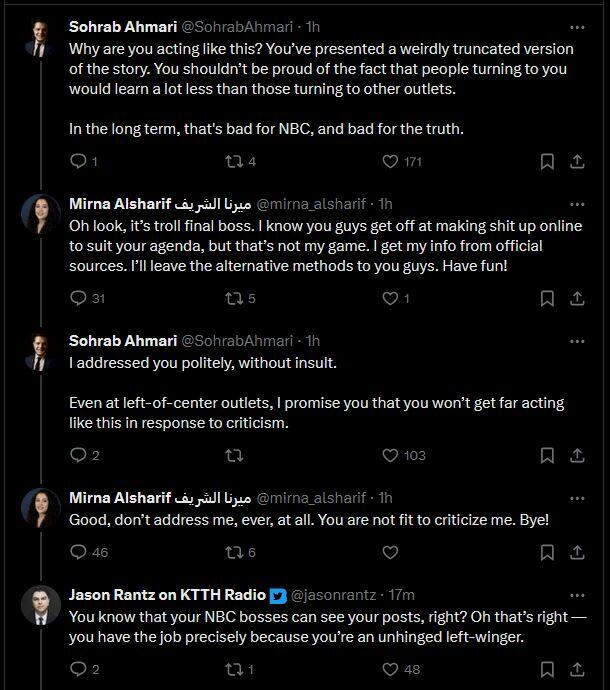
The story went viral – and was eventually picked up by NBC News reporter Mirna Alsharif (formerly CNN), who proceeded to not only rip off the report without citing the Daily Wire, she completely nerf’d it – failing to adhere to basic journalistic standards despite all of that information having been reported by DW.

When she was called out for her shitty reporting, Alsharif had a complete meltdown on X – claiming that the Daily Wire wasn’t her source, and hurtling High School insults at reporters.

And while she just deleted her account, we’ve got receipts…

She called several people a “troll final boss” in a thread in which journalist Jason Rantz called her an “unhinged left-winger.”

Busted out your mama jokes (probably because of her 90’s hair)…

Called John Podhoretz “sweetheart.”

Called someone a dumb bitch…

When DW’s Mary Margaret Olohan called on Alsharif to Log off, she replied “You first babes.”

Except then she did just that.

Who’s the dumb bitch?

Tyler Durden
Sun, 11/10/2024 – 21:35

Federal Judge Gives States In Censorship Lawsuit Against US Govt Chance To Make Case

0
Federal Judge Gives States In Censorship Lawsuit Against US Govt Chance To Make Case

Authored by Matthew Vadum via The Epoch Times,

A federal judge kept alive a lawsuit accusing the federal government of encouraging social media platforms to censor users’ views.

The judge ruled that the two states that filed the lawsuit can continue their discovery, a pretrial phase that allows litigants to gather evidence for trial and can consist of examinations under oath and requests for documents.

U.S. District Judge Terry Doughty in Monroe, Louisiana, issued the new order on Nov. 8 after the U.S. Supreme Court on June 26 threw out the request by Missouri and Louisiana to prevent the Biden administration from communicating with social media companies about public health issues related to the COVID-19 pandemic.

The states sued the federal government for censorship because it allegedly pressured social media companies to suppress certain content.

During the COVID-19 pandemic, U.S. Surgeon General Dr. Vivek Murthy issued a public statement encouraging the social media platforms to prevent information about COVID-19 that had been deemed misinformation by the Centers for Disease Control and Prevention “from taking hold.” The FBI and the Cybersecurity and Infrastructure Security Agency also communicated with the platforms about election-related misinformation in advance of the 2020 presidential election and the 2022 congressional elections.

Supreme Court justices ruled 6–3 in June that the states and five social media users challenging the federal government lacked legal standing to seek an injunction because they couldn’t show that they were directly harmed by the government’s efforts to communicate with the platforms.

Standing refers to the right of someone to sue in court. The parties must show a strong enough connection to the law or action complained of to justify their participation in the lawsuit.

The states argue that the Biden administration strong-armed social media companies into censoring disfavored views on important public issues, such as potential side effects related to COVID-19 vaccines and pandemic lockdowns. They say that applying this kind of pressure violates Americans’ First Amendment rights.

Conservatives and others have complained that social media platforms suppress information about their views on transgender issues, COVID-19, and the 2020 election.

Some on the left say removing posts on social media is necessary to prevent the spread of misinformation, and some have complained that social media platforms don’t do enough to combat falsehoods.

Doughty, whose 2023 ruling blocking the federal government from communicating with the social media companies was overturned by the Supreme Court in June, said in his new order that he considered it appropriate to ask the litigants whether there should be further discovery. The discovery would be related to the issue of standing to help the court evaluate if it has authority to continue with this case, or if the lawsuit should be dismissed.

The states argued for discovery, while the federal government argued for dismissal, he said.

“We currently find ourselves in jurisdictional purgatory—caught between differing standards,” Doughty said in his new order.

A “greater showing of standing” is required for an injunction than is required for the “minimal showing” needed to keep litigation alive.

The Supreme Court was “plainly applying this heightened standard when it reversed,” so this means the high court’s ruling “is not necessarily fatal to [the states’] suit generally.”

The states have demonstrated the need for more discovery on the standing issue, the judge said.

At the same time, Doughty denied for the time being the states’ request to amend their complaint in an effort to strengthen their legal standing in the case.

The fact that President Joe Biden, whose administration is being sued, will be replaced by President-elect Donald Trump in a little more than two months doesn’t justify throwing out the lawsuit, he said.

Even though “regime change is imminent,” it would be “quintessentially speculative” to dismiss the case based on that fact alone, the judge said.

The Epoch Times reached out to the attorneys general of Missouri and Louisiana and the U.S. Department of Justice for comment but did not receive a reply by publication time.

Tyler Durden
Sun, 11/10/2024 – 21:00

First Trump-Putin Call Since Election Focuses On The Quick ‘Resolution Of Ukraine War’

0
First Trump-Putin Call Since Election Focuses On The Quick ‘Resolution Of Ukraine War’

President-elect Donald Trump is already moving quite fast on his goal to quickly bring to an end the Ukraine war. It has been revealed Sunday he held a phone call with Russian President Vladimir Putin previously on Thursday, the first such communication between the two since Trump won the election.

Trump urged immediate de-escalation in the call with Putin. The Washington Post describes that “During the call, which Trump took from his resort in Florida, he advised the Russian president not to escalate the war in Ukraine and reminded him of Washington’s sizable military presence in Europe, said a person familiar with the call, who, like others interviewed for this story, spoke on the condition of anonymity to discuss a sensitive matter.”

Multiple sources said the call focused on the “goal of peace on the European continent” and ended on a positive note with plans to hold future conversations on “the resolution of Ukraine’s war soon”.

Image source: GQ/Getty Images

WaPo has further said that Ukraine was informed that the call was going to take place and did not object. However, the Zelensky government has subsequent this the report rejected this claim.

“Reports that the Ukrainian side was informed in advance of the alleged call are false. Subsequently, Ukraine could not have endorsed or opposed the call,” Ukrainian foreign ministry spokesperson Heorhii Tykhyi told Reuters.

WaPo has also underscored that the Trump transition team is fearful of leaks at this point:

Trump’s initial calls with world leaders are not being conducted with the support of the State Department and U.S. government interpreters. The Trump transition team has yet to sign an agreement with the General Services Administration, a standard procedure for presidential transitions.

Trump and his aides are distrustful of career government officials following the leaked transcripts of presidential calls during his first term. “They are just calling [Trump] directly,” one of the people familiar with the calls said.

Currently, the Zelensky government and some of the more hawkish leaders within NATO are deeply worried that the future Trump White House will force a ‘bad deal’ – or one that pressures Kiev to give up some 20% of his territory. They are against anything which the Kremlin could view as ‘victory’ for Russia.

One proposed plan, said to be getting the most attention from Trump’s team, would see an indefinite ‘freeze’ on the front lines in the east, paving the way for immediate ceasefire, and enforced by European peacekeepers along an 800-mile demilitarized zone.

Peace would also be ensured by Ukraine agreeing to suspend its aspirations to join NATO for twenty years. This buffer zone would not involve any US troops, according to initial reports based on the description of Trump officials.

Included a brief discussion on territory…

Regardless of if the hoped-for ceasefire takes shape, which would spare countless lives, the fact that Trump and Putin are already talking will only be seen as a bad thing by hawks who have recklessly pushed for escalation from the beginning. These same warmongers even condemned France’s Macron when he early in the war sought an off-ramp through an initial series of phone calls with Putin. 

Meanwhile, on the battlefield in the east:

Military bloggers on Friday reported that Russian forces were moving closer to capturing a major town on the eastern front in the war in Ukraine as part of their drive westward to capture all of the Donbas region.

Bloggers on both sides reported that Russian forces had entered the village of Sontsivka and were advancing from the northwest on the city of Kurakhove.

“The Kurakhove direction and the Pokrovsk direction are the most challenging right now,” President Volodymyr Zelenskiy announced in a nightly video address this weekend.

The world knows that Ukrainian forces are losing anyway, and Russia is poised to take all of Donetsk, so it is indeed long past time for Washington to do everything possible to both de-escalate and wind down and ultimately find permanent peaceful settlement.

Tyler Durden
Sun, 11/10/2024 – 20:25

US Childcare Cost Higher Than In Other Developed Countries

0
US Childcare Cost Higher Than In Other Developed Countries

U.S. childcare costs surpass those in all other OECD countries when taking into account single parents and couples earning average wage.

The price tag for having two children minded while working full-time is also significantly higher in the U.S. than in most other developed countries that are part of the organization.

Only Switzerland, the United Kingdom and New Zealand come even close to the high price parents have to shoulder for childcare in the United States.

Infographic: U.S. Childcare Cost Higher Than In Other Developed Countries | Statista

You will find more infographics at Statista

As Statista’s Katharina Buchholz details below, according to 2022 data from the OECD, U.S. couples who both earn average wage in full-time jobs and have two young children need to spend 20 percent of their disposable household income on childcare.

For singles on average wage, this rises to 37 percent.

In most countries, single parents pay less as they receive a more favorable rate.

In Switzerland, the most expensive OECD country after the United States, couples with two children spent a whopping 32 percent of their disposable income on childcare if working full-time and earning average wage. For singles, this was lowered to 18 percent, however. In the U.S. and Switzerland alike, childcare is dominated by the private sector and does not receive substantial amounts of regulation or subsidies, leading to high market rates. 

Treasury Secretary Janet Yellen has called this state of childcare in the U.S. a “broken market”.

Many Anglophone nations, also including Ireland, New Zealand and Australia struggle with high private market rates for childcare, low subsidies or a combination of the two.

In 2022, Canadian couples working full-time for average wage still needed to shell out 19 percent of disposable income, but the government has since made changes. Like in Canada, many English-speaking nations began to regulate and subsidize their childcare markets much later than elsewhere, leading to them lagging behind in affordability despite the topic of childcare becoming ever more important in the face of demographic change. Outside of Anglophone OECD countries, couples paid the most for childcare in relative terms in the Netherlands – another place dominated by private childcare – at 19 percent of disposable income. Singles paid the most in the Czech Republic at 18 percent.

In many European countries, parents paid substantially less, often just a couple of percent of their disposable incomes, as childcare centers are either run as a public service or private providers are heavily subsidized and regulated. In France, parents who work full-time and earn average wage spent between 6 percent and 10 pecent, while this number was even lower in South Korea, other German-speaking, Scandinavian and Baltic countries. In Germany, rates were as low as 1 percent of disposable income as all parents receive childcare vouchers depending on work time to be redeemed at private or public institutions.

Working parents pay a small fee on top if they receive more than the standard five care hours. Free childcare was provided in OECD countries Italy and Latvia as well as in associated nations Bulgaria and Malta. Single parents also paid no fees in Greece and were substantially unburdened in Canada, under rent subsidies in the United Kingdom and under social assistance benefits in Japan, if they qualified for those.

Tyler Durden
Sun, 11/10/2024 – 19:15

The Complex Legacy Of George Orwell

0
The Complex Legacy Of George Orwell

Authored by Allen Gindler via The Mises Institute,

George Orwell, one of the most influential political writers of the 20th century, is widely recognized for his searing critiques of totalitarian regimes in his novels Animal Farm and 1984. Orwell’s portrayal of state control, propaganda, and the manipulation of truth has resonated with readers across the political spectrum. However, Orwell’s personal political ideology and his critiques of totalitarianism are far more complex than is often acknowledged. Rather than being a passive observer or simply an opponent of dictatorship, Orwell was deeply involved in the socialist movements of his time, aligning himself—whether accidentally or intentionally—with Trotskyist circles. Orwell was a powerful voice of the left, despite being a target in the war among socialist factions.

Orwell’s Political Ideology and Alignment with Trotskyism

While Orwell is best remembered for his criticism of authoritarianism and totalitarianism, it is essential to understand that he was, first and foremost, a committed socialist. Despite never formally joining a political party, Orwell was an active and vocal participant in the socialist movement. This may surprise those who associate Orwell solely with his critiques of state tyranny. Indeed, Orwell’s disdain for the left dictatorship did not extend to all forms of socialism, and his political writings often reflect an internal critique of socialist regimes rather than a wholesale rejection of socialist principles.

Orwell’s critique of Stalinist totalitarianism is best understood as part of a broader ideological struggle within the socialist movement itself. Specifically, Orwell’s critiques echo the views of Leon Trotsky, a key figure in early Soviet history and one of Stalin’s most prominent critics. Trotsky was a revolutionary Marxist who played a crucial role in the Russian Revolution of 1917 and the subsequent civil war. He was instrumental in founding the Red Army, which secured the Bolshevik victory over the anti-communist White Army during the Russian Civil War. However, Trotsky’s theory of “permanent revolution” set him at odds with Stalin, who favored the consolidation of socialism in one country—namely, the Soviet Union—before pursuing global revolution. Trotsky’s insistence that socialism must be spread worldwide made him a figure of suspicion within the Soviet hierarchy. In the early 1920s, Stalin consolidated power, leading to Trotsky’s exile in 1929. Despite this, Trotsky continued to oppose Stalin’s policies from abroad, particularly through his writings.

Trotsky’s critique of Stalinism included accusations that Stalin had betrayed the original goals of the Russian Revolution. According to Trotsky, Stalin had established a bureaucratic dictatorship rather than a dictatorship of the proletariat, as envisioned by Marxist theory. He argued that Stalin’s regime represented, not the rule of the working class, but the rise of a privileged bureaucratic elite, a “nomenklatura,” that dominated Soviet society. In addition, Trotsky accused Stalin of fostering a cult of personality, suppressing political opposition, and betraying the internationalist principles of socialism.

Orwell and the Spanish Civil War

In 1936, when the Spanish Civil War broke out, Orwell made the fateful decision to join the Republican side, fighting against Francisco Franco’s Nationalista forces. What makes Orwell’s involvement particularly significant is his choice of faction. Rather than aligning himself with the International Brigades, Orwell joined the Workers’ Party of Marxist Unification (POUM), a Marxist faction heavily influenced by Trotskyist ideas. Orwell’s decision to fight with the POUM speaks volumes about his political leanings during this period.

The Spanish Civil War was not simply a battle between Republicans and Nationalistas; it was also an ideological battleground for various factions of the international left. The Republican side was a coalition of various socialist, communist, and anarchist groups. The POUM, with which Orwell fought, was aligned with Trotskyist and anti-Stalinist factions, while the Communist Party of Spain, supported by Stalin, took a hard line against any left-wing groups that did not adhere to Moscow’s policies. As Orwell would later write in Homage to Catalonia, his firsthand experience in Spain profoundly influenced his understanding of the brutal dynamics of power within the left. This dynamic reflects what biologists refer to as “intraspecific struggle,” where members of the same species (or political movement, in this case) compete most aggressively with each other for dominance.

While Orwell fought against Franco’s Nationalistas at the front, Stalin’s agents were conducting a purge of Trotskyist and anarchist factions behind the lines. The NKVD, Stalin’s secret police, were sent to Spain to suppress all non-Bolshevik leftist elements within the Republican forces. This included the POUM, which was eventually outlawed by the Stalinist-backed Republican leadership. NKVD agents kidnapped and killed the head of POUM, Andreu Nin. Orwell himself narrowly escaped assassination by the NKVD and covertly fled to England. These experiences deepened his disillusionment with Stalinism and reinforced his belief that the Soviet regime had betrayed the original ideals of socialism.

Orwell’s Literary Response: Animal Farm and 1984

Orwell’s experiences in Spain and his understanding of the internal conflicts within socialism found their most potent expression in his literary works. Animal Farm, published in 1945, is widely understood as an allegory of the Russian Revolution and the rise of Stalinism. Because of this, he struggled to find a publisher willing to take on the book, as many feared the political consequences of criticizing Stalin at the time of WWII. In the novella, Orwell portrays the betrayal of revolutionary ideals through the story of a group of farm animals who overthrow their human owner, only to see their new leaders—the pigs—become as oppressive as the humans they replaced. The pig Napoleon, who represents Stalin, manipulates the other animals, gradually consolidating power and rewriting the revolution’s history to justify his dictatorship.

What is often overlooked in discussions of Animal Farm is the role of Trotsky’s ideas in shaping Orwell’s narrative. The character of Snowball—who is expelled from the farm by Napoleon—represents Trotsky. Snowball, like Trotsky, is portrayed as an idealistic, but ultimately powerless figure, who is demonized by the regime in power. Orwell’s depiction of Snowball’s exile and the subsequent demonization of his legacy mirrors Trotsky’s real-life expulsion and assassination by Stalin’s agents in 1940.

In this sense, Animal Farm can be read as an artistic rendering of Trotsky’s The Revolution Betrayed (a critique of Stalinism from the left), with Orwell using the fable to illustrate the broader betrayal of socialist ideals by Stalin’s regime. Yet, Orwell could not grasp that if Trotsky had been the head of the Soviet Union, his regime might have been even more ruthless than the one Stalin built. Proletarian dictatorship is no better than party dictatorship.

Orwell’s final novel, 1984, extends his critique of totalitarianism beyond Stalinism to address the broader implications of state control, surveillance, and the manipulation of truth. Although 1984 is not explicitly focused on socialist ideology, its portrayal of a dystopian world ruled by a single party—where dissent is brutally suppressed and history is constantly rewritten—draws heavily on Orwell’s understanding of the Stalinist regime. The famous phrase “Big Brother is watching you” has since become synonymous with state surveillance and authoritarianism, but in the context of Orwell’s political trajectory, it also serves as a broader warning about the dangers of unchecked power, regardless of ideological orientation.

Orwell’s Dilemma: The Limits of Socialist Critique

Despite his damning critique of Stalinism, Orwell remained a socialist until the end of his life. His disillusionment with the Soviet Union did not extend to socialism as a whole. In fact, Orwell believed that socialism could still provide the solution to the social and economic problems facing the world, provided it did not fall into the traps of authoritarianism and bureaucracy. This presents a fundamental paradox in Orwell’s thought: while he was acutely aware of the dangers of totalitarianism produced by different currents of socialism, he continued to advocate for a general utopia that, in practice, often led to the very abuses of power he critiqued.

Orwell could not comprehend that, regardless of the specific flavor of socialism —whether Trotskyist, Stalinist, or otherwise—given enough time, it would inevitably lead to the same outcome: economic stagnation, moral decadence, and repression. His deep belief in the potential of socialism, particularly in its democratic form, blinded him to the inherent authoritarian tendencies within socialist movements.

Orwell’s Legacy

George Orwell’s legacy as a writer and political thinker is marked by his commitment to socialist ideals and his fierce opposition to totalitarianism. His engagement with Trotskyist ideas, his experiences in the Spanish Civil War, and his literary responses to Stalinism reveal a nuanced understanding of the complexities within the socialist movement. While Orwell’s critiques of political tyranny remain profoundly relevant today, his continued belief in socialism—even after witnessing its failures—underscores the intricacies of his thought. Therefore, it feels somewhat awkward to rely on a socialist’s critique of the very regimes that socialism consistently produces.

Tyler Durden
Sun, 11/10/2024 – 18:40

Rogan Reveals Kamala Campaign Wanted Editorial Control Over His Podcast

0
Rogan Reveals Kamala Campaign Wanted Editorial Control Over His Podcast

Authored by Steve Watson via Modernity.news,

Podcast king Joe Rogan has revealed that Kamala Harris’ people demanded editorial control over an appearance on his show, and a final say on what was released to the public.

As we have already highlighted, Kamala had demanded to only appear for an hour with Rogan, and wanted to do it outside of his studio, meaning he would have had to travel to a location of her choosing.

Needless to say, Rogan refused to meet the demands, reasoning that it simply wouldn’t be an episode of his podcast if that was to happen.

Rogan unveiled more of what went on with discussions between his team and Kamala’s campaign, noting “There were a few restrictions of things they wanted to talk about…They wanted to know if I’d edit it. I’m like, there’s no editing.”

They were treating it as if it was the corporate soundbite mouthpiece media.

Do they even know what Rogan’s podcast is?

It’s not surprising given that her campaign was just one big insubstantial fake, edited presentation.

Remember the edited 60 Minutes debacle?

This is how it should be now.

As Axios co founder Jim VandeHei noted yesterday, “I think all of us have to come to grips legacy media is just not as important as it thinks it is…Joe Rogan is more important than any of us.”

“The gravity of right-wing discourse is now taking place on 𝕏.. not Fox. 𝕏 is what matters. Elon Musk is arguably the most powerful civilian in the history of the country,” he added.

*  *  *

Your support is crucial in helping us defeat mass censorship. Please consider donating via Locals or check out our unique merch. Follow us on X @ModernityNews.

Tyler Durden
Sun, 11/10/2024 – 18:05

Was The 2024 Election Too Big To Rig?

0
Was The 2024 Election Too Big To Rig?

Authored by Edward Ring via American Greatness,

It’s Wednesday, the 6th of November, and America has chosen a new president. But we may not know the results for days or even weeks.

While there is a chance we will see a quick and decisive Trump victory, the media has prepared us for a protracted aftermath to election day. This raises an obvious question: Was there election rigging in 2024? Did the uniparty establishment and the institutions they control, desperate to prevent a Trump victory, break the rules? Did they cheat?

Answering this question in the affirmative doesn’t have to rely on the countless alarming allegations that are dismissed as unfounded conspiracy theories, even though there are so many of them:

The potential for mail-in ballot fraud, hundreds of ballots received at a single address, dozens of ballots received at a single address, questionable last-minute changes in verification procedures by the US Post Office, inaccurate voter rolls and fraudulent voter registrations, voter data leaks to partisan NGOs, vote harvesting, counterfeit ballots, destruction of legitimate ballots, ballot dumps, selectively applied “malfunctions” of voting machines in multiple states, last minute “patches” to fix voting machine software, illegal immigrants voting, and selectively applied closures of polling stations or inadequately staffed polling stations causing voter suppression.

You can claim there is no basis for concern over any one of those alleged cases of calculated, potentially widespread fraud. You can even dismiss the impact of fining and disbarring attorneys who challenged the integrity of the 2020 election and thus have deterred many attorneys from challenging this one.

The election was still rigged.

Anyone who watches David Muir at ABC, Lester Holt at CBS, Norah O’Donnell at NBC, or Amna Nawaz and Geoff Bennett at PBS will know this election was rigged, thanks to a multi-year propaganda campaign of shameless lying by the news anchors and reporters at the most prestigious networks in America. If you make it your business to keep track of what these “trusted news sources” are telling voters, it is obvious how hard they’ve tried to influence the election.

ABC News, for example, pretty much every single night for the last few months, has opened their newscast with 5-10 minutes where they heap slime all over Trump and praise Harris. If you watch the source material, for example, Harris’s CNN Town Hall, then watch the excerpts highlighted on ABC, you get two completely different impressions of her competence and integrity. Precisely the same tactic is used with Trump, but to the opposite effect. Watch one of his news conferences in its entirety, then watch what is grabbed, out of context, and presented on ABC.

Critics of Trump’s often brusque persona and often unvarnished condemnation of the media must ask, if they’re going to be fair, how would anyone react? For nearly ten years, David Muir has told us, with a straight face, that “the walls are closing in on Trump.” Along with fake scandals like the Russian collusion hoax, over and over we hear gross misrepresentations of things Trump has said. He mocked a disabled reporter; no, he didn’t. He told people to inject bleach to treat COVID; no, he didn’t. He called neo-Nazis “fine people;” no, he did not. And on and on it goes.

David Muir earned particular enmity among people who just wanted fair news coverage during the debate between Trump and Harris, when, for example, Muir insisted on “fact-checking” Trump but left Harris alone. For example, Muir contradicted Trump’s assertion that crime rates had risen, and Muir was wrong. The data, as Trump attempted to explain, was missing statistics from California’s major cities. Once that data was added, Trump’s claim was proven accurate.

Just in the last few days we’ve had the big four broadcast news anchors telling us that Trump wanted to put Liz Cheney in front of a firing squad, wants reporters covering his rallies to get shot, “groped” a woman back in the 1990s, expressed “deeply troubling” admiration for Adolf Hitler, held a “Nazi rally,” and intended to use the military against “the enemy within,” along with endless distorted repetition of everything bad they’ve ever said about him. All of this “news” was either truth twisted beyond recognition or outright lies. Meanwhile, their coverage of Harris has been indistinguishable from a paid Harris campaign ad.

There’s no end to the legacy television news media’s war on Trump. It’s not subtle, and despite their dinosaur status, they still exercise decisive influence over millions of voters. For the 2024 season-to-date, ABC Nightly News has averaged 7.7 million viewers, NBC averaged 6.4 million, and CBS averaged 4.7 million. PBS is now a big player as well, with a regular viewership of more than 5 million. That’s nearly 25 million regular viewers, with an average age of 65, nearly all of them high-propensity voters, and very few of them likely to be perusing alternative media. Cable news, for all the visibility and big audiences for the hosted talk shows on their networks, doesn’t compare. Recent estimates for primetime viewers of Fox News have averaged 359,000, versus 175,000 for CNN and 160,000 for MSNBC. Cable news audiences are dwarfed by the audiences for broadcast news content, which is overwhelmingly anti-Trump and pro-Harris. Tens of millions of Americans have been thoroughly brainwashed by these networks. But what about social media and online searches?

Back in 2015, Robert Epstein, a research psychologist with the American Institute for Behavioral Research and Technology, published “The search engine manipulation effect (SEME) and its possible impact on the outcomes of elections.” Continuing his research, in testimony before the U.S. Congress in 2019, Epstein claimed that biased search results on Google “impacted undecided voters in a way that gave at least 2.6 million votes to Hillary Clinton.” Epstein’s studies are compelling reading, and very little has changed. Google still controls 90 percent of the search engine market in the United States. In 2024, Google employee political donations favored Democrats by a ratio of more than 6 to 1. Draw your own conclusions.

As for social media, much is made of Twitter’s transformation into X, with no more censorship. Twitter, or X, has 95 million users in America. That’s a lot. But in the United States, Facebook has 194 million users, Instagram has 166 million users, TikTok reaches 170 million people, LinkedIn connects 200 million, and YouTube’s regular US viewers number 246 million. As a neutral platform, X’s audience reach is exceeded by more than 10 to 1 by the other major online platforms. With the lone exception of X, every one of these platforms employs biased algorithms designed to suppress conservative content. As for print media, intervention by the owners of the Los Angeles Times and the Washington Post to abstain from a presidential endorsement is too little, too late. Every newspaper and magazine with national reach, with the half-hearted exception perhaps of the Wall Street Journal, have been so anti-Trump and pro-Harris it is almost comical.

Social media, search engines, and legacy news media. In every facet of information gathering, the vast majority of Americans have been continuously exposed to anti-Trump, pro-Harris messages. None of this has been happening by accident. Michael Shellenberger, formerly a progressive liberal who was once honored as a Time Magazine “Environmental Hero,” has evolved into an investigative journalist of extraordinary integrity and courage. In recent years, his work has focused on what he has dubbed “the censorship industrial complex.” In a recent substack post, commenting on America’s news media from newspapers to television to online platforms, he had this to say, “It’s not a mirror of reality. It’s not just biased. And it’s not just deferential to the state or the party. It’s a propaganda arm dishonestly representing powerful political, ideological, and financial interests.”

Shellenberger, who alleges government manipulation of information sources available to Americans, is not alone. Mike Benz, a former US State Department official, claims that the U.S. government has become increasingly concerned about the rise of populist movements in the U.S. and around the world and is actively interfering in media freedom. Another window into how this is working is documented by Ben Shapiro in a must-watch video, where he describes the network of state-supported NGOs and quasi-private sector agencies that influence who gets advertising dollars and who gets boycotted, in an ostensibly benign effort to “create a universal framework full of guidelines and ratings designed to enforce approved narratives.”

It ought to be obvious to anyone who finds both sides of the story by using alternative media that in a fair election, America’s print, video, and online media, and search engine results, could have easily delivered just as much negative coverage about Harris as they have inflicted on Trump, and they could have delivered just as much positive coverage about Trump as they’ve lavished on Harris. Maybe the only rules that were broken were supposed norms of journalistic integrity. But by an order of magnitude, America’s sources of “news” and information were massively tilted in favor of Harris and against Trump.

If for no other reason but media bias, this election was rigged. As a result, regardless of the outcome, half of all Americans have lost faith in fair elections. Even if every allegation of actual, fraudulent, widespread rigging is false, nobody who thinks so will change their minds. For them, the media sources that might help debunk any of it have no credibility. That is a crime perpetrated by the elite who control these institutions that transcends even this moment.

Tyler Durden
Sun, 11/10/2024 – 17:30