79.6 F
Chicago
Tuesday, October 13, 2026
Home Blog Page 2136

On Day One, Five Things Trump Will Do With Executive Orders

0
On Day One, Five Things Trump Will Do With Executive Orders

Authored by Mike Shedlock via MishTalk.com,

Executive order drafts are being prepared. Here’s five things to discuss.

Five Things

  1. Immigration: Trump has said he would reimplement on day one his “Remain in Mexico” policy, which requires asylum seekers to stay in Mexico until their cases are processed by U.S. immigration courts.

  2. The Wall: He has also said he would resume construction of the wall along the U.S.-Mexico border—something he repeatedly criticized the Biden administration for failing to continue.

  3. Pardons: Fire Jack Smith and pardon Jan. 6 offenders. Trump has called the people facing charges hostages and political prisoners.

  4. Climate: Trump has said that he will sign an executive order once again withdrawing the U.S. from the Paris Climate Agreement, the international treaty which implements the objectives of the United Nations Framework Convention on Climate Change. President Biden on his first day in office had brought the U.S. back into the Obama-era accord after Trump had pulled out of it in 2019. Officials close to Trump said the order has been drafted and will be ready for Trump to sign on his first day in office.

  5. Transgender Student Protections: In April, the Biden administration unveiled a final set of changes to Title IX to cover discrimination based on sexual orientation and gender identity for the first time. Trump has vowed to revoke such protections for transgender students the day he takes office.

The above list is from the Wall Street Journal article What Trump Can—and Can’t—Do on Day One.

I agree with most of those, at least partially.

1: I am fine with remain in Mexico but we do need faster decisions on an outcome.

2: If the wall was funded, then it can continue. If not, Trump can’t do that on day one.

3: I strongly disagree with blanket pardons, but I am OK with pardons for anyone who was totally peaceful (no destruction of property or violent actions). My guess is Trump will go way overboard.

4: Go for it. End the nonsense.

5: No new protections were ever needed in the first place. Adding them made a huge mess of things with absurd state actions and interpretations.

Here are some other ideas from the article

Mass Deportations

Trump has vowed to implement “the largest deportation program in American history” as soon as he takes office. Although such a massive logistical feat would likely take longer to carry out, officials familiar with his planning said it is likely he will sign a pre-drafted executive order when he takes office ordering the Department of Homeland Security and other agencies to deport undocumented migrants.

Mass deportations would be a huge mistake, especially for those here for over two years and is working, those with citizen spouses, and those with citizen children.

But please deport the criminals. Start there, then intelligently think about how to proceed.

Otherwise, many states will not go along.

Ending Birthright Citizenship

Trump has also said he would use executive action on his first day in office to put a stop to granting birthright citizenship to children born to anyone who entered the U.S. illegally. This is likely to face legal challenges.

We can debate the merits of the idea, but there would be a court challenge and Trump would lose.

The Constitution says “All persons born or naturalized in the United States, and subject to the jurisdiction thereof, are citizens of the United States and of the State wherein they reside.”

That seems clear to me. The phrase “subject to the jurisdiction thereof” refers the children of foreign diplomats and invading foreign enemies.

Vox has an Excellent Discussion of Birthright Citizenship.

Trump would be wise to not step into this mess.

Ukraine and Israel

Trump has vowed to take several measures aimed at putting what he sees as America’s interests first and has vowed to end conflicts around the world, including in Ukraine and the Middle East, before he takes office. Among them, he has said he would give priority to American national security and economic interests at home over paying billions to support allies abroad, and would impose steep tariffs on imports to stimulate domestic job creation.

Trump may have luck encouraging Ukraine, which has been losing ground, to the negotiating table, but Russia’s Vladimir Putin—as well as Hamas and Israel—have shown no signs they want to end the fighting in their respective conflicts.

Ukraine and Israel are not day one issues that can be addressed by executive order.

Trump has also said that he would demand the resignation of any general involved in the U.S. withdrawal from Afghanistan by “noon on Inauguration Day.”

Demanding resignation is doable, but Firing is Complicated, says Lawfire.

The New Home for Hispanics is the Republican Party

The most disturbing day one action would be blanket deportations. I strongly disagree. But that won’t be day one regardless.

I discussed blanket deportations and the Dignity Act in The New Home for Hispanics is the Republican Party

Please click on the link and play the interview with Republican Florida rep. Maria Salazar. 

I endorse the bipartisan Dignity Act she sponsored. It is exceptionally balanced and well thought out. But it’s not what Trump promised.

Tyler Durden
Mon, 11/11/2024 – 09:45

Billionaire Pratt Will Move To America After Trump Win As Liberals Flee To Canada

0
Billionaire Pratt Will Move To America After Trump Win As Liberals Flee To Canada

Liberals have spent the last five days following Trump’s victory last Wednesday with blood pressure levels through the roof—many having complete meltdowns on social media, and some even plotting their exit to Canada. 

The good news is that while President-elect Trump heads to the White House in January, those infected by the woke mind virus are planning their exit…

… there is another story unfolding of inbound migration to America, beginning with Australian billionaire Anthony Pratt, who will now live in the US after a Trump victory. 

On Sunday, Pratt wrote on LinkedIn:

Honoured to be granted my Green Card for permanent USA residency last month.

We decided it was time to live in America because:

  1. My family are all US citizens.

  2. Over the past 30 years we have invested to build 70 factories in America, creating 12,000 well-paying American manufacturing jobs.

  3. I will remain Chairman of Visy Australia, and will be returning to Australia on a regular basis.

Data from the Bloomberg Billionaires Index shows Pratt has a net worth of about $12.3 billion, ranking him 209th on the list and sixth in Australia.

He’s also a member of Trump’s private Mar-a-Lago Club.

Exchanging liberals experiencing mental health crises for businessmen who know how to make this nation great again—now that’s a fair trade.

Tyler Durden
Mon, 11/11/2024 – 09:25

How The View’s Sunny Hostin Killed Kamala’s Chances Of Topping Trump

0
How The View’s Sunny Hostin Killed Kamala’s Chances Of Topping Trump

Authored by Steve Watson via Modernity.news,

Veteran leftist political strategist James Carville says that the stand out moment when Kamala Harris cemented her historic loss to president elect Donald Trump was when she couldn’t think of a single thing she’d do different to Joe Biden.

Harris first made the comment while appearing on The View, something that should’ve been a walk in the park.

“There is not a thing that comes to mind. And I’ve been a part of most of the decisions that have had an impact,” she stated at the time.

But it was even worse than this sounds.

Harris was also asked “What do you think would be the biggest specific difference between your presidency and a Biden presidency?”

Harris responded, “We’re obviously two different people.”

Carville, the former lead strategist in Bill Clinton’s winning 1992 Presidential campaign, noted “When we go back and history unearths this, it’s going to be right there on the View.”

“Sunny Hostin, Houston, whatever asked the question. That’s the most devastating answer you can imagine,” he added.

It’s still astounding that she did not have an answer prepared to this completely basic softball question?

The remarkable thing is that she was repeatedly asked the same question in the weeks after this and STILL couldn’t give an answer.

Let’s not forget, the Democratic Party made a monumental error in running with cackles. 

They didn’t have much choice, however after Biden screwed them over.

The most delicious thing about this might be the total meltdown that the screeching witches on The View engaged in once the results were in.

*  *  *

Your support is crucial in helping us defeat mass censorship. Please consider donating via Locals or check out our unique merch. Follow us on X @ModernityNews.

Tyler Durden
Mon, 11/11/2024 – 09:05

Mark Cuban Apparently Scrubs Pro-Kamala Posts After Election

0
Mark Cuban Apparently Scrubs Pro-Kamala Posts After Election

Mark Cuban was one of Kamala Harris’ most vocal supporters, posting tweets expressing his admiration for Harris-Walz while denouncing Trump and his supporters. After Trump’s presidential election victory, Cuban appears to have scrubbed posts on the ‘free speech’ social media platform, though he claims this is just regular activity.

“Mark Cuban is apparently deleting a bunch of his pro-Kamala posts,” Libs of TikTok said…

X user Kevin Dalton said Cuban’s account conducted a “pretty serious purge of posts on the 7th.” 

Clown World said, “Mark Cuban just scrubbed every post he ever made about Kamala.” 

Cuban then responded to Libs of TikTok’s post, “I’ve always gone back and deleted tweets.  For years.  Same with 2020 election. 2016 election. Same with other stuff.  You can use the wayback machine if you really want to see them.” 

Libs of TikTok responded with: “Thank for clarifying. Was this one of your deleted tweets? Why delete it?” 

CNBC’s Joe Kernen couldn’t stop laughing about the whole situation, which he said, “LoL.” 

Let’s remind readers that Cuban enthusiastically picked up his liberal pom-poms in the months before the election, cheering across X and in corporate media about how fantastic the Harris-Walz campaign was… And he also bashed Trump supporters. 

Then, in the days before the election… (was this the point when Harris’ team ran out of money? – after blowing a billion dollars…): 

Why did Cuban nuke his credibility in backing one of the worst political campaigns in a generation? After all, Trump secured 312 electoral votes, the popular vote, the Senate, and a majority in the House.

Also, the nation shifted heavily towards the right. 

If Cuban plots a future presidential run, X users won’t forget this meme…

Come on, Mark, you’re smarter than this.

Tyler Durden
Mon, 11/11/2024 – 08:45

Veterans Reflect On The Boy Inside Them That Died On The Battlefield

0
Veterans Reflect On The Boy Inside Them That Died On The Battlefield

Authored by Allen Stein via The Epoch Times,

“You can never go home again” rings true for combat veterans, especially the part of them that can never forget.

People have called war many things—cruel and tragic, the final court of appeals, a racket, and the most noble thing people can do for their country. It depends on how you look at it.

Lysander Caligo, 39, a former U.S. Marine from Mesa, Arizona, saw the beauty and ugliness of the battlefield in Afghanistan in the early 2000s.

Lysander Caligo, a former U.S. Marine who served in Afghanistan, stands behind a mesh barrier at a restaurant in Mesa, Ariz., on Nov. 3, 2024. Allan Stein/The Epoch Times

He was a counterintelligence specialist with the Third Battalion, Seventh Marines, and he hunted high-value targets for eight months before his discharge.

Though Caligo, the man, would return to civilian life, the boy in him would never see home again.

Sitting at a restaurant table, Caligo told The Epoch Times that Afghanistan shattered his rose-colored glasses.

On his right bicep is a tattoo of Che Guevara, the Argentine Marxist revolutionary.

He said it is a long story how he got the tattoo, and he is not a fan of communism. The short version is that the tattoo is a constant reminder of the uncertain nature of war, and of a high-value Taliban target—the one who eluded him—who used Guevara’s tactics to significant effect.

“We take violence and aggression and death as something very personal,” Caligo said. “It’s an offense to us—it’s an offense to our senses. It’s an offense to our lives.”

But the reality on the battlefield is different.

“The reality is that death and war are very impersonal. You see that very quickly. If you don’t, you end up having mental issues,” he said.

‘War Is Human Nature’

Caligo sees conflict as both a shock to the system and a necessity—a perpetual state of human existence written into the human genome.

Soldiers go to war and are injured. Soldiers die. If they are lucky, they will go home intact. There is no room for “boyish idealism,” Caligo said.

Even though his job as a soldier demanded violence, his conscience is clean.

“I never did anything so terrible that I had to question myself morally,” Caligo said.

“I could stop myself in those moments and think about how they would impact me in the future and how my future self would look at me. I’ve had those moments. … I’m lucky there.”

Caligo said it was more direct and personal to kill with a sword or spear in ancient times, compared to using today’s bullets, drone strikes, or bombs. He learned that firsthand when he met enemy insurgents hiding in plain sight or as he walked through a field or along the roadside.

“Bombs are the worst things because bombs were so [expletive] scary. You were fearful every step you took,” he said.

“Imagine taking every step and thinking, ‘I’m either going to be disfigured or badly injured.’ The biggest fear was losing limbs. Then there were the concussions,” traumatic brain injury, and post-traumatic stress that followed, he said.

U.S. Marines direct a Chinook helicopter arriving to pick up a container with supplies at Forward Operating Base Edi in the Helmand Province of southern Afghanistan on June 9, 2011. Anja Niedringhaus/AP Photo

The former staff sergeant can’t place an exact number on the people he aimed his rifle at during missions.

“But the boy inside me died. The rose-colored way of looking at the world through an ideological lens died—and I’m glad,” he said.

“You learn your base roots as a human being … that it’s there and it’s always going to be there.”

One of the most challenging parts of coming home for Caligo was seeing how much he had changed compared to everyone else.

Band of Brothers

His experience in war surprised him; it was not only about life or death, dog-eat-dog, or black-or-white survival in the desert. “I hate to say it—it was beautiful,” he said.

Most people never get to experience the closeness that develops between combat soldiers, who live every day and die together.

“It’s you and your bros,” Caligo said. “It’s about fighting and eating and cleaning your weapon and doing it all over again.”

U.S. Army flight medic SGT Tyrone Jordan (R) of Dustoff Task Force Shadow, 101st Combat Aviation Brigade, helps Marines carry a wounded Afghani man to a MEDEVAC helicopter near Marjah, Afghanistan, on Sept. 29, 2010. Scott Olson/Getty Images

“We loved it. Not like it was any sadistic thing. It’s just that it was real. Then, you come back to this illusion. You start to see how fake and phony people are—dressing in the latest fashions, buying furniture, buying vehicles, buying X, Y, Z, to try to fit in or be someone else.”

It’s reality—raw and painful, but with meaning and purpose—in the field of combat, he said. You’re there for your fellow soldier.

Sam, 55, a former Marine who lives in eastern Arizona, served in the Seventh Marine Regiment, First Battalion, during Operation Desert Storm from 1990 to 1991. He received a medal for exemplary conduct in battle.

“The Marine Corps is great at treating you like a man and holding you accountable for your [actions],” Sam, who asked not to use his surname, told The Epoch Times.

“When you come back and there’s civilians around you, you look at everybody differently—in a bad way.

A long line of vehicles, including destroyed Iraqi Army Russian-made T-62 tanks and trucks, stand abandoned by fleeing Iraqi troops on the outskirts of Kuwait City on March 1, 1991. Iraq’s invasion of Kuwait on Aug. 2, 1990, led to the Gulf War, which began Jan. 16, 1991. Pascal Guyot/Getty Images

“There were no happy pills or things like that.”

Sam, like Caligo, said that combat made him grow up quickly.

Into the Lion’s Den

The day ended with poor visibility in late February 1991, and Sam radioed ahead after spotting an Iraqi tank dug in and firing at his unit near al Jabbar.

The Marine lance corporal destroyed the tank with one anti-tank missile shot to the front turret.

He engaged an enemy personnel carrier and destroyed it on the second day of fighting. He identified an enemy platoon on the third day of battle and was able to destroy multiple vehicles using three BGM-71 TOW missiles.

Sam received a Navy commendation medal for his “exemplary and highly professional conduct” and is humble about it.

“There are lots of guys who did more than I did,” he said.

“It was an interesting transition coming back. I’m super glad I did the Marine Corps. It was the best thing I ever did. The second best thing was getting out, but that’s just me.”

The war in the Persian Gulf killed 219 Americans, while the war on terror killed 7,000 soldiers and 8,000 contractors.

Marsha Vance, a member of American Legion Post 30 in Springerville, Ariz., stands outside the hall on Nov. 9, 2024. Allan Stein/The Epoch Times

Marsha Vance, from Springerville, Arizona, is the daughter of the late Wallace Tucker, who served as an Air Force sharpshooter in Vietnam from 1966 to 1969.

“He didn’t really want to talk about it,” said Vance, a member of American Legion Post 30 in Springerville. “He didn’t want to do it. He carried those memories all those years.”

During the eight-year U.S. military intervention in Vietnam, more than 58,000 men and women in uniform died.

In Vietnam, Tucker left his innocence behind.

The Vietnam Veterans Monument at the Nixon Library in Yorba Linda, Calif., on March 29, 2023. John Fredricks/The Epoch Times

“He did have some poems he wrote about Vietnam—about seeing the things a human being should never see and do to another human being and that he never should have done,” Vance said.

She cries when she thinks about her father and the terrible things he went through, and how he dealt with it until he died from Agent Orange complications at age 68.

“He had to grow up fast. He had to be quick and make split-second decisions. It was either him or them,” Vance said. “It was something he never recovered from completely.

“There are certain things he wouldn’t talk about, and I wouldn’t push it because I knew it would trigger him.”

Her father lies buried in the National Memorial Cemetery of Arizona in Phoenix.

Never the Same

Caligo feels that he has mostly transitioned back into society since he left the military. An avid fitness and Brazilian jiujitsu enthusiast, he recently opened a health club, Deep End Scottsdale.

“The beauty of going to war,” Caligo said, is figuratively “killing the boy” inside.

“You went into the abyss. You’re not supposed to come back out the same person,” he said.

Tyler Durden
Mon, 11/11/2024 – 08:30

Futures Hit 51st Record High Of 2024 As Trump Trades Storm Higher

0
Futures Hit 51st Record High Of 2024 As Trump Trades Storm Higher

The post-Trump rally has returned full force, and US equity futures are sharply higher and well above 6,000 in what should be a light volume day with bonds closed due to the Veteran’s Day holiday. As of 8:00am ET, the breakdown is as follow: S&P futures 0.46bps, which hit their 50th all time high for 2024 on Friday; NDX +38bps; RTY +146bps; Crude -222bps; Bitcoin +290bps and at a record over $82,000 with global markets trading broadly higher as they continue to digest US election results + FOMC cut last week. R2K the standout and remains in focus, up over 8.5% last week for its best week since March of 2020. S&P + NDX both closed the week at ATHs. As JPM writes in its market intel note, the Trump Trade has potential to strengthen; TSLA is +7% pre-mkt as small caps outperform by ~1%-pt. The balance of Mag7 are weaker as are Semis, Financials continue to be bid up in what is a new regime. While US bond markets were shut for a holiday (although futures indicate a roughly 5bps rise in yields), the dollar rallied 0.3% against a basket of currencies, adding to a six-week winning streak as both EUR and JPY come from sale. Dollar strength appear to be weighing on commodities as China stimulus once again disappoints and is sold; gold reversed an earlier gain to trade at session lows of $2,660. Meanwhile, Trump and Elon Musk are making demands of the next Senate Republican leader, including allowing the President-elect to make recess appointments without Senate approval. No US data or Fed speakers scheduled for the session.

In premarket trading, the biggest gainer of the day was Tesla which rose as much as 7.3%. Its valuation surpassed $1 trillion on Friday, on a view that a Trump presidency will be a positive for Elon Musk’s company. Crypto-linked stocks also gained in premarket trading as Bitcoin rallied past $82,000 for the first time on the prospect of a Republican-led Congress with pro-crypto lawmakers (Riot Platforms (RIOT US) +14%, MARA Holdings (MARA US) +19%, Bit Digital (BTBT US) +21%, Coinbase (COIN US) +16%, Hut 8 Mining ADRs (HUT US) +12%, MicroStrategy (MSTR US) +11%, Robinhood Markets (HOOD US) +10%). Here are some notable premarket movers: 

  • Cabot (CBT US) shares fall 1% after the carbon black company was downgraded to underweight from neutral at JPMorgan.
  • Celanese (CE US) shares slip 0.7% after the specialty materials company was cut to underperform from market perform at BMO Capital Markets, which said there were “too many risks ahead for too little reward.”
  • Cisco Systems (CSCO US) shares rise 1.9% as JPMorgan lifted the maker of computer networking equipment to overweight from neutral, citing recovery in networking and further valuation headroom.

“Between now and the end of the year, I can easily see how the US market particularly will continue to be strong on hopes that everything Trump has said will come to pass, particularly when it gets confirmed that he got a clean sweep,” said Nick Clay, portfolio manager at Redwheel.

While it feels like the year is largely over and it’s all autopilot until 2025, the wait is now on for the next slug of inflation data due Wednesday for clues on the Federal Reserve’s interest-rate trajectory, with annual price growth seen to have quickened slightly to 2.6% in October. Traders will also listen out for Fed policymakers’ speeches after Minneapolis Fed President Neel Kashkari indicated on weekend that rates could ease less than previously expected due to the strong economy (amazing how that happened just days after Trump won).

In Europe,the Estoxx 50 advanced 1.2% on the day, with construction, chemical and industrial shares leading gains. While Trump’s pledge to impose hefty tariffs on trade partners has weighed heavily on European shares, the Stoxx 600 index rebounded after three weeks of declines. The gauge added 0.9%, with all industry groups in the index climbing, as the mood was lifted by a slew of robust company earnings, including German tiremaker Continental AG and insurance firm Hannover Re. Here are the biggest movers Monday:

  • Continental rises as much as 9.3%, the most since July, after the German firm reported third quarter Ebit that beat estimates. Bernstein says the beat is due to strength in the tire division
  • Croda rises as much as 5.5% as the chemicals company reconfirms full-year guidance amid stable demand and cost efficiency measures. Analysts point to life sciences as a stand-out performer
  • Swiss Re shares rise as much as 4.7% to their highest level since 2002, after a double upgrade from UBS, which says the stock is now its preferred European reinsurer instead of Munich Re
  • Hannover Re shares advanced as much as 4.3% as the German reinsurer raised its 2024 profit target and forecast net income for 2025 of about EU2.4 billion
  • Ceres Power rallies as much as 11% on Monday, snapping a run of five straight declines, as Jefferies upgrades to buy on growing market awareness of the company’s technology
  • Cellnex shares rise as much as 2.3% after the tower operator said it’s in talks with credit rating agencies to assess whether it can start returning capital to shareholders next year
  • Pantheon Resources shares jump as much as 18% to touch 4-1/2-month highs, after the oil and gas company began drilling the Megrez-1 well in the Ahpun field in Alaska
  • Leonardo rises as much as 5.2%, to highest since Sept. 2000, after both Bernstein and Mediobanca boost their price targets on the Italian defense company to a new Street-high of €30
  • NatWest rises as much as 2.1% after the bank bought £1b of its own shares from the UK government, as part of the directed buyback program. Shore Capital says this came sooner than expected
  • Lem Holding tumbles as much as 21%, to the lowest level since March 2020, after the Swiss electrical components maker posted underwhelming first-half results and issued a weak outlook

Earlier, Asian equities fell by the most in a month as Beijing’s latest economic measures disappointed the market, and soft China inflation data signaled that recent efforts to spur economic growth have not been enough. China’s CSI 300 benchmark fell as much as 1.4%, before erasing losses to close with modest gains. Oil pared losses to trade flat after China’s latest efforts disappointed markets. The MSCI Asia Pacific Index fell as much as 1.3% before trimming some losses, with Samsung Electronics among the biggest drags alongside Chinese megacaps Tencent and Meituan. Most key gauges in the region were in the red, with the Hang Seng Index falling 1.5%. South Korea’s Kospi fell more than 1%, while Japanese shares closed little changed. While stocks in Hong Kong slid, those on the mainland recovered a 1.4% drop to close the day higher. The mixed reactions underscore investor confusion over Beijing’s stimulus announcement, which stopped short of providing new plans to rev up its consumption or the property sector. China unveiled a 10 trillion yuan ($1.4 trillion) program Friday to refinance “hidden” local debt. Figures released over the weekend showed anemic consumer inflation in October while producer prices continued falling, indicating government stimulus has been insufficient to pull the economy out of deflation

“The latest debt swap provides temporary relief to local government finances, benefiting sectors like real estate and banking,” said Billy Leung, an investment strategist at Global X ETFs. “However, the swap’s limited scale and lack of consumer-focused stimulus leave broader markets cautious. Note that there are still concerns on tariff pressures and domestic monetary easing efforts which could have execution challenges.”

In FX, the Bloomberg Dollar Spot Index rises 0.4% and remains near best levels of the day into early US session, while the euro fell to its lowest versus the dollar since June 27 amid broad dollar strength with the yen leading losses (EUR/USD dropped 0.3% to 1.0682, down a second day). USD/JPY rallies 0.8% to 153.85 with US Treasury futures under pressure

In rates, treasury futures opened down in Asia and have broadly held losses, leaving the 10-year tenor lower by around 9 ticks on the day. There is no cash Treasuries trading due to a US holiday, but the drop in futures points to a 10-year yield that’s roughly 5 basis points higher than Friday’s closing levels.

US 10-year note futures sit around the 110-00 level, down around 9 ticks on the day. Further out, ultra-long bond futures are down around 12 ticks, implying a bear-steepening move in cash yields. In Europe, Bunds – which are open – advance with German yields richer by as much as 3.5bp across long-end of the curve, with the impact of potential German elections on the country’s debt brake and future issuance unclear. Back in the US, the treasury auction slate resumes Nov. 20 with 20-year bond sale; 2-, 5- and 7-year note auctions are scheduled week commencing Nov. 25.

In commodities, oil prices decline, with WTI falling 1.5% to $69.30 a barrel. Spot gold drops $15 to $2,670/oz. Iron ore declined toward $100 a ton.

Looking at today’s calendar, no Fed members scheduled to speak on Monday, and US data slate is empty as it is Veteran’s day, and bond markets are closed. This week’s data includes CPI, PPI, Empire manufacturing, retail sales and industrial production.

Market Snapshot

  • S&P 500 futures up 0.3% to 6,042.50
  • STOXX Europe 600 up 1.0% to 511.49
  • MXAP down 0.9% to 187.81
  • MXAPJ down 0.9% to 596.07
  • Nikkei little changed at 39,533.32
  • Topix little changed at 2,739.68
  • Hang Seng Index down 1.5% to 20,426.93
  • Shanghai Composite up 0.5% to 3,470.07
  • Sensex little changed at 79,507.60
  • Australia S&P/ASX 200 down 0.3% to 8,266.22
  • Kospi down 1.2% to 2,531.66
  • German 10Y yield down 5.2 bps at 2.32%
  • Euro down 0.4% to $1.0672
  • Brent Futures down 0.8% to $73.26/bbl
  • Gold spot down 0.7% to $2,666.45
  • US Dollar Index up 0.38% to 105.40

Top Overnight News

  • China’s trade surplus in on pace to hit ~$1T this year, a dynamic that will create huge trade tensions between Beijing and other countries, especially the Trump-led White House. BBG
  • China disinflation/deflation deepens in Oct, w/the CPI coming in +0.3% (down from +0.4% in Sept and below the Street’s +0.4% forecast) and PPI at -2.9% (down from -2.8% in Sept and below the Street’s -2.5% forecast). SCMP
  • China’s credit expansion slowed more than expected in October, as a surge in government bond sales far exceeded growth in lending during a traditionally slow month for financing activity: BBG
  • Bank of Japan board members discussed the need for caution on raising its benchmark rate and offered no clear hint of a move next month, a summary of opinions from its October policy meeting showed. BBG
  • Taiwan is considering large US defense purchases as an overture to the incoming Trump administration, the FT reported. BBG
  • Israel Defense Minister Israel Katz said on Sunday that his country has defeated Hezbollah and that eliminating its leader Hassan Nasrallah was the crowning achievement. Reuters
  • TSMC was told by the US to halt shipments of some advanced chips to China starting today. Reuters, BBG
  • Powell is prepared for a legal battle if Trump attempts to hire him before the end of his term. WSJ
  • Citigroup’s CEO Jane Fraser expects a significant easing in bank regulations in a Trump administration. BBG
  • Bitcoin rallied past $82,000 for the first time, boosted by Donald Trump’s embrace of digital assets and the prospect of pro-crypto lawmakers in Congress. It won’t be long before attention shifts toward call-option buyers’ hopes for the token to top $100,000, MLIV said. BBG
  • Fed’s Kashkari (2026 voter) said if growth and productivity are strong, the Fed may not cut as much, while he reiterated that housing inflation will take a while to come down all the way and they have made progress but want to get the job done on inflation. Kashkari also stated that the Fed wants to have confidence inflation will go all the way back to 2% and need to see more evidence before deciding on another cut.
  • Edison Research projected Republicans won another seat in the US House bringing their total to 213, while Democrats have 204 seats with 218 needed for control.

A more detailed look at global markets courtesy of Newsquawk

APAC stocks began the week mostly subdued amid China-related headwinds following the recent fiscal stimulus disappointment and softer-than-expected Chinese inflation data from over the weekend. ASX 200 was dragged lower by weakness in the commodity and consumer-related sectors. Nikkei 225 traded indecisively but with the initial downside cushioned alongside currency weakness. Hang Seng and Shanghai Comp were pressured with underperformance in Hong Kong amid losses in property and tech although some chipmakers were boosted after the US ordered TSMC to halt shipments to China of chips used in AI applications. Elsewhere, the mainland traded cautiously after last Friday’s announcement of fiscal measures disappointed those hoping for a more forceful stimulus in the aftermath of the Trump election victory, while Chinese CPI and PPI data were softer-than-expected and showed a worsening of the factory-gate deflation

Top Asian News

  • China’s Finance Ministry frontloads part of 2025’s central Govt. fiscal funds for affordable housing, renovation of villages, towns and residential quarters
  • Ishiba will continue to be the Japanese PM, after receiving 221/465 lower house votes
  • China International Import Expo saw a 2% Y/Y increase in intended transaction value to USD 80bln.
  • China and Peru will sign a deal to strengthen a Free Trade Agreement with the improved FTA to increase commerce by at least 50%, while President Xi is to travel to Peru with 400 business people interested in investing in infrastructure and technology.
  • TSMC (2330 TT) was ordered by the US to stop shipments to China of advanced chips used for AI applications.
  • BoJ Summary of Opinions from the October meeting noted a member said no change to the BoJ’s stance it will adjust the degree of monetary support if its economic and price forecasts are met and a member said they must remain vigilant regarding the overseas economic outlook and market movements. There was also the opinion that risk of a US hard landing is subsiding but it cannot yet be said with certainty that markets are stabilising, while it was noted that the BoJ must communicate clearly that it will continue to raise the policy rate if its economic and price forecasts are met. Furthermore, a member said the BoJ must take time and move cautiously in raising rates and a member also stated that Japan is not in a phase where it needs massive monetary support, so the BoJ can consider additional rate hikes after pausing temporarily to gauge US economic developments.

European bourses, Stoxx 600 (+1%) opened on a strong footing and continued to climb higher into the morning; some of the upside has since subsided, with indices now traversing best levels. European sectors hold a strong positive bias, with only Basic Resources sitting ever-so-slightly in negative territory. The sector is weighed on by slight losses in metals prices, given the continued disappointing inflation metrics out of China. Construction & Materials tops the pile, joined by Insurance and then Chemicals thereafter. US Equity Futures (ES +0.3%, NQ +0.3% RTY +1.2%) are entirely in the green, with very clear outperformance in the economy-linked RTY, with the “Trump Trade” very much still in action.

Top European News

  • UK Chancellor Reeves will set out the government’s plans to stimulate economic growth through the principles of stability, investment and reform, as well as hail the benefits of free trade amid impending US protectionism during her first Mansion House address on Thursday, according to FT.
  • UK HMRC is set to return GBP 700mln to top UK companies after the UK won an appeal against a Brussels state aid clampdown which had forced London to collect tax against its wishes, according to FT.
  • German Chancellor Scholz said he wouldn’t have a problem with a vote of confidence before Christmas and that there is a good chance he will win another mandate to form another government, according to CGTN Europe.
  • ECB’s Holzmann said a rate cut is possible in December as things look at the moment and there is nothing at the moment that would argue against that but that does not mean it will automatically happen, while he added they do not have the latest forecasts and data which they will get in December and will decide on that basis.
  • Fitch affirmed Spain at A-; Outlook revised to Positive from Stable, while it affirmed Poland at A; Outlook Stable and affirmed Lithuania at A; Outlook Stable. It was also reported that Moody’s upgraded Croatia to A3; Outlook changed to Stable from Positive.
  • EU sees little chance of a quick China deal to avoid EV tariffs, via Bloomberg

FX

  • DXY has started the week off on the front foot as markets continue to digest the likely impact of a Trump Presidency and a potential Republican sweep. DXY has extended above Friday’s peak at 105.20 but is yet to reclaim the post-election peak at 105.44.
  • EUR has extended on Friday’s losses with EUR/USD slipping further onto a 1.06 handle. Absent an improvement in the Eurozone outlook, the pair could end up testing its YTD low from 16th April at 1.0601.
  • GBP is softer vs. the USD but to a lesser extent than most peers with EUR/GBP hitting a fresh YTD low at 0.8282. Cable is tucked within Friday’s 1.2884-1.2989 range.
  • JPY is the notable laggard across the majors with the ongoing reasssessment of the relative Fed vs. BoJ policy paths continuing to guide the pair. The latest BoJ summary of opinions has been noted as a potential source of weakness for the JPY with the account continuing to highlight a lack of urgency for immediate hikes. USD/JPY has been as high as 153.85.
  • Antipodeans are both flat vs. the broadly stronger USD with some support garnered from the positive risk tone.
  • PBoC set USD/CNY mid-point at 7.1786 vs exp. 7.1813 (prev. 7.1433).
  • SNB Vice Chairman Martin said the central bank has made absolutely no commitment to future interest rate cuts and the next rate decision will depend on the assessment in December. Martin said the Franc is attractive as a safe haven and due to low Swiss inflation, while he added it is expected to appreciate in nominal terms in the future but real appreciation of the currency has been limited.

Fixed Income

  • A firmer start to the week with Bunds taking some reprieve on murmurings that the German no-confidence motion could occur sooner than thought, while such a motion will likely snuff out the traffic light coalition, at least it resolves the uncertainty. Hit a 132.59 peak early doors before stabilising around 20 ticks off this but has since inched back up to a fresh 132.61 high.
  • USTs are slightly softer, paring some of the gains seen on Thursday/Friday which were largely a rebound from Trump-induced pressure on Wednesday. Note, conditions today are thin with the calendar sparse and Veteran’s Day meaning cash trade is closed. Currently pivoting the 110-00 figure, a move lower has support between 109-30 to 109-07 from last week.
  • Gilts were initially flat, but have been inching higher in recent trade, in-fitting with peers. Attention this week is on a speech from BoE’s Bailey, remarks which will be judged to see if the hawkish bias from last week. Currently, towards the upper-end of 94.00-94.43 parameters.

Crude

  • Crude was initially firmer on the session but only modestly so. Focus on geopols, with the main update overnight being Qatar announcing that mediation efforts between Israel and Hamas are on hold. Thereafter, commentary via Al Arabiya that Hezbollah says there are negotiations to stop the war sparked marked pressure; Brent’Jan slumped to session lows of USD 72.79/bbl, but is just off worst levels.
  • Spot gold is pressured, weighed on by the stronger USD and soft performance of China overnight as the region reacted to the lack of major stimulus in Friday’s session.
  • Base metals are hampered by the stronger Dollar, the lack of China stimulus and disappointing CPI data from the region overnight weighing on metals generally. 3M LME Copper below the USD 9.5k handle.
  • BSEE estimated that approximately 27.59% of the current daily oil production and 16.67% of the current daily natural gas production in the Gulf of Mexico has been shut-in due to Tropical Storm Rafael. It was later reported that Chevron (CVX) began to redeploy personnel and restore output at its Gulf of Mexico platforms that was shut-in due to Rafael.
  • Saudi crude oil supply to China set to fall 36.5mln barrels in December, according to Reuters citing sources. Two other North Asian refiners to receive full Saudi crude allocation for December

Geopolitics: Middle East

  • Hezbollah says there are negotiations to stop the war, according to Al Arabiya.
  • Israeli Foreign Minister says “We are ready to end the war when our objectives are achieved”; there is progress on Lebanon ceasefire talks, working with the Americans on this. No decision on the issue of annexing areas of the West Bank. The main challenge will be to enforce what is agreed. “The war is not over yet”. Hezbollah’s capabilities are severely reduced, majority of missile capacity is destroyed. Pushes back on the prospect of a Palestinian state, does not believe this is realistic. Israel has responded positively to Gaza ceasefire proposals, Hamas has refused to move forward. Trump has made it clear he understands the danger of Iran’s nuclear ambitions
  • Israel called upon Israelis not to attend cultural and sports events abroad in the week ahead, according to a statement from the PM’s office.
  • Israeli media reported sirens heard in central Israel and the Israeli army reported interception of a missile approaching Israel coming from Yemen, according to Sky News Arabia.
  • Israel conducted a strike on a residential building near Damascus which resulted in casualties, according to the Syrian state news agency.
  • US National Security Adviser Sullivan said the US will make a judgement this week about the progress Israel made over the Blinken/Austin letter on humanitarian aid to Gaza. Sullivan also stated that President Biden will go through the top US foreign policy and domestic issues with President-elect Trump on Wednesday and Biden will make the case to Congress that they need ongoing resources for Ukraine beyond the end of his term.
  • Qatar’s Foreign Ministry said its mediation efforts between Israel and Hamas are currently on hold and reports it is withdrawing from the Gaza ceasefire mediation are not accurate, while it said it will resume mediating in ceasefire talks when there is enough seriousness to end the brutal war.
  • Iranian Foreign Minister Araqchi said a new scenario was fabricated after the US charged an Iranian man in the plot to kill President-elect Trump, while he said Iran is not after nuclear weapons and confidence building is needed from both sides.
  • IRGC’s Khatam al-Anbiya Headquarters deputy commander said Iran provides Hezbollah with ammunition and is not afraid of declaring it, while he added that Hezbollah has also publicly announced its affiliation with Iran, according to Iran International English.
  • IAEA Director General Grossi will travel to Tehran this week for high-level meetings with the Iranian government.
  • Iran announced the death of 5 security forces in an armed attack on the Pakistani border, according to Al Arabiya.
  • Iraqi armed factions announce attack on a “vital target” in southern Israel with marches, according to Sky News Arabia.
  • US-British aggression was reported on Yemen’s capital Sanaa and the Amran governorate, according to Al Masirah TV.
  • Two personnel from Saudi-led coalition forces were killed in an attack by a Yemeni Defence Ministry employee in Yemen’s Seiyun.

Geopolitices: Other

  • Russia’s Kremlin reports that rumors of a Putin/Trump call were false – there was no call.
  • US President-elect Trump spoke on the phone with Russian President Putin on Thursday and discussed the war in Ukraine, while Trump urged Putin not to escalate the war in Ukraine, according to The Washington Post.
  • Russian Foreign Ministry said on Saturday that there are no grounds for talking about resuming dialogue with the US on strategic stability and arms, while it added that US President-elect Trump’s promises to resolve the crisis in Ukraine fast are nothing more than rhetoric.
  • Russia and Ukraine launched their biggest drone attacks on each other since the start of the conflict, with several people injured in the tensions, according to LBC.
  • Russian President Putin signed the law on ratification of the strategic partnership with North Korea, according to TASS.
  • Ukrainian top military commander Syrski told a senior US general of reports regarding North Korean troops preparing to take part in combat alongside Russian forces, as well as noted that the front-line situation remains difficult and is showing signs of escalation.
  • Ukrainian drones hit a chemical producer in Russia’s Tula region overnight.
  • Chinese President Xi signed an order of regulations to guarantee military equipment, effective from December 1st.
  • China’s Foreign Ministry said China firmly opposes the Philippines’ Marine Zones Act which severely infringes on China’s territorial sovereignty and maritime rights in the South China Sea, while China’s Coast Guard said the Philippines has frequently sent military police, civilian vessels and aircraft to intrude into the air and sea space near Huangyan Island, which is also known as Scarborough Shoal.
  • Philippines aims to buy a US missile launcher in a move likely to anger China, according to FT.

US Event Calendar

  • Nothing scheduled/Veteran’s Day

DB’s Jim Reid concludes the overnight wrap

Although it’s Veterans’ Day today, with US bond markets closed (equities open), it’s another important week with US CPI (Wednesday) the focal point. US data may not be as heavily scrutinised as usual at the moment as with the Trump victory, the market might conclude that there may be changes in animal spirits in the near-term and policy in the medium-term. On this, any clues on Trump’s appointments may be market moving. Case in point the Dollar’s rise immediately after the FT reported late Friday afternoon UK time that Robert Lighthizer would be asked to be the US Trade Representative in the new administration. Given how central he’s been to Trump’s views on trade it was surprising that the market was surprised. However there has been no confirmation of this appointment and other wires have suggested no such approach has been made.

Having said that US data might not be the most important events of the week, outside of CPI the US highlights are the Fed’s senior loan officers survey (SLOOS) tomorrow, PPI on Thursday and retail sales, on Friday. There are a lot of Fed speakers so their view of policy post the election will be interesting after Powell navigated this uncertainty well last week. Powell himself speaks again on Thursday. Internationally the key events will be UK employment and the German ZEW tomorrow, Japanese and Eurozone GDP alongside the ECB account of the October meeting on Thursday, and China’s main monthly data dump on Friday. See the full week ahead in the day-by-day calendar at the end as usual.

In terms of US CPI, our economists (see “October CPI preview & webinar registration”), suggest that softer energy prices should lead headline CPI (+0.20% forecast vs. +0.18% previously) to be weaker than core (+0.26% vs. +0.31%) leading to a YoY rate that picks up a tenth in the headline to 2.5% but with core staying steady at 3.3% even if the 6-month rate would dip a tenth to 2.5%. Remember though that in the last several years the second half has been more seasonally favourable to inflation so it’s possible we’re coming towards the end of that help.

For context, and due to the election result, our economists are leaning towards core PCE inflation being upgraded from 2.2% in 2025 to around 2.5% and by around 0.5pp to 2.5% in 2026 as tariffs kick in. For growth the 2025 upgrade is likely to be from 2.2% to 2.5-2.75% but with 2026 downgraded a few tenths to 2% as tariffs offset the fiscal boosts. So the outlook becomes more complicated from here with most uncertainty around how aggressive the tariff regime will be. See Post election: Fiscal fuel trumps trade tensions for Fed for more on this and FOMC recap: Don’t hurry, Fed happy for the Fed implications where our economists believing now that the Fed may not be able to cut below 4%. Back in mid-September Dec 2025 Fed futures contracts were pricing in 2.78% so this is yet another example (around the 8th time) in this cycle where the market has got far, far too optimistic in terms of how much the Fed will be able to cut rates. For completeness, a reminder that our European economists have reacted to the US election result by taking their terminal ECB forecast to 1.5% (from 2%) due to the impact of the likely new trade policy.

Asian equity markets are mostly trading lower this morning after Beijing’s latest stimulus measures largely underwhelmed, and the release of weak inflation data over the weekend. Across the region, the Hang Seng (-1.65%) is the biggest underperformer, after initially sliding almost -3.0%. The Shanghai Composite (+0.25%) has just nudged into positive territory as I type though after a weak morning session. Elsewhere, the KOSPI (-0.87%) is trading noticeably lower, while the Nikkei is fairly flat. S&P 500 (+0.18%) and NASDAQ 100 (+0.25%) futures continue to rise.

Back to China, at the very end of last week the National People’s Congress announced a debt swap program worth about 10 trillion yuan ($1.4 trillion) to improve local government finances. However, the stimulus package disappointed market expectations as it lacked direct fiscal stimulus and targeted measures to improve the housing market. Our China economist reviewed the package and suggests that the government clearly believes the current measures will help them hit their 5% growth target for 2024 without needing to go further at the moment. He also believes they are keeping some powder dry for the imposition of tariffs in 2025 and beyond. So perhaps we’ll see more targeted measures at the NPC next March.

Over the weekend, the Chinese inflation rate rose +0.3% year-over-year in October, missing expectations of a +0.4% increase and lower than the +0.4% gain seen in September. Inflation fell for the second straight month, dropping to its lowest in four months. Meanwhile, the PPI slipped by -2.9% year-over-year in October, marking the 25th consecutive month of decline, after a -2.8% drop in September and worse than the -2.5% decline forecast by Bloomberg.

Looking back at last week, US assets performed incredibly strongly after Trump’s win. Indeed, the S&P 500 was up +4.66% (+0.38% Friday), which is its best weekly performance of 2024 so far. Moreover, the gains mean the index has now surpassed its previous peak, with Friday marking its 50th record high of 2024. The gains were led by the more cyclical sectors, with consumer discretionary stocks posting a +7.62% advance last week, whilst the KBW Banks Index was up +8.42% (+0.31% Friday).

That rally was evident among other asset classes. In credit, US IG spreads tightened by -9bps (-1bps Friday) to 74bps, which is its tightest level since 1998. And HY spreads moved -19bps tighter (-11bps Friday) to 256bps, their tightest since 2007. Even sovereign bonds recovered their losses from earlier in the week, with the 10yr Treasury yield down -8.0bps (-2.3bps Friday), despite a +16.1bps surge on Wednesday after the election result became apparent. The front-end did see a modest sell-off, with the 2yr yield up +4.6bps last week (+5.5bps Friday). 2s10s is back to 5bps having been as steep as 22bps in late September.

Outside the US, there was a more mixed performance, with European assets struggling by comparison. For instance, the STOXX 600 fell -0.84% (-0.65% Friday), posting a third consecutive weekly decline. And there was a big underperformance for the STOXX 600 Automobiles & Parts Index given the prospect of higher tariffs, which fell -3.56% (-1.35% Friday). In the bond space, 10yr bunds were down by -3.9bps (-7.9bps Friday). That said, even as European assets struggled, there was a much better performance in Asia, where the Nikkei rose +3.80% last week (+0.30% Friday), whilst the Shanghai Comp was up +5.51% (-0.53% Friday).

Other notable moves included the euro (-1.07%) falling to its weakest against the dollar since June at 1.0718, while Bitcoin posted new record highs, rising to $76,450 on Friday. It’s traded as high as $81,832 this morning after a further surge over the weekend. In commodities, Brent crude was +1.05% higher over the week to $73.87/bbl, despite a -2.33% retreat on Friday that in part followed an underwhelming fiscal announcement out of China.

Tyler Durden
Mon, 11/11/2024 – 08:19

Germany – A Country Without Sovereignty In A Comatose State

0
Germany – A Country Without Sovereignty In A Comatose State

Submitted by Rene Zittlau

Introduction

If you look at the current situation with a cool eye, you can only wonder how a country that set cultural, scientific and industrial standards until 90 years ago could completely lose its compass.

First it was destroyed by Hitler – the Germans allowed this to happen. Then Germany became a vassal – the Germans allowed that to happen. Finally, they managed to drive the former industrial jewel of the world to the wall with the most incompetent leadership you could dream of. A new government with Merz as Chancellor will do nothing to change this, as he has already been bought and paid for by the hegemon.

This article is therefore not about the political kindergarten in Berlin, which can hardly be put into words, but attempts to describe the fundamental problem of this great country and provide food for thought.

A look back – the emergence of the FRG

“We in Germany have not been fully sovereign at any time since May 8, 1945.”

Wolfgang Schäuble on November 18, 2011 at the EBC, the European Banking Congress in Frankfurt / Main.

Wolfgang Schäuble

Wolfgang Schäuble’s statement, which surprises many in its clarity and unambiguousness, as well as the vassal status of Germany articulated therein, is substantiated, among other things, by the history of the creation of the highly praised Basic Law. It was drawn up by so-called Parliamentary Councils. The councils were appointed by the Western occupying powers and convened in the Museum König in Bonn on September 1, 1948. This meant that the members were by no means democratically legitimized. They were entrusted with the task of drawing up a provisional constitution for the western part of the divided Germany, which later became the Basic Law.

The process of the final secession of the western occupation zones and the subsequent creation of a partial West German state began with the start of the work – the framework of which was defined by the “London Recommendations” of the western occupying powers.

The Basic Law was thus created on the express instructions of the Western occupying powers. In addition to the requirements of the “London Recommendations”, they repeatedly convened the so-called Parliamentary Councils to monitor their work and make amendments in their interests – 36 times in total.

The Basic Law was signed on May 8, 1949. On May 23, 1949, it came into force for the German states under the control of the Western Allies, the later federal states.

The German Basic Law is therefore not German at all, but a decree whose content was determined by the occupying powers. The fact that even the members responsible for implementing the Basic Law were also appointed by the occupying powers is testimony to this.

Facsimile of the signed Basic Law

In September 1949, the unelected Parliamentary Council was constituted as the Provisional Bundestag of the German states under the control of the Western Allies in the Museum König in Bonn. This enacted the provisional constitution drawn up under the strict supervision of the Western Allies as the Basic Law of the Federal Republic of Germany.

An unelected body appointed by the occupying powers thus introduced a non-German Basic Law, which was elevated to the status of a constitution and is still in force almost 80 years later. Truly not a democratic start for a country that was preparing to become sovereign.

The relationship between feudal lord and vassal is a very good description of the relationship between the Western occupying powers and the FRG. For a fiefdom is a landed property granted on condition of consideration.

A state born under such conditions can only achieve full independence and sovereignty if it completely removes the limiting circumstances. The FRG did not succeed in doing so either before 1990 or afterwards. Article 146 of the Basic Law contains a provision that could have been applied immediately, at least after 1990. It states:

“This Basic Law, which shall apply to the entire German people after the completion of the unity and freedom of Germany, shall cease to be valid on the day on which a constitution comes into force which has been freely adopted by the German people.”

Art. 146 German Basic Law

If German constitutional lawyers and judges, renowned for their precision and legal acuity, have been unable to compel parliament to implement this article, it is a matter worthy of profound reflection.

Striving for independency until 1990

One has to give the political class of the old FRG, i.e. the one before 1990, credit for producing personalities who repeatedly resisted the attempts of their Anglo-Saxon overlords to exert influence, and did so quite successfully. These include Willy Brandt, Helmut Schmidt and Helmut Kohl.

Helmut Schmidt, Federal Chancellor 1974-1982, was still able to hold his own against the American President Jimmy Carter. In connection with the construction of a gas pipeline to Russia, which ran counter to American interests, he called President Carter a “peanut farmer” in an eloquent and self-confident manner and forbade American influence – with success.

Those were the days – Helmut Schmidt could still prevail.

Weakening to ingratiation from 1990 onwards

After 1990, political and above all human qualities in this regard were only to be found sporadically and in contradictory forms. It was and is evident that the subordination of chancellors and thus of Germany’s political leadership to foreign interests has gradually increased since then. When Angela Merkel took office, Germany’s unquestioning subordination to American and other foreign interests was practically elevated to the status of raison d’état. Nuclear and coal phase-outs, the green agenda, migration, gender and LGBTQ issues, Russia sanctions, the war in Ukraine, the Middle East conflict – all of these issues were introduced into the German political debate from outside. The way they were then dealt with in Germany primarily played into the hands of interest groups outside Germany. The negative trend culminated in the person of Olaf Scholz. Under his aegis, even the last German interests were abandoned.

Olaf Scholz failed to comply with the duty to “avert harm from the German people”, part of the oath of office under Article 56 of the Basic Law: 45 years after Schmidt, this still-Chancellor had the Nord Stream pipeline blasted out from under his butt and remained silent; we refer to our article from February 15, 2023 “The silence of the lambs: Nord Stream blasting – an act of war by the USA – the West remains silent”.

Not exactly leading the way – Olaf Scholz visits the Lord of the Manor

The end of the traffic light government

On November 6, Chancellor Olaf Scholz dismissed his FDP Finance Minister, thus announcing the end of the “traffic light government”.

When announcing what had been inevitable for weeks and months, the head of government, Olaf Scholz, appeared to be controlled by others, as if not of this world. His voice, body language and facial expressions were completely inappropriate to the situation and in no way befitting of a statesman. It was a petty bourgeois in fear of his own sinecure speaking and not a chancellor concerned about the state and its citizens.

Olaf Scholz, unable to cope with the situation, gave free rein to his personal animosities towards his colleague Christian Lindner in a way that is probably unprecedented in the history of the Federal Republic of Germany. In doing so, Olaf Scholz showed the world that his personality was already completely out of his depth and that he was in no way up to the task of holding a leading state office.

Parallel, uncoordinated economic summits between the Chancellor and the Minister for Economic Affairs, at which both revealed their incompetence in economic matters, were unable to calm the situation – and how could they? After these days of “amazement and wonder”, there was finally a showdown between the Chancellor and the Finance Minister.

While Olaf Scholz lashed out at his dismissed finance minister as if in a personal furor, the latter showed the composure befitting his office in his subsequent statement and gave reasons for his actions that everyone could understand.

Among other things, the Chancellor insisted on gigantic aid for Ukraine. He intended to impose this obviously planned abuse of the debt brake on Christian Lindner. The latter opposed this and regarded such a course of action as a breach of the oath of office and accused the Chancellor of complete ignorance of economic contexts.

The impromptu appearance by Economics Minister Habeck put paid to the credibility of this triumvirate. Habeck’s appearance made it clear that the context of his colleagues’ debate was beyond his intellectual horizon.

Conclusion

Whether the political events in the USA had an influence on events in Berlin is not apparent and is also not relevant. The economic, financial and political problems of the Federal Republic, which are the causes of the government crisis, existed independently of the American election results. They could only culminate in this way because of the completely incompetent government leadership. The future exacerbation of these problems is already conceivable.

The sovereignty of a state is not a value in itself. It is the basis for everything, for state, national and therefore political independence, a conditio sine qua non. If sovereignty exists, it produces sovereign, self-confident citizens. Sovereign citizens do not grow on trees, they are the result of sovereign upbringing at home and comprehensive education from kindergarten to university. Sovereign citizens create social organizations, parties, which in turn create state institutions in which self-confident, sovereign citizens bring the interests of the community to bear; the interests of their own community, not the interests of foreign powers.

Only an independent policy based on the full sovereignty of the state and exclusively oriented towards its own national interests could have prevented the FRG from getting into such a catastrophic situation in the first place. One feels transported back 200 years when Heinrich Heine proclaimed in his thoughts on Germany:

“At night I think of Germany,
And then all slumber flies from me.”

– Heinrich Heine in “thoughts at night”

Tyler Durden
Mon, 11/11/2024 – 05:00

Which Nations Have The Shortest Populations?

0
Which Nations Have The Shortest Populations?

This graphic, via Visual Capitalist’s Marcus Lu, ranks the 20 shortest countries in the world, by average height.

Data comes from NCD Risk Factor Collaboration, compiled by Business Insider.

Note that the rankings are based on average person height (men and women combined). For context, the global average height of a human is 5 feet 4 inches.

Ranking the Countries with the Shortest Average Height

With an average height of 5 feet 3 inches for men and 4 feet 11.5 inches for women, Timor-Leste is the shortest country in the world.

A quick look at the rankings reveal that many of the shortest countries are found in Asia and Africa.

Rank Country Men Women
1 🇹🇱 Timor-Leste 5′ 2.9″ (159.8 cm) 4′ 11.5″ (151.2 cm)
2 🇱🇦 Laos 5′ 3.2″ (160.5 cm) 4′ 11.6″ (151.3 cm)
3 🇲🇬 Madagascar 5′ 3.6″ (161.5 cm) 4′ 11.5″ (151.2 cm)
4 🇬🇹 Guatemala 5′ 4.3″ (163.4 cm) 4′ 10.8″ (149.4 cm)
5 🇵🇭 Philippines 5′ 4.3″ (163.2 cm) 4′ 10.9″ (149.6 cm)
6 🇳🇵 Nepal 5′ 3.9″ (162.3 cm) 4′ 11.4″ (150.9 cm)
7 🇾🇪 Yemen 5′ 3.0″ (159.9 cm) 5′ 0.6″ (154.0 cm)
8 🇧🇩 Bangladesh 5′ 4.5″ (163.8 cm) 4′ 11.4″ (150.8 cm)
9 🇲🇭 Marshall Islands 5′ 4.1″ (162.8 cm) 4′ 11.6″ (151.3 cm)
10 🇰🇭 Cambodia 5′ 4.3″ (163.3 cm) 5′ 0.2″ (152.9 cm)
11 🇮🇩 Indonesia 5′ 4.4″ (163.6 cm) 5′ 0.2″ (152.8 cm)
12 🇲🇼 Malawi 5′ 3.9″ (162.2 cm) 5′ 0.8″ (154.4 cm)
13 🇷🇼 Rwanda 5′ 4.1″ (162.7 cm) 5′ 2.5″ (158.7 cm)
14 🇮🇳 India 5′ 4.9″ (164.9 cm) 5′ 0.1″ (152.6 cm)
15 🇻🇳 Vietnam 5′ 4.7″ (164.4 cm) 5′ 0.5″ (153.6 cm)
16 🇵🇪 Peru 5′ 5.0″ (165.2 cm) 5′ 0.2″ (152.9 cm)
17 🇵🇬 Papua New Guinea 5′ 4.4″ (163.6 cm) 5′ 1.0″ (154.9 cm)
18 🇸🇧 Solomon Islands 5′ 4.6″ (164.1 cm) 5′ 0.8″ (154.4 cm)
19 🇲🇿 Mozambique 5′ 4.9″ (164.8 cm) 5′ 0.6″ (154.0 cm)
20 🇧🇹 Bhutan 5′ 5.1″ (165.3 cm) 5′ 0.5″ (153.6 cm)

Genetics plays a large role in determining an individual’s height, but nutrition and socioeconomic factors are also key influences.

Some studies have shown that when immigrant families move to higher income countries, better access to nutrition and healthcare can have substantial influence on the height of the next generation.

In fact, cross-referencing this dataset with countries with the highest food insecurity reveals several correlations, especially in Sub-Saharan Africa: Madagascar, Rwanda, and Burundi to name a few.

Finally, a pregnant mother’s exposure to hazardous substances—like tobacco smoke—can also affect height. Looking through the countries with the highest smoking rates also results in several correlations—though it’s worth noting any one measure can’t be analyzed alone.

For example, the Balkan countries feature high up in smoking rates, but are also some of the tallest people in the world by average height.

Wondering who’s on the other side of the spectrum? Check out the World’s Tallest Countries. Spoiler: there’s even more geographic clustering on that end.

Tyler Durden
Mon, 11/11/2024 – 04:15

10 Obstacles To Trump’s Reported Plan For Western/NATO Peacekeepers In Ukraine

0
10 Obstacles To Trump’s Reported Plan For Western/NATO Peacekeepers In Ukraine

Authored by Andrew Korybko via substack,

It was recently assessed that “The Clock Is Ticking For Russia To Achieve Its Maximum Goals In The Ukrainian Conflict” after the Wall Street Journal reported that Trump plans to organize a Western/NATO peacekeeping mission in Ukraine without the US’ participation in order to freeze the conflict. This is obviously a lot easier said than done.

Here’s what can offset this scenario by either delaying it long enough for Russia to end the conflict on its own terms or capsizing Trump’s plan completely:

1. The Europeans Fear A Direct Kinetic Escalation With Russia

France’s tough talk earlier this year about conventionally intervening in the conflict and Poland subsequently refusing to rule out its participation as well mask the Europeans’ fear of a direct kinetic escalation with Russia. Trump will have to masterfully leverage the US’ influence over them and NATO as a whole in order to coerce his country’s European partners into putting their security on the line by going through with this risky plan. It could always backfire, after all, and inadvertently spark World War III.

2. Public Opinion In The Polish Lynchpin Is Strongly Against This

It’s difficult to imagine a Western/NATO peacekeeping mission in Ukraine without Poland’s leading participation, but public opinion is strongly against this after a reputable survey over the summer showed that 69% of Poles are opposed to dispatching troops to that neighboring country in any capacity. As mutual Polish-Ukrainian mistrust worsens as explained here, here, and here, it’ll become a very tough sell, plus Poles fear that they’ll once again be exploited by the West while getting nothing at all in return.

3. Trump’s Prior Rhetoric About Article 5 Doesn’t Inspire Confidence

Another hurdle that’ll have to be overcome is regaining confidence in Trump due to his prior rhetoric about Article 5 after he declared in February that the US won’t protect those NATO members who haven’t spent at least 2% of their GDP on defense. He even threatened that “I would encourage [Russia] to do whatever the hell they want.” Even though most now meet that target, they might still fear that he’ll attach more strings to Article 5, which they’ll rely on for defense if they participate in this mission.

4. It’s Unclear Exactly What Trump Would Do If Russia Hit NATO Troops

Trump will also have to convince NATO members that his response to Russia hitting their troops will balance the line between fulfilling Article 5’s perceived commitments while avoiding an escalation that could spiral into World War III. They also need to be sure that he’ll go through with it and not back down. Moreover, this would have to be clearly communicated to Russia too, who he’ll have to deter. There’s a lot that can go wrong anywhere along this sequence of events so its success can’t be taken for granted.

5. NATO Is Unprepared For A Prolonged Non-Nuclear Hot War With Russia

Even in the extremely unlikely scenario that neither Russia nor the US resorts to nukes in the event of direct kinetic exchanges between them, then NATO would be unprepared for waging a prolonged non-nuclear hot war with Russia. It’s losing the “race of logistics” by far, no progress was made during the last NATO Summit on the “military Schengen” for facilitating such movements eastward, and the bloc only has 5% of the air defenses needed to protect itself. NATO might therefore ultimately lose to Russia.

6. External Mediation Could Lead To A Scaled-Back Peacekeeping Mission

Hungary and India have excellent ties with Russia and the US so it’s possible that they could independently or jointly work to broker a scaled-back peacekeeping mission instead. This could result in Western troops deploying west of the Dnieper, Ukraine demilitarizing everything that it still controls in the east of heavy weapons, and Russia agreeing to freeze the Line of Contact. Such a scenario was broadly discussed here in mid-March. It’s unlikely, admittedly imperfect, but nonetheless still possible.

7. Cautious Europeans Might Wager That It’s Better To Just Cut Their Losses

All the same, the preceding six points might lead to the cautious Europeans waging that it’s better to just cut their losses and let everything play out however it will without risking the consequences that their participation in any Ukrainian peacekeeping mission could entail. It would be an unprecedented defeat for the West if it possibly lets Russia achieve a maximum victory, but growing fatigue as well as the fear of inadvertently sparking and losing World War III could result in this world-changing outcome.

8. A Cuban-Like Brinksmanship Crisis Could Break Out Before Trump’s Reinauguration

Another possibility is that anti-Russian hawks in the US’ permanent military, intelligence, and diplomatic bureaucracies (“deep state”) and/or Zelensky provoke a major escalation with Russia before Trump’s reinauguration out of desperation to prevent him from “selling out Ukraine” as they might see it. If that happens, then Trump would be powerless to influence the course of events. He’d have no choice but to inherit whatever the outcome would be, whether it’s World War III or a possibly lopsided peace deal.

9. There’s A Chance That Russia Achieves Maximum Victory Before Then Too

This scenario is unlikely due to the high probability that the aforesaid point would materialize, specifically in the form of a conventional NATO intervention to at least race Russia to the Dnieper, in the event that the front lines collapse before mid-January and Russia is about to achieve maximum victory. Even so, there’s always the chance that it’s averted for whatever reason, in which case there’d be no need for the NATO peacekeeping mission that Trump reportedly envisages.

10. The West Asian Wars Worsen & Become Trump’s Immediate Priority

And finally, nobody knows whether or not the West Asian wars might worsen and thus become Trump’s immediate priority upon resuming office, with there being compelling arguments to predict that both Israel and Iran might be plotting precisely this scenario in advance of their respective interests. Briefly, Israel might want to bait the US into helping it destroy Iran once and for all, while Iran might want to inflict a devastating blow to US regional interests as revenge for Trump’s assassination of Soleimani.

Given the enormity of the task at hand, Trump might be unable to execute his reported plan for organizing a Western/NATO peacekeeping mission in Ukraine unless he announces the US’ direct involvement in this scheme, which he’s not predicted to do. If he doesn’t get what he wants, then he might resort to threatening Russia and NATO alike, but such psychological warfare might have no effect. In that case, he might just give up and move on, blaming Biden for the West’s unprecedented defeat.

Tyler Durden
Mon, 11/11/2024 – 03:30

These Are The World’s Largest ‘Unconnected’ Populations

0
These Are The World’s Largest ‘Unconnected’ Populations

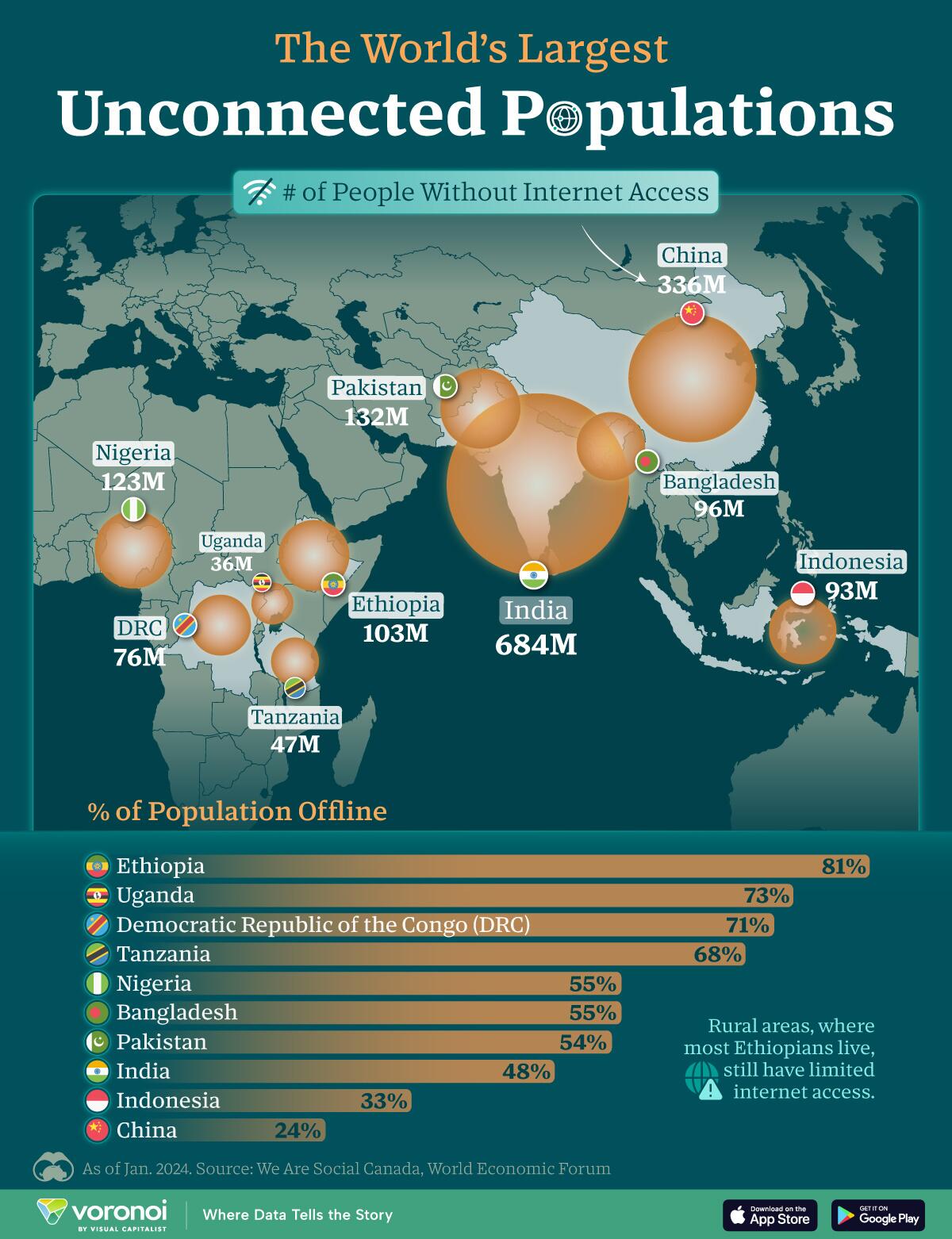
The internet has become essential for humanity, with most of the population spending hours online each day. Yet, over 2.5 billion people worldwide still lack internet access.

This graphic, via Visual Capitalist’s Bruno Venditti, illustrates the countries with the largest unconnected populations in absolute terms, according to We Are Social as of January 2024.

Asia and Africa Have the Largest Unconnected Populations

All 10 countries on the list are located in Africa or Asia.

India has the largest unconnected population, with over 684 million individuals offline, representing 47.6% of its population. China has the second-largest unconnected population, at 336 million, though its percentage of offline individuals is relatively lower, at 23.6%.

Meanwhile, Ethiopia and Uganda have the highest percentages of their populations offline, at 80.6% and 73.0%, respectively. The DRC is right behind them, with about 70% of their population offline.

And not surprisingly, in both Asia and Africa, most unconnected people are living in rural areas, where internet access is limited.

Despite having large unconnected populations, Nigeria and Indonesia are also among the top 10 countries with the highest average time spent on social media by those who are online.

If you enjoyed this graphic, make sure to check out this graphic that shows the average price of 1 gigabyte (GB) of mobile data (in USD) as of January 2024 across 52 countries.

Tyler Durden
Mon, 11/11/2024 – 02:45