80 F
Chicago
Tuesday, October 13, 2026
Home Blog Page 2154

Just How Dystopian Can Starmer’s Britain Become?

0
Just How Dystopian Can Starmer’s Britain Become?

Authored by Nick Corbishley via NakedCapitalism.com,

After his landslide election victory in July, Keir Starmer promised that his new Labour government would “tread more lightly” on the lives of voters. It is one of a multitude of pledges Starmer has broken in just his first four months in office, during which time his approval rating has suffered the biggest post-election fall of any British prime minister in the modern era.

It’s worth recalling that his government’s massive parliamentary majority represents just about 20 per cent of the eligible electorate.

As the Middle East Eye journalist John Obourne warned in 2023, “you would be very unwise to believe a word Starmer ever says.”

Last week, he and his Chancellor, Rachel Reeves, broke their pledge that they wouldn’t raise taxes on working people — by raising national insurance contributions for even the lowest-earning workers. The impact will be felt most keenly by small businesses, many of which are already struggling. As Richard Murphy notes on his blog, “Big businesses can afford to pay, but small businesses rarely pay their owners a great deal (contrary to common perceptions), and they will suffer, as will employment prospects for many people who are on lower pay.”

The latest broken promise came yesterday with the announcement of a hike in student tuition fees, from £9,250 to £9,535 a year. It is the first hike in seven years, and it comes after a period of persistent high inflation. Starmer had pledged to abolish tuition fees altogether when he ran for the leadership of the Labour Party in 2020, saying the Labour Party “must stand by its commitment to end the national scandal of spiralling student debt and abolish tuition fees.” Once in power, he did the exact opposite.

And there will be no “treading lightly” on voters, either. On the contrary, as Starmer told delegates at the Labour Party conference in September, under his government, the State would take more “control” in people’s lives. None of this should come as a surprise, of course. The Labour leader’s ruthless purge of the left and pro-Palestine voices in his party as well as his role in the British State’s persecution of Julian Assange were all clear warning signs, wrote Oborne and Richard Sanders, two of the journalists behind Al Jazeera‘s “The Labour Files”, in 2023:

In the Labour party, not only is the right in control, it is brutally pummelling the left into the dirt, determined that it will never again wield so much as a shred of meaningful influence within the Labour movement.

At the start of the first programme in The Labour Files, a Merseyside activist, Paul Davies, posed a question:

“If a small group of secretive people manipulate and control one of the two great parties in Great Britain, what will they do when they have control of MI5? When they have control of all the levers of the state? Are they suddenly going to believe in justice and proper investigations and fairness? Or are they going to be the same as they are now? Or even worse?”

A New, Orwellian Government Office

One of the main ways the British State plans to exert greater control over people’s lives is through the rollout of digital surveillance technologies. As we predicted would happen four months ago, the Starmer government is pushing hard to make digital identity a reality. Last week, as the country’s attention was focused on the government’s first budget announcement, Downing Street quietly launched a new government office to oversee the UK’s digital identity market: the so-called “Office for Digital Identities and Attributes”, or ODIA (which, I suppose, could be pronounced, fittingly, as “oh dear”).

First launched in 2022 by the Rishi Sunak government as an interim governing body for digital IDs, ODIA is now officially part of the Department for Science, Innovation and Technology (DSIT). Its responsibilities will include developing and maintaining the UK Digital Identity and Attributes Trust Framework (DIATF), which outlines standards that digital ID providers must follow, maintaining a register of certified organisations, and issuing a trust mark to identify registered services.

As the industry news site Biometric Update reports, another key task for the new government body will be liaising with international partners to promote interoperability of digital ID platforms among jurisdictions: “Industry experts have noted that the UK is behind other nations in digital ID” — including, first and foremost, the EU and Australia.

But both the UK government and its private-sectors partners are determined to catch up, notes the website Think.Digital Partners, an industry association whose “content partners” include seven UK government departments and tech companies like AWS, Microsoft and Solar Winds:

In a panel discussion on the future of digital wallets and identity strategies, industry leaders outlined both the opportunities and challenges facing the UK as it looks to become a global leader in the rapidly evolving space.

They were speaking at the recent Think Digital Identity and Cybersecurity for Government event in London…

“We’re conflating payments with wallets, but what a wallet will be in the future is likely to be much more than just payments,” explained Jim Small, head of identity at Hippo. “It’ll be a secure repository where we can own our own data, our own information, things like verifiable credentials and decentralised identifiers.”

Small pointed to initiatives around the world, from the US tech giants’ digital wallets to the EU’s eIDAS-based ID schemes, as examples of the diverse approaches being taken. However, he emphasised the need for a more centralised, ecosystem-focused framework to drive widespread adoption…

With regulatory clarity, user-centric design, and a focus on high-value use cases, the experts agreed that the UK can emerge as a global leader in digital identity, transforming how citizens interact with both government and businesses.

This would be a dream come true, not only for the tech companies involved but also for Starmer’s mentor, Tony Blair, who has repeatedly called for the development of a digital identity system in the UK, after trying but failing as prime minister to introduce an identity card system in the country. In his speeches, Blair routinely emphasises how a digital identity will be connected to one’s vaccine status.

“More Dangerous Than You Think”

Digital identity systems may help streamline bureaucracy and reduce fraud, but they are also fraught with risks. As Brett Solomon, the then-executive director of Access Now, warned in a 2018 Wired op-ed titled “Digital IDs Are More Dangerous Than You Think”, digital ID, writ large, “poses one of the gravest risks to human rights of any technology that we have encountered.”

Those risks include massive breeches of personal data, including biometric identifiers; hacks and system outages; function creep as more and more basic services require digital identification; unparalleled government and corporate surveillance; the near-total exclusion of people who don’t have access to mobile devices or the internet as well as those who do but choose not to comply with governments’ increasing demands.

As the WEF itself candidly admitted in a 2018 paper on digital identity, digital ID (emphasis my own) “open up (or close off) the digital world for individuals.” They can also close off vast swathes of the analogue world, too, as tens of millions of Indians have learnt since the rollout of Aadhaar, the world’s largest digital identity program, roughly a decade ago.

On October 1, the Kuwaiti government suspended electronic banking services, including cash withdrawals and payment transfers, for 60,000 people who had failed to submit their biometric data for the country’s e-ID program by the stated deadline. A few weeks later, those still in noncompliance had their electronic bank cards deactivated. Visa, MasterCard, and K-Net all complied with the government’s rules.

Like the EU, Australia, Canada and all the other Western “democracies” that are rolling out digital ID programs, the UK insists that digital identity will not be mandatory. But that’s exactly what India’s government said about its Aadhaar program. Yet as Kiran Jonnalagadda, an Indian digital rights activist, explains in Deccan Herald, enrollment in the program, while optional, “as repeatedly stated everywhere,… has been made mandatory in practice, via both illegal coercion and unconstitutional law, much of which is still being litigated in courts”:

The stated goal of Aadhaar is noble, of giving every individual an identity, but everything about it — the way it was proposed, budgeted, designed and implemented — has been inverted and used as a means to identify an individual for the convenience of the government.

Tip of the Iceberg

The Keir Starmer government is not only accelerating the development of digital identity. In the last four months, it has also:

  • Unveiled plans to further expand the use of live facial recognition technology, on the same day that an EU-wide law largely banning real-time surveillance technology came into force;

  • Called for the creation of digital health passports for NHS patients, prompting a backlash over concerns about digital privacy and the possible sale of patient data to third-party companies — a policy that Tony Blair and former Conservative Party leader William Hague lobbied for just before the elections.

  • Resurrected old Tory plans to grant inspectors at the Department of Work and Pensions increased powers to snoop on claimants’ bank accounts. Big Brother Watch warned that the increased powers could be used to spy on not only the accounts of pensioners and welfare claimants but ALL bank accounts. It was one of 18 NGOs and charities that signed a letter to the government warning that “imposing suspicionless algorithmic surveillance on the entire public has the makings of a Horizon-style scandal – with vulnerable people most likely to bear the brunt when these systems go wrong.”

  • Announced plans to pilot a Central Bank Digital Currency by 2025, carrying on Rishi Sunak’s controversial Digital Pound plans, with a “blueprint” expected by Christmas. As we reported last week, the proposal is not just opposed by most members of the British public, according to one of the few public surveys conducted on the matter, but also prominent figures within the City of London.

  • Launched a crackdown on lawful speech. After the riots in the summer, the Home Office is planning new non-crime “hate” measures. Again, this was a policy that was eventually dropped by the Tories, out of fears it would curtail free speech, but is now being resurrected by Starmer’s Labour Party.

That is just the tip of the iceberg. According to a recent expose by Matt Taibbi and Paul D Thacker, Starmer and his political circle are waging a war on misinformation far beyond British shores, and their ultimate goal is to destroy Elon Musk’s twitter:

“[I]nternal documents from the Center for Countering Digital Hate — whose founder is British political operative Morgan McSweeney, now advising the Kamala Harris campaign — show the group plans in writing to “kill Musk’s Twitter” while strengthening ties with the Biden/Harris administration and Democrats like Senator Amy Klobuchar, who has introduced multiple bills to regulate online “misinformation.”

The documents obtained by The DisInformation Chronicle and Racket show CCDH’s hyperfocus on Musk — “Kill Musk’s Twitter” is the first item in the template of its monthly agenda notes dating back to the early months of this year.

The Center for Countering Digital Hate is the anti-disinformation activist ally of Prime Minister Keir Starmer’s Labour Party, and a messaging vehicle for Labour’s neoliberal think tank, Labour Together. Both the CCDH and Labour Together were founded by Morgan McSweeney, a Svengali credited with piloting Starmer’s rise to Downing Street, much as Karl Rove is credited with guiding George W. Bush to the White House.

Lastly, while Starmer’s government is trying to massively expand the powers of the State, even beyond what it inherited from the Tories, it is using 0powers it already has — namely its anti-terror laws — to arrest and intimidate pro-Palestinian journalists and activists. As an op-ed in Middle East Eye reports, “protesters with placards with the ‘wrong’ slogans have been arrested and prosecuted, sometimes under anti-terror laws.”

In August, British journalist Richard Medhurst was arrested by anti-terror police as he disembarked from his plane at Heathrow airport. He was held incommunicado for 24 hours and his phone and laptop were confiscated. Since then, a string of activists and journalists have been arrested, including the human rights activist and reporter Sarah Wilkinson; Richard Barnard of Palestine Action; University of Portsmouth academic Amira Abdelhamid; Asa Winstanley, the associate editor of online news publication The Electronic Intifada; and, most recently, retired Jewish professor Haim Bresheeth.

At the same time, Declassified UK has revealed that the Starmer government has ordered 100 spy flights over Gaza to assist Israeli intelligence — equivalent to more than one a day since taking office — while 13 out of Starmer’s 25 cabinet members have received donations from Pro-Israel lobby groups and individuals. 

Of course, most of these policies and practices — particularly the crackdowns on protests and free speech — represent a continuation, and at times intensification, of policies and practices already well under way under the Tories. 

Since decoupling from the EU, both Tory and now Labour governments have taken the UK in an increasingly authoritarian direction. This is, of course, a generalised trend among ostensibly “liberal democracies” — as broad economic conditions deteriorate and AI-enabled technologies advance, the temptation among governments to exploit these new surveillance and control systems is irresistible while the potential benefits for Big Tech are huge — but the UK is most definitely at its leading edge. Moreover, it is a trend that shows no sign of slowing, let alone stopping, especially given the size of Kier Starmer’s majority parliamentary majority.  

Tyler Durden
Wed, 11/06/2024 – 05:00

These Are The Countries That Believe In Aliens The Most

0
These Are The Countries That Believe In Aliens The Most

This graphic, via Visual Capitalist’s Marcus Lu, visualizes the results of an Ipsos poll that asked adults whether they thought aliens would visit Earth.

The survey consisted of 24,471 adults across 36 countries, conducted between October and November, 2022.

Where E.T.’s Existence Would be Most Accepted

India, Saudi Arabia, and the UAE had the highest share of respondents who believe an alien visit would be likely.

Country Likely (%) No response Unlikely
🇮🇳 India 43 17 40
🇸🇦 Saudi Arabia 38 19 43
🇦🇪 UAE 36 23 41
🇹🇭 Thailand 29 25 46
🇨🇴 Colombia 26 23 51
🇨🇳 China 25 10 65
🇵🇪 Peru 23 21 56
🇮🇩 Indonesia 22 16 62
🇸🇬 Singapore 22 21 57
🇲🇽 Mexico 21 23 56
🇲🇾 Malaysia 21 23 56
🇹🇷 Turkey 20 18 62
🇿🇦 South Africa 19 19 62
🇧🇷 Brazil 19 18 63
🇨🇱 Chile 19 19 62
🇦🇷 Argentina 18 26 56
🇩🇰 Denmark 18 11 71
🇺🇸 U.S. 17 19 64
🇩🇪 Germany 17 11 72
🇦🇺 Australia 16 13 71
🇮🇪 Ireland 15 11 74
🇪🇸 Spain 15 17 68
🇸🇪 Sweden 15 10 75
🇮🇹 Italy 13 15 72
🇷🇴 Romania 13 20 67
🇫🇷 France 12 15 73
🇰🇷 South Korea 12 13 75
🇭🇺 Hungary 12 16 72
🇨🇦 Canada 12 18 70
🇳🇱 Netherlands 11 11 78
🇬🇧 UK 10 12 78
🇨🇭 Switzerland 10 13 77
🇮🇱 Israel 10 12 78
🇵🇱 Poland 10 14 76
🇧🇪 Belgium 10 11 79
🇯🇵 Japan 8 24 68

It’s hard to ascertain any one reason these three countries believe in aliens so strongly. It may be due to rich mythologies where the acceptance of various gods, djinn, and other magical beings translates into acceptance of alien life.

There might also be a religious element at play. Ongoing discussions about what the Quran states about other forms of life, except for humans, have generated interest on the internet.

It could also be an effect of mass media: the Star Wars movies, for example, were very popular in India.

However, the same influence for some countries clearly doesn’t work for others. The U.S., home to Hollywood—which seems to release at least one movie about aliens a year—sits firmly middle of the pack.

And then there’s Japan, where only 8% of those surveyed believed a visit was likely.

This is somewhat surprising, given the country’s strong technological advancements and fascination with futuristic themes in popular culture.

So… Do Aliens Exist?

NASA has said that so far, no credible evidence exists for extraterrestrial life. And despite multiple “strange light sightings,” over the years, the Department of Defense’s most recent report states there’s no “verifiable evidence” that all the “unidentified anomalous phenomena” (a new term for UFOs) actually represents alien life.

However, as a case study for probability, the odds of humans being the only advanced civilization in the whole universe is one in ten billion trillion. Or really, really, small.

So, purely mathematically, the chances of alien life existing are likely.

Now whether they’d visit—is another question entirely.

If aliens did visit, they’d probably bump into one of the many satellites hovering over the planet. Check out Operational and Planned Low Earth Orbit Internet Satellite Projects by creator MadeVisual to see which companies own what constellations.

Tyler Durden
Wed, 11/06/2024 – 04:15

Far-Left Advocacy Group In Hamburg Shows Migrants How To Get Cash In Benefits-Card-Loophole

0
Far-Left Advocacy Group In Hamburg Shows Migrants How To Get Cash In Benefits-Card-Loophole

Authored by Thomas Brooke via Remix News,

A left-wing advocacy group in Hamburg is openly teaching asylum seekers how to bypass the recently introduced payment card system, sparking political controversy and exposing a loophole in the system meant to control benefits distribution.

The Hamburg Refugee Council, which opposes the card, has launched a website explaining how asylum seekers can convert their card credit into cash through a voucher exchange system.

The payment card, introduced in November 2023 after an agreement between Chancellor Olaf Scholz and the state prime ministers, was designed to reduce the administrative burden of handling cash benefits for asylum seekers and prevent misuse. The goal was to ensure that aid would be used for essential needs, such as food and hygiene products, rather than cash being spent elsewhere or sent home amid concerns the cash is being used to buy drugs, prostitutes, and other illicit purposes.

Hamburg was the first federal state to implement the card, issuing around 2,500 of them in the first half of 2024.

However, the Hamburg Refugee Council has actively opposed the payment card, launching the “No to payment card” initiative. The group advertises in English and Arabic on its website, offering detailed instructions on how to convert the benefits into cash.

Asylum seekers are advised to buy supermarket vouchers with their cards and exchange them for cash, or to participate in a “shopping tandem” scheme whereby they pay for a willing participant’s groceries with their card and receive cash.

The initiative claims to receive around 300 shopping vouchers monthly, converting them into €15,000 to €20,000 in cash, or roughly €50 per voucher.

According to the Hamburg Refugee Council, around 400 people, referred to as “solidarity shoppers,” participate in this workaround.

A similar scheme was reportedly launched earlier this year by the “Stay Open” alliance in Munich.

The group’s website calls for the legalization of all undocumented migrants and criticizes the mass classification of individuals as “illegal.”

“The introduction of the Hamburg SocialCard is a symbolic political act, which entails serious deterioration for those affected and is intended to continue to normalize hostility,” the website states.

The State Social Court of Hamburg recently upheld the legality of the payment card system, ruling that asylum seekers in reception centers do not require cash, as their basic needs are already covered. Nonetheless, the far-left campaign has vowed to continue until the policy is reversed.

The Greens threatened to pull out of the federal traffic-light coalition earlier this year over plans to expand the benefits card system across the country, warning it was discriminatory.

Read more here…

Tyler Durden
Wed, 11/06/2024 – 03:30

Made In China, Sold On Amazon

0
Made In China, Sold On Amazon

More than 70 percent of the products that wholesalers and retailers sell on Amazon are produced in China, according to a survey conducted by Jungle Scout and published by the ECDB.

The United States is the second largest producer of items sold on Amazon, accounting for 30 percent of all total goods sold through the e-commerce giant.

Infographic: Made in China, Sold on Amazon | Statista

You will find more infographics at Statista

The retailers surveyed were able to list several countries in terms of source locations, which explains why the total share is above the 100 percent mark.

As Statista’s Anna Fleck notes, these figures illustrate the importance of China for Amazon’s business.

At the same time, Chinese companies such as the Pinduoduo Group are now trying to sell products from China directly to Western customers themselves.

This is with growing success, as the example of the e-commerce app Temu illustrates.

According to media reports, Amazon is now planning to launch its own low-cost offering.

A presentation seen by CNBC reveals the new store will offer a range of unbranded products with prices expected to be under $20.

Items cited include massage devices, fitness weights and cell phone cases. As with Temu, the products will be shipped directly from sellers in China.

Tyler Durden
Wed, 11/06/2024 – 02:45

Poland’s Military Loan Proposal To Ukraine Shows That Warsaw Is Finally Wising Up

0
Poland’s Military Loan Proposal To Ukraine Shows That Warsaw Is Finally Wising Up

Authored by Andrew Korybko via Substack,

This is in response to Polish public opinion souring on the proxy war and the ruling liberal-globalist coalition consequently trying to exploit that in an attempt to raise the chances that their candidate replaces the outgoing conservative-nationalist president during next year’s election.

Polish Foreign Minister Radek Sikorski proposed that Ukraine can order military equipment from his country on credit and then pay it back once the conflict ends in response to Zelensky complaining about Poland supposedly withholding some of its armaments such as the MiG-29 fighter jets. Sikorski also reminded Zelensky that Poland has done more for Ukraine than any other country in reference to President Andrzej Duda’s disclosure over the summer that it already gave 3.3% of its GPD to the cause.

Another important point that he made is that Poland is a “frontline country” against Russia and must therefore maintain its minimum national defense needs just in case the conflict spirals out of control. This echoed what Duda earlier said during his trip to South Korea about how:

“There is no scenario in which we hand over weapons that we have recently bought for billions of zlotys from the pockets of our taxpayers. These weapons must serve the security and defense of the Republic of Poland.”

That possibility had been discussed over the past few weeks amidst reports of North Korean troops fighting Ukraine, the rumors of which (whether true or not) were assessed here as a means for getting South Korea to send some of its enormous shell stockpile to Ukraine at this crucial moment in the conflict. Russia continues gaining ground, and its potential capture of Pokrovsk could prove to be a turning point for the reasons explained here. Even US intelligence and military officials fear the worst.

Poland’s refusal to give away any more of its military equipment for free, let alone that which it just obtained from South Korea, despite how urgent the situation has recently become isn’t surprising. Not only did it already max out everything that it can donate by this summer without endangering its minimum national defense needs, but it’s also wising up to the fact that it’s been exploited by Ukraine, which reportedly receives strings-attached military aid from everyone else but Poland.

There are also worsening political ties to consider after relations cooled over the past two months as the Volhynia Genocide dispute once again became a major issue. It’s beyond the scope of this analysis to elaborate on, but interested readers can learn more about it here, here, and here, with the takeaway being that Poland is disgusted that Ukraine refuses to exhume the victims’ remains. Sikorski and Zelensky also reportedly had a heated argument about this during the former’s visit to Kiev in mid-September.

That same report also claimed that Zelensky accused Poland of withholding military equipment from Ukraine during their argument, thus preceding what he explicitly complained about just last week. At the same time, Sikorski once again expressed support for Zelensky’s proposal that Poland intercept Russian missiles over Ukraine after the Helsinki Commission urged the US to approve this, but he also clarified that Poland won’t do so without support from NATO, which is presently lacking.

Considering this caveat and the US’ reluctance to approve direct NATO intervention in this conflict like that proposal requires, it’s likely that nothing will come of it unless hawkish American policymakers decide to “escalate to de-escalate” on more favorable terms out of desperation if the front collapses. Seeing as how there hasn’t been any serious indication of their interest in this thus far at least, it’s possible that Sikorski might be flirting with this doomed proposal to “save face” before Ukraine.

The return of the Volhynia Genocide dispute to the forefront of their political relations and Poland’s new policy of only transferring military equipment to Ukraine on credit instead of giving it away for free like before has harmed their ties so fantasizing about intercepting Russian missiles could just be a distraction. It’s a cost-free means of trying to manage their worsening ties, both in the political sphere as well as in the realm of public perceptions inside Ukraine, but some in the latter might see through this ruse.

In any case, what’s most important is that Poland is finally demanding something from Ukraine in return for all that it’s already done for it pro bono, namely the exhumation of the Volhynia Genocide victims’ remains and promises to pay for future arms imports at a later date. This new approach didn’t come about naturally but as a result to Polish society getting fed up with the proxy war as proven by a recent survey from a publicly financed research institution that was analyzed here.   

The only reason why Poland is wising up is because of next year’s presidential election that the ruling liberal-globalist coalition wants to win. Outgoing President Duda is a (very imperfect) conservative-nationalist who’s served to check returning Prime Minister Donald Tusk’s ideologically driven domestic agenda. It’s therefore imperative for the ruling coalition to replace him one of their own, which could end up being Sikorski as he himself recently hinted in response to speculation about his candidacy.

This insight adds a new dimension to him championing Polish national interests in the Volhynia Genocide dispute and proposing a military loan to Ukraine instead of continuing to give everything away for free like before. It seems that he’s courting conservative-nationalist support for his possible candidacy via these means while also flirting with the scenario of intercepting Russian missiles over Ukraine (which is likely a ruse as was earlier written) in order to retain the support of his party’s liberal-globalist base.

What matters most is that the first two parts of his potential candidacy’s foreign policy platform have respectively worsened ties with Ukraine and its military situation. Remembering that these approaches are the result of Polish society’s changing perceptions towards Ukraine ahead of next year’s presidential election, it can therefore be said that public opinion there is leading to tangible changes in the regional political and military situations, thus showing the power that Poles wield when they come together.

Tyler Durden
Wed, 11/06/2024 – 02:00

Watch Live: Republicans Take Senate As Trump Leads Across All Swing States

0
Watch Live: Republicans Take Senate As Trump Leads Across All Swing States

Here we go…

Results from the 2024 election have begun pouring in from around the country. Of course we won’t have a final count from several counties, until, well they’re ‘done’ so to speak…

Coverage:

Color:

What we’ve got so far:

Presidential: Trump Leads

Harris:

  • *HARRIS WINS VERMONT: AP

  • *HARRIS WINS MASSACHUSETTS: AP

  • *HARRIS WINS DISTRICT OF COLUMBIA: NETWORKS

  • *HARRIS WINS RHODE ISLAND: AP

  • *HARRIS WINS CONNECTICUT: AP

  • *HARRIS WINS MARYLAND: AP

  • *HARRIS WINS MAINE’S FIRST DISTRICT: FOX

  • *HARRIS WINS NEW JERSEY: AP

  • *HARRIS WINS DELAWARE: NBC

  • *HARRIS WINS ILLINOIS: AP

  • *DECISION DESK HQ PROJECTS HARRIS WINS NEW HAMPSHIRE

  • *HARRIS WINS NEW YORK: AP

  • *HARRIS WINS COLORADO: FOX

  • *HARRIS WINS WASHINGTON STATE: AP

  • *HARRIS WINS CALIFORNIA: AP

  • *HARRIS WINS OREGON: AP

  • *HARRIS WINS VIRGINIA: AP

  • *HARRIS WINS NEBRASKA’S 2ND DISTRICT: FOX

Trump:

  • *TRUMP WINS KENTUCKY: AP

  • *TRUMP WINS INDIANA: AP

  • *TRUMP WINS WEST VIRGINIA: AP

  • *TRUMP WINS MISSISSIPPI: AP

  • *TRUMP WINS ALABAMA: AP

  • *TRUMP WINS OKLAHOMA: AP

  • *TRUMP WINS FLORIDA: NETWORKS

  • *TRUMP WINS SOUTH CAROLINA: AP

  • *TRUMP WINS TENNESSEE: AP

  • *TRUMP WINS ARKANSAS: AP

  • *TRUMP WINS NEBRASKA: AP

  • *TRUMP WINS NORTH DAKOTA: AP

  • *TRUMP WINS SOUTH DAKOTA: CNN

  • *TRUMP WINS TEXAS: NETWORKS

  • *TRUMP WINS WYOMING: AP

  • *TRUMP WINS LOUISIANA: AP

  • *TRUMP WINS KANSAS: FOX

  • *TRUMP WINS OHIO: AP

  • *TRUMP WINS UTAH: AP

  • *TRUMP WINS MONTANA: AP

  • *DECISION DESK HQ PROJECTS TRUMP WINS IOWA

  • *DECISION DESK HQ PROJECTS TRUMP WINS GEORGIA

  • *TRUMP WINS IDAHO: AP

  • *TRUMP WINS KEY MAINE DISTRICT FOR 1 ELECTORAL VOTE: FOX
  • *TRUMP WINS NORTH CAROLINA, KEY BATTLEGROUND STATE: AP

  • *TRUMP WINS BATTLEGROUND STATE OF GEORGIA: NETWORKS

States called:

The shift to Trump from 2020 is very broad…

The market is shifting significantly pro-Trump:

The Dollar, Bitcoin (record high), and 10Y Yields are spiking…

Prediction markets shifting strongly pro-Trump:

Swing States:

Georgia and North Carolina have been called for Trump:

Trump leads across all swing states…

Trump just took the lead in PA…

Senate: Republicans Take Control

Republicans flip Ohio and West Virginia to take control of the Senate:

House:  Republicans Lead

What to watch for:

It’s all about the swing states – most notably Pennsylvania, where Donald Trump and Kamala Harris are virtually tied according to polls – so who actually knows.

1/ Pennsylvania is key for Harris to win.

2/ The best early indications for the presidential race might come from North Carolina and Georgia (key for Trump to win).

3/ Michigan, Pennsylvania and Wisconsin are likely to be the most important results to the presidential outcome but will take longer.

4/ Arizona and Nevada are likely to take the longest of the swing states.

The earliest results in most states will likely be dominated by early votes and mail-in ballots, with some states reporting these separately at the start of election night reporting, while others will report with partial election-day results, according to Goldman.

  • For Harris, most obvious path is to win Michigan (15), Pennsylvania (19), and Wisconsin (10), netting the bare majority 270 electoral votes.

  • For Trump, the most obvious path is to win the Sunbelt states of Arizona (11), Georgia (16), and North Carolina (16) and one of the Rust Belt states (any would be worth enough to reach 270).

In 2020 and 2022, early voting resulted in a shift to Democrats, however this year may be different – and might even slightly lean Republican, as early voting trends appear much more even based on party than in the past.

In larger counties, reporting is expected to take days vs. smaller counties.

Here’s Goldman Sachs’ expectations of how the night goes:

7pm ET  
•    28 electoral votes lean toward Trump: Indiana, Kentucky and South Carolina
•    16 electoral votes lean toward Harris: Virginia and Vermont
•    16 toss-up votes: Georgia (16). In 2020, the AP first reported Georgia results at 7:20 p.m. ET
 
7.30pm ET
•    21 electoral votes lean toward Trump: Ohio and West Virginia
•    16 toss-up votes: North Carolina (16). In 2020, the AP first reported results at 7:42 p.m. ET  
 
8.00pm ET
•    74 electoral votes lean toward Trump: Oklahoma, Missouri, Tennessee, Mississippi, Alabama, Florida and Maine’s 2nd Congressional District
•    78 electoral votes lean toward Harris: Illinois, Maine, New Hampshire, Massachusetts, Rhode Island, Connecticut, New Jersey, Delaware, Maryland and Washington, DC
•    19 toss-up votes: Pennsylvania (19). In 2020, the AP first reported results at 8:09 p.m. ET
 
8.30pm ET
•    Polls close in Arkansas, which has 6 electoral votes and is likely to support Trump. Polls will now be closed in half the states.
 
9.00pm ET
•    73 electoral votes lean toward Trump, including Wyoming, North Dakota, South Dakota, Nebraska, Iowa, Kansas, Texas and Louisiana
•    54 electoral votes lean toward Harris, including New Mexico, Colorado, Minnesota, New York and Nebraska’s 2nd Congressional District
•    36 toss-up votes: Arizona, Wisconsin and Michigan (11, 10, 15, respectively)
In 2020, the AP first reported Michigan results at 8:08 p.m. ET (note Michigan runs two time zones; most of the state close at 8pmET, with rest at 9pm ET)
In 2020, the AP first reported Wisconsin results at 9:07 p.m. ET  
In 2020, the AP first reported Arizona results at 10:02 p.m. ET
 
10.00pm ET
•    10 electoral votes lean toward Trump, including Utah and Montana
•    6 toss-up votes: Nevada (6)
In 2020, the AP first reported Nevada results at 11:41 p.m. ET
 
11.00pm ET
•    4 electoral votes lean toward Trump: Idaho
•    74 electoral votes lean toward Harris, including California, Oregon and Washington
 
Midnight to 1am ET
•    3 electoral votes lean toward Trump in Alaska
•    4 electoral votes lean toward Harris votes in Hawaii

Here’s when previous presidential election results were called:

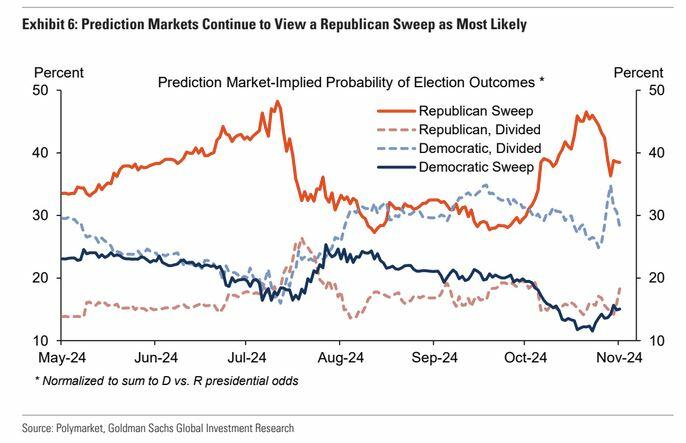
According to prediction markets, a Republican sweep is the most likely outcome, followed by a divided Democrat win.

In the House, the generic ballot shows a much tighter race than we had a few weeks ago – an is in line with the notion that the party that wins the White House usually carries the House as well.

Earliest indications will come from Florida (13th District), Virginia (2nd and 7th Districts) and North Carolina (1st District), where according to Goldman, trends could become clear by 9-10pm ET. It may take until 11pm – midnight ET before further House races come into focus.

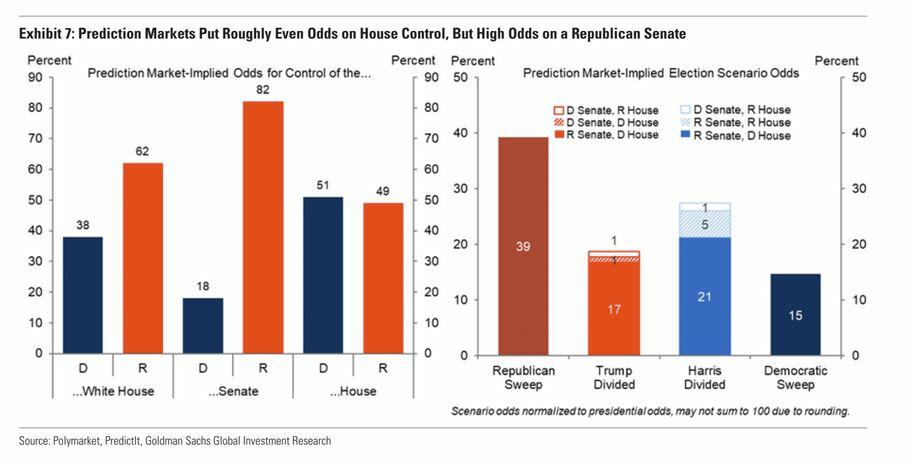
In the Senate, Republicans continue to maintain an advantage in both polling and prediction markets implying that two Democratic seats will likely flip, and a third (Ohio) has a slight chance of flipping to the Republicans, giving them either 51 or 52 seats.

That Ohio senate tossup should be decided tonight – as the state typically reports fairly quickly. The first vote counts should roll in around 8pm ET, and around half of the vote reported before 9:30pm, according to Goldman. If R’s win the seat, it would take the possibility of a Democratic sweep off the table.

Montana Senate results will likely take longer, as polls close around 10pm ET, and the state usually takes longer to count, reporting only 1/4 of its vote by midnight, and 1/2 by 2am ET.

Stay tuned for updates…

Tyler Durden
Tue, 11/05/2024 – 23:55

Antifa Returns On Election Night, Causing Chaos In Downtown Seattle

0
Antifa Returns On Election Night, Causing Chaos In Downtown Seattle

The potential return of former President Trump to the White House appears to have sparked rage among far-left activists on Tuesday night. With Trump currently leading the electoral count at 214 votes to Harris’s 179, reports are surfacing from Seattle that show Antifa activists have mobilized. 

Ahead of the elections, National Guard troops were activated in Alabama, Arizona, Delaware, Hawaii, Iowa, Illinois, North Carolina, New Mexico, Oregon, Pennsylvania, Tennessee, Texas, Washington, Wisconsin, and West Virginia. Guardsmen in Colorado, Florida, Nevada, and Washington, D.C., are on standby.

Earlier this week…

*Developing…

Tyler Durden
Tue, 11/05/2024 – 23:45

Sachs: The BRICS Summit Should Mark The End Of Neocon Delusions

0
Sachs: The BRICS Summit Should Mark The End Of Neocon Delusions

Authored by Jeffrey Sachs via Scheerpost.com,

The recent BRICS Summit in Kazan, Russia should mark the end of the Neocon delusions encapsulated in the subtitle of Zbigniew Brzezinski’s 1997 book, The Global Chessboard: American Primacy and its Geostrategic Imperatives. Since the 1990s, the goal of American foreign policy has been “primacy,” aka global hegemony. The U.S. methods of choice have been wars, regime change operations, and unilateral coercive measures (economic sanctions). Kazan brought together 35 countries with more than half the world population that reject the U.S. bullying and that are not cowed by U.S. claims of hegemony.

In the Kazan Declaration, the countries underscored “the emergence of new centres of power, policy decision-making and economic growth, which can pave the way for a more equitable, just, democratic and balanced multipolar world order.”

They emphasized “the need to adapt the current architecture of international relations to better reflect the contemporary realities,” while declaring their “commitment to multilateralism and upholding the international law, including the Purposes and Principles enshrined in the Charter of the United Nations (UN) as its indispensable cornerstone.” They took particular aim at the sanctions imposed by the U.S. and its allies, holding that “Such measures undermine the UN Charter, the multilateral trading system, the sustainable development and environmental agreements.”

Time has run out on the neocon delusions, and the U.S. wars of choice.

The neocon quest for global hegemony has deep historical roots in America’s belief in its exceptionalism. In 1630, John Winthrop invoked the Gospels in describing the Massachusetts Bay Colony as a “City on the Hill,” declaring grandiosely that “The eyes of all people are upon us.” In the 19th century, America was guided by Manifest Destiny, to conquer North America by displacing or exterminating the native peoples. In the course of World War II, Americans embraced the idea of the “American Century,” that after the war the U.S. would lead the world.

The U.S. delusions of grandeur were supercharged with the collapse of the Soviet Union at the end of 1991. With America’s Cold War nemesis gone, the ascendant American neoconservatives conceived of a new world order in which the U.S. was the sole superpower and the policeman of the world. Their foreign policy instruments of choice were wars and regime-change operations to overthrow governments they disliked.

Following 9/11, the neocons planned to overthrow seven governments in the Islamic world, starting with Iraq, and then moving on to Syria, Lebanon, Libya, Somalia, Sudan, and Iran. According to Wesley Clark, former Supreme Commander of NATO, the neocons expected the U.S. to prevail in these wars in 5 years. Yet now, more than 20 years on, the neocon-instigated wars continue while the U.S. has achieved absolutely none of its hegemonic objectives.

The neocons reasoned back in the 1990s that no country or group of countries would ever dare to stand up to U.S. power. Brzezinski, for example, argued in The Grand Chessboard that Russia would have no choice but to submit to the U.S.-led expansion of NATO and the geopolitical dictates of the U.S. and Europe, since there was no realistic prospect of Russia successfully forming an anti-hegemonic coalition with China, Iran and others. As Brzezinski put it:

“Russia’s only real geostrategic option—the option that could give Russia a realistic international role and also maximize the opportunity of transforming and socially modernizing itself—is Europe. And not just any Europe, but the transatlantic Europe of the enlarging EU and NATO.”

(emphasis added, Kindle edition, p. 118)

Brzezinski was decisively wrong, and his misjudgment helped to lead to the disaster of the war in Ukraine. Russia did not simply succumb to the U.S. plan to expand NATO to Ukraine, as Brzezinski assumed it would. Russia said a firm no, and was prepared to wage war to stop the U.S. plans. As a result of the neocon miscalculations vis-à-vis Ukraine, Russia is now prevailing on the battlefield, and hundreds of thousands of Ukrainians are dead.

Nor—and this is the plain message from Kazan—did U.S. sanctions and diplomatic pressures isolate Russian in the least. In response to pervasive U.S. bullying, an anti-hegemonic counterweight has emerged. Simply put, the majority of the world does not want or accept U.S. hegemony, and is prepared to face it down rather than submit to its dictates. Nor does the U.S. anymore possess the economic, financial, or military power to enforce its will, if it ever did.

The countries that assembled in Kazan represent a clear majority of the world’s population. The nine BRICS members (Brazil, Russia, India, China, and South Africa as the original five, plus Egypt, Ethiopia, Iran, and the United Arab Emirates), in addition to the delegations of 27 aspiring members, constitute 57 percent of the world’s population and 47 percent of the world’s output (measured at purchasing-power adjusted prices). The U.S., by contrast, constitutes 4.1 percent of the world population and 15 percent of world output. Add in the U.S. allies, and the population share of the U.S.-led alliance is around 15 percent of the global population.

The BRICS will gain in relative economic weight, technological prowess, and military strength in the years ahead. The combined GDP of the BRICS countries is growing at around 5 percent per annum, while the combined GDP of the U.S. and its allies in Europe and the Asia-Pacific is growing at around 2 percent per annum.

Even with their growing clout, however, the BRICS can’t replace the U.S. as a new global hegemon. They simply lack the military, financial, and technological power to defeat the U.S. or even to threaten its vital interests. The BRICS are in practice calling for a new and realistic multipolarity, not an alternative hegemony in which they are in charge.

American strategists should heed the ultimately positive message coming from Kazan. Not only has the neocon quest for global hegemony failed, it has been a costly disaster for the US and the world, leading to bloody and pointless wars, economic shocks, mass displacements of populations, and rising threats of nuclear confrontation. A more inclusive and equitable multipolar world order offers a promising path out of the current morass, one that can benefit the U.S. and its allies as well as the nations that met in Kazan.

The rise of the BRICS is therefore not merely a rebuke to the U.S., but also a potential opening for a far more peaceful and secure world order. The multipolar world order envisioned by the BRICS can be a boon for all countries, including the United States. Time has run out on the neocon delusions, and the U.S. wars of choice. The moment has arrived for a renewed diplomacy to end the conflicts raging around the world.

Tyler Durden
Tue, 11/05/2024 – 23:20

Rare Bees Nuke Mark Zuckerberg’s Plan For Atomic-Powered AI Data Center

0
Rare Bees Nuke Mark Zuckerberg’s Plan For Atomic-Powered AI Data Center

At an all-hands meeting last week, Mark Zuckerberg reportedly told Meta workers that plans to build an AI data center powered by nuclear energy were scrapped after rare bees were discovered on the proposed site.

Meta’s proposed AI data center project with an existing nuclear power plant operator fell apart over environmental and regulatory challenges, according to a Financial Times report, citing two people familiar with the meeting.

The people gave no details about which nuclear power plant Meta planned to build an AI data center in an adjacent lot. They noted that Meta continues to search for locations to tap into carbon-free energy. 

Here’s more from the report…

Zuckerberg told staffers at the all-hands that, had the deal gone ahead, Meta would have been the first Big Tech group to wield nuclear-powered AI, and would have had the largest nuclear plant available to power data centres, two people said.

One person familiar with the matter said that Zuckerberg has been frustrated with the lack of nuclear options in the US, while China has been embracing nuclear power. China appears to be building nuclear reactors at a fast clip, whereas only a handful of reactors have been brought online over the past two decades in the US.

Incredible power demand growth from AI data centers has sparked a nuclear power revival in the US (but no fast enough when compared with China): 

While we may not always see eye to eye with Zuckerberg, we share his concerns about China outpacing the US in nuclear power development. It’s alarming that Western lawmakers, wearing climate crisis blinders, have pushed de-growth global warming and climate policies that only stifle industrial output and fuel inflation, while providing China a clear runway to eclipse the West’s economy due to its total disregard for such policies.

It’s safe to say that when the Communist Party in China builds coal power plants, concerns about bees are likely the last thing on their minds. 

Tyler Durden
Tue, 11/05/2024 – 22:50

Homes In SoCal’s Planned ‘City Of Kindness’ To Start In The Very Friendly $400,000s

0
Homes In SoCal’s Planned ‘City Of Kindness’ To Start In The Very Friendly $400,000s

Authored by Jill McLaughlin via The Epoch Times (emphasis ours),

Imagine living in a city built on kindness, where residents are encouraged to respect one another and not judge their neighbors.

John Ohanian, general manager of DMB Development, hopes to build just that—a “City of Kindness” called Silverwood in San Bernardino County.

The Silverwood community center will be one of many places residents can mingle. DMB Development

“It’s really important to us,” Ohanian told The Epoch Times. “The idea is to create some expectations of how we’re all going to live together.”

The nearly 15-square-mile development is in Hesperia, California, on State Route 138 near the Cajon Pass in the San Bernardino Mountains, about 75 miles east of Los Angeles.

The project will offer homes built around active outdoor lifestyles and priced from the mid-$400,000s up to the $700,000s. The community will also have five elementary schools, one middle school, and one high school, according to plans.

“We’re trying to create a special place for folks to live that embraces an outdoor lifestyle and is community oriented,” Ohanian said.

With home prices far below those closer to the coast, Ohanian said the housing will be more attainable for Californians who can’t afford Los Angeles and Orange County.

“We’re trying very hard to articulate a lifestyle that is family oriented, allowing young families to be able to stay in California and afford to live here,” Ohanian said.

Living in Silverwood will also include paying $158 a month in homeowner association fees, but that will include connections to full-gig speed internet, which is 10 times faster than older cable connections, according to the developer.

Ohanian was inspired to build a community of kindness after hearing about former Anaheim Mayor Tom Tait’s “Kindness Initiative,” developed after he took office in 2010. The city officially made “kindness” its motto in 2017.

Silverwood might be just the kind of city the former mayor was hoping to inspire.

Developers plan to offer nearly 15,700 homes in eight villages within the Silverwood development in San Bernardino County. DMB Development

“Kindness is very simple. It’s doing something for someone else with no expectation in return,” he explained in 2017 on City Talk. “Imagine an entire city where people are just a little kinder. Where they know it’s who we are. When that happens, literally everything gets better.”

Tait did not return a request for comment about Silverwood on Friday.

In this spirit, though, Silverwood’s homeowner association would offer residents who buy one of their nearly 15,700 homes a chance to sign a pledge promising to be kind.

“We’re trying to make it feel like people have a voice, and have an opportunity to also be respected, not judged, and treated kindly,” Ohanian said. “It sets an expectation and we hope everybody who becomes a homeowner signs a pledge.”

Kindness won’t be enforced, but Ohanian said he hoped peer pressure and conscience would drive residents to enforce the idea themselves.

The project has been in the works since 2012, when the developer purchased the land out of a bankruptcy. The southern edge of the property was a working cattle ranch and will remain open space.

The lower cost of the land is part of what will allow the developer to offer more affordable houses. The homes will range from 1,400 square feet for a one-story condo close to the town’s center, up to 4,000-square-foot executive homes at the higher end.

Home prices in the Silverwood development in San Bernardino County will range from the mid-$400,000s to the $700,000s. DMB Development

“Silverwood will create the opportunity for thousands of families to live in a gorgeous natural setting with endless opportunities for outdoor recreation, all within a reasonable commute to San Bernardino, Riverside, Ontario, and other existing employment hubs,” according to the project’s website.

Each house will also come with solar panels, which are now required by California law. 

The development will also build a wastewater treatment facility that will allow the association to use recycled water for all parks and schools. Half of the houses will also be built to offer homeowners the ability to use recycled water for irrigation and landscaping, according to the developer.

The project is planned to include eight villages, each with its own theme and anchored by a green space. One might be built around pickleball courts, while another might have a swimming complex, according to the developer.

“Each village will have their own neighborhood identity and each of them will have their own character,” Ohanian said.

The community will also have its own medical services, grocery stores, and other services, he added.

People will be able to gather at the pools, recreational facilities, bandstands, and other areas, according to the developer. Nearly half of the land in the development has been set aside for natural open space, conservation easement, parks, and the Serrano Preserve.

The project is expected to include 59 miles of off-street trails, 107 miles of paths and paseos, and 387 acres of parks. Every house will be within a five-minute walk of a park, according to plans.

Silverwood Lake is on the southern boundary of the property, and Lake Arrowhead and Big Bear are about an hour away.

A room with a view at Lake Arrowhead Resort and Spa. Silverwood will be about an hour from Lake Arrowhead. Benjamin Myers/TNS

Model homes at the development should be open in the spring of next year, Ohanian said. He expects to have people living in the community between April and June.

Home builders include Lennar, Richmond American Homes, Watt Capital Developers, and Woodside Homes.

The developer expects to take up to 20 years to completely build out the community.

Tyler Durden
Tue, 11/05/2024 – 22:20