

76.6 F
Chicago
Wednesday, October 14, 2026
Home Blog Page 2155

Watch Live: Republicans Take Senate As Trump Leads Across All Swing States

0
Watch Live: Republicans Take Senate As Trump Leads Across All Swing States

Here we go…

Results from the 2024 election have begun pouring in from around the country. Of course we won’t have a final count from several counties, until, well they’re ‘done’ so to speak…

Coverage:

Color:

What we’ve got so far:

Presidential: Trump Leads

Harris:

  • *HARRIS WINS VERMONT: AP

  • *HARRIS WINS MASSACHUSETTS: AP

  • *HARRIS WINS DISTRICT OF COLUMBIA: NETWORKS

  • *HARRIS WINS RHODE ISLAND: AP

  • *HARRIS WINS CONNECTICUT: AP

  • *HARRIS WINS MARYLAND: AP

  • *HARRIS WINS MAINE’S FIRST DISTRICT: FOX

  • *HARRIS WINS NEW JERSEY: AP

  • *HARRIS WINS DELAWARE: NBC

  • *HARRIS WINS ILLINOIS: AP

  • *DECISION DESK HQ PROJECTS HARRIS WINS NEW HAMPSHIRE

  • *HARRIS WINS NEW YORK: AP

  • *HARRIS WINS COLORADO: FOX

  • *HARRIS WINS WASHINGTON STATE: AP

  • *HARRIS WINS CALIFORNIA: AP

  • *HARRIS WINS OREGON: AP

  • *HARRIS WINS VIRGINIA: AP

  • *HARRIS WINS NEBRASKA’S 2ND DISTRICT: FOX

Trump:

  • *TRUMP WINS KENTUCKY: AP

  • *TRUMP WINS INDIANA: AP

  • *TRUMP WINS WEST VIRGINIA: AP

  • *TRUMP WINS MISSISSIPPI: AP

  • *TRUMP WINS ALABAMA: AP

  • *TRUMP WINS OKLAHOMA: AP

  • *TRUMP WINS FLORIDA: NETWORKS

  • *TRUMP WINS SOUTH CAROLINA: AP

  • *TRUMP WINS TENNESSEE: AP

  • *TRUMP WINS ARKANSAS: AP

  • *TRUMP WINS NEBRASKA: AP

  • *TRUMP WINS NORTH DAKOTA: AP

  • *TRUMP WINS SOUTH DAKOTA: CNN

  • *TRUMP WINS TEXAS: NETWORKS

  • *TRUMP WINS WYOMING: AP

  • *TRUMP WINS LOUISIANA: AP

  • *TRUMP WINS KANSAS: FOX

  • *TRUMP WINS OHIO: AP

  • *TRUMP WINS UTAH: AP

  • *TRUMP WINS MONTANA: AP

  • *DECISION DESK HQ PROJECTS TRUMP WINS IOWA

  • *DECISION DESK HQ PROJECTS TRUMP WINS GEORGIA

  • *TRUMP WINS IDAHO: AP

  • *TRUMP WINS KEY MAINE DISTRICT FOR 1 ELECTORAL VOTE: FOX
  • *TRUMP WINS NORTH CAROLINA, KEY BATTLEGROUND STATE: AP

  • *TRUMP WINS BATTLEGROUND STATE OF GEORGIA: NETWORKS

States called:

The shift to Trump from 2020 is very broad…

The market is shifting significantly pro-Trump:

The Dollar, Bitcoin (record high), and 10Y Yields are spiking…

Prediction markets shifting strongly pro-Trump:

Swing States:

Georgia and North Carolina have been called for Trump:

Trump leads across all swing states…

Trump just took the lead in PA…

Senate: Republicans Take Control

Republicans flip Ohio and West Virginia to take control of the Senate:

House:  Republicans Lead

What to watch for:

It’s all about the swing states – most notably Pennsylvania, where Donald Trump and Kamala Harris are virtually tied according to polls – so who actually knows.

1/ Pennsylvania is key for Harris to win.

2/ The best early indications for the presidential race might come from North Carolina and Georgia (key for Trump to win).

3/ Michigan, Pennsylvania and Wisconsin are likely to be the most important results to the presidential outcome but will take longer.

4/ Arizona and Nevada are likely to take the longest of the swing states.

The earliest results in most states will likely be dominated by early votes and mail-in ballots, with some states reporting these separately at the start of election night reporting, while others will report with partial election-day results, according to Goldman.

  • For Harris, most obvious path is to win Michigan (15), Pennsylvania (19), and Wisconsin (10), netting the bare majority 270 electoral votes.

  • For Trump, the most obvious path is to win the Sunbelt states of Arizona (11), Georgia (16), and North Carolina (16) and one of the Rust Belt states (any would be worth enough to reach 270).

In 2020 and 2022, early voting resulted in a shift to Democrats, however this year may be different – and might even slightly lean Republican, as early voting trends appear much more even based on party than in the past.

In larger counties, reporting is expected to take days vs. smaller counties.

Here’s Goldman Sachs’ expectations of how the night goes:

7pm ET  
•    28 electoral votes lean toward Trump: Indiana, Kentucky and South Carolina
•    16 electoral votes lean toward Harris: Virginia and Vermont
•    16 toss-up votes: Georgia (16). In 2020, the AP first reported Georgia results at 7:20 p.m. ET
 
7.30pm ET
•    21 electoral votes lean toward Trump: Ohio and West Virginia
•    16 toss-up votes: North Carolina (16). In 2020, the AP first reported results at 7:42 p.m. ET  
 
8.00pm ET
•    74 electoral votes lean toward Trump: Oklahoma, Missouri, Tennessee, Mississippi, Alabama, Florida and Maine’s 2nd Congressional District
•    78 electoral votes lean toward Harris: Illinois, Maine, New Hampshire, Massachusetts, Rhode Island, Connecticut, New Jersey, Delaware, Maryland and Washington, DC
•    19 toss-up votes: Pennsylvania (19). In 2020, the AP first reported results at 8:09 p.m. ET
 
8.30pm ET
•    Polls close in Arkansas, which has 6 electoral votes and is likely to support Trump. Polls will now be closed in half the states.
 
9.00pm ET
•    73 electoral votes lean toward Trump, including Wyoming, North Dakota, South Dakota, Nebraska, Iowa, Kansas, Texas and Louisiana
•    54 electoral votes lean toward Harris, including New Mexico, Colorado, Minnesota, New York and Nebraska’s 2nd Congressional District
•    36 toss-up votes: Arizona, Wisconsin and Michigan (11, 10, 15, respectively)
In 2020, the AP first reported Michigan results at 8:08 p.m. ET (note Michigan runs two time zones; most of the state close at 8pmET, with rest at 9pm ET)
In 2020, the AP first reported Wisconsin results at 9:07 p.m. ET  
In 2020, the AP first reported Arizona results at 10:02 p.m. ET
 
10.00pm ET
•    10 electoral votes lean toward Trump, including Utah and Montana
•    6 toss-up votes: Nevada (6)
In 2020, the AP first reported Nevada results at 11:41 p.m. ET
 
11.00pm ET
•    4 electoral votes lean toward Trump: Idaho
•    74 electoral votes lean toward Harris, including California, Oregon and Washington
 
Midnight to 1am ET
•    3 electoral votes lean toward Trump in Alaska
•    4 electoral votes lean toward Harris votes in Hawaii

Here’s when previous presidential election results were called:

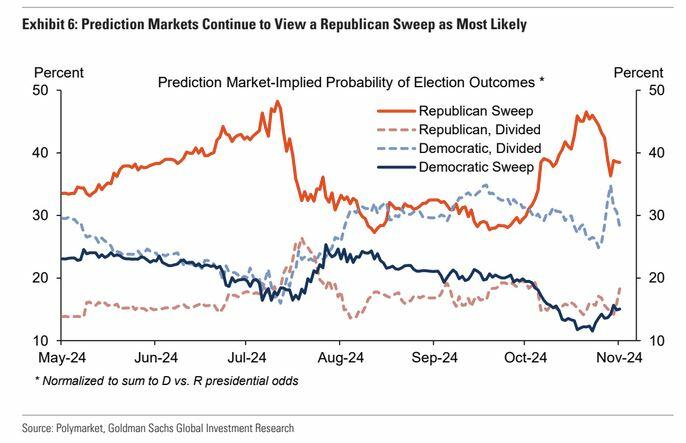
According to prediction markets, a Republican sweep is the most likely outcome, followed by a divided Democrat win.
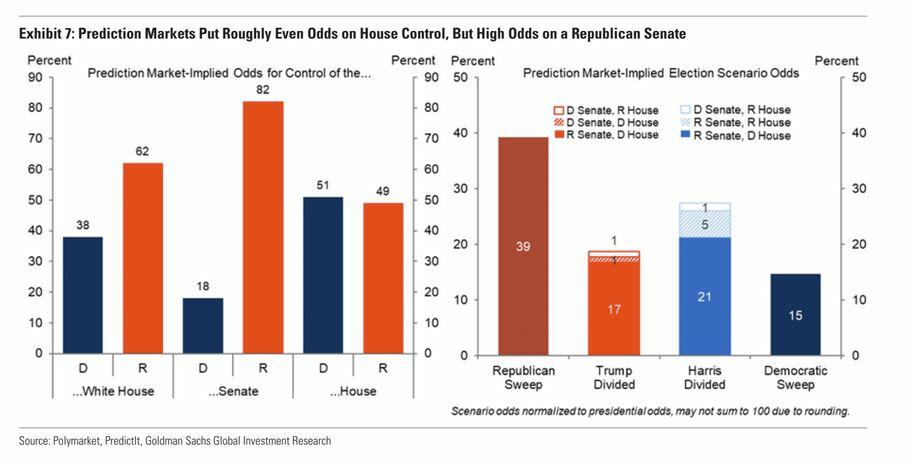
In the House, the generic ballot shows a much tighter race than we had a few weeks ago – an is in line with the notion that the party that wins the White House usually carries the House as well.

Earliest indications will come from Florida (13th District), Virginia (2nd and 7th Districts) and North Carolina (1st District), where according to Goldman, trends could become clear by 9-10pm ET. It may take until 11pm – midnight ET before further House races come into focus.

In the Senate, Republicans continue to maintain an advantage in both polling and prediction markets implying that two Democratic seats will likely flip, and a third (Ohio) has a slight chance of flipping to the Republicans, giving them either 51 or 52 seats.

That Ohio senate tossup should be decided tonight – as the state typically reports fairly quickly. The first vote counts should roll in around 8pm ET, and around half of the vote reported before 9:30pm, according to Goldman. If R’s win the seat, it would take the possibility of a Democratic sweep off the table.
Montana Senate results will likely take longer, as polls close around 10pm ET, and the state usually takes longer to count, reporting only 1/4 of its vote by midnight, and 1/2 by 2am ET.

Stay tuned for updates…

Tyler Durden
Tue, 11/05/2024 – 23:55

Antifa Returns On Election Night, Causing Chaos In Downtown Seattle

0
Antifa Returns On Election Night, Causing Chaos In Downtown Seattle

The potential return of former President Trump to the White House appears to have sparked rage among far-left activists on Tuesday night. With Trump currently leading the electoral count at 214 votes to Harris’s 179, reports are surfacing from Seattle that show Antifa activists have mobilized. 

Ahead of the elections, National Guard troops were activated in Alabama, Arizona, Delaware, Hawaii, Iowa, Illinois, North Carolina, New Mexico, Oregon, Pennsylvania, Tennessee, Texas, Washington, Wisconsin, and West Virginia. Guardsmen in Colorado, Florida, Nevada, and Washington, D.C., are on standby.

Earlier this week…

*Developing…

Tyler Durden
Tue, 11/05/2024 – 23:45

Sachs: The BRICS Summit Should Mark The End Of Neocon Delusions

0
Sachs: The BRICS Summit Should Mark The End Of Neocon Delusions

Authored by Jeffrey Sachs via Scheerpost.com,

The recent BRICS Summit in Kazan, Russia should mark the end of the Neocon delusions encapsulated in the subtitle of Zbigniew Brzezinski’s 1997 book, The Global Chessboard: American Primacy and its Geostrategic Imperatives. Since the 1990s, the goal of American foreign policy has been “primacy,” aka global hegemony. The U.S. methods of choice have been wars, regime change operations, and unilateral coercive measures (economic sanctions). Kazan brought together 35 countries with more than half the world population that reject the U.S. bullying and that are not cowed by U.S. claims of hegemony.

In the Kazan Declaration, the countries underscored “the emergence of new centres of power, policy decision-making and economic growth, which can pave the way for a more equitable, just, democratic and balanced multipolar world order.”

They emphasized “the need to adapt the current architecture of international relations to better reflect the contemporary realities,” while declaring their “commitment to multilateralism and upholding the international law, including the Purposes and Principles enshrined in the Charter of the United Nations (UN) as its indispensable cornerstone.” They took particular aim at the sanctions imposed by the U.S. and its allies, holding that “Such measures undermine the UN Charter, the multilateral trading system, the sustainable development and environmental agreements.”

Time has run out on the neocon delusions, and the U.S. wars of choice.

The neocon quest for global hegemony has deep historical roots in America’s belief in its exceptionalism. In 1630, John Winthrop invoked the Gospels in describing the Massachusetts Bay Colony as a “City on the Hill,” declaring grandiosely that “The eyes of all people are upon us.” In the 19th century, America was guided by Manifest Destiny, to conquer North America by displacing or exterminating the native peoples. In the course of World War II, Americans embraced the idea of the “American Century,” that after the war the U.S. would lead the world.

The U.S. delusions of grandeur were supercharged with the collapse of the Soviet Union at the end of 1991. With America’s Cold War nemesis gone, the ascendant American neoconservatives conceived of a new world order in which the U.S. was the sole superpower and the policeman of the world. Their foreign policy instruments of choice were wars and regime-change operations to overthrow governments they disliked.

Following 9/11, the neocons planned to overthrow seven governments in the Islamic world, starting with Iraq, and then moving on to Syria, Lebanon, Libya, Somalia, Sudan, and Iran. According to Wesley Clark, former Supreme Commander of NATO, the neocons expected the U.S. to prevail in these wars in 5 years. Yet now, more than 20 years on, the neocon-instigated wars continue while the U.S. has achieved absolutely none of its hegemonic objectives.

The neocons reasoned back in the 1990s that no country or group of countries would ever dare to stand up to U.S. power. Brzezinski, for example, argued in The Grand Chessboard that Russia would have no choice but to submit to the U.S.-led expansion of NATO and the geopolitical dictates of the U.S. and Europe, since there was no realistic prospect of Russia successfully forming an anti-hegemonic coalition with China, Iran and others. As Brzezinski put it:

“Russia’s only real geostrategic option—the option that could give Russia a realistic international role and also maximize the opportunity of transforming and socially modernizing itself—is Europe. And not just any Europe, but the transatlantic Europe of the enlarging EU and NATO.”

(emphasis added, Kindle edition, p. 118)

Brzezinski was decisively wrong, and his misjudgment helped to lead to the disaster of the war in Ukraine. Russia did not simply succumb to the U.S. plan to expand NATO to Ukraine, as Brzezinski assumed it would. Russia said a firm no, and was prepared to wage war to stop the U.S. plans. As a result of the neocon miscalculations vis-à-vis Ukraine, Russia is now prevailing on the battlefield, and hundreds of thousands of Ukrainians are dead.

Nor—and this is the plain message from Kazan—did U.S. sanctions and diplomatic pressures isolate Russian in the least. In response to pervasive U.S. bullying, an anti-hegemonic counterweight has emerged. Simply put, the majority of the world does not want or accept U.S. hegemony, and is prepared to face it down rather than submit to its dictates. Nor does the U.S. anymore possess the economic, financial, or military power to enforce its will, if it ever did.

The countries that assembled in Kazan represent a clear majority of the world’s population. The nine BRICS members (Brazil, Russia, India, China, and South Africa as the original five, plus Egypt, Ethiopia, Iran, and the United Arab Emirates), in addition to the delegations of 27 aspiring members, constitute 57 percent of the world’s population and 47 percent of the world’s output (measured at purchasing-power adjusted prices). The U.S., by contrast, constitutes 4.1 percent of the world population and 15 percent of world output. Add in the U.S. allies, and the population share of the U.S.-led alliance is around 15 percent of the global population.

The BRICS will gain in relative economic weight, technological prowess, and military strength in the years ahead. The combined GDP of the BRICS countries is growing at around 5 percent per annum, while the combined GDP of the U.S. and its allies in Europe and the Asia-Pacific is growing at around 2 percent per annum.

Even with their growing clout, however, the BRICS can’t replace the U.S. as a new global hegemon. They simply lack the military, financial, and technological power to defeat the U.S. or even to threaten its vital interests. The BRICS are in practice calling for a new and realistic multipolarity, not an alternative hegemony in which they are in charge.

American strategists should heed the ultimately positive message coming from Kazan. Not only has the neocon quest for global hegemony failed, it has been a costly disaster for the US and the world, leading to bloody and pointless wars, economic shocks, mass displacements of populations, and rising threats of nuclear confrontation. A more inclusive and equitable multipolar world order offers a promising path out of the current morass, one that can benefit the U.S. and its allies as well as the nations that met in Kazan.

The rise of the BRICS is therefore not merely a rebuke to the U.S., but also a potential opening for a far more peaceful and secure world order. The multipolar world order envisioned by the BRICS can be a boon for all countries, including the United States. Time has run out on the neocon delusions, and the U.S. wars of choice. The moment has arrived for a renewed diplomacy to end the conflicts raging around the world.

Tyler Durden
Tue, 11/05/2024 – 23:20

Rare Bees Nuke Mark Zuckerberg’s Plan For Atomic-Powered AI Data Center

0
Rare Bees Nuke Mark Zuckerberg’s Plan For Atomic-Powered AI Data Center

At an all-hands meeting last week, Mark Zuckerberg reportedly told Meta workers that plans to build an AI data center powered by nuclear energy were scrapped after rare bees were discovered on the proposed site.

Meta’s proposed AI data center project with an existing nuclear power plant operator fell apart over environmental and regulatory challenges, according to a Financial Times report, citing two people familiar with the meeting.

The people gave no details about which nuclear power plant Meta planned to build an AI data center in an adjacent lot. They noted that Meta continues to search for locations to tap into carbon-free energy. 

Here’s more from the report…

Zuckerberg told staffers at the all-hands that, had the deal gone ahead, Meta would have been the first Big Tech group to wield nuclear-powered AI, and would have had the largest nuclear plant available to power data centres, two people said.

One person familiar with the matter said that Zuckerberg has been frustrated with the lack of nuclear options in the US, while China has been embracing nuclear power. China appears to be building nuclear reactors at a fast clip, whereas only a handful of reactors have been brought online over the past two decades in the US.

Incredible power demand growth from AI data centers has sparked a nuclear power revival in the US (but no fast enough when compared with China): 

While we may not always see eye to eye with Zuckerberg, we share his concerns about China outpacing the US in nuclear power development. It’s alarming that Western lawmakers, wearing climate crisis blinders, have pushed de-growth global warming and climate policies that only stifle industrial output and fuel inflation, while providing China a clear runway to eclipse the West’s economy due to its total disregard for such policies.

It’s safe to say that when the Communist Party in China builds coal power plants, concerns about bees are likely the last thing on their minds. 

Tyler Durden
Tue, 11/05/2024 – 22:50

Homes In SoCal’s Planned ‘City Of Kindness’ To Start In The Very Friendly $400,000s

0
Homes In SoCal’s Planned ‘City Of Kindness’ To Start In The Very Friendly $400,000s

Authored by Jill McLaughlin via The Epoch Times (emphasis ours),

Imagine living in a city built on kindness, where residents are encouraged to respect one another and not judge their neighbors.

John Ohanian, general manager of DMB Development, hopes to build just that—a “City of Kindness” called Silverwood in San Bernardino County.

The Silverwood community center will be one of many places residents can mingle. DMB Development

“It’s really important to us,” Ohanian told The Epoch Times. “The idea is to create some expectations of how we’re all going to live together.”

The nearly 15-square-mile development is in Hesperia, California, on State Route 138 near the Cajon Pass in the San Bernardino Mountains, about 75 miles east of Los Angeles.

The project will offer homes built around active outdoor lifestyles and priced from the mid-$400,000s up to the $700,000s. The community will also have five elementary schools, one middle school, and one high school, according to plans.

“We’re trying to create a special place for folks to live that embraces an outdoor lifestyle and is community oriented,” Ohanian said.

With home prices far below those closer to the coast, Ohanian said the housing will be more attainable for Californians who can’t afford Los Angeles and Orange County.

“We’re trying very hard to articulate a lifestyle that is family oriented, allowing young families to be able to stay in California and afford to live here,” Ohanian said.

Living in Silverwood will also include paying $158 a month in homeowner association fees, but that will include connections to full-gig speed internet, which is 10 times faster than older cable connections, according to the developer.

Ohanian was inspired to build a community of kindness after hearing about former Anaheim Mayor Tom Tait’s “Kindness Initiative,” developed after he took office in 2010. The city officially made “kindness” its motto in 2017.

Silverwood might be just the kind of city the former mayor was hoping to inspire.

Developers plan to offer nearly 15,700 homes in eight villages within the Silverwood development in San Bernardino County. DMB Development

“Kindness is very simple. It’s doing something for someone else with no expectation in return,” he explained in 2017 on City Talk. “Imagine an entire city where people are just a little kinder. Where they know it’s who we are. When that happens, literally everything gets better.”

Tait did not return a request for comment about Silverwood on Friday.

In this spirit, though, Silverwood’s homeowner association would offer residents who buy one of their nearly 15,700 homes a chance to sign a pledge promising to be kind.

“We’re trying to make it feel like people have a voice, and have an opportunity to also be respected, not judged, and treated kindly,” Ohanian said. “It sets an expectation and we hope everybody who becomes a homeowner signs a pledge.”

Kindness won’t be enforced, but Ohanian said he hoped peer pressure and conscience would drive residents to enforce the idea themselves.

The project has been in the works since 2012, when the developer purchased the land out of a bankruptcy. The southern edge of the property was a working cattle ranch and will remain open space.

The lower cost of the land is part of what will allow the developer to offer more affordable houses. The homes will range from 1,400 square feet for a one-story condo close to the town’s center, up to 4,000-square-foot executive homes at the higher end.

Home prices in the Silverwood development in San Bernardino County will range from the mid-$400,000s to the $700,000s. DMB Development

“Silverwood will create the opportunity for thousands of families to live in a gorgeous natural setting with endless opportunities for outdoor recreation, all within a reasonable commute to San Bernardino, Riverside, Ontario, and other existing employment hubs,” according to the project’s website.

Each house will also come with solar panels, which are now required by California law. 

The development will also build a wastewater treatment facility that will allow the association to use recycled water for all parks and schools. Half of the houses will also be built to offer homeowners the ability to use recycled water for irrigation and landscaping, according to the developer.

The project is planned to include eight villages, each with its own theme and anchored by a green space. One might be built around pickleball courts, while another might have a swimming complex, according to the developer.

“Each village will have their own neighborhood identity and each of them will have their own character,” Ohanian said.

The community will also have its own medical services, grocery stores, and other services, he added.

People will be able to gather at the pools, recreational facilities, bandstands, and other areas, according to the developer. Nearly half of the land in the development has been set aside for natural open space, conservation easement, parks, and the Serrano Preserve.

The project is expected to include 59 miles of off-street trails, 107 miles of paths and paseos, and 387 acres of parks. Every house will be within a five-minute walk of a park, according to plans.

Silverwood Lake is on the southern boundary of the property, and Lake Arrowhead and Big Bear are about an hour away.

A room with a view at Lake Arrowhead Resort and Spa. Silverwood will be about an hour from Lake Arrowhead. Benjamin Myers/TNS

Model homes at the development should be open in the spring of next year, Ohanian said. He expects to have people living in the community between April and June.

Home builders include Lennar, Richmond American Homes, Watt Capital Developers, and Woodside Homes.

The developer expects to take up to 20 years to completely build out the community.

Tyler Durden
Tue, 11/05/2024 – 22:20

See The Human Brain Like Never Before

0
See The Human Brain Like Never Before

Authored by Makai Allbert via The Epoch Times (emphasis ours),

A decade ago, a small and unassuming brain sample arrived at Dr. Jeff Lichtman’s lab at Harvard University. Measuring less than a grain of rice, the 1 cubic millimeter of tissue contained 57,000 cells and 150 million synapses, each one a vital part of the brain’s intricate communication network.

Neurons from the anterior temporal lobe, color-coded by size and type, reveal the six distinct layers of the cortex.

Now, after a decade of collaboration with Google scientists, a monumental dataset—with 1,400 terabytes—has turned into the most detailed map of the human brain ever created.

“A terabyte is, for most people, gigantic, yet a fragment of a human brain—just a minscule, teeny-weeny little bit of human brain—is still thousands of terabytes,” Lichtman said in a National Institutes of Health report.

The detailed 3-D reconstruction reveals beautiful structures in the brain. Neurons forming dozens of connections, mirror-image neural pairs, and networks far more complex than expected, are just some of the groundbreaking discoveries.

“I remember this moment, going into the map and looking at one individual synapse from this woman’s brain, and then zooming out into these other millions of pixels,” said Viren Jain, a senior scientist at Google in Nature Magazine. “It felt sort of spiritual.”

The map, now part of an open-access dataset online, opens the door to new understandings of human cognition, psychiatric disorders, and the architecture of our minds.

“There is the saying that ‘A map of synaptic connections is necessary but insufficient to understand the brain.’ In its current form it is still missing a lot of important information, but it is a step in the right direction,” Daniel Berger, a scientist in the Lichtman lab, told The Epoch Times.

All images below are by Google Research and Lichtman Lab (Harvard University). Renderings by D. Berger (Harvard University)

Excitatory neurons, color-coded by size, with red being the largest and blue the smallest. Cell cores range from 15 to 30 micrometers.

A single white neuron receives signals from more than 5,000 blue axons, with green synapses marking the points where the signals transfer.

Neurons with long dendrites and dendrite spine. In very rare cases, a single axon (blue) made repeated synaptic connections (yellow) with a target neuron (green).

One unexpected discovery in the study was the presence of “axon whorls”—tangled loops of blue axons—which typically transmit signals away from nerve cells. These structures were rare in the sample and sometimes appeared to be resting on yellow cells. Their purpose remains unclear.

Read the rest here…

Tyler Durden
Tue, 11/05/2024 – 21:20

Israeli Airstrikes Pummel Syria For A Second Day In A Row

0
Israeli Airstrikes Pummel Syria For A Second Day In A Row

The last two days have witnessed more Israeli airstrikes carried out on Syria, with the Israel Defense Forces (IDF) on Tuesday issuing rare direct confirmation that it targeted Hezbollah weapons depots in the al-Qusayr area in western Syria, close to the border with Lebanon.

“The IDF says Hezbollah’s armament unit is responsible for storing weapons in Lebanon, and it recently expanded its activities to Syria, storing weapons in al-Qusayr,” Israeli media reports.

Illustrative prior attack on Damascus, Xinhua News Agency/Getty Images

And the NY Times writes of the expanding and more frequent nature of the raids, “The Israeli military on Tuesday said its Air Force had struck targets in Syria for the second day in a row, attacks it said were aimed at cutting off the flow of weapons and intelligence between Hezbollah, the armed Lebanese group, and its sponsor, Iran.”

The day prior, on Monday, Syrian state media confirmed Israeli airstrikes south of Damascus. The attack again targeted an area known to attract many Shia religious pilgrims.

SANA indicated that it involved Israeli warplanes hitting “a number of civilian sites south of Damascus, resulting in material losses.” There are regional reports that at least two were left dead and five injured in the Monday attack on the Syrian capital’s suburbs.

This could in part be Israel’s signaling Washington that whichever administration takes the White House, efforts to break up the ‘resistance axis’ of Tehran-Damascus-Hezbollah will continue.

On Sunday, Prime Minister Benjamin Netanyahu made clear in remarks that regardless of whether a cease-fire deal could be reached related to Lebanon, Israel’s military would remain committed to “cutting Hezbollah’s oxygen line from Iran via Syria.”

We reported previously that just last week Israeli government minister and war cabinet member Gideon Saar threatened Syria’s President Bashar al-Assad, warning that he will be “in danger” if his country continues to act as a “conduit” for Lebanese resistance movement Hezbollah.

Saar – who rejoined Benjamin Netanyahu’s government late last month – said during a conference that Tel Aviv “missed an opportunity” to “collapse” Assad’s government, which was “saved” by Iran and Hezbollah. 

Syria must not be permitted “under any circumstances to be a conduit for weapons supply from Iran to Hezbollah,” the minister went on to say, adding that “Israel must make clear to Assad that if he chooses to harm Israeli security in this manner, he places his regime in danger.”

Israel “will not agree to Hezbollah’s renewed buildup of power through Syria, and will not agree to the opening of a front against it from Syrian territory,” he said. “Removing Assad from the Iranian axis will have far-reaching consequences for Israel’s security.” Thus even if somehow ceasefire is reached in Lebanon, these regular Israeli attacks on Syria will likely continue.

Tyler Durden
Tue, 11/05/2024 – 20:50

77 Days Of Transition: New Law Aims To Streamline Presidential Power Transfer Process

0
77 Days Of Transition: New Law Aims To Streamline Presidential Power Transfer Process

Authored by Savannah Hulsey Pointer via The Epoch Times,

The 2024 presidential election will see the first application of a 2022 amendment to the laws governing the transfer of power between administrations.

There are 77 days between the Nov. 5 election and the Jan. 20, 2025, inauguration of the next president, during which time the president-elect will ready his or her administration to take over from President Joe Biden.

The handoffs between an outgoing administration and a government-in-waiting have been largely drama-free for decades, and they have been governed by the rules enumerated in the Presidential Transition Act of 1963.

The Electoral Count Reform Act will take effect this year, ensuring that five days after the election, the team of the winning candidate (or both candidates if the winner is not yet identified), will begin readying for the White House.

Unless another authority is designated by state law, the act appoints governors as the principal officials responsible for filing certificates of state presidential electors. By providing expedited court review of matters pertaining to electors, it guarantees that Congress can establish a final slate of electors.

The vice president’s involvement in the electoral vote count is defined by the new act as purely ceremonial, and he or she is not given any power to affect the count in any way. It also reduces the possibility of challenges by raising the threshold for congressional objections to one-fifth of each house. Previously, a single member of both chambers was needed to enter an objection to an elector or slate of electors.

Additionally, the General Services Administration (GSA) is now required to provide money to both candidates in the event that a candidate does not withdraw their candidacy within five days following the election. This change affects the presidential transition process. The GSA will cut off financing to the unsuccessful campaign once the results are finalized.

The initial responsibility of the successful candidate is to acquire knowledge of the current agency missions, policies, and ongoing projects, as well as to commence the process of filling political positions in the executive branch, ranging from Cabinet secretaries to press assistants.

The new team is provided guidance by career leaders and appointees from the outgoing administration to assist in the launch of its government. They also provide briefings on significant issues and facilitate inquiries. An orderly transition has long been dependent on the flow of resources.

Delays occurred following the 2020 presidential election as President Donald Trump questioned the validity of the election results as they were being reported. Because Trump was contesting the results in court, there was a delay in the start of the transition from Election Day on Nov. 3, 2020, to Nov. 23.

Emily Murphy, then head of the GSA, reviewed the transition law from 1963 and concluded that she lacked the legal authority to determine a winner and commence funding and collaboration with the transition to a Biden administration.

Weeks after the election, Murphy sent a Letter of Ascertainment to Biden and commenced the transition process after Trump’s efforts to contest the results had collapsed across key states.

According to the GSA’s guidelines on the new rules, the amendment eliminates lengthy delays and states “an affirmative ‘ascertainment’ by GSA is no longer a prerequisite for obtaining transition support services.”

However, the new law also effectively mandates federal support and cooperation for both candidates to initiate a transition. It is stated that such support should persist until “significant legal challenges” that could affect electoral outcomes have been “substantially resolved” or until electors from each state convene in December to formally select an Electoral College winner.

Under this mandate, Trump and Vice President Kamala Harris may find themselves forming rival administrations for weeks.

The Electoral Count Reform and Presidential Transition Improvement amendment to the Presidential Transition Act was passed in December 2022.

During a committee hearing on the Electoral Count Act on Aug. 3 that year, Sen. Joe Manchin (I-W.Va.) said, “We were all there on Jan. 6 … We have a duty [and] responsibility to make sure it never happens again.” Manchin was referring to the events on Jan. 6, 2021, when protesters breached the U.S. Capitol while Congress was counting electoral votes.

Sen. Susan Collins (R-Maine) said in her testimony: “In four out of the past six presidential elections, the Electoral Count Act’s process for counting electoral votes has been abused with frivolous objections being raised by members of both parties. But it took the violent breach of the Capitol on Jan. 6 to really shine a spotlight on how urgent the need for reform was.”

Sen. Ted Cruz (R-Texas) opposed the bill, stating in a press release: “This bill is a bad bill. … It’s bad policy and it’s bad for democracy. There are serious constitutional questions in the bill. The text of the Constitution, Article Two says, ‘Each State shall appoint, in such Manner as the Legislature thereof may direct, a Number of Electors.’ This bill is Congress trying to intrude on the authority of the state legislatures to do that.”

Tyler Durden
Tue, 11/05/2024 – 20:20

Space Force Will Test Launch ICBM Minuteman III Shortly After Election 

0
Space Force Will Test Launch ICBM Minuteman III Shortly After Election 

While everyone is hyper-focused on the US presidential election, America is testing its nuclear deterrent capabilities. With war raging in Eastern Europe and the risk of broadening conflict between Iran and Israel in the Middle East, the US Space Force will launch an unarmed Minuteman III intercontinental ballistic missile from Vandenberg Space Force Base later this evening.

“These launches are scheduled years in advance on a quarterly basis, and there is often one in early November. The election had nothing to do with its scheduling,” an Air Force Global Strike Command Public Affairs representative told the local newspaper Lompoc Record, located in the town of Lompoc, California, down the street from Vandenberg. 

Vandenberg’s Test Range will launch the LGM-30G Minuteman ICBM shortly after 2300 local time, with a launch window open through Wednesday. 

The re-entry vehicle with a dummy warhead will travel across the Pacific Ocean and, 22 minutes later, plunge into the ocean near the Marshall Islands. 

Here’s from from Lompoc Record about the launch:

In accordance with standard procedures, the United States has transmitted a prelaunch notification pursuant to the Hague Code of Conduct, notifying the Russian government in advance, as outlined in existing bi-lateral agreements, officials reported.

Test re-entry vehicles related to such missions travel approximately 4,200 miles southwest of California to the Kwajalein Atoll in the Marshall Islands.

Data collected from the missions are used by the wider ICBM community, consisting of the Department of Defense, the Department of Energy, and US Strategic Command.

Anti-war group CodePink noted, “This Tuesday, while everyone’s attention will be on who our next president will be, the U.S. Air Force will test-launch an Intercontinental Ballistic Missile with a dummy hydrogen bomb on the tip from Vandenberg Air Force Base in California.” 

The ICBM test comes one week after Russia test-fired missiles that simulated a “massive” nuclear response to an enemy’s first strike. And Iran has threatened Israel with severe retaliation amid further risks of broadening conflict.

Tyler Durden
Tue, 11/05/2024 – 19:50

California Takes Controversial Approach To Fentanyl Crisis

0
California Takes Controversial Approach To Fentanyl Crisis

Authored by Beige Luciano-Adams via The Epoch Times (emphasis ours),

By now the statistics are familiar: Fentanyl is killing Americans at an unprecedented rate—around 73,000 annually.

Illustration by The Epoch Times, Freepik

For those aged 18 to 45, it is the leading cause of death.

And it’s everywhere—tainting counterfeit pills, poisoning children and adults, addicts and first-time users, overwhelming any potential response. As a deluge of pills and powder flows across the southern border, authorities regularly seize enough fentanyl to kill everyone on earth, several times over.

Into this carnage, a windfall.

Nationwide, more than $50 billion is expected to flow from legal settlements with opioid manufacturers and distributors over the next two decades—with California in line to receive about $4 billion, divvied up among the state and local governments.

This money will now largely go to abating illicit fentanyl—the third wave in an opioid crisis that began with prescription pain medication in the 1990s.

In the first two years, California state programs have primarily used their share for “harm reduction” efforts—including opioid overdose reversal medication, needle exchange, and public education campaigns aimed at destigmatizing drug use.

Nationally, experts and progressive advocates are keeping a close eye on settlement spending, in an effort to avoid mistakes of Big Tobacco settlements and ensure funds go to actual abatement, rather than plugging municipal budgets.

But some wonder if another obvious lesson from the fight against Big Tobacco—in which stigmatization, graphic warnings about the dangers of cigarettes, and enforcement led to a radical decrease in smoking—is missing from the state’s approach to the fentanyl crisis.

California’s Department of Public Health recently gave a San Francisco-based advertising agency $40 million in opioid settlement funds to produce a youth awareness campaign that aims to “meet people where they are” by reducing stigma around using fentanyl and other drugs and encouraging the use of naloxone.

According to state records, the department has also paid that same advertising company nearly $900 million to produce campaigns that expressly stigmatize tobacco use and encourage abstinence from it.

“In general, there is a strange contradiction between [California] Public Health trying hard to stigmatize tobacco smoking while destigmatizing fentanyl use,” Keith Humphreys, professor of psychiatry and behavioral sciences at Stanford University, told The Epoch Times.

By now, Humphreys said, the lessons from Big Tobacco are clear.

“Disapproving of smoking has been a life-saving thing. And we should not be afraid to say to people that using fentanyl is incredibly dangerous and you shouldn’t do it.”

An anti-smoking poster issued by the California Department of Health Services adorns the back of a Los Angeles Metropolitan bus. Hector Mata/AFP via Getty Images

Harm Reduction Movement

Harm reduction is a social justice movement that seeks to reduce drug harms without judging, punishing, or even interfering in drug use. It is an explicit pendulum swing away from the War on Drugs of past decades, which state leaders continue to criticize as a “failed” approach.

Many who are critical of the harm reduction movement in California, where it is orthodoxy—baked into the law—support harm reduction measures like naloxone distribution, medication-assisted treatment, and needle exchange.

Where people tend to disagree is whether hard drugs should be decriminalized and destigmatized, whether those using and selling them should be penalized when they break the law—and especially, whether treatment can be coerced or, as many harm reduction advocates insist, can only happen when and if the person who uses drugs decides they are ready.

Humphreys supports harm reduction measures as part of a comprehensive, multi-pronged approach to the addiction crisis, and champions naloxone. As chair of the Stanford-Lancet Commission, he helped develop a national model for opioid response that recommends overdose rescue medications as “broadly the most lifesaving action policymakers can take.”

But he recognizes the limitations and has criticized the trend, prominent in blue cities, toward de-stigmatization of hard drugs.

“No one stops using drugs because of Narcan,” Humphreys said, citing recent research showing those successfully treated with naloxone—the overdose reversal medicine sold under the brand Narcan—have a 13-fold increase in mortality compared to the general population.

“Twelve percent of people are likely to be dead from their addiction within 12 months of getting the Narcan,” he said.

Keith Humphreys, a professor of psychiatry and behavioral sciences at Stanford University, poses for a photo in Stanford, Calif., on Aug. 29, 2016. Marcio Jose Sanchez/AP Photo

Further complicating the equation is the fact that non-opioids such as the “zombie drug” xylazine—which does not respond to naloxone—is showing up in nearly 30 percent of all fentanyl powder seizures, and there is no long term research indicating how effective naloxone is after repeated use, or the impact of increasingly higher doses needed to reverse synthetic opioid overdoses.

Meanwhile, naloxone has a shorter half-life than many powerful synthetic opioids—including nitazenes, an “emerging threat” in the U.S. drug supply—meaning people can re-overdose after revival.

California’s current fentanyl awareness campaigns elide the ugly realities of using fentanyl—or meth, which in Los Angeles County last year killed nearly as many people—in favor of a message that works “in alliance with people who use drugs for safer and managed drug use.”

There are no photos of children who died from a single dose, no acknowledgement of the people suffering what amounts to a living death on the streets, no testimony from people who have recovered from their addiction.

“I don’t see one ad in here that says anything about treatment,” noted Gina McDonald, co-founder of Mothers against Drug Addiction and Deaths (MADAAD), a San Francisco-based nonprofit critical of California’s permissive approach to fentanyl.

“I eradicated my risk of overdose by stopping doing drugs—it’s the only foolproof way to prevent overdose. You would think that would be in at least one ad,” said McDonald, a former addict.

According to 2024 statistics published by Mental Health America, a national nonprofit, nearly 83 percent of Californians with a substance use disorder, around five million people, did not receive needed treatment.

Narcan nasal spray sits in a vending machine by the DuPage County Health Department at the Kurzawa Community Center in Wheaton, Ill., on Sept. 1, 2022. Scott Olson/Getty Images

Nationally, only Illinois has a higher rate of untreated substance use disorder than California.

McDonald co-founded MADAAD with other mothers who have lost children to the streets—mothers with children currently addicted to fentanyl in places like the Tenderloin and Skid Row.

Their children are the intended targets of the state’s advertising campaigns—and the presumed beneficiaries of funds from a prescription opioid crisis that seeded subsequent heroin and fentanyl epidemics.

McDonald, like most everyone, wants to see Narcan everywhere—in every school and workplace and store—and knows what the shame of addiction feels like.

“I’m not saying we need to stigmatize drug users,” she said.

“But how many times are people going to be Narcan-ed and go back to die another day? It’s usually what happens,” she said. “I don’t know too many people who’ve been Narcan-ed on the street and went into treatment after being resurrected. … Narcan isn’t dealing with any root cause of why people are using drugs.”

Representatives from influential policy organizations that advocate harm reduction and opiate decriminalization—including the National Harm Reduction Coalition and OpioidSettlementTracker.com—did not respond to inquiries.

Gina McDonald holds a poster of herself and her daughter at a protest in front of the Tenderloin Linkage Center in San Francisco on Feb. 5, 2022. Cynthia Cai/The Epoch Times

An Empathetic Conversation

Robert Marbut, the former executive director of the U.S. Interagency on Homelessness and producer of the forthcoming documentary, “Fentanyl: Death Incorporated,” says the government is under reacting to an existential and continually evolving threat.

“We absolutely have to get into drug education and prevention at a level that we did with cigarettes,” he told The Epoch Times, pointing to the nearly 75-percent reduction in smoking since 1965, when nearly half of Americans smoked; now around 12 percent do.

“[Those campaigns] said cigarette smoking is not cool—it’s dirty, it’s ugly, it’s awful. If you go look at the PSAs, they didn’t go into a sort of kinder, gentler thing. It was hard. It was direct—it was: ‘This is nasty. It’s horrible.’ And governments backed it up with real fines,” Marbut said.

Generally, harm reduction advocates say a softer, empathetic approach is needed to avoid the stigmatization and punitive tones of the War on Drugs. They argue shaming or scaring people who use drugs will prevent them from seeking help.

Representatives of Duncan Channon, the ad agency behind California’s “Facts Fight Fentanyl” campaign, say they avoided the “fear and tragedy” of traditional PSAs in favor of an “approachable and empowering” way to talk about the fentanyl crisis and get people comfortable using naloxone.

“The last thing we are going to do is wag a finger at anybody or follow the failed tactics of ‘Just Say No,’ which has never really worked,” Duncan Channon’s CEO Andy Berkenfield told AdAge last year.

“The state strongly believes—and we are very much in line with them—that our job is to engage in empathetic conversation and ultimately reduce harm,” he told the industry publication.

Fentanyl de-stigmatization campaigns are common across the United States, and California’s opioid-settlement-funded “Unshame CA” campaign reports “measurable changes” in moving the needle on public perception of substance use disorder as a medical condition and naloxone as an everyday resource.

Read the rest here…

Tyler Durden
Tue, 11/05/2024 – 19:20
