US Treasury Sells $139BN In Two Polar Opposite Auctions: A Stellar 2Y And A Dismal 5Y
Ahead of Wednesday’s FOMC decision (where according to SOFR futures, the odds of a rate hike are a significant 38%, even as most traders expect no action by the Fed), we had the week’s first two coupon auctions take place according to an abbreviated schedule, with the sale of $69BN in 2Y notes taking place at 11:30am, followed by $70BN in 5Y notes. And while the former was unexpectedly strong, the latter was one of the ugliest 5Y auctions in years.
Here are the details.
The 2Y auction priced at a high yield of 4.315%, up from 4.189%, and the highest since December 2024. More importantly, it stopped through the 4.320% When Issued by 0.5bps, the third stop through in a row, and the highest since January.
The bid to cover was solid, at 2.662, it was also the highest since January.
The internals were likewise solid, with Indirects taking down 56.6%, up from 55.5%, if below the recent average of 58.2%. And with Directs awarded 34.1%, roughly flat with 34.3% last month, Dealers were left with just 9.4% of the auction, the lowest since January.
But if the 2Y auction was strong – and thus an indication that at least the primary bond buyers don’t expect any imminent rate hikes – the 5Y auction was a dismal mirror image.
The bond priced at a high yield of 4.408%, a big jump from 4.20% in June and the highest since December ’24. It also tailed the When Issued 4.399% by 0.9bps, which made it an unprecedented 14th tailing auction in a row, and the biggest tail since March.
The bid to cover was worse: it dropped to 2.282, the lowest in almost 5 years, since Sept 22.
The internals were just as ugly, with foreign demand sliding to just 59.24%, the lowest Indirects award since July 2025. And with Directs awarded 27.22%, the most since January, Dealers were left holding 13.5%, the highest since March.
In short, today’s two auctions – which took place within 90 minutes of each other – couldn’t be more different. The impressive 2Y showed remarkable buyside demand, while the dismal 5Y auction, separated by just 3 years in maturity, was one of the ugliest auctions for the tenor in years. Whether it is because someone expects inflation to spike aggressively 3-5 years from today (but not in under 2 years), or just jitters ahead of the Fed, remains to be seen, and when we get next week’s 3Y auction, we will have a much better sense of what drove the striking divergence in today’s two auctions.
Journalist Alex Newman is an expert on the so-called Deep State. He is the author of the longtime popular book “Deep State” and, most recently, “Deep State 2.0.”
The Deep State is not a conspiracy theory. It is a conspiracy fact.
This year, the Deep State will be going to war with the Trump Administration to hold onto the voter fraud that has won them elections for many years. Without voter fraud, Deep State Democrats lose and lose big in the midterms. They are fighting every way they can to keep the cheating going.
The Trump Administration is threatening fines and jail time if the Dems in Blue States “Refuse to Cooperate to Secure Elections.” It is so bad that Harvard PhD and political expert Dr. Jerome Corsi says President Trump must “Stop Voter Fraud or Lose the Republic.” The fight is going to get much more intense and violent before the midterm elections in November.
Alex Newman says:
“Voter integrity is one of the arenas where this fight to the death is taking place.
We are going to determine in the not-so-distant future if the Deep State and those who hate America and our Constitutional Republic are going to control the most powerful military and most powerful economy in the world, or are ‘We the People’ going to exert control over the government we created to protect our liberties?
It will be a fight to the death.
There is no option these two can end up with control of the government. We have a long fight ahead.”
This is no small thing as the very existence of America hangs in the balance in November. Newman says, “I don’t think the Left, the Deep Staters or totalitarians are going to roll over and play dead here…”
“They realize everything is at stake, and if they get caught, a lot of them are going to end up in jail…
We are talking about treason, and that is a key point to understand. This is not just a little crime, a misdemeanor or steering government contracts to your brother-in-law. This is an effort to subvert our form of government...
President Trump made it very clear that this is not just a domestic subversive movement. He made clear there are international forces involved such as communist China very directly . . . as one of the players to rig our elections…
President Trump spoke about how Deep State swamp creatures within the intelligence agencies and law enforcement deliberately suppressed the information they had about communist China trying to manipulate and steal our elections. What we are talking about, to be very clear, is treason. It’s an effort to seize control or perpetuate control over the most powerful country on the face of the earth.”
If the Deep State loses total control, Newman says you can expect the very worst. Newman explains,
“I believe there is a very good chance that this goes nuclear.
That might be the Iranians trying to launch a nuke . . . or the Russians trying to use a nuke, or it could be the communist Chinese using a nuke.
I think that is a very real possibility, especially if it looks like the whole thing is going to unravel and Americans are going to regain control of their country.”
The Deep State has tentacles all over the world, including the International Criminal Court, the UN and politicians installed in governments of many of our so-called allies.
In closing, Newman says, “I think we all need to be involved, and we all need to be praying for the President…”
” In fact, the Bible commands us to pray for those in authority whether you like them or not. We need to recognize this is much bigger than a personality and much bigger than a party. Please recognize that right now, President Trump, his Administration and the Hand of God are the only things standing between the people of the United States with our liberties and constitutional form of government and a global totalitarian political, economic and religious system that they have been telling us about openly for decades. . .. We better hope Trump succeeds and do everything in our power to help him succeed.
One of the key milestones is making sure we have a secure 2026 Election. . .. We are playing for all the marbles. That is a very good way to put it. If Donald Trump is not successful, I don’t know if we are going to have another opportunity to stop this . . .. controlled demolition of America.”
There is much more in the jam-packed 43-minute interview.
Join Greg Hunter of USAWatchdog as he goes One-on-One with hard-hitting journalist Alex Newman to talk about the stunning new Deep State revelations found in his new book called “Deep State 2.0” and the fight to the death coming for voter integrity coming this November for 7.25.26.
BlackRock, the world’s biggest asset manager, has chimed in on the crypto-quantum debate – and is surprisingly optimistic.
The firm, which manages over $15 trillion in assets, said in its new report, Quantum Computing and Blockchains, that upgrading existing cryptography to quantum-resistant standards is a far easier task than actually building a functional quantum computer capable of breaking that cryptography.
“In our view, PQ migration for cryptocurrencies is eminently addressable from a technical standpoint, and the key challenge is one of timely coordination and implementation,” the report read.
The crypto community has sounded the alarm about hypothetical advancements in quantum computers that could in the future be able to break Bitcoin’s cryptography. Some in the space — including Bitcoin developers — have started preparing for a post-quantum future by testing quantum-resistant signatures on live sidechains.
Quantum computers do exist but make mistakes and a machine that can break Bitcoin’s cryptography currently does not exist.
Bitcoin currently is the biggest computer network in existence.
BlackRock has skin in the game after having debuted in 2024 spot Bitcoin and Ethereum exchange-traded funds. BlackRock’s Bitcoin fund had the most successful launch in the history of the ETF industry.
BlackRock boss Larry Fink has also talked of Bitcoin being “digital gold” and an “international asset” and has spoken about how crypto networks can help tokenize everything.
JUST IN: Michael Saylor announces Strategy, BlackRock, Fidelity and Coinbase are pledging $15 million to support open source Bitcoin development “for the decades ahead.” 🚀 pic.twitter.com/W5q60ph9n3
The report said that while solutions exist for protecting Bitcoin against quantum computers — it is technically simple to upgrade — coordination is hard given the cryptocurrency’s decentralized, consensus-driven development.
BlackRock noted that about 35% of circulating Bitcoin’s supply is potentially vulnerable to certain attack types due to exposed public keys, and 11-19% may be permanently lost regardless of migration.
Along with crypto bigwigs like Coinbase, Fidelity Digital Assets, and Block, BlackRock on Thursday announced a new Bitcoin Security Consortium aimed at donating funds to engineers to help their open-source work supporting proposals like BIP-360.
The asset manager added in the report that while BIP-360 is a credible, well-designed piece of a larger puzzle, it stopped short of calling it the solution. Still, it added that Bitcoin and other crypto networks had the advantage.
“That said, it is a much less daunting task to upgrade current cryptographic systems (including Bitcoin, Ethereum, and others) to a quantum-secure standard than it is to build a CRQC from where quantum computing progress stands today,” the report noted.
“Thus, advantage remains decidedly with the defense, at the current juncture.”
Trump Cites ‘Deep Talks’ – Warns of Expanded Action; Houthis Claim Responsibility for New Aramco Attacks
President Trump has told Axios on Monday that he decided to pause American military attacks on Iran in order to give negotiations another chance, despite there currently being no evidence that Tehran has been urgently requesting them. Trump warned in the comments that war could immediately return with expanded strikes if diplomacy fails.
But it seems there’s at least some indirect ‘note passing’ between capitals going on, even as Saudi Aramco facilities have apparently come under drone assault from Iran-aligned militants in Yemen and Iraq. Axios writes that “The talks are being conducted mainly between Iran and Oman. But Qatar, Pakistan, Egypt and Trump’s envoys, Steve Witkoff and Jared Kushner, are actively involved.”
“We are in very deep talks with Iran. If they don’t work out, we will go back to very strong military action,” Trump said in an interview. Again, very deep talks?… The Iranian side is certainly not confirming this, but instead quite the opposite. Tehran has definitively stated its position that there are no talks currently happening. It seems it is merely the mediating powers that are most urgently trying to get the sides back to the negotiating table. Trump said he won’t give diplomacy “much time” and that it “either goes fast or not at all.”
“All of the people that deal with Iran asked me: ‘Don’t fire,'” he also said, perhaps alluding to reports like the following:
The top U.S. military commander in the Middle East recommended ending the bombing campaign around the Strait of Hormuz after concluding it reached the limits of its effectiveness, a recommendation that helped shape President Donald Trump’s decision to pause strikes against Iran, Axios reported Sunday.
Adm. Brad Cooper, commander of U.S. Central Command, advised Pentagon leaders, the Joint Chiefs of Staff, and the White House last week that two weeks of sustained airstrikes had weakened Iran’s ability to threaten commercial shipping through the strategic waterway, multiple sources familiar with the discussions said.
As for new reported strikes on Saudi Aramco facilities (below), and particularly the sprawling Abqaiq site, the Houthis are claiming responsibility.
The last time Abqaiq (in 2019) was attacked by drones, Brent prices rose 20%.
Previously Trump vowed to hold Iran directly responsible for any attacks carried out by its proxy groups.
PHOTOS OF THE DAY: Significant amount of **flaring** in the Eastern Province of Saudi Arabia, including the processing facility of Abqaiq and linked facilities of the Ghawar giant oilfield.
(**Flaring doesn’t mean damage. More photos below speculating about potential damage**) pic.twitter.com/5U1e9IaJkS
Saturday saw a final break in what was 13 consecutive days of tit-for-tat attacks between the United States and Iran, with US Ambassador to the United Nations Mike Waltz having confirmed to Fox News Sunday that President Trump is trying to give peace talks “some space”.
“He’s giving it a little bit of room,” Waltz said. “We’ve had both Oman and Iran and a number of our other negotiators engaged at every level, from the most senior levels all the way down to the technical level, over the past few weeks and particularly in the past few days.”
Walsh has brushed aside emerging reports that US defense interceptor supplies are running low, “I want to be crystal clear: The U.S. military, and I’ve verified this every which way, has everything that it needs to conduct this campaign as effectively as it needs to be,” he said.
But a who’s who of top admin and military officials have voiced concerns, including the following:
The New York Times reported Gen. Dan Caine, chair of the Joint Chiefs of Staff, has privately argued resuming major combat operations against Iran would seriously deplete the antimissile interceptors available to U.S. Central Command (Centcom). The outlet reported the threat to interceptor stockpiles is one of many considerations that have made a return to major combat operations risky.
Vice President Vance raised concerns about escalating the war in a meeting with the president at the White House on Friday, CNN reported.
Two sources with knowledge of Adm. Brad Cooper’s position told Axios that the Centcom commander has recommended stopping the bombing campaign around the Strait of Hormuz because it has reached the limit of its effectiveness.
An Iranian military official warned Sunday that the country would expand its ‘retaliatory’ attacks in the region if the US restarts airstrikes. This as a pause has held for two days.
Iran Warns it will Expand Strikes of US Bombing Resumes
“I believe that if the Americans once again fall for the Zionists’ deception, or move in line with them, and insist on continuing the war, particularly through airstrikes, geographically this will expand further,” Iranian army spokesman Mohammad Akraminia told AFP. Iran is also boasting that it still controls the Strait of Hormuz, and that Washington is “stuck” in the region – and that only Tehran decides when the conflict ends.
Tehran has at the same time once again confirmed there are no negotiations happening. “It’s possible that mediators share messages from the US side about current developments in the region, but at the moment we have no negotiations with the US,” Iranian Foreign Ministry spokesman Esmail Baghaei told reporters on Monday.
The ARAMCO refinery in Jizan, eastern Saudi Arabia, is still burning more than 2 days after the impact of ballistic missiles launched by the Houtis.
A massive trail of smoke which extends for about 70 km can be seen on Sentinel-2 satellite imagery, 26/07/2026. pic.twitter.com/v05cwhMRjY
He also batted down claims that Iran has requested negotiations – after Trump recently asserted it was begging for talks – as “fake news”. Baghaei further explained that Iran won’t hesitate to use diplomacy to protect national interests, as cited in Bloomberg. He also described that Iranian and Omani officials held several rounds of “useful” talks about the management of ship traffic in the Strait of Hormuz.
US strikes and Iranian counterattacks could restart at any moment, given that the US continues to enforce a blockade on Iranian ports.
Still, an unnamed Iranian official separately told Reutersthat Tehran’s position “remains ‘attack for attack’: if the attacks stop, Iran will also halt its operations. That message has already been conveyed to the United States.”
Reports of KSA’s Abqaiq Oil Facility Hit
Meanwhile there are emerging Monday reports that Saudi Aramco’s Abqaiq oil processing facility in the kingdom’s eastern province is on fire after probable drone and/or missile strikes by the Houthis, or from Iran-aligned Iraqi militias.
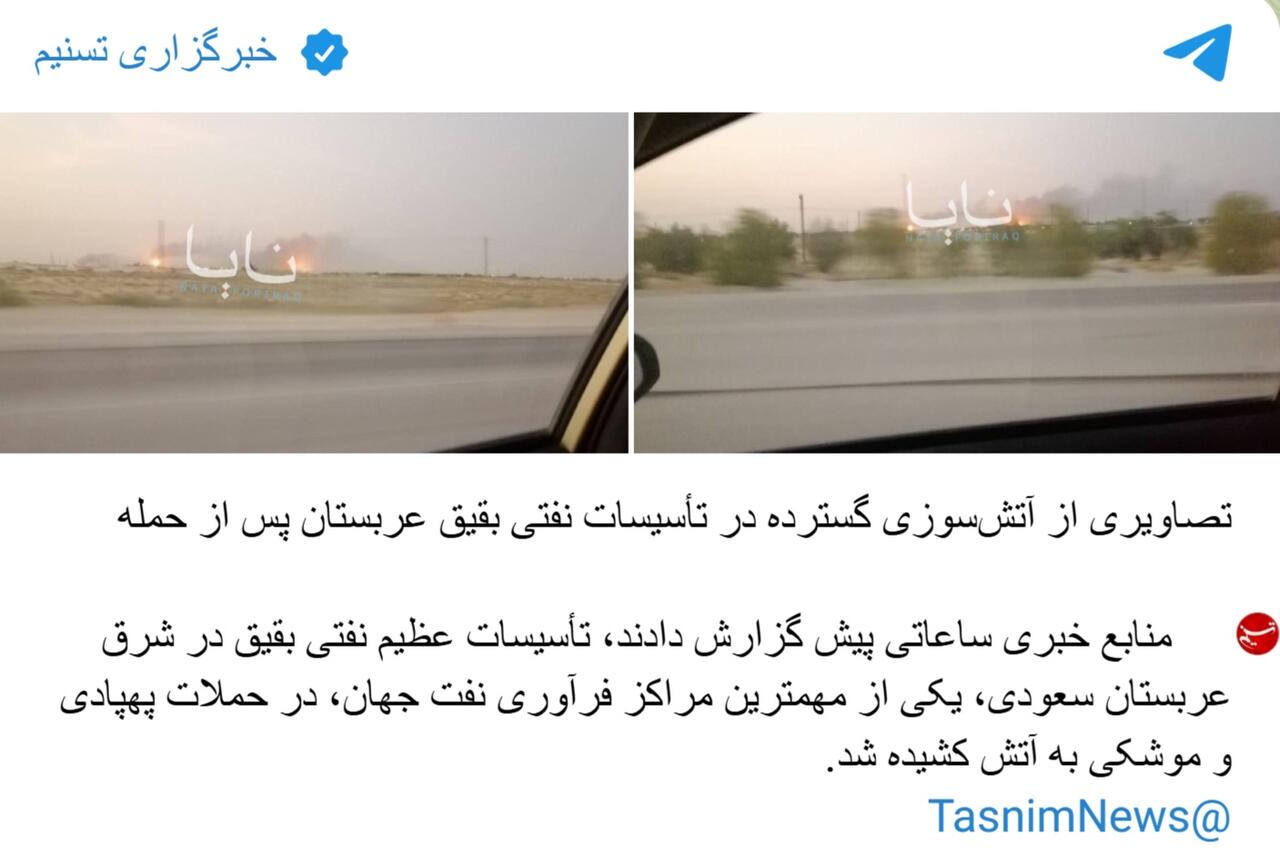
Newsquawk reports based on emerging Iranian state media that “Hours ago, the huge Abqaiq oil facility in eastern Saudi Arabia, one of the world’s most important oil processing centers, was set on fire in drone and missile attacks, reports Tasnim citing sources and images.” Below are the distant images posted by Tasnim on Telegram:
Some various OSINT accounts are also seeking to verify the fires. If confirmed this would be a very serious development, which potential significant impact on the kingdom’s crude output. An official response is emerging from Saudi media, as Arab sources report explosions in the kingdom:
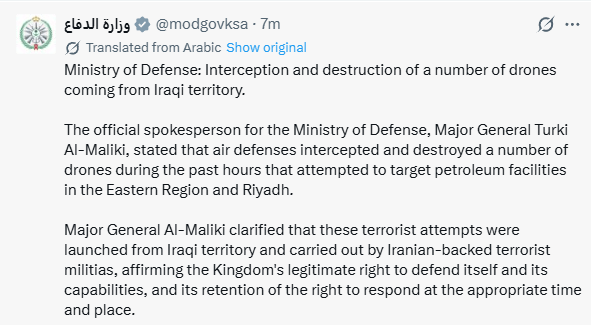
Saudi Arabia’s Ministry of Defence said it intercepted drones from Iraqi territory that attempted to target oil facilities in the Eastern Province and Riyadh regions, Al Hadath reports
Massive 300 mw fire at Abqaiq refinery and east west pumping station. Unclear what the cause is. This saudi oil facility is on fire.
25.92676, 49.68748 is not at a flaring location pic.twitter.com/0iFh1zhEc0
International reports commonly estimate that the sprawling Abqaiq facility – as the largest crude oil stabilization and processing facility in the world – has a maximum processing capacity of 7 million barrels per day (bpd) and typically operates at around 4.9 million bpd.
Houthi media has also been highlighting the fires at the site on Monday, following prior alleged Houthi attacks on key Aramco sites in Jizan and Yanbu over the weekend. The group’s military spokesperson Yahya Sare identified that these sites were hit, with international press agencies citing, “There is no immediate Saudi confirmation, though footage shows plumes of black smoke rising into the air from the Aramco refinery in Jizan.”
‘I Almost Cried’ – Documentary Video Trove Shows Lindsey Graham’s Joy At Start Of Iran War
Batches of previously unreleased documentary footage give a behind-the-scenes look at the late Sen. Lindsey Graham’s work to maneuver the United States into military conflicts on behalf of Israel, and the sheer joy he exuded when President Trump finally brought Graham’s long-held dreams of an all-out war on Iran to fruition.
The video comes from British documentary filmmaker Alex Holder, whom Graham had granted close, ongoing access from 2023 up until Graham’s sudden death on July 11. Holder plans to release a documentary called “Lindsey’s Game” later this year, but he’s just released several samples from his hundreds of hours of footage. They fully cement Graham’s reputation as a man who constantly pushed for war and found unparalleled joy in bringing destruction to foreign peoples.
That latter dimension of Graham’s twisted personality can be vividly seen and heard in footage of Graham in his Senate office in late February. He and is staff are watching Trump, on Fox News, bragging that “virtually everything [the Iranians] have has been knocked out.”
WATCH: Unreleased documentary footage shows Lindsey Graham extremely happy that Trump finally bombed Iran.
“Look what we’ve done here. I almost cried… How long have we been pushing this?” Graham says after U.S. strikes begin.
Positively exuberant that massive US-Israeli attacks on Iran had just begun, Graham laughs aloud with joy, then gushes to the documentary crew and his own staffers, “Look what we’ve done here. I almost cried. I mean, like, how long have we been pushing this?” Holder replies, “you’ve been pushing this for years.” Graham laughs again and — sounding just a child on Christmas morning — says with dewy-eyed disbelief, “Right…it’s here!”
Graham says Trump is enjoying the war too. “I talked to Trump this morning — he’s jacked. He said, ‘best thing I have ever done.’ He loves blowing stuff up.” We’d be remiss if we didn’t remind readers that one of the first things Trump and the US Navy had already blown up in Graham’s giddy early hours of the war was an elementary school in southern Iran. More than 150 civilians were killed at the Minab school, most of them girls between age 7 and 12.
In another remarkable scene, we get to sit in a March 4 Graham phone call with Israeli Prime Minister Benjamin Netanyahu,with whom Graham had actively conspired to maneuver Trump into simultaneously blowing up Iran and blowing up Trump’s many promises to break the cycle of never-ending US wars in the Middle East. The call starts with Graham greeting “Bibi” and sycophantically saying how “impressed” he is with Netanyahu. In what sounds like a thinly-veiled boast for the benefit of the documentary’s eventual audience, Graham adds, “I’m glad to be your friend.”
That’s nauseatingly entertaining, but what makes their ensuing strategy discussion so remarkable is that the infamously bellicose Netanyahu emerges as the relative voice of restraint. Graham tells Netanyahu that he intends to visit Trump in Florida to convince him to join Israel in its war with Lebanon’s Hezbollah militia, but Netanyahu diplomatically tells Graham to take it easy.
UNSEEN FOOTAGE of Lindsey Graham on CALL with Netanyahu revealing plans to LOBBY Trump to BOMB Lebanon
BIBI: Glad you’re my FRIEND
GRAHAM: Going to try to get Trump to join with y’all in Lebanon… WOULD YOU LIKE THAT?
“We’re concentrating right now on Iran,” Netanyahu replies. “If we tell Hezbollah that we’re going all the way… we threaten them, but if we actually do it, then they have no reason not to go all the way against us. And right now that’s not our interest.” Perhaps not wanting to fully spoil Graham’s dreams of American service members being thrown into another conflict for Israel’s benefit, Netanyahu offers, “We can do it later.”
Another clip nicely illustrates just how wrong Graham and other promoters of the war on Iran have been about what would be be rapidly accomplished. In early March, as he’s being driven across town, Graham tells documentarian Holder that, in “three or four weeks,” the United States and Israel would “have them in a spot where they start losing control of some cities” and, with more open Arab involvement in the war, achieve “almost irreversible momentum.”
Five months later, no cities have come even remotely close to falling. Instead, outraged over a war of aggression launched on their country on several bogus pretenses, support for the Iranian government has been galvanized. That’s been manifested in many ways, but none greater than what may have been the largest funeral in the history of the world, as millions turned out earlier this month for a multi-day state funeral for Supreme Leader Ali Khamenei. Continuing its long-running pattern of violating international norms that put heads of state off-limits — and furthering its corruption of what little remains of US government geopolitical morality — Israel collaborated with the United States to kill Khamenei, his daughter, son-in-law, and 14-month-old granddaughter in February’s opening assault.
In other footage reviewed by the Wall Street Journal, Graham voices his disappointment that more Republican politicians aren’t stepping up to promote the war on Iran, which quickly became the most unpopular major war in US history — even less popular than what was observed in the worst polling on the Vietnam War. “Very few people are out selling this war from the administration. I’m shocked,” Graham says.
The last footage recorded by the documentary crew — at a Columbia, SC bagel shop in June — shows a Graham who’s frustrated that Trump has signed a memorandum of understanding that was supposed to be a precursor to a lasting peace. “He’s letting this thing slip away,” Graham said. “I got to go talk to him.”
Key Events This Busy Week: FOMC, PCE, GDP, War On/War Off… And Earnings Galore
Before we look at the week ahead, a quick look at the main event that defines the market this Monday morning: after 13 consecutive nights of US strikes aimed at degrading Iran’s ability to threaten commercial shipping, Washington has refrained from further attacks since late Friday, while Tehran has publicly stated that it has also suspended retaliatory operations. The pause falls short of a formal ceasefire, but both sides are presenting it as an opportunity for diplomacy, with Omani-mediated talks continuing over the weekend focused on navigation through the Strait of Hormuz. US officials, including UN Ambassador Mike Waltz, have stressed that all military options remain on the table and that President Trump is simply giving negotiations more space. However, reports from the New York Times and Axios suggest an active debate within the administration over both the effectiveness and costs of further strikes, with some military officials reportedly arguing that key objectives have largely been achieved. For now, the market is treating the lull as a positive development, although the situation remains highly fluid.
The main market risk remains the energy and shipping front. Traffic through Hormuz remains severely disrupted, while the conflict has broadened into the Red Sea, where Iran-backed Houthi forces reportedly launched missile and drone attacks against Saudi energy infrastructure around Jizan and Yanbu over the weekend, prompting retaliatory Saudi strikes. This raises the prospect of simultaneous disruption to both Gulf and Red Sea export routes. So a welcome pause from the main actors but a fragile one, especially with side battles still ongoing.
However there is no doubt the weekend news is positive and this morning Brent crude prices are around -4.5% lower to $92.42 and 10yr USTs are down -4.5bps. S&P 500 futures are up +0.71% with Nasdaq futures gaining +1.17%.
With that in mind, let’s now look ahead, and as more and more of the financial world steps off the ever-turning carousel of market news and disappears towards sunnier shores, a busy global week lies ahead, with central bank decisions, major economic releases and a heavy slate of corporate earnings all competing for investors’ attention. The Federal Reserve meeting concluding on Wednesday remains the standout event, but investors will also hear from the Bank of England (Thursday) and the Bank of Japan (Friday). Meanwhile, key economic releases include US Q2 GDP and June core PCE inflation (both Thursday), Euro Area Q2 GDP and July inflation data (Thursday/Friday), Japan’s Tokyo CPI (Friday) and China’s official PMIs (Friday). Adding to the significance of the week, four of the world’s most influential companies — Microsoft, Meta, Apple and Amazon, which together account for 17% of the S&P 500—will report earnings, with the first two on Wednesday and the latter two a day later.
The headline event of course comes with the FOMC meeting (Wednesday), where DB economists continue to expect the Fed to leave rates unchanged. However, the decision appears unusually finely balanced. The renewed escalation in the Middle East and the sharp rise in energy prices have complicated the inflation outlook, while recent market-based measures of inflation compensation have moved higher as concerns around energy supply disruptions have intensified. Against that backdrop, policymakers face a difficult trade-off between evidence that inflation had been moderating and growing signs that higher oil prices could create a more persistent inflation shock.
It’s rare for a Fed meeting to be this finely balanced so close to the decision. Futures are still assigning a 34% probability to a rate hike this week (-4pps overnight in Asia), a level of uncertainty we seldom see at such a late stage. During the post-Covid hiking cycle, markets did receive a steer via the financial press during the blackout period if the Fed was considering a surprise move. Under the current regime, that appears far less likely.
The Fed decision will sit in the middle of several important data releases. Durable goods orders (today) and the advance goods trade balance (tomorrow) will help shape expectations for the first estimate of Q2 GDP (Thursday). Economists expect annualized GDP growth of 1.9% in Q2. Although this would mark a downgrade from earlier estimates, much of the weakness reflects a drag from net exports linked to strong AI-related imports. Beneath the surface, domestic demand remains considerably healthier. Indeed, DB’s economists expect final sales to private domestic purchasers, their preferred measure of underlying demand, to rise by a robust 3.3%, which would be the strongest reading since Q3 2024.
Attention will then turn to inflation. The June personal income and spending report (Thursday) includes the latest reading of core PCE, the Fed’s preferred inflation gauge. DB economists expect core PCE to increase by 0.19% month-on-month, which would leave the annual rate at 3.3% assuming no significant revisions. That will be followed by the Employment Cost Index (Friday), one of the Fed’s preferred measures of labor cost pressures. Economists expect the annual growth rate to remain at 3.4%, a level many policymakers would still view as broadly consistent with returning inflation towards target over time.
Alongside the macro data, earnings season moves into a critical phase. Around 35% of the S&P 500’s market capitalization is scheduled to report this week. Technology will dominate attention, with Microsoft and Meta releasing results (Wednesday), followed by Apple and Amazon (Thursday). Together, those companies account for 17% of the S&P 500 and will help determine whether investor enthusiasm around AI-related spending remains intact. Elsewhere, notable US earnings releases include Visa and Mastercard in financials, ExxonMobil and Chevron in energy, and Coca-Cola and Procter & Gamble in consumer staples.
In Europe, attention will be split between monetary policy and inflation. The Bank of England announces its latest policy decision (Thursday), and economists expect Bank Rate to remain unchanged at 3.75%, accompanied by a 7-2 vote split.
On the data side, Germany and Spain release flash July CPI figures (Thursday), before France, Italy and the Euro Area publish their inflation readings (Friday). DB’s European economists expect Euro Area headline HICP inflation to rise to 3.0% from 2.8%, while core HICP is forecast to edge higher to 2.52% from 2.36%. The Euro Area’s preliminary Q2 GDP estimate is also due (Thursday), while Germany’s Ifo survey (today) should provide an updated read on business sentiment.
In Asia, the Bank of Japan decision (Friday) will be the key event. Here, economists expect policymakers to keep their current policy settings unchanged. Japan will also release Tokyo CPI, retail sales, industrial production, labor market data and housing starts (all Friday), offering a comprehensive snapshot of the economy at the start of the third quarter. In China, the official manufacturing and non-manufacturing PMIs (Friday) will provide the latest evidence on growth momentum. Elsewhere, Australia’s June CPI report (Wednesday) will be closely watched for indications about the Reserve Bank’s policy path.
Courtesy of DB, here is a day by day preview of the week ahead.
Monday July 27
Data: US June durable goods orders, July Dallas Fed manufacturing activity, Japan June PPI services, China June industrial profits, Germany July Ifo survey, Eurozone June M3
Auctions: US 2-yr Notes ($69bn), 5-yr Notes ($70bn)
Tuesday July 28
Data: US June advance goods trade balance, wholesale inventories, July Conference Board consumer confidence index, Richmond Fed manufacturing index, business conditions, Dallas Fed services activity, May FHFA house price index, France July consumer confidence, Q2 total jobseekers
Earnings: Visa, Coca-Cola, KLA, Seagate Technology, Boeing, Rio Tinto, Safran, Unilever, Corning, Air Liquide, S&P Global, GSK, UPS, Barclays, EssilorLuxottica, Sherwin-Williams, Mondelez, American Tower, Royal Caribbean Cruises, Ecolab, Hilton, NXP Semiconductors, Teradyne, Ford, Orange, Mercedes-Benz, Kering, Centene, Sika
Auctions: US 7-yr Notes ($44bn)
Wednesday July 29
Data: UK June net consumer credit, M4, Germany June import price index, Italy May industrial sales, Australia June CPI, Sweden Q2 GDP indicator
Central banks: Fed’s decision, BoC summary of deliberations
Earnings: Microsoft, Meta, SK hynix, Lam Research, Procter & Gamble, ARM, L’Oreal, Hermes, Amphenol, Airbus, Qualcomm, UBS, Hitachi, Advantest, Intesa Sanpaolo, Starbucks, Vertiv, Fortinet, CaixaBank, Equinix, Vinci, Eni, Aon, Standard Chartered, Public Storage, Danone, BASF, Porsche, Humana, GE HealthCare Technologies, Telecom Italia
Auctions: US 2-yr FRN ($30bn)
Thursday July 30
Data: US June PCE, personal income, spending, Q2 GDP, initial jobless claims, Japan July consumer confidence index, Germany Q2 GDP, July CPI, France Q2 GDP, private sector payrolls, June consumer spending, Italy Q2 GDP, June unemployment rate, PPI, Eurozone July economic, industrial, services confidence, Q2 GDP, June unemployment rate
Central banks: BoE’s decision
Earnings: Apple, Amazon, Samsung Electronics, Mastercard, Shell, Tokyo Electron, Schneider Electric, AB InBev, Rolls-Royce, BBVA, British American Tobacco, Bristol-Myers Squibb, Altria, Stryker, Enel, Sanofi, ING Groep, Lloyds Banking, KKR, BAE, Cigna, Monolithic Power Systems, Regeneron, CRH, Societe Generale, Ferrari, Vale, LSEG, Anglo American, adidas, Leonardo, Reddit, DSM-Firmenich, MTU Aero Engines, Capgemini, Stellantis
Friday July 31
Data: US Q2 employment cost index, July MNI Chicago PMI, China July official PMIs, UK July Lloyds Business Barometer, Japan July Tokyo CPI, June jobless rate, job-to-applicant ratio, retail sales, industrial production, housing starts, Germany July unemployment claims rate, France July CPI, June PPI, Italy July CPI, consumer confidence index, economic sentiment, manufacturing confidence, Eurozone July CPI, Canada May GDP
Finally, looking at just the US, the key economic data releases this week are the advance release of Q2 GDP and core PCE inflation on Thursday. The July FOMC meeting is on Wednesday. The post-meeting statement will be released at 2:00 PM ET, followed by Chairman Warsh’s press conference at 2:30 PM.
Monday, July 27
08:30 AM Durable goods orders, June preliminary (GS +1.0%, consensus +1.8%, last -4.5%); Durable goods orders ex-transportation, June preliminary (GS +0.6%, consensus +0.8%, last +1.4%); Core capital goods orders, June preliminary (GS +0.6%, consensus +0.8%, last +1.4%); Core capital goods shipments, June preliminary (GS +0.6%, consensus +0.5%, last +0.1%): We estimate that durable goods orders rebounded 1% in the preliminary June report (month-over-month, seasonally adjusted) based on our tracking of commercial aircraft orders. We forecast a 0.6% increase in core capital goods orders—reflecting the increase in the new orders components in manufacturing surveys in June—and a 0.6% increase in core capital goods shipments—reflecting the continued increase in core capital goods orders in recent months.
Tuesday, July 28
08:30 AM Advance goods trade balance, June (GS -$95.0bn, consensus -$100.3bn, last -$105.9bn)
08:30 AM Wholesale inventories, June preliminary (last +0.1%)
09:00 AM FHFA house price index, May (last -0.1%)
09:00 AM S&P Case-Shiller home price index, May (GS +0.1%, consensus flat, last flat)
10:00 AM Conference Board consumer confidence, July (GS 92.0, consensus 92.4, last 91.2)
Wednesday, July 29
02:00 PM FOMC statement, July 28-29 meeting: As discussed in our FOMC preview, at its July meeting, the FOMC is likely to keep the funds rate unchanged at 3.50-3.75%. The post-meeting statement might acknowledge the upside risks to inflation posed by renewed geopolitical conflict, and there will likely be at least one dissent in favor of a hike. Market pricing implies that investors see the outcome of the July meeting as unusually uncertain, likely because the FOMC has been split recently, Chairman Warsh’s own position remains unclear, and some of the re-escalation with Iran occurred during the blackout period. But most voters appear unlikely to push for a hike this week after the softer June inflation data, the Fed has historically avoided delivering surprise rate hikes, and we suspect that voters might be especially reluctant to do so at a meeting without a Summary of Economic Projections.
Thursday, July 30
08:30 AM GDP, Q2 advance (GS +2.6%, consensus +2.1%, last +2.1%); Personal consumption, Q2 advance (GS +2.3%, consensus +2.3%, last +0.5%); Core PCE inflation, Q2 advance (GS +3.46%, consensus +3.5%, last +4.4%); We estimate that GDP rose 2.6% annualized in the advance reading for Q2, following a +2.1% annualized increase in Q1. Our forecast reflects a rebound in consumption growth (+2.3%, quarter-over-quarter annualized, vs. +0.5% in Q1) and another quarter of strong business fixed investment growth (+8.8% vs. +10.6% in Q1) driven by strong equipment investment growth (+17.1%). We expect net exports to contribute -1.3pp to Q2 GDP growth. We estimate that domestic final sales rose +2.6% in Q2. We estimate that the core PCE price index increased 3.46% annualized (or 3.35% year-over-year) in Q2.
08:30 AM Personal income, June (GS +0.4%, consensus +0.3%, last +0.7%); Personal spending, June (GS +0.6%, consensus +0.4%, last +0.7%); Core PCE price index, June (GS +0.18%, consensus +0.2%, last +0.3%); Core PCE price index (YoY), June (GS +3.32%, consensus +3.3%, last +3.4%); PCE price index, June (GS -0.07%, consensus -0.1%, last +0.4%); PCE price index (YoY), June (GS +3.70%, consensus +3.7%, last +4.1%): We estimate that personal income and spending increased by 0.4% and 0.6%, respectively, in June. We estimate that the core PCE price index rose 0.18% in June, corresponding to a year-over-year rate of +3.32%. Additionally, we expect that the headline PCE price index declined 0.07% in June and increased 3.70% from a year earlier.
08:30 AM Initial jobless claims, week ended July 25 (GS 205k, consensus 200k, last 187k): Continuing jobless claims, week ended July 18 (consensus 1,803k, last 1,796k)
Friday, July 31
08:30 AM Employment cost index, Q2 (GS +0.8%, consensus +0.8%, last +0.9%): We estimate the employment cost index rose by 0.8% in Q2 (quarter-over-quarter, seasonally adjusted). Our forecast would result in a 0.2pp decline in the year-on-year rate to 3.2% (year-over-year, not seasonally adjusted), which would mark the slowest pace of yearly wage growth since 2021Q2. Our forecast reflects slower ECI benefit growth after start-of-the-year benefit resets likely boosted growth in Q1 and a 0.8% quarterly pace of wage and salary growth—reflecting the signals from the Atlanta Fed’s wage tracker and average hourly earnings.
10:00 AM University of Michigan consumer sentiment, July final (GS 54.0, consensus 54.0, last 54.4); University of Michigan 5-10-year inflation expectations, July final (GS 3.3%, last 3.3%)
Deutsche Bank Says Starship Flight 13 Made “Solid Progress” Despite Booster Setback
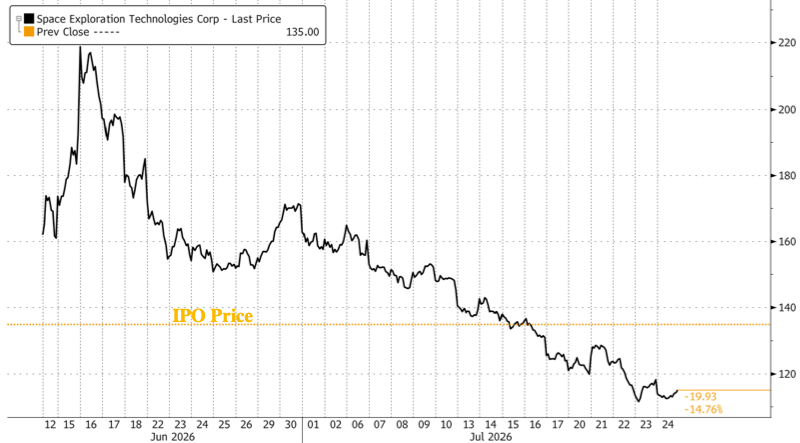
Following last month’s record-setting IPO, SpaceX shares have plunged 50% from their peak and now trade about 15% below the $135 offering price. The post-IPO euphoria has faded, stripping Elon Musk of his trillionaire status – at least for now.
On Friday evening, SpaceX launched Starship on its 13th test flight and successfully deployed 20 next-generation Starlink V3 satellites, making solid progress toward full reusability. The upper-stage spacecraft completed all its primary objectives, despite another landing-burn failure involving the Super Heavy booster.
Deployment of 20 @Starlink V3 satellites complete. Today’s test will provide critical data as we prepare to expand our Starlink constellation pic.twitter.com/jWKLwXGlsk
Deutsche Bank analyst Edison Yu offered clients a post-mortem on Flight 13, noting that the latest Starship test.
Here is Yu’s take:
Starship Test Flight 13 illustrated solid progress for the program, in our view. For context, this was the second time the upgraded V3 iteration of Starship was flown. Interestingly, the rocket’s second stage (Ship) executed all primary objectives whereas the first-stage booster (Super Heavy) performed well for most of the mission until an incomplete engine relight led to a harder splashdown than planned which was also an issue observed on Flight 12. As such, it does appear SpaceX may attempt a catch recovery of the second stage on the next test flight; if successful, this would represent a key milestone given the very high technical difficulty. Additionally, Flight 13 saw the successful deployment of 20 functional Starlink next-gen V3 satellites. Overall, while the initial abort was optically not ideal, we think Starship continues to progress in line with our base-case expectations
What caused the initial abort?
During the first launch attempt on July 16th , Starship reached T-0 and began the engine start sequence. However, 4 of Super Heavy’s 33 Raptor engines failed to ignite. Therefore, the flight computer automatically aborted because the launch commit criteria permits a maximum of 2 engines out at liftoff. The company identified the cause to be off-nominal spin response in the liquid oxygen (LOX) turbopumps of 6 engines (4 failed to light plus 2 that displayed off-nominal behavior). The most likely cause of this dynamic was residual moisture that had collected inside the turbopumps from earlier operations. When the extremely cold cryogenic propellant was loaded, that moisture appeared to have frozen. As a result, the ice either slowed the turbopumps dramatically or stopped them from spinning up properly, so those engines never reached the required conditions to ignite. To address this, SpaceX removed and replaced 6 Raptor engines, performed verification testing including spin checks after chill. Then the attempt on July 23rd was postponed due to weather conditions in order to preserve visual coverage of the heat shield tiles during ascent. For background, the heat shield is still being iterated upon and considered one of the higher risk + less mature parts of Starship; therefore, gathering optical data is
What went well?
Ascent & staging: All 33 booster engines and all 6 Ship engines performed well through their powered phases. Hot-staging was clean – rocket separation where the upper stage ignites its engines while still attached to the lower stage booster, which is also still firing.
Boostback: First successful completion of the high-thrust portion of the boostback burn with all 33 engines running on V3 boosters. This is the maneuver that reverses first-stage booster’s horizontal forward momentum and steers it back toward the ocean.
Starlink V3 deployment: First flight of functional (not simulator) next-gen V3 satellites. All 20 sats deployed, extended solar arrays and antennas, established RF and laser links, and returned telemetry before burning up on reentry after ~20 minutes.
In-Space Raptor relight: Successful single-engine restart in space; the longest demonstrated to date. Important capability for future orbital missions and controlled de-orbit.
Ship reentry & landing: Soft, controlled splashdown in the Indian Ocean. Ship 40 remained intact, continued transmitting telemetry and imagery, and provided the first high-quality views of an intact heat shield after a full reentry under higher dynamic pressure; should be ideal for heat-shield data collection.
What needs to improve?
Booster landing burn: Only a subset of the Super Heavy engines (seemingly 8 out of 13) successfully relit for the landing burn. Hence, there was a hard splashdown rather than a soft, controlled impact. This remains the primary technical open item on the first-stage booster.
Next up: Flight 14
Following Flight 13, Elon Musk posted on X: “Unless we discover problems after mission data review, SpaceX will attempt to catch the ship with the tower on next flight.” This would be the first attempt to catch the upper stage using the Mechazilla tower arms and if successful, would represent a major milestone for the program given the much higher technical difficulty level compared with catching the first stage (energy, speed, flip maneuver, margin of error, etc…). We estimate a target window in late August or September. Separately, we note that Starlink V3 satellites can be deployed on Starship even with partial reusability.t a catch recovery of the second stage on the next test flight;
SPCX shares dipped 1.5% in Monday premarket trading, falling to the $113 handle as the stock searches for a floor following its dismal post-IPO performance.
Looking ahead, SpaceX faces its first major post-IPO lockup expiration on Aug. 6, just two days after its scheduled quarterly earnings report. About 911.5 million shares will become eligible for sale, creating a potentially significant supply overhang.
A federal appeals court sided with 23 Democrat-led states and blocked the Trump administration from enforcing key pieces of the president’s election integrity order, setting up a likely showdown at the Supreme Court just months before the midterms.
The 1st U.S. Circuit Court of Appeals ruled 2-1 to deny the Justice Department’s request to pause a lower court injunction while the administration’s appeal moves forward, leaving in place a ruling that stripped federal agencies of the power to enforce several provisions of President Donald Trump’s order in those states through the Nov. 3 elections.
The Justice Department has signaled it may now turn to the Supreme Court for emergency relief, a path the administration flagged earlier in the litigation should it fail to prevail at the appellate level.
Trump signed Executive Order 14399 in March, directing the Department of Homeland Security to compile lists of confirmed citizens eligible to vote and hand them to states, ordering the U.S. Postal Service to set new handling standards for mail-in ballots, and instructing the Justice Department to prioritize investigations of state and local officials who send federal ballots to people who should not receive them.
The measures represent one of the most significant pushes yet from the administration to shore up confidence in an election system Republicans have long argued is vulnerable to fraud and error, particularly through loosely regulated mail voting.
The administration argued the lawsuit was filed too soon, since federal agencies had not yet finalized the rules needed to carry out the order. The panel’s majority rejected that argument, finding the states already faced fast-approaching deadlines tied to the order and had no choice but to begin preparing for compliance.
“As the district court reasoned, the (executive order) lays out a clear set of rapidly approaching deadlines by which states must coordinate with federal officials and comply with new voting procedures,” the majority wrote.
“The Plaintiff States have no practical choice but to respond to the (order) now.”
The lawsuit, led by California, Massachusetts, Nevada and Washington, was joined by 19 other states and the District of Columbia, all governed by Democrats who have resisted the administration’s election security efforts from the start.
The states claim the Constitution gives them, not the president, primary authority over administering federal elections, an argument U.S. District Judge Indira Talwani accepted in June when she ruled several provisions likely exceeded Trump’s authority.
Saturday’s decision does not settle the underlying dispute over presidential power but keeps Talwani’s injunction intact while the case winds through the courts, a delay that could push final resolution dangerously close to the midterms.
Critics of the ruling argue that leaving basic safeguards, like verifying citizenship and tightening mail-ballot standards, in legal limbo only benefits officials in blue states with a history of loose election administration.
Millions of families have already signed up, and millions more are asking the same practical questions: does my child qualify, how do I claim the $1,000, and is this better than the 529 plan we already have?
Most coverage explanations answer these questions in tax-professional language. Here are the essentials in plain terms, including one state-level catch that could surprise you at tax time.
Quick Answer: Who Qualifies for a Trump Account?
Any child who is a U.S. citizen with a valid Social Security number can have a Trump account, as long as it is opened before the year they turn 18. The one-time $1,000 federal seed contribution is narrower: it goes only to eligible children born between January 1, 2025, and December 31, 2028. Parents or guardians claim it by submitting IRS Form 4547, which can be filed through the Trump Accounts app, at trumpaccounts.gov, through an IRS Individual Online Account, or when filing taxes. Once the Treasury confirms the account is active, it deposits the $1,000.
What Your Child Gets, by Birth Year
The seed money depends entirely on when your child was born.
Dozens of companies, including several major banks and technology firms, have pledged to match the federal $1,000 for employees’ children. If you or your child’s other parent works for a large employer, it is worth asking human resources before assuming the seed money is all your child will receive.
The Contribution Rules in Plain Terms
Once the account exists, here is how money goes in:
The combined cap is $5,000 per year. Parents, grandparents, and anyone else contribute after-tax dollars, and all of it counts toward one shared limit per child. The cap adjusts for inflation after 2027.
Employers get special treatment. An employer can put in up to $2,500 per year for a worker’s child. That amount counts toward the $5,000 cap but is excluded from the employee’s taxable income.
Some money does not count against the cap. Contributions from qualifying charities, states, tribes, and local governments sit outside the $5,000 limit, as does the federal seed itself.
Contributions stop the year before the year your child turns 18.
For grandparents, the practical takeaway is coordination. Because the cap is shared, a grandparent writing a $5,000 check uses up the entire year’s room for everyone.
How the Account Actually Works
A Trump account is best understood as a special kind of IRA with training wheels. The money is invested in a low-cost index fund tracking the S&P 500, so the balance rises and falls with the stock market.
Earnings grow tax-deferred at the federal level, and the funds are locked until the child turns 18, with only limited exceptions. On January 1 of the year the child turns 18, the account essentially converts to a traditional IRA in the child’s name.
That last detail matters: Withdrawals in adulthood are generally taxed as ordinary income, the same as any traditional IRA.
The State Tax Catch Almost Nobody Explains
Here is the wrinkle buried in most coverage explanations.
Federal tax deferral does not automatically mean state tax deferral. State tax codes must conform to the new federal rules, but some states have not done so.
California is the most prominent example: Unless state law changes, annual earnings inside a Trump account could be taxable on your California return each year, even while federal taxes wait until withdrawal.
That does not make the account worthless in a nonconforming state. The $1,000 seed is still free money, and federal deferral still helps. But it changes the math on large voluntary contributions and creates a recordkeeping chore.
Before contributing beyond the seed, check your state’s current treatment with your state tax authority or a tax professional, because conformity decisions are still moving in several states.
Trump Account vs. 529: The Short Version
If you already fund a 529 plan, the two are not interchangeable.
A 529 offers tax-free withdrawals for qualified education expenses, and many states add a deduction for contributions – a Trump account offers neither.
A Trump account has no education restriction – at 18 it becomes retirement-oriented IRA money, giving your child a decades-long compounding head start.
The sensible sequence for most families: claim the free seed money if your child qualifies, keep education savings in the 529, and treat additional Trump account contributions as a separate, long-horizon decision.
FAQs About Trump Account Eligibility
Is the $1,000 Seed Contribution Automatic?
No. Eligible children born between 2025 and 2028 do not receive the money by default. A parent or guardian must first open the account and elect the contribution by submitting IRS Form 4547, whether through the Trump Accounts app, trumpaccounts.gov, an IRS Individual Online Account, or a tax return. After the Treasury confirms with the account trustee that the account is active, it deposits the $1,000. No account, no seed money.
Can Grandparents Contribute to a Trump Account?
Yes. Grandparents, other relatives, and even friends can contribute, but everything counts toward the single $5,000 combined annual cap per child, alongside contributions from parents and employers. Contributions are made with after-tax dollars and are not deductible. Families should coordinate before year-end so a well-meaning gift does not crowd out an employer match, which carries the added benefit of being excluded from the employee’s taxable income.
What if My Child Was Born Before 2025?
Your child can still have a Trump account, opened any time before the year they turn 18, and family or employer money can go in under the normal rules. They simply will not receive the federal $1,000. Children born from 2016 through 2024 may qualify for a $250 Dell Foundation deposit if they live in a ZIP code where the median income is $150,000 or less, which covers most of the country.
Will My State Tax the Earnings Each Year?
Possibly, depending on where you live. The accounts are tax-deferred under federal law, and states must conform to that treatment, but some, including California, may tax annual earnings at the state level unless their laws change. In a nonconforming state you could owe state tax on gains yearly while federal tax waits. Check your state’s current position before making large contributions, since several legislatures are still deciding.
Saudi Aramco Targeted, Including Sprawling Abqaiq Facility, As Tehran-Aligned Militants Test US-Iran ‘Pause’
Saturday saw a final break in what was 13 consecutive days of tit-for-tat attacks between the United States and Iran, with US Ambassador to the United Nations Mike Waltz having confirmed to Fox News Sunday that President Trump is trying to give peace talks “some space”.
“He’s giving it a little bit of room,” Waltz said. “We’ve had both Oman and Iran and a number of our other negotiators engaged at every level, from the most senior levels all the way down to the technical level, over the past few weeks and particularly in the past few days.”
Walsh has brushed aside emerging reports that US defense interceptor supplies are running low, “I want to be crystal clear: The U.S. military, and I’ve verified this every which way, has everything that it needs to conduct this campaign as effectively as it needs to be,” he said.
But a who’s who of top admin and military officials have voiced concerns, including the following:
The New York Times reported Gen. Dan Caine, chair of the Joint Chiefs of Staff, has privately argued resuming major combat operations against Iran would seriously deplete the antimissile interceptors available to U.S. Central Command (Centcom). The outlet reported the threat to interceptor stockpiles is one of many considerations that have made a return to major combat operations risky.
Vice President Vance raised concerns about escalating the war in a meeting with the president at the White House on Friday, CNN reported.
Two sources with knowledge of Adm. Brad Cooper’s position told Axios that the Centcom commander has recommended stopping the bombing campaign around the Strait of Hormuz because it has reached the limit of its effectiveness.
An Iranian military official warned Sunday that the country would expand its ‘retaliatory’ attacks in the region if the US restarts airstrikes. This as a pause has held for two days.
“I believe that if the Americans once again fall for the Zionists’ deception, or move in line with them, and insist on continuing the war, particularly through airstrikes, geographically this will expand further,” Iranian army spokesman Mohammad Akraminia told AFP. Iran is also boasting that it still controls the Strait of Hormuz, and that Washington is “stuck” in the region – and that only Tehran decides when the conflict ends.
Tehran has at the same time once again confirmed there are no negotiations happening. “It’s possible that mediators share messages from the US side about current developments in the region, but at the moment we have no negotiations with the US,” Iranian Foreign Ministry spokesman Esmail Baghaei told reporters on Monday.
The ARAMCO refinery in Jizan, eastern Saudi Arabia, is still burning more than 2 days after the impact of ballistic missiles launched by the Houtis.
A massive trail of smoke which extends for about 70 km can be seen on Sentinel-2 satellite imagery, 26/07/2026. pic.twitter.com/v05cwhMRjY
He also batted down claims that Iran has requested negotiations – after Trump recently asserted it was begging for talks – as “fake news”. Baghaei further explained that Iran won’t hesitate to use diplomacy to protect national interests, as cited in Bloomberg. He also described that Iranian and Omani officials held several rounds of “useful” talks about the management of ship traffic in the Strait of Hormuz.
US strikes and Iranian counterattacks could restart at any moment, given that the US continues to enforce a blockade on Iranian ports.
Still, an unnamed Iranian official separately told Reutersthat Tehran’s position “remains ‘attack for attack’: if the attacks stop, Iran will also halt its operations. That message has already been conveyed to the United States.”
Meanwhile there are emerging Monday reports that Saudi Aramco’s Abqaiq oil processing facility in the kingdom’s eastern province is on fire after probable drone and/or missile strikes by the Houthis, or from Iran-aligned Iraqi militias.
Newsquawk reports based on emerging Iranian state media that “Hours ago, the huge Abqaiq oil facility in eastern Saudi Arabia, one of the world’s most important oil processing centers, was set on fire in drone and missile attacks, reports Tasnim citing sources and images.” Below are the distant images posted by Tasnim on Telegram:
Some various OSINT accounts are also seeking to verify the fires. If confirmed this would be a very serious development, which potential significant impact on the kingdom’s crude output. An official response is emerging from Saudi media, as Arab sources report explosions in the kingdom:
Saudi Arabia’s Ministry of Defence said it intercepted drones from Iraqi territory that attempted to target oil facilities in the Eastern Province and Riyadh regions, Al Hadath reports
Massive 300 mw fire at Abqaiq refinery and east west pumping station. Unclear what the cause is. This saudi oil facility is on fire.
25.92676, 49.68748 is not at a flaring location pic.twitter.com/0iFh1zhEc0
International reports commonly estimate that the sprawling Abqaiq facility – as the largest crude oil stabilization and processing facility in the world – has a maximum processing capacity of 7 million barrels per day (bpd) and typically operates at around 4.9 million bpd.
Houthi media has also been highlighting the fires at the site on Monday, following prior alleged Houthi attacks on key Aramco sites in Jizan and Yanbu over the weekend. The group’s military spokesperson Yahya Sare identified that these sites were hit, with international press agencies citing, “There is no immediate Saudi confirmation, though footage shows plumes of black smoke rising into the air from the Aramco refinery in Jizan.”