When a state starts floating an exit tax, it is telling you something more important than any campaign slogan: the people running the place know their model is not working.
They may not say it that way. They will call it fairness, responsibility, or making the wealthy “pay what they owe.” But the meaning is the same.
If families, entrepreneurs, and investors are leaving, the state can either ask why its policies are pushing them out, or it can try to tax them for escaping. An exit tax chooses punishment over reform.
I understand why these proposals resonate with some people. If you are watching wealthy residents relocate while governments still face bills for schools, roads, pensions, and other commitments, it is easy to feel like the people with the most mobility are ducking the tab.
That frustration is real. It deserves a serious answer. But an exit tax is not a serious answer. It is a confession that lawmakers would rather cling to a failing fiscal model than fix the spending, regulation, and tax policies that made people want to leave in the first place.
That is why the current trend is so revealing.
In California, proposals have centered on taxing billionaire net worth, including wealth that often exists on paper rather than in cash. In New York, the push has extended to a new surcharge on high-value second homes in New York City.
In Washington, lawmakers have already enacted a “millionaires’ tax.” These policies differ in form, but not in spirit. They all send the same message: if government has made your state too expensive, too hostile, or too unpredictable, it may still try to claim part of your future anyway.
The economics are worse than the politics. Supporters talk as if wealth is a pile of idle cash sitting in a vault, just waiting to be skimmed. It is not. Wealth is usually tied up in businesses, shares, property, and future earnings.
Taxing net worth or unrealized gains means taxing value that often has not been sold, realized, or converted into cash. That can force asset sales, dilute business ownership, weaken investment, and change behavior long before the tax collector ever gets a check.
A Hoover Institution analysis of California’s proposal found that once likely migration responses are considered, the measure could leave the state with a negative net present value of about $25 billion. That is the real lesson: politicians score the tax statically, but the economy does not sit still.
And that is before you get to the broader evidence. The OECD has noted that recurring net wealth taxes have become much less common across advanced economies because they tend to raise less revenue than promised while creating large compliance costs, avoidance incentives, and economic distortions. Countries tried them. Many backed away.
A recent NBER study on Scandinavian wealth taxation found that higher top wealth-tax rates reduced the number of wealthy taxpayers and that many of those taxpayers were business owners whose departure reduced investment, employment, and value-added.
That is the part too often ignored in political talking points. When a state drives out a founder, investor, or employer, it is not just losing one tax return. It is losing future jobs, future capital formation, and future opportunity for everybody else too.
Defenders of exit taxes still fall back on one argument that sounds morally satisfying: these taxpayers benefited from state infrastructure, legal protections, and markets while they lived there, so the state deserves one final cut
But that argument quietly rewrites the relationship between citizen and government. It turns moving into a taxable offense. It says the state retains a lingering claim on your success because you once lived under its jurisdiction. That is a dangerous principle in a federal system built on mobility and competition.
Even in the international arena, exit taxes are controversial, complex, and tied to specific movements of assets or functions across borders. Importing that logic into state tax policy is not modernization. It is escalation.
The problem is not just that these taxes are bad economics. It is that they usually do not stay narrow. Politicians sell them as a tool aimed only at billionaires or luxury homeowners — policy aimed at an applause line. But when the revenue falls short, the scope expands.
Frédéric Bastiat warned us to look not just at what is seen, but at what is unseen. We see the tax revenues. That’s a small, visible victory compared to the investment that never happens, the entrepreneur who builds elsewhere, jobs that never arrive — the unseen costs compound.
Exit taxes are built on ignoring all of that.
Claiming an exit tax frames mobility as theft, when it is often a rational response to bad governance. They do not restore prosperity. They steal the opportunity to prosper by doubling down on the very policies that made growth harder in the first place.
If lawmakers want to deter departures, the answer is not a fiscal trap door. It is better policy: lower taxes, lighter regulation, spending restraint, and a serious effort to make their states places where productive people want to stay.
Real economic renewal is more difficult than yet more taxation, but it is also the only approach that works. Exit taxes will not save failing states. They only confirm why people wanted to leave.
No Deal Reached, Amid ‘Fabricated’ Mideast Media Reports; Trump Presses Nuclear Issue & Iran President Says ‘Won’t Back Down’
Summary
Al Arabiya issues dramatic retraction on prior ‘deal reached’ reporting.
Iranian president vows to not back down, as Trump still vows to get nuclear material.
AI Arabiya TV obtains what it describes as final draft of US-lran agreement,
Reuters reported that Ayatollah ordered that stockpile of uranium enriched to 60% remain strictly inside Iranian territory. Some Iranian officials then denied report to Al Jazeera.
WH says make a deal or else… “they can face a punishment from our military the likes of which has not been seen in modern history.”
US Intelligence says Iran has reconstitute drone program, defense industrial base, “faster than expected” (CNN).
After something like eight hours – which unleashed significant moves in oil and markets – complete retractions are being issued, with words like ‘fabrication’ used, after which oil swings higher…
Iranian President: Won’t Back Down
Iranian President Masoud Pezeshkian has stated, “We will not bow our heads, our ministers and experts are working day and night, without a single day off.” He added, per state sources: “We are willing to sacrifice as much as possible for the honor and pride of Iran, and we are not afraid of martyrdom.”
Markets reversed earlier gains as Iran’s President said on state TV that they won’t back down in talks. The momentum then picked up when a “high-level source” told Al-Arabiya that the Pakistani Army Chief will not head to Tehran tonight.
The Pakistani were supposed to head to Iran only when the reach of an agreement was in sight, so this kind of denies the earlier reports of a US and Iran draft agreement.
US stock indices erased more than half of earlier gains. We’ve seen the same reaction in oil, FX and bond markets but now they are consolidating.
Still, Al Jazeera is reporting that “negotiators are very close to reaching a deal, and are currently working on a draft text. At the same time, another source told Al Jazeera that it is too early to judge whether a serious, final agreement is within reach.”
IRNA has cited a Pakistani official who says the talks are “moving in the right direct” – though it’s anyone’s guess at this point. The prior reported draft did not take up the nuclear issue. Trump continues to press the nuclear issue:
US President Donald Trump has again pledged to seize Iran’s stockpile of highly enriched uranium as part of any agreement over Tehran’s nuclear program.
“Look, we’re going to make sure they don’t have a nuclear weapon or we’re going to have to do something very drastic. I believe when it’s put to the people of our country, they will all agree we cannot let Iran get a nuclear weapon,” Trump told reporters at the White House.
Asked whether Iran could retain its enriched uranium, Trump replied: “No, we will get it. We don’t need it, we don’t want it, we’ll probably destroy it after we get it. But we’re not going to let them have it.”
Oil Plunges on Final Draft of US-Iran Agreement Reached
Is this the one? While we’ve seen this rodeo before, oil is plunging on a Saudi media report which is positive for peace. Crude hits low of day…
Traders Circulate AI Arabiya TV obtaining what it describes as final draft of US-lran agreement: (CLICK TO SEE KEY PROVISIONS) – UNCONFIRMED
Key provisions include:
1) An immediate, comprehensive, and unconditional ceasefire on all fronts (land, sea, air)
2) Mutual commitment not to target military, civilian, or economic infrastructure
3) Cessation of military operations and instigating media warfare
4) Respect for sovereignty, territorial integrity, and non-interference in internal affairs
5) Guaranteed freedom of navigation in the Gulf, Strait of Hormuz, and Sea of Oman
6) Establishment of a joint monitoring and dispute resolution mechanism
7) Launch of negotiations on outstanding issues within seven days
8) Gradual lifting of U.S. sanctions in exchange for Iran’s adherence to the terms
9) Affirmation of compliance with international law and the UN Charter
Importantly, there’s no mention of the nuclear issue.
“The agreement is stated to enter into force immediately upon formal announcement by both parties,” the Al Arabiya report says.
Saudi’s @AlArabiya TV has obtained what it describes as the final draft of a prospective Pakistani mediated U.S.-Iran agreement, reportedly set to be announced within hours [It does not align with what I am hearing].
Drones, Military Industrial Base Being Rapidly Restored Amid Extended Ceasefire
The Iranians have reportedly rebuilt damaged and destroyed defense industrial sites much faster than expected. That’s according to US intelligence assessments cited in CNN, and based on anonymous officials. The Pakistan-mediated talks have been stalled, and each of the last several weeks has seen Washington issue updated peace conditions, only for Tehran to in return counter-issue its own demands. And round and round the indirect negotiation has gone, yet with no breakthrough, or not so much as a step forward.
But perhaps this was all a tactic to simply prolong the ceasefire? It allowed for Iran to rearm and regroup, after the prior 38-days of US-Israeli bombing. “Iran has already restarted some of its drone production during the six-week ceasefire that began in early April, one sign it is rapidly rebuilding certain military capabilities degraded by US-Israeli strikes, according to two sources familiar with US intelligence assessments,” CNN reports Thursday. “Four sources told CNN that US intelligence indicates Iran’s military is reconstituting much faster than initially estimated.”
One US official cited in the report has gone so far as to say “The Iranians have exceeded all timelines the IC had for reconstitution.” In the recent past, White House officials themselves have admitted that the Islamic Republic is probably reconstituting. Trump in the meantime keeps saying he’s ‘days’ away from reordering strikes amid Tehran’s intransigence. According to more on Iranian efforts to prepare for the next potential round of fighting:
The rebuilding of military capabilities, including replacing missile sites, launchers and production capacity for key weapons systems destroyed during the current conflict, means that Iran remains a significant threat to regional allies should President Donald Trump restart the bombing campaign, according to the four sources familiar with the intelligence. It also calls into question claims about the extent to which US-Israeli strikes have degraded Iran’s military in the long term.
While the time to restart production of different weapons components varies, some US intelligence estimates indicate Iran could fully reconstitute its drone attack capability in as soon as six months, one of the sources, a US official, told CNN.
Throughout the morning, and since the Reuters report was first issued, various unnamed Iranian officials are saying the Ayatollah gave no such order regarding taking enriched uranium removal off the table when it comes to potential negotiations. According to an Al Jazeera correspondent:
A senior Iranian official denied to me reports that Supreme Leader Mujtaba Khamenei has issued a new order requiring enriched uranium to remain inside Iran, saying they are “propaganda by the enemies of the deal” The official added there are “no new order has been issued,” and that Tehran’s position has been consistent: Iran would downblend the material itself. “That is the subject of talks in the next stage,” the official said.
This will likely only fuel speculation of deep division within Iranian leadership ranks. Traditionally the IRGC reports directly to the Ayatollah, and is seen as the more hardline faction, ready to resist compromise and opt for a military response to US pressure.
Oil snaps lower on the denials… per Newsquawk:
In an immediate reaction, crude fell to the detriment of the USD and the benefit of equity and fixed benchmarks. Specifically:
• WTI Jul’26 fell from USD 102/bbl to USD 100.56/bbl.
• UST Jun’26 lifted from 109-00 to 109-04+.
• ES Jun’26 lifted from 7418 to 7433.
Ayatollah Orders Enriched Uranium To Say On Iranian Soil: RTRS
The illusion of a grand diplomatic breakthrough in the Middle East is once again colliding with reality. The White House has been busy trying to paint a picture of a total capitulation by Tehran, which hasn’t been demonstrated given its consistent position defying Washington’s demands on the nuclear issue.
According to two senior Iranian officials speaking to Reuters, Iranian Supreme Leader Mojtaba Khamenei has drawn a hard line in the sand, ordering that Iran’s stockpile of uranium enriched to 60% remain strictly inside Iranian territory.
Reuters underscores that “Ayatollah Mojtaba Khamenei’s order could further frustrate U.S. President Donald Trump and complicate talks on ending the U.S.-Israeli war on Iran.”
“Israeli officials have told Reuters that Trump has assured Israel that Iran’s stockpile of highly enriched uranium, needed to make an atomic weapon, will be sent out of Iran and that any peace deal must include a clause on this,” the report continues.
The officials noted that within Tehran, there is deep suspicion that the ceasefire is in fact “a tactical deception by the US,” designed to lull Iran into a “false sense of security… before the fighting resumes.”
The fresh directive from from the supreme leader flies directly in the face of the narrative being spun by Washington and Tel Aviv, given Israeli officials maintain that President Trump explicitly promised Israel that Iran’s highly enriched stockpile would be completely removed from the country as part of any negotiated settlement.
Trump has also recently proclaimed this publicly, for example in a phone interview with CBS News last month, wherein he confidently proclaimed that Iran “agreed to everything” and would cooperate fully to ship its enriched uranium out of the country.
Extraction of nuclear material would of course rely heavily on the assumption of total Iranian compliance, given Trump has also lately appeared to rule out out a hostile invasion force, stating, “No. No troops.”
There seems to be widespread agreement among national security officials at this point that some kind of special forces op to covertly go in and take it would be tantamount to a ‘suicide mission’.
According to more of what Trump (prematurely) proclaimed in the prior CBS interview: “Our people, together with the Iranians, are going to work together to go get it. And then we’ll take it to the United States.”
The reality is all along the two sides’ positions have been very far apart, and largely unbending:
And on a potential deal: “We’ll be getting it together because by that time, we’ll have an agreement and there’s no need for fighting when there’s an agreement. Nice right? That’s better. We would have done it the other way if we had to” – he sought to explain.
At the moment, Iranian officials are reportedly reviewing the latest updated US proposals for peace, having reportedly asked Pakistan for time to assess and study the American points for negotiations.”
However, Khamenei locking down the 60% enriched uranium inside Iranian borders, and amid suspicion that the US ceasefire offer is but a Trojan horse to get the Islamic Republic to simply given up its potential last line of defense, doesn’t bode well for the chances of a breakthrough anytime soon.
For the latest warning from the White House, via Stephen Miller: “Iran has a choice to make: they can either agree to a piece of paper that is satisfactory to the United States, or they can face a punishment from our military the likes of which has not been seen in modern history. That’s the choice they face” – he told Fox News.
Trump Posts Article Laying Out: “Here’s How To Crush Tehran In Three Moves”
President Trump on Thursday posted to Truth Social a New York Post article which was first published over two weeks ago, on May 1st, with the headline “Here’s how to crush Tehran in three moves.“
Trump’s new social media post, issued without additional comment, comes just after news of Iranian Supreme Leader Mojtaba Khamenei having drawn a hard line in the sand, ordering that Iran’s stockpile of uranium enriched to 60% remain strictly inside Iranian territory. So now the world awaits what’s next at a moment the White House has renewed threats of massive military strikes if Iran doesn’t quickly come to the table and conform.
The NY Post article had straight-faced and without a hint of intended irony proclaimed: “President Trump has the upper hand.” That statement was issued on day 63 of Trump’s Iran war. Today is day 83.
What did the interim look like as the world’s most powerful military force has been unable to reopen the Strait of Hormuz, amid constant threats to take new, bigger military action – but which never actually materializes (at least not yet) no matter how many times the Iranians reject Washington’s terms?
The below timeline and outline, stretching from last week into this one, basically illustrates the weekly Trump pattern that’s been on display going back many weeks at this point:
Wed: Iran wants a deal. They called us
Thu: We are looking at proposals
Fri: We might be close. Very close
Sat: Iran knows what to do
Sun: OBLITERATION. TOTAL. COMPLETE. They have 24 hrs.
Mon: The storm is coming
Tue: I’m giving it more time
This is what ‘winning’ looks like according to the NY Post, apparently. The publication also feels itself in a position to give ‘advice’ and guidance to the White House on executing a war. “His best path forward is to pursue three lines of effort in parallel,” author Richard Goldberg (of Foundation for Defense of Democracies) wrote. It must be remembered that very recently a former senior official from FDD Action, the think tank’s lobbying arm, joined Trump’s Iran negotiating team – his name is Nick Stewart.
Sustain the blockade and accompanying economic warfare to destabilize the regime’s hold on the state;
Remake the world in America’s energy dominance image to mitigate long-term price impacts while undermining China’s global ambition to defeat the United States;
Order the US military to forge a path through the Strait of Hormuz to restore freedom of navigation on our terms not Tehran’s.
…if only simply ordering a military “path through”was that easy!
“You might call the latter Operation Epic Passage — a combined naval and air mission of self-defense that offers escort to tankers and restores freedom of navigation, all while making clear to Tehran the devastating consequences of breaking cease-fire,” Goldberg, who openly boasts of his close ties to the Israeli government, also wrote. He further offered the mission name of “Blockade Plus”.
After the opening days and weeks of Operation Epic Fury, when it became clear that the large-scale US and Israeli bombardment would not produced regime change in Iran, pundits widely questioned whether the Trump White House actually had a plan, or long-term strategic vision for the military mission.
And now, after more than 80 days in, the public gets Trump posting a NY Post article by a hawkish FDD writer, which seems more focused merely onways to mitigate the blowback and ‘make the best’ of a failed regime change operation, in the wake of the administration’s constantly evolving stated goals.
To say that the world is in turmoil to an extent not seen since the 1960s is an understatement.
The war in Ukraine is now in its fifth year. The war in Iran continues with no end in sight, despite Trump’s optimistic talk. NATO may be nearing the break-up stage as Trump pulls U.S. troops out of Germany.
Energy prices are soaring, inflation has accelerated sharply again, consumer confidence has fallen sharply, debt is at an all-time high and supply chains are breaking down.
Yet the major U.S. stock indices are at or near all-time highs.
What accounts for record stock prices amid almost unprecedented turmoil?
There are a number of key factors supporting stocks. The most obvious is the AI frenzy. This has two aspects. The first is that AI applications can improve productivity. The second is that the build-out of data centers with the most advanced semiconductors has led to a $1 trillion capital investment tsunami as Microsoft, Amazon, Google, Meta, OpenAI, Anthropic and other AI providers build their server farms.
The next factor is related to the first and is often called the picks-and-shovels trade. The idea is that those who benefit in a gold rush are not the gold miners but the merchants who sell tools, clothes, supplies and other goods the miners need.
In the AI gold rush, the winners are electricity suppliers, builders, hardware manufacturers (semiconductors and servers) and small towns where the server farms are located. These suppliers will do well today whether AI lives up to its promise or not.
Passive Aggression
Another major factor is passive investing. An enormous amount of U.S. wealth is held in 401(k)s, IRAs and assets under management by wealth managers.
Relatively few of the account holders (or, for that matter, wealth managers) really understand active stock investing or risk management. Instead, they buy index funds, ETFs or other equity basket products that track the stock market itself or a specified segment.
When money is put into these index funds, the manager buys the stocks in the index. That buying pushes stock prices higher. That attracts more money, more buying and more gains in a positive feedback loop that drives stocks even higher. No Ph.D. is required. You just buy the index, sit back and enjoy the ride.
FOMO and TINA
Two other factors related to the passive investing feedback loop are fear of missing out (FOMO) and the idea that there is no alternative (TINA). It’s difficult to show up at a cocktail party or the country club when all of your friends are touting their stock gains and you’re not in the market.
It’s also difficult to put money in 4% cash equivalents or assets like gold when stocks seem set to deliver 10% returns as far as the eye can see.
FOMO and TINA have nothing to do with fundamental stock analysis. But they are real and powerful drivers of human behavior.
It’s not all fairy dust, however. There are actual fundamental drivers behind stock gains. Corporate profits are coming in strong (despite some high-profile missed estimates). U.S. energy self-sufficiency will keep the lights on in the U.S. and help prevent 1970s-style gas lines — even if we are not immune to the impact of higher prices.
That’s the argument for higher stock prices despite global problems. What could possibly go wrong?
Unrecognized Risks
The greatest threat to higher stock prices is that the market has not fully discounted the impact of the war in Iran and the unprecedented disruption in the supply of oil, liquid natural gas, nitrates for fertilizer, helium, sulphur, aluminum and other critical inputs.
The reality of these shortages has not hit home (with the exception of higher prices for gasoline and oil), but that does not mean the coast is clear.
An enormous amount of oil supply was already on vessels that left the Strait of Hormuz before the war began. That “floating supply chain” took weeks to be delivered to end users. That process has now been completed; the last deliveries have been made. There is nothing else on the way.
Major manufacturing nations like South Korea, Japan, Taiwan and China are now using up reserves. These may last another month or so. The critical point at which reserves are gone, no resupply is on the way and the Strait of Hormuz remains closed grows nearer by the day.
Even if the strait reopens tomorrow, the current shortages will raise prices, disrupt supply chains and possibly lead to a global recession. Markets seem to be ignoring this possibility in favor of a narrative that says the strait will reopen soon and all will be well.
Great Expectations (for AI)
Eventually, it may also occur to markets that AI is not producing any revenue. It’s consuming $1 trillion in capital and promising untold riches, but those riches have yet to materialize. AI is a powerful technology and it’s here to stay. But that does not mean it will be particularly profitable. It may even hurt growth if hundreds of thousands of skilled workers are laid off.
There are serious reasons to believe that AI will not be that productive at all. Output errors (called “slop”) not only cast doubt on the reliability of AI, but are also populating the internet, which AI itself uses as a training set for new applications.
More slop in the training set means even less reliable output than earlier versions. The dream of superintelligence (artificial general intelligence, AGI) is out of reach because of the inability of engineers to code abductive logic.
If the AI bubble bursts (which I expect), it will not only hurt the Mag 7 stocks but also the picks-and-shovels plays around it.
The Private Credit Canary
A separate trigger for a market meltdown is the crisis in private credit. Funds sponsored by top managers like Apollo, BlackRock, Blackstone, KKR, Morgan Stanley and others are severely limiting investor withdrawals.
Complicating matters further, if fund managers try to sell assets quickly, there may be very few buyers unless the seller agrees to slash the price dramatically — sometimes by half or more compared with the stated “book value.”
Supporters of private credit say that this private market is only worth about $4 trillion and that even 20% write-offs will not jeopardize the system. But this calculation ignores the impact of leverage and the effects of contagion. Losses in private credit can trigger runs on mid-tier banks, which then spread to funds that hold those mid-tier bank stocks and so on.
The Dark Side of Passive
But the greatest threat to the stock market may be the dominance of passive investing.
The same buying dynamic that drives stock prices higher can work in reverse. A market drawdown can cause investors to sell their index funds. This causes fund managers to sell the underlying stocks, which takes down the indices, causing more selling by investors and so on.
While passive investing can push markets higher gradually, it can also drive them lower with startling speed and violence.
What’s an investor to do? The positive story for stocks is real, but the downside potential is equally real. The solution is to hedge by diversifying your portfolio. Keep some stocks, but also maintain a slice of cash, a slice of gold and medium-term U.S. Treasury notes.
Gold is the everything hedge. Treasury notes are secure and will rally when the recession goes into high gear. Cash will give you the option to go shopping for bargains when everyone else is dumping stocks.
TINA and FOMO are not your friends. Diversification is.
Rubio: Diplomacy Will Be Rendered ‘Impossible’ If Iran Enacts Hormuz Toll System
Iran has been seeking to significantly expand the area around the Strait of Hormuz over which it claims military control by this week advancing the newly-created government agency of the “Persian Gulf Strait Authority”.
The agency quickly published a map proclaiming “Iranian armed forces oversight” across more than 22,000 sq km (8,800 sq miles) of the Hormuz waterway. Now, all transit through the strait “requires coordination with and authorization from the Persian Gulf Strait Authority” – the new entity announced.
Of course, Washington has made clear that international vessels must not comply with Iran’s rules. Yet Tehran is Wednesday into Thursday claiming some ‘victories’ in this regard.
The Iranians say they are in active discussions with Oman to establish a permanent toll system for maritime traffic passing through the strait, according to Iran’s ambassador to France, Mohammad Amin-Nejad.
“Iran and Oman must mobilize all their resources both to provide security services and to manage navigation in the most appropriate manner, prevent pollution, and simply strive to establish an order so that global trade is not subject to disruptions. This will entail costs, and it goes without saying that those who wish to benefit from this traffic must also pay their share,” Amin-Nejad said, as cited in Bloomberg.
Amin-Nejad further asserted the potential costs would be “clear, transparent, reasonable, and logical” – though the system is not yet in place. An initial toll proposal, which some companies may have already paid in order to get their stranded vessels out, was reportedly up to $2 million per tanker.
Iran is also touting that China and and South Korea have been in direct communication to arrange passage of their ships:
Iran continues to control the flow of tankers through the Strait of Hormuz for political and propaganda gains as the war of words continues over the peace negotiations. The Islamic Revolutionary Guard Corps (IRGC) Navy is claiming to have increased the flow with Chinese tankers and the first South Korean tanker permitted to make the transit, while many other vessels continue to wait.
…The IRGC Navy released a statement claiming that in the past 24 hours, a total of 26 vessels safely transited the Strait of Hormuz. It said this included tankers as well as containerships and other vessels. It asserted, however, that they were all “under the coordination and security support” of the IRGC Navy. They said all the ships making the transit had obtained prior authorization and required close coordination with the IRGC.
…South Korea’s Ministry of Foreign Affairs announced May 20 that its first tanker had been able to make the transit carrying about two million barrels of crude bound for Ulsan. It said there are 25 other South Korean-flagged vessels still caught in the Persian Gulf, but it was significant after Iran refused transit a month ago to another South Korean tanker that was reportedly bound for Pakistan.
If Tehran can attract each country to make separate deals for the passage of their ships, this will be hailed as a ‘win’ for Iran and its Hormuz protocols.
But the US and its regional allies are not buying into Iran’s narrative, with the UAE having described Iran’s claims of control as “nothing but fragments of dreams.”
And importantly, on Thursday US Secretary of State Marco Rubio stated that a tolling system in the Strait of Hormuz would render a diplomatic deal unfeasible and that the US remains “very upset with NATO” their response to the Iran crisis. He said:
“A toll collection system in the Strait of Hormuz will make a diplomatic deal impossible.”
“We are very disappointed with NATO allies, we will discuss the issue of troop deployment at the upcoming meeting.”
Some vessels are paying Iranian authorities more than $150,000 for safe passage through the Strait of Hormuz, sources told Reuters. The US has warned that such payments might trigger American sanctions but some ship owners are paying anyway https://t.co/87HQZcBDcrpic.twitter.com/nuc7UXaFX9
But at this point, Tehran doesn’t look to be in a rush to complete a deal. Trump could be ready to indefinitely withhold new military strikes, and Iran is busy rearming and regrouping. Also, as enough time passes with the stalemated situation in place, Tehran is likely to convince more countries that they have no choice but to deal with the Islamic Republic directly.
There is a peculiar arithmetic that governs modern health reporting, one that has very little to do with actual risk. Hans Rosling captured it neatly during the 2009 swine flu episode, when he calculated a “news-to-death ratio” of 8,176-to-1. In other words, for every death attributed to swine flu, there were over eight thousand news stories. Tuberculosis, by contrast, received less than 0.1 news stories per death over the same period.
If that sounds absurd, it is, and yet very little has changed.
Take the current hantavirus scare. A cruise ship, the MV Hondius, sits off Cape Verde. There are 7 cases in total (2 confirmed, 5 suspected) and 3 deaths, including a Dutch couple and a German national. Passengers have been confined to their cabins while evacuations and disinfection efforts are organised. It is, undeniably, a dramatic story: a floating Petri dish, a whiff of quarantine, and a hint of the exotic.
In the past week alone, there have been at least 10 to 15 unique news stories, generating hundreds of articles. For a disease that, in normal times, struggles to attract even a single weekly mention, this represents a surge bordering on the hysterical.
And yet it is worth stepping back for a moment and asking, what are we actually looking at?
Hantavirus is a rare disease. In the United States, which diligently tracks such cases, there have been 890 laboratory-confirmed instances since 1993. In the UK, the situation is even less clear: from 2012 to early 2025, only 11 domestically acquired symptomatic cases have been recorded. Surprisingly, nine of these cases were not linked to cruise ships or exotic travel, but rather to a more mundane source—exposure to “pet fancy rats” or rodents bred as reptile feed.
This is not a pathogen ready to spread through the Home Counties. However, the rarity is not the issue; visibility is.
Diseases that afflict the poor, quietly and persistently, rarely command attention. Tuberculosis killed 1.23 million people globally in 2024. Over a million deaths every year, largely concentrated in less affluent parts of the world. It is one of the most lethal infectious diseases known to medicine, and yet it barely registers in the Western news cycle.
Why? Because TB is familiar, it is slow; It lacks narrative flair, and it does not trap well-heeled passengers in their cabins while helicopters circle overhead.
If you want coverage, you need something else entirely. You need novelty, uncertainty, and above all, proximity to affluence. A cruise ship outbreak ticks every box: a disease with a balcony suite.
This is the uncomfortable truth behind Rosling’s ratio: the media does not report risk, it reports drama. And drama requires context that audiences can imagine themselves in.
A rodent-borne virus in some remote rural setting barely registers. Put that very same virus aboard a cruise ship with buffet queues, balcony cabins, and a passenger list that looks uncomfortably like the readership, and suddenly it becomes headline news.
The result is a profound distortion of public perception. We are invited to worry about the improbable while ignoring the inevitable and reality. A handful of hantavirus cases generates dozens of headlines; a million tuberculosis deaths pass with barely a murmur.
If we were to apply Rosling’s lens to the present moment, the imbalance would be obvious. Three deaths linked to a suspected hantavirus cluster have produced hundreds of reports in a matter of days. Meanwhile, tuberculosis continues its relentless toll with scarcely a fraction of that attention.
The modern “news-to-death ratio” may not be precisely 8,176-to-1, but the underlying pattern remains intact.
The lesson here isn’t truly about hantavirus; instead, it’s about how we collectively determine what is significant.
Diseases associated with poverty—those that are endemic, predictable, and devastating—often fail to attract media attention because they don’t instill fear in the right audience or in the right way. No one is interested in the thousands of cholera deaths that are too remote, too ordinary, and lack the dramatic impact that draws interest. What commands attention are diseases that puncture our sense of safety, the kind that can slip past the gangway and make themselves at home on a cruise ship.
This post was written by two old geezers who live in a world where risk is misread, priorities are skewed, and the arithmetic of attention bears little resemblance to the arithmetic of death.
A newly unsealed court filing in the Terraform Labs bankruptcy case alleges Jane Street used a private Telegram channel with former Terraform intern Bryce Pratt to obtain nonpublic information before the collapse of TerraUSD. Pratt is currently a systems developer at Jane Street.
The channel, called “Bryce’s Secret,” allegedly gave the quantitative trading firm a backchannel to Terraform insiders as Jane Street unwound exposure to TerraUSD (UST) shortly before the algorithmic stablecoin lost its dollar peg in May 2022, according to the filing. “Jane Street used Bryce’s Secret chat group and other backchannel sources of non-public information to front-run trading that hastened the collapse of Terraform,” the filing states.
The claims renew scrutiny of who profited from Terra’s $40 billion collapse, one of the crypto industry’s largest failures, and could test how traditional insider trading and market manipulation theories apply to decentralized finance markets.
On Feb. 23, Todd Snyder, Terraform’s court-appointed administrator, sued Jane Street, its co-founder Robert Granieri, and employees Bryce Pratt and Michael Huang in Manhattan federal court, accusing them of “misappropriating confidential information and manipulating market prices.”
Two months later, Jane Street filed a motion to dismiss the lawsuit, arguing that Terraform attempted to “extract cash from Jane Street to foot the bill for a fraud that Terraform itself perpetrated on the market,” Cointelegraph reported on April 23.
A spokesperson for Jane Street told Cointelegraph that the lawsuit was a transparent attempt to “extract money when it is well-established that the losses suffered by Terra and Luna holders were the result of a multi-billion dollar fraud perpetrated by the management of Terraform Labs.”
Terraform Labs court filing in the lawsuit against Jane Street. Source: cloudfront.net
Curve trade raises new UST concerns
The timing of a particular UST trade has raised more concerns, suggesting potential access to insider information by an unknown entity.
On May 7, 2022, Terraform quietly withdrew about $150 million in UST from the Curve 3pool liquidity pool.
Less than 10 minutes after Terraform’s withdrawal, Curve 3pool saw its largest single swap of $85 million, precipitating a steep sell-off in UST, which the filing said “ultimately led to the collapse of the Terra ecosystem.”
The heavily redacted filing does not identify the entity behind the swap.
Terraform Labs court filing in the lawsuit against Jane Street. Source: cloudfront.net
Snyder seeks to recover alleged wrongful gains from Jane Street, plus compensation for additional damages to distribute to Terraform creditors and investors who lost funds in the 2022 collapse.
Jane Street is the world’s leading quantitative trading firm by net trading revenue, with $39.6 billion generated in 2025,reported Reuters.
Cointelegraph reached out to Terraform’s court-appointed administrator for comment but had not received a response by publication.
“Drills Are Intended To Send A Signal”: Russia Holds Massive Nuclear Drills On Land, Sea And Air Alongside Belarus
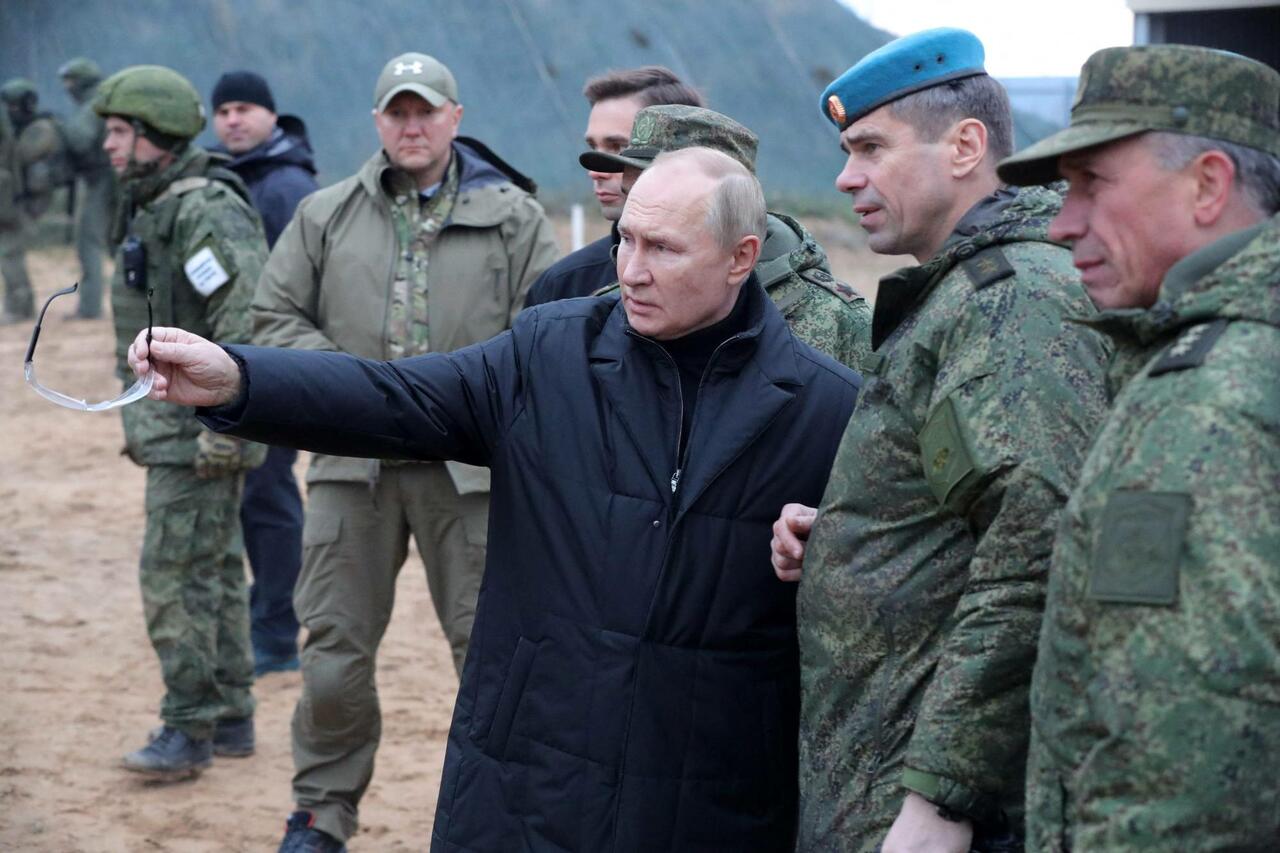
Trucks carrying intercontinental ballistic missiles rumbled over forest roads, atomic-powered submarines set sail from Arctic and Pacific ports, and crews scrambled into warplanes as Russia and neighboring Belarus held the final stage of their joint nuclear drills Thursday.
Russian President Vladimir Putin discussed the maneuvers in a video call with his Belarusian counterpart Alexander Lukashenko.“The use of nuclear weapons is an extreme, exceptional measure for ensuring the national security of our states,” Putin said, according to AP.
Lukashenko earlier inspected Russian short-range nuclear-capable Iskander ballistic missiles at a military unit involved in the drills and declared: “I dreamed about this machine a long time ago.”
The three-day drills that began Tuesday come amid a surge in Ukrainian drone strikes. including on Moscow’s suburbs that killed three people and damaged several buildings and industrial facilities. The strikes made it harder for officials in the Kremlin to cast the conflict in Ukraine — now in its fifth year — as something so distant that it doesn’t affect the daily routines of Russian civilians.
Drills involve wide array of nuclear weapons
Russia’s Defense Ministry said the exercise involved 64,000 troops, over 200 missile launchers, more than 140 aircraft, 73 surface warships and 13 submarines, including eight armed with nuclear-tipped ICBMs. The drills focused on the “preparation and use of nuclear forces under the threat of aggression,” it said.
The maneuvers also practice cooperation with Belarus, an ally that hosts Russian nuclear weapons. Russian arsenals in Belarus include its latest intermediate range nuclear-capable Oreshnik missile system.
Along with nuclear-tipped ground- and submarine-launched ICBMs, the maneuvers featured a broad assortment of short- and medium-range weapons.
Unlike the intercontinental missiles that can destroy entire cities, tactical nuclear weapons intended for use against troops on the battlefield are less powerful. They include aerial bombs and warheads for short- and medium-range missiles and artillery munitions.
The Defense Ministry said the Russian armed forces test-fired Yars and Sineva ICBMs, as well as medium-range sea-launched Zircon and air-launched Kinzhal missiles, noting that all missiles hit their designated practice targets. Belarusian troops test-fired a short-range Iskander ballistic missile inside Russia.
Putin has repeatedly reminded the world about Moscow’s nuclear arsenals since the war in Ukraine started in February 2022 to deter the West from ramping up support for Kyiv.
In 2024, the Kremlin adopted a revised nuclear doctrine, noting that any nation’s conventional attack on Russia that is supported by a nuclear power will be considered a joint attack on his country. That threat was clearly aimed at discouraging the West from allowing Ukraine to strike Russia with longer-range weapons and appears to significantly lower the threshold for the possible use of Moscow’s nuclear arsenal.
The revised doctrine also placed Belarus under the Russian nuclear umbrella. Putin has said that Moscow will retain control of its nuclear weapons deployed in Belarus, which borders Ukraine and NATO members Latvia, Lithuania and Poland, but would allow its ally to select the targets in case of conflict.
Drills come as Ukrainian drones spotted in the Baltics
The maneuvers are held amid an increase in drone activity in the Baltic nations. On Tuesday, a NATO jet shot down a Ukrainian drone over southern Estonia. Ukraine apologized for that “unintended incident,” without specifying what had happened.
On Wednesday, an emergency announcement about a drone flying over Belarus prompted residents of the Lithuanian capital of Vilnius, including top officials and lawmakers, to take shelter and led to a brief closure of its airport.
Ukrainian drones targeting Russia’s Baltic ports and energy facilities have recently crossed or come down in NATO territory on several occasions. Amusingly, instead of blaming the source, Ukraine, Western officials blamed Russian electronic jamming of the drones.
Russia’s Foreign Intelligence Service said Tuesday that Ukraine is preparing drone attacks against Russia from the territory of the Baltic countries and warned of retaliation It alleged Ukrainian military personnel had been deployed to Latvia and warned that the country’s membership in NATO wouldn’t protect it from “just retribution.” Latvian authorities said the allegation was not true.
Last month, the Russian Defense Ministry published a list of factories in Europe that it said were involved in producing drones and their components for Ukraine. It warned that attacks on Russia involving drones manufactured in Europe are fraught with “unpredictable consequences.”
Some commentators interpreted the bellicose statements from Moscow and this week’s exercise featuring short- and medium-range nuclear weapons capable of reaching targets in Europe as part of Kremlin efforts to discourage Western allies from bolstering support for Ukraine.
Asked what message the nuclear exercise was intended to send, Kremlin spokesman Dmitry Peskov responded that “any drills are intended to send a signal,” but wouldn’t elaborate.
The Department of the Treasury’s Office of Foreign Assets Control (OFAC) is sanctioning four individuals associated with a pro-Hamas flotilla that is trying to access Gaza in support of the terrorist group, the department said in a May 19 statement.
The flotilla is organized by the Popular Conference for Palestinians Abroad (PCPA), which has been classified as a specially designated global terrorist by the United States.
“The PCPA was established with funding from Hamas’s International Relations Bureau and Hamas directs its activity through the placement of Hamas officials throughout the organization, including its executive body, the General Secretariat,” the Treasury said.
“So-called humanitarian flotillas that are organized by or supporting designated parties represent a significant compliance risk for financial institutions. Sanctioned terrorist groups continue to maintain significant influence over maritime flotillas to Gaza.”
The four individuals sanctioned by the Treasury include a Spanish member of the PCPA’s General Secretariat, who is a central figure of the flotilla; the acting secretary general and president of the PCPA, who is from Jordan; a Belgium-based European coordinator for the Samidoun organization; and a Samidoun coordinator from Spain.
Samidoun is a front organization for the Popular Front for the Liberation of Palestine, which the State Department has designated as a foreign terrorist organization. Both the PCPA and Samidoun act on behalf of sanctioned Palestinian terrorist organizations, the Treasury said.
In addition, OFAC sanctioned several members of Muslim Brotherhood networks who are aligned with Hamas.
All property and interests in property of the sanctioned individuals that are in the United States or in control of U.S. persons are effectively blocked and must be reported to OFAC. The sanctions prohibit U.S. persons from engaging in any transactions involving the property or interests in property of those who are sanctioned.
“The pro-terror flotilla attempting to reach Gaza is a ludicrous attempt to undermine President Trump’s successful progress toward lasting peace in the region,” Secretary of the Treasury Scott Bessent said. “Treasury will continue to sever Hamas’ global financial support networks, no matter where in the world they are.”
State Department spokesperson Thomas Pigott said in a May 19 statement that OFAC has targeted three enablers – the flotilla organizers, Muslim Brotherhood members, and Samidoun members – who he said are used by Hamas to sustain its position in Gaza, engage in terrorist violence, and finance its operations.
OFAC’s action exposes how Hamas exploits purported civil society organizations, diaspora groups, and religious institutions “to advance its malign agenda while claiming humanitarian objectives,” according to the spokesperson.
“Under President Trump, the United States remains committed to supporting efforts to achieve lasting peace in the Middle East,” he added. “We will continue to use all available tools to counter those who support terrorism and obstruct the path to a peaceful resolution of the conflict.”
Hamas-UN Ties
Meanwhile, U.S. lawmakers are aiming to eliminate a U.N. agency accused of employing Hamas terrorists, according to a May 19 statement from the office of Sen. Tom Cotton (R-Ark.). The agency being targeted is the U.N. Relief and Works Agency for Palestine Refugees in the Near East (UNRWA).
In February 2025, President Donald Trump signed an executive order banning funding for UNRWA. According to the order, the agency has reportedly been infiltrated by members of foreign terrorist organizations, with employees from the organization being directly involved in the Oct. 7, 2023, Hamas attack on Israel.
UNRWA has dismissed these allegations. In a September 2025 fact sheet, the agency said that claims of some members of its staff in Gaza having links with Hamas or the Palestinian Islamic Jihad are false and that it has “not received any information, let alone any evidence, from the Israeli Authorities or any other Member State” about such accusations.
In a May 18 letter to Trump, Cotton and 24 colleagues asked that the administration take “decisive action to fully dismantle UNRWA and eliminate it from the UN budget.”
“Any aid organization in Gaza or otherwise must be demonstrably free of ties to terrorism and committed to transparency, accountability, and peace,” they said in the letter. “We must ensure this failed system doesn’t continue reinforcing the conditions that have fueled terrorism for generations. The time to act is now.”
Turkey Liquidated Almost All Of Its US Treasuries In March To Defend Crashing Lira
Two months ago, at the end of March, we reported that Turkey was aggressively dumping its gold reserves in a panic scramble to obtain dollar funding, which Erdogan’s regime was using to keep the Turkish lira from crashing, and to also pay for energy imports which had suddenly soared in price as a result of the Iran war.
The violent selling by Turkey (and other emerging markets) was behind the brutal plunge in gold prices, which tumbled by more than $1000 from near all-time highs at the start of the war to the low 4000s by the time Turkey had done selling much of its gold.
Then earlier this week, we got another confirmation of Turkey’s wild liquidation spree when the latest central bank data showed that Turkey’s foreign reserves had their biggest monthly decline on record in March, as the Iran war triggered global selloffs in emerging market assets and strained the lira.
According to balance-of-payments data, Turkey’s official reserves cratered by $43.4 billion in March. Part of the decline reflected state intervention to offset portfolio outflows. The current-account deficit, meanwhile, widened to $9.7 billion in March from $7.3 billion in February as a result of soaring commodity prices.
A major energy importer, Turkey has been hit hard by higher oil and gas prices caused by the effective closing of the Strait of Hormuz and the resulting disruptions to world supplies of crude and refined products. Meanwhile, global banks have started changing their formerly favorable outlook on the lira, citing the exploding current-account deficit. Should inflation pressures persist, Turkey will have no choice but to pursue another accelerated devaluation of the Turkish lira.
“As international institutions continue to raise their average oil price forecasts for 2026, disruptions in supply chains and ongoing regional tensions — and their potential negative impact on transportation and tourism revenues — keep upward risks alive in year-end projections” for Turkey, said Istanbul-based economist Haluk Burumcekci.
Turkish central bank Governor Fatih Karahan said last week that the ratio between the current-account deficit and gross domestic product would be “below historical averages” this year while acknowledging the upside risks.
Yet as we said in March, while selling gold is a step of clear desperation for Turkey which had put in much efforts in recent years to build up a substantial gold stock, it is understandable for a regime that suddenly finds itself in a dollar funding crisis, the bigger question is did Turkey do the same with its holdings of Treasuries which are far more liquid and thus far less likely to move the market even when facing a sizable liquidation.
The answer, we learned today, is a resounding yes.
According to Bloomberg calculations based on US Treasury data, Turkey sold almost all of its US Treasuries in March as it stepped up efforts to support its currency during the first month of the Iran war. The amount of Treasuries held by Turkey crashed to just $1.8 billion by the end of March, down from $16 billion the previous month, the data showed. The figure includes securities held by the central bank and other Turkish entities, including corporates.
The decline coincided with a selloff in Turkish markets after the Middle East conflict erupted, sending oil prices sharply higher. The central bank moved immediately to prevent a crash in the lira by tightening funding conditions and selling off foreign exchange and gold assets. Its interventions also included swapping gold from reserves, although now that it has also dumped the bulk of its last ditch dollar reserves, those swaps will almost certainly end up forcing Turkey to hand over whatever gold was pledged.
Turkey’s Treasury holdings were as high as $21 billion in February 2025 after the country spent a year rebuilding reserves. They had peaked about a decade ago at $80 billion, before steadily declining as relations with the US soured over a range of political and geopolitical disputes, and as Turkey consistently sold reserves to maintain a smooth devaluation of the lira.
Despite the interventions, the lira has remained under pressure as the war drags on. Last week, the central bank raised its year-end inflation target to 24% from 16%, after data showed annual inflation accelerated to 32.4%. Turkish bonds have also suffered steep losses, with 10-year yields hitting record highs of 35.75%.
And now that Turkey has no more gold or Treasurys with which to defend the currency, expect a sharp and painful death in the currency which has gone from less than 10 against the dollar five years ago to a record 45.6 today..