Two Drones Shot Down Over NATO Airspace In Less Than 24 Hours
This week has witnessed more dangerous Ukraine war spillover aerial activity in Eastern Europe. In a fresh instance, Romania’s defense ministry is reporting that two drones entered the country’s airspace in less than 24 hours.
The military said that radar systems had earlier picked up a drone “operating in the vicinity of the Ukrainian border” Saturday morning – after which F-16 fighter jets were scrambled and successfully shot it down.
The NATO member state’s defense ministry continued by describing that two of the F-16s “safely shot down in an unpopulated area near the border.”
A very similar situation played out Friday over an unpopulated area near Padina, northeast of the capital, Bucharest. In that case a pari of Italian air force Eurofighter Typhoon jets were deployed and shot it down.
Authorities did not immediately identify the drone’s origin but that are pointing to the Russian military. Romanian Defense Minister Radu Miruta was cited in national media as saying “the impact site and the drone wreckage are currently being analyzed” but that “the pattern is consistent with previous confirmed flights by Russian drones.”
Early indicators say these were likely Shahed-type drones used by Russian forces; however, there have also been past instances of Ukrainian projectiles entering friendly neighboring countries’ airspace.
These types of breaches have been happening with increasingly regularity over the past couple years. In prior incidents, Ukrainian President Volodymyr Zelensky has accused Moscow of deliberately orchestrating provocations against NATO countries.
He previously said on X during a past incident, for example, that “The Russian military knows exactly where their drones are headed and how long they can operate in the air. Their routes are always calculated.”
In prior recent instances of drones entering neighboring airspace, particularly in Baltic countries and also Poland, NATO jets were scrambled – and in some cases drones are safely brought down via electronic intercept means.
But each instance creates new tensions between Russia and NATO, and the typical accusations and threats then fly. The Kremlin has of late been especially alarmed at the Trump administration transferring 5,000 US troops from Germany to Poland, near Russia’s doorstep.
France Orders Largest Peacetime Evacuation Since WWII As Wildfires Rage
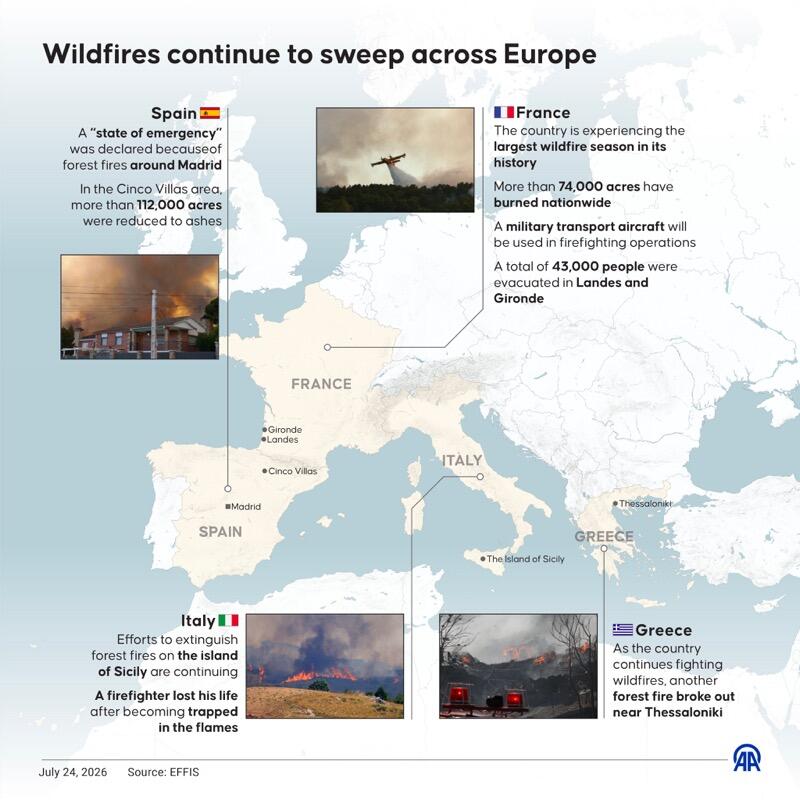
Thousands of firefighters are battling fast-moving wildfires spreading across Spain and France as extreme heat and strong winds forced more than 300,000 people to evacuate or shelter in place near Madrid, Valencia and Bordeaux.
Socialist Spanish Prime Minister Pedro Sánchez said fires burned about 20,000 hectares over the past 24 hours, with more than 105,000 people affected and two deaths reported so far. France evacuated more than 220,000 people in the Gironde region and mobilized 1,500 troops as roughly 30 fires spread near Bordeaux.
FRANCE: France has evacuated more than 220,000 people as the country’s largest wildfire continues to spread across the southwest, threatening Bordeaux. Officials said the blaze in Gironde has become so intense that it is generating its own winds. Interior Minister Laurent Nuñez…
Europe is burning. France + Spain: 250,000+ people evacuated this weekend alone. France: 98,000 hectares destroyed, a new national record. Worst wildfire crisis in the country’s history.
Even the Tour de France had to cut its final stage. When wildfires cancel the Tour de… pic.twitter.com/DOXFbJj8bZ
— France Safety Travel (@francesafetytra) July 26, 2026
CNN reporter Max Saltman spoke with wine expert Nicolle Croft, who said the 2026 vintage across Bordeaux is safe for now, but there are mounting concerns.
Saltman continued:
As wildfires burn west of Bordeaux, one of France’s most famous wine-producing regions, concerned oenophiles have called wine expert Nicolle Croft to voice concern over the fate of 2026 vintage.
“A lot of people are contactingme from around the world hearing all these terrible stories, but actually the vineyards are not impacted at the moment,” Croft, a tour guide based in Bordeaux, told CNN. “But we’re all very upset because there are people losing homes.”
Croft said at this time of year, the grapes aren’t yet large enough to absorb wildfire smoke – a phenomenon knownin winemaking as“smoke taint.”
“We won’t be harvesting until the beginning of September,” Croft said, “so there’s still time.”
Dr. Phil Crews, a winemaker and chemist at the University of California, Santa Cruz, explained that unripe grapes aren’t as vulnerable to smoke taint. Young grapes lack sugars that would otherwise bind with bitter-tasting phenols in wildfire smoke.
Fire Map
CNN noted, “Forecasts also indicate no rain in fire-ravaged areas, as officials in France mount the largest peacetime evacuation since WWII.”
A family summer beach event in the UK city of Nottingham now sits behind portable anti-ram steel barrier, the latest admission that open borders have turned public spaces into soft targets.
Local authorities across Britain are quietly installing more of what critics now call “diversity barriers” – heavy portable steel devices designed to stop vehicles being driven into crowds.
The annual artificial “Nottingham Beach” event opened this week behind a line of bright red Husson H-Stop units.
Meanwhile in the UK Local authorities are installing more and more ‘Diversity Barriers’. Why? Because as regularly seen throughout Europe – Radical Islamist Terrorists like to murder innocent people by driving their vehicles into crowds of people. pic.twitter.com/hq7tRKYcbW
— Concerned Citizen (@BGatesIsaPyscho) July 22, 2026
About 15 of the barriers now block the four main entrances. They tip upward on impact, changing a vehicle’s trajectory and generating enough friction to halt a three-and-a-half-tonne truck travelling at 30 mph.
Councillors and organisers insist the move is simply a precaution. The multi-agency safety group that approved them included counter-terrorism officers.
Councillor Neghat Khan, leader of Nottingham City Council, described them as an “additional safety measure” installed “following advice from the multi-agency events safety advisory group, which includes counter-terrorism colleagues.”
Event organiser James Mellors was more blunt: “I don’t think they look very pretty. But the Market Square is a very high footfall area. It’s not always about how things look, it’s about keeping people safe.”
A regular visitor, Amanda Hose Hawley, said she was “not surprised” and called the barriers “a sign of the climate we live in.”
The language is careful, the justification technical. Yet the reason these barriers exist is no mystery.
Before uncontrolled mass immigration we did not need diversity barriers.
Across Europe, radical Islamists have repeatedly turned vehicles into weapons against ordinary people gathered in public spaces. Britain is simply catching up with the physical reality already visible on the Continent.
Wouldn’t it be nice if we lived in a country where the problem got resolved rather than putting in precautions for the problem!
Last winter German towns were forced into even more extreme measures. In the small Bavarian community of Külsheim, officials resorted to recycled anti-tank barriers pulled from old military barracks.
Four massive concrete blocks, each 1.4 metres wide and weighing several tonnes, were painted red and white and placed around the Christmas market.
The town’s mayor, Simone Hickl-Seitz, explained the grim arithmetic: “They know exactly that all cities need this. But the coffers are empty.”
Bollards that once cost €800 had risen tenfold in price because demand had exploded. The anti-tank relics saved the town €30,000.
That was not an isolated improvisation. Security spending on German Christmas markets rose 44 percent in three years, according to the Federal Association of City and Town Marketing.
Some towns simply cancelled their markets rather than meet the new requirements. The pressure intensified after the December 2024 Magdeburg attack, in which a Saudi national living in Germany for nearly two decades drove a vehicle through a Christmas market, killing six and injuring hundreds.
AfD politician Ulrich Siegmund cut through the official euphemisms: “Why do we need to protect Christmas markets? Go to Czech Republic, Poland – they haven’t opened borders… We are losing our freedom bit by bit.”
The same pattern has been documented in footage that circulated widely at the time. One widely viewed report showed Berlin’s markets ringed by the same style of heavy concrete barriers once intended to stop invading armies, not shoppers buying Glühwein.
Britain’s new portable barriers are lighter and more mobile, but they serve the identical purpose. Hostile vehicle mitigation has become standard guidance from the National Protective Security Authority.
Official documents now list crash-rated bollards, vehicle barriers and stand-off distances as core measures against “vehicle as a weapon” attacks.
Maybe enforcing the barriers called BORDERS and keeping the terrorists out of the country would be the more intelligent effort.
The threat is no longer theoretical. In October 2025 a man who pledged allegiance to Islamic State used a vehicle and a bladed weapon outside a Manchester synagogue, killing three. Other plots and attacks across Europe have followed the same method: low-skill, high-impact, directed at soft civilian targets.
The Nottingham installation is being described as a trial. Organisers say there was no specific intelligence of an imminent attack. That claim misses the larger point.
Permanent or semi-permanent barriers are appearing at markets, festivals, high streets and public squares precisely because the background risk has become chronic.
Before the era of mass, uncontrolled immigration from regions where Islamist ideology remains mainstream, British towns did not need steel ramps that can stop a truck.
Children played in squares without negotiating “filter” gaps between anti-ram devices. Christmas markets did not require military surplus concrete painted in festive colours.
Now the physical landscape of everyday life is being redesigned around the assumption that someone may try to drive a vehicle into a crowd of shoppers, holidaymakers or beachgoers. The barriers are painted bright red and labelled H-STOP so no one can claim they are invisible. Their very visibility is the admission.
The cost is not only financial. Every barrier is a quiet confession that the post-1990s experiment in open borders has produced a security environment European cities once associated with conflict zones.
Politicians continue to speak of “community cohesion” and “diversity as strength” while the practical response is to harden every public gathering against the most predictable form of attack.
Nottingham’s beach will close at the end of the summer and the portable barriers will be stored away. The underlying problem will not. The same devices, or heavier permanent versions, will reappear at the next festival, the next market, the next Christmas period.
Local authorities are not inventing a threat; they are reacting to one that has already left bodies in European streets and forced democratic societies to turn festive spaces into fortified zones.
The choice facing Britain and the rest of the West remains the same one German politicians have already faced: continue importing the conditions that make these barriers necessary, or finally reverse the policies that created the danger in the first place. Concrete and steel can stop a truck. They cannot restore a country that no longer feels safe enough to gather without them.
Institutions built to prevent atrocities eventually face the question of what they actually protect. For the United Nations, voting patterns, internal investigations and its own decisions this year no longer support the fiction of neutrality. An UNRWA school in Gaza sat above a Hamas tunnel shaft and three anti-tank positions, and its own principal was on the payroll of both institutions at once – a fact that American investigators, not the UN, brought to light.
The pattern is old: during the oil-for-food scandal, a mid-level program director faced US prosecution while the officials who managed the program from above kept their positions. When UN failures surface, line staff absorb the exposure. The people who set the policy rarely do.
The arithmetic alone dismantles the pretense of balance. In 2025 the UN General Assembly (UNGA) adopted 15 resolutions targeting Israel, and only 11 addressing the rest of the planet combined – a tally covering North Korea, Iran, Myanmar, Russia and the United States together. From 2015 through 2024, the total reached 173 resolutions against Israel, compared to 80 for all other member states combined. The UN Human Rights Council has run comparable numbers since 2006, adopting 112 resolutions against Israel compared to 45 against Syria, despite a civil war there that killed hundreds of thousands.
On Nov. 20, 2025, the UNGA’s Fourth Committee passed six resolutions condemning Israel while producing not a single resolution on Sudan, where fighting has killed more than 150,000 people and driven 12 million from their homes. The bloc that commands the UNGA’s automatic majority sets these priorities; the scale of actual human suffering has nothing to do with it.
The United Nations Relief and Works Agency for Palestine Refugees in the Near East (UNRWA) supplies the starkest illustration. After October 7, the agency’s own internal review found that nine employees may have taken part in the massacre – a figure that American investigators have since made look negligible. According to USAID:
“The USAID Office of Inspector General (USAID OIG), a statutorily independent law enforcement and oversight entity, has referred for suspension/debarment consideration the names of 101 current or former staff at the United Nations Relief and Works Agency for Palestine Refugees (UNRWA) for participation in the Oct. 7, 2023, terrorist attacks and/or affiliation with the military wing (al-Qassam Brigades) of Hamas. Among the individuals referred were UNRWA school principals, teachers, security personnel, attendants, psychosocial counselors, and medical professionals, including:
– A deputy school principal serving as an al-Qassam deputy company commander in the Ain Gallout/5th infantry battalion.
– A deputy school principal serving as squad leader for the Khan Younis Brigade/2nd infantry battalion.
– A teacher serving as squad leader in Hamas’ military security department/intelligence unit who tracked assignment of explosive devices.
– A teacher serving as a platoon commander of the Central Brigade/Al Quds 2nd Battalion.
– A math & computer teacher with ties to an al-Qassam intelligence squad.
– A teacher with expertise as a sniper for Hamas.
– A teacher and Hamas soldier with orders to bring two anti-tank missiles to a prescribed location during the October 7 terror attacks.
– A deputy school principal serving as a platoon commander in Hamas’ Nuseirat battalion with communications responsibilities on October 7th.
– A school principal assigned to the chemical department of a Hamas military manufacturing unit whose school had three anti-tank positions and a tunnel shaft located under the facility.”
One of those referred, Hafez Mousa Mohammed Mousa, coordinated with fellow operatives during the Oct. 7 massacre while running an UNRWA school, and became the first person affiliated with a UN humanitarian agency ever debarred by the US government for terrorism. Under mounting pressure, UNRWA itself dismissed 70 staff linked to terrorist organizations in Gaza in the weeks before the referral was published, an admission that followed the release of evidence rather than the agency’s own vetting. Groups tracking UNRWA’s personnel put the true scale of Hamas penetration considerably higher, closer to 1,500 employees still drawing a UN salary.
The reckoning caught up with the agency in public on July 1, 2026, when the “Board of Peace,” the body now overseeing Gaza’s postwar administration, announced that UNRWA “has no place in the new Gaza” and described continued dependence on the agency as an obstacle to recovery rather than a form of relief.
Washington’s ambassador for UN reform, Jeff Bartos, told the annual pledging conference the same day that member states funding UNRWA had spent years choosing incitement, terrorism and stagnation over an alternative, and warned that history would remember the choice. Within hours, the Palestinian Authority and the Arab League rejected the announcement and insisted that UNRWA’s mandate cannot be dissolved by an administrative statement.
Whatever the outcome of this dispute, an institution long marketed as irreplaceable is being dismantled in real time by the very coalition managing the territory it was built to serve.
This state of affairs is not new behavior wearing new language. The UN’s largest financial scandal, the oil-for-food program, saw then Iraqi President Saddam Hussein extract $1.8 billion in kickbacks starting in 1996, with help from more than 2,000 companies, while the Volcker inquiry found that weak UN oversight and Security Council paralysis had made the scheme possible. The program’s own director was later indicted in the United States for bribery; senior UN officials mostly walked away untouched.
UN peacekeeping missions have produced a smaller, steadier version of the same pattern: a procurement task force documented more than $630 million in tainted contracts and two dozen confirmed corruption schemes, only to be shut down in 2008 after member states with implicated nationals refused to renew its mandate.
Sexual exploitation by peacekeepers followed an identical script, with nearly 2,000 allegations accumulated over 12 years and only a fraction of the accused ever serving prison time.
The historical ledger is worse than the bureaucratic one. In 1994, UN representatives and peacekeepers watched as more than 800,000 people were murdered in Rwanda over roughly 100 days, while its own commander in the field begged for reinforcements and was refused. A year later, the UN declared the Bosnian town of Srebrenica a protected zone, then denied the air support its peacekeepers requested as 8,000 men and boys were murdered under the UN flag. In Haiti, UN peacekeepers introduced cholera into a country that had been free of the disease for a century; nearly 10,000 people died before the organization admitted any responsibility – six years after the outbreak began. The zero-tolerance policies announced afterward changed little about how missions were run or how misconduct was punished.
Rwanda, Bosnia, Haiti and Gaza share the same organizational reflex: investigate quietly, discipline the lowest-ranking staff available, and leave the people who set policy in place.
UN Secretary-General António Guterres told the Security Council after October 7 that the Hamas attacks “did not happen in a vacuum,” a formulation he has since echoed on UNRWA’s failures – careful language built to avoid naming the agency’s own culpability.
The United Nations was founded to make atrocities costly for those who commit or enable them. It has instead built a machine that absorbs those costs internally, so long as the people responsible sit inside the institution or represent the states that control its votes.
Even the coalition now running Gaza’s transition has concluded that one of the UN’s flagship agencies does not belong there. This verdict came from the “Board of Peace,” the body tasked with cleaning up what the war left behind – not from Jerusalem or from Washington’s harshest critics of the UN. The record speaks plainly enough on its own. What remains open is how much longer the rest of the world intends to keep paying for it.
Originally published by the Gatestone Institute. Views expressed in this article are opinions of the author and do not necessarily reflect the views of The Epoch Times.
Platner’s Replacement May Not Be Eligible For Nomination
Maine Democrats gathered in Bangor on Saturday to select a replacement for Graham Platner, whose Senate campaign collapsed under allegations of sexual assault – which he denied – that surfaced after his June primary win. Former Senate President Troy Jackson formally won the nomination. He will face Republican Sen. Susan Collins in one of the nation’s most closely watched Senate races, a race that Democrats have deemed critical if they hope to win the majority in the Senate.
However, one inconvenient detail threatens to complicate Jackson’s coronation: a Republican state lawmaker says Jackson may not be legally eligible to accept the nomination at all.
State Rep. James White (R-Guilford) sent a letter to Secretary of State Shenna Bellows asking her office to determine whether Jackson, or any candidate who lost a primary for a different federal, state or county office in June, qualifies as a replacement nominee under Maine law. White wanted the question settled before Bellows certifies whatever comes out of Saturday’s convention, but that didn’t happen, which could be a problem.
Rep. James White has sent a letter to Shenna Bellows suggesting that Troy Jackson is not legally allowed to become the Senate nominee:
“The apparent justification for Mr. Jackson’s eligibility depends entirely on treating the June primary and November general election as… pic.twitter.com/NnTS3bSxFp
According to White, Jackson’s own ballot history might make him legally ineligible. Jackson ran for governor earlier this year, lost that Democratic primary in June, and became his party’s Senate nominee through a replacement process rather than a primary vote of his own.
Under Title 21-A, Section 331 of Maine election law, “a person may not file, whether by primary election or nomination petition, as a candidate for more than one federal, state or county office at any election.” He also points to Section 351, which imposes similar restrictions, and Section 363, which requires that a political committee filling a nomination vacancy “shall choose a qualified person to fill the vacancy.”
Whether Jackson still counts as a “qualified person” after losing a statewide primary is the crux of White’s argument. “The Department should resolve this question before accepting or certifying any replacement nomination,” he wrote.
White reaches back to 1974 for precedent, citing the U.S. Supreme Court’s ruling in Storer v. Brown, which described primary elections as “an integral part of the entire election process.” His argument is that treating June’s primary and November’s general election as two separate contests cuts against both the Court’s reasoning and the Legislature’s stated intent to keep candidates from seeking more than one office “at any election.” White’s letter frames this as standard sore loser logic. Laws of this type exist across the country to stop a candidate who loses one race from reaching the general election through a side door.
Maine has no explicit sore loser statute on the books, unlike several other states that spell out the prohibition in plain language. White’s position is that the existing patchwork of Title 21-A provisions accomplishes the same result even without a dedicated clause. Maine law does allow parties to replace nominees who withdraw after winning a primary, which is how Democrats find themselves in this position following Platner’s exit, but the statute never quite addresses what happens when the proposed replacement lost a separate statewide primary of his own.
Reasonable election law observers could land on either side of this question, and if a legal challenge follows Jackson’s nomination, according to The Maine Wire, a court may end up settling the matter, and depending on how that plays out, could put Democrats in a real bind.
The Secretary of State’s office did not issue a public response to White’s letter before the convention, and it remains unclear whether Bellows intends to produce a formal legal opinion. And Bellows is no neutral arbiter here: she was herself a candidate in this very Senate race, one of the contenders who dropped out and cleared the path for Jackson in the days before the convention. Regardless, Bellows, a Democrat, wouldn’t rule against her own party’s interest anyway, but clearing Jackson’s candidacy, especially now, won’t end the matter, since a court challenge could still follow.
If such a challenge were to proceed, and in the unlikely event it were to prevail, disqualifying Jackson would upend the Democratic Party’s effort to field any candidate against Collins with barely four months remaining before Election Day, a scramble that could pave the way for Collins to win in November easily.
Beijing prohibited 14 EU companies from obtaining Chinese dual-use goods on Friday, targeting Europe’s defense industry shortly after the EU included 14 Chinese and Hong Kong firms in its 21st sanctions package against Russia.
Announcing the measures with immediate effect, the Chinese Commerce Ministry called the bloc’s conduct “egregious” and demanded the EU “immediately correct its wrongdoing, eliminate the egregious impact, and safeguard the overall interests of China–EU relations with concrete actions.”
The restrictions cover dual-use items, goods, software, and technology with both civilian and military applications, including rare earth elements used to build drones and chips.
Parties outside China are also barred from transferring Chinese-origin dual-use goods to any listed entity, though exporters may request permission in exceptional cases or when a shipment is deemed “truly necessary.”
Rheinmetall leads the list, alongside Polish electronics producer Vigo Photonics, Italian electric motor manufacturer Lafert, French drone developer Cavok UAS, Czech truckmaker Tatra, Dutch naval engineering firm IHC Merwede, and several optics and laser companies.
Germany and France each have three entries, Italy and Poland each have two, and the Netherlands, the Czech Republic, Bulgaria, and Lithuania each have one.
China’s mission to the EU lodged a formal protest, voicing “strong dissatisfaction and firm opposition” to the measures and rejecting attempts by the bloc to place responsibility for the war in Ukraine on Beijing. It added that China “firmly opposes the EU’s unwarranted listing and sanctioning of Chinese companies and citizens.”
The 21st package subjected 51 entities to tighter export curbs on dual-use goods and technologies over their support for Russia’s military and industrial complex. Companies based in India, Turkey, and the UAE were listed alongside those from mainland China and Hong Kong.
Brussels targeted small trade and logistics operators in port cities like Guangzhou, Shenzhen, and Dalian, while Beijing focused on Europe’s defense industry.
🇨🇳🇪🇺 China just blacklisted the companies arming Europe.
14 EU firms lost access to Chinese dual-use exports overnight, payback for the EU’s latest sanctions over Russia.
The list hits artillery makers, drone builders, targeting systems, military trucks and lasers.
Cui Hongjian, a former diplomat who heads European studies at Beijing Foreign Studies University, told the South China Morning Post (SCMP) that the disparity does not make the response any less reciprocal from Beijing’s perspective, noting that successive EU packages have named far more Chinese firms overall than China has named in return.
“Since this whole episode arose from the Russia-Ukraine war, I think it’s understandable that China is now pointing its retaliation at Rheinmetall,” Cui said. “From Beijing’s point of view, if it’s going to retaliate, the retaliation has to bite.“
19 Million Eggs Pulled As Salmonella Outbreak Sickens 98 Across 17 States
The FDA and CDC have tied a growing Salmonella outbreak to eggs produced by Texas-based Midwest Poultry Services, which recalled roughly 1.5 million cartons – more than 19 million eggs – after the contamination surfaced. As of July 24, 98 people across 17 states had been sickened, according to the FDA, which said the recalled eggs are “a likely source of illnesses in this outbreak” and that its investigation is ongoing.
The recall itself went out through an FDA notice on July 22, before the illness count was attached. The eggs may be contaminated with Salmonella Enteritidis, a subtype that can cause serious and occasionally fatal infections in young children, the elderly, and the immunocompromised.
“Midwest Poultry Services identified the issue on its two Texas farms through proactive environmental monitoring practices and root cause analysis,” the company said, adding that it “is not distributing fresh eggs produced on its Texas farms at this time.” The company said it began diverting eggs to a breaking plant, where they would be pasteurized to kill any pathogens, and characterized the recall as precautionary. It did not respond to a request for more detail on how it detected the possible contamination.
There is a wrinkle worth noting. The recalled eggs were produced between June 6 and July 3, but the outbreak’s illness onsets stretch from Nov. 21, 2025 all the way to June 30, 2026 – a seven-month span far wider than the production window. That is why the FDA is describing the eggs as a likely source “in part” and says it is still investigating whether other foods are involved.
How To Check Your Carton
The eggs carried “sell by” or “best by” dates ranging from July 20 to Aug. 17. The recalled cartons carry an identifying code of P-1950 or 0840962 with a Julian date between 157 and 184, printed in date-coding ink on the side of the carton. No other Midwest Poultry Services products are affected.
The eggs were available at Kroger stores in Louisiana and Texas and Brookshire Grocery stores in Arkansas, Louisiana, Mississippi, New Mexico, Oklahoma, and Texas, as well as smaller retailers not named in the notice. They were also shipped to foodservice customers in Texas, Oklahoma, and Louisiana. Kroger and Brookshire Grocery did not respond to requests for comment.
People who bought the eggs can return them for a full refund. Salmonella infection typically sets in 12 to 72 hours after exposure, with symptoms – diarrhea, fever, nausea, vomiting, abdominal cramps – usually lasting four to seven days.
Stealers Wheel’s 1973 hit “Stuck in the Middle with You” could well become the theme song for today’s middle-income, first-time home buyers who don’t qualify for affordable housing programs yet cannot afford market-rate homes.
The household income required to purchase a starter home, currently priced under $350,000 in the United States, has surged more than 80 percent to $78,000 from $43,000 in 2019, according to a July 20 report from Realtor.com.
By contrast, the median household income was $83,730 in 2024, representing an increase of under 22 percent from $68,703 in 2019, according to the latest Census Bureau estimates.
This gap in growth between home prices and household incomes has made it increasingly difficult for even middle-income households to own a home, real estate professionals, economists, and recent research say.
Caught In The Middle
Vlora Sejdi, an associate broker with HomeSmart in White Plains, New York, recently told The Epoch Times about the challenges her young clients face in buying a home.
She is currently working with a childless couple under 40 who are living with parents while saving for a down payment on a home in Westchester County, an affluent suburb north of New York City, which had a median home price of $867,398 in May, according to Redfin.
“Home prices here just keep going up and up,” she said. “It’s a seller’s market and people who can afford to buy are willing to go above and beyond. We’re still seeing bidding wars.”
“They’re very unhappy with the current situation, and I think there’s also a shock factor for what their monthly payments will be with mortgage, taxes, and insurance,” she said.
Sejdi said another of her clients, a woman in her 20s, also from Westchester County, is currently renting while searching for a co-op, a type of housing in which residents purchase shares in a cooperative corporation that owns the building, rather than own individual units, according to Apartments.com.
Co-ops tend to be much less expensive than condos or single-family homes. According to OneKey MLS, in Westchester County, the median sales price for co-ops was $223,750 in May, compared with $576,500 and $1,200,000 for condos and single-family homes, respectively.
However, these properties are controlled by a co-op board of directors that can set stringent financial requirements for anyone seeking to purchase an apartment.
“My client actually had one accepted offer, but the board would not approve her, despite the fact that she now pays significantly more in monthly rent than she would for monthly maintenance at the co-op,” Sejdi said.
Sejdi will continue to search for other possibilities but admits the journey has been challenging for both of them.
“There’s definitely a lack of attainable housing for the middle class in Westchester,” she said. “These are people who make too much money to qualify for affordable housing, but don’t have enough to afford market-rate homes.”
Sejdi’s clients requested anonymity.
The Pew Research Center classifies households earning between 67 percent and 200 percent of the overall median household income, adjusted for household size, as “middle-income” households.
Based on the Census Bureau median of $83,730, this means those households had annual incomes of between $56,100 and $167,460.
In Westchester County, the median household income was $118,596 in 2024.
According to Westchester County government documents, the county’s affordable housing programs include developments for households earning up to 120 percent of the area median income (AMI), though the income limits vary by development.
The current 120 percent AMI income limits for one-person and two-person households in the county are $162,800 and $142,450, respectively.
The situation is not limited to high-priced markets like New York. Middle-income, first-time buyers in more affordable areas, such as Texas, also face affordability challenges.
“North Texas is still considerably more attainable than markets like New York or California, but affordability has become one of the biggest challenges facing first-time buyers here as well,” Johnny Mowad, associate broker with Ebby Halliday Realtors in Dallas, told The Epoch Times.
At the end of May, Redfin reported that the median sales price was $498,702 in Dallas and $337,798 in Fort Worth.
As in many other parts of the country, Mowad noted that wages have not kept pace with housing costs, and the demand in Northern Texas remains high as more people relocate to the area.
“That puts more pressure on inventory,” he added.
Housing Mismatch
A joint May report by NAR and Realtor.com indicates that the much-needed housing recovery is not reaching the people who are most likely to restart the market.
“Buyers earning about $75,000 can afford only 23 percent of active listings nationwide,” the report states. In a balanced market, they would be able to access about 44 percent.
The report notes that the gap represents about 311,000 missing listings priced below their maximum purchase point, which is estimated at $261,000.
“Too much of the inventory available today remains concentrated at higher price points, leaving a shortage of options for entry-level and middle-income buyers,” Nadia Evangelou, NAR principal economist, said in the report.
According to a June 24 Pew Research Center survey, 89 percent of America’s adults younger than 40 said it’s harder for them to own a home than for their parents’ generation.
The report attributes the perception primarily to rising housing costs and a challenging job market, which have made homeownership feel out of reach for many young adults.
The Harvard Joint Center’s June 17 State of the Nation’s Housing report states that, with a nationwide median price of about $417,400 for new single-family homes in 2025, most new housing was unaffordable for median-income households based on the standard affordability threshold of 30 percent of income.
Existing homes were less attainable. With the median price rising 54 percent since 2020 to $419,300, according to the National Association of Realtors (NAR), a typical single-family home sold at five times the median household income in 2025, the Harvard report notes. By contrast, the report said the average price-to-income ratio was 3.2 in the 1990s.
The median existing home price rose further to $440,600 in June, reaching an all-time high, the NAR said on July 9.
Using first-quarter data, a May 12 analysis by HSH Associates, a private mortgage and housing finance information company, found that U.S. households needed an annual income of $103,419 to afford a median-priced home. The calculation assumed buyers obtained a 30-year fixed-rate mortgage with a 20 percent down payment, while taking into account principal, interest, property tax, and insurance payments.
Of the 50 largest metropolitan areas analyzed, only 12 had required incomes below the national average for buying a median-priced home, the report shows. For high-priced markets such as San Jose, California, and New York City, the required incomes were $477,409 and $197,521, respectively. The median home prices of these cities were $2,030,000 and $750,000, respectively. In Dallas, households needed $105,798 to afford a median-priced home, according to the HSH Associates report.
Millions Of Adults Living At Home
With housing costs and a challenging job market, the Harvard report says, “Many young adults cannot afford to form new households, instead doubling up or living with family.”
The report shows that household growth, a primary driver of housing demand, slowed for the third straight year to 1.1 million in 2025, down from an average annual growth of 2.0 million in 2020 and 2021.
A mid-June report from Realtor.com indicates that one in three adults under the age of 35 – about 25.2 million people – lived with their parents in 2025, as they were priced out of the housing market.
“The adults living with their parents today are largely employed, and many hold college degrees. What’s holding them back isn’t a lack of qualifications, but rather, at least in part, a lack of housing they can actually afford,” Realtor.com senior economist Hannah Jones said in the report.
The data show that about nine in 10 adults aged 25 to 34 living with parents have never been married and about one in three aged 25 to 29 hold a four-year college degree. Men comprise the majority of this group at every age level.
Meanwhile, according to a June 25 report from the Census Bureau, the nation’s fertility rates have dropped almost every year since 2007, although they have risen in certain counties throughout the country.
The Year Of ‘Starter Homes’
Robert Dietz, chief economist at the National Association of Home Builders (NAHB), recently told Siyamak Khorrami, the host of EpochTV’s “Market Insider,” that a decade and a half of underbuilding, especially of entry-level housing, is a key factor contributing to the housing affordability issue Americans are facing.
While Realtor.com estimated in March that the United States was short by about 4.03 million homes in 2025, NAHB put the number at about 1 million using different methodology.
Dietz said the current housing shortage suggests pent-up demand is building among young homebuyers – there are just not enough homes on the market that fit their budgets.
“One really interesting data point that we track is the number of young adults who live with their parents. Right now, one out of five of those 25- to 34-year-olds live with their parents. Back 20 years ago it was one out of 10, so that share has doubled,” he said, citing a May NAHB analysis.
A northern California-based developer, Chris Duffy, founder and CEO of Hummingbird Development, agrees that the nation needs more entry-level housing, but providing that is very difficult due to rising construction costs.
“The cost of construction has gone up so much over the past 20 years,” he told The Epoch Times. “With land, materials, labor, permits, architect costs, and other regulatory fees, the economics of building less expensive homes just doesn’t work. Most new developments have to go with luxury housing to make a profit.”
Duffy noted that depending on where they decide to build, it can take years to jump through all of the local government regulations.
In the organization’s July 9 report, NAR chief economist Lawrence Yun warned that home prices could accelerate if housing inventory continues to stagnate.
The solution, noted Dietz, is to build more housing of all types, including single-family and multifamily for both sale and rent. He noted that construction of more multifamily options can help builders adapt to the challenges of creating more affordable homes.
“For example, we’ve seen a big rise in townhouse construction,” he said. “These are homes that are connected; they require less land.”
In its June 30 Housing Market Indicators report, the American Enterprise Institute called 2026 “the Year of ‘Starter Homes’ and ‘Small Lot, Small Lot, Small Lot.'”
The institute said 188 housing bills had been introduced so far this year, including 26 pending, enacted, or passed bills in 15 states that align with the AEI Housing Center Playbook. The Playbook outlines policy recommendations to increase the supply of naturally affordable housing.
AEI projects that enacted, passed, and pending bills aligned with the Playbook’s three policy options – smaller lots for new homes, greater flexibility on existing residential lots, and more housing near jobs and amenities – could add about 281,000 homes annually.
Because land prices are more affordable in the Sun Belt and Midwest, Dietz said new home construction has experienced growth in those areas. Demand for lower-entry-home price points continues to be strong throughout the nation, he said.
Mowad said while home purchasing remains challenging for younger buyers, starter homes do come up in the market, though they may not represent someone’s dream home. He noted that younger, middle-income buyers who are determined to make a purchase may start with a condo or townhome.
“While affordability has certainly tightened over the last several years, I’d much rather be a first-time buyer in Dallas than in many coastal markets,” he said. “In many parts of the Northeast, buyers are competing against housing costs that simply don’t align with middle-income salaries.”
Mowad said the region has been attracting many new residents due to a lower cost of living relative to other major metropolitan areas, a large concentration of Fortune 500 company headquarters, and no state income tax.
“People aren’t just moving here for cheaper homes; they’re moving here for careers and long-term opportunities,” he said.
Meanwhile, Sejdi is serving on the newly created Westchester County Board of Legislators’ Affordability and Economic Development Task Force that will address how to bring more affordable and middle-income housing into one of America’s most expensive areas.
“We are hopeful that together we can develop some solutions that will help people in the lower and middle-income brackets be able to afford to make their homes here,” she said.
India’s Education Minister Resigns, Delhi Protests End As Modi Caves To ‘Cockroach’ Youth Movement’s Demands
India’s education minister, Dharmendra Pradhan, resigned on Saturday and the government agreed to every demand raised by youth demonstrators, bringing weeks of protests – the gravest political crisis of Prime Minister Narendra Modi’s third term – to a jubilant close.
Pradhan’s exit was the core demand of the self-styled Cockroach Janta Party (CJP), the youth movement that has camped at Delhi’s Jantar Mantar since late June over the leak of medical school entrance exam papers. The May leaks forced the cancellation of results and a retest for some 2 million students, and have been linked to several student suicides.
Word of the resignation set off celebrations at the protest site, where thousands of young people danced, chanted victory slogans and handed out sweets as the national anthem played over loudspeakers. “We have done it,” CJP founder Abhijeet Dipke told the crowd. Roads around the neighbouring Connaught Place business district were shut as revellers poured in.
In a post on X announcing his decision, Pradhan said he had sent his resignation to the prime minister so that forces hostile to the country could not take advantage of the situation, and voiced deep respect for the aspirations and legitimate expectations of India’s young people.
Hours later, Health Minister J.P. Nadda and Jitendra Singh, a junior minister in the prime minister’s office, held a joint press conference with CJP representatives following a further round of talks. Nadda confirmed the government had accepted the movement’s full list of demands, which included an overhaul of the examination system, the withdrawal of police cases filed against protesters, and compensation for the families of students who died by suicide after the leaks.
CJP spokespeople formally declared the agitation over and urged supporters across the country to head home peacefully.
The settlement prompted a swift unwinding of the security clampdown that had paralysed parts of central Delhi through the week. Mobile data services around the protest site – which the government had ordered telecom companies to switch off, leaving shopkeepers, vendors and restaurants unable to take digital payments for much of the week – were restored on Saturday. The 16 Delhi Metro stations shut in and around the area, closed for most of the past four days, reopened.
The outcome amounts to a rare climbdown for Modi, who is known for standing firm under public pressure. Pradhan, 57, the son of a veteran Bharatiya Janata Party politician and himself a senior figure once floated as a possible party president, had held the education portfolio since 2021. He is just the second minister in Modi’s 12 years in power to leave office amid a scandal, after M.J. Akbar stepped down as junior foreign minister in 2018 during India’s #MeToo movement.
The protests were the biggest youth revolt Modi has faced since taking office in 2014, and they had intensified sharply over the past week. Tens of thousands marched on parliament on Monday, where police responded with tear gas and cane charges; on Wednesday night, a crowd of more than 10,000 gathered at Jantar Mantar and some protesters pelted police with stones and bottles. Solidarity rallies spread to cities including Ranchi, Pune, Thiruvananthapuram and Kolkata, while opposition parties, echoing the students’ demands, held up the monsoon session of parliament all week.
Modi’s first public attempt to calm the unrest – a pledge on Thursday to create special courts to try those behind paper leaks, alongside his declaration on X that “Nothing is more important than the welfare and future of our youth!” – was dismissed by the CJP, which countered that punishing culprits after the fact did nothing to address why papers keep leaking in the first place.
Beyond the exam scandal, the movement tapped deeper frustration among young Indians over scarce jobs and official accountability – discontent that carries echoes of the youth uprisings that toppled governments in neighbouring Sri Lanka, Nepal and Bangladesh in recent years. With young voters a key constituency for the BJP and major state elections due next year, the political stakes for Modi were considerable.
Among those marking the moment was activist Sonam Wangchuk, who had spent 26 days on hunger strike in support of the students and hailed the outcome as proof of what peaceful persistence can achieve.
The United States said on Friday it will end a ban on imports of Mexican cattle implemented more than a year ago to combat the New World screwworm (NWS), a flesh-eating livestock pest that has already made it into Texas and New Mexico.
In its announcement, the U.S. Department of Agriculture (USDA) said it would coordinate a phased reopening of southern cattle ports beginning Aug. 24.
USDA officials said the United States will first start taking Mexican cattle again at Douglas, Arizona, with two more ports in New Mexico to follow.
The reopening will be staged and depends on Mexico sticking to its New World screwworm control plan. Officials called the move safe to begin now.
Ports in Arizona and New Mexico sit farther from the heaviest infestations in Mexico, livestock traders noted, which lowers the immediate risk compared with Texas crossings.
“Every animal entering the United States through these ports will undergo a full USDA inspection to ensure it is free of any signs of New World screwworm (NWS),” the USDA said.
The United States suspended imports of live Mexican cattle and related livestock on May 11, 2025, as part of efforts to curb the spread of the parasite.
Also on Friday, Mexican President Claudia Sheinbaum said that she had directed local authorities to speed preparations for the reopening.
“I have instructed that we accelerate our work and collaboration with the United States even further to have everything ready as soon as possible to restart the movement of cattle,” she said in a post on X.
“Exports will resume starting in the last weeks of August through Agua Prieta, Sonora, followed shortly thereafter by two additional points in the state of Chihuahua.”
The USDA said it has identified Sonora and Chihuahua as the lowest-risk Mexican states for New World screwworm due to their strong, well-established inspection programs and their geographic distance from southern Mexico, where most cases are concentrated.
On Friday, U.S. Secretary of Agriculture Brooke L. Rollins said, “The closure of the Southern ports of entry for the last year has been a tough but necessary action to control the spread of NWS in Mexico and protect the American livestock industry.”
The New World screwworm is a parasitic fly whose females lay eggs in open wounds or mucous membranes of any warm-blooded animal. The hatched larvae burrow into living flesh and can kill the host if left untreated.
The pest has pushed north through Central America. It appeared in June on Texas farms and in New Mexico, representing the first confirmed U.S. cases since 2017. One early case involved a 3-week-old calf in south Texas, with others found in goats, calves, and a dog.
Beef Industry In Turmoil
The United States typically imports more than 1 million head of cattle from Mexico each year, roughly 5 percent of the animals that go through American processing plants. Those calves usually head to U.S. feedlots for finishing, and prices spiked.
The decision also comes after domestic cattle supplies in the United States fell to a 75-year low. Beef prices rose to records this year, with meat processors struggling; Tyson Foods closed a large processing plant in Nebraska in January, and JBS said it would shutter one in Pennsylvania in mid-August.
The $100 billion U.S. beef industry contracted most sharply in Texas, the nation’s top cattle state.
Texas Agriculture Commissioner Sid Miller called the reopening the right thing for ranchers and consumers, though he said it should have happened earlier.
“While I’m pleased to see this important trade relationship restored, the prolonged closure has already taken a toll on producers, disrupted supply chains and created uncertainty that could have lasting consequences for the cattle industry,” Miller said.
He added that while action has moved in the right direction, “the pace and scale of the screwworm response have not gone far enough.”
USDA has invested in sterile-fly production, which is the main tool used to push the pest back in past decades. It has renovated facilities in Mexico and activated dispersal sites in Texas.
Yet production remains under the hundreds of millions of sterile flies needed weekly to push the infestation south, as the pest entered the country despite the ban.