War Zones Converging? Zelensky Says Ukraine Hit Ship “Transporting Military Cargo” From Iran
Ukraine has rapidly expanded its one-way attack-drone campaign from the Sea of Azov into the Black Sea, claiming strikes against more than 180 vessels and maritime targets around the Crimean region over the past three weeks, according to Reuters. The widening maritime offensive follows a summer campaign in which Ukrainian drones struck dozens of Russian energy assets, warehouses and logistics hubs.
The risk of the Russia-Ukraine conflict merging with the US-Iran conflict seems plausible, but remains low at this point, despite overnight signals from Ukrainian President Volodymyr Zelensky on X that Ukrainian forces had hit “military cargo shipments involving Iran.”
Zelensky noted, “We also have very good results from long-range strikes in the waters of the Caspian Sea. In particular, these are vessels that were involved in transporting military cargo from Iran, and a warship.”
In August 2025, Ukraine struck the Russian cargo ship Port Olya-4 at a Caspian Sea port, saying it was loaded with Iranian Shahed drone components and ammunition.
An Estonian-born blogger on X, who goes by “WarTranslated,” cited Iranian Telegram channels claiming that Tehran is “threatening ballistic missile strikes on Ukraine after Zelensky said they hit a military vessel carrying cargo between Russia and Iran.”
Iranian Telegram channels are threatening ballistic missile strikes on Ukraine after Zelensky said they hit a military vessel carrying cargo between Russia and Iran. pic.twitter.com/t6TXWAaoUQ
The Ukrainian drone strike on the Iran-linked vessel points to deeper Russia-Iran military cooperation, likely centered on Tehran’s transfer of Shahed drone technology, components and munitions to Moscow.
More or less, this is just noise from both sides. Still, the two Eurasian war zones remain connected through Russia-Iran military cooperation, creating an ongoing risk that any escalation could cause the conflicts to converge into a broader confrontation. That risk remains low, but it cannot be dismissed.
Canadian authorities seized nearly 1.7 metric tons of illegal drugs during a cross-border investigation named Project Bay. The haul included suspected cocaine, methamphetamine and opium. Authorities estimated the products’ street value above $139 million. Investigators called it one of Ontario’s most significant seizures from a single case.
Traffickers used broker-style transportation model
Windsor Police launched the investigation in January 2025. The Canada Border Services Agency joined the effort the following month. Investigators worked to identify a trafficking network with connections to the international border. Ontario Provincial Police later supported the cross-border and interprovincial portions.
Investigators found a broker-style model operating within the commercial transportation sector. The organization used established connections to arrange cross-border drug movements. Drivers knowingly transported the illegal products within legitimate supply chains, according to the release. Authorities continue investigating the network’s source and full scope.
U.S. Homeland Security Investigations and the Drug Enforcement Administration assisted with international aspects. Toronto Police and Peel Regional Police also provided operational and investigative support. Several specialized Canadian units participated during the searches. Those agencies included local, provincial and federal law enforcement partners.
Searches uncover drugs, firearms and cash
Police teams executed 18 search warrants on June 25. The locations included Windsor, Corunna, LaSalle, Brampton and Kleinburg. Authorities conducted two additional searches in Markham and Caledon on July 14. Investigators then carried out two more in Brampton on July 20.
Authorities seized 973 kilograms of suspected cocaine and 660 kilograms of suspected methamphetamine. They also recovered 49 kilograms of suspected opium and 230 oxycodone tablets. Officers found 17 firearms, including an anti-tank rifle. The haul also contained ammunition, brass knuckles, magazines and a baton.
Investigators recovered C$80,000 and US$10,000 during the operation. Officers also took one vehicle as offense-related property. Additional items included high-end jewelry, money counters, 43 cellphones and six laptops.
Twenty-one people face 104 offenses
Authorities charged 21 people with 104 offenses under two Canadian laws. Those statutes include the Criminal Code and the Controlled Drugs and Substances Act. Police arrested 19 defendants during the operation. Two others remain wanted under outstanding arrest warrants.
The OPP Provincial Asset Forfeiture Unit joined the case. Its investigators will examine possible offenses involving criminal proceeds. The unit will also assist with taking property connected to alleged crimes. Project Bay’s broader investigation remains active.
“This seizure reflects the scale of criminal activity that crosses borders and impacts communities across Ontario,” OPP Chief Superintendent Mike Stoddart said. He credited cooperation among municipal, provincial, federal and international partners. “We have significantly disrupted the flow of harmful substances,” Stoddart said. He also said authorities removed substantial profits from the criminal economy.
“This investigation began as the result of information obtained by the Windsor Police Service,” Chief Jason Crowley said. He said the operation later expanded across several Ontario jurisdictions. Crowley credited law enforcement partners with dismantling the network. He said the organization moved dangerous drugs and firearms into communities across the province.
CBSA’s Southern Ontario region has seized 5,555 kilograms of illegal drugs at land ports this year. Officers there have also seized 206 firearms during that period. Regional Director General Michael Prosia credited cooperation among domestic and international agencies. He specifically thanked Ontario Provincial Police and Windsor Police for their work.
Project Bay remains an active investigation. Before publication, FreightWaves contacted OPP for additional information about the transportation operation. OPP did not provide a response before publication. FreightWaves will update this article as officials release more details.
Why it matters
The case shows how criminal networks can place illegal products inside legitimate commercial supply chains. Transportation professionals can use these details to recognize how traffickers may exploit industry connections.
Fauci no longer faces any realistic risk of criminal exposure for perjury or other past federal offenses covered by the pardon.
Next week, Dr. Anthony Fauci is scheduled to testify before Sen. Rand Paul’s Senate Homeland Security and Governmental Affairs Committee. After years of stonewalling, evasions, carefully parsed denials, and outright lies, this hearing presents a rare opportunity to get answers from America’s most notorious mad scientist, who recklessly funded dangerous animal experiments that likely caused COVID-19 and financed beagle torture in labs worldwide.
This time is different.
In one of his final acts in office, in January 2025, President Joe Biden granted Fauci a sweeping pardon that conspicuously covered a decade-long period starting when he first funded the infamous grant that paid the Wuhan lab, which was first exposed by White Coat Waste in early 2020 and cut days later by President Donald Trump.
This means that Fauci no longer faces any realistic risk of criminal exposure for perjury or other past federal offenses covered by the pardon. So, the usual Fifth Amendment justification for refusing to answer questions about potentially self-incriminating conduct is largely off the table.
Paul should press Fauci on three false statements he has repeatedly made to Congress, the press, and the American people about the Wuhan lab and BeagleGate – claims debunked by evidence obtained by White Coat Waste.
First, Fauci needs to finally fess up about funding gain-of-function animal experiments at the Wuhan Institute of Virology.
But White Coat Waste has receipts. Our Freedom of Information Act investigations uncovered damning internal government emails from 2016 showing that NIH officials told EcoHealth Alliance that its Fauci-funded animal experiments with the Wuhan lab “appear to involve” gain-of-function research that was banned at the time.
Instead of stopping the experiments, NIH worked with disgraced EcoHealth president Peter Daszak to skirt the ban. Daszak gleefully celebrated the decision, writing, “This is terrific! We are very happy to hear that our Gain of Function research funding pause has been lifted.”
In May 2024, then-acting NIH Director Lawrence Tabak finally admitted to the House Oversight Committee that NIH did, in fact, fund gain-of-function in Wuhan.
Paul should ask a simple question: Does Fauci still stand by his testimony, or will he finally acknowledge that his previous statements to Congress were false or misleading?
Second, Fauci should answer for his testimony denying that he used his personal email for official NIH business.
During House testimony in 2024, Fauci declared to Chairman James Comer, “To the best of my recollection and knowledge, I have never conducted official business via my private email.”
Yet White Coat Waste’s FOIA investigations uncovered official NIH emails showing Fauci telling a Washington Post reporter covering the BeagleGate scandal, “I will send you an email via my Gmail account.”
Records have also emerged showing that David Morens, Fauci’s longtime advisor who was indicted in April for FOIA violations, told Daszak and others in 2021, “I can either send stuff to Tony on his private Gmail or hand it to him at work. . . He is too smart to let colleagues send him stuff that could cause trouble.”
Will Fauci come clean?
Finally, Paul should revisit BeagleGate – the viral dog testing scandal first exposed by White Coat Waste that Fauci and his allies spent years falsely dismissing as a conspiracy.
In a 2021 Washington Postcover story written by the same reporter Fauci said he would contact through his personal Gmail account, he called the dog testing claims “ridiculous accusations and outright lies.” In his 2024 memoir, Fauci again dismissed the story as “lies,” “lunacy,” and “off-the-wall accusations” and defended himself by awkwardly saying, “I am a passionate animal lover, especially of dogs.”
But government documents obtained by White Coat Waste prove that Fauci funded countless dog labs, including the infamous experiments in Tunisia, where beagles were drugged and had their heads locked in mesh cages full of biting sand flies. After reviewing these records, even the Washington Post, which had aggressively defended Fauci and smeared White Coat Waste, finally acknowledged in 2024 that it published NIH disinformation, acknowledging that “NIH was not fully transparent as it tried to handle a public-relations nightmare.”
Paul was one of the lawmakers who led the charge with White Coat Waste to hold Fauci accountable for funding beagle abuse and lying about it.
Americans deserve answers.
Next week’s hearing may be Congress’s last meaningful opportunity to confront Anthony Fauci directly and finally set the record straight on Wuhan and BeagleGate. Paul should seize it.
* * * [ZH]: Not everyone is convinced Rand can bring the heat. What say you?
Fuck this guy too. He’s a powerless loser who is essentially a blow off valve for the disaffected pic.twitter.com/XJJb4PUnBo
Democrats Are Worried The GOP’s Cash Advantage Could Hurt Their Chances In The Midterms
The Democratic Party heads into the midterms with generic congressional ballot polling and historical precedent on its side. It is nevertheless worried that the majorities it so desperately wants could still slip away.
Politicoreported this week that Democratic strategists increasingly fear their favorable political environment could be overwhelmed by a Republican cash stockpile that dwarfs their own.
Federal Election Commission filings through the end of June show the three main GOP national committees and their affiliated congressional super PACs sitting on a combined $657 million. Their Democratic counterparts held $334 million. Add President Trump’s MAGA Inc. super PAC, which reported more than $400 million on hand several weeks earlier, and the Republican reserve runs to more than three times what Democratic Party committees and congressional super PACs can muster between them.
That gap matters more this cycle than it would have in any previous one. On June 30, the Supreme Court ruled in NRSC v. FEC that federal limits on coordinated party spending violate the First Amendment, overturning a 2001 precedent and freeing national party committees to spend without ceiling in direct coordination with their candidates. Committee money that once had to be routed through independent expenditures can now be aimed straight at a race.
Democratic strategist Morgan Jackson, an adviser to former Gov. Roy Cooper’s Senate campaign in North Carolina, calls the imbalance the central threat to his party’s hopes this cycle.
“What is putting the House majority and the Senate majority, nationally, in danger is the Republicans’ massive stockpile of resources that they’re putting together to push back,” Jackson said.
He warned that the spending gap could erode the advantage Democrats have built everywhere else. “If you get outspent five to six to eight to one, that can alleviate the environmental advantage that Democrats have this cycle,” Jackson said.
The committee-level numbers are lopsided almost everywhere. The Republican National Committee reported $128 million in cash against $16 million for the Democratic National Committee, which is also carrying $18 million in debt. The National Republican Senatorial Committee held $55.9 million to the Democratic Senatorial Campaign Committee’s $41 million. The National Republican Congressional Committee held $92.7 million to the Democratic Congressional Campaign Committee’s $79 million.
The super PAC gap is wider still. Senate Leadership Fund, the leading Republican Senate super PAC, reported roughly $112 million more on hand than the Democratic-aligned Senate Majority PAC. Congressional Leadership Fund, its House counterpart, held about $51 million more than House Majority PAC.
The national totals obscure a more complicated picture in the marquee Senate races, where the money runs the other way. Democratic Sen. Jon Ossoff holds roughly $40 million more on hand than Rep. Mike Collins in Georgia. In Texas, Democrat James Talarico has nearly $20 million more than Attorney General Ken Paxton. In North Carolina, Cooper is about $17 million ahead of former Republican National Committee Chairman Michael Whatley. In several of the contests that will decide both chambers, individual Democratic candidates are burying their opponents even as the national party apparatus falls behind.
The picture inside the party gets messier once primary season is factored in. A wave of insurgent challengers aligned with the Democratic Socialists of America has forced sitting Democratic incumbents into costly primary fights this cycle, draining accounts well before anyone gets near a Republican opponent.
Senate Majority PAC spokeswoman Lauren French rejected the idea that the committee gap tells the whole story. “Republicans can crow all they want about getting massive checks from donors and businesses and billionaires, but we’re going to win because we have the actual support from people who are voting,” French said.
Other Democratic strategists are less confident that grassroots enthusiasm can offset a structural disadvantage. Jesse Ferguson argued that the media environment itself has made the shortfall more expensive than it would have been in past cycles. “Too many people think that fragmentation of media meant more efficiency and spending less. Wrong – it means you have to spend more,” Ferguson said. The proliferation of streaming platforms, social media, and other digital outlets has driven up the price of political advertising, strategists say, raising the stakes for whichever side can deploy the deepest reserves of outside money.
What should worry Democrats most is that the Republican advantage has barely been touched. Trump political director James Blair said last month that Republican spending would begin “very soon,” without offering a timetable. The fear on the Democratic side is that the bulk of MAGA Inc.’s $400 million war chest is being held back deliberately, to be dumped into competitive House and Senate races in the closing weeks – at the exact moment undecided voters start paying attention and Democratic committees have the least room left to answer.
President Donald Trump issued an executive order on July 24 directing signs to be placed outside one of the Smithsonian Institution’s history museums warning visitors that some exhibits contain inaccurate information.
The order references a July report by the White House Domestic Policy Council, which alleges that the National Museum of American History “cannot be trusted to tell America’s story honestly and in a way that is inspiring, unifying, and worthy of our great republic.”
Trump said in his order that the report shows that “the Smithsonian leadership does not present American history as a shared national inheritance to be taught and celebrated, but instead views American history as a ‘prime tool’ to advance ideas of social justice and the radical transformation of our society.”
The president directed his administration to use “all available authorities” to encourage the Smithsonian Institution to correct the issues identified in the report and ensure compliance with the laws, funding requirements, and contract conditions.
The order instructs the Interior Department to place temporary signage along the sidewalks and walkways that are maintained by the National Park Service and used by the public to access the museum, informing visitors of the report’s findings.
The signage will direct visitors to locations and resources presenting what the president deems accurate information regarding America’s history, according to the order.
The Smithsonian Institution did not return a request for comment by publication time.
The National Museum of American History, located in Washington, was originally named the National Museum of History and Technology when it was opened in January 1964. The museum was renamed in October 1980.
The museum’s collection includes more than 1.7 million objects representing the nation’s heritage in the areas of science, technology, society, and culture, according to its website.
Anthea Hartig, director of the National Museum of American History, defended the museum during a July 21 congressional hearing, saying its work is guided by the Smithsonian’s standards of scholarship and independence.
“The museum does not take sides in America’s political debates,” Hartig said. “We preserve and document the evidence of American life in all of its breadth, so that the public can encounter the past and draw their own conclusions.”
The White House report followed Trump’s March 2025 executive order directing the Interior Department to ensure that public monuments “do not contain descriptions, depictions, or other content that inappropriately disparage Americans past or living.”
The report said the museum has not established any exhibit specifically dedicated to the Founding Fathers, the Second Continental Congress, the Declaration of Independence, the American Revolutionary War, or the nation’s path to independence and the establishment of constitutional rule of law.
“Our central finding is not that the museum has simply added overlooked stories, corrected perceived errors, or broadened its historical scope,” the report stated.
“Rather, it is that museum leadership has explicitly adopted an ideological framework that no longer treats the American story as a shared national inheritance to be taught or celebrated, but as a political instrument to divide, dispirit, and discourage our citizens.”
Private Forecasters Warn “New Heat Event” Will Target US East Coast
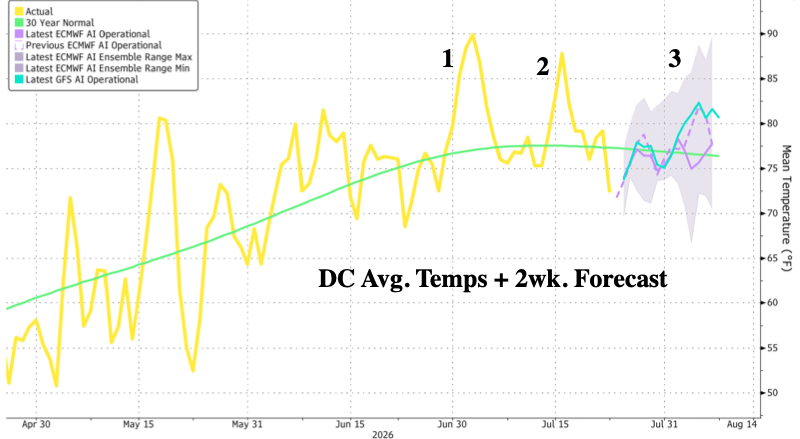
Folks across the Mid-Atlantic are enjoying a welcome stretch of mild weather today, with temperatures in the 70s following several rounds of extreme heat earlier this month that sent temperatures into the 90s and even into the triple digits. Enjoy the comfortable nights in the 60s and low 70s over the next few days, because another heat wave is already on the horizon.
“New heat event potentially targets East Coast Aug 5-7,” private forecaster Commodity Wx Group wrote on X.
Bloomberg forecast data show temperatures beginning to climb by the middle of next week, with highs peaking in the mid-to-upper 90s during the first week of August. The incoming heat wave is not expected to match the intensity of the two earlier this month, when temperatures surged well into the triple digits.
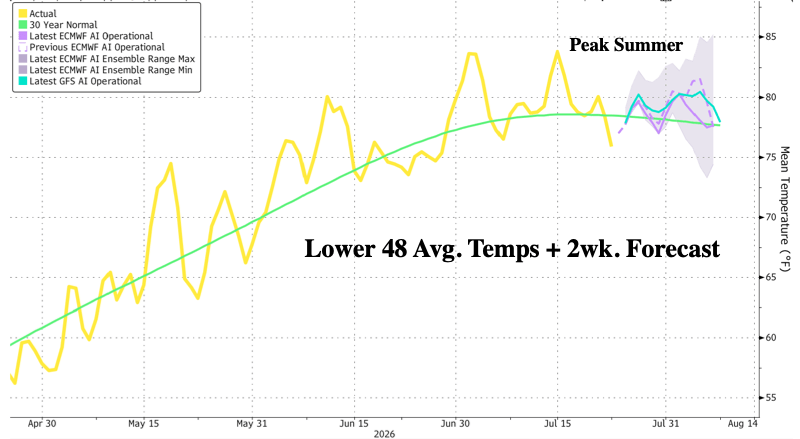
Notably, temperatures in the Lower 48 have reached their seasonal peak and will begin trending downward.
Peak summer is a welcome relief for customers across the PJM grid, who are facing some of the highest power costs in the nation.
Do DSA Elites Rank America Worse Than Mao’s 70-Million Body Count?
This is a lightly edited transcript of today’s video from Daily Signal senior contributor Victor Davis Hanson.
We’re hearing more and more from the Democratic Socialists of America about all of the sins of America and very little of the good things we’ve done to ourselves and to the world at large on our 250th birthday.
What is it, the nature of this DSA, Democratic Socialists of America, and the diversity, equity, inclusion criticism that we were racist, sexist, nativist, cruel, ruthless, etc., etc.
He was the greatest mass murderer in history, and that government is still communist in an unbroken chain from [Chinese leader] Xi [Jinping] all the way back to Mao. Do we ever talk about that or the million people who are in concentration camps in China?
Compared to historically to the Aztecs?
We’re told the Aztecs were great people. They had an empire, but they crushed over a million people to create their empire. Some years, they sacrificed up to 10,000, maybe 15,000 a year of conquered tribes of fellow Indigenous people.
Do we remember Shaka Zulu, the 19th-century creator of the Zulu nation?
He was responsible for a genocide in crushing his enemies that probably cost over a million lives.
Do we really think that the Native Americans were living in paradise until Europeans came? The story of Native Americans was conquest, enslavement, butchery of rival tribes.
So, what is going on?
We have a tradition in the West of self-criticism. That’s what makes us different. Rationalism, self-criticism, improvement. But when that goes to an extreme, it ventures from self-criticism and self-reflection to nihilism, and it’s quite destructive.
So, let’s just take a look at where the United States is compared to the rest.
Look at immigration. Why do a million people, or 2 million people, 10,000 a day under Joe Biden, from very poor countries, most of them from what we would call the former Third World that were victims of socialism, why do they risk their lives coming here every year?
Why do all these critics of the United States … [Rep. Alexandria Ocasio-Cortez], why did her parents want to come here? Why did [Rep.] Ilhan Omar’s father want to come here? Why did [Rep.] Rashida Tlaib’s father want to come here? Why did [New York City Mayor] Zohran Mamdani’s parents want to come? Was it so bad?
Can’t they ever acknowledge that they came here because they had greater security, they had greater freedom, they had greater economic opportunity? And if they had criticisms, it was never enough that they wanted to go back to the places that they praised, but only from a distance and in the abstract.
The truth is that the poor in the United States are better off than most of the middle classes in every other country.
We saw that in the World Cup when middle- and upper-middle-class Europeans came over, and unlike … to watch the games, and unlike most tourists, they didn’t just stick on the coasts. They went to places in Arkansas, Oklahoma, Texas, the South, and the Midwest.
And they found two things.
One, Americans were amazingly friendly and open, upbeat, not downers and drab, and everything’s terrible, which they expected from their experiences in Europe.
And more importantly, they were affluent. They had big homes. They had air conditioning. the poor had appurtenances. Everybody has a cell phone. Nobody worries about the cost, apparently.
There’s also then the hypocrisy of a lot of our critics.
And let me just give you an example of a few of them.
Hasan Piker is a child of very, very wealthy Turkish immigrants that became U.S. citizens. He grew up for much of his life in Turkey. He gave a talk the other day in a Mao suit to Democratic Socialists of America. Think about that. He put on the uniform, so to speak, of the greatest mass murderer in history, and then he denounced capitalism.
But he didn’t denounce capitalism in his own life because his parents are multimillionaires. He is a multimillionaire, and he drives a, what? $120,000 Porsche. Isn’t that a luxury of the bourgeoisie?
And then there’s Zohran Mamdani, of course. His family, as I pointed out numerous times, was the elite of the elite of the elite in Uganda, a community of expatriates, Indians, from India that control 60% of the wealth, and they’re only 1% of the population.
And he grew up in privilege here. He had a very nice home. He has a family estate on Lake Victoria, of all places.
Ro Khanna, the congressman from California, he always is pointing out the evils of Republicans, and as he looks at the drift of the Democratic Party, he puts his finger in the wind, and he says socialism is the answer. Ro Khanna does.
But he’s a multimillionaire. His father-in-law is one of the wealthiest members of the Indian American community, probably worth $500 or $600 million. His own children have been deeded golf courses. His wife drives a $190,000 Range Rover, and he’s lecturing us about our shortfalls?
And then, of course, we come to [California Gov.] Gavin Newsom. He wants to get in on the socialist craze, so he said the other day, as is his wont, moving his arms around and being very slick and glib, that capitalism fails. It didn’t work.
It worked for you, Gavin. You have a $9 million home.
You are the, basically, the quote-unquote, “protégé” of the Gordon Getty oil for- fortune, who backed all of your business opportunities.
Graham Platner, the now-disgraced madman who thought he was going to be senator with a Nazi tattoo. He criticized capitalism. He said that, you know, he was drifting towards socialism, very critical of America.
But he really wasn’t a small-business person. He was a construct. His mother and father, who were very wealthy, one owned an upscale restaurant, the other was a well-known, often corporate real estate lawyer. They set him up in business, and they were his only client, and they allowed him to have land to use.
So, what I’m getting at is most of this criticism of America is not coming from the so-called poor. It’s not coming from the lower middle classes. It’s coming from elites in urban enclaves who have done very well with capitalism, and they feel that by mouthing these socialist and communist platitudes, it’s a way to get power within the Democratic Party first, and then within the United States second.
And remember one thing, this is not new. Most of the violent socialist communist movements in history, whether we look at the anarchist of the late 19th century, or whether we look at the Bolsheviks of 1905 all the way up to the Russian Revolution of 1917, or we look at the revolutions of 1848 in Europe, especially the Reign of Terror, 1792 and 1793, when a bunch of very wealthy, this should sound familiar, socialists hijacked the French Revolution and turned it into a Stalinist-like murder spree.
They all had one thing in common. They were very, very wealthy, and they hated the very system that had enriched them, and they wanted to try out a whole series of nihilist projects on whom? On the middle class and the poor, with the proviso that none of their ideology would ever apply to themselves.
BLM Is Back And Protesting The Police Shooting Of Another Violent Career Criminal
They are far less active across the US in 2026, but not truly gone. Is it exasperating, or, is it entertaining? It depends on how you look at it. Yes, the Black Lives Matter movement is back, and big surprise, they’re angry over the police shooting of another violent minority criminal. But, is he black?
Not according to his extensive offender detail record, in which his race is listed as “White” and his ethnicity is listed as “Latino”. Yet another in a long line of imprisoned minority perpetrators falsely identified as white on their rap sheet in order to artificially reduce official crime stats. That said, it’s nice to know that BLM is finally admitting that all lives matter.
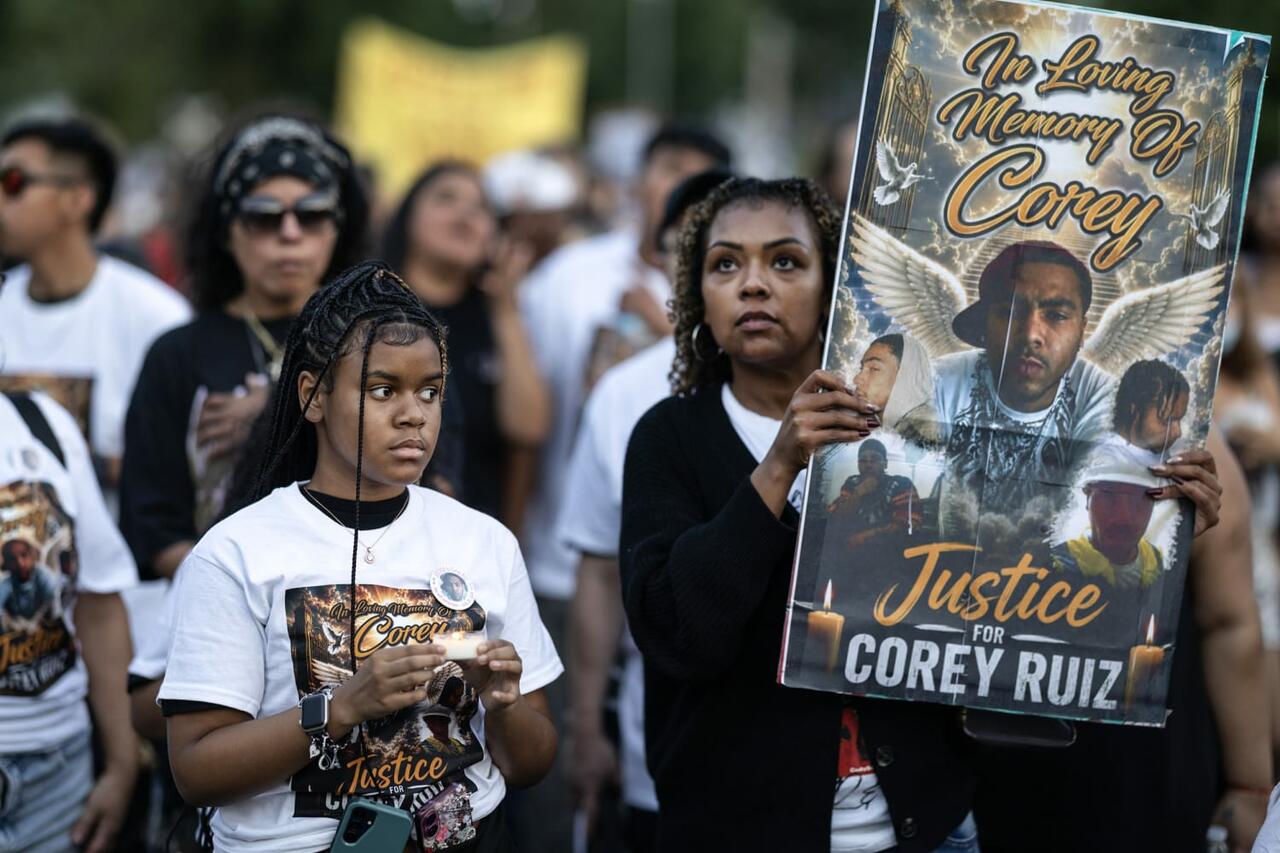
Corey Durrell Ruiz, 38, recently released from prison, was approached by police while riding a bicycle after allegedly attempting to enter (break into) random vehicles in Madison, Wisconsin. He was also suspected of a previous bike theft.
When officers attempted to detain Ruiz, he ran. He was tackled off the bike, but produced a fixed blade knife and stabbed one of the officers. The wounded officer fired three shots, killing the suspect.
July 22, 2026 – Madison, Wisconsin.
Four officers struggle to arrest a man suspected of stealing bikes and checking cars.
During the fight, he pulls a large fixed-blade knife.
One officer is stabbed. A second officer is also injured.
Generally speaking, pulling any weapon during an arrest and trying to use it against an LEO is legal justification for the use of deadly force in return. It is unlikely that the officers involved will face charges in court. Not to be overlooked, Corey Ruiz has a long criminal history of up to 40 separate misdemeanors and felonies dating back to 2007.
This includes an extensive history of attacking police officers, and yes, this does matter because it shows a consistent pattern of violence. A world without Corey Ruiz is, objectively, a better world.
The Black Lives Matter movement and the mainstream media have immediately seized on the shooting in an effort to exploit it for political purposes. The local Democrat run government is already bending the knee to protesters as they hijack press briefings with inane fatiguery. BLM mobs are stalking Madison looking for chances to create chaos. Wisconsin’s leftist governor is calling for “accountability” in the shooting.
It’s fascinating that the family of Corey Ruiz has appeared on camera to demand transparency, given that Ruiz was listed as homeless at the time of the encounter with police. Multiple reports indicate mental health and substance abuse issues, and apparently no one from Ruiz’s family was willing to give him a place to stay. They are, though, readily available to soak up the media spotlight and feed the activist fervor in the wake of his death.
News outlets are circulating photos of Ruiz from 2014; a common tactic used by the media to make the suspect look younger and elicit greater empathy from gullible portions of the public.
Concert attendees in Madison got a taste of the old BLM mob mentality when protesters stormed the venue and demanded a platform for their grievances. As much as they would like this to become a “George Floyd moment”, however, times have changed and BLM has exhausted much of the public support they had in 2020.
Mob of angry protesters crashed a concert in Madison, Wisconsin, demanding “justice” for Corey Ruiz, a black man who was shot and killed by police after he allegedly pulled a knife during an arrest.
They essentially held the attendees hostage while hijacking the stage. The event… pic.twitter.com/J2GALWl4ob
The shooting is a clear case of officer self defense based on eye witness accounts and the available video footage. Police body cams are liable to give more detailed insight into the incident, but the evidence against Ruiz is already damning.
Leftist groups and Democrats seem to be angling for more Kenosha-style riots, perhaps as a means to create disruption during an election year. But the American populace is tired of the theatrics. If the protests don’t fade due to lack of interest and riots do take place, few people are going to shed a tear if the National Guard drops the hammer on them.
Ultimately, Ruiz is one of many repeat offenders who had no chance of reform; a member of the 1% of people who cause the vast majority of societal grief for the other 99%. He should have stayed locked up for the safety of the community at large, and if he had been he would still be alive today. Maybe, though, that’s not what the Democrats and BLM really want.
While nearly one in four homes across the United States are located in areas susceptible to severe weather conditions, many homebuyers are still seeking out properties in these high-risk regions, a July Realtor.com report found.
The organization’s data show that 23.1 percent of America’s homes – with an estimated $11.2 trillion in value – are currently situated in areas prone to natural disasters.
The report indicates that, despite the likelihood of flooding, wildfires, or extreme windstorms in some areas, homebuyer demand remains strong, often driven by lower list prices than in nearby lower-risk areas.
“Price is still the biggest motivator for a lot of home shoppers, even in places where climate risk is well known,” Realtor.com economist Jiayi Xu said in the report.
“But that doesn’t mean the risk disappears. It shows up later, in insurance premiums, HOA fees, and financing, often after the sale is already done.”
Homeowners in these high-risk locations are already paying a premium to protect their properties against possible damage, a median of $192 per month in homeowner association (HOA) fees, which is 53.6 percent more than homeowners in lower-risk areas, according to the report.
Realtor.com found that Delaware, South Carolina, and Oregon lead the nation for the widest gaps between HOA fees in high- and low-risk areas. In Oregon, for example, the median HOA fee in high-risk areas is $423, compared with $114 in lower-risk areas.
In California, where certain regions have suffered from devastating wildfires over the years, many homebuyers are still not deterred from purchasing in those areas.
According to the report, listings in high-risk Santa Clara County are priced at 78 percent of the per-square-foot price of homes without severe risk. These properties also command 48 percent more views per listing.
Los Angeles County homes in higher-risk areas also offer discounts, with homes there priced at 75 percent of those in lower-risk areas and accounting for 23 percent more views.
“When disaster strikes, shoppers retrench, but the effect is short-lived,” the report states. “Following the January 2025 LA wildfires, buyer interest in high-risk homes dropped 10%, yet fully recovered within one month.”
However, in other markets such as Anne Arundel County, Maryland, homebuyers are willing to pay 44 percent more per square foot to live in areas deemed at high risk for weather damage because waterfront access often outweighs the risk.
A similar situation in Llano County, Texas, shows homebuyers paying almost double for a home in a higher-risk area so they can live near a river.
The report said other areas of the country that have been continuously hit by flooding include Oklahoma, Idaho, Mississippi, and Alabama.
“Buyers are not seeking risk – but in markets where affordability has long been an issue, price is the dominant signal, and high-risk homes happen to offer the discount that makes ownership possible,” the report states.
A May 2026 Pew Research Center report found that 71 percent of U.S. homeowners said their home insurance premiums had increased. Among those homeowners, many cited rising repair and rebuilding costs and more frequent extreme weather events as major reasons for the increases.
In an April report, Insurance.com, an online comparison service and digital agency, stated that Florida’s high hurricane risk has made it difficult for residents to obtain home insurance.
It also noted that many carriers in the state had gone out of business, leaving just the state insurance option, Citizens Insurance, which can cost homeowners about $7,000 a year and even more in coastal areas.
Obtaining insurance in California is also difficult, the report noted, due to wildfires. As a result, some major carriers, including State Farm and Allstate, have stopped issuing new policies.
For those who still choose to purchase homes in high-risk weather zones, Insurance.com recommends ensuring they have adequate replacement cost coverage in the event of a natural disaster.
Trump Pursues Diplomatic Off-Ramp As Omani Delegation Arrives In Tehran: Report
Summary
Why Trump Reportedly Ordered Military Not To Strike In Overnight
US Pauses Iran Bombing Campaign As Saudi-Houthi Red Sea Front Erupts
Why Trump Reportedly Ordered Military Not To Strike In Overnight
Axios reports that President Trump called off new U.S. military strikes on Iran Friday night, signaling a potential diplomatic offramp after nearly two weeks of tit-for-tat attacks.
People familiar with the decision told the outlet that the pause coincided with the arrival of Omani officials in Tehran for negotiations aimed at reopening the Strait of Hormuz.
Here’s what those sources are saying:
Trump’s order to hold fire was given several hours after an Omani delegation arrived in Tehran Friday for talks on a new arrangement to reopen the Strait of Hormuz.
Two regional sources with knowledge of the negotiations said progress has been made in the talks and that an agreement between Oman and Iran could be reached over the weekend.
More color:
Trump’s decision reflects both his willingness to provide more space for diplomacy and a recognition that — short of a return to major combat operations — the current level of U.S. strikes has reached the limit of its effectiveness.
If Trump orders a return to strikes, the U.S. military can mobilize on relatively short notice.
The U.S. military is still preparing plans for a possible return to major combat operations, but Trump hasn’t given orders to move in that direction, the sources said.
Why the Trump administration is likely finding the offramp (again) …
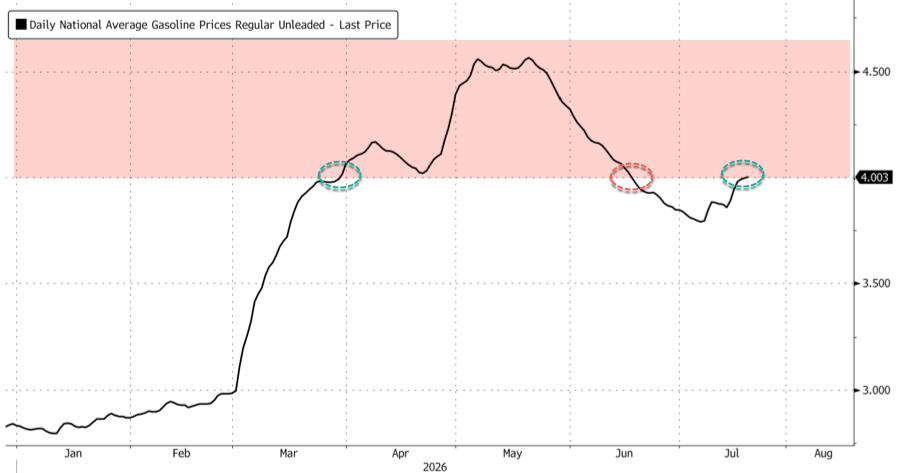
JPMorgan’s head of Global Commodities Research and Strategy, Natasha Kaneva, told clients: “In the previous round of escalations, negotiations were initiated once US gasoline prices reached $4.20 and became materially more urgent as prices neared $4.50. Oil may be a global commodity, but political tolerance for high energy prices remains overwhelmingly domestic.”
US Pauses Iran Bombing Campaign As Saudi-Houthi Red Sea Front Erupts
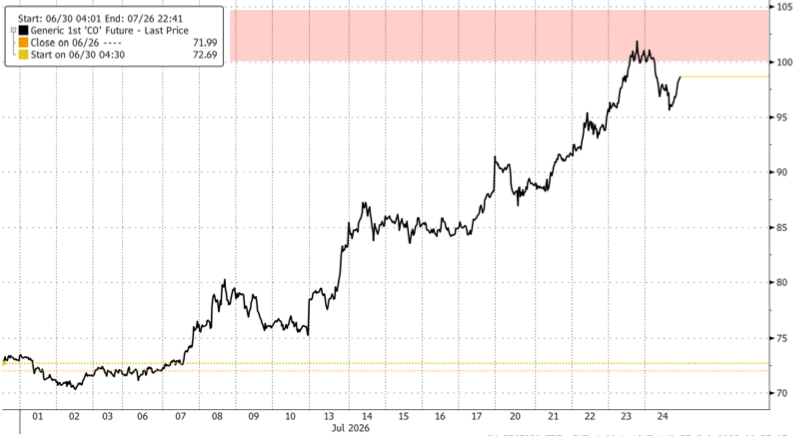
Brent crude surged 27% over two weeks to settle at $96.78 a barrel on Friday, briefly breaching $100 this past week as traders priced in a higher war-risk premium into energy markets amid simultaneous chokepoint threats to the Strait of Hormuz and the southern Red Sea.
Meanwhile, the US appeared to pause its 13-day campaign of daily overnight strikes against Iran. While there was no indication that the operational halt would extend into next week, the pause certainly reinforces the diplomatic signals highlighted in our US-Iran wrap on Friday.
However, there was an escalation overnight with Saudi-led strikes on Iran-backed Houthi targets in Hodeida. This comes after the terror group attacked multiple Saudi-linked tankers in the southern Red Sea area.
Houthis escalate with attacks against Saudi Arabia:
BREAKING: Houthi military spokesman Yahya Saree says the group has launched two “sensitive operations” targeting Saudi Arabia, vowing that the principle of a “blockade for a blockade” will continue.
Saudi Arabian oil refinery reportedly hit by Houthi missile:
Smoke has been seen coming from a Saudi Arabian oil refinery in Jazan after reports of a Houthi missile attack and air defence activity.
The Iran-backed Houthis said they had launched a series of attacks on the country in retaliation to Friday’s Saudi strikes on Hodeidah. pic.twitter.com/P88heLGtOO
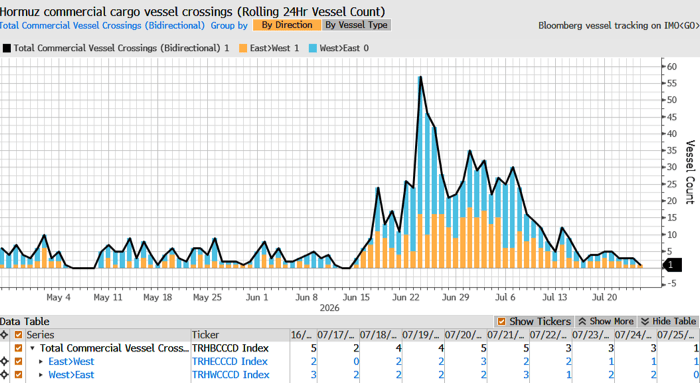
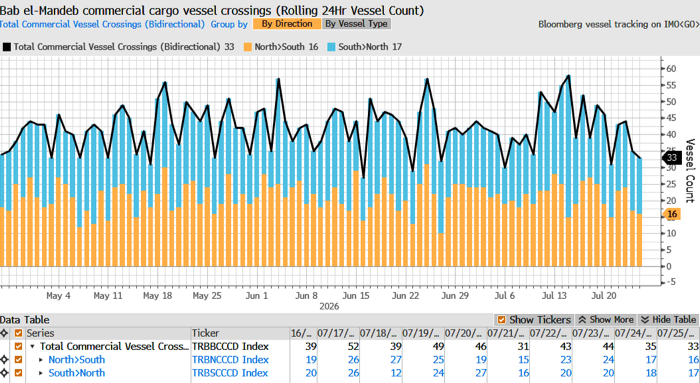
The confrontation threatens to open a second major front in the Gulf conflict. With traffic through Hormuz largely paralyzed, sustained Houthi attacks on Yanbu or ships entering Bab al-Mandab Strait could disrupt millions of barrels of Saudi exports, raise shipping costs, and further tighten physical markets.
Hormuz Traffic
Bab al-Mandab Strait Traffic
Commodity desks from JPMorgan, RBC, Goldman Sachs and others warned this past week that spreading “strait chaos” across the Gulf and widening disruptions to regional energy flows could drive further upside in crude if the conflict persists. Brent has returned to the $90s after briefly trading above $100 a barrel.
Red Sea disruption already materialized on Friday when a Hong Kong-flagged supertanker decided to turn away before reaching Bab el-Mandeb and to instead transit around the Cape of Good Hope, reinforcing longer freight times, higher rates, and more disruptions:
There is good news because US-allied Gulf countries are either planning or already developing new pipeline and port projects to bypass the Hormuz chokepoint entirely, which in the long run will erode Tehran’s leverage on the critical waterway:
Here are the latest overnight developments, courtesy of Bloomberg:
US Strikes & Pause
• Iran reported no US strikes overnight on Saturday, marking an apparent break after nearly two weeks of consecutive nightly US attacks.
• US strikes had progressively expanded in scope over two weeks, targeting bridges and infrastructure deeper inside Iran, following a collapsed ceasefire and renewed fighting over the Strait of Hormuz.
• Trump said on Friday he has not yet made a decision on whether to conduct major strikes against Iran, while noting US-Iran talks are continuing through VP Vance, Secretary Rubio, and others.
• Trump had previously told Axios he was considering a “massive attack” on Iran, saying the country “hasn’t received enough pain yet” and is not ready to make a deal.
Strait of Hormuz
• Iran’s Revolutionary Guards said on Saturday they stopped four ships attempting to transit the Strait of Hormuz over the past 24 hours after firing warning shots.
• The US and UK are planning a high-level international conference in London next week focused on forming a coalition to protect maritime shipping in the Strait of Hormuz, according to two European diplomats and other sources.
• An LPG tanker with 28 Indian crew members was attacked in Iranian territorial waters on Friday; India’s embassy confirmed the crew is safe.
Regional Escalation
• Houthis claimed to have struck Saudi Arabia with missiles on Saturday morning, targeting southern Saudi provinces; Saudi authorities issued emergency warnings before lifting them for Jazan.
• Bahrain and Kuwait secretly sent warplanes to strike drone- and missile-storage depots inside Iran earlier this month, according to people familiar with the matter, their first such direct retaliation against Tehran.
Diplomacy & Sanctions
• China urged Iran and the US to return to implementing their ceasefire memorandum, with Foreign Minister Wang Yi expressing deep concern over renewed escalation at an SCO meeting in Kyrgyzstan on Friday.
• Pakistan is exploring a path toward resuming stalled US-Iran talks following a push initiated by China, according to three Pakistani sources cited by Reuters; obstacles to talks remain high.
• The US Treasury imposed new sanctions on Friday on the network of Iranian financier Babak Zanjani, targeting four individuals and nine entities linked to sanctions evasion and digital asset exchanges.