55.4 F
Chicago
Friday, October 16, 2026
Home Blog Page 2226

US Manufacturing Output Plunged In September

0
US Manufacturing Output Plunged In September

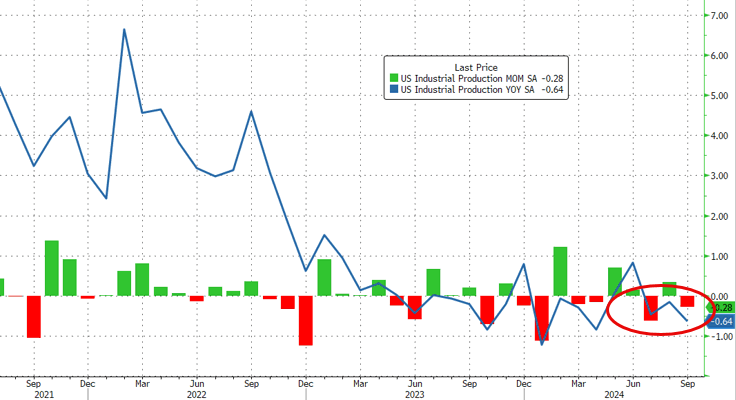
US Manufacturing contracted 0.4% MoM in September (dramatically worse than the 0.1% decline expected). This dragged Manufacturing output down 0.5% YoY…

Source: Bloomberg

This helped drag US Industrial Production down 0.3% MoM and -0.6% YoY (the weakest since April) as August’s print was revised down…

Source: Bloomberg

A strike by aircraft machinists held down industrial production by an estimated 0.3%, while the effects of hurricanes Helene and Francine subtracted a similar amount, the Fed said.

Production of aerospace equipment tumbled 8.3% during the month.

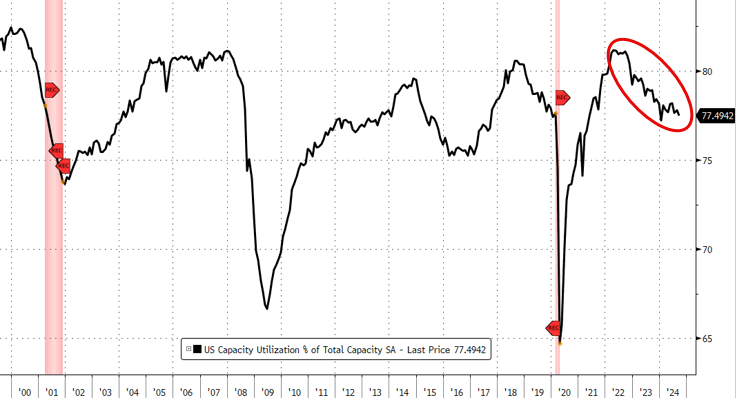
And this is all happening as Capacity Utilization tumbles to 77.5%

Source: Bloomberg

Mining and energy extraction slid 0.6%, while output at utilities increased for the first time in three months.

Does that looking a ‘no landing’ economy? Or is it all ‘transitory’ too?

Tyler Durden
Thu, 10/17/2024 – 09:28

The Next Wave(s) Of Inflation

0
The Next Wave(s) Of Inflation

Authored by Adam Sharp via DailyReckoning.com,

Have you ever been caught in a set of gnarly waves at the ocean? The kind where you get smashed by a breaker, come up for air and there’s another big one waiting for you at the surface?

This is a solid metaphor for inflationary periods. They don’t happen like a single big tsunami.

They are typically processes that play out in stages over a decade or more. Policymakers try various fixes, and most fail or only provide temporary relief.

Let’s take a look at the three waves of America’s 1970s inflation…

Source: Crescat Capital

I believe we are currently floating in the trough after the first wave of inflation, catching our breath.

Things seem to be trending in the right direction, despite prices remaining permanently higher.

But the fundamental problems haven’t been addressed, and more breakers loom on the horizon.

Commonplace Problems, Fewer Options

Like most inflationary periods, the ‘70s woes trace back to bad monetary policy and too much government spending.

In 1971, President Nixon ended the dollar’s convertibility into gold after France, Germany and others began to swap their rapidly inflating dollars for bullion.

This set the stage for a decade of stagflation (high unemployment, sluggish growth, and sustained inflation).

Throughout the 1970s, the Fed hiked interest rates to match CPI, yet inflation persisted.

Source: Econlib

Higher interest rates, price controls, but nothing really worked until the dollar found equilibrium after being severed from gold.

(Eventually, the petrodollar system would help restore demand for dollars, but we’ll save that for a separate article.)

We can learn much by studying the 1970s stagflation. I believe we will also see multiple waves of devaluation and disruption, interrupted by brief respites.

But we also need to acknowledge key differences.

In the 1970s, America’s debt load was not nearly as bad as it is today.

Throughout the 1970s, U.S. federal debt/GDP never got above 35% or so. Today it’s over 120%. At such levels, our country can’t even handle 3% interest rates for much longer.

Interest costs on U.S. debt are soaring and should approach 6% of GDP by the end of this year. At the current pace, we risk a severe debt spiral within the next few years.

This means that if and when inflation returns, hiking interest rates to compensate may not be an option. So this period will almost certainly look different from the ‘70s because the Fed has fewer options to choose from.

Unfortunately, more waves of inflation seem certain. Our financial situation practically guarantees it.

The Federal Reserve, and Americans, may have to simply grin and bear these next waves of debasement. The value of fiat savings will dwindle as yields can’t come close to matching CPI.

Gold: Crucial in the 70s and Today

Precious metals investors thrived in the 1970s. Purchasing power for gold and silver owners was preserved and even grew.

Jim Rogers and George Soros built the foundations of their fortunes by investing in precious metal assets through their Quantum fund.

Here’s a chart showing the performance of gold vs. inflation. Note how gold follows CPI closely during the 70s…

Source: Suisse Gold

The primary difference I see today is the magnitude of the problem we face. It’s far more severe, and the Fed has fewer options.

If anything, gold may be even more important today than it was in the 70s.

There’s only so much Jay Powell can do. Eventually the Fed will have to get “creative.” And when central banks get creative, that’s when money printing tends to get out of control.

Physical bullion is the most obvious way to protect your assets. And makes an excellent addition to any portfolio.

Tyler Durden
Thu, 10/17/2024 – 09:20

Expedia Jumps On FT Report That Uber Explored Takeover

0
Expedia Jumps On FT Report That Uber Explored Takeover

Shares of Expedia Group surged in premarket trading in New York following a report from the Financial Times, which stated that Uber Technologies has been in talks with advisors in recent months to explore a potential takeover of the travel website. Wall Street analysts viewed the possible merger between the ride-hailing giant and the travel website as ‘positive.’ 

The FT report cites three individuals familiar with the talks between Uber and advisors: 

Uber approached advisers in recent months after the idea of an Expedia acquisition was broached by a third party to examine whether such a deal would be possible and how it could be structured, according to three people familiar with the process.

The report noted that Uber chief executive Dara Khosrowshahi, who served as Expedia’s CEO between 2005-17 and remains a non-executive director on its board, may suggest that any deal would be ‘friendly’ instead of hostile in nature.  

The people briefed on the matter said Uber’s discussions with advisors to determine how a deal could be structured with the travel website was in the “very early stage, and it was possible that a deal would not transpire.” Another person said Uber and Expedia have yet to discuss any deal formally. 

Earlier this week, Uber chief executive Dara Khosrowshahi told FT, “Anywhere you want to go in your city and anything that you want to get, we want to empower you to do so.” 

Combining ride-hailing services with Expedia and its booking technology under one platform would create a ‘super app’ such as those built by Chinese tech firms. 

In August, Uber CEO Prashanth Mahendra-Rajah said that the ride-hailing firm’s “top priority” for deploying capital was investing in growth, including via acquisitions. 

In markets, Uber shares fell about 3% in premarket trading, while Expedia shares were up about 6%. 

Wall Street analysts provided commentary on FT’s report (courtesy of Bloomberg): 

Bloomberg Intelligence analyst Mandeep Singh

  • “Uber CEO Dara Khosrowshahi’s familiarity with Expedia as its former leader could help drive revenue and cost synergies”
  • “Adding Expedia would likely have a better margin profile than Uber’s Delivery segment and could support ads and subscriptions scale over time”

TD Cowen analyst Kevin Kopelman

  • A possible deal would offer synergies if Uber planned a broader rollout of Travel booking services
  • Kopelman notes Uber UK rolled out Hotel bookings in 2022 and Flights in 2023
  • “However, an acquisition of EXPE would also come with the challenges of managing EXPE’s existing brand portfolio in the face of difficult competition”

Bernstein analyst Nikhil Devnani

  • Hoping that Uber makes forays into travel, but thought it would come via partnerships “and not outright M&A — particularly a potential deal of this size”
  • “Despite Dara’s background, we think it would be the furthest step out of Uber’s core area of competency via M&A for the business at large — and that notion makes us nervous as Uber bulls”

Truist Securities analyst Gregory Miller

  • The timing of Uber’s possible outreach is potentially opportunistic as Expedia “has largely completed its multi-year strategic transformation to simplify its business model”

Since 2019, Uber has expanded into food and beverage delivery, freight, and logistics, yet it has made very few large deals. 

Tyler Durden
Thu, 10/17/2024 – 09:00

Initial Jobless Claims Drop As Storm Impact Fades

0
Initial Jobless Claims Drop As Storm Impact Fades

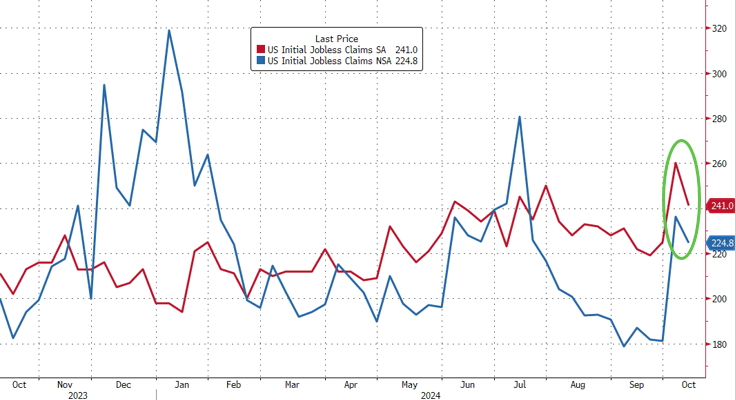
After last week’s storm- and strike-driven surge in initial jobless claims, the headline data slipped back from 260k (revised higher) to 241k…

Source: Bloomberg

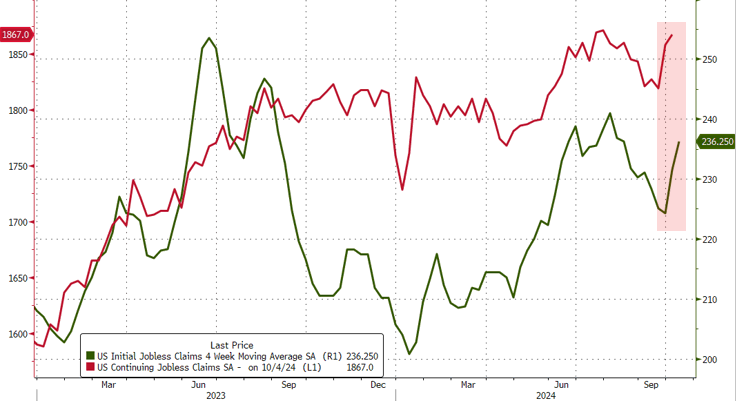
On an unadjusted basis, initial claims remain high (but off their highs) while continuing claims pushed higher from 1.858mm Americans to 1.867mm Americans…

Source: Bloomberg

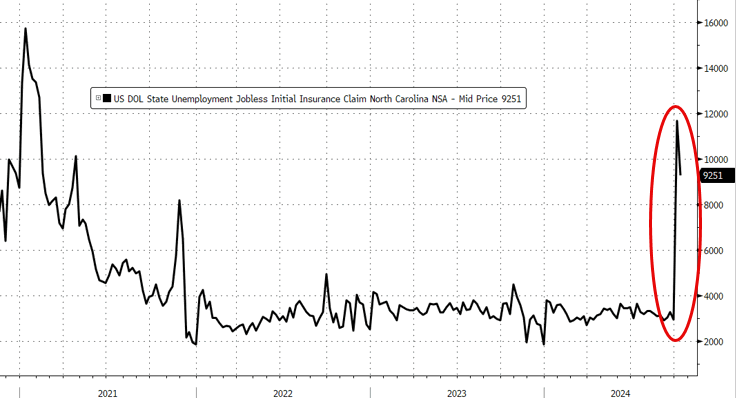
The impact of Hurricane Helene (North Carolina) will continue to be felt…

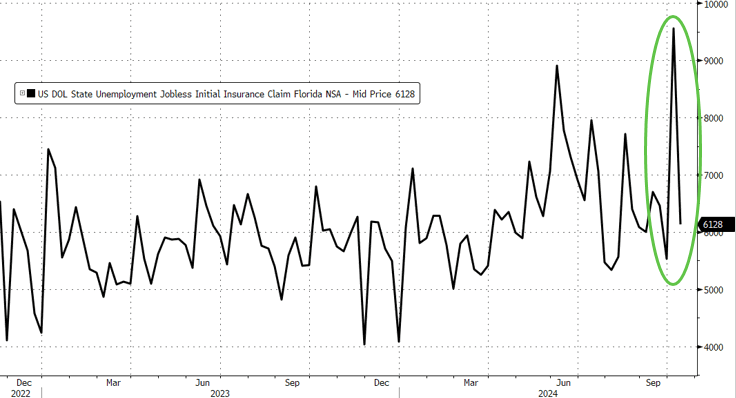
Presumably, this does not include the impact of Milton???

Source: Bloomberg

But analysts expect that to fade as all that lovely money from FEMA flows into the local economy (oh wait…).

And WTF is going on in Michigan? It appears those Stellantis layoffs were ‘transitory’…

In other words, ignore the jump in jobless claims this close to an election, it’s just transitory…

Tyler Durden
Thu, 10/17/2024 – 08:55

Retail Sales ‘Reality Check’: This Was The Biggest Positive September Seasonal-Adjustment Ever!

0
Retail Sales ‘Reality Check’: This Was The Biggest Positive September Seasonal-Adjustment Ever!

As we warned in our preview last night, the almost omniscient folk at BofA warned, ‘brace’ for a blowout retail sales print this morning, forecasting a huge 0.8% MoM rise in spending (well above the 0.2% consensus) all due to seasonal adjustments.

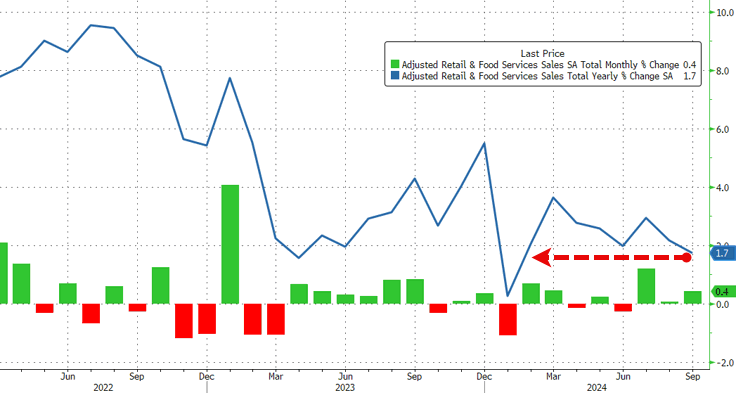
BofA was mostly right with all the retail sales cohorts coming in hot – headline +0.4% (+0.3% exp), ex-autos +0.5% MoM (+0.1% exp), and most notably the control group (which flows into the GDP calc) +0.7% MoM (+0.3% exp).

Headline retail sales MoM beat was not enough top keep the YoY print improving as it dropped to +1.7% YoY – the weakest since January…

Source: Bloomberg

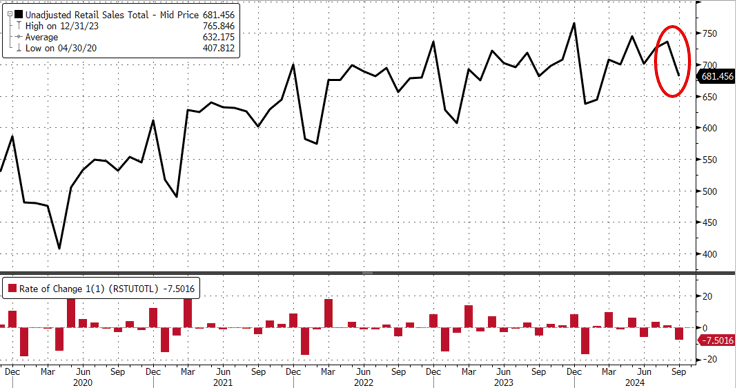
On an unadjusted basis, Retail sales fell a shocking 7.5% MoM…

Source: Bloomberg

This was the biggest positive September seasonal adjustment in history…

Source: Bloomberg

In case it’s hard to see above… how do you know it’s an election year (and Dem support is waning over a bifurcated economy or haves and have-nothings)…

However, Core retail sales rose 4.0% YoY…

Source: Bloomberg

Spending at Gas stations and Furniture Stores fell on a MoM basis while Food Services and Food & Beverage Stores spending jumped most…

Source: Bloomberg

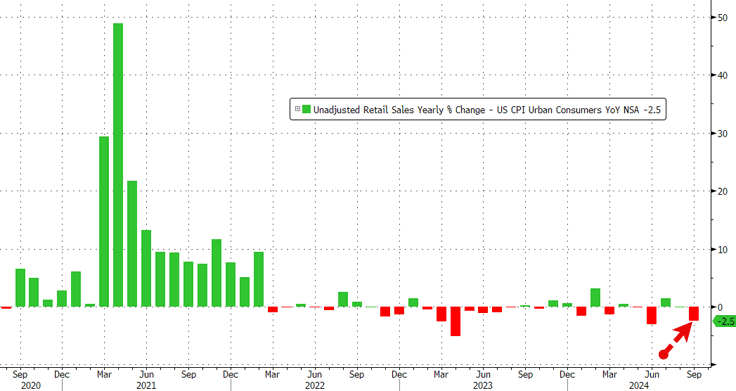
On an unadjusted basis, retail sales were flat (0.0%) YoY which means (roughly speaking) real retail sales were down notably on a YoY basis…

Source: Bloomberg

So, take your pick – is retail spending ‘hot’ or is inflation eating into personal incomes more than many think?

Tyler Durden
Thu, 10/17/2024 – 08:45

German Companies Skirt Sanctions To Help Putin’s War Machine

0
German Companies Skirt Sanctions To Help Putin’s War Machine

Authored by Liz Heflin via Remix News,

Germany continues to sell industrial goods to Russia, including machines for manufacturing vehicle and aircraft parts and ammunition, according to the Tagesschau news portal, which reported on an investigation conducted by broadcaster SWR.

Putin needs a constant supply of military equipment, and due to the sanctions imposed on Russia blocking imports, large parts of Russian industry have been transformed to cater to a war economy, producing military equipment, ammunition and spare parts as required. 

However, products from German mechanical engineering companies also continue to help out, with more than 300 machine deliveries for manufacturing everything from vehicle parts to ammunition made in Russia in 2023, often via Turkey, SWR research indicates. 

SWR was able to identify more than 30 German manufacturers whose machines were imported to Russia last year, many of them based in Baden-Württemberg, a traditional location for mechanical engineering.

In around two-thirds of the cases, the machines were imported to Russia via Turkey. Some Turkish middlemen involved have direct connections to Russia, while other companies there facilitating the shipments were founded by Russian entrepreneurs.

Videos and photos obtained by SWR prove just how extensively German machines are used by Russian military suppliers, including by Russian companies Parsek, Kamaz, NIR and Industrial Solutions. 

Most of the deliveries involved large industrial machines or so-called CNC machines, computer-controlled equipment that enables automated manufacturing.

These machines can cut steel, weld parts, and perform other functions for the production of defense equipment, such as vehicle/aircraft parts and ammunition.

Olena Yurchenko ,from the Economic Security Council of Ukraine, claims that 80 percent of CNC machines in Russia are now used in military production:

“With computer-aided CNC machines, they can produce much faster and more precisely, which is extremely important, especially in the weapons sector. This ultimately enables them to produce even more deadly weapons. And Germany is the market leader in the production of these machines, with a share of up to 30 percent in Russia,” she told the portal.

Read more here…

Tyler Durden
Thu, 10/17/2024 – 06:30

Taiwan & South Korea Have The Lowest Fertility Rates In The World

0
Taiwan & South Korea Have The Lowest Fertility Rates In The World

The fertility rate is the average number of children born per woman of child-bearing age in a country.

Usually, a woman between 15 and 45 is considered to be in her child-bearing years.

Below, voronoiapp.com shows a list of countries with the lowest fertility rates as of 2024, according to data compiled by Statista. All figures are estimates.

A fertility rate of 2.1 children per woman, known as the “replacement rate,” keeps the population stable by replacing both parents and accounting for infant mortality, assuming no migration and constant mortality rates.

Taiwan’s fertility rate is estimated at 1.11 children per woman, the lowest in the world. 

Europe leads our ranking with eight countries, followed by Asia with six, North America with five, and Africa with one.

Tyler Durden
Thu, 10/17/2024 – 05:45

Will The Conflicts In The Middle East Spill Over Into The Caucasus?

0
Will The Conflicts In The Middle East Spill Over Into The Caucasus?

Authored by Conor Gallagher via NakedCapitalism.com,

With the ongoing US/Israel rampage across the Middle East, we’re getting an increasing number of glimpses into the dark recesses of the neocon mind. This includes fantasies like “total victory” and daydreams about Israel assassinating Turkish President Recep Tayyip Erdoğan and Iran’s Supreme Leader Ayatollah Ali Khamenei. We recently featured one such vision here at Naked Capitalism from neocon-connected Simon Watkins at OilPrice. In it, he raises an option for Israel in attacking Iran out of Azerbaijan,  which would lead to another front in war, destruction of Middle East and Caspian energy infrastructure, the tanking of the global economy, and potentially the deaths of hundreds of thousands of people, if not more — just the usual neocon reverie.

While Watkins version is unlikely (see comments on his piece here), there are pathways for the Caucasus to get sucked into the US/Israel slaughter in the Middle East. Neocon fever dreams unfortunately do play a role, but there’s also a lot else going on, and I’d like to take a more sober look at that here.

The Caucasus is at the crossroads of Europe, Asia, and the Middle East, and is therefore one of the most contested centers for the vital issues of energy transfer and trade logistics. All the major players from the Middle East conflicts, as well as others, are heavily involved in geopolitical maneuvering here.

Much of the intrigue in the Caucasus centers around the so-called Zangezur Corridor, a 42-kilometer strip of land in southern Armenia wedged between Azerbaijan and its exclave, Nakhchivan, and bordered by Iran to the south.

This small piece of coveted territory plays an outsized role in larger trade and energy projects due to the fact that whoever controls it will increase their influence in the region. It is of major interest to all the large players in the wider Middle East conflict, including Iran, Russia, Türkiye, Israel, and the US.

The latter happens to be in large control of its fate due its recent infiltration of the Armenian government, which has become an outpost of the US, and the Zangezur Corridor is a big bargaining chip for Washington.

The nine-point ceasefire agreement signed under Russian mediation that ended the 2020 war between Azerbaijan and Armenia included a  stipulation that the latter is responsible for ensuring the security of transport links between the western regions of Azerbaijan and Nakhichevan, facilitating the unhindered movement of citizens, vehicles and cargo in both directions. Azerbaijan and Turkiye have latched onto that point, insisting they have the right to set up transportation links through southern Armenia.

Baku wants travel of people and cargo between Azerbaijan and Nakhchivan to be free of inspection and customs and expects Yerevan to agree to the deployment of Russian border guards along the corridor. Moscow agrees with the deployment of its border guards, even if it doesn’t see eye to eye on the customs issue (it wants the Russians to conduct the security checks).

While Türkiye, Iran, Azerbaijan, and Russia might not see eye to eye on Zangezur, there had been a concerted effort to find some agreement that works for all sides. Baku wanted a broader “3+3” framework, involving Russia, Iran, Türkiye, Azerbaijan, Armenia, and Georgia. Russia was steering the process until Armenia last year turned to the US and EU to replace Moscow, a decision that quickly resulted in Armenia’s loss of the contested Nagorno-Karabakh territory and more than 100,000 ethnic Armenians fleeing.

The insertion of the US into the equation makes a peaceful agreement more unlikely while increasing the odds that destabilization spills over from the Middle East.

The starting point for any conflict in the southern Caucasus that draws in outside actors would be another round of fighting between Armenia and Azerbaijan. The latter receives heavy military support from Israel and Türkiye while Armenia is now a western proxy with support primarily from France and the US, as well as India.

While Washington unleashes the crazies — both in the State Department and in its proxy states where its fevered support of neo-Nazis, jihadis, and genocidaires increasingly looks like a go-for-broke strategy — it would be surprising if it and Israel didn’t try to push forward with more recklessness in the Caucasus.

Will the other actors — Türkiye, Azerbaijan, Iran, and Russia — be able to find mutually acceptable paths forward rather than conflict?

The prospects aren’t looking so great at the moment. Peace talks between Azerbaijan and Armenia (with heavy input from the Americans) intended to settle long-festering border issues, as well as the Zangezur question, are currently circling the drain. The chief hold up is the Zangezur issue.

On October 14, Azerbaijan’s defense minister instructed the country’s military to stay on high alert and “to be ready to take preventive measures against all possible provocations of revanchist forces on the conditional border.”

Both Azerbaijani President Ilham Aliyev and Erdoğan have made frequent statements about taking the Zangezur Corridor by force if necessary, and in any new conflict between Azerbaijan and Armenia it’s entirely possible — if not likely — that they make an effort to do so.

The problem there is that Iran is increasingly worried about the prospect of the corridor as its influence is under attack across the Middle East and is drawing red lines as it becomes isolated on the issue.

It’s easy enough to imagine plenty of scenarios under which conflict spreads from the Middle East to the Caucasus, especially when factoring in the machinations of the current all-or-nothing US/Israel approach. Rather than speculate on those hypotheticals, I will here provide a brief summary of the positions of all the players as they relate to the Zangezur Corridor and how their positioning is likely attached to the current US/Israel rampage in the Middle East.

Iran 

Tehran is reportedly making it clear to the US that if Israel/US attacks its energy infrastructure, it will respond in kind in the region, and that includes not just the Middle East but the South Caucasus as well — specifically Azerbaijan.

That makes sense as Azerbaijan supplies 40 per cent of Israel’s energy needs. The strong weapons-for-energy relations between Israel and Azerbaijan continues to be a major concern for Iran where the media report on secret Israeli military bases in Azerbaijan and the belief that sabotage against Iran is frequently directed by Israel from Azerbaijan.

On the issue of the Zangezur Corridor, Tehran says that it crosses its red line.

The implementation of the Zangezur Corridor would be a negative for Tehran in about every conceivable way. Iran would be eliminated as a bypass route around Armenia. Details from Al Monitor:

Iran earns a 15% commission from Azerbaijan’s gas supplies to Nakhchivan. It serves also as a route for Turkish exports to Central Asia. An average of about 12,000 Turkish trucks use the route monthly, with Iran charging passage fees of up to $800 for their 1,800-kilometer (1,120-mile) journey to the Turkmenistan border.

More than the money, however, Iran doesn’t want to lose influence over Azerbaijan, which relies on transit through Iran to connect to its exclave. And Tehran is especially worried about a NATO Turan Corridor which sees the West link up hypothetical client states throughout central Asia. From  Dr. Vali Kaleji, a Tehran-based expert on Central Asia and Caucasian Studies:

Iran sees the creation of the Zangezur corridor as a matter beyond the access of the Republic of Azerbaijan to Nakhchivan exclave and believes that this corridor will provide direct military access for Türkiye as a NATO member in the Caucasus and west of the Caspian Sea. Indeed, a significant number of Iranian elites and experts believe that the expansion of Türkiye’s presence in the South Caucasus, especially through the Zangezur corridor, will strengthen pan-Turkism in the region, which is a direct threat to the Azeri regions of north-western Iran.

In 2022 Iran opened a new consulate in southern Armenia and has conducted more frequent military drills on its border with Azerbaijan, as well as in the Caspian Sea. Should Azerbaijan and Türkiye attempt to take Armenian land by force, an Iranian intervention would make sense, but what is Tehran to do if Armenia agrees to the Zangezur Corridor? Taking action in that case would come at a moment when Iran’s plate is awfully full and put Tehran at odds with everyone else in the region, including Russia.

In September, Iran summoned the Russian ambassador over Moscow’s support for Zangezur. There are reports of other issues between Iran and Russia, although it’s unclear how much meat is on the bone there. Regardless, recent news from the South Caucasus is reason for more concern for Tehran.

On October 8, Armenian Prime Minister Nikol Pashinian and Russian President Vladimir Putin announced that Russian border guards will withdraw from the Armenian-Iranian checkpoint by January 1. Since 1992 Armenia’s borders with Türkiye and Iran have been the responsibility of Russian troops.

Due to Armenia’s cozying up to NATO and coupled with Azerbaijan being a Mossad outpost, Tehran understandably views this development as part of an increasing threat from its north.

Israel and Azerbaijan

Azerbaijan wants the Zangezur Corridor. The question is how do they want to get there?

The problem is if they go for it, the US/Israel could try to make sure it becomes a conflict. You can understand temptation for Türkiye and Azerbaijan but could play right into trap. No doubt this item was under discussion by Putin and Aliev during the former’s visit to Baku in August and so far Azerbaijan — which also has strong ties to China (more on that later) — is refusing to play its role in the West’s attempt to direct the play.

Relations between Iran and Azerbaijan have long been difficult due to a variety of issues, but it’s important to remember that doesn’t always mean endless escalation until conflict as it frequently does for nations in the orbit of the rules-based international order. Baku and Tehran also find ways to cooperate, such as on the International North-South Transport Corridor that will run through both countries and connect Russia to India.

That being said, Baku’s friendly relationship with Israel is increasingly problematic, and both sides are accusing the other of espionage and terrorism. From 2016 to 2020 Tel Aviv accounted for 69 percent of Azerbaijan’s major arms imports, including its loitering munitions, which gained notoriety in the 2020 Nagorno-Karabakh War.

This relationship with Israel serves as a counterweight to Iranian influence on Azerbaijan, which includes pressure against the development of trans-Caspian routes through Azerbaijan. There is also the issue of Iran’s West Azerbaijan and East Azerbaijan Provinces, which are mostly populated by Azeris and Kurds. Baku makes some noise about self-determination, but this is mostly an American neocons dream. They have long imagined using the ethnic Azerbaijani population in Iran to destabilize the country. Oddly enough, Iran’s current president Masoud Pezeshkian, who came to power after his predecessor died in a helicopter crash on a return flight from Azerbaijan, is part ethnic Azeri, as is Supreme Leader Ali Hosseini Khamenei.

According to non-neocon accounts, (and maybe some Iran expert readers can add more insight) Iranian Azeris are mostly well integrated into Iranian society and there’s not a whole lot of dissatisfaction for outside actors to exploit. That rarely stops the neocons, however, who often view conflict as the key to unlock repressed ethnic tensions that will be unleashed in their favor.


Tyler Durden
Thu, 10/17/2024 – 05:00

Ukraine’s Azov Brigade Has ‘Changed’

0
Ukraine’s Azov Brigade Has ‘Changed’

Back in June, the US State Department announced that it had lifted its longtime ban on giving weapons and training to Ukraine’s notorious Azov Brigade (often referenced by its earlier name Azov Battalion).

Since then, efforts to normalize Azov—which mainstream media had long ago grudgingly admitted was full of “neo-Nazi ideology”—have only grown.

Azov neo-Nazis at a torchlit ceremony in Ukraine in 2020.

The group’s members have never been shy about sporting Nazi-inspired patches either. Ultimately, they haven’t changed, only their Western supporters’ perceptions of them have. 

Ukrainian scholar and historian, Dr. Marta Havryshko, has underscored this trend surrounding Azov, explaining that yes the group has “changed” – but not in the ways Ukraine’s supporters think, or what’s popularly portrayed in Western media attempts to whitewash the militia group.

Below is her scathing critique in full…

“Azov changed” – the mantra of many liberal and progressive public in the West, who, after 24 Feb. 2022, demonstrate sympathy toward the Azov movement, whitewashing its past, justifying its present, and showing no concerns about its future. My answer: Yes. It changed. Here are some indicators…

Enlargement & penetration of the entire security sector in Ukraine

Instead of one Azov regiment, there are now two brigades: the 12th in the National Guard and the 3rd in AFU. Another Azov unit, Kraken, acts under the direct supervision of Ukrainian Military Intelligence run by Budanov.

Weaponry

Thanks to lobbying and political expediency, the US lifted the ban on weapons to Azov. Now, it has all kinds of heavy weapons from the West and trains its members to use them whenever they’re needed against “external and internal enemies”.

Excusing past criminal activity

Some members of Azov were engaged in criminal activities and imprisoned before 2022 for gangsterism but released after the start of the full-scale Russian invasion of Ukraine. Now, they are celebrated and decorated as “freedom fighters.”

Media support 

Azov enjoys an enormous media presence. Many Ukrainian and foreign media fall into the trap of “elite brigades,” “true patriots,” and “just nationalists.” They don’t question Azov’s ideology and are unwilling to confront Azov members directly with tough questions about its ideology and political plans.

Experts’ backing 

Some scholars and analysts consciously downplay the role of radicalism and extremism in Azov, arguing that it is “depoliticized” and that claims about its threats to democracy are exaggerated and the product of Kremlin propaganda.

Indoctrination & military training of youth 

Centuria, a paramilitary Azov youth movement, widened its activities across Ukraine. It penetrates schools. It prepares youth for the street violence. It is already used for political violence against LGBTQI+, feminist, and leftist activists.

Mobilization of fear

Azov weaponizes the fear of Russia in Ukraine and beyond. Common slogans: “They will kill all men and rape all women,” “They will organize another Holodomor,” “They will mobilize all men to the war against NATO,” etc.

In sum, yes, Azov changed drastically after February 2022, but most importantly, the attitude of many liberals changed toward Azov, not its very nature.

Tyler Durden
Thu, 10/17/2024 – 04:15

US Politicians Are Pressuring Ukraine To Lower Draft Age To 18

0
US Politicians Are Pressuring Ukraine To Lower Draft Age To 18

Authored by Dave DeCamp via AntiWar.com,

A Ukrainian official said Tuesday that American politicians are pressuring Ukraine to lower the minimum age of conscription from 25 to 18 to make more young men available for combat.

“If this information has surfaced, I can confirm it: American politicians from both parties are putting pressure on President Zelensky to explain why there is no mobilization of those aged 18 to 25 in Ukraine. The argument of our partners is that when the US fought in Vietnam, people were drafted from the age of 19,” Serhiy Leshchenko, an advisor to President Volodymyr Zelensky’s chief of staff, wrote on Telegram.

Via Associated Press

Back in April, Zelensky signed a bill that lowered the minimum conscription age in Ukraine from 27 to 25. Leshchenko said that Zelensky is resisting the pressure to start conscripting 18-year-olds.

“That’s why the Americans are hinting that Western weapons alone are not enough and that mobilization from the age of 18 is necessary,” Leshchenko pointed out.

President Zelensky did not give in and continues to persuade politicians from both parties to provide weapons without changing the draft age,” the Ukrainian official added.

Right before Zelensky signed the bill lowering the draft age to 25, he received a visit from Sen. Lindsey Graham (R-SC), who called for younger Ukrainians to be sent to the frontlines.

“I would hope that those eligible to serve in the Ukrainian military would join. I can’t believe it’s at 27,” Graham said. “You’re in a fight for your life, so you should be serving — not at 25 or 27. We need more people in the line.”

However, it’s never really about the Ukrainians…

In the early days of the war, Graham said Ukraine would be willing to “fight to the last person” as long as the US continued to provide the weapons.

Tyler Durden
Thu, 10/17/2024 – 03:30