45.4 F
Chicago
Saturday, October 17, 2026
Home Blog Page 2247

GDP Report Continues To Defy Recession Forecasts

0
GDP Report Continues To Defy Recession Forecasts

Authored by Lance Roberts via RealInvestmentAdvice.com,

The Bureau of Economic Analysis (BEA) recently released its second-quarter GDP report for 2024, showcasing a 2.96% growth rate. This number has sparked discussions among investors and analysts, particularly those predicting an imminent recession. There are certainly many supportive data points that have historically predicted recessionary downturns. The reversal of the yield curve inversion, the 6-month rate of change in the leading economic index, and most recently, consumer confidence warn of a recessionary onset.

However, despite these warning signs, the U.S. economy continues to show resilience, defying many bearish forecasts. This article will explore the recent GDP report, the risks to continued growth, and potential investing opportunities.

Defying Recession Calls: The Resilient U.S. Economy

Numerous market analysts have warned of an impending recession since early 2023, citing several factors: rapid rate hikes by the Federal Reserve, high inflation, and growing geopolitical risks. Yet, the Q2-2024 GDP growth of 2.96% suggests the U.S. economy is holding up better than expected. That resilience is particularly evident in consumer spending, which remains strong despite persistent inflation and higher interest rates. Currently, Personal Consumption Expenditures (PCE), which comprises about 70% of the GDP report, continue to be well above the polynomial growth trend.

Given PCE’s rather significant impact on the GDP report, a recession remains unlikely unless spending slows markedly.

Several aspects of the GDP report highlight the economic strength that has caught many bearish forecasters off guard:

Furthermore, the labor market remains supportive of economic growth. Yes, as shown, employment growth has slowed substantially following the “re-hiring” surge after the pandemic-related shutdown. However, as demand in the economy normalizes, employment growth is returning to its long-term growth trend. The chart below shows the 3-month average growth rate of hiring. As noted, employment growth has slowed but remains in growth mode. Until that 3-month average approaches zero job growth, the risk of a recession remains muted.

Lastly, business investment, another contributing factor to the GDP calculation, doesn’t support the recessionary expectations. Although business investment has been somewhat uneven and certainly weaker following the post-pandemic surge, there are signs that companies are still expanding. At nearly 5% annualized, private investment is not near levels normally associated with an economic recession.

These elements, all part of the last GDP report, suggest that predictions of an impending recession may have been overly pessimistic, at least for now. We will continue to monitor this data, and when it begins to approach levels normally associated with recessionary outcomes, we will warn our readers accordingly.

However, the implications for the stock and bond markets are clear for now.

Market Reactions: Why Investors Are Optimistic

Unsurprisingly, financial markets reacted positively to the latest GDP report, viewing it as evidence that the economy has avoided a recession from a period of elevated interest rates. That optimism has been particularly evident in the stock market, where equities have climbed on the back of positive consumer data.

A notable example is the recent surge in economically sensitive sectors of the market. As noted recently by Sentiment Trader:

“When 90% of cyclical sub-industry groups close above their respective 10, 20, 50, 100, and 200-day moving averages for the first time in six months, and the S&P 500 is within 2% of a five-year high, the world’s most benchmarked index displayed solid returns and consistency across all time horizons. Over the following three months, the S&P 500 advanced 81% of the time, achieving 13 consecutive gains since 1992.”

Most notably, growth-oriented sectors outperformed the S&P 500 over the subsequent year.

Unsurprisingly, as the risk of recession remains low, growth stocks have outperformed high-dividend “defensive” stocks. This is because economic growth provides support for earnings growth. Over the last year, analysts have continued pushing estimates higher into 2025, favoring stocks dependent on faster earnings growth rates.

Since investors are willing to “pay up” for future earnings, valuations have risen sharply.

As we discussed recently, the overall stock market is trading on optimism the Federal Reserve will continue to cut rates. With inflation coming down and growth remaining positive, many investors are betting on a scenario where the economy avoids a recession entirely. This “soft landing” narrative has propelled the S&P 500 and other indices despite many recessionary concerns.

Risks to Continued Economic Growth

Despite the Fed’s intervention, several risks to economic growth remain. The Q2 GDP report, while positive, revealed certain vulnerabilities that could threaten future growth, even with lower rates.

1. Weakened Business Investment

Business investment has slowed in recent reports, and as noted above, is a direct input into the GDP report. While lower borrowing costs will encourage some companies to expand, sectors like manufacturing and construction remain constrained by global supply chain issues and external demand. Additionally, as noted in the NFIB Small Business report, businesses may become more reluctant to invest significantly if the economy slows further or the upcoming election outcome suggests higher taxes and more regulations are forthcoming.

2. Housing Market Still Under Pressure

The housing market, one of the most interest-sensitive sectors, has been battered by high mortgage rates. The Fed’s rate cut will provide some relief, but it may not be enough to fully revive housing demand. With mortgage rates still elevated by historical standards and home prices high, affordability remains an issue for many potential buyers. Therefore, while we may see a slight pickup in housing activity, the overall impact of the rate cut on the housing market could be limited.

3. Consumer Spending Could Slow

Although consumer spending remained strong in Q2, higher consumer debt levels—particularly credit card debt—are an increasing concern. While lower interest rates will ease the burden for some borrowers, the overall level of consumer debt remains high. As the labor market cools and wage growth moderates, consumer spending could slow in the coming quarters, especially if inflation continues to pinch household budgets. Notably, PCE as a percentage of GDP has remained relatively stagnant since 2010 despite a significant surge in household debt levels.

Conclusion

I don’t disagree there are many reasons to be concerned about the economy currently. The Government is clearly spending like a “drunken sailor” on pet projects that don’t produce long-term economic prosperity. Geopolitical risks remain along with upcoming election risks that could significantly change the landscape for taxes and regulations.

However, while it is easy to focus on those risks as a reason “not to invest,” the Q2 GDP report continues to provide evidence that undermines many of the “doom and gloom” predictions for the U.S. economy.

At least for now.

Will that eventually change? Absolutely. There will be a recession at some point in the future, whether in six months or three years. However, if we focus on sectors and asset classes that can perform well in both slow-growth and inflationary environments, investors can navigate the current landscape and capitalize on opportunities, even as some analysts continue to warn of recession risks.

Importantly, when a recession approaches, the market has a long history of letting investors know.

Tyler Durden
Fri, 10/11/2024 – 10:15

UMich Sentiment Slips In October As Inflation Expectations Rebound

0
UMich Sentiment Slips In October As Inflation Expectations Rebound

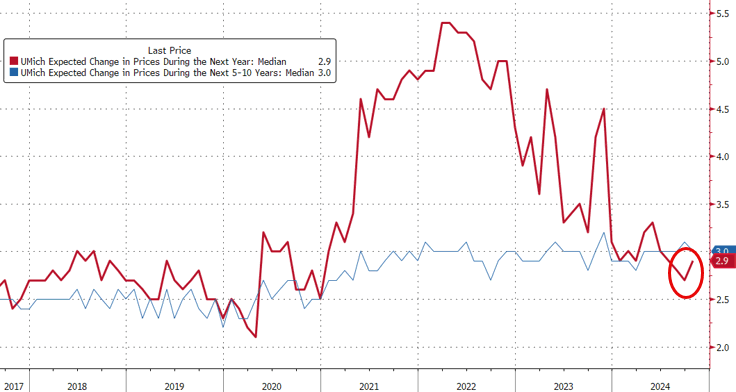
Medium-term inflation expectations picked up in preliminary UMich sentiment data for October, with the 5-10Y now at 2.9%…

Source: Bloomberg

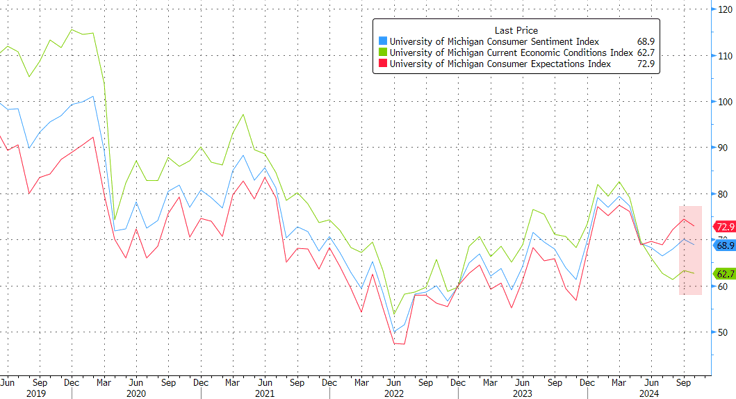
This anxiety weighed on the overall sentiment survey, as it declined from 70.1 to 68.9 (well below the 71.0 expected). Both the current conditions and expectations index also fell on the month…

Source: Bloomberg

Rather oddly, while inflation expectations have softened in recent months, concerns about high prices remains extremely elevated…

Source: UMich

It seems the ‘average American’ is smart enough to understand the difference between price levels (what it actually costs you every day) and inflation (the rate of change of that cost). Of course, it’s the former that matters to main street.

Tyler Durden
Fri, 10/11/2024 – 10:08

Judge Rejects Georgia Voting Registration Extension After Hurricane Helene

0
Judge Rejects Georgia Voting Registration Extension After Hurricane Helene

Authored by Katabella Roberts via The Epoch Times,

A request by voting rights groups in Georgia to reopen voter registration to counter disruptions caused by Hurricane Helene was rejected on Thursday by a federal judge.

The ruling came after voting groups filed a complaint on Tuesday, seeking to temporarily extend the voter registration period in the state which had closed last Monday.

U.S. District Judge Eleanor Ross found that voting rights organizations, including the National Association for the Advancement of Colored People (NAACP)—which advocates for racial justice and the rights of black Americans—the Georgia Coalition for the People’s Agenda, and the New Georgia Project, had failed to sufficiently prove that their members would be harmed if the deadline was not extended for an additional week.

Ross also said that no state laws exist that would allow Georgia Gov. Brian Kemp and Secretary of State Brad Raffensperger—the defendants in the case—to order an extension of the voter registration deadline.

The groups argued that potential voters in Georgia had been unable to register before the deadline because of prolonged power and internet outages, election office closures, and disruptions to the postal service resulting from the storm.

Failing to extend the deadline would result in the disenfranchisement of Georgians impacted by the effects of the hurricane, including those in counties with disproportionately large populations of Black voters, the groups said.

“Residents in many counties across the state have faced, and continue to face, widespread flooding, damaged roadways, power outages, and internet outages, as well as suspended postal service and the closure of county boards of election offices,” the groups wrote in their filing with the court.

“Compounding these significant issues is the fact that Defendant Secretary of State is aware that the Secretary of State’s online voter registration platform has been inaccessible and/or experiencing persistent glitches today,” they added.

The groups said there had also been multiple reports of voters experiencing difficulty using the secretary of state’s online voter registration platform on the same day the filing with the court was made.

Historically, there’s a spike in Georgia voter registrations just before the deadline, they argued.

Voter Registration ‘Significantly Impeded’ for Thousands

“As such, registering to vote during the crucial period leading up to the voter registration deadline—when Georgia typically sees a significant spike in registrations—has been significantly impeded or impossible for thousands of Georgians,” they wrote.

While the groups presented testimony stating that they know of at least two people unable to register, Ross said the testimony lacked sufficient details to link it to the damage and disruptions caused by Helene.

“I don’t think we had even one voter who had been harmed or would likely be harmed by failure to register to vote,” Ross said.

Republican presidential nominee former President Donald Trump walks outside the Chez What furniture store as he visits Valdosta, Ga., on Sept. 30, 2024. Evan Vucci/AP Photo

“The harm to the state’s interests outweighs the plaintiffs’ interests,” Ross said in her ruling.

Responding to the motion, the state of Georgia and the Republican Party argued an extension could interrupt the election processes, noting that absentee ballots had already been mailed. Early in-person voting was also scheduled to begin on Tuesday, they said.

Georgia is one of several closely contested states that will likely determine the outcome of the presidential race between Vice President Kamala Harris and former President Donald Trump.

In a joint statement after the ruling, NAACP President and CEO Derrick Johnson and Georgia State Conference President Gerald Griggs said Georgia’s election officials and state leaders have a “duty to ensure a fair elections process” in the midst of a “historic election year.”

“Extending the voter registration deadline is essential to give impacted communities the time they need to recover and fully participate in the election process,” they added.

Thursday’s ruling came one day after a separate judge in Tallahassee denied a similar request by the League of Women Voters of Florida and the state NAACP chapter to extend the voting deadline due to the disruption caused by Helene, and more recently, Milton.

The Epoch Times has contacted Gov. Brian Kemp’s office for comment.

Tyler Durden
Fri, 10/11/2024 – 09:50

“It Will Happen”: Elon Musk Predicts Joe Rogan Will Interview Donald Trump

0
“It Will Happen”: Elon Musk Predicts Joe Rogan Will Interview Donald Trump

Just minutes before the scheduled start of the much-anticipated Robotaxi event on Thursday night, Elon Musk took to Twitter to tell the world an interview between Joe Rogan and Donald Trump “will happen”. 

Musk made the post responding an our article, “Joe Rogan Has 25 Days To Interview Donald Trump“, submitted by Zero Hedge contributor Quoth the Raven, who wrote on Tuesday: “I can’t listen to another 4 years of Rogan bitch about how bad things have gotten if he won’t talk to Trump.”

Rogan has been notoriously uninterested in the interview, which he has been asked about multiple times over the last half decade. Back in June 2023, when asked about the idea, Rogan said to Lex Fridman:

“I have had the opportunity to have him on my show, more than once, and I have said no every time. I don’t want to help him, I’m not interested in helping him.”

By August 2023, it looked like Rogan might be changing his tune, as he told Valuetainment’s Patrick Bet-David:

“I don’t know. Maybe. At a certain point in time. Just like, it would be interesting to hear his perspective on a lot of things.”

Since then, Rogan has stated his admiration for RFK, Jr., who is now supporting Trump. He has also given a platform to Tulsi Gabbard, who is campaigning with, and for, Trump. The idea that Rogan wouldn’t interview Trump, who has recently done podcasts with Theo Von and Andrew Schultz, to name a few, seems bizarre. 

QTR wrote on his blog Tuesday night that “If anything, an interview would give Rogan an opportunity to push Trump on the things that he disagrees with him on. Bring him on and give him hell if you want, Joe. Rogan could even extend an invitation to the Harris campaign and invite her on for a separate appearance if she wants.”

“I don’t want to pretend to understand what the problem is that Rogan has with Trump, but all I know is that it’s not bigger than the potential consequences of this election,” he wrote.

“After listening to Rogan’s podcast for nearly 2,000 episodes, I’m confident in my assessment that he’s a person of integrity and a man of character. The truth is, whether he likes it or not, putting his personal animus aside and getting Trump on the largest media platform in the world can only make an impact for the next month or so.”

He concluded: “After the November election, especially if Trump loses, there will be no point — and it’ll be impossible to listen to Rogan crow about the lunatics on the left any further, knowing he didn’t talk to Trump when he had the chance. So let’s get real, Joe: what the hell are you waiting for?”

QTR first predicted the interview would happen in September 2023:

To me, this meeting seems inevitable over a long enough timeline. There’s sufficient positive motivation for both parties to make it happen before the 2024 election, which is why I predict the interview will likely air before the end of the first quarter of 2024.

He’s got about 3 weeks left…


Tyler Durden
Fri, 10/11/2024 – 09:30

Futures Dip After Hot PPI, China Frenzy Unravels

0
Futures Dip After Hot PPI, China Frenzy Unravels

Futures are lower ahead of the last trading day of the week, but well off session lows as JPM earnings were solid enough to push the stock higher and reverse some of the market’s losses as Q3 earnings season was officially launched. As of 8:45am, S&P futures are down fractionally, while Nasdaq futures dropped 0.2%, hammered by TSLA which is down -5.8% pre-market as the Robotaxi event failed to meet market expectations. Bond yields are higher with the 10Y rising 3bps to 4.09%, while the Bloomberg Dollar index reversed earlier losses. Commodities are mixed with Oil fractionally lower, base metals higher, and pPrecious metals mixed. Today’s macro focus will be banks earnings and PPI, which came in fractionally light MoM (headline 0.0% MoM, Exp. 0.1%; core 0.2%, exp. 0.2%), but hotter on a YoY basis (core 2.8% YoY, Exp. 2.6%). Over the weekend, key macro catalysts will be China finance minister’s press conference on stimulus package.

In premarket trading, JPMorgan rose 1% after the bank reported a surprise gain in net interest income for the 3Q and raised its forecast for the key revenue source. Wells Fargo also gained, rising 3% after posting 3Q profit that topped analyst expectations as a surge in investment-banking fees helped counter a dip in lending revenue as interest rates fall. Tesla fell 6% as Elon Musk unveiled prototypes of the automaker’s long-awaited robotaxi Cybercab. Analysts note that the event did give a clearer picture of the company’s autonomous plans, but it was “light on the details.” Here are some other notable premarket movers:

  • Aehr Test Systems (AEHR) jumps 13% after the semiconductor manufacturing firm reported fiscal 1Q results and reiterated its guidance for the fiscal year.
  • A.O. Smith (AOS) falls 10% after the manufacturer of water heating and water treatment equipment lowered its annual forecasts for net sales and adjusted earnings per share, citing continued softness in its China business.
  • BNY Mellon (BK) gains 1% after the bank’s 3Q adjusted earnings per share beat the average analyst estimate.
  • Humana (HUM) slips 3% after the US Medicare program released final quality ratings for private Medicare Advantage plans, confirming a previously announced cut for the health insurer.

The producer price index for final demand was flat from August after rising 0.2% in the prior month, printing below estimates. From a year ago, however, it rose more than expected up 1.8% and 2.8% for headline and core, respectively, both above estimates of 1.6% and 2.6%.

European stocks reversed earlier losses and rose 0.2% with automobile and telecommunications shares leading the decline, while real estate and basic resources stocks are the biggest outperformers. Here are the biggest movers Friday:

  • Aeroports de Paris gains as much as 2.7% as JPMorgan upgrades to overweight in note switching its top pick within the European airports space
  • Zalando shares rise as much as 1.5% after the online fashion retailer delivered preliminary third-quarter results that were significantly above expectations and boosted its full-year guidance
  • Brembo shares gained as much as 4.6% in Milan after the Italian company signed an agreement with Apollo Global Management’s Tenneco to buy a 100% stake in Öhlins Racing for $405m
  • BP shares drop as much as 1.6% after the UK oil company said in a 3Q trading update that it expects rising net debt due to weaker refining margins
  • Thales declines as much as 3.2% after Berenberg cuts to hold, citing in note continuing challenges for the defense contractor’s Space busines
  • J Sainsbury falls as much as 5.1% after the largest shareholder in the UK supermarket chain, the Qatar Investment Authority, offered around $400 million worth of shares at a discount to the last closing price
  • Revenio declines as much as 5.6% following a downgrade to sell from hold at Nordea, which cites short-term uncertainties for the Finnish ophthalmological device and software firm
  • THG shares drop as much as 7.9%, hitting their lowest intraday level since January 2023, after the online retailer reported third-quarter revenue that Citi said missed their estimates

Earlier, Asian equities were headed for a second week of losses as the rally in China fizzled. The MSCI Asia Pacific Index pared earlier gains of as much as 0.4%. TSMC and Fast Retailing were among the biggest boosts to the regional benchmark. Japanese stocks were mixed, while China’s onshore gauge capped its worst week since July ahead of a policy briefing by the Ministry of Finance on Saturday. Chinese stocks have been volatile this week as traders digested weaker-than-expected holiday spending data and await further announcements from the key meeting this weekend. Investors and analysts are expecting China to deploy as much as 2 trillion yuan ($283 billion) in fresh fiscal stimulus, according to a majority of 23 market participants surveyed by Bloomberg.

“We have to expect some profit taking” after China’s sharp rally in the past few sessions, said Jessica Amir, market strategist at Moomoo. Meanwhile, “traders are also considering the risks should China not deliver a second bazooka stimulus package on the weekend.”

In FX, the Bloomberg Dollar Spot Index is little changed. The Bloomberg Dollar Spot Index dipped 0.1% as the greenback slipped against most Group-of-10 peers; the Norwegian krone led gains alongside the British pound, while the Japanese yen slumped.

  • EUR/USD inched up 0.1% to 1.0943 reversing an earlier drop; France’s government unveiled a budget for next year that aims to deliver a €60.6 billion remedy for its creaking public finances
  • GBP/USD rose as much as 0.2% to 1.3081; The UK economy returned to growth in August, putting Britian on course for modest growth in the third quarter, albeit at a slower pace than in the first half of the year

In rates, treasuries are lower, with US 10-year yields rising 4bps to 4.10%, the highest since July 31. French government bonds dip after the government unveiled a budget for next year that aims to deliver €60.6 billion in spending cuts and higher taxes. The OAT-bund spread is steady around 77 bps.

Oil prices decline, with WTI down 0.7% as Israel’s government has yet to decide how to retaliate against Iran for a missile attack last week. Spot gold rises $8 to around $2,637/oz.

Today’s data calendar includes September PPI (full summary here) and October preliminary University of Michigan sentiment (10am). Fed speakers scheduled include Goolsbee (9:45am), Logan (10:45am) and Bowman (1:10pm)

Market Snapshot

  • S&P 500 futures down 0.1% to 5,822.75
  • STOXX Europe 600 little changed at 519.13
  • MXAP little changed at 192.69
  • MXAPJ up 0.2% to 613.35
  • Nikkei up 0.6% to 39,605.80
  • Topix down 0.2% to 2,706.20
  • Hang Seng Index up 3.0% to 21,251.98
  • Shanghai Composite down 2.5% to 3,217.74
  • Sensex down 0.3% to 81,370.74
  • Australia S&P/ASX 200 down 0.1% to 8,214.51
  • Kospi little changed at 2,596.91
  • German 10Y yield little changed at 2.27%
  • Euro up 0.1% to $1.0949
  • Brent Futures down 0.7% to $78.86/bbl
  • Gold spot up 0.4% to $2,641.07
  • US Dollar Index down 0.18% to 102.80

Top Overnight News

  • China could announce fiscal stimulus measures worth a combined ~$280B when the finance ministry holds a press conf. on Saturday according to a Bloomberg survey of investors and analysts. BBG
  • China’s housing market sees a spike in foot traffic following gov’t stimulus measures. WSJ
  • South Korea’s central bank lowered its policy rate by 25bp, as expected, but the decision wasn’t unanimous (one person wanted to keep rates unchanged) and while further easing will come, additional reductions are unlikely in the near-term. WSJ
  • France on Thurs unveiled a budget plan with EU60B worth of spending cuts and tax hikes as the country looks to put its fiscal policy on a more sustainable path. FT
  • The U.S. government announced quality ratings for 2025 Medicare health and prescription drug plans on Thursday, the first indication of which large health insurers, including CVS Health, UnitedHealth Group, and Humana will get bonus payments in 2026. RTRS
  • Tesla stock slumped premarket after Elon Musk’s much-hyped Cybercab launch fell flat. The event lacked technical details, glossed over topics including regulation, and his comment that production may start in 2026 only highlighted Tesla’s poor record on timelines. Musk originally promised to get 1 million on the road by 2020. BBG
  • Boeing’s relationship with its union turns more acrimonious, with the aerospace giant filing unfair labor practice charges, alleging labor leaders are failing to negotiate in good faith. BBG
  • BAC: Berkshire Hathaway filed a form 4 disclosing the sale of 3.9mn/4.0mn/1.6mn shares on 10/8, 10/9, 10/10. This takes their stake below the 10% reporting threshold and creates some uncertainty around whether they are still reducing their stake until the next 13F filing. .. Have heard mixed views around how the stock will trade with this uncertain supply overhang but we would flag that this has turned into a crowded long heading into the print on Tuesday. All eyes on JPM print this AM. GS GBM
  • Fed’s Goolsbee (2025 Voter) says does not see convincing evidence is overheating; repeats Fed must focus on both sides of the dual mandate; repeats inflation has cooled and job market is strong: BBG
  • DBRS calculates insured losses for hurricane Milton likely in the USD 30-60bln range.
  • Blackrock reported strong FQ3 EPS upside at 11.46 (vs. the Street 10.40), with the beat driven by robust margins (op. margins spiked 350bp Y/Y to 45.8% vs. the Street 44.1%) and higher revenue (sales climbed 25% to $5.197B vs. the Street $4.99B). Total net inflows were $221.1B in the quarter, including $160B long-term (the $160B number was far above the consensus forecast of $100B). Equity inflows were particularly robust at +$74.1B (vs. the Street $30B). Total AUM was nearly $11.5T as of the end of Q3. RTRS

A more detailed look at global markets courtesy of Newsquawk

APAC stocks traded mixed following the choppy price action stateside where markets reflected on disappointing data and hawkish-leaning comments from Fed’s Bostic, while regional participants await the Chinese Ministry of Finance’s press briefing. ASX 200 price action was lacklustre with the index contained by weakness in real estate, utilities and financials.  Nikkei 225 eked marginal gains with index heavyweight Fast Retailing leading the advances post-earnings, while Seven & I was at the other end of the spectrum after it cut its guidance and announced a restructuring plan to fend off a takeover. KOSPI sits with marginal gains following the BoK’s 25bps rate cut which Governor Rhee framed as a hawkish cut. Shanghai Comp was pressured in the absence of Hong Kong participants and stock connect flows, while participants await tomorrow’s Ministry of Finance press conference and whether China will unveil large fiscal stimulus.

Top Asian News

  • China issues guidelines on strengthening supervision, preventing risks and promoting high quality development of the Futures market. Will be cracking down on illegal and irregular activities. Measures will be implemented to curve specific speculation. To support deepening product and business cooperation
  • China’s Infrastructure Ministry, Ministry of Industry and Information Technology, and State Administration for Market Regulation are to hold a briefing on Monday at 10:00 local time (03:00BST/22:00EDT).
  • BoK cut its base rate by 25bps to 3.25%, as expected, with the decision not unanimous as board member Chang Yong-Sung dissented and the central bank also voted to lower policy interest rate in special loan programmes. BoK said it will thoroughly assess trade-offs among inflation, growth, and financial stability, as well as noted that South Korea’s economy is to continue moderate growth and the BoK will carefully determine the pace of further cuts to the base rate. Governor Rhee stated that five board members said keeping the policy rate at 3.25% is appropriate for the next three months and one board member was open to a further cut in the three months ahead, while Rhee added that today’s policy decision could be viewed as a hawkish cut. Furthermore, he said they will look at property prices, Q3 growth figures and the pace of household debt growth for the rate review in November, while he added that they will look at financial stability risks for any further rate reduction decisions and the pace of rate cuts will be slower in South Korea compared with the US.

European bourses, Stoxx 600 (U/C) are bobbling around the unchanged mark in what has been a very lacklustre and indecisive session thus far. European sectors are mixed but with the breadth of the market fairly narrow; Real Estate takes the top spot alongside Basic Resources whilst Autos lags. US Equity Futures (ES, NQ, RTY) are very modestly on the backfoot, continuing the losses seen in the prior session. Tesla (-5.7%) slips in the pre-market after its event where it unveiled Cybercab and a driverless Model Y, but RBC said they heard much of what they expected to hear.

Top European News

  • French Markets Digest Barnier’s Budget as Fiscal Concerns Linger
  • German Finance Chief Has More Room to Lift Net Debt Next Year
  • Northvolt to Pay Taxes Monday as Battery Maker Battles Crisis
  • Hays Rebounds From 2013 Low as Panmure Sees Stock Bottoming Out
  • MANDATE: Louis Dreyfus Exp. €500m 7Y Investor Calls
  • China Seeks Carbon Data From Ships as Trading Scheme Grows

FX

  • DXY is slightly lower and trading within a very busy 102.76-94 range, which is within the confines of the prior session. Today’s docket includes US PPI, UoM Inflation Prelim. and speak from Fed’s Goolsbee, Logan & Bowman.
  • EUR is slightly firmer vs the Dollar and trading just ahead of its 100 DMA (1.0934) in a current 1.0930-53 range. Today’s Final German CPI print for August were unrevised, but the internal commentary held a slight hawkish skew.
  • GBP is firmer vs the Dollar and trading within a very narrow 1.3042-80 range. Cable was little moved on the back of the softer-than-expected GDP 3M/3M and Y/Y figures, with the Services figure also printing below expectations.
  • JPY is very slightly lower vs the Dollar, with price action rangebound in what has been a quiet European session thus far. USD/JPY currently trades within a busy 148.41-85 range, which resides towards the midpoint of the prior day’s confines.
  • Antipodeans are ever-so-slightly firmer vs the Dollar, attempting to nurse of their recent losses. Price action has been contained within a tight range given the lack of notable newsflow, so focus will ultimately lie on China’s MoF press conference on Saturday.

Fixed Income

  • USTs remain bid following on from the US 30yr auction, which was well received. Since then, they have faded slightly from best but remain within reach of today’s 112-09+ peak and therefore only a few ticks shy of Thursday’s 112-11+ best.
  • Bunds were initially firmer, in-fitting with USTs after the auction. However, an unrevised flash/prelim. set of German CPI (where the internals held a hawkish skew) sparked some modest pressure. A release which sparked around 10 ticks of pressure in Bunds, downside which has continued since to a 133.05 base.
  • OATs are slightly firmer following the French draft budget; the OAT-Bund 10yr yield spread remains steady around the 76bps mark. Next up for France, is Fitch’s credit review.
  • Gilts are firmer and gapped higher at the open in reaction to today’s somewhat mixed GDP figures with the M/M as expected but Y/Y figures coming in softer than expected, a dynamic which spurred a dovish reaction at the open but it is hard to say how much of this was from the UK or led by the catch-up to US supply. Gilts currently off best levels and holding around 96.18.
  • Italy sells EUR 9.50bln vs exp. EUR 7.5-9.5bln 3.45% 2027, 2.65% 2027, 3.45% 2031, 4.15% 2039, 3.45% 2048 BTP:

Commodities

  • Crude is under pressure having initially spent much of the APAC session within a tight range. Downside accelerated on reports that there was no vote at all at the end of the Israeli Security Council Meeting on Thursday.
  • Spot gold is firmer, continuing to extend above the USD 2600/oz mark but yet to test the USD 2650/oz point and by extension the USD 2659/oz WTD peak.
  • Base metals hold a positive bias vs generally flat overnight with price action somewhat hampered by the absence of Hong Kong participants with the remainder of the region largely awaiting the Chinese support updates which are expected on Sunday and Monday.

Geopolitics: Middle East

  • “Israel Hayom: Last night’s cabinet meeting witnessed sharp differences between ministers”, via Al Jazeera
  • At the conclusion of Thursday’s Israeli Security Council Meeting there was no vote on the outline of Israeli action in Iran or on giving “authorization of Netanyahu and Gallant to accept the decision”, via Kann’s Stein.
  • Israeli Broadcasting Authority says the Security Cabinet has not yet made a decision on the nature of the response to Iran, according to Sky News Arabia.
  • US President Biden and Israeli PM Netanyahu narrowed the gaps regarding the nature of Israel’s response against Iran, according to Walla News’ Ravid citing three US officials. The officials noted that Netanyahu and Biden made significant progress during their phone call in achieving an understanding of the scope of Israel’s retaliation against Iran, while the administration was “a little less worried” after the call, and another official said “We are moving in the right direction”.
  • Iranian delegate to the UN said they do not seek war but are ready to defend their sovereignty against any aggression against their security and interests, while they will the exercise natural right to self-defence in accordance with international law against any attack. Furthermore, the delegate said Israel is a threat to international peace and its aggressive actions lead the region to all-out war.
  • Lebanon’s delegate to the UN said Lebanon is ready for a diplomatic solution and to facilitate the task of mediators.
  • Israeli army said a local leader of the Islamic Jihad movement was killed in a raid on the Nour Shams camp in Tulkarm in the West Bank, according to Al Jazeera.

Geopolitics: Other

  • US Secretary of State Blinken denounces China’s naval manoeuvres at ASEAN summit and said they are “increasingly dangerous”.

US Event Calendar

  • 08:30 PPI 0.0% M/M, Exp 0.1%
    • PPI Core 0.2% MoM, Exp. 0.2%
    • PPI 1.8% YoY, Exp. 1.6%
    • PPI Core 2.8% YoY, Exp. 2.6%
  • 10:00: Oct. U. of Mich. Sentiment, est. 71.0, prior 70.1
    • Oct. U. of Mich. Current Conditions, est. 64.0, prior 63.3
    • Oct. U. of Mich. Expectations, est. 74.8, prior 74.4
    • Oct. U. of Mich. 1 Yr Inflation, est. 2.7%, prior 2.7%
    • Oct. U. of Mich. 5-10 Yr Inflation, est. 3.0%, prior 3.1%

Central Banks

  • 09:45: Fed’s Goolsbee Gives Opening Remarks
  • 10:45: Fed’s Logan Participates in Panel Discussion
  • 13:10: Fed’s Bowman Speaks on Community Banking

DB’s Jim Reid concludes the overnight wrap

It’s yet another morning where I wake to social media posts of the most stunning Aurora Borealis pictures in my area last night. I stuck my head out the window at 9:30pm before I went to bed and it all looked pitch black. I think I need to work on my iPhone settings as that seems to be the trick. Talking of which, it’s the annual new model arrival day today so maybe I can up my game.

There have been some strange lights shining in market skies in the last week with the way above expected payrolls last week and a slightly above expected US CPI yesterday. The narrative has certainly changed a bit. Maybe the full implication of yesterday’s inflation number was offset by the much weaker than expected claims. However, we are in for a period of data heavily influenced by recent storms and strikes. So this will likely make it a complicated few weeks for markets and the Fed. Although I’ve struggled to work out which way things will go in recent weeks the view I’ve felt most certain of was that the market was massively overpricing the perfect scenario of smooth enough data that the Fed would be able to serenely cut rates back below 3% without a recession. If we don’t get a recession, it’s hard to see how rates can be cut anywhere near as aggressively as this.

Anyway there’ll be more twists and turns in that argument but for yesterday the response in markets to the data was fairly muted but a confused one, complicated further as oil prices posted a fresh advance due to geopolitical tensions in the Middle East.

We’ll start off with the CPI release, as that set the tone for a day where investors grew a bit more concerned about inflation. It showed that headline CPI was stronger than expected in September at +0.18% (vs. +0.1% expected), meaning that the year-on-year number only came down to +2.4% (vs. +2.3% expected), even if it was still the lowest since February 2021. But what concerned investors more was the core CPI number, which came in at a monthly +0.31% in September (vs. +0.2% expected), pushing the year-on-year number up to +3.3% (vs. +3.2% expected). Now of course, that’s only one month’s reading, but it also meant the 3-month annualised rate for core CPI rose to +3.1%, having been at +2.1% in August. So the last couple of months have added to fears that inflation is proving a bit more persistent than the Fed would like, and there were fresh signs that investors were pricing this in as well. For instance, the US 5yr inflation swap (+6.5bps) was up to a three-month high of 2.51% yesterday (low of 2.14% on September 10), and it was a decent day for precious metals, which traditionally operate as an inflation hedge, with gold prices up around +0.7% and a further +0.6% this morning.

Ordinarily, an inflation release like that would have led investors to dial back their expectations for rate cuts. But just as that was coming out, we simultaneously had the weekly initial jobless claims, which were noticeably worse than expected. They moved up to 258k over the week ending October 5 (vs. 230k expected), which is the highest they’ve been since August 2023. Now to be fair, there are some weather-related factors that can help explain that, and the numbers are likely to remain volatile for several weeks as a result. But even so, the number was higher than expected, and given it’s quite a timely release, it pushed back against the more positive labour market narrative from last week’s jobs report. The chances are still high that it was heavily distorted though and with the current storms in Florida, getting a clean reading soon will be tough.

Nevertheless, with all that in hand, investors moved to increase the pricing of Fed rate cuts in the coming months, even as they priced in more inflation for the years ahead. The likelihood of a 25bp cut next month rose marginally from 83% the previous day to 85%, but having peaked at 95% intra-day after the data. The move was more sustained further out the curve, with the rate priced in for the December 2025 meeting falling by -8.2bps to 3.34%. The reversal in November pricing from the day’s peaks came following a WSJ interview with the Fed’s Bostic, who left open the possibility of a pause in November, saying that “I am totally comfortable with skipping a meeting if the data suggests that’s appropriate”. On the other hand, comments from Williams, Goolsbee, and Barkin suggested they were largely unphased by the stronger CPI print.

The more dovish Fed pricing contributed to a rally in front-end yields that pushed the 2yr Treasury yield down -6.5bps to 3.96%, while the 10yr yield was down a more marginal -1.1bps to 4.06%. This comprised of sharply diverging moves in real yields and breakevens, especially at the front end. While 2yr breakevens (+9.8bps) rose to their highest since early July, 2yr real yields (-16.3bps) posted their sharpest daily fall since the December 2023 FOMC. So signs of market pricing turning in a slightly more stagflationary direction.

Whilst markets were digesting the latest US data, there were ongoing concerns about a potential escalation in the Middle East, and Brent crude oil prices moved up +3.68% yesterday to $79.40/bbl. That came as Israel’s security cabinet met last night to discuss how and when to retaliate against Iran’s strikes last week, with Israel’s public broadcaster reporting that the final decision will be made by PM Netanyahu and defence minister Gallant.

Against this backdrop, equities were unable to hold onto their recent gains, with the S&P 500 (-0.21%) moving off from its record high the previous day. The declines were pretty broad based, with nearly 70% of the S&P 500 lower on the day with the small-cap Russell 2000 (-0.55%) struggling in particular. Meanwhile in Europe, there was a similar pattern of evenly spread but modest declines, with small losses for the STOXX 600 (-0.18%), the DAX (-0.23%) and the CAC 40 (-0.24%). All change from today as we see the unofficial start of earnings season with releases beginning to ramp up, with several US financials reporting including JPMorgan, Wells Fargo, BNY Mellon and BlackRock.

Over in Europe, last night we heard the details of the French government’s 2025 budget proposal. This confirmed a fiscal deficit target of 5% of GDP, foreseeing some EUR 60bn of spending cuts and tax increases. The budget will now pass to parliament to be the first major test of PM Barnier’s minority government. Earlier in the day, the Franco-German 10yr spread had remained at 77bps, with yields on 10yr bunds (-0.1bps) and OATs (-0.1bps) both basically unchanged on the day.

Overnight in Asia, Chinese stocks are lagging behind other markets with Hong Kong closed for a holiday. The CSI 300 is down -1.88% while the Nikkei 225 and the Kospi are up by +0.72% and +0.18%, respectively. US equity futures are up less than a tenth of a percentage as I type. All eyes are on tomorrow’s finance ministry briefing in China to hopefully get much more details on the stimulus package the market has grown a little more nervous of this week. So lots to report by Monday.

To the day ahead now, and data releases include US PPI for September, the University of Michigan’s preliminary consumer sentiment index for October, and UK GDP for August. From central banks, we’ll hear from the ECB’s Holzmann, and the Fed’s Goolsbee, Logan and Bowman. Finally, today’s earnings releases include JPMorgan, Wells Fargo, BNY Mellon and BlackRock.


Tyler Durden
Fri, 10/11/2024 – 09:19

“‘We, Robot’ 10/10 Event”: Wall Street Reacts To Elon Musk’s Big Cybercab Debut

0
“‘We, Robot’ 10/10 Event”: Wall Street Reacts To Elon Musk’s Big Cybercab Debut

Tesla’s shares stumbled in premarket trading after the company’s long-awaited robotaxi event in Burbank, California. The event showcased the robotaxi Cybercab, the futuristic-looking Robovan concept, and the latest version of the humanoid robot, Optimus.

Just hours after the event, some top Wall Street analysts began weighing in, praising the impressive lineup of new innovative products that will revolutionize transportation and other areas of the economy but noting a lack of technical details. 

A team of Goldman analysts led by Mark Delaney and Will Bryant attended the robotaxi Cybercab.

The analysts said Tesla “demonstrated very strong progress with the Optimus humanoid robot, and we think the Cybercab looked attractive,” but noted, “the lack of data shared on Full Self Driving (FSD) performance, relatively limited details on the robotaxi business plan, and absence of a lower-cost consumer vehicle unveil may be disappointing for some market participants.” 

Here are more of their thoughts about Cybercab and Optimus:

Cybercab

Tesla unveiled a two-seat Cybercab vehicle without a steering wheel or pedals/controls, and with winged doors. The company also showcased a Robovan that can carry up to 20 people or could transport goods. Tesla expects to start unsupervised FSD robotaxi operations in Texas and California next year with its currently available models (e.g. 3 and Y) and be in production with the Cybercab in 2026/before 2027 (although the company noted that it tends to be optimistic with timelines).

Given that vehicles are only typically used for several hours per week, Tesla believes that autonomous vehicles can offer 5X or even 10X higher utilization. Importantly on costs, Tesla believes the average operating cost of its Cybercab over time will be ~$0.20 per mile and may be priced at ~$0.30-$0.40 per mile including taxes and other costs. Tesla expects the Cybercab to cost ~$30K or less. Tesla also commented that it plans to over-spec the computer for the Cybercab (AI 5 computer) as the company believes that distributed inference compute can be utilized when the vehicle is not in use. Additionally, the robotaxi will use inductive charging, and Tesla indicated there would be self-cleaning capabilities. Finally, Tesla said one business model could be a person owning a small fleet that they put onto the network. Tesla did not provide other details on its business plan (e.g. scope of the initial deployments, pricing to start, if Tesla will own the early fleet, remote assistance, etc).

The timelines for AV deployment (next year with 3/Y in Texas and California) and with Cybercab (in 2026/by 2027) and lack of incremental FSD performance data will likely leave the debate on how close Tesla is to unsupervised FSD (L4) unresolved.

As we have previously written in our report, “Can new AI technology help accelerate AV deployments? Updating our global ADAS and AV forecast” we believe there is a material long-term revenue opportunity from robotaxis. However, revenues from initial smaller scale deployments would likely be more limited, as we show in Exhibit 1 and Exhibit 2.

We also provide an illustrative cost model for an owned and operated fleet of robotaxis in Exhibit 3. At scale, we believe that Tesla could benefit from lower per mile costs for its vehicle depreciation (e.g. if Tesla can produce a robotaxi at $30k vs a competitor robotaxi at $50k-$75k, at 100k miles per year and a three year useful life, Tesla would have depreciation costs of $0.10/mi vs a standard robotaxi at $0.15-$0.25/mi). This is driven by the volume leverage Tesla already has making cars (with each vehicle already equipped with inference silicon), and its more narrow sensor stack (e.g. no lidar). Tesla said the cybercab will use vision and AI, implying that it may not use radar (and how it would handle operating in certain weather/lighting conditions without a secondary sensor type is something that may remain a debate).

Optimus

The progress with Optimus was impressive in our view especially given where Tesla was just a few years ago. The robots were very life like in several of the movements, and interacted via voice with attendees, danced, and gave out snacks. We had an impromptu conversation with one of the robots which asked us if we’d checked out the snack bar, and when we asked what it would suggest to eat, it said to ask its friend that was actually giving out snacks (which we found to be relatively human like). We expect Optiumus to be a growing part of the Tesla story.

The TAM for higher-end humanoid robots could be >$10 bn in 2030 per research from a report led by our colleague Jacqueline Du. Recall that on its 2Q24 earnings call, Tesla stated that it expects to have limited production of Optimus Version 1 starting early next year for internal Tesla use (and expects to have several thousand produced and deployed by the end of next year), and expects to ramp production and provide Optimus Version 2 to external customers in 2026.

The analysts are “Neutral-rated” on TSLA shares and believe “that Tesla can grow longer term including with FSD.” However, they noted that “headwinds in the auto business” will limit EPS growth in the near term. Their TSLA 12-month price target is $230, based on 65X applied to our Q5-Q8E EPS estimate, including SBC. 

Separately, other Wall Street analysts published notes to clients after the event, with many also detailing how Elon Musk and Tesla were light on details (list courtesy of Bloomberg):

Barclays analyst Dan Levy (equal weight, PT $220)

  • Tesla’s Cybercab demo was similar to prior sketches, but “the event was light on the details”
  • “Consumers able to buy Cybercab, but Tesla also likely planning to operate fleet,” Levy said
  • The near-term stock reaction is likely to be sell the news, “as the focus now shifts back to fundamentals – which has been neutral at best”

Baird analyst Ben Kallo (outperform, $280)

  • The company did not unveil a lower-cost vehicle which can be manufactured on existing factory lines.
  • Investor attention will now shift to auto margins in the near term as the company reports 3Q results on Wednesday

Bloomberg Intelligence analyst Steve Man

  • “Tesla will likely need to add steering wheels and pedals to scale its robotaxi production by 2026”
  • However, the robotaxi announcement provides a better visibility of the company’s capabilities in affordable cars and autonomy

Citi analyst Ronald Josey

  • Tesla’s event clarified the company’s vision and timeline for its robotaxi — leading us to be “incrementally positive on Uber shares as a result”
  • “Importantly, details regarding distribution or a potential ride-hailing app for the Cybercab were limited, which leads us to believe it’s still possible that Tesla could partner with Uber for distribution in the future”

Jefferies analyst John Colantuoni

  • Tesla’s event is a best-case outcome for Uber as the automaker did not provide verifiable evidence of progress in its self driving technology and it also did not outline the number of robotaxis planned

Morgan Stanley analyst Brian Nowak

  • Tesla’s $0.20 cost per mile estimate is in line with expectations, confirming its cost advantage
  • “This speaks to TSLA’s current theoretical cost advantage over Uber’s current cars and Waymo”

The market reaction to Thursday’s Tesla event this AM in premarket trading in NYC is simply underwhelming. Shares are down 6%. For the past two years, shares have traded sideways, facing resistance above $250. 

Nancy Tengler, the chief executive officer of Laffer Tengler Investments and a Tesla investor who attended the event, told Bloomberg that the only specifics Tesla gave were the $30,000 price tag for Cybercab. 

Tyler Durden
Fri, 10/11/2024 – 07:20

Tough Luck For NYC Apartment Hunters: Bargains Scarce As Rents Hover Near Record Highs

0
Tough Luck For NYC Apartment Hunters: Bargains Scarce As Rents Hover Near Record Highs

Tens of millions of Americans have been battered by a multi-year housing affordability crisis, mainly during the Biden-Harris administration’s first term. With high interest rates and record-high home prices, many prospective buyers have been sidelined and forced to remain in their parent’s basement or stuck in expensive rentals.

Despite a hotter September CPI print, this morning’s inflation report offered some good news: “The silver lining is that shelter inflation continues to slow.”

Yet rents are still at or near record highs in markets like Manhattan, giving apartment hunters minimal room for deals anytime soon.

Bloomberg cited new data from brokerage Douglas Elliman Real Estate and appraiser Miller Samuel showing that the median rent in the NYC borough slipped 3.4% in September to around $4.2k. Prices also fell in Brooklyn and Queens. 

Even though shelter costs in NYC are easing in some boroughs, prices are still near record highs – offering minimal deals for apartment hunters. 

Jonathan Miller, president of Miller Samuel, told Bloomberg that while rents typically trend lower in the autumn and winter, only “modest easing” is expected in the coming months, with no significant drops forecasted through the end of the year. 

Bloomberg noted, “That’s at least partly because the market remains fiercely competitive. The number of newly signed leases in Manhattan surged 40% from a year earlier, and bidding wars broke out in nearly a fifth of those deals.” 

Miller pointed out that the slight drop in rents last month was due to cheaper mortgage costs that turned some renters into buyers. However, with a recent hot jobs report and Thursday’s inflation print, the 30-year fixed-rate mortgage tracked by Bankrate has surged from 6.5% to nearly 7%. 

“Think of the direction of rents in terms of the direction of the economy. Wages and employment continue to defy expectations,” Miller noted, adding, “Symbolically, the Fed rate cuts are important to the purchase market. But if mortgage rates don’t come down, it will stall the decline in rents.”

What’s often left out from the conversation by leftist media outlets, and correctly pointed out by Sen. JD Vance at last week’s vice presidential debate is the topic of the illegal alien invasion stoked by Biden-Harris that is driving up housing costs in various markets: “[Y]ou have got housing that is totally unaffordable because we brought in millions of illegal immigrants to compete with Americans for scarce homes.”

The root cause of the affordability crisis is the housing shortage. Biden-Harris importing ten-plus million illegal aliens into the country certainly exacerbated the crisis.

Tyler Durden
Fri, 10/11/2024 – 06:55

While “Fighting For Democratic Values”, Zelensky Seeks To Squash Any Dissenting Voices

0
While “Fighting For Democratic Values”, Zelensky Seeks To Squash Any Dissenting Voices

Authored by Liz Heflin via Remix news,

The Ukraińska Pravda website is accusing the office of Ukrainian President Volodymyr Zelensky of “long-term and systemic pressure” on journalists, saying that representatives of the authorities in Kyiv cannot talk to the portal’s journalists. It also makes clear that they will be making sure the international public knows about the situation. 

The office of the President of Ukraine Volodymyr Zelensky is putting pressure on the business to bring about the termination of advertising cooperation with the editorial office of the service.

“We draw the attention of our colleagues, partners and international organizations to the long-term and systematic pressure exerted by the Presidential Office on the editorial office and individual journalists of Ukrayinska Pravda,” the portal’s statement reads.

“We would like to remind you that the values ​​of Ukrayinska Pravda since its establishment in 2000 have been editorial independence, objectivity and the ability to speak the truth,” it added.

The journalists stressed that the behavior of the Ukrainian authorities is “exceptionally outrageous” during the aggression from Russia. 

The editorial office of Ukrayinska Pravda intends bring these issues into the international arena, including that the end goal is to discourage advertising on the site, i.e., making it impossible for the portal to operate. 

The portal noted an “openly emotional conversation” between Ukrainian President Volodymyr Zelensky and journalist Roman Kravets in August, during which Zelensky tried to influence the editorial line of the website. 

This is not the first time Ukraińska Pravda has faced ire from authorities given their dedication to independent journalism, and it is not the first time the portal has found itself in the crosshairs of those in power. Back in 2016, one of their top writers, Pavel Sheremet, was killed in a car bomb. The case has never been solved, with numerous questions surrounding the investigation.

Human Rights Watch said back in 2017 that “Sheremet was known for his incisive journalism, raising issues of public concern – such as violence by volunteer battalions and investigations into corruption – that were often uncomfortable for the authorities.” The organization stated that he had been “harassed, threatened, and detained for his work,” further calling Ukrainskaya Pravda “a fiercely independent newspaper.”

The journalists at Ukraińska Pravda say they will not give in to attempts at censorship. They also called on the international community and all those who value freedom of speech to support the defense of the independence of Ukrainian media. 

“These and other non-public signals indicate an attempt to influence our editorial policy. It is particularly outrageous to realize this during Russia’s full-scale war against Ukraine, when our common fight for both survival and democratic values ​​is so necessary,” they stated.

Read more here…

Tyler Durden
Fri, 10/11/2024 – 06:30

UK To Unveil “Most Significant Package Of Employment Reforms In A Generation”

0
UK To Unveil “Most Significant Package Of Employment Reforms In A Generation”

By Stefan Koopman, Senior Macro Strategist at Rabobank

New Deal? Big Deal

The UK Labour government pledged to introduce its “new deal” for workers within 100 days of being elected in July. As these first 100 days draw to a close this weekend, Labour will unveil its new Employment Rights Bill today. This bill is being touted as the most significant package of employment reforms in a generation. Key elements include increased protections against unfair dismissal, the removal of the three-day waiting period for statutory sick pay, and the banning of exploitative zero-hour contracts. It also aims to curb unreasonable ‘fire and rehire’ practices and ensure the right to flexible working. Trade unions will gain new rights for the first time in years.

This marks a significant shift towards strengthening workers’ bargaining power and tightening employment protection legislation. Such measures reduce workers’ exposure to negative shocks, which should eventually support consumption by allowing for lower saving rates. However, they also impact employers by limiting their ability to adjust the workforce flexibly in response to changes in demand, thereby raising both hiring and firing costs. The implementation of these measures will exert upward pressure on firms’ marginal costs, which, if demand in the economy is strong enough, can lead to an increase in markups and prices. This dynamic aligns with economic theory, which suggests that countries that tighten employment protection experience a steepening of their Phillips curves post-reform.

It is yet another sign that economies are making a huge departure from the old paradigm, where workers in developed countries saw their middle-class status eroded by decades of neoliberal policies. It’s also a sign markets usually miss, focusing instead on headlines that are more easily tradable. However, in terms of policy rates, it is exactly this type of reforms that separate countries where inflationary pressures could prove a bit more persistent and where not. That new deal also happens to be a big deal.

Labour hasn’t had the best of starts, but yesterday was probably their finest day since July 4. Conservative MPs have eliminated the only leadership contender that Labour had any real concerns about. James Cleverley, who had surged ahead by apologising for the party’s past mistakes and proposing a somewhat moderate Conservatism, has unexpectedly dropped out of the race. Whether through strategic blunders, underhand scheming, sheer political folly, or a mix of all three, the Tory MPs have managed to extinguish the leadership hopes of the one man who might have saved them from disaster.

Now, party members must choose between Robert Jenrick and Kemi Badenoch, both right-wingers. While this aligns with the membership’s desires, it leaves voters struggling to distinguish between the Conservatives and Farage’s Reform Party. Essentially, this will pit Reform against ‘Reform 2.0’, splitting the right-wing vote and significantly boosting Labour’s chances of another term in office. And that’s another big deal for UK assets.

Chinese stocks surged once more after the People’s Bank of China unveiled a mechanism to enable institutional investors to purchase more stocks. This move grants the Chinese government some time, as the market waits for a finance ministry press conference scheduled for Saturday. The ministry is expected to unveil the specifics of the fiscal stimulus package, under the banner of “intensifying counter-cyclical adjustment of fiscal policy.” However, should this title imply that Chinese authorities view the nation’s economic challenges as “cyclical” rather than “structural,” the market could be setting itself up for yet another letdown.

As a weakening but still tremendously powerful Hurricane Milton slammed into Florida’s west coast, the FOMC released the minutes of its September meeting. Our Fed-watcher Philip Marey concludes that Bowman was not the only FOMC participant who preferred a 25 basis point rate cut in September. Although a substantial majority supported a 50 basis point cut, some participants would have preferred a 25 basis point reduction at this meeting and a few others indicated that they could have supported such a decision.

Looking forward, several participants said that reducing policy restraint too soon or too much could risk a stalling or a reversal of the progress on inflation. In light of the strong Employment Report for September that was published well after the September FOMC decision, the opposition may feel vindicated, although the CPI report published today will also be a factor. However, during the Q&A at the NABE Conference, Powell already indicated that he does not intend to make another 50 basis point cut and that we should expect 25 in November and 25 in December. This matches our forecast.

Tyler Durden
Fri, 10/11/2024 – 05:45

Who’s Drinking (Non-Alcoholic) Beer?

0
Who’s Drinking (Non-Alcoholic) Beer?

While alcoholic beer remains the preferred choice, non-alcoholic options too have made inroads in various markets around the world.

As Statista’s Anna Fleck shows in the following chart, as many as one in five people in Spain said that they regularly drink alcohol-free beer in a survey by Statista Consumer Insights.

Infographic: Who’s Drinking (Non-Alcoholic) Beer? | Statista

You will find more infographics at Statista

Spaniards were particularly partial to alcoholic beer too, with 51 percent of respondents saying they drank it frequently.

In the United States, far fewer people would describe themselves as regular beer drinkers, with only 22 percent drinking alcoholic beer regularly and five percent the non-alcoholic alternative.

In the U.S., a higher share of people drink energy drinks (27 percent) than beer (22 percent), wine (21 percent) or spirits (18 percent).

Tyler Durden
Fri, 10/11/2024 – 04:15