61.8 F
Chicago
Monday, October 5, 2026
Home Blog Page 2261

A Republic, If You Can Keep It

0
A Republic, If You Can Keep It

Authored by Carl M. Cannon via RealClearPolitics,

It’s Friday, Sept. 20. Interestingly, Election “Day,” which is now a profound misnomer, begins today: In Virginia, Minnesota, and South Dakota, citizens 18 and older can begin voting in the 2024 presidential election.

Charles Wilson Peale, Wikimedia Commons

Today is also the day of the week when I share a quote intended to be uplifting or educational. Earlier this week I wrote about Constitution Day, which fell on Tuesday, although the administration encourages us to think of this as “Constitution Week.”

I’m all for that, especially since the proclamation issued in President Biden’s name reprised the famous Benjamin Franklin “a Republic, if you can keep it” exchange. The White House didn’t garble the exchange as so many others have done. Nor did it provide the context that really makes the exchange so interesting – and so contemporary.

So how do we know about Ben Franklin’s profound “if you can keep it” rejoinder concerning the type of government forged at the Constitutional Convention in 1787?

The original source – the only source, actually – is a Scots-Irish immigrant from County Antrim named James McHenry, who arrived on these shores at 18. Young Mr. McHenry apprenticed as a physician under Benjamin Rush, a Founding Father from Philadelphia, and followed Rush into service as a military surgeon in George Washington’s army. Captured by the British during the war, McHenry was paroled, only to rejoin the Continental Army. He was with Washington at Monmouth and attached to Lafayette’s troops at Yorktown.

After the war, he was one of Maryland’s representatives to the Constitutional Convention and kept a regular diary. It is in that journal that McHenry records an exchange he apparently overheard – or heard from someone else – on Sept. 18, 1787, the last day of the convention:

“A lady asked Dr. Franklin Well Doctor what have we got a republic or a monarchy – A republic replied the Doctor if you can keep it.”

“Dr. Franklin” was an honorific for Ben Franklin, but who was the lady in question? Even though it’s not a mystery, succeeding generations of historians and politicians have obscured her identity – to their detriment and ours.

In his 2019 memoir, “A Republic, If You Can Keep It,” Neil Gorsuch flubs the facts of the story that forms the very title of his book. He writes that “a passerby asked what kind of government the delegates intended to propose” – thereby confusing the time sequence and hiding the identity of Franklin’s interlocutor.

A month after the book’s publication, House Speaker Nancy Pelosi took further liberties with the historical record.

Announcing the first impeachment inquiry of President Donald Trump, Pelosi said, “On the final day of the Constitutional Convention in 1787, when our Constitution was adopted, Americans gathered on the steps of Independence Hall to await the news of the government our founders had crafted. They asked Benjamin Franklin, ‘What do we have, a republic or a monarchy?’ Franklin replied, ‘A republic, if you can keep it.’ Our responsibility is to keep it.”

At least Pelosi had the time element correct. But the crowd on the steps of Independence Hall was a concoction.

Even those who don’t airbrush “the lady” Franklin spoke to that day give her short shrift. In his best-selling biography of Benjamin Franklin, Walter Isaacson properly identifies her, but hardly in complimentary fashion. He describes her an “anxious lady” who “accosted” Franklin. The author also mangles the famous quotation, having her ask, “What have you given us” rather than “What have we got …”

This is not a minor lapse, according to historian Zara Anishanslin, an expert in the Revolutionary War period, as it implies “her passive role in the political process.” Professor Anishanslin adds, “She is cast as a shrill, inappropriate woman, excluded from the politics of the nation’s founding.”

But this is not how Franklin’s contemporaries in Philadelphia would have viewed her. They would have known, or at least assumed, that Franklin’s inquirer was the erudite and well-connected Elizabeth Willing Powel. But James McHenry doesn’t require us to guess. His journal entry adds helpfully, “The Lady here alluded to was Mrs. Powel of Philada.”

It’s a sorry sign about the state of modern education that Eliza Powel is largely forgotten. She was just as much a Founding Father as James McHenry and the other signers of the Constitution (though Founding Mother is more precise).

Although no women were chosen as delegates to the Constitutional Convention, Mrs. Powel’s influence in these colonies was never in question. The wife of prosperous businessman Samuel Powel, she was known for convening salons that wrestled with the hardest questions of the day, including whether to break with Great Britain.

And not to diminish Samuel Powel, but the wealth and connections that made their home the epicenter in Pennsylvania politics and Philadelphia society originally came from her side of the family. Elizabeth’s father Charles Willing and her brother Thomas Willing were rich traders and merchants who served, as did Samuel Powel, as early mayors of Philadelphia. Eliza Powel wasn’t content just to enjoy the perks of power and wealth. In dinner parties at her home (the guests frequently included George and Martha Washington), she displayed a shrewd grasp of politics and a willingness and the intellectual dexterity to join the discussion that led to a new kind of government.

The political figure in modern America who seems to me most like Elizabeth Powel is Nancy Pelosi. Her father and brother were both mayors of Baltimore, and Pelosi’s father also served in the House of Representatives. Upon relocating to California, Nancy Pelosi befriended Phil and Sala Burton. One could say, a bit puckishly, that the Burtons were the George and Martha Washington of San Francisco in those years. (All of which is why Pelosi’s flight of rhetorical fancy regarding Ben Franklin and Eliza Powel seemed so discordant.)

In any event, in the 1780s the Powels were close friends of the Washingtons. Evidence in the form of letters found in the George Washington Papers at the Library of Congress shows that George Washington valued Eliza’s counsel greatly. That was a good thing for American history. In the third year of his presidency, George Washington confided in friends how much he longed to leave government and return to Mount Vernon. The friend whom Washington biographers credit with talking him out of it was none other than Elizabeth Powel.

James McHenry didn’t publish his account of the Franklin-Powel exchange until 1803, and even then he did so anonymously. He added other details, too, describing Powel as “a lady remarkable for her understanding and wit.” He also fleshed out the scene and had Franklin “entering the room” to talk to Powel.

Over time, friends began to ask Powel about the exchange. She didn’t remember it. Not because, as she wrote to a friend in 1814, it didn’t happen. But because she’d had so many momentous discussions over the years with the Founders and their contemporaries that 27 years later she couldn’t begin to recall them all.

Or, as she put it, she had been “associated with the most respectable, influential Members of the Convention that framed the Constitution, and that the all important Subject was frequently discussed at our House.”

So why does the accuracy of this anecdote matter? That’s the question Zara Anishanslin posed when writing about it five years ago. Here is her answer:

“Tracing its twists and turns over the centuries, we see Powel, a politically active, influential patriot in her own time, shaped to mold expectations about the history of women and politics. The story shifts – from her own assertion that she couldn’t possibly remember all the many important political conversations that took place within her home, to one in which she is simply an ‘anxious’ lady ‘accosting’ Franklin, to the recent omission of women at all.

“As we consider how and why America continues to elide the history of founding women from its collective origin story, we should take note that in 2019 we actually give less credit to this politically savvy woman than men did during the founding era,” Anishanslin added before concluding: “Recognizing women’s leadership in the past, as well as the present, might make it easier to keep a republic.”

And that is our quote of the week.

Carl M. Cannon is the Washington bureau chief for RealClearPolitics and executive editor of RealClearMedia Group. Reach him on X @CarlCannon.

Tyler Durden
Tue, 09/24/2024 – 22:35

Visualizing The Expected Growth In Working Age Populations Around The World Over The Next 10 Years

0
Visualizing The Expected Growth In Working Age Populations Around The World Over The Next 10 Years

Today, the working age population in almost half of U.S. metropolitan areas has declined due to demographic shifts, and this trend is set to continue.

As a result, the U.S. workforce is projected to grow at just 0.2% annually over the next decade, roughly a quarter of the rate of markets like India and Mexico. Given the low birth rates and aging populations across many advanced economies, the world’s workforce is set to change significantly, with implications for economic and productivity growth.

This graphic, via Visual Capitalist’s Dorothy Neufeld, shows the projected growth in major economies’ working age population, based on analysis from Ray Dalio’s Great Powers Index 2024.

An Evolving Global Workforce

Here are the estimated annual changes in the working age population across 35 countries over the next decade:

Saudi Arabia is projected to see the fastest-growing workforce across major economies, driven by high fertility rates of 2.8 children per woman and a rising expatriate population.

India, ranking in third, is set to contribute 24.3% of the world’s workforce over the next decade. With a current median age of 28.4, its working age population is expected to surpass one billion by 2030. These factors provide a significant competitive edge, especially in the services and manufacturing sectors, while also driving increased consumption among younger generations in the world’s most populous country.

Largely due to falling birth rates, the U.S. ranks 15th overall in the 35 countries on the list. In fact, America saw the slowest decade of population growth between 2010 and 2020 since the Great Depression, growing by 7.4%. For perspective, the U.S. population grew at nearly double this rate during the 1990s.

At the other end of the spectrum, South Korea ranks in last, with its workforce projected to see an annualized growth rate of -1.2% over the next 10 years. South Korea has the lowest fertility rate worldwide along with restrictive immigration policies, which are straining working age population growth and productivity.

Overall, 49% of major economies are projected to see declining working age populations, particularly across European nations and countries in Asia including China, Japan, and Thailand.

To learn more about this topic from an asset class perspective, check out this graphic on 10-year asset class return forecasts.

Tyler Durden
Tue, 09/24/2024 – 22:10

West Point Responds To Viral “Need For Reset” Post

0
West Point Responds To Viral “Need For Reset” Post

Authored by Tony Lentini via RealClearDefense,

Earlier this month, Real Clear Defense published my commentary, “West Point Needs a Reset,” detailing why I and many fellow graduates believe the United States Military Academy has lost its way and needs to get back to the basics of educating future Army officers to fight and win our nation’s wars.  Almost immediately, the piece went viral, shared across many platforms, including STARRS (Stand Together Against Racism and Radicalism in the Services) and the MacArthur Society of West Point Graduates.

Hazell, Frank, 1883-, artist, Wikimedia Commons

It also attracted the attention of West Point, which up to now has refused to discuss or even acknowledge serious graduate concerns over wokeness, politicization, divisive and battlefield-irrelevant course materials, merit-based admissions, and advancement, undermining of the cadet Honor Code, unanswered Freedom of Information Act filings and other such issues.

The day after publication, Real Clear Defense Editor and former Marine David P. Craig received the following email from West Point’s Director of Communications, Colonel Terence M. Kelley:

David, 

I would like to discuss a recent op-ed you published, “West Point Needs a Rest,” by Tony Lentini. 

To say the least, this piece is problematic. It makes false claims about statements by our superintendent, that we offer classes that we do not, and it is quite frank in its homophobia, equating the existence of a voluntary student LGBTQ alliance and social club with sexual deviance. Furthermore, it greatly distorts and misrepresents our curriculum and training programs in a deliberate manner to mislead the reader.

In short, this piece, even if opinion, undermines Real Clear Defense’s journalistic credibility. It is unworthy of your platform, and I respectfully request you consider removing it.

Please contact me at the number below to discuss.

Later that same day, Kelley sent Craig a follow-up email:

Bringing this to the top of your inbox. I would still like to discuss this op-ed. This isn’t about a difference of opinion—this is about fabricated quotes and false statements. 

Mr. Craig independently verified the truth and accuracy of my piece, refused Kelley’s request to take down the article, and contacted me for comment on the colonel’s allegations. I offered to discuss everything with Craig, Kelley, MacArthur Society President Bill Prince, and anyone else who wanted to be on the call. Kelley has not responded to that offer. I also decided to do this follow-up piece of my own so that everyone can see how West Point responds to legitimate criticism with ad hominem attacks and false statements, some of which I will discuss here.

  1. The Superintendent did refer to the Honor Code as “aspirational,” which is why I put it in quotes. The minutes of the Academy’s Board of Visitors from the Spring 2023 meeting contain the following on this subject: “LTG Gilland added that USMA was considering simplifying the mission statement, so people better understand what the Academy does and reviewing the Honor Code to make it more aspirational in nature.” Aspirational is most certainly not absolute.

  2. I never said West Point offered “courses in DEI and CRT;” I said, “course materials.”  Judicial Watch had to sue the Academy to obtain documents proving that such course materials have been offered. In fact, the Academy’s current course catalogue lists “SS392 Politics-Race, Gender and Sexuality” among its offerings. Included in the course description is: “Emphasis will be placed on the inherent inequalities found within the structures, rules, and processes of the American political system.”  Other courses with woke teaching include EN352 Power and Difference, PL377 Social Inequality, HI461 Topics in Gender History, HI463 Race, Ethnicity, Nation, and DEI/CRT themes are woven into other courses and permeate West Point culture.

  3. Referring to my outstanding and unanswered Freedom of Information Act request to learn the fate of those cadets who overdosed on fentanyl-laced cocaine on Spring Break two years ago, Kelley cited the Privacy Act of 1974 but failed to note that I had explicitly not asked for the cadets’ names, only their punishment. As a taxpayer and graduate, I most certainly am entitled to this information.

  4. Kelley derogatorily describes my discussion of West Point sponsoring a Spectrum Club for LGBTQ+ cadets as “quite frank in its homophobia, equating the existence of a voluntary student LGBTQ alliance and social club with sexual deviance.”  The context of my statement was that since admitting women, the Academy has struggled with sexual fraternization among cadets and would presumably not sanction a heterosexual club, nor should it. Elsewhere on the sexuality spectrum is bestiality, adultery, and pedophilia; would affinity clubs be permitted in these areas as well?

  5. Kelley impugns my personal honor by repeatedly referring to my statements as “false,” “misleading,” with “fabricated quotes.”  In fact, it is Colonel Kelley who is lying and quibbling.

I could go on and on about Kelley’s false allegations and other personal attacks but let me turn to a couple of final points.

First, toward the end of my military service, I sought civilian-relevant experience by serving in Col. Kelley’s MOS (Military Occupational Specialty) as a Public Affairs and Information Officer. Upon departing the Army, I then had a highly successful civilian career in public and international affairs, culminating as a vice president for two independent high-capitalization oil and gas companies. So, I know whereof I speak.

One thing I never did was demand that a news or opinion outlet take down a published piece. I would always manage queries from the media with honesty and integrity and would only ask for corrections of provably inaccurate statements.  And I would never, ever engage in ad hominem attacks on a reporter. Colonel Kelley’s emails were completely unprofessional and unworthy of any member of West Point’s administration.

The crux of the problem is that West Point brooks no discussion of divergent viewpoints and issues of concern to graduates. It simply stonewalls or, as in Col. Kelley’s case, engages in ad hominem attacks on those who dare to criticize the institution. I hereby formally request the opening of a dialogue among graduates and the Superintendent about needed reforms at the Academy. But I won’t hold my breath.

*  *  *

Tony Lentini is a 1971 graduate of the United States Military Academy at West Point. He served five years in the Army, attaining the rank of captain. He is a founding board member of the MacArthur Society of West Point Graduates.

Tyler Durden
Tue, 09/24/2024 – 21:45

RFK Jr. Asks Supreme Court To Reinstate On NY Ballot For ‘Contingent Election’ Scenario

0
RFK Jr. Asks Supreme Court To Reinstate On NY Ballot For ‘Contingent Election’ Scenario

Robert F. Kennedy Jr. has asked the US Supreme Court to reinstate his name on New York’s presidential ballot after he was disqualified by a lower court.

Kennedy, an independent, suspended his campaign for president on Aug. 23. And while he’s tried to have his name removed from swing state ballots since then, he has left his name on the ballot in other states due to a longshot scenario known as a contingent election that would put the presidency in the hands of the US House of Representatives in the event of an electoral college deadlock.

“If you do vote for me, and neither of the candidates wins 270 electoral votes, which is quite possible—in fact, today our polling shows them tying at 269-269—I could conceivably still end up in the White House in a contingent election,” Kennedy previously said.

On Sept. 21, Kennedy filed an emergency application with the US Supreme Court, which appeared on the docket on Monday. New York state officials have until 4p.m. on Wednesday the 25th to respond, per orders by Justice Sonia Sotomayor.

As the Epoch Times notes further, the application states that Kennedy’s campaign gathered more than the required number of signatures from New York voters. The New York State Board of Elections certified more than 100,000 signatures as valid and ordered his name placed on the ballot.

On Aug. 12, Judge Christina Ryba of the New York Supreme Court found Kennedy had falsely claimed he had a New York residence despite living in California. The rented room in Katonah, New York, that he said was his residence wasn’t a “bona fide and legitimate residence, but merely a ‘sham’ address that he assumed for the purpose of maintaining his voter registration” and advancing his candidacy, Ryba wrote.

On Sept. 10, the New York Court of Appeals affirmed the ruling and the next day the elections board certified the general election ballot without Kennedy’s name on it.

On Sept. 18, the U.S. Court of Appeals for the Second Circuit denied the campaign’s motion to reverse the ruling in a one-sentence order.

Kennedy argues in the new application that U.S. Supreme Court precedent is on his side.

Ohio blocked independent presidential candidate John Anderson from that state’s ballot in 1980 after he gathered the required number of signatures from Ohio voters. State officials disqualified him for missing a filing deadline.

In Anderson v. Celebrezze, the U.S. Supreme Court “would have none of it, holding that Ohio’s interests in its filing deadline did not outweigh the First and Fourteenth Amendment rights at stake.”

The precedent “indisputably controls this case” and “is in all material respects indistinguishable,” the application states.

The U.S. Supreme Court “has long recognized the constitutional ‘right of voters to associate and to have candidates of their choice placed on the ballot.’”

“Absent immediate, emergency relief, over 100,000 New York voters who signed the invalidated Kennedy petition will be irrevocably deprived of that right,” the application states.

The Epoch Times reached out for comment to New York Solicitor General Barbara Underwood on Kennedy’s application and did not receive a reply by publication time.

Kennedy’s application followed the U.S. Supreme Court’s Sept. 20 rejection of the Green Party’s request to restore its candidates to the Nevada state ballot for the Nov. 5 election.

The ruling left intact a Nevada Supreme Court decision from Sept. 6 removing the party’s candidates—including presidential candidate Jill Stein—because they used the wrong form when gathering ballot-access signatures from the public.

Tyler Durden
Tue, 09/24/2024 – 21:20

The Degradation Of America’s Liberal Education Is Anything But A Niche Public-Policy Concern

0
The Degradation Of America’s Liberal Education Is Anything But A Niche Public-Policy Concern

Authored by Peter Berkowitz via RealClearPolitics,

The degradation of liberal education in America is anything but a niche public-policy concern.

Like all rights-protecting democracies – and especially as a 21st-century great power with globe-spanning interests – the United States requires a host of highly-trained individuals to keep its government functioning, military operating, economy churning, and civil society thriving. Essential men and women perform manual labor, offer basic services, and run small businesses. In addition, the nation needs physicists, chemists, and biologists; lawyers, doctors, and business executives; teachers, software engineers, and architects; journalists and civil servants; military officers, politicians, diplomats, judges, and religious leaders; and many more.

To acquire the professional skills necessary to fill key roles in America’s advanced industrial society, individuals must typically obtain a four-year college degree. Prestigious undergraduate programs, which incubate America’s highly credentialed elites, purport to offer the requisite professional training – or requisite introduction to professional training – within the framework of liberal education.

When true to its mission – transmitting knowledge, invigorating the moral imagination, cultivating independent thought, fostering toleration and civility – liberal education serves the public interest by making experts of all sorts more informed, thoughtful, and judicious. When it betrays its mission – indoctrinating, administering political litmus tests, encouraging a haughty self-regard among those who toe the party line, and mocking and punishing dissent – liberal education subverts the public interest. A doctrinaire liberal education sends into the world young men and women who confuse their reflexes, preferences, aversions, biases, and conceits with the last word and only acceptable outlook on citizenship, government, and justice.

Consequently, remedying liberal education’s rampant dysfunction – suppression of free speech, disregard for due process in cases involving allegations of sexual misconduct, and politicization and hollowing out of the curriculum – should unite left and right. Hectoring professors and sanctimonious administrators promulgating an illiberal campus orthodoxy – supplemented by a critical mass of students selected for their fervent illiberalism – involve a gross abuse of power. Over the long term, the higher indoctrination on campus diminishes elites’ ability to meet their obligations as good citizens, as private sector professionals, as government officials, and as fair-minded human beings.

City Journal editor Brian C. Anderson summarizes the grim situation: “[P]oorly educated students, frequently facing lousy prospects for remunerative work and owing too much money, are not a source of future national flourishing, to put it mildly.” That assessment comes from “A Crisis on Campus,” Anderson’s introduction to “Which Way the University?” Comprising ten short, crisp contributions, City Journal’s symposium on higher education performs a public service by examining the variety of problems that plague liberal education, offering proposals to repair existing colleges and universities, and articulating principles and objectives to guide the creation of new ones.

Conservatives, observes political scientist John Dilulio in “Third Time’s a Charm?,” have been criticizing higher education in America for at least 70 years. The young William F. Buckley Jr. led the charge in 1951 in “God and Man at Yale,” which excoriated the university from which he had just graduated for preaching collectivism and atheism in the classroom. “The latest wave of conservative critiques of elite universities might make a real difference,” Dilulio nevertheless maintains, because of “a broader public awareness of the university problem.” The anti-Israel, pro-Hamas, atrocity-defending demonstrators roiling America’s elite campuses following the jihadists’ Oct. 7, 2023, massacres in Israel concentrated the minds of many – parents, legislators, wealthy donors – who had averted their gaze from liberal education’s steady deterioration.

In “Free Speech Is Not Enough,” Hillsdale College history professor Wilfred M. McClay agrees that liberal education has been corrupted. He, too, condemns professors and administrators for the “imposition of an intellectual monoculture, driven by the imperious claims of identity politics, propounded by an activist faculty operating in ideologically committed disciplines, and resulting in a suppression of diverse points of view and a general deadening of intellectual life.” Yet, McClay cautions, it will not be enough to instill in higher education “a robust recommitment to one of America’s fundamental values: free speech.” Universities must do more than relearn how to serve as “a community of inquiry.” They must also regain the capacity to form “a community of shared memory, the chief instrument by which the achievements of the past are transmitted to the present as a body of knowledge upon which future knowledge can be built.”

The blight of ideologically driven scholarship and teaching extends well beyond the humanities, argues City Journal contributing editor John Tierney in DEI v. Science. The diversity, equity, and inclusion industry has turned the social sciences into “political monocultures.” The Society for Personality and Social Psychology (SPSP), for example, weaves a requirement for ideological conformity into its determination of worthy scholarship: “Since 2022, it has evaluated papers submitted for presentation at its annual convention by asking each researcher to explain how the work ‘advances the diversity, equity, inclusion, and anti-racism goals of SPSP.’” Meanwhile, “even the hard sciences have been politicized by demands to meet diversity quotas and to ‘decolonize’ physics and mathematics by introducing ‘indigenous perspectives.’” In biology, chemistry, and physics, writes Tierney, “younger professors, administrators, and journal editors are more likely to champion the diversity, equity, and inclusion (DEI) regime: they value ethnic and gender diversity over originality and productivity, and they are far more eager to silence and punish scientists daring to challenge progressive orthodoxy.”

In “Demystify the Ivies,” Manhattan Institute senior fellow Allison Schrager stresses the difficulty of reforming universities where “some academic departments are overrun with true believers, and university staff is dominated by administrators who will resist any change.” However, this “disgraceful spectacle” – made vivid by the “anti-Israel (and often anti-American) frenzies” that “seemed tolerated, if not supported, by university administrations and even encouraged by some faculty” – presents an opportunity. “A loss of trust and stature could be just what our elite universities need in order to fix themselves,” Schrager argues. “The recent campus tumults thus might be the best thing for these universities in the long run. If a degree from a great state school like Texas A&M is seen as no less valuable than one from an Ivy League university, then America’s top colleges might finally get out of the elite-minting business and return to their original mission of education and research.”

Furthermore, it is wrong to suppose that “college is a surefire ticket to a better life,” argues Foundation for Research on Equal Opportunity senior fellow Preston Cooper. Yes, “college can be a path to upward mobility,” Cooper writes in “Is College Still Worth It?,” but “plenty of four-year college pathways aren’t, and some even leave students worse off.” As economic realities sink in, undergraduate enrollments will continue to drop.

“Accreditation is a problem that gets comparatively little attention, even as it slowly erodes the foundations of higher education,” contends Cato Institute research fellow Andrew Gillen in “Accreditation is Broken; Can it be Fixed?” University accreditors are drawn from faculty elsewhere. According to Gillen, they largely accept universities’ definition of quality – which tends to focus on inputs and process rather than learning and reasoning – and determine how well universities live up to their formal standard. To make matter worse, accreditors’ knowledge that they and their institutions will be reviewed by colleagues from the universities that they review compromises their independence. In addition, accreditors increase costs, since colleges and universities are, on pain of losing federal funding, compelled to adopt their recommendations, which typically push a progressive agenda. Gillen envisages no easy way out, but he sees promise in promoting competition through the establishment of alternative accreditation organizations.

In “Make Schools Bear Some of the Risk of Student Loans,” Manhattan Institute legal policy fellow Tim Rosenberg argues that the federal government should rein in reckless spending on costly undergraduate education that leaves students ill-equipped for the workplace. Washington could do this by “making student-debt indemnification a feature of school accreditation.” Rosenberg also wants the federal government to “require that all universities guarantee the most recent ten years of student aid (loans and Pell Grants) received by the institutions.”

Other efforts are more ambitious. In the “The Difficult Work of Academic Reform,” Manhattan Institute senior fellow Christopher Rufo explains the transformation of New College of Florida in Sarasota. Appointing a new slate of trustees in Jan. 2023 – including Rufo – Gov. Ron DeSantis has sought to turn the “left-wing activist haven” into a center of liberal education. And Joe Lonsdale, managing partner at venture capital firm 8VC, highlights the admirable purpose of the University of Austin, which he co-founded in 2021. In “Building a New University on Firm Foundations,” Lonsdale directs attention to UATX’s constitution, which establishes “an institution of higher learning that champions the pursuit of truth, scientific inquiry, freedom of conscience, and civil discourse, and that is independent of government, party, religious denomination and business interest.”

The degradation of liberal education harms multifarious aspects of America’s well-being. It erodes elites’ understanding of their rights and responsibilities, impairs their performance of their professional tasks, and constricts their minds and hearts. Reform can’t wait and must proceed simultaneously on many fronts.

Peter Berkowitz is the Tad and Dianne Taube senior fellow at the Hoover Institution, Stanford University. From 2019 to 2021, he served as director of the Policy Planning Staff at the U.S. State Department. His writings are posted at PeterBerkowitz.com and he can be followed on Twitter @BerkowitzPeter.

Tyler Durden
Tue, 09/24/2024 – 20:55

America Tried Third-World Immigration In The 1980s And The Results Were Horrifying

0
America Tried Third-World Immigration In The 1980s And The Results Were Horrifying

Authored by Brandon Smith via Alt-Market.us,

The American Founding Fathers built our nation on a core premise that has been long forgotten and this memory lapse is causing endless grief for current generations. What premise? That the rest of the world is not the responsibility of the US. We don’t owe the world anything, we don’t need to be involved in foreign wars, we are not beholden to foreign interests and we are not obligated to foreign peoples.

America is not a “melting pot.” It never has been a melting pot. This phrase is used by leftists and open borders activists to suggest that there is no American culture; that we are nothing more than an economic buffet for far flung tribes to feast upon.

America is its own very separate and very distinct culture with comprehensive tradition, principles and ideals. If foreigners want to come here they have to play by our rules, learn our language, assimilate into our culture and respect our heritage or they can go back to whatever cesspool country they are running away from. It’s that simple.

America started out with this vision because much of the world at the time of the Revolution was mired in empire, oligarchy and in some cases barbarism. Americans separated themselves from that world because it was hostile to the common man’s freedom and prosperity. The revolution was not just a war to secede from the British Empire, it was a means to stay isolated from the entanglements of foreign deviants.

Whether or not that plan was ever successful is up for debate, but the intent was real and consistently stated by the founders. As George Washington noted in his farewell address in 1796:

“Against the insidious wiles of foreign influence (I conjure you to believe me, fellow-citizens) the jealousy of a free people ought to be constantly awake, since history and experience prove that foreign influence is one of the most baneful foes of republican government…”

This sentiment can and does extend to mass immigration.  George Washington, in a letter to John Adams, stated that immigrants should be integrated into American life so that:

“…By an intermixture with our people, they, or their descendants, get assimilated to our customs, measures, laws: in a word soon become one people.”

Though they supported the idea of immigrants making a new life in the US, they asserted that restriction and requirements be met. Also, at that time the majority of immigrants were from Europe, were familiar with western customs and the vast majority were Christian. Open borders was NEVER a promise of American society. Thomas Jefferson warned against the effects of uncontrolled immigration and predicted quite clearly the crisis we are facing today.  He stated:

“Every species of government has its specific principles. Ours…is a composition of the freest principles of the English constitution, with others derived from natural rights and natural reason. To these nothing can be more opposed than the maxims of absolute monarchies. Yet, from such, we are to expect the greatest number of emigrants.

They will bring with them the principles of government they leave, imbibed in their early youth; or if able to throw them off, it will be in exchange for an unbounded licentiousness, passing, as is usual, from one extreme to another. It would be a miracle were they to stop precisely at the point of temperate liberty.

These principles, with their language, they will transmit to their children. In proportion to their numbers, they will share with us the legislation. They will infuse into it their spirit, warp and bias its direction, and tender it a heterogeneous, incoherent, distracted mass.”

In other words, Jefferson knew that migrants indoctrinated into mindless peasantry and conflicting ideologies would have no concept of individual liberty. They would one day overwhelm American culture and destroy it from within if we allowed them to.

Somewhere along the way the idea of mass immigration became romanticized. The migrations from Europe in the last decades of the 1800s and early 1900s are constantly depicted as a golden era, but again, these were predominantly European immigrants with Christian backgrounds, not third world migrants from completely alien societies.

The period was still rife with problems and was only ultimately accepted because the Civil War had wiped out the military and the working population. It was glorified later by Hollywood as some kind of core symbol of the American identity – The “melting pot” lie was born.

Even if you believe immigration was advantageous over a century ago, that doesn’t mean it is advantageous now. Times change and so must government policies reflect those changes. Clinging to the fantasy of America as a golden isle with enough riches for all is pure stupidity. If the American dream is offered to everyone, it will be achieved by no one.

Americans should have learned this lesson well during the immigration disaster of the early 1980s under the Jimmy Carter Administration. The federal government opened the floodgates to mostly unvetted migrants from Cuba and Haiti. The event, called the Mariel Boatlift, sparked one of the worst escalations of criminal violence in our nation’s history and it led to the deaths of thousands of innocents.  Famously depicted in the 1983 film ‘Scarface’ and the 1984 drama television series ‘Miami Vice’, the crime wave that erupted in the face of the migrant surge was not fictional, it was very real and it made a long lasting impression on American society.

Though some Cubans became staunch anti-communists and integrated well into American society, many were violent convicts kicked out of Cuba by Castro and dumped on American shores along with Haitian gang members and even foreign spies. In Florida where most of the migrants first congregated, murder rates exploded for over a decade.

Racial tensions skyrocketed as black Americans in Miami argued they were being pushed out of the economy and that they were being targeted by Cubans and Haitians. 

Keep in mind, the event was composed of only 150,000 migrants. Compare this to the over 500,000 Haitians imported into US communities (along with 800,000 other refugee applicants), not to mention the tens of millions of illegal aliens, mostly from South America, that have entered the country under the Biden Administration.

What is the obvious conclusion? That the third world and the western world are completely incompatible. They cannot be reconciled and very few people from the third world should ever be allowed to settle in the US. There should be a list of countries that we rarely take migrant applications from, and illegal immigration in general should be punished severely as it is in many nations.

Due to open border policies, Americans are suffering under an unprecedented housing crisis as foreign demand drives up rental prices. We have rising crime in sanctuary cities and Democrats refuse to fully track and report that data to the FBI until 2025. We have Venezuelan cartels invading metro areas across the US. And, we have local reports of Haitian migrants eating park animals and people’s pets. The situation isn’t pretty.

These people are NOT our responsibility. If history is any indication, things are going to get a lot worse in the near term unless illegal migrants and Biden’s third world visa recipients are removed from the country.

The immigration policies under Jimmy Carter were an unmitigated disaster and the Biden Administration seems to be following the exact same trajectory. Leftists and globalists argue that it is a part of our national identity to accept and cope with mass immigration. They also argue that American “imperialism” is the direct cause of instability in the world, and thus we must “pay the price” by welcoming the third world into our backyard.

The supposed effects of “American imperialism” are irrelevant. They do not matter and such foreign policy is often initiated by the very same people that now claim the American public must pay the price for foreign entanglements. The elites create the problems and we are required to suffer for them.

Foreigners should be tasked with fixing their own countries just as we Americans are tasked with fixing ours. We owe them nothing. No reparations, no redistribution of wealth, no inclusivity, no American dream. They need to go out and fight for those things on their own.

The solution is clear: All illegal immigrants need to be extricated from US borders and a moratorium on immigration must be put in place (for at least five years) until we sort out the mess that has been created.

The American communities that are being invaded by migrants right now should also have a say. Those native born Americans have built and maintained the towns and cities under siege right now, and no one is asking them how they feel about the cultural replacement agenda on their doorstep.

Make no mistake, illegal migrants will be leaving the US one way or another. There is a peaceful way to do this, and there’s other ways. I have little doubt that conflict will be the most likely outcome. If the current federal policies remain in place the concerns of native born citizens will be ignored and people will snap, at which point they will do what the establishment fears most of all – They will organize. And when Americans organize things will turn interesting very quickly.

*  *  *

If you would like to support the work that Alt-Market does while also receiving content on advanced tactics for defeating the globalist agenda, subscribe to our exclusive newsletter The Wild Bunch Dispatch.  Learn more about it HERE.

Tyler Durden
Tue, 09/24/2024 – 18:25

Trump Dominating Sunbelt States Key To Harris Win: NYT Poll

0
Trump Dominating Sunbelt States Key To Harris Win: NYT Poll

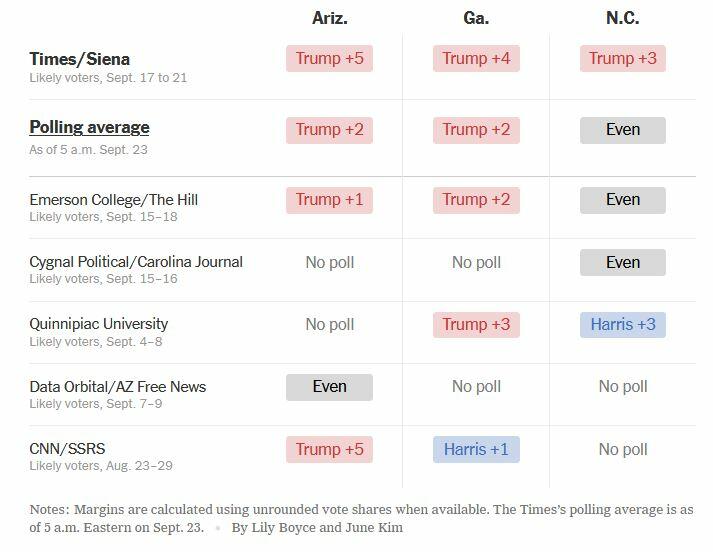
Donald Trump is riding a wave of momentum across the Sun Belt, according to a new poll, which shows the former president ahead in key battleground states like Arizona and Georgia, with North Carolina also leaning in his favor. In a post-debate bump, Trump has solidified his lead in two of those states which he lost to Joe Biden in 2020, Arizona and Georgia, while Kamala Harris struggles to close the gap as she contends with both voter skepticism and a rising Trump campaign.

Trump’s resurgence in these states signals a sharp contrast to Harris’s relatively narrow lead in other battleground areas like Pennsylvania. The most recent poll conducted by The New York Times and Siena College from Sept. 17 to 21 reveal Trump ahead in Arizona by five points, leading Harris 50% to 45%. This marks a significant shift from earlier polls where Harris was ahead, thanks in part to Latino voters shifting away from the Vice President.

Georgia, another crucial state, shows Trump maintaining a 49% to 45% advantage, while North Carolina — historically a Republican stronghold — remains more competitive, with Trump holding a slim lead of 49% to 47%.

As both campaigns focus heavily on these states, the pressure is mounting. Harris’s campaign has enjoyed a spike in donations and enthusiasm following her recent debate performance, but the polling suggests that Trump’s aggressive “America First” messaging is resonating deeply with voters worried about economic uncertainty, immigration, and the nation’s future.

According to the report, the Sun Belt states are key to a Harris victory in November.

While these three Sun Belt states have drawn a great deal of attention from both the Trump and Harris camps, North Carolina and Georgia are especially essential to the former president’s hopes of returning to the White House, analysts say. Ms. Harris could win even while losing all three of these states, though it would be difficult.

One Trump supporter in Georgia, Tyler Stembridge, expressed concern over the country’s trajectory. “Whatever road we’re on right now just, to me, does not look like it’s going to end well,” he told the NY Times.

The polls also reveal key vulnerabilities for both candidates. Harris’s challenge lies in winning over undecided voters, with about 15% of voters across these three states still undecided or open to switching. Trump’s character remains a sticking point, with concerns over his behavior looming largest in North Carolina, where 44% of undecided voters cited his personality as problematic.

For now, however, Trump’s economic message and promises to address inflation seem to be working in his favor. A majority of respondents in these Sun Belt states believe Trump would do a better job managing the economy, with 55% saying he is better equipped to tackle inflation compared to 42% who favor Harris.

Tyler Durden
Tue, 09/24/2024 – 18:00

Why Marx Was Wrong About Workers And Wages

0
Why Marx Was Wrong About Workers And Wages

Authored by Allen Gindler via The Mises Institute,

One of the central tenets of Marxism is the labor theory of value, which states that the value of a commodity is determined by the amount of socially necessary labor time required to produce it. In this framework, labor itself becomes a commodity—something that can be bought and sold in the marketplace. Marx argues that, under capitalism, workers are forced to sell their labor power to capitalists, who exploit them by paying wages that are less than the full value their labor produces. This difference – or “surplus value” – is appropriated by the capitalist as profit. However, this analogy between labor and commodities reveals deep flaws when examined critically.

The idea that labor is a commodity has been criticized in the works of many prominent economists, both from the Austrian school of economics and from others. Friedrich Hayek, in his work “The Road to Serfdom” (1944), offers a broader critique of socialist economic planning, which includes the Marxist treatment of labor as a commodity. Hayek’s critique of Marxism is that it leads to the centralization of power, where the state controls labor and other aspects of the economy. He argues that treating labor as a controlled commodity within a planned economy undermines individual freedom and leads to a form of “serfdom.”

According to Hayek, economic freedom, including the freedom to choose one’s work and negotiate wages, is essential for political freedom. His critique implies that the Marxist approach to labor, which treats it as a commodity to be controlled by the state, is fundamentally flawed and dangerous to individual liberty.

Karl Polanyi, in his influential work “The Great Transformation” (1944), introduces the concept of “fictitious commodities“ to describe things like labor, land, and money that are treated as commodities in a market economy but are not truly commodities in the traditional sense. Polanyi argues that labor is a “fictitious commodity” because it is not produced for sale but is an inherent aspect of human life.

Polanyi criticizes the commodification of labor because it reduces human beings to mere inputs in the production process, ignoring their social and moral significance. He argues that treating labor as a commodity is unnatural and harmful, leading to social disintegration and exploitation.

Ludwig von Mises, in his work “Human Action” (1949), critiques the Marxist concept of labor as a commodity from the perspective of the Austrian school of economics. Mises argues that labor cannot be treated as a commodity in the same way as goods and services because it is intrinsically linked to human choice and action. Mises contends that labor is an expression of individual preferences and values, which cannot be reduced to a market price alone. He criticizes Marxist economics for failing to recognize the subjective nature of value in labor, arguing that labor is not a homogeneous commodity and varies in quality and value depending on the individual and the context.

This critique challenges the Marxist framework by asserting that labor cannot be commodified in the same way as physical goods. Mises’s emphasis on individual choice and the subjective theory of value suggests that Marx’s treatment of labor as a commodity is an oversimplification that ignores the complexity of human behavior and economic relationships.

The Strange Case of Labor as a Commodity

According to Marx, labor power is treated as a commodity that workers sell in exchange for wages. But this commodity is unlike any other. Marx himself acknowledges that labor power is unique because it is tied directly to human beings; it cannot be separated from the person who provides it. This intrinsic link between labor and the worker creates several contradictions in Marxist theory.

First, if labor power is a commodity, it is a very strange one indeed. According to Marx, this commodity is always sold below its value. In other words, workers are constantly selling their ability to work for less than it is worth, generating surplus value for the capitalist. But this raises a fundamental question: if labor is a commodity, why is it the only commodity that is consistently sold below its cost? In any other market, selling a commodity below its value would be considered an unsustainable business practice, leading to bankruptcy. Yet, in Marx’s theory, this is not only common but necessary for the functioning of capitalism.

This notion implies that workers are essentially “stupid businessmen” who sell their commodity—labor—at a loss, every working day. This characterization is not only demeaning but also illogical. It is difficult to conceive of any rational actor, let alone an entire class of people, who would consistently engage in such a self-defeating economic practice.

In other words, if we accept the premise that labor power is a commodity, then we must also accept that workers are engaged in a very peculiar form of business—one where they consistently accept less than the market value for their product. This runs counter to basic economic principles, where sellers seek to maximize the price they receive for their goods or services. The idea that an entire class of people would willingly and consistently sell their labor below its value defies logic and undermines the credibility of Marxist theory.

To illustrate the absurdity of treating labor as a commodity, consider the example of a self-employed plumber. A plumber who owns their tools and operates independently does not sell their labor power to a capitalist. Instead, they provide a service directly to customers and charge a fee for their work. In this scenario, the plumber is both the owner of the means of production (their tools and skills) and the provider of the service. They control the price of their labor and the conditions under which they work.

According to Marxist theory, however, this self-employed plumber would somehow be selling their labor power below its value, even though they set their own rates and work conditions. This makes little sense. The plumber, acting as their own “capitalist,” would naturally aim to charge a price that covers their costs and provides a profit margin. There is no inherent reason why their labor power should be sold below its value, and the concept of surplus value becomes irrelevant in this context. The self-employed plumber is not a “stupid businessman” but a rational economic actor who sets prices based on the value of their work.

The Socialist Experience: Selling Labor Below Cost

Marxists argue that the exploitation of labor is inherent to capitalism and that socialism would rectify this by abolishing private ownership of the means of production. However, the experience of socialist regimes, such as the Soviet Union, China under Mao, and Cuba, tell a different story.

Even in these ostensibly Marxist societies, workers continued to sell their labor power in exchange for wages. The state, rather than private capitalists, controlled the means of production and determined the distribution of surplus value. However, this did not eliminate the fundamental Marxist critique that labor was being sold below its value. In fact, Marxists would argue that this exploitation continued, with the state acting as the new capitalist, appropriating surplus value from the workers.

If workers under socialism continued to sell their labor below its value, then Marxism fails not only as a critique of capitalism but also as a guide for building a classless society. The persistence of this dynamic under socialism suggests that Marxism is deeply flawed, both in theory and in practice.

Marxism as Sophism

The entire Marxist framework rests on the premise that labor is a commodity. If labor is not a commodity, the logical consistency of Marxism collapses because its key concepts—surplus value, exploitation, contradictions in capitalism, and the inevitability of socialist revolution—lose their foundation.

If labor is not a commodity, then:

  • Surplus value cannot be calculated in the way Marx described, undermining the concept of capitalist exploitation.

  • Exploitation of workers, as Marx defined it, cannot occur if there is no surplus value being extracted from labor.

  • The contradiction between productive forces and production relations may not exist in the form Marx theorized, removing the driving force behind the predicted collapse of capitalism.

  • The justification for a socialist revolution is weakened, as the proletariat may not experience the chronic exploitation that Marx believed would lead to revolutionary change.

Marxism’s reliance on the flawed premise of labor as a commodity renders it fundamentally unsound. Given the theoretical and practical flaws in Marxism, it is reasonable to conclude that Marxism functions as a form of sophism in socio-economic theory. Sophism refers to an argument that appears plausible on the surface but is fundamentally misleading and ultimately unworkable. Marxism fits this definition well.

Tyler Durden
Tue, 09/24/2024 – 17:40

“This Is Potentially The End Of The West…”

0
“This Is Potentially The End Of The West…”

“This is potentially the end of the West. It’s now or never,” warns Bret Weinstein in an ominous reality check of just what’s at stake over the next few months.

“This is, in my opinion, absolutely urgent,” he adds:

“People’s fancy rationales for staying on the couch and not voting because they don’t think their vote counts. This is no time for that…

This is no time for what I have done in past elections, which is, you know, to vote my conscience and vote for people that I knew would not be elected.

There is a time and a place for that. I do not believe this is the time and the place.

This is the moment at which we have to defeat whatever that force is that has taken over our system and targeted all of our rights.”

Weinstein points out that “we are in a better position than Europeans are because our constitution is better thought out.”

“We are kind of last on the list from the point of view of the degradation of our rights…

This is the moment to realize that whatever our ideological differences may be, are completely unimportant if we lose the republic, right?

If we are to fight about the differences between what conservatives and liberals see, it has to be after the republic has been put back on a course with a future to it.”

Watch the full clip below:

Tyler Durden
Tue, 09/24/2024 – 17:20

Hillary Clinton’s Sordid History Of Secrecy & Censorship

0
Hillary Clinton’s Sordid History Of Secrecy & Censorship

Authored by Jim Bovard via The Libertarian Institute, 

“You could drop Hillary into any trouble spot, come back in a month and…she will have made it better,” former President Bill Clinton declared in a 2016 speech championing his wife’s presidential candidacy. But Hillary’s entry into the brawls surrounding the 2024 presidential election will leave many Americans wishing to drop her elsewhere.

As the race enters the home stretch, Hillary Clinton is riding in like Joan of Arc to rescue truth—or at least to call for hammering government critics. But Hillary has been a triple threat to American democracy for fifteen years.

Last Monday evening, Hillary declared on Rachel Maddow’s MSNBC talk show that the federal government should criminally prosecute Americans who share “propaganda“—which she made no effort to define.

Hillary has long been one of America’s foremost censorship advocates. In 2021, she announced that there must be “a global reckoning with the disinformation, with the monopolistic power and control, with the lack of accountability that the [social media] platforms currently enjoy.” Hillary made her utterance at a time when freedom in much of the world had been obliterated by governments responding to a pandemic that occurred as a result of U.S. government funding reckless experiments in Chinese government labs. The U.S. denial of its role in the lab leak was perhaps the biggest deceit of the decade but Hillary never kvetched about that scam regarding a program that contributed to millions of deaths. But that wasn’t disinformation—that was public service.

Getty Images

In 2022, Hillary wailed that “tech platforms have amplified disinformation and extremism with no accountability” and endorsed European Union legislation to obliterate free speech. But “disinformation” is often simply the lag time between the pronouncement and the debunking of government falsehoods.

That awkward fact didn’t deter Democratic vice presidential nominee Tim Walz from declaring last month, “There’s no guarantee to free speech on misinformation or hate speech, and especially around our democracy.” Who knew the Minnesota version of the First Amendment has a loophole bigger than Duluth?

After the New York Post shot down Joe Biden’s Disinformation Governance Board in 2022, Biden appointed Vice President Kamala Harris as chief of a White House disinformation task force to find ways to protect women and LGBTQI+ politicians and journalists from vigorous criticism on the Internet (“online harassment and abuse”). Harris declared that such criticism could “preclude women from political decision-making about their own lives and communities, undermine the functioning of democracy.” To save democracy, the government must suppress criticism of women.

Five years ago, at an NAACP Detroit “Freedom Fund” dinner, Harris proclaimed, “We will hold social media platforms accountable for the hate infiltrating their platforms because they have a responsibility to help fight against this threat to our democracy.” She did not specify the precise degree of alleged rancor required to nullify a speaker’s constitutional rights. Based on Harris’s prior comments, she will likely sharply increase repression of her critics on social media if she wins in November.

Biden administration censorship schemes have been denounced by federal courts and Facebook chief Mark Zuckerberg. Rep. Nancy Mace (R-SC), chair of the House Cybersecurity Subcommittee, sent the White House a letter last week noting that the Biden administration always “advertised its willingness to manipulate the content of social media sites” and called for a cessation of all federal censorship tainting the 2024 election. Mace requested copies of all official “communications with social media companies…concerning the concealment or suppression of information on their sites.” At last report, nobody on Capitol Hill was sitting on the edge of their chair waiting for an informative White House response.

Hillary’s own career exemplifies a political elitist righteously blindfolding all other Americans.

When she was secretary of State from 2009 to 2013, Clinton exempted herself from the Freedom of Information Act (FOIA), setting up a private server in her New York mansion to handle her official email. The State Department ignored seventeen FOIA requests for her emails and said it needed seventy-five years to comply with a FOIA request for Hillary’s aides’ emails. The Federal Bureau of Investigation shrugged off Hillary’s aides using a program called BleachBit to destroy 30,000 of her emails under subpoena by a congressional committee. Federal Judge Royce Lamberth labeled the Clinton email coverup “one of the gravest modern offenses to government transparency.”

An Inspector General report slammed FBI investigators for relying on “rapport building” with Team Hillary instead of using subpoenas to compel the discovery of key evidence. The IG report “questioned whether the use of a subpoena or search warrant might have encouraged Clinton, her lawyers…or others to search harder for the missing devices (containing email), or ensured that they were being honest that they could not find them.” The FBI’s treatment of Hillary Clinton vivified how far federal law enforcement will twist the law to absolve the nation’s political elite, or at least those tied to the Democratic Party.

During Clinton’s tenure, the State Department gave grants to promote investigative journalism in numerous developing nations as part of its “good governance” programs. But exposing abuses was only a virtue outside U.S. territorial limits. Clinton vigorously covered up debacles in the $200 billion in foreign aid she shoveled out. From 2011 onward, AID’s acting inspector general massively deleted information on foreign aid debacles in audit reports, as The Washington Post reported in 2014. Clinton’s machinations helped delude Washington policymakers and Congress about the profound failures of U.S. intervention in Afghanistan.

Pirouetting as a champion of candor is a novel role for the former secretary of State. Shortly before the 2016 election, a Gallup poll found that only 33% of voters believed Hillary was honest and trustworthy, and only 35% trusted Donald Trump. The Clinton-Trump tag team made “post-truth” the Oxford English Dictionary’s 2016 word of the year.

Hillary believes that the lesson of George Orwell’s Nineteen Eighty-Four is that good citizens should shut up and grovel. In her 2017 memoir, Hillary claimed that Nineteen Eighty-Four revealed the peril of critics who “sow mistrust toward exactly the people we need to rely on: our leaders, the press, experts who seek to guide public policy based on evidence, ourselves.” Did Hillary think Orwell dedicated the novel to Stalin? Hillary’s book noted that the regime in Orwell’s novel had physically tortured its victims to delude them. Hillary is comparatively humane, since she only wants to leave people forever in the dark—well, except for the scumbags who undermine the official storyline.

Hillary was a key player in the Barack Obama administration that believed that Americans had no right to learn the facts of the torture committed by the CIA after 9/11. When she was secretary of State in 2012, she declared, “Lack of transparency eats away like a cancer at the trust people should have in their government.” But the more secrets politicians keep, the less trust they deserve.

Hillary’s vision of democracy permits only token interference by underlings. She believes that poohbahs like her have the right to rig elections to sanctify their power. In 2015, when she was running for the presidency, she condemned voter identification requirements as part of a “sweeping effort to disempower and disenfranchise people of color, poor people and young people.” A Washington Post headline aptly summarized her message: “Hillary Clinton Declares War on Voter ID.” This is the bargain Hillary offered; voters didn’t have to identify themselves and she didn’t disclose what she did in office. Subsequent Democratic Party attacks on Voter ID were more successful, leading to sixty million ballots for Biden, millions of which were counted but not verified.

To sanctify censorship, Hillary is again invoking the Russian peril. A 316-page report last year by Special Counsel John Durham noted that in mid-2016, after the shellacking she suffered from her email scandal, “Clinton allegedly approved a proposal from one of her foreign policy advisors to tie Trump to Russia as a means of distracting the public from her use of a private email server.” President Barack Obama was briefed on the Clinton proposal “to vilify Donald Trump by stirring up a scandal claiming interference by Russian security services.” FBI officials relied on the “Clinton Plan” to target the Trump campaign even though no FBI personnel apparently took “any action to vet the Clinton Plan intelligence.”

The first three years of Trump’s presidency were haunted by constant accusations that he colluded with Russians to win the 2016 election. In 2019, an Inspector General report confirmed that the FBI made “fundamental errors” and persistently deceived the FISA Court to authorize surveilling the Trump campaign.

Hillary’s scams were even too much for federal scorekeepers. The Federal Election Commission last year levied a $113,000 fine on Hillary Clinton’s 2016 campaign and the Democratic National Committee for their deceptive funding to cover up their role in the Steele dossier, which spurred the FBI’s illegal surveillance of Trump campaign officials.

In Hillary’s new improved version of the Constitution, there is no free speech for “deplorables”—the vast swath of Americans she openly condemned in 2016. But this is the same mindset being shown by the Kamala Harris presidential campaign. Harris has scorned almost every opportunity to explain how she would use the power she is seeking to capture over American citizens. Instead, she is entitled to the Oval Office by acclimation of the mainstream media and all decent folks—or at least those who drive electric vehicles and donate to her campaign.

Is “disinformation” becoming simply another stick for rulers to use to flog uppity citizens? Denouncing disinformation sounds better than “shut up, peasants!” But if politicians have no obligation to disclose how they use their power and can persecute citizen who expose their abuses, how in Hades can American freedom survive? How can we permit our rulers to selectively squelch citizens based on alleged hateful comments when, as historian Henry Adams pointed out a century ago, politics “has always been the systematic organization of hatreds.”

Ambitious politicians never lack pious pretenses for destroying freedom. But will censorship by the Biden administration steal the 2024 election for Harris? Unfortunately, according to Hillary Clinton, you are not worthy of knowing the answer.

Tyler Durden
Tue, 09/24/2024 – 17:00