67.6 F
Chicago
Monday, October 5, 2026
Home Blog Page 2265

“What Could Go Wrong? Probably More Than You Might Imagine…”

0
“What Could Go Wrong? Probably More Than You Might Imagine…”

Authored by James Howard Kunstler,

Wheezing Past The Graveyard

“The Democrats are self-immolating on the altar of their own tenuous relationship with common decency.”

– Tom Luongo

What could go wrong? Probably more than you might imagine. We have just turned the corner into autumn. Now, things get serious, even gravely dark. America has never been so into dancing skeletons and morbidity. The small-town yards are filling up with inflatable signifiers of hell and death. Don’t you wonder what all this signifies besides good old family fun? The zeitgeist maybe having a little sport with us, you think?

We are chiefly preoccupied with our badly dysfunctional self-governance, of course, and the method for periodically revising it, which we call an election. Nobody has confidence in the process, which has acquired so many layers of absurd, needless complexity for the sole purpose of perverting the outcome that every lawyer in the land will have a hefty guaranteed annual income in the probably futile effort to sort it out come November 6. There is your hell-scape, with overtones of death on a pale horse. . .  and all. Chaos. . . riots. . . anarchy. . . civil war.

The threat of World War Three may have abated for the moment, but in a peculiar and disconcerting way, viz. a coup in the executive branch. The gadfly Col. Lawrence Wilkerson, long ago chief-of-staff to Sec’y of State Colin Powell, reports that the Pentagon has cancelled “Joe Biden,” that is, taken him out of the decision-loop for anything. Well, you ask yourself, how is it possible he had even remained remotely close to any decision-loop this long, in any case, given the problem of his obviously broken brain? But now, it is unofficially official: just eat your mint-chocolate ice-cream and shut up, and let Dr. Jill run those “cabinet meeting” photo ops.

According to Col. Wilkerson, Sec’y of Defense Lloyd Austin told the “president” to his face that there will be no flinging of US-supplied long-range missiles from Ukraine “deep into Russia,” as the neocon-infested White House been chattering about endlessly. Wiser heads deep in the DOD HQ have decided the matter. Lump it, if you must, Tony Blinken and Jake Sullivan. The Russians’ “red-line” on such a caper is so wide you can see it from the International Space Station — that is, if you’re an astronaut marooned up there due to combined NASA/Boeing incompetence. . . but that’s another story.

Meanwhile, UK Prime Minister Keir Starmer was all revved up for the missile operation and flew to Washington for a one-to-one meet-up with “JB” to get the go-ahead. The Brits are avid for another World War. The last two went so well for them that they kissed their vast empire goodbye. Now they want to kiss goodbye their sceptered isle itself, which has almost no economy left and is overrun by cultural hostiles who are not into Shakespeare. The Brits’ floundering government is a posse of monomaniacs fixated on defeating Russia which, at this point in history, is like a dormouse (Glis glis) facing down a brown bear (Ursus arctos).

“Joe Biden,” reportedly “furious” at losing his executive power, was constrained to tell Mr. Starmer that the missile strike op was off, which left the UK PM miffed that he had crossed the ocean for no reason. Who knows, the Brits are so nuts these days that perhaps they’ll try to pull it off on their own. Mr. Zelensky, the no-longer-elected leader of Ukraine was begging them to try it because Ukraine has nothing left. NATO as a whole really has nothing left, either. Not much of a combined military, scant munitions left in the cupboard, and no will to wage war among the depressed citizens of its member nations.

There is nothing left except to come to terms on a settlement that will leave Ukraine not a member of NATO. The entire affair has been a humiliation for NATO and America, especially for the “Joe Biden” management team (whatever it actually consists of these days). The longer they refuse to engage in talks, the less of Ukraine will be left as a sovereign entity — having proven to the world that its sovereignty rests solely on its capacity to be used as a catspaw by the American neocon / intel blob. You’re reminded that for seventy years prior to 2014, Ukraine was not a problem for anyone until we made it a problem on-purpose — our purpose being idiotic and malicious — and Ukraine could, in theory, revert to not being a problem for anyone again. Wouldn’t that be wonderful?

The neocon / intel blob’s other catspaw (domestic version), candidate Kamala Harris, is promising all kinds of good things “when [she] is in-office.” For some reason, nobody on The New York Times’s enormous staff of Ivy League germinated journalist-geniuses has informed Ms. Harris that she is actually in-office now, and has been since 1/20/2021. Why no good things for us plebes all these many months? No rainbows, unicorns, tax cuts, or ten-pound blocks of government cheese? Nothing but a disintegrating dollar, floods of savage mutts crossing the border and landing everywhere from Springfield, Ohio, to Nantucket, and endless raging bullshit about fighting “misinformation” — i.e., any idea that contradicts the Democratic Party’s agenda for assisted national suicide.

Ms. Harris’s gaslight-powered campaign has lost its loft in recent days, its most newsworthy event being last week’s cuddle hour with America’s official Care-Bear, Oprah. . . because, you see, there is nothing left except to pander to the emotional void induced by Woke-ism in the desperately needy minds of X-million voters of the birthing-person persuasion — especially among those unhappy souls who never got around to the birthing. Ms. Harris’s loathsome accessory, Tim Walz, has performed so discordantly that the campaign had to hang him in a closet somewhere, along with all his assorted skeletons, and lock the door.

As ever, October surprises await: monsters, demons, ghouls, shrieking ghosts, the walking dead, and all the paid-up minions of the teachers’ union.

Tyler Durden
Mon, 09/23/2024 – 16:20

Election Meddling? Zelensky Stumps For Harris On Taxpayer Dime

0
Election Meddling? Zelensky Stumps For Harris On Taxpayer Dime

Update(1619ET): During his first day in a busy week traveling in the US, Ukraine’s President Zelensky was in Pennsylvania on Sunday. He was flown there on a US Air Force C-17. This unusual arrangement is of course courtesy of American taxpayers, and it looks like the Pentagon and Secret Service are sparing no expense.

Policy consultant Dan Caldwell has pointed out at a moment that Zelensky has attacked Trump’s running mate Sen. JD Vance in the pages of The New Yorker that “The Biden-Harris admin is using military assets to fly a foreign leader into a battleground state in order to undermine their political opponents.”

This is a scandal which the mainstream media is dutifully ignoring. Joe Lonsdale, Palantir co-founder and 8VC founding partner, has commented that this is a big, big deal. “Team Kamala is so concerned about Pennsylvania, they’re using military assets to fly in Zelensky to campaign!” Lonsdale wrote on X.

The blatant conflict of interest is out in the open. “They’re implying their war creates jobs, and are forcing Z to attack Trump & Vance,” Lonsdaile continues. “Literally funding a foreign leader and using the military to bring him to campaign with them in a battleground state.” 

He concludes, “PA voters aren’t dumb, this will backfire hard on the leftist Borg.”

The following scene also took place in Pennsylvania during the tour of the ammunition manufacturing plant:

* * *

Just ahead of his trip to the United States where he’s expected to meet with President Biden later this week, Ukraine’s President Volodymyr Zelensky gave an interview to The New Yorker wherein he mounted a risky and unexpected direct attack on Trump’s pick for Vice President, Ohio Senator JD Vance.

Zelensky told The New Yorker in response to Trump’s promises to negotiate an end to the Ukraine war that “Trump doesn’t really know how to stop the war even if he might think he knows how.”

Via Time

“With this war, oftentimes, the deeper you look at it the less you understand,” Zelensky contined.

The Ukrainian leader was then asked about Trump’s VP pick, to which the reply was “He is too radical.” Here is how that section of the interview began…

New Yorker: Vance has come out with a more precise plan to—

Zelensky: To give up our territories.

New Yorker: Your words, not mine. But, yes, that’s the gist of it.

Zelensky: His message seems to be that Ukraine must make a sacrifice. 

And Zelensky continued: “This brings us back to the question of the cost and who shoulders it. The idea that the world should end this war at Ukraine’s expense is unacceptable.”

“This would be an awful idea, if a person were actually going to carry it out, to make Ukraine shoulder the costs of stopping the war by giving up its territories,” Zelensky said. 

He asserted that this wouldn’t bring an end to the fighting regardless and that Trump and Vance’s vows to end the war is “just sloganeering”.

Zelensky then suggested that it is “dangerous” for men which such talking points to rise to power and that they could spark global war through irresponsible policies. He was then quoted in The New Yorker as follows:

[Vance and others who share his views] should clearly understand that the moment they start trading on our territory is the moment they start pawning America’s interests elsewhere: the Middle East, for example, as well as Taiwan and the U.S. relations with China. Whichever President or Vice-President raises this prospect—that ending the war hinges on cementing the status quo, with Ukraine simply giving up its land—should be held responsible for potentially starting a global war. Because such a person would be implying that this kind of behavior is acceptable.

I don’t take Vance’s words seriously, because, if this were a plan, then America is headed for global conflict. It will involve Israel, Lebanon, Iran, Taiwan, China, as well as many African countries. 

He then in a patronizing way told “Mr. Vance” to “read up on the history of the Second World War” while suggesting that his plan with Russia is tantamount to ‘appeasing’ Hitler.

We expect that the Trump team isn’t going to take too kindly to Zelensky’s attack on both Trump and Vance.

The rhetoric from the interview specifically in regards to Vance was much more direct than usual.

Typically Zelensky has appeared more cautious with his criticisms, not wishing to offend a potential future Republican administration; however, that caution seems to have gone out the window.

Tyler Durden
Mon, 09/23/2024 – 16:19

Markets Calm Ahead Of Macro Storm, But…

0
Markets Calm Ahead Of Macro Storm, But…

After last week’s chaotic dumps and pumps across various asset classes amid Powell’s comments, a giant ‘quad witch’ OpEx, and mean-reverting FedSpeak, today saw markets take a pause (of sorts) with stocks, bonds, the dollar, gold, and crypto all relatively flat close-to-close…

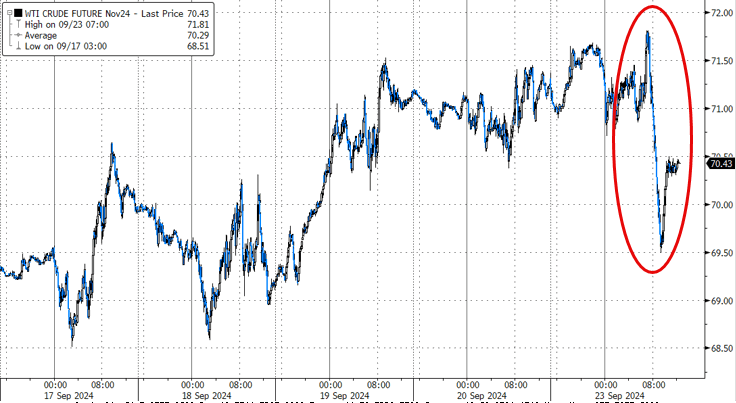
…with only crude oil showing any real action – monkeyhammered lower for no apparently good reason…

Source: Bloomberg

Today’s apparently calm demeanour perhaps reflects anxious traders gearing up for a pretty busy week of ‘hard’ and ‘soft’ data, including the Thursday’s durable goods report, Friday’s PCE inflation report, plus the Consumer Confidence survey and Richmond Fed survey tomorrow.

The vol market is showing nervousness (and the election is well and truly priced in)…

Source: Bloomberg

All the US majors plunged as European PMIs hit at the European open (ugly across the board). Then futs rallied into the US open, only to be sold again with Small Caps the biggest losers on the day. Of course, we managed a new closing high for both The Dow and S&P 500 though…

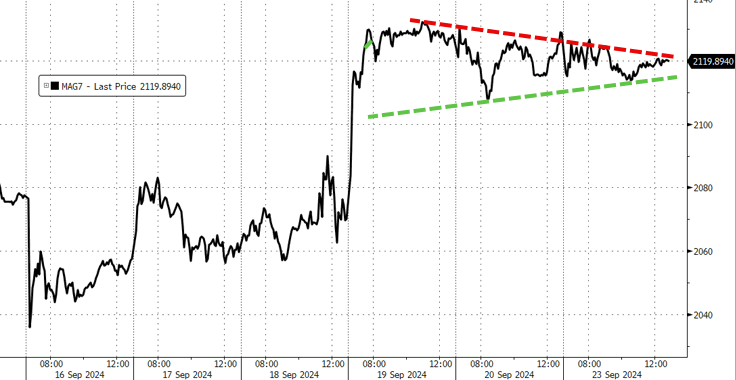
Mag7 stocks continued in their post-Powell surge wedge…

Source: Bloomberg

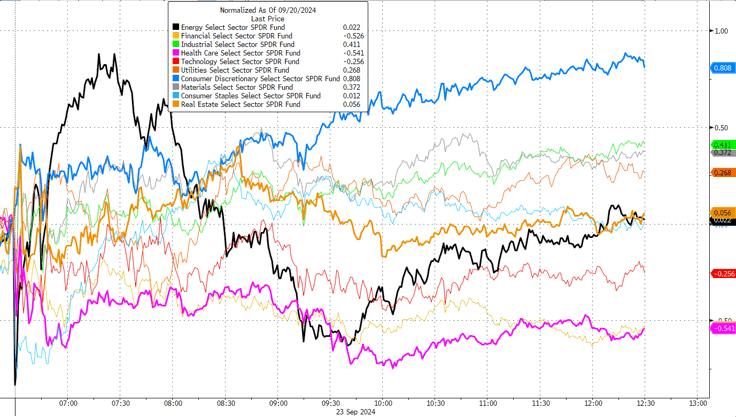
A somewhat chaotic looking day under the hood in stocks with energy puking at the open, then panic bid, then dumped into the European close. Discretionary outperformed as Real Estate lagged…

Source: Bloomberg

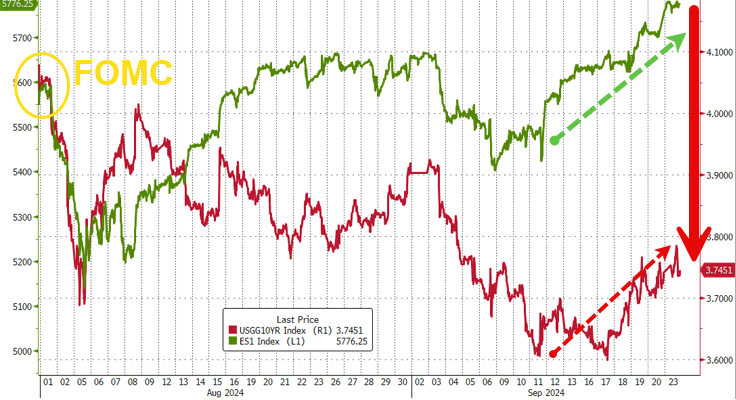
Stocks and bonds remain significantly decoupled since the July FOMC meeting…

Source: Bloomberg

Treasury yields were relatively unchanged close-to-close, despite selling pressure during the EU session and buying during US…

Source: Bloomberg

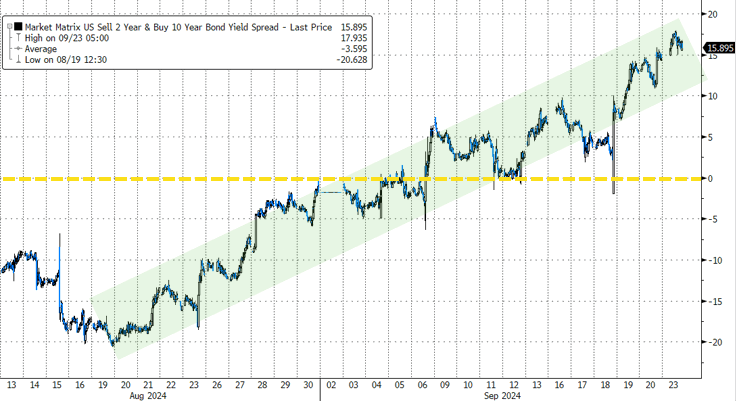
The yield curve continues to steepen dramatically with 2s10s up yo +16bps today – its steepest since June 2022…

Source: Bloomberg

Not exactly a good sign for those hoping that The Fed will bring down mortgage rates.

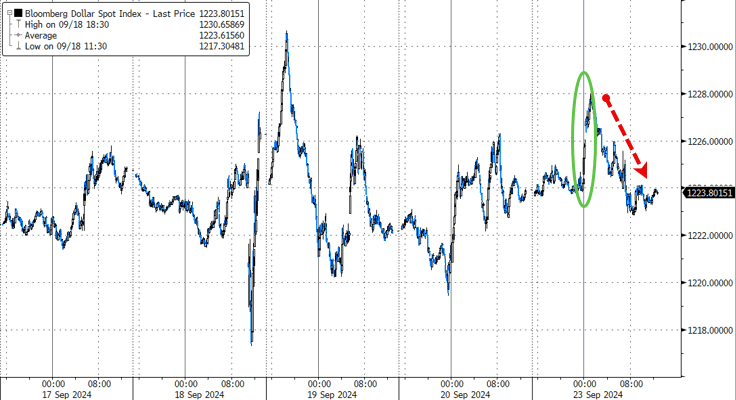
The dollar also ended flat on the day after surging on the EU PMIs (EUR weakness) and then fading back into its recent range…

Source: Bloomberg

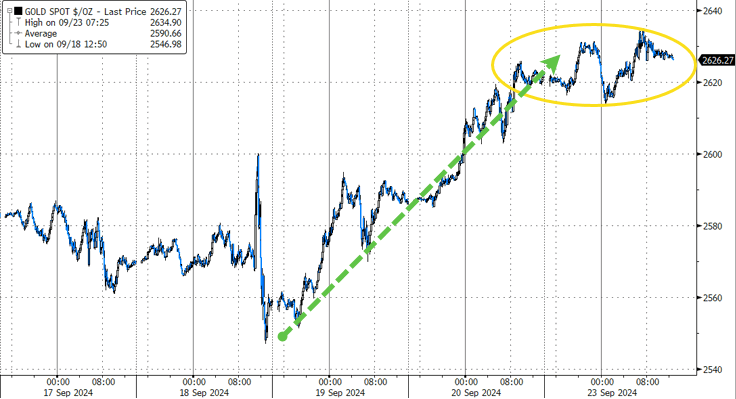
Gold limped a bit higher – another record high but was basically unchanged…

Source: Bloomberg

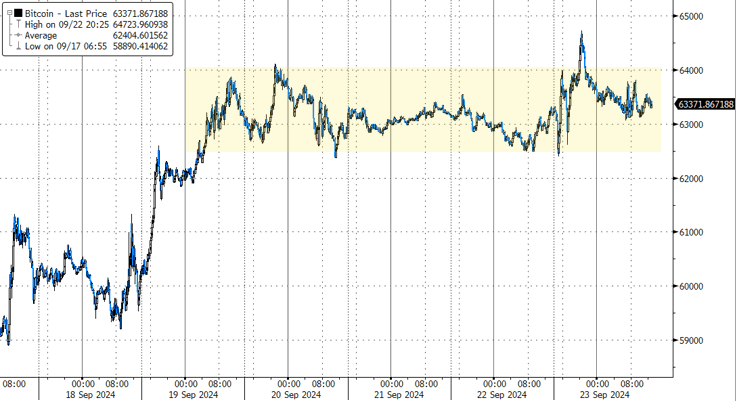
Bitcoin ripped higher overnight (topping $64,500) before fading back to almost unchanged…

Source: Bloomberg

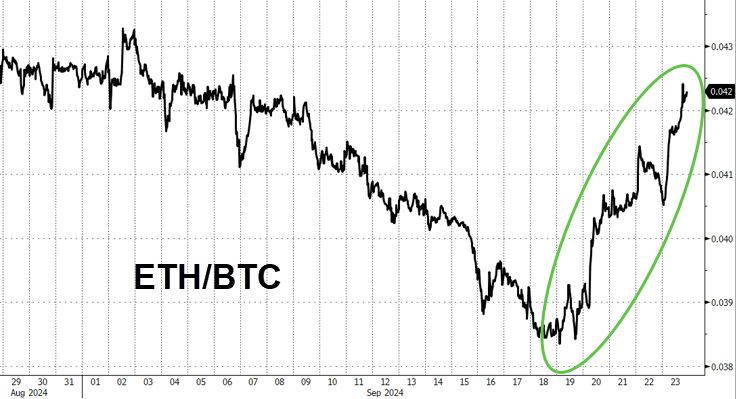
Ethereum continues to outperform Bitcoin, surging up to one-month highs on a relative basis…

Source: Bloomberg

Finally, this just happened…

Source: Bloomberg

That is a sudden surge in the market’s perception of USA’s short-term sovereign credit risk.

Are traders starting to worry about Kamalanomics (Communism?)

Tyler Durden
Mon, 09/23/2024 – 16:01

Durov Changes Tune While On Bail In France: Telegram To Allow More Data To Governments

0
Durov Changes Tune While On Bail In France: Telegram To Allow More Data To Governments

It has been one month since the arrest by French authorities of Pavel Durov, the billionaire co-founder and CEO of the Telegram messaging app, on charges of allegedly failing to act against criminals using his platform. He’s still in France after being released on a five-million-euro ($5.6 million) bail and must check in with police twice a week.

He very quickly began cooperating with the French government, it appears, though his lawyer decried it as “absurd” and Telegram supporters and free speech advocates blasted the efforts at state censorship. “It is totally absurd to think that the head of a social network… could be involved in criminal acts that could be committed on the messaging service,” Durov’s lawyer David-Olivier Kaminski had said. The question from the start was: why the highly unusual effort to prosecute a CEO directly instead of bringing legal action against the company as a whole? (the normative route)

The whole spectacle of him being hauled into custody after disembarking from his private jet over the possibility that individuals were using the world’s largest messaging app for criminal activity also seemed designed to ‘send a message’ from Western governments and create a chilling effect. We explored this scenario in “Musk Should Be Nervous” – Deep State Lackey Admits Real Target Following Telegram Founder’s Arrest.

On Monday Durov made a significant announcement which is clearly the result of his ongoing legal ordeal in France. He said Telegram has removed more “problematic content” at this point. He further acknowledged in the new statement that the app’s search feature “has been abused by people who violated our terms of service to sell illegal goods.”

durov/Instagram

“Over the past few weeks” his staff has been carefully searching through the platform using artificial intelligence to ensure “all the problematic content we identified in Search is no longer accessible,” he explained.

Importantly, he then said Telegram has changed its terms of service and privacy policy, now making clear that suspected criminals and policy violators can now have their personal details handed over to authorities, including internet IP addresses and phone numbers “in response to valid legal requests.”

The founder and CEO added that: “We won’t let bad actors jeopardize the integrity of our platform for almost a billion users.”

While the United Arab Emirates-based platform boasts nearly one billion monthly active users, that could change with this new policy update. There could be some degree of a user exodus over ‘trust’ and data security at a moment Durov is still essentially a hostage of the French state.

Durov was detained by the National Anti-Fraud Office (ONAF) over the alleged facilitation of crimes including terrorism, narcotics trafficking, and fraud. “On his platform, he allowed an incalculable number of offences and crimes to be committed, for which he did nothing to moderate or cooperate,” a source told TF1 TV.

There are also allegations of widespread child exploitation, and Durov has been repeatedly accused of ignoring outreach from child safety watchdogs.

But ultimately the arrest was characterized by Megaupload founder Kim Dotcom as part of the “crackdown against free speech.”

Tyler Durden
Mon, 09/23/2024 – 15:45

Metal Mania Starts Soon…

0
Metal Mania Starts Soon…

Authored by Adam Sharp via DailyReckoning.com,

I’ve had at least a dozen Uber drivers pitch me on suspect investments. For a while, it seemed like every trip came with free, and invariably horrible, picks.

Interestingly, I’ve never had a driver, or a barber for that matter, pitch me on gold and silver. Despite gold regularly breaking out to new highs, we really haven’t yet seen any signs of a typical retail mania.

Looking at Google trends, there are no signs of increased investor interest in precious metals. Here’s a chart showing Google search volume for “gold price” over the last year.

Barely any movement. Other search terms such as “buy gold online”, “gold etf”, which would indicate growing interest, are similarly flat.

Despite solid performance, gold and silver are not yet hot commodities. A 2023 survey by Bank of America showed that 71% of financial advisors had a 0-1% allocation to gold. Only 27% had a 1-5% exposure rate.

Perhaps even worse, only 2% of advisors report a 5-10% allocation to gold. Madness.

So if investors aren’t snatching up all the gold, what’s driving the price up?

Central bankers are buying in droves. The chart below shows purchases by country in 2024 through July.

According to the World Gold Council, central banks added 37 tons in July alone. That’s up 206% month-over-month.

There’s no sign of central banks slowing their buying anytime soon. It’s also important to note that we don’t have great data on Russia or China, which could both be buying substantially more bullion than reported.

There’s rich irony in the fact that the primary gold bulls today aren’t individual investors, it’s the guys running the fiat printers. This is an insider buy signal at a global scale. And these aren’t fickle day traders in for a quick flip. These central banks have a new reserve policy, and it appears to heavily favor gold.

Gold Re-Emerges as a Reserve Asset

Over the past 75 years, the U.S. dollar emerged as the world’s leading international reserve asset. It eclipsed gold in the early 1990’s and remains dominant to this day. But the trend has finally flipped. Today, gold as a percent of international reserves is climbing, and the dollar is falling.

This is a monumentally important trend. De-dollarization is actually beginning to happen. But central banks aren’t switching to the Chinese renminbi or the euro, they’re reverting to classic hard currency: gold. It’s re-goldification on a massive scale.

The era of fiat dominance may well be in its twilight years. And good riddance. Being home to the world’s reserve currency has hollowed out the U.S. manufacturing base and caused spending to spiral out of control.

Metals Mania Starts at $3k Gold

All of this helps confirm my view that we are still very early on precious metals. Fed printing operations are just now about to start back up. QE will eventually reignite, and the scale will likely dwarf previous episodes within a few years. Depending on who wins the White House, a stimulus program may be in the works as well.

Gold and silver are absolutely crucial aspects of a modern portfolio, and are still wildly under-owned by investors. In the next 5 years, we will likely see a number of sovereign debt crises, and/or sustained inflation above 10% in a number of countries. The piles of government debt have simply grown out of control.

Lower interest rates will help cut the debt servicing costs (interest expenses). But there’s a good chance it will also reaccelerate inflation. No matter which path we choose, the piper will be paid for past excesses.

Eventually, we will experience a true precious metal mania. I suspect it will begin when gold hits $3,000 and silver breaks out above $49.45, its 1980 all-time high. Everyone will be buzzing about gold and silver. Your neighbors, friends, and colleagues. And it will be glorious.

Fortunately, we’re not there yet and still have time to prepare. We may even get a pullback after gold’s impressive run from $2,000 in Feb 2024 to $2,569 as I write this on Sept 17 2024. But then again, we may not…

Tyler Durden
Mon, 09/23/2024 – 15:25

China Launches More Stimulus: PBOC Cuts Rates, Announces Rare Press Conference On Support For Economy

0
China Launches More Stimulus: PBOC Cuts Rates, Announces Rare Press Conference On Support For Economy

One month ago, when describing the rapid deterioration in China’s economy – including the crumbling welfare state, the country’s dwindling savings rate, the soaring youth unemployment and jump in labor strikes and overall social discontent – we said that despite its stubborn unwillingness to stimulate the economy, “Beijing will have no choice but to blink in the end, and that will mean unleashing a much delayed stimulus bazooka that likes of which have not been seen yet.”

Then, last Friday, when pointing out the record plunge in the China’s all-important M1 monetary aggregate…

… we said that it’s time for China to turn on the printing press.

We had to wait just a few hours for this prediction to come true, and while it’s not the full-blown massive bazooka we expect will be revealed in due course (as the alternative is civil insurrection), overnight China’s central bank lowered a key short-term policy rate and pumped more liquidity into the financial system, in its latest effort to boost the sagging economy.

Early on Monday, the People’s Bank of China cut the 14-day reverse repurchase interest rate by 10 basis points to 1.85%, and injected 74.5 billion yuan, equivalent to $10.6 billion, of liquidity via the policy tool, it said on its website.

The latest cut is a reflection of the reduction in the 7-day reverse repo rate in July, during which the PBOC didn’t conduct a 14-day reverse repo operation, said Zhiwei Zhang, an economist at Pinpoint Asset Management.

The central bank also injected 160.1 billion yuan through 7-day reverse repo agreements, keeping the interest rate unchanged at 1.7%, it said Monday.

Last week, the PBOC unexpectedly held its benchmark lending rates steady, despite rising expectations for easing following the U.S. Federal Reserve’s own rate cut. But with its economy in shambles, it’s just a matter of time before Beijing scrambles to catch down to the Fed.

Economists anticipate the Chinese central bank will lower its 7-day reverse repo rate—now seen as the key rate for pricing benchmark lending rates—in the coming months, as the Fed’s cut gives it more room for monetary policy easing.

But more important than the rate cut, China also announced plans for a rare briefing on the economy by three top financial regulators fueling speculation officials are preparing to ramp up efforts to revive growth. According to Bloomberg, authorities announced that central bank governor Pan Gongsheng will hold a press conference tomorrow on financial support for economic development, alongside two other officials. Minutes later, the People’s Bank of China lowered the 14-day reverse repurchase rate, catching up with reductions initiated in July.

The moves bolstered expectations that PBOC will further lower rates, after the US Federal Reserve finally started cutting last week easing pressure on China’s need to defend its currency. A slew of disappointing data in August raised concerns that President Xi Jinping’s government could not only miss its annual growth target of around 5% without unleashing more support, but is gambling with a total deflationary collapse of the Chinese economy, where housing is now at the lowest level since the global crisis.

Meanwhile, traders understandably are pricing in more stimulus, with the yield on China’s 10-year government bonds falling to a fresh low of 2.03% in the Monday morning session. The benchmark CSI 300 Index for onshore stocks marked their fourth straight day of increases, the longest streak in two months.

“I do expect the PBOC to cut the 7-day reverse repo rate as well as the reserve requirement ratio in the coming months,” said Zhiwei Zhang, president and chief economist at Pinpoint Asset Management. The briefing will give regulators a chance to “shed light on their policy stance,” he added.

Others were more willing to cut to the chase: according to Evercore ISI’s Neo Wang, PBOC Governor Pan Gongsheng’s planned presence at a rare joint briefing by top financial regulators scheduled for Tuesday makes a cut to reserve requirement ratio for financial institutions look likely. Pan may personally announce the RRR reduction, just like he did at a Jan. 24 press conference, two weeks ahead of time, when authorities tried to halt a $6 trillion stock-market rout. Wang said that the medium-term lending facility maturity wall before year-end also justifies a RRR reduction, and added that the presser is also valuable for any hint at the likelihood of future loan prime rate cuts.

That event kicks off at 9 a.m. — 20 minutes before the PBOC’s daily announcement on its short-term policy loans and their costs, in contrast to more typical 10 a.m. start times.

While the Fed’s bigger-than-expected half-percentage point slash has given central banks across Asia more room to move, not all are immediately following suit. Indonesia’s central bank unexpectedly reduced its main rate last week, but the Bank of Australia is set to hold on Tuesday, echoing last week’s decision by Japan’s monetary authority which is on a hiking path.

Unfortunately, even another RRR cut is unlikely to achieve much: China’s string of rate cuts has done nothing to stimulate an economy that most recently expanded at the slowest pace in five quarters, and to contain a years-long real estate crisis that’s wiped out an estimated $18 trillion in wealth from households has crushed appetite for spending and pushed China into its longest streak of deflation since 1999.

That means real interest rates — which are adjusted for changes in prices — have stayed elevated, weakening the impact of any moderate easing. A plunge in revenue from land sales has also held back fiscal spending, leaving indebted local governments struggling to pay their bills and with little bandwidth to invest in growth-boosting projects.

Now, the focus is on whether China’s fourth-quarter growth can get “remotely close” to the annual target, said Ken Wong, Asia equity portfolio specialist at Eastspring Investments, adding that a 4.8% expansion looked most likely for 2024. “Monetary policy could help,” he said, “but ultimately getting the consumer to spend, and building up consumer confidence, is going to be key to China.”

Economists in a Bloomberg poll pinpointed enforcement of the housing rescue package China unveiled in May as the single most-impactful way officials can give the economy a kick. So far, uptake has been weak with only 29 of some 200 cities heeding the call to absorb a housing glut.

“It is also needed for the PBOC to guide lower the interest rates on existing mortgages,” said Credit Agricole Chief China Economist Xiaojia Zhi, responding to the Monday cut. Regulators are also working on a proposal that would allow mega cities such as Shanghai and Beijing to relax restrictions for non-local buyers, Bloomberg News previously reported.

The PBOC’s decision to lower the 14-day rate to 1.85% from 1.95% Monday came ahead of the week-long nationwide break that begins Oct 1. The central bank typically offers fortnight-long loans ahead of extended breaks, previously doing so in February ahead of the week-long Lunar New Year break. The last time officials cut the RRR came on the cusp of the Lunar New Year holiday, as they looked to smooth liquidity.

“A bigger package is needed” than Monday’s 10-basis-point trim, said ANZ Chief Greater China Economist Raymond Yeung. “Other policy measures in the tool box such as RRR cut, MLF cut and mortgage rate cut will likely be announced.”

Tyler Durden
Mon, 09/23/2024 – 13:05

The Fed’s Last Sign Of Independence May Be Gone

0
The Fed’s Last Sign Of Independence May Be Gone

Authored by Daniel Lacalle,

The Federal Reserve decided to cut rates by 50 basis points despite what Chairman Powell considers “no risk of a recession or downturn,” a “solid economy,” and a “strong job market.”

After ignoring the impact of monetary aggregates and the warning signs of inflation, the Federal Reserve has breached its price stability mandate for three consecutive years, preferring to prioritize liquidity injections, i.e., printing money, to the recovery of the currency’s purchasing power.

The “higher for longer” policy only lasted eighteen months. Furthermore, the latest reading of the Chicago Fed National Financial Conditions Index indicates extremely loose conditions. In fact, the Fed has never cut rates by so much when financial conditions have been this loose.

If financial conditions are extremely loose and the economy and the labor market are strong, according to the FOMC minutes, there is no sign of recession and inflation remains above target, especially the core CPI, why should they cut rates so fast? What happened?

The Fed decided to bail out the government in the middle of an election process of all moments. The Fed’s questioned independence is even more doubtful today. Cutting rates to help an overly indebted government has become part of the electoral campaign.

The Fed did not panic in September after the negative revision that lost 818,000 jobs from the previous reading. The Fed had already panicked in June when it delayed its tightening cycle, which coincided with a burst in sovereign bond yields. Despite persistent inflation and an overheated economy, the Committee decided to “slow the pace of decline of its securities holdings by reducing the monthly redemption cap on Treasury securities from $60 billion to $25 billion.” Additionally, the Fed announced it would “reinvest any principal payments in excess of this cap into Treasury securities.” The Fed panicked because the two-year Treasury yield soared to 5.03% between January and May 2024, despite an alleged robust economy and very encouraging official headline figures.

The fiscal irresponsibility of the Biden-Harris administration had driven the annual deficit to new highs despite record tax receipts and better-than-expected GDP growth. Of course, we all know that the economy is not as strong as it looks and that headline figures disguise a much weaker labor market and productive economy, but the Fed reacted with its first loosening action once it saw that Treasury yields soared to new highs and because the demand for U.S. public debt of foreign investors started to decline visibly.

Things just got worse on the fiscal front after the “quiet easing” announced in June. The U.S. budget deficit reached $1.897 trillion in the first eleven months of the 2024 fiscal year, and annual interest costs on the public debt topped $1 trillion for the first time, according to the Treasury Department. Furthermore, in its own projections, the Treasury expected an increase of $16 trillion in government debt between 2024 and 2034. The Congress Budget Office estimates that the implementation of the Harris economic plan will result in a further $2.25 trillion increase in debt.

The Fed had to act with a large rate cut to bail out the Treasury. It has certainly impacted the markets. On September 20, the two-year yield was 3.59, the lowest level since September 2022. However, artificially reducing sovereign bond yields will not disguise the enormous fiscal problem of the United States; it will make it worse.

Lowering rates will have a limited impact on the real economy because a 15-year effective mortgage rate remains at 5.6%, and financial conditions will not ease significantly. Furthermore, it is difficult to believe that families and businesses will start demanding more credit with record levels of credit card debt and an already weak economy that has seen no growth in sales or earnings of the Russell 2000 in the past four years.

Lowering rates is a tool to rescue the government, but it will also make the Treasury add more debt in the next few months. If you make it easy for governments to borrow, they will gladly do it and continue printing currency, leading to the currency’s slow decline.

The Fed rate-cut cycle will likely continue. However, this will also continue to erode confidence in the currency and international demand for government bonds, perpetuating the U.S. dollar’s loss of purchasing power.

The Fed is now in campaign and will support the government debt as much as possible, passing the negative impact to real wages and small businesses. If the Fed cannot curb the appetite for deficit spending and debt of the government, it will lose one of its reasons to exist.

If the Federal Reserve becomes a government agency that prioritizes sovereign debt issuance over price stability, the endgame is likely to be a Japanese-style stagnation and the end of the US dollar as the world’s safest asset in global central banks’ balance sheets.

Tyler Durden
Mon, 09/23/2024 – 12:45

US Proposes New Rule Banning Chinese Tech In Connected Vehicles Over National Security Risks 

0
US Proposes New Rule Banning Chinese Tech In Connected Vehicles Over National Security Risks 

Modern vehicles have GPS tracking, cameras, microphones, and other optical sensors connected to the internet. If Chinese-made software and hardware were integrated into these vehicles, then there’s a genuine risk America’s highways could be flooded with rolling spying machines.

The Biden-Harris administration is getting tougher on China ahead of the November elections to show the American people that they mean business with Beijing. A newly proposed rule from the US Commerce Department reveals the potential to ban Chinese-made software and hardware in vehicles connected to the internet. 

Here’s more from the White House:

Today, President Biden is announcing strong action to protect America from the national security risks associated with connected vehicle technologies from countries of concern. The Department of Commerce is issuing a notice of proposed rulemaking (NPRM) that would, if finalized as proposed, prohibit the sale or import of connected vehicles that incorporate certain technology and the import of particular components themselves from countries of concern, specifically the People’s Republic of China (PRC) and Russia.

The announcement is the next step in a process President Biden announced in February, 2024. This NPRM incorporates public feedback submitted in response to the Department’s advance notice of proposed rulemaking (ANPRM) issued on March 1, 2024, which sought public comment on the national security risks associated with certain technologies used in connected vehicles.

…

As the Department of Commerce has found, vehicles’ increasing connectivity creates opportunities to collect and exploit sensitive information. Certain hardware and software in connected vehicles enable the capture of information about geographic areas or critical infrastructure, and present opportunities for malicious actors to disrupt the operations of infrastructure or the vehicles themselves. Commerce has determined that certain technologies used in connected vehicles from the PRC and Russia present particularly acute threats. These countries of concern could use critical technologies within our supply chains for surveillance and sabotage to undermine national security.

On Sunday, US Secretary of Commerce Gina Raimondo told reporters during a conference call that “in extreme situations, a foreign adversary could shut down or take control of all their vehicles operating in the United States, all at the same time, causing crashes (or) blocking roads.” 

A senior administration official told CNN that the proposed rule would not apply to vehicles already on US highways with Chinese software or hardware installed. The software ban is expected to begin for the model year 2027, and the hardware ban for the model year 2030. 

Raimondo said the proposed rule, which is now undergoing a 30-day public comment period, is not a protectionist move, yet Chinese critics have disputed this. She noted, “This is not about trade or economic advantage,” adding, “This is a strictly national security action.”

Meanwhile, Tesla vehicles have faced concerns about spying in China in the last several years. In response, Elon Musk’s EV company established a data center in China to store and process data collected from vehicles, aiming to appease authorities and demonstrate compliance with Beijing regulators to address spy fears. 

Tyler Durden
Mon, 09/23/2024 – 12:25

Escaping Bureaucratic Gravity: The Case For Free Market Economics In Space Exploration

0
Escaping Bureaucratic Gravity: The Case For Free Market Economics In Space Exploration

Via SchiffGold.com,

The spirit of space exploration is one of curiosity and innovation, not suffocating government bureaucracy…

Thus, as we stand on the cusp of a new era in astronautics, it’s time to apply free market principles in venturing into this new frontier. The recent surge in private sector involvement in space has demonstrated that when economic freedom is promoted, innovation flourishes and costs plummet. To fully realize the benefits of space exploration, we must embrace market-driven solutions and reduce government barriers to entry.

The success of companies like SpaceX has shown the power of competition and innovation in dramatically reducing launch costs. According to NASA, the average cost to launch a payload to low Earth orbit on the Space Shuttle was about $54,500 per kilogram. In contrast, SpaceX’s Falcon 9 rocket has brought that cost down to approximately $2,720 per kilogram – a reduction of 95%. This cost reduction has opened up new possibilities for scientific missions, satellite deployment, and even space tourism.

The benefits of private sector involvement extend beyond just launch costs. The development of reusable rockets, pioneered by SpaceX and now being pursued by other companies, promises to further slash costs and increase launch frequency. In 2022 alone, there were 61 successful orbital launches by SpaceX, 12 times the amount launched by all of Europe combined. These launches enable faster iteration and testing of new technologies, accelerating the pace of space innovation.

The economic potential of a commercial space sector is significant. According to a report by Morgan Stanley, the global space industry could generate revenue of $1.1 trillion in 2040, up from $350 billion in 2020. This growth will create high-paying jobs, drive technological innovation, and potentially open up entirely new industries such as space manufacturing and resource extraction.

Some argue that space exploration is too important or complex to be left to private companies. However, history has shown that government monopolies in any sector tend to lead to inefficiency, stagnation, and inflated costs. The role of government should be to set broad goals and ensure safety standards, not to micromanage industries.

A free market approach doesn’t mean abandoning government involvement entirely. Rather, it means leveraging the strengths of both public and private sectors. NASA’s Commercial Crew and Commercial Cargo programs have demonstrated the success of this model. By partnering with private companies to deliver cargo and crew to the International Space Station, NASA has not only reduced costs but also fostered a competitive commercial space industry in the United States.

Innovation thrives in a privatized industry. While the government should continue funding basic scientific research, commercial companies have demonstrated a remarkable ability to create and innovate in areas like propulsion, spacesuit design, and rocket efficiency. This approach ensures that cutting-edge discoveries continue to fuel the next generation of space technologies.

To fully harness the potential of free market principles in space exploration, several policy changes are needed. First, we must streamline regulations. The current regulatory framework for commercial space activities is often slow and cumbersome. Simplifying and expediting the approval process for launches, satellite deployments, and other space activities would encourage more companies to enter the market.

We should also expand public-private partnerships. Building on the success of programs like Commercial Crew, NASA and other space agencies should look for more opportunities to partner with private companies on ambitious projects like lunar bases or Mars missions.

The exploration of space represents one of the greatest challenges and opportunities of our time. By embracing free market principles, we can accelerate progress and open up new frontiers for scientific discovery and economic growth. The success of companies like SpaceX has shown that private enterprise can achieve what was once thought possible only through government programs.

As we look to the future – to establishing permanent bases on the Moon, sending humans to Mars, and perhaps one day venturing to the outer solar system – it’s clear that the dynamism and innovation of the free market will be essential. By creating the right regulatory and economic environment, we can usher in a new golden age of space exploration.

The stars are calling, and free markets can help us answer.

Tyler Durden
Mon, 09/23/2024 – 12:05

Policing The Narrative

0
Policing The Narrative

Authored by Allen Mendenhall via The Mises Institute,

The Deep State has struck again.

The Biden Administration’s intrepid Department of Justice (DOJ), ever-vigilant in its quest for Russian bogeymen, has proudly announced the seizure of 32 internet domains. Their purported crime? Daring to challenge the regime’s approved narratives.

According to the allegations, Russian entities such as Social Design Agency (SDA), Structura National Technology, and ANO Dialog operated these domains under the guidance of the Russian government. These “Doppelganger” campaigns reportedly sought to reduce international support for Ukraine, promote pro-Russian policies, and influence voters in U.S. and foreign elections, including the upcoming 2024 U.S. Presidential Election.

The methods allegedly used in these efforts include cybersquatting (registering domain names closely resembling legitimate news sites), creating fake media brands, deploying paid influencers, utilizing AI-generated content, running social media advertisements, and producing bogus social media profiles that impersonate U.S. citizens or non-Russian individuals. According to the DOJ, these campaigns target audiences across several countries, including the U.S., Germany, Mexico, and Israel.

The U.S. Treasury Department has designated ten individuals and two entities connected to these activities, stating that their actions violate U.S. money laundering laws, criminal trademark laws, and the International Emergency Economic Powers Act (IEEPA). The FBI spearheads the investigation while various U.S. Attorney’s offices and Justice Department divisions manage the prosecutions.

Attorney General Merrick Garland speaks of “Russian government propaganda,” but what’s the real propaganda here? Is it the belief that endless proxy wars and foreign election interference are in America’s best interest? Or the idea that our intelligence agencies aren’t actively shaping public opinion?

The authorities speak of “malign influence” and “disinformation,” but what they fear is the truth—about our political class’s corruption, the American economy’s decline, and the regulation of what people read and discuss.

Make no mistake: This isn’t just about Russia or “protecting democracy.”

The real threat isn’t some shadowy Russian troll farm.

It’s about control – control of information, control of narratives, control of you.

The regime trembles at the thought of freethinking Americans questioning the prevailing orthodoxies upheld by universities, mainstream journalists, and corporate America.

In our society’s intricate web of power relations, we find ourselves entangled in a discourse of truth and falsehood, legitimacy and illegitimacy. The state, that grand apparatus of control, wields its power through force and strategic manipulation of knowledge and narrative, amplified by a compliant and enabling legacy media.

Consider the continued withholding of information about the Kennedy assassination: a perfect illustration of how power operates through the control of knowledge. The state maintains its authority not by revealing truth but by managing what is known and unknown, creating a system of truth that serves its interests.

The Russia collusion narrative and the Steele dossier exemplify how power constructs its own truths. These are not mere lies or mistakes but manifestations of how institutional power shapes reality through discourse. The “truth” here is not an objective fact waiting to be uncovered but a product of power relations, carefully crafted to maintain existing authorities.

When we examine the treatment of ordinary individuals—the Duke lacrosse players or the Covington high school students—we see the disciplinary power of media at work. Far from being neutral conveyors of information, these institutions actively create and enforce societal norms and conventions.

These recent actions of the DOJ against people and firms expressing pro-Russian views reveal the state’s attempt to police the boundaries of acceptable discourse. This is not merely about protecting truth from falsehood but about maintaining a specific regime of truth that aligns with state interests.

State censorship is harmful, as are state propaganda and interference in the political affairs of other sovereign nations. The question is the extent to which the individuals and entities charged here act as state agents.

Regardless, state manipulation is a problem, and no government is entirely free from censorship or propaganda because these elements are inherent in the nature of state power. If actual money laundering is involved in this case, then prosecution is warranted. However, the authorities’ reliance on IEEPA raises grave doubts. This broad, amorphous law grants the president wide latitude to regulate international commerce in response to perceived threats, which suggests that the case may be weak. The act itself is problematic due to the excessive power it places in the executive branch.

Labeling dissenting speech as “disinformation” or “propaganda” is, in any event, an attempt to delegitimize and exclude certain forms of knowledge from acceptable discourse. The pattern of controlling knowledge and narrative is neither new nor limited to foreign interference. It reflects a deeper, ongoing struggle over who dictates the terms of discourse in our society.

Be skeptical when the government labels certain information as false, disinformation, or misinformation. Withhold judgment and refrain from accepting claims as fact until you have independently verified them. In our age of contested truths, the power to define reality is the ultimate sign of control. Do you control yourself, or does someone else?

Tyler Durden
Mon, 09/23/2024 – 11:25