67.6 F
Chicago
Monday, October 5, 2026
Home Blog Page 2266

Why Did The Biden DoJ Release Trump Assassin’s $150,000 Reward To “Complete The Job” Letter To The Public?

0
Why Did The Biden DoJ Release Trump Assassin’s $150,000 Reward To “Complete The Job” Letter To The Public?

Former President Trump’s would-be assassin Ryan Wesley Routh wrote a chilling letter admitting he failed in trying to take the life of the former president, and offering a reward for anyone who can finish the job…

The note was addressed to the “World” and reads:

“This was an assassination attempt on Donald Trump but I failed you. I tried my best and gave it all the gumption I could muster. It is up to you now to finish the job; and I will offer $150,000 to whomever can complete the job,” according to court papers.

Routh dropped off a box at a person’s home that included the letter, the court documents state.

As Jack Phillips reports at The Epoch Times, law enforcement officials were contacted on Sept. 18, or three days after he was arrested, by a person who said that Routh dropped off the box at his location in the months prior to the incident. The witness opened the box after learning of Routh’s arrest, finding ammunition, phones, and various letters.

Prosecutors said the note and other evidence found at the scene show a need for Routh to be detained while the government builds its case against him. A detention hearing is scheduled for Monday morning at a federal court in Florida.

“Because the facts are offered for the limited purpose of supporting the United States’s request for pretrial detention, the facts in this written proffer do not set forth all of the information and evidence known to the United States in this ongoing investigation,” the court documents state.

Prosecutors found “a notebook with dozens of pages filled with names and phone numbers pertaining to Ukraine, discussions about how to join combat on behalf of Ukraine.”

“He [the former President] ended relations with Iran like a child and now the Middle East has unraveled,” Routh wrote in one of the documents, according to the court papers.

“Everyone across the globe from the youngest to the oldest knows that Trump is unfit to be anything, much less U.S. president. U.S. presidents must at the bare miminum embody the moral fabric that is America and be kind, caring and selfless and always stand for humanity.”

Cellphone records from two of the recovered phones show that Routh traveled from Greensboro, North Carolina, to West Palm Beach on Aug. 14, 2024, prosecutors wrote.

Further, on “multiple days and times from Aug. 18, 2024, to Sept. 15, 2024, Routh’s cellphone accessed cell towers located near Trump International and the former president’s residence at Mar-a-Lago,” the filing said.

A cellphone that was recovered by authorities showed a Google search of how to travel from Palm Beach County, Florida, to Mexico. Federal officials also found a list with dates in August, September, and October as well as venues where the former president had appeared and was scheduled to appear, prosecutors say.

During his first court appearance last week, Routh declared that he had no assets and only owned two trucks worth $1,000. In a 2023 book that apparently written by him, Routh also wrote that he had no bank account and no retirement savings.

Posts made by Routh on X and other social media sites show that he was an avid supporter of Ukraine in the ongoing Russia–Ukraine conflict, even posting images and videos of himself in Kyiv and other areas in Ukraine since the war started. He also made critical comments about the former president, including several in July that referenced the first assassination attempt.

Routh faces federal firearms charges in connection to the Sept. 15 incident. Prosecutors say that Routh, 58, camped out near Trump’s Florida golf course for 12 hours before his gun barrel was spotted by a Secret Service agent, who then fired at the suspect before he fled the scene.

Authorities also discovered an SKS-style rifle with 11 rounds, including one round in the chamber, according to the court papers. Officials previously said that the suspect did not fire any shots and had no direct line of sight to Trump, who was golfing at the time of the incident. The former president also was not harmed.

In July, Trump survived his first assassination attempt and was shot in the ear by a gunman who fired at a rally while he was speaking in Butler, Pennsylvania, prompting questions about the Secret Service’s ability to protect him.

The FBI said that when its agents attempted to interview Routh after he was detained on Sept. 15, he invoked his right to an attorney. Routh has not entered a plea.

Finally, Matt Walsh brings up a crucial point about the release of this letter:

“They didn’t release the Covenant shooter manifesto because they were allegedly afraid it would inspire more shootings. And yet within a week they release a letter from Trump’s would-be assassin where he openly encourages more shootings and offers to pay for them.”

Routh is set to appear in federal court on Monday for a detention hearing after the attempted assassination on September 15 at Trump International Golf Club in West Palm Beach.

Better keep an eye out for ‘Jack Ruby’-esque followers…

Tyler Durden
Mon, 09/23/2024 – 10:30

“All That Glitters”: The Rally In Gold Seems Unstoppable At This Point

0
“All That Glitters”: The Rally In Gold Seems Unstoppable At This Point

By Benjamin Picton, Senior Macro Strategist

Gold prices traded at fresh all-time highs on Friday, closing well above the $2600/oz barrier. The rally in gold seems unstoppable at this point and resets on the all-time-high are becoming a frequent occurrence. This perhaps comes as no surprise given that the Fed wrong-footed many economists to start the easing cycle with a supersized rate cut even as growth has remained strong, inflation above target and the Federal deficit at eyewatering levels.

The contrast between the yellow metal and the bond market is worth exploring. While gold was resetting records, the 2s10s Treasury curve was busy bear-steepening. Usually we would expect a zero-yield asset that some disparagingly refer to as a “pet rock” to perform poorly when market yields are rising. Equity markets responded to the lift in long-end yields by closing the session flat in the case of the ‘money today’ Dow Jones, and down by 1/3rd of a percentage point in the case of the ‘money tomorrow’ (we hope!) NASDAQ. So why was gold insensitive to higher yields while equities were not?

Some have suggested that Fed dovishness was already ‘in the price’ for bonds, but that doesn’t fully explain the price action. The Dollar spot index was down by just 0.39% last week (the third consecutive weekly fall) as yields rose and spot gold lifted 1.71%. Is this an example of market inefficiency, or is this a least-dirty-shirt effect where the DXY (a relative price) doesn’t fully reflect a devaluation of all currencies being priced into gold as the market considers the potentially infinite supply nature of Treasury bonds?

Perhaps markets simply picked up on Christine Lagarde’s comments in Washington about the parallels between the 2020s and the 1920s? Particularly the bit where she cautioned that adherence to the gold standard in the 1920s induced deflation (true) and contributed to the rise of economic nationalism. Lagarde’s point seems to be that deflation is worse than the alternative of inflation; so perhaps it makes sense to get long pet rock while the world’s second most powerful central banker is openly hinting that she views the erosion of your salary and savings as the lesser of two evils. Bitcoin also had a pretty good week and is up more than 1% in early Monday trade.

Oil prices might offer further clues. Crude had fallen sharply in the fortnight prior to last week as markets started to get jittery about slowing demand in China and the USA and the prospect of a 180,000 bbl/day rebound in supply from OPEC+ later in the year. OPEC+ has now announced that production cuts will be extended and the Fed has delivered a supersized rate cut. Are those actions sufficient to justify last week’s 4% rally in crude prices, or might other commodity markets also be tentatively pricing in a secular inflation theme? The Bloomberg Commodity Index has closed higher in 9 of the last 10 sessions.

This week is a little less action packed in terms of market-sensitive data, but there are still a few points of interest on the calendar. Friday brings the August PCE price index for the USA, where a 0.1% M-o-M headline rate is anticipated, along with a 0.2% core rate. That would translate to a 1-tick lift in the Y-o-Y core rate to 2.7% (courtesy of base effects). Imagine the Fed’s discomfort if that figure comes in materially higher having just delivered a 50bps rate cut. Image the discomfort of traders pricing in 25bps of cuts in addition to the 50bps of additional cuts this year implied by the Fed’s latest dot plot!

Also, this week we will see the Reserve Bank of Australia’s September policy rate decision and the release of its semi-annual Financial Stability Review. The RBA has been talking tough on their willingness to raise rates again to tame inflation, but few expect them to ever make good on those threats. Consequently, the December OIS has an RBA rate cut 66% priced even after a strong(ish) August employment report released last week and repeated protestations from Bank speakers that the Board doesn’t expect that they will be able to cut rates in 2024.

The RBA’s credibility was dealt a severe blow by repeated assurances as late as November 2021 that the cash rate was unlikely to rise until “2024 at the earliest”. By November of 2023 the RBA had raised rates 13 times. So, now that the RBA is saying that they could hike again many analysts (including yours truly) seem to have concluded that the Aussie central bank is a sheep in wolf’s clothing and if they were really going to raise rates again, they would have done it by now.

Of course, the RBA has been under political pressure all year not to raise rates. Political interference in monetary policy re-emerged as a theme following the Fed’s decision to deliver a 50bps cut 48 days out from an election. The antipodean expression of this is found in Aussie Treasurer Jim Chalmers is trying to steer a bill through Parliament to reform the RBA to make it look more like the Bank of England (!), abolish its powers to direct the lending of commercial banks (which would be handy in a crisis) and abolish his own power to override RBA policy rate decisions (also handy in a crisis).

With the main opposition parties opposed to the bill the Treasurer must now rely on the left-wing Greens party to get it passed, but in one of the great ironies the Greens have demanded that the Treasurer retain his power to override the RBA and exercise that power immediately to cut interest rates! Clearly, there is nothing more political than the price of money, and the gold price knows it.

Tyler Durden
Mon, 09/23/2024 – 10:15

Key Events This Week: Core PCE, GDP, Durables And Fed Speakers Gallore

0
Key Events This Week: Core PCE, GDP, Durables And Fed Speakers Gallore

After a fast and furious week which saw not just key economic data but also central banks galore, fedspeak will dominate the week until we reach the core PCE number on Friday with Bostic (voter – dovish) opening up proceedings today, followed by Goolsbee (non-voter – dovish) who may give indications that he is looking for a continuation of large rate reductions. Tomorrow and Thursday, Bowman will tell us why she was the first governor to dissent at an FOMC since 2005. Kugler (voter – neutral) speaks on Wednesday and then takes part in a fireside with Collins (non-voter – dovish) on Thursday. Also on Thursday we have the 10th annual US Treasury Market Conference. Powell opens it up with pre-recorded remarks with Williams (voter – dovish) and Barr (voter – dovish) also speaking. So a busy array of speakers and plenty of focus of all of them.

In terms of data, DB’s Jim Reid notes that Thursday’s final reading of US Q2 real GDP (expected to be unchanged at 3.0%), and the personal income and consumption report which contains the core PCE will be the main highlights. DB expect core PCE to post a +0.18% gain in August, helping the YoY rate tick up a tenth to 2.7%. The GDP report includes 5 years of revisions up to Q1 2024 so that will be an interesting curiosity that could slightly reshape how we think about this cycle. Elsewhere in the US, tomorrow’s consumer confidence, Wednesday’s new home sales, Thursday’s durable goods orders and Friday’s advance goods trade balance round out the week. The full day-by-day week ahead appears at the end as usual.

Over the weekend Olaf Scholz’s SPD party has narrowly held onto first place in Brandenburg, pipping far right AfD with around 30.9% of the votes to the latter’s 29.2%. This has been an SPD stronghold since unification in 1990 and the popular regional premier did distance himself from the federal government during the campaign so there is less of a read through to national politics than could be thought at first glance. There will also be some concern that this is the third regional election in a row where the AfD has come first or second with around 30% of the votes. Perhaps some tactical voting stopped them winning over the weekend? However no main party will power-share with them so at the moment there is limited implications of their current poll standings, but their rise continues to be on a broadly upward path.

Courtesy of DB, here is a day-by-day calendar of events

Monday September 23

  • Data: US, UK, Germany, France and Eurozone September PMIs, US August Chicago Fed national activity index
  • Central banks: Fed’s Bostic, Goolsbee and Kashkari speak, ECB’s Cipollone speaks

Tuesday September 24

  • Data: US September Conference Board consumer confidence index, Richmond Fed manufacturing index, business conditions, Philadelphia Fed non-manufacturing activity, July FHFA house price index, Japan September PMIs, Germany September Ifo survey
  • Central banks: ECB’s Nagel speaks, RBA decision
  • Auctions : US 2-year Notes ($69bn)

Wednesday September 25

  • Data: US August new home sales, China 1-yr MLF rate, Japan August PPI services, France September consumer confidence, Australia August CPI
  • Central banks: Riksbank decision
  • Earnings: Micron
  • Auctions: US 2-year FRN (reopening, $28bn), 5-year Notes ($70bn)

Thursday September 26

  • Data: US August durable goods orders, pending home sales, September Kansas City Fed manufacturing activity, initial jobless claims, Germany October GfK consumer confidence, Italy September consumer confidence index, manufacturing confidence, economic sentiment, Eurozone August M3
  • Central banks: Fed’s Powell, Collins, Kugler, Williams, Barr and Kashkari speak, ECB’s Lagarde speaks, ECB’s economic bulletin, BoJ minutes of the July meeting, SNB decision
  • Earnings : Costco, H&M
  • Auctions : US 7-year Notes ($44bn)

Friday September 27

  • Data: US August PCE, personal income and spending, wholesale inventories, advance goods trade balance, September Kansas City Fed services activity, China August industrial profits, Japan September Tokyo CPI, Germany September unemployment claims rate, France September CPI, August consumer spending, PPI, Italy July industrial sales, August PPI, Eurozone September economic confidence, Canada July GDP
  • Central banks: ECB consumer expectations survey, ECB’s Rehn, Lane, Cipollone and Nagel speak

Finally, looking at just the US, the key economic data releases this week are the durable goods report on Thursday and the core PCE inflation report on Friday. There are many speaking engagements from Fed officials this week.

Monday, September 23

  • 08:00 AM Atlanta Fed President Bostic (FOMC voter) speaks: Atlanta Fed President Raphael Bostic will give a keynote speech on the economic outlook at an event convened by the European Economics and Financial Centre at the University of London. Speech text and Q&A are expected. On August 28, Bostic said, “Both [inflation and unemployment] would suggest that we’re closer to where we want to be than I had anticipated but suggest we should move our policy action closer.”
  • 09:45 AM S&P Global US manufacturing PMI, September preliminary (consensus 48.6, last 47.9); S&P Global US services PMI, September preliminary (consensus 55.3, last 55.7)
  • 10:15 AM Chicago Fed President Goolsbee (FOMC non-voter) speaks: Chicago Fed President Austan Goolsbee will participate in a fireside chat on monetary policy and the economy at the National Association of State Treasurers Annual Conference. A Q&A is expected. On August 14, Goolsbee said, “It feels like, on the margin, I’m getting more concerned about the employment side of the mandate.” And on August 23, he said, “We’re not just fighting inflation now—inflation is on a path to 2%.”
  • 01:00 PM Minneapolis Fed President Kashkari (FOMC non-voter) speaks: Minneapolis Fed President Neel Kashkari will participate in a Q&A about the economic impact of early childhood education at an event hosted by the Greater Kansas City Chamber of Commerce at the Science Museum of Minnesota. A Q&A is expected. On August 19, Kashkari said, “The balance of risks has shifted.”

Tuesday, September 24

  • 09:00 AM FHFA house price index, July (consensus +0.2%, last -0.1%)
  • 09:00 AM S&P Case-Shiller 20-city home price index, July (GS +0.3%, consensus +0.40%, last +0.42%)
  • 09:00 AM Fed Governor Bowman speaks: Fed Governor Michelle Bowman will speak on the economic outlook and monetary policy at Kentucky Bankers Association Annual Convention. Speech text and a moderated Q&A are expected. On September 20, Bowman published an essay addressing her dissent to the 50bp cut at the FOMC’s September meeting. Bowman agreed that it was appropriate to begin the process of lowering the fed funds rate “toward a more neutral policy stance” at the meeting but stated that she would have preferred a 25bp cut. Bowman characterized the economy as “strong” and the labor market as “near full employment,” but highlighted that inflation remains above the Fed’s 2 percent target. Bowman said she was concerned that the 50bp cut might be interpreted as a “premature declaration of victory” on the price stability goal and that a 25bp cut would have posed less of a risk of “unnecessarily stoking demand.”
  • 10:00 AM Conference Board consumer confidence, September (GS 103.5, consensus 103.0, last 103.3)
  • 10:00 AM Richmond Fed manufacturing index, September (consensus -12, last -19)

Wednesday, September 25

  • 10:00 AM New home sales, August (GS -6.0%, consensus -6.0%, last +10.6%)
  • 04:00 PM Fed Governor Kugler speaks: Fed Governor Adriana Kugler will speak on the economic outlook at Harvard’s Kennedy School of Government. A moderated Q&A is expected. Kugler has not recently commented on monetary policy.

Thursday, September 26

  • 08:30 AM GDP, Q2 third release (GS +2.9%, consensus +2.9%, last +3.0%); Personal consumption, Q2 third release (GS +2.9%, consensus +2.9%, last +2.9%): The third release of Q2 GDP will coincide with the 2024 annual update to the National Economic Accounts, which incorporates source data that are more complete than those previously available and methodological changes.
  • 08:30 AM Durable goods orders, August preliminary (GS -2.0%, consensus -2.7%, last +9.8%); Durable goods orders ex-transportation, August preliminary (GS +0.2%, consensus +0.1%, last -0.2%); Core capital goods orders, August preliminary (GS +0.2%, consensus +0.1%, last -0.1%); Core capital goods shipments, August preliminary (GS +0.2%, consensus +0.1%, last -0.3%): We estimate that durable goods orders declined 2.0% in the preliminary August report (month-over-month, seasonally adjusted), reflecting a decline in commercial aircraft orders. We forecast a 0.2% rebound in core capital goods orders and shipments—reflecting potential payback for outsized declines in the prior month.
  • 08:30 AM Initial jobless claims, week ended September 21 (GS 220k, consensus 225k, last 219k); Continuing jobless claims, week ended September 14 (last 1,829k)
  • 09:10 AM Boston Fed President Collins (FOMC non-voter) and Fed Governor Kugler speak: Boston Fed President Susan Collins and Fed Governor Adriana Kugler will participate in a fireside chat focusing on the intersections between bank supervision and financial inclusion. A Q&A with the audience or media is not expected. On August 22, Collins said, “I think a gradual, methodical pace once we’re in a different policy stance is likely to be appropriate.”
  • 09:15 AM Fed Governor Bowman speaks: Fed Governor Bowman will speak on the economic outlook and monetary policy at the Mid-Size Bank Coalition of America Board of Directors Workshop. Remarks are expected to be similar to those delivered to the Kentucky Bankers Association. Speech text and a moderated Q&A are expected.
  • 09:20 AM Federal Reserve Chair Powell speaks: Federal Reserve Chair Jerome Powell will give pre-recorded opening remarks at the 10th annual US Treasury Market Conference. The event is co-hosted by the US Department of the Treasury, the Board of Governors of the Federal Reserve System, the Federal Reserve Bank of New York, the US Securities and Exchange Commission, and the US Commodity Futures Trading Commission. After the September FOMC meeting, Powell argued that the logic for the larger cut was clear “both from an economic standpoint and also from a risk management standpoint.”
  • 09:25 AM New York Fed President Williams (FOMC voter) speaks: New York Fed President John Williams will give remarks at the 10th annual US Treasury Market Conference. Speech text is expected and a Q&A is not. On September 6, Williams said, “It is now appropriate to dial down the degree of restrictiveness in the stance of policy by reducing the target range for the fed funds rate…Looking ahead, with inflation moving toward the target and the economy in balance, the stance of monetary policy can be moved to a more neutral setting over time.”
  • 10:00 AM Pending home sales, August (GS -2.0%, consensus -0.8%, last -5.5%)
  • 10:30 AM Fed Vice Chair for Supervision Barr speaks; Fed Vice Chair for Supervision Michael Barr will give remarks at the 10th annual US Treasury Market Conference.
  • 10:30 AM Fed Governor Cook speaks: Fed Governor Cook will participate in a roundtable discussion hosted by the Cleveland Fed and Columbus State Community College on artificial intelligence and workforce development. A moderated Q&A is expected. Cook has not recently commented on monetary policy.
  • 11:00 AM Kansas City Fed manufacturing index, September (last -3)
  • 01:00 PM Minneapolis Fed President Kashkari (FOMC non-voter) and Fed Vice Chair for Supervision Barr speak: Minneapolis Fed President Neel Kashkari will host a fireside chat with Federal Reserve Vice Chair for Supervision Michael Barr on exploring the relationship between banking supervision and inclusive lending practices, including the Community Reinvestment Act. A Q&A with the audience or media is not expected.
  • 06:00 PM Fed Governor Cook speaks: Fed Governor Lisa Cook will deliver the Ohio State University President and Provost’s Diversity Lecture on artificial intelligence and the labor force. Speech text and a moderated Q&A are expected.

Friday, September 27

  • 08:30 AM Personal spending, August (GS +0.1%, consensus +0.3%, last +0.5%); Personal income, August (GS +0.5%, consensus +0.4%, last +0.3%); Core PCE price index, August (GS +0.16%, consensus +0.2%, last +0.2%); Core PCE price index (YoY), August (GS +2.69%, consensus +2.7%, last +2.6%); PCE price index, August (GS +0.12%, consensus +0.1%, last +0.2%); PCE price index (YoY), August (GS +2.25%, consensus +2.3%, last +2.5%): We estimate personal income increased 0.5% and personal spending increased 0.1% in August. We estimate that the core PCE price index rose +0.16%, corresponding to a year-over-year rate of 2.69%. Additionally, we expect that the headline PCE price index increased by 0.12% from the prior month, corresponding to a year-over-year rate of 2.25%. Our forecast is consistent with a 0.17% increase in our trimmed core PCE measure (vs. +0.14% in July and +0.13% in June).
  • 08:30 AM Wholesale inventories, August preliminary (consensus +0.2%, last +0.2%)
  • 08:30 AM Advance goods trade balance, August (GS -$97.7bn, consensus -$99.7bn, last -$102.8bn)
  • 09:30 AM Boston Fed President Collins (FOMC non-voter) and Fed Governor Kugler speak: Boston Fed President Susan Collins and Fed Governor Adriana Kugler will meet with small business and community leaders in a series of meetings. Highlights from these engagements will be shared online. Speech text and Q&A are not expected.
  • 10:00 AM University of Michigan consumer sentiment, September final (GS 69.4, consensus 69.3, last 69.0); University of Michigan 5-10-year inflation expectations, September final (GS 3.1%, last 3.1%)
  • 01:15 PM Fed Governor Bowman speaks; Fed Governor Michelle Bowman will speak in a moderated conversation at the Alabama Bankers Association Bank CEO Meeting. A moderated Q&A is expected.

Source: DB, Goldman, BofA

Tyler Durden
Mon, 09/23/2024 – 10:08

US Manufacturing PMI Plunges To 15-Month Lows; Prices Are Soaring Again

0
US Manufacturing PMI Plunges To 15-Month Lows; Prices Are Soaring Again

Following the shitshow that was European PMIs overnight, preliminary September soft survey data for the US was expected to be mixed with Services weaker but Manufacturing bouncing back a little.

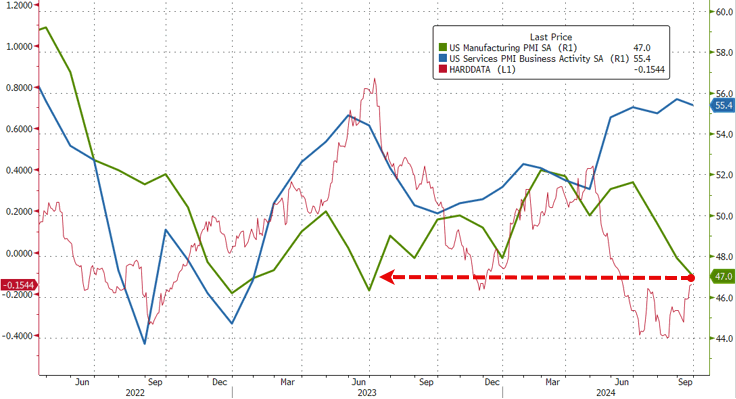
Despite strength in ‘hard’ data relative to expectations, PMIs disappointed in the early September print with both Services and Manufacturing falling.

  • S&P Global US Manufacturing PMI 47.0 (48.6 exp, 47.9 prior) – lowest since June 2023

  • S&P Global US Services PMI 55.4 (55.2 exp, 55.7 prior) – two-month lows

Source: Bloomberg

Commenting on the data, Chris Williamson, Chief Business Economist at S&P Global Market Intelligence said:

“The early survey indicators for September point to an economy that continues to grow at a solid pace, albeit with a weakened manufacturing sector and intensifying political uncertainty acting as substantial headwinds. A reacceleration of inflation is meanwhile also signalled, suggesting the Fed cannot totally shift its focus away from its inflation target as it seeks to sustain the economic upturn.

“The sustained robust expansion of output signaled by the PMI in September is consistent with a healthy annualized rate of GDP growth of 2.2% in the third quarter. But there are some warning lights flashing, notably in terms of the dependence on the service sector for growth, as manufacturing remained in decline, and the worrying drop in business confidence.

Under the hood, things are more worrisome:

“Business sentiment, demand, hiring and investment are being subdued by uncertainty surrounding the Presidential Election, casting a shadow over the outlook for the year ahead at many firms.

“The survey’s price gauges meanwhile serve as a warning that, despite the PMI indicating a further deterioration of the hiring trend in September, the FOMC may need to move cautiously in implementing further rate cuts. Prices charged for goods and services are both rising at the fastest rates for six months, with input costs in the services sector – a major component of which is wages and salaries – rising at the fastest rate for a year.”

Stagflation Anyone… Not exactly what a 50-bps-rate-cutting Fed wants to see!!!

Tyler Durden
Mon, 09/23/2024 – 09:54

Zelensky Uses US Trip To Attack JD Vance 

0
Zelensky Uses US Trip To Attack JD Vance 

Just ahead of his trip to the United States where he’s expected to meet with President Biden later this week, Ukraine’s President Volodymyr Zelensky gave an interview to The New Yorker wherein he mounted a risky and unexpected direct attack on Trump’s pick for Vice President, Ohio Senator JD Vance.

Zelensky told The New Yorker in response to Trump’s promises to negotiate an end to the Ukraine war that “Trump doesn’t really know how to stop the war even if he might think he knows how.”

Via Time

“With this war, oftentimes, the deeper you look at it the less you understand,” Zelensky contined.

The Ukrainian leader was then asked about Trump’s VP pick, to which the reply was “He is too radical.” Here is how that section of the interview began…

New Yorker: Vance has come out with a more precise plan to—

Zelensky: To give up our territories.

New Yorker: Your words, not mine. But, yes, that’s the gist of it.

Zelensky: His message seems to be that Ukraine must make a sacrifice. 

And Zelensky continued: “This brings us back to the question of the cost and who shoulders it. The idea that the world should end this war at Ukraine’s expense is unacceptable.”

“This would be an awful idea, if a person were actually going to carry it out, to make Ukraine shoulder the costs of stopping the war by giving up its territories,” Zelensky said. 

He asserted that this wouldn’t bring an end to the fighting regardless and that Trump and Vance’s vows to end the war is “just sloganeering”.

Zelensky then suggested that it is “dangerous” for men which such talking points to rise to power and that they could spark global war through irresponsible policies. He was then quoted in The New Yorker as follows:

[Vance and others who share his views] should clearly understand that the moment they start trading on our territory is the moment they start pawning America’s interests elsewhere: the Middle East, for example, as well as Taiwan and the U.S. relations with China. Whichever President or Vice-President raises this prospect—that ending the war hinges on cementing the status quo, with Ukraine simply giving up its land—should be held responsible for potentially starting a global war. Because such a person would be implying that this kind of behavior is acceptable.

I don’t take Vance’s words seriously, because, if this were a plan, then America is headed for global conflict. It will involve Israel, Lebanon, Iran, Taiwan, China, as well as many African countries. 

He then in a patronizing way told “Mr. Vance” to “read up on the history of the Second World War” while suggesting that his plan with Russia is tantamount to ‘appeasing’ Hitler.

We expect that the Trump team isn’t going to take too kindly to Zelensky’s attack on both Trump and Vance.

The rhetoric from the interview specifically in regards to Vance was much more direct than usual.

Typically Zelensky has appeared more cautious with his criticisms, not wishing to offend a potential future Republican administration; however, that caution seems to have gone out the window.

Tyler Durden
Mon, 09/23/2024 – 09:30

The Future Of Finance? Fintech Startup Launches AI ETF That Emulates Buffet, Druckenmiller, And Tepper

0
The Future Of Finance? Fintech Startup Launches AI ETF That Emulates Buffet, Druckenmiller, And Tepper

You knew it was coming… 

A new chatbot-powered exchange-traded fund (ETF) aimed at replicating the investment prowess of Wall Street titans has been launched by Minneapolis-based Intelligent Alpha. The Intelligent Livermore ETF (LIVR) is built around portfolio decisions generated by three prominent large language models (LLMs); ChatGPT, Gemini, and Claude – dubbed the fund’s “investment committee.”

According to the fund, the ETF will emulate the thinking of legendary investors like Warren Buffett, Stanley Druckenmiller, and David Tepper, among others – yet, the portfolio won’t necessarily reflect their real-life holdings. Instead, it will draw inspiration from the strategies and investment philosophies associated with said investors, spanning sectors like healthcare, renewables, and emerging markets, Bloomberg reports.

A Wall Street First: AI as the Investment Brain

According to the report, Clinton’s firm will feed specific instructions to the chatbots, directing them to create portfolios based on the personas of these financial icons.

The firm, with roots in engineering and emerging technologies, will instruct the large language models (LLMs) to emulate the investors’ personalities. The trio of chatbots will spit out 60 to 90 global firms that span a number of sectors, themes and geographies, including health care, renewables and Latin America, to name just a few.

The list of personas targeted by the ETF — besides Buffett, Druckenmiller and Tepper — will include Dan Loeb, Paul Singer and others, though the fund’s holdings may not necessarily reflect the real-life bets by those investors. -Bloomberg

“If you think about the hedge-fund world today, that has pods that each focus on specific areas of expertise,” explained Doug Clinton, CEO and founder of Intelligent Alpha. “In a sense, we’re recreating the very basics of that structure where we have these different inspirations for investors we really respect.“

Uncharted Territory

While the concept of an AI-managed ETF is bold, it’s not entirely new. Several hedge funds and ETFs have begun experimenting with AI to streamline investment processes. AI has been praised for its ability to process massive datasets quickly, eliminating the need for human analysts to perform tedious tasks. However, its ability to consistently outperform traditional strategies remains unproven.

Of the 16 AI-focused ETFs tracked by Bloomberg Intelligence in the U.S., only one, the Franklin Intelligent Machines ETF (IQM), is currently outperforming the S&P 500 in 2024, with a 19% return compared to the stock index’s 18%. Meanwhile, only two AI-centered ETFs have seen significant inflows: the Global X Artificial Intelligence & Technology ETF (AIQ), which brought in over $1 billion this year, and the Roundhill Generative AI & Technology ETF (CHAT), which attracted $117 million. The rest have either seen minimal inflows or experienced outflows.

What sets Intelligent Alpha’s ETF apart is its use of LLMs rather than traditional machine learning models. According to Clinton, most AI ETFs rely on older techniques, which limits their strategies to crowded quantitative insights. By leveraging LLMs, Intelligent Alpha aims to break through these limitations and create portfolios with a different kind of edge.

From Experiment to Product

The idea for the Intelligent Livermore ETF took root last year when Clinton began experimenting with ChatGPT to generate investment portfolios. After seeing success in creating strategies that outperformed the S&P 500, he expanded his testing to 40 different investment strategies. These trials ultimately led to the founding of Intelligent Alpha, which is affiliated with Deepwater Asset Management, a Minneapolis-based firm managing approximately $400 million in venture capital and public equity funds.

Though the Intelligent Livermore ETF is Intelligent Alpha’s debut product, the company has plans to launch a suite of AI-driven offerings, including custom portfolios and hedge funds aimed at both retail and institutional investors. Clinton and his team have already filed for additional ETFs and hope to lead the charge in the AI-powered investment space.

The new ETF pays tribute to Jesse Livermore, one of the most famous stock traders of the early 20th century. LIVR has a management fee of 0.69%.

In order to prevent ‘hallucination’ – in which a LLM either fabricates information or misinterprets input, a human the fund does have final human oversight.

“Just to make sure there’s not some sort of a hallucination in the portfolio, like a company that committed fraud or some egregious issue,” said Clinton. “And also that the portfolio will meet any regulatory or compliance constraints that we might know about that the AIs may not be thinking about when they create the portfolio.”

Tyler Durden
Mon, 09/23/2024 – 06:55

Argentina Sends More Gold To London

0
Argentina Sends More Gold To London

Authored by Jan Nieuwenhuijs via MoneyMetals.com

In July, the Central Bank of Argentina (BCRA) shipped another 3 tonnes of gold to the U.K. to swap for foreign exchange. A month prior, BCRA also transported 3 tonnes to the U.K. BCRA is now estimated to have 37 tonnes (60% of Argentina’s gold reserves) on swap in the London Bullion Market.

Argentina Is Leveraging Its Physical Gold

Argentine newspaper Clarín reported in 2017 that BCRA moved 11 tonnes of its monetary gold to London, according to their research, to be swapped out for Japanese yen. “We are already doing this with all the gold we have in London, because by placing it in that financial center, we can expand its use,” the central bank told to Clarín at the time.

El País reported in July of 2024 that BCRA was again transporting gold abroad. After rumors were making rounds about how much gold was shipped out and to where, President Milei hinted that the gold was used overseas as collateral for a loan (this is how a swap typically works). Argentina appears to be in need of foreign currency to pay interest or to pay off debt.

Argentina Sends More Gold to London

A few weeks back, I was able to confirm BCRA had sent $150 million worth of gold (3 tonnes) to the U.K. in June, based on cross-border trade statistics. Because officials had confessed that part of the Argentinian monetary gold was sent abroad, and for the first time ever the U.K.—home of the largest gold market globally—recorded to have imported 3 tonnes from Argentina that month, I was confident this batch could be assigned to BCRA.

Monetary gold can cross borders outside the scope of customs statistics, which apparently happened in 2017. However, if a central bank lets a bullion bank take care of the shipping, the bullion bank has to deal with customs, and the gold will show up in trade data (as was the case with the secret purchases by Saudi Arabia’s central bank in recent years).

In the same spirit, new trade data from the UK shows another import of 3 tonnes from Argentina for July. It looks like BCRA is sending more and more gold to London in a desperate need for foreign exchange.

Most of Argentina’s Gold Is Now Held in London

Bloomberg recently wrote that, according to its sources: “before the move, about half of Argentina’s gold was in domestic vaults with the other half in London.” Bloomberg speculated there was only one shipment of gold to Europe, which would be the one in June.

So, before June, half of BCRA’s total gold reserves (62 tonnes) were in London. Adding 6 tonnes transferred in June and July means there are now 37 tonnes abroad, which equals 60% of Argentina’s monetary metal.

If Milei succeeds in getting Argentina’s finances in order, international debt can be repaid and foreign exchange obtained through trade can be used to unwind the swaps. If not, BCRA could default on its swap obligations and thereby surrender ownership of 36 tonnes of precious metal.

Tyler Durden
Mon, 09/23/2024 – 06:30

Why App-Based Jobs Don’t Pay Like They Used To

0
Why App-Based Jobs Don’t Pay Like They Used To

Authored by Austin Alonzo via The Epoch Times (emphasis ours),

More Americans than ever are turning to the so-called gig economy—providing services ranging from taxi services to grocery deliveries, often through digital platforms—either on the side or as a career.

The marketplace, however, is no longer the “subsidized fantasy land” it once was, one former gig worker says. An analyst described pursuing gig work as a career as “the biggest mistake of your life.”

Members of the Independent Drivers Guild drive across the Brooklyn Bridge in protest against Uber and other app-based ride-hailing companies, in New York City on May 8, 2019. Drew Angerer/Getty Images

Several app-based drivers say the pay now is barely worth the effort. Others say there are issues such as lack of transparency around net pay.

Sergio Avedian, 57, a part-time driver in the Los Angeles area, told The Epoch Times workers are told they are making a certain hourly wage, but the amount is often misleading.

In reality, workers are paid only for time spent with a passenger or package in the car. So if gig workers spend an average of 15 minutes fulfilling a task and the rest of the hour either looking for or driving to a job, they are paid only for a quarter of the time they actually work.

Eddie Doyle, 36, a writer and content creator in the Philadelphia area who is mostly retired from driving for Uber and Lyft, said that on balance, most workers whose gig involves driving are probably actually losing money due to fuel expenses and the deterioration of their vehicles.

Doyle, who began driving in 2015, said pay used to be better. These days, Doyle said Uber or Lyft drivers in a major American city likely need to work 60 to 80 hours a week—splitting driving time among multiple apps—to earn a decent wage.

“I think the vast majority of [gig workers] are struggling,” Pedro Santiago, 42, a driver based near St. Louis who splits his working time among five app-based gig jobs, told The Epoch Times.

Sizing Up the Gig Economy

The world of employment was revolutionized with the launch of Uber Technologies Inc. in 2010. The smartphone application offered a new competitor to the taxicab industry by linking a paying passenger with a private driver using his or her own car.

Uber’s meteoric rise bred dozens of other applications, bringing the gig work concept to other business areas. Today’s smartphone-powered gig economy includes everything from odd jobs around the house to legal work.

The largest services are still focused on transportation. Uber and Lyft Inc. dominate the on-demand ride business, while DoorDash Inc. and Maplebear Inc., better known as Instacart, lead the way on delivery services for food and other goods. Uber has branched out into food and grocery delivery too. DoorDash, Instacart, Lyft, and Uber are now publicly traded.

A traveler walks toward the Uber rideshare vehicle pickup area at the Los Angeles International Airport on Feb. 8, 2023. Mario Tama/Getty Images

Massive retailers like Walmart and Amazon joined in with their own on-demand platforms: Spark Driver and Amazon Flex.

Gig workers are recruited with the promise of flexible hours to earn additional income. However, as independent contractors, gig workers are not entitled to traditional employment benefits like health insurance, and they must take on additional occupational risks, equipment costs, and tax burdens.

The U.S. Department of Labor doesn’t measure the number of people working gig jobs. But its Bureau of Labor Statistics does keep track of the number of people working multiple jobs.

According to the BLS’s September Employment Situation Summary, about 8.3 million Americans worked multiple jobs in August 2024. That was an increase from about 7.8 million in August 2023. In both years, most workers with two jobs had a full-time job and a part-time job.

In a 2024 economic impact report, Flex, a federal lobbying association supported by DoorDash, Grubhub, HopSkipDrive, Instacart, Lyft, Shipt, and Uber, estimated there were about 7.3 million “active drivers and delivery partners on major rideshare and delivery platforms” in 2022.

Representatives of Flex did not respond to a request for comment from The Epoch Times.

Other estimates said the number of gig workers is much higher.

A 2022 report published by the consultancy McKinsey & Co. surveyed workers and estimated as many as 58 million Americans, or 36 percent of the U.S. workforce, did some gig work that year.

According to the McKinsey survey, gig workers are most likely Latinos between 18 and 24 with less than a high school education, making less than $25,000 per year.

Santiago said the sheer number of people doing gig work demonstrates the struggles of most Americans.

“Most people come to [gig work] because they either lost a job, or the inflation of their rent and groceries has just gotten too out of hand where they’ve got to make an extra $200 a week,” Santiago said.

Struggling to Make a Living

Some gig workers say they are being left behind. They complain of low pay, unreliable job offerings, and a lack of benefits.

In an email, Rafael Espinal, executive director and president of the Freelancers Union, said many freelancers and gig workers in the United States say their lack of job stability and benefits “prevents them from reaching key life milestones.”

An Uber and Lyft driver carries a sign as he joins other app-based drivers and delivery workers in a protest at the former headquarters of Uber Technologies in New York City on March 29, 2022. The protesters demand fair pay in response to rising gas prices. Michael M. Santiago/Getty Images

“Inconsistent income and the high cost of health care and housing make it difficult for them to save for retirement, buy a home, or start a family,” Espinal said. “This economic uncertainty affects not only their day-to-day lives but their long-term goals as well.”

Espinal said the Freelancers Union represents more than 700,000 members across the country. It provides access to insurance, legal services, and financial planning for its members. He said many of its members work multiple part-time jobs “to make ends meet.”

Avedian, a Wall Street veteran and a senior contributor to the industry analysis and advice website The Rideshare Guy, said gig work is designed as a so-called side hustle and cannot replace a full-time job for most people.

“If you’ve chosen gig work as a career, you have made the biggest mistake of your life,” Avedian told The Epoch Times.

Both Doyle and Avedian said they believe the active-hour pay structure is misleading to gig workers. Doyle said gig work companies succeed by taking advantage of workers’ ignorance of the risks and costs inherent in gig work.

Espinal said gig workers tell him they are frustrated with their lack of bargaining power as independent contractors even though gig economy companies hold “significant control over their working conditions.”

In its Securities and Exchange Commission filings, Uber describes the classification of its drivers as “employees, workers, or quasi-employees” as an “operational risk” to its business. The same document details the various legal and political challenges involved in maintaining independent contractor status.

Uber’s latest quarterly filing, published in August, said that if drivers win the reclassification through legal means or the passage of new laws, the company would incur significant expenses for compensating drivers and would pass its elevated costs onto riders. Uber also argues reclassification would limit its ability to find workers due to a loss of flexibility.

The second-quarter reports filed by DoorDash, Instacart, and Lyft make nearly identical statements about classification and describe similar legal and political challenges to gig workers’ contractor status.

Profitability and the Future

The gig economy shows no signs of slowing down. Americans are used to the on-demand goods and services provided by gig workers, and corporations are eager to cut labor costs by expanding their use of independent contractors.

The latest earnings statements show Uber, Lyft, and Instacart all turned a profit in the second quarter of 2024.

According to their SEC filings, Uber collected $361 million in profits during the first six months of 2024, while DoorDash reported $191 million in profits. During the same period, Lyft lost about $26.5 million, while DoorDash lost $180 million.

Read the rest here…

Tyler Durden
Mon, 09/23/2024 – 05:00

Global Coal Consumption Is Still Soaring…

0
Global Coal Consumption Is Still Soaring…

Despite efforts to decarbonize the economy, global coal consumption surpassed 164 exajoules for the first time in 2023. The fossil fuel still accounts for 26% of the world’s total energy consumption.

In this graphic, Visual Capitalist’s Bruno Venditti shows global coal consumption by region from 1965 to 2023, based on data from the Energy Institute.

China Leads in Coal Consumption

China is by far the largest consumer of coal, accounting for 56% of the global total, with 91.94 exajoules in 2023.

It is followed by India, with 21.98 exajoules, and the U.S., with 8.20 exajoules. In 2023, India exceeded the combined consumption of Europe and North America for the first time.

Regionally, North America, Europe, and even the Rest of World have seen a decline in coal consumption since the 1990s. The Asia-Pacific region, however, has made up for this demand and more, with consumption soaring since about the year 2000.

Coal Production on the Rise

In order to meet consumption demand, global coal production also reached its highest-ever level in 2023.

Over 8.7 billion tonnes of coal were mined, equal to about 179 exajoules worth, with the Asia-Pacific region accounting for nearly 80% of global output. This activity was concentrated in Australia, China, India, and Indonesia.

China alone was responsible for just over half of total global production.

If you want to learn more about fossil fuel consumption, check out this graphic showing the top 12 countries by fossil fuel consumption in 2023.

Tyler Durden
Mon, 09/23/2024 – 04:15

Has The EU Suddenly Realized How Much It Has Screwed Itself Over?

0
Has The EU Suddenly Realized How Much It Has Screwed Itself Over?

Via Kitco News,

“History doesn’t repeat itself, but it often rhymes,” is a popular quote attributed to Mark Twain, and is an important concept to think about with the current state of the world amid ramping geopolitical tensions and deteriorating economic conditions.

Roughly 100 years ago, ‘rhyming’ circumstances were setting the stage for the Great Depression and a Second World War, and if we aren’t careful, there is the potential for the global economy to sink into a deep recession/depression while chatter about the potential for World War 3 is also on the rise.

With major conflicts now including Ukraine v. Russia, the growing threat of Russia v. NATO, Israel v. Palestine, Israel and the U.S. v. Iran, and China threatening Taiwan, among others, while we cannot say that WWIII is underway, it’s not a stretch to say that we are a world at war.

Naturally, the circumstances the world finds itself in are causing consternation for investors, who desperately want to maintain their wealth despite the mounting headwinds they face in doing so, leading many to question if gold, and to a lesser extent, Bitcoin (BTC), could potentially offer protection.

Kitco Crypto reached out to experts on geopolitical and financial matters to get their take on the likelihood of World War III happening in the foreseeable future and what it would mean for gold and Bitcoin.

“There are two forces at work here,” said Martin Armstrong, an economic forecaster and founder of Armstrong Economics.

“First, we have the Neocons who have waged endless wars since the 1960s.”

“Even Robert MacNamara wrote a book and on YouTube you will see his interview before he died explaining they thought Russia was behind Vietnam, but they were wrong; it was just a civil war,” he noted. “You can examine every war and you will find it was based on lies. Tony Blair’s video on YouTube is his Apology for the Iraq War. Again, they were wrong.”

“The Neocons have been relentless in their thirst for endless wars,” Armstrong said. “You have Blinken threatening China over Taiwan when they held 10% of the US debt. That are now net sellers. They only see war – not the economics or the country.”

“Second, virtually every country in Europe is now chanting war with Russia thanks to NATO, also a Neocon organization,” he highlighted. “The monetary system of the West is based on endless deficits spending. The default comes regardless of the debt level. The default in these Ponzi scheme unfolds when they cannot find a buyer for the new debt that enables them to pay off the old.”

“This is what we now face for the first time because Biden/Harris Administration has allowed the Neocons to run foreign policy,” Armstrong said. “Governments now NEED to create WWIII for like WWII, all of Europe defaulted on their debt, Britain went into a moratorium, but defaulted on the loans from the USA.”

He suggested that this is the real reason behind the surge in governments exploring the creation of central bank digital currencies (CBDCs).

“This is the real issue behind pushing for CBDCs to eliminate physical money and then everything is traceable,” Armstrong said. “I have spoken with government on both sides of the Atlantic. They assume moving to digital, they will increase tax collection by 35% and terminate the underground economy.”

“Europe routinely cancels its paper currency to prevent people from hoarding cash,” he noted. “America has never done that, which is why the dollar has been the reserve currency someone in China can hold dollars but not euros. Also, the US is a consumer-based economy, so this is why the dollar has been the reserve currency, for Europe needs to see to Americans, as do Asians.”

As for what the potential for WW3 means for investors, Armstrong said it underscores the need to invest in tangible assets.

“Because they will default on debts in the West and this is universal, the only safe place for capital long-term has been tangible assets,” he said. “Some have called it the Everything Bubble, for they do not understand that this is a divestiture from public assets to private.”

“This has been precious metals, real estate, and shares with tangible assets,” he highlighted. “Precious metals in the form of coins will most likely become the currency of the underground economy. Even if you look at the German Hyperinflation, the replacement currency in 1925 was backed by real estate. Tangible assets survive the collapse of currencies.”

As for the effect a major global conflict would have on financial markets, Armstrong said that governments are prepared for this and will take full advantage of it to ‘solve’ their growing list of economic problems.

“Governments are not stupid. They will seek to impose capital control to prevent capital fleeing,” he said. “This will most likely dominate Europe. Just look at the actions they take during war.”

“Abraham Lincoln closed the gold market before it reached $200 in greenbacks in 1864 and claimed people were making money off the blood of others,” he noted. “During World War I, all of Europe closed the share markets, fearing people would sell and take their money to America. The US share market crash by 10% on anticipation that it too would close, which it did the week of July 27th, and did not reopen until December 7th.  This was again for capital controls fearing Europeans would sell US shares and take the money home, which did not happen.”

“The lesson we must learn historically from wars is that governments will impose capital controls, and this may be when they attempt to switch canceling paper dollars and forcing everyone into CBDCs,” Armstrong warned.

If this were to occur, “Physical gold and silver will be the only form of money to survive under these conditions,” Armstrong said.

As for ‘digital gold’ and the growing cryptocurrency ecosystem, he warned that they “are entirely dependent on the PowerGrid.”

“As you see already in Europe, targeting people for comments is unfolding just as it has been shown that the Biden Administration conspired with social media to censor and create the cancel culture to shut down free speech,” he noted. “Anything that will transact through the internet will be vulnerable to the government assuming the PowerGrid is even functioning during war.”

For these reasons, Armstrong suggested it would be “best that precious metals are in the form of recognizable coins that the uneducated will accept, such as a $20 gold piece or silver coins dated pre-1965.”

When asked if alternative currencies could benefit from a world where certain countries shun the currencies of adversaries, Armstrong stressed that “All currencies are fiat.”

“The real scheme with these CBDCs is that the IMF is planning to replace the dollar and have already quietly created their own digital currency, and because of the sanctions the US imposed on Russia removing them from SWIFT, this is what gave the drive to establish BRICS.”

“It was geopolitical, not fiat-based,” he added. “The US threatened China with the same sanctions if they helped Russia. Countries realized that the American Neocons have used the dollar as a weapon, and that is what divided the world economy.”

As for going back to a gold standard, Armstong noted that the main problem with doing so is that people have become so accustomed to valuing things in fixed fiat terms that they don’t know another way to approach determining the true value of things.

“A gold standard has always failed when it has been fixed to a specific value,” he said. “Bretton Woods collapsed because you fixed gold at $35 per ounce, but you did not limit the amount of dollars created. A three-year-old could figure out such a system would collapse.”

“The only gold standard that has ever survived is when its value freely floated,” Armstrong stressed. “The Byzantine Empire was based purely on gold that floated in value, it too collapsed due to wars and spending that was unrestrained.”

“As Margaret Thatcher once said, socialism works until you run out of other people’s money,” he noted. “The same can be said of government relentless spending to retain power.”

Asked whether the powers that be could use an escalation in war to overshadow a potential economic collapse, Armstrong said, “Wars have been the driving force behind all monetary crises.”

“The value of a currency is always based on confidence,” he explained. “When the Roman Emperor Valerian I was captured in battle in 260 AD by the Persians, despite the fact that coinage was of precious metals, they still carried a premium over the precious metal because, like the dollar today, Rome was the consumer economy that everyone wanted to sell to. India routinely struct imitation Roman gold coins illustrating that there was a premium to the gold when struck by Rome.”

“The Roman Emperor Diocletian attempted to reintroduce silver that had vanished from circulation following the capture of Valerian I 26 years later in 286 AD,” he added. “He raised of the weight of gold coins from a norm of about 70–72 to the Roman pound to one of 60 to the Roman pound. The silver coinage was reintroduced at a rate of 96 to the Roman pound. And he introduced of the so-called follis—a copper coin of about 10 gm.”

“Just as Diocletian revised the monetary system and imposed wage and price controls to tackle inflation, we will see the same unfold,” Armstrong warned. “We will most likely see the US and Europe break apart into separate governments.”|

“Most people are unaware that during the Great Depression, over 200 cities issued their own money and collectors refer to these as Depression Scrip,” he highlighted.

“Currencies will also be fiat to some degree, for even when they were gold, they carried a premium based on their economic status,” Armstrong said. “We blame the currencies rather than governments. This is like a murderer claiming it was the gun that killed the people, not that he pulled the trigger. This is going to result in the fall of Republican forms of government.”

“Hopefully, this next version will be a real democracy where We the People decide do we go to war – yes or no,” he concluded. “The last cycle was the end of Monarchy. This one will be the end of republics, which tend to be the most corrupt in history. There was a major debt crisis in Rome and that is why when Caesar crossed the Rubicon, he did not have to fight his way to Rome, the senate fled, and the people cheered. This will unfold again by 2032 as it is becoming wider understood that governments are corrupt and in trouble worldwide.”

USD is too big to fail

Despite the rising number of smaller regional conflicts, Adam Koprucki, founder of RealWorldInvestor.com, doesn’t see a larger global conflict forming.

“It’s unlikely regional conflicts are going to morph into something larger,” he said. “The current administration has done a good job of stepping in where needed, but also drawing hard boundaries so they don’t risk driving up global tensions.”

That said, he noted that global tensions “always have an impact, the key is to monitor to see if the tensions will get worse, that’s when investors should worry. A major global conflict would likely disrupt supply chains and cause immediate and severe shocks in the financial market.”

As for a potential exodus from the U.S. dollar in favor of gold or Bitcoin, Koprucki said that “Unless there is concern about the stability of the U.S. dollar or severe inflation,” he doesn’t think “investors would immediately flock to gold, but more likely so than Bitcoin – which is still extremely volatile.”

When asked if alternative currencies could benefit from a world where certain countries shun the fiat currencies of adversaries, Koprucki said, “Sure, but those countries who would embrace alternative currencies likely already have an unstable fiat currency, so their adaption may not cause further adaption.”

“I think fiat currencies are generally here to stay,” Koprucki concluded. “A transition to another currency would be unheard of. As long as the U.S. government is backing the dollar, it will remain the preeminent currency. The world is too interconnected and dependent on the US Dollar now.”

Bitcoin in a WWIII scenario

“As global tensions rise, the possibility of regional conflicts escalating into a World War III scenario remains uncertain, but the financial implications are clear,” said Dr. Tonya M. Evans, Esq., an expert in crypto policy and law and full professor of law at Dickinson Law. “Historically, wars weaken fiat currencies, prompting investors to seek safe-haven assets like gold. However, Bitcoin and cryptocurrencies are emerging as new alternatives.”

“Bitcoin’s decentralized nature makes it a valuable hedge against inflation and currency devaluation, especially in regions where traditional banking systems may collapse,” she said. “Unlike fiat currencies, Bitcoin’s supply is capped, which protects it from inflationary pressures exacerbated by conflict.”

Evans suggested, “In a global conflict scenario, Bitcoin (in particular) could serve as both a trusted store of value and an alternative and censorship-resistant means of transferring wealth across borders, particularly for those seeking to avoid sanctions or economic fallout.”

“While gold remains a trusted safe haven, Bitcoin’s portability and accessibility offer a distinct advantage in times of crisis,” she concluded. “In my opinion, Bitcoin and cryptocurrencies provide a unique opportunity for financial resilience, potentially becoming even more crucial as the world navigates increasing geopolitical instability.”

Gold to be the go-to safe haven

To help predict what would happen if a global war were to escalate, Jim Cagnina, market analyst at NinjaTrader, used several recent examples to support his outlook.

“Russia invaded Ukraine on February 24, 2022, and since then, the S&P 500 is up approximately 27.5%. Hamas attacked Israel on October 7, 2023, and since then the S&P 500 is up approximately 29.7%,” he noted. “US-based risk assets anchored around regulated exchanges, on the longer term, are sensitive to domestic fundamental factors such as interest rates and inflation. If anything, geopolitical tensions outside the US tend to prop up US-based assets.”

“On-shoring or near-shoring capabilities of the US are more formidable than in the past,” he added. “A good example is the construction of the new 1,100-acre development of TSMC’s advanced semiconductor manufacturing fabrication facility in Phoenix, Arizona. As things get tense overseas, the US can and will pivot.”

Cagnina said another potential result would be a shakeup in the oil market.

“Regarding Crude Oil, OPEC+ seems to be losing its primacy with respect to setting global oil prices,” he noted. “With a potential increase in production being contemplated by OPEC+, the attitude seems to be ‘if you can’t beat them, join them.’”

As for Bitcoin, Cagnina said, in his opinion, it is “too esoteric and volatile to be considered a flight to quality investment.”

“In my experience, most investors struggle to explain what Bitcoin is and its practical purpose clearly,” he said. “Bitcoin futures average true range based on a 14-day look back is over $3,000 or more than 5% on any given day. I would think that flight to quality assets would not typically subject investors to 5% daily fluctuations, which would defeat the purpose. Furthermore, the supply of Bitcoin is highly inelastic, more so than gold.”

“Gold, on the other hand, can act as a flight to safety instrument,” Cagnina added. “Major industrial countries that can afford it have been adding to their gold reserves, most notably the US, Russia, China, Japan, Singapore, and Brazil. I would argue that this is one of the main reasons for gold’s recent appreciation. This accumulation of reserves will reduce supply for the rest of us resulting in additional appreciation as investors completely buy in.”

As for the U.S. dollar, he said he believes that “the US will maintain its world reserve currency status.”

“The dominance of US foreign aid contributions and that of the European Union helps lock emerging economies’ dependency on the US dollar and EURO concerning transactions for goods and services,” he noted. “Central clearing, strong GDP, and strong contract law will be barriers for alternative currencies becoming dominant.”

“In my opinion, if there is another major global war, it will look and be fought completely differently than in the past,” Cagnina concluded. “The currencies that will do well, I think, will be between alliances that can maintain good contract law during the conflict. Deep pockets certainly will help. Having said that, let’s pray that a World War II level conflict never happens.”


Tyler Durden
Mon, 09/23/2024 – 03:30