73.2 F
Chicago
Sunday, October 4, 2026
Home Blog Page 2267

When Could Billionaires Become Trillionaires?

0
When Could Billionaires Become Trillionaires?

Elon Musk could become the world’s first trillionaire by 2027, according to a recent report by Informa Connect Academy.

This graphic, via Visual Capitalist’s Bruno Venditti, shows the projected path for Tesla’s CEO and other billionaires to surpass the trillion-dollar mark.

Methodology

Informa analyzed the net worth data of the 30 wealthiest individuals from 2017 to 2024, as reported by Forbes. It calculated their average annual growth rates and forecasted their wealth over the next 30 years to predict the timing of potential trillionaires.

Musk Faces Competition

With a net worth of $242 billion and an average annual growth rate exceeding 100%, Elon Musk is on track to become the first trillionaire by 2027.

The recent boom of computer chip maker Nvidia could propel its CEO and co-founder, Jensen Huang, to trillionaire status by 2028, according to Informa. Huang’s current net worth is already about $100 billion (higher than listed in the table and graphic, which uses July data), according to Bloomberg’s real-time algorithm.

Indian billionaire Gautam Adani is also projected to become a trillionaire by 2028. He is the chairman of the Adani Group, which has interests in ports, airports, power generation and transmission, and green energy, among others.

Prajogo Pangestu, son of a rubber trader, is set to potentially become a trillionaire by 2028 as well. Pangestu started in the timber business in the late 1970s and now runs Indonesia’s largest integrated petrochemical producer.

The list of future trillionaires also includes familiar names like Meta CEO Mark Zuckerberg, former Microsoft CEO Steve Ballmer, and Nike founder Phil Knight.

French businessman Bernard Arnault is the only European on the list. The billionaire chairman and CEO of the global luxury goods company LVMH oversees dozens of luxury brands, such as Louis Vuitton, Sephora, and Tiffany & Co. He also invests in companies like Netflix and ByteDance, the parent company of TikTok.

To learn more about this topic, check out this graphic that shows the top 12 countries by their rate of millionaire population growth.

Tyler Durden
Sun, 09/22/2024 – 22:45

Owning A Car Is Less Important To Younger Generations

0
Owning A Car Is Less Important To Younger Generations

54 percent of Gen Z participants polled for Statista’s Consumer Insights survey in the U.S. between July 2023 and June 2024 claim that owning a car is important to them, compared to 69 percent of baby boomers.

This suggests that the perceived necessity of car ownership is not only influenced by the availability and quality of public transit but also by generation.

Infographic: Owning a Car Is Less Important To Younger Generations | Statista

You will find more infographics at Statista

The survey also shows that the importance of having a car decreased from generation to generation. Two thirds of all respondents in the Gen X bracket, categorized as individuals born between 1965 and 1979, said it was important for them to own a car, while the share for the same group stood at 62 percent for millennials. Overall, 62 percent of the more than 10,000 surveyed U.S. residents thought car ownership was important to them.

One way to decrease reliance on individual car ownership is improving long-distance and regional transit networks, an area in which the federal government has increasingly invested in over the past years. A variety of planned railway expansion initiatives have at least in part been funded with federal money, with some of the upcoming projects detailed by Newsweek in June 2024. These include the Brightline West High-Speed Intercity Passenger Rail System, a joint project by private railway company Brightline and the Nevada Department of Transportation connecting Greater Los Angeles with Las Vegas, and the Hudson Tunnel Project, which aims to improve connectivity between New Jersey and New York.

Following through on larger-scale public transport projects can be difficult in a country focused on motorized personal transportation, even in states with metro areas afflicted by daily traffic jams like Los Angeles. A mega project connecting all major cities in California which, according to media reports, will cost upwards of $150 billion has been in the planning stages since 2008 but has been mired by a variety of problems and delays.

Tyler Durden
Sun, 09/22/2024 – 21:35

India Reports Record Gold Imports In August

0
India Reports Record Gold Imports In August

By Mike Maharrey of MoneyMatals.com

India reported record gold imports in August after the country slashed its import duty the month before. India ranks as the world’s second-largest gold consumer behind China.

In July, the Indian government cut taxes on gold and silver imports by more than half, lowering duties from 15 percent to 6 percent. The domestic gold price fell 6 percent month-on-month after the lower duty went into effect, even as the dollar price of gold increased. As expected, the government’s move spurred a big jump in gold demand.

India reported record gold imports in dollar terms, totaling $10 billion in August. It was over a three-fold increase over the previous month. The World Gold Council estimates the country imported 140 tons of gold, tripling July’s total.

So far, in 2024, Indian gold imports are up 30 percent.

After falling sharply after the import duty cut, the gold price in rupees stabilized and largely moved in tandem with the international price. Gold was up 3.9 percent in rupee terms in August.

Despite the August price gains, the domestic gold price remains about 2 percent lower than it was before the reduction in the import duty.

According to the World Gold Council, domestic demand for gold coins, bars, and jewelry surged after the duty cut and has since stabilized. Market reports indicate that buying momentum remains “healthy,” with an overall uptick before the import duty reduction. 

“Purchases previously deferred are now materializing, and there is increased interest in heavier pieces of jewelry. Industry participants anticipate that this momentum will continue, though they are closely monitoring the crucial festive and wedding season sales that run through late August to December.”

Anecdotal evidence suggests that festival buying kicked off on a strong note.

The World Gold Council also reported that rural gold buying has shown improvement in recent months. A favorable monsoon season is expected to increase crop production, and additional income for farmers will likely boost gold demand in the fall months.

Evidencing strong investor interest in gold, Indian ETFs continue to report inflows of metal. According to World Gold Council estimates, India-based funds experienced the highest monthly inflows of gold on record in August.

So far, in 2024, Indian gold ETFs have added about 9.5 tons of gold.

According to the WGC, total assets under management by Indian gold ETFs have increased to INR374 billion (US$4.4 billion), an 8 percent month-on-month rise and a 54 percent year-on-year increase.

The Reserve Bank of India (RBI) continues to add gold to its reserves. Based on the latest figures, the Indian central bank has increased its gold holdings by 50 tons this year.

The RBI has been buying gold since 2017. Over that period, it has increased its gold holding by over 260 tons. 

The Indian central bank now holds a record 853.6 tons of gold. The yellow metal makes up 9 percent of its foreign reserves, up from 7.5 percent a year ago.

An Indian economist told the Times of India that the push to accumulate gold was based on both political and economic factors. He said that the “reliability” of the U.S. dollar has “diminished.” He noted the “noticeable decline” in the confidence in U.S. dollar assets. 

Another economist told the Times, “It makes a lot of sense (to invest in gold), given the increased volatility in the FX market, elevated interest rates in the U.S., and, of course, also as the central banks in each economy would like to diversify the asset classes in which they are parking their reserves.”

Last spring, the RBI transported 100 tons of its gold from the UK back into India. 

Indians have historically had an affinity for gold. Indian households own an estimated 25,000 tons of gold, and that likely understates the amount given the large black market in the country. Gold is deeply interwoven into the country’s marriage ceremonies and cultural rituals. Indians have long valued the yellow metal as a store of wealth, especially in poorer rural regions. Around two-thirds of India’s gold demand comes from beyond the urban centers, where large numbers of people operate outside the tax system.

Gold isn’t considered a luxury in India. Even poor Indians buy gold. According to a 2018 ICE 360 survey, one in every two households in India had purchased gold within the last five years. Overall, 87 percent of Indian households own some gold. Even households at the lowest income levels in India hold some of the yellow metal. According to the survey, more than 75 percent of families in the bottom 10 percent of income managed to buy some gold.

The yellow metal was a lifeline for Indians buffeted by the economic storm caused by the government’s response to COVID-19. After the Indian government locked down the country, banks tightened credit to mitigate the default risk. Unable to secure traditional loans, Indians used gold to secure financing. As Indians endured a second wave of lockdowns, many Indians resorted to selling gold outright to make ends meet.

Tyler Durden
Sun, 09/22/2024 – 21:00

Charting 150 Years Of Corn, Wheat, & Soy Yields In America

0
Charting 150 Years Of Corn, Wheat, & Soy Yields In America

America can grow three-times as much corn from a single acre of land as it can wheat and soy. This is the story of how corn became king in America.

To understand how this happened, Visual Capitalst’s Pallavi Rao visualizes the yields (measured in bushels per acre) for all three crops over the last century.

Data for this graphic is sourced from the National Agricultural Statistics Service, maintained by the U.S. Department of Agriculture.

The Corny American Love Story

In 2023, America produced 500 million metric tons of corn, a figure so astoundingly large, it compares to the weight of 7,000 Great Pyramids of Gaza. And all of that corn was grown on 92 million acres of land—an area bigger than Malaysia.

But America’s colossal corn-producing prowess didn’t always exist, as seen in the yield data from 1866.

Year Corn Yield Wheat Yield Soybean Yield
1866 24.3 11.0 N/A
1867 24.7 12.6 N/A
1868 26.2 12.9 N/A
1869 21.8 13.7 N/A
1870 29.3 12.1 N/A
1871 27.2 12.2 N/A
1872 29.4 11.8 N/A
1873 22.9 12.9 N/A
1874 22.2 13.0 N/A
1875 27.7 11.1 N/A
1876 26.7 10.9 N/A
1877 25.8 14.1 N/A
1878 26.2 13.5 N/A
1879 28.2 13.0 N/A
1880 27.3 13.2 N/A
1881 19.8 11.0 N/A
1882 26.5 15.1 N/A
1883 24.2 12.3 N/A
1884 28.3 14.8 N/A
1885 28.6 11.4 N/A
1886 24.1 14.1 N/A
1887 21.9 13.3 N/A
1888 29.1 12.1 N/A
1889 29.5 14.0 N/A
1890 22.1 12.2 N/A
1891 29.6 16.5 N/A
1892 24.7 14.2 N/A
1893 23.8 12.4 N/A
1894 20.2 13.5 N/A
1895 28.0 13.9 N/A
1896 30.0 12.8 N/A
1897 25.4 14.0 N/A
1898 26.8 15.2 N/A
1899 28.0 12.5 N/A
1900 28.1 12.2 N/A
1901 18.2 15.0 N/A
1902 28.5 14.9 N/A
1903 26.9 13.7 N/A
1904 28.2 12.9 N/A
1905 30.9 15.2 N/A
1906 31.7 16.0 N/A
1907 27.2 14.2 N/A
1908 26.9 14.3 N/A
1909 26.1 15.5 N/A
1910 27.9 13.7 N/A
1911 24.4 12.4 N/A
1912 29.1 15.1 N/A
1913 22.7 14.4 N/A
1914 25.8 16.1 N/A
1915 28.1 16.7 N/A
1916 24.1 11.9 N/A
1917 26.2 13.2 N/A
1918 23.9 14.8 N/A
1919 26.8 12.9 N/A
1920 29.9 13.5 N/A
1921 27.8 12.7 N/A
1922 26.3 13.8 N/A
1923 27.8 13.3 N/A
1924 22.1 16.0 11.0
1925 27.4 12.8 11.7
1926 25.7 14.7 11.2
1927 26.4 14.7 12.2
1928 26.3 15.4 13.6
1929 25.7 13.0 13.3
1930 20.5 14.2 13.0
1931 24.5 16.3 15.1
1932 26.5 13.1 15.1
1933 22.8 11.2 12.9
1934 18.7 12.1 14.9
1935 24.2 12.2 16.8
1936 18.6 12.8 14.3
1937 28.9 13.6 17.9
1938 27.8 13.3 20.4
1939 29.9 14.1 20.9
1940 28.9 15.3 16.2
1941 31.2 16.8 18.2
1942 35.4 19.5 19.0
1943 32.6 16.4 18.3
1944 33.0 17.7 18.8
1945 33.1 17.0 18.0
1946 37.2 17.2 20.5
1947 28.6 18.2 16.3
1948 43.0 17.9 21.3
1949 38.2 14.5 22.3
1950 38.2 16.5 21.7
1951 36.9 16.0 20.8
1952 41.8 18.4 20.7
1953 40.7 17.3 18.2
1954 39.4 18.1 20.0
1955 42.0 19.8 20.1
1956 47.4 20.2 21.8
1957 48.3 21.8 23.2
1958 52.8 27.5 24.2
1959 53.1 21.6 23.5
1960 54.7 26.1 23.5
1961 62.4 23.9 25.1
1962 64.7 25.0 24.2
1963 67.9 25.2 24.4
1964 62.9 25.8 22.8
1965 74.1 26.5 24.5
1966 73.1 26.3 25.4
1967 80.1 25.8 24.5
1968 79.5 28.4 26.7
1969 85.9 30.6 27.4
1970 72.4 31.0 26.7
1971 88.1 33.9 27.5
1972 97.0 32.7 27.8
1973 91.3 31.6 27.8
1974 71.9 27.3 23.7
1975 86.4 30.6 28.9
1976 88.0 30.3 26.1
1977 90.8 30.7 30.6
1978 101.0 31.4 29.4
1979 109.5 34.2 32.1
1980 91.0 33.5 26.5
1981 108.9 34.5 30.1
1982 113.2 35.5 31.5
1983 81.1 39.4 26.2
1984 106.7 38.8 28.1
1985 118.0 37.5 34.1
1986 119.4 34.4 33.3
1987 119.8 37.7 33.9
1988 84.6 34.1 27.0
1989 116.3 32.7 32.3
1990 118.5 39.5 34.1
1991 108.6 34.3 34.2
1992 131.5 39.3 37.6
1993 100.7 38.2 32.6
1994 138.6 37.6 41.4
1995 113.5 35.8 35.3
1996 127.1 36.3 37.6
1997 126.7 39.5 38.9
1998 134.4 43.2 38.9
1999 133.8 42.7 36.6
2000 136.9 42.0 38.1
2001 138.2 40.2 39.6
2002 129.3 35.0 38.0
2003 142.2 44.2 33.9
2004 160.3 43.2 42.2
2005 147.9 42.0 43.1
2006 149.1 38.6 42.9
2007 150.7 40.2 41.7
2008 153.3 44.8 39.7
2009 164.4 44.3 44.0
2010 152.6 46.1 43.5
2011 146.8 43.6 42.0
2012 123.1 46.2 40.0
2013 158.1 47.1 44.0
2014 171.0 43.7 47.5
2015 168.4 43.6 48.0
2016 174.6 52.7 51.9
2017 176.6 46.4 49.3
2018 176.4 47.6 50.6
2019 167.5 51.6 47.4
2020 171.4 49.7 51.0
2021 176.7 44.5 51.7
2022 173.4 46.5 49.6
2023 177.3 48.6 50.6

In fact, for the first half of the 20th century, yields remained range-bound between 20–30 bushels per acre.

Then, there were two miracles. First, the introduction of a drought-resistant variety of the crop (1940s). Then, the introduction of fertilizer, pesticides, and mechanized agriculture (1950s).

Since then, corn yields have climbed at a rate of roughly 1.9 bushel/acre, per year.

Why Are Corn Yields So Much Higher Than Soy and Wheat?

Corn has a high energy density which directly translates into more food per acre. It’s also better at turning sunlight into biomass, meaning it grows faster. Both of these qualities make it the preferred crop to sow.

Compared to soybean (mostly animal feed and export to Asia) and wheat (mostly for humans), it’s also a far more versatile grain.

All of this means it attracts significant investment for varied uses: in animal feed, biofuel production, and the creation of high-fructose corn syrup. This investment helps fund research into the continuous improvement of corn yields.

Despite lower yields compared to corn, the U.S. is still a major wheat producer. Check out Breaking Down Global Wheat Production, by Country, to see where it ranks.

Tyler Durden
Sun, 09/22/2024 – 20:25

This Is A New World Where The Most Powerful Players Are No Longer The Bankers, But Politicians, Their Deficits And Debts

0
This Is A New World Where The Most Powerful Players Are No Longer The Bankers, But Politicians, Their Deficits And Debts

By Eric Peters, CIO of One River Asset Management

“Today, unemployment is up to 4.2 percent, inflation’s down to a few tenths above 2. So, we know that it is time to recalibrate our policy to something that is more appropriate given the progress on inflation, and on employment, moving to a more sustainable level, so the balance of risks are now even,” answered Chairman Powell. He had just cut interest rates by 50bps.

“The labor market is actually in solid condition. And our intention with our policy is to keep it there. You can say that about the whole economy. The US economy is in good shape. It’s growing at a solid pace, inflation is coming down, the labor market is in strong pace, we want to keep it there. That’s what we’re doing,” explained Jerome, the financial reporters gently tossing him the usual softballs.

Naturally no one asked him how he felt about initiating an easing cycle with the stock market at all-time highs (see “Powell Vows To Cut Rates With Stocks, Home Prices, Rents And Food At All Time Highs“).

“We’re trying to achieve a situation where we restore price stability without the kind of painful increase in unemployment that has come sometimes with disinflation. That’s what we’re trying to do. And I think you can take today’s action as a sign of our strong commitment to achieve that goal,” explained Powell.

No one asked whether he took into consideration forward-looking inflation indicators like gold, which has soared to a new record. And Bitcoin is up 137% over the past year.

“And this is the beginning of that process I mentioned, the direction of which is toward a sense of neutral, and we’ll move as fast or as slow as we think is appropriate in real-time.”

No one asked him about AI, infrastructure buildout, the coming electricity shortage, the intensifying trade war with China, how the Inflation Reduction Act is impacting policy, or whether he thinks monetary policy is all that important, now that politicians of both parties seem comfortable running deficits that throughout history were only seen during times of war.

Venturing

“Intuitively most, many, many people anyway, would say we’re probably not going back to that era where there were trillions of dollars of sovereign bonds trading at negative rates, long-term bonds trading at negative rates,” said Chairman Powell, answering a question at the press conference. I was reading the transcript somewhere over the Pacific, at 41,000 feet. “And it looked like the neutral rate was, might even be negative, so and it was, people were issuing debt at negative rates,” said Powell, trying to explain something that probably defies definition.

“It seems that’s so far away now, my own sense is that we’re not going back to that,” continued the Fed Chairman. “But honestly, we’re going to find out. But it feels, feels to me, and that the neutral rate is probably significantly higher than it was back then,” he said, wrestling with his emotions, uncharacteristically touchy-feely for the Chairman. But that’s just the sort of thing that happens when highly intelligent people venture into the unknown. They feel their way. “How high is it? I don’t think we know. It’s again, we only know by how it works.”  

Since I couldn’t ask Powell a question, and since the reporters seemed uninterested in pursuing the only line of questioning that seemed interesting, I fed those quotes into ChatGPT4o and asked if the person speaking sounded like he knew what he was talking about?

“The person in this statement does not sound particularly confident or certain. Here’s why: Hesitation and Repetition: The use of phrases like “most, many many people anyway” and “so and it was, people were issuing debt” suggests uncertainty or a lack of clarity in their thought process. Indecisive Phrasing: The speaker uses terms like “might even be,” “probably,” “my own sense,” and “I don’t think we know,” all of which indicate a lack of firm conviction or precise knowledge. Contradiction: The speaker says, “we’re going to find out” and “we only know by how it works,” which implies they don’t have a clear answer and are relying on future outcomes to provide clarity.

I like really smart people who admit they don’t know things, especially when most people expect them to. Those kinds of people are in short supply. So, we’re lucky to have Powell in his seat. But the Fed completely underestimated inflation, got hopelessly behind the curve, then hiked rates in an unprecedented fashion. They thought the natural rate of interest for the world’s largest economy was probably negative, and in a few short years changed their minds and think it’s probably positive. The only bear market left is in the value of an economics PhD.

From 41,000 feet the world looks as it has for thousands of years, and certainly as it did under Greenspan, Bernanke, Yellen. Back then, people believed central bankers knew what they were doing, and they were the most powerful players in markets.

But now, we are coming to terms with a new world, where Powell and his people are feeling their way forward, in an economic environment that barely resembles recent decades. And where the most powerful players are no longer the bankers, but the politicians, their deficits, debts. This is going to be fun. 

Tyler Durden
Sun, 09/22/2024 – 19:50

Johnson Shrinks Again As Congress Reaches Shutdown Deal Without ‘Proof Of Citizenship’ SAVE Act

0
Johnson Shrinks Again As Congress Reaches Shutdown Deal Without ‘Proof Of Citizenship’ SAVE Act

House Speaker Mike Johnson (R-LA) on Sunday unveiled a 90-day band-aid to avoid yet another government shutdown which fails to include the SAVE Act, which would have required proof of citizenship at the time of voter registration – despite Donald Trump calling on Congressional Republicans not to pass a spending plan without “every ounce” of the proposal.

So, instead of playing chicken over the key issue of election integrity, the new continuing resolution (CR) – negotiated by bother parties – would keep the government funded at current levels through Dec. 20, setting the stage for yet another funding fight before Christmas recess.

It includes an additional $231 million to help the Secret Service protect candidates during this election season and into next year after Donald Trump was almost assassinated twice.

“There’s no doubt they need additional resources, but additional funding and resources is not going to solve the problem between now and Election Day,” said Rep. Jason Crow (D-CO), the top Democrat on a bipartisan task force established to look into the first assassination attempt.

“We can’t mass-produce Secret Service agents,” Crow added while speaking with ABC‘s “This Week,” noting that some agents are working 80 to 90 hours per week to cover various demands for protection.

According to the Treasury Department, the US has spent around $6.3 trillion in FY24, which ends Sept. 30.

Defending his missing spine, Johnson wrote in a Sunday letter: “While this is not the solution any of us prefer, it is the most prudent path forward under the present circumstances,” adding “As history has taught and current polling affirms, shutting the government down less than 40 days from a fateful election would be an act of political malpractice.”

“Since we fell a bit short of the goal line, an alternative plan is now required.“

On Friday, Rep. Tom Cole (R-OK), chairman of the House Appropriations Committee, said that talks were going well.

“So far, nothing has come up that we can’t deal with,” he said. ““Most people don’t want a government shutdown and they don’t want that to interfere with the election. So nobody is like, ‘I’ve got to have this or we’re walking.’ It’s just not that way.”

Schumer snarks

“While I am pleased bipartisan negotiations quickly led to a government funding agreement free of cuts and poison pills, this same agreement could have been done two weeks ago,” said Chuck Schumer, Democrat of New York and the majority leader, adding “Instead, Speaker Johnson chose to follow the MAGA way and wasted precious time.”

Johnson caved after a bipartisan majority of the House voted last week to reject his plan which included the SAVE Act. In the ensuing days, Johnson went limp over the issue and dropped his demands.

Tyler Durden
Sun, 09/22/2024 – 18:40

Apple A16 Chips Are Now Made In America 

0
Apple A16 Chips Are Now Made In America 

Taiwan-based independent journalist Tim Culpan revealed that Taiwan Semiconductor Manufacturing Company’s plant in Arizona has produced the first batch of Apple A16 chips using the 4 nm process used to make the same chips at TSMC’s Taiwan factories. 

The volume of the new A16 chips, first introduced with iPhone 14 Pro in 2022, will “ramp up considerably when the second stage of the Phase 1 fab is completed and production is underway, putting the Arizona project on track to hit its target for production in the first half of 2025,” Culpan said, citing sources familiar with the situation. 

In our view, it is notable that Apple has enough confidence in TSMC’s new Arizona chip factory that it’s willing to bet on new advanced mobile processors being built in America for the first time rather than building less critical components. 

TSMC spokeswoman Nina Kao confirmed to Culpan, “The Arizona project is proceeding as planned with good progress.”

Kao did not comment on specifics about clients or chips at the US-based factory in the southwestern part of the US. 

It’s unclear what Apple devices the new Arizona-made A16 chips will be installed in. This could be the latest iPad model or the next-generation iPhone SE. 

“I can’t tell you which Apple device these A16 chips will go into. One possibility is that they’re slated for one of the upcoming iPads, though perhaps not the iPad Mini since Mark Gurman believes they’re to be launched around October. Another likelihood is the next iteration of the iPhone SE, which makes sense since it’s supposedly based on the iPhone 14 which uses the A16 processor and is expected next year,” Culpan said. 

He noted that the development is great news for made-in-America chips as the Biden administration plows tens of billions of taxpayer funds into CHIPs to rebuild the nation’s chip manufacturing industry.  

“This is a BFD. TSMC Arizona is the marquee project of the US government’s $39 billion CHIPS for America Fund under the CHIPS Act. Six months ago, I thought Apple might tap Arizona for a less-consequential chip like the H-series used in AirPods. I was surprised when I heard it was the A16. The fact that they went for the most-advanced chip they could manage on US soil, in terms of both technology and volume, shows Apple and TSMC want to start big,” he said.

After the chips are manufactured in Arizona, they’ll likely be sent to Foxconn factories in China or India, where low-cost labor will be used to assemble iPhones or iPads. 

Tyler Durden
Sun, 09/22/2024 – 18:05

Tropic Trouble Brewing In Gulf Of Mexico Could “Slingshot” Towards Offshore Oil Rigs 

0
Tropic Trouble Brewing In Gulf Of Mexico Could “Slingshot” Towards Offshore Oil Rigs 

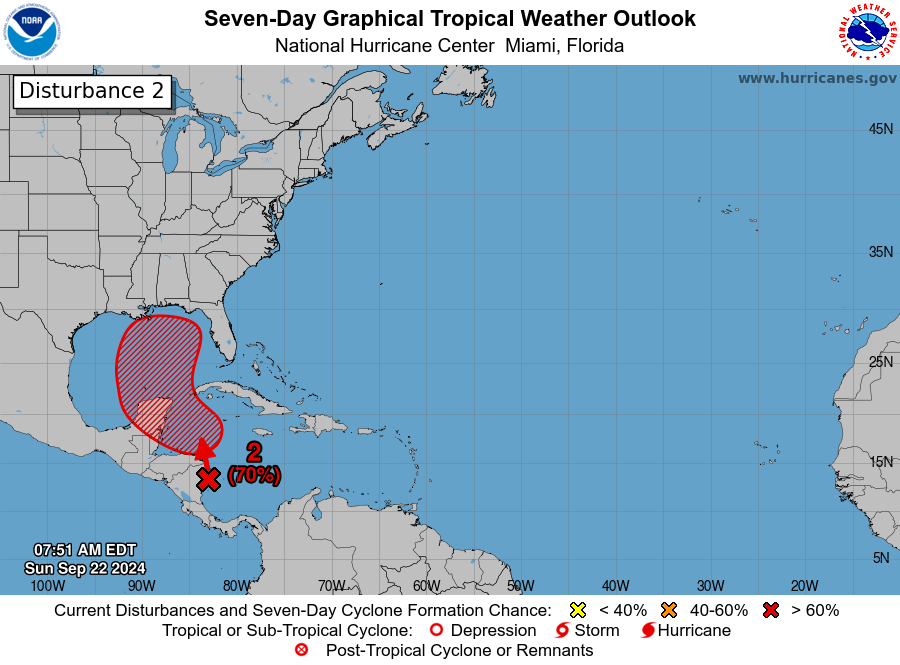
The latest Tropical Outlook from the National Hurricane Center indicates a 70% probability of tropical cyclone formation in the Gulf of Mexico or the Caribbean Sea over the next seven days. Forecast models predict that a tropical storm could develop early next week, potentially making landfall along the Gulf Coast—the location of America’s top offshore oil/gas rigs and refineries on the mainland—by late next week. 

“Northwestern Caribbean Sea and Gulf of Mexico: Disorganized showers and thunderstorms located over the western Caribbean Sea and portions of Central America are associated with a very broad area of low pressure. Environmental conditions appear favorable for gradual development of this system during the next several days. A tropical depression is likely to form while the system moves slowly northward across the northwestern Caribbean Sea and Gulf of Mexico through the end of the week,” NHC wrote in an update on Sunday morning. 

Since Thursday, we have been monitoring potential tropical development via various weather models because this potential storm threatens US oil/gas infrastructure. 

The Weather Channel’s Jim Cantore wrote on X, “One of the things to consider with this week’s pending tropical threat is where the “slingshot” sets up.  The slingshot is the upper low (blue) that could ventilate the system first and aid in intensification, then slingshot it into the coast.  The stronger it is at landfall the deeper inland  the more intense parts of it get.  Guidance has much to sort out with all the players coming together.  We should have an invest soon as NHC has issued a 10% area in 48hrs and marked a starting point.”

Washington Post’s Matthew Cappucci wrote on X that a hurricane will likely form in the Gulf of Mexico…  

“Mike’s Weather PageOvernight GFS/EURO ensembles on http://weathernerds.org. Huge consistency. EURO catching up to the GFS. Timing here Friday. Many already make landfall by then. Getting real Florida IMO,” Mike’s Weather Page wrote on X. 

Landfall in Florida, Georgia, Alabama, Mississippi and or Louisiana? 

About 15% of the nation’s total crude production capacity via offshore rigs is in the cone uncertainty. Also, about 45% of the US refining capacity resides at major refineries in Texas, Louisiana, Mississippi, and Alabama. Via Bloomberg data…

There’s a high probability the forecast could can change in the next five days. 

Tyler Durden
Sun, 09/22/2024 – 16:55

Did The Biden-Harris Campaign Collude With Iran?

0
Did The Biden-Harris Campaign Collude With Iran?

Authored by Jeff Carlson and Hans Mahncke via Truth Over News,

In a joint statement issued on September 18, 2024, the Office of the Director of National Intelligence (ODNI), the Federal Bureau of Investigation (FBI), and the Cybersecurity and Infrastructure Security Agency (CISA) revealed that Iranian hackers had stolen materials from the Trump campaign and passed some of them on to the Biden-Harris campaign:

“Iranian malicious cyber actors in late June and early July sent unsolicited emails to individuals then associated with President Biden’s campaign that contained an excerpt taken from stolen, non-public material from former President Trump’s campaign as text in the emails.”

This, of course, sounds eerily similar to the story we heard eight years ago, specifically from Hillary Clinton’s campaign director, Robbie Mook, who appeared on CNN on July 24, 2016, to assert:

“What’s disturbing to us is that we — experts are telling us that Russian state actors broke into the DNC, stole these e-mails. And other experts are now saying that the Russians are releasing these e-mails for the purpose of actually helping Donald Trump.”

However, there is a significant difference. In one instance, the revelation originates from the ODNI, the FBI, and the CISA. In the other instance, the revelation was fabricated by the Clinton campaign as a dirty trick to tarnish Donald Trump’s reputation by portraying him as a Russian agent. 

But let us set that aside for a moment. Instead, let us assume that the FBI was unaware that the Russia collusion narrative was a scheme orchestrated by Hillary Clinton and that there was credible information justifying an investigation into Trump and his campaign. What was that credible information?

(For the avoidance of doubt, it should be noted that the FBI had known since at least July 28, 2016, that Hillary Clinton had approved a plan to fabricate a scandal by linking Trump to Putin. (see Figure 1)

Figure 1

The supposedly actionable information that the FBI allegedly relied on to initiate its extensive “enterprise” investigation into Trump, a number of his advisors, and the campaign itself, was a single tip from an Australian diplomat. Contrary to some widely shared narratives, the FBI did not officially depend on the infamous Steele dossier or any other source when opening its Crossfire Hurricane investigation. It was the Australian tip, and it alone. 

So, what did the tip entail? Fortunately, the tip was reproduced several years ago, allowing us to examine it for ourselves (see Figure 2). In essence, the Australian diplomat Alexander Downer claimed that a Trump advisor, George Papadopoulos, had made a suggestion of a suggestion that Russia might assist Trump by releasing information about Hillary Clinton. Notably, Judge Andrew Napolitano made a very similar claim on Fox News the day before Papadopoulos allegedly informed Downer about it. Even more significantly, Downer’s tip made clear that the information the Russians might release could have originated from publicly available sources. In other words, the tip was not about stolen emails, as the media often falsely asserts, but rather about generic information that may have been accessible to the public regardless.

Figure 2

Let us compile the purportedly incriminating information from the Downer tip and compare it to the data released by the ODNI, the FBI, and CISA regarding Iran and the Biden-Harris campaign.

Trump-Russia:
• Suggestion of a suggestion
• Information may have originated from the public domain
• No evidence that any information was provided to anyone

Biden-Iran:
• Not a suggestion but a fact
• Information was stolen and not public
• Information was provided to the Biden-Harris campaign

The two situations could not be more different. However, in Trump’s case, he was subjected to years of fraudulent investigations, while in Biden’s and Harris’s case, the entire situation has already been swept under the rug, despite the underlying facts being significantly more incriminating.

The key issue here is not whether the Biden-Harris campaign colluded with Iran; we do not have definitive evidence to support that claim. The point is that there never will be an investigation of whether the Biden-Harris campaign colluded with Iran. Instead, the announcement by the ODNI, the FBI, and CISA was directed against Iran. They let the cat out of the bag by asserting, apparently without evidence, and certainly without investigating, that the Biden-Harris campaign’s receipt of the stolen materials was “unsolicited.”

What we are left with is the significant disparity in how federal law enforcement has treated the two situations, which reveals much—if not everything—about the Russia collusion narrative. If the Russia collusion investigation had ever been serious or anything more than a concerted campaign of legal warfare by federal agencies against an unfavored presidential candidate, and later president, there would now be a comprehensive investigation into the Harris campaign. It is the absence of such an investigation that unequivocally proves that the Trump-Russia collusion inquiry was nothing short of treason. 

The perpetrators of this treason remain not only unpunished but also continue to disseminate their falsehoods every single night. This includes, first and foremost, Hillary Clinton, who once again propagandized her Russia collusion lies on MSNBC just two nights ago.

Subscribe to Truth Over News here…

Tyler Durden
Sun, 09/22/2024 – 16:20

Hollywood Horror: Abandoned ‘Graffiti Mansion’ Becomes Squatters’ Paradise

0
Hollywood Horror: Abandoned ‘Graffiti Mansion’ Becomes Squatters’ Paradise

What was once a star-studded mansion in the Hollywood Hills has now become a nightmare for neighbors, as graffiti, garbage, and trespassers have taken over the 8,000-square-foot home that once housed celebrities like Mary J. Blige.

Mary K. Blige has resided inside the mansion in years past, as have several “high-level business folks,” one neighbor named Jack told KABC

Perched along Multiview and Mulholland drives, the sprawling property has become an eyesore and a safety hazard. Squatters have been coming and going freely for over two years, with the LAPD responding to multiple calls of vandalism and trespassing.

“Mary J. Blige used to live here,” said a neighbor, identifying himself only as Jack. “We had some high-level business folks, so to speak. I think some influencers have lived here over the years. It’s a really cool house, about 8,000 square feet. It’s big,” ABC7 reports.

Sean “Diddy” Combs inside the now-abandoned Los Angeles mansion during his music video for “Last Night.” ABC 7

But the mansion’s grandeur has long faded, replaced with the scars of neglect.https://abc7.com/post/abandoned-hollywood-hills-mansion-covered-graffit…

“They cut the fence. There were a lot of very questionable people. Some were crazy, some actually became threatening,” said another neighbor, Karin Gideon.

The mansion, which sits just a stone’s throw from some of the city’s most expensive homes, has become a hotspot for graffiti artists. Filmmaker Nick Sozonov, who documents the tagging community, said the property has caught the attention of some of the city’s most notorious taggers—those who once marked the famed “graffiti towers” downtown.

“With the graffiti towers and this graffiti mansion right now, it feels like a big middle finger to the city,” Sozonov said, adding that the tagging has escalated in recent weeks as word of the mansion’s history and its connections to the entertainment industry spread.

One tag on the roof, in bright spray paint, reads “Diddy was here,” a nod to the fact that Sean “Diddy” Combs filmed part of his music video for “Last Night” at the home.

Taggers have since spray-painted “Diddy was here” after learning of the music video.

“We all recognized the song, and once we knew that was the house, everyone was excited about it, like a celebrity mansion,” Sozonov said.

On Thursday evening, Eyewitness News captured footage of three taggers fleeing the scene as private security arrived. The LAPD has been called to the property six times this month alone, removing ten trespassers on Wednesday and arresting one individual with an outstanding warrant.

So, who owns this once-luxurious property? According to public records, the mansion belongs to John Powers Middleton, a Hollywood producer whose father owns the Philadelphia Phillies. Middleton also owns another Hollywood Hills mansion, similarly plagued by squatters and dilapidation, which has become a neighborhood blight.

“It’s become a bit larger than it should be, and there doesn’t seem to be much concern for the safety and well-being of the neighbors,” said Magnus Fiennes, another concerned resident.

Despite neighbors’ complaints and repeated calls to L.A. Councilwoman Nithya Raman’s office, little has been done to address the situation. Raman’s office issued an abatement order, but according to neighbors, the owner has ignored it, allowing the property to further deteriorate.

“The longer it sits like this, more people are going to come and keep doing what they’re doing,” said Jack. “The neighborhood, this house specifically, could use a security guard. Two guards … not that expensive. Let’s keep the neighborhood safe.”

Adding to the mess, Eyewitness News has learned that a lien has been placed on the property, and Middleton has defaulted on property taxes for several years. In a statement, Councilwoman Raman’s office said, “This is in egregious violation of the law… we are elevating the issue with the abandoned buildings unit at the department of building and safety to ensure that the fullest extent of enforcement is being implemented urgently and swiftly.”

For now, the once-glamorous mansion remains a symbol of how far things can fall when the rich and famous check out, but their homes are left behind.

Tyler Durden
Sun, 09/22/2024 – 15:45