Hedge Fund CIO: Europe’s Collapse Is A Healthy Reminder For Americans To Stay True To Their System
By Eric Peters, CIO of One River Asset Management
“For complex reasoning tasks this is a significant advancement and represents a new level of AI capability,” wrote OpenAI, describing its latest model release. “Given this, we are resetting the counter back to 1 and naming this series OpenAI o1.” Such is the pace of advancement (and hype) in AI that we need to rebase our calibrations. o1 answered 78% of PhD-level science questions accurately, compared to 56.1% for GPT-4o and 69.7% for human experts, which confirms that o1 is way smarter than I am.
But for some reason I feel I’m probably more intelligent, at least for now. Even if I couldn’t tell you without the help of o1 the precise difference between smarts and intelligence.
Overall:
“For the first time since the Cold War we must genuinely fear for our self-preservation,” Draghi told reporters, working himself up into another ‘whatever-it-takes” frenzy.
“And the reason for a unified response has never been so compelling and I am confident that in our unity we will find the strength to reform,” said Mario, far from confident, his long-awaited report on EU competitiveness hot off the press. But of course, the stock market provides objective, real-time analysis on national competitiveness, and the European benchmark equity index is now just slightly above where it was at the 2007 market high.
Equities are priced in nominal terms though, and the EU consumer price index is roughly 52% higher since 2007. Which means that European equities have fallen 30% in real terms from where they were 17yrs ago (excluding dividends). Relative to where they were at the 2000 highs, European stocks are worth about half what they were nearly 25yrs ago in real terms.
By the same measure, Chinese stock prices are -67% in real terms from the 2007 nosebleed highs (+44% in real terms since 2000 – just before its WTO entry). And the S&P 500 is +60% in real terms from the 2007 highs (+107% from the 2000 highs). As a general observation, the US invents, China builds, the EU regulates.
And the stock market does an admirable job at indicating which of those activities you want to prioritize, if the goal is to aggressively increase overall national prosperity. But the EU’s goal was never really that. That union was formed to avoid another disastrous continental war, which has been a recurring theme since well before the first Italian started shaving coins. The European project as it is currently constituted has narrowly achieved this primary objective, but at the cost of more chronic economic stasis. Naturally though, national weakness invites discontent from within and aggression from without. Which is where Europe finds itself today.
It’s a healthy reminder for Americans, as we enter our political season, to stay true to our system and to that which has led to our greatness. Innovation, invention, risk taking, entrepreneurialism.
Anecdote
“We have 4% of the world’s population and the dominant economy – almost twice the size of China and 5x the next largest,” said the Chairman, an American patriot, a public servant, realist, capitalist.
“US stock market cap is over $50trln, dwarfing China at $11trln and Japan at $6trln,” he continued. “For over five decades, the US has produced the next generation of great global companies.”
As Nippon Steel begs our politicians to buy US Steel for $14.9bln, Nvidia’s market cap is nearly $3trln, and OpenAI is raising a fresh venture round at a $150bln valuation. “Meta started in 2004 and employs 70k people, producing $134bln in annual revenue, much of it from abroad.” Apple, Google, Netflix, the list goes on.
“Silicon Valley is the world’s premier innovation hub and attracts the best and brightest from across the globe.” Technology is helping lift the world’s poor out of poverty at an unprecedented rate, and in today’s hyper-connected world, every person who comes online, becomes a customer of a US tech company.
“Genentech and Amgen were once startups and are now industry leaders. Without the hundreds of billions in they’d invested in R&D, we would never been able to develop the COVID vaccines in record time,” said the Chairman.
“The flywheel effects of being the world’s innovation and growth engine are breathtaking. And are strongly supported by the tax code.”
Since the Revenue Act of 1921, capital gains have been taxed at a lower rate than ordinary income, providing a powerful incentive for individuals to invest in new, often risky ideas. Fueling an entrepreneurial culture, that is the source of America’s prosperity, strength, power.
“Energy is vital to our enduring strength too, economic and geopolitical. We lifted US domestic oil production between 2016-2020 from 9mm barrels per day to 12mm, and natural gas production by 25%.”
Biden quietly continued Trump’s energy policies, lifting oil production another 1mm barrels and natural gas 15%. “Had we not, our military and economic adversaries would have more control over the future of America and our allies,” said the Chairman.
“We need a coherence across economic, national security, and energy policy that is centered on and builds upon all these strengths.”
Nearly three in five young Africans said that they are either very or somewhat likely to consider emigrating to another country in the next three years, according to the African Youth Survey 2024 by Ichikowitz Family Foundation.
As Statista’s Anna Fleck details below, this marks a seven percentage point increase from 2022, when the last survey wave was conducted, likely driven by the improving freedom of movement post-pandemic.
Where young people from Rwanda who are considering emigrating said that it would likely only be temporary (90 percent), those in Nigeria (45 percent), Ghana (44 percent) and Congo Brazzaville (41 percent) were among those more likely to say they would make a permanent move. The 2024 poll included 5,604 people aged between 18 and 24 year olds across 16 countries: Botswana, Cameroon, Chad, Congo Brazzaville, Côte d’Ivoire, Ethiopia, Gabon, Ghana, Kenya, Malawi, Namibia, Nigeria, Rwanda, South Africa, Tanzania and Zambia.
Main reasons cited as motivations for moving abroad included economic reasons (selected by 43 percent of respondents), education opportunities (38 percent) and due to corruption in respondents’ respective home countries. The latter option, corruption, saw an increase of three percentage points since the survey wave in 2022. In South Africa, corruption was cited as the top reason for young people considering emigrating in 2024 (38 percent) as well as in Gabon (32 percent).
When asked what the major barriers are to finding employment, corruption was selected as the top issue (40 percent), followed by a lack of well-paying jobs (29 percent) and not having enough government support (27 percent).
Sweden has announced plans to pay migrants 350,000 SEK (€30,809) to return to their homeland in a new voluntary remigration scheme proposed by the center-right government.
Remix News was one of few English-language sites to report on the plans proposed last month by then Migration Minister Maria Stenergard and reviewed by the Swedish justice ministry.
“For those who have not entered Swedish society, remigration can be a way to create a better life for themselves,” Stenergard said at the time.
“This is one of several ways we achieve sustainable immigration that strengthens integration and reduces exclusion,” she added.
This week, Stenergard was appointed the new foreign secretary and succeeded by Johan Forssell who announced the new policy on Thursday.
“Migrants who voluntarily return to their home countries from 2026 onwards will be eligible to receive 350,000 Swedish kronor (€31,000),” he said. Even those with Swedish citizenship will be eligible.
Forssell, whose appointment was backed by the right-wing Sweden Democrats who influence government policy, said upon starting his new role that the government must commit to remigration and abandon the open borders policies of the previous liberal administrations.
“The important thing now is that we should not return to the previous policy, which after all put Sweden in a very difficult situation. A lot of people were affected by it,” he told Aftonbladet.
“It is clear that it is an important issue for Sweden and for this government,” he added.
The country, previously lauded as a migrant magnet and known for its hospitality, has cracked down on the number of new arrivals permitted after a radical cultural shift across the country that has seen crime and particularly gang warfare skyrocket.”
Earlier this year, the Swedish government announced it was toughening up its family reunification laws to slash immigration with income requirements expected to increase and extra DNA testing to prove relations is likely to be rolled out.
Last month, Stockholm announced that for the first time in 50 years the country had seen net emigration over the past 12 months. These figures were contested, however, by some right-wing groups with some claiming the government has ramped up naturalizations to massage the figures.
Blinken Brags Over Gershkovich, Pretends Gonzalo Lira Didn’t Exist
Submitted by Liam Cosgrove,
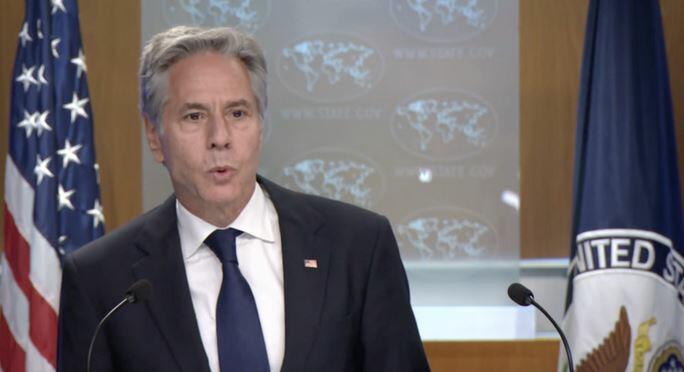
While speaking to “journalists” during a Friday press conference, US Secretary of State Antony Blinken pattedhimself on the back for securing the release of the Wall Street Journal’s Evan Gershkovich – telling them “Maybe the most striking part of spending time with Evan, is simply how wonderful it feels to see him free. Home where he belongs.”
“Evan’s freedom is also a reminder of all Americans who are still held hostage or wrongfully detained,” Blinken continued.
“We will not forget you, and we will not rest until we get you home.”
It’s hard to overstate what an egregious display of sanctimonious hypocrisy this is when Blinken’s department wittingly neglected Gonzalo Lira — the California-born writer for mainstream financial outlets like Business Insider, Seeking Alpha, and even ZeroHedge — as he was tortured in a Ukrainian dungeon for eight months until his eventual death at the start of this year. State Spox Matthew Miller was aware of Lira being tortured for at least five of those months.
Anthony Blinken spoke today after meeting WSJ’s Evan Gerskovich, recently freed from Russia.
“Evan’s freedom is a reminder of all Americans who are still wrongfully detained… We will not forget you.”
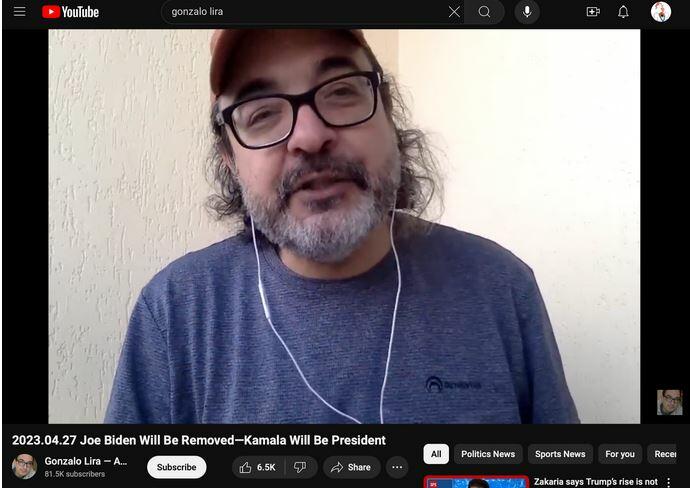
Lira’s father has accused Biden administration of greenlighting the arrest of his son, pointing to a video published to Lira’s YouTube days before his arrest in which he was uncharacteristically critical of Biden and Kamala. The video, interestingly enough, is titled “Joe Biden Will Be Removed—Kamala Will Be President.”
That such a greenlight was given is not far-fetched considering Ukraine’s massive incentive to curry favor with the American government that had approved more than $100 billion already by this point (now at $175 billion). Would the Ukrainians risk the political backlash of arresting a U.S. citizen unless first given the go-ahead?
Regardless, the State Department’s Miller acknowledged to me that he was aware of Lira’s arrest in May of 2023. Three months later, Miller then — after being made aware of allegations that Lira’s prison guards had tortured him with severe beating and having his cornea scraped with a toothpick — said he wanted to investigate the torture claims.
Yet, despite near-constant email correspondence between Lira’s father and State Dept officials, nothing was done and Lira died of pneumonia, an infection commonly treatable with antibiotics.
Ukrainian Government Becoming More Despotic
A story that slid under the radar this July: Natsya Umka, a Kyiv-based fashion blogger with 600k followers, made an Instagram post, saying “people want peace” and that Ukraine does not need “the border of 1991” (which would include Crimea). For doing so, she was promptly called in to the offices of the Ukrainian Security Services (SBU) for “talk”.
Umka posted videos before and after the meeting, appearing noticeably shaken up in the latter video where she claims to have been unable to eat for three days. Most notably… in the video after her “meeting” with the SBU, Umka suddenly supports the war effort: “Everything is fine and we will definitely win.”
WSJ: Ukraine’s national police summoned a Kyiv blogger because she posted:
“No one needs the border of 1991. All people want peace… How many more people must be lost for this to stop?”
After the meeting — despite an inability to eat from “stress” — she now supports the war: pic.twitter.com/iSGlL3d9Ve
Is this the liberal democracy we are risking nuclear war to maintain? Hundreds of billions of dollars and the possibility to destroy life on Earth so we can pay the pensions of these thugs who intimidate mothers into silence, who imprison and torture Americans to death?
From an email Lira’s father sent Friday morning, coincidentally a few hours before the Blinken presser:
“I ask for justice in this violent world, Gonzalo expressed his political views without violence, never threatening, nor advocating violence. Gonzalo Lira Sr.”
Escobar: BRICS, The Rise Of China, And How The Hegemon Buried The Concept Of “Security”
Authored by Pepe Escobar,
The first meeting of security experts/National Security Advisors under the expanded BRICS+ format at the Konstantinovsky Palace in St. Petersburg unveiled quite a few nuggets.
Let’s start with China. Foreign Minister Wang Yi proposed four BRICS-centric security initiatives. Essentially, BRICS+ – and beyond, considering further expansion – should aim at peaceful coexistence; independence; autonomy; and true multilateralism, which implies a rejection of Exceptionalism.
At the BRICS table, the overarching theme was how member-nations should support each other despite so many challenges – mostly unleashed by you-know-who.
On India, Secretary of the Russian Security Council Sergei Shoigu, meeting with Indian National Security Adviser Ajit Doval, stressed the strength of the alliance, “confidently standing the test of time”.
The larger context was in fact offered in parallel, in Switzerland, at the Geneva Center for Security Policy, by the always delightful Foreign Minister S.Jaishankar:
“There was a club called G7, but you wouldn’t let anybody else into it – so we said, we’d go and form our own club (…) It’s actually a very interesting group because if you look at it, typically any club or any group has either a geographical contiguity or some common historical experience or a very strong economic connect.” But with BRICS what stands out is “big countries rising in the international system.”
Cut to Russian Deputy Foreign Minister Sergey Ryabkov, stressing how Russia and Brazil “have similar approaches to key international issues”, emphasizing how Moscow cherishes the current “bilateral mutual understanding and interaction, including in the light of the simultaneous presidencies of BRICS and G20 this year.”
In 2024, Russia presides over BRICS while Brazil presides over the G20.
The Russia-Iran strategic partnership
President Putin, apart from addressing the meeting, had bilaterals with all the top players. Putin noted how 34 nations “have already expressed their desire to join the activities of our association in one form or another.”
Meeting with Wang Yi, Putin stressed that the Russia-China strategic partnership is in favor of a just world order, a principle supported by the Global South. Wang Yi confirmed President Xi Jinping has already accepted the official Russian invitation for the BRICS summit next month in Kazan.
Putin also met with the Secretary of Iran’s Supreme National Security Council, Ali Ahmadian. Putin confirmed he is expecting Iranian President Masoud Pezeshkian for another visit to Russia, apart from the BRICS summit, to sign their new strategic partnership agreement.
Geoeconomics is key. The development of the International North South Transportation Corridor (INSTC) was confirmed as a top Russia-Iran priority.
Shoigu for his part confirmed, “We are ready to expand cooperation between our security councils.” The deal will be signed by both Presidents soon. Moreover, Shoigu added that Iran’s entry into BRICS advances cooperation among members to form a “common and indivisible architecture of strategic security and a fair polycentric world order.”
Now compare it with the new collective West “strategy” – adopted by U.S., UK, France and Germany: another sanctions wave against Iran related to the case of Iranian missiles transferred to Russia.
Ahmed Bakhshaish Ardestani, a member of the Iranian Parliament’s National Security and Foreign Policy Commission, confirmed early this week that Iran is sending missiles and drones to Russia as part of their defense agreements.
But the heart of the story is that these missiles are Russian anyway; they are just being produced in Iran.
While security was being discussed in St. Petersburg, China was hosting the BRICS Forum on Partnership on New Industrial Revolution 2024 in Xiamen, in Fujian province.
Talk about interlocking BRICS cooperation: as sanctioned-to-oblivion Iran has been trying to get access to new industrial technologies, Iran-China collaboration on everything from AI to green technologies will be surging further on down the road.
A new Eurasian security architecture
The heart of the matter is China’s rising and rising status as the top global trade power – as scores of nations across the Global South adapt to the fact that interaction with China is the privileged vector to improve their own domestic living standards and socioeconomic development. This monumental shift in international relations is reducing the collective West to a bunch of headless chickens.
China’s increased power is reflected in every major geoeconomics move: from the RCEP (Regional Comprehensive Economic Partnership), a mega inter-Asia free trade agreement (FTA) to the countless ramifications of Belt and Road Initiative (BRI) projects, and all the way to BRICS+ cooperation. The future of all Global South nations involved spell out getting closer and closer to China.
In sharp contrast, the Hegemon – and that is bipartisan, all the way down from the rarified plutocracy – simply cannot contemplate a world that it does not control. An EU prone to acute disaggregation basically “reasons” along the same lines. For the whole collective West, the demented double trouble desire of maintaining hegemony while preventing the rise of China is unsustainable.
Add to it the mad obsession of the current U.S. administration to inflict a “strategic defeat” on Russia since it rejected Moscow’s late 2021 proposal for a new European security architecture, actually an “indivisibility of security” concerning the whole of Eurasia.
This new pan-Eurasian security system proposed by Putin was discussed in detail at the latest Shanghai Cooperation Organization (SCO) summit. Putin actually stated that a “decision was made to turn the SCO regional anti-terrorist structure into a universal center tasked with responding to the entire range of security threats.”
It all started with the concept of “Greater Eurasian Partnership”, which Putin advanced in late 2015. That was refined during his annual address to the Federal Assembly last February. And then, in a meeting with key Russian diplomats in June, Putin stressed that the time was right to kickstart a comprehensive discussion of bilateral and multilateral guarantees embedded in a new vision for collective Eurasian security.
The idea, from the start, was always inclusive. Putin stressed the need to create a security architecture open to “all Eurasian countries that wish to participate”, including “European and NATO countries.”
Add to it the drive to conduct discussions with all sorts of Eurasia-wide multilateral organizations, such as the Union State of Russia and Belarus, the CSTO, the EAEU, the CIS, and the SCO.
Crucially, this new security architecture should “gradually phase out the military presence of external powers in the Eurasian region.” Translation: NATO.
And on the geoeconomic front, apart from developing a series of international transportation corridors across Eurasia such as the INSTC, the new deal should “establish alternatives to Western-controlled economic mechanisms”, from expanding the use of national currencies in settlements to establishing independent payment systems: two top BRICS priorities, which will feature prominently in the Kazan summit next month.
We want a three-front war
As it stands, a deaf, dumb and blind Washington remains obsessed with its single-minded declared goal of inflicting a strategic defeat on Russia.
Russian Ambassador to the U.S. Anatoly Antonov cuts to the chase: “It is impossible to negotiate with terrorists”, adding that “no schemes or so-called ‘peace initiatives’ to cease fire in Eastern Europe without taking into account Russia’s national interests are possible. Conferences won’t help either, no matter how beautifully they are named. As in the years of the Great Patriotic War, fascism must be eradicated. Goals and objectives of the special military operation will be fulfilled. No one should have any doubts that this is exactly how it’s going to be.”
And that brings us to the current incandescent juncture. There are only two options ahead for the U.S. proxy war against Russia in Ukraine: an unconditional Kiev surrender, or escalation towards a NATO war against Russia.
Ryabkov has no illusions – even as he puts it quite diplomatically:
“Signals and actions that we are witnessing today are aimed towards escalation. This remark will not force us to change our course, but will create additional risks and dangers for the United States and its allies, clients and satellites, no matter where they are.”
After bombing the concept of diplomacy, the Hegemon has also bombed the concept of security. Acute dementia in U.S. Think Tankland has even reached the point of dreaming of a three-front war. And this from an “indispensable nation” whose mighty Navy has been utterly humiliated by the Houthis in the Red Sea.
It is really a spectacle for the ages to see the plutocracy of a 200-year-plus savage nation which essentially looted most of its land from others believe it can simultaneously challenge the Persians, the Russians, and an Asian civilization with 5,000 years of recorded history. Well, savages will always be savages.
The personal carbon footprint of the richest people in society is grossly underestimated, both by the rich themselves and by those on middle and lower incomes, no matter which country they come from. At the same time, both the rich and the poor drastically overestimate the carbon footprint of the poorest people.
An international group of researchers, led by the Copenhagen Business School, the University of Basel and the University of Cambridge, surveyed 4,000 people from Denmark, India, Nigeria and the United States about inequality in personal carbon footprints – the total amount of greenhouse gases produced by a person’s activities – within their own country.
Although it is well-known that there is a large gap between the carbon footprint of the richest and poorest in society, it’s been unclear whether individuals were aware of this inequality. The four countries chosen for the survey are all different in terms of wealth, lifestyle and culture. Survey participants also differed in their personal income, with half of participants belonging to the top 10% of income in their country.
The vast majority of participants across the four countries overestimated the average personal carbon footprint of the poorest 50% and underestimated those of the richest 10% and 1%.
However, participants from the top 10% were more likely to support certain climate policies, such as increasing the price of electricity during peak periods, taxing red meat consumption or subsidising carbon dioxide removal technologies such as carbon capture and storage.
The researchers say that this may reflect generally higher education levels among high earners, a greater ability to absorb price-based policies or a stronger preference for technological solutions to the climate crisis. The results are reported in the journal Nature Climate Change.
Although the concept of a personal carbon or environmental footprint has been used for over 40 years, it became widely popularised in the mid-2000s, when the fossil fuel company BP ran a large advertising campaign encouraging people to determine and reduce their personal carbon footprint.
“There are definitely groups out there who would like to push the responsibility of reducing carbon emissions away from corporations and onto individuals, which is problematic,” said co-author Dr Ramit Debnath, Assistant Professor and Cambridge Zero Fellow at the University of Cambridge. “However, personal carbon footprints can illustrate the profound inequality within and between countries and help people identify how to live in a more climate-friendly way.”
Previous research has shown widespread misperceptions about how certain consumer behaviours affect an individual’s carbon footprint. For example, recycling, shutting off the lights when leaving a room and avoiding plastic packaging are lower-impact behaviours that are overestimated in terms of how much they can reduce one’s carbon footprint. On the other end, the impact of behaviours such as red meat consumption, heating and cooling homes, and air travel all tend to be underestimated.
However, there is limited research on whether these misperceptions extend to people’s perceptions of the composition and scale of personal carbon footprints and their ability to make comparisons between different groups.
The four countries selected for the survey (Denmark, India, Nigeria and the US) were chosen due to their different per-capita carbon emissions and their levels of economic inequality. Within each country, approximately 1,000 participants were surveyed, with half of each participant group from the top 10% of their country and the other half from the bottom 90%.
Participants were asked to estimate the average personal carbon footprints specific to three income groups (the bottom 50%, the top 10%, and the top 1% of income) within their country. Most participants overestimated the average personal carbon footprint for the bottom 50% of income and underestimated the average footprints for the top 10% and top 1% of income.
“These countries are very different, but we found the rich are pretty similar no matter where you go, and their concerns are different to the rest of society,” said Debnath. “There’s a huge contrast between billionaires travelling by private jet while the rest of us drink with soggy paper straws: one of those activities has a big impact on an individual carbon footprint, and one doesn’t.”
The researchers also looked at whether people’s ideas of carbon footprint inequality were related to their support for different climate policies. They found that Danish and Nigerian participants who underestimated carbon footprint inequality were generally less supportive of climate policies. They also found that Indian participants from the top 10% were generally more supportive of climate policies, potentially reflecting their higher education and greater resources.
“Poorer people have more immediate concerns, such as how they’re going to pay their rent, or support their families,” said first author Dr Kristian Steensen Nielsen from Copenhagen Business School. “But across all income groups, people want real solutions to the climate crisis, whether those are regulatory or technological. However, the people with the highest carbon footprints bear the greatest responsibility for changing their lifestyles and reducing their footprints.”
After learning about the actual carbon footprint inequality, most participants found it slightly unfair, with those in Denmark and the United States finding it the most unfair. However, people from the top 10% generally found the inequality fairer than the general population, except in India. “This could be because they’re trying to justify their larger carbon footprints,” said Debnath.
The researchers say that more work is needed to determine the best ways to promote fairness and justice in climate action across countries, cultures and communities.
“Due to their greater financial and political influence, most climate policies reflect the interests of the richest in society and rarely involve fundamental changes to their lifestyles or social status,” said Debnath.
“Greater awareness and discussion of existing inequality in personal carbon footprints can help build political pressure to address these inequalities and develop climate solutions that work for all,” said Nielsen.
The study also involved researchers from Justus-Liebig-University Giessen, Murdoch University and Oxford University. The research was supported in part by the Carlsberg Foundation, the Bill & Melinda Gates Foundation, the Quadrature Climate Foundation and the Swiss National Science Foundation.
Houthis Hit Israel With “New Hypersonic Ballistic Missile”
A spokesman for the Iran-backed Houthis claimed in a video announcement on X that rebel forces launched a “new hypersonic ballistic missile” targeting Israel on Sunday morning. He also warned that additional attacks could be expected as the first anniversary of the October 7 Hamas attack approaches.
The Washington Post quoted Israel Defense Forces that said a surface-to-surface missile fired from Yemen hit an escalator in a train station in the central town of Modiin.
BREAKING:
🇾🇪🇮🇱 Yemen hit Tel Aviv with a missile
About 3 hours ago, at approximately 6:30 AM (GMT +3:00), a ballistic missile launched by Yemen’s Houthis impacted in Tel Aviv.
The target appeared to be the ‘Gezer’ power plant, 6 kilometers from Ben Gurion airport.
“Following the sirens that sounded a short while ago in central Israel, a surface-to-surface missile was identified crossing into central Israel from the east and fell in an open area. No injuries were reported,” IDF said.
IDF said the missile likely “fragmented in mid-air” but did not state if interceptor missiles were responsible for that.
“A Yemeni missile reached Israel after ’20 missiles failed to intercept’ it,” Nasruddin Amer, a Houthi media official, wrote on X.
BREAKING:
🇾🇪🇮🇱 Yemen confirmed that they used a hypersonic ballistic missile in the attack on Tel Aviv
Yemeni Armed Forces says it hit an Israeli military target in Yaffa (Tel Aviv) with a new hypersonic ballistic missile that traveled 2,040 kilometers.
Israeli Prime Minister Benjamin Netanyahu told officials at the start of a cabinet meeting that the Houthis “should have known by now that we charge a heavy price for any attempt to harm us.”
Today, we are in this unfortunate situation where the ostensible pillars of production are distinct from the actual pillars of production.
Let me explain…
The actual pillars of society (at least in terms of production) are agriculture, mining, fabrication, and transportation. All of these industries have benefited massively from technological advancements. Agriculture, for example, now uses harvesters as opposed to, say, oxen.
As a result, the actual number of people employed in agriculture continues to… you guessed it, fall. That’s a good thing! It frees up time for folks to do other things — build isht that doesn’t yet exist (this is how humans have advanced) or paint pretty pictures, play music, or write novels. The entire arts owes its existence to reducing the amount of time needed to actually provide for life functions. Stay with me because this part is important. The number of folks employed in “the arts” has therefore exploded upwards.
People tend to like these jobs, too. They’re more comfortable and less taxing on the body and increasingly less taxing on the mind as well. It is how we have such soft-brained individuals littering society today. The fact is, today we are drowning in comfort. Society is saturated with it. This is how universities have liberal arts degrees and gender studies, as if there’s more to know than that there are 2. There isn’t. That’s it.
Additionally, each group of people act like gangs. Consider the schoolyard. The kids who play football think they’re better than the kids who play chess (nerds). Well, today the kids drowning in comfort are finding that their “value” they bring to the table isn’t quite so high — hence they advocate for mandating and forcing society to value them. This is how we were told to “accept” all the “underprivileged,” except this term has been hijacked. You see, the thing is these people were always accepted. They just weren’t praised for these attributes. Today, we have to exalt them to media star status for their inadequacies. Today, you can be a victim for any number of reasons. Fat? No problem, you’re a victim. Ugly? You’re a victim. Stupid? Victim. Can’t do math? It’s the patriarchy or white supremacy and racism. You’re a victim. As daft as this is, we’ve moved beyond it. Take that disgusting obese lesbian (no sane man would touch her, so…) who we’re told we must applaud. When we don’t, we’re labelled any number of stupid things. Sexist, fat shamer lesbian hater, etc.
Here’s the kicker. These people vote. Their vote is equal to everyone else’s. Frighteningly, the pink-haired angry lesbian with a liberal arts major who now heads up the “Diversity and Equity” department at Lululemon has the same weight in vote as does a farmer. One produces for the world while the other detracts value. What’s worth understanding, too, is that with the advancement of technology, which builds on previous underlying fundamentals such as electricity, for example, there are more and more folks who fall into the “comfort saturation” bucket than fall into the “produce isht we need” bucket. Technology, remember. Combine harvesters don’t vote.
What’s more is that the “comfort class” have an inability to understand the connection between their liberal world and that of the reality world. Case in point. They are champions of electricity. In fact, they see it as part of the cosmic firmament. It’s just there, like the air you breathe, and therefore should be a right. At the same time, they are ready and willing to deface beautiful artwork, glue themselves to bridges, and become general nuisances to society in an effort to end the use of coal and natural gas. Their inability to understand the connection between what they see as a right (electricity) and what they see as evil (coal and natural gas) is complete. 100% complete.
Because these people are useless and an actual menace to society, they’re not wanted. Pray tell, who wants this?
It is why they have to resort to violence to demand society like, accept, and “value” them. Communists are always the same. They’re the parasite class in their early phase, but like any cycle before us (Mao’s China, Pol Pot’s Cambodia, Stalin’s Bolsheviks), they resort to tyranny. Always and every time.
You can easily spot tyranny because it always comes in the name of compassion and equality of outcomes. It is a road paved with cowards, conmen, corrupt bureaucrats, high taxes, debauchery, mass menticide, and the moral depravity of distracted and diseased materialists conned by chosen ones who monopolise control of information, media, spy agencies, war machines, and money. We’ve moved past the phase where we can vote our way out of the destruction. No, the deep state is a real thing. We still have politicians and politics, but it’s a facade. Today, politics is the entertainment division of the military industrial complex.
Take a look around you and tell me that this time is different.
They demand you like them and accept them, and they will cancel, and when the time comes, murder those who disagree with them. The EU commission threatened Elon Musk with broadcasting an interview with Trump (election interference by a foreign entity?). The now daily reports of folks being thrown into prison for sharing evidence of rioting in English towns and cities. At the last count, over 400 people have received prison sentences for disagreeing with the government… online. They’ve not thrown any rocks, not punched anyone, not rioted — just voiced their discontent online. This, folks, is the rapid march towards genocide. I know, it may sound absurd, but that is the story of history. Don’t believe me, just go read up a bit.
We can watch this from a psychological point of view as well as financial. The two go hand in hand.
The UK currently has a tax burden of 33% of GDP and rising fast — that is while a mass invasion continues (yes, it’s an invasion, and if you need more information, go and read about the Kalergi plan and then reconcile it with what’s taken place). This is important because a good majority of these folks are coming for the free benefits which increase the burden, all the while the UK is raising taxes.
You know why the UK is one of the countries with the highest level of rich people leaving? Because rich people look at this stuff, see the writing on the wall, and get out before they have their assets stolen from them by a collapsing economy, communist power grabs, and capital controls… which are all coming. Watch!
Oh, and one other thing I’ll mention…
Historically, revolutions take place when the income tax burden surpasses 30% of GDP. The UK budget office is projecting it will hit 37% of GDP by 2027.
The first step towards solving any problem lies in acknowledging its existence.
Rampant Censorship
Tech can continue to be a liberator. The events unfolding in Britain now should usher in a newfound awareness of the risks to tying any account with your details.
The communist Guardian published this:
Aimed at teaching critical thinking? God, these people lie through their teeth. This is EXACTLY the opposite of what they are teaching:
That’s why our curriculum review will develop plans to embed critical skills in lessons to arm our children against the disinformation, fake news and putrid conspiracy theories awash on social media. Our renewed curriculum will always put high and rising standards in core subjects – that’s non-negotiable.
It is worth knowing our history. In the Bolshevik revolution and the former USSR, children were taught to rat on their parents and their own family. Divide and conquer has been the strategy employed in every communist fascist movement since the dawn of time.
Remember last week when we spoke about the Bolsheviks in Britain? Europe under the EU is doing their part to usher in the great reset — a technocratic world with one world government and humanity enslaved.
Over in Frogland, they just passed a law that allows the government to open the camera and microphone of any phone remotely and without any legal process. Politicians are exempt, of course.
French Assembly passes bill allowing police to remotely activate phone cameras and microphones for surveillance
Lavrentiy Beria was the notorious chief of the Soviet secret police under Joseph Stalin. This phrase encapsulates the idea that authorities can fabricate or manipulate evidence to incriminate anyone they choose, regardless of actual guilt. Beria’s approach was to identify a target first and then find or create a crime to justify their persecution, reflecting a profound abuse of power within totalitarian regimes.
Rules for thee, but not for me. Take it you peasants and shut up!
The Bolsheviks at the European Union sent a letter to Elon Musk, demanding he censor their Donald Trump interview. They threatened Musk with legal consequences if he does not prevent the spread of what they label as “disinformation.”
Remember when these same clowns were blaming Putin for “interfering in US elections?” Oh, the irony.
Meanwhile the chief Bolshevik here, the EU commissioner Thierry, who is actually Senegalese (yup, he’s African, no, really), you see, this turd, who lectures all the European peasants and earns his income from them at the point of a gun only pays a 5% income tax thanks to a cosy dual national relationship with the French Ministry of Economy.
The conditions are now being set for a digital ID required to access the internet. First, they’ll conjure up all manner of misdeeds (riots, for example) and then build the narrative that it was social media posts that fomented this violence. The police will therefore need “extra powers” to deal with this. They’ll couch it in terms that are entirely warm and cosy with safety thrown around a lot.
Europe (and with that I would include Britain as well) is — and I believe this to be a technical term — F.U.K.T.
* * *
The Western system is undergoing substantial changes, and the signs of moral decay, corruption, and increasing debt are impossible to ignore. With the Great Reset in motion, the United Nations, World Economic Forum, IMF, WHO, World Bank, and Davos man are all promoting a unified agenda that will affect us all. To get ahead of the chaos, download our free PDF report “Clash of the Systems: Thoughts on Investing at a Unique Point in Time” by clicking here.
In 1989 I served as an advisor to the first post-communist government of Poland, and helped to devise a strategy of financial stabilization and economic transformation. My recommendations in 1989 called for large-scale Western financial support for Poland’s economy in order to prevent a runaway inflation, enable a convertible Polish currency at a stable exchange rate, and an opening of trade and investment with the countries of the European Community (now the European Union). These recommendations were heeded by the US Government, the G7, and the International Monetary Fund.
Based on my advice, a $1 billion Zloty stabilization fund was established that served as the backing of Poland’s newly convertible currency. Poland was granted a standstill on debt servicing on the Soviet-era debt, and then a partial cancellation of that debt. Poland was granted significant development assistance in the form of grants and loans by the official international community.
Poland’s subsequent economic and social performance speaks for itself. Despite Poland’s economy having experienced a decade of collapse in the 1980s, Poland began a period of rapid economic growth in the early 1990s. The currency remained stable and inflation low. In 1990, Poland’s GDP per capita (measured in purchasing-power terms) was 33% of neighboring Germany. By 2024, it had reached 68% of Germany’s GDP per capita, following decades of rapid economic growth.
On the basis of Poland’s economic success, I was contacted in 1990 by Mr. Grigory Yavlinsky, economic advisor to President Mikhail Gorbachev, to offer similar advice to the Soviet Union, and in particular to help mobilize financial support for the economic stabilization and transformation of the Soviet Union. One outcome of that work was a 1991 project undertaken at the Harvard Kennedy School with Professors Graham Allison, Stanley Fisher, and Robert Blackwill. We jointly proposed a “Grand Bargain” to the US, G7, and Soviet Union, in which we advocated large-scale financial support by the US and G7 countries for Gorbachev’s ongoing economic and political reforms. The report was published as Window of Opportunity: The Grand Bargain for Democracy in the Soviet Union (1 October 1991).
The proposal for large-scale Western support for the Soviet Union was flatly rejected by the Cold Warriors in the White House. Gorbachev came to the G7 Summit in London in July 1991 asking for financial assistance, but left empty-handed. Upon his return to Moscow, he was abducted in the coup attempt of August 1991. At that point, Boris Yeltsin, President of the Russian Federation, assumed effective leadership of the crisis-ridden Soviet Union. By December, under the weight of decisions by Russia and other Soviet republics, the Soviet Union was dissolved with the emergence of 15 newly independent nations.
In September 1991, I was contacted by Yegor Gaidar, economic advisor to Yeltsin, and soon to be acting Prime Minister of newly independent Russian Federation as of December 1991. He requested that I come to Moscow to discuss the economic crisis and ways to stabilize the Russian economy. At that stage, Russia was on the verge of hyperinflation, financial default to the West, the collapse of international trade with the other republics and with the former socialist countries of Eastern Europe, and intense shortages of food in Russian cities resulting from the collapse of food deliveries from the farmlands and the pervasive black marketing of foodstuffs and other essential commodities.
I recommended that Russia reiterate the call for large-scale Western financial assistance, including an immediate standstill on debt servicing, longer-term debt relief, a currency stabilization fund for the ruble (as for the Zloty in Poland), large-scale grants of dollars and European currencies to support urgently needed food and medical imports and other essential commodity flows, and immediate financing by the IMF, World Bank, and other institutions to protect Russia’s social services (healthcare, education, and others).
In November 1991, Gaidar met with the G7 Deputies (the deputy finance ministers of the G7 countries) and requested a standstill on debt servicing. This request was flatly denied. To the contrary, Gaidar was told that unless Russia continued to service every last dollar as it came due, emergency food aid on the high seas heading to Russia would be immediately turned around and sent back to the home ports. I met with an ashen-faced Gaidar immediately after the G7 Deputies meeting.
In December 1991, I met with Yeltsin in the Kremlin to brief him on Russia’s financial crisis and on my continued hope and advocacy for emergency Western assistance, especially as Russia was now emerging as an independent, democratic nation after the end of the Soviet Union. He requested that I serve as an advisor to his economic team, with a focus on attempting to mobilize the needed large-scale financial support. I accepted that challenge and the advisory position on a strictly unpaid basis.
Upon returning from Moscow, I went to Washington to reiterate my call for a debt standstill, a currency stabilization fund, and emergency financial support. In my meeting with Mr. Richard Erb, Deputy Managing Director of the IMF in charge of overall relations with Russia, I learned that the US did not support this kind of financial package. I once again pleaded the economic and financial case, and was determined to change US policy. It had been my experience in other advisory contexts that it might require several months to sway Washington on its policy approach.
Indeed, during 1991-94 I would advocate non-stop but without success for large-scale Western support for Russia’s crisis-ridden economy, and support for the other 14 newly independent states of the former Soviet Union. I made these appeals in countless speeches, meetings, conferences, op-eds, and academic articles. Mine was a lonely voice in the US in calling for such support. I had learned from economic history — most importantly the crucial writings of John Maynard Keynes (especially Economic Consequences of the Peace, 1919) — and from my own advisory experiences in Latin America and Eastern Europe, that external financial support for Russia could well be the make or break of Russia’s urgently needed stabilization effort.
It is worth quoting at length here from my article in the Washington Post in November 1991 to present the gist of my argument at the time:
This is the third time in this century in which the West must address the vanquished. When the German and Hapsburg Empires collapsed after World War I, the result was financial chaos and social dislocation. Keynes predicted in 1919 that this utter collapse in Germany and Austria, combined with a lack of vision from the victors, would conspire to produce a furious backlash towards military dictatorship in Central Europe. Even as brilliant a finance minister as Joseph Schumpeter in Austria could not stanch the torrent towards hyperinflation and hyper-nationalism, and the United States descended into the isolationism of the 1920s under the “leadership” of Warren G. Harding and Sen. Henry Cabot Lodge.
After World War II, the victors were smarter. Harry Truman called for U.S. financial support to Germany and Japan, as well as the rest of Western Europe. The sums involved in the Marshall Plan, equal to a few percent of the recipient countries’ GNPs, was not enough to actually rebuild Europe. It was, though, a political lifeline to the visionary builders of democratic capitalism in postwar Europe.
Now the Cold War and the collapse of communism have left Russia as prostrate, frightened and unstable as was Germany after World War I and World War II. Inside Russia, Western aid would have the galvanizing psychological and political effect that the Marshall Plan had for Western Europe. Russia’s psyche has been tormented by 1,000 years of brutal invasions, stretching from Genghis Khan to Napoleon and Hitler.
Churchill judged that the Marshall Plan was history’s “most unsordid act,” and his view was shared by millions of Europeans for whom the aid was the first glimpse of hope in a collapsed world. In a collapsed Soviet Union, we have a remarkable opportunity to raise the hopes of the Russian people through an act of international understanding. The West can now inspire the Russian people with another unsordid act.
This advice went unheeded, but that did not deter me from continuing my advocacy. In early 1992, I was invited to make the case on the PBS news show The McNeil-Lehrer Report. I was on air with acting Secretary of State Lawrence Eagleburger. After the show, he asked me to ride with him from the PBS studio in Arlington, Virginia back to Washington, D.C. Our conversation was the following. “Jeffrey, please let me explain to you that your request for large-scale aid is not going to happen. Even assuming that I agree with your arguments — and Poland’s finance minister [Leszek Balcerowicz] made the same points to me just last week — it’s not going to happen. Do you want to know why? Do you know what this year is?” “1992,” I answered. “Do you know that this means?” “An election year?” I replied. “Yes, this is an election year. It’s not going to happen.”
Russia’s economic crisis worsened rapidly in 1992. Gaidar lifted price controls at the start of 1992, not as some purported miracle cure but because the Soviet-era official fixed prices were irrelevant under the pressures of the black markets, the repressed inflation (that is, rapid inflation in the black-market prices and therefore the rising the gap with the official prices), the complete breakdown of the Soviet-era planning mechanism, and the massive corruption engendered by the few goods still being exchanged at the official prices far below the black-market prices.
Russia urgently needed a stabilization plan of the kind that Poland had undertaken, but such a plan was out of reach financially (because of the lack of external support) and politically (because the lack of external support also meant the lack of any internal consensus on what to do). The crisis was compounded by the collapse of trade among the newly independent post-Soviet nations and the collapse of trade between the former Soviet Union and its former satellite nations in Central and Eastern Europe, which were now receiving Western aid and were reorienting trade towards Western Europe and away from the former Soviet Union.
During 1992 I continued without any success to try to mobilize the large-scale Western financing that I believed to be ever-more urgent. I pinned my hopes on the newly elected Presidency of Bill Clinton. These hopes too were quickly dashed. Clinton’s key advisor on Russia, Johns Hopkins Professor Michael Mandelbaum, told me privately in November 1992 that the incoming Clinton team had rejected the concept of large-scale assistance for Russia. Mandelbaum soon announced publicly that he would not serve in the new administration. I met with Clinton’s new Russia advisor, Strobe Talbott, but discovered that he was largely unaware of the pressing economic realities. He asked me to send him some materials about hyperinflations, which I duly did.
At the end of 1992, after one year of trying to help Russia, I told Gaidar that I would step aside as my recommendations were not heeded in Washington or the European capitals. Yet around Christmas Day I received a phone call from Russia’s incoming financing minister, Mr. Boris Fyodorov. He asked me to meet him in Washington in the very first days of 1993. We met at the World Bank. Fyodorov, a gentleman and highly intelligent expert who tragically died young a few years later, implored me to remain as an advisor to him during 1993. I agreed to do so, and spent one more year attempting to help Russia implement a stabilization plan. I resigned in December 1993, and publicly announced my departure as advisor in the first days of 1994.
My continued advocacy in Washington once again fell on deaf ears in the first year of the Clinton Administration, and my own forebodings became greater. I repeatedly invoked the warnings of history in my public speaking and writing, as in this piece in the New Republic in January 1994, soon after I had stepped aside from the advisory role.
Above all, Clinton should not console himself with the thought that nothing too serious can happen in Russia. Many Western policymakers have confidently predicted that if the reformers leave now, they will be back in a year, after the Communists once again prove themselves unable to govern. This might happen, but chances are it will not. History has probably given the Clinton administration one chance for bringing Russia back from the brink; and it reveals an alarmingly simple pattern. The moderate Girondists did not follow Robespierre back into power. With rampant inflation, social disarray and falling living standards, revolutionary France opted for Napoleon instead. In revolutionary Russia, Aleksandr Kerensky did not return to power after Lenin’s policies and civil war had led to hyperinflation. The disarray of the early 1920s opened the way for Stalin’s rise to power. Nor was Bruning’sgovernment given another chance in Germany once Hitler came to power in 1933.
It is worth clarifying that my advisory role in Russia was limited to macroeconomic stabilization and international financing. I was not involved in Russia’s privatization program which took shape during 1993-4, nor in the various measures and programs (such as the notorious “shares-for-loans” scheme in 1996) that gave rise to the new Russian oligarchs. On the contrary, I opposed the various kinds of measures that Russia was undertaking, believing them to be rife with unfairness and corruption. I said as much in both the public and in private to Clinton officials, but they were not listening to me on that account either. Colleagues of mine at Harvard were involved in the privatization work, but they assiduously kept me far away from their work. Two were later charged by the US government with insider dealing in activities in Russia which I had absolutely no foreknowledge or involvement of any kind. My only role in that matter was to dismiss them from the Harvard Institute for International Development for violating the internal HIID rules against conflicts of interest in countries that HIID advised.
The failure of the West to provide large-scale and timely financial support to Russia and the other newly independent nations of the former Soviet Union definitely exacerbated the serious economic and financial crisis that faced those countries in the early 1990s. Inflation remained very high for several years. Trade and hence economic recovery were seriously impeded. Corruption flourished under the policies of parceling out valuable state assets to private hands.
All of these dislocations gravely weakened the public trust in the new governments of the region and the West. This collapse in social trust brought to my mind at the time the adage of Keynes in 1919, following the disaster Versailles settlement and the hyperinflations that followed: “There is no subtler, no surer means of over- turning the existing basis of society than to debauch the currency. The process engages all the hidden forces of economic law on the side of destruction, and it does it in a manner which not one man in a million is able to diagnose.”
During the tumultuous decade of the 1990s, Russia’s social services fell into decline. When this decline was coupled with the greatly increased stresses on society, the result was a sharp rise in Russia’s alcohol-related deaths. Whereas in Poland, the economic reforms were accompanied by a rise in life expectancy and public health, the very opposite occurred in crisis-riven Russia.
Even with all of these economic debacles, and with Russia’s default in 1998, the grave economic crisis and lack of Western support were not the definitive breaking points of US-Russian relations. In 1999, when Vladimir Putin became Prime Minister and in 2000 when he became President, Putin sought friendly and mutually supportive international relations between Russia and the West. Many European leaders, for example, Italy’s Romano Prodi, have spoken extensively about Putin’s goodwill and positive intentions towards strong Russia-EU relations in the first years of his presidency.
It was in military affairs rather than in economics that the Russian – Western relations ended up falling apart in the 2000s. As with finance, the West was militarily dominant in the 1990s, and certainly had the means to promote strong and positive relations with Russia. Yet the US was far more interested in Russia’s subservience to NATO than it was in stable relations with Russia.
At the time of German reunification, both the US and Germany repeatedly promised Gorbachev and then Yeltsin that the West would not take advantage of German reunification and the end of the Warsaw Pact by expanding the NATO military alliance eastward. Both Gorbachev and Yeltsin reiterated the importance of this US-NATO pledge. Yet within just a few years, Clinton completely reneged on the Western commitment, and began the process of NATO enlargement. Leading US diplomats, led by the great statesman-scholar George Kennan, warned at the time that the NATO enlargement would lead to disaster: “The view, bluntly stated, is that expanding NATO would be the most fateful error of American policy in the entire post-cold-war era.” So, it has proved.
Here is not the place to revisit all of the foreign policy disasters that have resulted from US arrogance towards Russia, but it suffices here to mention a brief and partial chronology of key events.
In 1999, NATO bombed Belgrade for 78 days with the goal of breaking Serbia apart and giving rise to an independent Kosovo, now home to a major NATO base in the Balkans.
In 2002, the US unilaterally withdrew from the Anti-Ballistic Missile Treaty over Russia’s strenuous objections.
In 2003, the US and NATO allies repudiated the UN Security Council by going to war in Iraq on false pretenses.
In 2004, the US continued with NATO enlargement, this time to the Baltic States and countries in the Black Sea region (Bulgaria and Romania) and the Balkans.
In 2008, over Russia’s urgent and strenuous objections, the US pledged to expand NATO to Georgia and Ukraine.
In 2011, the US tasked the CIA to overthrow Syria’s Bashar al-Assad, an ally of Russia.
In 2011, NATO bombed Libya in order to overthrow Moammar Qaddafi.
In 2014, the US conspired with Ukrainian nationalist forces to overthrow Ukraine’s President Viktor Yanukovych.
In 2015, the US began to place Aegis anti-ballistic missiles in Eastern Europe(Romania), a short distance from Russia.
In 2016-2020, the US supported Ukraine in undermining the Minsk II agreement, despite its unanimous backing by the UN Security Council. In 2021, the new Biden Administration refused to negotiate with Russia over the question of NATO enlargement to Ukraine.
In April 2022, the US called on Ukraine to withdraw from peace negotiations with Russia.
Looking back on the events around 1991-93, and to the events that followed, it is clear that the US was determined to say no to Russia’s aspirations for peaceful and mutually respectful integration of Russia and the West. The end of the Soviet period and the beginning of the Yeltsin Presidency occasioned the rise of the neoconservatives (neocons) to power in the United States. The neocons did not and do not want a mutually respectful relationship with Russia. They sought and until today seek a unipolar world led by a hegemonic US, in which Russia and other nations will be subservient.
In this US-led world order, the neocons envisioned that the US and the US alone will determine the utilization of the dollar-based banking system, the placement of overseas US military bases, the extent of NATO membership, and the deployment of US missile systems, without any veto or say by other countries, certainly including Russia.
That arrogant foreign policy has led to several wars and to a widening rupture of relations between the US-led bloc of nations and the rest of the world. As an advisor to Russia during two years, late-1991 to late-93, I experienced first-hand the early days of neoconservatism applied to Russia, though it would take many years of events afterwards to recognize the full extent of the new and dangerous turn in US foreign policy that began in the early 1990s.
Watch Sachs succinctly explain how the West destroyed Russia below…
From Carolina Roofer To Ukraine Activist: Would-Be Trump Assassin Ryan Routh Gave Many Interviews With MSM
Fox News confirmed earlier that the suspect in the second assassination attempt on former President Donald Trump has been identified as Ryan Wesley Routh.
Using public records, Routh appears to be from Greensboro, North Carolina (some reports say he now lives in Hawaii) and was or still is part owner of United Roofing and Construction Inc.
On Yelp, one negative review for “United Roofing” in late 2016 said:
“As a military member trying to buy a home before returning from a deployment, the proprietor, Ryan Routh, insulted me for trying to buy a house site unseen as many military members do returning from overseas.”
Another customer was unhappy with Routh’s work in 2017:
Perhaps the shooter was just a lousy roofer who turned far-left activist at some point. FEC filings show Routh donated to ‘ActBlue,’ the grassroots fundraising machine for the Democratic Party.
The political donations of would-be assassin Ryan Wesley Routh.
In the days after the Russian invasion of Ukraine, corporate media ran their propaganda machine, and it was possibly at that point that turned Routh into a NATO activist.
What’s startling is that corporate media, such as NYTimes, Financial Times, Semafor, and others, paraded the shooter around with a number of quotes about Ukraine and Taiwan:
“It’s a pretty big yard, but the front bank is completely full,” Ryan Routh, an American volunteer who started the memorial last year, said. “There may be 10,000 at this point. ‘Flags of the fallen’ is what I’ve been calling it.”
Routh, a former construction worker who lives in Hawaii, is one of the thousands of foreigners who, after seeing news reports about the invasion, travelled into Ukraine in early 2022 to volunteer as fighters or medics.
“Most of the Ukrainian authorities do not want these soldiers,” said Ryan Routh, head of the International Volunteer Center in Ukraine, a private organization which helps foreigners seeking to assist the war effort connect with military units and aid groups. “I have had partners meeting with [Ukraine’s Ministry of Defense] every week and still have not been able to get them to agree to issue one single visa.”
The New York Times article backs up the Russian Defense Ministry’s information regarding the countries which are actively trying to recruit mercenaries to join the fight in Ukraine. It wrote about Ryan Routh, a former construction worker from North Carolina who spent several months in Ukraine last year and is now seeking recruits among Afghan soldiers who fled the Taliban. He plans to move them to Ukraine from Pakistan and Iran – in some cases, illegally. Nevertheless, dozens of people have apparently expressed an interest.
With Legion growth stalling, Ryan Routh, a former construction worker from Greensboro, N.C., is seeking recruits from among Afghan soldiers who fled the Taliban. Mr. Routh, who spent several months in Ukraine last year, said he planned to move them, in some cases illegally, from Pakistan and Iran to Ukraine. He said dozens had expressed interest. “We can probably purchase some passports through Pakistan, since it’s such a corrupt country,” he said in an interview from Washington.
The man behind the wall of banners, Ryan Routh, told CNA that he posted the flags to pay tribute to the nations that have citizens fighting in Ukraine’s foreign legion, the International Legion of Territorial Defense of Ukraine. Routh said there have been no protests about the presence of the Taiwan flag so far, but even if China is dissatisfied, “I can order another 1,000, they can’t touch my flags.”
Routh, 56, originally hails from Hawaii, but most recently worked in the construction industry in North Carolina and has no military background. He came to Kyiv more than two months ago to show his support for Ukraine and wanted to join the foreign legion.
However, due to his age, he was unable to do so, and he is instead currently assisting the legion in recruiting volunteers for the Alpha, Bravo, and Charlie units in Kharkiv. Thus far, Routh has assisted in recruiting 70 volunteers to join the fight against Russia.
Routh began posting flags on the wall of a sandbagged monument in Kyiv’s Independence Square. He told the news agency that he included Taiwan’s flag because he had met at least five Taiwanese volunteers serving in the legion over the past two months and learned about Taiwan’s contribution to Ukraine’s war effort.
According to Routh, he has yet to receive any protests from China about the presence of the Taiwan flag. He said that any pressure that would come from China would be “nothing” compared to the daily assault by Russian forces on every soldier who supports Ukraine.
He said that he will continue to stay in Kyiv and encourage more people to fight against Russia. European countries deliver truckloads of food, medical supplies, and military equipment, but Ukraine may need three to four times more support, estimated Routh.
The volunteer pointed out that there are only 50 national flags on the stone wall, meaning that there are over 100 countries that do not have a single soldier that has volunteered to fight for Ukraine, “This is unacceptable.” He emphasized the war between Russia and Ukraine is a battle of good versus evil.
Routh asserted that at this critical moment, all countries should give their soldiers unpaid leave and provide air tickets to fly to Ukraine to participate in the war to prevent Russia from starting another war. “We should be united and share success and failure, which is what these flags stand for,” said Routh.
What’s been very odd about this shooter is that his digital footprint wasn’t instantly erased in the minutes following the attempted assassination. However, big tech has just started.
Social media companies like Meta/Facebook are working quickly to delete the pages of Trump assassin Ryan Wesley Routh.
Thanks to @realjakejacks, who managed to archive his entire Facebook page, we have a record of it.
So, a U.S. citizen actively recruits militants for the war in Ukraine—which is, of course, illegal—runs the operation through Haiti, and then decides to attempt an assassination on Donald Trump… pic.twitter.com/4vmw0ebzgD