64 F
Chicago
Sunday, October 4, 2026
Home Blog Page 2293

Tesla Robotaxi Prototype Reportedly Maneuvering Around LA Studio 

0
Tesla Robotaxi Prototype Reportedly Maneuvering Around LA Studio 

An image of a heavily camouflaged vehicle navigating Warner Bros. Discovery Studios in Los Angeles has surfaced on X. This comes ahead of the Tesla Robotaxi’s big unveiling in early October on the studio’s grounds.

According to the EV blog Teslarati:

The Tesla hacker’s observations were seemingly confirmed by r/TeslaMotors subreddit member u/dent3dwheel, who noted that for the last week, Tesla has been driving a fleet of test vehicles around the Warner Brothers Studio. These comments were reiterated by another member of the subreddit, u/boopitysmopp, who noted that he works in the area and he has been watching the Tesla fleet’s activities when he leaves at night.

Interestingly enough, the r/TeslaMotors subreddit member also claimed that Tesla seemed to be testing a small vehicle that was heavily disguised. The Tesla fan shared a photo of the mysterious car, which was covered in bright yellow wrap and what appeared to be dummy body panels. Eagle-eyed Tesla fans, however, observed that the vehicle actually looks quite similar to the Robotaxi concept image teased in Walter Isaacson’s Elon Musk biography.

Here’s the image of what some say is the Robotaxi in a canary yellow wrap that heavily manipulates the vehicle’s shape. 

Hmm.

Let’s see, indeed…

The launch date for the Robotaxi was initially planned for August 8, but Elon Musk pushed it to October 8 because of what he noted on X as an “important design change to the front, and extra time allows us to show off a few other things.” 

Late last month, Bloomberg reported that Tesla would unveil the Robotaxi on the studio’s 110-acre lot, which holds 29 sound stages, including fake suburban towns. 

JPMorgan analysts told clients in June, “Tesla’s delayed next-generation platform in our view, implies timing could be some years away).”

Tyler Durden
Fri, 09/13/2024 – 18:50

It’s Also “Disinformation” When Our Government Does It

0
It’s Also “Disinformation” When Our Government Does It

Authored by Connor O’Keefe via The Mises Institute,

In recent weeks, there have been a series of stories about the government cracking down on foreign agents allegedly working to influence the 2024 election.

First, the intelligence community linked the Iranian government to a hacking of Trump campaign documents. Then the federal government seized several websites it claims were linked to a Russian campaign to circulate disinformation—meaning deliberately spread false information.

The biggest story came last week when two employees of the Russian media organization RT—formerly Russia Today—were indicted for allegedly sending nearly $10 million to a Tennessee-based online media company.

US officials claim the scheme aimed to inject Russian government messaging across social media using conservative influencers.

Tenet Media was paying some big-name online conservatives—most of whom the DOJ admits had no knowledge of where the money was coming from—to produce content for Tenet’s YouTube channel. The indictment does allege that Tenet’s founders, Lauren Chen and Liam Donovan, were aware that the Russians were providing at least some of their funding, but formal charges have not been brought against either as of yet.

Attorney General Merrick Garland and FBI Director Christopher Wray spoke about these cases in a press conference last Wednesday. And they warned about other covert influence campaigns from the Russian, Iranian, and Chinese governments that aim to nudge the American electorate toward their regime’s preferred candidates.

Garland and Wray clearly wanted to convey that the DOJ and the FBI—its most prominent component—stand in total opposition to government officials manipulating public opinion to serve their own ends. But the actions of the DOJ, the FBI, and the political establishment more broadly paint a very different picture.

Obviously, our government conducts the exact kind of influence campaigns they demonize these foreign regimes for carrying out here. Just as Russia has RT, the US government funds a number of media organizations—like Radio Free Europe and Voice of America—that propagate the Washington party line across the globe. Last year, Biden’s USAID administrator Samantha Power was even bragging about launching US government-funded news organizations in Hungary to, in her words, help “build independent media.”

But it’s not as if our government officials are just trying to push their preferred messaging abroad while protecting Americans from similar efforts being directed against us. They’re also using these very same influence techniques against the American public.

The recent revelation from Meta CEO Mark Zuckerberg’s open letter to Representative Jim Jordan (R-OH) provides a good example.

In the letter, Zuckerberg recounts how, in the lead-up to the 2020 election, the FBI warned his company to be on the lookout for a “Russian disinformation operation about the Biden family and Burisma (the Ukrainian gas company that appointed Hunter Biden to its board).”

Not long after that, the New York Post broke its now famous story, reporting on evidence of the Biden family’s influence-peddling, obtained from Hunter Biden’s abandoned laptop. Concluding that that was the “Russian disinformation” operation the FBI had warned about, Meta “demoted” the story on Facebook—ensuring that few users would encounter it.

With all we know today, it’s hard to see the federal government’s conduct in the fall of 2020 as anything other than a disinformation operation of its own.

According to testimony from Laura Dehmlow, the Section Chief of the FBI’s Foreign Influence Task Force, the FBI agents tasked with warning social media companies about this supposed Russian disinformation operation already knew about Hunter Biden’s laptop and were already aware that it was authentic and not disinformation. The FBI had, after all, seized the laptop the year before.

The Bureau lied to Facebook, Twitter, and other social media giants for months—priming them to bury the story when it eventually came out. Then, after the New York Post published, the FBI went silent. They refused to confirm that the laptop was authentic. Five days later, fifty-one former “intelligence” officials signed an open letter arguing that the laptop was likely Russian disinformation. That allowed the rest of the political establishment to dismiss the very real story as something cooked up by the Kremlin. The authenticity of the laptop would eventually be confirmed, but not until well after the 2020 election.

So, by all indications, the FBI spread disinformation to American companies to help the rest of the political establishment quash a story that hurt the candidate they clearly liked better. A story that eight in ten Americans believe would have cost Joe Biden the election if the public knew it was true on election day.

Yet nobody in the political establishment condemns what the FBI and DOJ did. They may say they stand against election meddling, but they contradict themselves with their actions.

Our government is not trying to protect us from disinformation. They’re trying to maintain a monopoly on it.

Tyler Durden
Fri, 09/13/2024 – 18:25

SEC “Regrets Any Confusion” From Dubbing Crypto Tokens As Securities; New Filing Shows

0
SEC “Regrets Any Confusion” From Dubbing Crypto Tokens As Securities; New Filing Shows

According to a footnote in a Sept. 12 court filing, the United States Securities and Exchange Commission has retracted its longstanding characterization of cryptocurrencies as “securities” and intends to use more careful language in the future. 

Specifically, as CoinTelegraph’s Alex O’Donnell reports, the retraction arose from the SEC’s ongoing lawsuit against crypto exchange Binance for allegedly offering and selling unregistered securities. In a 2023 complaint, the SEC identified 10 crypto assets on the Binance platform as “securities,” including the native tokens of Solana, Cardano (ADA) and Polygon.

The SEC “regrets any confusion” caused by its characterization of these tokens as “crypto asset securities” and “no longer uses the shorthand term,” according to the Sept. 12 filing.

“With its use of the term ‘crypto asset securities,’ the SEC is not referring to the crypto asset itself as the security,” the agency said. Instead, a token’s status as a security “consists of the full set of contracts, expectations, and understandings centered on the sales and distribution of the [crypto asset],” it said, citing language from an earlier filing.

Coinbase’s chief legal officer has been critical of the SEC. Source: Paul Grewal

The SEC asserts that even by this narrower definition, Binance remains at fault for unlawful securities offerings because the exchange’s tokens “continue to be offered and sold as investment contracts.”

The securities regulator is advancing a similar argument against crypto exchange Kraken, which the agency charged in November with “operating [a] crypto trading platform as an unregistered securities exchange, broker, dealer, and clearing agency.”

The regulator’s emphasis on the context around which virtual assets are sold follows its 2024 approval of Bitcoin and Ether exchange-traded funds (ETF) using a legal entity structure typically associated with funds holding commodities, not securities.

The SEC is also suing Kraken for alleged securities law violations. Source: Kraken

“I’ll say it again:  somehow ETH transaction[s] HAVE changed [in] a meaningful way that the Ten Crypto Assets [referenced in the SEC’s Binance lawsuit] have not so as to avoid the agency’s clutches,” Paul Grewal, Coinbase’s chief legal officer, said in a Sept. 13 post on the X platform.

“How? That’s apparently for the [SEC] to know, and the rest of us to find out only if and when we are sued,” Grewal said. Coinbase is also being sued by the SEC for alleged violations of securities laws. 

Pressure is mounting on US financial regulators, including the SEC and Commodity Futures Trading Commission (CFTC), to abandon what critics describe as a high-handed and confusing approach to crypto enforcement. 

In a Sept. 4 statement, Summer Mersinger, one of the CFTC’s five commissioners, chastized the CFTC for engaging in “regulation through enforcement” and called for clearer guidance for crypto exchanges. 

“It [is] my hope that one day soon the commission would consider rulemaking, or at the very least guidance, making clear how DeFi protocols could comply with them,” Mersinger said. 

Tyler Durden
Fri, 09/13/2024 – 18:00

Homeowners Association Legislation Offers Opportunity For Reform

0
Homeowners Association Legislation Offers Opportunity For Reform

Authored by Juan Carlos Porras via RealClearFlorida,

For many Floridians, living within a Homeowners Association (HOA) can feel like navigating a complex web of rules and regulations that often seem more restrictive than beneficial or sometimes even predatory. A recent survey conducted by the Florida Homeowners Association Reform Coalition reveals just how pervasive this sentiment is. The poll found that a staggering 72% of respondents are dissatisfied with their HOA experiences, with a notable 65% pointing to a lack of transparency and fairness and 58% criticizing the arbitrary enforcement of rules. These figures highlight the widespread frustration felt by homeowners and the undeniable need for substantive reform.

The statute governing HOAs was untouched for twenty years and even the existing statute did almost nothing to govern HOAs beyond establishing their existence. Since my election in 2022, I have championed HOA reform starting with House Bill 919, the Homeowners’ Bill of Rights, and the most recent House Bill 1203. This latest bill seeks to enhance transparency, improve financial reporting, and establish clearer procedures for resolving disputes. It also aims to increase homeowners’ involvement in decision-making processes, aiming to empower homeowners when it comes to their community’s management.

However, while the passage of House Bill 1203 is a promising development, it’s essential to understand that far more is needed to finally resolve the HOA issue and the solution is not exclusively legislative. Even polling data suggests that while there is optimism for change, skepticism remains high. Specifically, 63% of homeowners believe that legislative reforms alone will not be sufficient to rectify the issues without robust enforcement and oversight.

One major concern is the balance of power between HOAs and homeowners. Many residents feel that HOAs wield excessive authority, often enforcing rules in ways that seem punitive rather than constructive or even selectively enforcing particular rules. The bill’s focus on procedural clarity is a positive step, but it must be reinforced by measures that enforce the desired reassessment of power dynamics within HOA governance. For example, rules governing property appearance and maintenance, while intended to maintain community standards, can sometimes lead to unnecessary conflicts, stress, and financial hardship for homeowners. Without future measures that more clearly review how power is distributed and exercised, the reforms risk being undermined by unwavering HOA Boards.

The proposed legislation includes important measures such as more detailed financial reporting requirements for HOAs. This is a crucial step, as financial transparency is often cited as a major concern among residents. Many HOAs operate with little oversight, leading to questions about how fees are utilized and whether they are justified. Improved reporting could help ensure that homeowners have a clearer understanding of how their money is being spent and provide a basis for holding HOAs accountable for mismanagement. It is critical to remember that the funds held by an HOA are made up of the monthly required dues from the residents and the Board is a steward, but not the owner, of those funds.

Another significant aspect of House Bill 1203 is its focus on dispute resolution. Clearer procedures for resolving conflicts between HOAs and homeowners are essential for reducing friction and ensuring that grievances are addressed fairly. This aligns with the poll’s finding that 59% of respondents believe better enforcement and oversight are critical for the success of any reform efforts. Effective dispute resolution mechanisms can help mitigate conflicts before they escalate, fostering a more harmonious community environment and easing tensions between the Board and the residents.

Education and advocacy also play crucial roles in the reform process. Many homeowners are unaware of their rights or lack the knowledge to effectively challenge an HOA’s decisions. By increasing educational initiatives and providing resources to help residents navigate disputes, we can empower homeowners to advocate for themselves and contribute to a more balanced HOA experience. This proactive approach can complement legislative efforts, ensuring that Florida’s homeowners are aware of their rights and powers as members of an HOA.

Despite the promising aspects of House Bill 1203, the real challenge lies in its implementation. For the reforms to have a meaningful impact, they must be supported by effective oversight and enforcement mechanisms. Policymakers and community leaders need to ensure that these new regulations are not merely symbolic but are applied consistently and fairly across all HOA-managed communities. This will require ongoing vigilance and a commitment to addressing any issues that arise as the reforms are put into practice.

Furthermore, the success of these reforms will depend on the active engagement of both homeowners and HOA boards. Homeowners must remain informed and involved in their communities, while HOA boards need to embrace the spirit of reform and work collaboratively with residents. The best way to achieve this goal is through homeowner participation which can shift Board elections, decisions, and community management as a whole. Only through a concerted effort can we hope to achieve a more equitable and functional HOA system.

In conclusion, while House Bill 1203 represents a significant step towards addressing the challenges associated with HOAs in Florida, it is only one piece of the puzzle. Greater reform will require a combination of legislative changes, effective enforcement, and community engagement. The recent polling data underscores the widespread demand for these improvements and highlights the need for a comprehensive approach to overhauling HOA governance.

As Florida moves forward, it is crucial for policymakers, community leaders, and residents to work together to ensure that these reforms result in a more balanced and fair HOA system. The goal should be to create a framework where HOAs genuinely enhance community living rather than create additional layers of frustration and bureaucracy. There are enough problems facing Florida’s homeowners during this tumultuous time. With sustained effort and collaboration, I am committed to resolving HOAs as one of those problems so that we can move closer to peace and harmony in Florida’s beautiful communities.

State Representative Juan Carlos Porras is the youngest member of the Florida House of Representatives and he is the first Gen Z member of the Florida House of Representatives. He is the proud son of Cuban exiles and is grateful for his parents’ sacrifices that allowed him to become his family’s first college graduate. He graduated from Florida International University with a Bachelors in Political Science and also runs a food distribution company specializing in trading produce from Latin America. During his first two years as a member of the Florida House of Representatives he has championed HOA reform, matters of commerce, and has passed extensive healthcare measures. 

Tyler Durden
Fri, 09/13/2024 – 17:40

Nvidia & NikiLeaks Spark Surge In Stocks, Gold, & Crypto This Week

0
Nvidia & NikiLeaks Spark Surge In Stocks, Gold, & Crypto This Week

An event-full week (US CPI, US PPI, Presidential debate, ECB rate decision, and WSJ Fed whispers) left stocks, bonds, gold, crypto, and crude all higher in price, while the dollar was clubbed like a baby seal.

Soft survey data continues to rebound higher (full of hope) while hard data – most notably labor market-related – has been significantly lagging expectations…

Source: Bloomberg

…which, along with comments from The Wall Street Journal’s Fed-Whisperer (NikiLeaks) on discussions about a 50bps cut next week, sent rate-cut expectations higher on the week (despite plenty of chop around the hotter-than-expected core CPI print)…

Source: Bloomberg

…and shifted the market’s expectations for a 50bps cut next week above 50%…

Source: Bloomberg

Treasury yields were all lower on the week, led by the short-end…

Source: Bloomberg

…but despite bonds being bid, US stocks snapped aggressively higher midweek (after NVDA CEO Jensen Huang said “demand was incredible” and the algos went wild) and extended that sudden squeeze into Friday (with Small Caps and Nasdaq leading). Nasdaq was up just under 6% this week – its best week since the Powell Pivot at the start of Nov 2023…

Small Caps soared 2.5% today as desk chatter was that we saw corporates scrambling to execute permitted buybacks before the blackout period begins (55% of SPX will be in a closed window by Monday)…

…as “Most Shorted” stocks soared all week…

Source: Bloomberg

…and Mag7 stocks were up 5 days in a row (soaring to their best week since March 2023)…

Source: Bloomberg

This week was not just AI stocks but the second-derivatives trades (like powering AI). Goldman’s Power-Up-America basket soared to its best week in the last two years…

Source: Bloomberg

Stocks notably decoupled from bonds this week…

Source: Bloomberg

…as the Treasury curve (2s10s) steepened back into dis-inversion and its steepest since June 2022…

Source: Bloomberg

The dollar was slammed lower after the WSJ comments yesterday (its sixth down week in the last seven weeks), but remains in a relatively narrow band for the last four weeks…

Source: Bloomberg

The dollar’s weakness helped lift gold, which surged to a new record high with its best week in five months…

Source: Bloomberg

Oil prices ended the week higher (despite today’s pullback) but WTI remains below $70…

Source: Bloomberg

Which, along with the broad commodity space, is the only aspect of the markets that comes close to pricing in the 230bps of cuts priced into FF futures (a hard landing!!!)…

Source: Bloomberg

Finally, bitcoin surged to its best week in two months, testing back up to $60,000 today…

Source: Bloomberg

…as perhaps the lagged impact of the surge in global liquidity (money supply) is about to send it to the moon…

Source: Bloomberg

Gold and stocks are already there… and don’t forget – after Nasdaq’s  best week since the Powell Pivot, we are entering the market’s worst two-week period of the year…

Will Powell let the market down?

Tyler Durden
Fri, 09/13/2024 – 16:00

President Trump Vows To “End Marxist Crusade” Aimed At Abolishing Suburbs

0
President Trump Vows To “End Marxist Crusade” Aimed At Abolishing Suburbs

Four years ago, former President Trump warned suburban Americans that radical leftists within the Biden-Harris administration were pushing policies that could eventually “abolish the suburbs.” At the time, far-left corporate media outlets mocked Trump, dismissing his warnings as ‘outlandish.’

Here’s Trump back in 2020:

Fast forward to today, and over ten million unvetted illegal aliens have had the red carpet rolled out to them by far-left Democrats, with some bussed to rural areas and suburban neighborhoods, has sparked violent crime, chaos, and exacerbated a housing crisis in places like Aurora, Colorado, Springfield, Ohio, and Charleroi, Pennsylvania. 

The extent of the reality that Trump warned is beginning to materialize in suburbia and small towns being overwhelmed by illegal aliens.  

And then there’s this:

What remains a mystery is why the Biden-Harris team is precision dumping illegal aliens in suburbia and or rural communities.

Well, the publication ‘Midwest Socialist,’ supported by Chicago Democratic Socialists of America, bluntly explained in 2021: “Abolish The Suburbs.” 

Circling back to Trump, on Thursday, he continued to call out the Marxist crusade against suburbs that VP Harris would most likely continue: 

“Finally, I will save America’s suburbs by protecting single-family zoning. The Radical Left wants to abolish the suburbs by forcing apartment complexes and low-income housing into the suburbs – right next to your beautiful house.”

“I will end this Marxist crusade…”

Trump appears to be back in delivering a dire message to the suburban housewives… 

At a separate campaign event last month, Trump said: 

“When I return to the White House, we will stop the plunder, rape, slaughter, and destruction of our American Suburbs, Cities, and Towns.” 

He noted: 

“We will shut down deadly Sanctuary Cities. I will shift massive portions of federal law enforcement to immigration enforcement. On Day One, we will begin the largest domestic deportation operation in the history of our country.”

Let’s not forget that former President Barack Obama, in his efforts to push for a socialist reconstruction of the US, pushed regulations in 2013 aimed at forcing neighborhoods with zero history of housing discrimination to construct low-income apartment housing for ethnic and racial minorities. Perhaps now, Biden-Harris dumping of illegals in small towns and suburbia makes a little more sense.

It’s pretty evident that Marxist Democrats dislike not just landowners but also the family unit. It’s stated very clearly in their far-left activist group BLM about their goals to dismantle the “Western nuclear family.” Essentially, there’s a multi-front assault on America by Marxists.

We have to seriously consider whether foreign adversaries, like Communist China, could be supporting far-left Democrats’ efforts to undermine the nation. And why not? Beijing doesn’t have to fire a shot while open borders overwhelm local towns and drain resources; plus, a fentanyl crisis (stoked by China) wipes out 100,000 Americans per year, many of which are military-age men and women, through a drug death overdose catastrophe.

This question arises because there’s something not right here: “Walz Under Fire: Appointee To State Board Has Deep Connections With CCP-Linked Group.”

Tyler Durden
Fri, 09/13/2024 – 15:45

The Clash Of The ‘Dollar General’ Versus ‘Ferrari’ Economies

0
The Clash Of The ‘Dollar General’ Versus ‘Ferrari’ Economies

Authored by Michael Wilkerson via The Epoch Times,

With equity markets, real estate, and other financial asset values at or near all-time highs, that small minority of citizens who primarily benefit from the Wall Street economy have never been more well-off in financial terms, at least on paper.

On the other hand, the vast majority of Americans in the Main Street economy, i.e., those who rely on real-world jobs with salaries, hourly wages, and other earnings from their labor, continue to fall further and further behind in both real income and household wealth. For Main Street, personal indebtedness is at record highs (more than $17 trillion in the United States), and savings rates are near all-time lows. Average real (after inflation) income has fallen since 2019. The financial stress on American households is increasing with each passing month.

A crisis is brewing.

The value and “dollar” retail stores serve as a good proxy for the financial health of the middle class and low-end household. The American consumer is increasingly closing his or her shrinking wallet to anything other than the most essential of items, such as food and fuel. Facing weak sales trends and profits pressured by everything from rising costs to forced discounting and increased theft, shares of Dollar General and Dollar Tree have each fallen approximately one-third since the beginning of August. Target had negative comparable store sales for over a year before finally turning slightly positive this quarter. The big box retailers, such as Home Depot, Lowe’s, and Best Buy, that sell more expensive, discretionary items, have had negative comparable store sales for six to ten consecutive quarters. Popular restaurants and specialty retailers alike are seeing fewer consumers place smaller-value orders.

Compare this dismal performance to the fortunes of the luxury goods sector, which caters to the wealthiest of affluent customers around the world. LVMH, which owns well-known global luxury brands such as Louis Vuitton, Moët, and Tiffany’s, reported 2 percent organic revenue growth for the first half of 2024, along with operating profit margins “significantly exceeding pre-Covid levels,” despite “a geopolitical and economic environment that remained uncertain.” Ferrari, another proxy brand for high-end consumer spending, announced revenues were up 16.2 percent, with shipments up almost 3 percent, in the second quarter compared to last year. Going from strength to strength, Ferrari’s shares are up more than 58 percent in the past year.

Comparing the “Dollar General versus Ferrari” economies reveals stark differences between the two worlds. Wall Street continues to prosper in the face of inflation, slowing GDP growth, and corporate layoffs, while Main Street is clearly in a practical, if not technical, recession, as good-paying jobs grow scarce. For most Americans, things are getting worse, and they know it.

According to data from the Federal Reserve, the top 1 percent of Americans now hold more than 30 percent of total net worth, while the bottom 50 percent hold a mere 2.5 percent. This wealth gap between the richest and everyone else is growing, both here in the United States and around the world. The trend of increasing wealth concentration is not new. It has been going on for some time, with accelerations after both the global financial crisis (GFC) of 2008-9 and the lockdowns of 2020. But what is new, and increasingly urgent, is the level of financial stress that the American working and middle classes now face.

While there are many contributing factors to the widening wealth gap, prominently, if not foremost among them, has been the easy money policies of central banks in the West over the past few decades. These institutions, by artificially suppressing interest rates over many years, have facilitated a massive asset bubble and a heavy tipping of the tables toward the rentier class, whose wealth comprises stocks, bonds, and real estate. The distortion of near-zero interest rates, combined with globalist-oriented U.S. trade policies that favored offshoring, led to the decimation of the American manufacturing base and the jobs it supported.

While it was the Trump administration that first confronted this imbalance with a stronger trade regime, and in particular the use of corrective tariffs against China and other countries that were abusing the free trade system, the Biden administration recognized the benefits of tariffs and other measures, and left many of the Trump-era trade policies in place. Nonetheless, it will take much more than what has been done to date to reverse course.

Previous crises, again referencing the GFC and the COVID-19 pandemic, were met with massive deficit spending, financial stimulus, and monetary expansion, which inevitably led to persistent inflation, and to an unsustainable level of government debt. That old trick will not work this time around. The storehouse has been emptied.

A strong nation requires a vibrant middle class, and an economy that is based on the production of real things. The United States can once again make the goods it consumes. This is the only way to build and retain national wealth. This difficult transformation will, at a minimum, require a stronger trade policy that protects American economic, financial, and national security interests. Onshoring must be encouraged, and value-add retained domestically wherever possible. Intellectual property must be safeguarded.

We need an unencumbering of America’s bountiful domestic energy and other natural resources, the production of which has in recent years been held back by relentless regulatory pressure and suffocating bureaucracy. The United States must develop a coordinated technology policy framework that encourages American leadership and innovation in different areas. We need a substantial upgrading of a broken educational system that no longer concerns itself with science, engineering, and related practical skills.

If the Federal Reserve lowers interest rates later this month, as is widely expected, the warp of benefits toward Wall Street will continue, while doing little to benefit Main Street. Marginally lower mortgage rates do little to help families when houses are priced out of the reach of Americans who don’t have stable, well-paying jobs to afford them anyhow. True recovery will come from the real, not the financial, economy, and a new administration will have ample opportunity to set the policy framework to attain it.

History warns us that if this crisis is ignored, and the distortions are allowed to continue, the nation risks serious social disruption and upheaval, which will benefit no one, including those who today aren’t yet feeling the pain.


Tyler Durden
Fri, 09/13/2024 – 15:25

Moscow Expels 6 British Diplomats Over Alleged Espionage

0
Moscow Expels 6 British Diplomats Over Alleged Espionage

Since the Russia-Ukraine war began in February 2022, there have been periodic tit-for-tat waves of punitive actions unleashed on diplomats on either side of the conflict between Moscow and the West.

This has often centered on accusations of spying and espionage. It’s no secret that nations often use embassies and consulates to place deep cover intelligence operatives, often posing as diplomats. That’s exactly what Russia is newly alleging in expelling six British diplomats on Friday.

Russia’s Federal Security Service (FSB) has announced it has revoked the accreditation of six British officials, alleging they were in the country for espionage and were “threatening Russia’s security.”

British Embassy in Moscow, via TASS

“As a measure of reprisals to the multiple unfriendly acts of London, the Russian Foreign Ministry… has withdrawn the accreditation of six employees from the political department of the British Embassy in Moscow,” the FSB said.

The diplomats stand accused of “subversive activities and intelligence” gathering, and the Russian agency further claims it possesses evidence of “coordination of an escalation in the international political and military situation.”

This new action comes just after Britain’s top diplomat, Foreign Secretary David Lammy, confirmed that his country is mulling giving Kiev Storm Shadow missiles with an authorization to mount long-range attacks on Russian territory.

This is being discussed in coordination with the US (and likely the rest of NATO), but it is an authorization which technically hasn’t come yet.

Russian Foreign Ministry spokeswoman Maria Zakharova in a Friday press briefing alleged that “the British embassy has largely flouted the limits set by the Vienna Convention.” She said it is conspiring to inflict a “strategic defeat” on Russia.

Her comments strongly suggest that Moscow’s action against the diplomats is politically-motivated punishment for Britain’s recent escalations in providing Ukraine with more money and arms.

London has called these allegations “completely basis” and has chalked it up to revenge for London previously expelling Russian diplomats and nefarious Moscow-linked entities.

The war has reached an extremely dangerous moment given that President Putin on Thursday warned that if the US and UK greenlight long-range strikes on Russian soil, this means NATO and Russia will be in an official state of war. Putin still has not ordered a full military mobilization of the country, which is a card he still holds.

Tyler Durden
Fri, 09/13/2024 – 15:05

UK’s Starmer, Canada’s Trudeau, Pressure Biden To Escalate With Russia Despite Putin Warning Of ‘War’ With NATO

0
UK’s Starmer, Canada’s Trudeau, Pressure Biden To Escalate With Russia Despite Putin Warning Of ‘War’ With NATO

Update(1450ET): Kirby came out on Friday and told reporters that there’s been no change in US policy regarding Ukraine using Western arms for long-rage strikes inside Russia. But the pressure is quickly ramping up: first Canada’s Trudeau said he supports greenlighting this, despite Putin making clear this would mean ‘direct war’ between Russia and NATO, and now UK Prime Minister Keir Starmer is coming out in support. According to breaking reporting in The Wall Street Journal: 

U.K. Prime Minister Keir Starmer is expected to urge President Biden on Friday during a visit to Washington to sign off on allowing Ukraine to use long-range European-made cruise missiles to strike targets deep inside Russia, according to U.S. and Western officials.

…A decision to lift a ban on Kyiv using the Storm Shadow missile, which can hit targets 155 miles away, to fire into Russia would be a major win for Ukraine, which has been urging Western countries for months to loosen restrictions on long-range weapons.

Yes, Zelensky has been essentially begging for it, but we highly doubt a “win” will follow especially given as we detailed below Putin still holds many cards, and would likely escalate attacks on Kiev in a big way.

“While the final decision on Storm Shadow will be made by the U.K. government, British officials will ask for the Biden administration to weigh in because some components of the missiles are made in the U.S.,” WSJ continues in the Friday afternoon report.

Hours earlier, PM Trudeau made his position clear: 

Canada fully supports Ukraine using long-range weaponry to “prevent and interdict Russia’s continued ability to degrade Ukrainian civilian infrastructure”, Prime Minister Justin Trudeau said on Friday.

Trudeau told reporters that Russian President Vladimir Putin was trying to deeply destabilize the international rules-based order and added: “That’s why Canada and others are unequivocal that Ukraine must win this war against Russia.”

That Western officials are still talking a “win” against Russia means this tragic conflict is about to take a whole new catastrophic turn and path of uncontrollable escalation based on their delusions.

However, Kirby has indicated that while it’s hard to take everything Putin says at face value, these latest threats and red lines are being taken “seriously”.

An afternoon State Dept briefing also confirmed there’s as yet no change in US policy.

…but for how long?

* * *

Russian leadership has issued a follow-up statement to President Vladimir Putin’s Thursday brief video address warning that if the US and UK authorize Ukraine to pursue long-range strikes on Russian soil, then NATO and the Russian Federation will be in an official state of war.

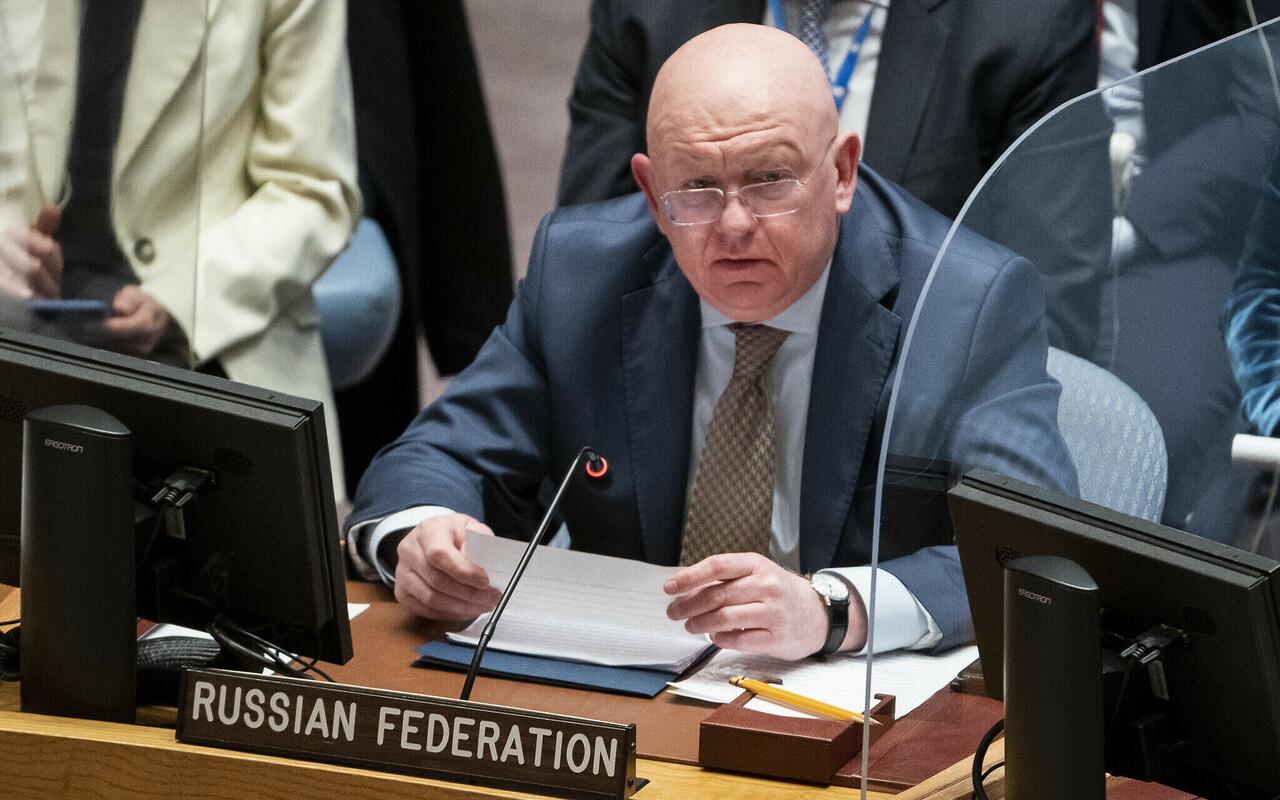
On Friday Russia’s ambassador to the United Nations, Vassily Nebenzia, informed the UN Security council that NATO countries would “start an open war” in allowing Western long-range missiles to target Russia.

“If such a decision is made, that means NATO countries are starting an open war against Russia,” Moscow’s envoy introduced. “In that case, we will obviously be forced to make certain decisions, with all the attendant consequences for Western aggressors.”

Vassily Nebenzia, permanent representative of Russia to the United Nations, via AP

Nebenzia continued, “Our Western colleagues will not be able to dodge responsibility and blame Kiev for everything.” And he echoed some key talking points of Putin’s from the day prior in explaining to the UN body, per Russian media:

“Only NATO troops can program the flight solutions for those missile systems. Ukraine doesn’t have that capability. This is not about allowing Kiev to strike Russia with long-range weapons, but about the West making the targeting decisions.”

The Kremlin’s position is that if Western missiles staring raining down on Russian soil, it will consider no distinction between Kiev forces and their NATO backers supplying the munitions. It won’t matter who is pulling the trigger.

“NATO would become directly involved in military action against a nuclear power. I don’t think I have to explain what consequences that would have,” Nebenzia concluded.

To review of Putin’s firm words the day prior…

“So this is not about whether or not to allow the Ukrainian regime to strike Russia using these weapons, but of deciding whether or not NATO countries are directly involved in the military conflict or not. If such a decision is taken, it will mean nothing short of direct participation of NATO countries, the United States, European countries, in the war in Ukraine.

This would constitute their direct participation, and this, of course, changes the very essence, the very nature of the conflict. It will mean that NATO countries, the United States and European countries, are at war with Russia. And if this is so, bearing in mind the change in the very nature of the conflict, we will make appropriate decisions based on the threats that will be posed to us,” Putin said.

It is important to note that Putin used the word “war” – a word he typically doesn’t throw around lightly. The Kremlin still calls its actions in Ukraine a “special military operation” and has yet to launch a full-scale national mobilization of the country’s manpower and resources.

It appears a highly dangerous nuclear game of chicken (among nuclear super-powers!) is being played out on the world stage…

HARD TO TAKE ANYTHING FROM PUTIN AT HIS WORD: KIRBY

Below is more from breaking White House statements issued by spokesman John Kirby ahead of an afternoon press briefing. He appears to actually be downplaying Putin’s warning. 

Kirby: “If Mr. Putin is so concerned about the safety and security of Russian sites and cities, the easiest way to alleviate those concerns is to get his troops to hell out of Ukraine and the war.”

“…He starts brandishing the nuclear sword, for instance, yeah, we take that seriously. We constantly monitor that kind of activity. He obviously has proven capable of aggression. He’s obviously proven capable of escalation over the last now going on three years. So, yeah, we take these guns seriously, but it is not something that we haven’t heard before. So, we take note of it…. We have our own calculus for what we decide to divide to Ukraine and what not.”

If Washington and London do actually pull the trigger on long-range strikes even after Putin’s new red line warning, there are a couple of hugely escalatory things Moscow might do in response.

Russia could begin directly taking out Ukrainian government buildings in the capital, such as the Verkhovna Rada building or Zelensky’s offices. It’s areal forces control the skies but have refrained from such action up to this point. Putin could also declare a formal state of war along with full national mobilization, and this war could even be declared against NATO, which would likely be a point of no return.

Meanwhile, a reminder from a prior Putin speech on the topic of nuclear confrontation with the West: “There will be no winners…”

And cue Trudeau and Canada, an influential NATO member…

BREAKING – CANADA PM TRUDEAU SAYS CANADA FULLY SUPPORTS UKRAINE USING LONG-RANGE WEAPONRY IN WAR AGAINST RUSSIA

Tyler Durden
Fri, 09/13/2024 – 14:51

Recession Now… Or Stagflation Forever

0
Recession Now… Or Stagflation Forever

Authored by Michael Pento via PentoPort.com,

The labor market is clearly weakening. But in reality, this is what needs to happen.

Short-term pain is needed to reconcile the great imbalances created by decades of free money. The alternative is intractable inflation that renders the middle class into penury.  

  • The most recent ADP employment report showed job growth in August was just 99k, far below the projected 140k net new jobs that were supposed to be created. This was the smallest number of net new jobs created in over three and a half years.

  • The August Institute for Supply Management (ISM) services index came in as expected at 51.5 vs. 51.4 in the prior month. However, the employment subcomponent dropped to 50.2 from 51.1 in July. This data backs up the figure from the ADP print; the conclusion is that while companies are not yet conducting mass layoffs, they are also not hiring either.

  • Initial unemployment claims were 5.1% higher compared to the same week last year.

  • U.S.-based employers announced 75,891 cuts in August, a 193% increase from the 25,885 cuts announced one month prior, according to the research firm Challenger Grey and Christmas. But what I found most interesting is that if you exclude the 115,762 job cuts announced in the pandemic year of 2020, last month was the highest August total since 2009, when 76,456 layoffs were recorded. Again, not massive layoffs yet, but moving steadily in the wrong direction.

  • US employers announced 79,697 hiring plans so far this year. That is down 41% from the 135,980 plans recorded through August of last year.

  • The August Nonfarm Payroll (NFP) Report showed 142k net new jobs created, less than the 161k predicted for the month. The unemployment rate fell to 4.2% from 4.3%. But once again, the downward revisions were significant. The change in total NFP employment for June was revised down by 61,000, from +179,000 to +118,000, and the change for July was revised down by 25,000, from +114,000 to +89,000. With these revisions, employment in June and July combined is 86,000 jobs lower than previously reported. One has to wonder why every single month, the Bureau of Labor Statistics (BLS) has to revise its initial report significantly lower. But still, the 142k net new jobs announced for August, which will likely be revised lower, along with the 3-month moving average of just 116k new jobs, were far below the average monthly gain of 202,000 over the prior 12 months.

Recession or not, the truth is there is no chance the economy and earnings growth will live up to Wall Street’s expectations. EPS for the S&P 500 is projected to grow by 15% next year, and the forward multiple on those earnings is 21.0x, while the 10-year average is just 17.9. Current dollar GDP and earnings growth have a very high correlation. In a soft-landing scenario, nominal GDP growth should be around 4% next year (2% inflation target + 2% trend real GDP growth). How is it possible to get 15% earnings growth in a 4% nominal GDP world? You would need a huge corporate tax cut. But instead, tax rates are most likely going up. And even if you get that miraculous 15% EPS growth, the market is already overpriced for that aspirational growth rate.

There is credible evidence that GDP and earnings growth will end up being much lower in 2025, and were not just talking about the potential election chaos and the expiration of the massive Trump tax cuts scheduled for the end of next year. The ABC Presidential Debate lowered the odds of a red sweep, which is necessary to keep the tax cuts in place. Here is a list of conditions that lead us to the conclusion that earnings and growth will be anemic at best.

  • The total non-financial debt to GDP is a record 260%. Debt-saturated economies don’t grow quickly, especially when the middle class’s living standards have been torpedoed by inflation.

  • Bank lending standards continue to tighten, and loan demand is slowing.

  • The Index of Leading Economic Indicators predicts growth of just 1% for Q4.

  • The yield curve un-inverted on September 4th for the first time since July 2022. It was the longest inversion in history. This indicator always correctly predicts a recession and/or GDP collapse that begins 3-6 months after normalizing.

  • The Real Fed Funds Rate is now more than 200 bps in positive territory and has been elevated for over a year. This has led to trouble in the economy and stock prices in the past.

  • The same is true for the shrinking Fed’s balance sheet, which has cut $2 trillion off the base money supply in the past two years.

  • As the Sahm rule points out, when the three-month average U.S. unemployment rate rises by 0.5% or more from its 12-month low, a recession is underway. That milestone was triggered in July.

And don’t forget that this tenuous economic construct exists in an environment of record asset bubbles in real estate, equities, and credit.

I must point out Fed Governor Chris Waller’s response to the most recent jobs report, which was less than anticipated but far away from a disaster. After all, the unemployment rate fell, and the average hours worked expanded. He said, “the time has come to lower the target range for the federal funds rate at our meeting.” He also said he is open to a series of rate cuts larger than 25bps if the data weakens further.

Here are some more gems from Governor Waller’s speech given before for the Council on Foreign Relations in New York., “Furthermore, I do not expect this first cut to be the last. With inflation and employment near our longer-run goals and the labor market moderating, it is likely that a series of reductions will be appropriate,”

Waller added, “we will be open-minded about the size and pace of cuts…If the data suggests the need for larger cuts, then I will support that as well.”

Ok, so I’ll give you the real reason why the Fed is starting to panic.

The stock market recently had its worst week in about a year. Therefore, the Fed felt compelled to unleash its plunge protection team. It’s so sad, but the Fed proves over and over again that it is in the business of bailing out asset prices and banks; it only pretends to care about fighting inflation and defending the middle class.

Am I being too harsh on the Fed? Could it be that the FOMC is just concerned about too many people losing their incomes and wants to prevent the pain associated with job losses?

There are two problems with that line of thinking.

  • The first is that jobs are not yet being lost. We still have positive net new job creation that is commensurate with labor force growth. So, there is absolutely no need to rush into a rate-cutting cycle; and certainly not one with oversized rate cuts.

  • The second and most important is that inflation has already wiped out most Americans’ standard of living. Therefore, the aggregate level of prices needs to decline, not just go up more slowly to a level that has destroyed the purchasing power of consumers. Hence, we need to have a recession and some pain in the labor market in the short term to ensure the economy’s long-term health. It is much better to have a recession of a small duration than to have inflation become an existential crisis for the country.

Instead, what we have is a Fed that is pouring gasoline on the inflation pyre, whose embers are still glowing white hot. This will intensify the trenchant and pernicious bifurcation between the rich and the poor. And will serve only to destroy the real incomes of those who manage to remain employed while further impoverishing the middle class in the foreseeable future.

*  *  *

Michael Pento is the President and Founder of Pento Portfolio Strategies, produces the weekly podcast called, “The Mid-week Reality Check”  and Author of the book “The Coming Bond Market Collapse.”

Tyler Durden
Fri, 09/13/2024 – 12:45