65.6 F
Chicago
Saturday, October 3, 2026
Home Blog Page 2298

Moderna Shares Tumble As R&D Cuts Follow COVID Business Slump

0
Moderna Shares Tumble As R&D Cuts Follow COVID Business Slump

Moderna’s post-pandemic future remains highly uncertain. The company revealed new plans to slash $1.1 billion in expenses by 2027 to steer toward profitability. This comes a little over a month after investors were left disappointed following management’s outlook cut on slumping vaccine sales amid a sliding Covid business. 

“Moderna’s broad clinical success and recent commercial challenges necessitate a more selective and paced approach to its research and development investment. Through portfolio prioritization and cost efficiencies, the company expects to reduce annual research and development expense by approximately $1.1 billion starting in 2027,” the Cambridge, Massachusetts-based company wrote in a press release.

Here are the key initiatives management outlined:

  • Focuses on ten product approvals through 2027

  • Expects to submit next-generation COVID vaccine for approval in 2024

  • Expects to submit flu/COVID combination vaccine for approval in 2024

  • Announces positive Phase 3 results for its RSV vaccine for high-risk adults aged 18 to 59; expects to submit sBLA for US approval in 2024

  • Announces positive Phase 3 results for its standalone flu vaccine for adults aged 65 and older relative to high-dose licensed comparator

  • Announces norovirus vaccine advances into Phase 3 study, bringing the total of non-respiratory pivotal stage programs to five, across oncology, rare diseases and first-in-class vaccines

  • Implements portfolio prioritization and cost efficiencies to reduce R&D expense by $1.1 billion, from $4.8 billion in 2024E to $3.6-3.8 billion in 2027

  • Updates and extends financial framework through 2028

In response to a sliding Covid business, Moderna said it would “expand its commercial portfolio into oncology, rare diseases, and first-in-class non-respiratory vaccines. The company expects this strategy to yield 10 product approvals over the next three years.” 

“We are still dealing with a market of uncertainty,” Moderna CFO Jamey Mock said in an interview, which Bloomberg quoted. 

Mock said, “We hope that will settle out this year, but we have to brace ourselves just in case vaccination rates continue to go down.” He noted that the R&D cuts are a sign the company “is exercising financial discipline,” adding that the need to reduce costs was based on expensive later-stage trials. 

 Moderna expects ten products to be approved for US commercial use in the next three years. 

“We do recognize the need to pace ourselves because there is now this huge bolus of important medicines to get approved,” Moderna President Stephen Hoge said in an interview.

In early August, Moderna posted a second straight quarterly loss. It downgraded its sales outlook to a range between $3 billion and $3.5 billion, down from its prior outlook of roughly $4 billion. The company does not project breaken until 2026.

At the time, Jefferies analyst Michael Yee said the forecast cut “heightens concerns, given Moderna is already running net losses and raises doubt about hitting profitability and cash burn goals.” 

Bloomberg Intelligence’s Sam Fazeli noted, “Moderna’s reduced 2024 sales guidance of $3-$3.5 billion, from $4 billion at the end of 1Q, may still not be enough, given vaccine fatigue and the competitive nature of the nascent US market. The lack of any commentary on the potential sales of its mRESVIA RSV vaccine is also a concern.” 

In markets, Moderna shares plunged 11% in premarket trading in New York. Through Wednesday’s close, shares tumbled into a bear market year-to-date.

Current Bloomberg data shows 25.6 million shares in the float are short, or about 7.48%. A steady short position has been building in a post-pandemic world. 

Moderna executives just need another pandemic to clear all the uncertainty from the air… 

Tyler Durden
Thu, 09/12/2024 – 09:05

WTF Chart Of The Day: Initial Jobless Claims Continue To Confuse

0
WTF Chart Of The Day: Initial Jobless Claims Continue To Confuse

Having torn apart the “official” BLW labor market data earlier in the month, this morning’s jobless claims data remains a mystery. Unadjusted initial jobless claims tumbled to +177k – practically a record low while adjusted claims has been flat for the last month…

Source: Bloomberg

Continuing claims was flat on the week at 1.85mm Americans…

Source: Bloomberg

But the gap between the unemployment rate and unadjusted claims continues to widen…

Source: Bloomberg

…how can The Fed cut rates with near-record-low initial jobless claims prints?

Tyler Durden
Thu, 09/12/2024 – 08:54

Enabling A “Brutus” To Slay The Elon Musk “Caesar”

0
Enabling A “Brutus” To Slay The Elon Musk “Caesar”

Submitted by Alastair Crooke

In the Washington Post on Monday, the headlines read: Musk and Durov are facing the revenge of the regulators. Former US Labor Secretary, Robert Reich, in the British Guardian newspaper, published a piece on how to ‘rein-in’ Elon Musk, suggesting that “regulators around the world should threaten Musk with arrest” on lines of that which befell Pavel Durov recently in Paris. 

As should be clear to all now, ‘war’ has broken out. There is no need for further pretence about it. Rather, there is evident glee at the prospect of a crackdown on the ‘Far-Right’ and its internet users: i.e. those who spread ‘disinformation’ or mal-information that ‘threatens’ the broad ‘cognitive infrastructure’ (which is to say, what the people think!).  

Make no mistake, the Ruling Strata are angry; they are angry that their technical expertise and consensus about ‘just about everything’ is being spurned by the ‘deplorables’. There will be prosecutions, convictions and fines for cyber ‘actors’ who disrupt the digital ‘literacy’, the ‘leaders’ warn.

Professor Frank Furedi observes: 

“There is an unholy alliance of western leaders – Prime Minister Keir Starmer, French President Emanuel Macron, German Chancellor Olaf Scholtz – whose hatred of what they call populism is undisguised. In his recent visits to Berlin and Paris, Starmer constantly referred to the threat posed by populism. During his meeting with Scholz in Berlin on 28 August, Starmer spoke about the importance of defeating “the snake oil of populism and nationalism”.

Furedi explained that as far as Starmer was concerned, populism was a threat to the power of the technocratic élites throughout Europe:

“Speaking in Paris, a day later, Starmer pointed to the far Right as a ‘very real threat’ and again used the term ‘snake oil’ of populism. Starmer has never stopped talking about the ‘snake oil of populism’. These days virtually every political problem is blamed on populism … The coupling of the term snake-oil with populism is constantly used in the propaganda of the technocratic political elite. Indeed, tackling and discrediting snake oil populists is its number one priority”.

So, what is the source of the élite’s anti-populist hysteria? The answer is that the latter know that they have become severed from the values and respect of their own people and that it is only a matter of time before they are seriously challenged, in one form or another.

This reality was very much on view in Germany this last weekend, where the ‘non-Establishment (i.e. non Staatsparteien) parties — when added together — secured 60% of the vote in Thüringen and 46% in Saxony. The Staatsparteien (the nominated establishment parties) choose to describe themselves as ‘democratic’, and to label the ‘others’ as ‘populist’ or ‘extremist’. State media even hinted that what counted more were ‘democratic’ votes; and not non-Staatsparteien votes, so the party with the most Staatsparteien votes should form the government in Thüringen. 

These have co-operated to exclude AfD (Alternative für Deutschland) and other non-Establishment parties from parliamentary business as far as legally possible — for instance by keeping them out of key parliamentary committees and the imposition of various forms of social ostracism.

It reminds of the story of the great poet Victor Hugo’s membership rejection — no less than  22 times — by the Académie Française. The first time he applied, he received 2 votes (out of 39) from Lamartine and Chateaubriand, the two greatest men of letters of their time. A witty woman of the time commented: “If we weighed the votes, Monsieur Hugo would be elected; but we’re counting them.” 

Why war?

Because, after the 2016 US election, the US political backroom élites blamed democracy and populism for producing bad election outcomes. Anti-establishment Trump had actually won in the US; Bolsonaro won too, Farage surged, Modi won again, and Brexit etc., etc.  

Elections were soon proclaimed to be out of control, throwing out bizarre ‘winners’. Such unwelcome outcomes threatened the deep-seated structures that both projected and safeguarded long-seated US oligarchic interests around the globe, by subjecting them (oh the horror!) to voter scrutiny. 

By 2023, the New York Times was running essays headlined: “Elections Are Bad for Democracy”.

Rod Blagojevich explained in the WSJ, earlier this year, the gist of what it was that had broken with the system:

“We [he and Obama] both grew up in Chicago politics. We understand how it works—with the bosses over the people. Mr. Obama learned the lessons well. And what he just did to Mr. Biden is what political bosses have been doing in Chicago since the 1871 fire:  Selections masquerading as elections”. 

“While today’s Democratic bosses may look different from the old-time cigar-chomping guy with a pinky ring, they operate the same way: in the shadows of the backroom. Mr. Obama, Nancy Pelosi and the rich donors—the Hollywood and Silicon Valley élites—are the new bosses of today’s Democratic Party. They call the shots. The voters, most of them working people, are there to be lied to, manipulated and controlled”. 

“The Democratic National Convention in Chicago next month will provide the perfect backdrop and place [for appointing a] candidate, not the voters’ candidate. Democracy, no. Chicago ward-boss politics, yes”.  

The problem was that the revealing of Biden’s dementia had pulled the mask from the system. 

The Chicago model is not so very different from how EU democracy works. Millions voted in the recent European parliamentary elections; ‘Non-Staatsparteien’ parties chalked-up major successes. The message sent was clear — yet nothing changed. 

Cultural War

2016 represented the onset of cultural war, as Mike Benz has described in great detail. A complete outsider, Trump had crashed through the System’s guardrails to win the Presidency. Populism and ‘disinformation’ were the cause, it was held. By 2017, NATO was describing ‘disinformation’ as the greatest threat facing western nations.

Movements designated as populist were perceived as not simply hostile to the policies of their opponents, but to élite values too.

To combat this threat, Benz, who until recently was directly involved in the project as a senior State Department official focused on technology issues, explains how the backroom bosses pulled an extraordinary ‘sleight of hand’: ‘Democracy’ they said, was no longer to be defined as a consensus gentium — i.e. a concerted resolve amongst the governed; but rather, was to be defined as the agreed ‘stance’ formed, not by individuals, but by democracy-supporting institutions.

Once re-defined as ‘an alignment of supporting institutions’, the second ‘twist’ to the democracy re-formulation was added. The Establishment had foreseen a risk that were a direct info-war on populism pursued, they themselves would be portrayed as autocratic and imposing top-down censorship. 

The solution to the dilemma of how to pursue the campaign against populism, according to Benz, lay in the genesis of the ‘whole of society’ concept whereby media, influencers, public institutions, NGOs and allied media would be corralled and pressured into joining an apparently organic, bottom-up censorship coalition focussed on the scourge of populism and disinformation. 

This approach — with the government standing at ‘one removed’ from the censorship process — seemed to offer plausible deniability of direct government involvement; of the authorities acting autocratically.

Billions of dollars were spent in raising up this anti-disinformation eco-system in such a way that it appeared to be a spontaneous emanation out of civil society, and not the Potemkin façade that it was.  

Seminars were conducted to train journalists on Homeland Security disinformation best practices and safeguards — to detect, mitigate, dismiss and distract. Research funds were channelled to some 60 universities to found ‘disinformation laboratories’, Benz reveals.

The key point here is that the ‘whole of society’ framework could facilitate a blending back into the policy mainstream of the long timeframe and largely unspoken (and sometimes secret) bedrock structures of foreign policy — on which foundation many key élite financial and political interests are leveraged. 

An outwardly bland ideological alignment focussed on ‘our democracy’ and ‘our values’ would nonetheless allow for the re-integration of these enduring structures to foreign policy (hostility to Russia; support for Israel; and antipathy towards Iran) to be re-formulated as the appropriate rhetorical slap in the face to the Populists.

The war may escalate; It may not end with a disinformation eco-system. The New York Times in July posted an article arguing how The First Amendment is Out of Control and in August another piece entitled, The Constitution is Sacred. Is it Also Dangerous?

The war, for the moment, is targetted at the ‘unaccountable’ billionaires: Pavel Durov, Elon Musk and his ‘X’ platform. The survival or not of Elon Musk will be crucial to the course of this aspect of the war: The EU’s Digital Service Act was always conceived to serve as ‘Brutus’ to Musk’s ‘Caesar’.

Throughout history, self-regarding and self-enriching élites have become dangerously contemptuous of their peoples. Crackdowns have been the usual first response. The cold reality here is that recent elections in France, Germany, Britain and for the Euro-parliament reveal the deep distrust and dislike of the Establishment:

“The alienation is worldwide, against the postmodern West. Europe will either distance itself from it, or become embroiled in the detestation of the “privileged ci-devant”. The end of the dollar is indeed the analogue of the abolition of feudal rights. It is inevitable, but it will also cost Europeans dearly”.  

An eco-system of propaganda does not restore trust. It erodes it.

Tyler Durden
Thu, 09/12/2024 – 06:30

Kim Jong Un Vows To Exponentially Boost Nuclear Arsenal In Response To US Escalation

0
Kim Jong Un Vows To Exponentially Boost Nuclear Arsenal In Response To US Escalation

While on Tuesday VP Harris and former president Trump were squaring off in a debate which only touched on foreign policy a couple of times, and briefly related to Ukraine and Gaza, North Korea’s leader Kim Jong Un issued statements vowing to “exponentially” boost the nation’s nuclear arsenal.

Kim gave a speech marking the 76th founding anniversary of his government at the start of this week. He said that a nuclear overhaul is needed to defend the country from “hostile” forces and that North Korea faces “a grave threat” as a result of the “reckless expansion” the United States-led military bloc in the region.

KCNA via Reuters

North Korea will “redouble its measures and efforts to make all the armed forces of the state, including the nuclear force, fully ready for combat,” he sated.

In particular Kim was reacting to a new US-South Korean defense agreement signed in July. The new agreement allows for the integration of US nuclear weapons and South Korean conventional weapons to defend the peninsula from the nuclear-armed north if need be.

Pyongyang has been seen as engaged in heightened nuclear saber-rattling over the last year, especially following the US decision to at times park a nuclear submarine at South Korean port. The north has also frequently condemned joint US-South Korean military drills, which it denounces as “invasion rehearsals”.

Seoul and the West at this point are deeply worried that the north could renew banned nuclear tests. The last known North Korean nuclear test was in 2017.

Regional analysts have pointed out that these warnings of ‘exponential’ increases in nukes began in 2022. Yang Uk, a research fellow at the Asan Institute for Policy Studies, has been cited in international reports as saying, “From the end of the following year, they started to mention ‘exponential increases’,” – he said in reference to the 8th Party Congress held in 2021.

“We believe that by 2027 North Korea can secure enough nuclear material for about 200 warheads and by 2030, this can reach 300,” Yang added.

Tyler Durden
Thu, 09/12/2024 – 05:45

Watch Live: SpaceX Polaris Dawn Astronauts Attempt Historic Private Spacewalk

0
Watch Live: SpaceX Polaris Dawn Astronauts Attempt Historic Private Spacewalk

Billionaire Jared Isaacman and SpaceX employee Sarah Gillis are minutes away from attempting the first-ever commercial spacewalk from their Crew Dragon spacecraft. 

On Wednesday, the Polaris Dawn crew of four civilian space astronauts unlocked a major milestone…

Here’s the latest space mission update from Polaris Dawn on X:

The Polaris Dawn crew completed their first day on-orbit, also known as Flight Day 1. After a successful launch by SpaceX’s Falcon 9 rocket to low-Earth orbit from Launch Complex 39A at NASA’s Kennedy Space Center in Florida at 5:23 a.m. ET, the crew took off their spacesuits and began their multi-day mission.

Shortly after liftoff, the crew began a two-day pre-breathe protocol in preparation for their anticipated spacewalk on Thursday, September 12 (Flight Day 3). During this time, Dragon’s pressure slowly lowers while oxygen levels inside the cabin increase, helping purge nitrogen from the crew’s bloodstreams. This will help lower the risk of decompression sickness (DCS) during all spacewalk operations.

About two hours into Flight Day 1, the crew enjoyed their first on-orbit meals before engaging in the mission’s first science and research block and testing Starlink, which lasted about 3.5 hours.

About two hours into Flight Dragon made its first pass through the South Atlantic Anomaly (SAA), a region where Earth’s magnetic field is weaker, allowing more high-energy particles from space to penetrate closer to Earth. Mission control operators and the crew worked closely to monitor and respond to the vehicle’s systems across all high-apogee phases of flight, particularly through the SAA region.ay 1, the crew enjoyed their first on-orbit meals before engaging in the mission’s first science and research block and testing Starlink, which lasted about 3.5 hours.

Mid-day, the crew settled in for their first sleep period in space, during which Dragon will perform its first apogee raising burn. Orbiting Earth higher than any humans in over 50 years, the crew will rest for about eight hours ahead of a busy day on Flight Day 2.

Most excitingly, during its first orbit, Dragon reached an apogee of approximately 1,216 kilometers, making Polaris Dawn the highest Dragon mission flown to date. Following a healthy systems checkout, the crew and mission control will monitor the spacecraft ahead of the vehicle raising itself to an elliptical orbit of 190 x 1,400 kilometers at the start of Flight Day 2.

*Developing…  

Tyler Durden
Thu, 09/12/2024 – 05:25

How Does One Hedge Against Open Stupidity?

0
How Does One Hedge Against Open Stupidity?

Authored by Matthew Piepenburg via VonGreyerz.gold,

How To Hedge Anti-Heroes?

How does one hedge against open stupidity?

Left, right or center, our policy makers – from parliaments and executive branches to central banks and think tanks – have taken the world closer to war, immigration disasters, infrastructure failures, credit traps, wealth inequality, social unrest and currency destruction than any other time in recent memory.

Like myself, many are asking, privately or publicly: How did we get to this historical economic, social and political inflection point?

Perhaps the answer lies, at least in part, from trusting false idols, false slogans and even false notions of success.

The Philosophy of Success

Aristotle included aspects of the heroic in his definition of Success; one was “successful” who made it a priority to serve something larger than one’s self.

But between Paris, Virginia and Paris, France, I’ve often discovered that many who make political power or dollars an end in itself have missed the bullseye of thinking beyond their own interests…

My grandfather was a pilot in the Second World War. Never, not even once, did he speak of aerial combat or brag of a kill.

By the end of the Battle of Britain, hundreds of RAF pilots had perished, but England remained free. As Winston Churchill famously remarked when referring to these pilots:

“Never in the field of human conflict was so much owed by so many to so few.”

But when I consider the embarrassing, DC/Wall Street history of self-interest at the expense of public interest, many of our modern “success stories” boil down to this:

“Never in the field of human vanity was so little owed by so few, to so many.”

Today’s Mis-Understanding of “Success”

As recent whiz-kids from Mark Zuckerberg and Adam Neuman to Sam Bankman Fried, or ARC to Theranos remind, so many of our former “heroes” are anything but heroic.

Like Wall Street, DC has even less heroes to admire. The historical evidence of this is worth a brief reminder.

Wilson

Unlike Thomas Jefferson, who would have fought to the death to prevent a private central bank from taking over our economy and “coin,” Woodrow Wilson let a private bank raid our nation’s economic destiny in exchange for his own political self-interest when signing the Fed into law in 1913.

Andrew Jackson previously described the very notion of such a private central bank as the “prostitution of our government for the advancement of the few at the expense of the many.”

The unprecedented wealth inequality that exists today in America is proof that Jackson was right.

FDR

It was not a local bank run that caused the markets to tank in 1929; rather it was the now all-too-familiar low-interest rate policy/pattern and debt orgy of the prior and roaring 20’s that caused markets to grow too hot – a theme repeated to this day in market bust, after market bust–from 1929 to 1987, 2000 to 2008 or 2020 to the next disaster looming off our bow.

FDR helped create a subsequent template whereby America solves old debt problems, by well…taking on more debt paid for with debased money.

By removing the dollar from the gold exchange, FDR, like other anti-heroic actors to come, focused on manipulating the US currency rather than addressing US productivity—the veritable “P” in GDP.

FDR’s macro policies interfered with the hard but informative lesson of free markets, namely: Deep recession always follows deep debt. There’s just no such thing as a free ride…

Policy makers, however, like to sell free-rides to get or stay elected.

As I recently argued with math rather than emotion, the net result has been the death of democracy, which has piggy-backed off an equally empirical death of capitalism.

Nixon

In 1971, Nixon was staring down the barrel of an economy on the brink of bad news.

The gold standard, revived by the Post World War II Bretton Woods Accord (and the heroic fiscal restraints of Eisenhower and Martin) meant the dollar was once again tied to a restraining asset upon which global markets and trade partners relied.

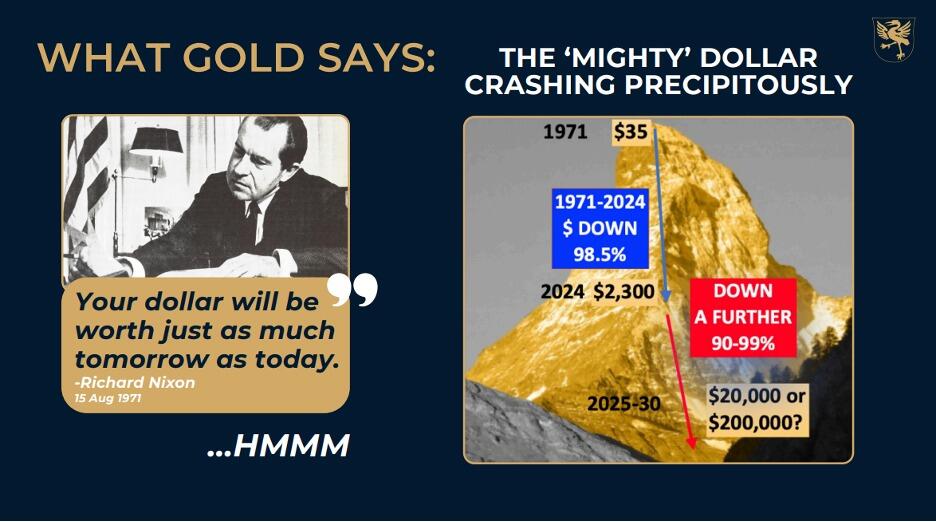
But in a move similar to FDR in the 30’s, Nixon jettisoned the gold standard and once again welched on US dollar holders and currency-honest trade partners overseas in order to retain power for himself via unlimited dollar liquidity.

He promised the USD would remain as strong as ever. He lied. It has lost 98% of its purchasing power vs. gold since 1971.

Gold, however, is far more honest in its actions than politicians are with words:

In short, and as always, the currency was sacrificed to “save” a broke system and buy political time.

He won by a landslide.

Nixon’s policies strengthened the template for a now trend-setting perversion of free market price discovery via a familiar pattern of:

1) removing the dollar from a gold standard,

2) lowering rates to encourage short-term speculation which

3) ends in unnaturally large market bubbles and corrections.

Look familiar?

The Greenspan Monster

The spark which set off the crash of 87′ was the ironic fear/rumor that the new Fed Sheriff in town (Alan Greenspan) might put an end to the Wall Street binge party by raising rates in a “Volcker-like” scenario.

And so, in a single day, the stock index suddenly dropped 23% – double the 13% declines on the worst day of the 29 Crash.

But even more astounding than this Black Monday was the Lazarus-like resurrection of the market recovery on the White Tuesday to follow. By 12:30 PM the next day, the market saw massive buy orders which, in a miraculous swoop, stopped the panic.

The Greenspan Fed was clearly no “Volcker 2.0” (or Bill Martin either), but instead, this patient-zero of the current bubble cycle came to the rescue of wayward markets and an over-valued Wall Street.

That is, rather than allow painful corrections (i.e. natural market hangovers or what the Austrians call “constructive destruction”) to teach investors a lesson about derivatives, leverage and other land mines dotting the S&P futures pits (which dropped by 29% in a single day), the Fed came in with buckets of cheap money and thus destroyed any chance for the cleansing, tough-love of naturally correcting markets.

Modern Wall Street – Almost Nothing but Anti-Heroes

Self-seeking, career-preserving policy makers who create environments where the dollar is unrestrained, credit is cheap and regulation is lax (or favors “creativity”) stay popular, get rich and keep their jobs.

The mantra everyone knows in Wall Street is simple: “Bears get fired and bulls get hired,”

Such thinking has set a stage where clever market players are free to scheme their ways into ever-increasing bubbles which enrich insider whales and crush the middle-class/retail plankton.

The Exchange Pits and the Modern Derivatives Cancer

Irrational credit expansion creates a cancer to form in every asset class, including within the once humble mercantile exchange.

It was in this former cob-web-modest Chicago-based exchange where another anti-hero, Leo Melamed, applied the notion of using futures contracts (originally and modestly created to help humble farmers and suppliers adjust for price volatility) to global currencies.

Shortly thereafter, Melamed, having conferred with well-paid “advisors” like Greenspan and other easy-money, self-interested minds (including Milton Friedman), got the green light to open currencies to an entirely new level of speculative alchemy via addictive leverage.

Four decades later, the volume of currency (and risk) traded in 1 hour on the bankers-only commodities exchange exceeded the annual volume of funds traded on the original, farmers-only MERC.

Now, like all post-71 markets, the exchange pits have morphed into a casino with an astonishing 50,000X growth based on derivative time bombs that set up 100:1 ratios of hedging volume to the underlying activity rate.

These “modern derivative pits” (now surpassing the quadrillion levels in notional risk) are nothing more than levered and cancerous hot potatoes whose degree of risk and intentional confusion will be a party to the next liquidity crisis.

In short, this is not our grandfather’s MERC…

Long-Term Capital Management

In yet another example of the non-heroic, we saw the 1998 collapse of LTCM—aka, Long Term Capital Management —a hedge fund leveraging over $125B at the height of its drunken splendor.

This Greenwich, CT-based creation of the not-so-heroic John Meriwether, with a staff of the best and brightest Wall Street algorithm writers and Nobel Laureate advisors, stands out as a telling reminder of three repeated observations regarding Wall Street:

1) The smart guys really aren’t that smart,

2) wherever there is exaggerated leverage, a day of reckoning awaits, and

3) the Fed will once again come to the aid of Wall Street (its real shadow mandate) whenever its misbehaving “elites” get caught in yet another market DUI—that is trading under the influence of easy credit and hence easy leverage.

Of course, the pattern (and lesson) after LTCM was not headed, it simply continued…

The Dot.Com Anti-Heroes…

Just as the smoke was rising from the Connecticut rubble of LTCM, another classic asset bubble misconstrued as free-market prosperity was playing itself out in the form of a dot.com tech hysteria. 

In retrospect, the dot.com implosion seems obvious. But even at the time it was happening, that market (precisely like today’s) felt, well: Immortal, meme-driven and surreal.

Consider Dell Inc. It started at $0.05 per share and grew to $54.00/share (a 1,100X multiple), only to slide back to 10.00/share.

Today, similar unicorns abound and the magnificent 7, which comprise 30% of the S&P’s market cap (while violating every principal of the anti-trust laws I studied in law school) continue to act as sirens seducing FOMO sailors to the fatal rocks.

The dot.com champagne party of the 1990’s, like its predecessor in the dapper 1920’s, ended in ruins, with the S&P down 45% and the wild-child NASDAQ off its prior highs by 80% in 2003.

Today’s tech, real estate and bond bubbles, by the way, will be no different in their eventual fall from grace…

Playing with Rates Rather than Reality

In the rubble of the dot.com bubble, the market-enamored policy makers at the Fed began the greatest rate reduction yet seen, resulting in a wide-open spigot for more easy credit, leverage and hence debt-induced market deformations.

That is, they solved one tech bubble crisis by creating a new real estate bubble.

A wide and embarrassing swath of wasteful M&A, stock-by-backs and LBO deals also took place.

Highlights of this low point in “American deal making” include GE’s dive from $50 to $10 share prices. Net result? Did GE’s Mr. Jeffrey Immelt take his lumps heroically? Did the company learn the necessary lessons of reckless speculation in the fall from its 40X valuation peaks?

No. Instead, GE’s CEO took a bailout…

Larry Summers

And then there’s the endless Larry Summers, the veritable patient-zero of the derivatives cancer…

Larry Summers was the president of Harvard. He worked for Clinton; served as a Treasury Secretary. He made lots of opinionated (and well paid) speaking appearances. Even Ray Dalio hangs with him.

But let’s not let credentials get in the way of facts. As La Rouchefoucauld noted centuries ago, the highest offices are not always – or even often – held by the highest minds.

Opinions, of course, differ, but it’s hard not to list Larry Summers among the key architects behind the 2008 financial debacle “Where Larry Summers Went Wrong.“

Most veterans of recent market cycles pre and post 08, concede that OTC derivatives were the heart of the 2008 darkness.

Bullied Hero

During this period, Brooksley Born, then head of the CFTC (Commodity Futures Trading Commission)- openly warned of the derivative dangers of, well…derivatives.

But in 1998, then Deputy Treasury Secretary Larry Summers telephoned her desk and openly bullied her: “I have 13 bankers in my office,” he shouted, “who tell me you’re going to cause the worst financial crisis since World War II” if she continued moving forward in bringing much needed transparency and reporting requirements to the OTC market.

Larry then went on to attack Born publicly, condescendingly assuring Congress that her concerns about the potential unwieldiness of these instruments were exaggerated. As he promised:

“The parties to these kind of contracts are largely sophisticated financial institutions that would appear to be eminently capable of protecting themselves from fraud and counter-party insolvencies.”

But fast-forward less than a decade later (and an OTC derivatives market which Summers helped take from $95 Trillion to $670 Trillion), and we all learned how those “eminently capable” and “largely sophisticated financial institutions” (Bear, Lehman, Goldman, AIG et al…) created the worst financial crisis (and bailout) since World War II.

More Bad Ideas, More Anti-Heroes

It’s worth remembering that neither Greenspan in 01 nor Bernanke in 08 ever saw these market crashes coming. Of course, neither did any of the “heroes” running the private banks or the US Treasury.

Powell will be no different. The Fed’s record for calling a recession or market implosion in 0 in 10.

Revisiting “Success”

A man, Walt Whitman reminds, is many things. Most would agree that we are philosophically, economically, morally and historically designed to screw up – over and over again.

What is less forgivable is not a lack of perfection, but rather a lack of accountability, even humility.

We can’t all be brave RAF pilots.

But sometimes, just being honest is heroic enough.

Unfortunately, the anti-heroes touched upon above, and the countless other Wall Street “supermen” (whose executive to worker salary ratios are at 333:1) do not represent anything close to serving a cause greater than one’s own income or position.

Anti-heroes like those above help explain the graph below and the new Feudalism that has replaced American capitalism:

More Candor—Less Anti-Heroes

We stand today at the edge of a market, social and political cliff built upon unprecedented levels of post-08 debt and money supply expansion.

The current public debt of $35T and a government debt-to-GDP ratio of 125-30% is mathematically unsustainable and makes real (rather than debt-driven) growth objectively impossible.   

Today, we and our children’s generation are the inheritors of the sins of such anti-heroes.

If easy money leads to market bubbles, drunk investing and sobering crashes, then we can all see what’s coming as Powell inches predictably from rate hikes, to a rate pause to rate cuts.

Next, will come a deflationary recession and/or market correction followed by Super QE to absorb Uncle Sam’s unwanted IOUs, $20 trillion of which are projected in the next 10 years by our Congressional Budget Office.

The anti-heroes, of course, won’t say this, and they certainly won’t take accountability.

Instead, they will lie – blaming the troubles now and to come on Putin, COVID, global warming and their opposing party.

Gold, however, will be more honest. Gold is not a debate against paper or crypto money, but a voice of yesterday, today and tomorrow.

When money is expanded by 5X in just 20 years, it dilutes its value…

…which explains why gold, even at all-time-highs, is still under-valued when measured against the broad money supply:

As in every liquidity, market and political crisis throughout history, gold will store value far better than any debased currency engineered to inflate away national debt disasters with debased money.

This explains gold’s deliberately ignored tier-one asset status, its greater favor (and performance) over USTs and USDs and its historically-confirmed answer to every currency crisis since time was recorded.

It also explains why none of our Anti-heroes – from DC to Brussels – will talk about gold out loud. They are literally allergic to blunt truth, historical lessons or simple math.

For an informed minority, however, sophisticated investors will forever hedge against the golden tongues of anti-heroes with the golden bars of time and nature.


Tyler Durden
Thu, 09/12/2024 – 05:00

Venezuela’s Plight By The Numbers…

0
Venezuela’s Plight By The Numbers…

Tensions remain high in Venezuela following a disputed presidential election on July 28.

According to Human Rights Watch, at least 24 people have been killed, including protesters and bystanders, as well as a member of the Bolivarian National Guard. The post-election turmoil hits hard in a country already suffering from a weak economy.

In recent years, Venezuela has faced runaway inflation, political upheavals and falling oil prices, creating an extremely difficult environment for businesses and workers. The Venezuelan economy has suffered a prolonged collapse, with triple-digit inflation and massive migration in search of better prospects.

“Venezuela has experienced a recession unprecedented for a Latin American country or globally for a country without war. The economic contraction between 2014 and 2021 exceeded 70 percent and reached its lowest point,” says Asdrúbal Oliveros, director of the consulting firm Ecoanalítica, in an interview with CNN.

The country has emerged from the hyperinflation period it experienced between 2018 and the end of 2019; however, as Statistas Anna Fleck shows in the chart below, it is still premature to consider it restored from the losses accumulated in the last decade. 

Infographic: Venezuela in Numbers | Statista

You will find more infographics at Statista

Gross Domestic Product (GDP) at current prices is slowly recovering, with an estimated value of US$102.3 billion in 2024, but remains a fraction of pre-crisis levels.

The national public debt has risen to US$4.2 trillion in 2023, further exacerbating the economic situation. Although the unemployment rate is relatively low at 5.5 percent, this figure does not fully reflect the underemployment and informal work faced by many Venezuelans.

While Venezuelan inflation is no longer the highest in Latin America, with Argentina exceeding 200 percent, it remained above 50 percent in June 2024. This economic instability continues to affect Venezuelans’ standard of living. The minimum wage has remained frozen at 130 bolivars since March 2022, but its value has been devalued to approximately $3.50. However, in May 2024, President Nicolás Maduro announced an increase in state bonuses for the public sector, which include the minimum wage, a $40 food bonus and an “Economic War Bonus” that will increase from $60 to $90.

The deterioration of finances in recent years is evident too in everyday life, with over 80 percent of the population living in poverty and 53 percent facing extreme poverty.

Tyler Durden
Thu, 09/12/2024 – 04:15

Study Links Children’s Skin Care Products To Hormone-Disrupting Chemical

0
Study Links Children’s Skin Care Products To Hormone-Disrupting Chemical

Authored by Huey Freeman via The Epoch Times (emphasis ours),

A new study found for the first time that common skin care products used by young children may increase their exposure to hormone-disrupting chemicals.

triocean/Shutterstock

The results may help guide parents to limit their children’s exposure to toxins that could harm their development, Michael Bloom, study leader and professor at George Mason University’s College of Public Health, told The Epoch Times.

“We found associations between recent use of different skin care products and higher concentrations of phthalate and phthalate-replacement compounds,” Bloom said in a press release.

Phthalates, often found in skincare products, can disrupt the endocrine system, potentially interfering with hormones. These chemicals may be added to skincare products to improve absorption, prolong fragrances, or make the product more lubricating.

“Phthalates are endocrine-disrupting chemicals, and children’s exposure has been associated with differences in body composition, neurodevelopment, and pulmonary and immune function,” the researchers wrote in the study.

“While the evidence is not definitive at present, the potential hazardous human health effects … demands a precautionary approach,” said Bloom, who has worked on several other studies involving phthalates and other potential health hazards.

Phthalate-replacement compounds are chemicals used instead of phthalates. Replacements can also be toxic.

Potential Risks Demand Precautions

Researchers from George Mason University collected data from 630 children, aged 4 to 8, across 10 different clinical sites in the United States. Each child underwent a physical examination, including a urinalysis to detect phthalate byproducts left in the body.

As part of the clinical study, parents were asked to list skin care products that had been applied in the 24 hours before the examination. These products included soaps, lotions, shampoos, cosmetics, and sunscreen. The researchers noted frequent use of skin care products among participants during this period, with most children using at least one type of soap and lotion.

The researchers also surveyed the parents about their children’s racial and ethnic backgrounds. Black participants had the highest rate of phthalates in their urine, possibly because of their choice of products and frequency of use.

“Consumers can check product labels to identify potentially harmful ingredients in skin care products and refer to websites that provide detailed information about commercially-available skin care products,” Bloom said.

The U.S. Food and Drug Administration requires manufacturers to declare their ingredients through a label. So consumers can tell whether some products contain phthalates by reading the ingredient declaration for ingredients that contain the word “phthalate.”

Common phthalates added to personal products in diethyl phthalate (DEP) and monoethyl phthalate (MEP).

However, the regulations do not require the listing of the individual fragrance or flavor, or their specific ingredients. As a result, a consumer may not be able to determine from the ingredient declaration on the label if phthalates are present in a fragrance or a flavor used in the product. Thus, some groups advise people to avoid scents and flavors.

Phthalates can also migrate from plastic packaging into products, Bloom said, suggesting that policy changes may be needed to limit children’s exposure.

The study, published Wednesday in Environmental Health Perspectives journal, was funded by the U.S. National Institute of Health (NIH) Environmental Influences on Child Health Outcomes study.

Toxic or Not? The Ongoing Debate

Although this study did not directly investigate the health risks, Bloom said other experimental studies using animal models and cell cultures have shown phthalates can affect hormone function, cause inflammation, and induce oxidative stress. These biological pathways, shared by humans, that might lead to adverse health effects in humans.

“These studies were often conducted at very high doses of phthalates, greater than those typically experienced by human populations,” Bloom said. “Still many observational studies in human populations worldwide have reported associations between exposure to some phthalates and neurocognitive problems, reproductive problems, changes in hormones, metabolic disease, and other adverse health effects, suggesting that there are toxic effects,” he added.

The results in human studies have been mixed, which makes the toxicity of these chemicals a controversial subject. Due to ethical concerns “it’s difficult to study phthalate exposure in people, especially in children,” Bloom said.

A Growing Health Concern

Previous studies have suggested widespread use of phthalates may harm human health.

A 2020 Columbia study identified that some phthalates can harm attention span in children and was linked to neurological harms.

A 2024 French study linked phthalate exposure in pregnant women to decreased placenta weight and decreased placenta to infant ratio, both of which are negative health outcomes.

The current study’s results may inform policymakers, doctors, and parents to “help limit children’s exposure to developmental toxicant,” authors of the current study wrote.

Tyler Durden
Thu, 09/12/2024 – 03:30

Turkey’s Erdogan Demands Russia Must Return Crimea To Ukraine

0
Turkey’s Erdogan Demands Russia Must Return Crimea To Ukraine

While some people think Turkey is an ally to Russia, the reality is that this “friendship” is more often shaky and could perhaps even be seen as a facade ready to collapse at any moment.

Turkish President Recep Tayyip Erdogan on Wednesday reminded the world that his country firmly reflects NATO’s view of the Ukraine war. He said in video message to 4th Crimea Platform happening in Kiev, a Ukrainian government sponsored event, that the return of Crimea to Ukraine is “a requirement of international law.”

Via Anadolu Agency

“Our support for Ukraine’s territorial integrity, sovereignty, and independence is unwavering. The return of Crimea to Ukraine is a requirement of international law,” Erdogan declared, while also stressing ongoing support for Crimean Tatar rights.

He said of the minority ethnic group commonly viewed as Turkish: “I believe that additional steps will continue to be taken to strengthen the rights of the Crimean Tatar Turks in the upcoming period.”

Turkey has long denounced not only historic persecution of the Tatars at the hands of Russians which reaches back to the 18th-19th centuries, but also the alleged persecution following Russia’s 2014 takeover of the peninsula. Erdogan stressed before the conference that Tatars must be able to live “freely, securely, and peacefully in their own homeland.”

Erdoğan added of the broader conflict, “Our sincere wish is for the war to end with a fair and lasting peace based on Ukraine’s territorial integrity, sovereignty and independence.”

The Kremlin was quick to respond, saying the following within hours after Erdogan’s speech:

“Subjects of the Russian Federation are not subject to negotiation,” Zakharova told reporters who asked about Erdogan’s remarks during the press briefing at the Foreign Ministry, adding that anyone who wants to address the issue needs to read the Russian constitution first. 

Residents of Crimea and the city of Sevastopol voted overwhelmingly to rejoin Russia in March 2014, shortly after a US-backed coup in Kiev overthrew the Ukrainian government in favor of militant nationalists. Neither Ukraine nor its Western backers have ever accepted the results of the referendum, declaring it to be an illegal “annexation.”

This isn’t the first time that the Turkish leader has expressed such a firm position, which has not made Russia happy. Turkey has also since near the start of the conflict supplied Ukraine forces with armed drones.

Turkey was central along with UN negotiators in securing the 2022-2023 Black Sea Grain Initiative, and has been a rare open line of communication to the Kremlin within NATO. It has also positioned itself as a potential future mediator of peace.

But Erdogan’s Crimea stance is yet another reminder that Turkey in the end is still a powerful NATO member, and with a Washington relationship that’s more impactful for Ankara than its ties with Moscow.

* * *

Meanwhile, using Erdogan should be more consistent…

Tyler Durden
Thu, 09/12/2024 – 02:45

Germany Suspends Schengen, Immigration Repercussion Across The Entire EU

0
Germany Suspends Schengen, Immigration Repercussion Across The Entire EU

By Mish Shedlock of MishTalk

For the first time in EU history, Germany is at the forefront of immigration suspension. Other EU countries will follow.

Image notes, I created the image using Grok, then modified the image in Photoshop to add German text, hopefully contextually accurate.

Schengen Zone

The Schengen Area (English: /ˈʃɛŋən/ SHENG-ən, Luxembourgish: [ˈʃæŋən]) is an area encompassing 29 European countries that have officially abolished border controls at their mutual borders.

Immigration Crackdown

Reuters reports Germany Tightens Controls at All Borders in Immigration Crackdown.

Germany’s government announced plans to impose tighter controls at all of the country’s land borders in what it called an attempt to tackle irregular migration and protect the public from threats such as Islamist extremism.
The controls within what is normally a wide area of free movement – the European Schengen zone – will start on Sept. 16 and initially last for six months, Interior Minister Nancy Faeser said on Monday.

The government has also designed a scheme enabling authorities to reject more migrants directly at German borders, Faeser said, without adding details on the controversial and legally fraught move.

The restrictions are part of a series of measures Germany has taken to toughen its stance on irregular migration in recent years following a surge in arrivals, in particular people fleeing war and poverty in the Middle East.

Recent deadly knife attacks in which the suspects were asylum seekers have stoked concerns over immigration. The Islamic State group claimed responsibility for a knife attack in the western city of Solingen that killed three people in August.

Polls show it is also voters’ top concern in the state of Brandenburg, which is set to hold elections in two weeks.

Scholz and Faeser’s centre-left Social Democrats (SPD) are fighting to retain control of the government there, in a vote billed as a test of strength of the SPD ahead of next year’s federal election.

“The intention of the government seems to be to show symbolically to Germans and potential migrants that the latter are no longer wanted here,” said Marcus Engler at the German Centre for Integration and Migration Research.

“We Can Do This”

Does anyone recall Chancellor Angela Merkel’s comment on immigration? For discussion, please see my September 5, 2016 post Merkel humiliated in 3rd Place Finish to AfD in State Elections; Irony of the Day

Her highness, chancellor Angela Merkel suffered a humiliating loss in German state elections on Sunday.

Merkel came in third place, to the anti-immigration, eurosceptic AfD party in her own home state in statewide elections.

Peak Merkel

Also recall my June 15, 2018 post Merkel Coalition About to Collapse Over Immigration: Peak Merkel Revisited

Horst Seehofer, Germany’s Interior Minister, threatens to start the automatic rejection of refugees by executive order – which would be the end of the coalition.

The government crisis was triggered by two unrelated events – the murder of a young girl by an immigrant, and a scandal about the granting of refugee status to illegal immigrants.

No Longer Wanted

We have gone from “We Can Do This” to “No Longer Wanted”

From Eurointelligence …

It is almost comical that as Mario Draghi presents his report on the future of Europe, Germany has the brilliant idea to re-impose border controls and suspend the Schengen system of passport-free travel. The German government has come under pressure to crack down on immigration by trying to stop refugees at the border. Nancy Faeser, the interior minister, said the reason was to protect Germany against Islamic extremism, following a series of murders and attempted murders committed by immigrants in the last few weeks. The Schengen rules require an over-riding national security interest.

The collateral damage will be huge. Austria already said it will not take in any immigrants rejected by Germany. So Austria will almost surely do the same and close its border. Nobody to the east and south-east of Germany has the physical capacity and political willingness to absorb immigrants. The Czech Republic, Slovakia, Hungary, Slovenia and Croatia will all do the same. We assume that Switzerland, not a member of the EU but a member of Schengen, will follow. Italy has no border to close, but France does. Germany has now become an active participant in the beggar-thy-neighbour refugee policies of EU member states. Except that when Germany plays this game, it has much more serious consequences. This is a serious threat to the whole idea of Schengen. This is where the unravelling of Europe could be starting.

Annalena Baerbock, the foreign minister, warned her colleagues not to endanger the EU’s migration deal, and not to succumb to the illusion that European countries can solve the refugee problem at a national level.

The border closures do not come with a change in current laws. The German border guards will have to take in anybody who mentions the word asylum. But a majority of immigrants do not. FAZ notes that Friedrich Merz wants to go much beyond the current rule. He wants the police to be able to even reject people who claim asylum. The argument he uses is that Germany’s borders only with safe countries, so it is technically impossible for anyone to claim asylum at a German land border. He also maintains that law and order within Germany have a higher priority than Germany’s obligations under international law.

Friedrich Merz is leader of the CDU and leader of the opposition to the current Traffic Light Coalition: Social Democratic Party of Germany (SPD), the Free Democratic Party (FDP) and the Greens, (red, yellow, green) respectively.

No Change in Current Laws

Schengen is enshrined in treaty. No country will propose any changes.

Instead, every county will ignore the treaty on grounds of a “higher law”.

Higher Laws

Given there are now higher laws than the EU treaties, I have a question:

When does France or Italy say the same thing about budget rules? Such logic could finally spell the end of EU and Eurozone Monetary Union (EMU) rules.

Meanwhile, back in the states ….

More Americans Call Volume of Immigrants a ‘Critical Threat’

The Washington Post reports More Americans Call Volume of Immigrants a ‘Critical Threat’

Americans’ concerns about immigration have risen sharply this year, with half of Americans saying that the large number of immigrants and refugees entering the country is a “critical threat” to U.S. interests, up from 42 percent last fall to the highest level since 2010, according to a poll by the Chicago Council on Global Affairs.

The poll found that most Americans support two proposals laid out by former president Donald Trump: using U.S. troops to stop immigrants from coming into the United States from Mexico and expanding a wall on that border.

But a larger majority of Americans oppose Trump’s proposal to put undocumented immigrants in mass-detention camps. If elected, Trump has pledged to immediately launch “the largest domestic deportation operation in American history.”

A late July Wall Street Journal poll found that voters thought Trump would handle immigration better than Harris by 53 percent to 40 percent.

Chicago Council’s poll found 50 percent of Americans say large numbers of immigrants and refugees coming into the United States is a critical threat to the country’s interests, marking the highest level in Chicago Council polling since 2010, when it was 51 percent. Concerns over immigrants as a threat peaked at 60 percent in 2002, less than one year after the Sept. 11 terrorist attacks. The United States has about 45 million immigrants, about 11 million of whom are undocumented.

“Mood on Main Street Darkens”

In the US, NFIB “Mood on Main Street Darkens” Small Business Optimism Dips

The July jump in small business optimism momentum lasted precisely one month.

What Are the Odds of Recession?

In case you missed it, please see The McKelvey Recession Indicator Triggered, But What Are the Odds?

Many eyes are on the McKelvey recession indicator. Too many? That would probably be the case if everyone believed it.

Heck, most of my own readers don’t seem to believe it. I have the odds well over 50 percent that a recession is underway. Click on the above link for discussion.

Tyler Durden
Thu, 09/12/2024 – 02:00