76.7 F
Chicago
Friday, July 31, 2026
Home Blog Page 230

Canada Rethinks Selling Its Crown Jewel Pipeline

Canada Rethinks Selling Its Crown Jewel Pipeline

Authored by Charles Kennedy via OilPrice.com,

  • The Canadian federal government may reconsider a plan to privatize the Trans Mountain oil pipeline.

  • Since the expanded TMX pipeline launched in 2024, exports to Asia—especially China—have surged, with up to 70% of shipments from British Columbia heading to Asian buyers by late 2025.

  • Officials now see TMX as a highly profitable “strategically important asset,” with potential for further expansion

The Canadian federal government may reconsider a plan to privatize the Trans Mountain oil pipeline and keep it state-owned amid a surge in appetite for Canadian crude to replace lost Middle Eastern barrels.

“The prior narrative had been that this should be returning to private hands,” the head of the government entity that owns Trans Mountain said at an event this week, as quoted by the Financial Post.

“That was in a different market and that was in a different time,” Elizabeth Wademan also said.

Indeed, this is a very different market from what it was when the government in Ottawa had to step in and buy Trans Mountain from Kinder Morgan, which quit the project under relentless pressure from climate activists who used environmental regulations to strangle the expansion project. The price tag for the nationalization deal, which took place in 2018, was about $3.3 billion, and the Trudeau government quickly signaled it would start looking for buyers as soon as possible.

By 2024, the cost of the pipeline expansion project had swelled to about $23 billion, but the project, somewhat surprisingly, was completed, and the expanded pipeline launched in May of that year, running at three times its original capacity or a total of 890,000 barrels daily.

The destination for these barrels was the vast Asian market, as a way to diversify away from the U.S., which has for decades been pretty much the only foreign market for Canadian crude—and an export conduit, with the oil transported from Canada to the U.S. Gulf Coast, and from there, to markets overseas. With the new TMX, Canadian crude producers got a new, more convenient channel to Asian energy buyers.

It did not take long for the effect to be felt: between the launch of the expanded pipe and spring 2025, the average flow rates for shipment to China reached 207,000 barrels daily. That compares with an average of 173,000 barrels daily pumped to the United States. Since spring, the shift has become even more marked. By October 2025, as much as 70% of Canadian crude exported from the British Columbia coast was going to China. Now, everyone else in Asia is also interested.

The Trans Mountain pipeline is a “strategically important asset”, Trans Mountain Corp.’s Wademan said this week, suggesting the project could be expanded further, with more “energy corridors” that would add value for Canadians, the Financial Post reported.

“Let’s look where we are, and look how important energy security is, and look how incredibly profitable this asset is; there’s a lot,” Wademan said.

“There’s a lot of merit to holding onto it and realizing that full value.”

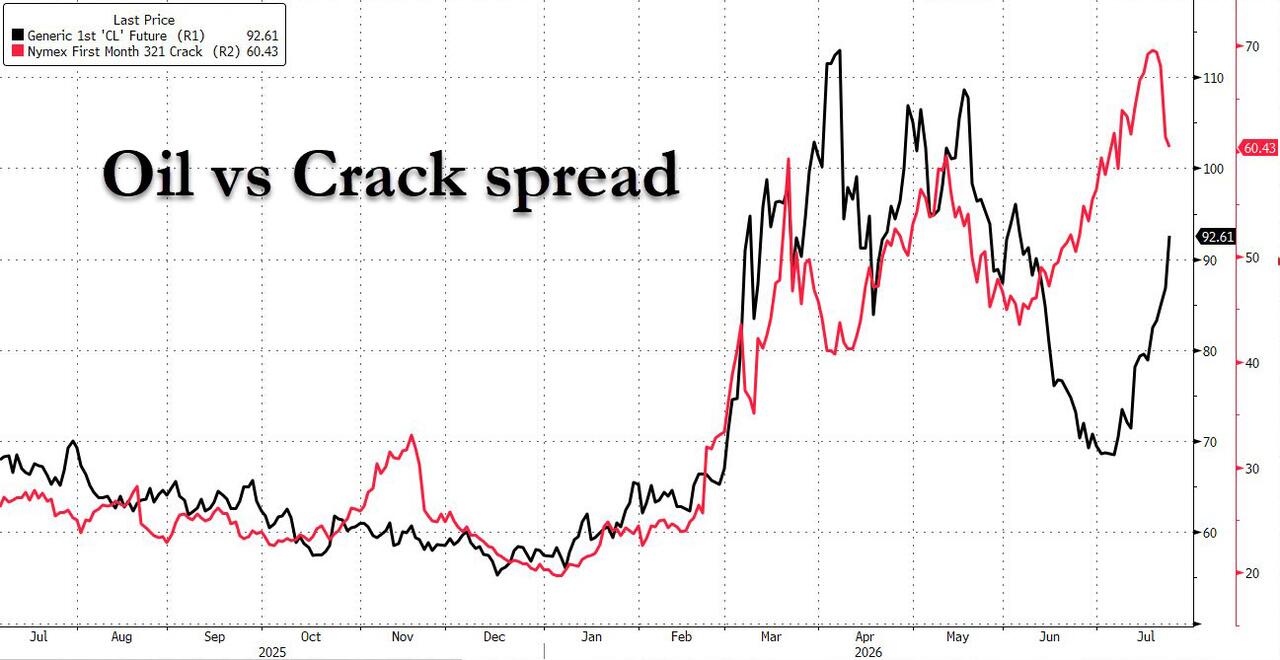
Indeed, it would be profitable for the federal government to hold on to the infrastructure as the price of Canadian crude inches closer to $90 per barrel—a level hardly seen as possible just five years ago, and even more recently. TMX has turned into a game-changer for the Canadian oil industry and it will be in the center of the “golden opportunity” that Canada has to become a bigger global player in both oil and gas.

Canada has a “golden opportunity” to become a major global oil player as the war in the Middle East limits sources of crude and natural gas, the head of the International Energy Agency, Fatih Birol, said earlier this month, adding that “The cost of missing this train will be incredible.” It seems the Canadian government is acutely aware of that risk and plans to avoid it and make the best of the country’s resources in a fascinating departure from the previous government’s focus on emission reduction and alternative energy.

Tyler Durden
Mon, 05/18/2026 – 06:30

Behind Turkey’s Gold Sales: The Biggest Ever Plunge In Foreign Reserves

Behind Turkey’s Gold Sales: The Biggest Ever Plunge In Foreign Reserves

Shortly after the Iran war started, with gold unexpectedly tumbling, we showed that the reason behind gold’s paradoxical move – after all, the precious metal has traditionally been a store of value in times of geopolitical stress – was the furious liquidation of gold by emerging markets, in this case Turkey, scrambling to obtain reserve dry powder so Ankara could cover soaring costs of energy imports.

And indeed, the latest central bank data showed that Turkey’s foreign reserves had their biggest monthly decline on record in March, as the Iran war triggered global selloffs in emerging market assets and strained the lira.

According to balance-of-payments data released on Wednesday, Turkey’s official reserves cratered by $43.4 billion in March. Part of the decline reflected state intervention to offset portfolio outflows. The current-account deficit, meanwhile, widened to $9.7 billion in March from $7.3 billion in February as a result of soaring commodity prices.

A major energy importer, Turkey has been hit hard by higher oil and gas prices caused by the effective closing of the Strait of Hormuz and the resulting disruptions to world supplies of crude and refined products. Meanwhile, global banks have started changing their formerly favorable outlook on the lira, citing the exploding current-account deficit. Should inflation pressures persist, Turkey will have no choice but to pursue another accelerated devaluation of the Turkish lira. 

“As international institutions continue to raise their average oil price forecasts for 2026, disruptions in supply chains and ongoing regional tensions — and their potential negative impact on transportation and tourism revenues — keep upward risks alive in year-end projections” for Turkey, said Istanbul-based economist Haluk Burumcekci.

Turkish central bank Governor Fatih Karahan said last week that the ratio between the current-account deficit and gross domestic product would be “below historical averages” this year while acknowledging the upside risks.

Since President Erdogan’s reelection in 2023, a new economic team has sought to stabilize Turkey’s external finances by cooling demand through conventional tools such as higher interest rates and restrictions on credit growth.

The central bank has kept its benchmark rate at 37% for two straight meetings but has effectively lended from a costlier rate of 40% since the outbreak of the Iran war — a technical measure to tighten liquidity without instituting a formal rate hike.

Inflationary pressures persist, however, with annual price growth picking up to 32.4% in April, a number that is set to rise higher in the coming months. 

Tyler Durden
Mon, 05/18/2026 – 05:45

Trump Tells Iran ‘Clock Is Ticking, Move Fast’ After New Peace Proposal As Analysts Predict Likely Return To War

Trump Tells Iran ‘Clock Is Ticking, Move Fast’ After New Peace Proposal As Analysts Predict Likely Return To War

Update(1410ET): President Trump has warned Iran on Sunday that the “clock is ticking” as Pakistani-mediated talks have not only stalled, but show no signs at all of restarting anytime soon. “They better get moving, FAST, or there won’t be anything left of them,” he wrote on Truth Social. “TIME IS OF THE ESSENCE!”

He spoke the same day with Israeli Prime Minister Benjamin Netanyahu, who along with Lindsey Graham has been calling for resumption of robust anti-Tehran action to ensure Iran can never go nuclear. Trump’s words have been somewhat of a familiar refrain going back several weeks. 

As we detailed below, Iran says it received a counter proposal of ‘5 conditions’ for peace from the White House. In many ways they are directly opposite the 5 conditions Iran sent to the US last week, which Trump had rejected as “garbage”.

But as yet there’s been no indicator that the US side has attached a timeline to its latest demands. Trump is perhaps pushing this new “clock is ticking” as a timeline threat of sorts. But again, there was no specific date included in the fresh warning.

Last week Bloomberg Intelligence circulated a report titled, Iran Rejects Trump’s Offer – Return to War Likely. It concluded:

The diplomatic dance continues: the US and Iran exchanged offers yet again. But they remain far apart, shooting maximalist demands at each other. A comprehensive peace deal is unlikely to materialize. We think the US and Iran will likely return to strikes. But we expect an intense exchange of fire to be temporary and reduce to lower-levels of fighting – what we call the new normal in this protracted conflict. 

More from the Bloomberg Intelligence analysis: 

Short but Intense… and Costly

Trump doesn’t want long war. His popularity is taking a hit as its economic impact is being felt.

We think Trump will likely revert to a short air and missile strike campaign on Iranian infrastructure, military positions, and energy assets while simultaneously continuing the blockade. Tehran will likely respond with strikes of its own, both on US military assets and America’s regional partners. But we expect this to be a short bombardment, rather than the sustained, high-intensity strike campaign that marked the beginning of the war.

The war has already imposed a heavy economic cost. Oil markets flipped from an expected record surplus to historic supply disruption. Major central banks, facing fresh inflation risks, are turning more hawkish. Consumers now pay more for energy, while their borrowing costs also rise, and the future grows more uncertain.

The longer the Strait of Hormuz remains closed, the more it will drain the oil stockpiles cushioning governments, companies, and consumers today. Once inventories run thin, prices need to do the hard work: rising high enough to curb demand back in line with available supply.

Since that report was issued, nothing has changed, and both sides seem to have dug in their heels even more.

*  *  *

According to a Sunday report from Iran’s semi-official Fars news agency, the United States has laid down a firm, take-it-or-leave-it ultimatum to Tehran. Both sides are still trying to patiently wait out the Hormuz crisis, hoping to inflict more economic pain on the other until they blink.

At the top of the list, the US is demanding a near-total dismantling of Iran’s atomic ambitions, “allowing only one Iranian nuclear facility to remain operational.” 

Anadolu Agency

The list includes direct rejections in response to Iran’s own five conditions from a week ago, which President Trump said were “unacceptable” and “garbage”.

For example the US is refusing to pay compensation for damage caused during strikes on Iranian territory – a ‘maximalist’ sticking point which Tehran had demanded previously.

Washington is also reportedly insists that 400 kilograms of enriched uranium be transferred from Iran to the US, while only one active nuclear facility would remain operational inside the Islamic Republic.

Iran for its part has recently vowed to never transfer its nuclear material out of the Islamic Republic, calling the issue a matter of national sovereignty and energy security which it alone has say over. This after even Russia offered to take it.

The newly reported five conditions by the US side further states that the US does not intend to release more than 25% of frozen Iranian assets. Tehran has demanded the dropping of all US sanctions as a key basis for lasting settlement.

Here are the five newly proposed Washington conditions, which some pundits have called ‘wishful thinking’:

  1. No war compensation from US
  2. Give up 400kg of Highly Enriched Uranium to US 
  3. Iran can only have on nuclear facility to remain active
  4. Not more than 25% of frozen assets to be unfreezed 
  5. Halting war on all fronts depends on negotiations

So this leaves a huge distance between the Washington list and Tehran’s list, as the seemingly unbridgeable gulf remains, also as Iran is digging in its heels.

As a reminder, the below is the Islamic Republic’s list, which it hasn’t backed down from. It has offered the following as the only basis on which to restart talks:

  1. Ending the war on all fronts, including Lebanon
  2. Lifting all sanctions
  3. Releasing frozen Iranian assets
  4. Compensation for war damages and losses
  5. Recognition of Iran’s sovereign rights over the Strait of Hormuz

While a Pakistani-mediated ceasefire managed to take effect on April 8, subsequent talks in Islamabad completely collapsed, but then President Trump later extended the truce indefinitely, likely to buy time and to figure out “what’s next” – while seeking a complete blockade of Iranian oil exports, and of all vessels entering or exiting Iranian ports.

With Washington demanding total disarmament and Iran demanding control over the world’s most critical oil transit choke point, the stage is set for a likely coming renewal of direct clashes, given the zero sum demands of each side now on the table.

Tyler Durden
Mon, 05/18/2026 – 05:10

So Where Does Wokeism Come From? (Spoiler Alert: The French, Of Course!)

So Where Does Wokeism Come From? (Spoiler Alert: The French, Of Course!)

Authored by Monica Showalter via AmericanThinker.org,

How did wokeism happen?

A French intellectual, who goes by Brivael Le Pogam on X, has written a tightly focused and brief explanation of it worthy of Eric Hoffer, putting his finger on the thinking of French philospher-historian Michel Foucault, French philosopher Jacques Derrida, and French philospher-literary critic Gilles Deleuze, the first of whom claimed there was  no such thing as truth, just power relationships, the second of whom claimed truth was malleable, and the third of whom made the really weird claim that seeds were greater than fully developed trees because becoming was more important than being, poor romantic devil.

Married to guilt-tripping academics of the U.S., he explains how wokery was the result.

His tweet is in French, but Grok translate kicks in on my site, so I will post the translation below the tweet.

Grok translate, (with censorship from me of one cuss word that means merde): (emphasis ours)

I want to offer my apologies, on behalf of the French, for giving birth to French Theory (which in turn gave birth to the worst of all ideological monstrosities: wokism).

We gave the world Descartes, Pascal, Tocqueville. And then, in the intellectual ruins of post-1968, we gave Foucault, Derrida, Deleuze. Three brilliant men who forged, in the elegance of our language, the ideological weapon that today paralyzes the West.

We must understand what they did.

Foucault taught that truth does not exist, that there are only power relations disguised as knowledge. That science, reason, justice, the medical institution, the school, the prison, sexuality—everything is merely a staging of domination.

Derrida taught that texts have no stable meaning, that every signifier slips away, that every reading is a betrayal, that the author is dead and the reader reigns supreme.

Deleuze taught that we should prefer the rhizome to the tree, the nomad to the sedentary, desire to the law, becoming to being, difference to identity.

Taken individually, these are debatable theses. Combined, exported, and popularized, they form a system. And that system is a poison.

For here’s what happened.

These texts, unreadable in France, crossed the Atlantic. The departments of Yale, Berkeley, and Columbia absorbed them in the 1980s. They found there a soil that did not exist among us: American Puritanism, its racial guilt, its obsession with identity. French Theory married this substratum, and the child of that union is called wokism.

Judith Butler reads Foucault and invents performative gender. Edward Said reads Foucault and invents academic postcolonialism. Kimberlé Crenshaw inherits the framework and invents intersectionality. At every step, the matrix is French: there is no truth, there is only power, so every hierarchy is suspect, every institution is oppressive, every norm is violence, every identity is constructed and thus negotiable, every majority is guilty.

That’s how three Parisian philosophers, who probably never imagined their practical consequences, provided the operating software to an entire generation of activists, university bureaucrats, HR managers, journalists, and legislators. That’s how we ended up with a civilization that no longer knows how to say whether a woman is a woman, whether its own history is worth defending, whether merit exists, whether truth can be distinguished from opinion.

It’s sh** for one simple reason, and it must be stated calmly.

A civilization stands on three pillars: the belief that there exists a truth accessible to reason, the belief that there exists a good distinct from evil, the belief that there exists a heritage to be transmitted.

French Theory set out to dynamite all three. Not out of malice. Out of intellectual play, fascination with suspicion, hatred of the bourgeoisie that had nurtured them. But the result is there. An entire generation learned to deconstruct and never learned to build. An entire generation knows how to suspect and no longer knows how to admire. An entire generation sees power everywhere and beauty nowhere.

I apologize because we French bear a particular responsibility. It’s our language, our universities, our publishers, our prestige that gave this nihilism its chic packaging. Without the legitimacy of the Sorbonne and Vincennes, these ideas would never have crossed the ocean. We exported doubt the way others export weapons.

What is being built now, in Silicon Valley, in AI labs, in startups, in workshops, in all the places where people still make things instead of deconstructing them—that is the response. A civilization is rebuilt by builders, not by commentators. By those who believe that truth exists and is worth devoting oneself to. By those who embrace a hierarchy of the beautiful, the true, the good, and are not ashamed to transmit it.

So, forgive us. And back to work.

His viral tweet has been retweeted by Elon Musk, Javier Milei, and 20,000 other people on X, multiplied many more times by Musk and others. 

Eric Hoffer used to write about these guys in the ’50s and ’60s, the earlier wave of them, French and German intellectuals, plus numerous academics in the states, often noting that they have never having done a day of work in their lives. He linked their relativist and nihilist radicalism to antisemitism, too. Hoffer knew who they were and he  had their number.

So does this guy.

His tweet advances to the recent wave of them, which created an unholy fusion with U.S. academics to produce wokesterism, the reason we see in our culture the inability to define what a woman is, the collective racism charge that never, ever can be ended, and more rubbish that a whole industry has been built around.

Eric Hoffer, who died in 1983, loved those who could express ideas concisely. Since I knew him personally as a high school and college student, I think he would have enjoyed X.

I hope we hear more from this French guy, because knowledge of this kind is power — that is why this tweet went viral. It’s why, when I first discovered Eric Hoffer’s True Believer book as a 12-year-old kid, I hid the book under my bed, because to a kid like me, it felt like it contained all the secrets of the universe. Hoffer has never been out of print, because what he tells is the truth. Truth like this French tweet is the same kind of truth, and the gives me the same kind of feeling: Exposes the liars is the strongest way to stamp the wokeism out. It’s a reminder that Western Civilization must win this war on ideas.

Tyler Durden
Mon, 05/18/2026 – 05:00

Switzerland To Vote On Capping Population At 10 Million

Switzerland To Vote On Capping Population At 10 Million

In less than four weeks, on June 14, Swiss voters will decide on a proposal that, if passed, would mark a constitutional first: enshrining a hard limit on the country’s total permanent resident population.

The “No to a Switzerland with 10 Million” initiative, backed by the right-wing Swiss People’s Party (SVP), seeks to amend the Federal Constitution to keep the population below 10 million until 2050. If thresholds are approached or breached, the government would be required to tighten asylum and family reunification rules and renegotiate or terminate international agreements—including the landmark Agreement on the Free Movement of Persons with the EU—that contribute to population growth.

Rapid Growth

Switzerland’s population stands at approximately 9.1 million as of early 2026. It has grown by roughly 1.9 million since 2000, with net international migration accounting for about 80% of that increase. Natural population growth (births minus deaths) remains very low due to a fertility rate of around 1.3 children per woman.

Foreign nationals currently make up roughly 27% of the resident population (about 2.5 million people as of late 2024/early 2025 data), a share that has risen steadily:

  • Around 2011 (15 years ago): ~22–23%
  • Around 2016 (10 years ago): ~25%
  • Today: ~27% foreign nationals (foreign-born and migration-background shares are higher, reaching ~40% when including naturalized citizens and second-generation residents)

    Most foreign residents come from EU/EFTA countries (around 63–82% of the foreign population), primarily for work. Net migration into the permanent resident population has averaged 60,000–90,000 annually in recent years, though it declined modestly in 2025.

    The Case for a Cap

    Supporters argue that sustained high immigration, while economically beneficial in many respects, has created tangible pressures in a small, mountainous country with limited space for expansion. Key concerns include:

    • Housing shortages and rising rents, especially in urban centers like Zurich and Geneva.
    • Overcrowded public transport and congested roads.
    • Strain on schools, healthcare, and the environment.
    • Questions about long-term social cohesion and infrastructure sustainability.

    Proponents frame the initiative as a pragmatic “sustainability” measure—prioritizing quality of life and per-capita prosperity over indefinite aggregate growth. In a nation with one of the world’s highest standards of living, they ask a straightforward question: How big should Switzerland be?

    But What About Worker Shortages?

    Opponents, including the Federal Council, a parliamentary majority, and much of the business community, warn that a rigid constitutional cap could backfire. Key arguments:

    • Switzerland’s economy relies heavily on foreign talent to fill skilled positions in pharmaceuticals, finance, engineering, healthcare, and hospitality.
    • An aging society needs workers to sustain pensions and public services.
    • Terminating or renegotiating EU bilateral agreements risks damaging market access, research collaboration, and overall economic dynamism.
    • Existing tools (quotas, safeguard clauses, and labor market preferences) already allow for managed migration; a blunt population target introduces uncertainty and potential labor shortages.

    Critics also note that recent net migration has moderated somewhat and that many immigrants integrate successfully and contribute significantly through taxes and innovation.

    Popular Idea

    Recent polls show the outcome is too close to call, with support hovering around 47–52% depending on the survey. Parliament recommends rejection, but the decision rests directly with voters in Switzerland’s system of direct democracy.

    The referendum reflects a deeper European tension: how to reconcile low native fertility, labor needs, and the desire to preserve national character, infrastructure capacity, and social trust. Unlike fertility policies or temporary immigration quotas tried elsewhere, Switzerland’s proposal is unique in attempting a constitutional limit on total population stock.

    Tyler Durden
    Mon, 05/18/2026 – 04:15

    Net Zero Fearmongering In Tatters After Climate Report ‘Implausibility’ Ruling

    Net Zero Fearmongering In Tatters After Climate Report ‘Implausibility’ Ruling

    Authored by Chris Morrison via DailySceptic.org,

    The fallout from the recent Intergovernmental Panel on Climate Change (IPCC) ruling that computer model high emissions pathway RCP8.5 is “implausible” is only just beginning. Most mainstream media fearmongering stories over the last 15 years need to be moved into the junk file, as do the increasingly shrill sandwich-board pronouncements of King Charles and Sir David Attenborough.

    But the rot goes much deeper than ill-informed public comment, although that alone has been enormously influential in promoting the Net Zero fantasy. Activist-ridden science bodies such as the UK Met Office have brazenly used RCP8.5 to flam up weather predictions which in turn has led to onerous requirements being placed on British industry and finance. Politicians have been convinced by patently ridiculous claims and Net Zero rules and regulations have cascaded through the economy and society.

    All the politicised predictions need to be junked and all the resulting regulations reconsidered with a view to abolition. They are all based on assumptions that many at the time said were ridiculous and have now been officially marked as not wanted on voyage. Those inclined to be uncharitable might suggest it was all a hoax from start to finish.

    In 2022, the Met Office published its latest ‘UK Climate Projections Report‘ (UKCP18) and claimed it provided users “with the most recent scientific evidence on projected climate change with which to plan”. Many words come to mind to describe the output of computer models, none of which include ‘evidence’. In fact, the Met Office made a feature of its deliberate use of RCP8.5, highlighting its findings in bold type and describing them as “plausible”. These plausible projections, a more accurate description might be laughable, suggested summers and winters in the UK by 2070 could be up to 5.1°C and 3.8°C warmer respectively. More bold claims suggested summer rainfall could decrease by up to 45%, with winter precipitation increasing by 39%. Severe droughts and floods would inevitably follow.

    The Met Office concludes: “Governments will make use of UKCP18 to inform its adaption and mitigation planning and decision-making.” Unfortunately, they probably did.

    The science writer Roger Pielke Jr. was the first to spot the IPCC’s rejection of RCP8.5, calling it “the most significant development in climate research in decades”. He said that the scenario described “impossible futures”, although the results have dominated climate research, headlines and policy for the best part of two decades. Helped also by the reporting in the Daily Sceptic which went viral across social media, the IPCC finding is firmly established in the public domain. But, notes Pielke, remarkably there has not been a peep from major US or international English language mainstream media outlets.

    The New York Times is said to be perhaps the most prominent home for promoting news stories based on studies that rely on RCP8.5. It has said nothing, likewise the BBC and the Guardian. Green Blob-funded Climate Brief has covered RCP8.5 more than perhaps any other English language publication, but again silence reigns. Pielke is led to observe: “The outlets most invested in their longstanding promotion of RCP8.5 have the most to lose from a clear-eyed accounting of what its retirement means for science, policy and their own coverage.”

    Nevertheless, there have been some rare sightings of mainstream coverage. The Dutch newspaper De Volkskrant published a front page story headed ‘UN Climate Panel Drops Doomsday Scenario’. The writer of the story Maarten Keulemans later posted on X:

    Also in Europe, the Berliner Zeitung ran an article suggesting that “extreme climate scenarios played too large a role in public debate for too long”. Another German publication Die Welt also picked up the story, observing: “A lobby made RCP8.5 famous: the most sensationalist of all climate scenarios has determined scientific studies, media and politics – yet it is unrealistic. Now it is actually being phased out”.

    Two members of that ‘lobby’ are the main science publications Nature and Science. In recent years it has sometimes been suggested that climate scientists have moved on from RCP8.5 but the evidence suggests the popular climate crackpipe is difficult to put down. Pielke notes that so far in 2026, more than 2,600 studies have been published using the high emission scenarios, and tens of thousands before that. Both Nature and Science have thrived on publishing RCP8.5 drivel – it will be interesting to see how they spin the passing of an attention-seeking, grant-manufacturing old friend.

    The implications of RCP8.5’s demise are vast. Science and journalism careers will be affected, trust in another branch of politicised science will be diminished, rules and regulations imposing unnecessary financial climate costs will need to be re-written (don’t hold your breath), while the promoters of Net Zero will lose a vital fearmongering weapon propping up their Great Reset fantasy. Watch this space.

    Tyler Durden
    Mon, 05/18/2026 – 03:30

    Japanese Company Simplifies Ketchup Packaging Amid Ink Shortage Tied To Middle East Conflict

    Japanese Company Simplifies Ketchup Packaging Amid Ink Shortage Tied To Middle East Conflict

    Kagome is revamping the packaging of several ketchup products after supply disruptions made white printing ink harder to source, according to Japan Today. The shortage stems from raw material constraints tied to the conflict in the Middle East.

    Under the redesign, bottles of Kagome Tomato Ketchup will no longer feature the brand’s usual full white-and-red label. Instead, part of the bottle will be left clear, creating a more minimal look. Kagome said switching to a different ink is not a practical option because of technical printing limitations.

    Japan Today writes that the updated packaging will be introduced gradually later this month for 500-gram, 300-gram, and 180-gram bottles.

    The change reflects broader supply strain across Japan’s food industry. Earlier this week, Calbee Inc. said it would temporarily sell 14 potato chip varieties in monochrome packaging as shortages of naphtha — a petroleum-based material used in production — continue to disrupt operations.

    Calbee’s affected products include popular flavors such as Lightly Salted, Consomme Punch, and Seaweed Salt. The company also said it will raise prices on 25 snack items starting Sept. 1, including potato chips and Jagarico. Chip prices are set to increase by 5% to 10%, while Jagarico products will rise by 3% to 10%.

    The back-to-back announcements highlight how geopolitical tensions are rippling into everyday consumer goods, affecting everything from packaging materials to retail prices. For shoppers, the most visible impact may be simpler packaging now — and higher grocery bills later.

    Tyler Durden
    Mon, 05/18/2026 – 02:45

    Poland Is Now The Last Country Standing In The Way Of A Federalized Europe

    Poland Is Now The Last Country Standing In The Way Of A Federalized Europe

    Authored by Andrew Korybko via Substack,

    Its conservative president is totally against this project and can veto related legislation tabled by the liberal prime minister since the latter’s ruling coalition doesn’t have the two-thirds majority to overrule him, thus enabling Poland to play the role that Hungary did prior to Orban’s downfall.

    Politico earlier reported that “European Commission President Ursula von der Leyen waited less than a day after Hungary voted Viktor Orbán out of office to call for the EU to get more power over national governments to force through foreign policy decisions.” In particular, she wants qualified majority voting on foreign policy matters whereby at least 55% of member states vote in favor and they represent at least 65% of the EU’s population, which hasn’t yet happened in order to safeguard state sovereignty.

    Spanish journalist and analyst Javier Villamor published a piece at The European Conservative that same day about how “Hungary’s Fall Clears Path for a More Centralized EU”.

    In brief, “The removal of Brussels’ most persistent opponent is set to accelerate plans to curb national vetoes, expand EU borrowing, and tighten control over member states.” The combined effect would amount to furthering the plan to federalize Europe in alignment with what the EU elites have wanted for some time already.

    Von der Leyen’s plan in summer 2024 to “build a veritable union of defenseas well as Germany’s “two-speed Europe” proposal earlier this year and the proposal to fast-track Ukraine’s EU membership are all complementary means to this end that’ll now be easier to implement after Orban’s downfall. If progress is made on any of what was mentioned thus far, then states will lose even more sovereignty than they already have, and this could have disastrous implications for their national identity and social cohesion.

    Many of the EU elites pushing this agenda are German, which is why Polish opposition leader Jaroslaw Kaczynski said before the election that Orban’s win would help prevent the EU from becoming a tool for “German neo-imperialism”. He also accused Germany in late 2021 of building a “Fourth Reich” through the EU. Polish President Karol Nawrocki, who’s an independent in alliance with Kaczynski’s conservatives, alluded last December to this significant non-military threat that the German-led EU poses to Poland.

    One month prior, he shared his “vision of the direction in which the European Union should go”, which advocates reforming the bloc in order to restore states’ sovereignty, while last month he presented Poland and implicitly himself personally at CPAC as Europe’s conservative champions. With all this in mind, Poland is now the last country standing in the way of a federalized Europe since Nawrocki can veto related legislation and the ruling liberals don’t have the two-thirds majority to overrule him.

    The next parliamentary elections aren’t till fall 2027, and given how close they’re expected to be, liberal Prime Minister Tusk isn’t expected to risk the public’s wrath by tabling doomed-to-fail federalization-related legislation. Accordingly, von der Leyen and her ilk’s plot won’t prospectively make any progress despite Orban’s downfall due to these Polish domestic political reasons, and the conservatives’ potential retaking of parliament could then doom it for another four years after that.

    In Christian eschatology, the katechon is the one who prevents the arrival of the anti-Christ, so a political comparison among critics of the EU would be the one who prevents the bloc’s federalization. That was Orban up until last year, but then this role was shared with Nawrocki and is now exclusively held by him, with their Czech and Slovak counterparts being considered too susceptible to EU pressure. This is a huge responsibility, an historic one in fact, and his legacy will be determined by whether he stands strong.

    Tyler Durden
    Mon, 05/18/2026 – 02:00

    A Deadly Day In Butler

    A Deadly Day In Butler

    The following is an excerpt from the newly published book “The Trump Assassination Plots: What the Investigations Missed, and Why it Matters.” The book, which can be found here, attempts to provide the most complete account to date of the attempts on Donald Trump’s life (emphasis ours),

    A Deadly Day in Butler

    *CRACK* *CRACK* *CRACK*

    Three shots rang throughout the Butler Farm Show – causing Trump to grab his ear and fall on the ground, his security detail piling on top of him moments later. Numerous rallygoers later said that they thought they were hearing fireworks at first, but there was a shooter on the AGR rooftop. His first three shots were aimed at Trump, but then he started spraying seemingly indiscriminately.

    *CRACK* *CRACK* *CRACK* *CRACK* *CRACK*

    As Crooks fired, Butler ESU operator Aaron Zaliponi, who was on the ground, could see his head peeking over the rooftop. Zaliponi had been one of the Butler ESU operators deployed seconds before Crooks started firing. When the shooting began, he was between Trump’s podium and the AGR building – by the fence that separated the Farm Show from the company’s property.

    Keeping calm despite the bullets whizzing by, Zaliponi focused on Crooks through the EOTECH red-dot sight on his M4 AR platform SWAT rifle.

    *CRACK*

    Zaliponi returned fire with a single 5.56mm NATO 62 grain TAP Barrier projectile.

    I can see the gas emit from his barrel, his muzzle. Then right after that I hear the snap of his fifth shot go off. Then immediately after that, I press one off, and that’s whenever he immediately goes down. When I say he goes down, it wasn’t like he was ducking to get out of the way. I mean, like, I know I hit him. Like there’s no doubt about it,” Zaliponi later recounted. “He goes down. He kind of jerks to the right, and then he kind of slumps over slowly and then kind of slowly rolls backwards out of my field of view.

    For the next 10 seconds, the crowd seemed to be under a spell. Some in the stands ducked down, some turned toward the AGR building, and some looked with concern at Trump.

    “What are we doing? What are we doing?” one of Trump’s security agents could be heard saying frantically.

    At the bottom of a body-bunker of agents who piled onto Trump, the second-in-command of his detail could see that he was bleeding.

    “Sir, are you okay?” said Nick Menster, the Assistant Special Agent in Charge (ASAC).

    “I think so,” Trump said.

    Menster said that he used a white cloth that Trump had at the podium to apply pressure on his ear – the left one.

    “No, it’s my right ear,” Trump corrected the agent.

    Counter-Snipers in Disarray

    On the barn rooftops behind Trump, the Secret Service counter-snipers were in similar disarray. Though they had reoriented their weapons toward the AGR building at 6:10 P.M. and were aware that local police were pursuing someone in that vicinity, they were still caught flat-footed when the shooting began.

    A tree was blocking the northern barn counter-sniper team’s view of the rooftop gunman, and video shows them seemingly flinching at the first shots. One of them later told congressional investigators that he and his partner believed they took fire.

    “I’m telling you, I could have reached out and smacked these projectiles out of the air with my hand. They were that close. I could feel the air, the pressure difference in my eardrum as these rounds passed,” said a Secret Service counter-sniper, who has not been publicly identified.

    While the Secret Service counter-snipers were scrambling, Sgt. Zaliponi kept a watchful eye on the rooftop. He saw Crooks slowly crawl back up and into his sights. But just as the local cop was about to put another bullet into the would-be assassin, Secret Service counter-sniper David King fired a final, 10th shot — a .300 Winchester Magnum bullet. King’s shot, fired from the southern barn behind Trump, came 15 seconds after shooting began and 10 seconds after it had stopped.

    *CRACK*

    “I got him,” King said.

    It’s unclear exactly how long King had the rooftop gunman in his sights.

    According to notes King took immediately after the shooting, he saw Crooks “crawling” into position before firing.

    I and my teammates positioned ourselves to observe that area that everyone was moving to. I noticed an individual, white male, white or gray shirt, low crawling on the roof. I noticed an AR-style weapon in his hands. As I moved to observe through my rifle scope I heard weapon fire,” King’s notes said.

    “I looked up to see my engagement scope, looked back through the scope, observed the individual shooting, and engaged. At that time, the shooter dropped out of my sight in the scope. I continued to observe the area, as there were reports of another individual on the water tower at four o’clock,” his notes said.

    However, King later told congressional investigators that he didn’t actually see Crooks crawling. In fact, he didn’t see Crooks until after he stopped firing, King said.

    “I was observing the rooftops, didn’t see anything… When the first shot rang out, I identified the location that Crooks was at, put my binos down, got my rifle. At the time that I was getting into my rifle and getting the [view] of Crooks, that’s when I assumed that three rounds and then five went off,” King told House investigators.

    King’s partner, team leader John Marciniak, claimed he didn’t see Crooks until he was dead.

    Marciniak indicated that he was discombobulated after a bullet ruptured a hydraulic line on a nearby speaker tower, spraying him with fluid. At first, Marciniak thought that he was having a heat stroke. Another thought flashed through his head: “Am I seeing snow right now?”

    Unlike his counterparts on the north barn, Marciniak and King didn’t think they were under fire — though Marciniak may have had second thoughts after speaking to federal investigators.

    “At the time, I had no reason to believe shots were fired at us until speaking to the FBI… I guess a round — it was in the air, in our [general] direction, but not close to us.”

    Excerpt from “The Trump Assassination Plots: What the Investigations Missed, and Why it Matters.”

    Tyler Durden
    Sun, 05/17/2026 – 23:20

    Pro-Israel Forces Throw Kitchen Sink At Massie Ahead Of Tuesday Primary

    Pro-Israel Forces Throw Kitchen Sink At Massie Ahead Of Tuesday Primary

    Eleven months after President Trump launched an all-out political war on Rep. Thomas Massie, the Tuesday, May 19 Kentucky GOP primary is almost here. With polls showing the race going down to the wire, the anti-Massie forces — whose animus is largely driven by Massie’s refusal to vote in accordance with the Israel lobby’s wishes — have been throwing everything they can at him, from vague 11th-hour allegations of inappropriate conduct with a woman, to AI ads showing Massie entering a hotel room with progressive congresswomen, to a new round of Trump social media rants and enough money to make the contest the most expensive House primary in US history. Massie’s challenger is former Navy SEAL Ed Gallrein. 

    In just the past few days, various anti-Massie PACs have filed disclosures indicating another huge load of cash showering down on the race. The Republican Jewish Coalition is spending another $470,000. The misleadingly-named United Democracy Project, which is a PAC affiliated with the formidable American Israel Public Affairs Committee (AIPAC) revealed more than $950,000 in additional spending. The MAGA Kentucky PAC — which was created solely to oust Massie and funded by non-Kentuckian Jewish billionaires Miriam Adelson, Paul Singer and John Paulsen — disclosed more than $1.6 million since May 7.

    As large as those sums sound, they’re just a fresh coating atop a mountain of money: The race has now seen more than $20 million dollars in “outside spending” — that is, money spent by PACs and other entities that are not part of the candidates’ campaigns or political parties. Not coincidentally, the next two most-expensive-ever primary races also featured quests by pro-Israel PACs and individuals to oust incumbents who failed to heed the Israel lobby’s voting directives. In 2024, AIPAC alone spent $14.5 million and $9 million, respectively, to successfully dislodge New York Democrat Jamaal Bowman and Missouri Democrat Cori Bush. 

    On Tuesday — exactly one week before the primary — Massie was hit by oddly-vague allegations of wrongdoing by an ex-girlfriend, Cynthia West, who said Massie paid her $5,000 in “hush money” after the two had dated following Massie becoming a widower in 2024. Massie denies the characterization of the money, saying he gave it to her to help her move to Washington, and that she even repaid some of the money. What’s more, he said she’s never been under any restriction from him about speaking about anything. Among others, the sensationalist, pro-Israel attack-dog Laura Loomer has been running wild with the non-story on X, with characteristic long posts heavy on innuendo and light on details or evidence. (For a deep dive, check out Robby Soave’s thorough dissection of the fuzzy allegations at Reason.)

    There’s more where that came from. Earlier this month, the Adelson-Singer-Paulsen-funded MAGA KY PAC rolled out an anti-Massie ad that used AI video showing him cavorting on the town with Democratic Representatives Alexandria Ocasio-Cortez and Ilhan Omar. The ad starts by displaying “Thomas Massie caught in a throuple!” on the screen. It concludes by showing the three holding hands and checking into a hotel room together:

    While the video has a brief, smaller-print disclosure calling it a “satirical ad created with artificial intelligence,” some people, including Massie, say that notification may go overlooked, particularly by those in the older crowd where Gallrein draws the most support. “Older voters who don’t know that AI exists [are] going to look at that and think that’s actually me going on a date with AOC and Ilhan Omar and checking into a hotel together. It’s so ridiculous,” said Massie at a “debate” that, along with all the other debates, Gallrein refused to participate in. Gallrein has skipped eight debate opportunities, which is an extraordinary choice for someone challenging an incumbent who’s spent most of the race leading the polls, albeit by decreasing margins. 

    In one of the most eyebrow-raising ads on Massie’s behalf, Restore Freedom PAC recently launched this one that attacks Gallrein over this sponsorship by billionaire Paul Singer, who has donated to LGBT causes, imploring voters to “say ‘no’ to Woke Eddie Gallrein and his billionaire club of LGBT weirdos.”   

    In a Big Data poll published Friday, Massie was up by just 1.2%, leading Gallrein 50.6% to 49.4%. Like other polls,  Big Data’s showed enormous differences across age groups. At the extremes, 82% of voters under age 30 support Massie, while 61% of voters over age 64 support Gallrein. 

    After long having Massie out in front by often-large percentages, prediction markets have shifted mightily in Gallrein’s direction in the closing weeks of the primary, to an extent that some have accused anti-Massie individuals of manipulating the markets to create headlines and optimism for Gallrein. As of Saturday night, Polymarket participants gave Gallrein a 53% chance of winning, while Kalshi’s gave him a 54% chance. Massie’s odds, meanwhile, have been… well… 

    Will Thomas Massie be the Republican nominee for KY-04?
    Yes 48% · No 53%
    View full market & trade on Polymarket

    With early voting ended Saturday and election happening Tuesday, various political figures have been flying into Kentucky to boost Massie or Gallrein. In an unusual move, the sitting Secretary of Defense, Pete Hegseth, will campaign with Gallrein on Monday. Over the weekend, former Congressman Matt Gaetz and current Colorado Rep. Lauren Boebert made appearances with Massie.

    The latter appearance triggered Trump’s wrath, which was manifested in the latest of his dozens and dozens of Truth Social posts excoriating Massie and his supporters. Much as he did with MAGA-centric Georgia Rep. Marjorie Taylor Green (MTG), Trump is now excommunicating long-time supporter Boebert from the movement, and seeking a primary challenger for her (though he may not have realized it’s too late for this cycle.) On Saturday night, Trump let loose on the “weak-minded” and “dumb” Boebert: 

    It should be noted that, while Boebert has almost uniformly backed Trump’s agenda, she was one of a small handful of Republicans — including MTG, who defied Trump and joined Massie in demanding the release of the Epstein files. Trump’s vilification of Boebert was one of three Massie-centric rants Trump posted on Saturday. In them, he called Massie a “major sleazebag,” a “loser,” an “insult to our nation,” and an “disloyal, ungracious and sanctimonious FOOL.” 

    Massie gets high marks from right-wing evaluators of his voting record, but has refused to support several Trump undertakings. In Trump’s first term, Massie tried to thwart the $2 trillion Covid-19 “relief” package. Last May, Massie was one of only two Republicans to vote against the “Big Beautiful Bill.” The last straw was Massie’s condemnation of Trump’s June 2025 decision to join Israel in waging war on Iran, and Massie’s introduction of a war powers resolution to prohibit further military action without congressional consent. Within days, the PAC funded by three pro-Israel billionaires was launched. 

    Massie has repeatedly put a spotlight on the fact that Gallrein’s campaign is being turbocharged by pro-Israel forces. In a “debate” on public TV that Gallrein opted out of, Massie told the audience: 

    “This is another reason I’m in trouble with the swamp, why they want me gone. 95% of my opponent’s donations come from the Israeli lobby. This comes from Miriam Adelson, Paul Singer, John Paulson, AIPAC. They put millions of dollars into this race for one simple reason: I’ve never voted for foreign aid, not to Ukraine, not to Egypt and not to Israel.”

    The Massie campaign has countered the Israel lobby’s enormous monetary onslaught to some extent via small-dollar donations from thousands of supporters from across the country, achieving particular success with three “moneybomb” campaigns. The “Finish the Fight Moneybomb” raked in more than $2.4 million, and a “Final Countdown Moneybomb” that started on Saturday had $31,000 in the early-Sunday hours. 

    Tuesday will also bring primary elections in Alabama, Georgia, Idaho, Oregon and Pennsylvania. However, on both sides of the aisle, all across the country — and in Israel — none will be more closely-watched than the Kentucky 4th Congressional District race in which Trump and his pro-Israel allies have gone all-in to remove Massie

    Tyler Durden
    Sun, 05/17/2026 – 22:45