Below is a ranking of states based on per-person health care spending:
Rank
State
Per-Capita Health Care Spending
1
Alaska
$14,044
2
District of Columbia
$13,865
3
South Dakota
$12,451
4
New York
$12,221
5
West Virginia
$12,055
6
Delaware
$11,987
7
Massachusetts
$11,985
8
North Dakota
$11,667
9
Vermont
$11,493
10
Indiana
$11,071
11
California
$11,054
12
Maine
$10,913
13
New Hampshire
$10,682
14
Connecticut
$10,639
15
Minnesota
$10,567
16
New Jersey
$10,468
17
Pennsylvania
$10,262
18
Ohio
$10,202
19
Nebraska
$10,192
20
Louisiana
$10,148
21
Wisconsin
$10,079
22
Missouri
$10,036
23
Kentucky
$9,964
24
Oregon
$9,931
25
Illinois
$9,895
26
Rhode Island
$9,864
27
Hawaii
$9,808
28
Montana
$9,747
29
Washington
$9,693
30
Wyoming
$9,640
31
Florida
$9,545
32
Maryland
$9,456
33
Virginia
$9,123
34
Kansas
$9,066
35
Oklahoma
$9,052
36
Michigan
$9,023
37
Colorado
$8,871
38
Tennessee
$8,761
39
North Carolina
$8,744
40
Georgia
$8,680
41
Iowa
$8,660
42
Arkansas
$8,562
43
Arizona
$8,556
44
New Mexico
$8,469
45
Mississippi
$8,135
46
Idaho
$8,078
47
Alabama
$7,980
48
Texas
$7,807
49
South Carolina
$7,741
50
Nevada
$7,536
51
Utah
$7,233
Alaska spent nearly twice as much per resident on health care as Utah in 2024.
Several Northeastern states, along with South Dakota and Washington, D.C., also ranked near the top. Meanwhile, much of the Mountain West and South recorded below-average spending.
Why Do Some States Spend More Than Others?
Higher spending does not necessarily mean residents receive more medical care.
Numerous studies have found that differences in prices, especially for hospital and physician services, explain much more of the variation in U.S. health spending than differences in how often people use care. Administrative costs, provider wages, and regional labor markets also play major roles.
State-specific factors matter as well. Alaska’s remote geography and limited provider network make delivering care significantly more expensive, while states with older populations often spend more because seniors tend to use more medical services.
Broader insurance coverage can also increase the share of care captured in personal consumption expenditures.
Health Care Spending Continues to Climb
Nationally, health care expenditures continue to rise.
CMS projects U.S. health spending will approach $9 trillion annually by 2034, driven by increased enrollment in Medicare and Medicaid, along with continued growth in health care prices. Despite already spending more per person than any comparable high-income country, the U.S. is expected to devote an even larger share of its economy to health care over the next decade.
International comparisons show the U.S. spends substantially more on health care than other high-income countries, largely because medical services cost more rather than because Americans use dramatically more care.
As national spending continues to rise, the nearly twofold gap between states highlights how geography remains a major factor in what Americans ultimately spend on health care.
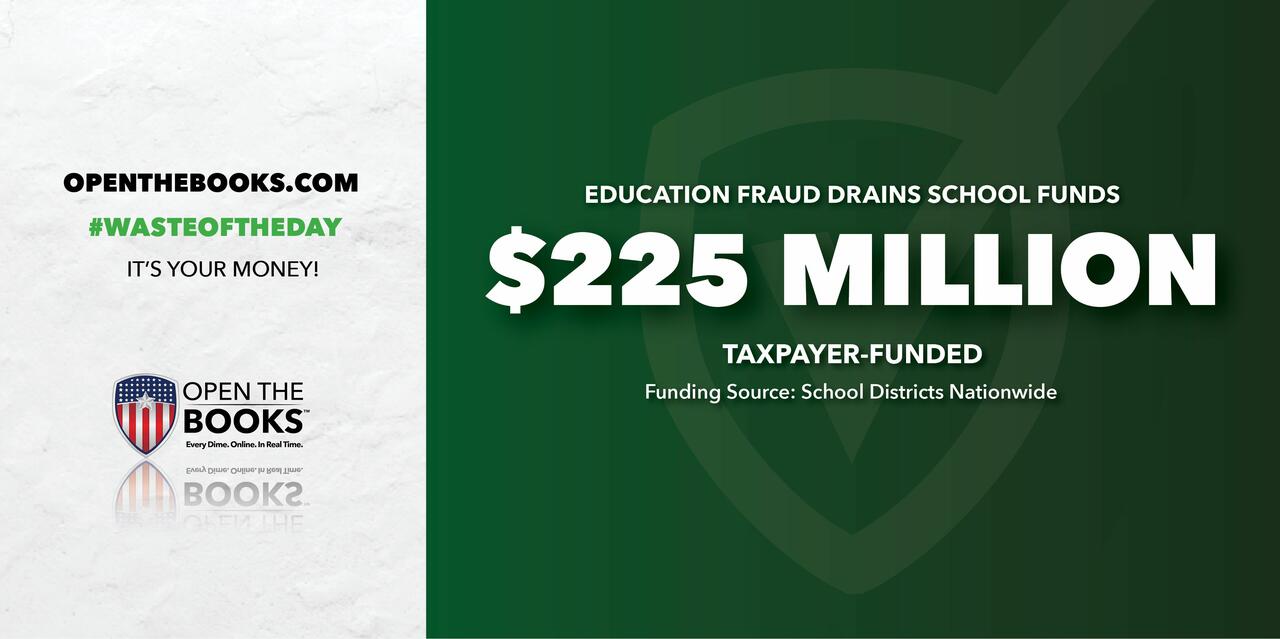
Topline:Since 2019, school districts across 24 states and Puerto Rico have lost $225 million to fraud confirmed by the U.S. Department of Education inspector general’s semiannual report to Congress. No more than $67 million has been recovered.
Key facts: Open the Books and the State Financial Officers Foundation documented74 instances of confirmed school fraud, averaging over $3 million each. There are far more that have gone unprosecuted or undetected.
Florida and Illinois schools each had the most instances of fraud with 11.
Indiana lost the most money – $44 million – due to inflated attendance numbers that increased state funding to two schools. The schools’ founder then allegedly sent the money to companies he owned. The schools closed in 2019, and four alleged conspirators were charged in 2024.
At Broward County Public Schools in Florida, information officer Anthony Hunter allegedly used district funds to buy $17 million worth of school supplies from a friend’s business, ignoring the competitive bidding process. In return, the friend hired Hunter and his son to work a security job and sold Hunter a house for $150,000 below market value, state prosecutors claim
Chicago Public Schools received $1 million of federal grants meant for Native American students, using an application that included more than 1,000 students of South Asian descent. The district was unable to verify how many students were actually in the program, and agreed to repay the money.
Fraud arguably hits small school districts the hardest because they have fewer budgetary resources to begin with. When Janis Bucknor, former head of Community Preparatory Academy in California, admitted to stealing $3 million from the school over five years, it amounted to one-third of all the school’s state and federal funding.
Bucknor spent $220,600 of the money on Disney vacations and also funded her internet shopping and private school tuition for her kids. She was sentenced to three years of home detention and ordered to repay the money.
Summary: The government loses hundreds of billions of dollars to fraud annually, but redirecting money away from children’s education is especially egregious.
The #WasteOfTheDay is brought to you by the forensic auditors at OpenTheBooks.com
India expects to build domestically five small modular reactors (SMRs) by 2033, India’s Atomic Energy Minister, Jitendra Singh, said. The five SMRs would be part of India’s push to accelerate nuclear power capacity installations over the next two decades, the minister told lawmakers in a written reply to questions as carried by local media.
The Bhabha Atomic Research Centre (BARC), India’s premier nuclear research facility under the Department of Atomic Energy, is currently developing a 220-MW Bharat Small Modular Reactor, a 55-MW reactor, and a high-temperature gas-cooled reactor designed to produce hydrogen, Singh said quoted by OilPrice.com.
As per India’s nuclear energy roadmap, the country aims to boost its installed nuclear power capacity from 8.78 gigawatts (GW) now to about 22 GW by the 2031-32 fiscal year, the minister said.
India goal is to boost its installed nuclear power capacity to 100 GW by 2047, up from just 8.8 GW now. This would require as much as 19.28 trillion Indian rupees, or $200 billion at current exchange rates, of cumulative capital, a panel set up by India’s power ministry said in the ‘roadmap to 100 GW’ report last year.
At the end of 2025, India’s government approved the landmark Atomic Energy Bill, which allows private companies to invest in its nuclear energy industry for the first time, as the country looks to boost nuclear power capacity tenfold within two decades.
The so-called SHANTI (Sustainable Harnessing of Advancement of Nuclear Energy for Transforming India) Act could drive huge investments from private companies in India’s nuclear energy sector.
Yet, Indian state-owned NTPC Ltd, the biggest utility in the country, is expected to account for 30% of the new nuclear power capacity installations by 2047.
NTPC, currently the only nuclear power generator in India, is now looking to acquire stakes in uranium assets globally to secure fuel for the expected massive expansion of India’s nuclear power capacity.
Through what he envisions as a federal declaration, consenting adults would be allowed to buy and sell homemade and farmstead food directly, without the costly commercial infrastructure and cumbersome government regulation currently in place.
Salatin’s mission reflects a push among homesteaders and independent farmers to cultivate local food networks, where food is grown and raised without chemicals and consumers can gain a more transparent connection to how food is produced.
The Next 15 Years
At its core, food emancipation and local food networks are about neighbors feeding neighbors, sidestepping a system many no longer trust.
Salatin told The Epoch Times that the American food system is at a historic inflection point. He points to an aging farm class; the average American farmer is now around 60 years old.
Around half of U.S. agricultural equity is expected to change hands in the next 15 years, he said.
“That’s the most unprecedented peaceful transfer in modern history,” he said.
In 2025, Americans spent 56.3 percent of their food dollars on items prepared outside the home, at restaurants, at fast-food chains, and through takeout delivery services. Overall, out-of-home food spending reached a record $1.41 trillion out of a total $2.51 trillion in national food spending, according to the U.S. Department of Agriculture (USDA).
Meanwhile, the farmer’s share of the retail food dollar after production expenses has plummeted to roughly 5.8 cents today, according to the USDA. That figure was 40 cents in the mid-20th century.
The idea of food emancipation is simple: Let small producers legally and freely sell directly to the people who want their food.
Salatin notes that the real barrier to young people entering farming is not access to land alone, but the inability to profit from small-scale, value-added food production under existing rules.
He illustrates the gap with a simple calculation.
On a couple of acres, a farmer might raise 1,200 pastured chickens, selling them as whole birds or cut-up parts at an average of about $30 per bird, yielding $36,000 in gross income, he said.
If that same farmer could legally turn those birds into homemade chicken pot pies – free of dyes, seed oils, and industrial additives – and market them as high-quality convenience food, the average value per bird could jump to around $200, he explained, turning the same flock into $240,000 in revenue on the same land.
Once a farmer moves from raw ingredients to prepared foods, the regulatory threshold explodes, going from a home kitchen with existing equipment to what he described as “a half-million-dollar requirement to sell one chicken pot pie.”
Saving The Family Farm
Pennsylvania dairy farmer Edwin Shank told The Epoch Times that his family nearly lost a four-generation farm after expanding from 40 to 300 cows under university-driven advice that prioritized volume above all else.
Despite filling a tractor-trailer with milk every two days, the Shanks were going bankrupt.
Milk checks came once a month – whatever the processor felt like paying. His banker warned that if nothing changed in three to four months, the farm would be gone.
A family portrait from that period, he said, looks idyllic – flowers, six children, a tidy yard – but behind the smiles they “were losing the farm.”
“Inside the fence, hope is outside the fence,” he said, quoting a conventional dairyman who described it as “a hard time to be a farmer these days.”
The Shanks’ response was to step outside the fence.
They converted their operation to certified organic; then, with borrowed money and little capital, they began selling raw milk directly from the farm under Pennsylvania’s permit system. They couldn’t afford a modern facility, so they bought used refrigerated semi-trailers – or reefers – for a few thousand dollars each and bolted them together into a makeshift cold-storage complex.
Business started to flourish after a phone call from New Jersey. A mother in Trenton asked if Shank could deliver raw milk across the state line. Legally, he could not, but he took a cue from Salatin.
“I told her, ‘I can’t deliver to you alone, but if you have enough friends, I can meet you at the state line,'” Shank recalled. The customer organized five families. That was enough for Shank to load his minivan and make the three-hour trip.
He drove down I-95 and reached the exit ramp to New Hope.
“Right there, it went through me,” he said. “God, are you telling me something?”
That first drop point grew into a network of 55 delivery locations. Shank’s business, The Family Cow, ships raw dairy, grass-fed beef, pastured pork and poultry, and other regenerative products five days a week to thousands of households.
‘Survival Of The Collaborators’
Around 90 percent of the business is now online, Shank said, with about 10 percent sold through a new on-farm retail store and cafe that offers sourdough-based sandwiches piled high with organic, grass-fed meats and slathered in real butter.
Shank abandoned the idea that his farm had to produce everything it sold. He opted to develop what he calls “survival of the collaborators.”
Multiple family farms share production.
Two dairies supply raw milk, seven families produce pastured eggs, and 11 families raise grass-fed beef. Other families specialize in pastured pork, turkeys, and piglets.
The Family Cow brought aboard three young families to raise pastured poultry. The farm provided the market, butchering, and marketing know-how, while the families provided the labor and land. In their first year, the group produced 10,000 chickens.
Shank is open to suggestions from entrepreneurs. A mother and daughter approached him, offering water kefir priced at $5 per jar. Initially, Shank acknowledged that he doubted customers would pay.
Within six months, they sold 10,000 jars through The Family Cow network, Shank said.
Getting Healthy
Max Kane, a raw milk activist and farmer in Wisconsin, reversed a life-threatening illness by changing his diet and has emerged as a leading voice in the fight for food sovereignty, raw milk access, and local farm-based economies.
Diagnosed with degenerative Crohn’s disease at 11, he spent more than a decade cycling through surgeries, supplements, and medications with little improvement. The Chicago native rejected the conventional medical path and switched to an all-unprocessed, farm-direct diet from local producers. That restored his health and allowed him to leave federal disability assistance and become what he calls “a functional, contributing member of society” in his mid-20s.
Today, Kane operates a 211-acre farm in southwest Wisconsin and a raw milk buying club that has served Chicago-area families for around two decades.
In 2009, he said, the USDA, Food and Drug Administration, and state authorities tried to put him in jail for 18 months over his raw milk deliveries to Chicago. The experience spurred his advocacy for legalizing raw milk and reinforced his view that Americans must have the freedom to opt out of the industrial food system and to form private food networks between farmers and consumers.
He created Farm Match, an online marketplace he described as “Etsy for local food.” The platform connects consumers directly with vetted farms and buying clubs.
Homesteading at any level – whether it involves full rural homesteads, balcony gardens in urban high-rises, or suburban backyard gardens – is on the rise because of the failures of the current industrial food system, defined by ultra-processed foods and unpredictable supply chains, Kane told The Epoch Times.
Industrial supply chains lack true transparency and traceability, which allows ingredients to be legally hidden from labels and makes it difficult for consumers to understand what they are eating or to track the source of contamination when something goes wrong, Kane noted.
Economically, this “takes the money out of the local economy and sends it far away, undermining rural communities and small producers,” he said.
“Simply put, the food people eat is the single biggest determinant of their ability to perform their life, no matter what they do for a living,” Kane said. “If citizens cannot legally build private food systems that nourish their bodies and minds, they risk becoming permanently dependent on an infrastructure that leaves them sick, disempowered, and economically sidelined.”
Sally Fallon Morell agrees. The founding president of the Weston A. Price Foundation – a nonprofit that promotes traditional diets, whole foods, and the consumption of animal fats – shared a simple grassroots strategy that bypasses corporate supply chains and empowers small, pasture-based producers during her discussion with The Epoch Times.
“If we asked people to spend half their food dollars on direct purchases from farms, it would change everything, and we’d get back to the kind of farming that we want to promote,” Fallon Morell said.
Her vision includes buying raw milk, eggs, and meat directly from regenerative farmers, and supporting local artisans and small-scale producers of sourdough bread, sauerkraut, and other traditionally prepared foods.
This encourages interdependence and local networks, she added.
“The goal is a resilient local web of producers and eaters, not a homestead cut off from the broader world,” she said.
These Are The States Where Speeding Is Most Likely To Kill You
Montana has the highest rate of speeding-related traffic deaths per capita in the United States, underscoring a reality that runs counter to how most people think about dangerous driving, according to a new study by Siegfried and Jensen.
While speeding is often associated with crowded urban highways and aggressive commuters, the greatest danger appears to exist on long, open rural roads where higher speed limits, lighter traffic, and longer emergency response times can turn a single mistake into a deadly crash.
Speeding claimed 11,288 lives across the country in 2024, making it the second-leading cause of fatal crashes behind only alcohol-impaired driving. It was a contributing factor in roughly 29% of all traffic fatalities, meaning nearly one out of every three people killed on American roads died in a crash where speed played a role.
A new analysis by Siegfried & Jensen ranked states by speeding deaths after adjusting for population. Montana finished first, followed by South Carolina, Wyoming, New Mexico, and North Carolina. Many of these states have similar characteristics, including vast stretches of rural highway, relatively high posted speed limits, and significant distances between towns, hospitals, and emergency responders.
The findings challenge the conventional wisdom that speeding is primarily an urban problem driven by congestion or road rage. Instead, the data suggests rural highways may be even more dangerous. Drivers often feel comfortable traveling well above the speed limit on open roads, but when crashes occur at those speeds, the consequences are far more severe. With fewer barriers, longer response times, and higher impact forces, accidents that might be survivable elsewhere are much more likely to become fatal.
There is also a seasonal pattern to these crashes. Fatal speeding accidents climb sharply during the warmer months, with May, June, and September each recording close to 1,000 deadly crashes involving excessive speed. The trend remains elevated throughout late summer and into early fall, suggesting increased travel, vacations, and heavier highway traffic all contribute to the higher death toll.
Despite decades of public awareness campaigns, stricter enforcement, and tougher penalties, speeding remains one of the nation’s deadliest driving behaviors. Unlike some other traffic risks that have gradually improved through advances in vehicle safety technology, excessive speed continues to claim more than 11,000 lives every year.
The report also notes that speeding’s true role in fatal crashes is likely even larger than official statistics indicate. A crash is only classified as speeding-related when investigators determine a driver was speeding, racing, or traveling too fast for road or weather conditions. In many serious collisions, speed may contribute to the outcome without ever being officially recorded as the primary cause.
The broader findings suggest geography plays an enormous role in roadway safety. While the country’s largest states record the highest raw number of traffic fatalities, smaller and more rural states consistently post the highest death rates after adjusting for population. Long travel distances, limited transportation alternatives, and high-speed rural roads appear to create a particularly dangerous combination.
The analysis serves as another reminder that speeding is far more than a traffic violation. It remains one of the leading causes of preventable deaths in the United States, and the places where drivers feel safest putting their foot down may ultimately be where the risks are greatest.
A man on the FBI’s Most Wanted Fraudsters list, accused of a scheme to defraud Medicare of $547 million, was arrested by authorities on Monday.
The foreign national, Khalid Satary, 54, owned and operated multiple diagnostic testing laboratories in the United States between 2016 and 2019 that billed Medicare for “expensive and medically unnecessary genetic tests,” the Department of Justice (DOJ) said in a July 21 statement.
Satary is accused of conspiring with several patient recruiters and telemarketing services to generate unnecessary cancer genetic test samples that were reimbursed by Medicare at the rate of $10,000 to $20,000 per sample.
To run the operation, Satary allegedly paid millions of dollars in bribes and illegal kickbacks to patient recruiters and doctors.
The defendant was initially indicted in 2019. However, Satary was later released on bond, with the condition that he doesn’t work in the healthcare sector. While on bond, Satary allegedly conspired with labs in Texas to continue submitting fraudulent genetic testing claims to Medicare.
A federal arrest warrant was issued against him in December 2022. However, Satary failed to appear for a court hearing and was believed to have escaped the United States. On July 20 this year, the defendant was arrested in the Middle East with a fake Mexican passport using a fake name. He was then transferred to U.S. authorities.
The Most Wanted Fraudsters list was announced by FBI Director Kash Patel last month. The White House Task Force to Eliminate Fraud partnered with the FBI to compile the list, according to a June 19 X post from Vice President JD Vance, the task force’s chairman.
The task force was established through a March 16 executive order signed by President Donald Trump, which said criminals and other individuals were exploiting various benefit programs intended to provide American citizens with a safety net.
Trump ordered the task force to “coordinate and accelerate a comprehensive national strategy to stop fraud, waste, and abuse within Federal benefit programs.”
One of those on the list, Said Abdullahi Ereg, surrendered to law enforcement on June 10, according to the FBI and federal prosecutors. Ereg is accused of laundering millions of dollars from a program that aimed to feed needy children during the COVID-19 pandemic.
Another individual on the list, Herbert Leon Kimble, accused of $1.2 billion Medicare fraud, was arrested on June 11 in the Philippines.
In its latest statement, the DOJ said that Satary has been charged with various fraud-related crimes, conspiracy to commit money laundering, and paying bribes and illegal healthcare kickbacks. He faces a multi-decade prison term if convicted.
“The arrest of Khalid Ahmed Satary and return to the U.S. is the third Most Wanted Fraudster capture from this FBI and our partners in just five weeks—continuing the historic run of success for this new initiative,” Patel said in the statement.
“This is another subject who exploited a program dedicated to helping our most vulnerable and instead stole for himself. Satary has been on the run since 2022, but we got him thanks to great work and coordination from the interagency and our overseas partners.”
The Epoch Times was unable to reach Satary’s legal representative.
According to the FBI’s website, Satary is one among nine individuals currently mentioned on the Most Wanted Fraudsters list.
One of the individuals is a naturalized U.S. citizen of Somali origin wanted for allegedly being part of a fraud scheme that exploited the federal Child Nutrition Program during the COVID-19 pandemic.
Another individual, a female from Jamaica, is linked to a scheme that fraudulently obtained more than $32 million from COVID-19 relief funds.
A third person, a U.S. citizen, is wanted for alleged involvement in a mail fraud scheme in Georgia. The man allegedly defrauded at least $10 million from his victims.
Meanwhile, on June 23, the DOJ announced that a coordinated enforcement action involving a whole-of-government approach led to the arrests of 455 individuals for their alleged role in healthcare fraud and opioid abuse schemes.
The schemes, which involved more than $6.5 billion in false claims, posed “significant patient harm,” including death. Among the arrested were two Estonians connected to a $10.6 billion fraud scheme.
James Carville Calls On Democrats To Cave On Voter ID
The SAVE America Act, which would mandate proof of citizenship along with valid ID for federal elections and tighten mail-in voting rules, remains stalled in Congress due to the Democrats’ filibuster in the Senate, even though the underlying idea is among the most popular in American politics.
Gallup found 84 percent of Americans favor requiring photo identification at the polling place, and 83 percent favor proof of citizenship for first-time registrants – including 98 percent of Republicans, 84 percent of independents, and 67 percent of Democrats. Pew Research Center put photo-ID support at 83 percent, with 95 percent of Republicans and 71 percent of Democrats behind it and only 16 percent opposed. Rasmussen found 77 percent of likely voters calling photo ID a reasonable measure to protect election integrity. Thirty-six states already request or require identification for in-person voting.
As CNN’s Harry Enten put it: “The bottom line is this: Voter ID is NOT controversial in this country.”
A bill with that kind of consensus isn’t controversial, yet Senate Democrats keep blocking it. Now longtime Democratic strategist James Carville is looking at those numbers and has decided his own party needs an exit ramp. On his podcast, Politics War Room, he told Democrats to stop fighting voter ID and find a way out of a fight he believes is already lost.
The trigger for the conversation was New Jersey. Carville’s co-host Al Hunt opened by noting the right had seized on Gov. Mikie Sherrill’s disclosure that roughly 6,600 noncitizens were registered to vote in the state, fewer than 400 of whom cast ballots.
“Voter fraud in the United States is an infinitesimal problem,” Carville said. “I don’t even… to the extent, I guess you could say it exists, anything could exist, it exists on such a minuscule scale, and it’s been proven time and time and time again.”
That is where most Democrats stop – the problem is too small to bother with. Carville kept going.
“But I don’t know if we’re not better off saying, okay, we’ll take that alternative ID, bring your gas bill or your light bill or something,” he said. “Because for whatever reason, it polls at 75%.”
He pointed to his home state of Louisiana, where voters already have to show a driver’s license at the polls, and asked why the national party keeps treating that standard as an emergency. A rule allowing alternative documents such as a gas or electric bill still polls at 75 percent – a number that should give pause to a party that has spent a decade calling identification requirements a modern poll tax.
“We are not gonna win the war” on some kind of ID, Carville said. “I never had a problem with it. I’m just saying of all the things… if every poll shows 75 or better, saying we should have some kind of ID to vote… just quit fighting it and go along with it and move to the next thing.”
Hunt pushed back, arguing that most states already have ID requirements and criticizing the SAVE America Act directly. Carville was quick to draw the same line. “I’m not talking about the SAVE Act, I’m not talking about the SAVE Act at all,” he said. His proposal was narrower: “Whatever the law in Louisiana is, make it the national law.”
It is worth being precise about what the New Jersey episode actually was, because it is not quite the case for the policy Carville is conceding. Those 6,600 people had pressed “no” when a Motor Vehicle Commission keypad asked whether they were U.S. citizens, and a software defect registered them anyway. They held valid state identification – that is why they were at the MVC. An ID check at the polling place catches someone voting under another person’s name. It does not catch a state agency overriding what an applicant told it.
Which is rather the point of Carville’s argument. He is not claiming voter ID would fix anything. He is saying it costs Democrats nothing and they are losing the fight anyway – that a party cannot win by declaring war on a basic expectation shared by nearly every voting bloc, and that the energy would be better spent on arguments it can win.
The concession is notable coming from this particular program. Politics War Room has hosted the Brennan Center’s Michael Waldman to argue that widespread voter fraud is a myth and to pick apart the SAVE Act. Carville still believes the first part. He has simply stopped believing it matters.
The Washington Postreported on Wednesday that the Trump administration is considering conducting military action against an al-Qaeda affiliate in Mali, which, if carried out, would mark the eighth known country bombed by the US since President Trump returned to power last year.
The report said there is disagreement among Trump officials over the potential military intervention, and named Sebastian Gorka, a British-born former radio host who currently serves as senior director for counterterrorism on the National Security Council, as a vocal advocate for military force in the administration.
The al-Qaeda-linked group in Mali, known as Jama’at Nusrat al-Islam, or JNIM, has been waging a major offensive along with Tuareg separatists, formally known as the Azawad Liberation Front, against the Mali government, which took power in a 2021 coup and is backed by Russia.
The US’s ally Ukraine has been on the other side of the conflict, as it’s known to have provided drones and intelligence support for Tuareg militants fighting against the Malian military and Russian mercenaries.
When asked by the Post if the administration intends to take military action in Mali, a White House official told the paper that terrorist activity in the Sahel is a “multinational problem” and urged “regional partners and NATO allies to support the Alliance of Sahel States in their war against JNIM and ISIS.”
The Alliance of Sahel States (AES) is a confederation of Mali, Burkina Faso, and Niger, three West African countries where military juntas ousted governments that had maintained close ties with Western countries and the Economic Community of West African States (ECOWAS).
Sebastian Gorka — also a strong advocate for maintaining US ops against Al-Shabaab — is pushing for US military intervention against JNIM
The official suggested the administration may attempt to peel Mali and other countries in the region away from Russia, saying that Moscow “has proven to be an ineffective security partner for Mali” and that the US hoped “that other African nations take note of Russia’s terrible performance in combating terrorism.”
A survey finding that 70% of Americans support putting half the stock of major AI companies into a public wealth fund reveals a deeper cultural shift toward viewing wealth as zero-sum and favoring redistribution of innovation rewards, unlike the more market-accepting attitude during the internet era.
Thirty years ago, the commercial internet burst onto the scene amid sweeping predictions. It would transform commerce, eliminate industries, reshape labor markets, and create fortunes on an unprecedented scale. It did all of those things. Yet there was not just remarkably little public appetite for confiscating half the equity of internet companies and redistributing it through a government-run fund: there was none. Americans largely accepted that entrepreneurs, investors, and workers who assumed extraordinary risks would also enjoy extraordinary rewards. Today, by contrast, a new survey finding that roughly seven in ten Americans support transferring half the stock of major AI companies into a public wealth fund suggests that something more profound than anxiety over a new technology is taking place.
Every technological revolution has its Luddites, however, marginal their appearance. What’s new is that today’s Luddites don’t merely want to stop the machines; they want to confiscate their owners’ property.
Certainly, artificial intelligence has generated genuine concerns. Many fear job displacement, misinformation, privacy violation, or the concentration of economic power in a handful of firms. Those concerns deserve discussion. But support for effectively nationalizing half the ownership of successful companies marks a dramatic departure from the country’s traditional understanding of property rights, entrepreneurship, and the relationship between entrepreneurship and reward.
The internet itself offers an illuminating comparison.
Few technologies have been as economically disruptive. Newspapers collapsed, retailers disappeared, travel agencies became obsolete, music stores vanished, classified advertising evaporated, and countless occupations either changed radically or ceased to exist. At the same time, the internet created entirely new industries employing millions of people while dramatically lowering costs, expanding consumer choice, and increasing productivity. Although critics worried about monopolies or privacy, proposals to seize half the ownership of companies such as Microsoft, Amazon, Google, or eBay scarcely emerged, let alone attracting something approaching majority public support.
Why has the public reaction shifted so dramatically?
One explanation is that Americans have become increasingly accustomed to viewing wealth through a zero-sum lens. For decades, political rhetoric, media coverage, and even educational institutions have increasingly emphasized inequality over wealth creation as an engine of overall prosperity. Rather than asking whether society as a whole becomes richer through innovation, discussion often centers on whether innovators have become “too rich.” When economic success itself is viewed with suspicion, redistribution naturally appears more reasonable than allowing innovators to retain the returns from their investments.
A second explanation is declining confidence in upward mobility. During the internet boom, many Americans believed they could personally participate in the gains, whether by starting businesses, purchasing stocks, or finding new career opportunities. Today, younger generations often face high housing costs, elevated student debt, and persistent pessimism about their future prospects. If people increasingly believe they won’t participate in economic growth through ordinary market participation, government intervention begins to seem like the only remaining avenue to benefit from economic progress.
A third possibility is that artificial intelligence itself feels more immediate and personal than previous technological revolutions. The internet largely complemented human labor before gradually replacing certain businesses and occupations. AI, by contrast, appears capable of performing cognitive tasks once thought uniquely human. White-collar professionals from writers, programmers, accountants, designers, and analysts now perceive direct competition from software. Fear often produces demands for political intervention that would have seemed unnecessary under more optimistic circumstances. (See the New Deal for additional evidence.)
None of this means policymakers should ignore legitimate questions surrounding AI. Governments have an appropriate role in enforcing contracts, protecting property rights, ensuring competition, prosecuting fraud, and addressing clearly demonstrated harms. But confiscating ownership after firms have invested billions of dollars in research and accepted enormous commercial risks would establish a troubling precedent extending well beyond artificial intelligence. Among other effects, inventors, and their backers would understandably ask which successful industry might be next.
The survey therefore reveals something larger than public opinion about AI. It reflects a striking evolution in American attitudes toward markets, technological, advancement, and private property. The internet transformed the economy every bit as profoundly as artificial intelligence promises to do, yet Americans overwhelmingly viewed its rewards as something to be earned rather than redistributed. If American citizens increasingly see extraordinary innovation as justification for extraordinary government force, the most important story may not be artificial intelligence at all. It may be the changing philosophy of the society deciding how to govern it.
If a majority can be persuaded that today’s successful innovators no longer deserve to own what they built, there is little reason to believe AI will be the last industry to find itself in the redistributionist crosshairs.
Three Levers China Is Pulling To Weather Gulf Energy Shock; How Long Can Beijing Hold Out?
The new troubling development is that maritime chokepoint chaos spread overnight from the Strait of Hormuz to the Bab el-Mandeb Strait, where Iran-backed Houthis targeted two Saudi Arabian tankers. The attacks expose yet another maritime chokepoint and risk further physical market tightening, forcing traders to price a larger war-risk premium into Brent crude futures and pushing the benchmark above $100 a barrel Thursday morning.
Oil headed to Asia generally does not flow through both chokepoints. Persian Gulf exports pass through Hormuz and sail east, while Saudi crude loaded at Yanbu enters the Red Sea and passes south through Bab el-Mandeb.
Asia takes most of Hormuz crude, with China alone absorbing nearly two-fifths. On Saudi Arabia’s Red Sea route through Bab el-Mandeb, China recently accounted for more than half of exports.
With both chokepoints disrupted, we want to check back in with China to understand what levers Beijing is pulling to absorb the energy shock – this builds on our three previous notes:
On Wednesday, Goldman commodities strategist Hongcen Wei outlined three factors that have so far allowed Beijing to contain the economic fallout from the Gulf energy shock:
drawing down fuel inventories,
switching to coal and renewables,
and concentrating production cuts in oil- and gas-intensive industries.
China’s real GDP growth slowed to an annualized 3.6% in the second quarter from 5.3% in the first, while total energy demand still rose .4% from a year earlier in April and May. Destocking of coal, oil and NatGas added 5.4 percentage points to energy-demand growth.
Fuel substitution also softened the impact. Lower oil and gas use subtracted 1.7 percentage points, while increased consumption of coal and renewables added 2.2 points. Gasoline demand sank 23%, but EV charging jumped 60%, allowing transportation activity to migrate toward electricity.
The remaining damage was concentrated in industries heavily dependent on oil and NatGas, while industries with greater flexibility shifted toward electricity and alternative fuels.
Wei provided the full rundown on how China is absorbing the energy shock:
Major Fall in Net Imports, but Total Energy Demand Growth Still Positive. Ordinarily the largest importer of energy products shipped through the Strait of Hormuz, China has drastically reduced its net imports of fossil fuels, effectively acting as a shock absorber for global energy prices through reduced demand. Net imports of crude oil cratered in China and the rest of Asia beginning in March, but recovered in the rest of Asia to 2025 levels by June while continuing to fall in China through the first half of July (Exhibit 3).
China’s net imports of oil/natural gas/coal fell 24%/7%/24% YoY in April and May reflecting YoY price jumps of 59%/49%/38% (Exhibit 4). These reductions in fossil fuel net imports were the largest source of negative total energy demand growth, representing -3.7pp/-0.3pp/-1.2pp of China’s total YoY energy demand growth of +0.4% (Exhibit 5).
Exhibit 3: China Crude Oil Net Imports Continue to Fall While the Rest of Asia Recovers to 2025 Levels
Chinese total energy consumption in April and May increased by an average of 0.4%, or 52 petajoules, year-over-year. To roughly estimate the impact of the supply shock on energy consumption, we estimate counterfactual consumption growth as the average +3.1% annual total energy demand growth rate from 2014-2023.[2] Applying this rate to China’s average total monthly consumption in April and May 2025 would imply 375 PJ counterfactual YoY energy demand growth. This would suggest roughly 323 PJ of demand destruction for April and May, or 2.7pp reduction in the potential YoY growth rate. China’s Q2 real GDP growth fell to 3.6% after 5.3% Q1 growth quarterly annualized, slightly exceeding our China team’s nudged-down June forecast of 3.5% Q2 growth but missing market expectations. Lower GDP growth reflected mostly slower government spending, but also higher energy prices and unfavorable weather conditions.
Below, we highlight three factors that helped mitigate the total demand shock.
#1 Effective Destocking of Coal, Oil and Natural Gas Filled in for Fall in Fossil Fuel Imports and Production
Importing less of its energy needs from abroad, China has turned to its domestic inventories–rather than domestic production growth–to supplement the supply of fossil fuels.
Total domestic fossil fuel production actually fell slightly YoY in April and May, with lower coal production comprising a 0.5 percentage point reduction in total energy supply growth (Exhibit 5). Domestic crude oil production was unchanged compared to April and May of last year, likely constrained by high extraction costs in China’s aging brownfields.
The bulk of the rise in total energy consumption has been driven by the effective destocking of fossil fuels.
Thermal coal inventory levels increased by 1.6%/3.7% during April/May 2026, significantly lower than the 4.7%/5.8% MoM increase of April/May 2025. Though China’s coal inventory level rose this April and May, we consider the reduction in MoM additions compared to last year’s flows–in other words, how much less China added to its coal inventory this April/May compared to April/May 2025–as effective destocking. Defined this way, coal stock use contributed 3.0 percentage points to total YoY demand growth (Exhibit 5).
We estimate that oil destocking also accelerated, contributing 2.2pp to total YoY demand growth (Exhibit 5). Moreover, changes in China’s visible crude oil stocks also appear directionally consistent with our implied destocking estimates of around 1mb/d in May and June, suggesting a shift from restocking in Q2 2025 to greater inventory use this year (Exhibit 6).
Effective natural gas destocking accounted for 0.2pp of total YoY energy demand growth (Exhibit 5).
#2 Fuel Substitution to Coal and Renewables Has Limited the Demand Destruction
To avoid wider demand destruction caused by lower fossil fuel imports and production, China has increased its reliance on coal and renewables in its wider energy mix. Lower oil/natural gas use in China’s overall energy demand contributed -1.6/-0.1 percentage points to its total YoY energy demand growth in April and May, while greater reliance on coal/renewables contributed +1.4/+0.8pp (Exhibit 7).
As an example of this fuel switching in practice, we observe China substituting driving with gasoline for driving with electricity. Gasoline consumption fell 23%/23%/21% YoY in April/May/June, but EV charging growth rose to 62%/60%/57% YoY. Despite much lower gasoline consumption, traffic congestion remained relatively stable, falling only 1.2% YoY in April before growing by 0.2% and 2.1% YoY in May and June (Exhibit 8). These findings are consistent with our prior reporting on China’s uptick in domestic EV sales since the start of the Iran war (despite seasonally-adjusted total passenger car sales remaining flat) and may reflect substitution both in car purchases (more EVs bought) and especially in choosing which kind of energy to drive on.[3]
#3 Energy-Related Reductions in Output Are Concentrated in Oil- and Natural Gas-Reliant Sectors
Several industries that are highly oil- or natural gas-intensive have slowed production. Physical output of processed crude oil fell by 10.9% YoY in Q2 reflecting lower crude oil inputs (Exhibit 9).[4] Sulfuric acid, produced as a byproduct during oil and natural gas refining, saw 4.6% lower Q2 physical output YoY. Chemical fibers, produced with either oil or natural gas feedstocks like ethane or naphtha as inputs, saw 3.7% lower Q2 physical output YoY.
The production of the industrial chemical ethylene increased in Q2 by 1.2% YoY, rebounding from a 4.1% YoY fall in April to +2.1% and +5.5% YoY growth in May and June. Though conventional ethylene production involves steam cracking of oil feedstocks like ethane or naphtha, the recent rebound in ethylene output growth may reflect China’s significant acceleration in modern coal-to-chemicals pathways like Coal-to-Olefins (CTO) where coal is gasified into syngas, synthesized into methanol, and dehydrated to form ethylene. China’s use of coal in chemical production rose by 11.5% in April YoY amid the energy supply shock according to DBX Commodities, with coal-to-chemicals facilities residing atop domestic coal reserves well-positioned to facilitate the transition.
Furthermore, energy-intensive products more reliant on power than oil or natural gas feedstocks saw more resilient output growth. The production of caustic soda, a major industrial chemical, is highly electricity-intensive but does not require oil or natural gas as unique inputs. Physical output of caustic soda grew by 2.4% YoY in Q2. EV production, more reliant on power than on materials made with oil and natural gas, also increased 17.0% YoY.
The key question is how long China’s energy strategy to bridge Hormuz and Red Sea disruptions can last.
China recently had 1.3 billion to 1.4 billion barrels in crude inventories, including roughly 400 million barrels accumulated during 2025. At the current import shortfall of about 3.5 million barrels a day, that recent stock build is about four months of coverage. Of course, the substitution strategy also has its limits. Coal, renewables, and EVs can replace gas-fired power and some gasoline consumption, but they cannot entirely substitute for oil used in aviation, trucking, petrochemicals, or industrial processes.
The bigger risk comes when China stops drawing on its strategic stockpile and returns aggressively to the global crude market.
Earlier today, Helima Croft, head of global commodity strategy at RBC Capital Markets, warned in a note that “war enters a dangerous phase with the Red Sea and critical infrastructure at risk.” Read it here.
Professional Subscribers can access our latest energy-market intelligence, including analysis of Hormuz and other critical maritime chokepoints, through the new Marketdesk.ai.