Houthis Release New Footage On Tanker Explosion; Satellite Imagery Suggests Oil Leak Has Begun
Iran-backed Houthi militants published new footage showing rebel forces commandeering Greek-flagged oil tanker MV Sounion about 77 nautical miles west of the Yemeni port of Hodeidah.
Yahya Saree, a spokesperson for the Houthis, posted the footage on X on Thursday, showing heavily armed masked men moving around the Suezmax tanker—the largest type of oil tanker capable of transiting the Suez Canal—and setting it ablaze.
“Scenes of the storming and burning of the Greek ship (SOUNION) in the Red Sea, whose owner company violated the decision to ban entry to the ports of occupied Palestine,” Saree wrote on X.
مشاهد اقتحام وإحراق السفينة اليونانية (SOUNION) في البحر الأحمر والتي قامت الشركة المالكة لها بانتهاك قرار حظر الدخول إلى موانئ فلسطين المحتلة. pic.twitter.com/yGKgUNaIuh
It’s unclear when the footage was taken. The initial attack was on August 21, when missiles and drones paralyzed the tanker carrying 150,000 tons of crude.
X account Open Source Intel posted a Maxar satellite image from Thursday that shows Sounion ablaze. According to the account, the tanker “has begun leaking oil.”
Maxar Satellite Image from Aug 29th: The tanker Sounion, which was attacked by the Houthis in the Red Sea, has begun leaking oil. pic.twitter.com/eImeHNL8Eh
On Tuesday, US Air Force Maj. Gen. Patrick Ryder, the Pentagon press secretary, warned about the risks of a major ecological disaster looming in the Red Sea with the tanker on fire.
“These are simply reckless acts of terrorism which continue to destabilize global and regional commerce, put the lives of innocent civilian mariners at risk and imperil the vibrant maritime ecosystem in the Red Sea and Gulf of Aden, the Houthis’ own backyard,” Ryder said.
To put it in perspective, Sounion is hauling 150,000 tons of crude—a little more than four times the amount spilled by the Exxon Valdez in 1989.
Another Houthi spokesperson, Mohammed Abdulsalam, was quoted by Reuters earlier this week as saying salvage efforts were underway, and tugboats and rescue ships were permitted into the region to support the crippled tanker.
Abdulsalam noted there was no temporary truce and only agreed to allow salvage efforts to occur after talks with several international groups.
Here’s the latest reporting on the Sounion crisis:
All of this Red Sea chaos signifies one thing, as former Navy Seal and Blackwater founder Erik Prince recently explained on X: America’s “credibility and deterrence” are quickly eroding.
Where is the rightful outrage from environmentalists? Thousands of tons of crude oil will now pour into the Red Sea.
This is a clear sign of the collapse of American credibility and deterrence. Letting the Iranian proxy Houthis shut off a major maritime seaway is an epic fail.… https://t.co/ThmzZ5FAED
During election years, incumbent presidents are routinely blamed for every societal ill during the previous four years. And almost nothing is riper for the picking than a significant rise in consumer prices. According to the Bureau of Labor Statistics (BLS), prices are currently increasing at a rate of 3 percent year over year and peaked at 8 percent during President Biden’s term in 2022.
That is significantly higher “inflation,” as the BLS defines it, than American consumers have experienced in decades. But as economically harmful as many of President Biden’s policies may have been, no president can cause prices in general to rise. Neither can Congress or “greedy corporations.”
Incidentally, “inflation” as an economic term originally meant the creation of new money and credit, not rising prices. Those wishing to confuse the public on which is the cause and which the effect has gradually redefined inflation as rising prices. Check any hard copy Merriam-Webster dictionary printed in the 20th century and see for yourself.
Only the Federal Reserve can cause a general rise in prices and only when it creates new US dollars that didn’t previously exist (inflation).
To further deflect the blame for rising prices away from the culprit, the public is constantly given other reasons for this phenomenon. Each one of them can be eliminated using a priori reasoning.
For example, energy policy is often blamed. President Biden restricted drilling on federal land and canceled the permits for multiple oil pipelines, thus decreasing the supply of oil.
Decreasing the supply of oil and gasoline causes their prices to rise. But without the creation of new money, it must necessarily reduce demand for everything else.
Consider a simple model. There is a total of $100 in the entire economy; $50 is currently being spent on Commodity A and $50 on Commodity B. If the price of A were to increase by 20 percent, then purchasing the same units of A would cost $60. That would leave only $40 with which to purchase B.
The economic actors in this imaginary economy could purchase less of A, less of B, or less of both. But they could not go one purchasing the same amounts of both goods because there are not enough dollars in the economy to make that possible.
If they do not reduce their demand for A at the higher price, they will necessarily reduce their demand for B and the price of B will fall. If they reduce their demand for A, the price of A will fall. If they reduce their demand for both A and B, the prices of both A and B will fall.
While it is true that the US economy is far more complex than this, the same principle still holds. Without the creation of new dollars, the increase in price of one or more products must be offset by a reduction in demand and therefore the price of others.
Assume the US economy is producing $30 trillion GDP per year and spends $6 trillion per year on oil and gasoline and $24 trillion on everything else. If government policy causes the cost of oil and gasoline to rise to $7 trillion per year, the economy can no longer continue spending $24 trillion on everything else because it will run out of dollars when the $30 trillionth dollar is spent.
Now, in reality, a rise in the price of oil and gasoline will necessarily reduce the quantity demanded for oil and gasoline as some spending on these is discretionary. But this doesn’t change the dynamic. It merely means the upward pressure on the price of oil and gasoline is muted a bit as is the downward pressure on the price of everything else.
“But wait,” some will argue, “higher oil and gas prices also raise the price of myriad other products, since they are all delivered to market using oil or gasoline.” This argument faces the same problem. The economy can only spend the dollars that currently exist. No matter how many different products are made more expensive by government policies, demand is limited to the existing dollars.
For the increased price of one or many products not to be offset by reduced demand for others, new dollars must enter the economy. This is the only way it is possible to spend more on A and go on spending the same or more on everything else.
New dollars can only be created permanently by the Federal Reserve. The reason prices have steadily risen over the past 111 years is because the Fed has constantly increased the supply of dollars over that period.
The reason prices rose so much more over the past four years than they had previously is the Federal Reserve created far more dollars in the past four years than it has on average during the past century.
One can verify this either by looking at the Fed’s balance sheet or the monetary base. Both are slightly different yardsticks for measuring the amount of new money created by the Fed. They both show massive increases over historical trends beginning in 2020.
It is true that commercial banks can increase the money supply due to fractional reserve policies. Because they can simultaneously lend out deposits and keep them available on demand for depositors, they create new money with each new loan. However, this ability is limited and ultimately requires new base money from the Fed to avoid reaching an equilibrium level.
There are several other arguments made for the cause of general price level increases that all suffer from the same problem as our example above.
One is that excessive government spending itself causes price increases. But while government spending often creates the conditions for new money creation by the Fed, it does not directly cause general price increases. Any money the government takes from taxpayers necessarily reduces their purchasing power and offsets the spending by the government.
Similarly, when the government borrows existing dollars from lenders, it necessarily reduces the purchasing power of the lenders.
It is only when the government borrows the money from the Fed, meaning the Fed buys government bonds with newly created dollars, that the government can spend more money without reducing the purchasing power of others.
By signing the CARES ACT and other Covid relief spending, President Trump authorized expenditures far beyond what the government could borrow from lenders of existing dollars. So, the Fed created trillions in new dollars to underwrite the difference.
President Biden also signed into law trillions more in excess government spending on the ironically named “Inflation Reduction Act” and other programs. Again, the Fed made the additional spending possible by buying government bonds with newly created dollars.
Trump and Biden’s spending created reasons for the Fed to inflate the currency, but it was the currency inflation and not the spending that caused the subsequent general rise in prices.
Rising prices have also been blamed on “supply shocks” due to the Covid lockdowns. By shutting down a huge percentage of businesses in the economy, the government drastically reduced the overall supply of goods and services. With lower supply, says this argument, comes increased prices, all things being equal.
But all things were not equal. Had the government merely prevented people from working, it wouldn’t have merely been supply that decreased but demand as well. As much as the Keynesians would like to ignore him, Monsieur Say was correct. People producing nothing would have no means to go on consuming.
They were only able to do so because the government paid them not to work. And they weren’t paid with existing dollars that would have reduced the demand of whoever provided them. They were sent newly created dollars to replace their lost wages.
Probably no argument for the cause of higher prices is more absurd than “corporate greed.” Politicians resort to this argument to deflect blame. But no matter how greedy corporations are or become, they have no power to increase general price levels.
First, every corporation always seeks maximum profit. If this is greed, then corporations are always greedy. There would be no reason for them to suddenly become greedier just at the moment when consumer prices are rising. On the contrary, corporations generally compete by trying to lower their prices to undercut competitors.
But even if corporations did suddenly all decide at once, through coincidence or collusion, to raise their prices at the same time, this could not cause prices in general to rise. It would merely force consumers to make different decisions on what they purchase and what they do not. Consumers would pay the higher prices for those products most important to them, then the next important, and so on until they ran out of money. They would forgo those items lower on their value scales they could no longer afford, putting downward pressure on the prices of those products.
There are many other non-monetary arguments made for what is commonly called “inflation,” but they all fail for the same reasons as those analyzed here. There is no way to increase the price of one product without a corresponding fall in the demand for others unless new dollars are added to the economy. It’s the Fed, stupid.
Tulsi Gabbard Reveals The Real Reason Behind Endorsing Trump: ‘This Is Personal For Me’
Former Democrat Rep. Tulsi Gabbard (HI) offered a detailed explanation for her endorsement of former President Donald Trump’s 2024 White House bid earlier this week on Fox Business’s “Kudlow.”
DAVID ASMAN: since you and RFK are part of the Trump campaign, explain why did you go with Trump?
TULSI GABBARD: The choice in this election is very clear and the differences between President Trump and Vice President Harris couldn’t be more stark. Frankly, to put it simply, the choice for the American people is a choice with Donald Trump, a man who values peace, prosperity, and freedom. He has a record that proves that. And Vice President Kamala Harris, whose record shows an increasingly tyrannical government undermining our freedoms. We are embroiled in multiple wars and the world is closer to the brink of nuclear war than ever before, with increasing economic hardship for Americans throughout the 3½ years she served as Vice President of the United States. The contrast couldn’t be more clear.
This is personal for me, the endorsement of President Trump. As a soldier for over 21 years, I deployed to multiple war zones in different parts of the world, putting my life on the line for the safety, security, and freedom of the American people. It is important to me and every one of my brothers and sisters in uniform that we have a Commander-in-Chief who values every one of our lives, who carries that responsibility as Commander-in-Chief very seriously, and who will exhaust all diplomatic avenues before seeing war truly as a last resort.
The last point that I will make on this—another point of contrast—is that President Trump showed through his last administration that not only did he not start any new wars, but he took action to prevent them by courageously meeting with adversaries, allies, partners, dictators. He would meet with whoever he needed to pursue peace. Kamala Harris criticized Donald Trump for doing exactly that. That shows if she is elected President, she will not do what is necessary in the pursuit of peace, and I’m certain she will lead us very quickly into a war to mask the weakness and insecurity that she feels and try to project strength using the lives of my brothers and sisters in uniform to do so.
With spot gold prices at record highs, investors might expect that shares of precious metals mining companies are also trading at record highs.
By and large, that is not the case.
Mining stocks, as represented by the HUI Gold BUGS Index, are still underwater by more than 40% compared to their 2011 highs. And that’s despite being pulled up significantly this year by soaring gold and silver prices.
There are a variety of reasons why most mining shares have lagged the metals. First and foremost, mining is a tough business that is fraught with risks. Even when the value of a mine’s end product goes up, the costs of getting it out of the ground can go up even faster.
During periods when market prices for metals fall below a mining company’s all-in sustaining costs, it may choose to sell at a loss. That’s because it would be impractical for a mine to lay off all its workers and let its expensive equipment sit idle while waiting for market conditions to improve.
But there is another option available to precious metals mining companies during times when their product is being undervalued.
If the CEOs of companies that have “gold” (or silver) in their name truly believe in their product – which is money itself – then why don’t they hold some of it on their books as a reserve asset instead of immediately exchanging it for dollars regardless of prevailing price?
Gold is considered by the Bank for International Settlements to be a “Tier 1” asset within the banking system. That means it is globally recognized as a high-quality capital reserve asset.
Central bankers around the world agree. Despite refusing to make their fiat currencies redeemable in gold, central banks have been accumulating the monetary metal at a blistering pace over the past few years.
But with a few exceptions, large corporations — including major gold and silver producers — have failed to bolster their own finances with sound money backing.
SilverCrest Metals Sets an Example
One company that actually does is Canada-based SilverCrest Metals. Under the leadership of President Christopher Ritchie, SilverCrest has added some $30 million in gold and silver bullion to its balance sheet, which represents nearly 30% of its treasury assets.
With the benefit of a fantastic producing mine, SilverCrest began accumulating its precious metal reserves right after paying off all its debts over a year ago. As the nominal price of gold has risen 30% over the past year, this strategy is already looking like a pretty genius move.
Plenty of other publicly traded companies regularly engage in stock buybacks.
CEOs who believe in the underlying strength of their business are happy to have the company buy back its own shares during periods when they are trading at a discount. Share buybacks often do a far better service to shareholders than holding depreciating cash, issuing taxable dividends, or deploying capital into riskier projects.
Last year, Berkshire Hathaway, helmed by legendary value investor Warren Buffett, bought back $9.2 billion of its own shares. Buffett eats his own cooking.
Unfortunately, however, the typical mining industry executive does not.
Gold Holdings Can Buffer a Company’s Ups & Downs
Mining leaders have overlooked golden opportunities to buy back their own product when it was ridiculously cheap and hold it on their balance sheet. Instead, they myopically opted to trade it for a relative pittance in dollars that they thought would look better on their quarterly earnings reports.
Throughout its history, the mining industry as a whole has been such a poor steward of investor capital that it has earned a bad reputation on Wall Street. Negative sentiment toward the industry has, in turn, contributed to share price underperformance.
Of course, with gold recently darting to a record high price above $2,500 an ounce, industry executives might feel that now would be a poor time to make such a move.
Given the current momentum and array of bullish factors driving bullion, we doubt that will prove to be the case.
But even if they think the market price of the yellow metal is currently too elevated, at least in nominal terms, what’s their excuse for not retaining its much cheaper cousin, silver?
Even at $30 per ounce, silver remains well below its previous all-time high near the $50 level. Silver is, by many measures, undervalued – especially when considering the potential for rapidly growing sources of industrial demand to outstrip supply.
Taking concrete action that demonstrates a belief in their product will help gold and silver mining industry leaders break the cycle of share underperformance.
Musk’s X Lawsuit Against Media Matters Can Proceed To Trial: Judge
A federal judge in Texas has ruled that a lawsuit brought by Elon Musk’s X against Media Matters can proceed to trial, after dismissing a request by the Democrat-run enterprise.
“Because the Court has personal jurisdiction over Defendants, venue is proper, and Plaintiff has properly pled its claims, Defendants’ Motion to Dismiss is denied,” wrote Judge Judge Reed O’Connor in his ruling.
X, formerly known as Twitter, filed the suit in Novemberafter Musk threatened to bring a “thermonuclear lawsuit” against the left-leaning nonprofit and “all those who colluded” for “completely misrepresenting” the real user experience on X.”
According to the lawsuit, Media Matters – founded by Democratic operative David Brock, who left the organization in 2022, used manipulative and deceptive tactics to convince advertisers like Apple, IBM and Disney that ‘hateful’ content was being displayed next to their brands – leading them to pause their X advertising campaigns.
X claims Media Matters fabricated the results. From the original complaint:
Media Matters has opted for new tactics in its campaign to drive advertisers from X. Media Matters has manipulated the algorithms governing the user experience on X to bypass safeguards and create images of X’s largest advertisers’ paid posts adjacent to racist, incendiary content, leaving the false impression that these pairings are anything but what they actually are: manufactured, inorganic, and extraordinarily rare.
Media Matters executed this plot in multiple steps, as X’s internal investigations have revealed.
First, Media Matters accessed accounts that had been active for at least 30 days, bypassing X’s ad filter for new users. Media Matters then exclusively followed a small subset of users consisting entirely of accounts in one of two categories: those known to produce extreme, fringe content, and accounts owned by X’s big-name advertisers. The end result was a feed precision-designed by Media Matters for a single purpose: to produce side-by-side ad/content placements that it could screenshot in an effort to alienate advertisers.
But this activity still was not enough to create the pairings of advertisements and content that Media Matters aimed to produce.
Media Matters therefore resorted to endlessly scrolling and refreshing its unrepresentative, hand-selected feed, generating between 13 and 15 times more advertisements per hour than viewed by the average X user repeating this inauthentic activity until it finally received pages containing the result it wanted: controversial content next to X’s largest advertisers’ paid posts.
X CEO Linda Yaccarino defended the company in November:
If you know me, you know I’m committed to truth and fairness. Here’s the truth. Not a single authentic user on X saw IBM’s, Comcast’s, or Oracle’s ads next to the content in Media Matters’ article. Only 2 users saw Apple’s ad next to the content, at least one of which was Media…
If you want to go deep into the accusations, click into Michael Shellenberger’s tweet below, or visit his blog.
The media say X is placing Apple, IBM, and other ads near pro-Nazi content, but it’s not. We tried various ways to replicate Media Matters’ research and couldn’t. The real goal of Media Matters isn’t to fight antisemitism. It’s to destroy X as a free speech platform. pic.twitter.com/rpxANwkMDx
Andrew Carusone, president of Media Matters and one of the defendants, said that it was a “frivolous lawsuit” that was “meant to bully X’s critics into silence.”
Judge O’Connor didn’t buy it, and denied the nonprofit’s effort to have the case dismissed, ruling that X “had properly pled its claims.”
In August, O’Connor dismissed a request by Media Matters to force Musk to list Tesla
as an interested party in X’s lawsuit against the nonprofit. O’Connor said at the time in a legal filing that “there is no evidence that shows Tesla has a direct financial interest in the outcome of this case.”
O’Connor was also overseeing a recently filed antitrust lawsuit by X against a global advertising association and its member companies like Unilever, Mars and CVS Health. O’Connor then recused himself from the lawsuit. Although he didn’t provide a reason for the recusal, a recent financial disclosure showed that the judge invests in Unilever. –CNBC
Federal Reserve Chairman Jerome Powell, in his prepared speech at the recent Jackson Hole Economic Symposium, said: “It seems unlikely that the labor market will be a source of elevated inflationary pressures anytime soon. We do not seek or welcome further cooling in labor market conditions.”
Have the central bank’s tightening efforts since March 2022 finally doused the red-hot, post-COVID-19 pandemic U.S. labor market?
So far this year, the number of new jobs has totaled about 1.9 million, compared with 1.4 million in 2023. The unemployment rate is at 4.3 percent, compared with 3.5 percent.
Over the past year, market watchers have observed various other economic indicators that suggest the jobs arena is loosening and becoming better balanced, in line with pre-crisis conditions.
What has happened in the job market since last year’s Labor Day holiday?
Hiring, Quitting, Expectations
The number of job openings has declined by about 1.1 million since September 2023, with vacancies totaling a little more than 8 million, according to the Job Openings and Labor Turnover Survey by the Bureau of Labor Statistics.
Research has highlighted that employers are putting their staffing plans on ice.
RedBalloon’s recent Freedom Economy Index, for example, found that more than two-thirds (70 percent) of small businesses are neither hiring nor reducing staff.
Hiring is now at its lowest year-to-date level since 2012, according to the latest data from Challenger, Gray & Christmas, Inc., which researches and analyzes job market trends.
Businesses’ reasons for not adding staff or trimming the fat vary economically and politically.
Troy Miller, president and CEO of National Religious Broadcasters, said that although some positions have been open for several months, the company is not looking to add new positions.
As a result, hiring plans have been frozen until the fourth quarter, and economic conditions will be assessed to determine how confident his organization is moving forward.
“We’re waiting to see after the election,” Miller told The Epoch Times. “This is what I hear from people in our association, quite honestly: The economy is not strong. They’re very concerned about where that’s going.”
Workers are also nervous.
The number of people quitting their jobs, according to the Department of Labor, has tumbled by about 300,000 to its lowest level since November 2020.
The New York Fed’s latest Survey of Consumer Expectations (SCE) reported that nearly 15 percent of individuals anticipate receiving a pink slip in the next 12 months, up from roughly 12 percent in September 2023.
The regional central bank’s SCE data revealed that fewer respondents than a year ago would expect to find a job in the next three months if they were terminated today.
In a separate New York Fed quarterly Labor Market Survey, the share of individuals searching for a job in the past four weeks climbed to 28.4 percent, up from about 20 percent a year ago. This was the highest reading since March 2014.
Researchers also found that 4.4 percent of those currently employed expect to be unemployed in the next four months, up from 3.4 percent in November 2023.
This coincides with a new Bankrate survey that learned that close to half (48 percent) of workers plan to look for a new job in the next year.
Job loss concerns are ubiquitous across the U.S. labor market, with 55 percent of full-time workers worried about losing their positions, a recent AuthorityHacker survey found.
“This is not the red-hot job market coinciding with the reopening of the economy a couple of years back,” Mark Hamrick, senior economic analyst at Bankrate, said. “It is more in line with what we experienced before the pandemic.”
2 or More Jobs
Over the past year, the number of people working two or more jobs has steadily risen and hovered near an all-time high of approximately 8.5 million.
They account for 5.3 percent of those currently employed, little changed from a year ago.
Workers have been continually searching for other employment opportunities amid economic concerns. Even when employed full time, many complement their schedule with part-time jobs, contract positions, or gig work.
Keith, a tech professional who has been with his current employer for more than three years, routinely looks for part-time work, often during the holidays or when his children are asleep.
“I try to keep my options open. I have a wife and four kids that I have to think about,” Keith, who asked that his last name not be used, told The Epoch Times.
Citing worries about the growing cost of living, economic stability, and job insecurity, he said it can be challenging in today’s economic climate if employers do not hand out bonuses or give their staff members a raise.
“If I move to the next company, they know they need to pay me 10 percent more now because that’s the standard of living,” Keith said. “In the current job that I have, I get 1 percent. That’s not good.”
Keith is perusing platforms such as Indeed to find part-time or contract work. He said that balancing full-time employment with a part-time job can be challenging, but it needs to be done to meet his family’s financial needs.
The overall inflation growth rate has stabilized, with the consumer price index (CPI) falling below 3 percent for the first time since March 2021.
Still, month-over-month prices continue to surge in many pockets of the economy. In July, ground beef prices rose by 1.3 percent, the price of a dozen eggs climbed by 5.5 percent, and the price of milk increased by 1.9 percent.
When the COVID-19 pandemic inflation bomb went off, it reset prices across the marketplace, meaning households are still trying to catch up, even as wages stagnate.
Since January 2021, the CPI has rocketed by more than 20 percent. By comparison, real (inflation-adjusted) hourly compensation has tumbled by more than 4 percent in the same span.
Price pressures have leveled off since September 2023. However, there is still a divergence between what workers earn and the cost of living. Real hourly compensation is still down by 0.3 percent, while the CPI has risen by 2 percent.
What would it take for Keith to quit working more than one job? Lower prices across the board.
“I look at my house, and I want to do all these projects, but what about the cost of wood? The flooring I’d like to do, or the kitchen counter,” he said. “I can put those things off. I can’t put off eating or my groceries, right?”
Labor Day 2025
The Federal Reserve maintains a dual mandate of price stability and maximum employment.
After the hope that inflation would be transitory was unrealized, the Fed focused on restoring price stability and lowering inflation to its 2 percent target.
Powell said in his speech that now that “inflation has declined significantly” and “the labor market is no longer overheated,” the central bank will shift its attention to the other part of its two-sided mandate: maximum employment.
Despite raising interest rates to their highest levels in 23 years, the institution did not collapse the labor market. After two-plus years of a restrictive policy stance, monetary policymakers are gearing up for rate cuts as unemployment has reached its highest level since October 2021.
Powell is not panicking, asserting in his Aug. 23 Jackson Hole address that the rise in joblessness has been fueled by an increase in the supply of workers rather than layoffs.
Indeed, according to Challenger data, layoffs have slowed for four straight months since peaking in March.
In the first seven months of 2024, companies announced more than 460,000 job cuts, down by more than 4 percent from the same time last year.
“The job market is indeed cooling, with hiring at the lowest point in over a decade. While we are seeing increased cuts in manufacturing sectors, both consumer and industrial, most industries are cutting below last year’s levels,” Challenger, Gray & Christmas, Inc. Senior Vice President Andrew Challenger said.
Economic forecasts predict slightly higher unemployment in the coming years.
Preston Caldwell, Morningstar’s chief economist, wrote in a July report recently that “the post-pandemic excesses of the US job market are largely gone.”
He forecasts the unemployment rate to rise to 4.4 percent in 2025 and 4.5 percent in 2026.
That is slightly higher than the Fed’s predictions of 4.2 percent and 4.1 percent, respectively.
As for earnings, U.S. employers are penciling in 3.5 percent raises next year, according to Payscale’s latest salary budget survey.
“Given the stabilization of inflation and the easing of labor market conditions, we’re seeing a slight reduction in planned salary increases for 2025, though figures are still above the 3 [percent] pre-pandemic baseline that employees have come to expect,” Ruth Thomas, chief of research and insights at Payscale, said in a statement.
Will the Fed’s rate cuts be enough to prevent further joblessness? For Powell and his colleagues on the Federal Open Market Committee, the labor market has cooled enough.
Majority Of Americans Can No Longer Afford An Average House
Housing affordability in the United States has taken a sharp turn for the worse in recent years, as house prices surged to historical highs during and after the pandemic and mortgage rates have risen steeply over the past three years, as the Fed tried to rein in inflation.
It all began with a surge in demand for houses during the Covid-19 pandemic, when many Americans, flush with cash from government stimulus checks, reevaluated their living situation and sought more space amid stay-at-home orders and the sudden possibility of remote work. Further fueling demand were the historically low mortgage rates after the Fed had slashed interest rates to near zero at the onset of the pandemic.
At the same time, supply of new and existing homes was very constrained, as construction was disrupted by Covid restrictions and would-be sellers refrained from putting their house on the market during this uncertain time. This imbalance caused a rapid increase in home prices across the country, pushing many potential buyers out of the market, a trend that was exacerbated when the Fed started to tighten its policy stance in March 2022 in its efforts to cool inflation.
Back then, the minimum income to buy a mid-range house – around $380,000 at the time – was $74,000, roughly in line with the national median income.
Since then a massive affordability gap has opened up, as a required income of $120,000 stands opposite a median income of around $84,000 – more than 40 percent shy of what would be needed.
Consumer Sentiment Misses As Home-Buying Conditions Hit Record-Low
UMich consumer sentiment once again missed expectations slumped in the final August data, even as it staged the tiniest of rebound from the July print with Current Conditions at their lowest since Dec 2022, while homebuying conditions hit a new record low.
Here are the details: the final August Consumer Sentiment print was 67.9, missing estimates of 68.1, but still above the July print of 66.4. The modest rebound was entirely thanks to a bounce in expectations which rose to 72.1 from 68.8, while current conditions declined to the lowest since 2022, sliding to 61.3, from 62.7
While cooling price pressures are helping to stabilize expectations – if not current conditions – consumers remain hamstrung by still-elevated borrowing costs, less hiring and a higher cost of living. The university’s confidence measure is well short of pre-pandemic levels.
“The index of news heard about the economy deteriorated over 20% this month,’’ Joanne Hsu, director of the survey, said in a statement. “In particular, about 25% of consumers mentioned hearing negative news about unemployment, the highest reading since November 2023.”
At the same time, 48% of respondents said they expect interest rates to fall in the coming year, the largest share since 1982.
On the positive side, year-ahead inflation expectations fell for the third consecutive month, reaching 2.8%, the lowest since 2020, and down from 3.3% in May. In comparison, these expectations ranged between 2.3 to 3.0% in the two years prior to the pandemic. Long-run inflation expectations were unchanged at 3.0% (and in line with expectations), remaining remarkably stable over the last three years.
Still, these expectations remain elevated relative to the 2.2-2.6% range seen in the two years pre-pandemic.
And while the Kamala admin will try to spin the inflation expectations as favorable, they will have a more difficult time trying to spin the ongoing collapse in Buying Conditions which plunged across the board – for both vehicles and durable goods which tumbled to the lowest level since the end of 2022 – but the focus will be on home-buying attitudes, which once again crashed to new record lows!
While a separate report earlier Friday showed solid consumer spending at the start of the third quarter, discretionary income barely rose and the saving rate dropped to just shy of record lows.
Naturally, like everything else, the August index was mostly influenced by politics. The survey showed more optimism among Democrats after Joe Biden was replaced on the party’s ticket by Kamala Harris. Confidence among Republicans sank to the lowest since November.
At the same time, consumers’ outlook for their personal finances rose to a three-month high: we hope Democrats can pay their bills with their cheerful outlooks.
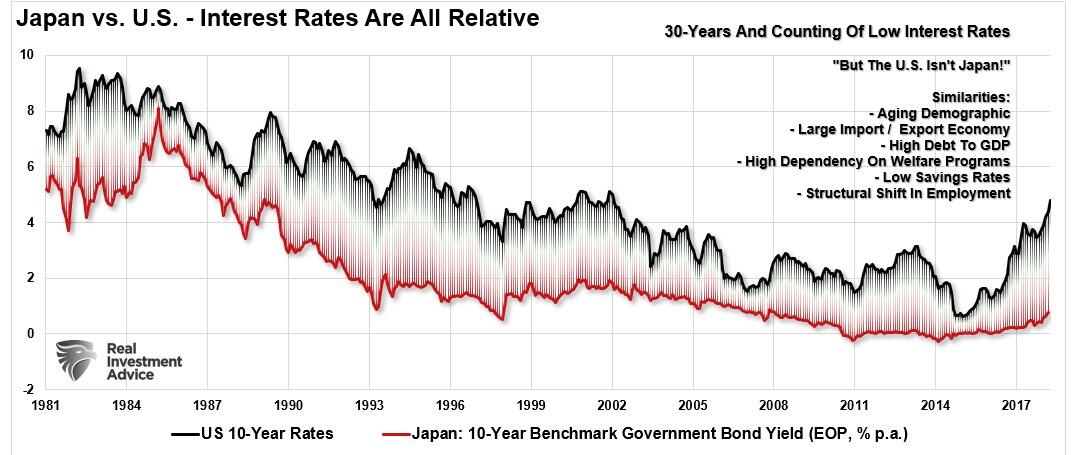
In a recent discussion with Adam Taggart via Thoughtful Money, we quickly touched on the similarities between the U.S. and Japanese monetary policies around the 11-minute mark. However, that discussion warrants a deeper dive. As we will review, Japan has much to tell us about the future of the U.S. economically.
Let’s start with the deficit. Much angst exists over the rise in interest rates. The concern is whether the government can continue to fund itself, given the post-pandemic surge in fiscal deficits. From a purely “personal finance” perspective, the concern is valid. “Living well beyond one’s means” has always been a recipe for financial disaster.
Notably, excess spending is not just a function of recent events but has been 45 years in the making. The government started spending more in the late 1970s than it brought in tax receipts. However, since the economy recovered through “financial deregulation,” economists deemed excess spending beneficial. Unfortunately, each Administration continued to use increasing debt levels to fund every conceivable pet political project. From increased welfare to “pandemic-related” bailouts toclimate change agendas, it was all fair game.
However, while excess spending appeared to provide short-term benefits, primarily the benefit of getting re-elected to office, the impact on economic prosperity has been negative. To economists’ surprise, Increasing debts and deficits have not created more robust economic growth rates.
I am not saying there is no benefit. Yes, “spending like drunken sailors” to create economic growth can work short-term, as we saw post-pandemic. However, once that surge in spending is exhausted, economic growth returns to previous levels. What those programs do is “pull forward” future consumption, leaving a void that detracts from economic growth in the future. That is why economic prosperity continues to decline after decades of deficit spending.
We agree that rising debts and deficits are certainly concerning. However, the argument that the U.S. is about to become bankrupt and fall into economic oblivion is untrue.
For a case study of where the U.S. is headed, a look at Japanese-style monetary policy is beneficial.
The Failure Of Central Banks
“Bad debt is the root of the crisis. Fiscal stimulus may help economies for a couple of years but once the ‘painkilling’ effect wears off, U.S. and European economies will plunge back into crisis. The crisis won’t be over until the nonperforming assets are off the balance sheets of US and European banks.” – Keiichiro Kobayashi, 2010
Kobayashi will ultimately be proved correct. However, even he never envisioned the extent to which Central Banks globally would be willing to go. As my partner, Michael Lebowitz pointed out previously:
“Global central banks’ post-financial crisis monetary policies have collectively been more aggressive than anything witnessed in modern financial history. Over the last ten years, the six largest central banks have printed unprecedented amounts of money to purchase approximately $24 trillion of financial assets as shown below. Before the financial crisis of 2008, the only central bank printing money of any consequence was the Peoples Bank of China (PBoC).”
The belief was that driving asset prices higher would lead to economic growth. Unfortunately, this has not been the case, as debt has exploded globally, specifically in the U.S.
“QE has forced interest rates downward and lowered interest expenses for all debtors. Simultaneously, it boosted the amount of outstanding debt. The net effect is that the global debt burden has grown on a nominal basis and as a percentage of economic growth since 2008. The debt burden has become even more burdensome.”
Not surprisingly, the massive surge in debt has led to an explosion in the financial markets as cheap debt and leverage fueled a speculative frenzy in virtually every asset class.
Soaring U.S. debt, rising deficits, and demographics are the culprits behind the economy’s disinflationary push. The complexity of the current environment implies years of sub-par economic growth ahead. The Federal Reserve’s long-term economic projections remain at 2% or less.
The U.S. is not the only country facing such a gloomy public finance outlook. The current economic overlay displays compelling similarities with the Japanese economy.
Many believe that more spending will fix the problem of lackluster wage growth, create more jobs, and boost economic prosperity. However, one should at least question the logic given that more spending, as represented in the debt chart above, had ZERO lasting impact on economic growth. As I have written previously, debt is a retardant to organic economic development as it diverts dollars from productive investment to debt service.
Japanese Policy And Economic Outcomes
One only needs to look at the Japanese economy to understand that Q.E., low-interest rate policies, and debt expansion have done little economically. The chart below shows the expansion of BOJ assets versus the growth of GDP and interest rate levels.
Notice that since 1998, Japan has been unable to sustain a 2% economic growth rate. While massive bank interventions by the Japanese Central Bank have absorbed most of the ETF and Government Bond market, spurts of economic activity repeatedly fall into recession. Even with interest rates near zero, economic growth remains weak, and attempts to create inflation or increase interest rates have immediate negative impacts. Japan’s 40-year experiment provides little support for the idea that inflating asset prices by buying assets leads to more substantial economic outcomes.
However, the current Administration believes our outcome will be different.
With the current economic recovery already pushing the long end of the economic cycle, the risk is rising that the next economic downturn is closer than not. The danger is that the Federal Reserve is now potentially trapped with an inability to use monetary policy tools to offset the subsequent economic decline when it occurs.
That is the same problem Japan has wrestled with for the last 25 years. While Japan has entered into an unprecedented stimulus program (on a relative basis twice as large as the U.S. on an economy 1/3 the size), there is no guarantee that such a program will result in the desired effect of pulling the Japanese economy out of its 40-year deflationary cycle. The problems that face Japan are similar to what we are currently witnessing in the U.S.:
A decline in savings rates to extremely low levels which depletes productive investments
An aging demographic that is top-heavy and drawing on social benefits at an advancing rate.
A heavily indebted economy with debt/GDP ratios above 100%.
A decline in exports due to a weak global economic environment.
Slowing domestic economic growth rates.
An underemployed younger demographic.
An inelastic supply-demand curve
Weak industrial production
Dependence on productivity increases to offset reduced employment
The lynchpin to Japan and the U.S. remains demographics and interest rates. As the aging population grows and becomes a net drag on “savings,” dependency on the “social welfare net” will continue to expand. The “pension problem” is only the tip of the iceberg.
Conclusion
Like the U.S., Japan is caught in an ongoing “liquidity trap” where maintaining ultra-low interest rates is the key to sustaining an economic pulse. The unintended consequence of such actions, as we are witnessing in the U.S. currently, is the ongoing battle with deflationary pressures. The lower interest rates go, the less economic return that is generated. Contrary to mainstream thought, an ultra-low interest rate environment has a negative impact on making productive investments, and risk begins to outweigh the potential return.
More importantly, while interest rates did rise in the U.S. due to the massive surge in stimulus-induced inflation, rates will return to the long-term downtrend of deflationary pressures. While many expect rates to increase due to the rise in debt and deficits, such is unlikely for two reasons.
Interest rates are relative globally. Rates can’t rise in one country, while most global economies push toward lower rates. As has been the case over the last 30 years, so goes Japan, and the U.S. will follow.
Increases in rates also kill economic growth, dragging rates lower. Like Japan, every time rates begin to rise, the economy rolls into a recession. The U.S. will face the same challenges.
Unfortunately, for the next Administration, attempts to stimulate growth through more spending are unlikely to change the outcome in the U.S. The reason is that monetary interventions and government spending do not create organic, sustainable economic growth. Simply pulling forward future consumption through monetary policy continues to leave an ever-growing void. Eventually, the void will be too great to fill.
But hey, let’s keep doing the same thing over and over again. While it hasn’t worked for anyone yet, we can always hope for a different result.
Oil Tumbles On Reuters Report OPEC+ Will Hike Output In October
With two months left until the election and amid growing speculation that the China/Russia axis may unleash an “October” surprise to make sure the belligerent deep state candidate does not win and send the price of oil higher, moments ago Reuters – a popular conduit for well-time market slam “breaking news”, reported that with oil just barely above 2024 lows, OPEC+ is already set to proceed with a planned oil output hike from October, because “Libyan outages and pledged cuts by some members to compensate for overproduction counter the impact of sluggish demand” which of course is idiocy as the only thing that matters for oil prices – a bump in Chinese demand – is missing. And yet, despite the lack of this clear catalyst, Reuters managed to round up no less than six anonymous sources from the Kamala Harris re-election committee OPEC+. Predictably, oil tumbled instantly.
As a reminder, eight OPEC+ members are scheduled to boost output by 180,000 barrels per day in October, as part of a plan to begin unwinding their most recent layer of output cuts of 2.2 million bpd while keeping other cuts in place until end-2025.
But that’s only if oil prices can remain sustainably higher and absorb the incremental output, something which has clearly not been the case in recent months, when Brent tumbled to 2024 lows.
As such, one can easily conclude that the Reuters “report” – which hilariously comes more than a month ahead of the October meeting – has just one goal: to slam oil prices and push them even lower, in what is either a trial balloon or intentional price manipulation on behalf of various pro-Harris interests.
A slowdown in demand growth, notably in China, has weighed on oil prices and prompted some analysts to doubt whether the Organization of the Petroleum Exporting Countries and allies, known as OPEC+, will go ahead with the October increase.
But, according to Reuters, six OPEC+ sources – who almost certainly are being spoonfed what to tell Reuters by the Deep State which is scrambling to keep gas prices as low as possible ahead of the elections – the plan to increase production remains in place as the loss of Libyan output tightens the market and hopes build that the U.S. Federal Reserve will cut interest rates in mid-September. Which, again, is absolute idiocy, and we expect that OPEC+ will issue an official denial within minutes, especially since Saudi Energy Minister Prince Abdulaziz bin Salman previously said OPEC+ could pause or reverse the production hikes if it decides the market is not strong enough, which it clearly is not right now!