61.6 F
Chicago
Wednesday, September 30, 2026
Home Blog Page 2357

Rabobank: Kamala Taxing Unrealized Gains Would Risk Mass Sale Of US Assets And The Rich Fleeing

0
Rabobank: Kamala Taxing Unrealized Gains Would Risk Mass Sale Of US Assets And The Rich Fleeing

By Michael Every of Rabobank

On the border, Nietzsche

“Cruisin’ down the centre of a two-way street; Wonderin’ who is really in the driver’s seat
Minding my business, along comes big brother; Said, “Son, you better get on one side or the other”
(Whoa-ooh) I’m out on the border; (Whoa-ooh) I’m walkin’ the line
Don’t you tell me ’bout your law and order (whoa-ooh); I’m tryin’ to change this water to wine”

          – The Eagles, ‘On the Border’


“He who has a why to live for can bear almost any how.”         

          – Nietzsche

——-

It’s not often The Eagles and Nietzsche both describe the political economy, but the US, and the world, are bordering on major change in their “why” and “how” as November’s election looms.

On the border gap, Vice-President Harris proposes amnesty for those who arrived in the US illegally, which would logically incentivize more arrivals failing a tough border approach(?) Trump proposes to deport all those illegal arrivals and take a tough border approach. On one hand, we’d have the larger, unofficial US labor force and the implication of a similar trend ahead. On the other, we’d have a potential drop in the labor force and much lower growth in it. Market economists and the Fed have very belatedly started to realize undocumented immigration might be impacting macro data; the point may be underlined by today’s BLS revision to past payrolls data, where 600,000 to 1m jobs may be cut from the total ‘created’ over a year. If so, the macro story shifts; and so does that of new jobs added net new labor force arrivals. Yet while “Rate cuts!” views of this are already clear, there’s little discussion of the very different assumptions of post-election border policy on wage growth, inflation, housing, budgets, and productivity, etc.

[ZH: and this is what we said back in January, long before “belatedly” everyone else did]

There’s a widening Harris-Trump policy gap on tax. Social media claim Harris backs President Biden’s plan for a 44.6% capital gains tax and a 25% tax on unrealized capital gains for those with more than $100m in assets. That would theoretically narrow the fiscal deficit and act against dangerous inequality; practically it may risk a mass sale of US assets and the move of capital and the rich outside it. Of course, that this tax hike was already raised by Biden yet didn’t pass speaks to the president proposing and Congress disposing: that means those guessing the presidential electoral outcome also need to guess the Senate and House outcomes. Meanwhile, Trump favors lower taxes: fiscal deficit, fiscal shmeficit. Which tax rates do your models assume?

There’s also a Harris-Trump gap on trade. The former may keep existing Biden tariffs and add to them strategically. The latter wants a 20% universal tariff and up to 100% on China. Our house view incorporates a lower universal tariff yet is already inflationary enough for our Fed watcher Philip Marey to call a floor in rate cuts at 4.50% in H1 2025. Imagine if we were to get 20% and 100%! While it’s impossible to find a neoclassical economist who backs tariffs (or the working paper a pro-tariff US think tank says proves they have a positive economic impact), it helps to look at things more broadly in what policy assumptions to make.

To illustrate, my colleague Ben Picton is now reading Factory Man, published in 2004, from which he just shared two key passages from when the US protagonist visits a Chinese furniture factory run by a Taiwanese businessman who had negotiated deals with European and South American counterparties, but had “never met anyone like Americans”, then a CCP official, He YunFeng:

“I have figured you guys out, the translator finally relayed.

Tell me.

If the price is right, you will do anything. We have never seen people before who are this greedy – or this naïve.

The Americans were not only knocking one another over in a stampede to import the cheapest furniture they could, but they were also ignoring the fact that they were jeopardizing their own factories back home by teaching their Asian competitors every nuance of the American furniture-making trade.

When we get on top, the man said, don’t expect us to be dumb enough to do for you what you’ve been dumb enough to do for us.”

“He YunFeng would be happy to provide Basset with the dressers at a fraction of what they cost to make, a feat Basset knew would not be possible without Chinese government subsidies. All Basset had to do in return, Hu YunFeng said, was close his own factories.”

The author, whose protagonist opts to keep his US factory, has their own bias, and the above sounds Trumpian. However, it was not Americans saying it, and they were doing so 20 years ago. How many readers were aware this, not ‘free trade comparative advantage’, was realpolitik two decades ago? More to the point, how many voters — so politicians — were/are now? In short, it’s more logical to expect further global protectionism and goods inflation (and onshoring or friendshoring), than endless structural goods deflation (and deindustrialisation) via China.

Even in China-friendly Thailand, the government may impose tariffs as it worries about the collapse of local industry due to Chinese imports, joining the US, EU, Canada, Mexico, Brazil, India and Indonesia in doing so. Meanwhile, the US and EU are set to impose high tariffs on solar panels made in Malaysia, Thailand, Vietnam, and Cambodia by Chinese firms circumventing existing 25% tariffs on Chinese production, which may rise to 50%. The pattern is clear: the US (and EU) tariffs China; China shifts its exports to others; they also tariff China; China shifts its production to Asia and Mexico; and the US (and EU) tariffs these new China proxies. Ultimately, most countries will either end up being in one trade zone or the other: a Trump election victory would massively accelerate this process.

And what does the non-US bloc look like? Hard to say – but it’s not going to be anything like the US bloc. Russian companies that import from China have started receiving their CNY payments back from Chinese banks who fear US sanctions for dealing with them, sometimes even after the goods have been delivered and cleared by customs. Obviously, this makes importing from China even harder for Russians. As such, while the West is not doing well in general, or the dollar this week as “Rate cuts!” fever builds, it’s clear that building a global dollar alternative is hard: if you can’t even do CNY-RUB trade now due to potential US sanctions, it’s back to bilateral (dollar-priced) barter, which isn’t efficient or scalable within a bloc. And for those who say gold as medium, that metal might hedge well vs. political inflation, but you can’t run sustained trade deficits with it, and both China and Russia (and most of the BRICS) want to run trade surpluses.

So, yes, we are stuck on the border: literally, in the US case, and much else; metaphorically in a US and global sense, where everything is shifting —don’t you tell me ‘bout your law and order– and November’s election will determine the Nietzschean “why” we are living/acting, allowing us a new “how” to achieve it – I’m tryin’ to change this water to wine.

Tyler Durden
Wed, 08/21/2024 – 09:45

Justice Department Steps In For Trump In George Floyd Protests Case

0
Justice Department Steps In For Trump In George Floyd Protests Case

Authored by Sam Dorman via The Epoch Times,

The Justice Department has intervened for former President Donald Trump, asking a federal court in Washington to dismiss a civil complaint brought over a clash between protestors and police that took place in the city following George Floyd’s death.

Black Lives Matter D.C. and others brought the original lawsuit in June 2020, just days after police used crowd control tactics in Lafayette Square before Trump was set to appear at a nearby church.

The case has seen court filings for years, with a group of plaintiffs filing an amended complaint in April this year.

On Aug. 19, the Department of Justice (DOJ) filed a notice that it was substituting itself for Trump because he was acting within the scope of his office that day.

Its decision was based on the Federal Tort Claims Act (FTCA).

In its notice, the DOJ said the law “provides that upon certification by the attorney general that a federal employee was acting within the scope of his office or employment at the time of the incident out of which the plaintiff’s claim arose, any civil action or proceeding commenced upon such a claim and arising under state law shall be deemed an action against the United States, and the United States shall be substituted as the defendant with respect to those claims.”

James G. Touhey, who leads the torts branch of DOJ’s civil division, certified that Trump “was an employee of the government acting in the scope of office or employment at the time of the incident out of which the plaintiffs’ claims arose.”

The amended complaint had named Trump in his individual capacity and requested damages. It alleged Trump was liable for intentional infliction of emotional distress, assault, battery, and negligence in purported violation of a district law surrounding free speech.

A separate motion to dismiss, also filed on Aug. 19, argued that the court lacked subject matter jurisdiction over the plaintiffs’ claims because they failed to exhaust administrative remedies.

It added that the plaintiffs had failed to show that their claims fell within the limited waiver of sovereign immunity offered by the FTCA.

The complaint alleged that the agencies involved with the suit had failed to respond within a six-month timeframe specified under the FTCA.

“Plaintiffs have therefore exhausted their administrative remedies under the FTCA,” the complaint read.

The DOJ’s actions came against the backdrop of broader controversy about Trump’s immunity and the federal government’s involvement in his legal battles.

Special Counsel Jack Smith prompted a legal battle that ultimately resulted in the Supreme Court establishing a landmark precedent on presidential immunity in July.

That case focused on criminal liability, but presidents have long enjoyed broad immunity from civil liability for actions that fall within the outer perimeter of their official duties.

In 2023, however, the U.S. Court of Appeals for the District of Columbia Circuit ruled the former president could not avoid civil liability in a suit from injured Capitol Police officers.

In that case, DOJ attorneys told the court that a president would not be protected by “absolute immunity” if his words were found to have been an “incitement of imminent private violence.”

Trump has denied wrongdoing associated with the U.S. Capitol breach on Jan. 6, 2021, and his attorneys said he didn’t intend to spark violence.

The DOJ had supported Trump in the lawsuit between him and writer E. Jean Carroll but reversed it in 2023.

In a July 11 letter to attorneys for Trump and Carroll, Principal Deputy Assistant Attorney General Brian Boynton said the DOJ could no longer conclude the former president was acting in his capacity as president when he made the allegedly defamatory statements about Carroll.

Tyler Durden
Wed, 08/21/2024 – 09:25

Ukraine Sends One Of Largest Ever Drone Attacks On Russian Capital

0
Ukraine Sends One Of Largest Ever Drone Attacks On Russian Capital

Russia on Wednesday says its anti-air defenses have successfully thwarted a major Ukrainian drone attack against the capital of Moscow, having shot down eleven inbound drones in total.

“The echeloned defense of Moscow against enemy UAVs made it possible to repel all attacks. This was one of the largest attempts to attack Moscow with the help of drones of all time,” Moscow Mayor Sergei Sobyanin said in a Telegram post early Wednesday morning.

Moscow, Getty Images

Russia’s defense ministry said the effort to target the capital was part of a broader cross-border attack which included 45 drones total sent by Ukraine across different regions overnight, including:

  • 11 shot down over the Moscow region

  • 23 intercepted over the Bryansk region

  • 6 over Belgorod,

  • 3 over the Kaluga region 

  • 2 over Kursk

Reuters noted that some of the drones were downed over the city of Podolsk, which lies some 24 miles south of the Kremlin. There have been no initial reports of injuries or damage due to the drone attack on the capital. Separately the governor of Bryansk, Alexander Bogomaz, cited a “mass” attack on his region which included all 23 drones intercepted.

Kremlin officials likely see this brazen attack on the capital as but a new extension of the Kursk incursion. While it’s certainly not the first drone attack on Moscow since the war began, it could mark the start of more consistent efforts to reach Moscow with UAVs. 

President Zelensky has meanwhile been busy demanding that the West lift all restrictions for using long-range missiles inside Russian territory.

Ukraine has assaulted the Russian capital on a few prior notable occasions. First, on May 3, 2023 a pair of explosive-laden drones targeted the Kremlin complex in what Russia called an “act of terrorism” and an assassination attempt. The drones were intercepted, but just barely, as one appeared to explode at the top of the Kremlin Senate dome. President Putin had not been present there at the time.

Another drone attack occurred in July 2023, when drones struck two buildings very near the Ministry of Defense headquarters. Another in November included a wave of 20 Ukrainian drone attacks on separate locations of Russia, some which tried to reach Moscow.

Ukraine, for its part, said it was also subject of a large-scale overnight drone attack which included 72 projectiles launched by Russia, most which were reportedly intercepted.

Ukraine’s military said 69 Iranian-design one-way drones targeted locations in Kyiv, Odesa, Kherson and Donetsk. Of these it said 51 drones were shot down; however, at least two Russian ballistic missiles made impact.

Meanwhile, former president Dmitry Medvedev, who serves as deputy head of Russia’s Security Council, has reiterated that the ongoing Kursk incursion means peace talks are impossible until Ukraine is completely defeated. “The empty chatter of intermediaries that no one had appointed about the wonderful peace is over. Everyone understands everything now, even though they do not say it out loud,” Medvedev wrote on Telegram.

He concluded his message in caps with: “There will be NO MORE NEGOTIATIONS UNTIL THE COMPLETE DEFEAT OF THE ENEMY!”

Tyler Durden
Wed, 08/21/2024 – 09:05

Traders Consistently Underestimate The Fed

0
Traders Consistently Underestimate The Fed

Authored by Michael Lebowitz via RealInvestmentAdvice.com,

Profitable bond trading opportunities arise when your expectations about Fed policy differ from those of the market. Therefore, with the Fed seemingly embarking on a series of interest rate cuts, it behooves us to appreciate how many interest rate cuts the Fed Funds futures market expects and over what period. Equally important, Fed Funds futures help us assess the market’s economic growth and inflation expectations.

Currently, Fed Funds futures imply the Fed will start cutting rates in September and reduce them by 2.25% to 3.09% in early 2026. From that point, the market expects the Fed to slowly increase Fed Funds to 3.50%. The limited rate cuts and relatively high trough in Fed Funds tell us the market is not pricing in a recession but a normalization of GDP with inflation running at or slightly above the Fed’s 2% target.

If the Fed Funds futures market is correct, the upside in bond prices may be limited, especially compared to prior easing cycles. However, suppose the market underestimates the probability of a recession or a sharper-than-expected inflation drop over the coming few years. In that case, there is significant upside potential in bond prices.

Fed Funds Futures Caveat

Before we provide historical context for what the Fed might do and a historical track record of Fed Funds futures estimates, it’s important to caveat that market beliefs about future Fed actions and, consequently, the economy and inflation can swing wildly.

The graph below shows that expectations for the Fed Funds rate at the coming September 24th FOMC meeting have whipped around over the past year. Fed Funds futures currently imply that the Fed will cut rates by 34 bps at the September meeting. This includes a 100% chance of 25 bps and a 36% (.34-.25)/.25) chance of 50 bps. Only two months ago, it was priced at a 50/50 chance of only one 25-bps rate cut. Furthermore, at the start of the year, the market thought the Fed would cut rates by 1.34% by next month’s meeting. The data suggest that the markets’ collective assessment of economic conditions can be volatile.

Fed Funds and Fed Funds Futures

The graph below charts the effective Fed Funds rate since 1955. As implied by Fed Funds futures, we added the future rates for the next three years.

The market expects Fed Funds to decline from the current rate of 5.33% to 3.09% by March 2026. Following that, Fed Funds futures imply Fed Funds will slowly rise to 3.50% by the end of 2027.

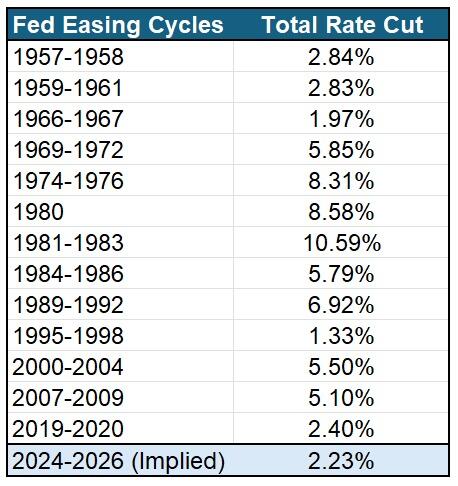
The table below quantifies the thirteen easing cycles shown above. Of these easing cycles, only two periods saw declines of less than 2.23%. 2.23% represents current market expectations. Of the two instances, the economy did not enter a recession (1966-1967 and 1995-1998).

Since 1980, only two easing cycles have seen the Fed cut Fed Funds by less than 5%. The most recent, 2020, was limited as the Fed could only bring rates down to 0%. The other was 1995-1998.

Based on history, the market is betting on an anomaly, like 1995-1998, and not normal monetary policy behavior.

What Is The Market Expecting?

Given that the market expects a relatively minimal rate cut, we should suppose it’s expecting a 1995-1998 economic scenario, i.e., no recession.   

John Authers of Bloomberg recently opined what Fed Funds futures may imply regarding inflation. To wit:

So even if markets buy the notion that the Fed will have to cut soon, they also seem convinced by the theory that the very low rates of the last three decades were an aberration, and that the norm for monetary policy will be tighter in future. That presumably goes hand-in-hand with slightly higher inflation rates.

Presuming the collective market thinks this time is different, they must believe that economic growth and inflation trends of the pre-pandemic have been reversed. We have discussed such a forecast many times. To wit, we share a section from Our Elevator Pitch For Bonds, published in July 2023.

Our view of the attractiveness of bonds can be honed into an elevator pitch. It essentially boils down to a straightforward question – Is this time different? Have the forty-year pre-pandemic economic trends reversed, and the economy’s inner workings changed permanently over the last three years? More specifically, are slowing productivity growth, weakening demographics, and rising debt levels about to reverse their prior trends and become a tailwind for economic growth?

If you think, as we do, that the last three years are an economic, fiscal, and monetary anomaly, then the opportunity to earn 4% or more on a longer-term bond is a gift.

We think yields will revert to low levels when the pre-pandemic economic and inflation trends reemerge. Negative interest rates are not out of the question.

Traders Consistently Underestimate The Fed

While the market appears to be pricing a “this time is different” scenario, it frequently prices in such a scenario, only to find out this time is no different.

In 2019, we quantified how accurately Fed Funds futures predict the future. The graph below shows our results. We recently released the article describing our analysis HERE. 

The graph compares the effective Fed Funds rate to what was implied by the futures contract for that same period six months earlier.

The gray shading represents periods in which the Fed consistently raised or lowered the Fed Funds rate. The three easing cycles shown are 1989-1991, 2000-2003, and 2007-2009. At one point during each of those cycles, the market underestimated the amount of Fed rate cuts by roughly 2.50%. The yellow-shaded circles highlight these gross underestimations.  

While not pertinent to this article, the futures market also underestimates rate increases but to a much lesser extent.

In late 2019, when we published the findings, we theorized:

 “If the Fed initiates rate cuts and if the data in the graphs prove prescient, current estimates for a Fed Funds rate of 1.50% to 1.75% in the spring of 2020 may be well above what we ultimately see.”

It turns out we were prescient. Fed Funds went to 0%.

What Do Economists Think?

With an idea of what the market forecasts for longer-term economic growth and inflation, let’s compare that to economists’ expectations.

The table below is from the Fed’s most recent series of economic projections. As circled, they forecast the long-term economic growth rate of the U.S. is 1.80%. The second table compares the projections below with those from December 2019.

The difference column shows that the Fed doesn’t believe this time is different. On the contrary, it thinks real GDP in the “longer run” will run 0.1% less than before the pandemic. Furthermore, it expects a slightly higher long-term unemployment rate. The Fed believes inflation will run around 2% in the future, as it did in 2019.

The CBO also forecasts that pre-pandemic GDP and inflation trends will prevail over the next decade.

Don’t believe the government?

The following commentary is from the Blue Chip Economic Indicators, compiled by Wolters Kluwer. The report polls 50 leading business economists to arrive at its forecasts.

In general, the longer-term outlook in the most recent survey is little changed from that in the March survey. Forecasters usually anticipate that the real GDP will grow on average at its potential rate over the longer term. The BCEI consensus looks for 1.9% growth in real GDP over the 2025- 29 period, the same estimate as in March but much slower than the 2.5% growth experienced during the five years prior to the Covid pandemic. On inflation, the consensus expects the Federal Reserve to essentially achieve its 2% target with the PCE price index inflation rate (the measure that the Fed targets) expected to average 2.1% from 2025-29. This is slightly higher than the 2.0% estimate in the March survey.

Both public and private sector economists are forecasting that this time is not different. They believe the pre-pandemic trends of lower economic growth and stable 2% inflation will prevail.

Summary

History shows that Fed Funds futures are volatile and consistently underestimate the amount of Fed easing in a cycle. Their forecast of relatively minimal Fed Fund rate cuts implies that the economy will remain strong and, to some degree, start reversing the economic and price trends existing before the pandemic.

Economists, however, believe that the major factors that drove a steady trend of declining economic growth before the pandemic will continue.

We side with the economists. There is little evidence that productivity and demographic trends have changed. The nation is more indebted today than it was before the pandemic. Given those essential economic factors remain intact, it’s difficult for us to believe that this time is different. Therefore, should we expect this coming rate-cutting cycle to differ from the past?

If the answer is no, bond investors could be on the cusp of outsized returns. 

Tyler Durden
Wed, 08/21/2024 – 08:45

No, The Biden And Harris’ Border Crisis Is Not Over

0
No, The Biden And Harris’ Border Crisis Is Not Over

Authored by Mark Green via RealClearPolitics,

Ever since early 2021, Americans have watched as illegal aliens have flooded across the Southwest border unimpeded. They have read with horror the accounts of innocent Americans victimized by those here unlawfully. They have seen family and friends die after being poisoned by fentanyl coming across the border. And the Biden-Harris administration has largely done nothing.

Yet now, following a few months of somewhat-reduced numbers of apprehensions between ports of entry along the Southwest border, the Biden-Harris administration is taking a victory lap. Such premature celebration, however, ignores the reality of the continuing nature of this crisis.

Before explaining why, Americans must understand that even if not one more inadmissible alien crossed our borders for the remainder of Biden and Harris’ term, the millions they have already allowed into our country have done damage that will take decades to remedy. For many families, like those of Laken Riley, Rachel Morin, and Jocelyn Nungaray, the damage can never be undone.

But if Biden and Harris want to talk about numbers, the president and his “border czar” will find no exoneration. On their watch, Customs and Border Protection (CBP) has recorded more than 10 million encounters nationwide, plus another two million known “gotaways” who have crossed our borders uncaught.

Many on the left like to appeal to the history of Ellis Island as an excuse for mass immigration – despite the fact that these individuals arrived in accordance with then-existing law. However, the number of people who came through Ellis Island was also roughly 12 million – in the 62 years between 1892 and 1954.

The number of inadmissible aliens who have been encountered at our borders or crossed uncaught since the start of Fiscal Year (FY) 2021 is unprecedented. Claiming victory now due to temporarily reduced border crossings displays a willful ignorance of the nature of this ongoing crisis, because these numbers alone do not tell the full story of what Americans are experiencing.

First, there are the continuing financial impacts. As of mid-June 2024, more than 205,000 illegal aliens had arrived in New York City since the spring of 2022. Mayor Eric Adams has declared that these arrivals and the resultant costs “will destroy New York City.” Small towns will also be struggling for years with the consequences of unchecked crossings. Springfield, Ohio, home to 60,000 people, has seen roughly 20,000 Haitians arrive since the crisis began, putting major strain on housing and other services. Whitewater, Wisconsin, a town of just 15,000 people, has been overwhelmed by the arrival of 1,000 illegal aliens “often lacking basic English skills.” According to one official in Sanford, Maine last year, “We’re tapped. … We’ve been overrun,” after costs to care for illegal aliens tripled.

DHS has reported that more than 80% of illegal aliens who are “neither expelled or repatriated directly by CBP nor continuously detained by ICE” remain in the United States years later. These communities, and thousands more like them, are going to be dealing with these costs for years.

Second, consider the ongoing public safety implications of what’s happening at the Southwest border. Border Patrol arrests of illegal aliens with criminal histories since FY2021 have more than doubled from FY2017-2020. Worse, criminals and individuals with possible ties to terrorism have been, and continue to be, released into the interior. In fact, news recently broke that the Biden-Harris administration actually released into the interior 99 individuals whom they knew were on the terrorist watchlist. According to one DHS source, ICE officials have been “discouraged from deporting even illegal immigrants who had final deportation orders and were linked to gangs.” Former ICE Field Director John Fabbricatore has said, “I was being forced to release people that should not have been allowed on the street.”

How many other threats to our safety and security have likewise been unwittingly released or entered as gotaways? How many more, who either did not commit crimes in their home country or were never caught, will do so for the first time against American victims?

Finally, despite a recent decrease in illegal crossings between ports of entry, encounters of inadmissible aliens at ports of entry are at record highs, in large part because the administration has devised numerous, unlawful mass-parole programs encouraging them to enter this way. Consider that in February 2021, Biden and Harris’ first full month in office, CBP recorded just 17,744 encounters at ports nationwide. By July 2024, that number was 110,615. Encouraging would-be border crossers to cross at ports of entry certainly cuts down on the embarrassing optics of overwhelmed Border Patrol agents and facilities, but ultimately leads to the same result – inadmissible aliens being released into the interior. And now, one of these mass-parole programs has been temporarily shut down due to massive fraud.

This border crisis is not over – not by a long shot. It is time for Congress, and the American people, to say enough is enough.

Rep. Mark E. Green, chairman of the House Committee on Homeland Security, represents Tennessee’s 7th Congressional District.

Tyler Durden
Wed, 08/21/2024 – 07:20

Wall Street On Edge: Election Talk In Earnings Calls Up ‘More Sharply’ Than Past Political Cycles

0
Wall Street On Edge: Election Talk In Earnings Calls Up ‘More Sharply’ Than Past Political Cycles

With 93% of S&P 500 companies reporting, Goldman analysts have found a sharp increase in earnings calls mentioning election uncertainty, likely dampening capital expenditure growth for companies through the end of the year. There are currently 76 days (as of Tuesday) until the November 5th US presidential elections.

“Election discussions have entered management commentary earlier than in past election cycles, with some companies—particularly financials, government contractors, and those with exposure to the Inflation Reduction Act—noting that either they or their customers are postponing some investment decisions until after the election,” a team of Goldman analysts led by Jan Hatzius wrote in a note to clients. 

The bank’s chief economist said, “Consistent with an election drag, we find that capex growth has been 5pp lower for companies citing election uncertainty on Q2 earnings calls, and that capex growth is expected to accelerate disproportionately post-election for those same companies.” 

The analysts pointed out that election discussions during the current earnings season has been “more abruptly than in previous election cycles.” 

In the bank’s mid-year capex update, Goldman highlighted that policy uncertainty leading up to the November election is expected to impact business investment modestly.

Here’s a list of companies mentioning election uncertainty: 

Companies citing election uncertainty on the earnings calls are facing lower capex growth. However, capex growth is expected to tick higher after more economic clarity is realized after the elections. 

“We expect business investment growth in the national accounts to slow from a roughly 5% pace in 2024H1 to a roughly 3% pace in 2024H2. That’s in part because there could be an election drag worth a few tenths, but mostly because the factory-building boom catalyzed by CHIPS Act and Inflation Reduction Act subsidies—which played such a large role in business investment growth over the last year and a half—has now peaked,” the analysts said. 

Wall Street is certainly on edge as this is one of the most important presidential elections in the nation’s history. Folks will choose between VP Harris’ communist-style price controls and or former President Trump’s pro-America agenda. 

Tyler Durden
Wed, 08/21/2024 – 06:55

RFK Jr. Can Save Liberalism…By Endorsing Trump

0
RFK Jr. Can Save Liberalism…By Endorsing Trump

Submitted by QTR’s Fringe Finance

“The Democratic Party positions itself as the party of liberty. Kamala Harris says that Americans should make personal decisions without the government telling them what to do. Tim Walz’s Golden Rule is ‘Mind your own damn business.’

In view of the censorship, surveillance, vaccine mandates, and the confederacy of fixers openly working to prevent me from getting on ballots, this is like the arsonist telling us he’s a firefighter. I am running to make America once again the land of liberty.”

— RFK, Jr. on X, Today

On Tuesday, one of the big headlines to hit the wire was that RFK, Jr. could wind up dropping out of the race to support Donald Trump. The speculation came after this interview of Nicole Shanahan talking about how the DNC sabotaged their campaign and how they are considering joining forces with Donald Trump.

“There’s two options that we’re looking at and one is staying in, forming that new party, but we run the risk of a Kamala Harris and Waltz presidency because we draw more votes from Trump,” she says during the interview. “Or we walk away right now and join forces with with Donald Trump and explain to our base why we’re making this decision.”

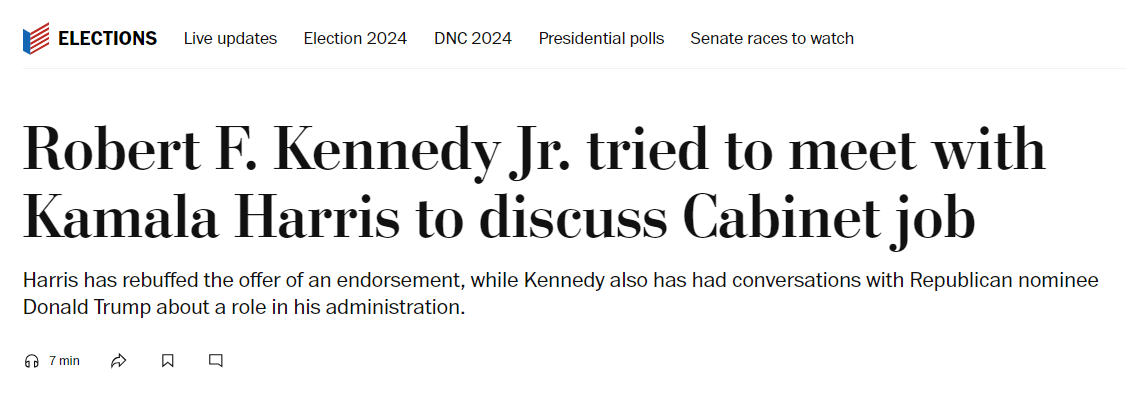
Hilariously, the news comes just days after the left-wing propaganda machine Washington Post tried to pass off a story that RFK, Jr. had gone groveling to the Harris campaign in order to back them.

Upon seeing this headline last week, I contacted my sources in the RFK, Jr. campaign, which are extremely close to Mr. Kennedy and trustworthy enough that they helped set up my recent podcast with him.

Those sources told me that the reporting about Kennedy wanting Harris’ help was “a load of crap.” Instead, they informed me that a family member of RFK, Jr. had tried to convince him, at a wedding, to talk to Harris on the phone.

My source told me directly:

“…we were at a wedding and one of [RFK, Jr.’s] cousins was like ‘let me please put you on the phone with Kamala to just talk’ and then they didn’t want to have a phone call…”

“…[it is RFK, Jr.’s] deal is talk to anyone anytime so not out of character…”

I then tweeted out the refutation to that report last Friday, which was picked up by precisely zero media outlets, thereby demonstrating how extraordinarily easily fake or extremely unreliable news can conveniently make its way into liberal headlines when it benefits them.


🔥 50% OFF FOR LIFE: Using the coupon entitles you to 50% off an annual subscription to Fringe Finance for as long as you wish to subscribe: Get 50% off forever


Given the events of last week, I wasn’t entirely surprised to see Nicole Shanahan’s comments today refuting the WaPo claims as well, as I’m sure the campaign was inundated with people sending emails like mine last week after the story dropped.

I had actually jotted down the idea of calling for RFK, Jr. to endorse Trump a week or two ago and was planning on writing an article about it anyway. Given that it’s now being talked about in the mainstream media, I’ll make my points extremely concise.

Many former Democrats and liberals have switched over to the conservative party in the last decade or so as the calibration of the parties has shifted significantly. Left-wing causes have become extraordinarily far-left, while “classic liberal” causes now look more towards the center, or even slightly to the right, because of the Democratic Party’s drastic shift further left.

Prime examples of this include stances on capitalism and war. Looking to former President John F. Kennedy as an example, he was staunchly anti-war and warned of the dangers of moving towards communism. He wanted peace by diplomatic means, and fought for the cause of freedom and liberty, which is something that Democrats used to embrace before the authoritarian shift they’ve undergone the last decade.

Many of the causes that liberals used to support, like freedom of speech, have now become conservative talking points. An idea like Bitcoin would have been rabidly supported by the free thinkers, feminists, and hippies of the 1960s to the 1980s. Now, people like Elizabeth Warren think of it as the devil reincarnate because it doesn’t allow for enough government micromanaging or oversight.

Hell, former Democratic President Bill Clinton even went out of his way to balance the budget, an idea that is unconscionable for Democrats given today’s spending addiction and policy stances on the fiscal state of the country.

When you take a look at his policy choices, as he laid out to me on my podcast with him, RFK, Jr. really is a DINO in today’s age—a Democrat in name only.

Like Joe Biden, the party that he and his family have been threaded into for decades turned on him viciously and all but threw him out the back door and into the dumpster. His own family members have gone out and publicly railed against him in the press. His party wants nothing to do with him and sees him as a thorn in their side — they have infiltrated his campaign, taken him to court and fabricated headlines about him — as Shanahan described in the above interview.

The reasoning for this is simple: we simply don’t have a democratic process unfolding when it comes to selecting our next president.

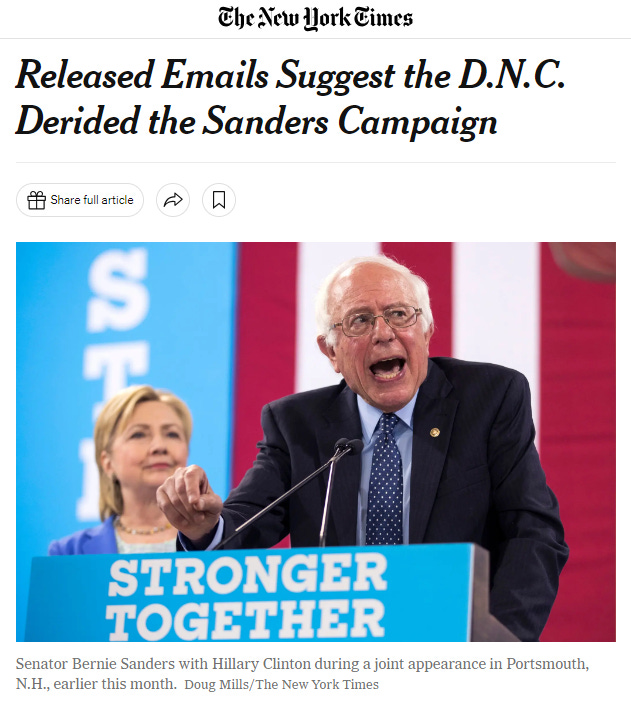
At least in the Republican Party, people have started to unify around President Trump. If RFK, Jr. had been a Republican to begin with, the dynamic would’ve been interesting to watch, but he wasn’t. He was a Democrat before becoming an independent, and he went out on his own because, like Joe Biden, he had fallen out of favor with a select group of extraordinarily powerful, extraordinarily rich elites that pull the strings for the entire party, arresting any true Democratic ideas or talking points that could get in their way fiercely and without hesitation. We all saw this in 2016 and 2020 with what they did to Bernie Sanders.

In short, the current Democratic Party is everything that former classic liberals used to fight against. They have become the party of reckless spending, the party of encouraging war, the party of censoring speech and media they don’t like, and the party of authoritarian oversight.

On top of this, on the economic side, the Democratic Party has simply become the party of socialism. As I stated in my last article about Kamala Harris, there’s no other way to describe her policy prescriptions other than the top of a very slippery slope that ends in communism. It broke today she is supporting Biden’s plan for 44% capital gains taxes and taxing unrealized gains, something that would undoubtedly destroy the U.S. economy in short order, as I wrote earlier this year.

With the nation running the multi-trillion-dollar deficit it’s running now, with our national debt skyrocketing and interest on the national debt over $1 trillion a year, while nations like China, Russia, and India are openly mounting a challenge to the U.S. dollar, it is unfathomable to me that a presidential candidate wants to make raising taxes further and price controls part of their fiscal policy.

Before we went off the gold standard, America became an economic powerhouse after World War II the old-fashioned way, with sound money. We had a bunch of people return to work, we became an extraordinarily productive nation, we balanced our checkbook, and we were modest with our spending, and, as a result, we saw the nation boom and even survived the inflationary crisis of the 1970s by hiking rates to a level that, today, would destroy the entire global economy.

How many policies that the Democrats support today would President John F. Kennedy have never thrown his support behind?

RFK, Jr. now has an extraordinary opportunity to recalibrate the legacy of his family’s name as standing for what they are best known for.

By withdrawing from the race and putting his support behind President Trump, he could easily help sway crucial votes that could help the nation return power to the people and away from the political elites who wield it now.

RFK, Jr. entered the race because he wanted to effect major change for the future of the United States for the better. Ironically, despite the fact that he won’t come anywhere near the vote total necessary to win, and despite the fact that he’s being left off of New York’s ballots, he still has that very same opportunity on the table, if he wants it, by endorsing Donald Trump and serving in his administration.

Now read:

QTR’s Disclaimer: Please read my full legal disclaimer on my About page here. This post represents my opinions only. In addition, please understand I am an idiot and often get things wrong and lose money. I may own or transact in any names mentioned in this piece at any time without warning. Contributor posts and aggregated posts have been hand selected by me, have not been fact checked and are the opinions of their authors. They are either submitted to QTR by their author, reprinted under a Creative Commons license with my best effort to uphold what the license asks, or with the permission of the author. This is not a recommendation to buy or sell any stocks or securities, just my opinions. I often lose money on positions I trade/invest in. I may add any name mentioned in this article and sell any name mentioned in this piece at any time, without further warning. None of this is a solicitation to buy or sell securities. I may or may not own names I write about and are watching. Sometimes I’m bullish without owning things, sometimes I’m bearish and do own things. Just assume my positions could be exactly the opposite of what you think they are just in case. All positions can change immediately as soon as I publish this, with or without notice and at any point I can be long, short or neutral on any position. You are on your own. Do not make decisions based on my blog. I exist on the fringe. The publisher does not guarantee the accuracy or completeness of the information provided in this page. These are not the opinions of any of my employers, partners, or associates. I did my best to be honest about my disclosures but can’t guarantee I am right; I write these posts after a couple beers sometimes. I edit after my posts are published because I’m impatient and lazy, so if you see a typo, check back in a half hour. Also, I just straight up get shit wrong a lot. I mention it twice because it’s that important.

Tyler Durden
Wed, 08/21/2024 – 06:30

RFK Jr Campaign Mulling “Joining Forces With Trump” Because We ‘Run The Risk Of Enabling A Harris/Walz Presidency’

0
RFK Jr Campaign Mulling “Joining Forces With Trump” Because We ‘Run The Risk Of Enabling A Harris/Walz Presidency’

Just days after refuting reports that RFK Jr approached Harris for a cabinet position, his running mate, Nicole Shanahan just dropped a bombshell during a podcast that could change the race considerably.

Appearing on the ‘Impact Theory’ podcast (that was filmed yesterday), Shanahan said they are debating whether to stay in the race or drop out and join forces with Trump:

“There’s two options that we’re looking at…

…and one is staying in, forming that new party, but we run the risk of a Kamala Harris and Waltz presidency because we draw more votes from Trump.

Or we walk away right now and join forces with with Donald Trump and explain to our base why we’re making this decision.”

Watch the brief clip below:

Shanahan is clearly disillusioned at the anti-democratic methods that the Democratic Party have pulled to stall RFK Jr’s progress:

“...the DNC made it impossible for us…

…they have banned us, shadow-banned us. kept us off stages. manipulated polls. used lawfare against us. sued us in every possible State. They’ve even planted insiders into our campaign to disrupt it, and to create actual legal issues for us.

I mean the extent by which the sabotage they’ve unleashed upon us is mindblowing.

I mean we’re still learning new ways that they have sabotaged us.

I really wanted a fair shot at this election and I believed in the America that I a little girl pledged an allegiance to…”

The full podcast is viewable here…

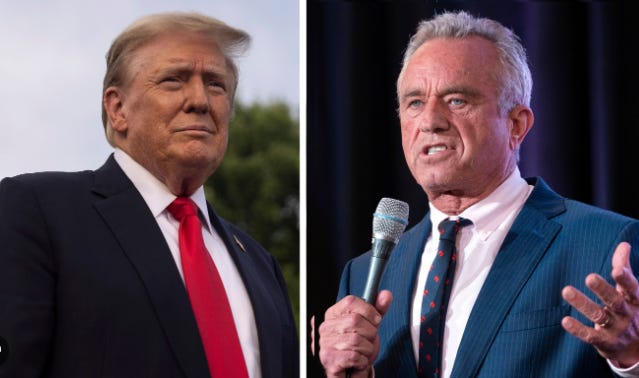
It is worth noting that Kennedy reportedly met with Trump in mid-July to discuss a possible endorsement in exchange for a position advising the Republican nominee on health policy. The meeting did not result in an endorsement, though Trump campaign advisers told The Washington Post they are still in touch with Kennedy and his campaign.

Tyler Durden
Wed, 08/21/2024 – 06:00

Goldman Says European NatGas Price Rally “Overdone” As Flows Continue Through Ukraine

0
Goldman Says European NatGas Price Rally “Overdone” As Flows Continue Through Ukraine

Ukraine’s incursion into Russia’s Kursk region earlier this month rattled the European natural gas market, pushing prices above 40 euros per megawatt-hour amid concerns that Russian natural gas supplies to the EU might be severed. However, prices have since receded, with Goldman’s Samantha Dart telling clients Monday that the price rally is mostly “overdone.”

Last week, Ukraine’s president claimed that troops have control over the Russian town of Sudzha, about six miles inside Russian territory. Within the town is a critical gas measuring station where NatGas flows from West Siberian gas fields through pipelines that pass through Sudzha and cross into Ukraine and then into utilities in Austria, Slovakia, and Hungary. 

Despite the fierce fighting and alleged Ukrainian control of Sudzha and the metering station, Russian state-owned energy giant Gazprom recently said NatGas flows into Ukraine from Sudzha have not been disrupted. Network operators in Austria and Hungary have also confirmed no disruptions. 

Given this, Goldman’s Dart believes the price rally that surged from 30-35 EUR/MW to the 40 EUR/MW level on the pipeline supply fears has largely run its course. 

“In our view this gas price rally is overdone for three main reasons,” she told clients. 

Here are the three main reasons: 

First, since Russian gas has continued to flow through the Ukraine, there has been no actual physical tightening of the balance, and we maintain our view that these flows will only halt from Jan25, when the existing Ukraine gas transit agreement with Russia expires.

Second, while there has been no loss of pipeline supply, the longer these higher European gas prices are sustained relative to European coal and Asia LNG prices (Exhibit 1 and Exhibit 2), the lower the gas demand (owing to gas-to-coal switching) and the higher (potentially) European LNG imports, especially if the ongoing heat wave in Northeast Asia ebbs, helping soften the forward balance outlook for European gas.

Third, even if the current Ukraine flows were interrupted, we would not expect that to translate into a 1:1 tightening of the NW European balance. This is because other suppliers can step in to help offset the lost gas, such as higher Algeria flows to Italy, as we have seen during a previous interruption to the region, and higher gas flows to Hungary via Turkey, consistent with a gas trade deal announced earlier this year. From Jan25, when the Russian gas transit deal through the Ukraine expires, we expect German pipeline exports to Central/Eastern Europe to rise by 16 mcm/d on average as a result, which is already embedded in our balances.

Looking ahead, Dart forecasts Europe’s NatGas storage will be at a “comfortable 95% full” by the end of October. 

She concluded:

That said, the TTF rally illustrates how sensitive the market remains to any tightening risks into this winter, and we agree that winter TTF price risks remain skewed to the upside relative to our 35 EUR/MWh forecast.

Austria, Hungary, and Slovakia still import NatGas from the Russian pipeline. The looming threat is if war persists and Moscow weaponizes energy flows to Europe in the dead of winter. 

Tyler Durden
Wed, 08/21/2024 – 05:45

Lithuania Constructs New Base To House German Soldiers To ‘Deter Russia’

0
Lithuania Constructs New Base To House German Soldiers To ‘Deter Russia’

Via The Libertarian Institute

Vilnius started constriction on a military base that would house over 4,000 German soldiers. The facility will be located just miles from the border shared with Belarus. 

Lithuanian Defense Minister Raimundas Vaiksnoras described the construction as a “huge investment” that will cost over $1.1 billion. He said the German deployment represents “deterrence, to push the Russians out.”

Lithuanian Ministry of Defense: new base groundbreaking ceremony.

However, it is unclear where Lithuania plans to push Russia from as Moscow has not invaded the Baltic state. 

At least two dozen German soldiers are already stationed in Lithuania. The German troop deployment, which is scheduled to surge to 4,800 troops by 2027, is Berlin’s first permanent garrison of soldiers deployed to Lithuania since World War 2.

From 1941-1945, Nazi Germany occupied Lithuania. Under Hitler’s control, nearly Lithuania’s entire Jewish population was wiped out.  

The deployment will provide a significant military surge to Lithuania, which has only 15,000 active duty soldiers. The base is located just 12 miles from the border with Belarus. Germany plans to deploy over 100 Leopard Tanks to the base. 

Since the end of the Cold War, Washington has facilitated the expansion of the North Atlantic alliance up to the Russian border. Additionally, Brussels has increased military deployments to new members in Eastern Europe. 

Lithuania formally jointed the NATO military alliance in March of 2004 alongside Latvia and Estonia. The countries of Bulgaria, Romania, Slovakia, and Slovenia were also part of that wave of NATO enlargement.

The Kremlin has consistently complained that the Eastward expansion of the bloc is a threat to Russian security. Russia has been invaded through its European borders multiple times. Prior to the Ukrainian invasion of Kursk, the last power which invaded Russia was  Nazi Germany.

Tyler Durden
Wed, 08/21/2024 – 04:15