72.2 F
Chicago
Wednesday, September 30, 2026
Home Blog Page 2380

Pushing Back Against Viewpoint-Based Discrimination By Banks

0
Pushing Back Against Viewpoint-Based Discrimination By Banks

Authored by Michael Ross via RealClearMarkets,

On paper, Zulfat Suara and Steve Happ don’t have much in common.

One, a Muslim woman, immigrated to the U.S. from Nigeria in the 1990s and now serves on the Nashville City Council. The other, a Christian man, is a Memphis native with a background in software who began a ministry partnering with Ugandan non-profit charities that care for orphaned and at-risk children in 2015.

But they do have at least one thing in common: Both were canceled by large national banks with little warning and virtually no explanation.

Suara, who like Happ, is also involved in non-profit work, received a vaguely worded notice of cancelation from Regions Bank earlier this year, giving her 30 days to find a new bank. Happ’s cancelation by Bank of America came in 2023 shortly before he made a trip overseas—forcing him to scramble for solutions and delay hard-earned paychecks to Ugandans.

Happ’s notice said he was operating in the wrong “business type.” As we reported in this year’s report for our Viewpoint Diversity Score Business Index, which measures corporate respect for free speech and religious liberty, these problematic policies are present in at least 69% of the country’s largest financial institutions.

Incidents like these are a small sample of a larger trend of viewpoint-based discrimination in financial services—known as “de-banking”— which has also affected firearms and fossil fuels because of radical net zero emissions commitments and government initiatives like Operation Choke Point. It has also garnered the attention of both sides of the political aisle.

These incidents propelled Tennessee lawmakers to adopt a landmark legislative solution aimed at curbing this dangerous weaponization of the financial system. Like a similar law that recently went into effect in Florida, the legislation is a first-of-its-kind consumer protection bill that prohibits big banks from canceling customer accounts based on their constitutionally protected speech and religious exercise.

The Tennessee law applies to banks with at least $100 billion in assets—which includes both Regions and Bank of America—the latter of which has also been exposed by U.S. House oversight as working hand-in-hand with the U.S. Department of Treasury to profile as domestic terrorist threats my organization, Alliance Defending Freedom, and everyday Americans who committed the sin of shopping at Bass Pro Shops or buying “religious texts.” It should come as no surprise that this same government entity has now spoken out in opposition to these state-level attempts to protect the God-given freedoms guaranteed by the First Amendment.

In a recent letter lauded in these pages by Hispanic Leadership Fund president Mario H. Lopez, the Treasury makes a series of false assertions about Tennessee and Florida’s laws. Chief among these specious claims is that the laws prevent Treasury’s Financial Crimes Enforcement Network (FinCEN) from dealing with money launderers and terrorist threats.

There’s no need to provide a nuanced answer to this accusation. It’s simply untrue. Twenty state attorneys general recently responded to this letter and rightly observed that the standards the Treasury is attacking in the state laws are the exact same standards the Office of the Comptroller of the Currency proposed—and the Treasury did not object to—only a few years ago.

Likewise, Lopez’s reactionary appeal to free market principles fails. Banks don’t operate in a free market. ESG is avowedly anti-free market. And the market is not free if access depends on your political and religious views.

First, banks are highly regulated. But in exchange for those regulations, they benefit from a wide spectrum of government subsidies. Those include bailouts, tax credits, property tax abatements, and grants at the state and federal levels. Since 1998, for example, JPMorgan Chase has received over $1.7 trillion from American taxpayers in the form of subsidies.

Second, ESG activists, and even government regulators, are introducing non-financial and subjective factors into decision-making by classifying groups like mine as domestic terrorist threats and denying service to ministries that support orphans and widows for being the wrong “business type.” Someone should explain how these groups, or those of Christian broadcaster Lance Wallnau or U.S. Ambassador Sam Brownback, present national security threats. Of course, one of the features of the state laws is that customers like Wallnau and Ambassador Brownback can demand a written explanation from the banks.

Third, the market is not free if it does not support a free society. There are numerous antidiscrimination laws that apply specifically to financial services, from the Equal Credit Opportunity Act to state fair lending laws—because every American deserves equal access to financial services. If we allow financial services to become politicized, we undermine the democratic process and deny businesses the ability to focus on what they do best, create excellent goods and services for their customers.

The Treasury cannot profile half of America as domestic terrorists, institute Orwellian financial surveillance, and then hide behind the fig leaf of national security when the states push back.

Banks, insurance providers, and others in the financial sector need to make tangible changes to their policies to protect their customers from discrimination. States like Tennessee and Florida have a critical role to play—not only in adopting laws to ensure their citizens’ freedoms are protected but also in enforcing these laws so that no one else has to fear financial discrimination because of their religious or political beliefs.

Michael Ross is legal counsel for Alliance Defending Freedom (@ADFLegal). 

Tyler Durden
Tue, 08/13/2024 – 20:05

Geopolitical Tensions Are Transforming The Rare Earth Market

0
Geopolitical Tensions Are Transforming The Rare Earth Market

Authored by Rystad Energy via Oilprice.com,

  • China’s dominance in the rare earth market is gradually declining as other countries ramp up production.

  • Western governments are incentivizing domestic rare earth production to reduce reliance on China and mitigate supply chain risks.

  • Despite recent price volatility and oversupply, rare earth demand is expected to remain strong due to their essential role in high-tech and green technologies.

The rare earth market is undergoing a shift in geographical supply chain concentration, spurred by Western efforts to reduce reliance on China off the back of growing demand, focus on national security, and the strategic importance of the materials. Over the last decade, annual rare earth supply has tripled, setting global production records almost every year – from 142,000 tonnes in 2013 to 359,000 tonnes of rare earth oxide equivalents mined last year.

The rare earths market is in a state of flux, finding itself at the crossroads of technological innovation and geopolitical tension. China’s long-standing dominance remains strong but is gradually waning with its share of global production declining from 98% in 2010 to 78% in 2015 and down to 67% last year as producers in Australia and the US, backed by substantial government support, ramp up activity.

China is still dominant, although its market share is declining

Despite a decline in China’s market share in the upstream mining sector, its absolute supply output is still rising. More importantly, its control across the complex midstream to downstream processing and manufacturing stages is proving harder to shake. Although relatively geologically abundant, rare earths are deemed rare because extracting and separating the ores into individual oxides needed for use in manufacturing is difficult. This makes economically viable deposits rare. The consolidated state-controlled Chinese market is at the forefront of industrial and technologically demanding operations related to rare earths processing. Last December, China imposed export control of technologies for rare earth extraction, separation, refining and magnet production, potentially slowing down new development outside of the country. Continued financial backing will be required from Western governments to loosen China’s mature grip and increase its market share across the rare earth processing value chain.

Regional policies to boost domestic rare earths supply

The US is promoting the development of its domestic rare earths value chain through research funding and project financing via the Inflation Reduction Act. Australia has long supported rare earths projects through tax incentives, meanwhile, Europe aims to build out supply through domestic targets for supply quotas through its Critical Raw Materials Act. In May this year, both the US and Australia announced policies to combat competition from China. Australia announced the extension of incentives in the 2024-2025 budget plan through a 10% production tax credit and pre-feasibility project funding for all critical minerals, including rare earths. At the same time, the Biden administration in the US imposed a 25% import tariff on rare earth magnets from China, effective from 2026.

There are several countries with abundant rare earth ore reserves, and with global reserves measuring around 115 million tonnes, the world has enough to last over 300 years, based on last year’s production volumes. With more reserves likely to be discovered, a shortage of resources is not a realistic concern.

Although small in volume compared to the over 3 billion tonnes of metals mined annually, rare earth elements are crucial to society, and their unique properties have proven extremely difficult to substitute. Demand for the 17 lustrous silvery-white metals has risen recently due to their essential role in buoyant energy transition-related sectors, as well as in high-tech equipment within defense, artificial intelligence and consumer electronics. Permanent magnets, required for any device related to electric motion such as wind turbines and electric vehicle (EV) motors, is the largest application for rare earths, making the magnetic rare earths neodymium, praseodymium, dysprosium and samarium among the most in-demand and highly valued rare earths. We expect the magnetic rare earths to remain principal, propelled by technological advancements and the electrification of society.

The race between China and the West will continue

A dramatic rise in supply has outpaced demand over the last few years, resulting in an oversupply of rare earth products. This has created an erratic low-price environment where many producers are operating at a loss. Rare earth prices are notoriously volatile and difficult to predict, partly due to their high susceptibility to geopolitical risk and ongoing global trade disputes. A volatile price environment is challenging early-stage initiatives launched by an expanding supplier landscape aiming to capitalize on the emerging globalized supply chain.

Rare earths have become a key battleground in the ongoing technological and economic rivalry between China and the West as the race continues for control to ensure its reliable supply.

Tyler Durden
Tue, 08/13/2024 – 19:15

GM Cutting Jobs Amidst “Larger Structural Overhaul” In China

0
GM Cutting Jobs Amidst “Larger Structural Overhaul” In China

General Motors has been cutting staff in China and eventually will meet with its local partner SAIC to explore a “larger structural overhaul” of the business oversees.

The shift indicates that GM likely won’t eclipse its peak sales in the country it set in 2017, according to Bloomberg.

GM is reducing staff in its China-focused departments, including research and development. In coming weeks, GM and its partner SAIC will discuss potential capacity cuts as part of a strategic shift for American brands in China.

Bloomberg writes that this marks a significant change for GM, which once made billions in the Chinese market. The automaker is scaling back as foreign brands struggle with intense competition and overcapacity in the world’s largest car market.

GM is shifting its focus to producing electric vehicles, particularly upscale models, and importing premium vehicles. The company is considering reducing factory capacity and further job cuts, though these plans haven’t been publicly disclosed yet.

Despite these changes, GM will still produce affordable vehicles and EVs locally in partnership with SAIC Motor and Wuling Motors, with some of these models being exported from China, according to the report. 

GM’s 30-year contract with state-owned SAIC expires in 2027, and the company aims to restore profitability before then. The goal is to strengthen the SAIC-GM partnership, which produces Buick, Cadillac, and Chevrolet vehicles, so it can self-fund operations and development.

A second partnership, SAIC-GM-Wuling, which makes small, affordable vehicles, has fared better, particularly with the Hongguang Mini EV. However, GM lost $104 million in its Chinese operations in the most recent quarter, contributing to a $210 million loss for the first half of the year.

In the latest quarter, GM’s China sales dropped 29% to 373,000 vehicles, with steep declines across its U.S. brands like Buick, Cadillac, and Chevrolet. In contrast, sales from the SAIC-GM-Wuling partnership fell only 12%, as it produces compact EVs that remain in high demand in China, which GM views as a stronger growth opportunity.

Chief Financial Officer Paul Jacobson commented earlier this month: “We’ve got to remain competitive and that means that we’ve got to take a look at the business with our partner to ensure that we can restore it to profitability and that we can restore it to self-sustaining cash flow going forward. China can be a good asset for us and remains a good asset for us.”

Tyler Durden
Tue, 08/13/2024 – 18:50

The DNC Is Coming To Chicago, The Nation’s Homicide Capital 13 Years Running

0
The DNC Is Coming To Chicago, The Nation’s Homicide Capital 13 Years Running

By Ted Dabrowski and John Klingner of Wirepoints

When the DNC delegates come to Chicago, they’ll be visiting the city that for more than a decade has experienced the most murders in the country. Chicago suffered 617 total homicides in 2023, marking the 12th year in a row it has led the country. 

And it will be 13 years in a row if Chicago’s 2024’s homicide numbers continue at their current pace. The below chart shows how the top five cities nationally for total homicides may change from year to year, but what always remains true is Chicago’s position at the very top – often the extreme outlier.

That’s just one of the findings from Wirepoints’ analysis of publicly-available 2023 homicide data from the nation’s 75 largest U.S. cities.

St. Louis was the nation’s other murder capital in 2023 when based on homicides per capita. The Gateway City suffered 60 homicides per 100,000 residents, taking the top spot away from 2022’s capital, New Orleans.* The city was struggling even before George Floyd, with a homicide rate of 64.5 in 2019.

Looking at homicides on a per capita basis is the most logical way to measure the weight crime imposes on a given community. It also allows for an apples-to-apples comparison across cities. However, ranking cities by the number of homicides is also important due to the sheer number of murders that occur in big cities. St. Louis may have a homicide rate that’s much higher than Chicago, but it suffered less than a third of the murders Chicago did. They both deserve to be crowned murder capitals.

Below we list the nation’s top 20 cities by total homicides and per capita homicides and in Appendix A and B we list out all 75 cities. 

Homicides have continued their year-on-year decline in most cities across the nation. That lessening bloodshed is good news, but it doesn’t change the fact that homicide rates remain far above their 2019 pre-covid, pre-George-Floyd levels.

The report below includes the following sections:

  • A look at total homicides in 2023
  • A look at homicides rates in 2023
  • A comparison of 2023 homicides to their 2019 levels
  • A comparison of 2024 homicides to 2023 YTD 
  • The DNC and the reality of Chicago crime

Chicago, New York, led the nation in number of homicides

Chicago led the nation in criminal homicides 617 murders in 2023. That was by far the most among the nation’s top 75 cities. Not even New York, which is three times bigger than Chicago, or Philadelphia came close, with those two cities suffering 391 and 389 murders, respectively. 

Rounding out the top ten were Memphis (367), Houston (351), Los Angeles (327), Washington D.C. (274), Dallas (268), Baltimore (263), and Detroit (252). See Appendix A for the complete 75-city ranking.

The good news in 2023 vs. 2022 was the 10% drop in homicides across the surveyed cities. Since the massive jump in 2021 after George-Floyd, homicides have fallen the last two years (see Appendix C for full data).

Notable in 2023 was Philadelphia’s 24% decrease in homicides – a fall of 121 murders – which allowed the City of Brotherly Love to drop from the number 2 position in total homicides to number 3. New York City, which dropped 11% in homicides, went up to the second position. 

Other key cities which had been battered by violence in 2020 and 2021 also saw drops. For example, New Orleans, Baltimore, St. Louis and Milwaukee all dropped by 20% to 24%.

Two cities were particularly notable for moving in the wrong direction in 2023. Memphis and Washington D.C. had increases in homicides of 37% and 35% respectively. Memphis’ increase of 100 murders pushed the city into 4th-place nationally.


St. Louis, Memphis led the nation in homicide rates

St. Louis’ 20% drop in homicides in 2023 wasn’t enough to help the “Gateway to the West” avoid suffering the nation’s worst homicide rate – 60.0 homicides per every 100,000 in population. As mentioned above, Memphis finished second with a rate of 59.3. New Orleans, last year’s top city for homicides per capita, came in third with 52.7 murders per 100,000. 

Rounding out the top ten were Baltimore (46.5), Cleveland (42.5), Washington D.C. (40.4), Detroit (39.8), Kansas City (35.6), Milwaukee (30.6), and Oakland (28.9). Those homicide rates are all multiples higher than the 2020 national average of 6.5 per 100,000, the most recent reliable national calculation available.

The list of the cities with the top homicide ratios among America’s 75 largest cities includes those with relatively smaller populations, like Greensboro, New Orleans and Cleveland. It’s worth looking at, then, how their homicide ratios performed in 2023 vs 2022.

Greensboro, NC suffered the worst increase, with its homicide rate jumping 75% to 24.5 per 100,000 – a consequence of the city of 300,000 people experiencing 74 murders in 2023. Memphis also suffered a dramatic jump of nearly 40%.

A majority of America’s most murder-prone cities saw their homicide rates fall. Some declines were modest, such as Cincinnati’s rate falling 9% over the year or Las Vegas’ 12% decline. But a number of other cities experienced far larger drops. Cities like Detroit, Indianapolis, Milwaukee and Baltimore all had their homicide rates drop by nearly 20% or more. New Orleans experienced the biggest drop of 24%, though its 2023 rate was still a sky-high 52.7 per 100,000.

It’s also important to compare homicide rates across the big cities because that’s where most of the nation’s murders occur. Among the nation’s 20 biggest cities, Philadelphia suffered the highest homicide rate of 25.1 per 100,000 residents in 2023. Chicago was second with a rate of 23.2, followed by Dallas at 20.6, Indianapolis at 19.4 and Columbus at 16.2.

Notable is just how low the homicide rate is in many big cities, including Los Angeles, Austin and New York City.


While homicides continue to fall, many city rates are still above 2019 levels

Despite the drop in homicides in most major cities in 2023, homicide rates still remained above those in 2019. Chicago, for example, saw murders drop by nearly 200 compared to its 2021 spike. Nevertheless, its homicide rate remained 25% above that in 2019 (23.2 vs. 18.5). Ditto for New York City’s homicide rate, up 23% over 2019. And Houston’s rate remained 27% higher.

Of the top 15 cities with the highest 2023 homicide rates, 12 were higher than they were in 2019. And eight of those cities had homicide rates that were 60% higher or more compared to 2019. For example, Milwaukee’s 2023 homicide rate of 30.6 was 87% higher than its 2019 rate. And Memphis’ homicide rate of 59.3 was 103% higher.

Looking at the nation’s other murder capital, St. Louis’ homicide rate was 7% lower than in 2019. But that was of little comfort to residents of St. Louis. The rate was dramatically high back then, with the recent drop making little difference. 


The continued decline of homicides in 2024

Year-to-date data for 2024 show that homicides are continuing their downward trend this year, with many of the nation’s biggest cities experiencing a drop in total murders of about 30% or more.

Philadelphia has endured far less bloodshed so far in 2024, with homicides dropping 41% compared to the same period in 2023. Jacksonville homicides are down 38%. San Antonio has recorded 61 murders as of the end of July. That’s 29% fewer than the same time last year. Dallas homicides have fallen by 21% YTD. 

Chicago officials can also point to a decline in homicides in 2024, but the decrease is one of the smallest among cities with populations over 1 million. Windy City homicides are down just 10% compared to last year – the 2nd-lowest reduction behind only Los Angeles’ 2% decline and just behind New York City’s own 10% reduction. 

It’s important to note, however, that while Los Angeles and New York have small declines like Chicago, both those cities experience a far lower number of homicides to begin with.


The DNC in Chicago

Count on Chicago’s leadership to tout the city’s recent decline in homicides as an achievement of the city’s commitment to equity and social justice. Chicago experienced a 12% decline in homicides in 2022, another 13% drop in 2023 and a further 10% reduction so far in 2024.

But that drop in homicides must be taken within the context of the massive surge in murders Chicago experienced post George Floyd. In 2021, they jumped to 804 from just 500 two years earlier, a 62% spike.

And even with the recent declines in homicides, Chicago is still on track in 2024 to exceed its 2019 murder levels, considering that YTD homicides are running 23% higher than they were in the same period in 2019.

Chicago’s murder record must also be compared to that of its two big-city peers: New York and Los Angeles. Chicago is the extreme outlier among the three, especially when viewed on a per capita basis over time.

All three cities had nearly identical homicide rates in the late 1980s before experiencing a decline in homicides during the 1990’s. New York and Los Angeles’ declines were far deeper and more sustained, however, leading to the disparity in homicide rates seen today: Chicago’s 2023 homicide rate, at 23.3 per 100,000, is 5 times higher than New York’s (4.7 per 100,000) and 2.7 times higher than LA’s (8.6 per 100,000).

Even worse, Chicago’s soft-on-crime policies continue to encourage more crime. 

Banned police foot and car chases have emboldened criminals to go on robbery sprees. An increased felony-theft threshold has incentivized shoplifting and other crimes. The elimination of cash bail has resulted in a drop in the number of offenders held behind Cook County bars to the lowest level in 40 years. And the overall failure to prosecute crimes of all types has led to an ever-faster revolving door. Criminals are not deterred from committing crimes.

It’s no surprise then, that violent crimes have hit a six-year high in 2024 despite the 10% drop in murders this year, and that the number of victims of violent crime is at a 13-year high.

While the DNC will do its level best to promote Chicago as a triumph of city management and progressive policy, the constant bloodshed is a reminder of the city’s many failures – and an example of criminal justice policies that other cities would do well to ignore.

Download a PDF copy of the report

Tyler Durden
Tue, 08/13/2024 – 18:25

EU Disavows “Attention-Seeking Politician” Thierry Breton Over ‘Electoral Interference’ Letter Threatening Musk

0
EU Disavows “Attention-Seeking Politician” Thierry Breton Over ‘Electoral Interference’ Letter Threatening Musk

With Monday night’s unfiltered discussion between Donald Trump and Elon Musk generating a reported billion views, it’s no wonder the left collectively freaked out.

Not only did the Washington Post ask the White House if there was anything they could do to stop the conversation from taking place…

…The EU’s Thierry Breton, the current Commissioner for Internal Market of the EU, sent a letter to Musk threatening X with punishment if they didn’t crack down on “content that promotes hatred, disorder, incitement to violence, or certain instances of disinformation.”

It seems that Breton’s warning to Musk has surprised many within the Commission. | Sebastien Salom-Gomis/AFP via Getty Images

Musk responded appropriately:

For the uninitiated:

Theory Fucks His Own Face After All…

In a harsh rebuke, Brussels has accused Breton of going rogue with the letter to Musk – saying he never sought approval from European Commission president Ursula von der Leyen to send the letter.

“The timing and the wording of the letter were neither co-ordinated or agreed with the president nor with the [commissioners],” the Commission said in a Tuesday statement reported by the Financial Times.

“Thierry has his own mind and way of working and thinking,” said one EU official who asked not to be named.

As the Times notes (lol), “Musk responded to the letter from Breton with a meme from the 2008 film Tropic Thunder, that showed one character yelling: “Take a big step back and literally fuck your own face.”“

Politico Europe reports that four separate EU officials said that Breton’s threat to Musk caught many off guard within the Commission.

“The EU is not in the business of electoral interference,” said one of those officials. “DSA implementation is too important to be misused by an attention-seeking politician in search of his next big job.”

Meanwhile, a Trump campaign spokesperson responded by saying “The European Union should mind their own business instead of trying to meddle in the US presidential election,” while Musk later posted that he would be “happy to host” Kamala Harris for a similar discussion.

In response to Breton’s letter, X CEO Linda Yaccarino said it was an “unprecedented attempt to stretch a law intended to apply in Europe to political activities in the US,” while Trump campaign official Chris LaCivita said that the “European Union is attempting to meddle in the US Election,” adding “They can go to hell.”

Never go full Thierry…

Tyler Durden
Tue, 08/13/2024 – 18:00

The Federal Reserve Does Not Own Gold

0
The Federal Reserve Does Not Own Gold

Authored by Ryan McMaken via The Mises Institute,

Historically – as during the days of the classical gold standard – central banks maintained stocks of gold to facilitate the conversion of gold-backed national currencies. Those days are long gone, but in modern times, many central banks continue to own gold, and many central banks buy gold as part of their open-market operations. For example, in his article last week—”Central banks purchase gold to offset their own money destruction“—Daniel Lacalle writes: 

The rising purchases of gold by central banks are an essential factor justifying the recent increase in demand for the precious metal. Central banks, especially in China and India, are trying to reduce their dependence on the dollar or the euro to diversify their reserves. 

The US’s central bank, the Federal Reserve, is not among these banks buying gold. Obviously, the Fed has no interest in buying up gold as a means of “de-dollarization.” Moreover, the Fed is presently concerned with purchasing more dollar-denominated government debt to keep interest rates low on the Federal government’s huge deficits.  

But we must also note that another reason the Fed isn’t buying gold is that the Fed hasn’t been in the gold-owning business for a very long time. 

That is, the Fed has owned no gold since 1934, when the Fed handed over all its gold in exchange for gold certificates. This is how the Fed’s Board of Governors summarizes the situation:

The Federal Reserve does not own gold.

The Gold Reserve Act of 1934 required the Federal Reserve System to transfer ownership of all of its gold to the Department of the Treasury. In exchange, the Secretary of the Treasury issued gold certificates to the Federal Reserve for the amount of gold transferred at the then-applicable statutory price for gold held by the Treasury.

Gold certificates are denominated in U.S. dollars. Their value is based on the statutory price for gold at the time the certificates are issued. Gold certificates do not give the Federal Reserve any right to redeem the certificates for gold.

The statutory price of gold is set by law. It does not fluctuate with the market price of gold and has been constant at $42 2/9, or $42.2222, per fine troy ounce since 1973. The book value of the gold held by the Treasury is determined using the statutory price.

Although the Federal Reserve does not own any gold, the Federal Reserve Bank of New York acts as the custodian of gold owned by account holders such as the U.S. government, foreign governments, other central banks, and official international organizations. No individuals or private sector entities are permitted to store gold in the vault of the Federal Reserve Bank of New York or at any Federal Reserve Bank.

A small portion of the gold held by the U.S. Treasury (roughly $600 million in book value)–about five percent–is held in custody for the Treasury by the Federal Reserve Banks, as fiscal agents of the United States. The vast majority of this gold is located in the vault at the Federal Reserve Bank of New York, and a very small portion is on display in several Federal Reserve Banks. The remaining 95 percent of U.S. Treasury gold ($10.4 billion in book value) is held in custody for the Treasury by the U.S. Mint.

It is possible to imagine that the Fed could start buying gold, but it’s hard to see why the Fed would be motivated to do so. 

Moreover, given that the Fed’s gold certificates have essentially no connection to the actual market price of gold, changes in the price of gold have virtually no effect on the value of the Fed’s assets. 

The only way gold prices would become relevant to the Fed’s portfolio would be for the Congress to change the statutory price of gold from $42.2222. If the Fed wanted to actually take possession of that gold, the Congress would also have to authorize the Fed to redeem its certificates in gold.

This is all very unlikely barring a very big change in the ideology of the ruling regime.

Indeed, barring said ideological change, I suspect that in a true crisis, the Fed’s extremely tenuous claim to owning its pre-1934 gold stockpile would be null and void altogether.

If the Treasury finds itself truly strapped for cash, the Congress would only have to declare the Fed’s gold certificates permanently unredeemable.

Or, the Treasury could simply buy back the gold certificates at the ridiculously low statutory price. Then there would be no doubt about who owns that gold.

The Treasury could then simply sell off all the gold to Wall Street banks in exchange for dollars that would go to luxury hotels for illegal immigrants or more bombs for the State of Israel. 

Tyler Durden
Tue, 08/13/2024 – 17:40

Dollar Dumped To 4-Mo Lows, Bitcoin & Big-Caps Pumped Ahead Of CPI Tsunami

0
Dollar Dumped To 4-Mo Lows, Bitcoin & Big-Caps Pumped Ahead Of CPI Tsunami

Cooler than expected headline and core PPI (dovish for monetary policy hopefuls) trumped the margin-compression (bearish for corporate profitability and therefore stocks) aspect of the producer prices data this morning exaggerating a weak-dollar/BTFD stocks trend that emerged overnight.

The ‘cool’ PPI knocked the ‘inflation-surprise’-macro-index down to its lowest since February… but at the same time ‘growth-surprise’ data has also stagnated significantly…

Source: Bloomberg

But, it was the dollar index that stood out today, tanking to post-payrolls plunge lows…

Source: Bloomberg

… dumped to its lowest in four months, breaking below its 200DMA…

Source: Bloomberg

Interestingly, as the dollar tanked, it was a buy-all-the-things day with bonds (prices) up, stocks up, and crypto up; but of particular note was weakness in oil (well, Iran hasn’t blown anything to shit today), and gold (flat – at record highs – as WW3 appears to be postponed… for now).

Nasdaq was the biggest winner on the day (surging 2.5%), but all the majors were up strong today…

Seems like we could have seen this one coming…

Mag7 stocks continued to roar back to life…

Source: Bloomberg

…and ‘most shorted’ stocks were squeezed hard, having now erased exactly 50% of their plunge from last week…

Source: Bloomberg

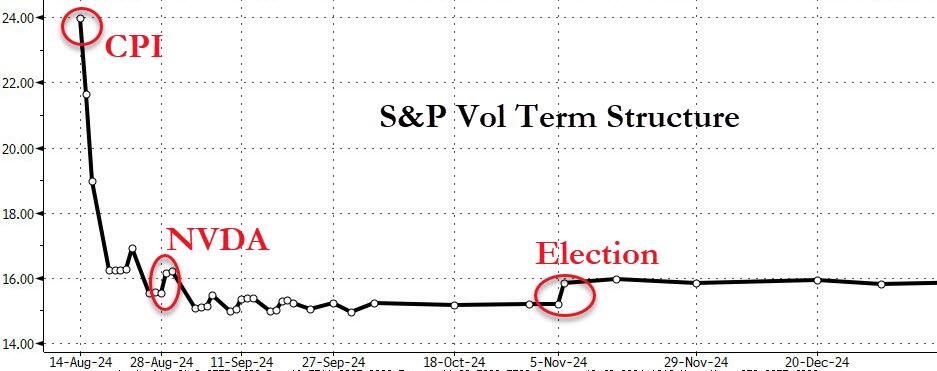
VIX was sold once again, back down to an 18 handle (and the levels before the payrolls panic)…

Source: Bloomberg

But shorter-dated vol is aggressively bid into tomorrow’s CPI and NVDA’s earnings

Source: Bloomberg

Treasury yields tumbled on the day, extending lower after the cool PPI. The Short-end outperformed (2Y -8bps, 30Y -4bps)…

Source: Bloomberg

The 2y Yield broke back below 4.00%…

Source: Bloomberg

Rate-cut expectations jumped around 10bps on the day, mainly focused on the 2024 shift…

Source: Bloomberg

Bitcoin surged back to $61,500, erasing all of the weakness from Sunday…

Source: Bloomberg

Crude oil prices dipped after WTI double-topped at $80…

Source: Bloomberg

Gold was relatively flat today, holding at record highs…

Source: Bloomberg

Finally, for context, today’s tumble in the dollar was NOT driven by a resumption of the yen-carry trade…

Source: Bloomberg

…of course tomorrow’s CPI print will decide which way yen breaks out.

Tyler Durden
Tue, 08/13/2024 – 16:00

NY Times: Feds Accelerating Naturalization Of Immigrants To “Reshape The Electorate”

0
NY Times: Feds Accelerating Naturalization Of Immigrants To “Reshape The Electorate”

Authored by Paul Joseph Watson via Modernity.news,

The New York Times reports that the federal government is accelerating the naturalization of immigrants in America as part of a process of “reshaping the electorate, merely months before a pivotal election,” according to one observer quoted in the piece.

“The federal government is processing citizenship requests at the fastest clip in a decade, moving rapidly through a backlog that built up during the Trump administration and the coronavirus pandemic,” reports the newspaper.

One Honduran woman marveled at the fact that authorities were able to process and approve her application in as little as six months.

The story highlights how many of these new citizens will immediately become eligible to vote in key battleground states, including Georgia, Arizona, Nevada and Pennsylvania.

The piece includes a very revealing quote from Xiao Wang, chief executive of Boundless, a data analysis company.

“The surge in naturalization efficiency isn’t just about clearing backlogs; it’s potentially reshaping the electorate, merely months before a pivotal election,” said Wang.

“Every citizenship application could be a vote that decides Senate seats or even the presidency,” he added.

In other words, knowing that immigrants are far likelier to vote Democrat, the Biden administration is importing them at breakneck speed in order to tip the scales for Kamala Harris.

3.3 million immigrants have become citizens during Biden’s time in office, with data showing that more will vote Democrat than Republican.

This has partly driven the Trump campaign’s efforts to appeal more to “Jamal” and “Enrique,” and not so much “Karen,” although the strategy has caused division amongst Trump’s base.

The legacy media has consistently denounced the idea of mass migration being a deliberate ploy to increase the voter base for Democrats as part of the “great replacement” conspiracy theory, while simultaneously admitting it’s happening.

A poll conducted by YouGov in 2022 found that 73 per cent of Trump voters believed Democrats are “trying to replace white Americans with immigrants and people of color” who overwhelmingly vote for Democrats.

According to the media, when people on the right talk about it in a negative way, it’s a horrendous form of extremist radicalization, but when leftists celebrate it, it’s a progressive virtue.

*  *  *

Your support is crucial in helping us defeat mass censorship. Please consider donating via Locals or check out our unique merch. Follow us on X @ModernityNews.

Tyler Durden
Tue, 08/13/2024 – 15:40

Paramount Cuts 15% Of US Workforce, Closes TV Studio, As Traditional TV Market Slumps

0
Paramount Cuts 15% Of US Workforce, Closes TV Studio, As Traditional TV Market Slumps

Paramount, the parent company of CBS News, BET, MTV, Nickelodeon, dozens of local TV stations, and Paramount Pictures, announced in an internal memo from top executives to employees that the first round of job cuts is set to begin. 

The multinational media conglomerate in Manhattan plans to reduce its US-based workforce by 15%, or about 2,000 workers, by the end of September. This is troubling news for the company that struggles with migrating one-time TV viewers to its streaming video platform and an even bigger warning that the traditional TV market languishes. 

“The industry continues to evolve, and Paramount is at an inflection point where changes must be made to strengthen our business. And while these actions are often difficult, we are confident in our direction forward,” Brian Robbins, the head of Paramount Pictures; George Cheeks, the head of CBS; and Chris McCarthy, the head of Showtime and MTV Entertainment Studios, wrote in an internal memo to employees, first obtained by New York Times. 

The there co-CEOs said, “As we continue to advance our plan, we announced on our earnings call last week that we will be reducing our US-based workforce by approximately 15%, focusing on redundant functions and streamlining corporate teams.” 

“This process will take place in three phases, starting today and continuing through the end of the year. We expect 90% of these actions to be complete by the end of September,” they added. 

The Wall Street Journal noted, “Paramount Television Studios is shutting down this week as part of a cost-cutting effort by parent company Paramount Global.” 

Last week, during an earnings call, Paramount’s top executives said the company would incur $300 million to $400 million in charges related to the restructuring. It also took a second-quarter impairment charge of $5.98 billion across its cable networks. 

Variety provided more color on Paramount’s struggles:

Paramount is one of several big U.S. media companies struggling with the migration of one-time TV viewers to streaming video. While the company owns the big CBS broadcast network, home to many of its big-audience sports properties, the bulk of the Paramount portfolio is centered around a cluster of cable networks that only show a few original programs and have seen the communities that once clustered around them dissipate over the past decade.

Did going ‘woke’ have something to do with Paramount’s demise? 

The layoffs come as other major media players, such as Warner Bros. Discovery, the parent of CNN, TNT, and HBO, announced layoffs in mid-July. Just weeks ago, Disney cut 140 employees, or 2% of its workforce, in the television division. In news media, the cuts are worsening by month, with Axios laying off 10% of its employees in recent days. 

Meanwhile, the emergence of X, the world’s news platform, is becoming the status quo in how people retrieve information, mostly free from government and corporate media censorship.

On Monday night, the conversation between Donald Trump and X owner Elon Musk generated a billion views. 

The death of legacy media is accelerating… 

Tyler Durden
Tue, 08/13/2024 – 15:20

USPS Sees Steep Drop In Expedited Shipping Demand

0
USPS Sees Steep Drop In Expedited Shipping Demand

By Max Garland of SupplyChainDive

The U.S. Postal Service’s expedited package shipping services have seen a steep drop in demand, according to quarterly results released Thursday.

U.S. Postal Service worker loads a delivery truck on Oct. 1, 2021 in Chicago, Illinois.

The agency weathered a 40.7% decline in Priority Mail Services volume year over year for the third quarter of fiscal year 2024, which ended June 30.

The category includes shipments for Priority Mail, which offers delivery in one-to-three business days, and Priority Mail Express shipments, providing delivery in one to two days with a money-back guarantee.

“Our Priority Mail Services subcategory can be more price sensitive than other services and it continues to face intense competition from more affordable products and an industry-wide trend away from expedited products,” the Postal Service said in its quarterly report.

Shippers are embracing slower parcel delivery services to save on shipping costs, a choice that’s easier to make as they move inventory closer to end consumers and carriers improve transit times within their ground transportation networks.

UPS is seeing shippers “trade down” from speedy air transportation to more cost-effective options like its SurePost product, which utilizes the Postal Service for final-mile delivery, CFO Brian Dykes told analysts during a July earnings call.

FedEx’s international customers are also opting for slower deferred services more often, tied in part to growth from e-commerce shippers that tend to utilize those offerings, President and CEO Raj Subramaniam said on a March earnings call.

The Postal Service is seeing this market shift play out within its own network.

More economical products like USPS Ground Advantage fared better for the Postal Service in Q3, leading to a 2.7% overall increase in volume within the agency’s Shipping and Packages category.

“USPS Ground Advantage, the Postal Service’s shipping offering which provides a simple, reliable, and more affordable way to ship packages, has continued to experience wide adoption and growth in the marketplace,” the agency said in a news release about the Q3 results.

Tyler Durden
Tue, 08/13/2024 – 15:00