Green Party Survives Dems’ Ballot Challenge In Battleground State – Kamala Shudders
For a party that’s constantly crowing about the need to save Our Democracy, the Democrats have been working awfully hard to limit Americans’ choices in November. Happily, Democrats’ drive to exclude the Green Party from the ballot in the battleground state of Nevada was defeated on Monday— sending shudders through Democrats who blame Green presidential candidate Jill Stein for enabling Donald Trump’s 2016 victory.
Stein, who’s back at it in 2024, wasn’t even on the Nevada ballot when Trump upset Hillary Clinton that year. However, Democrats point to Stein’s share in Pennsylvania, Wisconsin and Michigan — which was larger than the margin by which Clinton lost those pivotal Rust Belt states.
The Democrats’ challenge to the Green Party’s ballot-access petition questioned the validity of the signatures the Greens had collected. Carson County District Court Judge Kristin Luis shot the challenge down, saying“The Democratic Party has not met its burden of demonstrating that the petition is clearly invalid because it has not produced sufficient evidence to show that the petition has less than the required number of valid signatures in any petition district.” Stein took to social media to celebrate, saying, “We are excited to say that the ruling has been made in our favor and we will offer an anti-genocide, pro-worker, climate action choice for Silver State voters!”
All across the country, the Democratic Party has been using lawfare to impede third-party and independent candidates seeking a presence on general election ballots. Their motive: to banish candidates who might siphon voters away from Kamala Harris and down-ballot Democrats.
This will be theGreen Party’s first appearance on the Silver State’s ballot since 2008. In 2020, Biden won Nevada by 2.4%. In 2016, Clinton took it by the same margin. The three most recent Nevada polls give a mixed picture of the 2024 contest:
Trafalgar Group (Aug 6-8): Trump +3
Telegraph/Redfield & Wilson (July 31-August 3): Tied at 40%
Public Opinion Strategies/Competitiveness Coalition (July 23-29): Trump +1
A July Bloomberg/Morning Consult poll gauged the Nevada race as both a head-to-head and as a five-way race with independent and third-party candidates. In the straight Trump v Harris survey, Harris led Nevada by 2%. With Robert F. Kennedy Jr, Stein and Libertarian Chase Oliver on the menu, the result was a 43-43 tie.
Noticing a serious uptick in anti-Jill Stein posts and comments from the Kamala crowd now that it’s been reported that Dr. Stein is likely to choose a Palestinian American as a running mate. They’re scared.
The substitution of Harris for Biden has taken some wind out of the sails of those “other” candidates, who gave an outlet to so-called “double-hater” voters who can’t stand either Trump or Biden. Whatever her ideological and intellectual shortcomings, Harris grants the wish of voters who were desperate for something, anything different than a 2020 rematch.
Looking for a spark, Stein is expected to name a running mate meant to channel the anger many voters feel about the Biden-Harris administration’s military and diplomatic backing of the State of Israel throughout its devastating, 10-month military campaign and blockade of Gaza following the Oct. 7 Hamas invasion of Israel.
Jill Stein’s team approached me to run as her vice-presidential candidate, & I am seriously considering it. The Harris team is demanding our votes to “save our democracy” but has been oblivious to the fact that supporting a #genocide poses the most significant threat to it 🧵
Those potential Green vice presidential candidates include human rights lawyer and Rutgers professor Noura Erakat, American-Arab Anti-Discrimination Committee executive director Abed Ayoub, Dearborn, Michigan mayor Abdullah Hammoud, and political activist and comedian Amer Zahr.
Zahr, who lives in Dearborn, said that he was initially open to voting for Vice President Kamala Harris but lost enthusiasm after she “disrespectfully” shut down protesters who interrupted her at a Detroit campaign rally, and after an aide said that she would not support an arms embargo against Israel. – The New Republic
When pro-Gaza ceasefire protestors started chanting at the Detroit rally, Harris dusted off her trusty “I’m speaking” rhetorical device, eliciting a roar from the crowd. For many anti-war Americans, however, it came across as an empty gimmick evidencing a warped set of priorities. “Kamala’s message is loud and clear: It’s time to fall in line and shut up about genocide,” tweeted Stein. “But we will not be silenced.”
“If you want Donald Trump to win then say that , otherwise I’m speaking”
Blue MAGA in action .. let’s not talk about my complicity in genocide because Orange Man Bad!
Speaking of Michigan, the Green Party has already secured its ballot access in that swing state, and the choice of a running mate who’s been a leader of Gaza ceasefire efforts will likely have its largest impact there. Michigan has one of the largest Muslim populations in America, and more than 100,000 Michigan Democrats voted “uncommitted” in the February primary to express their outrage over the Biden-Harris administration’s largely blank-check backing of Israel.
The conversation was streamed live on X spaces, but had to overcome huge technical issues dues to a sustained DDOS attack on the platform shortly before the stream began.
We tested the system with 8 million concurrent listeners earlier today https://t.co/ymqGBFEJX0
The attack followed sustained moaning by the dinosaur media, complaining that Trump would be allowed to say “whatever he wants to” by Musk.
Axios’ @sarafischer: “@elonmusk will let Donald Trump speak all of the falsehoods & misinformation that he wants. I mean, he’s not a journalist … Does he want to be fact checking all the information? So I think it‘s just a platform for Trump to come out say whatever he wants.” pic.twitter.com/13w1MVzzGD
Oh my God, the horror of letting a presidential candidate say what he wants and people being able to hear him without being able to cut away and shut it off.
The meltdowns have already begun and he’s not even really posting anything yet. pic.twitter.com/iX43U5tWJE
Why do you think Trump is on there in the first instance?!
Earlier, a Washington Post ‘journalist’ called for the White House to step in and stop the conversation from happening.
The Washington Post’s Cleve Wootson: “One more, @ElonMusk is slated to interview [@realDonaldTrump] tomorrow — tonight on — on @X. I don’t know if the president is going to — feel free to say if he is or not — but I — I think that misinformation on Twitter is not just a campaign… pic.twitter.com/zKxJNF1zbf
They operate in a tiny bubble and fundamentally cannot fathom that they are not the purveyors of all information on the planet.
I am amazed how these young girls who pretend at journalism so easily dismiss the voting bloc that don’t bother to watch CNN or The Spew. https://t.co/fjM5BYv2PQ
— Jennifer Oliver O’Connell (@asthegirlturns) August 12, 2024
The Harris campaign got their best 20 something year old PR intern to type up an anxiety laced post that didn’t address any of the content of the conversation between Musk and Trump, and instead focused on the technical issues as some kind of criticism.
20 something Kamala PR person can’t handle that it wasn’t some sort of staged fawning phone call from a reality show, that there was actual long form substance and real conversation involved, and tech issues because it wasn’t completely fake and staged and re-done until ‘right’ https://t.co/nk6CkZQMme
Of course, they’re not used to an organic and substantial longform conversation between people happening, they only understand heavily staged, scripted and produced soundbites that belong in bad reality TV shows that no one watches.
Musk made it clear that Harris is welcome to join him for a conversation.
She likely won’t accept the invitation on to the biggest platform on Earth though because she cannot manage to go more than two minutes off script without looking like a complete clown.
LOL – she’s too dumb and fake to do a real interview.
Lets see CNN or MSNBC trying to run a livestream with millions of listeners while fending off a cyber attack.
Outside of the US, Elon received more threats from the European Union in the form of a letter from Thierry Breton, the current Commissioner for Internal Market of the EU,
Referring directly to the conversation with Trump, Breton stated in no uncertain terms that X has to crack down on “content that promotes hatred, disorder, incitement to violence, or certain instances of disinformation.”
Musk responded with a meme telling Breton to “Fuck your own face.”
Your support is crucial in helping us defeat mass censorship. Please consider donating via Locals or check out our unique merch. Follow us on X @ModernityNews.
Are the “Mega-Cap” stocks dead? Maybe. But there are four reasons why they could be staged for a comeback. The recent market correction from the July peak certainly got investors’ attention and rattled the more extreme complacency. As we noted previously:
“While there have certainly been more extended periods in the market without a 2% decline, it is essential to remember that low volatility represents a high “complacency” with investors. In other words, the longer the market moves higher without a significant correction, the more confident investors become. They respond by raising their allocations to equities (risk) and reducing their allocations to cash (safety).”
As repeatedly discussed in June and July, a 5-10% correction is normal and occurs almost yearly.
“Historically, when the 37-week rate of change is greater than 30%, such events typically precede short—to intermediate-term corrections. While the bulls are very confident, the risk of a 5% to 10% correction over the next three months remains elevated.”– July 13th
Unsurprisingly, retail and professional investors have witnessed a more extreme amount of selling of large-cap positioning over the last three weeks.
“The level of de-grossing by some strategies, alongside the correlated drawdowns in alpha / crowding performance, suggests that we could be mostly done with the drawdown and de-grossing. However, performance/alpha/gross flows could remain choppy over the next few months.” – John Schlegel, JPM
As John notes, the question is whether the correction process is over and whether investors will return to the “mega-caps” in their portfolios.
4-Reasons Mega-Caps Are Not Dead Yet
The recent sell-off in “Mega-cap” stocks, in particular, is unsurprising. We have warned about investors crowding into relatively few stocks to chase market returns.
“The bifurcation between the top 10 companies, as measured by market capitalization, and the other 490 stocks in the index has created an illusion of market bullishness. Despite the extremely crowded trade into the three sectors comprised of those ten stocks, we continue to see professional investors crowd into those shares at a record clip.”
There are four (4) reasons why investors, both professional and retail, were chasing a handful of stocks. They are also the same reasons that “Mega-caps” will likely regain their favor.
First, these stocks are highly liquid, and managers can quickly move money into and out without significant price movements. The importance of liquidity cannot be overlooked for insurance companies, pensions, hedge funds, and endowments. These investors must move millions of dollars at a time, and small companies are not liquid enough for sizeable inflows and outflows.
Secondly, the passive indexing effect has not gone away. As investors change their investing habits from buying individual stocks to the ease of purchasing a broad index, capital inflows unequally shift into the largest capitalization stocks in the index. Over the last decade, capital inflows into exchange-traded funds (ETFs) have exploded.
“The top-10 stocks in the S&P 500 index comprise more than 1/3rd of the index. In other words, a 1% gain in the top-10 stocks is the same as a 1% gain in the bottom 90%.As investors buy shares of a passive ETF, the shares of all the underlying companies must get purchased.“
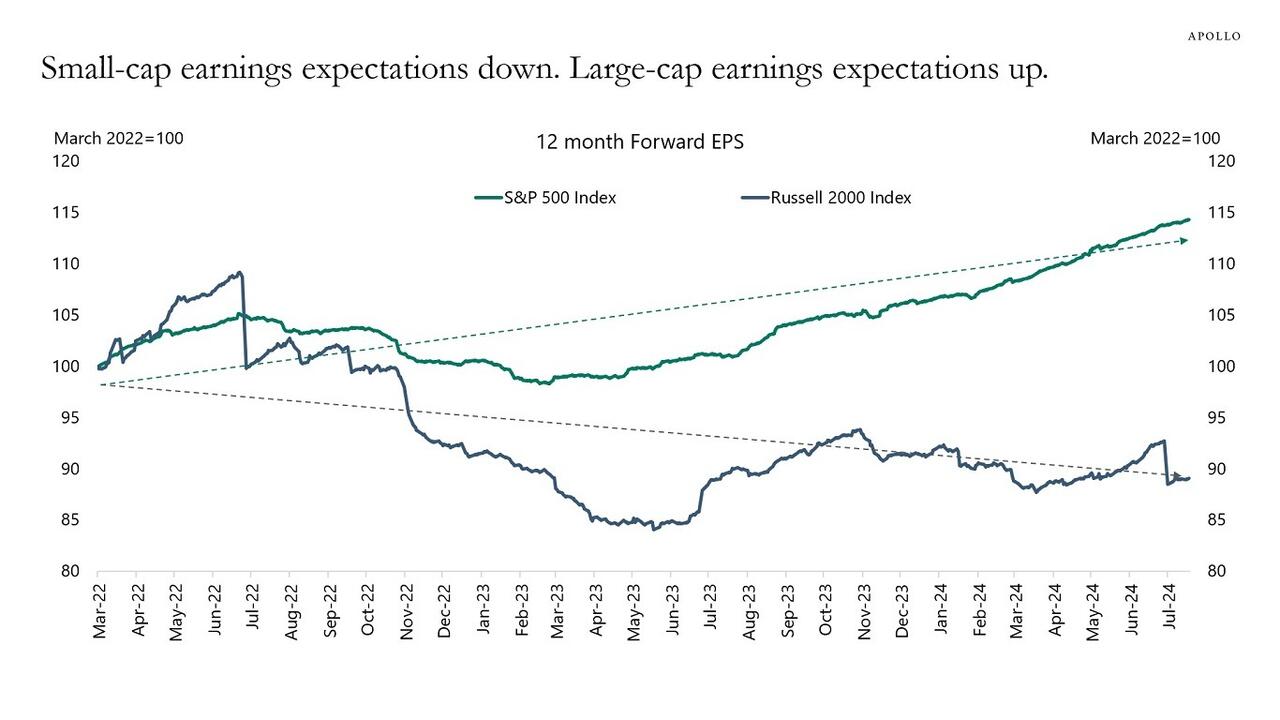
Third, the “Mega-cap” companies have more substantial earnings growth than their small—and mid-cap brethren. For now, the large-cap, primarily the “Mega-Cap” companies, are driving most of the earnings growth. With the economy showing clear signs of deterioration, earnings of small and mid-cap companies remain the most vulnerable to changes in economic demand.
Lastly, and probably most importantly, large-cap, predominantly “Mega-cap” companies engage in share repurchases much more than small and mid-caps. Corporate share buybacks will approach $1 trillion this year and exceed that in 2025, with Apple alone accounting for more than 10% of those purchases.
As we noted previously, this is not an insignificant factor supporting the rise in asset prices. Since 2000, corporate share buybacks have provided 100% of all the “net equity purchases.”
Therefore, it should be unsurprising that there is a high correlation between the ebbs and flows of corporate share buybacks and market performance.
With earnings season mostly behind us, the “buyback window” for the largest companies is now open. Such will allow the “Mega-caps” to start repurchasing shares.
However, while the support for the “Mega-caps” remains, the current correction process is likely incomplete.
Correction Is Likely Not Over Yet
So are “Mega-Caps” likely becoming a “mega-buy?” That may be stretching it a bit, but what is likely is that the recent underperformance is likely near its conclusion.
From a purely technical perspective, the “Mega-Cap” stocks have witnessed a sharp contraction over the last few weeks. Using the Vanguard Mega Cap Growth ETF (MGK) as a proxy for the largest companies, the recent correction has reversed most of the previous overbought and extended conditions.
MGK is oversold on multiple levels, and the MACD indicator is well below zero, which has previously coincided with short-term market bottoms. Furthermore, MGK tested and held the 200-DMA, which was also the lowest in October 2023. However, while technically oversold, many investors are “trapped” by the recent decline, so we will likely see some “selling pressure” as they look to exit, which would set up a retest of the 200-DMA before the correction is complete.
MGK already completed an initial 38.2% correction level using a Fibonacci retracement sequence from the recent high. While the 200-DMA is providing initial support to MGK, a failure of that support would bring a 50% retracement level into focus. Such would align with the lows of the April correction.
Given the short-term oversold conditions and the decline in sentiment, the reflexive bounce in the “Mega-Caps” we saw last week was unsurprising. However, as we suggested, given such a sharp rotation from recent highs, it may only be a “tactical trading opportunity” before the completion of the correction process. This is because “bullish sentiment” remains elevated, historically not what is seen at corrective lows.
We suspect that while we could see an oversold bounce following the recent sell-off, “trapped longs” will likely use any such opportunity to exit positions. Therefore, we suggest the following rules for whatever comes next.
The Rules
The rules are simple but effective.
Raise cash levels in portfolios.
Reduce equity risk, particularly in areas highly dependent on economic growth.
Add or increase the duration of bond allocations, which tend to offset risk during recessionary downturns.
Reduce exposure to commodities and inflation trades as economic growth slows.
If a further correction occurs, the preparation allows you to survive the impact. Protecting capital will mean less time spent getting back to breakeven afterward. Alternatively, it is relatively easy to reallocate funds to equity risk if the market reverses and resumes its bullish trend.
Investing during periods of market uncertainty can be difficult. However, you can take steps to ensure that increased volatility is survivable.
Have excess emergency savings, so you are not “forced” to sell during a decline to meet obligations.
Extend your time horizon to 5-7 years, as buying distressed stocks can get more distressed.
Don’t obsessively check your portfolio.
Consider tax-loss harvesting (selling stocks at a loss) to offset those losses against future gains.
Stick to your investing discipline regardless of what happens.
If I am correct, and this current corrective process is incomplete, the risk reduction will lower portfolio volatility. However, if I am wrong, we can reallocate to equities and rebalance our portfolios for growth as needed,
Home Depot Slashes Sales, Profit Outlook As Higher Rates “Pressure Demand”
The largest home improvement retailer in the US beat second-quarter earnings and sales expectations but lowered its comparable sales and profit forecasts for the year. This aligns with our ongoing theme of an emerging consumer slowdown.
This is aging pretty well so far. $HD beats, guides everything lower. Says foot-traffic weakened as the quarter progressed. Guides to SSS decline of 3-4%.
HD expects business to get worse in the back half of the year which is a) New b) Bad.
Here’s a quick look at Home Depot’s second-quarter results (courtesy of Bloomberg):
Comparable sales -3.3% vs. -2% y/y, estimate -2.39%
US comparable sales -3.6% vs. -2% y/y, estimate -2.63%
Net sales $43.18 billion, +0.6% y/y, estimate $43.79 billion
Adjusted EPS $4.67, estimate $4.52
EPS $4.60 vs. $4.65 y/y
Customer transactions -1.8%
Average ticket sales $88.90, -1.3% y/y
Average ticket -1.3%
Sales per square foot -3.6%
Merchandise inventories $23.06 billion
Total location count 2,340, +0.6% y/y
SG&A expense $7.14 billion, +3.3% y/y
“During the quarter, higher interest rates and greater macro-economic uncertainty pressured consumer demand more broadly, resulting in weaker spend across home improvement projects,” Home Depot CEO Ted Decker wrote in a statement.
The focus is on Home Depot’s full-year outlook. It now expects comparable sales to decrease by 3% to 4% compared to the previous forecast of -1%. This is far worse than the average Wall Street estimate tracked by Bloomberg of -1.65%. It lowered earnings per share for the year to -2% to -4%, down from +1%.
Snapshot of the full-year forecast (courtesy of Bloomberg):
Sees comparable sales -3% to -4%, saw about -1%, estimate -1.65% (Bloomberg Consensus)
Sees sales +2.5% to +3.5%, saw about +1%
Sees operating margin 13.5% to 13.6%, saw about 14.1%
Sees EPS growth -2% to -4%, saw about +1%
Sees adjusted EPS growth -1% to -3%
Here is Goldman’s reaction to earnings:
HD – Weak, As Expected. Will They Also Get a Pass Like Housing Peers?: We think a comp miss and FY comp sales cut was widely expected. It was always going to just be a matter of magnitude and whether or not the stock would get punished for it. Whether fair or not, most housing/big ticket exposed names who cut have acted pretty well on 2Q EPS day, despite many cutting 2H numbers. Ultimately, they did miss the mark slightly here on top-line for the quarter and the guide. Commentary on the call about whether they have seen further deterioration, or just still sluggish trends will be important to watch. Would expect some weakness to start, but expect the move in rates the next couple days to matter just as much for the stock as actual results, if other housing prints are any indication. They beat EPS, with upside from revenue and SG&A. Comps were -3.3% (US was -3.6%) vs Consensus -2.1% and we think the bogey was -3%. They took FY comps down to down 3-4%. They said -3% is where it will be if the demand holds where it is now into 2H. We think they bogey for the guide was down 2-3%.
In an interview with CNBC, CFO Richard McPhail said consumers have been undergoing a “deferral mindset” since the middle of 2023. The reason is straightforward: high mortgage rates have paralyzed the housing market, and elevated inflation and high interest rates, in general, have led households to pull back on spending.
McPhail said, “Pros tell us that, for the first time, their customers aren’t just deferring because of higher financing costs,” adding, “They’re deferring because of a sense of greater uncertainty in the economy.”
“What our customers tell their pros is, ‘Everything I read tells me interest rates will be lower in three to six months,'” the exec said, explaining,” ‘Why would I borrow to finance the project now rather than just wait a few months?'”
Companies heavily exposed to consumers have posted weak results this earnings season and warned about consumer weakness.
Rate traders are currently pricing in as many as four 25bps cuts by the end of the year. The labor market is cooling, and the economy is trending in the wrong direction.
Low/mid-tier consumers have been tapping out in the Biden-Harris economy, plagued with elevated inflation and high interest rates. Many of these folks have depleted savings and maxed out credit cards. The big question is whether lowering interest rates will create a soft economic landing, or if the Fed has already missed the mark.
Producer Price Inflation Slows As Services Costs Slump
Having been resurgent for the last few months, US Producer Price inflation was expected to slow significantly in July and it did, with Headline Final Demand PPI rose just 0.1% MoM (+0.2% exp) which pulled the YoY PPI down from +2.7% to +2.2%…
Source: Bloomberg
Energy prices picked up MoM while Services prices tumbled by the most since March 2023…
Source: Bloomberg
Final demand goods: Prices for final demand goods rose 0.6% in July, the largest advance since a 1.1- percent jump in February. Nearly 60 percent of the broad-based increase in July can be traced to the index for final demand energy, which moved up 1.9%. Prices for final demand goods less foods and energy and for final demand foods also rose, 0.2 percent and 0.6 percent, respectively.
Product detail: A quarter of the July rise in the index for final demand goods is attributable to a 2.8-percent advance in prices for gasoline. The indexes for diesel fuel, meats, jet fuel, fresh fruits and melons, and basic organic chemicals also increased. Conversely, prices for electric power decreased 1.1 percent. The indexes for fresh and dry vegetables and for steel mill products also moved down.
Final demand services: Prices for final demand services fell 0.2 percent in July, the largest decrease since moving down 0.2 percent in March 2023. The July decline can be traced to the index for final demand trade services, which dropped 1.3 percent. (Trade indexes measure changes in margins received by wholesalers and retailers.) In contrast, prices for final demand services less trade, transportation, and warehousing and for final demand transportation and warehousing services rose 0.3 percent and 0.4 percent, respectively.
Product detail: Leading the July decline in prices for final demand services, margins for machinery and vehicle wholesaling decreased 4.1 percent. The indexes for food and alcohol retailing, automobiles retailing (partial), automotive fuels and lubricants retailing, desktop and portable device application software publishing, and physician care also fell. Conversely, prices for portfolio management advanced 2.3 percent. The indexes for chemicals and allied products wholesaling and for truck transportation of freight also rose.
We would expect portfolio management fees to drop next month as stocks were slammed…
Core (Ex-Food and Energy) was unchanged MoM and plunged from +3.0% to +2.4% YoY…
Source: Bloomberg
However, ex-Trade-Services, PPI increased to +3.3% YoY…
Source: Bloomberg
Companies are feeling the squeeze as they eat the difference between CPI and PPI…
Chipotle Shares Tank After Starbucks Steals Their CEO Amid Activist Pressure
Amid increasing tales of a consumer who is quickly pulling back from spending on anything discretionary (like iced, non-fat, six-pump vanilla lattes, with soy milk, and honey), Starbucks has unceremoniously dumped its CEO this morning, and snagged a very prominent CEO from another chain.
Starbucks has named Chipotle Chief Executive Brian Niccol as the coffee chain’s new CEO and chairman, replacing Laxman Narasimhan after just over a year in the role.
“I am excited to join Starbucks and grateful for the opportunity to help steward this incredible company, alongside hundreds of thousands of devoted partners,” said Niccol.
“I have long-admired Starbucks iconic brand, unique culture and commitment to enhancing human connections around the globe. As I embark upon this journey, I am energized by the tremendous potential to drive growth and further enhance the Starbucks experience for our customers and partners, while staying true to our mission and values.”
Niccol will become the sixth person to serve as Starbucks’s CEO in the company’s history, and the second to come from outside the company. Narasimhan, who became CEO in March 2023, was the first.
Starbucks is thrilled…
“We are thrilled to welcome Brian to Starbucks. His phenomenal career speaks for itself. Brian is a culture carrier who brings a wealth of experience and a proven track record of driving innovation and growth. Like all of us at Starbucks, he understands that a remarkable customer experience is rooted in an exceptional partner experience,” said Mellody Hobson, Starbucks board chair.
“Our board believes he will be a transformative leader for our company, our people, and everyone we serve around the world.”
Chipotle shareholders not so much – SBUX is up 11% and CMG -10% on the news…
Most notably, this decision by Starbucks to oust their CEO comes after activist investor Elliott Investment Management pushed for transformation at the coffee giant to address slowing sales and operating problems. Additionally, last week The Wall Street Journal reported that another activist, Starboard Value, had taken a stake in Starbucks.
The 39-year-old SunPower is the latest solar rooftop business to fail this year. Others include Titan Solar Power and Sunworks. SunPower cited a “severe liquidity crisis caused by a sharp decline in demand in the solar market and SunPower’s inability to obtain new capital.” The IRA boosted solar subsidies, so why has demand fallen?
One reason is higher interest rates have made rooftop panel leasing less attractive to customers. Some states like California have scaled back programs that pay customers to send solar power they don’t use to the grid. Such subsidies raise the cost of power for people who don’t have panels. In California the grid is often overloaded with solar power.
The cost of panels has also increased amid overall inflation and President Biden’s tariffs, which were backed by domestic manufacturers and Democrats in Congress. Solar installers warned the tariffs would hurt their industry, and they have. Jobs that Mr. Biden’s subsidies giveth, his tariffs and inflation taketh.
Offshore wind projects are also getting scratched because of rising costs and interest rates that make them uneconomic even with subsidies. BP last year wrote down its U.S. offshore wind business by $1.1 billion. Wind developer Orsted last autumn announced $4 billion in write-downs after walking away from two projects off the New Jersey coast.
BP recently scaled back a planned U.S. biofuels investment. Shell this year said it would close its hydrogen refueling stations in California as few people are buying fuel-cell vehicles, and subsidies for hydrogen production have fallen. Talk about stranded assets.
Tariffs and Subsidies Backfire
Biden only wants clean energy if it every piece of it is made in the USA. That means higher costs, even with subsidies.
I commented on this in advance as it was easy to see.
The attempt force production of solar panels in the US resulted in prices so high that few wanted them.
About 40% Of Biden-Harris’ IRA Projects Face Delays
President Joe Biden and Vice President Kamala Harris signed the Democrats’ Inflation Reduction Act and Chips and Science Act in 2022, promising to lower inflation and make life more affordable for Americans. However, the reality has been quite the opposite, as the federal government embarked on a spending spree of taxpayers’ dollars. Even VP Harris recently admitted on the camping trail that a cost of living crisis persists.
Two years after Biden-Harris’ Inflation Reduction Act and Chips and Science began offering some of the $400 billion in tax credits, loans, and grants to promote the development and promotion of clean energy across the country while expanding the semiconductor supply chain, a number of projects have been delayed or paused.
A newly published investigation by the Financial Times reveals that nearly 40% of Biden’s key industrial and climate projects (each valued over $100 million) have been delayed or put on hold. FT said that’s about $84 billion worth of projects sitting idle. It added the total value of projects tracked by its investigative team was approximately $228 billion.
The delays raise significant questions about big government’s ability to effectively manage the industrial transformation across the US to rebuild the Heartland’s industrial capacity.
Here’s a map of the delayed or paused manufacturing projects.
The uninspiring success rate of these projects, with many not on track as they should be, is a national management issue that extends all the way to the top. In the private sector, such dismal performance would not be tolerated.
Considering the US is in a race to expand its manufacturing base and reduce reliance on China as global conflict threats continue to surge – the dismal success rate so far needs to be reviewed by lawmakers on Capitol Hill to understand if the most qualified folks are managing the projects.
Intermittent fasting has gained significant attention in recent years for its potential health benefits, including weight loss, improved metabolic health, and even longevity. As more and more people try it out as a possible means to improve their overall health and well-being, it’s important to take a deeper look into the science behind this way of eating.
Exploring the existing evidence behind the purported benefits of intermittent fasting can provide valuable insights into how it affects our bodies and whether it lives up to the hype.
How Is Intermittent Fasting Different From Fasting?
Intermittent fasting and fasting are two different approaches to the timing of meals and calorie intake. Traditional fasting is refraining from consuming calories—whether from food or drink—for an extended period.
There are myriad ways to fast, from drinking only water to a more modified approach that includes some calories from drinking bone broth or fresh-pressed juices. The duration of the fasting period also varies and may last up to 28 days or more.
Intermittent fasting is an eating pattern that involves cycling between periods of eating and fasting. Intermittent fasting does not dictate what you eat but rather when you eat. It is a shorter period of fasting and involves adding blocks of time-restricted eating to your daily schedule.
While there is no standard set delineation, the most extended duration of intermittent fasting before it is considered general fasting is commonly agreed upon as 48 hours.
Types of Intermittent Fasting
Several of the most popular approaches to intermittent fasting include:
16:8 Method
The most common approach to intermittent fasting, the 16:8 method, involves fasting for 16 hours and eating all meals within an eight-hour window each day.
Eat-Stop-Eat
This method consists of fasting for 24 hours once or twice a week.
5:2 Intermittent Fasting
This approach involves following a regular diet five days a week and significantly reducing caloric intake on the other two days.
Alternate-Day Fasting
This method includes alternating between days of regular eating and fasting.
One-Meal-a-Day (OMAD)
With this method, you fast for 20 hours daily and eat one large meal, typically at night.
The Benefits of Intermittent Fasting–What We Know
While an evolving area of research, evidence supports several health benefits of incorporating intermittent fasting into your regime.
Weight Loss
Many people seek out intermittent fasting as a means to reduce body fat. Mrinal Pandit, a registered dietitian, clinical nutritionist, and certified nutritional counselor, told The Epoch Times in an email, “Intermittent fasting can aid in weight loss by reducing calorie intake and enhancing hormone function to facilitate weight loss.”
Research supports that intermittent fasting may lead to increased metabolic rate, allowing the body to burn more calories even at rest. There is also evidence that it can lead to a decrease in insulin levels, which allows the body to burn stored fat.
However, some research suggests intermittent fasting produces no additional benefit to weight loss than simple overall continuous caloric restriction. Yet the authors of an article published in the BMJ Open Sport & Exercise Medicine in 2022 noted that intermittent fasting may be responsible for weight loss and a reduction in waist circumference that is independent of just calorie restriction.
More research is needed to uncover the exact mechanism, but weight loss is often seen in people who adopt an intermittent fasting approach to eating.
While intermittent fasting is a means of weight loss, it’s worth noting that in 2023, a review published in Nutrition Reviews highlighted that it takes between five and 20 days of prolonged fasting to see a weight loss of two to ten percent of a person’s total body weight. Given the extended period of fasting time needed to see significant weight loss results, intermittent bouts of fasting may not be the best method if a reduction in body weight is the primary goal.
Metabolic Health
Metabolic health is how well the body breaks down the food you eat and converts it into energy. It refers to markers including optimal body mass index, cholesterol, blood pressure, and blood sugar levels. Metabolic dysfunction, or poor metabolic health, is a contributor to many chronic illnesses and a cause of diabetes, heart disease, and stroke.A study published in 2022 in the BMJ Open Sports & Exercise Medicine saw overall improvements in metabolic health due to intermittent fasting. Pandit said “Fasting can improve various metabolic markers of health, including improved insulin sensitivity and reductions in blood sugar levels. These benefits are typically observed with fasting windows ranging from 14 to 16 hours daily.”
Autophagy
Autophagy is a process in the body that involves the destruction of cells. It allows the body to rid itself of damaged cells and regenerate new ones. It’s like a self-cleaning oven within cells that helps to maintain their function.
Autophagy has been linked to various health benefits, including the potential to protect against certain diseases and promoting longevity.
Decreased autophagy is linked to various health issues and conditions. Research suggests that a reduction in autophagy may contribute to neurodegenerative diseases, cancer, and metabolic disorders. Additionally, impaired autophagy may lead to accelerated aging and a decline in cellular health.
Research published in the journal Autophagy shows intermittent fasting activates and upregulates autophagy in many of the body’s organs. According to Pandit, “Fasting periods of at least 16–18 hours can initiate autophagy, with the process becoming more pronounced as the fasting window extends.”
Human Growth Hormone
The human growth hormone (HGH) has a myriad of responsibilities in our growth and development in adolescence, but it begins to decrease around middle age. HGH maintains our tissues and organs throughout the body and is believed to play a role in our immune system function, aging process, and mental health and well-being.
Such benefits are seen in more extended periods of forgoing food. According to Pandit, “A fasting window of about 16 to 24 hours is often associated with a noticeable increase in HGH … production.” Levels of the hormone significantly increase after 24 hours of intermittent fasting, and research published in the Journal of Clinical Endocrinology & Metabolism found that after 48 hours of intermittent fasting, the amount of HGH present is five times that seen at the 24-hour mark.
Additionally, there is research tying spikes in insulin levels with an interference in HGH communication in the body. Since intermittent fasting involves refraining from eating—and insulin is released upon food intake—blood levels will be lower throughout the majority of the day. Thus, there may be less interference.
Oxidative Stress
Oxidative stress occurs when the body’s free radical and antioxidant levels are imbalanced. This imbalance can lead to cellular and tissue damage, inflammation, and cellular aging. Chronic oxidative stress is a driver of many chronic diseases. “Fasting for 16-24 hours can activate pathways that enhance cellular resistance to stress,” Pandit said.
A study published in 2019 in the Federation of American Societies for Experimental Biology suggests that “prolonged nighttime fasting, without altering daily caloric or dietary intake, may improve antioxidant capacity,” thus aiding with any imbalance with free radicals. The study also concluded that intermittent fasting “significantly reduced markers of inflammation while supporting antioxidant function” when combined with physical activity.
A study published in the International Journal of Exercise Science in 2020 found that intermittent fasting also reduced oxidative stress in the heart and brain. However, some research indicates that the oxidative stress benefit may be due to weight loss. Whatever the mechanism, intermittent fasting ultimately mitigates oxidative stress and enhances health.
Cognitive Function
Intermittent fasting is associated with cognitive benefits such as improved brain function and a potentially reduced risk of neurodegenerative diseases. A three-year study published in Nutrients in 2020 found that such benefits are beneficial, particularly as we age.
A systematic review published in 2021, also in Nutrients, highlighted the benefits of intermittent fasting on mental health, especially stress, anxiety, and depression. Further, according to the findings of a 2020 randomized controlled trial in the publication, it may have the ability to improve memory function as well.
There is also research suggesting that intermittent fasting may increase the generation of brain-derived neurotrophic factor (BDNF), which is strongly linked to improved cognitive function. Low levels of BDNF are linked to diseases such as Parkinson’s disease, Alzheimer’s disease, multiple sclerosis, and Huntington’s disease.
“These cognitive benefits are observed typically with longer fasting periods, usually 18—24 hours, which stimulate protective processes in the brain,” Pandit added. However, more research is needed to fully understand the cognitive effects of the practice in their entirety.
Cardiometabolic Health
A review published in the Annual Review of Nutrition in 2021 suggests that, in particular, alternate-day fasting, the 5:2 diet, and time-restricted eating may lower blood pressure. The review determined that these specific types of intermittent fasting could benefit cardiometabolic health by decreasing insulin resistance and oxidative stress.
“[The improvements] have been associated with fasting periods of 16–24 hours. These benefits arise from hormonal adjustments and improved metabolic responses,” Pandit said.
Conversely, research released by the American Heart Association in March suggested that 16:8 intermittent fasting increases the risk of death from cardiovascular disease. However, it’s important to note there are limitations to the study, including self-reported data from only two days per week.
Gut Health
A study published in the American Journal of Clinical Nutrition in 2021 found that, after fasting for 16 hours per day for the entirety of the month of Ramadan, participants had higher levels of beneficial bacteria in the gut. Once the fasting period ended at the end of the month, the levels returned to baseline.
A study published in the British Journal of Nutrition in 2020 found a similar increase as well as an enhanced diversity in the gut microbiome of participants who fasted for 16 hours a day for 25 days.
“In regard to gut health, shorter fasting times of 12–16h [hours] might be beneficial for the gastrointestinal tract and could improve gut barrier function and the composition of gut microbiota when compared to non-fasting state,” said Pandit.
‘V For Vendetta’ Got It Wrong: Tyranny Comes To Britain Under The Political Left
There have been plenty of depictions of dystopian future from popular entertainment media over the years, most of them derivatives of books like Brave New World by Aldous Huxley or 1984 by George Orwell with a contemporary spin. Interestingly, Orwell was inspired to write 1984 by a lesser known dystopian tale called ‘We’, written by Russian author Yevgeny Zamyatin during the darkest years of communism. Orwell argued that Huxley was also inspired by We, but Huxley denied it.
Whenever scientific dictatorship is envisioned by fiction writers the end result is usually very similar to already existing socialist regimes. Soviet doctrine and the ideals of the Third Reich were inspired by Karl Marx; meaning, both regimes were built on far-left philosophies. Progressives today often maliciously associate Nazis with conservative thought, but both Adolph Hitler and Benito Mussolini were avid followers of Marx. As Hitler noted on January 27, 1934, in an interview with Hanns Johst in Frankforter Volksblatt:
“National Socialism derives from each of the two camps the pure idea that characterizes it, national resolution from bourgeois tradition; vital, creative socialism from the teachings of Marxism. Volksgemeinschaft: that means a community of all productive labor, that means the oneness of all vital interests, that means overcoming bourgeois privatism and the unionized, mechanically organized masses, that means unconditionally equating the individual fate and the nation, the individual and the Volk…”
Hitler presented himself as a Christian patriot to win over the German public as they faced economic and moral degradation during the unchecked liberalism of the 1920s, but in private he was not a fan of the religion. Hitler is noted by Albert Speer as saying:
“You see, it’s been our misfortune to have the wrong religion. Why didn’t we have the religion of the Japanese, who regard sacrifice for the Fatherland as the highest good? The Mohammedan religion [Islam] too would have been more compatible to us than Christianity. Why did it have to be Christianity with its meekness and flabbiness?”
In fact, finding and defining a “conservative” totalitarian regime is almost impossible in modern times. Without the defense of free markets, individual liberty, meritocracy and a healthy respect for constitutional fairness one cannot call himself conservative. The Nazis were no more conservative than Neo-Conservatives are conservative, they are simply leftists that pursue ultimate power using nationalism as a proxy instead of pure globalism.
How the “right wing” was culturally associated with authoritarianism is all thanks to modern Hollywood. The same people that write endless tales of Nazi horror have long ignored the even greater genocides of communism in the Soviet Union, China and elsewhere. And, whenever a modern dictatorship is portrayed in art or film it is usually tied somehow to a conservative (and often Christian) takeover of society.
This brings us to a little film called V For Vendetta released in 2006, and it brings us to the tyranny now accelerating in the UK.
V For Vendetta is based on the graphic novel by the same name written by Alan Moore (picture below), a talented British scribe but also known by many in the comics industry as a leftist and communist. Moore’s take on an Orwellian government dominating Britain was decidedly anti-conservative, to no one’s surprise.
The film, directed by the Wachowski Brothers (creators of The Matrix and now both claiming to be “trans women” pictured below), took the anti-conservative view from the comic to even greater extremes with an underlying LGBT propaganda message. V depicts a British government gripped by authoritarian Christian zealots bent on rounding up and exterminating gay people (and anyone else they deem unfit). They use an engineered pandemic crisis to frighten the English population and seize power (sound familiar?), establishing a relentless police state run by sexual degenerates that saturates media with disinformation to keep the public docile.
Another film with a similar theme is Children Of Men (release the same year as V for Vendetta), which uses the UK as a backdrop to showcase the steady decline of humanity after a pandemic ends our ability to have children. The authoritarian government in that tale is dominated by white Brits who round up migrants and place them in concentration camps, and of course a migrant woman ends up being the key to solving the question of infertility.
While most people can relate to the struggle against totalitarianism, the intolerable fallacy being perpetuated is that when the jackboots finally march on the western world they will do so in the name of conservative values and religion. Well, the dystopian nightmare has arrived in the UK, and the truth is quite the opposite.
The British public is being culturally diminished through forced mass immigration to which the government offers no redress. UK authorities are far-left in their ideology and promote globalism as the system which Brits must accept without question. And, those same establishment elites have joined with third-world migrants and Islamic militants to terrorize the population into submission.
Today, UK police are out in force threatening to arrest anyone remotely critical of open immigration or UK migrant policies. They have also doubled down on the two-tier policing that caused the patriot protests and riots to begin with. These are not scenes from V For Vendetta, these are scenes from the UK this week:
The UK police have never spoken like this before. It’s like they’re trying to antagonise tens of millions of peaceful sensible Brits who simply want a conversation.pic.twitter.com/TNRgSpG1Da
UK authorities have now made multiples arrests dealing with social media posts and opinions as well as arresting people who were merely spectators at various protests. They are also searching for ways to take down their political opponents, with leftist politicians using MI6 to investigate Nigel Farage for “financial ties” to Tommy Robinson and Russia. It’s expected that adjacent leftist governments around the world will be following the UK’s example.
Is the far-left really oblivious to their own natural tendencies towards tyranny? Or, is all the media depicting a conservative run dystopia really a form of gaslighting? A means to demonize the very people the elites have long sought to erase from history?
When rebellion against this trend explodes (and it will), many great speeches on liberty similar to those spoken in so many pieces of predictive entertainment will not be spoken by leftists and they won’t apply to leftists. Leftists are not the freedom fighters they imagine themselves to be. They are, in fact, the villains of the story.