Canada’s standard of living is on track for its worst decline in 40 years, according to a new study by Canada’s Fraser Institute.
The study compared the three worst periods of decline in Canada in the last 40 years – the 1989 recession, the 2008 global financial crisis, and this post-pandemic era.
They found that, unlike the previous recessions, Canada is not recovering this time. Something broke.
In fact, according to the Financial Post, since 2019 Canada’s had the worst growth out of 50 developed economies. Inflation-adjusted Canadian wages have been flat since 2016.
So, yes, something broke.
And it’s nowhere near over: Canada’s per-person real GDP is still falling and with a looming US recession – the US is 75% of Canada’s exports – Canada could crash again before it ever recovered.
Trudeau’s Canada in Decline
In previous videos, I’ve talked about the disaster that is Justin Trudeau’s Canada. In short, incomes are West Virginia-level, house prices are at the Los Angeles level, and Canadian taxes are halfway to the Soviet Union.
It’s not rare for a middle-class family in Canada to pay half their income in taxes.
Meanwhile, since the pandemic, Canada’s official food inflation is up 25%, and energy is up 30% – partly thanks to a carbon tax.
And keep in mind sales tax in most Canadian provinces is 13 to 15 percent on everything you buy.
While Canadians post TikToks about trying to stretch a loaf of rye bread through the week or selling off their possessions to afford groceries, the cost of living is hitting harder with time.
Canadian bankruptcy filings jumped 40% last year, while CIBC reports nearly half of Canadians have zero emergency savings.
An Ipsos poll found 7 in 10 Canadians agree that “Canada is broken” – rising to 8 in 10 of those between age 18 and 34.
Angus found fully 42% of Canadians are considering moving to another country.
What Changed
This is all a shock because it happened so fast – it’s night and day from the last crisis in 2008, which Canada weathered much better than America.
What changed? Justin Trudeau. Specifically, his campaign to convert Canada from a mixed economy like the US into a government-dominated economy like the sick men of the European Union.
Under Trudeau, business investment has plunged by a third. While government spending nearly doubled to almost half of GDP.
Government workers in Canada are growing almost four times faster than the private sector, and one in three Canadians now work for the government, raking in 30% more in salary and benefits than the taxpayers they lord over. Another 1.7 million Canadians – roughly 1 in 10 households – are on welfare.
Of course, that makes it very difficult to win an election in Canada on a small-government platform: You’re up against the government-provided livelihoods of 40% of voters. Meaning you’ve got to win, what, 80% of everybody else.
What’s Next
Near-term things will get worse because Canadians are stuck with Trudeau through the next election in 2025.
Conservative Pierre Poilievre is ahead in the polls for now, but Canada’s government-funded media is doing everything they can to destroy him so the lead’s already narrowing.
That means more inflation, more decline, more mass migration, and rising crime in what was once a paradise.
High-speed internet is no longer a luxury – it is necessary for Americans to do their jobs, to participate equally in school, access health care, and to stay connected with family and friends. Yet, more than 8.5 million households and small businesses are in areas where there is no high-speed internet infrastructure, and millions more struggle with limited or unreliable internet options. Just like Franklin Delano Roosevelt’s Rural Electrification Act brought electricity to nearly every home and farm in America, President Biden and Vice President Harris are delivering on their historic commitment to connect everyone in America to reliable, affordable high-speed internet by the end of the decade.
The senior Republican on the Federal Communications Commission (FCC) is blaming the Biden administration for a lack of high-speed internet projects that were approved under the Infrastructure Investment and Jobs Act, comparing the situation to the dearth of electric vehicle charging stations that were also supposed to be built with the funds.
“There’s no question that the 2021 law put some process in place, but the Biden administration decided to layer on top of that a Byzantine additional set of hoops that states have to go through before the administration will approve them to actually get these funds and start completing the builds,” Carr told FOX Business in an interview.
Carr acknowledged that some high-speed internet projects have connected people during the Biden administration, but he said none of them have been funded by the $42.5 billion allocation from the Broadband Equity, Access, and Deployment (BEAD) Program from the Infrastructure and Jobs Act, which was the administration’s signature broadband initiative.
Where Would We Be?
I am sure glad Biden put Kamala Harris in charge of the border and also delivery of high speed internment because otherwise where would we be?
As long as I am asking questions, might I suggest it’s time for more fact checks on “Biden-Harris” Fact Sheet announcements?
But hey, let’s step back and give credit is due. In this case, the “Biden-Harris” plan delivered nothing but amazingly cost nothing!
No money has been spent because $42.5 billion has been bogged down in the “Biden-Harris” bureaucracy.
How can you possibly beat that? This is arguably the biggest success story of the entire “Biden-Harris” term.
No doubt I have piqued someone’s curiosity here, perhaps many people.
Do I have any volunteers to fact check all of the “Biden-Harris” fact sheets?
It’s a daunting task, but democracy undoubtedly depends on it.
For 25 Minutes, Secret Service In Command Center Never Notified Trump’s Detail
While members of the Secret Service in a Butler, Pennsylvania command center were notified that an individual later identified as Thomas Matthew Crooks was acting suspiciously before he tried to assassinate Donald Trump, members of the former president’s secret service detail were not informed of the threat, according to the Washington Post.
Members of former president Donald Trump’s Secret Service detail and his top advisers have privately questioned why they were not informed that local police were tracking a suspicious person before that person opened fire on Trump at his July 13 rally in western Pennsylvania, according to people with direct knowledge of the concerns.
Approximately 20 to 25 minutes before Thomas Matthew Crooks shot at the former president, local countersnipers noticed him behaving strangely and sent his photograph to a command center staffed by state troopers and Secret Service agents, the head of Pennsylvania State Police told a congressional committee Tuesday.
According to three sources, members of Trump’s Secret Service detail have complained to confidants and others inside the agency that they were never made aware of the warning, and they had no idea that local countersnipers eventually lost track of Crooks – or that a local police officer who was hoisted onto the roof of the building saw Crooks perched there with a gun.
Trump was on stage a full eight minutes – roughly 20 minutes after Crooks was spotted and reported – before shots rang out, wounding Trump, critically wounding two others, and killing one rallygoer.
“Nobody mentioned it. Nobody said there was a problem,” Trump told Fox News in an interview last Monday. “They could’ve said, ‘Let’s wait for 15 minutes, 20 minutes, five minutes, something. Nobody said — I think that was a mistake.”
Meanwhile, the Secret Service, which initially lied about denying Trump additional security requests, is not talking.
“As it relates to communications at the rally, the Secret Service is committed to better understanding what happened before, during, and after the assassination attempt of former President Trump to ensure that never happens again,” said spox Anthony Guglielmi, the guy who lied about the denied security.
Trump’s team has been at odds with Secret Service headquarters over various requests that the agency denied, including more magnetometers at events, more countersnipers at some events and other specialty teams at other events, The Post has reported. The Secret Service and Trump’s team also repeatedly clashed over security and logistics at the Republican National Convention earlier this month.
The Butler, Pa., shooting is also emblematic of what some Secret Service critics say are chronic communication problems that have dogged the agency and contributed to serious security lapses. -WaPo
Yes, just a breakdown in communication. Nothing nefarious.
Also on Monday, then-Secret Service Director Kimberly Cheatle deflected when asked by House lawmakers why the Secret Service didn’t immediately delay Trump’s speech when local police reported a suspicious person – telling the committee that such reports are commonplace.
“At a number of our protected sites, there are suspicious individuals that are identified all the time,” she said. “It doesn’t necessarily mean that they constitute a threat.”
Cheatle – who resigned last week, admitted that the Secret Service was notified of a suspicious person at the Butler, PA rally “somewhere between two and five times,” and she didn’t know when Trump’s security detail was notified.
In popular lingo young people simply say, “that tracks.” It’s a quick way of saying, new information makes sense with pre-existing information.
Investigative journalist Seymour Hersch writes on his substack [SEE HERE], an article outlying how his sources in Washington DC and the White House have confirmed to him that former President Barack Obama was the impetus to push Joe Biden out of the 2024 presidential race.
Seymour Hersh says President Obama was “deeply involved” with the alleged coup and called Joe Biden after his “incident” in Las Vegas, which, from all outward appearances, looks like a major slip and fall – with a significant hit to the head.
“I went over [reports] this week with a senior official in Washington who helped me fashion an account of a White House in complete disarray,” Hersh said.
“Obama called Biden after breakfast [on July 20] and said, ‘Here’s the deal. We have Kamala’s approval to invoke the 25th Amendment,’” a senior Washington official told Hersh. Nancy Pelosi, Chuck Schumer, and Hakeem Jeffries were reportedly directly involved.
Obama’s plan was to not to immediately endorse Kamala, but it was clear that she would “get the nod.” “[Obama] had an agenda and he wanted to seek it through to the end, and he wanted to have control over who would be elected.” (Hersch article encapsulated)
Not only does this outline track with every datapoint known about events leading up to the Biden announcement, it also aligns with the entire background of the Obama team operating inside the Biden administration. Team Obama have always been in control. Heck, the Obamas never even left Washington DC after their term in office.
The bigger understanding is in the final quote cited.
“[Team Obama] had an agenda and he wanted to seek it through to the end, and he wanted to have control over who would be elected.” This is the part where people forget the risk to Team Obama that has never gone away.
The Obama “fundamental change” was a construct of malicious intent. Much of it fraught with unlawful activity only possible by weaponizing the various agencies and bureaus of the U.S. government. Going all the way back to 2007 through 2017, that decade is filled with unlawful action by Barack Obama and the people behind him. This is the core of their ongoing need for control, likely for a generation or more.
President Obama and his likeminded ideological foot-soldiers weaponized the federal system of government. In every action from the moment he left office, Obama’s team have been working one long continuum of control in order to keep all of their prior activity hidden.
The need for Kamala ‘brat’ Harris is simply another step in this long process to hide the activity.
The NSA Database was weaponized to conduct political surveillance.
The Dept of Justice was weaponized to target their political opposition.
The Federal Bureau of Investigation was weaponized to act as the police investigative units for those targets.
The Dept of Homeland Security was weaponized to control the evidence and information about their political targeting and surveillance.
The IRS was weaponized against Obama’s political opposition.
The Office of the Director of National Intelligence was weaponized to allow the targeting radar to sweep internally against American citizens under the guise of national security and domestic terror threats.
The Central Intelligence Agency was weaponized allowing and permitting their “foreign surveillance” mandate to merge with the DHS internal surveillance mandate, while simultaneously the CIA conducted overseas political operations against the interests of sovereign countries. All of their activity in ideological alignment.
The Defense Department was purged of patriotism, intentionally weakened through diversity equity and inclusion, and then boiled down to a flag corps of general willing to go along with the policy of Obama.
Main Justice through the National Security Division used FARA violations to target anyone who was determined a threat to the fundamental change, and Main Justice began wholesale Lawfare operations against Donald Trump and any entity who would dare align with him.
Hundreds of millions, likely billions, were funneled through the American Recovery and Reinvestment Act, The Green New Deal, The Inflation Reduction Act, and various legislative expenditures to foreign governments; those funds went directly into the bank accounts of Democrat donors and political activist groups.
And that’s just the tip of the iceberg, the part the awakened American public can look into and see for themselves. Underneath the waterline, there’s tens of thousands of vested interests, inside and outside of Washington DC, operating to maintain the fundamental change that Obama created. However, their defenses are weak and shallow, fraught with vulnerability and the endless need to avoid sunlight.
All of that scheming, rot, corruption and unlawful activity makes them vulnerable. The need for control is a reaction to fear. The ‘fundamental change’ group are fraught with fear. That is why they consider the current political landscape as a zero-sum contest.
After Failed 1984-Style Censorship-Crusade, Paris Olympics Forced To Apologize For Woke Opening Ceremony
On Saturday, the organizers of the Paris Olympics scrambled to pressure social media platforms, such as X, to censor users who mocked and criticized Friday night’s shocking Opening Ceremony. The event, which featured drag queens, nudity, and scenes deemed highly disrespectful to Christians, sparked outrage worldwide. When the International Olympic Committee’s social media 1984-style censorship efforts failed (read: here), the committee had no choice but to apologize for the drag queen parody of Jesus’ Last Supper on Sunday morning.
Here’s what shocked the world on Friday night during the Opening Ceremony:
The 2024 Paris Olympics has gone full Woke dystopian.
The opening ceremony was filled with transgend*r mockery of the Last Supper, the Golden Calf idol, and even the Pale Horse from the Book of Revelation.
God will not be mocked. This is blasphemy. All satanic. Boycott the Olympics. Go woke, go broke. Who is with me?
“And I looked, and behold a pale horse: and his name that sat on him was Death, and Hell followed with him. And power was given unto them over the fourth part of the… pic.twitter.com/lzFAyDga1h
“There was never an intention to show disrespect to a religious group,” a Paris 2024 spokeswoman said, quoted by The Wall Street Journal.
The spokeswoman continued, “If people have taken any offense, we are, of course, really sorry.”
Denial of intent…
Olympic organizers apologize to anyone who was offended during the opening ceremonies. It’s not really an apology though, it’s just another tiring attempt to say it was about inclusivity. It’s not inclusive when you mock billions of people’s religious beliefs. pic.twitter.com/xM305psf6y
What were the organizers thinking when they recreated the Biblical scene of Jesus Christ and his apostles with drag queens, a transgender model, and a naked singer made up as the Greek god of wine, Dionysus?
— The Pleb 🇨🇦 Reporter (@truckdriverpleb) July 27, 2024
“We wanted to talk about diversity. Diversity means being together. We wanted to include everyone, as simple as that,” the artistic director Thomas Jolly told reporters.
Everyone except the Christians…
The woke mind virus is a phenomenon spreading like cancer across the Western world, infecting the youngest generations through public schools and activist corporations funding non-profits, as well as leftist politicians, who intend to install a new religion of woke. It’s only natural for a competing religion to mock and attack the status quo, that being Christians, and that’s exactly what occurred at the Games by the new religion rooted in Marxism.
Remember, the Olympics’ planning phase takes years and tens of millions of dollars. For the Games spokesperson to now desperately claim that this opening performance was a big misunderstanding – insults the intelligence of the world, which was watching and left in disbelief. Even the French…
Last night’s Paris Olympics Opening Ceremony even shocked the French.
The backlash this weekend makes it very clear: the majority of folks just want to watch sports without having the woke religion forced upon them. Keep politics and social issues out of sports, please.
US ‘Watching Closely’ Venezuela Election After Maduro Warned Of ‘Bloodbath’ If He Loses
President Nicolas Maduro alarmed and riled his enemies as well as Washington and its allies by declaring just ahead of Sunday’s elections: “If you don’t want Venezuela to fall into a bloodbath, into a fratricidal civil war, due to the fascists, let’s ensure the greatest success and greatest victory in the electoral history of our people.”
Many pundits are taking this as a warning that he’ll refuse to give up power in the unlikely event he loses his bid for six more years in office, which would be his third term. While there are eight names total on the ballot as Venezuelans wait in long lines to vote Sunday, 74-year old opposition candidate and former diplomat Edmundo González Urrutia is considered the only real contender who has a chance of defeating Maduro.
González is basically the surrogate candidate for María Corina Machado, who has organized the opposition and has become wildly popular, even recently gaining name recognition abroad and in US media.
Maduro and his United Socialist Party of Venezuela (PSUV) have ruled over the central American country since 2013, after he took over following the death of his mentor, far-left icon Hugo Chavez.
Millions of desperate citizens have already left their country in search of work and opportunities abroad amid a crushed economy and rampant accusations of corruption against Maduro government officials. Millions more may leave if his power is extended for another term.
Polls have seen massive queues since they opened at 6am, but already there are reports of barriers in pro-opposition areas and stories of black-clad, masked men blocking voting stations, as The New York Times has alleged. “The destiny of Venezuela depends on our victory,” Maduro has proclaimed at campaign rallies, while decrying efforts of a hidden imperialist foreign hand to thwart his aims, as well as longtime US-led sanctions.
Both the United States and Brazil have issued messages of “we’re watching closely”:
Asked in a press briefing whether Maduro was likely to rig Sunday’s vote, John Kirby, White House national security spokesperson, said it was difficult to know how the situation would play out but that the U.S. wanted “to make it clear to Mr. Maduro that we’re watching, we’re watching closely.”
Brazil’s President Luiz Inácio Lula da Silva has also urged Maduro to respect the results, telling international news agencies that he was “scared” by the Venezuelan’s recent remarks, Reuters reported.
Brazil’s president added that Maduro “needs to learn that when you win, you stay; when you lose, you leave.”
Some analysts expect some degree of unrest and violence to break out no matter who emerges victorious, with either side set to contest.
“On the basis of their own exit polls, the opposition will probably declare victory and push for regime change, ushering in a period of heightened political tension and uncertainty ahead of the inauguration,” Andre Masuko, a research analyst with the Economist Intelligence Unit, stated to CNBC.
President Nicolas Maduro ahead of Sunday’s elections: “If you don’t want Venezuela to fall into a bloodbath, into a fratricidal civil war, due to the fascists, let’s ensure the greatest success & greatest victory in the electoral history of our people.” pic.twitter.com/rao45c0NIC
“However, we do not expect the Maduro regime to be overthrown. His strict control over the country’s institutions, including the security forces, the judiciary and the electoral national council (CNE), will be instrumental in helping him to stay in power,” he underscored.
One big unpredictable scenario of huge consequence is whether the US would throw its support behind any opposition allegations claims of widespread election abuse and fraud.
Meanwhile, the usual Neocon suspects in Congress are alleging a ‘stolen’ national election before the ballots are even in…
If the election in #Venezuela today is legitimate Maduro will lose by 40 points
But the election commission that counts the votes is controlled by the Maduro regime and they will do everything they can to try and steal it pic.twitter.com/EhxzGZjb1j
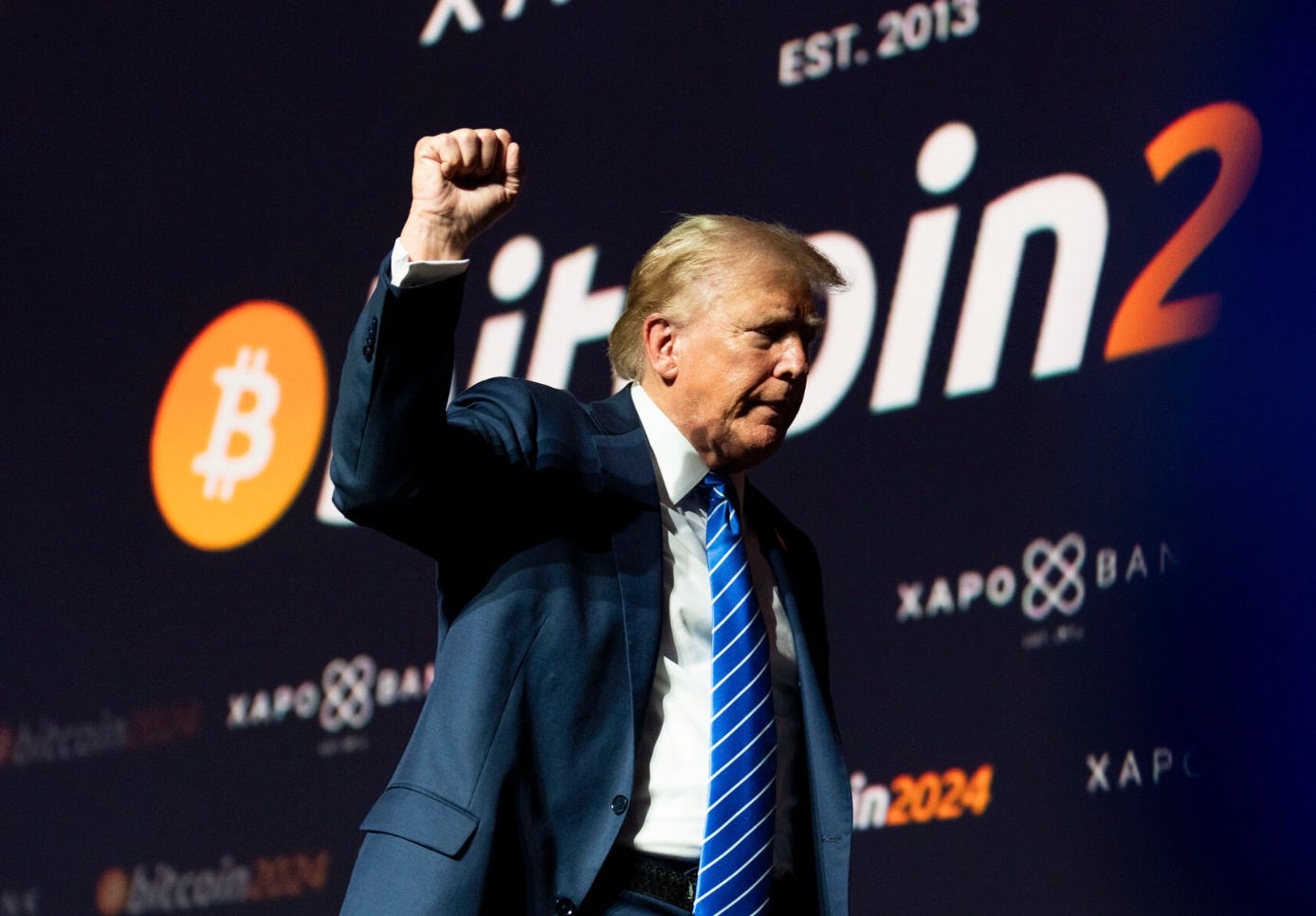
Almost everybody in the Bitcoin world is already going to be aware of the headlines former President Donald Trump made last night at the Bitcoin 2024 conference.
At Bitcoin 2024, Trump pledged that if re-elected, his administration would retain all federal Bitcoin holdings, establishing a “strategic national bitcoin stockpile.” He highlighted that the federal government currently possesses nearly 210,000 bitcoins, about 1% of the total supply, mostly seized from cybercriminals. Trump promised that his administration would never sell this Bitcoin, adhering to the fundamental Bitcoin principle of holding.
Additionally, he vowed to fire SEC Chair Gary Gensler on his first day in office, criticizing Gensler’s stringent regulations that many believe have hindered innovation in the crypto industry.
Anyway you slice it, last night was a flurry of positive Bitcoin-related headlines hitting the wire as soon as Trump took the stage and began speaking to the crowd of crypto enthusiasts. The idea of bitcoin as a reserve asset has always been the holy grail for maximalists and Trump’s speech sent the idea of a bitcoin “standard” to supersonic speeds.
And while there’s been plenty of speculation online about Trump’s motives, with some saying he’s simply fishing for votes from wherever he can get them, it doesn’t matter at this point: the game theory snowball of a Bitcoin “standard” has officially started rolling down the hill.
Photo: New York Times
This pro-Bitcoin psychology and reserve asset game theory, and what it could do for the world of Bitcoin regardless of whether or not Trump is elected, cannot be understated.
The Bitcoin community has now, for the first time, seen a former and potential US president endorse the cryptocurrency as a strategic reserve asset for the country. This is multiple times more consequential than Wall Street listing Bitcoin ETFs, in my opinion, because it accelerates Bitcoin’s adoption regardless of whether or not Trump is elected our next president. The idea that the United States could potentially make Bitcoin part of a monetary standard has officially been launched into the orbit of the country’s economic zeitgeist.
For comparison, when I started to warm up to the idea of Bitcoin about 6 months ago, I speculated that Middle Eastern money would be the next, after El Salvador, to put Bitcoin on a sovereign balance sheet. From there, I speculated such a move could unleash a tsunami of game theory, with multiple other countries scrambling to catch up across the world, not unlike the way Democrats — the party of Elizabeth “Ban Crypto” Warren — are now scrambling to play catch-up and modify their position stance on crypto.
Too late, losers.
If you would have told me months ago that one of the two major United States presidential candidates and a former president would be the first to assure the world they would place Bitcoin on the sovereign balance sheet of the most powerful nation in the world, I would have been assured the rest of the world would follow.
That is exactly the case that is unfolding.
And, by removing the red tape in the world of Bitcoin, not only would the Trump administration send adoption of the asset to stratospheric levels, it would also be the first tacit public acknowledgment that the fiscal crisis unfolding in the United States is not sustainable and must be dealt with via means other than printing dollars.
🔥 50% OFF FOR LIFE: Zero Hedge readers take 50% off a Fringe Finance annual subscription for life by using this link: ZH50
In other words, holding a bitcoin reserve would represent an attempt at a strategic move to sound money, regardless of whether or not Bitcoin itself stands the test of time.
Yesterday not only marked a momentous occasion for Bitcoin, it marked a momentous occasion for everybody on the Austrian side of the economic aisle who has been waiting for a politician to begin to make serious concessions that the fiscal trajectory the country and the dollar are on is not sustainable. It was a limited hangout of sorts – a passive admission that eventually, the country is going to need a solution to its monetary problem that is outside the Keynesian pattern of simply printing more fiat.
And so even if you are first and foremost an advocate for gold or silver, like I am, it’s easy to see last night’s comments by President Trump as not just a victory for Bitcoin but a victory for economic common sense.
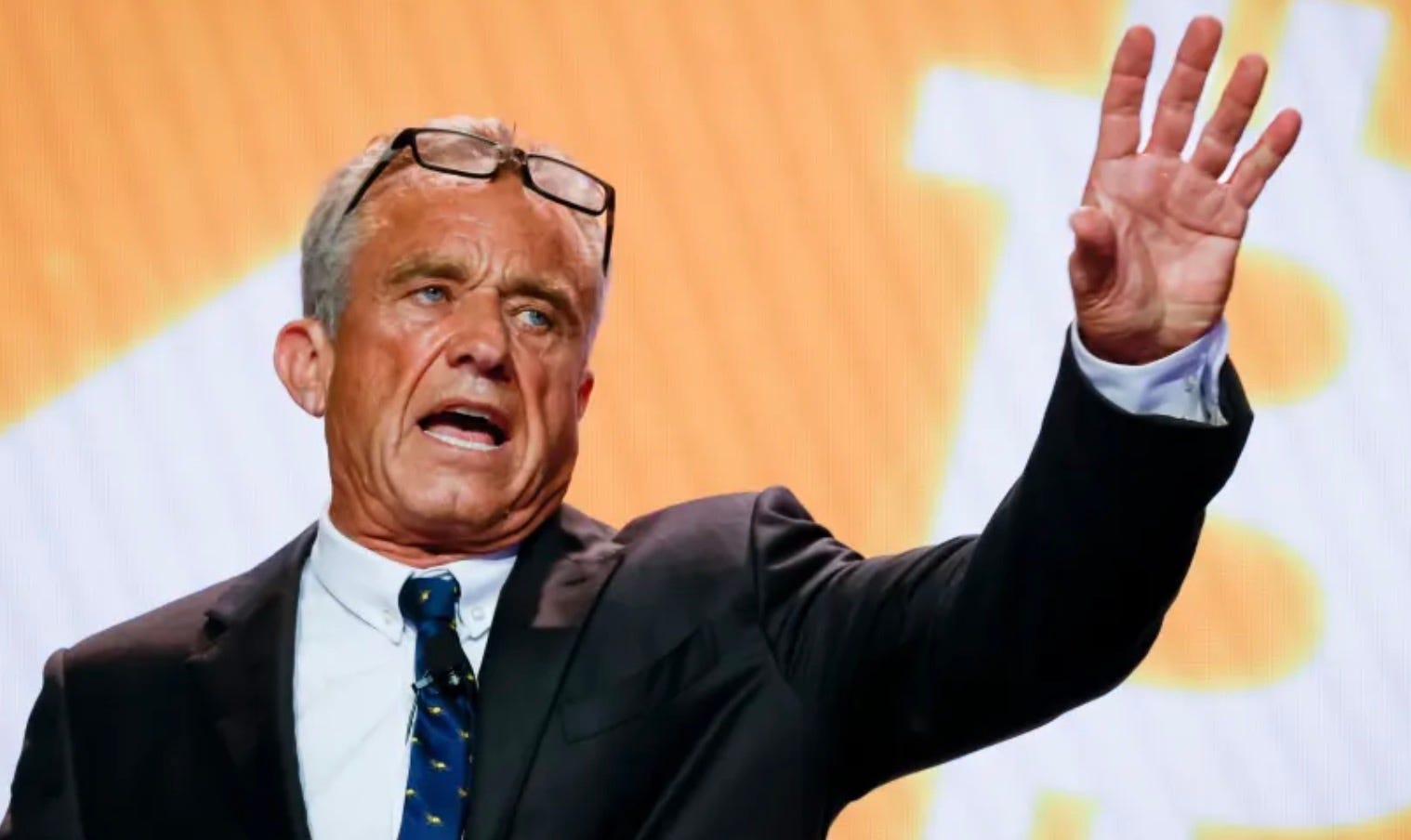
Just think about this: two major presidential candidates in the United States, both Donald Trump and Robert F. Kennedy, have now publicly come out and supported Bitcoin. That, in and of itself, is enormous.
Even more consequential is the fact that the pro-regulation Orwellian juggernaut known as the Democratic Party, which can never seem to have enough oversight or control on how people live their lives, including saving and spending their money, has begun to realize they are fighting a losing battle.
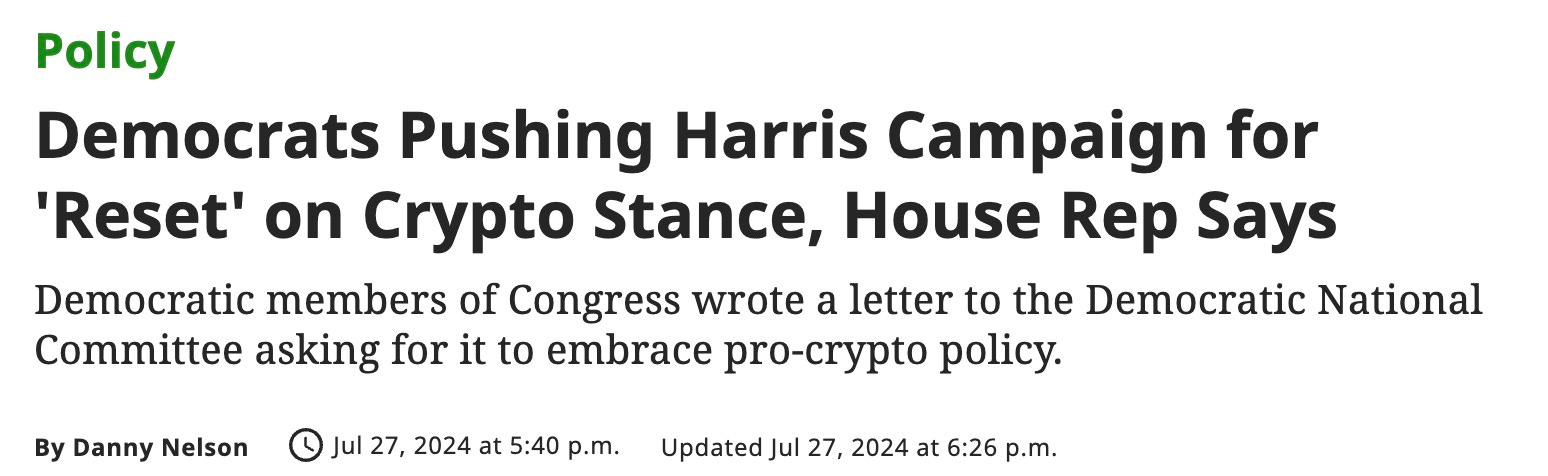
This was evident last night when headlines started to cross the wire around the time of Trump’s speech that multiple Democrats were urging Kamala Harris to walk back her stance on being anti-crypto. This is a monstrous pivot, especially given that party cornerstone Senator Elizabeth Warren has been the most outspoken critic of crypto over the last few years. The pivot is too little too late in my opinion — Democrats are already playing second fiddle with crypto adoption.
In other words, the oft-touted adage that “you don’t change Bitcoin, Bitcoin changes you” seems to have once again rung true. History appears to have shown that eventually, people fall in line behind Bitcoin as long as it remains what the people want. Trump’s foresight to be first to figure out that it’s not worth fighting crypto advocates, but rather joining them, could wind up being one of the most consequential decisions that will determine the outcome of the 2024 election.
What’s a better argument for a populist campaign than offering populist ways to save, store and preserve your wealth?
As I wrote earlier this year in my first article about Bitcoin, Bitcoin will work if the people decide they want it to. It’s one of the few instruments that I’ve seen over the years capable of returning some power to the people in the world of economics. And despite Harris flip-flopping and scrambling to right her position on the issue, not unlike what she is doing with issues like banning fracking, having the freedom to choose how you want to store your wealth – even if it turns out to not be effective – is congruent with freedom and personal liberty. And freedom and personal liberty are far more aligned with the Republican party right now than the party that advocated for us to wear masks while outside at the beach, three years into Covid.
If Trump was smart, he would continue tapping into the independent and libertarian base in the country by announcing that, if elected, he would make RFK Jr. his Bitcoin czar. In my exclusive interview with RFK, Jr. several weeks ago, he told me he was exploring ideas similar to Trump’s:
“One of the issues that we’re toying with now is a Treasury bill that is based at least partially—maybe starting at one percent and increasing it—on a hard currency. On base currencies, like maybe a basket of currencies that include platinum, gold, silver, and Bitcoin. You know, my uncle tried to do something like this just before he died with the silver certificate and the gold certificate, to give Americans a hedge against inflation.
“And there are lots of ways we can do that. We’re talking about making, for example, Bitcoin available and stopping the war against Bitcoin so that middle-class people, working-class people who want to hedge against inflation can do that. They don’t have to rely on fiat currency.”
“And that will insert a discipline into the printing of money. If Americans have a choice, it will inject a discipline into the printing of money that we do not have right now.”
Perhaps Trump could also take on Michael Saylor as an advisor. Saylor said to me in my exclusive interview with him that Bitcoin adoption would be inevitable due to “the inefficiency of central government or central banking planners”. He appears to be right so far: the people are driving Trump toward Bitcoin, not the other way around, and when the people want something, elected officials have no choice to but to conspire to make it happen.
And so while the price of Bitcoin dipped last night after Trump’s speech, this was likely only a classic “sell the news” event after a week leading up to Trump’s speech where people were bidding up the price.
The launch of Bitcoin ETFs this year was a major shot in the arm for the adoption of the digital asset and one of the reasons I began to strongly reconsider my position on Bitcoin. As sad as it is, if Wall Street gets behind an idea, it has a way of finding adoption, even if it eventually also peters out or collapses in value down the road.
Similarly, when the United States as a country gets behind an idea, it also has a way of creating aftershocks worldwide. My contention is that if Bitcoin makes it for the long haul, the world could potentially look back at Trump’s comments this weekend as an inflection point in American history, American monetary policy and potentially the day even more doubt in Bitcoin’s long-term sustainability died.
—
As a quick disclaimer and reminder, I still believe there is significant risk in owning Bitcoin. Bitcoin is an unprecedented monetary experiment and it is extraordinarily volatile. I keep only a portion of my net worth that I am OK with losing in Bitcoin and consider the bet to be speculative in nature.
Personally, I perfer apps like Swan for buying Bitcoin on a recurring basis, which, in my opinion, is important to help alleviate the volatile swings in the asset. Anyone that wishes to use my referral link at Swan will get $10 in free Bitcoin to start.
QTR’s Disclaimer:Please read my full legal disclaimer on my About page here. This post represents my opinions only.In addition, please understand I am an idiot and often get things wrong and lose money. I may own or transact in any names mentioned in this piece at any time without warning. Contributor posts and aggregated posts have been hand selected by me, have not been fact checked and are the opinions of their authors. They are either submitted to QTR by their author, reprinted under a Creative Commons license with my best effort to uphold what the license asks, or with the permission of the author. This is not a recommendation to buy or sell any stocks or securities, just my opinions. I often lose money on positions I trade/invest in. I may add any name mentioned in this article and sell any name mentioned in this piece at any time, without further warning. None of this is a solicitation to buy or sell securities. These positions can change immediately as soon as I publish this, with or without notice and at any point I can be long, short or neutral on any position. You are on your own. Do not make decisions based on my blog. I exist on the fringe. The publisher does not guarantee the accuracy or completeness of the information provided in this page. These are not the opinions of any of my employers, partners, or associates. I did my best to be honest about my disclosures but can’t guarantee I am right; I write these posts after a couple beers sometimes. I edit after my posts are published because I’m impatient and lazy, so if you see a typo, check back in a half hour. Also, I just straight up get shit wrong a lot. I mention it twice because it’s that important.
French Bishops Blast Olympic “Mockery Of Christianity” While MSM Hails “Unprecedented Display Of Inclusivity”
The French Bishops’ Conference of the Catholic Church has blasted the Olympic Games’ opening ceremony for its excesses and provocations which sought to make a mockery of Christianity.
The French bishops expressed their thoughts “to Christians worldwide who were hurt by the excess, and provocation of certain scenes.” As we detailed previously, it included at least ten men in drag performing a reenactment of Leonardo da Vinci’s “The Last Supper” – along with many other sexualized scenes that included a man with his testicles exposed and hanging out of his outfit.
“The opening ceremony… included scenes of derision and mockery of Christianity, which we deeply deplore,” the statement continued.
“We think of all Christians worldwide who were hurt by the excess and provocation of certain scenes,” the French bishops continued. “We hope they understand that the Olympic celebration extends far beyond the ideological biases of a few artists.”
Still, The Associated Press and other mainstream outlets hailed the segment as an “unprecedented display of inclusivity” despite an overwhelmingly negative reaction which come even from secular quarters.
Several X accounts that posted videos and/or screenshots about the absurdities of the Olympics’ opening ceremonies have been hit with Digital Millennium Copyright Act (DMCA) complaints. Additionally the Opening Ceremony highlights has been removed from the Olympics’ official YouTube page, as we detailed earlier.
Even elements of the European Left condemned it, including far-left French politician Jean-Luc Mélenchon.
* * *
The following is a translation of and commentary on Mélenchon’s words by Arnaud Bertrand…
Mélenchon on the Olympics opening ceremony, which really goes to show that the criticisms of it aren’t “far-right” as many are arguing, they’re just common sense:
“I didn’t appreciate the mockery of the Christian Last Supper, the final meal of Christ and his disciples, which is foundational to Sunday worship. Of course, I’m not getting into the criticism of ‘blasphemy.’ That doesn’t concern everyone.
But I ask: what’s the point of risking offending believers? Even when one is anticlerical! We were speaking to the world that evening. Among the billion Christians in the world, how many good and honest people are there for whom faith provides help in living and knowing how to participate in everyone’s life, without bothering anyone?”
It’s the exact same point I was making yesterday: the whole point of the Olympics is to bring the world together, and this was perhaps the most needlessly divisive opening ceremony in history, because so shocking and tasteless to so many.
🇫🇷 FLASH | Jean-Luc Mélenchon à propos de la cérémonie d’ouverture des JO de #Paris2024:
« Je n’ai pas aimé la moquerie sur la Cène chrétienne, dernier repas du Christ et de ses disciples, fondatrice du culte dominical. Je n’entre pas bien sûr dans la critique du « blasphème ».… pic.twitter.com/ERbJ8U5SJK
It spoke to an extremely tiny group of people. I actually think many even in the LGBT community found it completely ridiculous. Being secular doesn’t mean hating on religion. It means a separation of state and religion but it doesn’t imply insult of religion and their believers… In fact many profoundly secular states ban insults to religion…
I admit that France does have a history of being irreverent to religion, but it is unwise to sacralize this as a core part of our identity as this show attempted to do, especially in the context of an event meant to bring the world together. These types of provocations belong in fringe publications like Charlie-Hebdo, not a ceremony like this.
“Adult Swim”: Four Reasons Why We Have Not Seen The Summer Lows Yet…
By Peter Tchir of Academy Securities
Baby Pool Closed for “Maintenance”
Anyone who ever got that notice from a town or community pool knows exactly what happened. It feels like some of that has gone on in our markets of late, ensuring that this is an “adult swim.” For those who have had their vacations disrupted or are about to experience that as market volatility continues, we feel your pain!
The Nasdaq 100 has had some wild swings, and the S&P 500 broke a long string of trading days without dropping 2%. Stocks ended the week strong on Friday and we got to continue to examine de-grossing, rotations, and de-risking. Last weekend we delved into these subjects in Know When to Fold ‘Em and we refined our views on Thursday morning in A Lot Going On.
Here we are, once again attempting to navigate through what is likely going to be another “interesting” week to say the least. But, before diving into the week ahead, we saw lots of evidence of rotation/de-grossing:
The Nasdaq 100 was down 2.6% while the Russell 2000 gained 3.5%.
The S&P 500 was down 0.8% while the equal weight version was up 0.8%.
Energy, which we like as our favorite hedge against geopolitical risk, was mixed (XLE was down a smidge, while OIH was up 1.6%).
The 2s vs 10s spread on the Treasury side of things got as low as -14 and ended the week less inverted than when it started. For now, we will put this on the rotation/de-grossing side of the ledger and expect it to continue.
Questions remain about how much de-risking has occurred?
Sure, QQQ has had some outflows of late, but it actually had inflows last week, while IWM (Russell 2000 ETF) had another week of strong inflows – which feels more like a rotation than de-risking.
When I look at the “frothier” end of things, I see little evidence of de-risking. TQQQ (a triple leveraged Nasdaq 100 ETF) had inflows, and SQQQ (3x inverse Nasdaq 100) had outflows. That looks like risk is being added. Similarly, NVDL (1.5x NVDA) had inflows. NVDS (-1.5x NVDA) had outflows, but it is tiny. I truly don’t understand the need for single stock ETFs (call me old fashioned), but those flows give some sense of the underlying tone out there. While I don’t understand why they exist, NVDL at $4.2 billion of AUM with an expense ratio of 1.15% is on a roughly $50,000,000 annual fee run-rate, which is pretty darn impressive for the creators!
What really “seals the deal” for me on my view that we are not done de-risking (but likely will be) is the view of the Fed.
We’ve gone from being “out there” for saying that the Fed should cut in July, to being a more or less consensus view that the Fed should be cutting, but won’t cut until September.
According to Bloomberg’s WIRP function, based on futures contracts, the market is now pricing in 1.13 cuts at the September meeting and 3.4 cuts by the end of the January meeting. We’ve been in the camp that the Fed is late to the easing cycle, the real rates are too high, the economy is slowing, and inflation pressures have abated, but the market may be getting ahead of itself again. The current pricing is just a bit more aggressive than our view (from having been more conservative), which leads us to wonder if the Fed isn’t already priced in? Or, and this is becoming our base case, the Fed will have to ease at this pace or faster, only because economic conditions won’t support anything resembling tight monetary policy.
With a lack of fear (even VIX has scaled back), some aggressive fund flows, and conviction that the Fed is going to announce the start of rate cuts driving this market, there still seems to be far more downside risk than upside risk.
Maybe the weakest hands have played out their de-grossing strategy and the rotation that remains (which still makes sense to us) will happen in an “overall rising” market. The data could support that.
We have four reasons to expect that we have not seen the summer lows yet:
1. The Fed is fully priced in.
2. The jobs data this week will be extremely disappointing. But not so disappointing that the Fed can pivot to “full-on dovish” given the Fed’s fears of an inflation resurgence. The pendulum swinging from no landing, to soft landing, to a possible bumpy landing could be the catalyst for more downside risk, especially since the Fed will likely feel the need to be restrained for the coming months.
3. Earning and AI. There is no longer an automatic 5% pop in your stock price just for saying “AI” on your earnings call (I’m being facetious, but….). What is the cost of AI? The price to implement AI has soared. How good is the AI you are getting? The best analogy, that I have heard on many fronts, is that the “large language models” are like reading a really good newspaper or magazine. The articles on subjects that you know little about make a lot of sense. However, you find a lot of issues with the articles about your area of expertise. Yes, LLMs are only one part of AI. Even in that subset, there are different ones, and some have very specific training to overcome that rather generic analogy of reading articles. Will today’s models (or more accurately, the perception of what the cost benefit analysis will yield in a couple years) be able to justify today’s current valuations? Given positioning and some of what we have seen in some recent earnings, that might prove difficult and be a catalyst for de-risking.
4. Politics and Geopolitical Risks.
Political first. There is a real risk that as both parties start campaigning on their policies, the market will get nervous about where we are headed on the deficit and inflation. How we get the bigger deficit and inflation risks posed by each parties’ policies will be different, but I think the risks are similar and currently not being priced in. This is why we expect to see less inversion and even “normal” yield curves as term premium gets put back into the market.
Geopolitical. On Thursday we published a SITREP as Chinese AND Russian Bombers were Intercepted Off the Alaskan Coast. While intercepting bombers is “normal,” this was the first time (that we are aware of) that planes from these two countries took off from the same base and operated together near North America.
This comes on the heels of our monthly Around the World piece, published on Wednesday. It is longer than usual, as there is so much going on. The Geopolitical Intelligence Group provides an updated assessment on the War in Gaza and the risk of escalation with Hezbollah. Next, it addresses what might change and what is likely to remain the same following Iran’s election of a reformist president. Next, it identifies how Russia is enhancing its partnerships to support its war in Ukraine and some problems that are coming up in discussions about what any sort of peace might look like. Finally, we address the Increased Tensions with China in the South China Sea! While for most people, Taiwan is the main area of concern, but there is also an increased concern about China’s intentions regarding some “disputed” reefs with the Philippines. “Disputed” is in quotes, as the international courts have ruled in favor of the Philippines, so away from China’s view, there is little to dispute.
This seems like a good time to update our Geopolitical Risk vs Perception Heatmap, last published in June.
While the events of July 19th were not CYBER related, we have inched up the risk of a real cyber threat.
We’ve reduced the risk of a trade war as it seems that China is content to wait until after the election to respond to our most recent round of tariffs against them. While the real risk is reduced, the perception of risk has declined almost as fast, leaving this as a potential problem for markets.
While nothing has specifically happened with Russia, current signals, messages, and chatter warrant increasing the risk of some activity on their part, which helps support commodities.
Far and away is the risk of some “wildcard” event. The potential opportunities for a geopolitical event somewhere around the globe seem to be on the rise. We currently have a President who is not running for re-election, parties that seem as happy to attack and divide to win as they are to win on policies alone, and an entire media industry geared towards elections at the expense of reporting on the rest of the world. Maybe Russian and Chinese planes flying together near Alaska is all that we will get? Or maybe that is a snippet of our enemies/adversaries/competitors (take your pick) trying to analyze how much they can get away with?
Bottom Line
The Fed is not enough to “end the risk of de-risking.” The rotation trades should continue to work (though the move has already been quite extreme), but look for it to occur in a falling market. Look for some form of “not so good” landing to make its way back into the lexicon in the coming weeks.
Energy remains a favorite sector.
For banks (both KRE and KBE have been doing very well) the risk is that we get data indicating stretched consumers and unrealized problems in some segments of commercial real estate (such as office space in some specific cities). That could put some pressure on banks. The outlook is good, unless the data starts coming in worse than our already mildly bearish view, which isn’t our base case, but it seems more likely than surprising to the upside.
Credit. If we are correct and equities face more pressure, it will translate into some pressure on spreads, but nothing to be too concerned about as equities are far more about valuations in certain areas and positioning rather than overall economic concerns that would directly affect the creditworthiness of most borrowers. However, it would be helpful if the calendar slowed, giving everyone a little time to tuck away the recent issues. Finally, if we get a scenario that puts banks under any pressure (not our view, but something to think about for the first time in a while), that would impact credit spreads more materially.
The worst might be behind us in risk assets, but the view here is that we have more trouble to come and August, often a “trend-following month,” will follow the trend of choppiness and losses for stocks.
Good luck and for those of you who swim as poorly as I do, put on the water wings, because the adult swim is likely going to continue!
Meteorologists Watching New “Area Of Disturbed Weather” In Atlantic Basin After Lull In Activity
July has been a super quiet month in what has been expected to be a very active hurricane season, but that could all soon change with a new disturbance developing in the Atlantic Basin.
The National Hurricane Center reported a tropical development over the central tropical Atlantic Ocean. It is expected to interact with an approaching tropical wave early next week.
Here’s more from NHC’s latest report:
“Near the Leeward Islands and Greater Antilles: An area of disturbed weather over the central tropical Atlantic Ocean is expected to interact with an approaching tropical wave during the next several days. Environmental conditions are forecast to become conducive for some development in a day or two, and a tropical depression could form around midweek while the system is near or over the northern Leeward Islands, Greater Antilles, or the southwestern Atlantic Ocean.”
Formation odds:
Formation chance through 48 hours was low or near 0 percent.
Formation chance through 7 days was medium or 40 percent
Good Sunday morning! As we head through the rest of the week, we’ll be watching for the potential for a tropical depression to form near the Leeward Islands, Greater Antilles, or southwestern Atlantic.
— National Hurricane Center (@NHC_Atlantic) July 28, 2024
“Overnight 00z ensembles here on weathernerds. GFS still only has a few. EURO more aggressive and more east. Nothing expected to form until near the islands. NHC remains at 40% chance,” Mike’s Weather Page wrote on X.
— Mike’s Weather Page (@tropicalupdate) July 28, 2024
AccuWeather Lead Hurricane Expert Alex DaSilva noted that the hurricane season will soon be entering the point where more “systems take hold and organize into tropical depressions, storms, and even hurricanes under the right conditions.”
July brought a lull in tropical development, which will likely change as August quickly approaches. Plan those East Coast and Gulf Coast trips accordingly.