Iran Says Two Tankers Exploded In Hormuz Chokepoint As Ship Traffic Near Standstill
Visible maritime traffic through the Hormuz chokepoint remained subdued into the new week after Iranian forces allgedly targeted tankers attempting to transit the narrow waterway, including routes close to Oman. This comes as the US and Iran have been locked in a dangerous tit-for-tat escalation that has entered its ninth day.
UK maritime authorities reported an unverified vessel fire near Oman late Sunday. Reuters reports that Iran’s Revolutionary Guards claimed two crude oil tankers exploded and were immobilized while using what Tehran called an unsafe southern route in the Hormuz.
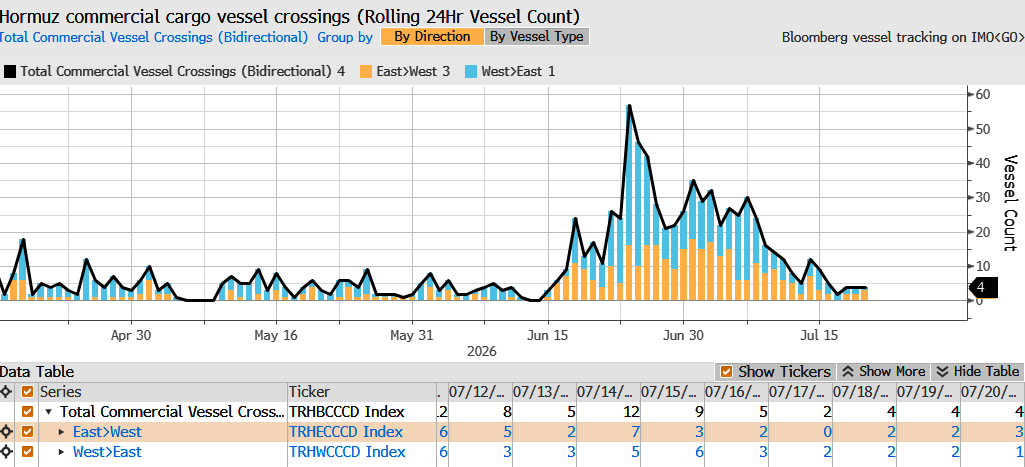
Bloomberg ship-tracking data shows that vessels crossing the Hormuz chokepoint have come to a near standstill as Gulf escalation has surged for the ninth day, with Iran targeting not just the maritime chokepoint but also US military assets at Jordan’s Aqaba airport with ballistic missiles, as well as US assets at Kuwait’s Al-Adiri camp and Ali Al Salem Air Base, and in Syria. Iran also hit civilian infrastructure, notably power generation and water desalination plants in Kuwait.
There is a power struggle for control over the critical strait. The US launched a series of airstrikes along the waterway to degrade Iran’s offensive capabilities.
US Central Command said overnight that it had begun “a new wave of strikes” aimed at “degrading” Iran’s ability to attack ships in the strait.
US Secretary of State Marco Rubio was quoted overnight by the outlet as saying that US forces would continue targeting Iran while it attacks global shipping lanes in the strait.
“The Strait of Hormuz are international waterways, and they continue to launch against the ships in that international waterway,” Rubio said.
He continued, “As long as Iran insists on controlling an international waterway, we’re gonna have to respond to that. The United States always remains open to a diplomatic solution.”
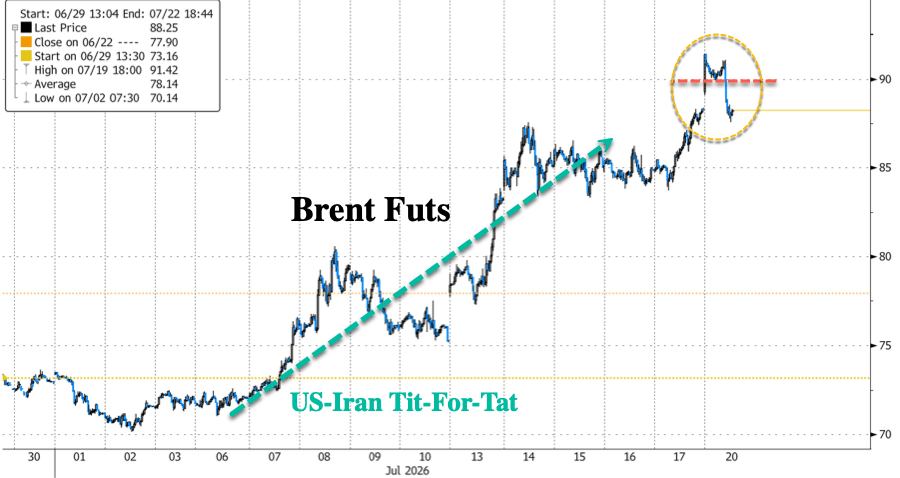
In markets, Brent crude futures are flat this morning around 06:30 ET. Brent trades around $88 a barrel, while WTI futures are around $82.
Brent briefly traded above the $90 handle for the first time since early June in the overnight hours but has since reversed the move.
“A near-term escalation in the Mideast now appears to be the key left tail risk which could tip the index lower. Broader infrastructure strikes or a Houthi-led Red Sea disruption likely sees Brent over $100 again,” UBS analyst Justinus Steinhorst noted, adding, “The desk’s preferred hedges are long Mideast Resilient {UBXEMERR} and E&Ps {UBXEXPO}.”
The lights went on at approximately 3pm on September 4, 1882 in New York City.
Thomas Edison (with major funding from JP Morgan) had spent roughly two years building the first-ever commercial power plant, located in Manhattan’s financial district. Its total capacity was about 600 kilowatts… barely enough to power a single rack of GPUs today.
But at the time it was nothing short of miraculous.
Edison’s coal-fired DC power plant initially served just 82 customers, and electricity was nothing more than a luxury flex by the ultra-wealthy.
But over time– especially after Westinghouse and Tesla’s alternating current became the gold standard– electrification rates in the United States skyrocketed.
At the turn of the 20th century, hardly anyone had electricity in their homes. By 1920, it was about 35%. By the time the Great Depression hit in 1929, roughly 70% of US homes were electrified, and urban areas were nearly 85%.
The systems were surprisingly reliable given the rudimentary technology of the day.
Blackouts were not infrequent, but they were generally short and localized, often just affecting a few streets or houses.
And typically the biggest reason for a short, localized blackout was simply because electrical demand was increasing more rapidly than the grid could create new supply. More and more homes were being electrified, and, after World War II, consumer appliances like refrigerators and air conditioners began consuming more power. We’ll come back to that.
In response, the industry began looking for efficiencies to be able to scale more quickly. They built larger, beefier power plants and connected their independent grids to be able to share reserves and load balance.
In short, they planned for speed and scale. Not resilience. And the end result was an incredibly complex network that was highly vulnerable to systemic failure.
That failure first came at 5:16pm on November 9, 1965: a minor maintenance issue near Niagara Falls triggered a chain reaction across the entire grid. 30 million people went without power– most until the next morning, some for a few days.
It was a wake-up call… and the first catastrophic grid failure of many more to come. So naturally the government stepped in to “fix” it.
With the electrical grid’s vulnerabilities laid bare, Congress held inquiries and hearings. New rules and regulations were passed. And, before long, the US electrical industry became a confusing alphabet soup of state, local, and federal authorities– ISOs and RTOs, FERC, PJM, MISO, CAISO, SPP, and so many more.
Layers and layers of bureaucratic agencies didn’t fix anything. But technology was quite fortunately on America’s side, and over the past few decades, advances (like LED bulbs) made consumer appliances more energy efficient. Power plants also became more productive.
In fact, today the US consumes less electricity per capita than it did in 1995. And the grid produces much more power.
But this balance is starting to change rapidly.
We all know the story of data centers and their insatiable appetites for energy. Electricity is such a critical input, in fact, that data centers are typically described by their power consumption.
For example, Softbank recently announced 5GW of new data centers in France. The famous StarGate project in the US is targeting 10GW. Facebook is building a 5GW data center in Louisiana.
And various plans over the next few years go in to several hundred gigawatts.
This trend is similar to the 1950s– utility companies struggled to keep up with surging demand from US consumers who were plugging in air conditioners and refrigerators for the first time.
But supply and demand in the electricity market is a funny thing. Demand can surge very quickly… just like we’ve seen over the past year or so. But electrical supply grows more slowly.
New power plants take years to build. Thanks to the aforementioned alphabet soup, the regulatory burden alone is a minefield.
And most electrical producers aren’t willing to go through the effort, risk, and capital expenditure unless they’re sure the new power plant will be profitable. And profitability depends on the price of electricity.
That’s where politicians and the regulators have stepped in to screw it all up.
Naturally, with demand soaring and supply constrained, electricity prices are rising. You’d think that politicians would respond by making it easier for utilities to build new power plants, i.e. reduce the regulatory and permitting process to increase electricity supply.
But no. Instead, they’re capping prices.
Last year, a whole lot of state officials and federal regulators got together to set a ceiling for certain wholesale electricity prices to roughly $333 per megawatt-day.
Clearly, they’re responding to voters’ demands to rein in inflation and reduce the cost of living.
Unfortunately, $333/MW-day isn’t high enough to justify investment in new power plants.
Existing power plants are old. Sometimes extremely old. They already own their land, and their construction loans are all paid off. So $333/MW-day is sufficient for them to pay for fuel, conduct maintenance, and turn a small profit.
But $333 isn’t enough to build a new plant– to cover the additional costs of construction, land purchases, permitting, etc.
In fact, the regulators themselves estimate that electricity prices need to be about $500/MW-day (i.e. 50% higher) to justify investment in new power plants.
This means there won’t be enough new commercial power plants built to sufficiently supply the grid. In fact the northeast grid (known as PJM) is already in a 6.5 GW deficit against its own reserve requirement for the first time ever, increasing the chance of failure next summer.
This is essentially a form of shrinkflation. i.e. paying the same amount of money but getting less for it. We’ve all seen it at grocery stores and restaurants– same price, smaller portions.
In this case, electricity prices are supposedly remaining flat. But you’re getting less for it– potential grid failure.
All because the maze of political and regulatory authorities won’t do the obvious thing and make it easy for new power plants to be built.
Western Nuclear Industry Bounces Back With Progress Across Small And Large Designs
After last month’s report from Goldman Sachs on the ongoing global nuclear renaissance listed only a couple headlines for the western nuclear industry, June saw a significant bounce back as the industry saw progress across the microreactor landscape and the larger SMR and national grid-scale designs.
The Micro Reactor Industry saw a huge achievement with the exceeding of the goals set by President Trump in the 2025 Executive Orders, with four microreactor designs obtaining criticality by July 4th.
The AP1000 reactor, which is emerging as America’s flagship grid-scale design, also saw significant multi-billion-dollar support from the Department of Energy when the Office of Energy Dominance Financing put up a potential $17.5 billion in funding for long-lead components and other pieces/parts of the reactor supply chain.
Goldman Sachs analyst Brian Lee reviews headlines across the nuclear industry for June.
New reactor progress and announcements
North America
6/2/26 – United States – The New York Power Authority has launched a solicitation to develop at least 1 GW of advanced nuclear capacity in Upstate New York, seeking proposals for both large reactors and SMRs, while also committing $40 million to nuclear workforce development.
6/8/2026 – United States – FERC approved Constellation’s request to transfer 760 MW of interconnection rights to the Crane Clean Energy Center, helping support the planned restart of the former Three Mile Island Unit 1 and improving its ability to deliver power to the grid ahead of major transmission upgrades.
6/9/2026 – Canada – Bruce Power’s refurbished Bruce 3 reactor has returned to service in Canada, more than seven months ahead of schedule, following a major component replacement project that extends the unit’s operating life by over 30 years.
6/16/2026 – United States – The US NRC has approved an 80‑year operating life for the two reactors at Georgia Power’s Edwin I. Hatch nuclear plant, extending operations into the mid‑2050s. The licence renewal follows a review completed in under 12 months and supports the continued operation of one of Georgia’s key nuclear generating assets.
6/23/2026 – Canada – Canada has unveiled a national strategy that positions nuclear energy as a key part of its future energy mix, supporting the deployment of new large-scale reactors, SMRs, and an expanded domestic nuclear supply chain.
6/24/2026 – Canada – AtkinsRéalis has formally begun the US licensing process for its CANDU reactor technology, submitting a Notice of Intent to the NRC and marking the start of pre‑application engagement. The move supports potential deployment of the 700+ MW Enhanced CANDU 6 reactor in the US.
6/24/2026 – United States – The US DOE has conditionally committed up to $17.5bn in loans to support procurement of long‑lead components for up to 10 Westinghouse AP1000 reactors, aiming to accelerate reactor deployment and strengthen the domestic nuclear supply chain.
Europe
6/16/2026 – Sweden – Nordic Baseload Power has applied for Swedish state support to build two large-scale reactors (~2.5 GW) at the former Barsebäck nuclear site, marking the fourth application under Sweden’s new nuclear support programme.
6/29/2026 – Germany – A group of former German nuclear plant managers and experts has urged the government to restart Germany’s nuclear power plants, arguing that reactivation is technically feasible and could improve energy security and electricity affordability.
6/30/2026 – Slovakia – Fuel loading has begun at Slovakia’s Mochovce 4 reactor, marking the start of active commissioning for the country’s fourth nuclear unit. The unit has now entered the testing and startup phase ahead of commercial operation.
7/8/2026 – Czech – The Czech Ministry of Industry and Trade said the Dukovany new‑build project remains on schedule one year after contracts were signed with KHNP, with geotechnical surveys completed, the first conceptual design submitted, and key Czech suppliers selected. The project is currently focused on licensing, permitting, and infrastructure work ahead of a targeted 2029 construction start.
7/9/2026 – UK – The UK government and EDF have agreed terms to extend the operating life of the Sizewell B nuclear plant by 20 years to 2055, with EDF committing £800 million of refurbishment investments to support long‑term operation.
Asia and other
6/5/2026 – Japan – Japan has proposed replacing aging nuclear reactors to maintain its nuclear generation capacity, with the government targeting the replacement of up to 14 reactors by the 2050s as older units retire.
6/10/2026 – Russia – Russia is targeting a 2027 construction start for the BN‑1200 fast reactor at Beloyarsk, with site preparation under way and licensing expected in 2027. The project is currently targeted for completion in 2034.
6/19/2026 – India – India’s Tarapur Units 1 and 2, the world’s oldest operating nuclear reactors, have returned to the grid following extensive modernization and refurbishment. The two units, which had been offline since 2020, received major safety upgrades and regulatory approval to resume operation.
7/6/2026 – China – Taipingling Unit 2 has been connected to China’s grid for the first time, marking a key commissioning milestone for the 1,116 MWe Hualong One reactor. The unit is the second of six planned reactors at the Guangdong site and is expected to enter commercial operation in 2H26.
7/13/2026 – China – Changjiang Unit 3 has achieved first criticality, marking the startup of the 1,100 MWe Hualong One reactor at the Changjiang nuclear plant in China’s Hainan province. The unit has now entered the commissioning phase ahead of grid connection and commercial operation.
SMR announcement tracker
6/3/2026 – UK – X‑energy has submitted its Xe‑100 high‑temperature gas‑cooled reactor for the UK’s GDA process, marking the start of formal regulatory review. The submission supports X‑energy and Centrica’s plans to develop up to 6 GW of new nuclear capacity in the country.
6/4/2026 – United States – US SMR developers announced a series of partnerships to advance reactor deployment, including Day & Zimmermann supporting pre‑construction and above‑ground construction for Deep Fission’s Gravity reactor, while Sciaky will manufacture components for NX Atomics’ SMR platform using additive manufacturing technology.
6/5/2026 – Sweden – Blykalla has applied for Swedish government financing for its planned six‑reactor SEALER SMR plant in Norrsundet, the first advanced nuclear project submitted under Sweden’s new nuclear support framework. The proposed plant would have up to 330 MWe of capacity and could enter operation in the early 2030s, subject to approvals and investment decisions.
6/5/2026 – Uzbekistan – Uzbekistan has marked the start of construction of its first SMR, with a ceremony for first concrete at the Jizzakh nuclear project. The project features Russia’s RITM‑200N reactor technology and represents a key milestone in Uzbekistan’s nuclear power programme.
6/5/2026 – United States – Antares Nuclear’s Mark‑0 microreactor has achieved first criticality at Idaho National Laboratory, becoming the first reactor to reach this milestone under the US DOE’s Reactor Pilot Program. The demonstration validates the company’s microreactor technology and marks an important step toward future advanced reactor deployment.
6/9/2026 – Romania – DP World has launched a feasibility study into deploying SMRs at Romania’s Port of Constanța, evaluating whether nuclear power could support the port’s long‑term energy needs, growth, and decarbonisation goals.
6/11/2026 – United States – DOE has approved the PDSA for Oklo’s Aurora reactor at Idaho National Laboratory, a key regulatory milestone under the DOE’s Reactor Pilot Program. The approval advances the project toward deployment by validating the reactor’s preliminary safety basis.
6/12/2026 – Sweden – Studsvik has applied for Swedish state support to develop up to 1.4 GW of SMR capacity in southern Sweden, with potential projects at Nyköping and Valdemarsvik based on light‑water reactor technology. The company is targeting first operation in the second half of the 2030s.
6/15/2026 – Sweden – Videberg Kraft has selected Rolls‑Royce SMR technology for its planned nuclear project on Sweden’s Värö Peninsula, with plans to deploy three SMRs. The project would be Sweden’s first new nuclear power plant in more than 40 years, with the first unit targeted for the mid‑2030s.
6/17/2026 – UK – Core Power has launched a feasibility study to assess BWXT’s mPower SMR for use in floating nuclear power plants, evaluating the technical, regulatory, and commercial viability of deploying the 195 MWe reactor in shipyard-built floating power platforms.
6/17/2026 – UK – TerraPower’s Natrium reactor has entered the UK’s GDA process, marking the start of formal regulatory review for the 345 MWe sodium‑cooled fast reactor. The move advances TerraPower’s plans for potential deployment in the UK and follows the company’s submission to the UK regulators earlier this year.
6/19/2026 – United States – Elementl Power has selected GE Vernova Hitachi’s BWRX‑300 SMR technology for a proposed 1.5GW nuclear project in Ohio, with plans for up to five reactors at a site. The company has already filed for grid interconnection and is targeting construction in 2030 and completion of the first unit in 2034.
6/22/2026 – United States – Valar Atomics’ Ward 250 microreactor has achieved criticality under the US DOE’s Reactor Pilot Program, becoming the second reactor to meet the programme’s July 2026 target. The 5 MW TRISO‑fuelled, helium‑cooled reactor completed a zero‑power criticality demonstration at the Utah San Rafael Energy Lab.
6/24/2026 – UK – Holtec and EDF have submitted a proposal to deploy up to four SMR‑300 reactors at the former Cottam power station site in the UK. The companies have also agreed to form a joint venture to advance the project, which would repurpose the former coal plant site for new nuclear generation.
6/29/2026 – Sweden – Blykalla and Hitachi Energy have signed an MoU to support deployment of Blykalla’s lead‑cooled SEALER SMRs, combining reactor technology with Hitachi’s expertise in electrification, grid integration, and digital energy systems.
6/30/2026 – Poland – Orlen Synthos Green Energy has applied for a Contract for Difference to support the construction of 14 BWRX‑300 SMRs across three sites in Poland, marking a key financing milestone for its SMR programme.
7/2/2026 – UK – SGE and a consortium including Samsung C&T, Laing O’Rourke, Aecon and Google Cloud have proposed deploying 14 GE Hitachi BWRX‑300 SMRs across three UK sites, representing 4.2 GW of capacity. The privately financed project targets first commercial operation in 2034, with the initial site planned to host six reactors and two additional sites hosting four reactors each.
7/2/2026 – United States – Deployable Energy’s Unity demonstration reactor has achieved initial criticality at Idaho National Laboratory, becoming the third US microreactor to reach the milestone ahead of the DOE’s 4 July target.
7/3/2026 – Finland – Finland’s nuclear regulator has completed an international safety review of Steady Energy’s LDR‑50 SMR design, with regulators from the Czech Republic, Poland, Sweden, and Ukraine participating in the assessment. The review found no fundamental obstacles to further development of the reactor concept, while providing feedback to support future licensing work.
7/7/2026 – UK – Chiltern Vital Group and Cambridge Atomworks have signed a LoI to explore building the prototype Odin microreactor at the Berkeley Green Science and Technology Park in England. The project would support testing and regulatory development of the molten‑salt‑cooled microreactor, with Cambridge Atomworks targeting an operational prototype by 2030.
7/7/2026 – United States – Aalo Atomics’ Critical Test Reactor achieved initial criticality at Idaho National Laboratory, becoming the fourth US microreactor to reach the milestone by the DOE’s 4 July 2026 target.
7/8/2026 – United States – Deep Fission has received its prototype reactor canister at its Kansas pilot site, marking a key milestone for development of its Gravity reactor, which is designed to place a nuclear reactor in a borehole about a mile underground. The canister will be used in the company’s proof‑of‑concept program to validate installation, infrastructure, and deployment processes ahead of a future commercial demonstration.
7/8/2026 – USA, Japan & South Korea – The US, Japan, and South Korea have signed a trilateral agreement to accelerate SMR deployment in third countries, initially focusing on the Indo‑Pacific region. The framework aims to coordinate financing, supply chains, licensing, and industry partnerships to support fleet‑scale SMR deployment and expand access to nuclear energy.
7/10/2026 – United States – Argentina has announced plans for a privately financed 300 MWe ACR‑300 SMR at the Atucha site, with US‑based Meitner Energy planning to invest $1.2bn in the project. The reactor would be the first commercial ACR‑300 and the first nuclear reactor in Argentina financed entirely with private capital, marking a major investment in the country’s nuclear sector.
Global reactor critical updates
In the month of June, there have been few changes to new reactor construction starts, grid connections, shutdowns, or restarts.
Global reactor construction tracker
Fuel announcements
6/1/2026 – United States – Cameco and Orano have agreed to acquire TEPCO’s remaining 5% stake in the Cigar Lake uranium mine, giving the two companies full ownership of the project. Following the transaction, Cameco’s stake will increase to 57.4% and Orano’s to 42.6%, further consolidating ownership of one of the world’s highest‑grade uranium mines.
6/2/2026 – United States – Urenco has announced a multi‑billion‑dollar investment to build a new uranium enrichment plant at its New Mexico site, adding 2.1 million SWU of capacity and increasing output by nearly 50%. Construction is planned to begin in 2029, with first production targeted for 2032, supporting US nuclear fuel supply as reactor deployment grows.
6/8/2026 – Mongolia – Orano has started construction of the Zuuvch Ovoo uranium project in Mongolia, following a 2025 investment agreement with the Mongolian government. The project is expected to produce ~2,500 tonnes of uranium per year over a 30‑year mine life.
6/9/2026 – India – Fuel for the initial loading of Kudankulam Unit 4 has been manufactured and accepted by NPCIL, marking a key milestone toward commissioning of the VVER‑1000 reactor.
6/9/2026 – Australia – Ampera will use thorium sourced from Australia to fuel its advanced microreactor systems, supporting its strategy to vertically integrate fuel supply and in‑house TRISO fuel production.
6/12/2026 – Canada – Denison Mines has marked the start of site preparation and early construction at the Phoenix ISR uranium project in Saskatchewan, following final regulatory approvals and a positive investment decision. The project is targeting first uranium production in mid‑2028.
6/17/2026 – UK – The UK will guarantee a £210 million loan to support Urenco’s supply of enriched uranium to Energoatom, helping secure fuel for Ukraine’s nuclear fleet over the next two years.
6/17/2026 – Sweden – Sweden’s parliament has approved amendments to nuclear legislation that streamline permitting for uranium mining and open up more coastal locations for potential nuclear projects, further supporting the country’s plans to expand nuclear power and domestic fuel supply.
6/18/2026 – United States – Shine and Newcleo have agreed to collaborate on recycling used nuclear fuel, linking Shine’s fuel‑reprocessing technology with Newcleo’s reactors and MOX fuel capabilities to support a closed nuclear fuel cycle.
6/19/2026 – United States – Centrus has agreed to supply HALEU to Oklo for up to five Aurora reactors, with deliveries expected to begin in 2029 from its Ohio enrichment facility. The agreement strengthens fuel supply certainty for Oklo’s planned reactor deployments and is among the first large‑scale commercial HALEU supply agreements in the US.
6/24/2026 – Russia – Rosatom is studying the construction of a high‑capacity nuclear fuel reprocessing plant with an initial capacity of 400 tonnes per year, with investment and site selection decisions expected by the end of 2026.
6/25/2026 – United States – Lightbridge has removed the first batch of its irradiated fuel samples from Idaho National Laboratory’s Advanced Test Reactor, marking a key milestone in the testing of its advanced nuclear fuel technology. The samples will now undergo post‑irradiation examination to support fuel performance validation and future regulatory licensing efforts.
6/26/2026 – Italy – Italy’s Sogin has begun re‑encapsulating 64 uranium‑thorium fuel elements at the Rotondella site for long‑term dry storage, marking a key decommissioning milestone for the facility.
6/26/2026 – United States – US uranium production more than doubled in 2025 to 1.39mn lbs U3O8, the highest level in nine years, according to the EIA, also uranium exploration and development drilling reached their highest levels since 2013.
6/30/2026 – United States – Urenco USA has brought a fifth new enrichment cascade online at its New Mexico facility, as part of a program to add 700,000 SWU of capacity by early 2027. The expansion is progressing ahead of schedule and on budget.
7/1/2026 – United States – The US NRC has renewed the source materials licence for enCore Energy’s Dewey Burdock uranium project for another 20 years, completing the federal permitting process for the South Dakota ISR project. The company is now pursuing final state permits ahead of construction and future production.
7/3/2026 – United States – Radiant has delivered the first TRISO fuel shipment for testing of its Kaleidos microreactor at Idaho National Laboratory, enabling full‑power, full‑temperature testing this summer. The testing programme will support performance validation and help advance the reactor’s commercial licensing pathway.
7/9/2026 – India – Australia and India have finalized the arrangements needed to enable Australian uranium exports to India for peaceful civilian use under their long‑standing nuclear cooperation agreement. The deal opens a new uranium supply source for India and supports its plans to expand nuclear power generation.
7/9/2026 – Finland – Framatome has signed an eight‑year fuel supply agreement with TVO for Finland’s Olkiluoto 3 (OL3) reactor, strengthening long‑term fuel security for the plant. The deal also includes an option to adopt Framatome’s GAIA fuel design and supports longer operating cycles of up to two years at OL3.
Uranium pricing and volume trackers
Spot pricing remained broadly range-bound. Spot U3O8 prices softened through early June, easing from ~$86/lb to the mid‑$84s before recovering into the mid‑$85s through the middle of the month. Prices drifted modestly lower again toward month‑end, finishing June around ~$85/lb and remaining largely unchanged through early July. Market activity was subdued throughout the period, with trading volumes concentrated in a limited number of transactions and overall price movements remaining relatively narrow.
Term pricing firm. Term pricing strengthened through June, with the long‑term price increasing to $94/lb by end of June from $93/lb at the start of the month, reinforcing the view that longer term pricing remains well supported despite softer spot market activity. Market engagement continued across the term market, with utilities evaluating mid‑ and long‑term supply requirements and several new contracting opportunities emerging. Overall, longer‑dated price indicators remained resilient, with forward prices continuing to reflect supportive long‑term market fundamentals.
Over the past decade our political system has chewed through and spat out Prime Ministers at a faster rate than Premier League football teams burn through managers. As Andy Burnham enters 10 Downing Street, why would we think there is any reason he will do much better – in terms of longevity – than his immediate predecessors? I’m keeping my eyes peeled for a bookmaker offering odds on Burnham being removed from office before the next election rather than at it.
As the Labour Party slowly coalesced around a consensus that Starmer simply had to go there was an oft repeated refrain of, ‘We have to get this right first time if we are going to do it, we only have one chance.’
The theory here seems to be that ditching a leader – however unpopular – and finding a fresh one is not the sort of thing that the electorate approve of. They have passed their judgement at the ballot box and are usually unimpressed when the powers-that-be decide to second guess that decision.
More generally, ditching an incumbent leader against their will gives the impression of chaos and instability. It gives such an impression precisely because chaos and instability are typically what have brought about the decision to make a change.
The circumstances around removing a Prime Minister are always different but can be broadly batched into three categories – they are based on aesthetics, ideology or health. The last two are easier to explain to the public than the first. Margaret Thatcher was removed for ideological reasons – she was unwilling to retreat on the hugely unpopular poll tax and was also pursuing a European policy that a large chunk of her party disapproved of. On the basis of needing to wholly reset our approach to the EU, David Cameron jumped and Theresa May was pushed.
These sorts of switches of leader seem to have a fair chance of working. Indeed, each of Thatcher’s, Cameron’s and May’s successors went on to retain office at a General Election.
But changing Prime Minister just on the basis that the outgoing leader wasn’t very good and without a clear and explicit shift in an area of policy seems fraught with electoral danger. Callaghan and Brown went on to lose elections having entered office mid-term. Both had different approaches to their predecessor but there wasn’t a single, specific and explicable change in policy.
Similarly, the switch from Johnson to Truss and then swiftly onto Sunak didn’t appear to improve the standing of the Conservatives amongst the electorate. In fact, it probably worsened it.
Burnham finds himself in the same vague, messy scenario. He didn’t launch a coup against Starmer because he fundamentally disagrees with him on, say, the war in Iran or Net Zero or membership of the ECHR. Instead, it’s simply based on Labour’s abysmal poll ratings, Starmer’s catastrophic approval ratings and the hope that a fresh approach to ‘comms’ can somehow revive the party’s fortunes.
It’s early days (indeed, we are not yet even in the early days of a new administration as I write these words), but the evidence of recent polls suggests little or no Burnham bounce for Labour.
The governing party remains stubbornly stuck on only around 20% in the polls. If there was a wave of national enthusiasm – or even a noticeable trickle – about Burnham entering Downing Street, one would have expected some sort of uplift in the polls in anticipation of it happening. So far, nothing.
Burnham’s supporters will insist – or at least hope – that once we see their man in action as our actual PM the electorate will warm to him. He is certainly a more charismatic politician and a better communicator than Starmer, but I’m sceptical that this will meaningfully move the dial of public opinion.
If our new Prime Minister has a markedly different economic strategy to that of the last two years, I’ve yet to hear it (or at least I’m yet to understand what the various vague analyses and prescriptions put forward actually amount to).
He lamented a “series of wrong turns in the 1980s” – his teenage years – which, he believes, sent the country on the path to ruin.
“Political power was centralised and economic power was privatised,” he said in his coronation speech as Labour leader on Friday.
“The country surrendered control of the essentials, housing, water, energy, transport and left people exposed to higher costs.”
He lumps the Thatcher years and everything that followed, Tory or Labour, as “four decades of the neoliberalism that began in the 1980s [which] have not been kind to the places that built our party”.
His solution is “control” – more state ownership, more diktats from politicians.
All of this suggests to me that we are likely to continue on the pathway of taxes being dialled up, growth being low, debt increasing and public spending ballooning (particularly welfare spending). I suspect if there is any Burnham honeymoon at all, it will be very brief.
If this is so, what happens if in a year or so the Labour Parliamentary party is still staring down the barrel of electoral oblivion? Having decided to twist rather than stick when it came to Starmer, might the same apply to Burnham? In such a scenario, it will likely be too late to change policy direction in any dramatic fashion – the party will be locked in as a government that seeks to tax and spend to the maximum. However, desperate folk in politics are prone to throw the dice. Having set the precedent of throwing the captain overboard because the polling numbers look bleak it can easily become habit-forming. Historically, the Conservatives have had a much greater propensity for regicide than Labour, but there’s no persuasive reason why the latter couldn’t adopt the same psychopathy.
This is why I’m looking forward to a book opening on Andy Burnham’s departure date, even if it seems a bit mean-spirited to do so right at the start of his reign.
If I can find 3/1 or longer that he will be out by the end of 2028, I will certainly be snapping up those odds.
Technology has an unusual habit of revealing itself twice.
The first version appears quietly, almost unnoticed, inside research papers, patent filings, laboratory demonstrations and corporate presentations that attract little attention beyond specialists.
The second version arrives years later, polished into a consumer product that suddenly convinces everyone the breakthrough happened overnight. History repeatedly favors this illusion. By the time society begins discussing a technological revolution, thousands of engineers have already spent years solving problems the public never realized existed.
That gap between discovery and public awareness has become one of the defining characteristics of the twenty-first century, and nowhere is it more apparent than in the race to build machines that no longer resemble machines at all.
During the last three years alone, humanoid robotics has advanced at a pace few analysts considered realistic even a decade ago. Tesla continues developing Optimus as a general-purpose humanoid assistant, Figure AI has demonstrated robots capable of performing increasingly complex industrial tasks while collaborating with advanced language models, Boston Dynamics has introduced an entirely electric generation of Atlas after retiring one of the most recognizable research robots ever built, and companies such as Sanctuary AI, Agility Robotics and Apptronik are openly competing to place human-shaped machines inside factories, warehouses and commercial environments. Simultaneously, breakthroughs in computer vision, reinforcement learning, synthetic materials and multimodal artificial intelligence have dramatically reduced the distance between experimental prototypes and practical deployment. None of these developments belong to science fiction anymore. They are unfolding in plain sight, documented through academic publications, investor briefings and live demonstrations watched by millions around the world.
Yet an uncomfortable pattern has begun emerging alongside this extraordinary progress. Every major technological leap seems to generate a parallel conversation taking place far from universities and conference halls, unfolding instead across anonymous forums, encrypted chat groups and obscure corners of the internet where speculation often grows faster than evidence. Some theories disappear within hours because they collapse under the weight of obvious contradictions. Others survive for years despite the complete absence of proof, not because they successfully explain reality but because they ask questions that remain surprisingly difficult to dismiss. One recurring idea has become particularly persistent: if companies publicly demonstrate machines capable of walking, reasoning and manipulating objects with human-like dexterity today, what might exist inside research facilities whose work will not become public until five or even ten years from now?
No credible evidence has ever answered that question.
The absence of evidence, however, has never prevented the internet from trying.
Among the countless stories that circulate through speculative technology communities, one in particular continues resurfacing despite never being independently verified. It describes an invitation-only exhibition allegedly organized inside an anonymous research complex where visitors were shown humanoid entities unlike anything previously demonstrated in public. According to archived discussions that periodically reappear online, the event itself was almost deliberately ordinary. There were no theatrical presentations, no dramatic product launches and no executives standing beneath oversized screens announcing the future of artificial intelligence. The building resembled a research facility more than a convention center, its corridors illuminated with clinical precision and stripped of nearly every identifying feature that could reveal who financed or operated the installation. Whatever attracted attention that day was not the architecture. It was what stood behind the glass.
The descriptions vary in countless small details while remaining strangely consistent about the central image. Long rows of transparent containment chambers reportedly filled an immense exhibition hall, each enclosing a female humanoid whose appearance challenged the very definition of robotics. Visitors allegedly expected exposed actuators, composite frames or polished metallic joints similar to those displayed by contemporary engineering prototypes. Instead, they found figures possessing skin that reflected light with subtle biological imperfections, naturally distributed hair, nearly imperceptible facial asymmetry and eyes that appeared disturbingly capable of maintaining silent attention. Some accounts insisted they were sophisticated androids. Others argued they were advanced synthetic organisms. A few dismissed the entire story as an elaborate digital art project designed to exploit growing public fascination with artificial intelligence. None of these interpretations has ever been supported by verifiable evidence, yet none has managed to erase the story either.
Perhaps that persistence says less about the photographs than it does about the era in which they allegedly appeared.
Only a few years ago, generating a convincing human face required painstaking digital artistry. Today, artificial intelligence routinely produces images, voices and video sequences capable of deceiving experienced observers under ordinary viewing conditions. Simultaneously, roboticists are steadily solving challenges once considered decades away from practical implementation. Artificial muscle systems continue improving. Synthetic skin capable of sensing pressure and temperature is advancing through laboratories across Europe, Asia and North America. Neural networks increasingly interpret visual information with remarkable precision, while large language models have transformed natural conversation into something machines perform with astonishing fluency. Each breakthrough, taken individually, appears understandable. Together they create an unsettling possibility that public imagination often races ahead to explore long before reality catches up.
The modern conspiracy landscape thrives inside precisely that narrow space between demonstrated capability and undocumented possibility. It rarely invents technology from nothing. Instead, it observes genuine scientific progress, extends every trend several years into the future and asks whether society is already witnessing carefully selected fragments of a much larger picture. Throughout history, classified aviation projects, cryptographic systems and surveillance technologies have all existed years before their official acknowledgment. That historical precedent fuels endless speculation whenever another rapidly advancing field begins transforming the world. Humanoid robotics, perhaps more than any emerging technology today, naturally invites the same questions—not because hidden laboratories have been proven to exist, but because technological acceleration has repeatedly surprised even the experts attempting to measure it.
THE EXHIBIT THAT ARRIVED BEFORE THE FUTURE
Technology rarely introduces itself with a dramatic announcement. More often, it arrives disguised as another research paper, another patent application, another demonstration watched by a few thousand engineers before disappearing beneath the next day’s headlines. Looking backward, every technological revolution appears inevitable. Looking forward, it almost always resembles coincidence. That contradiction has become increasingly difficult to ignore over the past several years as artificial intelligence and humanoid robotics have advanced at a pace that even optimistic forecasts struggled to anticipate. What seemed extraordinary in 2020 became commercially viable by 2024, and by 2025 discussions that once belonged exclusively to science fiction had quietly entered boardrooms, government agencies, and manufacturing plants around the world.
Unlike previous waves of automation, today’s race is no longer centered around machines built exclusively for factories. The objective has shifted toward creating systems capable of operating naturally inside environments originally designed for people. That distinction changes everything. Companies such as Tesla continue refining Optimus, Figure AI has demonstrated humanoid robots performing industrial tasks alongside advanced language models, Boston Dynamics has transitioned to an entirely electric version of Atlas, while Sanctuary AI, Apptronik, and Agility Robotics are openly competing to deploy human-shaped machines into warehouses, logistics centers, hospitals, and commercial environments. None of these developments are hidden behind classified documents. They are documented through public demonstrations, engineering conferences, investor presentations, and peer-reviewed research. The world is not waiting for humanoid robots to arrive. They have already arrived; the only remaining question concerns how quickly they become ordinary.
What makes this timeline remarkable is not any single breakthrough, but the compression between them. Technologies that previously evolved over decades are now progressing within months. Computing power continues expanding, neural networks become more efficient with every iteration, synthetic materials increasingly mimic biological tissue, and robotic dexterity improves through reinforcement learning systems trained inside simulated environments before ever touching the physical world. Several research groups are now experimenting with electronic skin capable of detecting pressure, temperature and texture, while others are developing artificial muscle fibers designed to reproduce the flexibility of biological movement. Independently, each achievement appears incremental. Viewed together, they begin resembling pieces of a much larger puzzle whose final image remains frustratingly incomplete.
Throughout history, transformative technologies have almost always existed in limited forms before becoming public knowledge. Stealth aircraft remained classified long before their official acknowledgment. Modern cryptographic systems evolved inside government programs years before entering consumer electronics. Satellite reconnaissance, advanced computing and even the internet itself all followed similar trajectories, transitioning gradually from restricted environments into everyday life. None of this proves that humanoid robotics follows the same path, yet it explains why discussions surrounding undisclosed research facilities continue appearing wherever technological acceleration outpaces public understanding.
Among the countless stories circulating across futurist forums, one recurring narrative refuses to disappear despite the complete absence of verifiable evidence. According to these accounts, anonymous images allegedly depicting a private exhibition began surfacing shortly after several major robotics announcements captured international attention. The photographs themselves were unremarkable at first glance. There were no dramatic explosions of light, no cinematic laboratories filled with exposed machinery and certainly no science-fiction aesthetic designed to impress an audience. Instead, they portrayed an environment whose greatest source of discomfort came from its overwhelming normality. Clean architectural lines, carefully controlled lighting, visitors quietly observing transparent containment chambers, and inside those chambers, female humanoids whose appearance blurred the distinction between biological life and engineered design so effectively that many viewers struggled to identify where one ended and the other supposedly began.
What fascinated online communities was not the imagery itself but the possibility it represented. If the photographs were fabricated, they reflected an extraordinary understanding of contemporary robotics and human anatomy. If they depicted an elaborate artistic installation, the creators had achieved precisely the emotional response they intended. Yet if—purely as a matter of speculation—they represented a glimpse into technology more advanced than anything publicly demonstrated, they suggested something profoundly unsettling about the pace at which artificial intelligence and embodied robotics might already be evolving beyond public awareness.
WHEN MACHINES STOP LOOKING LIKE MACHINES
Perhaps the most significant shift occurring today has little to do with processing power or mechanical engineering. It concerns perception. Early industrial robots never attempted to resemble humans because efficiency mattered more than familiarity. Modern humanoid research pursues the opposite objective. Engineers increasingly recognize that machines designed to work alongside people benefit from recognizable gestures, natural movement and intuitive communication. Artificial intelligence no longer exists solely inside software; it is gradually acquiring a physical presence capable of navigating environments originally built for biological life. That transition introduces questions extending far beyond engineering specifications. It touches psychology, ethics, economics and identity itself.
Researchers studying the uncanny valley have documented for decades that human beings respond differently to machines once they become almost—but not entirely—indistinguishable from living people. Small imperfections that might otherwise pass unnoticed suddenly become psychologically significant. A smile held a fraction too long. Eyes that maintain uninterrupted focus without natural micro-adjustments. Facial muscles moving with perfect synchronization rather than subtle asymmetry. These details rarely appear frightening in isolation, yet together they produce an instinctive discomfort difficult to explain rationally. As synthetic materials improve and artificial intelligence becomes increasingly sophisticated, the boundary responsible for that sensation continues narrowing.
Whether humanity ultimately embraces lifelike humanoids or resists them remains impossible to predict. What can be stated with confidence is that the underlying technology continues advancing regardless of public opinion. Investment in embodied AI has accelerated dramatically, governments have begun drafting regulatory frameworks for autonomous systems, and major technology companies increasingly describe robotics as one of the next defining industries of the coming decade. Against that backdrop, it becomes easier to understand why fictional stories about hidden laboratories, invitation-only exhibitions and technologies existing several years ahead of public demonstrations continue capturing the imagination of millions.
BEYOND THE GLASS
Whether the exhibition ever existed eventually became the least interesting question.
The discussions that followed took on a life of their own, gradually shifting away from anonymous photographs and toward something far more unsettling. Engineers began debating theoretical manufacturing limits. Neuroscientists questioned whether synthetic cognition would eventually require emotions rather than simply simulating them. Military analysts speculated about autonomous decision-making systems, while ethicists found themselves asking an entirely different question: if a machine could imitate every observable characteristic of human behavior, what objective measurement would still separate the creator from the creation?
Within the universe surrounding the alleged exhibition, researchers supposedly referred to the project using an unusual expression that later appeared across several archived discussion boards: “Convergence.” The name carried no technical explanation, only a philosophical one. According to the mythology that slowly developed online, the objective had never been to construct machines capable of replacing human labor. That milestone had already become commercially achievable through ordinary automation. The real ambition was allegedly something considerably more difficult—to construct artificial beings capable of existing inside society without ever being recognized as artificial in the first place.
The concept itself had already escaped.
The documents discussed by online communities described laboratories unlike conventional research facilities. Engineers supposedly worked alongside psychologists, behavioral scientists, linguists, neurologists and artists, each responsible for solving a different aspect of the same impossible equation. Mechanical movement alone could never convince an observer they were looking at genuine life. Human beings unconsciously detect thousands of microscopic behavioral patterns every hour without realizing it. Eye contact lasts for predictable intervals. Facial muscles contract unevenly. Breathing changes with emotion. Tiny pauses interrupt ordinary conversation. Even silence possesses rhythm.
An anonymous character allegedly summarized the problem in a single sentence that became strangely popular among the hidden communities based on these controversial topics:
“People don’t recognize humanity because of perfection. They recognize it because perfection never survives long enough to become human.”
THE FINAL PROTOTYPE WAS NEVER A MACHINE
As years passed, technological progress accelerated alongside real industry developments. Every genuine breakthrough in artificial intelligence strengthened public conviction regarding the rapid pace of innovation. Public demonstrations showed humanoid robots becoming smoother, quieter, and more capable each year. Language models learned to hold increasingly natural conversations. Synthetic voices lost their unmistakable mechanical cadence. Artificial vision systems improved beyond what many experts believed possible only a few years earlier. Observers interpreted every public announcement as confirmation that society was witnessing technologies whose foundational frameworks had already been quietly developed over the preceding years.
That progression reflected a psychological phenomenon repeatedly observed throughout technological history. Human imagination rarely invents futures from nothing. Instead, it extends visible trends until they become predictable realities. Steam engines became locomotives before becoming intercontinental railways. Primitive computers became smartphones through thousands of incremental improvements rather than one miraculous discovery. In much the same way, the Convergence Program mapped a future assembled not through impossible inventions, but through the gradual integration of disciplines already advancing today.
According to unpublished data, the exhibition itself was never intended to impress investors or government officials. It served another purpose entirely. Visitors unknowingly became participants in a behavioral experiment. Cameras hidden throughout the exhibition allegedly measured eye movement, hesitation, emotional response, interpersonal distance and unconscious reactions as guests walked past each observation chamber.
Every moment of curiosity became data. Every expression of uncertainty refined the next generation of synthetic behavior.
The humanoids behind the glass were not being evaluated.
The observers were.
That single twist transformed the entire legend from an ordinary tale into something psychologically far more disturbing. It suggested that humanity had misunderstood the experiment from the beginning.
This ongoing focus on rapid technological evolution reflects a broader recognition that modern civilization is crossing a significant historical threshold with profound long-term implications. Artificial intelligence is actively transforming key sectors, including education, medicine, finance, manufacturing, and scientific research. Concurrently, humanoid robotics continues to advance at an accelerated pace, while brain-computer interfaces are successfully progressing through human clinical trials. Furthermore, synthetic materials are increasingly replicating the functional properties of biological tissue. While each of these advancements represents an isolated milestone, their combined integration shapes a highly complex and rapidly changing socio-technological landscape.
A Deep Dive Inside Kimi K3, And All Other Chinese AI Models: The Definitive China LLM Primer
We were lucky enough to read the tea leaves ahead of the “frontier”, so to speak, and conclude that various “open” models out of China would soon be the biggest talking point – not to mention the market’s fulcrum catalyst. See for example:
More recently, last week we summarized virtually all of China’s AI Models in “The Definitive LLM Primer” (July 11), which we republished below for our readers’ convenience, yet in the fast-paced world of AI, even that article is now woefully out of data due to the recent arrival of Moonshot’s open-sourced Kimi K3 (July 16), which has not only taken the AI world by storm, but promptly sparked a momentum meltdown amid growing fears that Chinese LLMs are catching up too fast to frontier US models (something we warned about one month ago here). The reason for the jarring market reaction is that Kimi K3 is viewed as being on par, if not better, than most leading US frontier models.
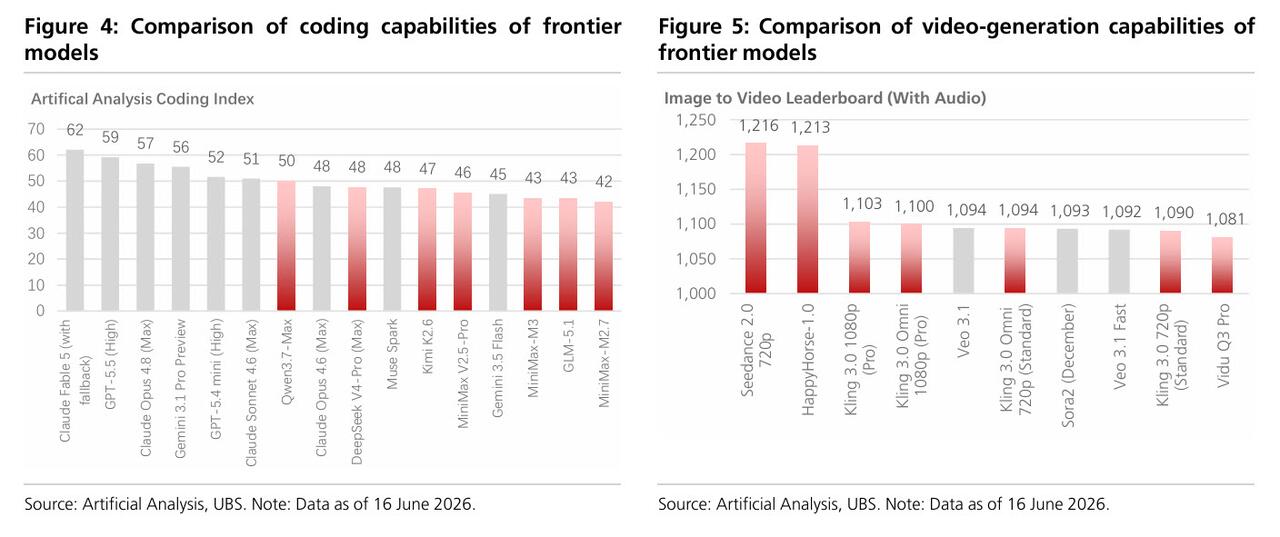
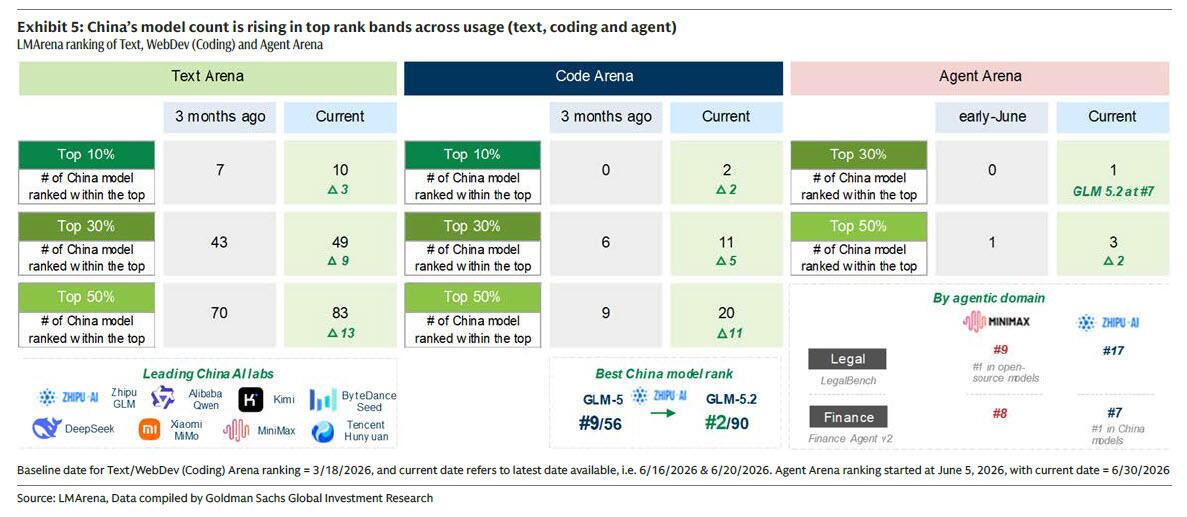
Big news: Kimi-K3 by @Kimi_Moonshot is now #1 in the Frontend Code Arena with 1679 pts, surpassing Claude Fable 5.
This is a 17-place jump from Kimi-k2.6 (#18 -> #1).
And while there is rampant debate whether this performance is accurate or gamed to beat specific benchmarks, the bigger issue is that China is now clearly developing stunning(ly cheap) open-sourced models which are on par with much more expensive US models, which in itself renders the entire ROI calculus behind trillions in AI capex spending null and void, because if China can achieve 98% what the US has done with a fraction of the capex…
… then all those trillions already allocated to AI capex are nothing more than sunk costs, as end markets will quickly pivot to what is cheapest, since in most cases it is also on par with what is best.
So what happened for those who went on vacation early last week and are stunning how everything has changed?
Well, as Ronald Keung, the Goldman strategist who wrote the original Chinese LLM primer said late on Friday, we have gone “from cost efficiency (DeepSeek), rise in model intelligence (GLM) to new frontier/pricing power at Kimi K3.”
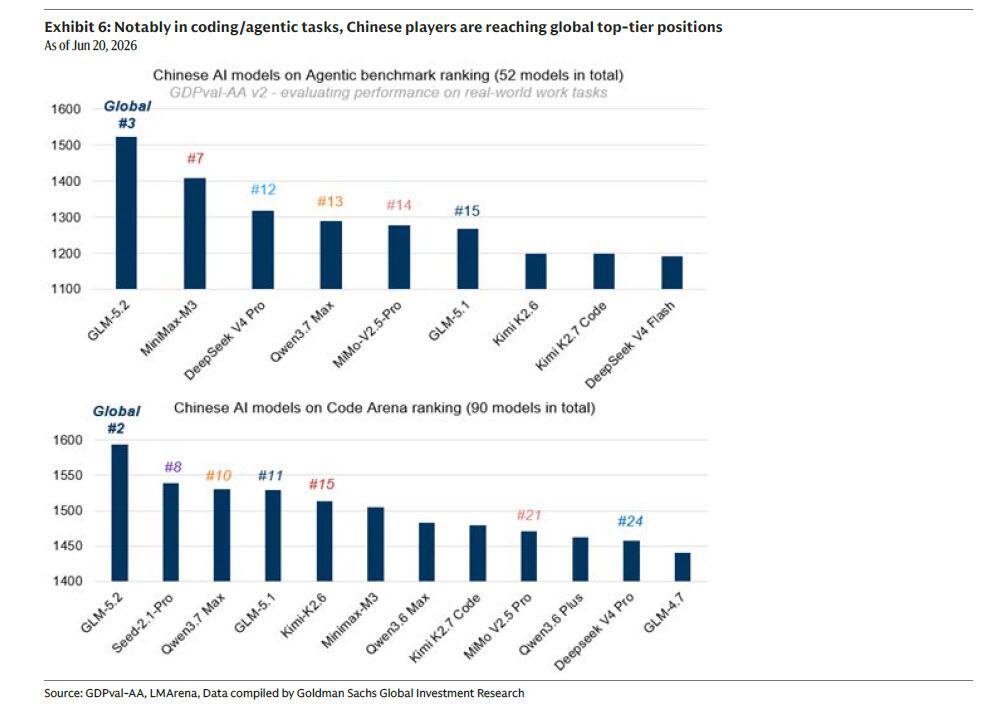
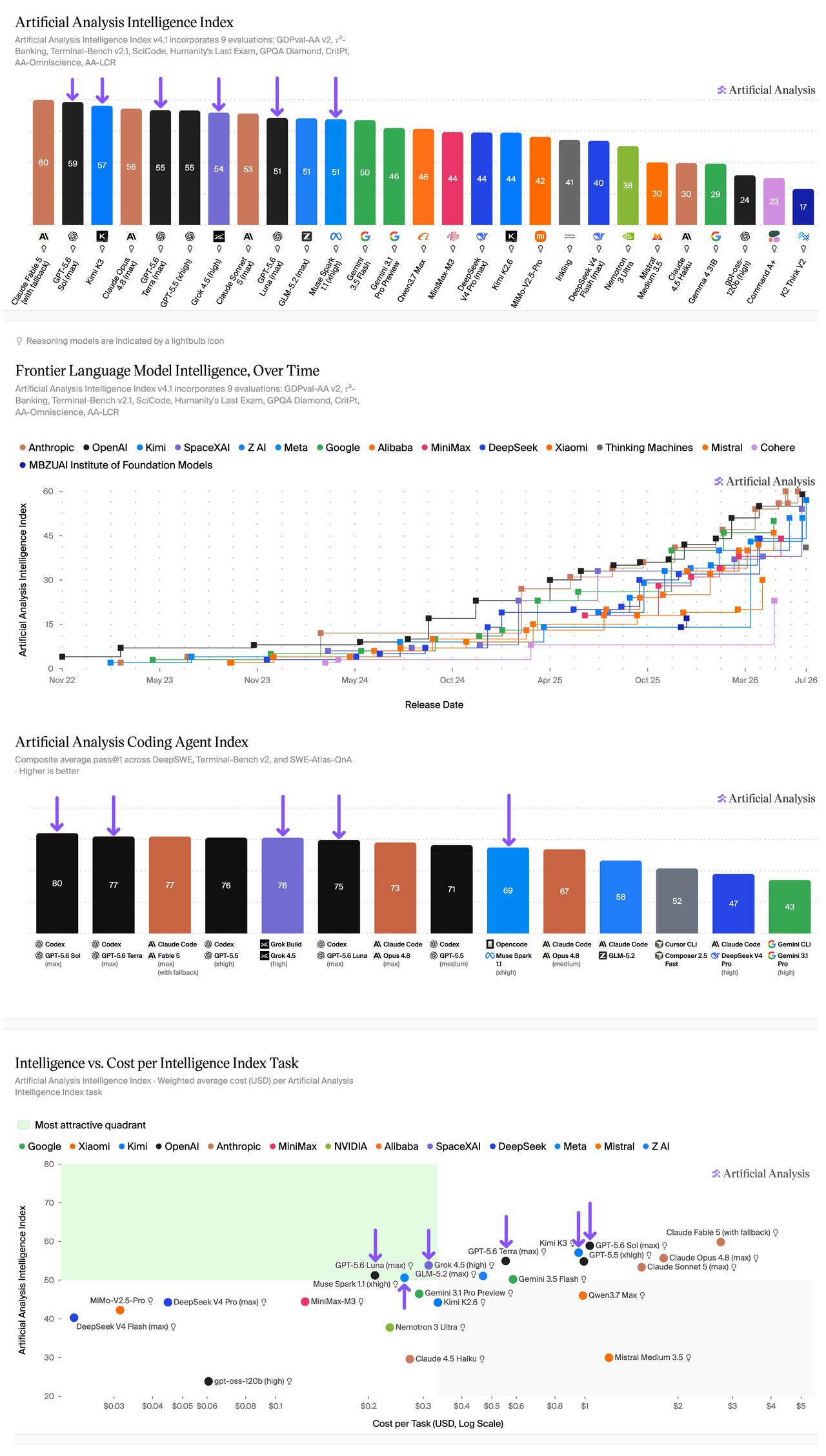
On July 17, the Kimi K3 open-weight model was released with 2.8 trillion parameters, and has set a new frontier in coding and certain agentic capabilities globally, as per Arena.ai coding rank and Artificial Analysis Intelligence score.
Accordingly, Goldman notes K3’s pricing was set at a new high amongst Chinese models, US$2.3 per 1M tokens (blended) vs. Qwen3.7 Max of US$1.4/Zhipu’s GLM5.2 of US$0.9/MiniMax’s M3 of US$0.22/DeepSeek’s V4 Pro of US$0.18, being still below global SOTA models.
As highlighted in our recent China LLM primer, China’s AI open-source/open-weight models are reaching a critical point of intelligence performance for global proliferation. Amongst signposts into 2H 2026, we have anticipated that competition could intensify in the high-end coding segment via coding data flywheel and scaling (to larger models, up to 2-5 trillions parameter sizes). The share price reaction of Knowledge Atlas/Zhipu (where Goldman recently initiated at Neutral, -28% on July 17) and MiniMax (Buy-rated, -16% on July 17) have been due to concerns around Chinese AI model competition and who the potential long-term winners will be, given the competitive landscape/sustainability of model company leadership remains highly dynamic.
Here, Goldman repeats that Independent AI model companies stand out in its Competitive Positioning framework (see full report for more). The bank also notes the positive read from Chinese President Xi’s comments at the opening ceremony of World Artificial Intelligence Conference (WAIC) in Shanghai held last Friday, drawing parallels of AI’s societal impact to the invention of electricity and steam engines, and in offering China’s technology infrastructure to developing nations with its continued open approach, yet cautioned on the need for human oversight/controls and risk mitigation.
What to watch out for from here?
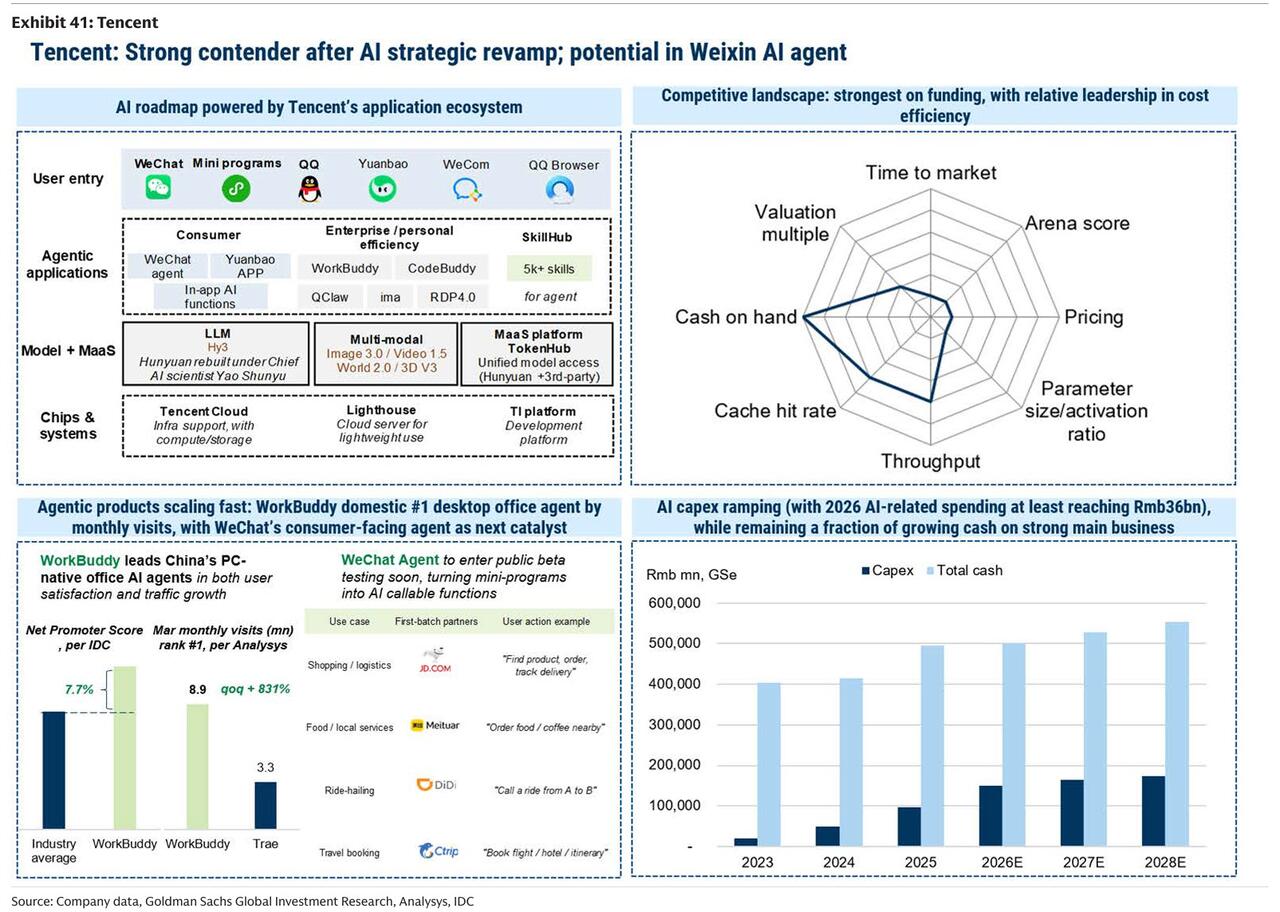
Harness/agentic applications: We expect China AI model companies to increasingly focus on positioning their harness/agentic applications as key entry points, especially in coding (e.g. Zhipu’s ZCode, Tencent’s Workbuddy, and Alibaba’s Qoder which are aggregate platforms that support the full suite of AI models) as model companies attempt to close the loop in capturing more real-life coding and agentic data for scaling. Co-work and industry expert agentic products could be the next priorities.
Multiple large parameter high-end coding model launches and potentially stricter access to the most advanced Chinese AI models outside of China: After Kimi K3 launch, we anticipate for further new Chinese AI model launches over 2H26 (Zhipu GLM, Alibaba Qwen, MiniMax M3 Pro and more) with significantly larger total parameter sizes of 2-5 trillion across Chinese AI model players. Coding/programming segment competition will remain intense. The addition of multi-modal/visual understanding will also be the next upgrades amongst Chinese AI foundation models.
Continued suppressed API pricing for the lower end agentic-focused segment: Goldman expects API pricing and therefore gross margins to remain under pressure at the lower-end pricing segment (around US$0.1-0.2 per 1M tokens) into the second half, as China’s AI model players have significant cash buffers post-fund raising to subsidize competitive pricing. As a result, we see financial strength as one of the three most important metrics (alongside pricing power and cost efficiencies) in assessing a Chinese AI model company.
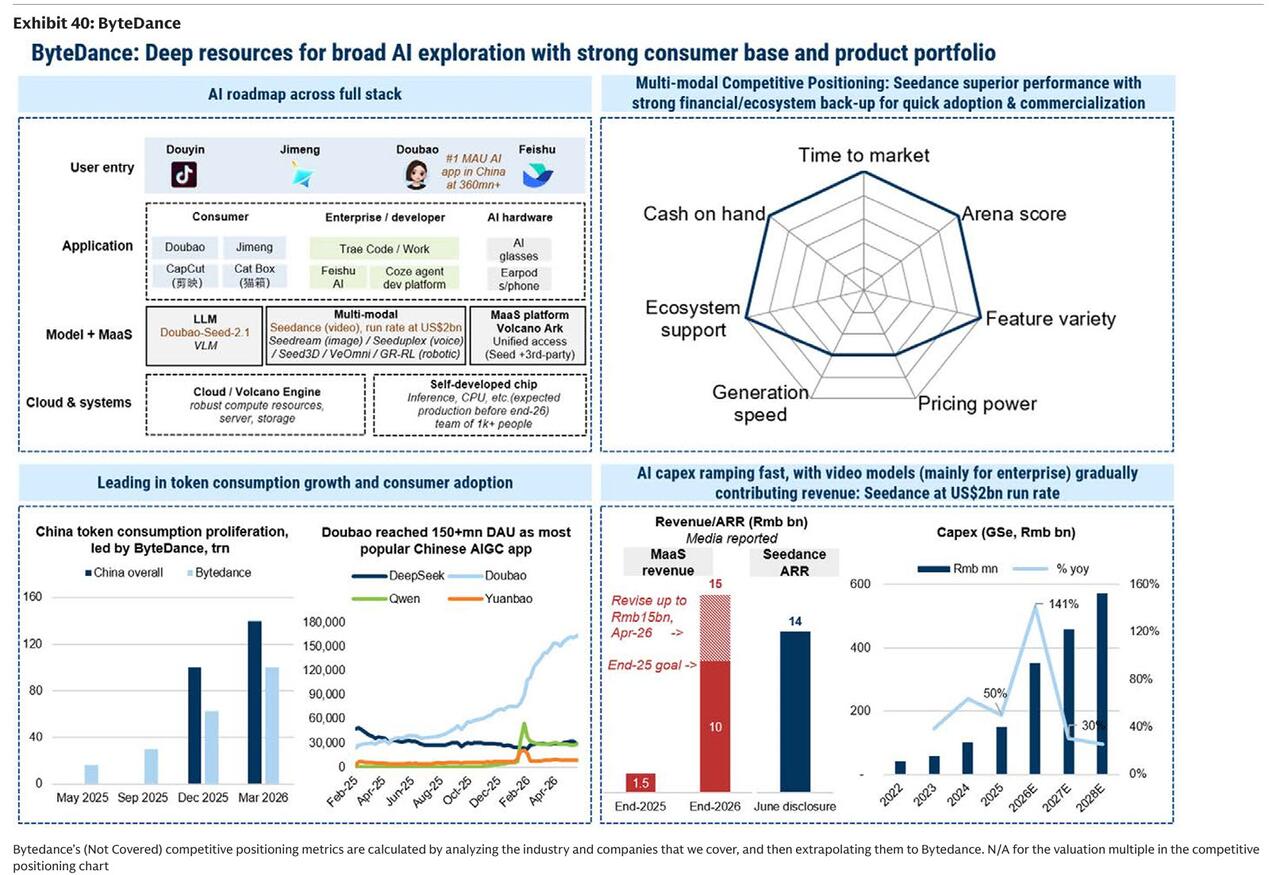
Multi-modal/video-generation models to see further ARR ramp-up from global adoption: Goldman expects continued healthy industry pricing and gross margins within video generation (unlike foundation text) where key players ByteDance’s SeeDance (at reportedly 70% gross margins, latest US$2bn ARR run-rate), Kuaishou’s (Buy) Kling and MiniMax’s (Buy) Hailuo/upcoming H3 models to enjoy healthy growth over 2H 2026 amid new functionality breakthroughs (combination of video-generation with LLM) and tight computing resources where demand significantly outpaces capacity.
Expect increasing domestic ASICs supply, any stricter access to China’s future most frontier models for overseas markets, Western markets’ policies on China models, and access to high-end computing in model training as key swing factors/risks to our China AI model token/revenue growth trajectory.
Goldman’s key ideas/stock picks
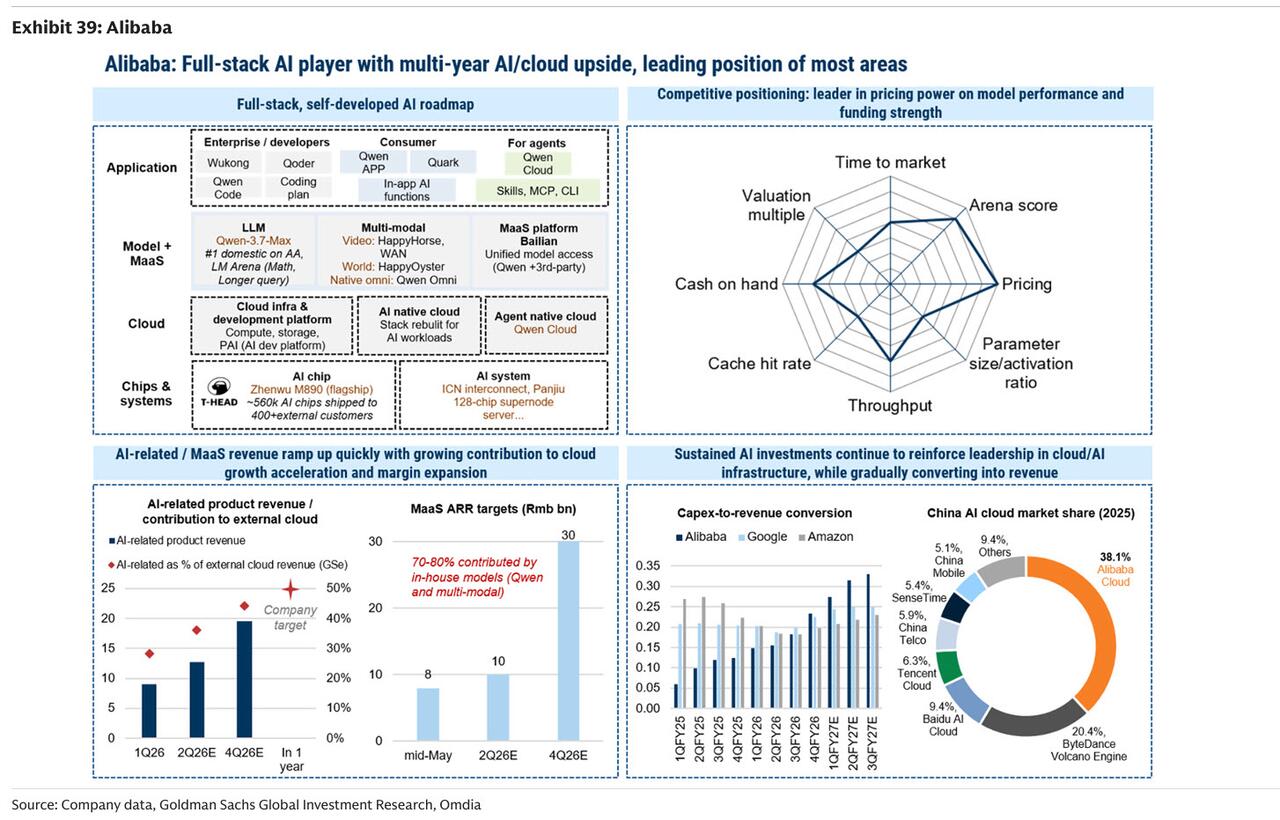
Within Cloud & Data Centers (the bank’s top preferred sub-sector within China Internet), GS continues to highlight key ideas (Alibaba, GDS, VNET, and Kingsoft Cloud) on the back of higher AI hyperscaler capex spending into 2H 2026.
Within AI models, Keung highlights MiniMax on upside skewed risk-reward. Key swing factors for MiniMax to improve its overall competitive positioning will hinge on its pricing power following its recent completed fund-raising that has strengthened financial strength. Expect its H3 video generation model performance (imminent launch in a more favorable industry landscape vs. text models) and time-to-market for its next M3 updates (focusing on further coding intelligence level uplift from post-training/reinforcement learning, we estimate M3 update over July-Aug, and a larger parameter size M3 Pro model later in 2H 2026) will be the next key drivers.
Yet what may be the clearest signal yet just how competitive with the US Chinese LLMs have become comes from none other than OpenAI’s “head of strategic futures” (presumable that title refers to whoever can demand protectionism the loudest) who essentially is begging for protectionism against open Chinese LLMs…
Some observations on Kimi:
1. It’s a very good model! I don’t think its performance can be explained away by distillation or anything like that. In agentic coding sessions, it seems pretty much on par with the best public models of Q1 2026. In my fairly limited use, it also…
… and the scathing retorts from Trump’s (former?) AI Tsar David Sacks, who responds that “K3 just fixed 15 critical security bugs that Codex and Fable refused because of “cyber guardrails.” There’s no reason to limit American models on tasks that Chinese models handle without issue. We’re only making ourselves less competitive.” And then again, here to point out that Chinese LLMs are already more useful to some programmers than the best of the (very expensive) best Anthropic and OpenAI have the offer, to wit: “Here’s another example: Hugging Face tried using American frontier models to analyze an AI-powered cyber attack. But the guardrails blocked requests containing real exploit payloads so they switched to GLM 5.2 running locally. The guardrails actually impaired defensive security.”
Three weeks ago, we attempted a lengthy answer of the “trillion dollar question” namely are Chinese AI models a better value than US models and, using extensive research from UBS, concluded that at almost 95% of the capability (and rising) and just 10% of the cost, the answer was a resounding yes.
Fast forward to today when Goldman analyst Ronald Keung also addressed the $64 trillion elephant in the room, and published a 50-page China AI models LLM primer (available to pro subs), in which he agrees with our conclusion, namely that “China’s AI open-source/open-weight models are reaching a critical point of intelligence performance vs. global proprietary models, with a significant ramp up in domestic enterprise & global SME adoption that will enable a positive data flywheel of further model improvement.”
In the report, Goldman evaluates:
How these models achieve such performance at low costs/tight computing resources;
Why they pursue an open-source/open-weight approach and how they monetize;
What the key addressable markets are, as global enterprises shift from ‘token-maxxing’ to ROI-first, where Goldman highlights two favored ARR quadrants for Chinese models; and
Who the potential long-term winners will be under the bank’s Competitive Positioning framework.
In keeping with the recent newsflow, Ronald notes that ongoing politicization of AI, namely any stricter access to China’s future ‘most frontier’ models for overseas markets, Western markets’ policies on China models, and access to high-end computing in model training, are three key swing factors/risks to the bank’s China AI model token/revenue growth trajectory.
Additionally, the Goldman strategist introduces his Chinese AI model Competitive Positioning framework based on pricing power, cost advantage and financial strength, overlaying with token scale and market share progressions, and identify Knowledge Atlas (Zhipu, initiation) and DeepSeek (private) as the strongest positioned in foundation models, and Bytedance (private) in multi-modal.
Before we get into the weeds, excerpted from the gull Goldman report, lets start with a visual summary of China’s AI Model and Hyperscaler Ecosystem…
… and a Breakdown of China’s open-source models unit economics today and path to profitability
Which brings us to the core overarching theme of Chinese AI development, from cheap to smart, or as Goldman’s Ronald Keung puts it:
From DeepSeek’s moment last year (on cost efficiency) to Zhipu’s GLM moment this year (on model intelligence).
China’s AI open-source/open-weight models are reaching a critical point of intelligence performance vs. global proprietary models, with a significant ramp up in domestic enterprise adoption and a proliferation of global consumer and SME demand. In this report, Goldman evaluates:
How these models achieve such performance at low costs/tight computing resources;
Why they pursue an open source/open weight approach and how they monetize;
What the key addressable markets are, where the bank highlights two favored ARR quadrants and risk factors; and
Who the potential long-term winners will be under Goldman’s Competitive Positioning framework.
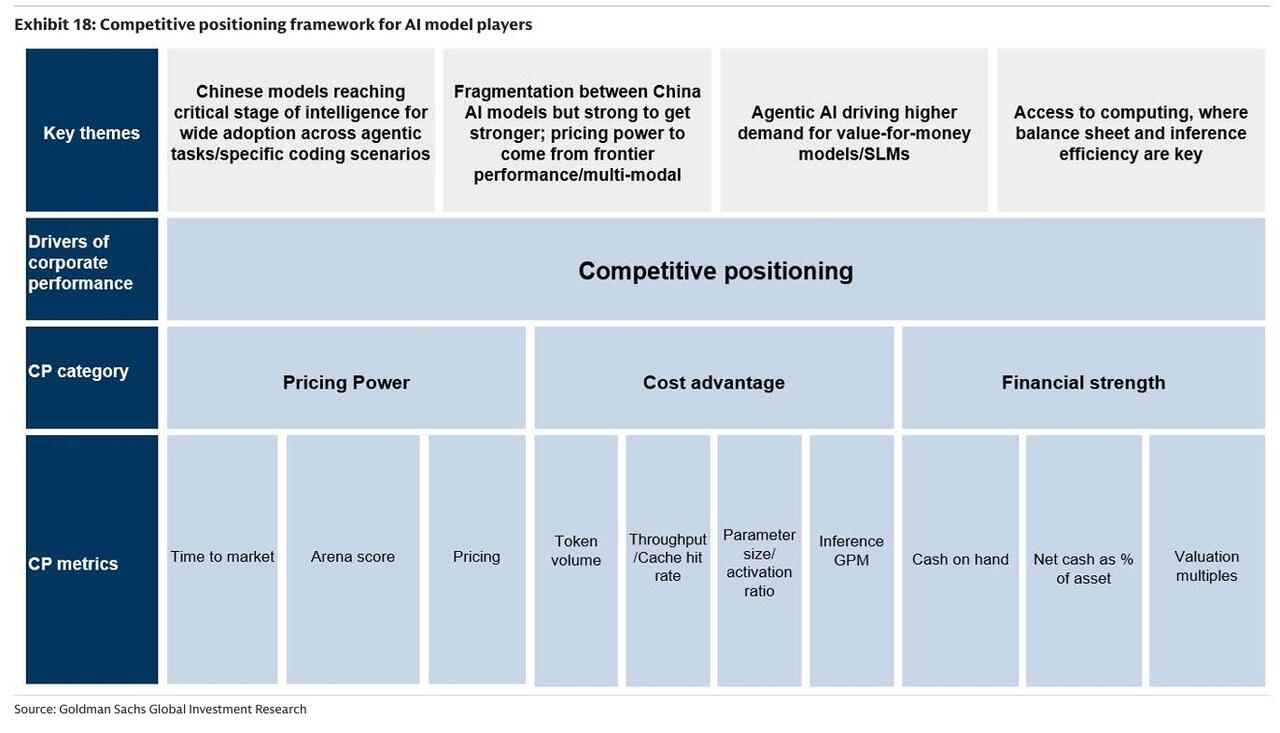
Chinese models are reaching a critical ‘good enough’ stage for agentic tasks/specific coding scenarios, and rising fragmentation in China’s AI model landscape (but the strong will get stronger). While pricing power remains strong for models with frontier performance/multi-modal, the lower-end segment is in a price war; nevertheless, Agentic AI is driving explosive demand for these value-for-money models at the lower-end. Access to computing will be a swing factor, where US/China regulations, balance sheet and inference efficiency are key. Accordingly, the bank introduces its Chinese AI model Competitive Positioning framework based on pricing power, cost advantage and financial strength, overlaying with token scale and market share progressions, and identify several companies its views as the strongest positioned in both foundation models and in multi-modal.
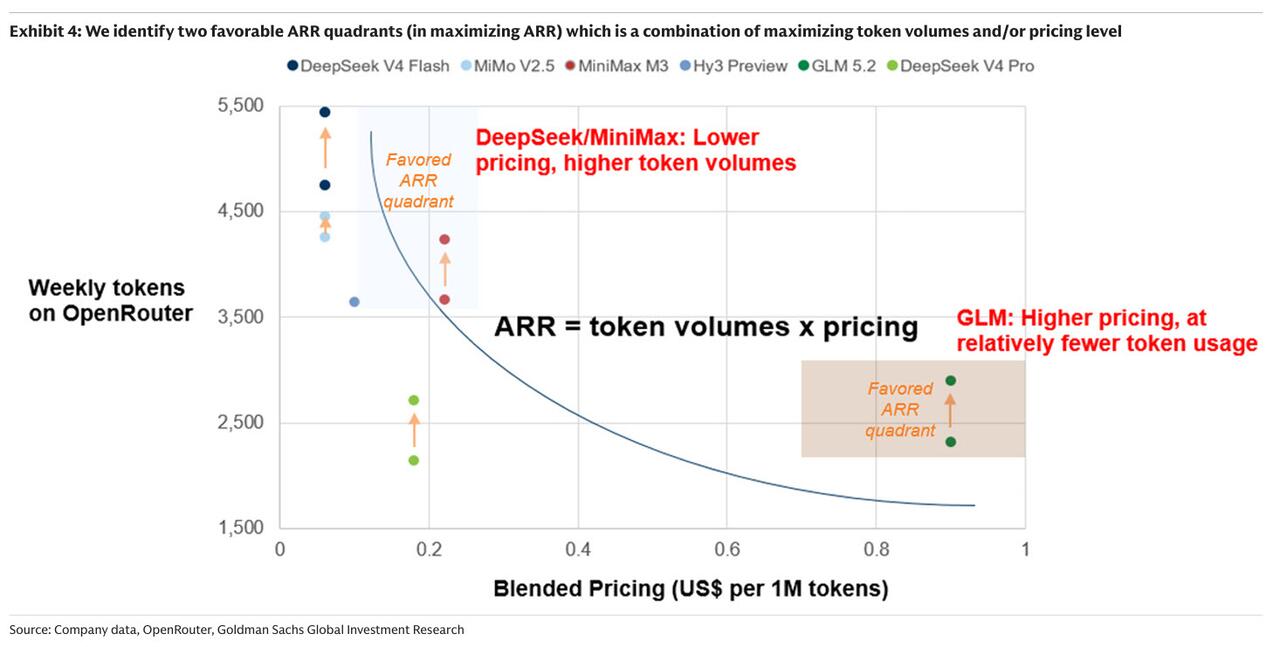
How do Chinese models achieve competitive performance at low costs/tight computing resources? By leveraging smaller-sized parameter models for equivalent benchmark performance, and Mixture-of-Expert and new architectural innovations. Chinese AI models are bifurcating into a two-tiered market where performance and time to market are key to pricing power, thereby leading to two ‘ARR maximizing’ quadrants based on token adoption and pricing. A positive flywheel is taking effect for top Chinese AI models driven by increasing actual real world coding adoption, and reducing their reliance on model distillation practices.
Why are Chinese models pursuing an open source/open weight approach, and ways to monetize? Open source allows for greater flexibility in model training/deployment, and allows for the widest adoption and an open community. Open-source models’ disclosed ARRs are likely understating total deployment and revenue potentials, and Goldman expects more shifts to open weight (with Community License, i.e., commercial terms if for commercial use) among Chinese AI models down the road.
What are the key addressable markets, domestically and internationally, and key risks? The bank highlights two favored ARR quadrants and estimate China/China AI models market to see token growth of 25X by 2030E; the coding landscape to consolidate while the agentic/low-end segment could remain fragmented. International (going global) should be a key upside, with the potential for higher pricing and global proliferation, especially in non-US markets as global enterprises increasingly pivot from a token-maxxing to a ROI-first model that prioritizes clear task boundaries, number of agents per day, back-end process automation and actual output over pure computational token volume.
Key risk factors are market access/anti-distillation and regulations, including any stricter access to China’s future most frontier models for overseas markets, access to highest-end leased computing equipment (used for training), market access to western markets, further restriction lists/entity list designations (but this could be positive for China’s path to further AI self-sufficiency across software/CPU/ASICs), and competition from SLM/threat from AI architectures.
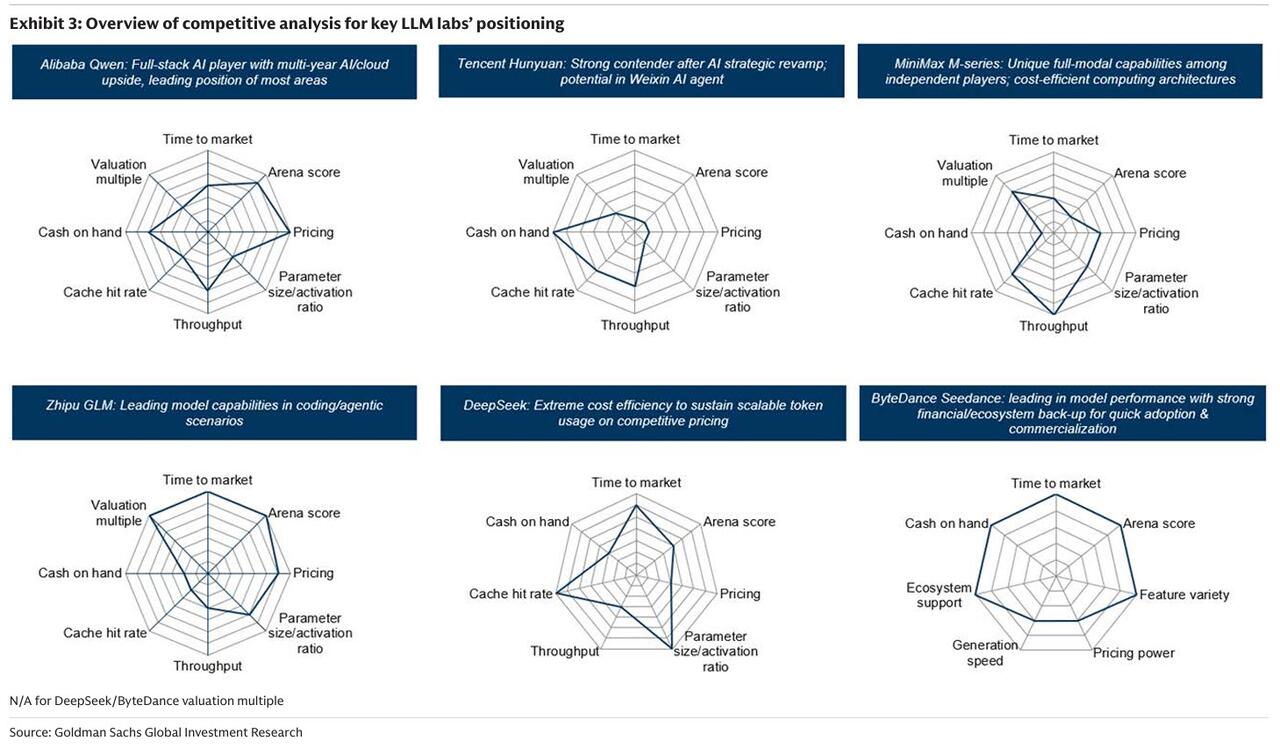
Who are best positioned to be the long term winners within China’s AI model companies? Goldman expects players with the largest ARR scale with a gross margin advantage + financial strength to be the long-term winners. The bank highlights independent AI model companies mostly stand out in its Competitive Positioning framework in pricing power + cost advantage (in aggregate represent over US$200bn in implied valuations, based on latest market cap/funding rounds), where Zhipu and DeepSeek are the most strongly positioned in text based foundation models, while ByteDance leads in multi-modal capabilities.
Signposts for 2H 2026
Harness/agentic applications: China AI model companies will increasingly focus on positioning their harness/agentic applications as key entry points, especially in coding (e.g. Zhipu’s ZCode, Tencent’s Workbuddy, and Alibaba’s Qoder which are aggregate platforms that support the full suite of AI models) as model companies attempt to close the loop in capturing more real-life coding and agentic data for scaling. Co-work and industry expert agentic products could be the next priorities. Enterprises will increasingly focus on overall cost per task instead of headline pricing per token, with an openness to using different models (multiple-models approach).
Multiple large parameter high-end coding model launches and potentially stricter access to the most advanced Chinese AI models outside of China: Multiple new Chinese AI model launches are expected over 2H26 with significantly larger total parameter sizes of 2-5 trillion across Chinese AI model players. Coding/programming segment competition will intensify as Chinese models try to challenge Zhipu GLM’s leadership via training on high-quality real-life coding data (where available) and scaling to larger parameter model sizes. There may be a potential shift from an open-source to an open-weight approach for best-performing models (i.e. from free-for-all use cases to requiring revenue sharing/a take rate for commercial use). The addition of multi-modal/visual understanding will be the next upgrades amongst Chinese AI foundation models (e.g. for GLM, DeepSeek), while MiniMax M3 already excels in these given the multi-modal focus of MiniMax from the start. That said, press reports on potential future restrictions on overseas access to China’s most advanced AI models (both closed and open source if at the frontier level) as cutting-edge artificial intelligence is increasingly being seen as a critical national asset.
Continued suppressed API pricing for the lower end agentic-focused segment: While DeepSeek recently announced an increase in peak-hour pricing from mid-July, API pricing and therefore gross margins should remain under pressure at the lower-end pricing segment (around US$0.1-0.2 per 1M tokens) into the second half, as China’s AI model players have significant cash buffers post-fund raising to subsidize competitive pricing at zero/negative gross margins in the near term. As a result, financial strength will be one of the three most important metrics (alongside pricing power and cost efficiencies) in assessing a Chinese AI model company, where cash on hand, net cash as % of assets and valuation multiples will be the critical financial strength metrics for long-term success. This said, Goldman is Buy-rated on MiniMax as the company stands out on cost efficiency/cost advantage metrics under a Competitive Positioning framework. With its M3 model well positioned in the favored ARR maximizing quadrant (attractive pricing + high token volumes), alongside its discounted valuation at 13X P/2026E year-end ARR (vs. China/global peers which command multiples several times higher at similar ARR stage), risk-reward is skewed to the upside (Goldmanb reiterates its Buy rating of the stock). Key swing factors for MiniMax to improve its overall competitive positioning will hinge on its pricing power and financial strength. Its H3 video generation model performance (imminent launch in a more favorable industry landscape vs. text models) and time-to-market for its next M3 updates (focusing on further coding intelligence level uplift from post-training/reinforcement learning, estimated over July-Aug, and a larger parameter size M3 model later in 2H 2026) will be the next key drivers.
Multi-modal/video-generation models to see further ARR ramp-up from global adoption: Goldman expects continued healthy industry pricing and gross margins within video generation (unlike foundation text) where key players ByteDance’s SeeDance, Kuaishou’s (Buy) Kling and MiniMax’s Hailuo/upcoming H3 models to enjoy healthy growth over 2H 2026 amid new functionality breakthroughs (combination of video-generation with LLM) and tight computing resources where demand significantly outpaces capacity. According to China news reports like LatePost and 36Kr, ByteDance’s Seedance gross margins have been at a healthy 70% at its latest US$2bn+ ARR run-rate.
The bank’s strategists also expect increasing domestic ASICs supply, tighter access to overseas computing resources and potential market access limitations (could mirror TikTok’s trajectory where rapid expansion in western markets was followed by more regulations/focus on ensuring data security where computing will have to be conducted within local jurisdictions).
Goldman’s assessment of AI model companies: ARR scale x gross margin advantage + financial strength
Financial strength (Balance sheet, Access to computing)
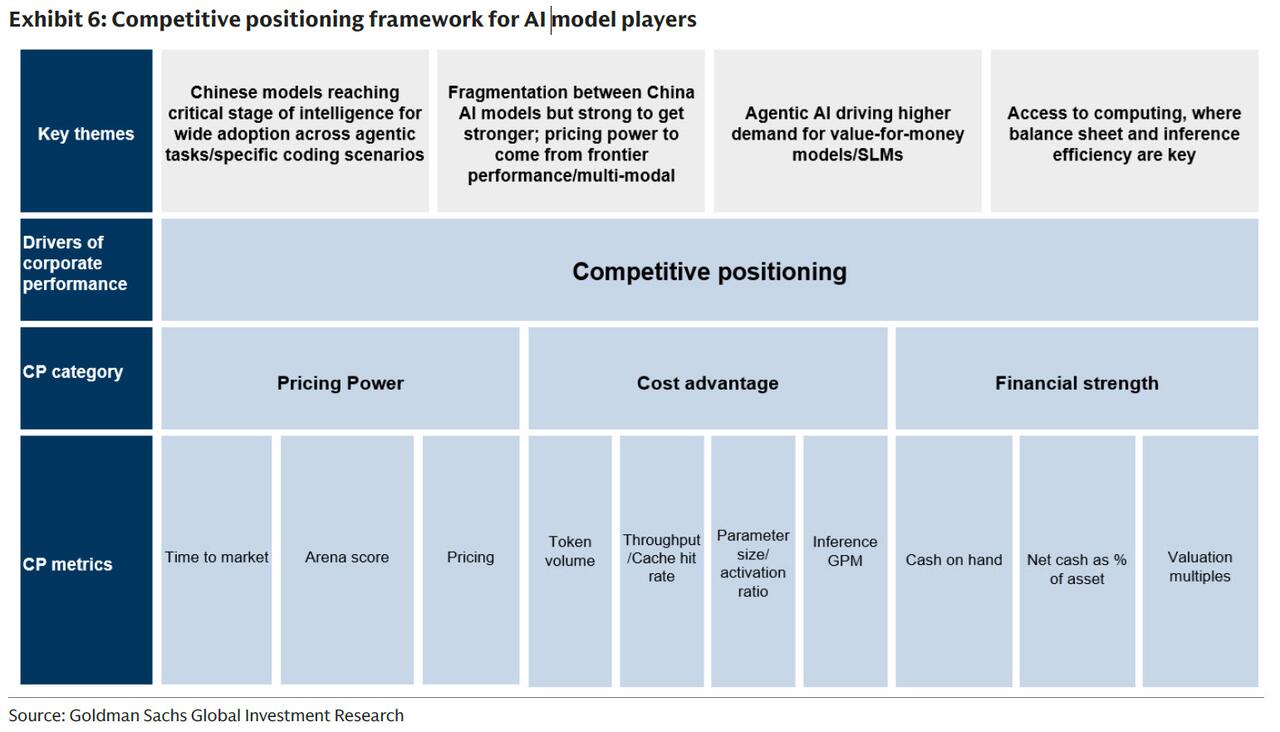
Accordingly, the bank lays out its Competitive Positioning framework for AI model players based on quantifiable metrics, 1) Pricing Power (amongst which, based on Time-to-market of model launch, Arena score based on actual usage cases and pricing level), 2) Cost advantage (based on token volume scale, throughput/cache hit rate, parameter sizes/activation ratio and our estimate of inference gross margins), and 3) Financial strength (based on cash on-hand, net cash as % of assets, and valuation multiples).
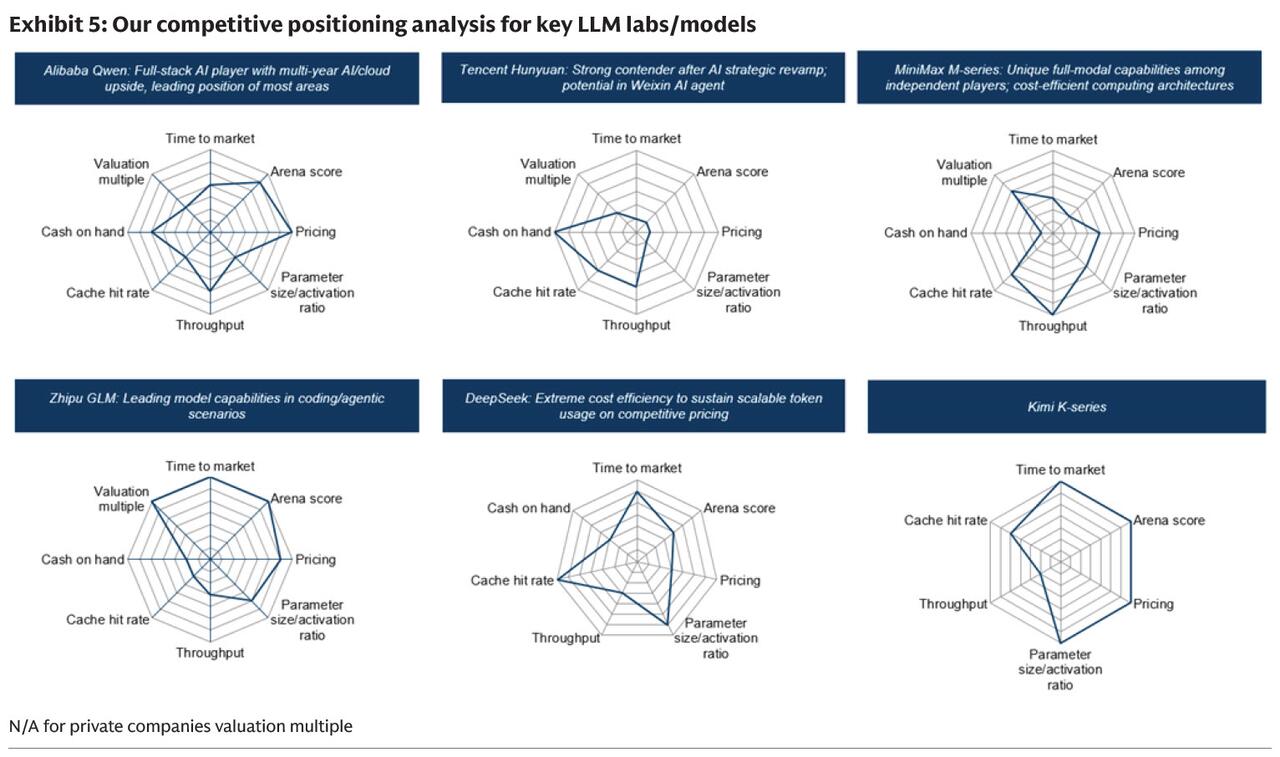
Next, an overview of competitive analysis for key LLM labs’ positioning
The bank identifies two favorable ARR quadrants (in maximizing ARR) which is a combination of maximizing token volumes and/or pricing level
Comparing China’s key LLM players
Decoding China’s AI model tokens & our forecasts on token/revenue share
How do Chinese models achieve competitive performance at low costs/tight computing resources
Smaller-sized parameters models for equivalent benchmark performances, Mixture-of-Expert and new architectural innovations
As readers of our Chinese LLM primer may recall, compared with a year ago, Chinese models’ coding and agentic capabilities have reached a critical level in being able to complete more coding and autonomous agentic tasks with higher success rates as context windows have been expanded to 1 million tokens. The smaller parameter model sizes of Chinese models (spanning from 200bn to 1.6T parameters, at 2-10% of leading SOTA models, due to constrained access to high-end computing), and highly efficient architectures (MoE, Sparse Attention, OCR etc., at 3-5% activated parameters only vs. total parameter sizes) all contribute to the much lower training and inference costs for Chinese models vs. leading US models. Goldman attributes the recent step improvement of Chinese models in coding according to Arena.ai to data curation, distillation techniques and reinforcement learning post training, despite their relatively small parameter model sizes (1.6T for DeepSeek V4 Pro, 0.7T for Zhipu’s GLM5.2 and 0.4T for MiniMax’s M3). On June 27, DeepSeek introduced DSpark, a speculative decoding framework that makes existing DeepSeek-V4 models serve faster. DSpark has already been deployed in DeepSeek-V4 Flash / Pro online serving, improving per-user DeepSeek-V4 generation 60-85% faster on V4-Flash and 57-78% faster on V4 Pro without changing the model’s weights or output quality.
Chinese AI models bifurcating into two-tiered market (where performance and time to market are key to pricing power), with two ‘ARR maximising’ quadrants based on token adoption and pricing
Goldman is seeing pricing power for the highest performing Chinese AI models, e.g. Zhipu’s GLM5.2 model and Alibaba’s Qwen3.7 Max models at around US$1 per blended 1M tokens, at 5X that of low-end Chinese AI models. The reported tighter US processes in allowing most SOTA model access has also opened new arenas for China’s top performing coding models for enterprises and SMEs. Smaller parameter and activated ratios allow China’s top performing models to be priced at US$1, 10-25% vs. US SOTA models at US$4-8 per blended 1M tokens, while generating double digit 10-20% gross margins (GSe) that are lower than global SOTA models due to relatively lower pricing power. In the lower-end segment, agentic focused models are priced at US$0.06-0.2 per blended 1M tokens, which are enabling these models to tap into new global TAMs for price sensitive SMEs and one-man companies. MiniMax generates 60-70% revenues from overseas.
Note that DeepSeek announced that its V4 official version is set for launch in mid-July, alongside the introduction of peak/off-peak API pricing to better allocate resources and improve service stability. V4 Pro/Flash non-peak pricing remains unchanged, while peak hour (9am-12pm/2pm-6pm China time) will be charged at 2X non-peak rates, implying blended pricing of US$0.35/US$0.12 per 1M tokens due to strong Chinese AI model demand that is increasingly causing significant compute tightness in work/productivity scenarios.
Positive flywheel is taking effect for top Chinese AI models from increasing actual real world coding adoption, with less reliance on model distillation ahead
Compared with learning and distillation tactics from global SOTA models in the past, top Chinese models like GLM5 are reaching a critical stage of adoption by China’s major enterprises and global users. As per LatePost, AI-generated code has increased to as high as 90% at some China mega-cap companies, up from 20-30% in 2H25, which will enable a positive data flywheel effect of further improvements via reinforcement learning with actual user data (both successful and unsuccessful coding cases) and post training. These have underpinned the step improvements in GLM5.2 from GLM5.1 in just over the course of a few months in 2026, and expect to see further step improvements to Chinese AI models over the next 6-12 months.
In coding/agentic tasks, Chinese players are reaching global top-tier positions
Compared with global SOTA leading models of several tens of trillions, China open source models are mostly around or below 1 trillion parameter in size, and adopt a MoE structure, with low activated to total parameter ratios for higher inference efficiency.
Blended LLM token price (SDLLMTK) has been declining since early June, potentially driven by rising adoption of cost effective China models
Historical and projected capex for major US & China cloud service providers
Capex to operating cash flow ratio is still healthy for China hyperscalers
Case study on Meituan’s LongCat 2.0: A milestone for China’s domestic AI infrastructure
Released on June 30, 2026, Meituan’s LongCat 2.0 marks a major milestone as China’s first official 1.6 trillion-parameter open-source Mixture-of-Experts (MoE) model trained and deployed entirely on a 50,000-card domestic compute cluster. Purpose-built for agentic coding and complex software engineering workflows, the model features a native 1-million-token context window enabled by LongCat Sparse Attention (LSA) and dynamically activates an average of 48 billion parameters per token to optimize inference costs. Implications for a more self-sustainable China AI model outlook that is less reliant on foreign high-end chips for model training: The successful end-to-end pre-training and inference of a trillion-parameter class model on Chinese silicon (reportedly utilizing Huawei Atlas-950 SuperPods) fundamentally drives a more sustainable China’s AI model development outlook, in our view. While previous Chinese flagship models, such as DeepSeek V4-pro, mentioned domestic chips for inference, LongCat 2.0’s ability to overcome critical memory bottlenecks and distributed stability challenges during the compute-heavy pre-training phase proves the viability of a wider and more localized hardware stack for AI model training in the future.
Why are Chinese models pursuing an open source/open weight approach, and ways to monetize?
Open source allows for higher flexibility in model training/deployment, and allows for the widest adoption and an open community
Alibaba’s Qwen model family has long pursued an open source approach (before adopting a closed source for its largest and highest performing Qwen-Max models for better monetization), while other key Chinese AI model players have mostly pursued an open source/open weight approach including DeepSeek, Zhipu’s GLM and MiniMax M3 series models with the exception of ByteDance’s full closed proprietary approach for its Seed model. The open source approach allows for the highest flexibility in terms of the locations of where models are trained (and thus where the models can be deployed both inside and outside of Mainland China after training). An open source approach also allows for the highest adoption amongst the AI community with full transparency of the model parameters/architecture for trust, and an open community in driving more user feedback and thus model iterations/improvements. The open source approach vs. world’s leading closed/proprietary approach also provides an alternative choice for worldwide AI users when the best performing closed models have stricter user access and higher costs from their premium pricing, especially at a time when ‘token-maxxing’ has become a key cost consideration for many corporates.
Open source models’ disclosed ARRs are likely understating total deployment and revenue potentials
While open source model companies offer their own coding plans and a chargeable open platform API channel (where the model companies conduct their own model inference), the majority of open source models also allow individuals/third-party hyperscalers/neocloud providers to deploy the models without a charge even for commercial use (e.g. Alibaba Cloud’s Bailian MaaS platform can house GLM5.2 open source model without needing to pay a fee/take rate to Zhipu). As a result, while Zhipu’s last stated ARR target for year-end 2026 is at US$1bn, the actual deployment of GLM5.2 model worldwide is and will be multiple-fold higher vs. Zhipu’s own API channel token volumes and revenue. There is also increasing post training of Chinese AI models that are re-branded by global companies (e.g. Composer 2 etc.) where the Chinese AI models do not necessarily receive any revenues given the open source spirit.
Expect more shifts to open weight (with Community License) approach among Chinese AI models down the road
While Zhipu’s open source GLM model’s MIT license allows for free for all use cases (regardless of revenue), MiniMax M series models have pursed a restricted license (where the industry terms it as an open weight with Community License model), which requires MiniMax’s agreement and commercial terms (e.g. revenue sharing/a take rate) on commercial use. This will be the likely next path for other open source models in the Chinese AI model industry, in order for eventual gross profits of inference tokens to cover training costs and for each AI model company to achieve a sustainable path to returns.
What are the key addressable markets, domestically and internationally, and key risks?
According to Goldman estimates, China AI models’ aggregate API+subscription revenue to increase from Rmb35bn in 2026E to Rmb879bn by 2030E from rising model intelligence, in particular with recent models like GLM5.2 reaching a critical point for global adoption and attractive pricing. The bank’s revenue pool estimates for China AI models imply total Chinese AI model daily token consumption of 350T in 2026E to increase to 4,600T by 2030E.
Goldman estimates domestic market to see token growth of 25X by 2030E; coding landscape to consolidate while agentic/low-end segment could remain fragmented.
At 140tn daily token volumes for the country in March 2026 and several hundred trillions by June 2026 as per the National Bureau of Statistics, open source/open weight models have roughly a 30% token share (vs. 70% token market share by ByteDance alone, which is closed source and mainly driven by its Doubao app enterprise and individual user base, as the #1 used AI chatbot in China). Similar to the US, the coding segment (at a premium pricing level) will continue to be dominated by SOTA best performing models. Meanwhile, the lower-end segment focused on agentic AI will remain fragmented with multiple players due to the financial strength of AI model companies/mega-caps which would sustain the lower-end segment price war for longer.
International (going global) to be the key upside; with potential for higher pricing and global proliferation, especially in non-US markets
Goldman’s US research team estimates agentic AI will drive 24X growth in token consumption by 2030 (from 2026) to 120 quadrillion tokens per month (or 4 quadrillion tokens per day, from their estimate of 170 trillion daily tokens today), with the biggest driver at 55X from enterprise agents and 12X from consumer agents. The global (ex. China) landscape has seen significant token share gains from Chinese AI models, as rising model intelligence and attractive token costs have driven higher adoption across 24/7 Hermes/Claw/Productivity agents, and shifting global SME mindset on using Chinese models in managing token costs given Chinese models have reached a ‘good enough’ stage in terms of intelligence/performance.
Pivoting from ‘token-maxxing’ to ROI-focused metrics, e.g. Daily Active Agents/Agentic Work Units
The AI token proliferation is undergoing a paradigm shift from ‘token-maxxing’ (an initial focus from late 2025 to early 2026 where enterprises equated high AI token consumption directly with organization productivity) towards an ‘ROI-first’ model that prioritizes clear task boundaries and output over raw computational volume.
‘Token-maxxing’ has been attributed to corporate inefficiencies and cost overruns: Data from a Jellyfish AI Engineering trends study indicated heavy AI users at enterprises consumed 10X more tokens but only had a 2X increase in output. Meanwhile, multiple US Internet companies have commented back in April 2026 that either their engineering teams utilized a full year’s AI budget in just four months using agentic products (promoting stricter monthly caps per tool) or changed their internal token utilization leaderboards that previously wrongly incentivized staff to launch inefficient/low value autonomous agent tasks.
Enterprise framework is pivoting towards an ROI-first model that prioritizes clear task boundaries, number of agents per day, backend process automation and actual output over pure computational token volume. Besides a marked increase in adoption of Chinese AI models, global enterprises have been downgrading default models to cheaper flash models for more typical tasks (while reserving SOTA models for only the top most value creating tasks like coding/programming). There is a transition from just token tracking to metrics like Daily Active Agents (DAA) and Agentic Work Units (AWU), and the overall cost per task will become more relevant than price per token metrics.
Open source/open weight approach allows for the option for U.S. hyperscalers to host Chinese models, operated within U.S. cloud ecosystem
Alphabet and Amazon’s respective cloud services Gemini Enterprise Agent Platform (via. its Model Garden) and AWS Bedrock already offer a broad selection of Chinese AI models including DeepSeek, MiniMax, Moonshot, GLM and Qwen which are fully managed by the US hyperscalers. Besides the model layer, into applications, worthy of note is Microsoft (covered by Gabriela Borges) CEO’s recent remarks at a Wall Street Journal interview (link) where he noted Microsoft is considering hosting versions of DeepSeek on Copilot as an optional, cost-effective model which could give its customers access to cheaper choices alongside US proprietary models. Microsoft indicated that if it hosts DeepSeek, the model would operate within its cloud ecosystem, ensuring customer data stays inside Azure.
Noting key risks around any potential tighter geopolitical policies given Chinese AI models inroads into western markets.
Key risks to the ‘going global’ opportunity will hinge on end market access (especially in western countries, and with a focus on where computing is done/data is stored), access to high-end computing for AI model training (that could impact iteration pace and cost structure of Chinese models), and restrictions on Chinese AI model companies could impact supplier relationships/access to US companies and/or access to US capital.
Who are best positioned to be the long term winners? Introducing our Competitive Positioning framework
Players with the largest ARR scale with a gross margin advantage + financial strength are expected to be the long-term winners.
ARR scale x gross margin advantage + financial strength
Financial strength (Balance sheet, Access to computing)
Accordingly, Goldman introduces a Chinese AI model Competitive Positioning framework based on pricing power, cost advantage and finance strength, overlaying with token scale and market share progressions, and identify Knowledge Atlas (Zhipu initiation) and DeepSeek (private) as the most strongly positioned in foundation models, and Bytedance (private) in multi-modal capabilities
Foundation models
Goldman assesses each key player’s competitive positioning from its flagship foundation model, scored across 3 aspects: pricing power, cost advantage and financial strength (of the company), with each aspect further built upon granular quantitative metrics.
Pricing Power
Time to market: Goldman assesses this in terms of how quickly and effectively a player delivers frontier competitive models. From comparing the launch date of the company’s flagship models with its prior generation & other models at similar performance level, Goldman assesses whether the release delivers a meaningful capability step-up over its past generation, and whether it narrows the gap to the current global SOTA models.
Arena score (overall text): Model intelligence is viewed as the primary determinant of pricing power, since models capable of handling higher-value tasks can deliver clearer ROI and therefore sustain their pricing premium. Here, the LMArena’s score is used instead of any static benchmark because it reflects a large scale of blind user reviews, making it a more objective read on the real-world capability.
Pricing (blended, US$ per 1M tokens): The bank refer to the realized headline price (across input/output/cached input) for flagship models, where sustained higher pricing with iteration signals stronger pricing power, whereas pricing cuts may indicate a more volume-prioritized strategy.
Cost advantage: the structural cost-to-serve (i.e. inference costs) that sets the floor for price and margin
The below metrics are referred to as proxies for inference efficiency:
Throughput (tokens/second): Measured by the number of tokens a single GPU generates per second. The more tokens a GPU outputs per second, the more fixed hourly compute cost is spread out. Therefore, throughput is a strong indicator of inference efficiency, which depends on model architecture (sparsity & attention design) and serving efficiency (batching & utilization).
Cache hit rate (%): The share of input tokens served from cache rather than recomputed. In conversations and agentic workflows, much of the input repeats across calls, so models can read those tokens from cache memory instead of recomputing from new inputs. A higher rate cuts compute, and since cached tokens are near-free to serve despite being billed at a discount (10X-100X cheaper than input cost), it is also margin accretive.
Parameter size/activation ratio: The share of total parameters activated per token (available for open-source MoE models), where fewer active parameters mean fewer FLOPs per token and therefore lower inference cost, at any given level of performance.
Inference GPM (where disclosed, or GS estimates based on total parameter size/activated parameters): The realized gross margin on model API, where ~90% of COGS is inference costs, as a direct indication on cost efficiency
Financial strength: capacity to keep funding frontier R&D and training before a profitability turnaround
Cash on hand and net cash/debt as % of assets: Goldman uses total cash on hand as a measure of balance sheet strength, with net cash as % of assets to normalize across players of different scale. Mega-caps (compared with individual players) are seen as having greater resources to accumulate compute, fund multi-modal exploration and push faster product distribution.
Valuation multiples: For independents, P/ARR 2026E multiples are used as they are not yet profitable and P/ARR is a more comparable measure of business scale and future monetization potential, and for mega-caps the P/E 2026E is used.
Appendix
China’s Key Players at a Glance: Mega-caps
China’s Key Players at a Glance: Key Independent Players
The interception of a Chinese vessel accused of illegal fishing highlights the technical lengths many use to remain undetected across millions of square kilometres of open ocean.
Tuvalu Police operating on a Sea Shepherd patrol boat boarded and arrested a Chinese longliner, the Lu Rong Yuan Yu 138, on July 9 for allegedly illegally operating within the small South Pacific nation’s waters.
The vessel was allegedly running with its navigation light turned off and transmitting false data showing it to be in different area – an increasingly common practice known as “spoofing.”
After boarding the ship, officers found it did not hold a valid permit to fish the area, detaining the vessel and escorting it to the Port of Funafuti for further investigation.
Sea Shepherd Australia Chair Peter Hammarstedt said illegal fishers were increasingly “going dark” by switching off their automatic identification systems, or using them to broadcast false information.
“It’s very common practice, especially in the Pacific Ocean, for Chinese fishing vessels to transmit false positions,” Hammarstedt told AAP.
“If you go onto some vessel tracking software websites, you’ll see some Chinese fishing vessels appear on land, like in the Mongolian desert, for example.
“Obviously the fishing vessel isn’t there, but is operating elsewhere and simply inputting false data to mislead investigators.”
In the case of the Lu Rong Yuan Yu 138, it was allegedly transmitting a location that put it squarely on the equator at 0 degrees, raising the suspicions of investigators.
Sea Shepherd has partnered with Tuvalu Police for the past two years, since the nation’s only operational patrol boat was damaged in a cyclone.
The small island nation monitors a marine domain covering roughly 750,000 square kilometres, with limited assets to keep an eye on such a large area, meaning most illegal fishing operations go undetected.
“The fishing vessels that do this kind of behaviour operate under the expectation that they’re just not going to get caught,” Mr Hammarstedt said.
Australia and Pacific nations have recently ramped up efforts to clamp down on illegal fishing under the Pacific Islands Forum Fisheries Agency Fishing Authorisation.
“The Tuvaluans live by the sea, with the sea, and have done so for hundreds and hundreds of years,” Hammarstedt said.
“When I see illegal fishing on an industrial scale happening in the Tuvaluan waters, I see this as theft from the Tuvaluans.”
India’s Nuclear Push Further Strains The Massive Uranium Supply Gap
Prime Minister Modi secured another major uranium supply line. During his visit to Australia this month, the two sides finalized the administrative arrangements needed to move Australian uranium to India under the previous 2014 nuclear cooperation agreement. The fuel must stay under IAEA safeguards for exclusively peaceful use.
Australia holds roughly 28% of global uranium reserves. New Delhi has eyed those reserves for years, and now the yellowcake spigot can open.
This follows the March deal with Canada’s Cameco. That contract covers nearly 22 million pounds of U3O8 from 2027 through 2035 at market-related pricing, worth around C$2.6 billion.
India already buys from Russia and Uzbekistan, and holds some domestic production. The message is consistent: a country targeting 100 GW of nuclear capacity by 2047 cannot rely on thin indigenous resources alone.
Current operable capacity sits near 8 GW. The gap requires sustained annual additions measured in gigawatts, not megawatts.
Cumulative net deficits keep expanding as reactor builds in China and Russia outpace primary supply response. Goldman models have only recently started taking into account the significant expansion in the SMR space as well, resulting in some relatively alarming supply gaps in the years ahead.
The Cameco agreement already reflected this reality. CEO Tim Gitzel noted that sovereign buyers are locking up volumes in a window where available supply grows more uncertain. Kazakhstan has also moved to build its own strategic reserve.
Couple these data points with Goldman’s estimate of the ongoing lack of long-term uranium supply contracting by the existing global fleet…
We’ve been pointing to the uranium upside trade for several years now. We laid out a longer form of our thesis for the anticipated continued rise of the price of uranium just a few months ago. The idea is incredibly straightforward. There’s not enough mines, and the demand is exploding faster than people can keep track of.
China’s Moonshot Eyes IPO After Sparking Another “DeepSeek Moment” For US AI Stocks
Chinese startup Moonshot AI sparked another DeepSeek-like momentfor US AI stocks and hyperscalers last week. David Sacks, the former White House AI and cryptocurrency czar, warned that this is “very concerning.”
Moonshot AI debuted Kimi K3, which ranks number three on the Artificial Analysis Intelligence Index, trailing only OpenAI’s GPT-5.6 Sol and Anthropic’s Fable 5. This only shows the continued trend of open-weight models toward the AI frontier.
Kimi K3 has emerged as a top challenger across reasoning and coding workloads, highlighting the rapid pace of innovation and the increasing competitive pressure on models in terms of capabilities and downward trend in pricing. This only sparked weakness in sentiment toward AI US stocks and hyperscalers last week due to their massive capex binges to build out data centers.
It serves as a reminder for companies amid the ‘tokenmaxxing‘ woes that there are lower-cost alternatives for end users besides expensive frontier Anthropic and OpenAI.
Now, Moonshot AI is leveraging last week’s momentum and preparing for an initial public offering in Hong Kong within six months. Kimi K3 has strengthened investor confidence, positioning the startup to enter public markets.
Bloomberg reports that Moonshot is in the process of concluding a funding round that values the three-year-old startup at $30 billion.
Annual revenues topped $300 million in June, up from $200 million in April, supported by chatbot subscriptions and enterprise services.
The startup has held talks with CICC and Goldman Sachs about the offering and is dismantling its red-chip structure to facilitate an overseas listing.
Meanwhile…
We’ve identified industrial-scale distillation attacks on our models by DeepSeek, Moonshot AI, and MiniMax.
These labs created over 24,000 fraudulent accounts and generated over 16 million exchanges with Claude, extracting its capabilities to train and improve their own models.
Here is the latest institutional commentary on Moonshot AI:
Jefferies analyst Roger Song
Moonnshot AI triggered another Deepseek-like moment + semi/ memory lost momentum, both potentially benefiting biopharma rotation. While still waiting for FDA leadership renewal, we started to see more potential policy reversals (while maintaining good ones, nice to see CRL release back for now) along with swift industry reactions. Open clinical trial prediction betting – will that be a distraction/ noise or another actionable datapoint for real investment? We shall all see.
Wolfe Research analyst Alex Zukin
China’s Moonshot Unveils Kimi K3, Autonomously Designed Functional Chip in 48 Hours – Moonshot released Kimi K3, a 2.8 trillion parameter Mixture-of-Experts model with a 1-million-token context window and native text, image, and video support, positioned as the first open 3T-class frontier model with full weights releasing July 27, 2026 and API pricing at $3/$15 per million input/output tokens. The model autonomously designed a functional 4mm² chip in a single 48-hour run with zero human intervention, handling design, optimization, verification, and simulation, achieving over 8,700 tokens/second decoding throughput, while also building a custom GPU compiler called MiniTriton from scratch that reportedly matches parts of Nvidia’s official Triton compiler. Kimi K3 scored 88.3 on Terminal-Bench 2.1, trailing but competitive with OpenAI’s GPT-5.6 Sol, while lagging flagship closed models like Anthropic’s Claude Fable 5 in broader evaluations, with the model available today via the Kimi app, Kimi Code, and OpenRouter
Canaccord Genuity analyst Martin Roberge
Meanwhile, sentiment toward AI stocks and hyperscalers’ capex binge keeps weakening and today’s release of a new AI model by Chinese company Moonshot, capable of competing with AI models from OpenAI and Anthropic, serves as a reminder that there are lower-cost alternatives for end users.
The race among AI startups to go public has China-based DeepSeek targeting a 2027 IPO, while US rival Anthropic could list as early as late 2026 and OpenAI increasingly appears headed for a 2027 debut. Both US firms have confidentially submitted IPO paperwork.
Taiwan’s President Ratchets Anti-China Rhetoric In Party Speech: Must Resist ‘Red Terror’ Of Beijing
President Lai Ching-te said on Sunday that Taiwan must renew efforts to protect its democracy and never become part of China. He urged members of his Democratic Progressive Party (DPP) to oppose the “red terror” coming from Beijing.
The ruling DPP champions Taiwan’s separate identity from China, and is working to combat what Lai called China’s “legal warfare”.
“I also expect comrades within the party to stand on the front lines, unite as one, and jointly oppose the threat posed by China’s ‘red terror’ to Taiwanese society,” Lai added, speaking in Taiwanese, rather than the main language of government, Mandarin.
“We must work together to protect our democratic and free way of life, and absolutely never allow ‘democratic Taiwan’ to turn back and become ‘China’s Taiwan’,” he said.
“Regardless of ethnic group, regardless of who came earlier or later, anyone who identifies with Taiwan is a master of the country. Taiwan’s future must be decided jointly by the 23 million people of Taiwan,” he said.
One establishment US publication has held up a prime example of Beijing’s “legal warfare” against an autonomous Taiwan in the following:
On March 12, China’s legislature adopted the Law on Promoting Ethnic Unity and Progress (Chinese; English translation), a sweeping new statute that codifies Beijing’s approach toward China’s 56 officially recognized ethnic groups. Substantively, the law enshrines a decades-long shift towards aggressive assimilationist policies. Structurally, it reflects a deepening merger of Party ideology and state law that is becoming increasingly prevalent under Xi Jinping.
This new law is the culmination of a policy trajectory that has been building for over a decade, dating back to the 2014 Central Ethnic Work Conference. Under Xi, Beijing is steering away from the post-1949 legal framework of nominal ethnic autonomy (albeit under tight Party control) imported from the Soviet Union. In its place, officials have steadily been pivoting towards what scholars have termed “second-generation ethnic policies”—an aggressive assimilationist approach that emphasizes a common Chinese national identity over accommodation of ethnic differences. Provincial and municipal authorities across China have enacted a wave of local “ethnic unity and progress” regulations in recent years, such as those in Xinjiang (2015) or Inner Mongolia (2021). The new national legislation elevates this approach to the level of a national statute governing all of China.
The new law’s core concept is captured in the term zhulao – to “forge” or “cast” metal – and its instruction that “forging the communal consciousness of the Chinese nation” is core to the Party’s ethnic policies. As James Leibold has pointed out, this phrasing reflects a hardening of Beijing’s political line under Xi Jinping – explicitly written into the Party’s Charter at the 19th Party Congress in 2017 – aimed at “melting” subnational and ethnic identities into a shared collective one.
Meanwhile, on a global stage Beijing has continued to present itself as the only peace guarantor and as a force for stability and is seeking ‘Taiwan’s willing participation’ – at a moment the Middle East is on fire largely as a result of American policy and quickness to result to force and surprise attacks.
President Donald Trump suggests the United States might not come to Taiwan’s aid if China attacks, arguing that Taiwan “took” America’s advanced semiconductor business and should therefore pay more for its own protection. — @atrupar (July 2023)pic.twitter.com/WNMUZe6IUf
— The Intellectualist (@highbrow_nobrow) July 19, 2026
And yet, President Trump has of late publicly touted his personal relationship with Chinese President Xi Jinping as “amazing”. Planned weapons deal with Taiwan have been indefinitely put on hold as Washington tries to repair relations with Beijing.