65.9 F
Chicago
Saturday, September 26, 2026
Home Blog Page 2476

Zelensky Angry US Won’t Lift Restrictions On Strikes Deeper Into Russia

Zelensky Angry US Won’t Lift Restrictions On Strikes Deeper Into Russia

Anything Zelensky had to say Thursday at the close of the NATO summit in Washington was overshadowed by President Biden’s verbal flub where he introduced the Ukrainian leader as “President Putin”.

But among the more interesting statements of Zelensky was the demand for his Western backers, especially the US, to lift all restrictions on arms used to attack inside Russian territory.

“If we want to win, if we want to prevail, if we want to save our country and to defend it, we need to lift all the limitations,” Zelensky said while standing alongside NATO Secretary-General Jens Stoltenberg in the summit’s closing session.

Getty Images

The Ukrainian president argued that this is crucial for “having Ukraine on the map” and not allowing Russia to “attack half of the planet.”

“That is a crazy question why we can’t answer and attack these… military bases from where these guided bombs from jets or missiles came, targeted us and killed our children,” Zelensky continued, clearly criticizing his own more powerful backers.

So far the White House has greenlighted using US-weapons against Russian territory from which its forces are attacking, thus confining strikes to not far inside Russia’s border.

President Biden at his evening press conference responded to Zelensky’s words, based on a reporter’s question, and showed an unwillingness to change policy (at least for now) based on Kiev’s demands. Referencing his national security and defense advisers, Biden said:

“If he had the capacity to strike Moscow, strike the Kremlin, would that make sense?” Biden said of Zelenskyy. He later added, “We’re making it on a day-to-day basis … how far they should go in” to Russian territory.

Thus he did acknowledge that this dangerous, escalatory policy which threatens to draw Washington directly into the fight could change at any moment.

Among the other aspects to the NATO summit which suggests further escalation with Russia is that Ukraine was offered an “irreversible” path toward membership. According to what is spelled out in the annual summit’s final communique:

It said Ukraine had made “concrete progress” on “required democratic, economic, and security reforms” in recent months – but that a formal membership invitation would only be extended when “conditions are met”.

“As Ukraine continues this vital work, we will continue to support it on its irreversible path to full Euro-Atlantic integration, including Nato membership,” the statement added.

Russia responded to this, with former Russian president and top national security adviser Dmitry Medvedev saying that this means either Ukraine must go or NATO must go altogether.

He said Thursday: “The conclusion is obvious. We have to do everything to make sure that the ‘irreversible path of Ukraine’ towards NATO ends with either the disappearance of Ukraine, or the disappearance of NATO. Better, both.” 

Medvedev’s fiery words suggest the Kremlin sees this increasingly as a growing and direct conflict with the whole of the Western military alliance, and not just with Ukraine forces.

Tyler Durden
Fri, 07/12/2024 – 13:05

The “Broken Clock” Fallacy & The Art Of Contrarianism

The “Broken Clock” Fallacy & The Art Of Contrarianism

Authored by Lance Roberts via RealInvestmentAdvice.com,

Some state that “bears are like a ‘broken clock,’ they are right twice a day.” While it may seem true during a rising bull market, the reality is that both “bulls” and “bears” are owned by the “broken clock syndrome.”

The statement exposes the ignorance or bias of those making such a claim. If you invert the logic, such things become more evident.

“If ‘bears’ are right twice a day, then ‘bulls’ must be wrong twice a day.”

In the investing game, the timing of being “wrong” is critical to your long-term goals. As discussed in “The Best Way To Invest,”

“There is a massive difference between AVERAGE and ACTUAL returns on invested capital. Thus, in any given year, the impact of losses destroys the annualized ‘compounding’ effect of money.”

Throughout history, bull market cycles are only one-half of the “full market cycle.” That is because, during every “bull market cycle,” the markets and economy build up excesses that are then “reversed” during the following “bear market.” In other words, as Sir Issac Newton once stated:

“What goes up, must come down.” 

Bulls Are Wrong At The Worst Time

During rising bull markets, the bears become an easy target for ridicule. While the bears have logical arguments for why the markets should reverse, markets can often remain “illogical longer than you can remain solvent,” to quote John M. Keynes. Such is an important point because, as Howard Marks once quipped:

“Being early is the same as being wrong.”

The problem for perennially bearish people is that while they may eventually be deemed correct, they were so early to the call that they became the “boy who cried wolf.”

Robert Kiyosaki, who has long called for a market crash, is a good case study.

“But the real tragedy here is that one day he will be right. One day a crash will come and Kiyosaki will take a victory lap for all to see.

Will his prior incorrect calls matter? Not at all. You can try to point out his flawed track record, but it won’t make a difference. Most people aren’t going to see your reply. But what they will see is his tweet. They will feel the pain from the crash after it happens and then they will think, ‘Kiyosaki knew it all along.’”

Oh he got it wrong eight times before? Who cares? He is right now, isn’t he?” – NIck Mugulli

Nick is correct. No one will remember the “bears” wrong calls when the crash eventually comes. However, Nick is also incorrect because the same applies to the “bulls.”

For example, few remember Jim Cramer’s Top 10 Picks in March 2000 or the bullish media analysts who said “buy” through the entire 2008 crisis? But they remember the eventual “buy” recommendations that were eventually right. Unfortunately, few investors had capital left at that point.

We give Nick a pass because he is young and has not lived through an actual bear market. As anyone who has will tell you, it is not an adventure they care to repeat.

The problem with being “bullish all the time” is that when you are eventually wrong, it comes at the worst possible cost: the destruction of investment capital. However, being “bearish all the time” also has a price, such as failing to grow investment capital to reach financial goals. While some investors left the market to avoid a 50% crash in 2008, they never returned for the subsequent 500% return. What was worse?

While the “bulls” seem to have their way during rising markets, the always-bullish media overlooks a problem. Over the past 120 years, the market has indeed risen. However, 85% of that time was spent making up previous losses, and only 15% making new highs.

The importance of this point should not be overlooked. Most investors’ “time horizon” only covers one market cycle. Suppose you are starting at or near all-time highs. In that case, there is a relatively significant possibility you may wind up spending a significant chunk of your time horizon “getting back to even.”

The “rt Of Being A Contrarian

The biggest problem for investors, and the “broken clock syndrome,” is the emotional biases by being either “bullish” or “bearish.” Effectively, when individuals pick a side, they become oblivious to the risks. One of the most significant factors is “confirmation bias,” where individuals seek confirmation and ignore non-confirming data.

As investors, we should avoid such a view and be neither bullish nor bearish. We should be open to all the data, weigh incoming data accordingly, and assess the risk inherent in our portfolios. That risk assessment should be an open analysis of our current positioning relative to the market environment. Being underweight equities in a rising bull market can be as harmful as being overweight in a bear market.

As a portfolio manager, I invest money in a way that creates short-term returns but reduces the possibility of catastrophic losses that wipe out years of growth.

We believe you should not be “bullish” or “bearish.” While being “right” during the first half of the cycle is essential, it is far more critical not to be “wrong” during the second half.

Howard Marks once stated that being a “contrarian” is tough, lonely, and generally right. To wit:

“Resisting – and thereby achieving success as a contrarian – isn’t easy. Things combine to make it difficult; including natural herd tendencies and the pain imposed by being out of step, particularly when momentum invariably makes pro-cyclical actions look correct for a while. (That’s why it’s essential to remember that ‘being too far ahead of your time is indistinguishable from being wrong.’)

Given the uncertain nature of the future, and thus the difficulty of being confident your position is the right one – especially as price moves against you – it’s challenging to be a lonely contrarian.”

The problem with being a contrarian is determining where you are during a market cycle. The collective wisdom of market participants is generally “right” during the middle of a market advance but “wrong” at market peaks and troughs.

As an individual, you can avoid the “broken clock“ syndrome.

  • Avoid the “herd mentality” of paying increasingly higher prices without sound reasoning.

  • Do your research and avoid “confirmation bias.” 

  • Dev”lop a sound long-term investment strategy that includes “risk management” protocols.

  • Diversify your portfolio allocation model to include “safer assets.”

  • Control your “greed” and resist the temptation to “get rich quick” in speculative investments.

  • Resist getting caught up in “what could have been” or “anchoring” to a past value. Such leads to emotional mistakes. 

  • Realize that price inflation does not last forever. The larger the deviation from the mean, the greater the eventual reversion. Invest accordingly. 

Being a contrarian does not mean always going against the grain regardless of market dynamics. However, it does mean that when “everyone agrees,” it is often better to look at what “the crowd” may be overlooking.

Tyler Durden
Fri, 07/12/2024 – 12:45

A Defiant Biden Vows To Press On As Top Democrats, Donors Freak Out Over “Path Forward”

A Defiant Biden Vows To Press On As Top Democrats, Donors Freak Out Over “Path Forward”

Democrats are in a worst-case scenario after last night’s NATO summit press conference. While President Biden may have accidentally called Trump his Vice President, and introduced Zelsnsky as Putin – he also failed to melt into a puddle of incoherent nursing home gibberish.

What’s more, a defiant Biden made it abundantly clear that he’s not pulling out of the race and haters can get off his lawn. During last night’s presser, Biden acknowledged that the only way he’ll step aside is if his advisors prove to him that he can’t possibly win against Donald Trump – but then leaned into the microphone and dramatically whispered “No one’s saying that,” adding “No poll says that,” apparently unaware of virtually every poll in existence (notwithstanding PBS, of course).

“I believe I’m the best qualified to govern,” Biden insisted. “And I think I’m the best qualified to win.” Except that’s not true either.

Top Democrats, meanwhile, ratcheted up calls for Biden to step aside following last night’s display, while Democratic donors are putting multimillion-dollar pledges on hold until the president abandons his re-election campaign, according to the NY Times.

The frozen contributions include multiple eight-figure commitments, according to the two people, who spoke on the condition of anonymity given the sensitivity of the situation. The decision to withhold such enormous sums of money is one of the most concrete examples of the fallout from Mr. Biden’s poor debate performance at the end of June.

On Friday, another House Democrat asked Biden to call it a day.

“Please pass the torch,” said Rep. Brittany Pettersen (D-CO):

Hours before Biden’s presser, his top advisers met privately with Senate Democrats in a session that reportedly got “heated” at times, as a majority of Senate Democrats don’t think he can win reelection.

Within moments of the news conference ending Thursday night, multiple House Democrats released statements calling on Biden to step aside. Biden world expects more Democrats to come out in opposition to the president in the coming days.

Rep. Jim Himes of Connecticut, the top Democrat on the House Intelligence Committee, said Biden isn’t the best candidate that Democrats can put forward against Trump. Himes told MSNBC he purposely waited until the NATO summit was over to make his announcement:

    “The hard reality is — and I am far from the only Democrat who believes this — that the numbers, the trajectory, what Americans feel in their bones right now, suggest not only that Joe Biden would lose this race but that we would lose the Senate and the House.” –Punchbowl News

That said, Punchbowl says that Biden’s performance ‘bought him time.’

House minority leader Hakeem Jeffries (D-NY), meanwhile, said he’s shared lawmakers’ “insight, heartfelt perspectives and conclusions about the path forward” during a Thursday meeting with Biden, after more than a dozen House Democrats publicly called on Biden to end his campaign following his disastrous debate performance last month.

Jeffries had promised to talk with Biden after conferring with the 213 Democrats in the House, writing in a Friday letter:

On behalf of the House Democratic Caucus, I requested and was graciously granted a private meeting with President Joe Biden. That meeting occurred yesterday evening. In my conversation with President Biden, I directly expressed the full breadth of insight, heartfelt perspectives and conclusions about the path forward that the Caucus has shared in our recent time together.

Trump, meanwhile, has been capitalizing on Biden’s gaffes from last night.

So, total chaos.

Tyler Durden
Fri, 07/12/2024 – 12:25

Orbán Continues Ukraine ‘Peace Mission’ With Trump Meeting: “He Is The Man Of Peace”

Orbán Continues Ukraine ‘Peace Mission’ With Trump Meeting: “He Is The Man Of Peace”

Hungarian Foreign Minister Peter Szijjarto said in a Reuters interview this week that Hungary believes a second Trump presidency will boost the chances for achieving peace in Ukraine.

Currently, the country’s prime minister Viktor Orban is on a global peace mission, also in the capacity of Hungary currently holding the presidency of the EU council. Within the past two weeks he met with Presidents Putin and Xi Jinping, and before that with Zelensky in Kiev.

Via AFP

On Thursday he was in Mar-a-Lago in Florida, where he met with Donald Trump, in the next iteration of the ‘peace mission’. Hungary’s NATO allies have not been happy, especially over the meeting with Putin, and have declared that Orban is not representing the EU on this mission. The Hungarian leader was already in the US this week attending the annual NATO summit in Washington hosted by Biden.

Orban announced on X of the meeting with Trump: “It was an honor to visit President [Donald Trump] at Mar-a-Lago today. We discussed ways to make peace. The good news of the day: he’s going to solve it!”

He referenced the Florida visit as “Peace mission 5.0” – but this too resulted in consternation from EU leadership. For example, Germany’s foreign ministry responded by saying, “We have to see how the Hungarian council presidency continues. We are now on day 12 and it has already caused a lot of damage.”

But Trump agreed with Orban that it was a worthy and fruitful visit, and issued the following message:

“Thank you Viktor. There must be PEACE, and quickly. Too many people have died in a war that should have never started!” Trump wrote on social media.

Orban’s spokesperson later confirmed of the Mar-a-Lago visit, “The discussion was about the possibilities of peace.”

Both the White House and Zelensky have responded negatively to the Hungarian leader’s peace tour, with Zelensky telling a NATO press briefing, “Not all the leaders can make negotiations. You need to have some power for this.”

And Biden’s National Security Adviser Jake Sullivan said any effort to negotiate peace is not possible without Ukraine’s approval and direct involvement.

“Whatever adventurism is being undertaken without Ukraine’s consent or support is not something that’s consistent with our policy, the foreign policy of the United States,” Sullivan said.

Despite Sullivan trying to ‘talk tough’ – the reality is that the White House and US position is looking weaker by the day, given all of the latest Biden flubs…

As for Orban, in an interview given earlier this month he described Trump as “a self-made man” with a “different approach to everything.”

“He is the man of peace,” Orbán had said. “Under his four-year term he did not initiate a single war, and he did a lot in order to create peace in old conflicts in very complicated areas of the world.”

Tyler Durden
Fri, 07/12/2024 – 12:05

“Stubbornly Subdued” – UMich Sentiment Slumps As Home-Buying Conditions Hit Record-Low

“Stubbornly Subdued” – UMich Sentiment Slumps As Home-Buying Conditions Hit Record-Low

UMich consumer sentiment slumped in preliminary July data with Current Conditions at their lowest since Dec 2022…

Source: Bloomberg


UMich Director Joanne Hsu warned: “Although sentiment is more than 30% above the trough from June 2022, it remains stubbornly subdued.“

“Nearly half of consumers still object to the impact of high prices, even as they expect inflation to continue moderating in the years ahead.

With the upcoming election, consumers perceived substantial uncertainty in the trajectory of the economy, though there is little evidence that the first presidential debate altered their economic views.”

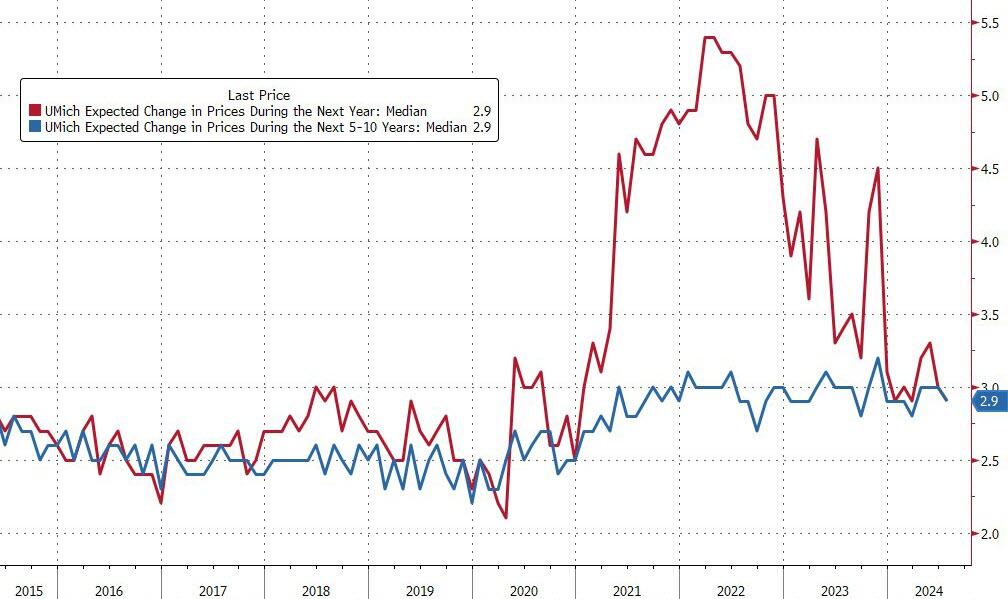
On the positive side, year-ahead inflation expectations fell for the second consecutive month, reaching 2.9%. In comparison, these expectations ranged between 2.3 to 3.0% in the two years prior to the pandemic. Long-run inflation expectations came in at 2.9%, down from 3.0% last month and remaining remarkably stable over the last three years.

Source: Bloomberg

However, these expectations remain somewhat elevated relative to the 2.2-2.6% range seen in the two years pre-pandemic.

Buying Conditions plunged across the board with home-buying attitudes crashing to record lows…

Source: Bloomberg

Democrats saw the biggest drop in sentiment…

Source: Bloomberg

…but, but , but Bidenomics?

Tyler Durden
Fri, 07/12/2024 – 10:16

Most Voters Want Biden To Step Down, Oldest Voters Least Concerned

Most Voters Want Biden To Step Down, Oldest Voters Least Concerned

Authored by Garbiella Fine via RealClearPolitics.com,

The 2024 presidential campaign is now enmeshed in skepticism about Joe Biden’s mental acuity. Some 51 million Americans watched the president go one-on-one with Donald Trump in the June 27 presidential debate, which immediately ignited questions about the president’s age and the possibility of an open Democratic convention.

The oldest president in U.S. history, Biden will turn 82 shortly after Election Day, meaning if he wins the 2024 election, he would be 86 at the end of his second term. Today’s RealClearPolitics polling average shows that 78-year-old President Donald Trump has the lead in the national head-to-head contest by 3.4 percentage points. When RealClearPolitics White House correspondent Philip Wegmann asked Press Secretary Karine Jean-Pierre last Wednesday about Biden’s debate slip-ups and whether she’s noticed any slowdowns in the president, she responded, “He is as sharp as ever.” It seems that a significant majority of voters don’t believe this is true.

In a CBS News/YouGov poll published last Monday, voters were asked whether Biden should drop out of the race and allow another Democrat to vie for the title of the party’s nominee. Most voters (64%) believe it is time for a new Democratic candidate. Of the 1,130 registered voters surveyed, only 20% of respondents under 30 believed Biden exclusively had the appropriate cognitive health to serve as president. (The younger a voter was, the more likely they were to believe neither candidate had adequate mental fitness. 37% of voters under 30 felt that neither candidate had appropriate cognition, as did 35% of voters aged 30-44 and 28% of 45-64 year-olds.) The age group least concerned with the cognition of the 2024 major party candidates are voters 65 and up, of whom only 19% believed neither candidate had appropriate cognitive health.

While only 36% of voters believe Biden should continue to run, the older a respondent was, the more likely they were to believe that Biden should remain in the race.

Sixty-eight percent of voters under 30, 66% of voters aged 30-44, 64% of voters aged 45-64, and 58% of voters 65 and older believed it was time for a new nominee.

Look at the rest of the voter age categories, and confidence in Biden’s mental acuity drops.

The age category with the least confidence in Biden’s mental acuity alone was 45-64 year-olds (16%). Voters 65 and older were the most confident in Biden, with 26% responding that only the current president was fit to serve. Voters under 30 and aged 30-44 felt about the same, with 20% of the younger demographic and 19% of the older demographic believing exclusively in Biden’s mental fitness.

An older CBS News/YouGov poll of 2,159 U.S. adults conducted between Feb. 28 and March 1 shows that the 65 and older demographic most confident in Biden’s mental fitness seems not to have been affected by Biden’s debate performance. When asked the same question about the candidates’ mental and cognitive health, 25% were confident in Biden alone. Every other age group that answered “only Joe Biden” has declined. Adults under 30 had the most significant loss of confidence, declining 13%, and voters in the 30-44 and 45-64 age ranges declined 7%.

While all voters are troubled by the president’s apparent cognitive abilities, the oldest voting demographic is the least concerned.

Despite the slight boost from the oldest voters, most agree it’s time to give a new candidate the chance to beat Trump.

[ZH: The market odds of Biden getting the nomination are back at post-debate lows and Kamala Harris is now even…]

Explanations the White House has provided for Biden’s poor performance range from a bad cold and jet lag to Trump’s behavior, or just “a bad night.” Last Friday, Biden sat with ABC’s George Stephanopoulos in an interview the Biden campaign likely hoped would restore some confidence in the president’s ability to engage in straightforward, unscripted conversation. It did little to alter the conversation. While Biden seemed more alert than he did during the debate, only 8.5 million viewers saw the interview, nowhere near the number that viewed the debate.

[ZH: And last night’s gaffe-fest presser did nothing to help improve confidence in Biden’s cognition.]

Tyler Durden
Fri, 07/12/2024 – 09:45

After Dumping $22 Billion Overnight, Is The BoJ Intervening Again In USDJPY?

After Dumping $22 Billion Overnight, Is The BoJ Intervening Again In USDJPY?

Mrs Watanabe will not be best pleased again this morning as it appears – having dumped billions of dollars into the FX markets overnight to try and maintain the momentum higher in yen – the Bank of Japan is ‘intervening’ in the currency markets.

USDJPY just puked almost two big figures after the hotter than expected PPI print…

Presumably they were hoping for a miss and planned their intervention – just like yesterday’s – to exaggerate the momentum lower in USDJPY.

Comments overnight from Japan’s top currency official, Masato Kanda, who stuck with a strategy of trying to keep market players guessing, prompted a spike lower also but that failed very fast.

He told reporters in Tokyo on Thursday night that he wasn’t in a position to say if the move was intervention.

“Our practice is basically not to say whether we have intervened or not,” he said Thursday.

“While some believe the move was a reaction to the CPI results, others say that other forces may have been at work.”

He followed up with comments early Friday, saying that given the yield gap between the US and Japan, speculation was probably behind the moves.

TV Asahi, a Japanese broadcaster, reported officials had stepped into the currency market.

Daily newspaper Mainichi Shimbun also reported an intervention, citing an unidentified Japan government official.

More problematically, according to a Bloomberg analysis of central bank accounts, the scale of intervention was probably around ¥3.5 trillion ($22 billion), based on a comparison of Bank of Japan accounts and money broker forecasts.

“Right now we are seeing two-way activity in the market but no clear directional bias,” said Ruchir Sharma, London-based global head of FX option trading at Nomura International Plc.

Sharma added that there was “palpable nervousness in the market” in recent sessions from hedge funds looking to protect carry trades for scenarios like the one that just played out.

The spike on Thursday shared similarities with this year’s previous interventions, in which the Ministry of Finance bought ¥9.8 trillion to stem losses in apparent moves on April 29 and May 1.

The yen’s Thursday rally was the biggest on a one-day basis since May 1.

Not much bang for their buck and the PPI ‘beat’ ruined the momentum this morning, with USDJPY stalling at yesterday’s lows.

“Certainly the extent of the move does suggest it could well have been intervention,” said Jane Foley, head of currency strategy at Rabobank.

“It’s quite exciting and does cause ripples on our trading desk.”

However, the lack of follow-through makes us wonder if the BoJ running out of ammo (or fortitude) to maintain any control of its currency?

Tyler Durden
Fri, 07/12/2024 – 09:31

Watch: Boeing 777 Suffers Serious Tail Strike During Takeoff At Milan 

Watch: Boeing 777 Suffers Serious Tail Strike During Takeoff At Milan 

Dramatic footage from the largest airport in northern Italy, which serves Lombardy, Piedmont, Liguria, and the Swiss canton of Ticino, captures the moment a LATAM Airlines Boeing 777-300 experienced a severe tail strike incident. 

Aviation blog AIRLIVE reports that a LATAM Boeing 777-300 departing from Milan Malpensa Airport to Sao Paulo suffered a tail strike on runway 35, left. 

“The Boeing aircraft is seen performing the rotation too early making the tail to strike the runway for 10 seconds before finally climbing,” AIRLIVE wrote. 

The leading cause of tail strikes in the aviation world is premature rotation by the pilot of an aircraft. However, an investigation needs to be conducted into this incident to see whether the incident was a human error or perhaps a mechanical one.

AIRLIVE said, “As the tower noticed the pilots, the B777 climbed to 6,000 ft before circling for about one hour. It landed back at Milan on runway 35R one hour and 9 minutes after departure.” 

Local media outlet VareseNews posted CCTV footage of the incident on YouTube, along with a caption that read (translated into English):

The accident which occurred at Malpensa at 1.32pm on Tuesday 9 July is part of a codified type of accident, called “tail strike”: it occurs when the tail of a plane touches the runway during take-off or landing. This type of accident can cause significant damage to the aircraft structure, compromising its integrity and safety. During a tail strike, the lower part of the rear fuselage, including the tail, suffers a direct impact with the ground, causing abrasions, deformations and, in more serious cases, failure of the structure.

Earlier this week, a series of aviation mishaps occurred in the US, including:

Monday: United Flight 1001, a Boeing 757-200, lost a main landing gear wheel while taking off from Los Angeles International Airport.

Monday: A Delta Connection flight nearly collided with an American Eagle flight at Syracuse Hancock International Airport

Wednesday: United Flight 1001, a Boeing 757-200, lost a main landing gear wheel while taking off from Los Angeles International Airport.

This week has yet to inspire much confidence in the aviation industry following a series of Boeing jet mishaps this year.

Tyler Durden
Fri, 07/12/2024 – 09:05

Futures Flat After Hot PPI, Mixed Bank Earnings

Futures Flat After Hot PPI, Mixed Bank Earnings

US equity futures are flat, erasing a modest earlier gain, as yesterday’s rotation continues this morning with RTY rallying +0.8% pre-mkt even as megacap tech stocks are higher (NVDA +93bp, AAPL +39bp, AMZN +19bp). As of 8:45am, S&P futures were little changed after the index fell almost 1% in the previous session.  The yield on 10-year Treasuries was unchanged at 4.21% and the USD is lower despite a PPI report that came in hotter than expected. Commodities are mixed: oil is higher, base metals are lower. Today, the key focus will be PPI (which beat across the board) and banks earnings (which were mixed).

In premarket trading, Wells Fargo sank 5% after warning it won’t be able to whittle away costs as fast as forecast amid higher-than-expected expenses. JPMorgan swung between gains and losses after reporting record profit, while missing on a few key metrics, like net interest income. Citigroup climbed 3% as equity trading beat estimates even as the lender said costs for the year are likely to be at the high end of the range previously provided. Here are some other notable premarket movers:

  • Tesla dropped 1% after UBS cut its rating on the electric-vehicle maker to sell, saying the stock has rallied “too much, too soon.”
  • Array Technologies gains 5% after Citi raised the solar tracking equipment company to buy, touting its growth potential.
  • AT&T slips 2% as the company suffered a massive hack of customer data — separate from one reported earlier this year — that included records of calls and texts for nearly all of its mobile-phone users for a six-month period in 2022.
  • Bally’s ticks 1% higher after securing a funding commitment from Gaming and Leisure Properties.
  • JPMorgan falls 1% despite investment banking revenue beating estimates. CEO Jamie Dimon said while there has been some progress, inflation and rates may stay higher than expected.

US producer prices climbed in June more than forecast as a pickup in margins at service providers more than offset declines in the cost of goods. Investors are also eager to hear from the largest banks about the state of the US economy and expectations for the rest of the year, including the potential impact of the presidential elections in November.

In Europe, the Stoxx 600 is up 0.2% – rising for a third day – led by gains in energy and consumer product shares.  Here are the biggest movers Friday:

  • Ericsson shares rise as much as 9.3% to the highest since September 2022 after the company reported stronger-than-expected sales, in part thanks to a growth revival in the key US market
  • Addtech advances as much as 13%, the most since 2021 and to a record high, with DNB seeing a “solid” 1Q report from the Swedish industrial technology group, with net sales 4% ahead
  • Lifco shares jump as much as 12% to hit a new record high after the maker of dental equipment, machinery and tools reported quarterly net sales above expectations in the second quarter
  • Norwegian Air shares rise as much as 8.2% after 2Q Ebit surpassed expectations, leading analysts to predict upgrades to consensus forecasts, with DNB describing the report as “slightly postitive”
  • Elkem shares jump as much as 11%, the most since July 2022, after the Norwegian silicon maker reported Ebitda for the second quarter that beat the average analyst estimate
  • BFF Bank jumps as much as 14% to touch a two-month high after the Italian lender reported an increase in its past due exposures and risk-weighted assets, following a credit reclassification
  • Volkswagen gains as much as 1% as Redburn raises its recommendation to neutral, saying the firm faces less exposure to any tariff escalations, with negotiations potentially dragging on
  • European shipping companies extend their slide, with Denmark’s Maersk shedding as much as 4.6%, as economic uncertainty and excess capacity concerns continued to pressure freight rates
  • Axfood falls as much as 8.8%, the most since 2022, after the Nordic retail group reported its latest earnings. DNB sees an overall week report, with its Dagab logistics unit the main drag
  • EMS-Chemie shares slump as much as 7.2%, the most since 2020, after the Swiss company cut its revenue forecast and said the challenging economy and rising costs are weighing on demand
  • Avanza shares drop as much as 6.5%, the most in three months, after the Swedish online bank and trading platform reported operating income for the second quarter that missed estimates
  • Europris falls as much as 6.1% after DNB cut its recommendation for the Norwegian retail group to hold due to soft sales trend in its key Norwegian market and for its Swedish retail chain ÖoB

Earlier, Asian stocks declined as tech shares tracked their US peers lower after slowing inflation data. Equities in Hong Kong bucked the selloff amid prospects of lower borrowing costs. The MSCI Asia Pacific Index fell as much as 1.1%, the most in over a month, with TSMC, Samsung Electronics and Tokyo Electron among the biggest laggards. Tech-heavy markets such as Taiwan, Japan and South Korea led declines in the region. Equities in mainland China fluctuated as traders rebalanced their holdings ahead of next week’s Third Plenum. Property stocks climbed amid rising expectations for more support for the sector at the meeting. Meanwhile, shares in Hong Kong rose as soft US consumer price print boosted hopes for potential interest rate-cuts in the city. Here are the most notable movers:

  • BOC Aviation shares rise as much as 5.3%, the most since April, after it closed a self-arranged club loan transaction with 25 banks globally totaling $2.3 billion.
  • CK Infrastructure shares climb as much as 7.5% in Hong Kong, the most since December 2023, as the company considers a second listing on an overseas stock exchange.
  • BayCurrent shares climb as much as 19%, the most since January 2022, after the Japanese IT services company reported first quarter operating income that beat analyst estimates and saw unit rates grow quarter-on-quarter.
  • Chalco rises as much as 10% in Hong Kong and 6.4% on the mainland after JPMorgan upgrades the stock to overweight on expectations the company will raise its full-year payout ratio after its preliminary 2Q results beat estimates.
  • Seven & I shares plunge as much as 8.4%, the most since August 2020, after the Japanese retail conglomerate reported first-quarter operating income that missed the average analyst estimates and weak performance in overseas convenience stores.
  • Fast Retailing shares decline as much as 4.1%, the most since April 12, on concerns the stock’s recent gains will increase the probability that the Nikkei will reduce the company’s weighting in its benchmark average.
  • Astro Malaysia Holdings shares plunge as much as 9.7% after the Inland Revenue Board served the company notices of additional tax assessment for 2019 to 2023.
  • Huafon Chemical shares rise as much as 8%, the most since Feb. 7, after the company said it expects to report 1H profit rose by 1.6% to 24% y/y.
  • Hanssem shares rally as much as 10% after Samsung Securities says the furniture manufacturer’s profits may get a lift from rising home sales in South Korea.
  • Xtep International shares rise to the highest since June 11 as Goldman Sachs says the company’s ‘solid’ 2Q retail revenue growth is driven by online and emerging brands sales that were ahead of target.

In FX, the yen initially weakened against the dollar, paring some of the sharp rally seen in the prior session, before resuming its trek higher. An analysis of Bank of Japan accounts suggests authorities did step into the markets to prop up the yen on Thursday. USD/JPY was flat at ~158.90. The Bloomberg Dollar Spot Index is down 0.1% and set for a third day of declines. The Swedish krona is the weakest of the G-10 currencies, falling 0.5% against the greenback after underlying inflation slowed more than expected.

In rates, treasuries edged lower, with US 10-year yields rising 1bps to 4.22%. Long-end yields are higher by ~1bp with 2s10s spread steeper by ~1bp; US 10-year around 4.225% outperforms bunds by ~4bp, gilts by ~6bp. European government bonds underperform their US peers.

In commodities, oil prices advance, with WTI rising 1% to trade near $83.50 a barrel. Spot gold falls $12 to around $2,404/oz.

Bitcoin is incrementally softer and holds just above USD 57k, after briefly dipping below the level earlier. Ethereum remains firmly above USD 3k.

Today’s economic data slate includes June PPI (8:30am, which beat across the board) and July preliminary University of Michigan sentiment (10am). No Fed members are scheduled to speak

Market Snapshot

  • S&P 500 futures little changed at 5,643.50
  • STOXX Europe 600 up 0.3% to 521.21
  • MXAP down 0.6% to 187.44
  • MXAPJ up 0.1% to 587.14
  • Nikkei down 2.4% to 41,190.68
  • Topix down 1.2% to 2,894.56
  • Hang Seng Index up 2.6% to 18,293.38
  • Shanghai Composite little changed at 2,971.30
  • Sensex up 1.0% to 80,665.58
  • Australia S&P/ASX 200 up 0.9% to 7,959.28
  • Kospi down 1.2% to 2,857.00
  • German 10Y yield rose 4bps at 2.51%
  • Euro up 0.1% to $1.0884
  • Brent Futures up 0.9% to $86.16/bbl
  • Gold spot down 0.4% to $2,406.32
  • US Dollar Index little changed at 104.37

Top Overnight News

  • US President Biden mistakenly referred to Ukrainian President Zelensky as President Putin before correcting himself during comments at the NATO summit, while he also mistakenly referred to Vice President Harris as Trump during his press conference. Furthermore, Biden said he has to finish the job because there is so much at stake and has taken three significant and intense neurological exams which say he is in good shape.
  • US President Biden is expected to face a deluge of calls from House Democrats urging him to drop out of the presidential race regardless of his performance at the NATO press conference, according to Axios. It was also reported that dozens of Democratic lawmakers are to call for US President Biden to quit the race in the coming 48 hours: CBS.
  • Three Biden officials directly involved in his re-election told NBC News that his chances of winning are zero and one said he needs to drop out, while it was also reported that some Biden advisers were discussing how to convince him to step aside: NYT.
  • The Biden campaign is quietly assessing the viability of Vice President Harris’ candidacy against Donald Trump in a new head-to-head poll: MSNBC.
  • Softbank has acquired U.K. semiconductor company Graphcore, the latest in a series of steps taken by the Japanese tech investment company in the artificial-intelligence field. The Bristol-based chip company, which specializes in AI, said that it is now a wholly-owned subsidiary of SoftBank Group and will continue to operate under the Graphcore name. WSJ
  • Fed’s Goolsbee (non-voter) said the June CPI report is excellent and the improvement on shelter inflation is profoundly encouraging, while he added this is what a path to 2% inflation looks like and as inflation falls, leaving Fed policy rate steady means Fed is tightening policy. Goolsbee said the reason to tighten policy would be if the economy is overheating but added they are not overheating, as well as noted that he doesn’t like tying their hands on policy decisions and they need to decide when to cut rates, not trying to figure out a rate path for next seven months.
  • China’s already formidable exports surged in June, China’s customs administration reported on Friday. But imports shrank, with Chinese companies and households becoming more cautious about spending money. The result was a record monthly trade surplus of just over $99 billion. NYT  
  • Despite billions of dollars in additional weapons and security assistance that NATO announced this week, allied officials said Ukraine would not be ready to launch a dramatic counteroffensive or retake large swaths of territory from Russia until next year. NYT
  • Some American officials have grown more optimistic that a deal to release Israeli hostages held in Gaza in return for a cease-fire is at hand. But people briefed on the talks say it will be days until it is clear whether a breakthrough has been achieved because of difficulties in communication between Hamas officials in Qatar and the group’s leaders in Gaza. NYT
  • Joe Biden vowed to stay in the presidential race despite new gaffes, including mixing up Volodymyr Zelenskiy and Vladimir Putin, and VP Kamala Harris and Donald Trump, during a press conference on the sidelines of the NATO summit. At least three more House Democrats, including Jim Himes, the top member from his party on the Intelligence Committee, called for Biden to drop his re-election bid. BBG
  • Big bank earnings kick off today with JPMorgan, Citi and Wells Fargo as shares trounce the broader market. Investors are looking past another projected drop in net interest income, instead focusing on investment banking and a rebound in loan profits. BBG
  • Boeing is said to have told some 737 Max customers that aircrafts due in 2025 and 2026 face additional delays. BBG
  • U.S. Republican lawmakers are seeking a probe into Microsoft’s  $1.5 billion investment in artificial intelligence firm G42, citing concerns about the transfer of advanced technology and possible ties the Abu Dhabi-based company may have with China. WSJ
  • Axel Springer is considering a break-up, w/a separation of its media assets (including Politico and Business Insider) and classifieds business. FT

A more detailed look at global markets courtesy of Newquawk

APAC stocks took their cues from the mixed performance stateside where softer-than-expected CPI data boosted Fed rate cut bets and spurred a stock rotation out of large-cap tech into small-cap cyclicals. ASX 200 gained amid lower yields with gold miners, real estate, and consumer stocks leading the advances. Nikkei 225 underperformed after recently sliding back from record highs and amid speculated FX intervention. Hang Seng and Shanghai Comp. diverged as the former rallied back above the 18,000 level with strength seen in property and tech, while the mainland was lacklustre after mixed Chinese trade data in which Exports topped forecasts but Imports surprisingly contracted.

Top Asian News

  • China’s Foreign Minister said in a phone call with his Dutch counterpart that China is willing to establish close ties with the new Dutch government and carry out all-around dialogue, as well as enhance mutual understanding. Furthermore, China believes the Dutch side will encourage the European side to look at China objectively and rationally and play a constructive role in maintaining a healthy and stable development of China-EU relations.
  • Japanese government official said Japan conducted currency intervention to prop up the yen on Thursday, according to Mainichi citing an unidentified official. It was separately reported that the BoJ likely conducted rate checks in EUR/JPY on Friday, according to Nikkei.
  • Japanese Finance Minister Suzuki said currency rates should be set by the market and rapid FX moves are undesirable, while he wouldn’t comment on FX levels, FX intervention and media reports that Japan conducted FX rate checks.
  • Japanese Chief Cabinet Secretary Hayashi said no comment on FX intervention and wouldn’t comment on forex levels, while he added it is important for currencies to move in a stable manner reflecting fundamentals and they are ready to take all possible means on forex.
  • Japanese top currency diplomat Kanda said no comment on FX intervention and noted recent yen moves are somewhat rapid, while he added they will take appropriate action on forex if needed. Furthermore, he is puzzled about the media report on intervention, while he did not comment on whether they intervened in the FX market and cannot think if government officials commented on forex intervention.
  • BoJ Survey says wage growth spreading among small and medium firms this year. Growth being driven by rising prices, hiring competition and a recovery in earnings performance.
  • Japan’s business lobby Doyukai Chief Niinami has asked the BoJ to raise rates in July, according to Nikkei.
  • Japanese gov’t is reportedly expected to slightly cut its economy growth forecast for FY24 from the current view of 1.3%, via Reuters citing sources.
  • BoJ data suggest Japan intervened in the FX market on July 11th, may have spent between JPY 3.37-3.57tln, according to Reuters; Accounts point to intervention of some JPY 3.5tln, according to Bloomberg.

European bourses, Stoxx 600 (+0.3%) are entirely in the green, continuing the price action seen in the prior session. Indices initially opened tentatively higher and continued higher as the morning progressed, though has edged off best levels in  recent trade. European sectors hold a strong positive bias; Energy takes the top spot, benefiting from underlying strength in the crude complex. The Telecoms sector has been lifted by post-earnings strength in Ericsson (+7.2%). US equity futures (ES +0.1%, NQ U/C, RTY +0.7%) are mixed with the ES and NQ taking a breather from yesterday’s hefty selling pressure; the RTY continues to advance and holds at highs, with the rotation narrative remaining firm. Bank earnings today: BNY Melon, JPMorgan, Wells Fargo, Citi. Intel (INTC) exec. says they are on track for cumulative software sales of USD 1bln by end-2027
UBS has downgraded Tesla (TSLA) to Neutral from Sell with a price target of USD 197

Top European News

  • Rio Tinto (RIO LN) studies mining megadeals after collapse of the BHP (BHP AT)-Anglo American (AAL LN) swoop; Rio is said to have held talks with bankers to ‘wargame’ a potential USD 32bln offer for Teck Resources (TECK), via Sky News. The article notes that Teck is among a “refreshed list” of potential takeover targets. One source stated that Rio is “not about to launch an imminent bid for Teck Resources, but acknowledged that it was on a list of possible targets.”

FX

  • Despite initial upside earlier in the session, USD strength has begun to wane with the DXY now flat. Should the downside continue, a test of Thursday’s low at 104.07 could be seen.
  • EUR/USD firmer on the session as the attempted recovery in the USD has begun to wane. Upside focus for EUR/USD remains on a potential breach of 1.09 after topping out bang on that level yesterday.
  • GBP firmer vs. the USD with Cable on a 1.29 handle but below yesterday’s 1.2949 high. It has been a solid week of gains for the GBP amid hawkish interjections from MPC’s Haskel, Mann and Pill as well as a solid M/M June GDP print.
  • JPY is a touch softer vs. the USD after some wild price action yesterday spurred by US CPI and suspected Japanese intervention. Since then, more volatile price action was observed overnight with the Nikkei suggesting the BoJ likely conducted rate checks in EUR/JPY.
  • Antipodeans are both firmer vs the Dollar; AUD/USD is currently extending its winning streak vs. the USD to a 9th consecutive session, albeit is currently below yesterday’s CPI-induced 0.6798 peak.
  • Soft Swedish inflation data saw EUR/SEK spike higher from 11.4240 to 11.4600. The significantly cooler than expected print serves to reinforce market expectations for an August cut.
  • PBoC set USD/CNY mid-point at 7.1315 vs exp. 7.2514 (prev. 7.1339).

Fixed Income

  • USTs are very slightly softer, in a paring of US CPI-induced strength and following a subdued 30yr auction on Thursday. Docket today includes US PPI and UoM Prelim. Currently trading around 110’30.
  • Bunds hold a bearish bias, but still remains at elevated levels sparked by the dovish US CPI report. Bunds are down to a 131.56 base where they appear to have made a bit of a floor thus far having pulled back from an overnight 131.81 peak.
  • Gilt price action is in-fitting with peers given the lack of UK-specific newsflow. Gapped lower by 26 ticks to 98.25 before slipping further to lows of 97.87; complex awaiting next week’s key wage and inflation metrics.

Commodities

  • Crude is extending on yesterday’s modest gains which were supported by a softer Dollar following the US CPI metrics, with the strength continuing in APAC hours. Brent September topped USD 86/bbl to trade in a current USD 85.45-86.35/bbl parameter.
  • Downbeat trade across all precious metals following yesterday’s US CPI-induced surge, with underperformance this morning seen in spot silver and palladium whilst spot gold posts shallower losses ahead of US PPI. Spot gold is subdued in a current USD 2,400.14-2,416.26/oz band.
  • Mixed trade across base metals with copper bucking the trend this morning following yesterday’s slide despite the constructive US data for the metal.

Geopolitics

  • “Israeli warplanes breach the sound barrier over areas north of Beirut (capital of Lebanon)”, according to Sky News Arabia
  • US President Biden said NATO confirms support for Ukraine and will not allow Russia to achieve victory.
  • NATO Secretary General Stoltenberg said Ukraine can count on NATO now and for the long haul, while he added that Chinese exercises with Belarusian forces are part of a pattern and confirms authoritarian regimes are aligning more.
  • German Chancellor Scholz said more needs to be done to ramp up air defences for Ukraine, while he added their defence industry needs to be capable of expanding production capacities swiftly.
  • South Korea and the US signed a guideline on nuclear deterrence and operation in the Korean Peninsula, according to the South Korean Presidential Office.
  • “Israel says it was bombed in southern Syria in response to a projectile fired from the Golan”, via Al Arabiya..

US Event Calendar

  • 08:30: June PPI Final Demand MoM, est. 0.1%, prior -0.2%
    • June PPI Final Demand YoY, est. 2.3%, prior 2.2%
    • June PPI Ex Food and Energy YoY, est. 2.5%, prior 2.3%
    • June PPI Ex Food and Energy MoM, est. 0.2%, prior 0%
  • 10:00: July U. of Mich. Current Conditions, est. 66.0, prior 65.9
    • July U. of Mich. Sentiment, est. 68.5, prior 68.2
    • July U. of Mich. Expectations, est. 69.3, prior 69.6
    • July U. of Mich. 1 Yr Inflation, est. 2.9%, prior 3.0%
    • July U. of Mich. 5-10 Yr Inflation, est. 3.0%, prior 3.0%

DB’s Jim Reid concludes the overnight wrap

Markets got another boost yesterday, as the latest US CPI print surprised on the downside once again, which led to growing hopes that inflation was finally being tamed. Of course, it’s worth remembering that one report doesn’t make a trend, but recent months have brought some of the weakest inflation numbers since the current surge began in 2021, and it’s led to growing expectations that the Fed will finally be able to start cutting rates in the months ahead. In fact, investors are now fully pricing in a rate cut by the September meeting, and yesterday saw the 2yr Treasury yield (-10.6bps) post its biggest daily decline since January. Equities also put in a strong session for the most part, and the small-cap Russell 2000 (+3.57%) had its best daily performance of 2024 so far. That said, one very notable exception were the Magnificent 7 (-4.26%), which put in their worst performance since October 2022, and their concentration meant that the S&P 500 (-0.88%) ended its run of 7 consecutive daily gains, even though nearly 80% of the index’s members were actually higher on the day.

In terms of the details of that CPI report, headline CPI for June actually fell by -0.1% on the month (vs. +0.1% expected), which was the biggest outright decline in prices since May 2020 during the Covid-19 pandemic. Other details in the report were also very promising, as core CPI came in at just +0.1% (vs. +0.2% expected), which is the weakest month for core inflation since January 2021. The declines were driven by several factors, but there was a meaningful step lower in shelter inflation, with Owners’ Equivalent Rent up just +0.28% in June, which was its weakest month since April 2021, and down from +0.43% in May. Bear in mind that the OER category alone makes up more than a quarter of the CPI basket, and around a third of core CPI, so if that shift lower is durable, then that’s very good news in terms of keeping inflation low.

Markets were also reassured that the latest print followed a series of softer inflation numbers in Q2, raising hopes that it wasn’t simply one good month. In fact, on a 3-month annualised basis, core CPI is up just +2.1% now, which is the lowest since March 2021. To be fair, the 6-month core CPI is still at +3.3%, which reflects the stronger prints from Q1, but that’s also on a downward trajectory, and similar prints to the last two would cement the idea that inflation is on a clear path lower. On the back of the print, our US economists have lowered their 2024 core CPI forecast by three tenths to 3.0% (on Q4/Q4 basis). See their full reaction note here.

With that inflation report in hand, there was immediate speculation that the Fed might accelerate the timing of their rate cuts and announce a first cut as soon as the September meeting. For instance, f utures are now fully pricing in a move by September, whereas beforehand it was only fully priced in by November. Likewise for the year as a whole, there were growing expectations that the Fed would deliver multiple rate cuts, with 61bps of cuts now priced in by the December meeting at the close, up from 51bps the previous day. When it came to Fed officials themselves, Chicago Fed President Goolsbee said that the latest data was “excellent”, and that his view “is this is what the path to 2% looks like”.

As investors priced in more rate cuts, the US Dollar index weakened -0.58%, and US Treasuries rallied strongly, with both the 2yr and 10yr yields falling to their lowest level since March. Specifically, the 2yr yield (-10.6bps) was down to 4.51%, in its biggest daily decline since January, and the 10yr yield (-7.4bps) was down to 4.21%. Treasuries did give up some of their initial post-CPI gains late on however, with the 10yr yield having traded as low 4.165% intra-day. And overnight, the 10yr yield (+1.0bps) has moved a bit higher to 4.22%. There were similar moves in Europe, with yields on 10yr bunds (-7.0bps), OATs (-6.3bps) and BTPs (-7.0bps) all falling as well.

For equities though, there was a much more divergent performance in the US, with small-caps surging whilst the Magnificent 7 slumped. That meant the small-cap Russell 2000 (+3.57%) had its best daily performance since December, rising to its highest level since March 2022. By contrast, the Magnificent 7 (-4.26%) had its worst performance since October 2022. Ultimately though, that meant the S&P 500 (-0.88%) fell back by a sizeable amount, even though more than three-quarters of the index’s members actually rose on the day. The equal-weighted S&P 500 (+1.17%) posted a strong advance, with the largest daily performance gap versus the main market cap-weighted index since 2020. Rate-sensitive sectors including real estate (+2.66%) and utilities (+1.83%) outperformed within the S&P 500. Meanwhile in Europe, there were more consistent gains, with advances for the STOXX 600 (+0.60%), the DAX (+0.69%) and the CAC 40 (+0.71%).

Speaking of Europe, there were some strong growth numbers from the UK yesterday, where monthly GDP was up by +0.4% in May (vs. +0.2% expected). The monthly GDP numbers can be a bit choppy, but if you look at the full three months leading up to May, the economy was +0.9% bigger than the previous three months, which is the fastest growth since January 2022. In turn, that meant that gilts underperformed, with the 10yr yield only down -5.2bps, and the weakness in the dollar also helped sterling reach its strongest level against the dollar in almost a year, at $1.2911. Staying on the UK, Luke Templeman and Galina Pozdnyakova published a piece yesterday on the country’s new listing rules, which you can read here.

Overnight in Asia, equity markets have lost ground across the region, with losses for the Nikkei (-2.23%), the KOSPI (-1.31%), the Shanghai Comp (-0.21%) and the CSI 300 (-0.20%). The main exception to that is the Hang Seng, which has surged +1.98% this morning. For the Nikkei, those losses have come amidst a sharp appreciation in the Japanese Yen, which strengthened by +1.79% yesterday against the US Dollar, reaching 158.83. In part that was down to the weakness of the dollar after the CPI print, but there was speculation about whether there’d been an intervention, and Japan’s current chief Masato Kanda said he was “not in a position” to comment on whether Japan had intervened. Looking forward, US equity futures haven’t seen much movement this morning, with those on the S&P 500 unchanged, and those on the NASDAQ 100 down -0.14%.

When it came to yesterday’s other data, the US weekly initial jobless claims for the week ending July 6 came in at a 6-week low of 222k (vs. 235k expected). Moreover, the continuing claims fell to 1.852m (vs. 1.860m expected) over the week ending June 29, which ends a run of 9 consecutive weekly gains.

To the day ahead now, and data releases include the US PPI reading or June, along with the University of Michigan’s preliminary consumer sentiment index for July. We’ll also get earnings releases from JPMorgan Chase, Citigroup, Wells Fargo and BNY Mellon.


Tyler Durden
Fri, 07/12/2024 – 09:02

These Are The Eight US States With Population Declines In 2023

These Are The Eight US States With Population Declines In 2023

Between 2022 and 2023, the U.S. added approximately 1.58 million people, or grew its population by about 0.5%. However, not all states grew by the same proportion.

In fact, some states saw their number of residents drop, both from net population loss (deaths outnumbering births) and from net migration (emigrants outnumbering immigrants).

Visual Capitalist’s Palla vi Rao visualizes the U.S. states with population declines between July 1, 2022 and July 1, 2023, along with the percentage change.

Data is sourced from Census Bureau estimates, released May 2024.

Ranked: Population Changes in U.S. States

A demographic reshuffling is taking place across the U.S., with states in the Northeast and the West seeing shrinking populations.

Below are the changes for all U.S. states, Washington D.C., and Puerto Rico, ranked from declines to gains in ascending order.

U.S. State 2023 Population Population Change
(2022–23)
% Population
Change (2022–23)
New York 19,571,216 -101,984 -0.52%
California 38,965,193 -75,423 -0.19%
Illinois 12,549,689 -32,826 -0.26%
Puerto Rico* 3,205,691 -14,422 -0.45%
Louisiana 4,573,749 -14,274 -0.31%
Pennsylvania 12,961,683 -10,408 -0.08%
Oregon 4,233,358 -6,021 -0.14%
Hawaii 1,435,138 -4,261 -0.30%
West Virginia 1,770,071 -3,964 -0.22%
Alaska 733,406 +130 +0.02%
Vermont 647,464 +354 +0.05%
Mississippi 2,939,690 +762 +0.03%
New Mexico 2,114,371 +895 +0.04%
Rhode Island 1,095,962 +2,120 +0.19%
Wyoming 584,057 +2,428 +0.42%
New Hampshire 1,402,054 +3,051 +0.22%
Kansas 2,940,546 +3,830 +0.13%
Michigan 10,037,261 +3,980 +0.04%
North Dakota 783,926 +5,014 +0.64%
Maine 1,395,722 +6,384 +0.46%
Iowa 3,207,004 +7,311 +0.23%
District of Columbia** 678,972 +8,023 +1.20%
Connecticut 3,617,176 +8,470 +0.23%
South Dakota 919,318 +9,449 +1.04%
Montana 1,132,812 +9,934 +0.88%
Nebraska 1,978,379 +10,319 +0.52%
Delaware 1,031,890 +12,431 +1.22%
Kentucky 4,526,154 +14,591 +0.32%
Maryland 6,180,253 +16,272 +0.26%
Nevada 3,194,176 +16,755 +0.53%
Massachusetts 7,001,399 +18,659 +0.27%
Missouri 6,196,156 +18,988 +0.31%
Wisconsin 5,910,955 +20,412 +0.35%
Arkansas 3,067,732 +21,328 +0.70%
Minnesota 5,737,915 +23,615 +0.41%
Idaho 1,964,726 +25,730 +1.33%
Ohio 11,785,935 +26,238 +0.22%
Washington 7,812,880 +28,403 +0.36%
Indiana 6,862,199 +29,925 +0.44%
New Jersey 9,290,841 +30,024 +0.32%
Oklahoma 4,053,824 +34,553 +0.86%
Alabama 5,108,468 +34,565 +0.68%
Utah 3,417,734 +36,498 +1.08%
Colorado 5,877,610 +36,571 +0.63%
Virginia 8,715,698 +36,599 +0.42%
Arizona 7,431,344 +65,660 +0.89%
Tennessee 7,126,489 +77,513 +1.10%
South Carolina 5,373,555 +90,600 +1.71%
Georgia 11,029,227 +116,077 +1.06%
North Carolina 10,835,491 +139,526 +1.30%
Florida 22,610,726 +365,205 +1.64%
Texas 30,503,301 +473,453 +1.58%

Note: *Territory. **Federal district.

New York’s population shrank by approximately 102,000 people in 2023 compared to 2022. Most of that drop occurred in New York City, where the net population fell by 77,000 people. This is more than the amount by which California’s population shrank (75,000 people).

In conjunction with the Northeast and Western states’ declines, Southern states (Texas, Florida, and North Carolina to name a few) saw gains in the same period. In fact, Texas added nearly half a million people, a 1.5% gain, or three times the national average.

These patterns could indicate ongoing interstate migration. For example, between 2020 and 2021, more than 100,000 Californians moved to Texas. A 2021 New York Times analysis found that Texas in particular is teeming with jobs and good schools alongside a low crime rate. As a result it has become a preferred destination for those looking to maintain their quality of life for lower costs, compared to New York City and California.

Tyler Durden
Fri, 07/12/2024 – 06:55