Nasdaq Pukes To Worst Day Versus Small Caps In 22 Years, Gold Soars Near Record High After Soft CPI
Misses across the board today in CPI left US macro surprise data languishing in ‘not so soft landing’ territory…
Source: Bloomberg
…as inflation and growth factors have are now tumbling in a ‘recession-y’ kinda way…
Source: Bloomberg
…all of which prompted a surge in rate-cut hopes, with 2024 expectations at their highest since April (61bps) as 2025 is now pricing in four full rate-cuts…
Source: Bloomberg
Which sent gold higher, the dollar lower and Treasury yields plunging (led by the short-end)…
Source: Bloomberg
… BUT the picture was very different in equity market land…
Source: Bloomberg
…where Nasdaq was monkeyhammered while Small Caps surged. The Dow clung to unchanged as the S&P ended off around 1% weighed down by Tech obviously…
That RTY/NDX spread was over 600bps at its peak today. By the close it was the biggest relative outperformance of the Russell 2000 over Nasdaq 100 since 2002…
Source: Bloomberg
…and oddly, breadth was crazy positive despite the ugliness as the reverse MAG7 trade struck hard…
388 members of the S&P currently trading up on the day vs 111 in the red (top 5 breadth day of the year).
TSLA tumbled on robotaxi-delays talk…
NVDA stalled at its previous record close and dropped over 5%…
However, as Goldman’s traders noted, as big as today’s moves are, they hardly register on long-term charts…
Source: Bloomberg
But, the NDX/RTY pair does remain at a key support level for now…
Source: Bloomberg
Finally, before we leave stocks, volumes on Goldman’s trading desk were tracking higher +27% vs the 20dma and index trading leading the way w/ ETF’s capturing 31% of the overall tape.
Both LOs and HFs much better for sale.
LO supply concentrated in mainly Tech + Hcare, vs buying Discretionary names and macro products.
HF’s sellers of every sector expect Indust. and Cons Discretionary (covers) with supply most concentrated across Tech.
There was plenty of activity in other asset classes too…
The dollar was clubbed like a baby seal on the dovishness back to pre-June Payrolls lows…
Source: Bloomberg
..helped lower by alleged BOJ intervention to strengthen the yen…
Source: Bloomberg
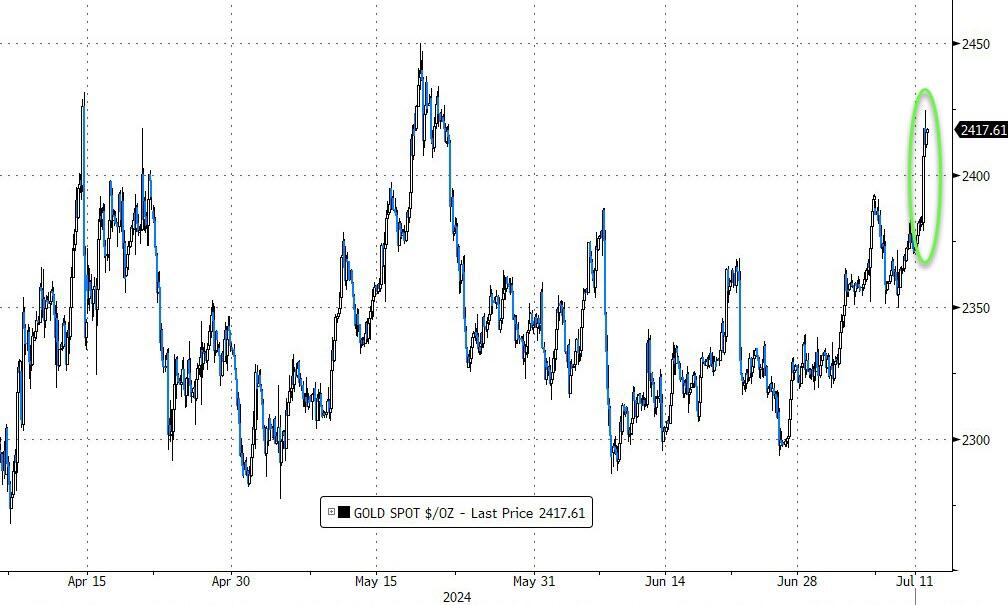
Gold soared back near record highs with spot prices topping $2400 once again…
Source: Bloomberg
Crude prices managed gains too with WTI back up to $83…
Source: Bloomberg
And Powell and Biden better hope that oil prices (and thus gas prices) start coming down soon or today’s CPI may be overwhelmed…
Source: Bloomberg
Still if you think you had a turbulent day, give a thought for President Biden who is now behind none other than Kamala Harris in the betting for who will get the Democratic Party nod…
US Spent A Record $140 Billion On Debt Interest In June, 30% Of All Tax Revenues
On the surface, and following 4 months of triple-digit deficits (in the billions), the June budget deficit of “only” $66 billion was a pleasant surprise (especially when the market expected an $83 billion deficit, and compares favorably to the $228 billion deficit a year ago). Indeed, the deficit was small enough it managed to shrink the cumulative YTD deficit ($1.268 trillion), below the deficit for the comparable period one year ago ($1.393 trillion).
Unfortunately, that’s as good as it gets, because when one takes a step back and ignores the monthly calendar effects, the picture remains the same: the US is spending far more than it is generating in tax revenues.
And it only goes downhill from there, because as we have noted previously, the biggest risk factor is not so much spending on such discretionary items as social security, health and national defense (“how dare you say these are discretionary! these are mandatory, untouchable outlays” some will scream, but if and when the taxes dry up and the dollar loses its reserve status you will see just how discretionary they are), but on interest, and here recall what we said back in April: “interest on US debt – currently the second biggest government outlay at $1.1 trillion – will surpass social security and become the single biggest US expense before the end of 2024 at $1.6 trillion.”…
Now that rate cuts are off the table, interest on US debt – currently the second biggest government outlay at $1.1 trillion – will surpass social security and become the single biggest US expense before the end of 2024 at $1.6 trillion. pic.twitter.com/OQYjHhOks9
So where are we now? Well, according to the latest Treasury Monthly Statement, in June the US spent a gross $140 billion on debt interest, bringing the YTD total to $868 billion and is on pace to hit $1.144 trillion for the full year.
This is a big number. How big? Well, as the chart below shows, this was the single biggest monthly interest outlay on record!
And putting it in context, the $140 billion in gross interest spending was just over 30% of all US receipts (mostly taxes) in June..
… a staggering number fast approaching the threshold where everyone will be forced to admit the US has crossed into a Minsky moment.
Imagine an institution whose ratchet was set to relentlessly reduce budget, staffing and processes while focusing on increasing output / results.
It’s tempting to personalize our problems, as those in power tend to possess all the traits that qualify one for immediate delivery to Devil’s Island as a danger to humanity. Rather than focus on bad people in power, let’s consider the good people working in institutions and agencies, of whom there are many, trying their best to keep the status quo glued together.
The problem they face is systemic and structural: there are no self-correcting mechanisms in American institutions other than running out of money, which rarely happens as money can be printed or borrowed in whatever quantities are needed to bail out the institutions that are the social technology / social infrastructure of our economy and society.
In systems / evolutionary terms, there has never been any need to develop corrective feedback, self-correcting mechanisms, triage protocols or any other institutionalized “muscle memory” responses to sclerosis and dysfunction or to the existential threats posed by multiple mutually-reinforcing crises (i.e. polycrisis) because no recession in the past 78 years has ever lasted more than a few quarters and so the money has always continued flowing in ever greater quantities once the spot of bother passes.
The sole institutional response to failure is to replace the big boss, on the theory that a new “supreme leader” will be able to fix the mess with managerial experience, financial acumen and inspirational leadership.
If the institution lacks the structures–feedback loops, self-correction, the means to radically transform the entire institution as needed–then this is akin to dropping someone in a desert and tasking them to create the Garden of Eden. It cannot be done because the needed tools and resources are not available.
The institutional tools don’t exist because all that the employees have ever experienced is The Ratchet Effect: like a mechanical ratchet that only allows a cable to move in one direction, institutions only have the mechanisms to expand: higher budgets, more staff, more meetings, more regulations, more compliance reporting, all of which define the staff’s conception of work and the purpose of the institution.
The output and results are secondary to the demands of process, which continually expand: the task of the staff is fulfilling the processes that define “work”: attend meetings, fill out compliance reports, enter the data, pass it on to the next department, etc. Whether the mission of the institution is actually being fulfilled is lost in the tyranny of process, the assumption being that if everybody fulfills their job description then the organization’s mission would automatically be fulfilled.
Ironically, the processes that are supposed to fulfill the organization’s mission end up being the substitution for the mission: there’s no meaningful feedback on the goal or purpose, there is only feedback on completing processes. All accountability is for completing processes, not for results.
Did the university’s education actually prepare the graduate for a successful career and life, or was it little more than a rubber stamp? The answer is nobody knows because the feedback required to make that assessment–brutally honest, stripped of sugarcoating–doesn’t exist.
Meanwhile, the threshold for organizational collapse keeps ratcheting closer to the breaking point. As budgets, staffing and processes bloat, actual results falter, causing the leadership to demand more staffing and budget to “fix the problem.” The actual, unaddressed problem is the organization’s faulty structure of Ratchet Effect expansion as the “solution” to every manifestation of failure.
lacking any institutionalized requirement to perform triage, to prioritize the mission over process, the organization stumbles off the cliff once budgets are cut. Since there has never been any pressing need for triage, ruthless prioritization, slashing make-work in favor of real-world, measurable results, and the imposition of accountability on every employee not for compliance but for results, the organization never evolved these capabilities. The only capability the organization evolved was to ceaselessly expand.
Imagine an institution whose ratchet was set to relentlessly reduce budget, staffing and processes while focusing on increasing output / results. Imagine an institutional structure that focused solely on feedback of results rather than processes. Imagine an institutional structure that demanded constant triage to weed out needless regulations and processes, who left processes open to those accountable for results, a structure that enabled managers to radically re-order the structure on the fly to better serve the mission.
Imagine an institution capable of instantiating the Pareto Principle, of slashing the budget by 20% while increasing output, or even more radically, cutting the staff by 80% while increasing results. This is of course “impossible” until the money runs out or loses its purchasing power. Then there is no other option but triage and a radical re-conception of organizational structures, missions and results.
Management guru Peter Drucker foresaw the obsolescence and replacement of institutions we consider permanent. He understood that ultimately, every organization, from a sole proprietorship to a sprawling agency employing thousands, is an enterprise that doesn’t have profits / results, it only has costs.
Our social technology has ossified while our consumer technology overloads our daily lives with shadow work once performed by public and private organizations. Squeezed between corporate monopolies stripmining us with addictive technologies and crapified goods and services (planned obsolescence run amok) because there is no real competition left, and sclerotic institutions that respond to failure by expanding, we need a radical reversal of the Ratchet Effect. Nothing less will matter.
Biden Camp Thinks Obama Working ‘Behind The Scenes’ Orchestrating Calls To Drop Out
The Biden campaign thinks former President Barack Obama is working behind the scenes to orchestrate calls for President Biden to quit the 2024 race, The Hill reports.
“One thing that we do have to underline here — just so viewers can follow what’s going on behind the scenes — is the Biden campaign and many Democratic officials do believe that Barack Obama is quietly working behind the scenes to orchestrate this,” said MSNBC host Joe Scarborough during a Thursday broadcast, adding that Biden is “deeply resentful of his treatment under not only the Obama staff but also the way he was pushed aside for Hillary Clinton” in 2016.
Co-host Mika Brzezinski chimed in – adding “I think Barack Obama has a lot of influence, and there’s a lot there.“
Watch:
BREAKING: MSNBC’s Joe Scarborough:
“What’s going on behind the scenes is the Biden campaign and many Democratic officials do believe that Barack Obama is quietly working behind the scenes to orchestrate this.”
The report comes amid a growing contingent of top Democrats and left-leaning news outlets publicly calling for Biden to exit the race following last month’s disastrous debate performance against Donald Trump.
On Wednesday, actor George Clooney – an ally of both Biden and Obama – published an op-ed in the NY Times calling for Biden to step aside. According to the report, Clooney and Obama discussed the op-ed beforehand.
As we noted earlier on Thursday, Democrats are now ‘quietly testing’ VP Kamala Harris’ viability against Trump, while Biden advisers are ‘discussing how to convince him to step aside.’
The Biden campaign, meanwhile, continues to dig in.
In a Thursday memo to campaign staff, Biden campaign chair Jennifer O’Malley Dillon and campaign manager Julie Chavez Rodriguez wrote: “In addition to what we believe is a clear pathway ahead for us, there is also no indication that anyone else would outperform the president vs. Trump,” adding “Hypothetical polling of alternative nominees will always be unreliable, and surveys do not take into account the negative media environment that any Democratic nominee will encounter. The only Democratic candidate for whom this is already baked in is President Biden.”
Scaramucci Gates 70% Of Investors In His SkyBridge Crypto Fund
Despite solid performance in recent months by SkyBridge Capital’s crypto-focused hedge fund, investors in Anthony Scaramucci’s investing vehicle are rushing to cash out: investors who own about 70% of the fund’s shares have asked for their money back in the latest redemption period that ended in March, Bloomberg reported citing a regulatory filing. The fund, which returns money through a tender offer, bought back just 7% of those shares while gating the remaining redemption requests, effectively barring clients from exiting even though returns have jumped.
Scaramucci, 60, declined to comment to Bloomberg, but he previously said the fund lets him limit redemptions and that he’s “operating inside the ambit of the prospectus.”
This isn’t the first time SkyBridge has gated its investors: the fund began limiting withdrawals two years ago amid the so-called crypto winter, when the fund posted large losses and investors sought to flee. In retrospect, good thing it did because bitcoin is about 3 times higher than where it was back then, preventing SkyBridge’s investors from booking huge losses.
The recent burst of redemption requests is more confusing, considering the fund’s recent outperformance. Bitcoin soared roughly 150% in the 12 months ended March 31, and the SkyBridge fund gained 46.4%. Yet many clients want the Mooch to stop holding their cash captive.
According to Bloomberg, Morgan Stanley’s private wealth clients account for about 70% of the fund’s $1.6 billion, and the bank has been trying to get them out for more than a year, according to Bloomberg sources.
Hedge funds usually only curb redemptions, also known as gating, when they’re holding hard-to-sell investments and redemptions would disadvantage remaining investors. Others curb redemptions amid poor performance as a way to hold onto capital. SkyBridge Co-CIO Brett Messing gated investors at his earlier fund, GPS Partners, after it dropped almost 15% in January 2008. Back then, fewer than a fifth of its clients asked to pull their money.
Despite recent outperformance, including a 26% jump in the first quarter, SkyBridge has barely erased previous losses. In the five years ended March 31, it posted annualized returns of less than 1%. The firm managed a total of about $2 billion as of year-end, down from a $9 billion peak in 2015.
Scaramucci is perhaps best known for being Donald Trump’s communications director for 11 days in July 2017 until he was fired after an expletive-filled interview with the New Yorker. Scaramucci also founded the SkyBridge Alternatives hedge fund conference, known as SALT.
SkyBridge was previously known for being a Fund of Funds, and investing in other hedge fund managers such as Steve Cohen, Dan Loeb and Izzy Englander. While it still has some of these investments, it began pivoting to crypto beginning in 2020.
At the end of the first quarter, the fund had 57% of cryptocurrency and digital assets, 21% in multistrategy funds, 7% in equity funds and 15% in structured credit funds, according to a filing.
Kamala Rising: Biden Campaign Tests Harris’ Viability, As Longtime Aides Discuss Convincing Biden To Step Aside
Two massive headlines just hit concerning the state of the Democratic party, both from the NY Times, suggesting they’re actively trying to take the keys away from Joe Biden, and fast.
First: The Biden campaign is ‘quietly testing’ Vice President Kamala Harris’ viability against Donald Trump in a head-to-head survey of voters.
The survey, which is being conducted this week and was commissioned by the Biden campaign’s analytics team, is believed to be the first time since the debate that Mr. Biden’s aides have sought to measure how the vice president would fare at the top of the ticket. It was described by three people who are informed about it and insisted on anonymity because of the sensitive nature of the information. They did not specify why the survey was being conducted or what the campaign planned to do with the results.
Second: Biden advisers are ‘Discussing how to convince him to step aside.’
A small group of Mr. Biden’s advisers in the administration and the Biden campaign — at least two of whom have told allies that they do not believe he should keep trying to run for a second term — have said they would have to convince the president of three things.
They said they have to make the case to the president, who remains convinced of the strength of his campaign, that he cannot win against former President Donald J. Trump. They have to persuade him to believe that another candidate, like Vice President Kamala Harris, could beat Mr. Trump. And they have to assure Mr. Biden that, should he step aside, the process to choose another candidate would be orderly and not devolve into chaos within the Democratic Party.
Needless to say – Kamala just blew past Biden‘s odds of nomination, and winning the election in November:
Pepsi Warns US Snack Demand “Subdued” As Consumer Slowdown Worsens
PepsiCo reported weaker-than-expected revenue growth in the second quarter on Thursday as consumers dialed back snack spending. The junk food giant tempered its full-year outlook on a more challenged consumer. This reflects a broader consumer slowdown trend, particularly impacting working-poor households amid elevated inflation and high interest rates.
CEO Ramon Laguarta wrote in a filing that the company’s North American snack demand was “subdued” during the second quarter and noted sales volumes declined.
On a call with investors, Laguarta said customers across all income brackets are reducing snack spend and trading down to store brands.
“In the US, there is clearly a consumer that is that is more challenged,” the CEO said. This suggests the cumulative impact of several years of price hike has pushed consumers over the edge.
The maker of Lay’s chips and Gatorade reported organic revenue of 1.9% in the second quarter, missing the 2.9% average estimate of analysts tracked by Bloomberg.
The volume of food products sold in the quarter fell 2% from a year earlier, including sizeable drops in Frito-Lay and Quaker Foods businesses in the North American market.
Here’s a snapshot of the second quarter results (courtesy of Bloomberg):
Core EPS $2.28 vs. $2.09 y/y, estimate $2.15 (Bloomberg Consensus)
Net revenue $22.50 billion, +0.8% y/y, estimate $22.59 billion
Revenue by region in the quarter:
Frito-Lay North America revenue $5.87 billion, -0.5% y/y, estimate $5.94 billion
Quaker Foods North America revenue $561 million, -18% y/y, estimate $588.2 million
PepsiCo Beverages North America revenue $6.81 billion vs. $6.76 billion y/y, estimate $6.86 billion
Europe revenue $3.52 billion, +2.5% y/y, estimate $3.47 billion
Latin America revenue $3.05 billion, +6.6% y/y, estimate $3.08 billion
Africa, Middle East & South Asia revenue $1.59 billion, +1.5% y/y, estimate $1.55 billion
Asia Pacific, Australia, New Zealand & China revenue $1.10 billion, -2.1% y/y, estimate $1.1 billion
Organic revenue growth by region:
Organic revenue growth +1.9%, estimate +2.89%
Quaker Foods North America organic revenue -18%, estimate -14.1%
PepsiCo Beverages N. America organic revenue change +1%, estimate +1.61%
Latin America organic revenue +2%, estimate +7.04%
Europe organic revenue +7%, estimate +7.77%
Asia Pacific, Australia and New Zealand and China Region organic revenue +1% vs. +7% y/y, estimate +3.14%
Africa, Middle East and South Asia organic revenue +12%, estimate +6.28%
Food volumes:
Total convenient foods volume -2%
Frito-Lay North America volume -4%
Quaker Foods North America volume -17%
Latin America convenient foods volume -6%
Europe convenient foods volume +5%
Africa, Middle East and South Asia convenient foods volume +1%
Asia Pacific, Australia and New Zealand and China region convenient foods volume -1%
Beverages:
PepsiCo Beverages North America volume -3%
Latin America beverages volume +2%
Europe beverages volume +1%
Africa, Middle East and South Asia beverages volume +2%
Asia Pacific, Australia and New Zealand and China Region beverages volume +1%
EPS $2.23 vs. $1.99 y/y, estimate $2.14
For the full-year outlook, forecasts were tempered. Execs now expect organic revenue growth of around 4% for the year compared with “at least 4%” in previous forecasts.
Sees organic revenue +4%, saw at least +4%, estimate +3.91%
Still sees core EPS at least $8.15, estimate $8.16
Shares of PepsiCo dropped as much as 3.4% but have since clawed back some losses. Prices earlier were at the lowest intraday level since October. The stock has fallen 4% year-to-date.
For a more in-depth analysis of PepsiCo’s earnings, Bonnie Herzog from Goldman offers her take:
PEP delivered mixed Q2 results, with softer than expected organic revenue growth that was more than offset by strong gross margin expansion, leading to a nice EPS beat. Given the slightly softer than expected topline, mgmt updated its FY24 organic sales growth guidance range to ~4% (vs prior of at least 4%) – which we believe was broadly anticipated based on conversations with investors ahead of the print, and should be viewed as more realistic given the tough first half. Mgmt’s updated guidance implies a step up in 2H organic sales growth to ~5.5% (vs ~2.5% in 1H), although the y/y compares in 2H are easier (particularly on vols) – which gives us confidence that this should be doable especially considering mgmt’s initiatives to reaccelerate growth. Overall, we expect the stock to trade down modestly today, but are optimistic that trends should improve in the back half – and therefore maintain our Buy rating.
Meanwhile, Bernstein analysts told clients that these results signify an “abrupt end to the strong period of growth enjoyed during the Covid-19 era.”
Here’s what other Wall Street analysts are saying about the second-quarter earnings (courtesy of Bloomberg):
JPMorgan (neutral)
“While the setup into the print was negative and investors we spoke seemed to be expecting a weak top line, the organic sales growth performance came in worse than anticipated in key regions, in particular in FLNA and Latin America,” analyst Andrea Teixeira writes
Lowered organic sales annual guidance now seems “doable,” as year-over-year comparisons ease, but Teixeira thinks investors will remain concerned with volume declines in key divisions
“We are confident in PEP’s ability to meet the EPS number with ample productivity opportunities across the P&L, but we believe the key driver for the stock (and Staples as whole) is volume growth which remains challenging,” she adds
Bernstein (market perform)
2Q report and slightly lowered annual guidance organic growth target are unlikely to be the “clearing event that long-term shareholders were looking for,” and worries of further cuts probably persist throught 3Q, writes analyst Callum Elliott
Expects some questions about “need to right-size” some of the pricing (adjust prices lower) given recent trade-down to private label and market share losses for Frito
Separately, Goldman’s Natasha de la Grense provided clients this AM additional color on the mounting pressures impacting consumers:
We hosted a “subprime consumer” field trip in the US earlier this week, including meetings with FICO, Dollar General, QuickChek and Circle K. The key takeaways are that credit card delinquency rates are rising (now above long-run averages) with a decline in average FICO scores across the past year due to the subprime category (lower income). Companies called out accelerating trade down from national brands to private label, increased pomo activity and stable traffic trends at discount store. The risk from here is that a slowing labor market would disproportionately weigh on spending for lower income households.
A number of mega corps have been warning about the consumer slowdown, earlier this week, shares of consumer products company Helen of Troy crashed after missing earnings expectations and slashed its full-year outlook on “softer consumer demand” and “shifts in consumer spending.”
We’ve detailed for months about the onset of a consumer slowdown:
With today’s deflationary June CPI print, mounting economic uncertainties are leading rate traders to bet that the first interest rate cuts could occur as early as September.
Tech companies are once again colluding with Democrats to push disinformation and censor legitimate conservative opinions, this time with the imprimatur of legitimacy conferred by the U.S. Supreme Court that allows them to do so more shamelessly and aggressively than ever.
Today’s censorship is being made possible by the letters A, C and B—as in Justice Amy Coney Barrett.
While the court’s two other centrists, Justice Brett Kavanaugh and Chief Justice John Roberts, are equally culpable (along with its leftist bloc) in allowing the atrocity that is Murthy v. Missouri, it was Barrett’s name on the majority opinion.
And, indeed, her support for the wrong side in several of the court’s other recent landmark cases has raised serious red flags.
Pundit Mark Levin speculated recently that Barrrett has already gone the way of Harry Blackmun and David Souter—two Republican-appointed justices who had, by the end of their terms, become some of its most unabashedly left-leaning, likely due to what is sometimes dubbed the “Greenhouse effect” in honor of a former New York Times reporter fond of haranguing the court’s conservatives.
“I’m telling you that Barrett has decided she’s a politician, not a Justice,” Levin noted on a recent podcast, according to Newsweek. By the end of her term, the 52-year-old justice “will have flipped all the way to the left,” he added.
As I pointed out a while ago, Amy Coney Barrett is flipping
The media now owns Amy Coney Barrett. She’s the latest in a long line of formerly conservative justice nominees who is smitten with media adulation. It’ll get worse.https://t.co/k266uA1nDc
With Democrats in Congress and the media exerting immense pressure on conservative justices like Clarence Thomas and Samuel Alito, perhaps Barrett, the court’s youngest jurist—who replaced liberal icon Ruth Bader Ginsberg—remains in survival mode, opting to pick her battles carefully.
But in the process, she is throwing essential civil liberties, such as First Amendment free-speech rights, under the bus and severely undermining the safeguards that help preserve America’s democratic institutions.
CHILLING IMPLICATIONS
Barrett’s maverick streak made no difference in the recent Fischer and Trump rulings—which sided in favor of conservatives by, respectively, tossing the Justice Department’s overreach on Jan. 6 “obstruction” cases and forcing the D.C. district court to adjudicate whether former President Donald Trump’s 2020 election challenges qualify for presidential immunity.
However, the Murthy decision—which found the court’s “wet noodle” wing delivering a win for Big Tech and the Deep State by deciding that the plaintiffs lacked sufficient standing after years of alarming anti-conservative censorship and government collusion on social-media platforms—will continue to have chilling implications for free speech until the right case comes along to overturn it.
It effectively gave sites like Google (and YouTube), Facebook (and Instagram), LinkedIn and countless other leftist dominated tech companies carte blanche to continue the sort of egregious suppression of views that many noted in the lead-up to the 2020 election, with Hunter Biden’s laptop becoming the most ignominious example.
In addition to the laptop, the case dealt with the aggressive suppression of COVID skepticism—much of which has borne out as valid, but which continues to be mischaracterized due to the stigma attached by government-backed propaganda that was designed to clear the paths for Big Pharma’s mRNA “vaccines” to get their emergency approval from the Food and Drug Administration.
Then there are the questions surrounding the irregularities in the 2020 election—questions that have fueled ongoing suspicions of massive vote fraud and a stolen election, since all of the major public and private institutions colluded to prevent any sort of meaningful presentation of evidence.
‘AN IN-KIND CONTRIBUTION FROM BIG TECH’
The silencing of this pivotal component in democracy emboldened the Biden administration to continue pushing lie after lie, culminating in President Joe Biden’s recent debate performance, when the house of cards came tumbling down.
But luckily for the gaslighting leftist establishment, SCOTUS had come to its rescue just days before.
A three-word post from Biden’s personal account on Tuesday made clear that Democrats are fully aware of the Murthy decision’s implications and have every intention of leveraging them to their fullest advantage.
Even as the main storyline dominating the news cycle continues to be Biden’s own mental and physical decline, and the existential crisis within his party over whether to replace him or double-down on laying cover for his obvious infirmities, Democrat operatives are hoping to use an otherwise mundane collection of whitepapers from a conservative think-tank as a boogeyman to redirect mainstream media attention toward a shiny new object.
Anybody who heeded the president’s call to “Google” the Heritage Foundation’s Project 2025 would receive little, if any, substantive information regarding the policies themselves; nor would they learn that its experts developed the proposals independent of—and, indeed, to some extent, in spite of—Trump’s ongoing role as the de-facto party leader.
The main objective of the initiative was to offer expert analysis and research that was “candidate agnostic,” in the words of Project 2025 director Paul Dans.
However, Biden’s campaign appears to have launched and promoted its own fake Project 2025 website—an alarmingly brazen tactic, especially coming from the party that has so frequently panic-mongered about the spread of disinformation interfering with the electoral process.
Meanwhile, the top search results for Google—and other engines, such as Yahoo and Duck Duck Go—are laden with Democrat talking points from sources like Media Matters and the Marc Elias-backed blog “Democracy Docket.”
While Headline USA’s own story debunking some of these lies was prominently featured over the weekend on ZeroHedge, garnering more than 133,000 views, there is no trace of any conservative media coverage of Project 2025 several pages deep into the search engines.
Google was sure to rig the search results to propaganda attacks.
Search engines like Google are not the only ones likely to relish in their newfound freedom to censor dissenting or disagreeable viewpoints with impunity.
Social-media users can expect platforms traditionally hostile to conservative views to begin ratcheting up those efforts yet again, likely under duress from the federal intelligence apparatus.
LinkedIn, founded by notorious lawfare financier Reid Hoffman, has long been suspected of being one of the worst offenders.
Because the site is oriented toward professional networking, it is understandable that it might have some tightly enforced community standards not found on other sites. Unfortunately, those standards are inconsistently applied and often have appeared to target conservative viewpoints.
And we have the receipts to prove it.
On Tuesday night, this editor responded to a post from Michael Cohen, the former Trump lawyer turned antagonist and key witness in his Manhattan porn-star trial.
Cohen notably referred to former Trump Administration Attorney General William Barr as the “POS [piece of s**t] Attorney General #BillBarr.”
The response simply pointed out the irony over the fact that Trump and his supporters likely shared Cohen’s disdain for Barr, who ultimately revealed himself to be just as disloyal to the president as Cohen.
But unlike Cohen’s original post, the response was promptly flagged as “hate speech” by LinkedIn’s automatic artificial-intelligence thoughtcrime scanners.
Although I filed a report on Cohen’s comment, that appears to have gone unaddressed, apart from hiding it from my personal feed.
The complaint over the censorship double-standard has now been escalated to a higher level of LinkedIn’s customer service team and is pending response.
In addition to having any negative marks cleared from my account (which I have long suspected may be causing posts to be suppressed), I demanded a formal apology from LinkedIn and an acknowledgment that its enforcement of its standards were inconsistent and possibly politically motivated.
A PATTERN OF CENSORSHIP
On at least two other occasions I have been suspended for spurious reasons, one of which, in May 2023 appeared to be linked to a post I made about the John Durham report, although LinkedIn subsequently claimed I had used mild profanity in a separate post earlier that day.
Another suspension last fall stemmed from criticism of a British Hamas apologist—purportedly a professor at Cambridge University—whose intellectual acumen I questioned.
In response to the May 2023 censorship incident, Rep. Dan Bishop, R-N.C.—a member of the House weaponization subcommittee who is currently running for attorney general of North Carolina—said that House Republicans’ efforts to hold social-media companies accountable had been slow but steady.
“Although I am not satisfied with the pace, the staff has a broad swath of subpoenas outstanding to social media operators, INCLUDING LinkedIn,” Bishop told me at the time.
It is unclear how the recent Murthy decision may have impacted legislative efforts to conduct oversight and hold bad actors accountable under statutes such as Section 230 of the Communications Decency Act.
A separate Supreme Court case in the recent session shot down efforts by Florida and Texas to enact their own anti-censorship laws, remanding them back to the lower courts.
It is possible that by gaining control of the White House and Congress, Republicans could enact legislation to hold companies accountable at the federal level. But doing so requires that they first win elections—and the Big Tech censorship industrial complex will be hell bent, once again, on preventing that.
Vision Pro’s Success Hinges On Cheaper Version As Consumers Balk At $3,500 Price Tag
Apple’s augmented reality headset, the Vision Pro, costs $3,499 and was released earlier this year during a period of elevated consumer stress, which has only worsened by the month. There have been notable signs of mounting demand woes for the overpriced headset, and new estimates forecast dismal sales until a cheaper version debuts next year.
Bloomberg cites new estimates from market tracker IDC indicating Vision Pro sales have not cracked the 100,000 units per quarter mark since its release in February. IDC said the mixed-reality headset faces a 75% plunge in domestic sales this quarter.
While Apple CEO Tim Cook has said, “The enthusiasm for Apple Vision Pro has been extraordinary,” Ming-Chi Kuo, an Apple analyst at TF International Securities, reported in April that Vision Pro production has been reduced to adapt to sliding demand.
Le Xuan Chiew, a Canalys analyst, said, “The Vision Pro’s move to international markets is ahead of industry expectations and appears to be an attempt to drive sales amid lower-than-expected demand due to its niche use case and hefty price tag.”
In late June, Vision Pro debuted across several international markets, including China, Hong Kong, Japan, and Singapore. The headsets will become available in Europe and Australia on Friday.
“The unimpressive start has spurred a rethink among Apple’s management, with the company planning a more budget-friendly version of the device,” according to Bloomberg.
Francisco Jeronimo, vice president at IDC, said headset sales are expected to double next year after a cheaper version arrives.
Recall our notes pointing out that no one wants overpriced Vision Pro:
What a flop for the world’s most valuable company. The Silicon Valley execs actually thought they could sell goofy augmented reality headsets for thousands of dollars while failed Bidenomics crushed the vast majority of America’s middle class.
And all the hype now is that Wall Street analysts believe consumers will be more compelled than ever to upgrade to the new iPhone 16 because of AI features. These corporate and Wall Street elites are not rooted in reality of inflation crushing working poor households.
As I wrote then, there are a number of negative catalysts still just waiting to play out for markets: numerous potential wars, a fiscal situation in the U.S. that is completely untenable (listen to this interview with James Lavish and read this report from Mark Spiegel to understand) and uncertainties with the 2024 election.
Long story short, the entire world is begging, pleading, hoping and setting all of their models around the idea of a Fed rate cut being the savior for markets this year.
But we shouldn’t be so sure that’ll be the case.
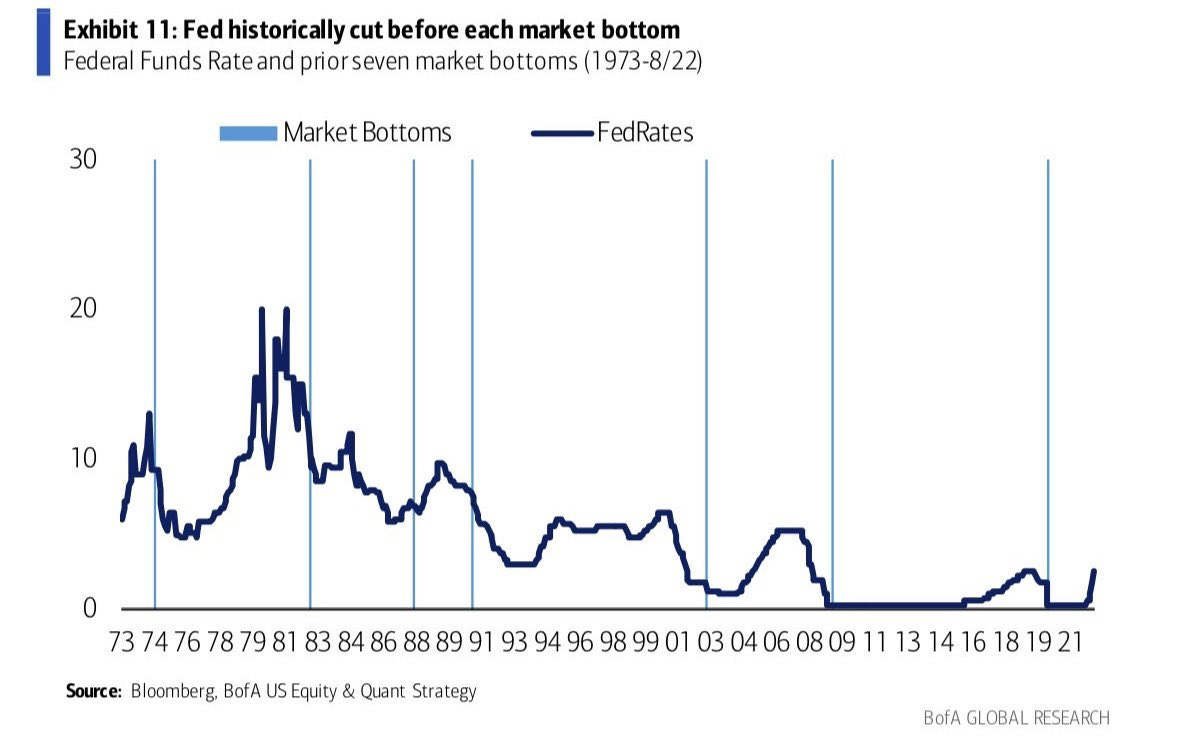
Rate cuts don’t mean the market is going to rip higher. In fact, if history is any guide, they mean just the opposite.
So while the market is anticipating rate cuts and the economic data that could portend a Fed pause or cuts as positives, they really could instead be the alarm that indicates the market could be setting up for a marked move lower.
As you can see in the charts above and below, market bottoms generally follow Fed rate cuts. Cuts usually come just after hikes have made their way through the economy and are set to manifest in the economy (this usually takes 18 months to 24 months, something I wish I had been clearer about when I took my bearish stance on markets 18 months ago, only to be proven very wrong thus far).
But don’t let rate cuts be the only signal that the market could be ready to tank. The macroeconomic data behind the scenes continues to pile up like a wreck on a highway. With the Fed in QE mode, bad news is still looked at as good news.
But with the Fed engaged in quantitative tightening, make no mistake about it, bad news is simply just bad news. Want some proof?
🔥 Zero Hedge readers take 50% off a Fringe Finance annual subscription for life by using this link: ZH50
Regional banking and commercial real estate are showing major cracks, consumers are completely tapped out as reflected in retail companies’ recent earnings, and unemployment is now ticking higher to 4.1%, the highest it’s been since November 2021, this past week.
Per the NY Fed, in 2024, more people are maxing out their credit cards compared to 2023. The New York Fed’s latest report shows household debt increased by $184 billion in the first quarter of 2024, with credit card balances dropping by $14 billion, typical for the period. However, credit card delinquency is rising, with 18% of borrowers using at least 90% of their credit limit, indicating a higher rate of maxed-out cards.
Here’s the coming cycle in a nutshell, even if we cut rates.
Debt delinquencies indicate borrowers are unable to meet their obligations. Most immediately, financial institutions that have issued these debts may experience liquidity constraints, as their expected flow of income is interrupted. In an environment of rising delinquencies, it’s natural for lenders to become more cautious, tightening lending criteria or increasing interest rates to offset the higher risk. This might not only inhibit entrepreneurship but also decrease consumer spending, as both individuals and businesses find it harder to obtain credit.
When consumers spend less, businesses see reduced revenue and profits, making them less attractive investments. Lower earnings can then lead to a decline in stock prices (via multiples or fundamentals or both).
And so yes, there will be a time between when the Fed decides to pause and cut rates.
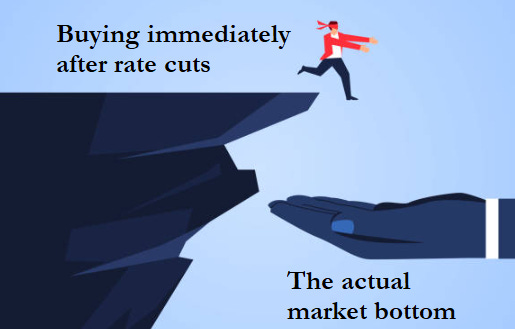
But if history is any indicator, stocks will tank, not go up. It’s only in the quarters or years following this move that the market may find its bottom. That’s why rate cuts should not necessarily be looked at as an immediate signal to buy stocks, in my opinion.
As they say in London, mind the gap between rate cuts and a market bottom.
QTR’s Disclaimer:Please read my full legal disclaimer on my About page here. This post represents my opinions only.In addition, please understand I am an idiot and often get things wrong and lose money. I may own or transact in any names mentioned in this piece at any time without warning. Contributor posts and aggregated posts have been hand selected by me, have not been fact checked and are the opinions of their authors. They are either submitted to QTR by their author, reprinted under a Creative Commons license with my best effort to uphold what the license asks, or with the permission of the author. This is not a recommendation to buy or sell any stocks or securities, just my opinions. I often lose money on positions I trade/invest in. I may add any name mentioned in this article and sell any name mentioned in this piece at any time, without further warning. None of this is a solicitation to buy or sell securities. These positions can change immediately as soon as I publish this, with or without notice. You are on your own. Do not make decisions based on my blog. I exist on the fringe. The publisher does not guarantee the accuracy or completeness of the information provided in this page. These are not the opinions of any of my employers, partners, or associates. I did my best to be honest about my disclosures but can’t guarantee I am right; I write these posts after a couple beers sometimes. I edit after my posts are published because I’m impatient and lazy, so if you see a typo, check back in a half hour. Also, I just straight up get shit wrong a lot. I mention it twice because it’s that important.